JXSOL

DNOOO blank theme is active for local preview.

Solar Street Light Suppliers for Nigeria Compared by Off-Grid Specs and Import Readiness

Nigeria's Off-Grid Reality Changes the Supplier Filter

Grid unreliability, ambient temperatures that regularly exceed 35°C, a rainy season that can run five to six months in the south, and a port clearance process that punishes incomplete documentation — these four factors together mean that a solar street light quote that looks competitive on paper can become a warranty problem or a customs delay before the first unit is installed.

Local suppliers solve real problems. If you need 20 units for an emergency replacement on a municipal contract, a Lagos-based distributor who can deliver next week is the right call. If your project requires on-site installation, commissioning, and a local service contact, a Nigerian project installer is worth the premium. Speed, familiar communication, and local accountability are genuine advantages that factory-direct sourcing cannot replicate for urgent or installation-heavy work.

But when you are comparing quotes for a 500-unit distributor order, a tender batch, or a repeat container import, the filter changes. Battery chemistry, autonomy-day sizing for your specific region, IP rating verification, pre-shipment inspection records, and SONCAP-ready documentation become the criteria that separate a reliable supplier from a cheap quote that costs more over three years.

This article maps 10 verified solar street light suppliers active in or serving the Nigerian market, grouped by supplier model and buyer fit. The comparison logic is: off-grid spec strength, import readiness, and reorder reliability — not a trophy ranking.

A cheap quote is incomplete until you know the battery chemistry, the autonomy days sized for your location, the IP rating test record, the inspection process, and the document set that will clear Nigerian customs.

The 10 Verified Suppliers, Grouped by Control and Buyer Fit

These 10 companies were verified through their official websites. Descriptions stay conservative where detail certainty is limited — no invented capacities, certifications, or lead-time claims for external companies.

Nigeria-Based Local Suppliers and Installers

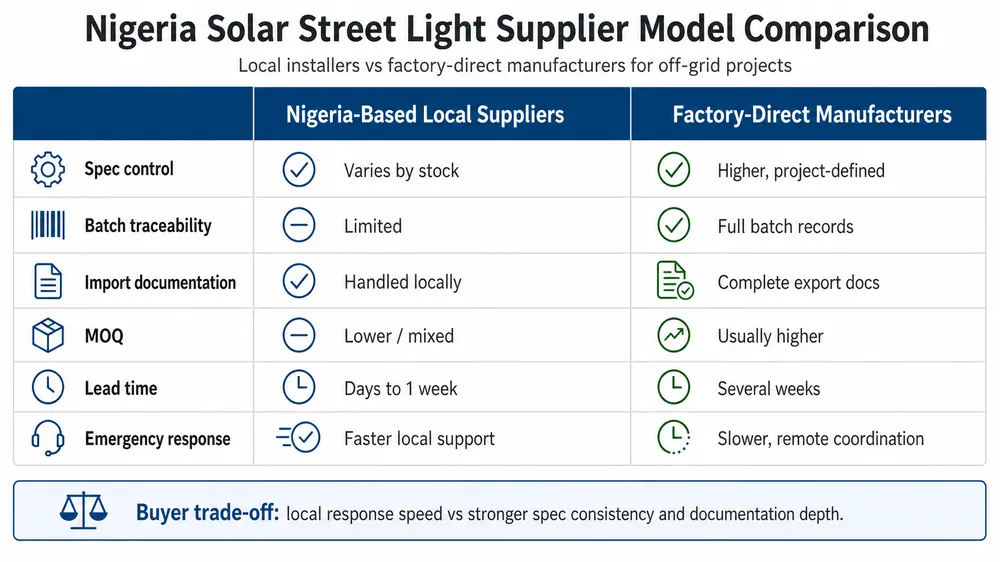
Six of the ten are Nigeria-based, ranging from product distributors to full project installers. Their shared advantage is local presence: faster emergency supply, site response, and familiar communication. Their shared limitation is that factory-level spec control, batch traceability, and import documentation are harder to verify from the buyer's side.

Company Supplier Model Best-Fit Buyer Situation What to Verify Before Ordering Import/Spec Risk to Watch
D.O Green Solar Energy Ltd (solarstreetlight.company) Nigeria-based all-in-one solar street light supplier Local distributor orders, emergency supply, small municipal projects Battery chemistry and capacity, autonomy-day sizing basis, warranty claim process Spec sheet may not tie to a specific factory or batch
J & W Solar Nigeria Ltd (jwsolar.co) Nigeria-based solar engineering installer Installation-heavy projects requiring local site support and commissioning Product source factory, battery test records, IP rating documentation Installation-focused; product spec control depends on upstream supplier
JRB Solar (jrbsolar.com) Nigeria-based project installer and supplier Municipal and public infrastructure projects with local execution requirements Factory origin of supplied units, certificate traceability per model Project track record visible; product-level batch inspection less clear
Meldon Energy Solutions (meldonenergysolutions.com) Nigeria-based manufacturer and installer Buyers wanting local design-to-installation capability In-house manufacturing scope vs. assembled/sourced components, test records Manufacturing claims should be verified against actual production capability
Ensky Solar Nigeria (enskysolarng.com) Nigeria-based solar product supplier Local product supply, Lagos-area distribution Battery spec and chemistry, IP rating test basis, autonomy-day calculation method Product range visible; factory-level traceability unclear
PSC Solar UK / PSC Industries (pscsolaruk.com) Solar integrator with Nigeria presence Buyers needing a supplier with both UK/international and Nigerian market reach Nigeria-specific stock availability, product certificate origin, lead time from UK vs. local Multi-market positioning; verify which entity and stock location applies to your order

Factory-Direct and Global Manufacturers

Four of the ten are factory-direct manufacturers supplying Nigeria through direct import. Their advantage is spec control, batch consistency, and documentation depth. Their limitation is lead time — a factory order takes weeks, not days, and requires import coordination.

Company Supplier Model Best-Fit Buyer Situation What to Verify Before Ordering Import/Spec Risk to Watch
Inlux Solar (inluxsolar.com) Factory-direct solar street light manufacturer OEM/ODM buyers, project tender supply, repeat import orders Battery chemistry, autonomy-day sizing support, CE/IP test records per model Verify that certificate applies to the exact model and configuration ordered
HRLUX Solar (hrluxsolar.com) China-based outdoor lighting manufacturer Africa-market importers, distributor reorders Africa-specific product range, battery spec for tropical heat, pre-shipment inspection policy Confirm IP rating test records and battery aging test documentation
Gillson Lights (gillsonlights.com) Factory-direct commercial solar street lighting manufacturer Municipal and commercial-scale buyers, global project supply Commercial-grade spec documentation, batch traceability, inspection records Verify autonomy-day sizing support for Nigerian irradiance zones
JXSOL (jxsolarlight.com) Factory-direct solar lighting manufacturer, Zhongshan, China Repeat-volume importers, distributors piloting a SKU, quality-critical tenders See Section 7 for full factory profile 100% pre-shipment inspection; documentation package supports SONCAP clearance
Supplier model comparison matrix for solar street light buyers in Nigeria showing local installers versus factory-direct manufacturers

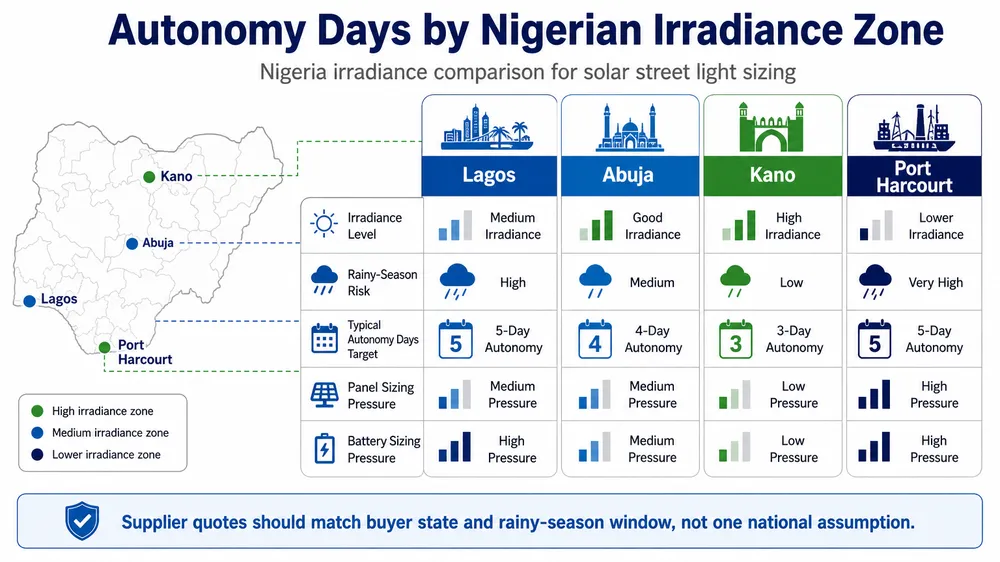
Autonomy Days by Nigerian Irradiance Zone

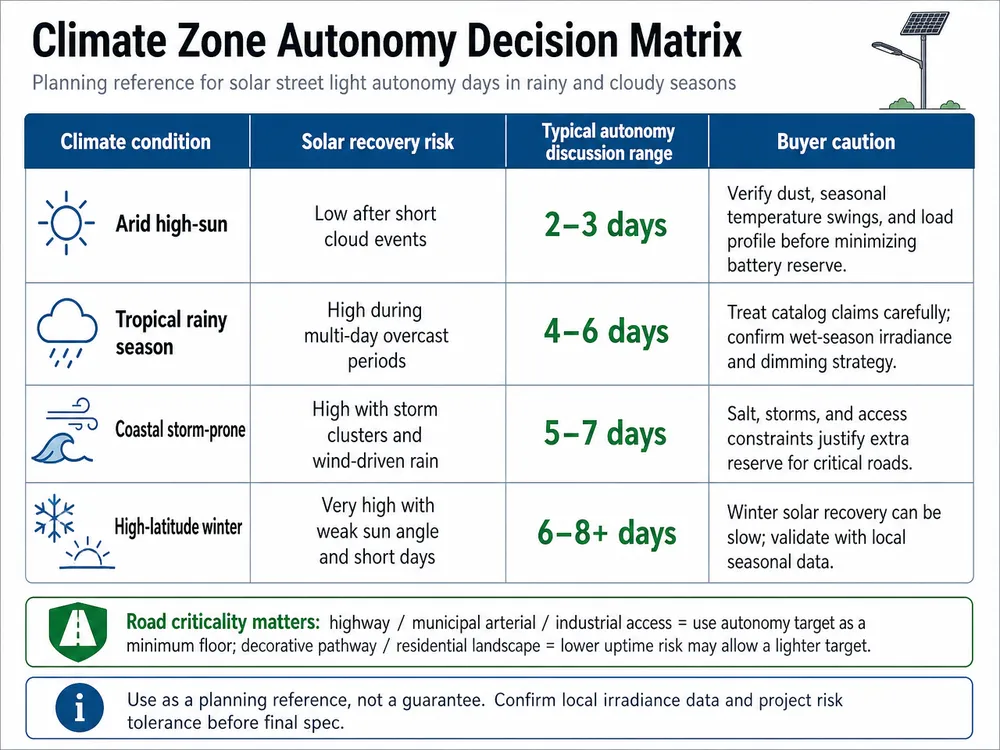
One national "Nigeria spec" is too loose to be useful. A solar street light sized for Kano's dry-season irradiance will underperform in Port Harcourt's rainy season. The difference is not marginal — it changes battery capacity, panel wattage, landed cost per unit, and carton weight.

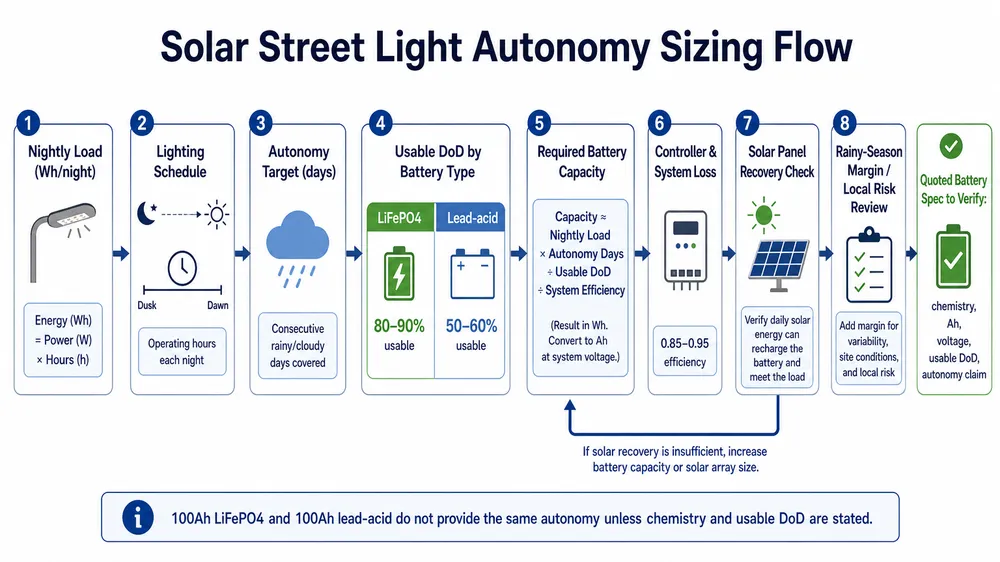
Nigeria spans roughly 4°N to 14°N latitude. The north receives stronger and more consistent solar irradiance year-round. The south — Lagos, Port Harcourt — faces a longer rainy season with more consecutive low-irradiance days. That rainy-season window is the design constraint. A system that cannot sustain rated output through five consecutive overcast days in Lagos will generate warranty claims and replacement orders.

(We size every Nigeria project quote against the buyer's specific state and rainy-season window — not a single national assumption. It takes one extra question at the RFQ stage and prevents a first-year failure.)

Location Solar Resource Pattern Rainy-Season Risk Autonomy-Day Implication Battery/Panel Sizing Note
Kano High irradiance, long dry season, short rainy window (Jun–Sep) Lower consecutive low-irradiance days 3–4 autonomy days typically sufficient Smaller battery pack viable; panel wattage can be moderate
Abuja Moderate-high irradiance, transitional zone Medium rainy-season risk (Apr–Oct) 4 autonomy days recommended baseline Mid-spec battery; verify rainy-season depth for project location
Lagos Moderate irradiance, long rainy season (Apr–Oct, peak Jun–Jul) Higher consecutive overcast days 5 autonomy days recommended for reliable operation Larger battery pack; higher panel wattage to recover charge faster
Port Harcourt Lower average irradiance, longest rainy season (Mar–Nov) Highest consecutive low-irradiance risk 5–6 autonomy days for critical applications Largest battery requirement; panel sizing must account for reduced daily harvest

The jump from 3-day to 5-day autonomy adds battery capacity, increases carton weight, and raises landed cost per unit. A supplier who quotes a single spec for all of Nigeria is either not sizing for your location or is padding the battery to cover the gap — both outcomes affect your margin.

For a detailed breakdown of how autonomy days are calculated against real irradiance data, see solar street light autonomy days. For all-in-one unit configurations and how panel and battery are integrated, all-in-one solar street light specifications covers the spec decisions in detail.

Nigeria irradiance comparison chart showing how Lagos and Kano affect solar street light autonomy days

SONCAP, Product Certificates, and the Import Paper Trail

Import readiness is a supplier capability, not a paperwork afterthought. A container that arrives at Apapa or Tin Can Island without the correct document set can sit for weeks while certificates are corrected — and the cost of that delay lands on the importer, not the factory.

The Standards Organisation of Nigeria (SON) administers the SONCAP (Standards Organisation of Nigeria Conformity Assessment Programme) for regulated products entering Nigeria. As of March 31, 2026, SON has mandated migration of SONCAP and import permit processes to the National Single Window (NSW) platform. Buyers and their clearing agents should confirm that their supplier's documentation workflow is aligned with the NSW process before shipment.

The document set to request from any supplier before paying a deposit:

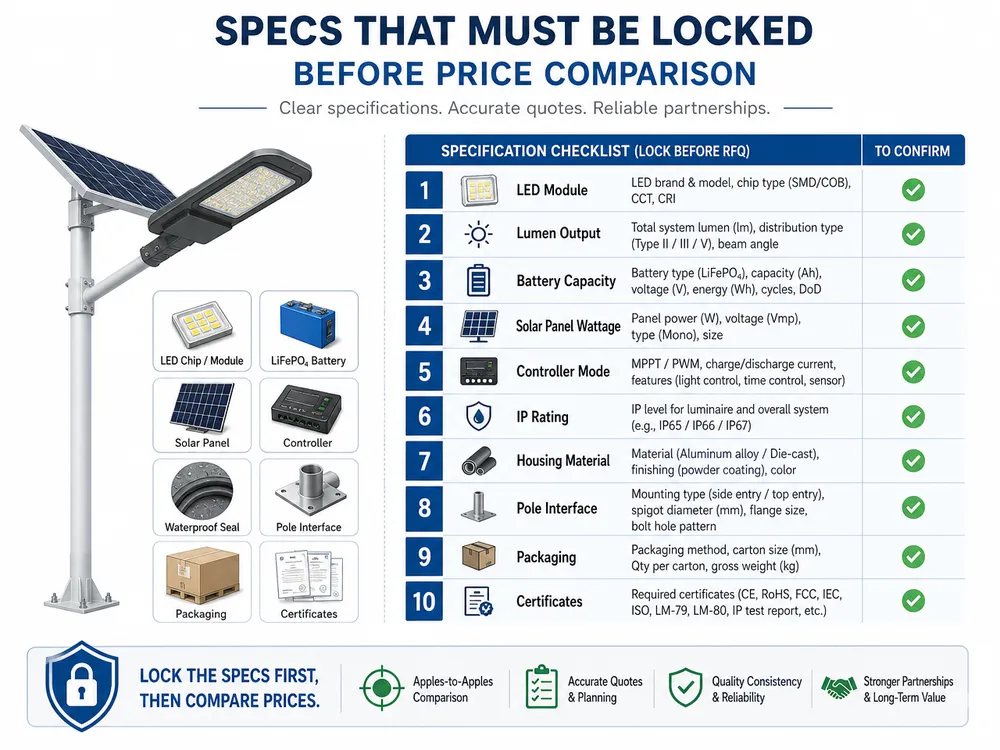
  • Product model specification sheet — must match the exact model being shipped, not a generic catalog page
  • Commercial invoice and packing list — with model numbers, quantities, unit weights, and carton dimensions that match the physical shipment
  • CE and RoHS test reports — tied to the specific model, not a blanket certificate covering a product family
  • IP rating test documentation — IP65 or IP67 test record per model, not a self-declared label
  • Product Certificate and SONCAP/Shipment Certificate — issued through an accredited conformity assessment body; confirm the model is covered
  • Form M and PAAR coordination — your clearing agent handles these, but the supplier's invoice and packing list must be accurate for the Form M to clear without amendment
  • Batch traceability records — serial number ranges or production batch codes that link the shipped units to inspection records

NAFDAC is not the primary approval path for standard solar street lights. It applies to food, drugs, cosmetics, and related regulated products. Mentioning NAFDAC to a solar street light supplier is a signal that the buyer may be working from incomplete compliance guidance — a credible supplier will clarify this without being asked.

A supplier who cannot produce model-specific CE and IP test reports, or who offers a generic certificate that covers a broad product family rather than the exact configuration ordered, is a documentation risk. Port delays caused by certificate mismatches are common and entirely avoidable.

LiFePO4 vs. Lead-Acid in Nigeria's Heat

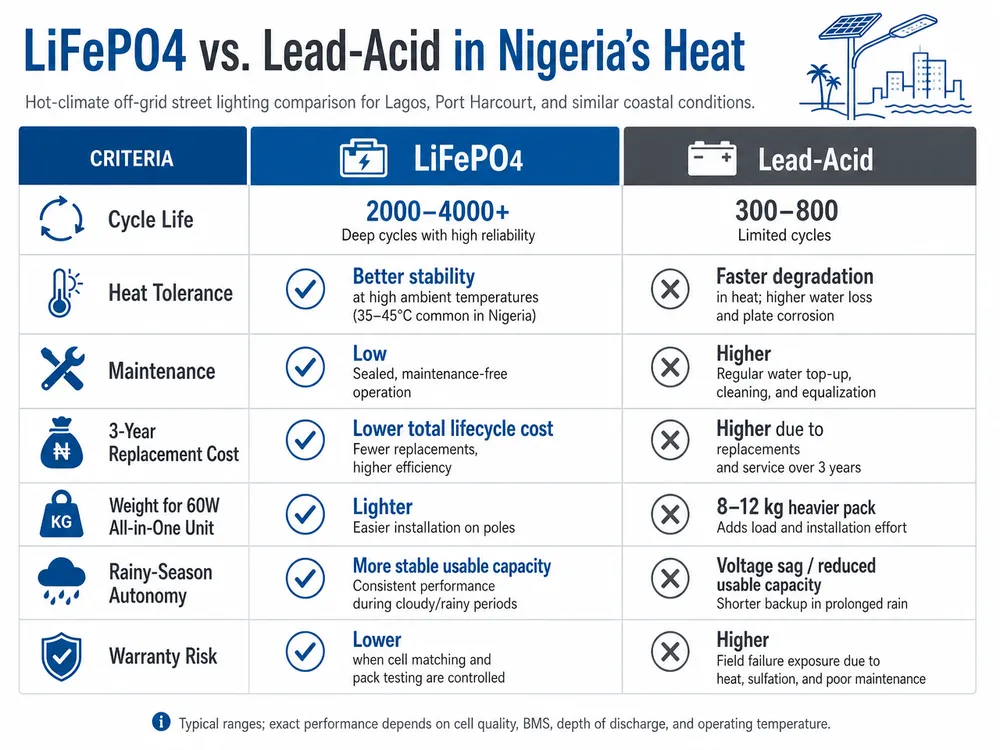
Battery chemistry is the highest-impact commercial decision in a solar street light order for Nigeria. The wrong chemistry does not fail immediately — it degrades over 12 to 24 months, then generates replacement orders, warranty disputes, and reputational damage for the distributor or contractor who specified it.

Battery Chemistry Heat Behavior Cycle-Life Implication Maintenance/Replacement Risk Best-Fit Buyer Scenario
LiFePO4 Stable thermal performance up to ~60°C; minimal capacity loss at sustained high ambient temps 2,000–3,000+ cycles at 80% depth of discharge; multi-year service life under Nigerian conditions Low maintenance; no electrolyte topping; sealed unit Repeat-volume importers, rural deployments, quality-critical tenders, buyers who cannot service units in the field
Lead-Acid (VRLA/GEL) Accelerated capacity loss above 35°C; heat shortens effective cycle life significantly 300–500 cycles under real-world tropical conditions; effective service life often 12–18 months in Nigeria Higher replacement frequency; weight penalty increases freight cost Short-term or pilot projects where first cost is the primary constraint and replacement logistics are manageable

Lead-acid looks cheaper in the first quote. Over a three-year project horizon in Lagos or Port Harcourt, the replacement cycle and service cost typically reverse that advantage. The weight difference also matters at scale: a lead-acid battery pack for a 60W all-in-one unit can weigh 8–12 kg more than an equivalent LiFePO4 pack, which adds freight cost per container.

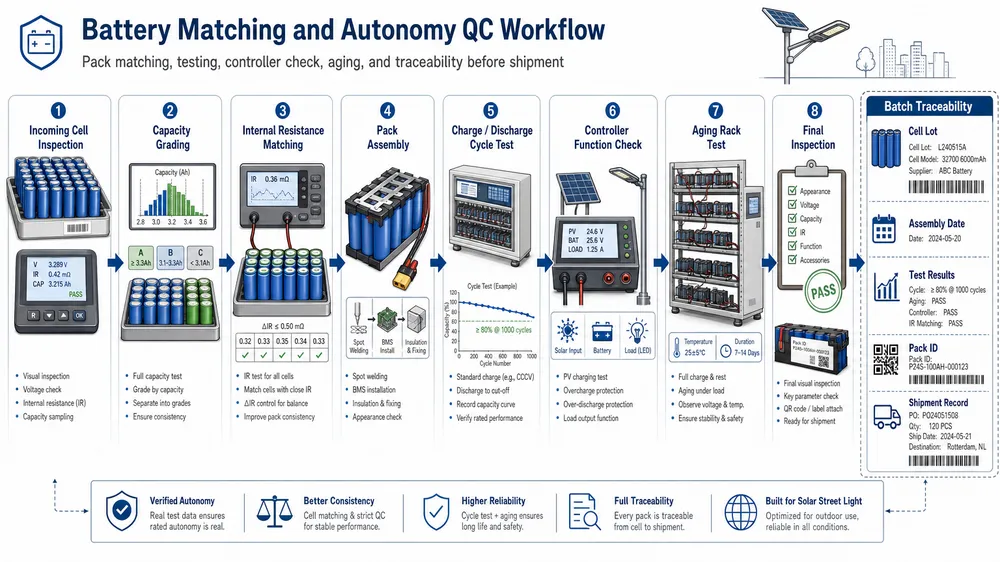
We run charge/discharge cycle testing on every battery pack before it leaves our facility — not as a quality theater exercise, but because we have seen what happens when a batch with inconsistent cell matching reaches a hot climate. A pack that tests fine at 25°C can show 15–20% capacity variance at 45°C if the cells were not matched properly. That variance shows up as uneven street light performance across a project, and it shows up in year one.

For a full breakdown of battery chemistry options and how they interact with panel sizing and dimming schedules, see solar street light battery spec.

LiFePO4 and lead-acid battery comparison chart for solar street lights in Nigeria's hot climate

MOQ, Lead Time, and the Red Flags Behind a Cheap Quote

MOQ and lead time should be evaluated together against your order type, not as standalone numbers.

Order Type Typical Buyer Need Supplier Fit
Urgent small replacement (1–50 units) Same-week delivery, local stock Nigeria-based distributor or installer
Pilot SKU for resale (100–300 units) Low MOQ, clear spec, sample approval Factory-direct supplier with MOQ from 100 units
Tender batch (500–2,000 units) Spec lock-in, batch inspection, certificate package Factory-direct manufacturer with QC documentation
Repeat distributor reorder (1,000+ units) Consistent batch quality, reorder reliability, documentation Factory-direct with ISO 9001 and pre-shipment inspection
Container-scale import (FCL) Landed cost optimization, packing efficiency, full document set Factory-direct with export experience and SONCAP support

A trading company can be useful for mixed-product sourcing — if you need solar street lights alongside other product categories from different factories, a trading company consolidates the order. The trade-off is that batch consistency and spec control are weaker. The trading company does not control the production line, and when a batch has a defect, the resolution path runs through an intermediary rather than directly to the engineering team that built the product.

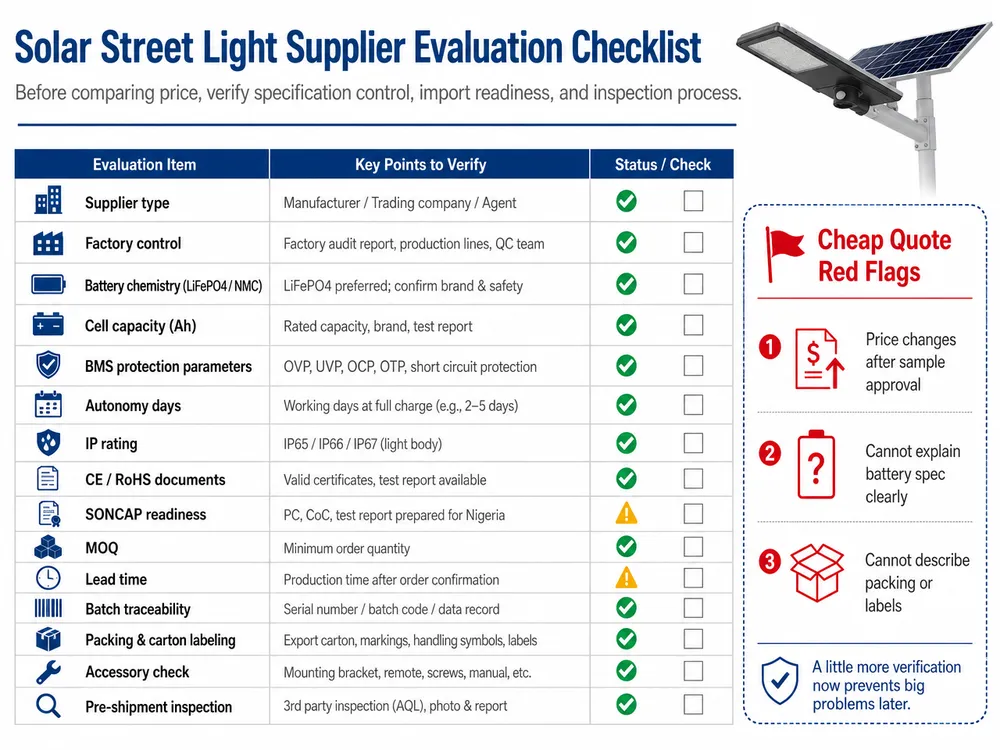
Factory audit red flags — apply these to any supplier, including JXSOL:

  • Cannot define battery chemistry or capacity — "lithium battery" without specifying LiFePO4 vs. NMC vs. LFP, or capacity stated in Wh without cell count or voltage
  • Autonomy days stated without location or dimming logic — "5-day autonomy" without specifying the irradiance assumption, dimming schedule, or load wattage
  • Generic certificate not tied to the exact model — a CE certificate covering a product family rather than the specific SKU being ordered
  • No battery test records — no aging test, no charge/discharge cycle data, no cell-matching records
  • No waterproof inspection records — IP65/IP67 claimed but no test report per model
  • No batch traceability — cannot provide serial number ranges or production batch codes for the shipped units
  • Price changes after sample approval — sample price and production price diverge without a clear material or specification change
  • Cannot explain packing, accessory checks, or carton labeling — a factory that controls its own production can describe exactly what goes in each carton and how it is labeled for customs

(The battery chemistry question alone filters out a significant portion of low-quality quotes. A supplier who cannot immediately tell you whether the pack is LiFePO4 or NMC, the cell capacity in Ah, and the BMS protection parameters is not controlling their own production.)

Solar street light supplier evaluation checklist covering battery tests, documents, MOQ, lead time, and pre-shipment inspection

Where JXSOL Fits as the Factory-Direct Alternative

JXSOL is the export brand of Zhongshan Century Juxing Optoelectronics Technology Co., Ltd., a solar lighting manufacturer in Guzhen Town, Zhongshan, Guangdong — the center of China's lighting manufacturing industry. Founded in 2012, the factory covers 12,000 square meters, runs 6 production lines, employs 150 people including 15+ optical and electrical engineers, and produces 1,200,000 units annually. Certifications include ISO 9001:2015, CE, RoHS, IP65/IP67, and IEC 62124.

What that means for a Nigerian buyer specifically:

Battery and panel sizing for your location. Our engineering team sizes battery capacity and solar panel wattage against the buyer's actual project location — Lagos, Kano, Abuja, or any specific state — using real irradiance data and the buyer's target autonomy days and dimming schedule. We do not quote a single national spec and hope it works. A Lagos buyer asking for 5-day autonomy gets a different battery and panel configuration than a Kano buyer asking for 3-day autonomy, and the price difference is real and explained.

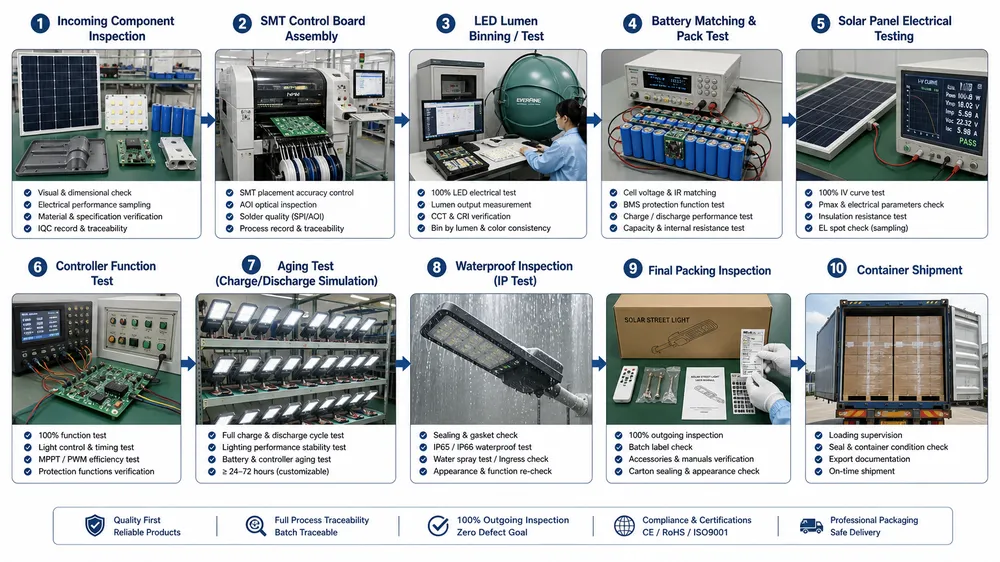
100% pre-shipment inspection. Every unit is inspected before it leaves the factory — lumen output, color temperature, waterproof integrity, battery charge/discharge performance, and carton labeling. We run automated SMT production lines with daily output of 5,000+ units and an integrated battery and LED module testing lab in the same building where the product is assembled. The inspection is not a sampling exercise — it is a 100% check. For a Nigerian importer who has no local recourse if a defective batch arrives at Apapa, that distinction matters.

Documentation package for import clearance. We provide model-specific CE and RoHS test reports, IP65/IP67 test documentation, ISO 9001:2015 certification, and commercial invoice and packing list formats that align with Nigerian customs requirements. For buyers navigating the SONCAP process through the National Single Window, we coordinate the product certificate documentation per order. Our Certifications & Quality Standards page lists the current certificate set.

MOQ from 100 units. A 100-unit pilot order lets you test a SKU with your own customers or on a small project before committing to a container. Most of our Nigerian distributor relationships start with a 100–300 unit pilot, then move to FCL reorders once the product is proven in the field. OEM and ODM options — custom lumen output, color temperature, housing color, or label — are available through our OEM & ODM Solar Lighting Services for buyers building a private-label product line.

The honest trade-off: factory-direct from China means 25–35 day lead time from order confirmation to port of departure, plus shipping and clearance time. If you need units in Lagos next week, we are not the right call. If you are planning a tender, building a distributor catalog, or setting up a repeat import program, the economics and spec control are worth the lead time.

FAQ: What Buyers Usually Miss When Comparing Suppliers

What should I check first when comparing solar street light suppliers in Nigeria?

Start with battery chemistry and autonomy-day sizing. Ask every supplier: what is the battery chemistry (LiFePO4 or lead-acid), what is the capacity in Wh, and how many autonomy days is the system sized for — and at what location and dimming schedule? If a supplier cannot answer those three questions with specific numbers, the quote is incomplete regardless of price.

How many autonomy days should a solar street light have for Lagos or Kano?

For Lagos and Port Harcourt, 5 autonomy days is the recommended baseline for reliable operation through the rainy season. For Kano, 3–4 days is typically sufficient given the shorter rainy window and stronger average irradiance. Specifying fewer autonomy days than the location requires is the most common cause of first-year performance failures in Nigerian solar street light projects.

Is LiFePO4 worth the higher first cost for Nigerian solar street light projects?

For any order where the units will be in service for more than 18 months — which is most distributor and project work — yes. Lead-acid degrades faster in sustained heat above 35°C, and the replacement cycle in a Nigerian climate typically erases the first-cost advantage within two years. For short-term or pilot projects where replacement logistics are manageable, lead-acid may be acceptable. For rural deployments or projects where field service is difficult, LiFePO4 is the lower-risk choice.

What documents should I ask for before importing solar street lights into Nigeria?

Request: model-specific CE test report, RoHS declaration, IP65/IP67 test record, ISO 9001 certificate, commercial invoice and packing list matching the exact shipment, and the Product Certificate for SONCAP. Confirm that the supplier's documentation workflow is aligned with SON's National Single Window platform, which became mandatory for SONCAP and import permit processes as of March 31, 2026. A generic certificate covering a product family rather than the specific model ordered is a clearance risk.

What MOQ is reasonable for testing a new solar street light supplier?

100–300 units is a workable pilot range for most distributors. It is enough to test the product with real customers or on a small project, verify that the spec matches what was quoted, and assess the supplier's documentation and communication before committing to a container. A supplier who requires a full FCL minimum for a first order is asking you to take all the risk — that is a negotiating signal, not a fixed constraint.

When is a local Nigerian supplier better than factory-direct import?

Local is the right call for urgent small orders (under 50 units), emergency replacements on active projects, installation-heavy work requiring on-site commissioning and local service response, and situations where the project timeline cannot accommodate a 6–8 week import cycle. Factory-direct becomes the better economics for repeat-volume orders, tender batches, and any situation where spec control, batch consistency, and documentation depth matter more than delivery speed.

Which Supplier Type Fits Your Order Size and Risk

Buyer Situation Best Supplier Type Key Criteria
Urgent small replacement (1–50 units, needed within days) Nigeria-based distributor or installer Local stock availability, delivery speed
Installation-heavy municipal or project order Nigeria-based project contractor Site execution capability, local service response
Pilot SKU for resale or small project (100–300 units) Factory-direct with low MOQ and clear specs Battery chemistry, autonomy sizing, sample approval process
Repeat-volume distributor import (1,000+ units, FCL) Factory-direct manufacturer with batch testing ISO 9001, pre-shipment inspection, reorder consistency, documentation
Quality-critical tender or infrastructure project Engineering-led factory with certificate and inspection records IEC 62124, CE/IP test records per model, battery aging test, SONCAP document support

The sourcing decision is not a permanent choice between local and factory-direct — most serious distributors and project contractors in Nigeria use both. Local suppliers handle emergency and installation work. Factory-direct handles the volume that builds margin.

If you are at the stage of comparing configurations for a specific project or building a distributor catalog, the most useful next step is to send the project parameters — location (state or region), required lumen output or wattage, pole height, target autonomy days, and order volume — and get a Nigeria-specific configuration and pricing back. That comparison is more useful than a generic quote, and it takes one email. Request Quote with those details and we will respond with a sized configuration.

Solar Street Light Manufacturers for Indian Projects Compared by Capacity and Certifications

Why Capacity and Paperwork Matter More Than Wattage in Indian Sourcing

Most sourcing problems in Indian solar street lighting don't start with the product — they start with the supplier model. A 40W all-in-one fixture from a marketplace aggregator and the same spec from a manufacturer with a documented production line are not the same purchase. The wattage is identical. The batch consistency, the certification trail, and the reorder reliability are not.

Indian project buyers — whether they're running a municipal tender, an EPC contract, or a distributor program — face a specific pressure: aggregators on IndiaMART and TradeIndia offer the lowest headline price, but they assemble orders from whoever has stock that week. Domestic brands with strong BIS positioning often have the compliance paperwork sorted, but their production capacity can create lead-time friction on large orders. Neither model is wrong for every situation. The question is which one fits your order size, your compliance requirements, and your reorder cadence.

This article maps the solar street light manufacturers india landscape across those dimensions — production scale, certification depth, MOQ, and OEM support — so you can shortlist on criteria that actually predict field performance, not just price per unit.

The Comparison Matrix Buyers Need Before They Shortlist a Supplier

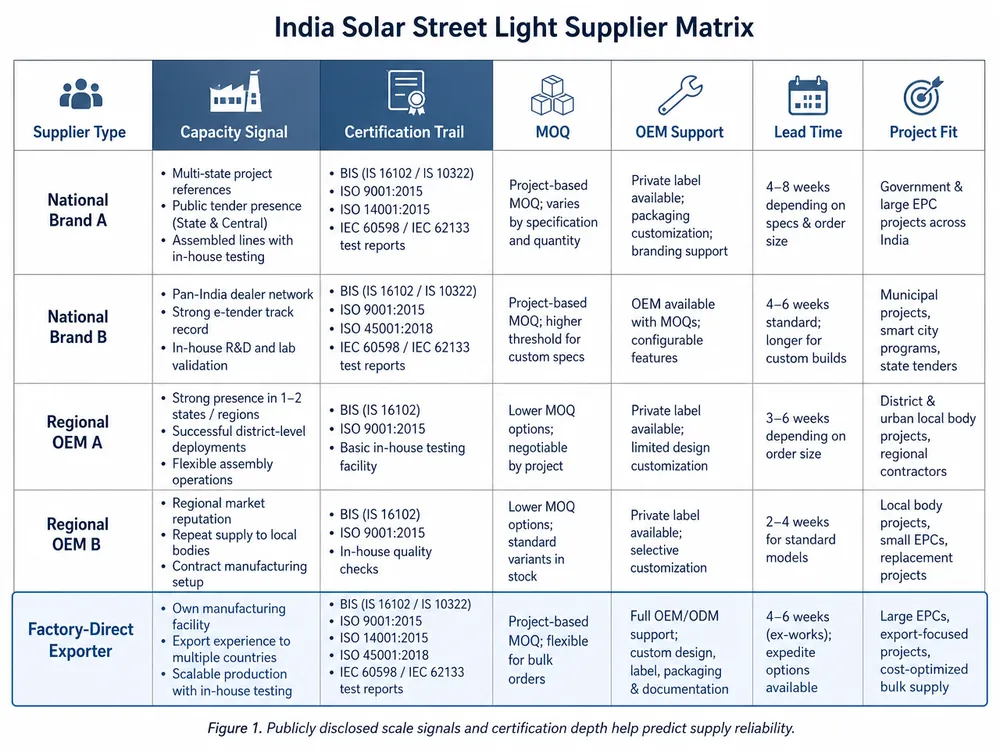
Before profiling individual companies, it helps to see the landscape in one view. The table below uses disclosed scale signals rather than invented capacity numbers — where a company hasn't published annual output, the column shows the scale indicator that is publicly available.

Manufacturer Scale Signal Key Certifications MOQ OEM Support Lead Time Signal
Waaree Energies National solar manufacturer, broad product line BIS, MNRE, ISO Not published Limited Standard domestic
Servotech Power Systems Listed company, integrated + 2-in-1 lines IP66, ISO, CE Not published Limited Standard domestic
Instapower 2M+ lights supplied, 70 patents, 150 staff ISO, CE, RoHS Not published Selective Standard domestic
Triveni Solar ISO 9001/14001, BIS, NSIC, GeM registered BIS, ISO, NSIC Not published Available Standard domestic
Fevino Industries All-in-one + semi-integrated lines ISO, CE, RoHS, ERDA, BIS Not published Available Standard domestic
N.Light Solar IP66, ISO 9001, MSME/NABL accreditation IP66, ISO, NABL Not published Limited Regional
Urja Saur Electronics 28 units/day disclosed output IP65, ISO Low Available 7-day quoted
Sugam Energy 50,000 SSL + 80,000 semi-integrated capacity ISO, CE 50–100 units OEM focus Standard
AD POWER Integrated + semi-integrated, IP65/IP66, IK08 IP65/IP66, IK08 Not published Available Standard
Aura Energy All-in-one + hybrid lines, global footprint IP65, CE Not published Available Standard
JXSOL (factory-direct) 1,200,000 units/year, 6 lines, 12,000 m² ISO 9001:2015, CE, RoHS, IP65/IP67, IEC 62124 100 units Full OEM/ODM Ex-factory quoted

(Note: domestic supplier MOQ and lead time data is drawn from public disclosures only — contact each supplier directly for current project pricing.)

A procurement comparison matrix of solar street light manufacturers in India by capacity signal, certifications, MOQ, OEM support, and lead time

For all-in-one solar street light specifications and how to read the technical parameters in this table, that guide covers the fixture-level detail.

National-Scale Brands with the Deepest Public Compliance Trail

These four companies operate at national scale with documented compliance positioning. For government tenders where BIS registration or MNRE empanelment is a hard requirement, they are the natural shortlist.

Waaree Energies — waaree.com

Waaree is one of India's largest solar manufacturers, with a product line that extends from panels into all-in-one solar street lights. Their BIS and MNRE positioning makes them a default consideration for government-facing tenders. The trade-off is that their solar street light line sits alongside a much larger panel business — it's not their primary engineering focus, and buyers sourcing at volume sometimes find lead times less predictable than the brand scale suggests.

Servotech Power Systems — servotech.in

Servotech is a listed company with integrated and 2-in-1 solar street light lines rated at IP66 and above 105 lm/W. The listed-company structure means public financial disclosure, which matters for buyers who need supplier stability documentation for tender submissions. Their product range covers the mid-to-high efficiency band that municipal projects typically specify.

Instapower — instapower.com

Instapower's public profile shows over 2 million lights supplied across two manufacturing units, 150 personnel, and 70 patents. That installed-base number is the most useful signal here — it means field data exists across multiple project types and climate zones. For buyers who want a domestic supplier with a long track record rather than a newer entrant, Instapower's depth is worth the conversation.

Triveni Solar — trivenisolar.com

Triveni holds ISO 9001, ISO 14001, BIS, NSIC, and GeM registration — the GeM listing in particular is relevant for government procurement teams who need suppliers on the Government e-Marketplace. Their solar street light line covers standard municipal specifications. NSIC registration also opens access to certain government financing and procurement schemes that non-registered suppliers can't access.

Regional Manufacturers That Fit Smaller Tenders, OEM Runs, and Faster Replenishment

These six companies operate at regional or mid-scale, with profiles that suit different procurement needs: lower MOQ, OEM flexibility, faster local replenishment, or specific certification combinations.

Fevino Industries — fevino.com

Fevino runs both all-in-one and semi-integrated solar street light lines with a certification stack that includes ISO, CE, RoHS, ERDA testing, and BIS references. The ERDA (Electrical Research and Development Association) testing reference is worth noting — it's a credible Indian testing body that some state-level tenders accept as an alternative to full BIS certification. For buyers navigating state government projects where BIS is preferred but not always mandatory, Fevino's documentation trail covers more ground than most regional suppliers.

N.Light Solar — nlightsolar.com

N.Light holds IP66, ISO 9001, and MSME/NABL accreditation. The NABL accreditation signals that their testing lab meets national standards — relevant when buyers need test reports that hold up under tender scrutiny rather than self-declared specs. Regional supplier, so replenishment lead times for smaller orders tend to be faster than national brands.

Urja Saur Electronics — urjasaurelectronics.com

Urja Saur publishes a 28-unit daily output figure and quotes 7-day delivery on their product pages. That's a small-batch, fast-turnaround profile — useful for emergency replacement orders, pilot installations, or situations where you need product on-site before a larger factory order arrives. Don't use them for a 5,000-unit infrastructure program; do consider them when you need 50 units in a week.

Sugam Energy — sugamenergy.com

Sugam discloses 50,000 solar LED street light capacity and 80,000 semi-integrated capacity — one of the few Indian regional suppliers to publish actual output numbers. Their OEM focus is explicit on their site, which means they're set up for private-label runs rather than just selling their own brand. For Indian EPC firms building a branded solar lighting program without investing in their own manufacturing, Sugam's disclosed capacity and OEM orientation make them a credible conversation.

AD POWER — adpower.in

AD POWER covers integrated and semi-integrated solar street lights with IP65/IP66 and IK08 impact resistance ratings. The IK08 rating — mechanical impact protection — is relevant for installations in high-traffic or vandalism-prone areas where fixture durability matters beyond weatherproofing. Not every supplier tests to IK standards, so if your project spec includes impact resistance, AD POWER's documentation is worth requesting.

Aura Energy — auraenergy.com

Aura Energy runs all-in-one and hybrid solar street light lines with a global distribution footprint. Their hybrid line — combining solar with grid backup — addresses a real gap in Indian project specifications: sites where solar irradiance is insufficient for full autonomy but grid connection is available as a fallback. If your project includes locations with partial shading or inconsistent irradiance, a hybrid-capable supplier is worth including in your shortlist.

How to Read BIS, CE, IEC 62124, IP65, and IP66 Without Guessing

The certification question trips up more Indian project buyers than any other sourcing decision. Here's the practical breakdown.

BIS (Bureau of Indian Standards) registration under IS 16077 is required for solar street lights in most central government tenders and many state government programs. If your project is government-funded and the tender document specifies BIS, there is no substitute — CE alone will not satisfy the requirement. Check the tender document first, not the supplier's marketing page.

CE marking is a European conformity declaration, not an Indian government certification. It signals that the product meets EU safety and performance directives, which is useful evidence of engineering discipline, but it does not replace BIS for Indian government procurement. For private projects — EPC contracts, commercial developments, private infrastructure — CE is often sufficient and sometimes the only certification the project owner requires.

IEC 62124 is the international standard for standalone solar electric systems, covering performance testing under real-world conditions. It's the most technically rigorous of the three for solar-specific performance claims. Suppliers who hold IEC 62124 documentation have had their systems tested against actual charge/discharge cycles, not just component-level specs. For high-value infrastructure projects where system performance over a 5–7 year horizon matters, IEC 62124 test reports are worth requesting even when they're not mandatory.

IP65 vs IP66: IP65 means dust-tight with protection against water jets. IP66 adds protection against powerful water jets. For most Indian installations — including monsoon-exposed roadway fixtures — IP65 is the minimum acceptable spec. Coastal installations or fixtures in areas with high-pressure cleaning should specify IP66. (We've seen IP65-rated fixtures from suppliers who test the housing but not the cable entry points — always ask for the full test report, not just the rating label.)

For a full breakdown of certification requirements by project type, the solar street light certifications guide covers the documentation chain in detail.

Battery Autonomy for Monsoon, Coastal, and High-Irradiance Indian Sites

A solar street light that fails in year one almost always traces back to a battery autonomy spec that wasn't sized for the buyer's actual rainy season. I've seen this pattern across projects in Kerala, Maharashtra, and the Northeast — the fixture spec looks fine on paper, but the battery was sized for 2–3 autonomy days when the site gets 10–14 consecutive overcast days during peak monsoon.

The autonomy day calculation is straightforward once you know your site's worst-case consecutive cloudy days. Kerala and the Northeast need 5–7 autonomy days minimum. The Gangetic plains and Rajasthan can often work with 3–4 days because irradiance recovery is faster. Coastal Karnataka and Andhra Pradesh sit in the middle — 4–5 days is the safe spec.

The second variable is the depth of discharge (DoD) limit on the battery. Lithium iron phosphate (LiFePO4) cells can safely discharge to 80–90% DoD, which means a smaller battery pack delivers more usable capacity than lead-acid at the same nominal rating. Most of the domestic suppliers in this list offer both chemistries — specify LiFePO4 if your project has a 5-year performance expectation, because lead-acid degradation in high-temperature Indian summers compresses the effective autonomy window within 18–24 months.

The third variable is the solar panel tilt and orientation. Fixed-tilt panels at the wrong angle for the installation latitude lose 10–15% of annual yield — which directly reduces the effective charging window and forces you to oversize the battery to compensate. For projects above 25°N latitude, a 15–20° tilt toward south is the standard recommendation. Below 15°N, near-flat mounting is often more efficient because the sun angle is high year-round.

For the full autonomy calculation methodology and climate-zone reference tables, battery autonomy days explained walks through the numbers.

When Factory-Direct China Beats Local Buying on Landed Cost and Batch Control

Local suppliers have real advantages: faster emergency replenishment, easier communication, no import logistics, and no currency exposure. For urgent small orders — 50 units to replace failed fixtures on a live road — a domestic supplier with stock is the right answer. Don't import for that.

The economics shift at repeat volume. At 500 units and above, the landed cost of a factory-direct order from a manufacturer like JXSOL — including sea freight, customs duty, and local delivery — typically comes in below the ex-works price from a domestic trading company, not just below the domestic retail price. The reason is structural: a trading company buying from a Chinese factory and reselling into India carries two margins. A direct factory relationship carries one.

The quality control argument is separate from the cost argument, and it's often more important. We run 100% pre-shipment inspection on every order — every unit is tested for lumen output, battery charge/discharge performance, and IP integrity before it leaves our facility. The inspection report travels with the shipment. When a batch arrives at your warehouse, you have documentation for every unit, not a sample-based certificate that covers 5% of the order.

JXSOL's 1,200,000-unit annual capacity across 6 production lines means a 10,000-unit Indian infrastructure order is schedulable without displacing other accounts. Smaller domestic manufacturers running 50,000–80,000 units annually face a real capacity constraint when a large tender lands — your order either waits or gets split across production runs with different component batches. Batch consistency matters for large installations because lumen output variation between batches creates visible inconsistency on the road.

Our MOQ starts at 100 units for standard models, so Indian distributors can run a test SKU before committing to tender volumes. OEM and private-label support is available for EPC firms building a branded solar lighting program — we handle the engineering specification lock-in, the certification documentation, and the production scheduling. The Solar Street Light OEM Program covers the process in detail.

Certifications for Indian project use: CE, RoHS, IP65/IP67, and IEC 62124 are standard on our solar street light line. BIS registration is a separate process that we can support for buyers with ongoing Indian government tender programs — the timeline and documentation requirements depend on the specific IS standard and product category.

Which Sourcing Route Fits Your Order Size, Timeline, and Compliance Risk

The decision isn't local vs. import — it's which supplier model fits the specific order in front of you.

Urgent replacement orders under 100 units: domestic supplier with stock. Import lead time doesn't work here.

Government tenders requiring BIS: domestic BIS-registered suppliers are the path of least resistance. Waaree, Servotech, Triveni, and Fevino all carry BIS references. Verify the specific IS standard against your tender document before shortlisting.

Private EPC projects, commercial developments, or highway contracts where CE and IEC 62124 are sufficient: factory-direct import is competitive on both price and documentation quality. Request the full test report package, not just the certificate.

Distributor test orders before tender commitment: JXSOL's 100-unit MOQ is designed for this. Test the SKU with your own customers or on a pilot installation before you commit to the tender volume.

Repeat-volume programs above 500 units per order: run a landed-cost comparison that includes freight, duty, and inspection cost. The factory-direct economics are usually clear at this scale.

OEM or private-label programs: domestic OEM capacity is limited to a handful of suppliers. Factory-direct gives you full specification control, consistent batch documentation, and a single engineering contact for the life of the program.

Send your project type, required wattage and lumen output, target autonomy days, order volume, and any certification or OEM requirements to Request Quote — we'll respond with a configuration recommendation sized for your specific Indian climate zone and a factory price that lets you run the landed-cost comparison yourself.

Smart Solar Street Light vs Standard Solar Street Light for Large-Scale Project Budgets

The Real Budget Question Is Not Unit Price

The fixture cost difference between a standard solar street light and a smart solar street light is real — typically 20–40% higher per unit for the smart version, depending on controller spec, connectivity module, and monitoring platform. On a 500-unit tender, that gap is visible on the first page of your budget sheet. What doesn't appear on that first page is the cost of not knowing which lights are failing, how long they've been dark, and how many truck rolls it takes to find out.

That's the actual comparison. Not smart versus standard as a feature argument — but upfront fixture cost versus long-term maintenance visibility, and which one costs more over the project lifecycle.

Here's the quick verdict before we go deeper:

  • Standard solar street lights win when the project is compact, accessible, budget-capped, and easy to inspect manually. The simpler controller, fewer electronic SKUs, and lower unit cost are genuine advantages when your maintenance team can walk or drive the route.
  • Smart solar street lighting wins when the fleet is large, dispersed, tied to maintenance SLAs, or operating in locations where a night inspection visit costs real money. Remote fault reporting and dimming control reduce operating cost in ways that compound across hundreds of units.
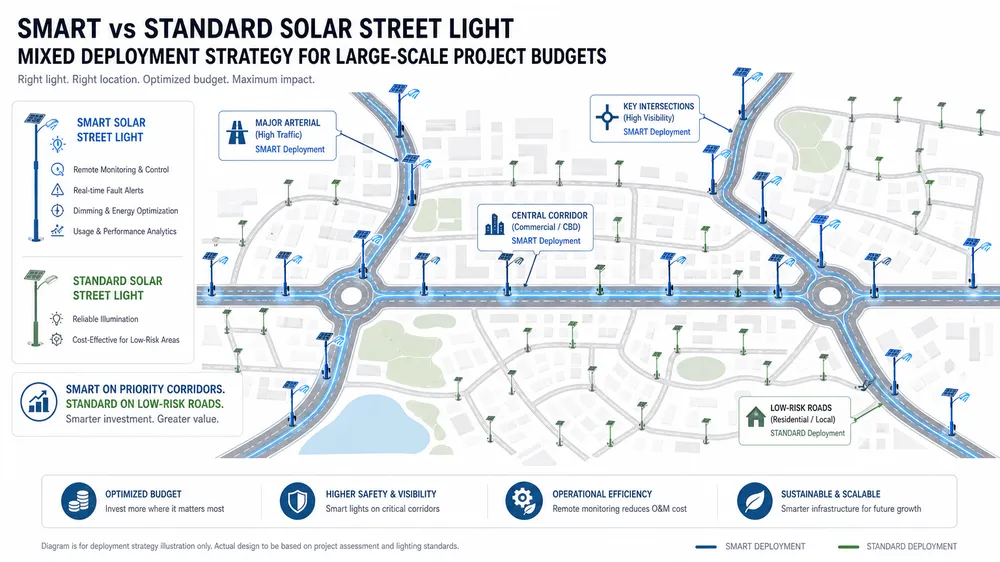
  • Mixed deployment is often the most commercially rational answer: smart units on main corridors, intersections, and high-visibility roads; standard units on lower-risk side roads where manual inspection is cheap.

The rest of this article proves that verdict section by section, with a spec matrix, a TCO framework, a scenario winner map, and an RFQ checklist you can use directly.

What Actually Changes Between Standard and Smart Fixtures

The mechanical housing — panel, battery compartment, LED module, pole bracket — can be identical between a standard and a smart unit. The difference is in the controller and what it connects to.

A standard solar street light runs on a fixed controller: time-based switching, PIR motion sensing, or light-sensor activation. It operates autonomously, requires no network, and produces no data. When a unit fails, you find out when someone reports a dark road or when your maintenance crew does a scheduled inspection. The controller logic is set at commissioning and doesn't change unless a technician is on-site.

A smart solar street light — or more precisely, an IoT solar street light — adds a communication layer on top of the controller. That layer can include a GPRS/4G SIM card, a Zigbee or LoRa mesh node, or a gateway-connected module depending on the platform architecture. What it enables: remote dimming schedules, real-time fault alarms, energy consumption logging, and fleet-level visibility from a dashboard. A solar street light with remote monitoring means you know which unit is underperforming before a complaint arrives.

One clarification worth making explicit: "all-in-one" describes the mechanical structure — panel, battery, LED, and controller integrated into a single housing — not the control capability. An all-in-one smart solar street light combines that compact form factor with IoT control. An all-in-one standard unit has the same housing without the communication layer. Buyers sometimes conflate these terms in RFQs, which creates configuration mismatches at production. (We see this regularly — a buyer specifies "all-in-one smart" but the monitoring requirement turns out to be fault alarm only, not full platform access. Clarifying this before production saves rework.)

Smart functionality is not a single spec. Remote monitoring, dimming scheduling, fault alarm, gateway/SIM requirement, and platform access are separate capabilities that may or may not all be required for your project. Specify exactly which functions you need — it affects both unit cost and commissioning complexity.

For a deeper look at smart control features and platform options, see smart solar street light features.

Specification Matrix for Engineering Sign-Off

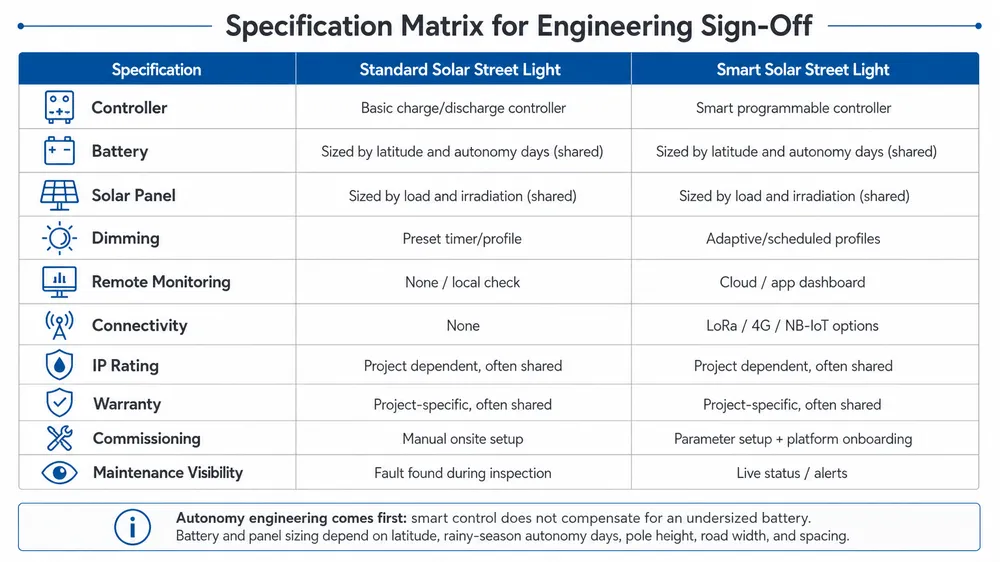
Both types still require correct sizing for your deployment: target latitude, rainy-season autonomy days, pole height, road width, and installation spacing. The smart controller does not compensate for an undersized battery — autonomy engineering comes first regardless of which type you choose. We size battery and solar panel for the target latitude on both standard and smart configurations through our in-house engineering review.

The table below covers the commercially meaningful differences for project sign-off. Specs that are identical between the two types are noted as shared.

Specification Standard Solar Street Light Smart Solar Street Light (IoT)
Lumen output range 2,000–20,000 lm (application-dependent) 2,000–20,000 lm (same range)
LED module High-efficiency LED, Type II/III/V optics Same LED module; optics unchanged
Battery capacity Sized for autonomy days at target latitude Same sizing logic; dimming schedule can extend autonomy
Solar panel sizing Matched to battery and daily load Same; remote dimming reduces daily load if scheduled
Controller type Fixed logic: time/PIR/light-sensor modes Programmable: remote dimming, scheduling, reporting
Dimming logic Pre-set at commissioning (e.g., 100%→50% at midnight) Remotely adjustable post-deployment
Remote monitoring None Fault alarm, energy log, status dashboard
Connectivity None GPRS/4G SIM, Zigbee, LoRa, or gateway (project-specific)
Network dependency Zero SIM/gateway required; coverage must be confirmed
IP rating IP65/IP67 (both types, same housing standard) IP65/IP67 (same)
Commissioning Set controller parameters on-site; straightforward Device registration, signal check, platform onboarding required
Spare parts complexity LED module, battery, controller (3 core SKUs) Adds communication module, SIM, gateway variants
Certification CE, RoHS, IEC 62124, ISO 9001:2015 Same certifications; platform documentation may be added
Warranty 3-year standard 3-year standard (hardware); platform/SIM terms separate
OEM/ODM Available from 100 units Available; MOQ may vary by controller configuration

For the full Solar Street & Roadway Lights Manufacturer product range, both types are manufactured on the same production lines with the same QC baseline.

Smart and standard solar street light specification matrix for project budget comparison

The Hidden Cost Is Fault Visibility, Not the Controller

The controller price difference is visible. The maintenance cost difference is not — until you're 18 months into a 600-unit deployment and your client is asking why three roads have been dark for two weeks.

Here's how the hidden cost structure actually works for each type.

Standard solar street light maintenance costs:

  • Scheduled night inspections to identify failed units (labor + vehicle + time)
  • Complaint-driven fault discovery — meaning the road is dark before you know about it
  • No energy consumption data, so battery degradation is invisible until the unit stops working
  • Inspection frequency must increase as the fleet ages, because there's no early-warning signal

Smart solar street light operating costs:

  • Higher unit cost (20–40% premium, configuration-dependent)
  • Commissioning time: device registration, signal verification, platform onboarding — typically adds 15–30 minutes per unit at installation
  • SIM card or gateway cost: ongoing data fees, typically modest per unit but real at scale
  • Technician familiarity with the platform: first deployment has a learning curve
  • Platform or software license fees if the monitoring system is proprietary

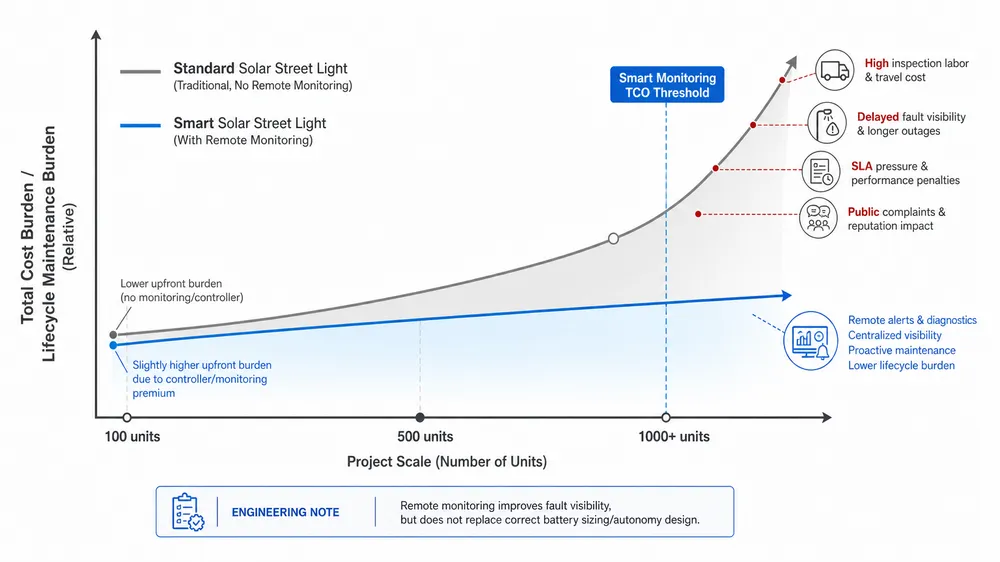
The TCO comparison comes down to one calculation: smart premium + commissioning + data fees versus avoided inspection visits + faster fault response + lower service-contract exposure.

At 100 units on a compact, accessible site, the math usually favors standard. Your maintenance team can inspect the full fleet in a single night run. The smart premium across 100 units may exceed the inspection savings for years.

At 500 units across dispersed municipal roads, the calculation shifts. If each inspection visit covers 20–30 units and takes a crew half a day, a full fleet inspection is a significant recurring cost. A fault alarm that triggers a targeted repair visit — instead of a full sweep — starts paying back the smart premium within the first year of operation.

At 1,000+ units across highway corridors or regional road networks, smart monitoring is almost always the lower total cost option when maintenance SLAs are in place. The cost of a missed fault — a dark highway section, a service-contract penalty, a municipal complaint — exceeds the per-unit smart premium many times over.

One engineering point that gets missed in this comparison: remote monitoring does not fix an undersized battery. A smart unit with insufficient autonomy days for the rainy season will still fail in the field — you'll just get a fault alarm instead of a complaint. Correct battery sizing for your target latitude and consecutive cloudy days is the foundation. Smart control is the visibility layer on top of it, not a substitute for it.

The strongest case for smart solar street lighting is not energy savings or dimming efficiency — it's the reduction in blind spots. On a large project, the lights you don't know are failing are the ones that create liability.

Conceptual TCO chart comparing smart monitoring value against standard solar street light maintenance cost across project scales

Project Scale Winner Map

Generic pros-and-cons lists don't help you make a budget decision. Scenarios do. Here are the five deployment conditions we see most often, with a direct verdict for each.

Project Scenario Likely Winner Budget Reason
50–150 units, compact site, easy road access Standard Inspection cost is low; smart premium exceeds maintenance savings
200–500 units across municipal roads, mixed access Mixed deployment Smart on main corridors; standard on side roads controls capex while keeping visibility where it matters
500–1,000+ units, dispersed roads or highway corridors Smart Inspection cost per unit is high; fault visibility reduces service-contract risk
Industrial park or campus with internal maintenance team Depends on labor cost If the team is on-site daily, standard is sufficient; if the team is shared across sites, smart reduces unnecessary visits
Remote rural roads or highway corridors, expensive site access Smart Each truck roll is costly; fault alarm replaces blind inspection sweeps

On mixed deployment: this is not a compromise — it's a deliberate budget optimization. Main roads, intersections, and high-visibility corridors carry the most political and operational risk when dark. Smart units there. Side roads and low-traffic paths where a dark light is noticed quickly and fixed cheaply — standard units there. The same factory, the same housing, the same QC baseline. The only difference is the controller and connectivity module.

The smart solar street light vs standard decision is not binary for most large projects. The question is which zones justify the monitoring premium and which don't.

Mixed deployment map showing smart solar street lights on monitored corridors and standard units on low-risk roads

Regional Conditions That Change the Budget Answer

The smart-versus-standard decision is not purely about project scale. Operating environment and regional infrastructure context shift the calculation.

Middle East: Long road corridors, high ambient temperatures, and dust accumulation make battery sizing and thermal management the first engineering priority — not the control layer. That said, when a project spans 50+ km of highway with limited maintenance crew coverage, the cost of a night inspection sweep is high enough that smart fault reporting pays back quickly. Confirm network coverage before specifying SIM-based monitoring; some remote corridors require gateway mesh rather than cellular.

Africa: Remote roads and limited local maintenance infrastructure make fault visibility genuinely valuable — a dark road that goes unreported for weeks is a real operational risk. The constraint is network availability. In areas with reliable 4G coverage, IoT solar street lights with remote monitoring are a strong fit. In areas with patchy coverage, a gateway-based mesh or LoRa network may be needed, which adds commissioning complexity and cost. Confirm connectivity before the specification is locked.

Southeast Asia: High humidity, heavy rainy seasons, and dense road networks make autonomy sizing and IP67 waterproofing the baseline requirements for both types. The rainy season is where undersized batteries fail — and where smart monitoring earns its keep by flagging degraded units before the next storm cycle. For large municipal projects in the region, documentation and reporting requirements are increasingly common, which favors smart systems.

North America and Europe: Municipal and infrastructure projects in these markets often carry service accountability requirements — maintenance reporting, uptime documentation, and SLA compliance. Smart solar street lighting with remote monitoring supports those documentation requirements directly. CE and IEC 62124 certification covers both types from our factory; platform documentation for the monitoring system may be an additional requirement depending on the tender.

In all regions: IP65 is the minimum for outdoor solar street lights; IP67 is the correct spec for areas with flooding risk, heavy rain, or road-level water exposure. Both standard and smart units from our factory meet IP65/IP67 depending on configuration. (We've seen projects in Southeast Asia specify IP65 and then deploy in flood-prone zones — the first rainy season makes the case for IP67 clearly.)

Procurement Risk Falls When Both Options Come From One Factory

Qualifying two suppliers for a mixed smart-and-standard deployment is a procurement risk that doesn't get enough attention in project planning. When the standard units come from one factory and the smart units from another, you're managing two sets of housing tolerances, two battery chemistries, two controller logic systems, two spare-parts inventories, two warranty processes, and two QC baselines. On a 500-unit project, that complexity compounds at every stage: incoming inspection, installation, commissioning, and after-sales.

We manufacture both standard and smart solar street lights in-house at our 12,000 m² facility in Zhongshan. The same housing tooling, the same LED module, the same battery cell sourcing, the same automated SMT production line for control boards — whether the unit ships with a fixed controller or an IoT module. Our 15+ optical and electrical engineers handle battery autonomy sizing and system configuration for both types in a single engineering review. One RFQ, one factory audit, one pre-shipment inspection process covering the full mixed order.

100% pre-shipment inspection applies equally to standard and smart units. For smart units, that includes controller function verification, communication module pairing, and dimming logic confirmation before the container is sealed. We've seen what happens when smart units arrive on-site with misconfigured controllers or unregistered SIM modules — it turns a one-day commissioning job into a week of troubleshooting. We test it here so you don't debug it there.

OEM and ODM are available for both types. Private-label standard or Smart Solar Street Light units from the same factory means your brand appears consistently across the full deployment, regardless of which zones get smart control and which get standard. MOQ starts at 100 units for standard models; smart configurations may have higher minimums depending on the controller and connectivity module specified.

Reorder simplicity is the long-term benefit. When the project expands or replacement units are needed two years later, one supplier relationship covers both types.

RFQ Checklist for a Clean Budget Comparison

The most common reason a smart-versus-standard budget comparison produces a misleading result: the two quotes are not built on the same battery, panel, and lumen basis. A standard unit quoted with a smaller battery and a smart unit quoted with a larger one will show a cost gap that has nothing to do with the control layer. To get a clean comparison, both configurations need to be sized identically for your deployment conditions.

Use this checklist when sending an RFQ for either type:

Project parameters:

  • [ ] Total unit count (and split if mixed deployment is planned)
  • [ ] Road width and target pole height
  • [ ] Required lumen output and optical distribution (Type II, III, or V)
  • [ ] Installation spacing (meters between poles)
  • [ ] Target region and latitude (for battery autonomy calculation)
  • [ ] Required autonomy days during rainy season (consecutive cloudy days)

Technical requirements:

  • [ ] IP rating requirement: IP65 or IP67
  • [ ] Preferred structure: all-in-one or split (separate panel and fixture)
  • [ ] Monitoring requirement: none / fault alarm only / remote dimming / full platform access
  • [ ] Connectivity preference: SIM/4G, Zigbee mesh, LoRa, or gateway-based
  • [ ] Dimming profile: fixed schedule or remotely adjustable

Commercial and documentation requirements:

  • [ ] OEM branding or packaging requirements
  • [ ] Certification documentation needed: CE, RoHS, IEC 62124, DLC, or others
  • [ ] Platform or software documentation required for the smart system
  • [ ] Warranty terms required

Comparing smart versus standard without locking these parameters first gives you a price difference, not a budget decision. Once the specs are aligned, the cost gap between the two types reflects only the controller and connectivity layer — which is the number you actually need to evaluate against your maintenance cost model.

Send your project parameters to Request Quote and we'll return a configuration recommendation and unit pricing for both standard and smart options on the same battery and lumen basis.

FAQ for Procurement and Engineering Review

Is a smart solar street light worth the premium for a 500-unit road project?

It depends on inspection cost and maintenance accountability, not unit count alone. At 500 units across dispersed municipal roads where each inspection sweep requires a crew and vehicle, smart fault reporting typically pays back the per-unit premium within the first year of operation by replacing blind inspection sweeps with targeted repair visits. If the 500 units are on a compact, easily accessible site where a single crew can cover the full fleet in one night run, the standard option is likely the lower total cost. The break-even is not a fixed number — it's the ratio of your inspection cost per visit to the smart premium per unit.

Can standard solar street lights and smart solar street lights be used in the same project?

Yes, and for large projects this is often the most commercially rational approach. The housing, LED module, battery, and solar panel can be identical between the two types — only the controller and connectivity module differ. Using the same factory for both means consistent housing tolerances, matching spare parts, and a single QC baseline across the full deployment. The practical requirement is that the smart and standard zones are clearly defined in the project specification before production, so controller configuration and commissioning planning are handled correctly.

Does remote monitoring reduce battery failure?

Remote monitoring detects battery degradation earlier — it does not prevent it. A smart solar street light with remote monitoring will flag a unit whose runtime is shortening before it goes completely dark, giving you a maintenance window instead of a failure event. But the underlying cause of battery failure — undersized capacity for the rainy season, incorrect charge/discharge cycling, or cell quality — is an engineering and sourcing problem, not a monitoring problem. Correct autonomy sizing for your target latitude and consecutive cloudy days is the foundation. Monitoring is the early-warning layer on top of it.

What should be checked before specifying an IoT solar street light?

Four things before the specification is locked: (1) Network coverage at the deployment site — SIM-based monitoring requires reliable 4G or 3G coverage; remote or rural sites may need a gateway mesh or LoRa network instead. (2) Platform requirements — fault alarm only, remote dimming, energy logging, and full platform access are different specifications with different costs. (3) Commissioning plan — IoT units require device registration and signal verification at installation; factor this into the installation schedule. (4) Ongoing data costs — SIM fees and platform licenses are real recurring costs; confirm these before the project budget is finalized.

Is an all-in-one smart solar street light better than a split smart system for large projects?

All-in-one units — where panel, battery, LED, and controller are integrated into a single housing — reduce installation time and pole hardware complexity, which matters on large projects where installation labor is a significant cost. The trade-off is that battery replacement requires removing the full fixture rather than swapping a separate battery box. For projects in regions with high battery replacement frequency (extreme heat, extended rainy seasons), a split configuration with an accessible battery compartment can reduce long-term service cost. For most standard deployment conditions, the all-in-one form factor is the more practical choice at scale. Specify which structure you need in the RFQ — both are available with standard or smart control.

How to Specify Solar Highway Light Wind Load Ratings for High-Wind Road Corridors

The Solar Panel Is Not an Accessory in Wind Design

A contractor approves a solar highway lighting package based on a pole wind rating in the supplier catalog. The project later increases panel wattage to meet autonomy requirements — larger panel, heavier bracket. The poles go up along an open coastal highway. After the first storm season, several lean. A few bracket welds crack. The supplier points to the pole rating. The installer points to the foundation. The buyer pays for replacement units, lane closures, and rework.

This is not a rare scenario. We see the pattern in field feedback from projects across the Middle East and Southeast Asia: the pole rating was real, but it applied to a different configuration than what was actually installed.

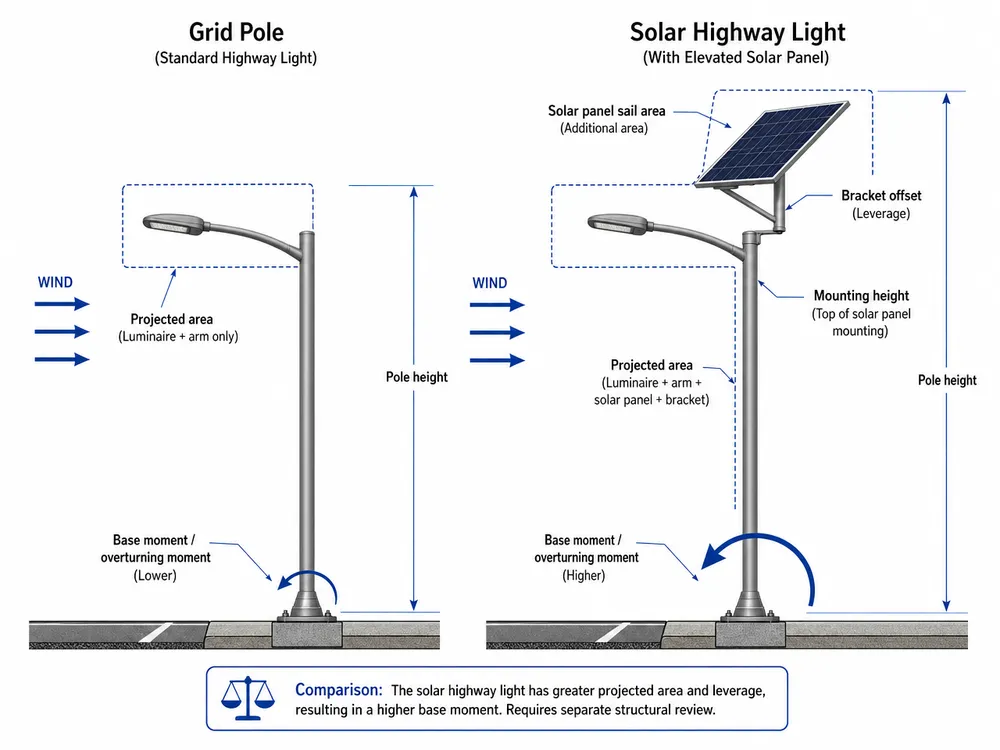
The core problem is that a solar highway light is structurally different from a grid-powered highway light. A grid pole carries a luminaire and arm. A solar highway light adds a solar panel, a mounting bracket, sometimes a battery housing, and a top-mounted assembly that can be significantly larger than the luminaire itself. That panel becomes a wind-catching surface — a sail — and the pole calculation changes accordingly.

Red flag: A supplier provides a wind rating without specifying what panel size, pole height, tilt angle, or standard it applies to.

Red flag: A solar highway light is quoted on the same pole table as a grid highway light, with no adjustment for the panel assembly.

IP65, IP67, CE, RoHS, and electrical performance documents confirm weatherproofing and electrical compliance. None of them replace structural wind verification. A solar street light wind load rating is only useful when it applies to the full installed system: pole, arm, luminaire, solar panel, bracket, anchor bolts, base plate, and foundation assumptions. Getting that specification right before the order is locked is the only way to protect project margin and keep warranty exposure under control.

Wind Zone First, Product Catalog Second

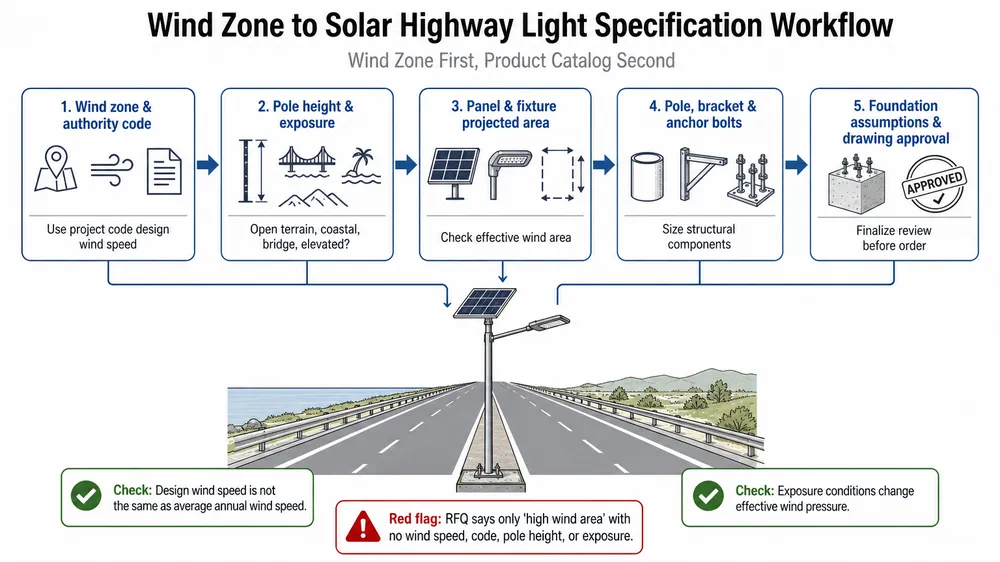
The specification process for a solar highway light wind load starts at the installation site, not the supplier catalog. Buyers who start from the catalog and work backward to the site conditions are the ones who end up with mismatched configurations.

Before you can ask a supplier to confirm structural adequacy, you need to define the site:

  • Design wind speed from the applicable project code — not average weather data, not historical storm records. The design wind speed is a code-defined value that accounts for return period and exposure. In the US, ASCE 7 defines wind speed maps by risk category. In Europe, EN 40 governs lighting column structural design. Most road authorities in the Middle East, Southeast Asia, and Africa reference either a national building code or a regional road standard that specifies design wind speed by zone.
  • Exposure category or terrain condition — open terrain, coastal, mountain pass, bridge deck, or elevated road section. An open coastal highway corridor can see effective wind pressures 30–50% higher than a sheltered urban street at the same nominal wind speed, because there is no upstream obstruction to reduce gust intensity.
  • Pole height and mounting location — wind pressure increases with height, and the overturning moment at the base increases with the square of the height above ground.
  • Road authority requirements — some jurisdictions require stamped structural calculations for highway lighting poles regardless of the supplier's catalog rating.

Check: Pull the design wind speed from the project code, not from a weather website. Average annual wind speed and design wind speed are different numbers.

Check: Identify whether the corridor is open terrain, coastal, bridge, or elevated. These conditions change the effective wind pressure on the pole and panel assembly.

Red flag: An RFQ that says only "high wind area" with no wind speed, applicable code, pole height, or exposure condition. A supplier cannot confirm structural adequacy from that description.

Workflow showing wind zone data feeding into a solar highway light pole and panel specification

How the Solar Panel Changes the Pole Calculation

This is the part most catalog wind ratings skip, and it is where most procurement mistakes happen.

Wind load on a pole structure is calculated from the effective projected area of everything mounted on the pole — luminaire, arm, panel, bracket, and any housing — multiplied by the wind pressure at that height. A standard grid highway light has a relatively small projected area at the top: the luminaire and arm. A solar highway light adds the panel face, which on a 200W–400W fixture can be 0.8 m² to 1.6 m² of additional projected area, mounted on a bracket that extends away from the pole centerline.

That bracket offset matters. The further the panel center of mass sits from the pole axis, the larger the bending moment it generates at the base under wind load. A panel mounted 600 mm off-center on a 10 m pole creates a meaningfully different base moment than the same panel mounted flush against the pole. Panel tilt angle also changes the exposed area: a panel tilted at 15° presents a different projected area to horizontal wind than one tilted at 30°.

The table below shows what data the buyer needs to provide for each component, and what can fail if it is left unspecified:

Component Data buyer should provide What can fail if ignored
Solar panel Length, width, tilt angle, mounting bracket offset from pole centerline Underestimated projected area, incorrect overturning moment
Luminaire Weight, dimensions, arm length Arm fatigue, weld cracking at arm-to-pole joint
Battery housing Position (top-mounted vs. pole-integrated), weight Shifted center of gravity, increased base moment
Pole Height, diameter, taper, wall thickness, material grade Pole lean, base plate cracking, anchor bolt pull-out
Bracket Thickness, weld spec, fastener grade Bracket deformation, weld failure at panel mount
Foundation Anchor bolt pattern, embedment depth, concrete grade Anchor bolt pull-out, base plate rocking

Integrated designs — where the battery is inside the pole or the panel is fixed directly to the luminaire housing — still need the same review. The geometry is different, but the calculation logic is the same: total projected area, mounting height, bracket offset, and base moment.

Red flag: A supplier confirms luminaire wind resistance but does not include the panel bracket in the calculation basis.

Red flag: Panel wattage is increased late in the project — for autonomy reasons — without recalculating the pole. A 100W panel and a 300W panel are not structurally interchangeable on the same pole at the same height.

Comparison diagram showing how a solar panel increases wind load on a highway light pole

Step-by-Step: Building a Usable Wind Load Specification

This is the workflow we walk buyers through before locking a production order. It is not a structural engineering course — it is a procurement sequence that prevents the configuration mismatches that cause field failures.

Step 1: Confirm local design wind speed and applicable standard. Pull the design wind speed from the project code. For US highway projects, ASCE 7 wind speed maps by risk category. For European projects, EN 40 governs lighting column design. For other markets, identify the national building code or road authority standard that applies. If the project engineer has already specified a design wind speed, use that number directly.

Step 2: Fix pole height, road geometry, and lumen target. Pole height determines the wind pressure at the top of the pole and the overturning moment at the base. Road width and spacing determine the number of poles and the lumen distribution requirement. Lock these before selecting a fixture, because changing pole height after structural confirmation requires recalculation.

Step 3: Define the full top-of-pole assembly. This is where most buyers underspecify. You need: solar panel wattage and physical dimensions, panel tilt angle, bracket type and offset from pole centerline, luminaire weight and dimensions, arm length, and battery housing position. If you are evaluating Solar Highway Lights from multiple suppliers, get the panel and bracket dimensions for each configuration — they are not the same across models.

Step 4: Estimate effective projected area as a screening step. You do not need a licensed engineer to do a rough check. Add the panel face area (adjusted for tilt) to the luminaire and arm projected area. If the combined projected area is significantly larger than a standard grid luminaire, the pole needs a separate structural review — not the catalog rating.

Step 5: Confirm pole structure with supplier engineering. Provide the site wind speed, exposure condition, pole height, and full top-of-pole assembly dimensions. Ask the supplier to confirm pole diameter, taper, wall thickness, material grade, base plate dimensions, anchor bolt pattern, and foundation assumptions. This is a highway solar light structural specification review, not a catalog lookup.

Step 6: Freeze drawings and BOM before production. Once the structural review is complete and the configuration is confirmed, lock the drawings and bill of materials. Any change to panel size, pole height, or bracket geometry after this point requires a new review. We hold this line on every OEM order — a drawing freeze before component procurement is the only way to prevent rework.

Red flag: A supplier quotes pole wall thickness before seeing panel dimensions. Wall thickness is an output of the calculation, not a starting assumption.

Red flag: A buyer changes pole height or panel wattage after structural confirmation without requesting a revised review.

What Makes a Wind Load Claim Usable

"Wind resistant up to 150 km/h" on a catalog page is not a specification. It is a marketing claim until it is tied to a named standard, a defined design wind speed, an exposure condition, and a specific system configuration.

A usable solar street light wind load rating includes:

  • The applicable standard (ASCE 7, EN 40, or the relevant national code)
  • The design wind speed and return period
  • The exposure category or terrain condition
  • The pole height, diameter, taper, and wall thickness assumed in the calculation
  • The panel size, tilt angle, and bracket geometry included in the projected area
  • The base plate dimensions and anchor bolt pattern
  • The foundation assumptions (concrete grade, embedment depth, soil bearing capacity)

IEC 62124 is worth clarifying here. It is a solar photovoltaic system performance standard — it covers electrical output, battery charge/discharge behavior, and system autonomy. It does not certify pole structural adequacy or wind load resistance. CE marking covers electrical safety and EMC compliance for the fixture. Neither document replaces a structural wind load calculation for the pole and foundation system.

The documents you should request from a supplier before approving a highway solar light structural specification:

  • Product drawing with dimensions and weights
  • Pole drawing with diameter, taper, wall thickness, and material grade
  • Panel bracket drawing with offset dimensions and weld spec
  • Anchor bolt layout drawing
  • Material specification for pole steel
  • Base plate and weld notes
  • Calculation sheet or structural review basis
  • Foundation assumptions document

Red flag: The wind rating is supported only by a catalog line or a marketing page. No drawing, no standard, no calculation basis.

Red flag: The supplier cannot identify the standard or the configuration assumptions behind the number they quoted.

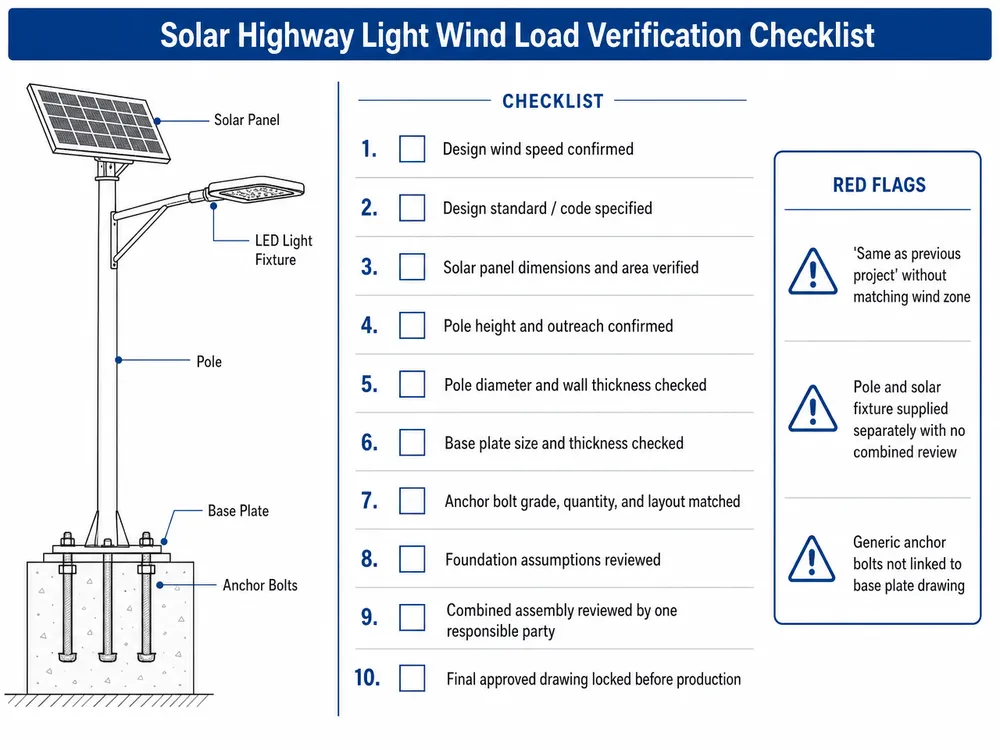
Supplier Verification Checklist Before Purchase Approval

Before approving a pole-fixture combination for a high-wind corridor project, work through these questions with the supplier. Each one connects to a specific failure mode or commercial risk.

On the rating basis:

  • What design wind speed and standard is the rating based on?
  • What exposure category or terrain condition was assumed?
  • Does the rating apply to the full pole-fixture-panel assembly, or only to the pole alone?

On the panel and bracket:

  • Does the calculation include the exact solar panel size and tilt angle for this order?
  • What is the bracket offset from the pole centerline?
  • What bracket wall thickness and weld specification are used?

On the pole structure:

  • What pole height, diameter, taper, wall thickness, and material grade are assumed?
  • Is the pole hot-dip galvanized or painted? What is the coating thickness?
  • What base plate dimensions and anchor bolt pattern are specified?

On the foundation:

  • What foundation assumptions are included — concrete grade, embedment depth, soil bearing capacity?
  • Are the anchor bolts treated as part of the structural package, or supplied separately?

On change control:

  • What configuration changes trigger a recalculation before production?
  • If panel wattage increases, does the supplier automatically flag the structural impact?

Tying each of these to commercial value: a supplier who can answer all of them reduces your warranty exposure, eliminates emergency freight for replacement poles, and gives your project approval package a defensible structural basis. A supplier who cannot answer them is transferring that risk to your project margin.

For a complete review of road lighting system options and configurations, see Solar Street & Roadway Lights Manufacturer.

Red flag: The supplier says "same as previous project" without confirming that the wind zone, pole height, and panel size match.

Red flag: The pole and solar fixture come from separate suppliers with no single party reviewing the combined assembly. This is more common than it should be on price-driven tenders.

Red flag: Anchor bolts are treated as generic accessories and sourced separately without reference to the pole base plate drawing.

Checklist for verifying solar highway light pole wind load claims before purchase approval

Specification Mistakes That Become Field Failures

These are the patterns we see repeatedly in projects that come back with structural problems. None of them are exotic engineering failures — they are procurement decisions that looked reasonable at the time.

Using average wind speed instead of design wind speed. Average annual wind speed for a region might be 6–8 m/s. The design wind speed for the same region under ASCE 7 or a local road code might be 40–50 m/s for a 50-year return period. These are not the same number, and using the wrong one produces a pole that is structurally inadequate for the actual risk environment.

Ignoring corridor exposure. An open coastal highway, a bridge deck, or an elevated road section has no upstream obstruction to reduce gust intensity. The effective wind pressure on the pole and panel assembly in these locations is higher than a standard urban street at the same nominal wind speed. Buyers who specify from a city-average wind zone without checking corridor exposure are underspecifying the structure.

Increasing panel wattage for autonomy without checking structural load. This is the most common late-stage mistake. The project autonomy calculation comes back short, so the panel wattage goes up — from 200W to 300W, or from 300W to 400W. The panel gets physically larger. The bracket gets heavier. Nobody rechecks the solar pole wind load calculation. The poles go up with a configuration that was never structurally reviewed.

Reducing pole wall thickness to cut freight cost. Thicker pole walls add weight, which adds freight cost. On a 500-unit order, the difference between a 3.5 mm and a 4.5 mm wall thickness is real money in a container. But wall thickness is a structural output, not a cost lever. Reducing it without recalculating the pole for the actual wind load and panel configuration is how you get pole lean after the first storm season.

Treating foundation design as separate from pole approval. The anchor bolt pattern, embedment depth, and concrete grade are part of the structural system. A pole that is correctly sized for the wind load can still fail if the foundation is undersized or if the anchor bolts are generic hardware that was not specified to match the base plate. Foundation assumptions should be part of the supplier's structural review, not a separate civil engineering afterthought.

Skipping drawing freeze before mass production. Configuration changes after production starts — a different panel bracket, a revised arm length, a substituted pole supplier — can invalidate the structural review without anyone flagging it. A drawing freeze before component procurement is the control point that prevents this.

Red flag: Price comparison focuses only on pole weight per kilogram and ignores the cost of a field failure: replacement labor, lane closure, warranty dispute, and project delay.

What to Send for Engineering Confirmation Before the Order Is Locked

We do structural review as part of the OEM/ODM process — it is not a separate service or an add-on. But the review is only as good as the data we receive. Here is what the engineering team needs to confirm a highway solar light structural specification before production:

  • Project country or region — to identify the applicable standard and wind zone map
  • Design wind speed — from the project code or road authority requirement, in m/s or km/h
  • Applicable standard — ASCE 7, EN 40, or the relevant national code
  • Road type and corridor condition — open terrain, coastal, bridge, elevated, or urban
  • Pole height — in meters, from ground to luminaire mounting point
  • Fixture power and lumen target — to confirm the luminaire size and weight
  • Solar panel wattage and physical dimensions — length, width, and tilt angle
  • Battery housing position — top-mounted, pole-integrated, or separate ground cabinet
  • Installation quantity — for production planning and component procurement
  • Road authority drawing requirements — if stamped calculations or specific drawing formats are required for project approval

With this data, we can confirm pole diameter, wall thickness, taper, base plate, anchor bolt pattern, and bracket design before any component is ordered. The structural review is done in-house — not outsourced to a third-party calculation service — because the engineers who review the pole are the same team that specifies the bracket weld and the anchor bolt grade. That connection matters when a project has a non-standard corridor condition or a tight approval timeline.

(We have seen projects where the buyer sent only lumen output and quantity. That is enough to quote a price, but not enough to confirm structural adequacy. The structural data needs to come with the RFQ, not after the PO is signed.)

If your project has a defined wind zone, pole height, and panel configuration, Request Quote with that data and the engineering team will include a structural specification with the commercial quote.

Buyer Questions That Deserve Short Answers

Can one solar street light wind load rating apply to every project?

No. A wind load rating is configuration-specific. It applies to a defined pole height, panel size, tilt angle, bracket geometry, and design wind speed. Change any of those variables and the rating no longer applies. A supplier who quotes a single wind rating for all projects without asking for site data is not doing a structural review — they are repeating a catalog number.

Does a thicker pole always solve wind resistance problems?

Not automatically. Wall thickness is one variable in the structural calculation. Pole diameter, taper, material grade, base plate dimensions, anchor bolt pattern, and foundation assumptions all contribute to the system's ability to resist wind load. Increasing wall thickness without reviewing the full system can add freight cost without addressing the actual failure mode — which is often at the bracket weld, the base plate, or the anchor bolt embedment.

Does IP65, IP67, CE, or IEC 62124 prove solar highway light pole wind resistance?

No. IP ratings confirm ingress protection against dust and water. CE marking covers electrical safety and EMC compliance. IEC 62124 covers solar photovoltaic system performance. None of these standards address pole structural adequacy or solar highway light pole wind resistance. Structural wind load verification requires a separate calculation based on the applicable structural standard for the installation jurisdiction.

Should integrated and split solar highway lights use the same wind load check?

Yes, with different inputs. An integrated design — where the panel is fixed to the luminaire housing — has a different projected area geometry than a split design with a separate panel on a side bracket. Both need a full system review: projected area, mounting height, bracket offset, pole structure, and foundation. The calculation method is the same; the input geometry is different. Do not assume an integrated design is automatically lower wind load — some integrated top assemblies are larger and heavier than a split panel on a compact bracket.

How Commercial Solar Street Lights Differ from Residential Models in Specs and Performance

The Grade Difference Is a Procurement Risk Decision

A residential-style solar street light can look attractive on a quotation sheet. The unit price is lower, the product photos look similar, and the supplier will often describe it using the same language — "solar street light," "IP65," "high lumen." The problem is not the label. The problem is what happens when that fixture goes onto a municipal road, a commercial campus access route, or a 200-pole parking lot project and the spec was never sized for the actual load.

The difference between commercial vs residential solar street lights is not a marketing tier. It is a system sizing decision. Commercial Solar Street Lights are engineered around project requirements: wattage and lumen output matched to road class and pole spacing, battery capacity calculated against nightly load and rainy-season autonomy, pole and bracket compatibility confirmed before production, and documentation available for tender review or import clearance. Residential models are built for a different job — driveways, private yards, garden paths, and retail single-unit demand where the failure cost is small and project documentation is not the buying standard.

The quick verdict: commercial solar street lights are the correct tier for municipal roads, commercial campuses, industrial access routes, parking areas, and repeat distributor programs. Residential models belong in lower-output private-property or retail channels. Some low-risk private sites can use residential-grade products, but not as substitutes for a solar street light for municipality, roadway, or bulk project procurement where lumen coverage, autonomy, compliance, and batch consistency are part of the acceptance criteria.

The rest of this article gives you the spec thresholds, the hidden cost logic, and the RFQ controls to tell the difference before you commit to a purchase order.

Spec Thresholds That Make Two Quotes Non-Comparable

The most common sourcing mistake we see is buyers comparing unit prices without first confirming that the two quotes are describing the same system. A 60W commercial fixture and a 20W residential fixture are not the same product with a different price — they are different systems with different coverage geometry, different battery sizing, and different failure profiles.

Here are the planning anchors we use when reviewing project specs:

Criterion Commercial-Grade Anchor Residential-Grade Anchor Buyer Consequence
LED power 60W–200W typical project range 10W–40W common retail range Quotes are not comparable unless wattage and tested lumen output are both stated
Lumen output 6,000–20,000 lm for road, campus, parking, and industrial layouts 800–4,000 lm for driveway, yard, garden, or low-risk private use Low lumens force more poles or create dark zones that generate project complaints
Battery sizing Matched to nightly load, dimming schedule, and required autonomy days Smaller pack with runtime often based on low-mode operation Undersized batteries fail first during rainy-season or cloudy-week operation
Solar panel wattage Sized to recover nightly discharge within the local peak sun hours Often undersized relative to the battery capacity Insufficient charging means the battery never fully recovers after consecutive cloudy days
Pole height and mounting Roadway pole and bracket compatibility, typically 6–12 m mounting heights Shorter private-property mounting or wall/post installation Wrong mounting height changes beam spread, glare angle, and coverage uniformity
IP protection IP65 minimum; IP67 where submersion risk exists Basic waterproof claim or lighter-duty housing Public-site water ingress becomes warranty cost and site-visit labor
IK rating IK08–IK10 for public-exposure or vandalism-risk sites Often not rated or not tested Impact damage on public sites creates replacement cost and liability exposure
Certifications CE, RoHS, IEC 62124, and order-level documentation where required Often retail listing claims without project submittal files Missing documents can delay tender approval or import review
QC evidence Lumen binning, battery matching, aging test, waterproof inspection, 100% outgoing check Limited final visual check or mixed-source assembly Batch inconsistency becomes reorder and warranty risk
Order model Bulk project, distributor reorder, OEM/ODM, MOQ planning Single-unit or small retail purchases Sourcing strategy affects landed cost, packaging, labels, and after-sales exposure

The wattage and lumen thresholds above are planning anchors, not universal guarantees — actual project specs depend on road class, pole spacing, mounting height, and local solar resource. What the table shows is that a high wattage solar street light in the commercial range is a fundamentally different procurement object than a residential fixture, and comparing their unit prices without aligning the spec is how projects end up with dark roads and warranty disputes.

Commercial and residential solar street light specification matrix comparing wattage, lumens, battery autonomy, pole height, and certification checks

Lumen Output and Pole Height Decide Real Road Coverage

Wattage gets quoted. Lumens decide whether the road is actually lit.

A 100W fixture with poor-quality LED binning can deliver fewer usable lumens on the road surface than a well-engineered 80W unit with matched optics and a proper beam distribution pattern. This is why solar street light lumen output comparison between two quotes needs to go beyond the headline number — you need tested lumen output, not rated input power, and you need to know how that output is distributed across the road width at your planned mounting height. Our solar street light lumen guide covers the calculation in detail, but the planning logic starts here.

For commercial projects, the coverage geometry matters because you are repeating the same pole layout across dozens or hundreds of positions. A 5% lumen shortfall per fixture becomes a systematic dark-zone problem across the entire installation. Residential models are typically designed to light a smaller patch — a driveway, a yard entrance, a garden path — where the coverage geometry is forgiving and a single fixture's performance variation doesn't cascade into a project acceptance dispute.

Here is how the spec variables change by application type:

Application Typical Lumen Range Mounting Height Key Spec to Confirm
Municipal road or public street 8,000–20,000 lm 8–12 m Lumen output, beam distribution, autonomy days, CE/IEC 62124 docs
Commercial campus or factory road 6,000–15,000 lm 6–10 m Lumen output, pole bracket compatibility, IP65/IP67
Parking lot access lane 4,000–10,000 lm 5–8 m Coverage uniformity, IK rating for exposed areas
Driveway or private commercial entrance 2,000–6,000 lm 4–6 m Runtime, basic IP rating, unit price
Garden path or private yard 800–3,000 lm 2–4 m Aesthetics, low-mode runtime, retail price point

The practical rule: if your project requires predictable coverage across repeated pole positions, you need a commercial-grade fixture with confirmed lumen output and matched optics. Residential models are not engineered for that geometry — they are engineered for a single-point installation where "bright enough" is the acceptance standard.

(One thing we check on every commercial project quote: whether the lumen figure is measured at the fixture or at the road surface. The difference can be 20–30% depending on optics and mounting height — and that gap is where project complaints start.)

Battery Autonomy Is the Hidden Cost Behind the Cheap Unit Price

My signature observation after a decade of this work: a solar street light that fails in year one almost always traces back to a battery autonomy spec that wasn't sized for the buyer's actual rainy season.

This is the hidden cost that makes a cheap residential-grade fixture expensive in a commercial setting. The unit price looks attractive. The battery failure shows up 8–14 months later, after the rainy season has run the pack down to a state it can't recover from. By then, you are paying for site visits, replacement units, and the labor to swap fixtures on poles — costs that were never in the original project budget.

Commercial battery autonomy sizing starts with a calculation, not a product listing. The inputs are: nightly load (wattage × operating hours, adjusted for dimming schedule), local peak sun hours for the installation latitude, rainy-season duration and typical consecutive cloudy days, and the target autonomy days the project requires. A project in Southeast Asia with a 15-day rainy season needs a meaningfully larger battery pack than the same fixture installed in the Middle East with 340 sunny days per year. Residential runtime claims are almost never calculated this way — they are typically based on low-mode operation under ideal conditions, which tells you nothing about how the fixture performs during a week of overcast weather.

The commercial risk runs in both directions. Undersized battery saves unit cost but creates field failure, warranty replacements, and project complaints. Oversized battery without calculation wastes margin and adds freight cost and housing weight without improving performance. The right answer is a battery pack sized to the actual load profile, not a round number chosen to look impressive on a spec sheet.

At JXSOL, battery matching is a production step, not an afterthought. We test charge/discharge cycles on matched cell groups before assembly, and we size the pack to the fixture's actual nightly load and the buyer's stated autonomy requirement. When a buyer tells us they need 3 autonomous days for a project in northern Europe, we calculate backward from that requirement — not forward from whatever cell inventory is cheapest that week. The full methodology is covered in our solar street light battery spec guide.

The IP rating solar street light commercial grade question connects here too. A battery pack that is properly sized but housed in a fixture with inadequate waterproofing will still fail — water ingress into the battery compartment is one of the most common causes of premature capacity loss. IP65 is the minimum for outdoor commercial use; IP67 is worth specifying for installations in flood-prone areas or where the fixture is mounted at low heights with standing water risk.

Hidden cost stack showing how residential solar street light substitution can add replacement, labor, warranty, and project delay costs

Ratings and Documents Decide Municipal Acceptance

A waterproof claim on a product listing is not the same as an IP65 rating backed by test documentation. For a solar street light for municipality, contractor, or infrastructure project, the difference between those two things can be the difference between a project that clears tender review and one that gets held at the import stage.

Here is what the ratings and documents actually mean in procurement terms:

IP65/IP67 — Ingress protection against dust and water. IP65 means the fixture is dust-tight and protected against water jets from any direction. IP67 adds submersion protection to 1 meter for 30 minutes. For public road and commercial site installations, IP65 is the baseline. IP67 is worth specifying for low-mounting or flood-risk locations. The rating needs to be backed by a test report, not just printed on the carton.

IK rating — Impact protection. IK08 means the fixture housing withstands 5 joules of impact; IK10 means 20 joules. For public-exposure sites — municipal roads, transit areas, commercial campuses with vehicle movement — an IK rating matters because vandalism and accidental impact are real failure modes. Residential fixtures are often not IK-rated at all, which is fine for a private garden but not for a public street pole.

CE and RoHS — Required for export to European markets and increasingly expected in other regulated markets. CE covers electromagnetic compatibility and low-voltage safety. RoHS restricts hazardous substances. Both require documentation that can be submitted with a tender package or import declaration. A supplier who cannot produce CE test reports on request is not a compliant source for European project procurement.

IEC 62124 — The international standard for stand-alone solar lighting systems. It covers system performance, battery sizing methodology, and field verification. For municipal and infrastructure buyers, IEC 62124 compliance documentation is increasingly part of the project specification — it is the standard that separates engineered solar lighting systems from assembled products with unverified runtime claims.

Batch traceability — For project orders, you need to be able to trace a warranty claim back to a production batch. That means lot numbers, test records, and inspection reports that travel with the shipment. Residential-grade supply chains rarely maintain this level of documentation because their buyers don't require it.

JXSOL holds ISO 9001:2015, CE, RoHS, IP65/IP67, and IEC 62124 certifications, and we can provide order-level documentation packages for project procurement. (We've had buyers come to us specifically because their previous supplier couldn't produce the IEC 62124 paperwork their municipal client required — that's a project delay that costs more than the price difference between suppliers.)

Factory Controls Behind Commercial-Grade Batch Consistency

Commercial grade is not a label you print on a carton. It is the output of a production system that controls the variables that matter — lumen output, battery capacity, waterproof integrity, and controller behavior — consistently across every unit in a batch and every batch in a reorder program.

We have been building solar-powered outdoor lighting since 2012. The factory is 12,000 square meters in Guzhen Town, Zhongshan — the center of China's lighting manufacturing industry — with 6 production lines and annual capacity of 1,200,000 units. That scale matters not because of the number itself, but because it means we run the same production controls on a 200-unit project order that we run on a 50,000-unit distributor program. The QC infrastructure doesn't change based on order size.

Here is what commercial-grade batch consistency actually requires at the production level:

LED module assembly and lumen binning — We sort LED chips by lumen output and color temperature before assembly, so the fixture you receive matches the spec sheet and the fixtures in your next reorder match the fixtures in your first order. Mixed-source assembly skips this step, which is why batch-to-batch lumen variation is one of the most common complaints in solar street light procurement.

Battery pack matching and charge/discharge testing — Cell groups are matched by capacity and internal resistance before assembly into packs. Every pack goes through a charge/discharge cycle test before it goes into a fixture. This is the step that catches weak cells before they become field failures. We switched to automated cell matching in 2021 after seeing too many early-life capacity drops traced back to unmatched cell groups in manually assembled packs.

Automated SMT production lines — Our 15+ optical and electrical engineers run automated surface-mount technology lines for the control board assembly. Manual soldering introduces joint variability that shows up as controller failures in the field — automated SMT eliminates that failure mode.

Aging tests and waterproof structure inspection — Assembled fixtures run through an aging test before final inspection. Waterproof integrity is checked on every unit, not sampled. A fixture that passes a visual check but has a compromised seal will fail in the field within one rainy season.

100% pre-shipment inspection — Every unit in every outgoing order is inspected before it ships. Not sampled — every unit. For project buyers, this means the inspection record travels with the shipment and is available for your incoming QC review.

MOQ starts at 100 units for standard models, which means you can validate a commercial spec on a real project quantity before committing to a full program. OEM customization — autonomy days, color temperature, wattage, pole mount configuration, packaging, and labeling — is available with engineering review before production lock-in.

Market Segment Winner Map for Project and Distribution Decisions

The right grade depends on what the project requires, not on what the supplier calls the product. Here is the decision by segment:

Scenario Recommended Grade Spec Trigger Commercial Reason
Municipal road or public street Commercial 8,000+ lm, IP65/IP67, CE/IEC 62124 docs, 3+ autonomy days Lumen coverage, pole compatibility, documentation, and acceptance support are all required
Industrial park, logistics road, or commercial campus Commercial 6,000+ lm, IP65, autonomy sizing, batch consistency Downtime and poor coverage create safety complaints, warranty cost, and repeat-order risk
Parking lot access lane or private commercial entrance Commercial (residential only for low-risk small areas) Depends on pole count, coverage area, and operating hours Multiple poles mean batch consistency matters; safety requirements usually push to commercial grade
Distributor retail SKU line for homeowners Residential 800–4,000 lm, retail price point, single-unit packaging Lower lumen and lower unit cost fit retail margin when documentation and project uptime are not the buyer expectation
100-unit project validation order Commercial with locked spec Full spec documentation, autonomy calculation, CE/IEC 62124 MOQ from 100 units lets buyers validate project-grade performance before scaling to full program
Garden path, yard, or decorative private property Residential 800–2,500 lm, aesthetic design, low-mode runtime Lower output is acceptable where failure cost and coverage requirements are limited

The solar street light spec for parking lot vs driveway question comes up often. The short answer: a parking lot with repeated poles and safety requirements is a commercial project. A private driveway with one or two fixtures is a residential application. The line is not about the physical space — it is about whether the project depends on consistent coverage, documentation, and reorder reliability.

For buyers building a distribution catalog, the two grades serve different channels and should be sourced and positioned separately. Mixing them under the same SKU program creates warranty exposure when a residential-grade fixture ends up in a commercial installation through a downstream customer.

Browse the full Solar Street & Roadway Lights Manufacturer category to see how commercial-grade specifications map to specific product configurations.

Decision matrix showing when to choose commercial solar street lights or residential solar street lights by project type and risk level

RFQ Spec Lines That Stop Residential-Grade Substitution

The most reliable way to prevent a residential-grade fixture from appearing in a commercial project quote is to make the spec explicit enough that a substitution is visible before you sign the purchase order. Vague RFQ language — "solar street light, 100W, IP65" — leaves room for a supplier to quote a residential-grade product at a commercial-grade price. Specific RFQ language closes that gap.

Here are the fields that should be locked in every commercial solar street light RFQ:

  • LED wattage and tested lumen output — both numbers, not just wattage. Ask for the lumen figure from a third-party test report, not the supplier's spec sheet.
  • Battery chemistry, Wh capacity, and autonomy target — state the required autonomy days and the dimming schedule used for the calculation. A supplier who cannot show the calculation is guessing.
  • Solar panel wattage and charging assumptions — confirm the panel is sized to recover the nightly discharge within the local peak sun hours for your installation latitude.
  • Pole height, arm, bracket, and mounting method — confirm compatibility before production, not after delivery.
  • IP rating and IK rating — require test documentation, not just a printed claim. For public-exposure sites, specify IK08 minimum.
  • CE, RoHS, IEC 62124, and IP documentation — ask whether these are available as order-level documents for your project file. A supplier who hedges on this question is not a compliant source for regulated markets.
  • Aging test, battery matching, lumen binning, and outgoing inspection records — ask what QC steps are performed and whether records are available per shipment.
  • MOQ, packaging, label, and OEM/ODM requirements — confirm these match your program before the quote is finalized.

A supplier quote that is significantly below project-grade pricing almost always means one of these spec lines has been quietly downgraded — smaller battery, lower-grade cells, no lumen binning, or no documentation. The price gap is real, but it is not a sourcing advantage. It is a cost that moves into your warranty budget and your project timeline.

JXSOL's OEM customization scope covers autonomy days, CCT, wattage, pole mount configuration, packaging, and labeling — all locked before production with an engineering review. If your project has specific inputs, submit them through our Request Quote page with your road classification, required lumen output, pole height, and target order volume.

FAQ: Commercial vs Residential Solar Street Light Selection

What wattage separates commercial solar street lights from residential models?

The practical planning threshold is 60W as the lower bound for commercial-grade fixtures. Commercial solar street lights typically run 60W–200W depending on road class, pole spacing, and lumen requirement. Residential models are generally 10W–40W, sized for driveways, yards, and garden paths where coverage geometry is forgiving. Wattage alone is not the full answer — a high wattage solar street light still needs confirmed lumen output and matched optics to deliver the coverage a commercial project requires. A 100W fixture with poor LED binning can underperform a well-engineered 80W unit on the road surface.

How many lumens do commercial solar street lights need compared with residential lights?

For a solar street light lumen output comparison: commercial-grade fixtures for road, campus, parking, and industrial applications typically deliver 6,000–20,000 lm depending on mounting height and pole spacing. Residential models are generally 800–4,000 lm, which is sufficient for a driveway or private yard but not for a repeated road layout where coverage uniformity across multiple poles is the acceptance standard. The lumen figure should come from a tested output measurement, not from the LED chip's rated input power.

Can residential solar street lights be used for a municipality?

Not reliably. A solar street light for municipality needs to meet lumen coverage standards for the road class, carry CE and IEC 62124 documentation for tender review, be sized for the local rainy-season autonomy requirement, and maintain batch consistency across the full installation. Residential models are not engineered or documented to those standards. Using them in a municipal project creates acceptance risk, warranty exposure, and documentation gaps that can delay project completion or trigger replacement costs within the first year.

What IP rating should a commercial-grade solar street light have?

IP65 is the minimum for outdoor commercial and public-site installations — it provides dust-tight protection and resistance to water jets from any direction. IP67 is worth specifying for low-mounting heights or flood-risk locations, as it adds submersion protection. The IP rating solar street light commercial grade requirement also extends to the battery compartment specifically — a fixture with an IP65 housing but a poorly sealed battery access panel will still fail from water ingress. Always ask for the test report, not just the printed rating.

Why do commercial solar street lights need larger batteries than residential models?

Because the load is larger and the autonomy requirement is real. A commercial fixture running at 80W–120W for 10–12 hours per night with a 3-day autonomy requirement needs a battery pack sized to that calculation — typically 400–800 Wh or more depending on the dimming schedule and local solar resource. Residential models are sized for a smaller load and shorter runtime, often under low-mode conditions that don't reflect actual project operating hours. The commercial solar street light battery autonomy days requirement is a calculated spec, not a product feature — and a supplier who cannot show the calculation is not sizing the battery correctly.

How to Spec Solar Street Light Autonomy Days for Reliable Performance Through Rainy Season

A solar street light that passes its first sunny-season test can still fail three months later. The failure almost always traces back to the same place: a battery autonomy spec that wasn't sized for the buyer's actual rainy season. The light ran fine when the panels were charging daily. Then the clouds came, the battery ran down, and the road went dark.

Solar street light autonomy days is the number of consecutive low-sun or no-sun nights a system can sustain its required lighting schedule before the battery drops below its minimum usable threshold. It is not a marketing claim. It belongs in the spec sheet, and it needs to be defined precisely enough that two factories quoting the same project are actually quoting the same thing.

The problem with most "3 days backup" claims in supplier catalogs is that they leave out the variables that determine whether that number is real: what load, what dimming schedule, what battery chemistry, what usable depth of discharge, and under what test conditions. Without those inputs, you cannot compare quotes, and you cannot hold a supplier accountable when the lights go dark in week two of the rainy season.

We build Solar Street & Roadway Lights as our core product line, and battery autonomy sizing is where we spend the most engineering time on project orders. This article explains how to calculate the right autonomy target, how climate and road type should shape that target, and what factory controls actually determine whether the rated autonomy is delivered in the field.

The battery sizing math that belongs in your quote review

Autonomy days are not a single number you pick from a catalog. They are the output of a calculation that starts with your nightly energy demand and works backward to the battery capacity required to sustain that demand across the target number of no-sun nights.

The core logic:

Step Variable Notes
1 Nightly energy consumption (Wh) Fixture wattage × operating hours × dimming profile factor
2 Required stored energy (Wh) Nightly consumption × target autonomy days
3 Usable battery capacity (Wh) Required stored energy ÷ usable depth of discharge (DoD)
4 Nominal battery capacity (Wh) Usable capacity ÷ system efficiency factor (controller loss, wiring loss)
5 Battery pack spec Convert to Ah at system voltage, then add temperature margin

The dimming schedule matters more than most buyers expect. A 60W fixture running full output from dusk to dawn draws roughly 480Wh per night on a standard 8-hour schedule. The same fixture on an adaptive dimming profile — full output for 4 hours, 50% for the remaining 4 — draws around 360Wh. That 25% difference compounds across every autonomy day in the calculation. A 3-day autonomy spec on the full-output profile requires a meaningfully larger battery than the same spec on an adaptive profile.

Usable depth of discharge is the other variable that separates real autonomy from nameplate capacity. LiFePO4 cells are typically sized at 80–90% usable DoD in solar street light applications. Lead-acid packs are usually derated to 50–60% to protect cycle life. A 100Ah LiFePO4 pack and a 100Ah lead-acid pack do not deliver the same autonomy — the lead-acid pack is effectively half the size for this calculation. (We see this misunderstanding in quote comparisons regularly. Two factories quote "100Ah battery" and the buyer assumes they're equivalent. They're not, unless the chemistry and DoD assumption are both stated.)

Oversizing the calculation wastes budget and adds weight and freight cost. Undersizing creates the rainy-season failure risk you're trying to avoid. The right answer is a calculation anchored to your actual project inputs, not a round number from a catalog.

For buyers working through full system design beyond battery autonomy, the solar street lighting design guide covers panel sizing, pole load, and road standard compliance together.

Solar street light autonomy days sizing flow from nightly load to battery capacity and rainy-season backup target

Climate zone and road type set the backup target

There is no universal answer to "how many autonomy days for a solar street light in rainy season." The right target depends on where the project is, how long the low-sun period runs, and what happens to the road if the lights go dark.

Use this as a planning reference, not a guarantee. Local irradiance data and project risk tolerance should always be confirmed before finalizing the spec.

Climate condition Solar recovery risk Typical autonomy discussion range Buyer caution
Arid / high-sun (Middle East, North Africa) Low 1–2 days often sufficient for low-risk roads Dust accumulation on panels can reduce effective charging — factor in cleaning schedule
Tropical rainy season (Southeast Asia, West Africa, Central America) High during monsoon 3–5 days is the practical discussion range for municipal roads Consecutive overcast days can exceed 5 in some zones — confirm local weather data
Coastal storm-prone (typhoon belts, hurricane corridors) High, episodic 3–5 days minimum; consider panel tilt and IP67 housing Storm surge and salt spray add failure modes beyond battery autonomy
High-latitude winter (Northern Europe, Canada, northern China) Very high in winter months System redesign may be needed; autonomy alone may not solve the problem Short winter days reduce daily charge input significantly — panel capacity often needs to increase alongside battery

Road criticality is the other axis. A highway or municipal arterial road has a different uptime requirement than a decorative pathway in a residential development. For highways and industrial access roads, we recommend treating the autonomy target as a minimum floor, not a midpoint. A project failure on a highway — lights out for three nights during a storm — creates acceptance disputes, warranty claims, and sometimes safety liability. The cost of an extra day of battery capacity is small compared to that risk.

For lower-criticality applications like park paths or decorative streetscaping, a tighter autonomy spec is commercially reasonable. The goal is matching the spec to the actual project risk, not defaulting to the largest number available.

Climate zone decision matrix for choosing solar street light autonomy days in rainy and cloudy seasons

Extra backup days change cost, housing, and freight

Every additional autonomy day adds battery capacity, and battery capacity has a direct cost chain: more cells, heavier pack, larger enclosure, higher shipping weight, and sometimes a different carton dimension that affects container loading efficiency.

A 3-day autonomy spec on a 30W fixture in a tropical climate might require a 60–80Ah LiFePO4 pack. Pushing that to 5 days on the same fixture and schedule could require 100–120Ah. That difference affects the housing design, the pole bracket load calculation, and the per-unit landed cost. For a 500-unit project order, the cost difference is not trivial.

The risk runs in both directions. Undersizing creates field failure and warranty exposure. Oversizing reduces your margin and can make your quote uncompetitive against a supplier who sized correctly for the same project. The buyer who automatically selects the largest backup claim in a catalog comparison is not necessarily buying the best product — they may be buying an oversized battery that adds cost without adding reliability for their specific climate.

All-in-one solar street lights have an additional constraint worth noting: the battery compartment is integrated into the fixture housing, so thermal management and physical space limit how much capacity can be packed in. If your project requires 5+ days of autonomy in a compact all-in-one form factor, confirm the battery chemistry, pack configuration, and heat dissipation design before committing. The all-in-one solar street light specifications guide covers these constraints in detail.

When comparing quotes, confirm that all suppliers are working from the same autonomy definition: same load profile, same dimming schedule, same battery chemistry, same usable DoD assumption. A quote comparison without those inputs aligned is not a real comparison.

Factory battery matching decides whether rated autonomy is real

This is where most autonomy failures actually originate — not in the calculation, but in the battery pack assembly.

A battery pack's real capacity is limited by its weakest cells. If a 100Ah pack is assembled from cells with 5% capacity variance and no internal resistance matching, the pack will behave like a 90–95Ah pack in the field, and it will degrade unevenly. After 200–300 charge cycles — roughly one to two years of operation — the weakest cells will have degraded further, and the effective autonomy will have dropped below the rated spec. That's the failure pattern we saw repeatedly in early solar street light deployments, and it's why we built our production system around battery matching from the start.

We started in 2012 with a narrow focus on solar-powered outdoor lighting for export markets. Battery failures after one rainy season were one of the three original failure points we built our production system around. The others were inconsistent lumen output between batches and waterproof claims that didn't survive field conditions. Battery matching and charge/discharge testing became non-negotiable parts of our process because we saw what happened when they were skipped.

The factory controls that determine whether rated solar street light autonomy days are actually delivered:

  • Cell capacity grading: incoming cells are sorted by measured capacity before pack assembly. Cells within a pack should be matched to within a tight tolerance — we target ±2% capacity variance within a pack.
  • Internal resistance matching: high internal resistance in one cell creates heat and accelerates degradation. Resistance matching at assembly prevents the weak-cell failure pattern.
  • Charge/discharge cycle testing: assembled packs are cycled under load before installation into fixtures. This catches capacity shortfalls and cell defects that don't appear in static measurements.
  • Controller function verification: the charge controller determines how the battery is charged and discharged. A misconfigured or defective controller can undercharge the pack, reducing effective autonomy even when the battery itself is correctly sized.
  • Aging test under load: packs are held on aging racks at operating temperature before shipment. This screens out early-life failures that would otherwise appear in the field during the first rainy season.
  • Batch traceability: every pack is traceable to its cell lot, assembly date, and test results. If a field failure occurs, we can identify whether it's a batch issue or an isolated unit.
  • 100% pre-shipment inspection: every unit is inspected before it leaves the factory. For battery-related checks, this includes a final capacity verification and a controller function test.

Our in-house testing lab handles battery pack testing alongside lumen verification and IP65/IP67 ingress protection checks. CE, RoHS, and IEC 62124 certification covers the system-level compliance requirements, but those certifications don't substitute for the pack-level matching and cycle testing that determines real-world autonomy. A certified fixture with a poorly matched battery pack will still fail in year one.

Battery pack matching and charge discharge testing workflow for solar street light autonomy performance

RFQ inputs that prevent autonomy misunderstandings

The most common source of autonomy disputes in project orders is not a dishonest supplier — it's an RFQ that didn't define the spec clearly enough for two factories to quote the same thing. "3 days backup" without supporting inputs is not a specification. It's a starting point for a misunderstanding.

When you send an RFQ for a project that requires defined solar street light autonomy days, include these inputs:

  • Project city or latitude — solar irradiance varies significantly by location; this is the foundation of any autonomy calculation
  • Rainy season or cloudy season pattern — how many consecutive low-sun days does the worst-case period typically produce?
  • Required lighting hours per night — dusk-to-dawn, or a defined schedule?
  • Full-output and dimming schedule — what percentage of output, and for which hours?
  • Target lumen output or road class — this determines fixture wattage, which drives the load calculation
  • Required autonomy days — state this as a minimum, not a preference
  • Mounting height and pole spacing — affects fixture selection and sometimes battery sizing for adaptive systems
  • Battery chemistry preference — LiFePO4 or lead-acid, if already specified by the project
  • Certification or documentation requirements — CE, IEC 62124, DLC, or local market requirements
  • Sample testing expectations — will you test autonomy on samples before production approval?

A clear RFQ forces every factory to quote against the same spec. It also gives you a basis for holding the supplier accountable if the delivered product doesn't meet the stated autonomy under the stated conditions. Without it, you're comparing catalog claims, not engineering commitments.

When your project inputs are ready, you can submit them directly through our Request Quote page — our engineering team reviews location, load profile, and autonomy target before confirming the battery and panel configuration.

Where to spend on backup and where to control cost

Not every project needs the same autonomy target, and not every way to improve rainy-season reliability requires a larger battery.

Municipal and roadway projects carry the highest acceptance risk. A road that goes dark during a storm creates a public safety issue and a contract dispute. For these projects, treat the autonomy target as a floor and build in margin. The cost of an extra 20Ah of battery capacity is small compared to the cost of a failed acceptance test or a warranty replacement campaign.

Highway and remote road projects have a different problem: service access is expensive. If a light fails on a remote highway, the repair cost — travel, labor, logistics — can exceed the cost of the fixture. Higher autonomy and more conservative battery sizing make commercial sense here even if the climate doesn't strictly require it.

Industrial parks and logistics roads usually have a defined security lighting requirement. The autonomy target should be set to cover the longest expected low-sun period in the project's climate zone, with enough margin that a single extended cloudy period doesn't trigger a service call.

Distributor stock SKUs are a different calculation. You're not sizing for one project — you're choosing a spec that works across the range of climates your buyers operate in. A practical middle spec (typically 3 days for tropical and subtropical markets) covers most use cases without the cost and weight penalty of a 5-day configuration. If your distribution territory spans both arid and tropical climates, consider stocking two SKUs rather than over-specifying one.

One point worth making directly: if your project is in a high-latitude winter market where daily solar input drops to 3–4 hours, adding more battery capacity alone may not solve the problem. The panel needs to be sized to recover the battery within the available charge window. Sometimes the right answer is a larger panel and a moderate battery, not a larger battery with an undersized panel. We've seen projects where buyers specified 5-day autonomy but the panel was too small to recover the battery in winter — the system ran down progressively over the season regardless of battery size.

FAQ

Is 3-day autonomy enough for solar street lights in rainy season?

It depends on the climate and the road type. For tropical markets with monsoon seasons, 3 days covers most normal rainy periods but may not cover extended storm events. For municipal roads and highways, we recommend treating 3 days as a minimum and confirming local weather data for the worst-case consecutive overcast period. For lower-criticality applications in moderate climates, 3 days is often sufficient. The number only means something when the load profile, battery chemistry, and usable DoD are also stated.

What is the difference between autonomy days and battery backup days?

In practice, suppliers use both terms, but they don't always mean the same thing. "Battery backup days" in a catalog often refers to the theoretical number of nights the nameplate battery capacity could sustain the fixture — without specifying the load, the dimming schedule, or the usable depth of discharge. "Autonomy days" as an engineering spec should include all of those inputs. When reviewing a quote, ask the supplier to state the autonomy calculation: fixture wattage, operating hours, dimming profile, battery chemistry, usable DoD, and the resulting backup duration. If they can't provide that, the number in the catalog is not a reliable spec.

Should I increase the battery or the solar panel first for cloudy climates?

Start with the panel. A larger battery stores more energy, but if the panel can't recover that energy within the available daily charge window, the battery will run down progressively over a multi-day cloudy period. The right approach is to size the panel for the worst-case daily charge input in your climate, then size the battery for the target autonomy days at that load. In high-latitude winter markets especially, panel capacity is often the binding constraint, not battery capacity.

How does dimming mode change the autonomy calculation?

Significantly. A fixture running full output all night draws roughly 25–40% more energy than the same fixture on an adaptive dimming profile. That difference compounds across every autonomy day. A 3-day autonomy spec on a full-output schedule requires a larger battery than the same spec on an adaptive schedule. When comparing quotes, confirm that both suppliers are using the same dimming assumption — a supplier quoting adaptive dimming against your full-output requirement will appear to offer better autonomy at lower cost, but the comparison isn't valid.

What proof should a supplier provide for a solar street light autonomy claim?

At minimum: the battery capacity specification (chemistry, Ah, voltage), the usable depth of discharge assumption, the fixture wattage and operating schedule used in the calculation, and charge/discharge test results from the assembled pack. For project orders, ask for a sample unit and test the autonomy yourself under controlled conditions before approving production. A supplier who can't provide the calculation inputs or the test data is quoting a catalog claim, not an engineering commitment. IEC 62124 covers solar home system testing methodology and is sometimes referenced for solar street light battery performance — ask whether the supplier's testing protocol aligns with it.

How to Evaluate Solar Street Light Manufacturers and Source from the Right Factory

Start With the Failure Points, Not the Supplier List

One approved sample does not prove batch consistency. That's the real problem when sourcing from solar street lighting manufacturers — the sample looks right, the price is acceptable, and then the first container arrives with battery packs that drain in two days, lumen output that varies 20% across units, or housings that leak after the first rainy season.

A real solar street light manufacturer controls the full production chain: component selection, LED module assembly, battery cell matching, controller configuration, waterproof structure, in-process testing, and pre-shipment inspection. A supplier who assembles from whatever components are available that week cannot reproduce your approved sample reliably at reorder scale.

The commercial risks are specific. Battery failures after one rainy season are the most common warranty driver — usually caused by unmatched cells or skipped charge/discharge testing. Lumen inconsistency across a batch creates downstream complaints from your customers and complicates project acceptance. Waterproof shortcuts that pass visual inspection fail in humid storage or coastal installation. Non-matching certificates create import clearance problems. And suppliers who cannot reproduce the approved sample at scale turn your second order into a new sourcing project.

This guide works through the decision path: factory control, specifications, QC workflow, production capacity, customization, export documentation, and the RFQ questions that separate real manufacturing control from thin assembly.

Factory Control Changes Your Warranty Exposure

The most important distinction in solar street lighting manufacturers is not price — it's how much of the production chain the supplier actually controls. Three supplier types dominate the market, and they carry very different risk profiles.

Supplier Type Component Control Engineering Support Quality Traceability Reorder Consistency Documentation
Trading company None — sources from multiple factories None on-site Depends on factory used Low — factory changes between orders Inconsistent
Assembly-only workshop Partial — buys components, assembles Limited Batch-level at best Moderate — depends on component sourcing Basic
Integrated manufacturer Full — in-house component testing, assembly, QC On-site engineering team Full batch traceability High — same line, same process, same components Complete

JXSOL is the export brand of Zhongshan Century Juxing Optoelectronics Technology Co., Ltd., based in Guzhen Town, Zhongshan, Guangdong — the center of China's lighting manufacturing industry. We've focused on solar-powered outdoor lighting since 2012, and our R&D team, production lines, and inspection lab are all in the same building where the product is assembled. There's no handoff to a third-party factory between your order and your shipment.

That integration matters commercially. When the same engineering team that designed the product also runs incoming inspection and signs off on outgoing quality, warranty claims trace back to a specific batch, a specific component lot, and a specific production checkpoint — not to a supplier who sourced from three different factories that month.

For buyers building a distributor program or supplying project contracts, fewer warranty claims and repeatable SKU quality are the two things that protect margin over time. See the full solar street and roadway lighting range for the product scope we manufacture in-house.

Specs That Must Be Locked Before Price Comparison

The cheapest quote is meaningless until the buyer confirms the real configuration. Solar street light pricing varies by 40–60% across the market — and most of that variation is hidden in the specs, not in the margin.

Spec Item What to Ask the Manufacturer Why It Changes Your Commercial Risk
All-in-one vs split configuration Which design is quoted? Are both available? All-in-one suits standard roads; split suits high-wind or high-lumen applications. Mixing them in a project creates installation and warranty complexity.
LED module output and lumen target What is the tested lumen output at the module level, not just the chip rating? Chip ratings are theoretical. Module-level lumen output after thermal management is what your buyer's project actually delivers.
Battery chemistry and capacity LiFePO4 or Li-ion? What is the rated Ah capacity and how many autonomy days? LiFePO4 has longer cycle life and better thermal stability — relevant for hot climates and coastal markets. Autonomy days determine whether the light survives a cloudy week.
Solar panel wattage What wattage is quoted, and for which target latitude? A panel sized for Southeast Asia will underperform in Northern Europe or Canada. Mismatched panel sizing is the most common cause of early battery failure.
Controller and dimming logic Is the controller programmable? What dimming modes are available? Fixed-output controllers waste battery capacity. Programmable dimming extends autonomy and reduces warranty claims in markets with long winter nights.
PIR or smart control Is PIR standard or optional? What is the detection range and delay? PIR motion sensing is a margin-protection feature — it lets your buyer sell a smarter product at a higher price point.
IP rating Is IP65 or IP67 tested on the specific model, or assumed from housing design? IP ratings that are assumed rather than tested fail in field conditions. Ask for the test certificate, not just the spec sheet claim.
Housing and pole compatibility What pole diameter and mounting interface does the housing support? Pole compatibility mismatches create installation delays and project cost overruns.
Installation accessories What is included in the carton? Mounting hardware, remote, manual? Missing accessories generate after-sales complaints and warranty claims that cost more to resolve than the accessories themselves.

For standard solar street lights, locking these specs before requesting price protects your landed cost calculation. For all-in-one solar street lights and split solar street lights, the configuration choice itself changes the installation cost and the warranty risk profile. Smart solar street lights add sensor logic and dimming variables that need to be confirmed at the engineering level before pricing.

Solar street light RFQ checklist showing battery, panel, LED, controller, housing, and waterproof specifications.

Battery, LED, Controller, and Waterproof Tests Decide Real Quality

Most solar street light failures in the field trace back to four production shortcuts: battery cells not matched by capacity and internal resistance, LED output drifting across a batch, controller settings that don't match the project's autonomy requirements, and waterproof structures that pass visual inspection but fail under real rain, dust, or humid storage conditions.

We've built our production system around those four failure points specifically because they were the most common buyer complaints when we started in 2012. The process hasn't changed in structure — it's gotten more controlled.

Incoming inspection covers every component category before anything enters the production floor: solar panels, LED chips and modules, battery cells, controllers, housings, fasteners, and packaging materials. A component that doesn't meet spec doesn't enter the line — it doesn't get assembled and then rejected at final inspection.

In-process checkpoints run at SMT for control boards, LED module assembly with lumen binning to confirm output and color temperature, battery pack matching by capacity and internal resistance, and controller function verification. Lumen output and color temperature are confirmed at the module assembly stage, not assumed from chip specifications.

Reliability testing includes aging tests under full charge/discharge cycles, waterproof structure inspection on the assembled unit, and lighting mode verification for products with PIR sensors or dimming functions. The aging test is where controller mismatches and battery cell inconsistencies surface — before shipment, not after installation.

Outgoing inspection is 100% — every unit, every carton, every accessory pack, every label — before the container is sealed. (Buyers sometimes push back on this as a cost driver. It adds time. It also means a defective batch gets caught before it's on a ship, not after it's in your warehouse. We've kept it as a non-negotiable since 2012.)

Certifications: ISO 9001:2015, CE, RoHS, IP65/IP67 Ingress Protection, and IEC 62124. CE and IEC 62124 cover the electrical and photovoltaic performance requirements for European and regulated market entry. IP65/IP67 ratings are tested on our own waterproof inspection equipment, not assumed from housing design. Full certification and quality documents are available per order.

Solar street light manufacturing quality control workflow from component inspection to pre-shipment inspection.

Capacity Only Matters When Reorders Stay Consistent

A large factory number on a spec sheet doesn't protect your reorder. What protects your reorder is a factory that schedules production in advance and doesn't displace existing accounts to onboard new customers.

Our facility covers 12,000 square meters in Guzhen Town, with 150 employees across production, engineering, QC, and operations. Six dedicated production lines run automated SMT assembly, LED module integration, battery pack matching, and final assembly. Daily output runs above 5,000 units, and annual capacity sits at 1,200,000 units.

For distributors, that capacity means your repeat order runs on a scheduled line — not in a queue behind a new customer's first run. A 10,000-unit reorder doesn't compete with a 50,000-unit project order; the lines are sized to handle both simultaneously. For project buyers, it means a batch can be scheduled and confirmed at order placement, not estimated at shipment.

Batch traceability runs through the full production flow. Every carton carries a batch code, accessory packs are checked against a packing list before sealing, and container loading is planned for standard 20GP and 40HQ configurations. When your customer reports a field issue, you can trace it to a specific production batch and a specific component lot — not to "somewhere in that shipment."

Mixed-SKU orders across multiple solar lighting categories stay under one quality system, one inspection standard, and one point of contact for reorders. That's a supply chain efficiency advantage for distributors building a broader solar-powered catalog.

OEM and ODM Options Should Protect Margin, Not Just Add Logos

Customization has commercial value only when it helps you sell into a segment, reduce warranty exposure, or simplify your product line. A logo on a standard product is the lowest-value form of OEM. Engineering-led customization — where the specification is built around your market's actual requirements — is what protects margin.

Our in-house R&D team includes 15+ optical and electrical engineers who work on both standard product development and OEM/ODM project support. The customization scope covers:

  • Lumen output adjustment within the LED module's design range — without changing the housing
  • Color temperature selection across the standard range from warm white through daylight
  • Battery capacity sizing for target autonomy days in your specific market
  • Solar panel sizing for your buyer's target latitude — a panel spec that works in Southeast Asia will underperform in Northern Europe
  • Sensor logic configuration for PIR detection range, delay, and dimming behavior
  • Housing layout modifications for specific pole interfaces or installation requirements
  • Packaging, labeling, and accessory configurations for private-label programs

MOQ for standard catalog models starts at 100 units — low enough to test a new SKU with your customers before committing to a larger program. For OEM/ODM projects with custom specifications, we run an engineering review before production to confirm the configuration is achievable and to lock the spec before tooling or component procurement. (We've seen buyers skip the engineering review to save time and then spend three times as long resolving spec mismatches during production. The review is faster.)

OEM and ODM solar lighting services are available for buyers building a private-label solar lighting line or configuring a product for a specific project requirement. For buyers who want to add intelligence to their catalog, smart solar street light options include programmable dimming and PIR sensor configurations that can be adjusted to your market's installation standards.

Match the Manufacturer to the Market Segment

Application scenarios in solar street lighting are commercial segments, not installation environments. The question isn't "where does the light go" — it's "which segment can you profit from, and does your manufacturer's capability support it."

Market Segment Manufacturer Capability to Check Commercial Reason It Matters
Municipal roads and public streets CE, IEC 62124, IP67 documentation; lumen output verification; batch traceability Tender acceptance requires certified documentation. Batch traceability protects you when a project inspector flags a unit.
Commercial streets and private developments Flexible lumen and color temperature options; OEM/ODM support; MOQ flexibility Developers want differentiated specs, not catalog standards. Customization capability lets you win specs that commodity suppliers can't match.
Highways and access roads Split configuration availability; high-lumen output; robust housing for high-wind installation Highway projects specify higher lumen targets and structural requirements. A manufacturer without split-configuration capability loses these tenders.
Parks and public outdoor areas Warm color temperature options; PIR sensor availability; aesthetic housing options Park lighting tenders increasingly specify warm white and motion sensing. Manufacturers without these options are excluded at the spec stage.
Remote sites and low-grid areas Extended battery autonomy configurations; LiFePO4 chemistry; solar panel sizing for low-irradiance seasons Remote sites need 5–7 autonomy days minimum. A manufacturer who can't size battery and panel for the target latitude creates field failures that come back to you.
Distributor mixed-SKU programs Broad catalog depth; consistent quality standards across SKUs; single-supplier reorder reliability Mixed-SKU programs fail when quality standards vary across product types. One factory, one inspection standard, one reorder contact — that's the supply chain efficiency your program needs.

Solar road lights and solar highway lights serve the higher-lumen, higher-structural-spec end of the market. Solar park lighting covers the aesthetic and sensor-logic requirements of public outdoor spaces. For project buyers who need to specify the full installation, solar street lighting poles are part of the same supply relationship.

Supplier Questions That Expose Weak Manufacturing Control

Vague answers at RFQ stage become warranty and documentation problems after shipment. These questions separate real manufacturing control from thin assembly — ask them before you commit to a sample order.

On component testing:

  • Which components are tested before assembly — solar panels, LED modules, battery cells, controllers, housings?
  • Can battery capacity and internal resistance test records be provided by batch?
  • Is lumen output checked during LED module assembly, or only after final assembly?

On waterproof and certification:

  • What IP rating is tested on the specific model being quoted — IP65 or IP67?
  • Are CE, RoHS, IP65/IP67, and IEC 62124 documents available for the specific product, not just the product category?
  • Is the IP rating tested on your own equipment or assumed from housing design?

On production and reorder consistency:

  • How does the production sample connect to the final batch — same components, same line, same process?
  • What is the batch traceability system — how do you trace a field failure back to a specific production lot?
  • How are cartons, labels, accessories, and batch codes checked before shipment?

On MOQ and customization:

  • What is the MOQ for standard models?
  • When does OEM/ODM engineering review start, and what does it cover before tooling or component procurement?

A manufacturer who can answer these questions with specific process details — not marketing language — has the production control that protects your project margin and warranty exposure. For buyers ready to move to the next step, solar lighting RFQ details can be submitted with your project specifications, target market, and required configuration.

FAQ: Evaluating Solar Street Lighting Manufacturers

What should I check first when comparing solar street lighting manufacturers?

Start with battery testing and lumen verification — these are the two most common sources of field failures and warranty claims. Ask whether battery cells are matched by capacity and internal resistance before pack assembly, and whether lumen output is confirmed at the module level during production. A manufacturer who can provide batch-level test records for both has the production control that matters. Certifications and price come after you've confirmed the quality system.

Is an all-in-one or split solar street light better for bulk projects?

It depends on the installation environment and lumen requirement. All-in-one units are faster to install and suit standard road widths with moderate lumen targets — they're the right choice for most municipal and commercial street projects. Split configurations separate the solar panel from the light head, which allows higher panel wattage, better panel angle optimization, and higher lumen output — relevant for highways, wide roads, and high-latitude markets where panel sizing is critical. For bulk projects, confirm which configuration your manufacturer actually produces in-house rather than sources externally.

Why do solar street lights from different manufacturers fail at different rates?

Battery cell matching is the primary variable. Manufacturers who assemble battery packs from unmatched cells — different internal resistance, different capacity — create packs that degrade unevenly. One weak cell pulls down the whole pack, and the light fails within one or two seasons. The second variable is waterproof structure: IP ratings that are assumed from housing design rather than tested on the assembled unit fail in field conditions that the spec sheet never anticipated. The third is controller configuration — a controller not matched to the battery capacity and panel wattage will either undercharge or overcharge the pack, shortening battery life regardless of cell quality.

What certificates should a solar street light manufacturer provide for export orders?

For European market entry: CE Declaration of Conformity, RoHS test report, and IP test certificate (IP65 or IP67 depending on the model). IEC 62124 covers photovoltaic standalone system performance and is increasingly required for regulated project tenders. ISO 9001:2015 certification covers the quality management system. For North American and Middle East project buyers, ask specifically which certificates apply to the model being quoted — not the product category. A manufacturer with real certification control can provide documents tied to the specific product, not just a general factory certificate.

What MOQ is reasonable when testing a new solar street light supplier?

100 units is a workable test quantity for standard catalog models — enough to validate the product with your customers or on a small project without committing to a full container. Below 50 units, most manufacturers either decline or quote at sample pricing that doesn't reflect production cost. For OEM/ODM projects with custom specifications, the MOQ is higher because engineering review, component procurement, and tooling are involved — but the starting point for standard models at 100 units means you can test a new SKU before scaling. Run the 100-unit order through your own inspection before placing the first full container order.