

Solar Lighting Certifications &
Quality Standards
Thirteen-plus years building outdoor solar lighting for export markets means our quality system was designed around the failure modes that actually cost buyers money: battery inconsistency, lumen drift between batches, and waterproof claims that don't survive field conditions.
Certification Documents Buyers Need Before a Solar Lighting Order Moves Forward
This page is for buyers checking whether JXSOL's quality system and documentation can support import review, tender qualification, distributor onboarding, and repeat orders. We're the export brand of Zhongshan Century Juxing Optoelectronics Technology Co., Ltd., a solar lighting manufacturer based in Guzhen Town, Zhongshan — the center of China's lighting manufacturing industry since 2012.
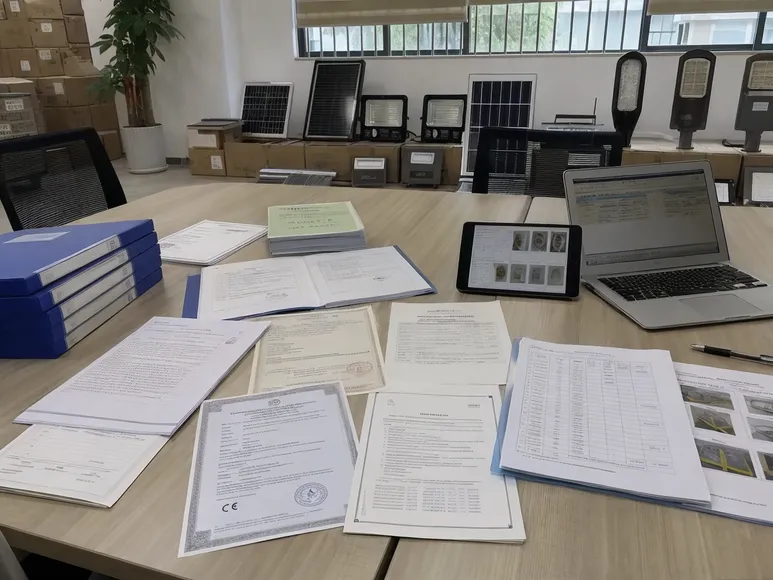
Our solar light certifications cover the full range of outdoor solar lighting we produce: solar street and roadway lighting, parking lot and area lights, waterproof solar flood and security lighting, garden and landscape products, pathway and bollard lights, wall lights, and smart solar systems. The certifications we hold — ISO 9001:2015, CE, RoHS, IP65/IP67 Ingress Protection, and IEC 62124 — are the documented entry point. The quality system behind them is what this page is actually about.
For buyers, the commercial value of a clean certification file is straightforward: fewer shipment holds at customs, faster distributor onboarding, cleaner tender submissions, and fewer warranty disputes downstream. We can provide certification copies and available test reports matched to your SKU and order configuration. If your market or project requires specific documentation, tell us before order confirmation — not after the container is loaded.
Practical Note for Buyers
We've had buyers discover a documentation gap at the port. It's avoidable. Send us your required document list with the RFQ and we'll confirm what's available before production starts.
Fewer Shipment Holds
Faster Onboarding
Cleaner Tenders
Fewer Warranty Disputes
Solar Lighting Certifications and Quality Standards at a Glance
Certification copies and available test reports can be provided for order review. We do not publish certificate numbers or validity dates on this page — those details are confirmed per order and per SKU.
ISO 9001:2015
Quality Management SystemCoverage: All product lines and production processes
Buyer Value: Controlled production flow, traceable inspection records, consistent batch quality
CE
Market AccessCoverage: Applicable solar lighting products for CE-marking markets
Buyer Value: Import clearance and distributor onboarding in EU and CE-recognized markets
RoHS
Restricted Substance ComplianceCoverage: LED modules, control boards, battery-related electronics, applicable components
Buyer Value: Restricted substance compliance for EU import and regulated distribution channels
IP65 Ingress Protection
Weatherproof ConstructionCoverage: Outdoor solar fixtures rated IP65
Buyer Value: Dust-tight, protected against water jets — standard for most outdoor solar lighting applications
IP67 Ingress Protection
Weatherproof ConstructionCoverage: Outdoor solar fixtures rated IP67
Buyer Value: Dust-tight, protected against temporary immersion — for higher-exposure outdoor environments
IEC 62124
PV Stand-Alone System PerformanceCoverage: Solar-powered lighting system configurations
Buyer Value: Performance standard for stand-alone PV systems, relevant for project specification and system reliability verification
If your tender file or distributor onboarding process requires specific documentation, contact us with your requirements before order placement.
Our solar street and roadway lighting and waterproof solar flood and security lighting product lines carry the highest documentation demand from project buyers — CE declarations, IP test certificates, and RoHS compliance records are the most frequently requested documents for those categories.
What Each Standard Means for Your Import, Bid, and Warranty Risk
Solar lighting certifications affect different parts of your supply chain risk. Here's how each one lands in practice.
CE Solar Lighting Documentation
EU Market AccessCE is the primary requirement for buyers importing into EU member states and markets that recognize CE marking. It covers electrical safety and electromagnetic compatibility requirements applicable to the product.
For distributors building a solar lighting catalog for European retail or project channels, CE documentation is typically required at the distributor onboarding stage — before the first order ships, not after.
We provide CE Declarations of Conformity matched to applicable product models.
RoHS Compliance
Import Clearance & LiabilityRoHS affects import clearance and downstream liability in the EU and increasingly in other regulated markets.
Our RoHS compliance is built into component sourcing — LED chips, battery cells, and electronic components are sourced from suppliers who provide material declarations, and we maintain records by batch.
For buyers importing into the EU, the compliance trail traces to the component level, not just the finished product label.
IP65 & IP67 Solar Lights
Environmental ProtectionIP65 is the standard specification for most outdoor solar lighting applications — street lights, area lights, wall lights, pathway lights. IP65 means dust-tight and protected against water jets from any direction. For buyers supplying coastal, tropical, or high-rainfall markets, IP65 is the minimum credible specification.
IP67 adds temporary immersion protection and is relevant for ground-level fixtures, recessed installations, or environments with standing water risk.
We test IP ratings on our own waterproof inspection equipment — the rating is verified on production units, not assumed from housing design.
IEC 62124
PV System PerformanceIEC 62124 covers stand-alone photovoltaic system performance. For solar-powered lighting, this standard is relevant when buyers are specifying system reliability for project bids — particularly infrastructure projects, municipal contracts, or development programs where performance documentation is part of the tender file.
It addresses charge/discharge behavior, battery autonomy, and system performance under varying irradiance conditions.
For North American Projects
CE and RoHS are not the primary compliance frameworks in the US and Canada. North American projects may require buyer-specific approvals or local authority certifications beyond what JXSOL's current certification set covers. We do not claim UL or ETL listing.
If your project requires North American market-specific certifications, confirm requirements with us before order placement — we can advise on what documentation we can provide and where additional buyer-side steps may be needed.
For smart solar lighting systems with IoT or communication components, local radio frequency approvals may also apply depending on the market.
Factory QC Starts Before Assembly, Not at Final Packing
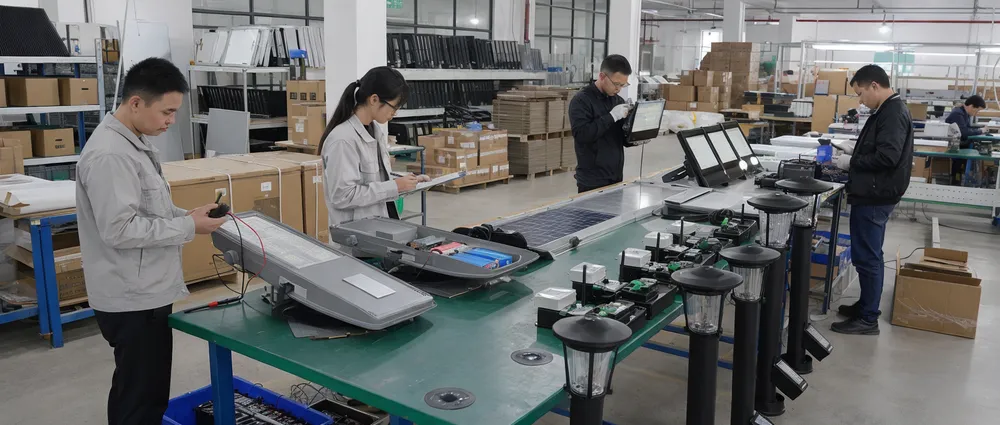
Certifications document that a quality system exists. The inspection chain below is how that system runs on the production floor.
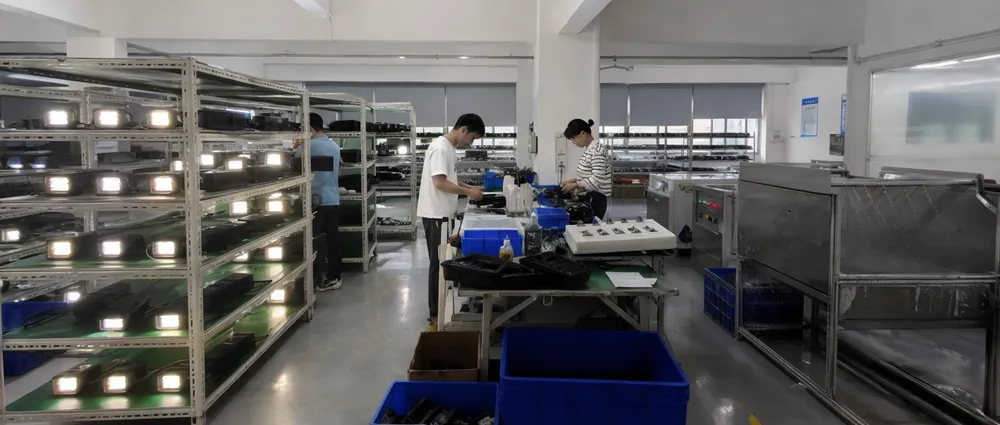
We've been building outdoor solar lighting since 2012, and the failure modes we've seen most often in this category are consistent: battery cells that don't match in capacity or internal resistance, LED modules that drift in lumen output or color temperature between production batches, and waterproof housings that pass visual inspection but fail under sustained moisture exposure. Our QC process was built around those three failure points specifically — not as a general quality framework, but as a direct response to what actually causes field failures and warranty claims in outdoor solar lighting.
Incoming Material Inspection
Runs before any component enters the production floor.
Solar Panels
Electrical output checked against rated specifications
LED Chips & Modules
Forward voltage and binning consistency verified
Battery Cells
Capacity and internal resistance — mismatched cells pulled before pack assembly
Controllers
Checked against incoming specs
Housings & Fasteners
Dimensional and material verification
Packaging Materials
Checked against incoming specs
Non-conforming components are isolated, recorded, and returned or rejected before production starts.
Note: The battery cell check at incoming is the one step that adds the most time to our receiving process — but it's also the one that prevents the most field failures. We've kept it as a non-negotiable since the early years.
In-Process Inspection
Runs at four stages during assembly:
SMT Control Board Assembly
Boards are functionally checked before they move downstream.
LED Module Assembly
Lumen output and color temperature confirmed — units outside the specified bin range are pulled before final assembly, not after.
Battery Pack Matching
Packs assembled from matched cells and tested for capacity and charge acceptance before integration.
Controller & Sensor Function Testing
Charging logic, lighting modes, dimming behavior, and motion detection response verified before the unit is closed.
Reliability Checks
Covers aging tests, charge/discharge cycle tests, and lighting mode verification.
- Full units run on aging racks under load — not component-level bench tests, but complete assembled units operating through charge and discharge cycles.
- Products with motion sensors or dimming functions are verified for consistent trigger response and mode switching.
- This stage catches integration failures that component-level testing misses: a controller that passes bench testing but behaves inconsistently when connected to a specific battery pack configuration, for example.
Our 6 production lines, automated SMT assembly, and integrated testing lab run as a single connected system — incoming inspection feeds production, in-process inspection gates each assembly stage, and reliability checks run before units reach final packing.
If you're evaluating OEM/ODM solar lighting engineering support, the same inspection chain applies to custom configurations.
6
Production Lines
13+
Years Manufacturing
Waterproof, Aging, and Pre-Shipment Checks for Outdoor Solar Lights
IP65 solar lights and IP67-rated fixtures are the products where waterproof verification matters most commercially. A batch of outdoor solar lights that passes visual inspection but fails in the field after the first rainy season generates warranty claims, replacement shipments, and distributor relationship damage that far exceeds the cost of proper pre-shipment testing.
Waterproof Inspection Protocol
Tested on production units — not samples or prototypes
We've seen it happen to buyers who sourced from factories that relied on housing design rather than production-unit verification. Our waterproof inspection covers:
- Housing construction integrity
- Seal integrity at cable entry points
- Lens and panel mounting interfaces
- Fastener seating verification
The test protocol checks for ingress at the rated IP level. Units that fail are pulled, reworked, and re-tested before they move to packing.
For commercial solar area and parking lot lights and waterproof solar wall lighting, where installation environments range from coastal to high-humidity tropical, this step protects your warranty accounting most directly.
Aging Tests
Full assembled units — charge/discharge cycles under load
The purpose is to catch integration failures that component-level testing misses:
- A battery pack that charges correctly in isolation but doesn't deliver rated runtime when connected to the controller and LED load
- A lighting mode that functions correctly at room temperature but drifts under thermal load
Production-volume racks, not sample-and-extrapolate. We run aging on racks sized for production volume. This is not a spot-check on a handful of units — it's a systematic verification step applied to the production run.
Pre-Shipment Inspection Is 100%
Every unit, every carton, every accessory pack, every label, every packing record — before the container is sealed.
Spot checks on production units
Function verification per unit
Cosmetic and structural defects
Verified against packing list
SKU, batch code, compliance markings
Sealed per packing record
Why 100% Since 2012
The commercial value is straightforward: defective units are caught before they're on a ship, not after they're in your warehouse or at your customer's site. Fewer RMAs, fewer replacement shipments, cleaner warranty accounting, and stronger reorder confidence. It adds time to the production schedule. We've kept it as a non-negotiable since 2012 because the alternative — catching defects at the destination — costs everyone more.
Documentation Support for Your Compliance File, Tender, and Reorder
Documentation is matched to your SKU and order configuration. We source from a single in-house production facility, so documentation comes from one place — not assembled from multiple sub-suppliers with inconsistent records.
CE Declaration of Conformity
Matched to applicable product models and configurations in your order.
RoHS Compliance Documentation
Component-level material declarations available for applicable products.
IP Test Certificates
IP65 and IP67 test records for applicable product models.
IEC 62124-Related Documentation
Available for applicable solar-powered lighting system configurations.
Product Specifications
Lumen output, color temperature, battery capacity, solar panel rating, controller specs, physical dimensions, and weight.
Packing Details
Carton dimensions, gross/net weight, units per carton, container loading configuration.
Batch Traceability Records
Batch codes on SKU labels, traceable to production records.
Confirm Your Document List Before Order Confirmation — Not at Shipment
For tenders, regulated import channels, or distributor onboarding programs with specific document requirements, confirm your list before order confirmation. Documentation is matched to your SKU and order configuration from a single production source.
For buyers who need documentation reviewed before committing to an order, request available certification documents and we'll provide what we have for your target SKU category.
Quality Standards Across JXSOL Solar Lighting Product Lines
The same certification framework and inspection chain applies across our product range, but the documentation emphasis and testing priorities differ by category.
Solar Street & Roadway Lighting
Highest Documentation DemandCarries the highest project documentation demand. Municipal and infrastructure buyers typically require CE declarations, IP test certificates, lumen output verification, and battery autonomy documentation for tender files.
Primary QC Focus
- Lumen stability across batches
- Controller reliability
A street light that dims after six months generates complaints at the municipal level, not just a warranty claim.
Flood & Security / Wall Lighting
Highest Waterproof Verification PriorityPIR sensor function, lighting mode consistency, and IP rating integrity are the three checkpoints that matter most for buyers supplying security and perimeter lighting applications.
Primary QC Focus
- PIR sensor trigger distance & response time
- Lighting mode consistency
- IP rating integrity
Inconsistent PIR behavior is one of the most common field complaints in this category — checked at the controller function stage.
Garden & Landscape / Pathway & Bollard
Highest SKU Repeatability DemandsLower project documentation requirements but higher SKU repeatability demands. Distributors building a catalog in these categories reorder frequently and need consistent appearance, lumen output, and packaging across batches.
Key Controls
- Lumen binning at LED module assembly
- Packing inspection for batch-to-batch consistency
Smart Solar Lighting Systems
IoT / Remote Monitoring / CameraSystems with IoT control, remote monitoring, or camera integration involve additional controller logic verification and communication function checks at the in-process inspection stage.
Additional Verification Steps
- Controller firmware verification
- Sensor integration checks
- Communication module function test
Engineering review is part of the production setup — verified before production runs begin.
Solar Fans / Battery & Portable Power
Adjacent Product LinesAdjacent solar-powered product lines. Fans, home batteries, and portable power stations do not always share the same certification package as outdoor solar lighting fixtures.
Documentation should be confirmed by SKU — certification packages may differ from lighting fixtures.
FAQ: Solar Lighting Certifications and Quality Checks
Direct answers to the certification, documentation, and ingress protection questions B2B buyers ask before placing solar lighting orders.
What solar lighting certifications does JXSOL currently provide?
We hold ISO 9001:2015, CE, RoHS, IP65/IP67 Ingress Protection, and IEC 62124.
Certification copies and available test reports are provided per order — contact us with your target SKU and required document list.
Does CE solar lighting documentation cover every product model?
CE documentation applies to applicable product models — not every SKU in our range carries CE marking. Products designed for CE-marking markets are configured and documented accordingly.
If CE documentation is required for your order, specify this at the RFQ stage so we can confirm coverage for your target models.
Buyer tip: For buyers building a European distribution catalog, we recommend confirming CE documentation availability per SKU before finalizing your product selection.
What is the difference between IP65 and IP67 solar lights for outdoor projects?
Dust-tight and protected against water jets from any direction.
The standard specification for most outdoor solar lighting applications including street lights, area lights, wall lights, and pathway lights.
Adds protection against temporary immersion up to 1 meter for 30 minutes.
Relevant for ground-level fixtures, recessed installations, or environments with standing water or flooding risk.
For most above-ground outdoor solar lighting applications, IP65 is sufficient. If your project involves ground-level installation, coastal flooding zones, or environments with regular water accumulation, specify IP67.
We test both ratings on production units, not on housing design assumptions.
Why does IEC 62124 matter for solar-powered lighting systems?
IEC 62124 is the performance standard for stand-alone photovoltaic systems. For solar lighting, it's relevant when buyers are specifying system reliability for project bids — particularly municipal contracts, infrastructure programs, or development projects where performance documentation is part of the tender file.
The standard addresses charge/discharge behavior, battery autonomy under varying irradiance, and system performance consistency.
If your project tender requires IEC 62124 documentation, confirm with us at the RFQ stage which product configurations have applicable documentation available.
Can JXSOL provide RoHS and CE documents before mass production?
Yes. For buyers who need documentation reviewed before committing to a production order — for distributor onboarding, tender pre-qualification, or import compliance review — we can provide available CE declarations and RoHS documentation for your target SKU category before order confirmation.
Send us your product category, target market, and required document list and we'll confirm what's available.
This is the right time to surface any documentation gaps — not after production is underway.
Do North American solar lighting projects need additional approvals beyond CE or RoHS?
Yes, typically. CE and RoHS are EU-framework certifications and are not the primary compliance requirements for US or Canadian projects.
North American projects may require buyer-specific approvals, local authority certifications, or utility program qualifications that go beyond JXSOL's current certification set. We do not hold UL or ETL listing.
Important for US/Canada buyers:
Confirm the specific compliance requirements with your local authority or program administrator before placing an order. We can advise on what documentation we can provide and where additional steps are needed on your side.
How does JXSOL inspect solar lights before shipment?
Pre-shipment inspection is 100% — every unit, every carton, every accessory pack, every label, before the container is sealed.
The inspection covers:
This follows the in-process inspection chain that runs through:
The pre-shipment step is the final gate before loading — it's not a substitute for in-process controls, it's the confirmation that everything that passed in-process is still intact at the point of shipment.
Request Certification Copies and Quality Documents for Your Order
Send us your target market, SKU category, order volume, and required document list. We'll confirm which certification copies, test reports, and compliance documents are available for your configuration, and whether any project-specific documentation needs to be addressed before order confirmation.
What to Include in Your Request
Target Market
Country or region where the product will be imported and installed
SKU Category
Product line or specific model numbers you're evaluating
Order Volume
Estimated quantity so we can confirm documentation scope
Required Document List
Specific certificates, test reports, or compliance documents needed
WhatsApp / Phone
+8613627818806If you're also evaluating customization or private-label options, our OEM/ODM solar lighting engineering support page covers how that process works.