

Portable Power Station Direct From Factory
Factory-direct portable power stations — LiFePO4 or NMC, 300W to 2000W AC output, OEM/private-label ready.
Add a portable power SKU to your solar product program without adding a new supplier. JXSOL's battery and electronics production supports this line with the same QC controls we run on solar lighting.
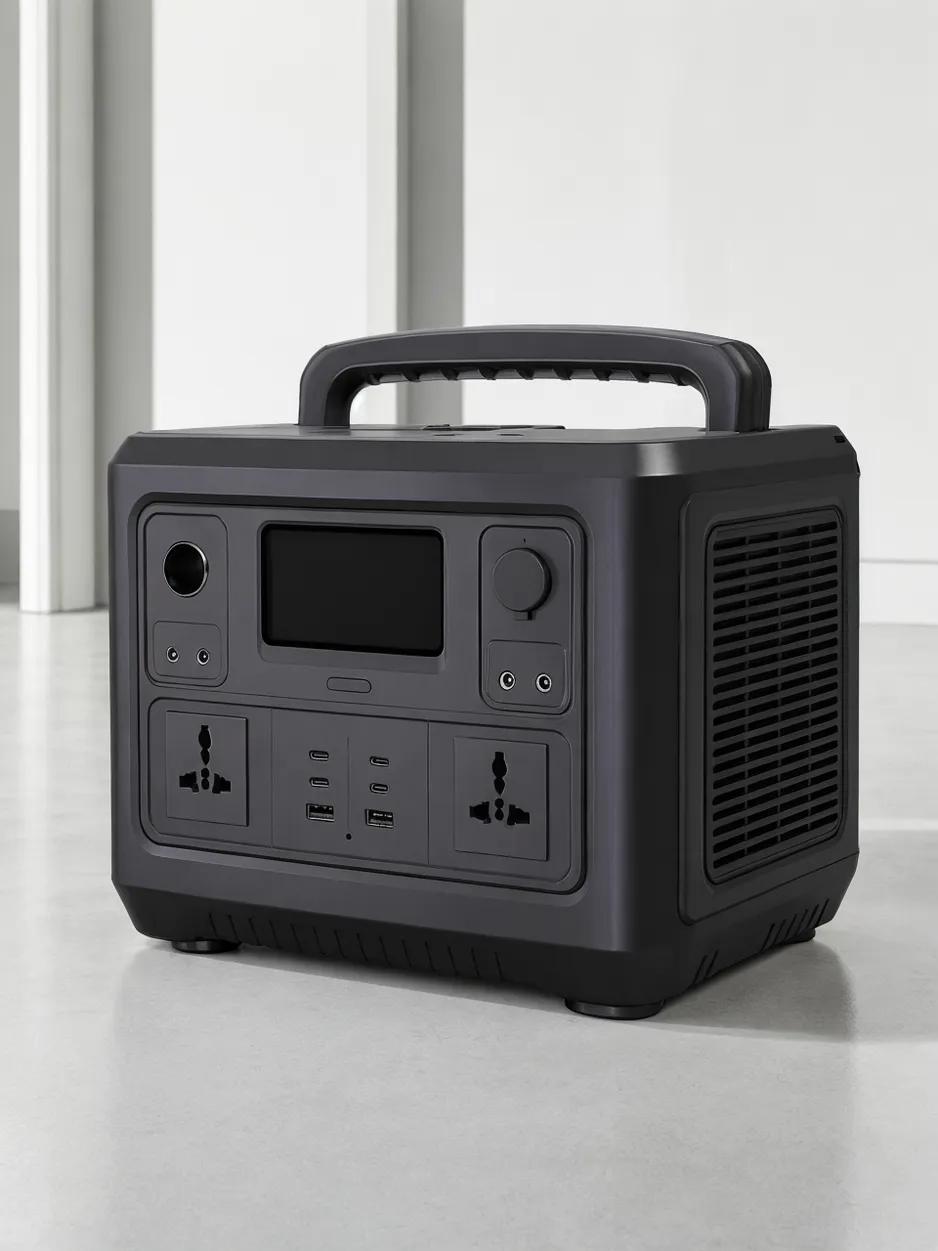
Portable Power Station for Solar Product Distributors
If you're already sourcing solar lighting and want to add a portable power station to your catalog, the sourcing logic is straightforward: the battery chemistry, control board assembly, and pre-shipment inspection we run on solar lighting products carry directly into this line. You're not starting a new supplier relationship — you're extending an existing one into an adjacent product category.
A portable power station is a self-contained battery unit with AC, DC, and USB outputs, designed for off-grid power, emergency backup, outdoor use, and small project support. The product sits in our Solar Battery & Portable Power cluster alongside home battery backup and solar generator options. This page covers the standalone portable power station — a finished, retail-ready unit that ships with all outputs, a display, and optional solar charging input.
For buyers building a mixed solar product program, this is the SKU that moves in outdoor retail, emergency preparedness, and off-grid channels. The margin profile is different from solar lighting — higher per-unit value, lower volume per SKU — but the reorder pattern is consistent once you've validated the capacity tier with your market.
Send us your target capacity, AC output, and destination market.
Product Position
- Self-contained battery unit with AC, DC, and USB outputs
- Optional solar charging input for off-grid pairing
- Finished retail-ready unit with display panel
- Moves in outdoor retail, emergency prep, and off-grid channels
Margin Profile
Higher per-unit value, lower volume per SKU compared to solar lighting. Reorder pattern is consistent once you've validated the capacity tier with your market.
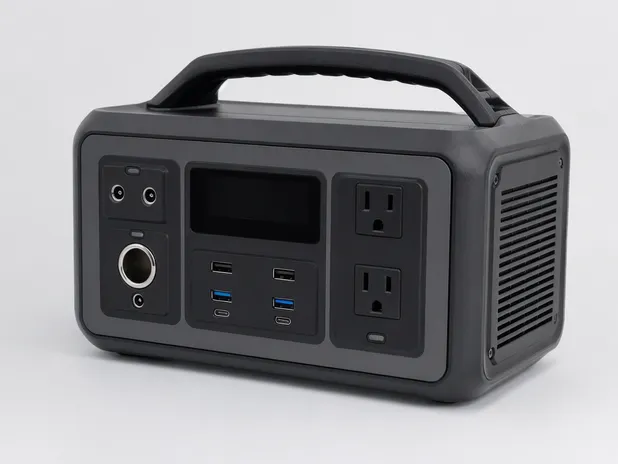
Capacity and Output Choices That Protect Your SKU Margin
The most common sourcing mistake we see with portable power stations is importing a single capacity tier and discovering it doesn't match the channel. A 300Wh unit that sells well in camping retail doesn't move in emergency preparedness, where buyers expect 1000Wh or more. Getting the capacity-to-channel match right before your first order protects your margin and avoids a slow-moving SKU.
300–500Wh
Entry-Level Retail
Moves in outdoor, camping, and travel channels. Lower landed cost, faster inventory turns, but limited AC output (typically 300–500W rated).
Good for testing a new channel before committing to higher-capacity SKUs. The price point is accessible enough that end buyers purchase without extended evaluation.
- Camping & travel retail
- 300–500W rated AC output
- Fast inventory turns
600–1000Wh
Mid-Tier Sweet Spot
Covers emergency home backup for a day or two of essential loads, off-grid small business power, and outdoor power tool use. Rated AC output typically 500–1000W with 1500–2000W peak.
This tier has the broadest channel fit and the most reorder consistency in our experience.
- Emergency home backup
- 500–1000W rated / 1500–2000W peak
- Broadest channel fit
1200–2000Wh
High-Capacity / Project Power
High-capacity units for serious off-grid, RV, and project power markets. Higher per-unit value, longer sales cycle, but strong margin per unit.
Solar charging input becomes a primary feature at this tier — buyers in this segment are often pairing the unit with a portable solar panel, which is where the portable solar power station positioning becomes relevant.
- Off-grid, RV, project sites
- Strong per-unit margin
- Solar panel pairing
Battery Chemistry: LiFePO4 vs NMC
Battery chemistry is the other selection variable. We can supply both; the choice depends on your channel and the price point you're targeting.
LiFePO4
Lithium Iron Phosphate
- 2000+ cycle life
- Better thermal stability
- Longer product warranty story
- Minimizes warranty claims, builds durable brand reputation
NMC
Nickel Manganese Cobalt
- Higher energy density
- Smaller form factor
- Weight and size advantage for travel and camping
- Right choice where portability is the primary selling point
We'll recommend the configuration that fits your market.
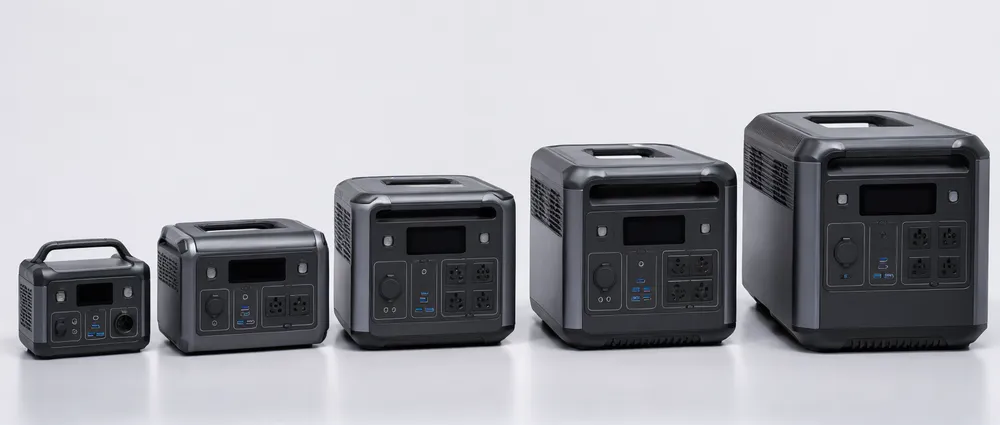
Procurement Specification Table
The table below uses configurable ranges and typical values. Exact specifications vary by model and capacity tier. Contact us for model-specific data sheets before finalizing your comparison sheet.
| Parameter | 300–500Wh Tier | 600–1000Wh Tier | 1200–2000Wh Tier |
|---|---|---|---|
| Battery Capacity | 300–500Wh | 600–1000Wh | 1200–2000Wh |
| Cell Type | LiFePO4 or NMC (specify at order) | LiFePO4 or NMC | LiFePO4 recommended |
| Cycle Life | LiFePO4: 2000+ cycles; NMC: 500–800 cycles | LiFePO4: 2000+ cycles; NMC: 500–800 cycles | LiFePO4: 2000+ cycles |
| Rated AC Output | 300–500W | 500–1000W | 1000–2000W |
| Peak AC Output | 600–1000W | 1000–2000W | 2000–4000W |
| AC Socket Standard | EU/UK/US/AU (specify at order) | EU/UK/US/AU | EU/UK/US/AU |
| Solar Charging Input | 100–200W max | 200–400W max | 400–600W max |
| AC Charging Time | 3–6 hours (standard charger) | 4–8 hours | 5–10 hours |
| DC Output | 12V/10A (car port) | 12V/10A | 12V/10A |
| USB-A Output | 5V/2.4A × 2 (typical) | 5V/2.4A × 2–4 | 5V/2.4A × 4 |
| USB-C Output | 60W PD (typical) | 60–100W PD | 100W PD |
| Display | LED or LCD battery level + output status | LCD with wattage display | LCD with full status |
| Protection Functions | Overcharge, over-discharge, over-temp, short circuit, overload | Same + BMS cell balancing | Same + BMS cell balancing |
| Operating Temperature | Charge: 0–45°C; Discharge: -20–60°C | Same | Same |
| Unit Weight (typical) | 4–7 kg | 8–14 kg | 14–22 kg |
| Carton Packing | 1 unit/carton with accessories | 1 unit/carton | 1 unit/carton |
| Standard MOQ | 100 units | 100 units | 100 units |
| Warranty Support | 12–24 months (confirm per model) | 12–24 months | 12–24 months |
Specifications shown are configurable ranges for this product line. Actual values depend on model selection. Contact us for detailed data sheets and confirm specifications before placing an order.
Request Data SheetsCommercial Segments Where Portable Power Stations Sell Through
The portable power station market has several distinct B2B channels, and the right capacity tier and feature set varies by segment. Here's where we see consistent sell-through for our buyers.
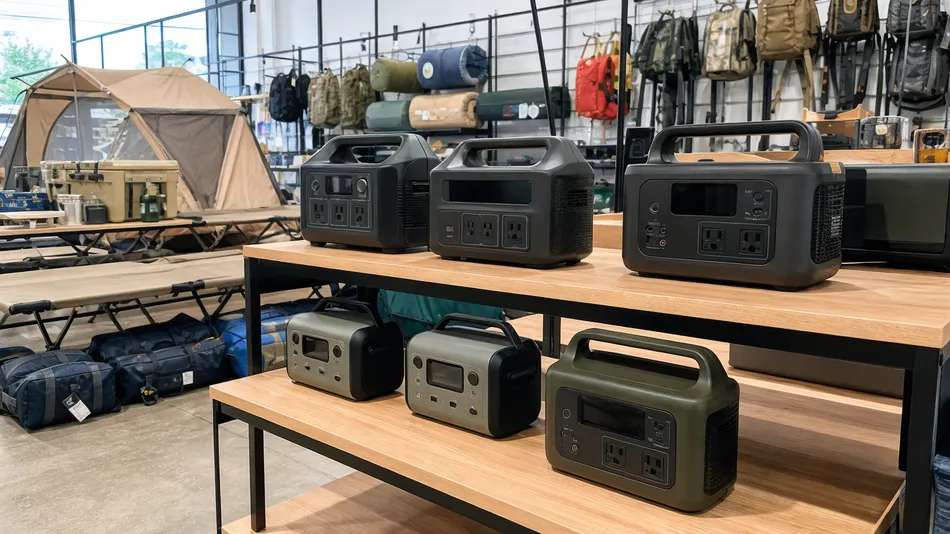
Outdoor Retail and Camping Channels
Outdoor specialty retailers, camping gear distributors, and e-commerce sellers in the outdoor category are the highest-volume channel for 300–600Wh units. The buying pattern is seasonal in temperate markets (spring/summer peak) but year-round in warmer climates.
Typical order sizes run 200–500 units per SKU per season, with reorders triggered by sell-through data rather than calendar.
The key product requirements for this segment: compact form factor, USB-C fast charging (buyers' customers are charging phones and laptops), and a retail-ready carton with lifestyle imagery. Private-label packaging is common — most serious outdoor retailers want their own brand on the box.
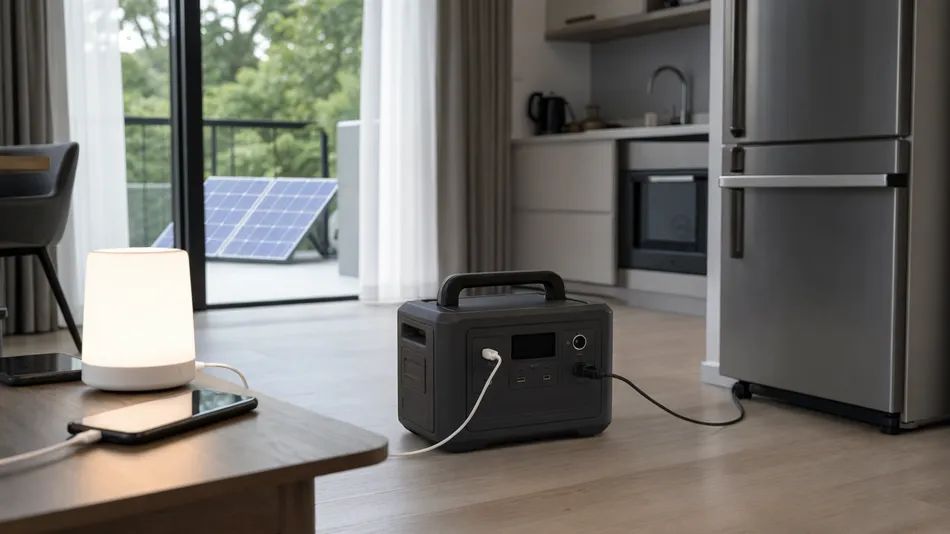
Emergency Preparedness and Home Backup Retail
This segment has grown significantly in markets with grid reliability concerns — North America, parts of Europe, and increasingly Southeast Asia and Africa. The 600–1500Wh tier dominates here, because buyers' customers want to run a refrigerator, lights, and phone charging for 12–24 hours during an outage.
The sales cycle is longer than outdoor retail (buyers evaluate more carefully), but the average order value is higher and the reorder rate is strong once a SKU is established.
Emergency preparedness buyers are also more likely to pair the unit with a portable solar panel — this is where the portable solar power station positioning earns its margin premium.
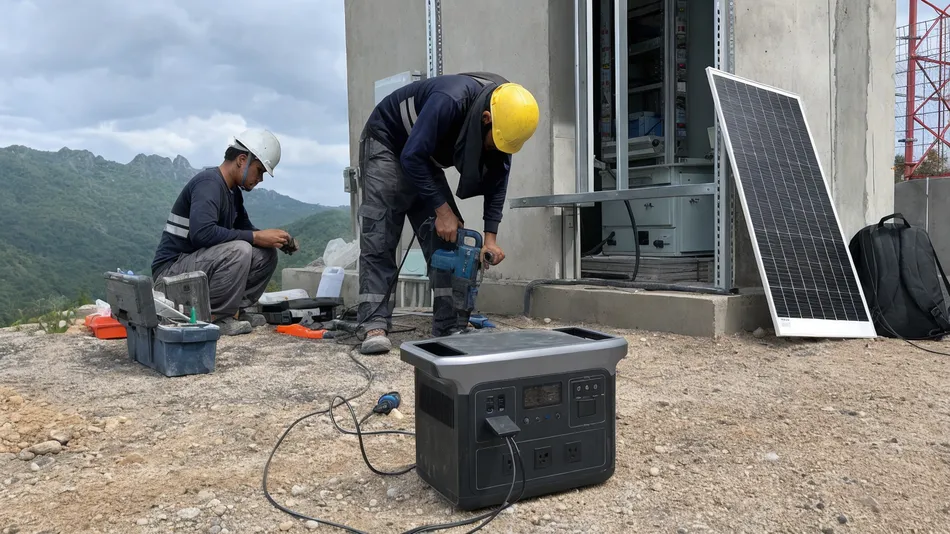
Off-Grid Small Business and Project Power
Contractors, telecoms, and small businesses in markets with unreliable grid access use portable power stations as temporary or semi-permanent power sources for tools, lighting, and communications equipment.
This segment buys on specification rather than price — AC output rating, peak surge capacity, and cycle life are the decision factors. The 1000–2000Wh tier with LiFePO4 chemistry is the standard choice here because the units need to survive daily charge/discharge cycles over months of field use.
We've had buyers in West Africa and Southeast Asia specifically request LiFePO4 for this reason — the cycle life difference is real in daily-use conditions.
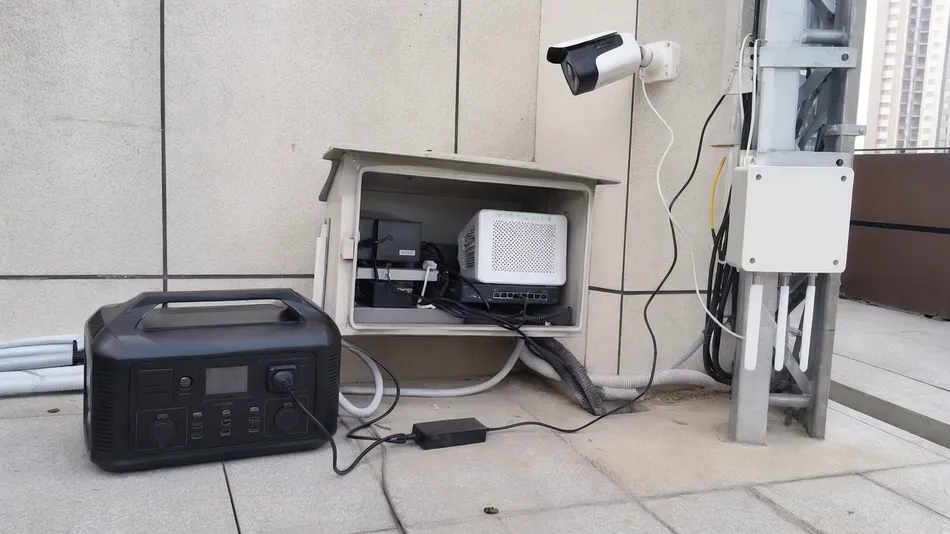
Security and Telecom Temporary Backup
Security installers and telecom contractors use portable power stations as backup power for cameras, routers, and small communication equipment during installation or in locations without grid access.
This is a lower-volume but high-margin segment — buyers are purchasing on reliability and documentation, not price. CE certification and a clear product data sheet are often required for project approval.
Units in the 300–600Wh range with clean DC output and USB-C are the typical spec.
Solar Lighting Distributors Expanding into Battery Products
This is the segment most relevant to JXSOL's existing buyer base. If you're already distributing our core solar lighting catalog or smart solar lighting systems, adding a portable power station SKU to your catalog is a natural extension.
Your existing customers — contractors, municipalities, and project buyers — often ask about portable backup power alongside solar lighting. Sourcing both from one factory simplifies your procurement, consolidates your compliance documentation, and gives you a single point of contact for reorders.
Battery, Control Board, and Aging Tests Before Shipment
The QC process we run on portable power stations follows the same logic we've applied to solar lighting since 2012: find the failure modes that matter and build checkpoints around them. For portable power stations, the three failure modes that generate the most warranty claims in the field are cell inconsistency inside the battery pack, control board failures under load, and output port degradation after repeated use. We address all three before the unit leaves the factory.
Cell Inconsistency
A mismatched cell in a series-parallel pack degrades faster than the rest and shortens the pack's effective life. Highest warranty-claim driver in the field.
Control Board Failures
BMS malfunction, protection circuit false-triggering, or output regulation drift under load — all caught before installation.
Output Port Degradation
Every AC socket, USB-A, USB-C, and DC port verified for correct voltage, current output, and physical connection integrity after repeated use simulation.
Cell Sorting by Capacity & Internal Resistance
Cells that fall outside the matching tolerance are pulled before pack assembly. This step reduces inconsistency at the source, but the cycle test that follows is the confirmation.
Charge/Discharge Cycle Test
After assembly, each pack goes through a full charge/discharge cycle to confirm actual capacity against rated capacity. We don't ship a pack that tests below 95% of rated capacity. This step is where we catch the most issues.
Control Board Testing Under Load
BMS function verification, protection circuit activation (overcharge, over-discharge, short circuit, overload), and output regulation accuracy. Each board is tested under load before installation — not just powered on.
Full-Unit Aging Test
Every portable power station goes through a full charge/discharge cycle under rated load, with output voltage and temperature monitored throughout. Units that show abnormal temperature rise, output drop, or protection circuit false-triggering are pulled for investigation.
Output Port & Accessory Verification
Every AC socket, USB-A port, USB-C port, and DC port checked for correct voltage, current output, and physical connection integrity. Accessory packs — charging cables, adapters, user manuals — checked against the packing list before carton sealing.
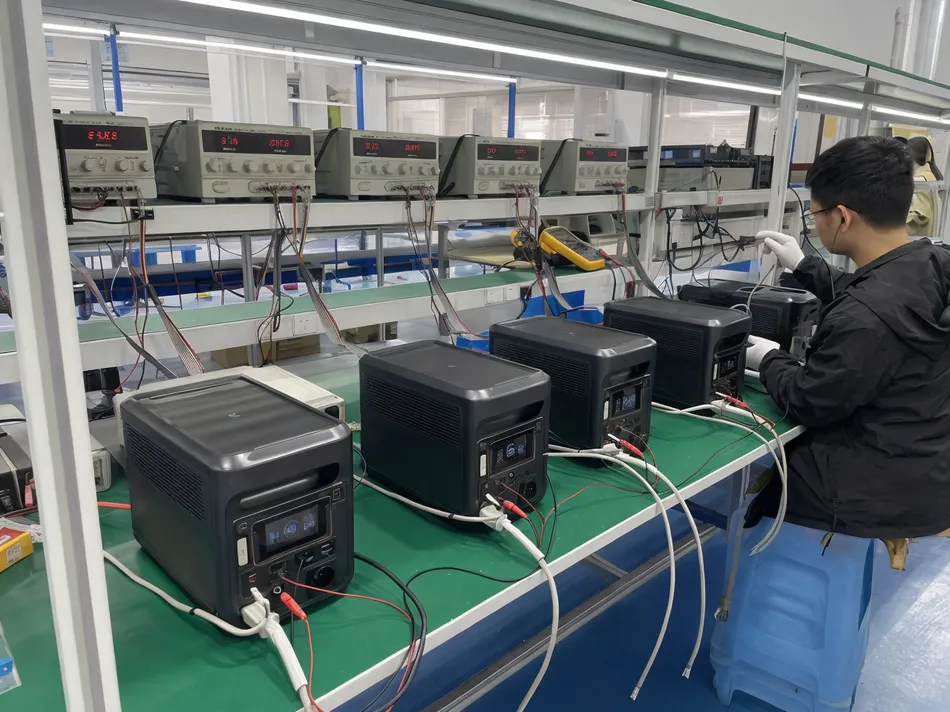
Same Standard Since 2012
This is the same 100% pre-shipment inspection standard we maintain across all product lines at the JXSOL solar lighting factory. It adds time to the production schedule. It also means your first container arrives right, which matters more than a few days of lead time.
Key Thresholds
- Minimum 95% of rated capacity confirmed before shipment
- Cell matching tolerance enforced at pack assembly
- BMS tested under load — not just powered on
- Temperature and voltage monitored during full aging cycle
- Every output port individually verified for voltage and current
OEM and Private-Label Options for Portable Power Programs
Most serious distributors and brand owners want their own brand on the product, not the factory name. We support full private-label and OEM programs on portable power stations, with the following customization scope:
Brand & Packaging
- • Logo on unit housing (screen print or label)
- • Custom retail carton with your brand artwork
- • Instruction manual in your required language(s)
- • Barcode/SKU labeling to your specification
- • Amazon FBA labeling, retail shelf-ready packaging, and bulk carton configurations for distributor warehousing
Product Configuration
- • Capacity tier selection: 300Wh to 2000Wh
- • Battery chemistry: LiFePO4 or NMC
- • AC socket standard: EU / UK / US / AU — specify your destination market
- • Plug type for the AC charger
- • USB-C output wattage: 60W or 100W PD
- • Solar panel bundle option (matched portable solar panel as a kit SKU)
Color & Finish
- • Housing color options available on runs of 200 units or more
- • Standard color: black
- • Custom colors require a color confirmation sample before production
Documentation
- • CE Declaration of Conformity
- • RoHS test report
- • Product data sheet in your required language
- • For markets requiring additional documentation, confirm requirements before order placement — battery products have model-specific certification timelines that affect lead time
Limitations to Confirm Before Ordering
UN38.3 Transport Testing
UN38.3 transport testing documentation is required for air freight of lithium battery products. Confirm this requirement with your freight forwarder before finalizing your logistics plan.
Market-Specific Certification
Certification for specific destination markets (FCC for the US, PSE for Japan, SAA for Australia) requires model-specific testing and adds lead time. We can advise on what's needed for your target market, but the testing timeline is outside our production schedule.
100 Units
Standard MOQ for catalog models
200 Units
Minimum for custom housing color
5–7 Days
OEM engineering review turnaround
OEM programs with custom housing, tooling changes, or new capacity configurations require an engineering review before production confirmation. Most OEM reviews complete within 5–7 business days.
Request an OEM Portable Power Station QuoteInclude your target capacity, AC socket standard, branding requirements, and destination market.
Compliance and Export Documentation to Check Before Ordering
Battery products have more documentation complexity than most product categories. Here's what to confirm before you place an order, not after.
What JXSOL Holds at the Company Level
- ISO 9001:2015 quality management certification
- CE marking — covering Low Voltage Directive and EMC Directive requirements for applicable products
- RoHS compliance documentation traceable to component level
- IEC 62124 — covers solar photovoltaic performance, relevant where solar charging input is a primary product feature
What Requires Model-Specific Confirmation
- CE Declaration of Conformity is issued per model — confirm the specific model you're ordering has a current DoC before shipment
- RoHS test reports are available per product family; request the report for your specific model
What You Need to Arrange Separately
UN38.3 transport testing is required for lithium battery products shipped by air. If your logistics plan includes air freight at any point in the supply chain — including your downstream distribution — confirm UN38.3 documentation is available for the specific model and cell configuration.
We can advise on documentation status per model, but the testing is conducted by third-party labs and the timeline varies.
Destination Market Certifications
CE covers EU and many markets that accept CE. For North America (FCC, UL), Japan (PSE), Australia (SAA/RCM), or other markets with mandatory product certification, confirm requirements before ordering.
Some certifications require model-specific testing that adds 4–8 weeks to the timeline. We've worked through this process with buyers in multiple markets — contact JXSOL early in your planning cycle, not after you've committed to a launch date.
MSDS/SDS for Battery Products
Material Safety Data Sheets for the battery cells are available and should be included in your import documentation for most markets. Request these at order placement.
Packaging, Carton Labeling, and Lithium Battery Shipping Control
Packaging for portable power stations does more work than packaging for most products. The unit is heavy, the battery is a regulated item for freight, and the retail carton is often the first thing your customer sees. Getting packaging right protects your margin at three points: fewer damage claims in transit, cleaner customs clearance, and a retail presentation that supports your price point.
Inner Protection
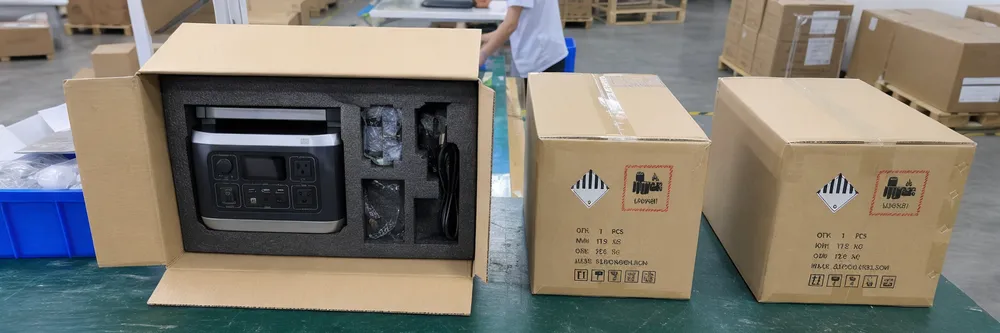
Each unit ships in a custom-fit foam insert inside the retail carton. The foam is cut to hold the unit and all accessories in fixed positions — no movement during transit.
We test carton drop resistance before approving a new packaging configuration. (We've seen buyers use generic foam that shifts in transit and results in cosmetic damage claims. The tooled insert costs more upfront but eliminates that problem.)
Accessory Checklist
Every carton is packed against a printed checklist — AC charger, DC car adapter, solar charging cable (if applicable), USB-C cable, user manual, and warranty card.
The checklist is signed off by the packing operator and verified by QC before carton sealing. Missing accessories are the most common source of customer complaints on first orders; the checklist process catches them before shipment.
Carton Labeling
Standard carton marks include product name, model number, capacity, battery chemistry, cell count, watt-hour rating, and lithium battery warning labels per IATA/IMDG requirements.
For private-label orders, carton marks are updated to your brand and SKU. Batch codes are printed on each carton for traceability — if a quality issue surfaces in the field, you can trace it back to the production batch.
Lithium Battery Shipping Documentation
For sea freight, lithium battery products ship under IMDG Class 9 regulations. We prepare the required dangerous goods declaration and ensure carton marking meets IMDG requirements.
For air freight, UN38.3 test reports must accompany the shipment — confirm documentation availability per model before booking air freight.
Retail Packaging for E-commerce Channels
If you're selling through Amazon, Wayfair, or your own e-commerce store, we can configure retail-ready packaging with your brand artwork, barcode placement per FBA requirements, and suffocation warning labels.
Blind drop-shipping and white-label configurations are available on request.
Quote Packaging & Carton Requirements
Include your channel (retail shelf, e-commerce, bulk distributor) and any labeling specifications.
Choose the Right Product Inside the Solar Battery & Portable Power Line
The portable power station is one of six products in our Solar Battery & Portable Power cluster. Here's how to navigate between them:
Portable Power Station
A portable AC/DC power unit for outdoor, emergency, or off-grid use
Solar Generator
A portable power station bundled with a solar panel as a kit
Portable Solar Battery
A compact portable battery focused on USB/DC charging (no AC)
Home Battery Backup
Residential backup power, wall-mounted or floor-standing
Home Energy Storage Battery
A modular home energy storage system with inverter integration
Wall Mounted Lithium Battery
A wall-mounted lithium battery module for home or small commercial
Stackable Home Battery
A scalable stacked battery system for growing storage needs
Key Distinction: Portable Power Station vs. Solar Generator
A solar generator is typically sold as a bundled kit (power station + solar panel), often positioned as a complete off-grid power solution. The portable power station on this page is the standalone unit — buyers who want to source the station and panel separately, or who are building their own kit SKU with a specific panel, start here.
If you're not sure which product fits your program, contact JXSOL with your target market and capacity requirements — we'll point you to the right configuration.
Buyer FAQ for Portable Power Station Orders
What capacity portable power station should I import first?
Start with the 600–1000Wh tier if you're entering a new market without clear channel data. This range has the broadest application fit — it covers emergency home backup, outdoor power, and small off-grid use — so it's the lowest-risk first SKU.
Once you have sell-through data, you can add a lower-capacity entry SKU for price-sensitive buyers and a higher-capacity unit for serious off-grid customers. Most of our distributors who start with a single SKU end up running three capacity tiers within two years.
The 300Wh entry unit is tempting because of the lower landed cost, but it often disappoints buyers who expected to run household appliances — the 600Wh tier sets more realistic expectations and generates fewer complaints.
Is LiFePO4 better than NMC for portable power stations?
For most B2B programs, yes — but the answer depends on your channel.
LiFePO4
- 2000+ cycle life vs 500–800 cycles for NMC
- Better thermal stability (lower risk of thermal runaway)
- Longer warranty story for brand building
- Ideal for emergency preparedness, off-grid, and project power markets
NMC
- Higher energy density (more Wh per kg)
- Lighter and more compact form factor
- Suits travel and camping retail where weight matters most
- Shorter cycle life justified by lighter use patterns
If you're building a brand and want to minimize warranty claims, LiFePO4 is the safer specification. See our LiFePO4 Battery for Solar Storage guide for a deeper comparison.
What is the difference between a portable power station and a solar generator?
A portable power station is the battery unit with AC/DC/USB outputs — it can be charged from a wall outlet, a car port, or a solar panel. A solar generator is typically a bundled product: the same type of battery unit sold together with a matched solar panel as a complete off-grid kit. The hardware inside is often identical; the difference is the sales format and the buyer's use case.
If your customers want a complete plug-and-play off-grid solution, the Solar Generator page covers the bundled kit option. If they want to source the station and panel separately — or if you're building your own kit with a specific panel — start with the portable power station.
For a detailed comparison, see Portable Power Station vs Solar Generator.
Can JXSOL supply private-label packaging for portable power stations?
Yes. We support full private-label programs: logo on the unit, custom retail carton with your brand artwork, instruction manual in your required language, and barcode/SKU labeling to your specification.
Standard Private-Label MOQ
100 units
On catalog models
Custom Housing Colors
200 units minimum
Color-matched housing
OEM programs with hardware modifications (different capacity, custom port configuration, new housing design) require an engineering review before production confirmation.
Send us your branding requirements and target market when you request a quote.
What documents should I confirm before shipping lithium battery products?
Before booking freight, confirm:
- CE Declaration of Conformity for the specific model
- RoHS test report for the product family
- UN38.3 test report if any part of your logistics chain involves air freight
- MSDS/SDS for the battery cells
- Destination market certification if your market requires it beyond CE (FCC, PSE, SAA, etc.)
For sea freight, IMDG Class 9 dangerous goods documentation is required — we prepare this as part of the shipment.
The most common documentation gap we see is buyers who assume UN38.3 is covered and discover it isn't when their freight forwarder asks for it. Confirm this early.
Contact JXSOL to verify documentation status for your specific model before committing to a freight bookingCan the portable power station charge from solar panels?
Yes — all models in our line include a solar charging input (MC4 or XT60 connector, depending on model). The maximum solar input ranges from 100W on entry-tier units to 600W on high-capacity models.
For buyers who want to sell a complete solar charging solution, we can supply a matched portable solar panel as a kit component, or you can source panels separately and confirm compatibility with the input spec.
The portable solar power station positioning — unit plus panel as a complete off-grid kit — is covered on the Solar Generator page if you want the bundled product format.
Quote a Portable Power Station Program
Send us the details below and we'll come back with a model recommendation, data sheet, and pricing.
What to Include in Your RFQ
-
Target battery capacity (Wh) and AC output (W)
Define the energy storage and power delivery your market requires.
-
Battery chemistry preference
LiFePO4 or NMC — or ask for our recommendation based on your use case.
-
AC socket standard and plug type
Specify the outlet configuration for your destination market.
-
Order quantity and reorder frequency
Helps us optimize unit cost and production scheduling.
-
Private-label or OEM requirements
Logo placement, packaging design, language localization.
-
Destination market and certification requirements
Country of sale and any known compliance standards (CE, FCC, UL, etc.).
-
Solar panel bundle requirement
Let us know if you need matched solar panels shipped with the units.
Reach Us Directly
Next Steps
Submit your requirements via the form or email.
Receive a model recommendation and data sheet within 24 hours.
Confirm specs, approve pricing, and schedule production.