

Solar Tree Lights Manufactured for Volume Programs
String, wrap, cluster, and canopy formats. IP65/IP67 weatherproof construction, 100% pre-shipment inspection, and MOQ from 100 units for SKU testing. OEM/ODM available for custom string length, LED color, and retail packaging.
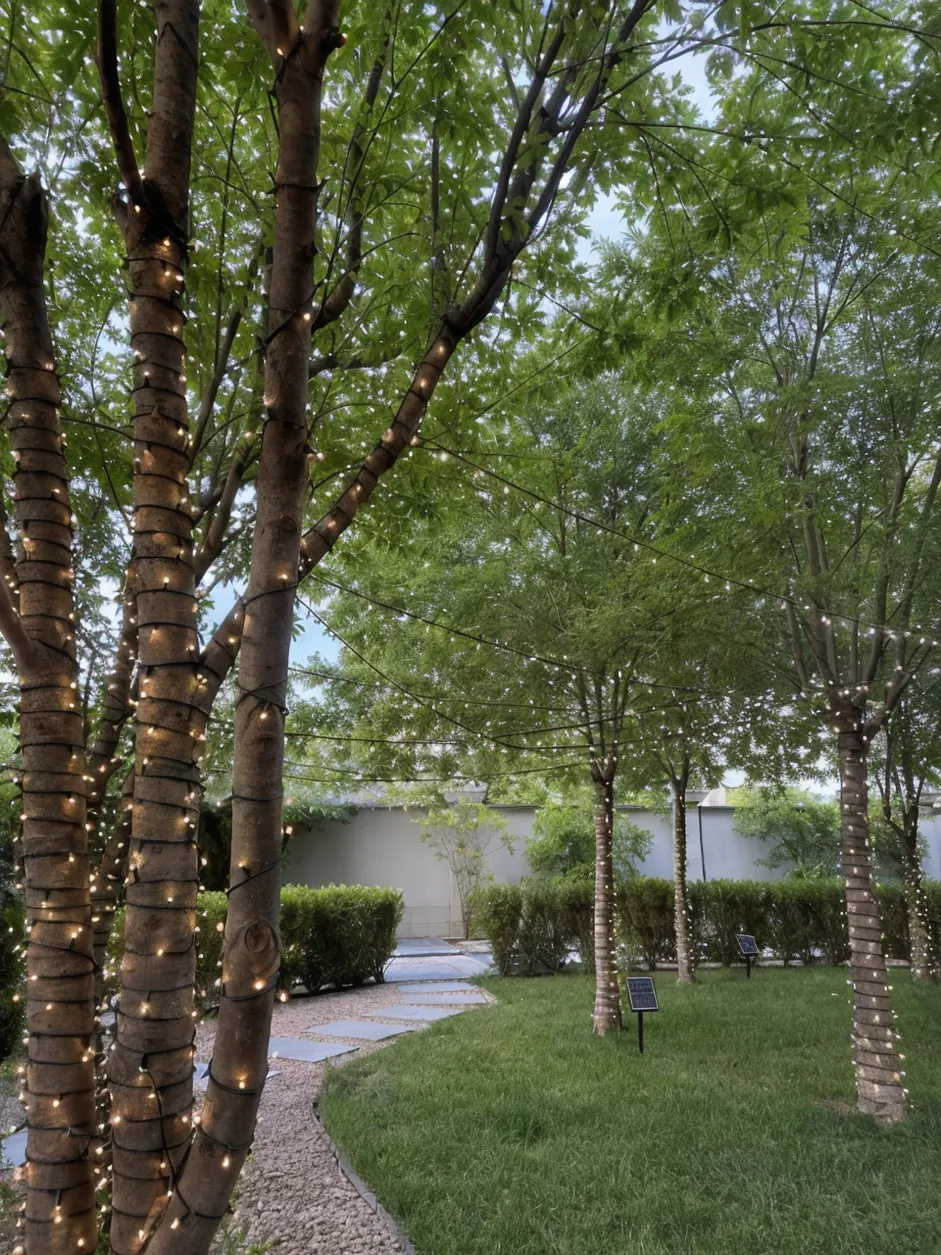
Solar Tree Lights for Seasonal, Retail, and Hospitality Programs
JXSOL manufactures solar tree lights for distributors, garden retailers, hospitality buyers, event suppliers, and private-label brands sourcing decorative outdoor lighting at volume. We've been producing solar-powered outdoor lighting since 2012, and solar tree lights sit within our solar garden and landscape lighting category — one of five product families we've built dedicated production capacity around.
What we supply here is a commercial SKU program, not a one-off decorative accessory. Buyers come to us for repeatable batches of string, wrap, and canopy-style solar tree lighting that ships consistently, packages cleanly for retail or hospitality use, and holds up through a full outdoor season without generating warranty claims. MOQ starts at 100 units for standard models, and OEM/ODM is available for buyers building a private-label tree lighting line.
Who This Program Serves
-
Garden retailers & seasonal shelf programs
-
Hospitality buyers & venue installations
-
Distributors sourcing at volume
-
Event & festival suppliers
-
Private-label brands building a tree lighting line
Tree Decoration Is a Different Sourcing Brief Than Tree Uplighting
Before comparing prices, it's worth being precise about what solar tree lights are — and what they aren't — because the two most common product types in this space serve completely different commercial purposes.
Solar Tree Lights
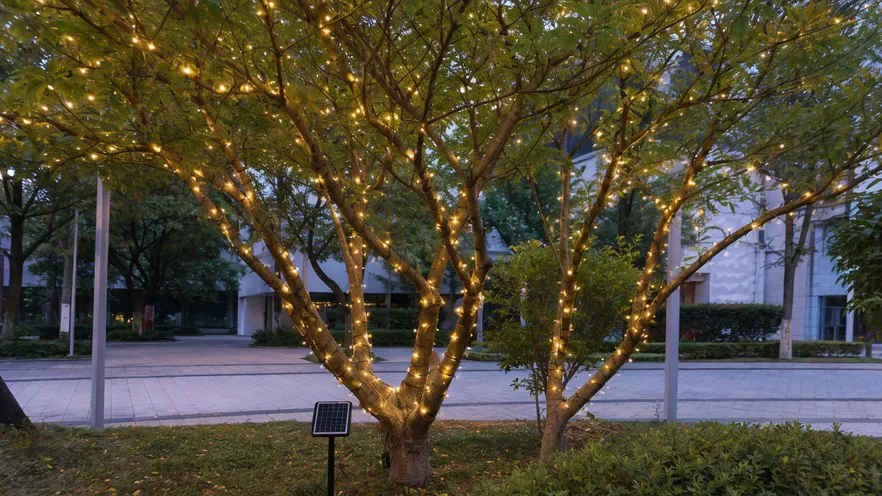
Decorative string, wrap, cluster, and canopy-style lighting products powered by a solar panel and rechargeable battery. Designed to be installed on or around trees and outdoor structures to create ambient visual effect — wrapping trunks and branches, draping through canopies, or clustering at branch tips.
Seasonal retail programs, hospitality ambiance, event and festival display, and garden center shelf product.
Solar Spotlights
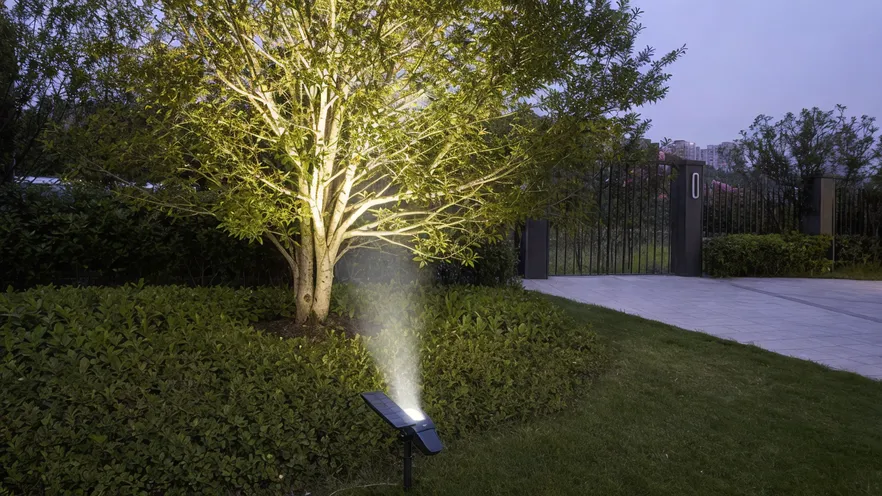
A different product entirely. They sit on the ground or mount on a wall and project a directional beam upward to illuminate a tree as a landscape feature. The commercial value is functional accent lighting — highlighting a specimen tree, illuminating a garden focal point, or providing security-adjacent visibility.
If your buyer brief calls for illuminating trees from the ground with a defined beam, that's solar spotlights for directional tree uplighting, not this product.
Why This Distinction Matters Commercially
Buyers who conflate the two end up with the wrong product for their channel:
A hospitality buyer who needs ambient tree decoration and orders spotlights gets a product that's too bright, too directional, and too expensive for the application.
A landscape contractor who needs feature tree lighting and orders string lights gets a product that doesn't deliver the lumen output or beam control the project requires.
Getting the brief right before sampling saves a round trip.
Variables to Define Before Requesting a Sample
For solar tree lights specifically, the variables that matter before you request a sample are:
SKU Formats Buyers Should Lock Before Sampling
Solar tree lighting comes in several distinct formats, and the format choice affects string length, LED count, panel sizing, packaging, and which commercial channels the product fits. Define your SKU brief before requesting samples.
String / Fairy Tree Lights
Scattered point-source sparkle across branches
String length, LED spacing, wire gauge, panel lead cable length
Seasonal retail, garden centers, e-commerce
Anti-tangle reel or inner tray; retail color box
Trunk Wrap Lights
Dense spiral or linear wrap around trunk and main branches
String length, LED density per meter, wire flexibility, IP rating
Hospitality, resort grounds, commercial outdoor
Coiled on card or reel; plain or branded carton
Branch / Canopy Lights
Draping effect through upper canopy
Long lead cable, flexible wire, lightweight panel
Event and festival suppliers, seasonal importers
Reel pack; mixed-SKU master carton
Net-Style Tree Lights
Uniform coverage over a shaped canopy
Net dimensions, LED grid spacing, panel output
Garden centers, municipal parks, retail display
Folded flat pack; retail box or plain carton
Cluster Lights
Dense point-source clusters at branch tips
Cluster count, wire branch length, panel sizing
Seasonal retail, hospitality, e-commerce bundles
Individual inner tray; retail color box
Outdoor Structure Wrap
Wrap lighting for pergolas, gazebos, fences
String length, connector type, IP67 for ground-level runs
Hospitality, resort, commercial outdoor
Reel or coil; plain or branded carton
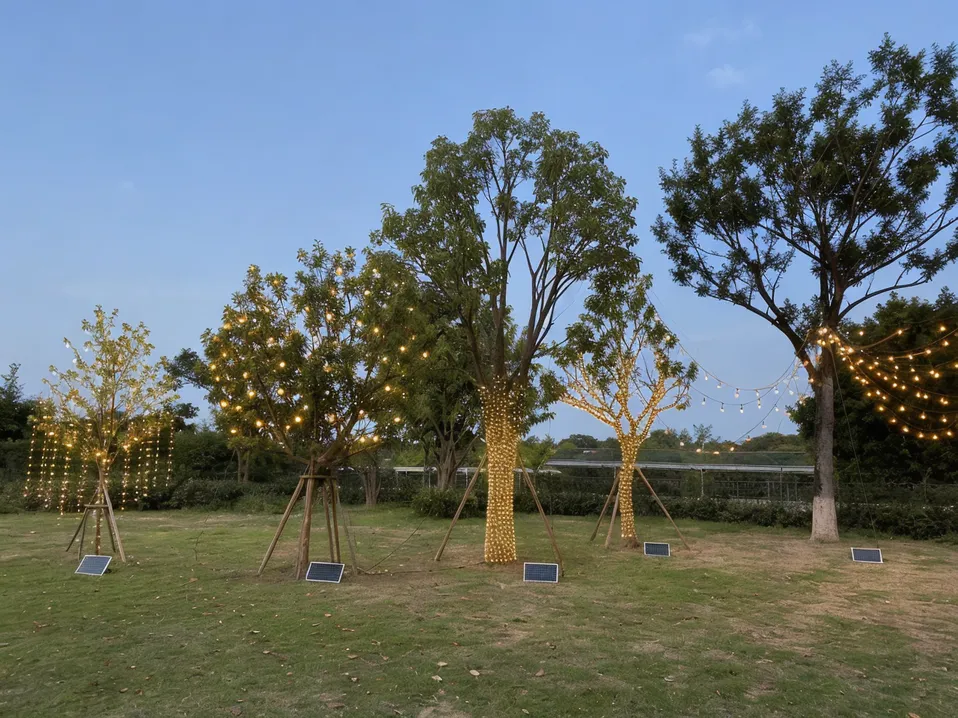
Channel-Format Alignment
Most buyers building a seasonal retail assortment start with string/fairy lights and cluster lights — they're the highest-volume formats for garden center and e-commerce channels.
Hospitality and resort buyers tend to specify trunk wrap and structure wrap for permanent or semi-permanent installations where the product needs to survive a full season without being removed.
Event and festival suppliers often need canopy-style strings with longer lead cables so the panel can be positioned away from the tree canopy where it gets better sun exposure.
Lock Tree Size Before Sampling
One thing we see regularly: buyers request samples of a format without specifying string length or LED spacing, then find the sample doesn't match their target tree size. A 5-meter string wraps a small ornamental tree; a 20-meter string is needed for a mature specimen. Lock the tree size and wrap density target before sampling — it saves a second sample round.
After-Sales Risk Starts With Cable Length, Panel Placement, and Wrap Density
Solar tree lights generate more after-sales issues from setup mismatch than from basic electrical failure. The product works — the string lights up, the panel charges the battery, the modes function. The returns come from buyers who didn't specify the right configuration for their end-use environment, and whose customers couldn't get the product to perform as expected.
Here are the four setup variables that drive the most support tickets and seasonal returns:
Panel Placement vs. Canopy Shade
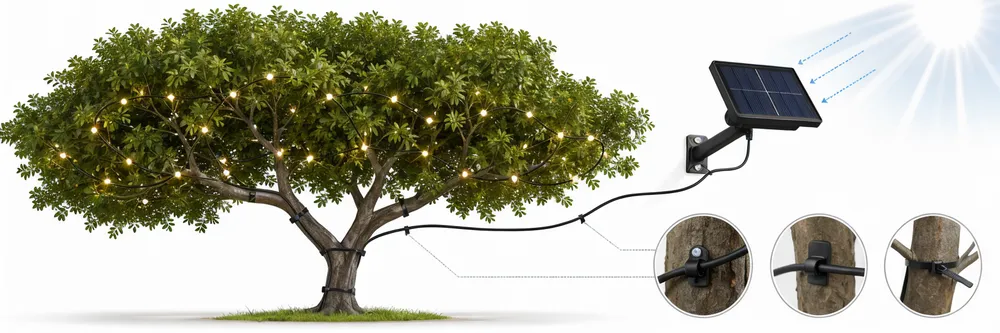
The solar panel needs direct sun exposure to charge the battery. A tree canopy blocks sun. If the panel is integrated into the string and the string is wrapped through the canopy, the panel may spend most of the day in shade — and the battery never reaches full charge.
The fix is a separate panel with a long enough lead cable to position the panel outside the canopy shadow, or a panel mounted on a ground stake or wall bracket away from the tree. We configure lead cable length to match the installation scenario; confirm your panel placement plan before ordering.
String Length vs. Tree Size
A 10-meter string wraps a small ornamental tree once or twice. A mature garden tree with a 3-meter trunk circumference and 5-meter branch spread needs 20–30 meters of string for a full wrap.
Buyers who don't specify tree size end up with a product that looks sparse on the target tree, and their customers return it. We ask for target tree size and desired wrap density at the RFQ stage — it's a two-minute conversation that prevents a returns problem.
Wire Flexibility and Bending Resistance
Tree lights are wrapped, removed at the end of the season, stored, and reinstalled the following year. Wire that's stiff or has poor bending resistance develops micro-cracks at the LED solder joints after a few installation cycles, leading to intermittent failures along the string.
We use flexible PVC-insulated wire with a bending radius specification that survives repeated installation and removal. The wire spec is one of the things we don't compromise on for this product type.
Fastening Accessories and End-User Instructions
Missing cable ties, no ground stakes for the panel, and unclear installation instructions are the three most common accessory complaints on tree light orders.
We pack fastening accessories against a confirmed packing list and include installation instructions in the buyer's specified language. If your channel is retail, the instruction sheet needs to cover panel placement clearly — end users who can't figure out where to put the panel return the product, not because it's defective, but because the instructions didn't help them succeed.
Prevent returns at the spec stage
Tell us your target tree size, panel placement plan, and channel — we'll configure the right string length and lead cable for your application.
Procurement Specs for Solar Tree Light Comparison Sheets
The table below covers the standard specification range for JXSOL solar tree lights. Values are typical ranges across the product line — exact specifications vary by SKU and configuration. Use this table to confirm whether our range covers your requirements; request a SKU-specific datasheet during the RFQ process for exact values.
| Parameter | Typical Range / Standard Value | Notes |
|---|---|---|
| String Length | 5m – 30m | Confirm based on target tree size and wrap density |
| LED Quantity | 50 – 300 LEDs per string | Varies with string length and LED spacing |
| LED Spacing | 5cm – 20cm | Tighter spacing for dense wrap; wider for canopy drape |
| Wire Material | Flexible PVC-insulated copper wire | Bending-resistant; suitable for seasonal installation/removal |
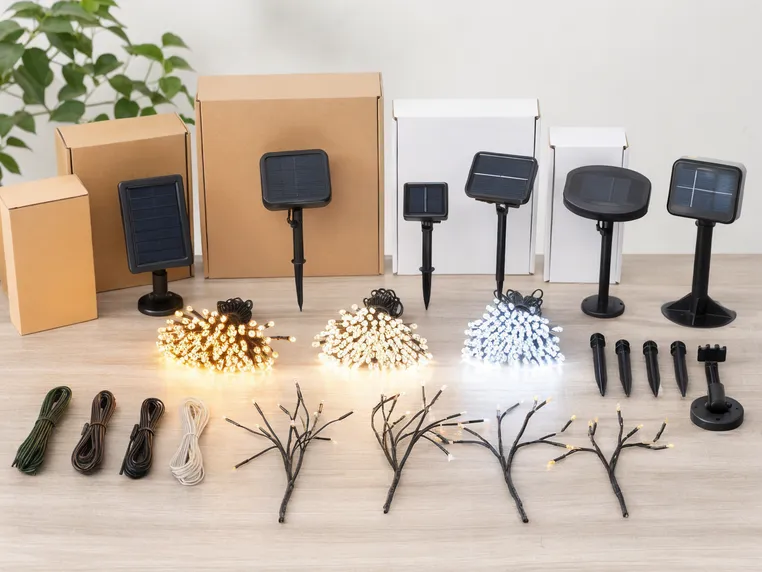
| Wire Color | Green, black, brown, clear, custom | Standard colors; custom wire color on OEM runs |
| Lead Cable Length | 1m – 5m | Confirm for panel placement outside canopy shadow |
| Solar Panel Type | Monocrystalline silicon | Higher conversion efficiency vs polycrystalline |
| Solar Panel Output | 0.5W – 3W | Sized to battery capacity and target runtime |
| Battery Chemistry | LiFePO4 / Li-ion | LiFePO4 for longer cycle life; Li-ion for cost-sensitive SKUs |
| Battery Capacity | 600mAh – 3000mAh | Matched to runtime target; cells tested before pack assembly |
| Charging Time | 6 – 8 hours (full sun) | Varies by panel wattage and battery capacity |
| Runtime (full charge) | 6 – 12 hours | Varies by mode and LED count |
| Working Modes | Constant-on, flash, fade, combination | Mode count varies by controller; confirm at order stage |
| CCT Options | 2700K, 3000K, 4000K, 6500K, RGB | Warm white, neutral white, cool white, multicolor |
| IP Rating | IP65 / IP67 | IP65 standard; IP67 for ground-level runs and high-exposure |
| Operating Temperature | -20°C – +50°C | Suitable for most export market climates |
| Accessories | Panel stake, cable ties, wall bracket (optional) | Accessory pack confirmed per SKU |
| Packaging | Retail color box, plain carton, custom OEM box | Anti-tangle reel or inner tray standard |
| MOQ (standard models) | 100 units | OEM/ODM MOQ reviewed by configuration |
| Warranty Support | 3 years | Covers manufacturing defects; confirm terms at order stage |
Specifications shown are typical values for this product line. Actual specifications vary by SKU and configuration. Contact us for SKU-specific datasheets and solar lighting certifications and quality standards.
Include your target string length, LED count, CCT, and order quantity for fastest response.
Wire, Connector, and Waterproof Controls That Keep Strings Working
Solar tree lights fail in ways that are specific to how the product is used — wrapped around branches, exposed to rain and UV, removed and stored at the end of the season, and reinstalled the following year. The failure modes are different from a fixed outdoor fixture, and the manufacturing controls need to match.
Wire Flexibility & Incoming Inspection
The wire is the first thing we pay attention to. Tree light strings flex repeatedly during installation and removal, and the LED solder joints at each connection point are the highest-stress location on the string. We use flexible PVC-insulated copper wire with a defined bending radius specification — the wire needs to survive a minimum number of flex cycles without developing micro-cracks at the insulation or at the solder joint.
We test wire samples from each incoming batch for flexibility and insulation integrity before they go into production. Wire that passes the bench test but fails after two installation cycles is a sourcing problem, not a production problem, and we catch it at incoming inspection.
Solder Joint Encapsulation
Solder joint protection is the second control point. Each LED connection on the string is soldered and then encapsulated with a UV-stable compound that seals the joint against moisture ingress and mechanical stress.
The encapsulation step adds time to the assembly process — it's also the step that prevents the intermittent failures that show up as "some LEDs not working" after the first rainy season. We don't skip it on cost-sensitive SKUs.
Panel-to-Cable Waterproof Connection
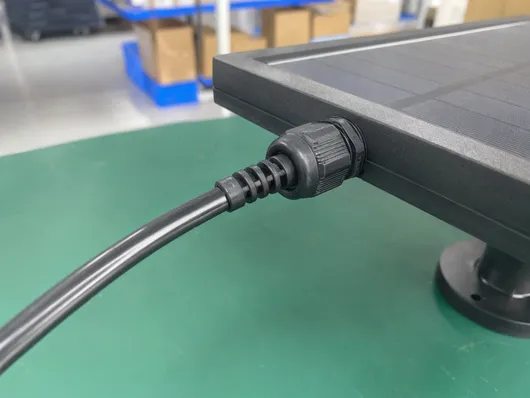
The panel-to-cable connection is the highest-risk waterproof point on the product. The junction between the solar panel and the lead cable is exposed to UV, thermal cycling, and mechanical stress from the cable moving in wind. We use compression-sealed connectors at this junction, rated to the same IP level as the housing, with a strain relief that prevents the cable from pulling directly on the solder joint inside the panel.
We've seen products from other factories where the panel-to-cable connection was sealed with heat shrink and silicone — it works for the first season, then the silicone degrades and water gets in. The compression connector is more expensive and more reliable.
Battery Matching & Charge/Discharge Testing
Battery matching and charge/discharge testing follow the same process we use across all our solar lighting lines: cells are tested for capacity and internal resistance before pack assembly, matched within a defined tolerance, and every assembled pack goes through a charge/discharge cycle test on our aging racks before installation.
Runtime consistency across a batch — not just the first unit — is what matters for retail and hospitality buyers who need their product to perform the same way across 500 units.
100% Pre-Shipment Inspection
100% pre-shipment inspection covers every string:
- LED function check across the full string length
- Mode verification
- Panel charging test
- Waterproof structure check
- Accessory pack verification against the packing list
Learn more about JXSOL's factory inspection process and certifications.
Market Programs Where Solar Tree Lighting Can Carry Margin
Solar tree lighting is a visual product — it photographs well, it sells on display, and it has a seasonal demand pattern that creates predictable reorder windows. Here's how the main commercial segments work for buyers building a tree lighting program.
Garden Centers & Hardware Retailers
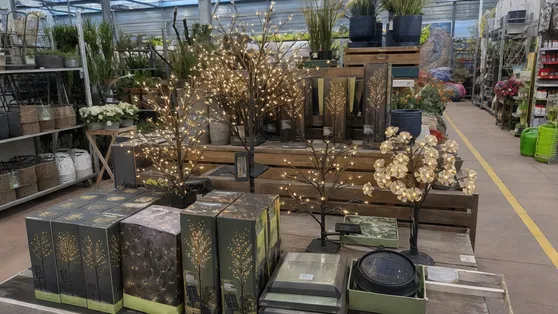
Spring and summer are the primary ordering windows for Northern Hemisphere markets, with a secondary Q4 window for holiday and winter display programs.
A garden center assortment typically runs 3–5 solar tree light SKUs: a standard fairy string in warm white, a cluster light for impulse purchase, and one or two specialty formats (net lights, trunk wrap) for the premium shelf tier.
The reorder pattern is annual, and buyers who establish a consistent SKU set with reliable runtime performance build repeat sell-through without needing to re-educate their retail accounts each season.
E-commerce Private Label
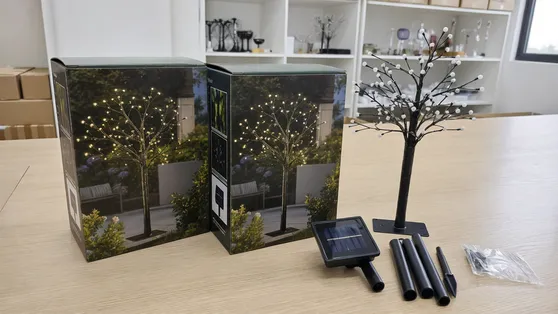
Solar tree lights are a strong e-commerce category — the product is visual, the price point supports online impulse purchase, and the review risk is manageable when the product performs as described.
The main margin risk in this channel is runtime claims: a product listed as "8-hour runtime" that delivers 4 hours in winter generates negative reviews and returns. We size battery capacity to match the stated runtime target for the buyer's target market latitude, and we confirm the runtime spec during the engineering review before production.
Buyers building an Amazon or DTC solar tree light line should also confirm packaging durability for mail-order transit — we cover this in the packaging section below.
Hospitality & Resorts
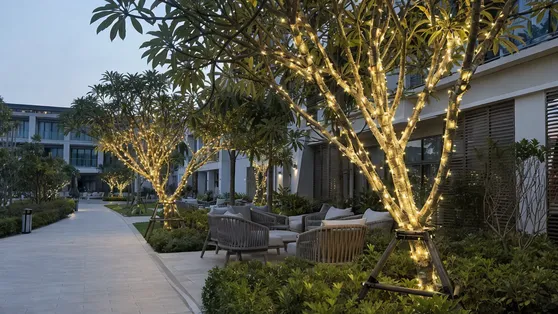
Hotels, resorts, and restaurant groups use solar tree lights for courtyard and garden decoration without the cost and disruption of trenching cable or running grid power to outdoor areas.
The commercial logic is straightforward: solar avoids the infrastructure cost, and decorative tree lighting is a visible amenity that photographs well for marketing.
Hospitality buyers typically specify trunk wrap and structure wrap formats for semi-permanent installation, with IP67 rating for year-round outdoor exposure. Order volumes run 200–1,000 units per property, and properties that renovate or expand generate repeat orders on a 3–5 year cycle.
Event, Holiday & Festival Suppliers
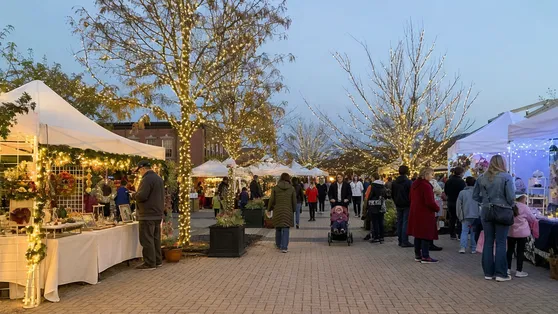
Short-season programs — Christmas markets, outdoor festivals, seasonal pop-up retail — need solar tree lights that can be installed quickly, run reliably for the event duration, and pack down without tangling for storage and reuse.
Lead time is the critical variable for this segment: event suppliers often confirm orders 8–12 weeks before the event date, and a production delay that misses the event window means the order has no value.
We confirm production schedules at order placement and communicate any changes before they affect the delivery window.
Municipal Parks & Commercial Outdoor Spaces
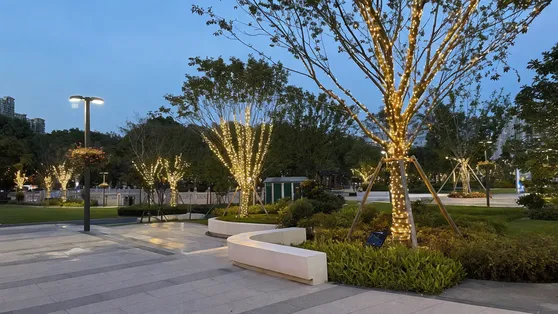
Municipalities and commercial property managers use solar tree lighting for decorative programs in parks, plazas, and commercial outdoor areas where solar avoids cable routing and grid connection costs.
This segment values documentation — CE certification, IP rating test certificates, and RoHS compliance records — for procurement compliance.
Order volumes are typically 500–5,000 units per project, with multi-year supply agreements for properties that run annual seasonal programs.
Scope Note: What Solar Tree Lights Are Not
Solar tree lights are not a substitute for security lighting, code-required pathway illumination, or high-output architectural uplighting.
- For directional tree feature lighting with defined beam control, see Solar Spotlights.
- For project-level outdoor lighting packages that include pathway and area lighting, see Solar Landscape Lighting.
Ready to Build Your Solar Tree Light Program?
Share your target market segment and order volume for a tailored quote with confirmed lead times and runtime specifications.
Get a Quote for Solar Tree LightsOEM/ODM Options for Private-Label Tree Lighting Lines
Solar tree lights are one of the more customizable products in our solar garden and landscape range — the string format gives us a lot of variables to work with, and most of them can be adjusted without new tooling. Here's what's available and where the limits are.
Customizable Without Tooling
- String length: 5m to 30m, or longer on engineering review
- LED count and spacing: tighter or wider spacing within the wire gauge's current-carrying capacity
- CCT selection: warm white (2700K, 3000K), neutral white (4000K), cool white (6500K), or RGB multicolor
- Lighting modes: constant-on, flash, fade, slow-glow, combination sequences — controller firmware is configurable
- Wire color: green, black, brown, clear, or custom color on qualifying run sizes
- Battery capacity: sized up for longer runtime or higher autonomy days
- Solar panel wattage: sized for the buyer's target installation latitude
- Accessory kit: cable ties, panel stakes, wall brackets, ground anchors — configured per SKU
- Retail packaging: color box design, logo printing, instruction language, barcode, SKU label, carton marks
- Private-label manual: product name, brand, installation instructions in buyer's specified language
Requires Engineering Review
- Unusual string structures (branching strings, multi-panel configurations, integrated timer controllers)
- New controller logic beyond standard mode sequences
- Custom panel housing or decorative panel shapes
- Special waterproof connectors for specific installation environments
- Proprietary decorative LED shapes or diffuser styles
In-house R&D team of 15+ optical and electrical engineers handles OEM/ODM reviews for this product line.
MOQ for standard models starts at 100 units; OEM/ODM MOQ is reviewed by configuration.
Practical Limits to Confirm Before Committing
Panel & Battery Sizing
Longer strings require matched panel and battery sizing — a 30-meter string with 300 LEDs draws more current than a 10-meter string with 100 LEDs. If you specify a long string with a small panel to keep unit cost down, runtime will suffer. We flag this during engineering review rather than letting it become a field performance problem.
IP Rating Constraints
Higher IP ratings (IP67 vs IP65) depend on the connector and housing structure — not every string configuration can be upgraded to IP67 without design changes. Confirm the IP requirement at the RFQ stage.
Custom Packaging Lead Time
Custom packaging needs artwork approval and a sample carton before production. We build the sample approval step into the production schedule — skipping it to save time is the most common reason packaging comes out wrong on the first run.
See OEM and ODM solar lighting services for the full process, including timeline, sample stages, and engineering review scope.
Get a Quote for Solar Tree LightsInclude your customization requirements and target order volume.
Packaging That Prevents Tangled Strings and Seasonal Damage Claims
Packaging is where solar tree light margin gets lost — not at the factory, but in transit and at the point of sale. A tangled string that takes 20 minutes to unpack generates a return. A crushed solar panel in a thin carton generates a warranty claim. A missing cable tie generates a support call. These are packaging problems, not product problems, and they're entirely preventable.
Anti-Tangle Protection
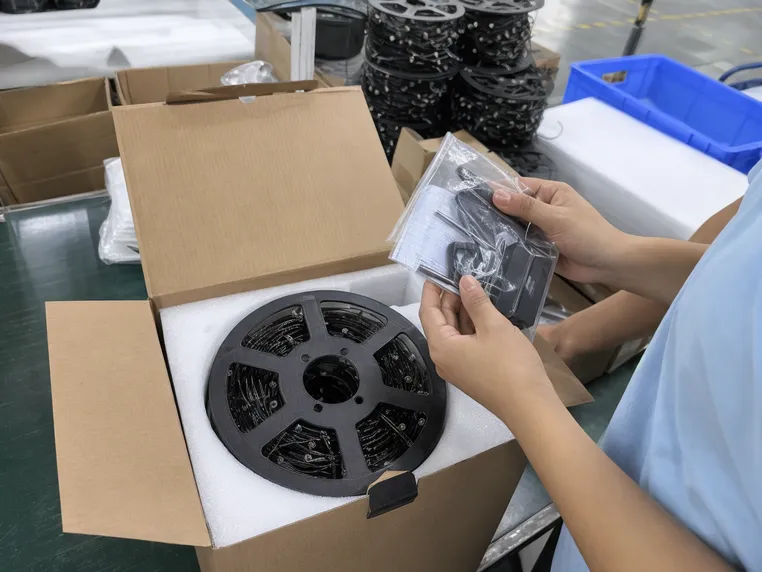
String lights are packed on a reel or in a formed inner tray that keeps the string in a defined coil. We don't pack strings loose in a box.
The reel or tray is sized to the string length — a 20-meter string needs a larger reel than a 5-meter string, and we don't compress the string to fit a smaller box.
We've seen buyers receive product from other factories where the string was folded into a retail box that was too small — the string was kinked at the fold points and the wire insulation was stressed before the product was even installed. That's a packaging design problem that shows up as a product failure.
Panel Protection
The solar panel is the most fragile component in the package. We use a formed foam or EPE insert that holds the panel in position and prevents it from shifting during transit.
For retail color box packaging, the panel insert is part of the box design, not an afterthought.
Accessory Pack Verification
Every carton is packed against a confirmed packing list: main string, solar panel (if separate), cable ties, panel stake or wall bracket, and instruction sheet.
Accessory packs are checked before carton sealing. Missing accessories are the most common complaint on tree light orders and the easiest to prevent.
Packaging Format Options
Retail Color Box
Custom design and printing available; sized for shelf display and pallet stacking.
Neutral Plain Carton
For wholesale and distribution channels that apply their own labels.
Private-Label Box
Buyer's brand, logo, and language; artwork approval before production.
Mail-Order Carton
Reinforced for e-commerce transit; drop-test rated for standard courier handling.
Mixed-SKU Master Carton
Multiple SKUs in a single master carton with individual inner boxes; batch codes for warehouse receiving.
Seasonal Reorder Planning
For seasonal reorder planning, we recommend confirming packaging specifications and artwork at least 8 weeks before your target ship date — packaging lead time is often the constraint, not production.
For logistics and container planning details, see shipping and delivery process.
Include your packaging format requirements.
Export Documentation and Inspection Evidence Buyers Can Verify
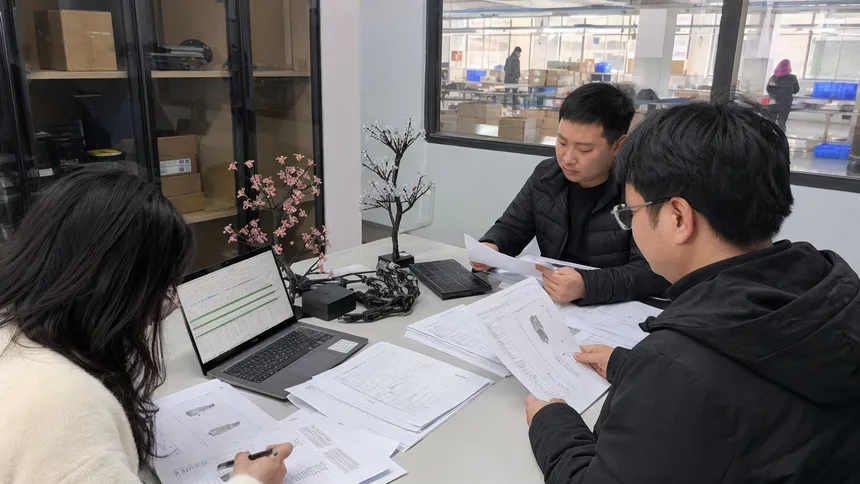
JXSOL holds ISO 9001:2015, CE, RoHS, IP65/IP67 Ingress Protection, and IEC 62124 certifications at the company level. For solar tree lights specifically, the documentation available with export orders covers the compliance requirements for most of our target markets.
What's Available Per Order
- CE Declaration of Conformity — covers EU market entry for electrical and electromagnetic compatibility requirements
- RoHS test reports — restricted substance compliance for EU and markets with equivalent requirements
- IP65 or IP67 test certificate — ingress protection rating confirmed per SKU; specify your required IP level at order stage
- IEC 62124 compliance documentation — photovoltaic system performance standard
- ISO 9001:2015 quality management system certificate
- Batch traceability records — component sourcing and production batch codes traceable to the finished unit
- 100% pre-shipment inspection report — available per shipment
What to Confirm by SKU and Target Market
Exact IP rating, CE test scope, and RoHS substance list should be confirmed against the specific SKU datasheet and your target market's import requirements. We don't claim every certificate applies to every configuration — a custom OEM SKU with a new controller or housing may require additional testing before the documentation is complete. We flag this during the engineering review.
EU Import (Retail & Distribution)
CE Declaration of Conformity and RoHS test reports are the primary documents for customs clearance and retail onboarding.
Municipal & Commercial Projects
IP test certificates and IEC 62124 documentation are typically required for project approval.
E-Commerce Channels
RoHS compliance and CE marking are increasingly required by platform policies.
Choose Adjacent JXSOL Products When the Tree Brief Changes
Solar tree lights are the right product when the brief calls for decorative string, wrap, or canopy lighting on trees and outdoor structures. When the brief shifts, here's where to look within the JXSOL range.
Directional Tree Feature Lighting
If the brief calls for illuminating a specimen tree from the ground with a defined beam — that's solar spotlights. Delivers 200–800 lumens with adjustable beam angles, designed for landscape contractor and hospitality project use where the tree is a focal point, not a decoration surface.
Solar SpotlightsBroader Decorative Garden SKUs
If the brief calls for dandelion lights, firefly lights, lanterns, or novelty garden fixtures — this line covers the novelty and themed end of the garden lighting category, suited for retail shelf programs and seasonal collections.
Decorative Solar Garden LightsGeneral Residential Garden Assortment
If the brief calls for standard stake lights, path lights, or ambient garden fixtures — this is the catalog volume end of the category, suited for hardware retailers and e-commerce distributors building a core solar garden range.
Solar Garden LightsProject-Level Outdoor Lighting Package
If the brief calls for pathway lighting, garden bed definition, or contractor installation — this line covers the 50–300 lumen range with more controlled output for defined landscape applications.
Solar Landscape LightingFAQ for Bulk Solar Tree Light Buyers
What string length should buyers choose for solar tree lights?
Match string length to tree size and desired wrap density. The most common mistake is underspecifying string length — the product looks sparse on the tree and the end customer returns it.
Small Ornamental Tree
- Trunk circumference under 60 cm, branch spread under 2 m
- Light wrap: 5–10 meters
- Dense wrap: 10–15 meters
Mature Garden Tree
- Trunk circumference 1–2 m, branch spread 4–6 m
- Full coverage: 20–30 meters
- Canopy drape: add 30–50% to account for irregular branch geometry
Tip: Tell us your target tree size and wrap style at the RFQ stage and we'll recommend the right string length.
How do solar tree lights differ from solar spotlights for trees?
Solar tree lights are decorative — they wrap around or drape through the tree to create ambient visual effect. Solar spotlights are functional accent lighting — they sit on the ground or mount on a wall and project a directional beam to illuminate the tree as a landscape feature.
| Attribute | Solar Tree Lights | Solar Spotlights |
|---|---|---|
| Purpose | Decorative — ambient visual effect | Functional — directional accent beam |
| Mounting | Wrapped around or draped through tree | Ground-mounted or wall-mounted |
| Lumen output | 5–50 lumens total across string | 200–800 lumens in focused beam |
| Effect source | Number of point sources, not raw output | Concentrated beam intensity |
Quick decision rule: If the buyer brief calls for "lighting up a tree so it's visible at night," that's a spotlight application. If it calls for "decorating a tree with lights," that's a solar tree light application.
See solar spotlights for directional tree uplighting if you need the former.
What IP rating should solar tree lighting use for outdoor retail or hospitality programs?
IP65 is the minimum for any outdoor solar tree lighting product. It covers dust ingress and water jets from any direction, which handles rain and irrigation exposure for most retail and hospitality applications.
For trunk wrap and structure wrap products that are installed at ground level or in areas with standing water after rain, IP67 is the better specification — it covers temporary immersion up to 1 meter.
Regional recommendation
For hospitality buyers in coastal or high-rainfall markets (Southeast Asia, the UK, Florida), we recommend specifying IP67 across the range. The unit cost difference is small; the warranty claim reduction is significant.
Confirm your required IP rating at the RFQ stage — not every string configuration is available in both IP65 and IP67 without design changes.
Why do solar tree light strings fail after one season?
The three most common failure modes:
Wire micro-cracking at LED solder joints
Caused by repeated installation and removal cycles. Shows up as intermittent LED failures along the string — some LEDs stop working while others are fine.
Battery degradation from unmatched cells or incorrect charge controller configuration
Shows up as shorter runtime each season.
Water ingress at the panel-to-cable junction
Occurs after UV and thermal cycling degrade the seal. Shows up as the product stopping charging after the first winter.
How JXSOL addresses all three failure modes:
- Flexible wire with a defined bending radius spec — prevents micro-cracking at solder joints
- Battery cell matching and charge/discharge testing before pack assembly — ensures consistent runtime across seasons
- Compression-sealed panel connectors rated to the same IP level as the housing — eliminates junction water ingress
Products that fail after one season are almost always a component specification or manufacturing control problem, not a design problem.
Can JXSOL customize LED color, string length, and retail packaging?
Yes on all three. LED color is selectable across warm white (2700K, 3000K), neutral white (4000K), cool white (6500K), and RGB multicolor — no tooling required. String length is adjustable from 5m to 30m (longer on engineering review) with matched panel and battery sizing. Retail packaging — color box design, logo printing, instruction language, barcode, SKU label — is available as part of the OEM/ODM service.
MOQ for standard models with custom packaging starts at 100 units. For custom string length or battery sizing, the engineering team reviews the configuration before production to confirm panel and battery sizing matches the runtime target.
See OEM and ODM solar lighting services for the full process.
What MOQ is practical for testing several solar tree light SKUs?
100 units per SKU for standard catalog models — low enough to test 3–5 SKUs with your retail accounts or hospitality buyers before committing to a seasonal program.
For a typical garden center or e-commerce assortment test, a 300–500 unit mixed-SKU order across 3–5 formats gives you enough product to validate sell-through before placing a full seasonal order. OEM/ODM MOQ varies by customization type and is confirmed during the engineering review.
Mixed-SKU orders across multiple formats are handled from a single factory with a single point of contact. Request a quote with your SKU list and target quantities.
What documents can JXSOL provide for export orders?
CE Declaration of Conformity, RoHS test reports, IP65/IP67 test certificates, IEC 62124 compliance documentation, ISO 9001:2015 certificate, batch traceability records, and 100% pre-shipment inspection reports.
Exact documentation availability should be confirmed by SKU and target market — a custom OEM configuration may require additional testing before the full documentation set is complete.
Common documentation by use case:
- EU import: CE and RoHS are the primary documents
- Project procurement: IP test certificates and IEC 62124 documentation are typically required
See solar lighting certifications and quality standards for the full list.
RFQ Checklist for Faster Solar Tree Light Pricing
The more specific your RFQ, the faster we can respond with a useful quote. Here's what to include:
Target Market & Climate
Country, latitude, typical seasonal conditions
Preferred SKU Format
String/fairy, trunk wrap, canopy, net, cluster, or structure wrap
String Length
Or target tree size and wrap density if you need a recommendation
LED Count or Spacing
Or describe the visual density you're targeting
CCT or Color Preference
Warm white, neutral white, cool white, RGB, or specific Kelvin
Runtime Target
Hours per night at full output
Panel & Battery Preference
Or confirm you want us to size for the runtime target
IP Rating Requirement
IP65 or IP67
Order Quantity
Per SKU and total
Packaging Format
Retail color box, plain carton, private-label box, mail-order carton
OEM/ODM Requirements
Custom packaging, logo, instruction language, wire color, accessory kit
Target Ship Date
So we can confirm production schedule availability
We respond with a configuration recommendation, available SKUs that match your requirements, and pricing based on your quantities.