

Solar Stand Fan Direct From Factory
Full-size rechargeable solar stand fan — pedestal format, battery-backed operation, matched panel and motor sizing for household retail and off-grid programs.
The floor-standing SKU in our solar fan line. Familiar form factor your buyers recognize, with the battery and panel configuration that actually delivers the runtime they expect.
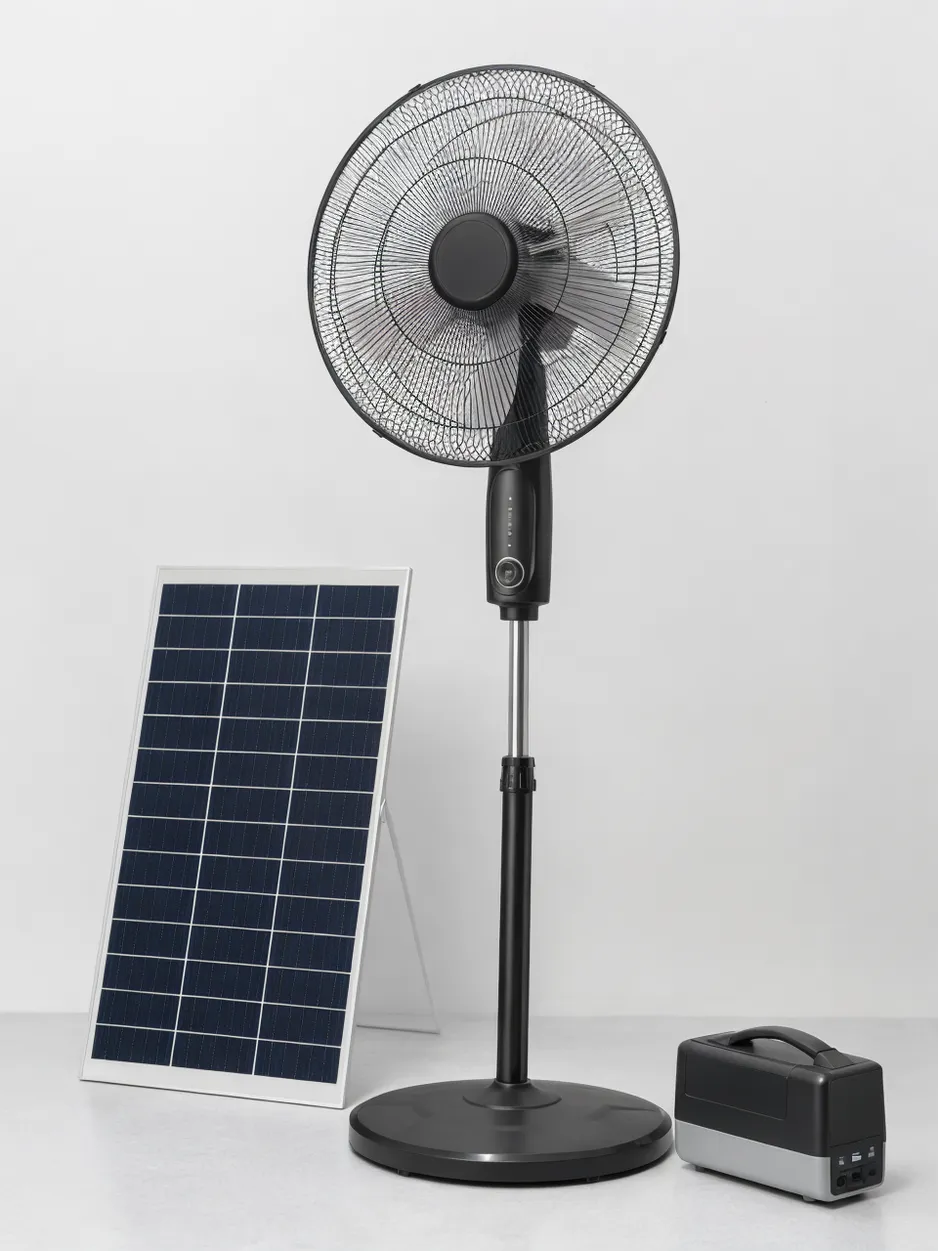
Solar Stand Fan for Household Solar Appliance Programs
A solar stand fan is a floor-standing, pedestal-mounted rechargeable fan powered by a solar panel and lithium battery. It is not a portable mini fan, and it is not a ventilation exhaust unit — it is the household-size, full-airflow SKU that sits in a living room, bedroom, or off-grid workspace and runs through the evening on stored solar energy. That distinction matters when you are building a catalog, because the stand format sells differently than compact or wall-mounted alternatives: it is the form factor your buyers already know from grid-powered pedestal fans, which means lower education cost at the retail level and faster sell-through in markets where solar appliances are still gaining adoption.
JXSOL is a solar lighting manufacturer based in Guzhen Town, Zhongshan, Guangdong. Solar stand fans are part of our selected adjacent solar-powered line — we support them because the core components are the same ones we already build and test for solar street lights and flood lights: lithium battery packs, solar panels, DC motor controllers, and charge management circuits. The battery matching and charge/discharge testing we run on solar lighting products runs on every solar fan battery pack that leaves this factory.
If you are adding a rechargeable solar stand fan to an existing solar lighting program, or building a solar appliance catalog for off-grid household retail, this page covers the specs, battery and panel sizing logic, QC controls, customization options, and packing details you need to evaluate whether this product fits your channel.
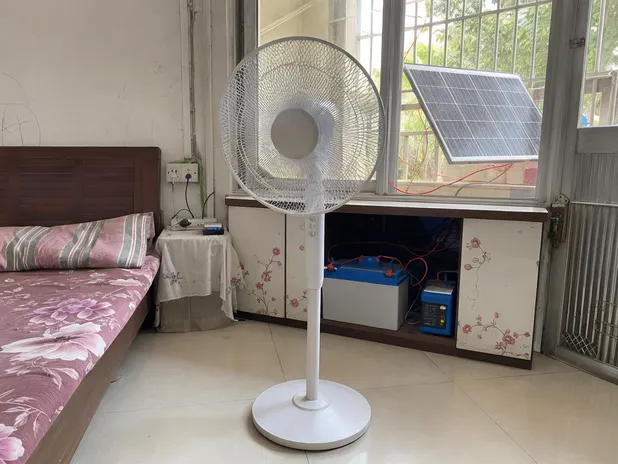
Shared Component Architecture
- Lithium battery packs
- Solar panels
- DC motor controllers
- Charge management circuits
Quote solar stand fan or contact JXSOL to discuss your requirements.
Where This Pedestal Format Protects Distributor Margin
The commercial case for a solar pedestal fan is not just that it cools a room — it is that the stand format commands a higher retail price point than compact or desktop solar fans while using a similar panel and battery configuration. That spread is where your margin lives.
Off-Grid Household Retail
Primary ChannelIn markets with unreliable grid power — sub-Saharan Africa, rural Southeast Asia, parts of the Middle East — a battery-backed solar stand fan is a daily-use appliance, not a discretionary purchase. Buyers in these markets are not comparing it to a grid-powered fan; they are comparing it to no fan at all, or to a generator-dependent one.
The solar pedestal fan wins on total cost of ownership, and repeat demand is driven by household formation and product replacement, not seasonal trends.
Distributors in this channel typically run mixed-SKU containers alongside solar lighting — adding a solar stand fan SKU to an existing solar lighting order means no new supplier, no new QC relationship, and one consolidated shipment.
Solar Lighting Distributors Expanding Catalog
If you are already sourcing from our core solar lighting catalog, adding a solar stand fan SKU to your container is a straightforward margin expansion. The product appeals to the same end-market — off-grid and unreliable-grid households — and it fills a gap in your catalog without requiring a new factory relationship.
We have buyers who started with solar street lights and added stand fans to their program specifically because the container economics worked: the fan cartons fill the remaining container space that would otherwise ship air.
Rural Electrification & Solar Home Kit Channels
NGOs, government electrification programs, and solar home system distributors bundle fans with solar lights and small battery systems. The solar stand fan is the higher-value add-on in these kits — it is more substantial than a portable fan and more recognizable as a household appliance.
Program orders in this segment tend to run 500–2,000 units per deployment, with repeat orders tied to program phases rather than seasonal demand.
Emergency Preparedness & Heat-Season Programs
Buyers in North America and Europe source solar stand fans for emergency kit programs, disaster preparedness retail, and seasonal cooling promotions. The rechargeable solar stand fan is a natural fit because it operates without grid power — the same feature that sells it in off-grid markets sells it as a backup appliance in grid-connected markets.
This represents a smaller but repeatable volume opportunity with consistent seasonal demand cycles.
Container Economics & Landed Cost
Carton volume and landed cost are part of the margin calculation for all of these channels. Stand fans ship in larger cartons than portable fans — more parts, more accessories, more packing material — so CBM per unit is higher. We confirm container loading quantities during quotation so you can model landed cost before committing to a program.
Specification Range Buyers Should Confirm Before RFQ
The table below covers industry-typical specification ranges for solar stand fans in our product line. These are the parameters you need to build a comparison sheet or evaluate channel fit. Exact values depend on the specific configuration — confirm final specs during quotation.
| Specification | Typical Range | Notes |
|---|---|---|
| Fan diameter | 12 inch – 18 inch | 14 inch and 16 inch are the most common retail sizes; 18 inch for higher-airflow programs |
| Stand height | 90 cm – 130 cm (adjustable) | Telescoping pedestal with height-lock mechanism; confirm range for your target retail segment |
| Motor type | BLDC (brushless DC) preferred | Brushed DC available for price-sensitive programs; see motor section below for trade-off |
| Motor power | 15W – 30W | Depends on blade diameter and airflow target; larger blades draw more current |
| Solar panel wattage | 20W – 40W | Matched to motor load plus battery charging requirement; confirm for your target market irradiance |
| Battery chemistry | Li-ion or LiFePO4 | LiFePO4 for longer cycle life and better performance in high-temperature markets; Li-ion for lower cost |
| Battery capacity | 10Ah – 20Ah | Sized for target runtime at full motor load; 12Ah–15Ah is the most common range for household retail |
| Runtime (battery-backed) | 6 hours – 12 hours | Stated at medium speed; runtime at high speed is lower — confirm by speed setting during quotation |
| Speed settings | 3 – 5 speeds | Standard 3-speed; 5-speed available on higher-spec models |
| Oscillation | Standard (90°) | Fixed-head option available; oscillation increases motor load slightly |
| Charging input | Solar panel; solar + AC adapter; solar + USB-C | Multi-input charging available; confirm plug/adapter type for destination market |
| Optional features | Timer, remote control, LED light | Remote and timer are common retail additions; LED integration available as a separate SKU |
| Grille material | ABS plastic grille | Metal grille available on higher-spec configurations |
| Housing material | ABS plastic | UV-stabilized ABS for outdoor-adjacent use |
| Carton configuration | Fan head + stand sections + base + panel + cable + accessories | Accessory pack contents confirmed per SKU at order stage |
Specifications shown are industry-typical values for this product type. Actual specifications may vary by configuration. Contact JXSOL to confirm exact specs for your target SKU, or see How to Choose a Solar Powered Fan for configuration guidance.
Include your target fan diameter, runtime requirement, and market — we'll confirm the matching configuration and spec sheet.
Battery, Panel, and Runtime Matching for a Rechargeable Solar Stand Fan
This is the section most buyers skip during sourcing and regret after the first field season. Getting the battery and panel sizing right for a rechargeable solar stand fan is not complicated, but it requires matching three numbers: motor load, panel output, and battery capacity. When those three are mismatched, the product fails commercially — not because it breaks, but because it delivers 4 hours of runtime when your buyers expected 8.
Motor Load Is the Starting Point
A 16-inch stand fan with a 20W BLDC motor draws roughly 20W at high speed and 10–12W at medium speed. That is the load the panel needs to cover while simultaneously charging the battery.
A 20W panel running a 20W motor at full speed has nothing left for battery charging — the battery drains during the day and never recovers.
Practical Rule
Panel wattage should be 1.5–2× the motor load to ensure the battery reaches full charge within 6–8 hours of peak sun while the fan is running.
Battery Capacity Determines Evening Runtime
A 12Ah lithium battery at 20W draw gives roughly 6 hours of runtime at full speed, accounting for efficiency losses in the controller and motor. At medium speed (10–12W draw), the same battery gives 8–10 hours.
We specify runtime at medium speed for household retail programs because that is how most buyers actually use the product — high speed is for peak heat, medium speed is for sleeping.
Watch Out
We've seen spec sheets claiming 16-hour runtime on a 10Ah battery. That number is only achievable at the lowest speed setting with the fan barely moving air. It is not a useful spec for your buyers.
Panel Sizing for Your Target Market
A 30W panel in Southeast Asia with 5–6 peak sun hours per day delivers 150–180Wh of energy daily. A 30W panel in Northern Europe in winter delivers 60–90Wh on a good day.
If your market is high-latitude or has a significant rainy season, size the panel toward the higher end of the range — or specify dual charging (solar + AC adapter) so your buyers can top up from the grid when solar input is insufficient.
Our Process
We confirm panel sizing during quotation based on your target market and runtime requirement.
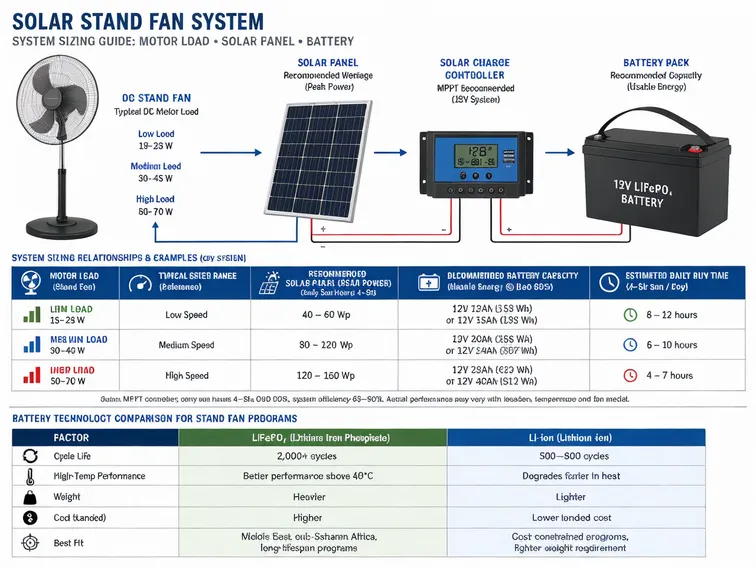
LiFePO4 vs Li-ion for Stand Fan Programs
| Factor | LiFePO4 | Li-ion |
|---|---|---|
| Cycle life | 2,000+ cycles | 500–800 cycles |
| High-temp performance | Better above 40°C | Degrades faster in heat |
| Weight | Heavier | Lighter |
| Cost | Higher | Lower landed cost |
| Best fit | Middle East, sub-Saharan Africa, long-lifespan programs | Cost-constrained programs, lighter-weight requirement |
We supply both; the choice depends on your market and your buyers' expected product lifespan.
For a detailed comparison of battery-backed vs direct solar fan configurations, see Solar Powered Fan.
Confirm the right panel and battery spec for your target market.
Stand Structure, Motor Testing, and After-Sales Risk Control
A solar pedestal fan has more mechanical failure points than a portable fan or a wall-mounted unit. The stand itself — base, telescoping tube, height-lock mechanism, and head tilt — introduces failure modes that don't exist in simpler configurations. We test for them specifically because we've seen what happens when they're skipped.
Stand Stability and Height-Lock Testing
The base needs to support the fan head and stand tube without wobbling under normal oscillation load. We test base stability with the fan running at full speed and full oscillation — if the base walks or tips, it fails before shipment.
The height-lock mechanism is tested through 200 adjustment cycles to confirm the lock holds under load and doesn't slip during operation.
A stand fan that slowly sinks to its lowest position during use is one of the most common complaints we see from buyers who sourced from suppliers that skipped this test. It is not a safety issue, but it generates returns.
Motor Load Testing at Rated Speed
Every motor is run at rated speed under load before assembly. We check current draw, temperature rise, and noise level. BLDC motors are tested for bearing noise specifically — a fan that develops bearing noise within 3–6 months of use is the second most common warranty driver in this product category.
Our BLDC motors include thermal protection that cuts power if the motor temperature exceeds the rated limit, which prevents the overheating failures that show up in high-ambient-temperature markets.
Grille and Blade Alignment
Blade imbalance causes vibration, and vibration causes noise and accelerated bearing wear. We check blade balance and grille alignment at the assembly stage.
The grille is also checked for deformation — a grille that arrives bent from shipping creates a safety concern and a return. Grilles are packed with foam support to prevent deformation during transit.
Battery Cell Matching
Battery cells are matched by capacity and internal resistance before pack assembly. Mismatched cells in a pack cause uneven charge/discharge, which accelerates degradation in the weaker cells and reduces overall pack capacity faster than the spec suggests.
We run charge/discharge cycle testing on assembled packs — not just cell-level testing — to confirm the pack performs as a unit.
Accessory Checklist at Outgoing Inspection
Stand fans ship with more accessories than most solar products. A missing panel cable means the product is unusable on arrival. Every carton is checked against a packing list at outgoing inspection before sealing.
The packing list is included inside the carton so your buyers can verify on receipt.
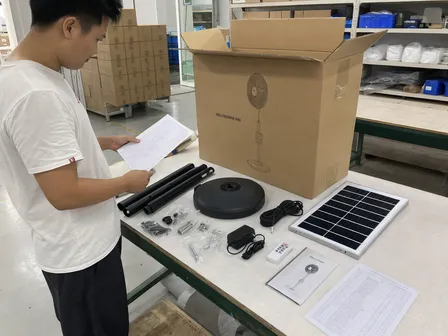
100% Pre-Shipment Inspection on Every Unit
The JXSOL factory quality system runs 100% pre-shipment inspection on every unit — the same standard that covers our solar lighting products. Solar stand fans go through the same four-stage QC process:
Contact JXSOL to request a QC checklist or pre-shipment inspection report format for your program.
Custom Solar Stand Fan Options for Private-Label Orders
Most buyers who come to us for solar stand fans are not sourcing a commodity — they are building a branded solar appliance line or adding a private-label SKU to an existing solar catalog. The customization options below cover what we can configure, what affects MOQ, and what information you need to provide to get a useful quote.
Branding & Packaging
- Logo on fan housing, grille center cap, solar panel label, and retail carton
- User manual in your language and format
- Retail box design with your brand identity, barcode, and SKU label
- Carton printing handled in-house — you provide artwork, we confirm print spec before production
Fan Configuration
- Fan diameter: 12–18 inch
- Blade count and design
- Motor power selection
- Speed settings: 3 or 5 speed
- Oscillation: standard or fixed head
- Timer function
Confirm based on your target retail price point and airflow requirement.
Battery & Panel
- Battery chemistry: Li-ion or LiFePO4
- Capacity: 10Ah–20Ah
- Cell brand specification (if preferred)
- Solar panel wattage: 20W–40W
- Panel dimensions, cable length, bracket style
Charging Input & Plug Type
- Solar-only
- Solar + AC adapter
- Solar + USB-C
- Multi-input
Plug type and adapter voltage must match your destination market — we confirm this during the engineering review. Getting the plug type wrong is a customs and safety issue, not just an inconvenience.
Housing & Stand Color
- Standard colors available from existing tooling
- Custom colors: minimum 500 units
Custom colors require a dedicated injection mold cleaning and re-shot, plus a dedicated powder/paint line run. Below 500 units, we recommend selecting from standard color options.
Accessory Pack
- Remote control
- Replacement fuse
- Carry bag
- Mounting hardware kit
- Instruction card
Accessory pack contents confirmed per SKU at order stage and checked every carton at outgoing inspection.
Engineering Review Before Production
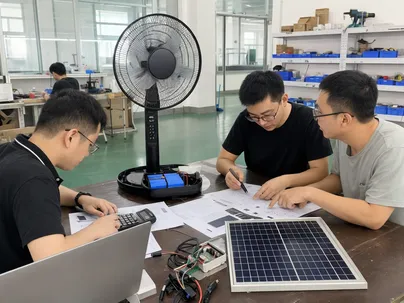
We run an engineering review on custom battery and panel configurations before production to confirm the sizing is correct for your target runtime and market irradiance.
Example mismatch we catch: A buyer requested a 10Ah battery with a 40W panel for a 16-inch fan targeting 12-hour runtime. The math doesn't work — the panel is oversized and the battery is undersized for that runtime target. The engineering review catches these mismatches before they become production problems.
MOQ and Lead Time
MOQ for standard catalog models starts at 100 units. OEM/ODM programs with custom specifications go through an engineering review before production — spec must be locked before component procurement. Changes after procurement affect lead time and cost.
What to include in your RFQ: Target market, fan diameter, battery/runtime target, panel wattage, charging input, packaging requirements, and branding needs. We'll respond with a configuration recommendation and pricing.
Solar Stand Fan vs Other Solar Fan SKUs
If the pedestal format is not the right fit for your channel, the table below maps each sibling SKU to its commercial use case. The goal is to help you find the right product, not to route you to the most expensive one.
| Product | Best Commercial Fit | When to Choose It |
|---|---|---|
| Solar Stand Fan (this page) | Household retail, off-grid home use, solar appliance programs | Your buyers want a full-size floor-standing fan with battery-backed evening operation |
| Solar Powered Fan | Buyers who need confirmed panel + battery + runtime specs for a defined performance target | You need a matched configuration with documented performance data for a specific market or project |
| Portable Solar Fan | Camping retail, emergency kits, compact outdoor programs | Your buyers need a lightweight, travel-packaged fan — not a floor-standing household appliance |
| Solar Fan With LED Light | Solar home kits, rural electrification bundles, multi-function catalog SKUs | Your buyers want fan + light on a single solar system; higher-value SKU for kit programs |
| Solar Exhaust Fan | Building ventilation, greenhouse, attic, warehouse channels | Your buyers need daytime ventilation, not household cooling — direct solar operation, no battery |
| Solar Fans | Distributors building a broad solar fan catalog across multiple form factors | You want to evaluate the full solar fan family before narrowing to a specific SKU |
Best fit: Household retail, off-grid home use, solar appliance programs
Choose when: Your buyers want a full-size floor-standing fan with battery-backed evening operation
Best fit: Buyers who need confirmed panel + battery + runtime specs for a defined performance target
Choose when: You need a matched configuration with documented performance data for a specific market or project
Best fit: Camping retail, emergency kits, compact outdoor programs
Choose when: Your buyers need a lightweight, travel-packaged fan — not a floor-standing household appliance
Best fit: Solar home kits, rural electrification bundles, multi-function catalog SKUs
Choose when: Your buyers want fan + light on a single solar system; higher-value SKU for kit programs
Best fit: Building ventilation, greenhouse, attic, warehouse channels
Choose when: Your buyers need daytime ventilation, not household cooling — direct solar operation, no battery
Best fit: Distributors building a broad solar fan catalog across multiple form factors
Choose when: You want to evaluate the full solar fan family before narrowing to a specific SKU
If you are not sure which format fits your channel, contact JXSOL with your target market and distribution channel — we'll recommend the right starting SKU based on what's moving for our existing buyers in your region.
Packing, Carton Volume, and Mixed-Container Planning
Stand fans have more carton complexity than any other SKU in the solar fan line. A portable fan ships in one compact carton. A solar stand fan ships with a fan head, stand tube sections, base plate, solar panel, panel cable, battery (if external), mounting hardware, remote control, AC adapter (if included), and instruction manual — all in a single carton that needs to arrive without grille deformation, panel glass cracking, or missing accessories. Packing sequence and carton construction matter more for this product than for most.
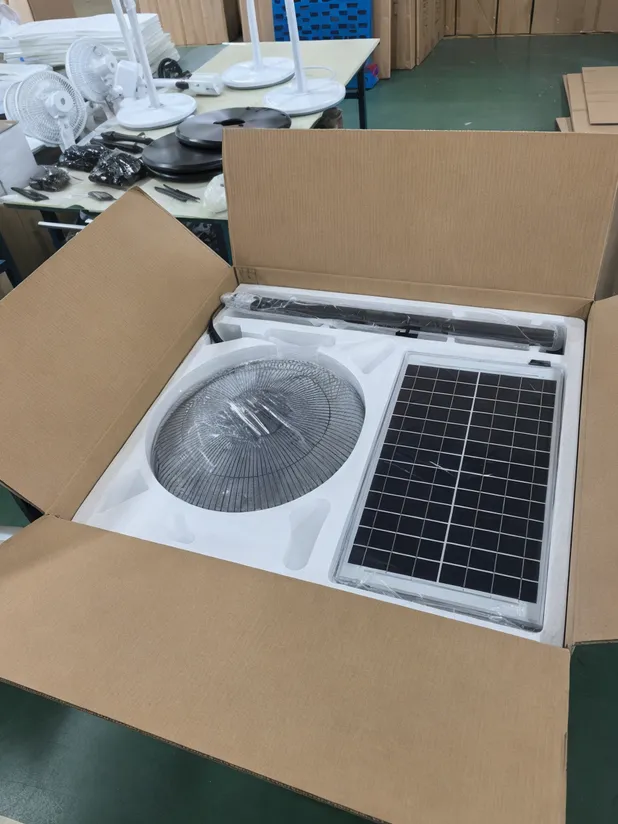
Double-wall corrugated carton with foam inserts for fan head and solar panel protection
Carton Construction
We use double-wall corrugated cartons for solar stand fans. The fan head is packed with foam inserts that hold the grille in position and prevent deformation under compression. The solar panel is wrapped in foam and packed flat with corner protection — for panels 30W and above, we add reinforced carton walls on the panel side. Stand tube sections are bundled and packed alongside the base to prevent rattling and surface scratching.
KD (Knockdown) Packing
Stand fans ship in semi-knockdown configuration by default — fan head, stand sections, and base are packed separately and assembled by the end user. This reduces carton CBM compared to a fully assembled unit and lowers the risk of stand damage during transit. Assembly requires no tools for standard models (snap-fit stand sections and base). If your channel requires fully assembled units (some project deployments), we can discuss alternative packing, but CBM increases significantly.
Accessory Control
Every carton is packed against a defined accessory checklist: panel cable, mounting hardware, remote control (if included), adapter (if included), spare fuse, and instruction manual. The packing list is printed and placed inside the carton. At outgoing inspection, every carton is opened and checked against the list before sealing. A missing panel cable is a product that cannot be used — we treat it as a defect, not a packing oversight.
Retail Box vs Bulk Carton
Retail Box
Full-color printing, product photography, spec callouts, barcode, and SKU label — suited for shelf display and e-commerce fulfillment.
Bulk Carton
Plain brown carton with SKU label and batch code — suited for project deployment and distributor warehouse stock.
We confirm the carton format at the order stage.
Mixed-Container Planning
Solar stand fans consolidate well with solar lighting products and other solar fan SKUs. We manage mixed-SKU consolidation on our end — you receive one container with one master packing list.
CBM per carton and container loading quantities (20GP and 40HQ) are confirmed during quotation based on your selected models and carton format.
For shipping and delivery details, see our shipping and delivery page.
Contact JXSOL to confirm CBM, container loading quantities, and packing format for your solar stand fan program.
Get Packing DetailsCompliance and Export Documentation Buyers Should Prepare For
Solar stand fans are consumer electrical products with a battery and a solar panel — that combination triggers documentation requirements in most regulated markets. Here is what we can provide and what you need to confirm for your destination market.
What JXSOL Holds
Documentation we provide with qualifying orders
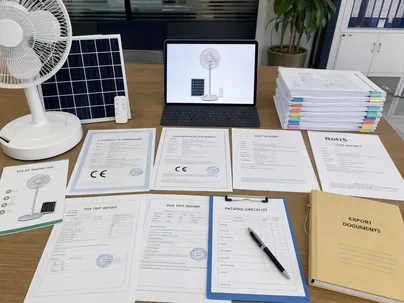
Our production management system is ISO 9001:2015 certified. CE Declaration of Conformity and RoHS test reports are available for orders destined for the EU and markets that accept CE documentation. These cover the electrical safety and restricted substance requirements that affect import clearance in those markets.
IEC 62124 is a photovoltaic system standard relevant to our solar panel and controller testing capability — it reflects our component-level testing infrastructure, not a product-level certificate for every SKU.
We are precise about this distinction because overclaiming certifications creates problems at customs that are harder to resolve than the original documentation gap.
Documentation included with order:
What You Need to Confirm for Your Market
Destination-specific requirements to verify during RFQ
Battery documentation
Requirements vary by destination — some markets require UN 38.3 test reports for lithium battery shipments, others require MSDS/SDS for the battery pack.
Adapter and plug certification
UL, SAA, PSE, etc. — depends on your destination market and the charging input configuration you select.
Destination-market labeling
Language, safety symbols, energy ratings — should be confirmed during the engineering review for OEM/ODM orders.
Compliance as Landed-Cost Protection
Getting documentation right before shipment is cheaper than resolving a customs hold after the container arrives. We provide the documentation package with the order — CE Declaration of Conformity, RoHS test reports, and IP test certificates where applicable — so your import clearance process has what it needs.
For markets with additional requirements, confirm them during RFQ so we can prepare the documentation in advance.
Solar Stand Fan Procurement FAQ
What is the difference between a solar stand fan and a portable solar fan?
A solar stand fan is a full-size floor-standing pedestal fan — typically 12–18 inch blade diameter, 90–130 cm stand height, designed for household use in a fixed location. A portable solar fan is a compact, lightweight unit — typically 6–10 inch blade diameter — designed for travel, camping, and emergency kits.
The commercial difference is channel fit: stand fans sell into household retail and off-grid home programs at a higher price point; portable fans sell into outdoor retail, camping, and emergency preparedness at a lower price point with retail packaging optimized for shelf display.
Channel selection guide:
- If your buyers are furnishing a home or off-grid dwelling, the stand fan is the right SKU.
- If your buyers are packing a bag or a kit, the portable fan is the right SKU.
What panel wattage is suitable for a rechargeable solar stand fan?
Panel wattage should be 1.5–2× the fan's motor load to ensure the battery reaches full charge within 6–8 hours of peak sun while the fan is running.
| Fan Configuration | Minimum Panel | Market Condition |
|---|---|---|
| 16-inch, 20W BLDC motor | 30W panel | Standard tropical/subtropical markets |
| 16-inch, 20W BLDC motor | 35–40W panel | High-latitude or heavy cloud cover (Northern Europe, parts of East Africa during rainy season) |
For high-latitude markets or markets with significant cloud cover, size toward 35–40W or specify dual charging (solar + AC adapter) to maintain runtime reliability.
Important: We confirm panel sizing during quotation based on your target market and runtime requirement — do not accept a panel spec without knowing the target market irradiance.
How should runtime be specified for different fan speeds?
Runtime should be stated at the speed setting your buyers will actually use, not at the lowest speed setting. A 15Ah battery at 20W draw (high speed) gives roughly 6–7 hours. The same battery at 10W draw (medium speed) gives 10–12 hours.
Suppliers who state runtime at low speed produce impressive numbers — 16, 18, 20 hours — that collapse under real conditions because nobody runs a stand fan at its lowest setting for cooling.
Runtime Reality Check — 15Ah Battery Example
High Speed (20W)
6–7 hrs
Medium Speed (10W)
10–12 hrs
Low Speed (quoted)
16–20 hrs
Misleading if used alone
Ask for runtime at medium speed and high speed separately. If a supplier only provides one runtime number without specifying the speed setting, that is a signal to ask more questions.
Is a BLDC motor worth the extra cost for a solar pedestal fan?
For household retail and off-grid programs, yes. A brushless DC (BLDC) motor draws 20–30% less current than a brushed DC motor at the same airflow output, which means more runtime from the same battery capacity. It also lasts significantly longer — brushed motors develop bearing and brush wear within 12–24 months of regular use; BLDC motors in the same application typically run 5+ years without mechanical degradation.
BLDC Motor
- 20–30% less current draw at same airflow
- 5+ years typical lifespan without mechanical degradation
- Lower warranty claims and returns
- Cost premium: $2–5 per unit depending on motor size
Brushed DC Motor
- Higher current draw for equivalent airflow
- Bearing and brush wear within 12–24 months
- Lower unit cost
- Available where landed cost is the primary constraint
The cost premium is modest at the unit level (typically $2–5 per unit depending on motor size), and the reduction in warranty claims and returns more than covers it for most programs. We default to BLDC on all current stand fan models. Brushed DC is available for programs where landed cost is the primary constraint and the buyer accepts the trade-off.
What packing details matter most for stand fan export orders?
Three things cause most of the damage and missing-accessory claims on stand fan shipments:
Buyer action: Ask your supplier for their accessory checklist and outgoing inspection procedure before placing an order.
What MOQ does JXSOL support for standard and private-label solar stand fans?
Standard catalog models are available from 100 units — low enough to test a new SKU with your buyers before committing to a larger program.
OEM/ODM programs with custom specifications (private label, custom battery capacity, custom panel wattage, custom color, custom packaging) go through an engineering review before production, and MOQ is confirmed based on the configuration.
Custom housing colors typically require 500+ units due to tooling changeover costs.
Include your target model, quantity, and customization requirements — we'll confirm MOQ and lead time.
Send Your Target Runtime, Fan Size, and Market Requirements
If you are evaluating a solar stand fan program — whether that is a single SKU addition to an existing solar catalog, a private-label household fan line, or a volume program for off-grid retail — send us the details below and we will respond with a configuration recommendation, spec sheet, and quote.
Useful Information to Include
-
Target market and distribution channel
Off-grid household retail, solar home kit, emergency preparedness, mixed solar catalog
-
Fan diameter preference
12, 14, 16, or 18 inch
-
Runtime requirement
Hours at medium speed; daytime-only or overnight operation
-
Panel wattage preference or target landed cost
-
Battery chemistry preference and capacity target
Li-ion or LiFePO4
Program & Logistics Details
-
Charging input requirement
Solar-only, solar + AC adapter, solar + USB-C
-
Order quantity and reorder frequency
-
Branding and packaging requirements
Private label, retail box, bulk carton, manual language
-
Destination market and compliance documentation
CE, RoHS, SONCAP, or other regional requirements
Standard models are available from 100 units. If you are already sourcing solar lighting from us, we can consolidate your solar stand fan order into the same shipment — one container, one documentation package, one point of contact.
Ready to Start Your Solar Stand Fan Program?
Send your requirements and receive a configuration recommendation, spec sheet, and quote.