

Solar Porch Lights Direct From Factory
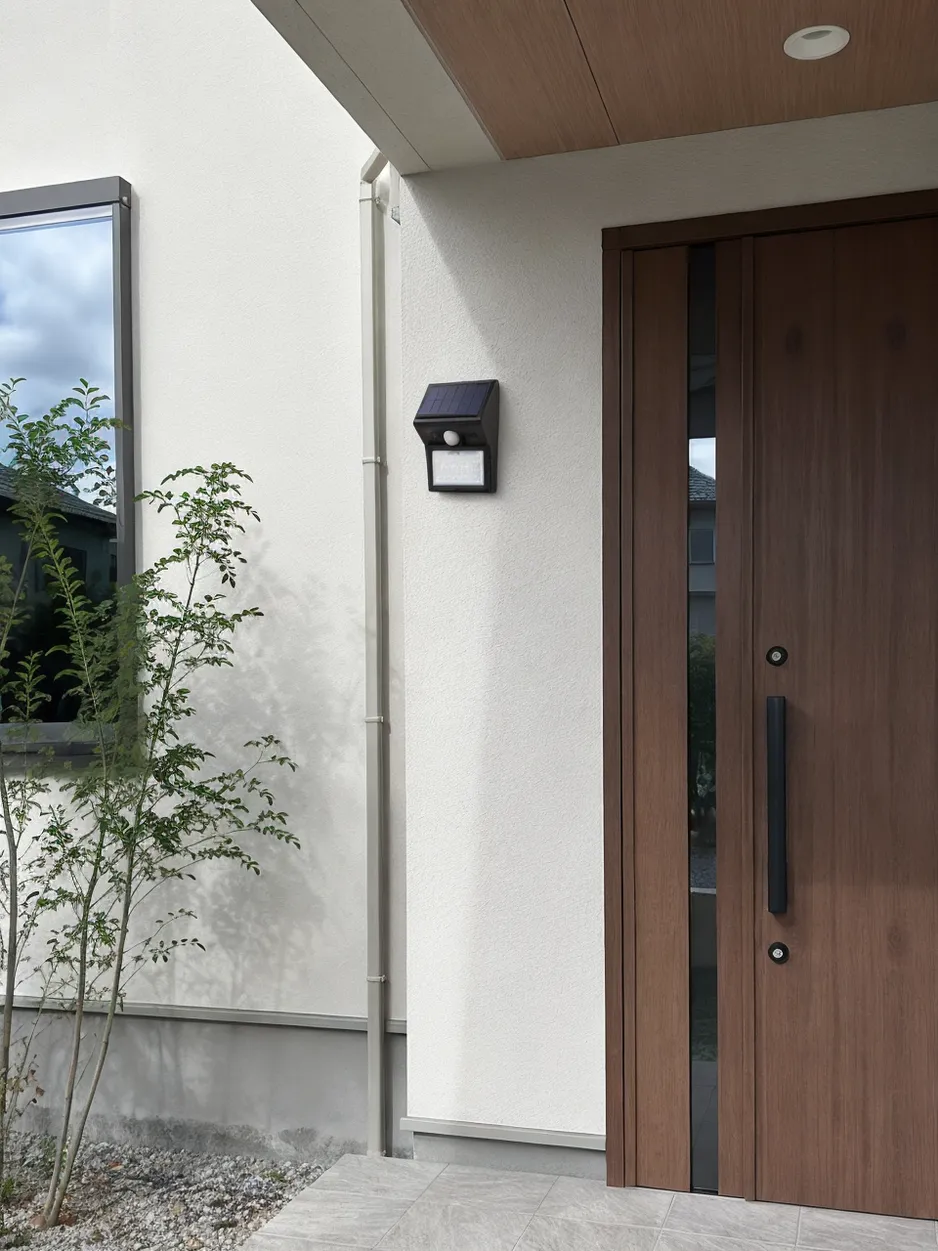
Compact solar wall fixtures for porch, patio, and entrance programs — no grid wiring, no electrician, no installation complaints from your downstream buyers.
IP65/IP67 rated, CE and RoHS certified, with PIR sensor options and OEM packaging from 100 units. Built in our 12,000 m² Zhongshan factory with 100% pre-shipment inspection on every unit.
13+
Years Manufacturing
12,000 m²
Factory Floor
100%
Pre-Shipment QC
IEC 62124
Tested
100 Units
MOQ OEM/ODM
IP65/67
Waterproof Rating
Where This SKU Makes Commercial Sense
Solar porch lights sit at the intersection of two buyer demands that keep showing up in our order history: the need for a wiring-free outdoor fixture that installs in under 20 minutes, and the need for a compact SKU that fits retail carton programs without requiring a dedicated electrician on the project. That combination opens up several market segments worth understanding before you decide on configuration.
Residential Porch & Entrance Retail Lines
Hardware chains, home improvement distributors, and online outdoor living retailers consistently reorder compact solar porch lights on seasonal cycles — spring and fall are the volume peaks in North America and Europe. The SKU fits standard retail shelf dimensions, ships in individual color boxes, and generates low post-sale support volume when the product is spec'd correctly.
Buyers in this channel typically start with 500–2,000 units per SKU to test sell-through before scaling to full container programs.
Patio & Garden Product Assortments
Solar patio lighting is a natural companion SKU to solar pathway lights, solar garden stakes, and outdoor furniture accessories. Distributors building a solar outdoor living assortment use porch wall lights as the anchor fixture — higher perceived value than ground stakes, lower installation complexity than hardwired sconces.
The margin profile on compact solar wall fixtures tends to be stronger than on pathway lights because the product category is less commoditized at retail.
Villa, Resort & Hospitality Exterior Upgrades
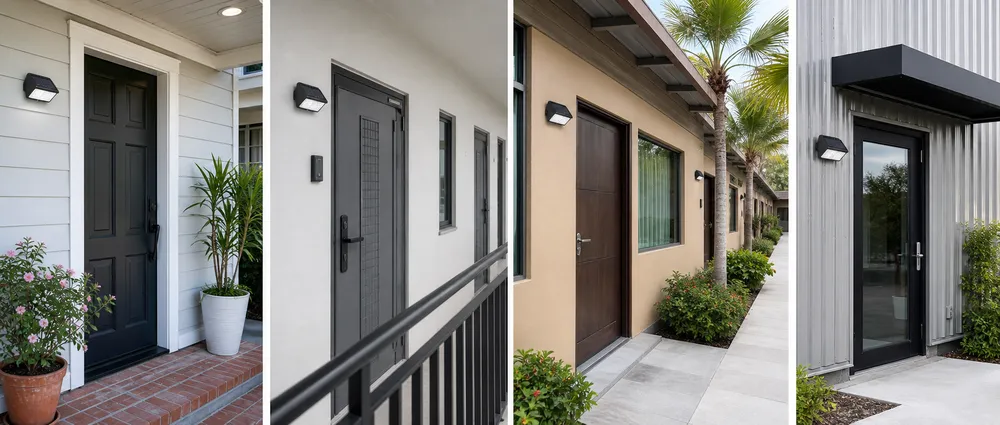
Project buyers sourcing for villa developments, boutique resorts, and hospitality renovation programs use solar porch lights at entrance gates, covered walkways, and balcony walls where running conduit is either cost-prohibitive or structurally inconvenient.
A 50-villa development typically needs 4–8 fixtures per unit, which puts a single project in the 200–400 unit range — repeatable volume if you're positioned with the right contractor network.
Apartment Corridor & Small Commercial Entrance Programs
Property management companies and building contractors in Southeast Asia, the Middle East, and Africa increasingly specify solar wall fixtures for covered corridor lighting and entrance upgrades in buildings where grid extension costs are high.
These programs often run 100–300 units per building phase and reorder as development expands. The key spec requirement here is battery autonomy through consecutive cloudy days — worth confirming before you quote.
Not sure which configuration fits your market?
Tell us your target market and expected order volume — we'll recommend the right configuration.
Configuration Choices That Affect Your Landed Cost and Warranty Risk
The spec decisions you make at the ordering stage determine your after-sales exposure more than any other factor. We've seen buyers optimize for the lowest unit cost and then absorb three times the savings in warranty claims because the battery was undersized for their market's rainy season. The table below covers the parameters that matter for procurement decisions.
| Parameter | Typical Range / Options | Notes |
|---|---|---|
| Lumen output | 200–800 lm | Higher lumen output requires larger battery and panel; confirm with target application |
| Solar panel | 2W–6W monocrystalline | Panel size affects charging speed and rainy-season autonomy |
| Battery type | LiFePO4 or Li-ion | LiFePO4 has longer cycle life (2,000+ cycles vs. 500–800); better for markets with high reorder sensitivity |
| Battery capacity | 1,200–4,000 mAh | Size to target working hours × lumen draw; we calculate this during engineering review |
| Charging time | 6–8 hours (full sun) | Covered porch installations may need 20–30% larger panel to compensate for reduced exposure |
| Working time | 8–12 hrs (PIR) / 6–8 hrs (constant) | PIR mode extends battery life significantly; constant mode suits decorative applications |
| PIR sensor | Optional (adjustable sensitivity/delay) | Detection range typically 3–8 m; angle 120° standard |
| Lighting modes | PIR only / Dim+PIR / Constant / Dusk-to-dawn | Mode selection affects battery sizing; confirm with buyer's end-use requirement |
| CCT options | 2700K / 3000K / 4000K / 6000K | Warm white (2700–3000K) for residential/hospitality; daylight (5000–6000K) for security-oriented buyers |
| LED module | High-efficiency SMD LEDs, lumen-binned | Binning tolerance ±5% — consistent output across your batch |
| Housing material | Die-cast aluminum or ABS+PC | Die-cast aluminum for premium/coastal markets; ABS+PC for cost-sensitive programs with moderate UV exposure |
| IP rating | IP44 / IP54 / IP65 | IP65 required for fully exposed installations; IP44 acceptable for covered porches |
| Mounting | Wall-mount bracket (included) / pillar adapter (optional) | Confirm mounting surface type early — masonry vs. wood vs. metal affects hardware spec |
| Finish options | Black / Bronze / Silver / Custom RAL | Custom RAL available at MOQ 500+; standard finishes ship from stock |
| Dimensions | Varies by model (compact to lantern-style) | Larger housings accommodate bigger panels and batteries; balance aesthetics with autonomy needs |
| Certifications | CE / FCC / RoHS / IP test report | Additional certs (SAA, SASO, etc.) available on request; lead time 2–4 weeks for new filings |
Common Spec Mistakes We See
- Undersizing the battery for markets with 5+ consecutive cloudy days
- Specifying IP44 for fully exposed wall installations in tropical climates
- Choosing ABS housing for coastal or high-UV environments without UV stabilizer
- Selecting constant-on mode without confirming battery capacity supports full-night runtime
How We Help You Get It Right
- Engineering review calculates panel-to-battery ratio for your target latitude and season
- Pre-production samples tested under simulated worst-case charging conditions
- Material recommendations matched to your market's climate and price positioning
- Certification roadmap provided before you commit to tooling or MOQ
Need help selecting the right configuration?
Send us your target specs or application details — we'll return a recommendation with pricing within 24 hours.
OEM & ODM Capabilities for Solar Porch Lights
Whether you need your brand on an existing design or a fully custom fixture developed from scratch, we support both paths. The right approach depends on your volume, timeline, and how differentiated you need the product to be in your channel.
OEM (Your Brand, Our Design)
Apply your branding to proven, production-ready designs. Fastest path to market with lowest tooling investment.
- Logo printing, engraving, or embossing on housing
- Custom packaging design and retail-ready box printing
- Custom color/finish on existing molds
- Instruction manual and warranty card customization
- MOQ typically 300–500 units per SKU
Lead time: 15–25 days after sample approval
Tooling cost: None (existing molds)
ODM (Custom Design & Engineering)
Develop a unique fixture from your concept or brief. Full design exclusivity for your market or channel.
- Industrial design from concept sketch or reference
- Custom mold development with design exclusivity agreement
- Optical design optimization for specific beam patterns
- Custom PCB and driver circuit engineering
- MOQ typically 1,000–3,000 units per SKU
Lead time: 45–60 days (including tooling and samples)
Tooling cost: Quoted per project; amortizable over volume
Development Process
Brief & Scope
Share your requirements, target market, volume expectations, and any design references
Design & Quote
We return renderings, spec sheet, and pricing within 3–5 business days
Sample & Validation
Pre-production samples shipped for your review and testing before mass production
Production & QC
Full production run with in-line inspection and pre-shipment quality audit
Ready to start your OEM or ODM project?
Share your brief and we'll confirm feasibility, timeline, and pricing within 48 hours.
Porch and Patio Installation Variables That Drive After-Sales Costs
The most common source of end-user complaints on solar porch lights isn't product failure — it's installation in a location where the panel doesn't get enough sun. Understanding the installation variables before you quote protects your margin and your customer relationship.
Covered Porch and Roof Overhang
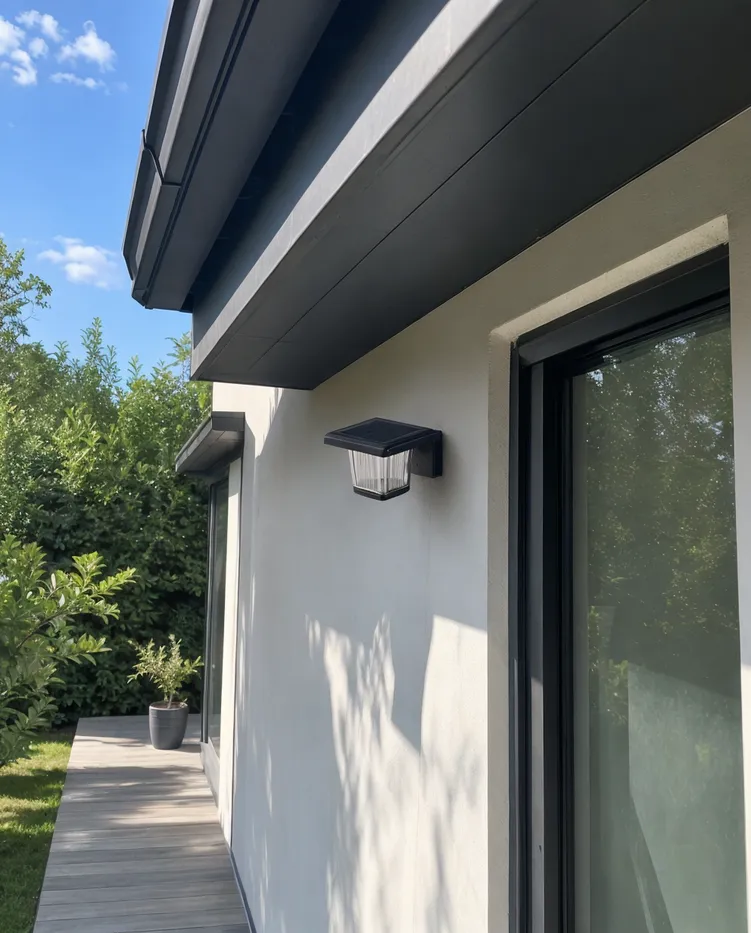
An integrated-panel porch light mounted under a deep roof overhang may receive only 2–4 hours of direct sun per day instead of the 5–6 hours the battery sizing assumes. The result is shortened working time after 2–3 consecutive cloudy days.
If your target market includes covered porch applications, either specify a larger panel (which we can accommodate in the OEM configuration) or recommend our Solar Wall Lights With Separate Panel — the separate panel can be positioned on an unobstructed surface while the fixture mounts in the shaded location.
Wall Orientation
South-facing walls in the northern hemisphere and north-facing walls in the southern hemisphere receive the most panel exposure. East and west-facing walls lose 20–30% of peak charging hours.
For buyers supplying markets at latitudes above 45°N or below 45°S, battery capacity should be sized for winter irradiance, not annual average.
Pre-Order Checklist for Your Buyers
Providing this to your downstream customers reduces installation complaints and unnecessary returns.
Confirm mounting wall receives at least 4–5 hours of direct sun daily
Check roof overhang depth — if overhang exceeds 60 cm, consider separate-panel model
Confirm wall material (concrete, brick, wood) for appropriate anchor selection
Select CCT based on application: warm white for entrance ambiance, daylight for security visibility
Confirm PIR detection distance requirement (3 m, 5 m, or 8 m options)
For rainy-season markets, specify battery capacity for 3-day autonomy minimum
Framing this checklist as part of your product documentation reduces your after-sales support load. We include an installation guide in each carton — OEM versions can carry your brand's instructions.
OEM/ODM Options for Private-Label Solar Porch Light Programs
Most of our buyers in this category are building a branded outdoor solar lighting line, not reselling generic product. The customization options below cover what's practical at different order volumes.
Standard Customization
From 100 units
- Logo printing on housing or back plate
- Custom retail color box design
- Neutral brown carton with your label
- Instruction manual in your language
- Barcode and SKU labeling per your warehouse system
- Accessory kit configuration (screw types, anchor sizes, extension cables)
Configuration Customization
Typically from 300–500 units
- CCT selection (2700K, 3000K, 4000K, 6000K)
- Lumen output adjustment within LED module's design range
- PIR sensor mode programming (sensitivity, delay time, detection angle)
- Battery capacity upgrade
- Solar panel size upgrade for covered-porch markets
- Housing color change within standard powder coat options (RAL colors available)
Engineering-Review Customization
MOQ & lead time confirmed case by case
- New housing geometry or mounting configuration
- Non-standard panel integration
- Unusual battery chemistry or capacity
- Custom controller logic
- New mold tooling for housing modifications
These require our engineering team to review feasibility before we confirm MOQ and lead time — typically a 2–3 week review process before production scheduling.
In-House R&D Team
Our in-house R&D team includes 15+ optical and electrical engineers who handle OEM/ODM project support directly. For buyers building a private-label solar porch light line, the engineering team manages lumen output confirmation, battery sizing for your target market's irradiance profile, and packaging specification review.
We've had buyers come to us after a previous supplier confirmed a custom spec without engineering review, then delivered product that didn't meet the spec. The review adds a week to the timeline and prevents that outcome.
MOQ Starting Points
MOQ for standard catalog models starts at 100 units — low enough to validate a new SKU with your retail buyers before committing to a full container program.
OEM programs with custom packaging and configuration typically run from 300–500 units depending on the scope of changes.
Send us your target retail price, market, and packaging requirements — we'll spec the right configuration.
Get Your OEM ConfigurationQuality Controls Built Around Battery, Lumen, and Waterproof Failure Points
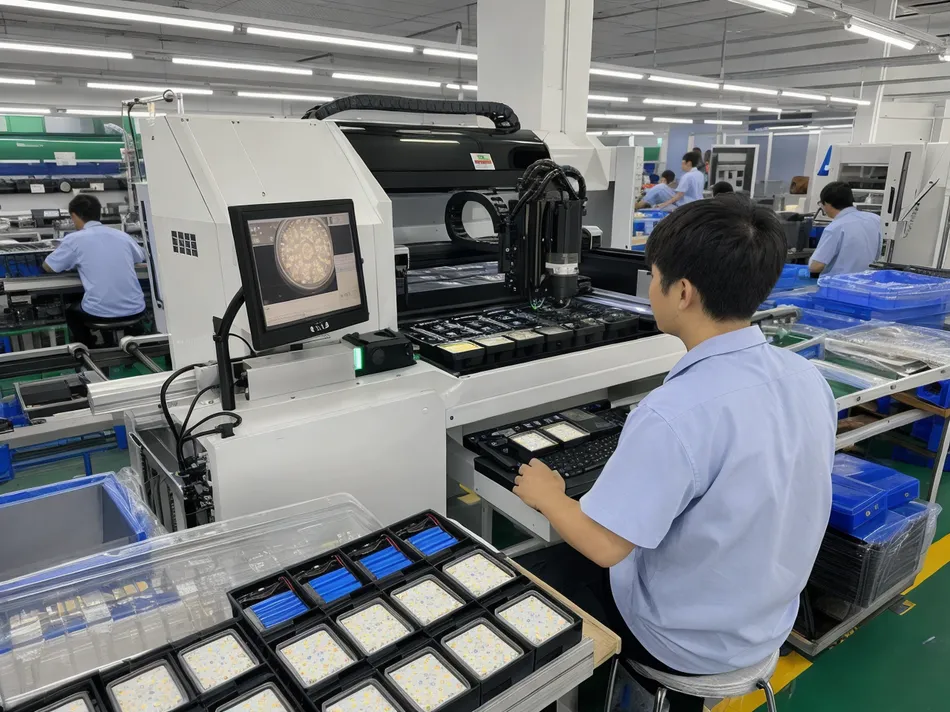
We've been making solar-powered outdoor lighting since 2012. Early in that history, the three failure modes that generated the most buyer complaints were battery degradation after one rainy season, lumen output inconsistency between production batches, and waterproof ratings that didn't hold up in field conditions. Our production system is built around those three failure points specifically — not as a general quality philosophy, but as a direct response to what we saw coming back from the field.
Battery Degradation
Premature failure after one rainy season — caused by mismatched cells. Caught at the capacity and internal resistance matching stage before assembly.
Lumen Inconsistency
Output and color temperature variation between batches. Solved by lumen binning — chips sorted by output and CCT before assembly, holding ±5% of spec.
Waterproof Failure
IP ratings that didn't hold in field conditions. Now verified on production units with pressure testing equipment — not assumed from housing design alone.
Production QC Sequence for Solar Porch Lights
SMT + AOI Board Inspection
Control boards assembled on automated SMT lines with automated optical inspection. Solder joint defects and component placement errors caught before the board enters a housing.
LED Lumen Binning
LED chips sorted by output and color temperature before assembly. Finished units stay within ±5% of spec across the entire production batch for both lumen output and CCT.
Battery Cell Matching
Packs matched by capacity and internal resistance before assembly. Mismatched cells are the primary cause of premature battery failure — caught at matching stage, not in the field.
PIR & Controller Bench Test
PIR sensors and controller functions tested on dedicated test benches before final assembly. Functional verification happens at the component level, not after the unit is sealed.
Charge/Discharge Aging
Every assembled unit goes through a charge/discharge aging test before packing. This catches early-life battery and circuit failures before the product ships.
IP Pressure Testing
Waterproof structure inspection uses pressure testing equipment. IP65 and IP67 ratings are verified on production units — not assumed from housing design drawings.
100% Outgoing Inspection
Every unit, every carton, every accessory pack, every label — inspected before the container is sealed. This is the one step buyers sometimes push back on as a cost driver. It adds time. It also means a defective batch gets caught before it's on a ship, not after it's in your warehouse generating RMA paperwork.
A defective batch caught at the factory costs you lead time. A defective batch caught in your warehouse costs you returns, reputation, and channel trust.
Certifications & Standards
ISO 9001:2015
CE
RoHS
IP65 / IP67
IEC 62124
DoC Available
CE Declaration of Conformity, RoHS test reports, and IP test certificates are available with the order.
Packaging and Channel Readiness for Bulk Solar Patio Lighting Programs
Packaging decisions affect your landed cost, your damage claim rate, and your channel's ability to receive and shelve product efficiently. For solar patio lighting programs, the packaging options we offer cover the main channel types.
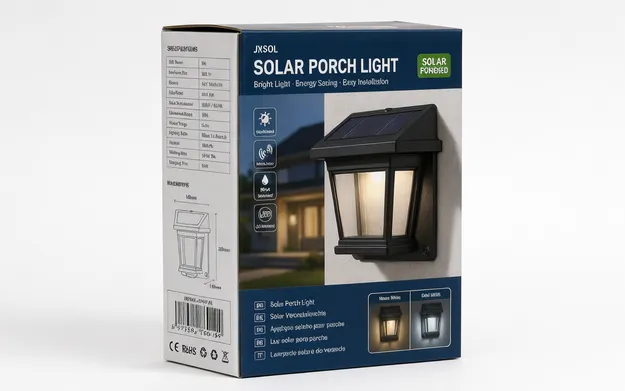
Retail Color Box
Full-color printed box with product image, spec callouts, barcode, and language options. Standard for hardware retail, home improvement chains, and online marketplace programs.
- Sized for standard shelf depth and pallet stacking efficiency
- Multi-language options available
- Barcode and compliance marks included
Note: Oversized retail boxes improve perceived shelf value but cost you in container loading efficiency. We'll show you the loading numbers before you decide.
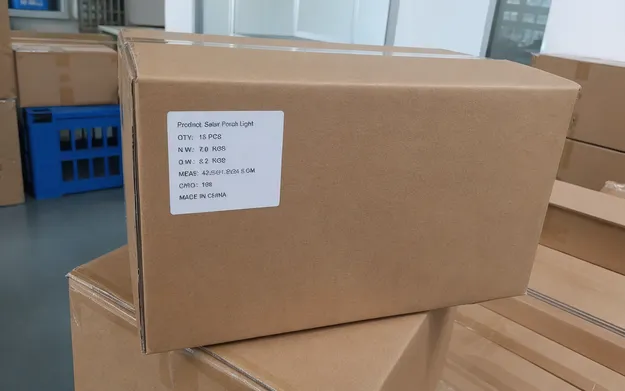
Neutral Brown Carton
Plain export carton with your label applied. Standard for wholesale distribution, project supply, and buyers who repack for their own retail program.
- Lower per-unit packaging cost
- Faster production lead time
- Suitable for repack programs
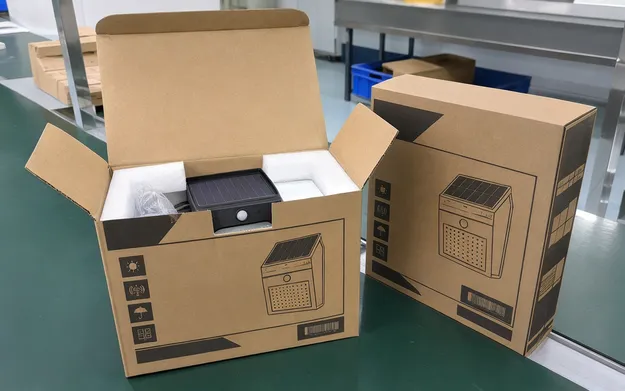
Private-Label Packaging
Your brand's box design, printed to your spec. We manage the print production and quality check before packing.
- Full custom brand design
- Print production managed in-house
- Minimum print run aligns with OEM order MOQ
Container Loading Reference
20GP Container
800–1,200 units
40HQ Container
1,800–2,400 units
Compact solar porch light cartons — actual loading depends on housing size and carton configuration. Mixed-SKU container programs are common: porch lights, pathway lights, and garden lights can share a container with separate carton labeling for warehouse sorting.
Export Destinations
We export to the following regions with packaging configured for each destination's handling conditions:
Logistics & Traceability
- Export cartons tested for compression strength appropriate to destination port handling conditions
- SKU labeling includes batch codes for full traceability
- Accessory packs (screws, anchors, instruction manuals) checked against packing list before carton sealing
- Missing accessories are a disproportionate source of end-user complaints relative to how easy they are to prevent
Choose the Right Solar Wall Lighting SKU Before You Quote
Solar porch lights are one of six product types in our Solar Wall Lighting range. If the porch light configuration doesn't match your buyer's requirement, the table below routes you to the right SKU.
Solar Porch Lights
Porch, patio, entrance, balcony, villa wall — decorative and functional integrated-panel wall fixtures.
Solar Wall Lights
General outdoor wall-mounted solar lighting across a wider range of housing styles and lumen outputs.
Motion Sensor Solar Wall Lights
Security-led applications where PIR detection is the primary function, not an option.
Up Down Solar Wall Lights
Architectural wall-wash effect — dual-beam fixtures for facade lighting and decorative exterior programs.
Solar Wall Lights With Separate Panel
Shaded walls, covered porches with deep overhangs, or any installation where the fixture location can't receive adequate sun.
Waterproof Solar Wall Lights
Exposed coastal environments, high-rainfall markets, or applications requiring IP67 as the primary spec.
Shading Problem? The Separate-Panel Model Is the Most Common Alternative
The separate-panel model is the most common alternative when a buyer's installation site has a shading problem. If you're not sure which configuration fits your market, send us a photo of the installation location or a description of the mounting conditions — we'll recommend the right SKU.
Send Your Use Case for SKU Matching| Product | Best Fit For |
|---|---|
| Solar Porch Lights | Porch, patio, entrance, balcony, villa wall — decorative and functional integrated-panel wall fixtures |
| Solar Wall Lights | General outdoor wall-mounted solar lighting across a wider range of housing styles and lumen outputs |
| Motion Sensor Solar Wall Lights | Security-led applications where PIR detection is the primary function, not an option |
| Up Down Solar Wall Lights | Architectural wall-wash effect — dual-beam fixtures for facade lighting and decorative exterior programs |
| Solar Wall Lights With Separate Panel | Shaded walls, covered porches with deep overhangs, or any installation where the fixture location can't receive adequate sun |
| Waterproof Solar Wall Lights | Exposed coastal environments, high-rainfall markets, or applications requiring IP67 as the primary spec |
Procurement Questions Buyers Ask Before Ordering Solar Porch Lights
Common engineering and specification questions we resolve during the quoting stage — answered here so your procurement team can move faster.
Can solar porch lights charge properly under a covered porch?
It depends on how much direct sun the panel receives. An integrated-panel porch light needs 4–6 hours of direct sun daily to maintain full working time. If the roof overhang blocks more than 30–40% of the panel's sky exposure, you'll see reduced working time after consecutive cloudy days.
The practical threshold: if the mounting wall is in full shade for most of the day, specify our Solar Wall Lights With Separate Panel instead — the panel mounts on an unobstructed surface while the fixture goes where you need it.
For partially shaded porches, we can size the battery and panel larger to compensate — this is a standard OEM configuration adjustment.
Engineering note: For projects where shade conditions vary across installation sites, the separate-panel configuration eliminates field complaints about inconsistent runtime.
What lumen range is practical for porch and patio lighting?
For residential porch and entrance applications, 200–400 lm covers most use cases — enough to illuminate a 3–5 m entry area without being harsh. For patio and outdoor living applications where ambient light is the goal, 150–300 lm is typical. For small commercial entrances or security-oriented porch applications, 400–800 lm is more appropriate.
The lumen output also determines battery draw, which affects working time — higher lumen output requires either a larger battery or PIR mode to extend runtime. We size the battery to the lumen output during the engineering review.
| Application | Lumen Range | Coverage |
|---|---|---|
| Residential porch / entrance | 200–400 lm | 3–5 m entry area |
| Patio / ambient outdoor living | 150–300 lm | Ambient / decorative |
| Commercial entrance / security | 400–800 lm | Wider coverage, deterrence |
Should I choose PIR motion sensor or constant lighting mode for porch lights?
PIR mode extends battery life by 40–60% compared to constant-on operation, which matters for markets with shorter winter days or frequent cloudy periods. For residential entrance and security applications, PIR is the standard choice — it also reduces light pollution complaints from end users.
For decorative patio and hospitality applications where continuous ambient light is the product's selling point, constant or dusk-to-dawn mode is more appropriate.
We offer multi-mode controllers that let the end user switch between modes — useful if your buyers serve mixed markets. The mode selection affects battery sizing, so confirm this before finalizing the spec.
- 40–60% longer battery life
- Residential entrance / security
- Reduces light pollution complaints
- Continuous ambient light
- Decorative patio / hospitality
- Requires larger battery sizing
What IP rating should I specify for outdoor porch lights?
IP65 is the standard for covered porch and patio applications — it handles rain splash, dust, and typical outdoor humidity. IP67 is worth specifying for exposed coastal environments, high-rainfall tropical markets, or any installation where the fixture may be directly exposed to water jets or standing water.
The housing design difference between IP65 and IP67 involves tighter gasket tolerances and sealed cable entry points — we test both ratings on our own waterproof inspection equipment before shipment.
Regional guidance:
- North America & Europe (residential programs): IP65 is sufficient.
- Middle East, Southeast Asia & African coastal markets: IP67 is the safer specification.
Can JXSOL customize packaging and logo for solar porch lights?
Yes. The following customization options are available from 100 units for standard models:
- Logo on the housing or back plate
- Custom retail color box
- Neutral carton with your label
- Instruction manual in your language
- Barcode/SKU labeling per your warehouse system
Custom retail box design with your brand artwork is available from the OEM order minimum — typically 300–500 units depending on configuration scope. We manage print production and quality check the packaging before packing.
Send us your packaging brief and we'll confirm the minimum run and lead time.
What MOQ should a new distributor start with for solar porch lights?
Standard catalog models start at 100 units — the minimum is set low deliberately so you can validate a new SKU with your retail buyers or test a market before committing to a full container.
Most new buyers in this category start with a 200–500 unit trial order, which gives enough volume to test across 2–3 retail accounts or a small project program. Once sell-through is confirmed, reorders typically move to 1,000–3,000 units per run.
Typical order progression:
We can ship samples before the first production order — send us your target configuration and we'll confirm sample availability and lead time.
Get a Quote for Solar Porch Lights
Send us the details below and we'll respond with a configuration recommendation and pricing within 24 hours.
Details to Include
-
Target market and destination port
-
Estimated order quantity
-
Lumen output and CCT preference
-
PIR sensor requirement (yes / no / multi-mode)
-
Battery capacity or target working hours
-
Packaging type (retail color box / neutral carton / private label)
-
Certification requirements (CE, RoHS, IP67, or others)
-
OEM/ODM requirements (logo, packaging design, housing color)
Standard models from 100 units
New buyers can start with a sample order to confirm the configuration before production. We've been supplying solar lighting to distributors, project contractors, and brand owners across North America, Europe, the Middle East, Southeast Asia, and Africa since 2012 — our production is in-house, our engineering team is on-site, and your reorder runs on a scheduled line.
Reach Us Directly
Explore More Solar Wall Lighting
Solar Wall Lights
General-purpose solar wall lighting for commercial and residential projects.
Motion Sensor Solar Wall Lights
PIR-activated solar wall lights for security and energy-saving applications.
Up Down Solar Wall Lights
Bi-directional beam solar wall lights for architectural accent lighting.
Solar Wall Lights With Separate Panel
Split-panel designs for shaded or north-facing installation locations.
Waterproof Solar Wall Lights
IP65/IP67-rated solar wall lights for exposed and coastal environments.
All Solar Wall Lights
View the full solar wall lighting category from JXSOL.