

Solar Wall Lights With Separate Panel
The right configuration when the lighting point and the charging point are not the same place.
Independently mounted solar panel connected by cable to the wall fixture, so the panel goes where the sun is and the light stays where it's needed. Built for shaded walls, north-facing elevations, overhangs, and retrofit sites where integrated-panel models undercharge.
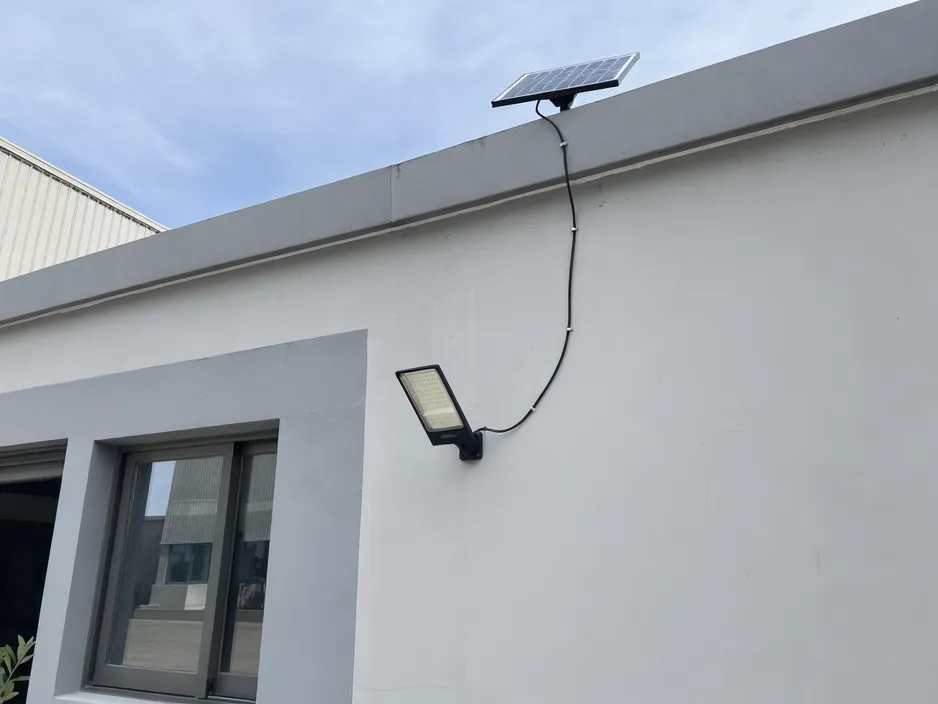
Separate-Panel Wall Lighting for Sites Where the Sun and Light Are in Different Places
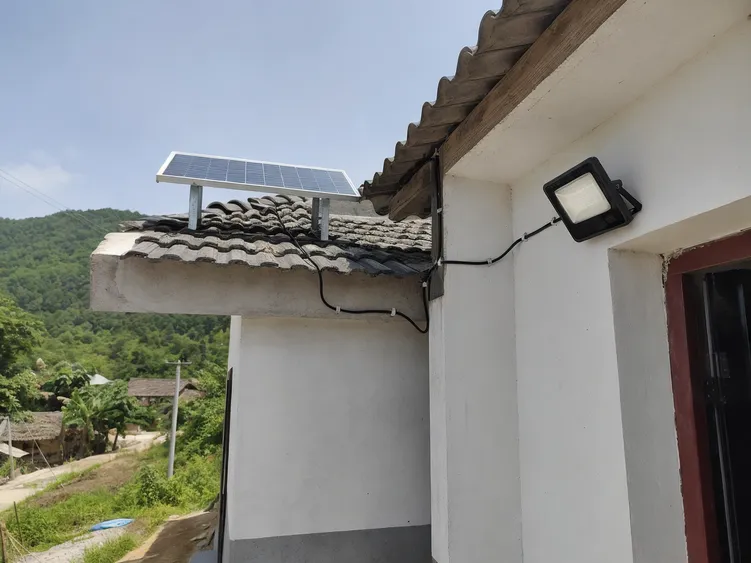
Solar wall lights with separate panel are a wall-mounted solar lighting configuration where the solar panel mounts independently from the fixture body, connected by a weatherproof cable. The fixture goes on the wall where illumination is needed. The panel goes on a surface — a nearby roof edge, a fence top, an adjacent wall face, a bracket above the overhang — that receives direct sunlight. That separation is the entire point.
Most solar wall lighting problems we see in the field trace back to one root cause: the panel was installed where the light was needed, not where the sun actually reaches. An integrated-panel model on a north-facing wall, a wall shaded by a tree canopy, or a recessed entrance under a deep overhang will undercharge the battery regardless of how well the rest of the product is built. The end customer complains about short runtime. The buyer gets a warranty claim. The product gets a bad reputation in a market where it would have performed fine on a south-facing wall.
The separate-panel configuration removes that constraint. Panel placement is independent of fixture placement, so the charging system can be optimized for the site rather than compromised by it. For project contractors working on building retrofits, perimeter security installations, and mixed-orientation sites, this is the configuration that protects the project handover. For distributors selling into markets with dense urban construction or heavy tree cover, it's the SKU that reduces after-sales risk on the accounts where integrated models would struggle.
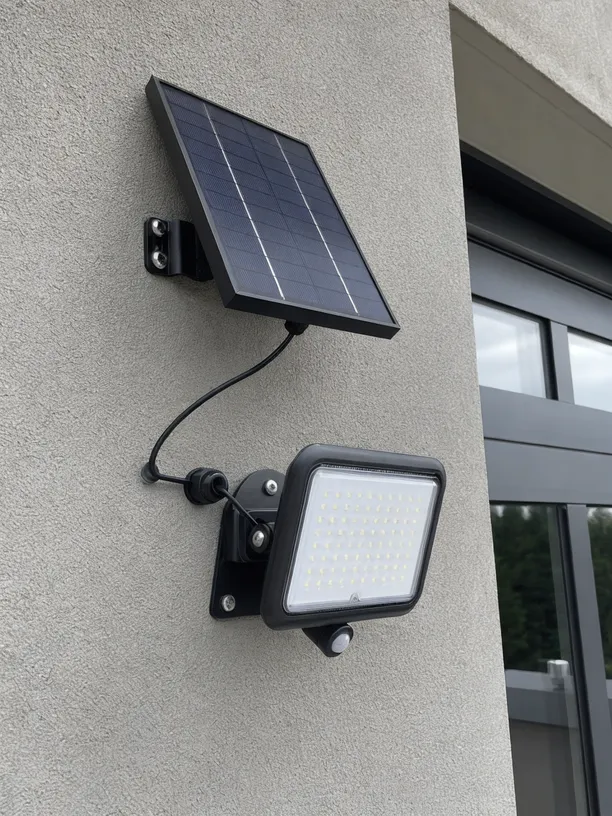
Core Principle
Panel goes where the sun is. Light stays where it's needed. The cable bridges the gap.
Project Contractors
Building retrofits, perimeter security, mixed-orientation sites — the configuration that protects the project handover.
Distributors
Markets with dense urban construction or heavy tree cover — the SKU that reduces after-sales risk where integrated models struggle.
When the Separate Panel Protects Your Project Margin
The decision to specify solar wall lights with separate panel is a site-condition decision, not a preference decision. The extra cost — a second mounting point, a cable run, slightly more installation time — is justified when the alternative is a product that underperforms and generates complaints. Here's how we advise buyers on when the separate-panel model earns its place.
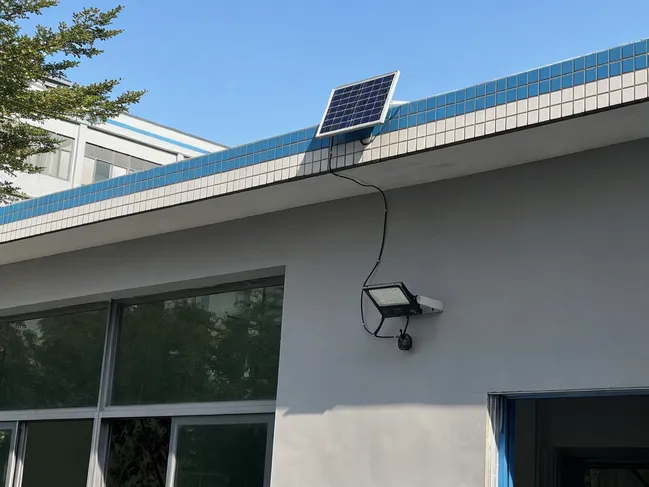
North-Facing Walls and Shaded Elevations
Any wall that receives fewer than 4–5 hours of direct sunlight per day is a risk for integrated-panel models. North-facing walls in the northern hemisphere are the obvious case, but east and west-facing walls with adjacent obstructions can have the same problem. A panel that charges for 2–3 hours instead of 5–6 hours will deliver noticeably shorter runtime, and the shortfall compounds in winter when daylight hours are already reduced.
The separate-panel model lets you mount the panel on the roof edge, a south-facing parapet, or any surface with adequate exposure while the fixture stays on the wall where the light is needed.
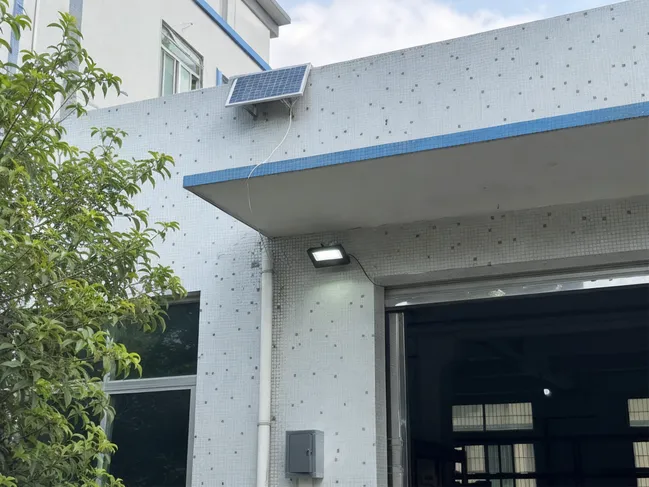
Walls Under Overhangs, Canopies, and Deep Eaves
Building entrances, covered walkways, loading dock walls, and carport perimeters are common installation sites for wall lighting — and they're also the sites most likely to have permanent shade over the wall surface. An overhang that provides weather protection for the entrance also blocks the sun from any integrated panel mounted below it.
The separate-panel model solves this without requiring the fixture to be relocated to an exposed position where it may not provide useful illumination.
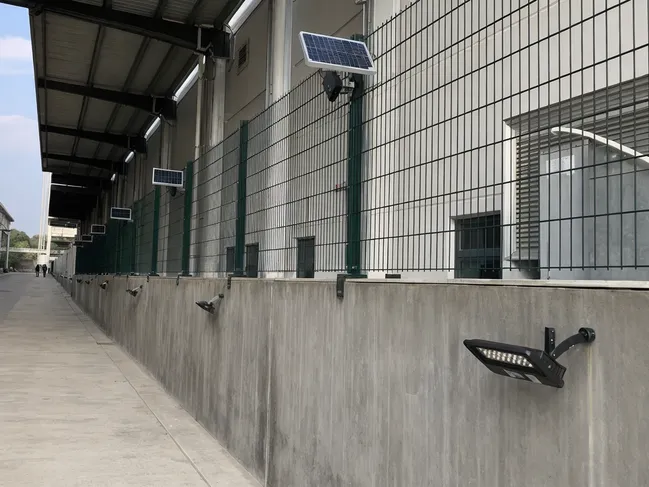
Retrofit Projects on Existing Buildings
Building retrofit contractors face wall orientations they didn't design. A perimeter security upgrade on an existing industrial facility may require fixtures on walls that face every direction. Specifying integrated-panel models across a mixed-orientation site means some fixtures will underperform.
A separate-panel specification allows the contractor to optimize panel placement for each fixture independently, which simplifies the project handover and reduces the risk of post-installation complaints from the facility manager.
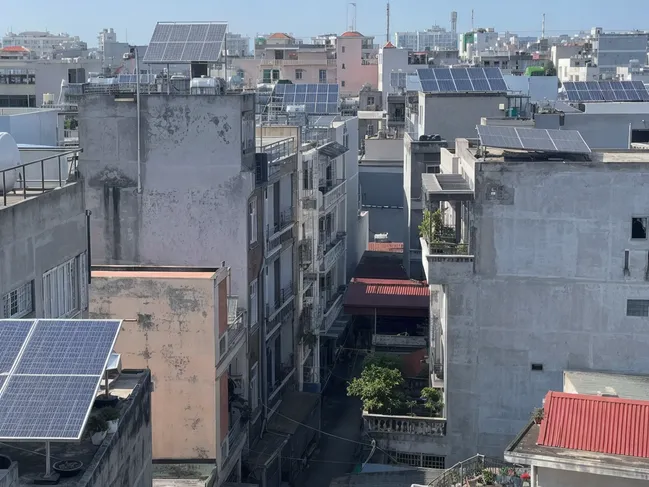
Dense Urban Sites With Adjacent Building Shading
In cities where buildings are close together, a wall that receives direct sun in summer may be shaded for most of the day in winter as the sun angle drops. Buyers selling into dense urban markets — Southeast Asian cities, Middle Eastern commercial districts, European city centers — should consider separate-panel models as the default specification for any wall that isn't clearly south-facing and unobstructed.
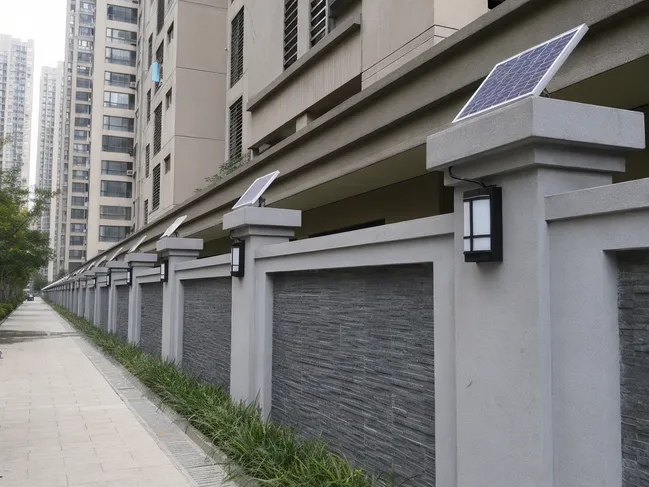
Perimeter Security Walls and Gated Community Entrances
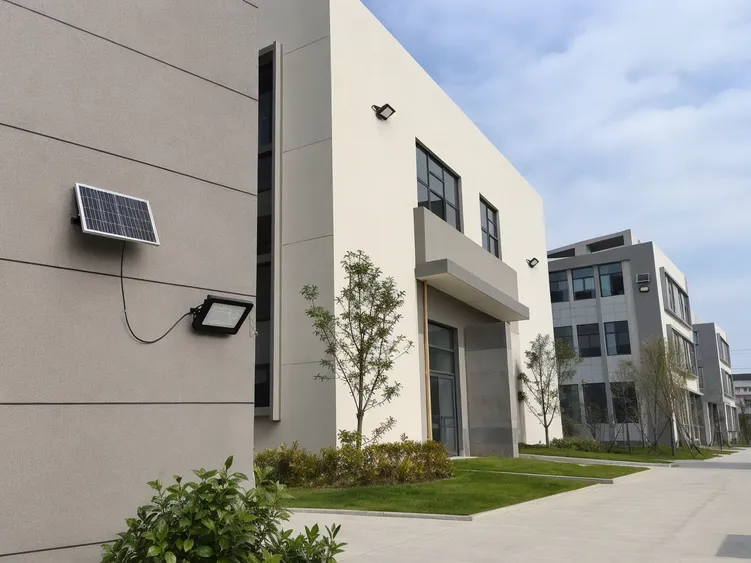
Long perimeter walls often run in multiple directions. A gated community perimeter may have sections facing north, east, south, and west. Specifying separate-panel models for the entire perimeter means every fixture charges reliably regardless of wall orientation, and the contractor doesn't need to survey each wall section individually to determine which models will work.
The Commercial Logic
The separate-panel model costs more per unit and takes slightly longer to install. A warranty claim on an undercharging integrated-panel model costs more than the price difference, and it costs it in the wrong place — after the sale, in the field, with an unhappy end customer.
For buyers who are building a reputation in project channels, the separate-panel model is the lower-risk specification on any site where sun exposure is uncertain.
Not sure if you need the separate-panel configuration?
Send us your site details — wall orientation, location, and target runtime — and we'll confirm whether the separate-panel configuration is the right fit or whether a standard model will work.
Product Specifications Buyers Should Confirm Before Quoting
These are typical specification ranges for our solar wall lights with separate panel. Exact values vary by model and are confirmed in the quotation. Use this table to check whether our range covers your project requirements before requesting a detailed quote.
| Parameter | Typical Range / Options |
|---|---|
| Lumen Output | 400–1,800 lm (varies by wattage tier and LED configuration) |
| LED Type | High-efficiency SMD LED, lumen-binned at assembly |
| Solar Panel Type | Monocrystalline silicon |
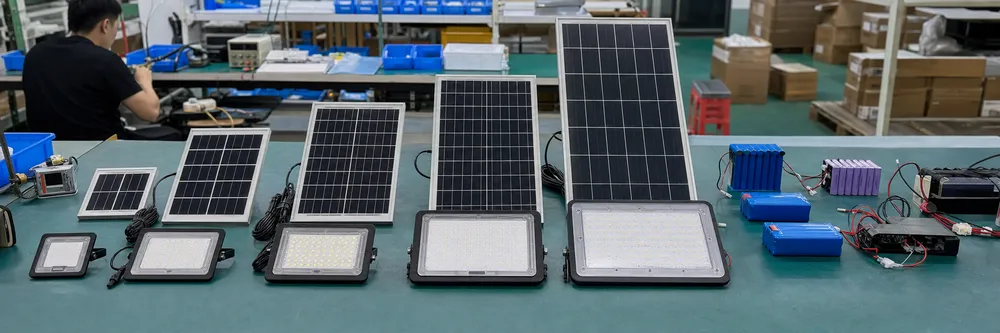
| Panel Wattage | 5W–20W (sized to battery capacity and target autonomy) |
| Panel Mounting | Independent bracket mount, separate from fixture body |
| Cable Length (Panel to Fixture) | Standard 3m–5m; extended lengths available, confirm with engineering |
| Cable Connector | Weatherproof connector, IP65 minimum at junction |
| Battery Chemistry | LiFePO4 (lithium iron phosphate) or lithium-ion; LiFePO4 recommended for high-temperature markets |
| Battery Capacity | 5,000–20,000 mAh (varies by model and autonomy target) |
| Housing Material | ABS, PC, or die-cast aluminum (varies by model tier) |
| IP Rating | IP65 standard; IP67 available on request |
| Lighting Mode | Dusk-to-dawn constant; PIR dim-to-bright; PIR full-on with standby dim; configurable |
| Sensor Type | PIR passive infrared (motion sensor models); light sensor (dusk-to-dawn models) |
| Color Temperature | 3000K warm white, 4000K neutral white, 6000K–6500K daylight |
| Charging Time | Typically 6–8 hours full sun to full charge |
| Runtime Target | 8–12 hours constant; 2–4 nights with PIR activation (varies by battery and mode) |
| Operating Temperature | -20°C to +50°C |
| Mounting Hardware | Wall bracket, screws, cable clips, and panel mounting bracket included |
| Certifications Available | CE, RoHS, ISO 9001:2015, IP65/IP67 test documentation, IEC 62124 |
| Warranty | 3 years |
| Standard MOQ | 100 units |
| OEM/ODM | Available; engineering review required for custom specifications |
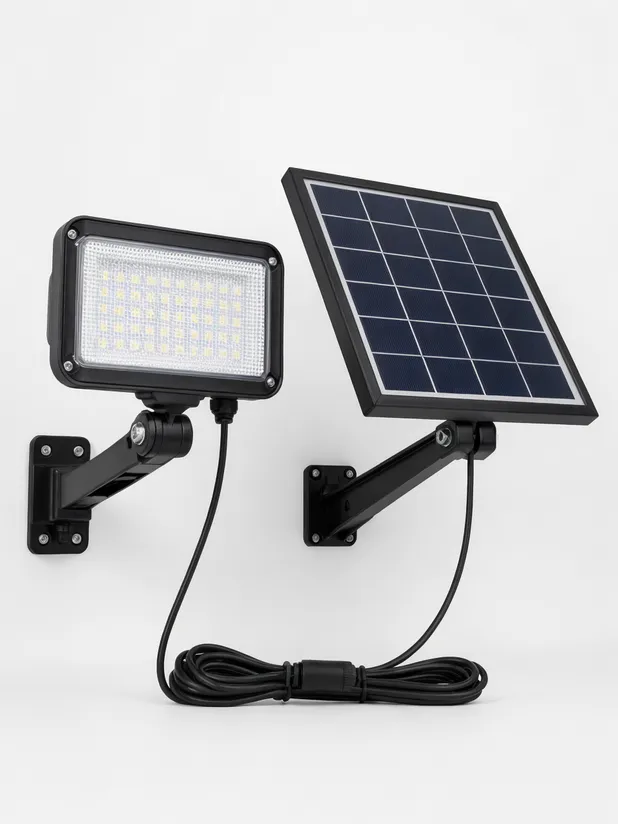
Specifications shown are typical ranges for this product configuration. Actual values vary by model. Contact us for model-specific data sheets and exact specifications.
Get a Model-Specific Data Sheet & QuoteSend your target lumen output, required IP rating, cable length, and order volume.
Panel Placement, Cable Routing, and After-Sales Risk
Installation planning for solar wall lights with separate panel is where most of the after-sales risk either gets managed or gets ignored. The fixture itself installs like any wall-mount solar light. The panel is where the decisions matter.
Panel Placement and Sunlight Hours
The panel needs a minimum of 4–5 hours of direct sunlight per day to charge the battery adequately for a full night of operation. "Direct sunlight" means unobstructed sun on the panel face — not bright ambient light, not reflected light from a nearby surface.
The panel should be mounted at an angle that faces the sun during peak hours: roughly south-facing in the northern hemisphere, tilted at an angle close to the site's latitude. A panel mounted flat on a horizontal surface loses efficiency compared to a tilted installation, and a panel mounted vertically on a wall loses efficiency compared to a tilted bracket mount.
We've seen installations where the contractor mounted the panel on the nearest available surface without checking the sun angle, and the product undercharged from day one. The fix is straightforward — check the panel's sun exposure before finalizing the mounting point — but it's easier to do before the installation than after.
Cable Length and Voltage Drop
The standard cable length between panel and fixture is 3–5 meters. Extending the cable beyond the standard length introduces voltage drop that can reduce charging efficiency, and it requires a cable with adequate cross-section to compensate.
We can supply extended cable lengths, but the specification needs to go through an engineering review to confirm the cable gauge is appropriate for the distance and the panel's output voltage. Buyers who ask for longer cables without confirming the gauge are creating a charging problem that won't show up until the product is in the field.
We've had buyers request 10-meter cable extensions without flagging it as a custom requirement. The product shipped with standard cable gauge, the voltage drop was significant, and the battery never reached full charge. The fix required replacing the cable on-site. The engineering review would have caught it in 10 minutes.
Cable Entry and Connector Waterproofing
The cable entry point on the fixture housing and the connector between the panel cable and the fixture cable are the two most common water ingress points on separate-panel models.
The connector must be rated IP65 minimum and seated correctly — a connector that's been pulled slightly out of alignment will pass a bench test and fail in the field after a few months of rain cycling.
We inspect every connector and cable gland on our outgoing inspection line, but the installation team needs to handle the connectors correctly during mounting. The installation guide covers this, and we recommend buyers include it in their contractor briefing.
Fixture Serviceability
The fixture body should be mounted at a height that allows the battery to be accessed for replacement if needed — typically 2.5–4 meters above ground.
Mounting at 6+ meters to maximize light spread makes sense for some perimeter applications, but it increases the cost of any future service visit.
For buyers selling into property management or municipal channels where long-term maintenance cost matters, this is worth flagging to the end customer at the specification stage.
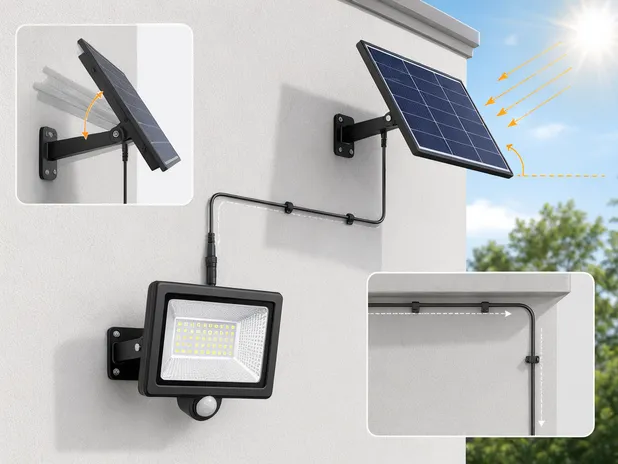
For detailed layout guidance — panel angle calculations, mounting height recommendations, and autonomy estimates for different latitudes — see our solar wall lighting design guide. For site-specific layout review, send us your project details and our engineering team will review the configuration.
Market Segments Where This SKU Earns Its Place
Solar wall lighting with separate panel is not the right product for every wall. It's the right product for specific site conditions and specific buyer channels. The segments below are where this configuration generates consistent repeat volume for our distributor and contractor accounts — not because the product is universally superior, but because the site conditions in these segments make integrated-panel models a liability.
Building Retrofit Contractors
Core market for separate-panel configurationRetrofit projects are the core market for this configuration. A contractor upgrading perimeter lighting on an existing industrial facility, warehouse complex, or commercial building doesn't control the wall orientations — they work with what's there. Integrated-panel models on north-facing or shaded walls will underperform, and the contractor owns the warranty claim.
Separate-panel models give the contractor a specification that works across mixed orientations, which simplifies the project scope and protects the handover. Retrofit contractors who have had one bad experience with undercharging integrated models on a mixed-orientation site tend to specify separate-panel models as their default for any project where wall orientation is uncertain.
Order Pattern
Order patterns in this segment tend to follow project phases: 50–200 units per project, with repeat orders as the contractor wins additional retrofit contracts.
Key Selling Point
The key selling point is risk reduction, not price — contractors in this segment are buying a specification they can defend to the facility manager, not the cheapest unit that meets the lumen requirement.
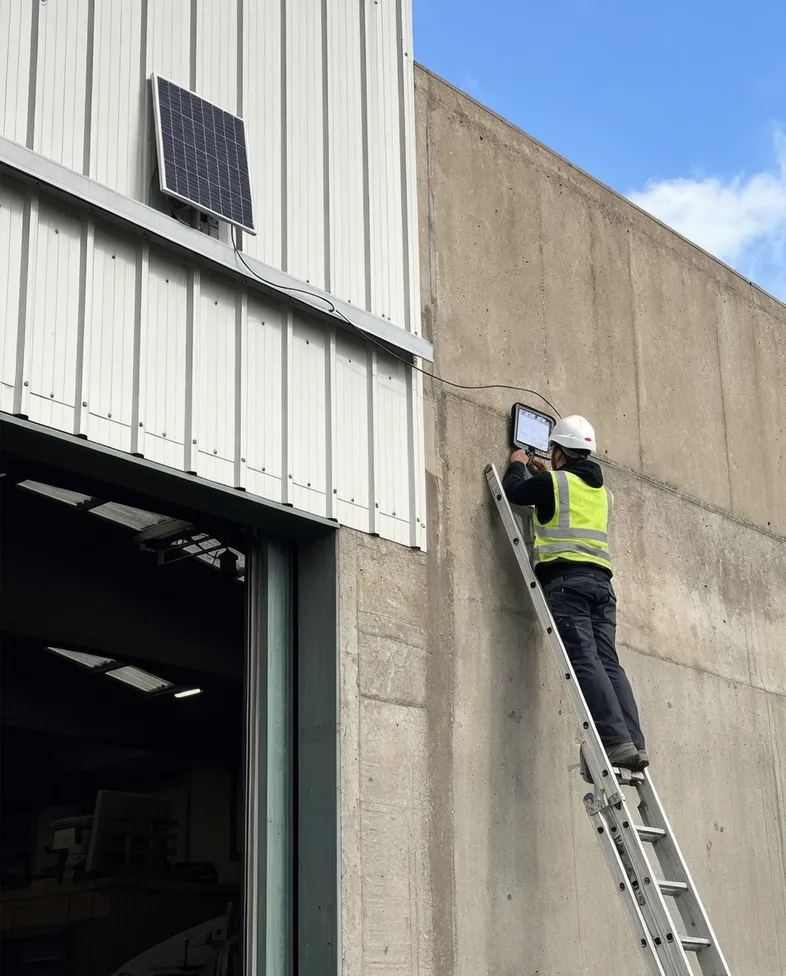
Separate-panel configuration allows consistent charging performance regardless of wall orientation — critical for retrofit projects with no control over building geometry.
Property Management and Gated Community Perimeters
Property management companies and gated community developers installing perimeter wall lighting face the same mixed-orientation problem as retrofit contractors, but with a longer-term maintenance relationship. A property manager who installs undercharging fixtures on a north-facing perimeter wall will be dealing with resident complaints for the life of the product. Separate-panel models on the shaded sections of the perimeter eliminate that risk.
This segment generates predictable repeat orders as property management companies expand their portfolios or replace aging fixtures. The documentation requirement is typically straightforward — CE and RoHS are sufficient for most markets — and the order volumes are moderate (100–500 units per property), which fits our standard MOQ structure.
Segment Profile
- Order volume: 100–500 units per property
- Certification need: CE and RoHS sufficient for most markets
- Reorder pattern: Predictable repeat as portfolios expand or fixtures age out
- Key risk: Resident complaints from undercharging on shaded walls
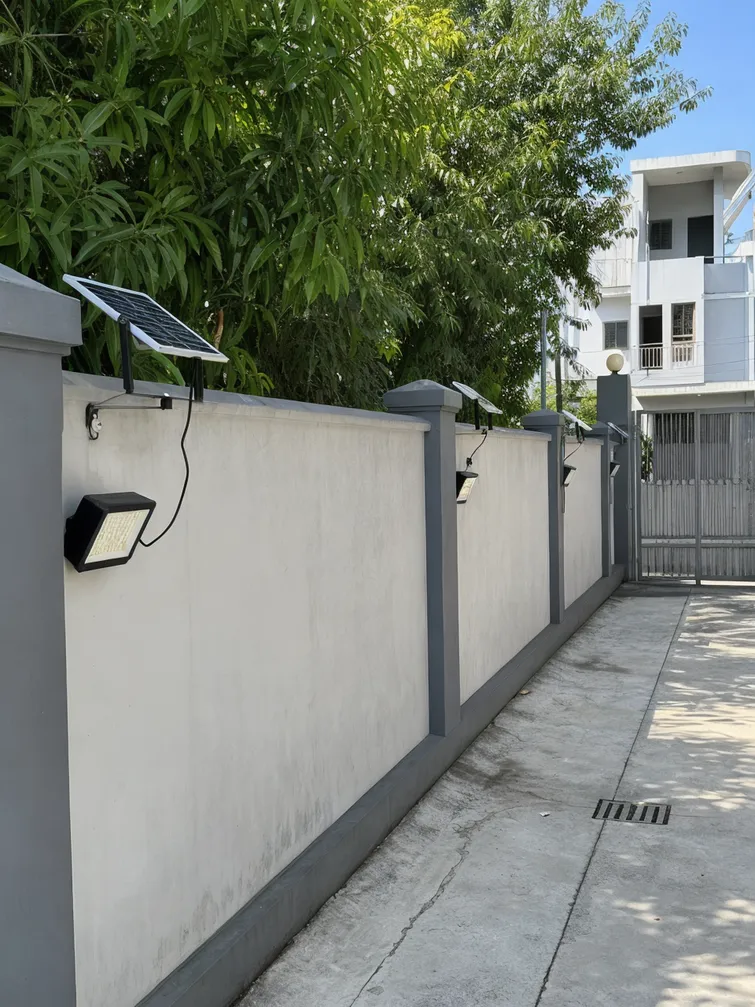
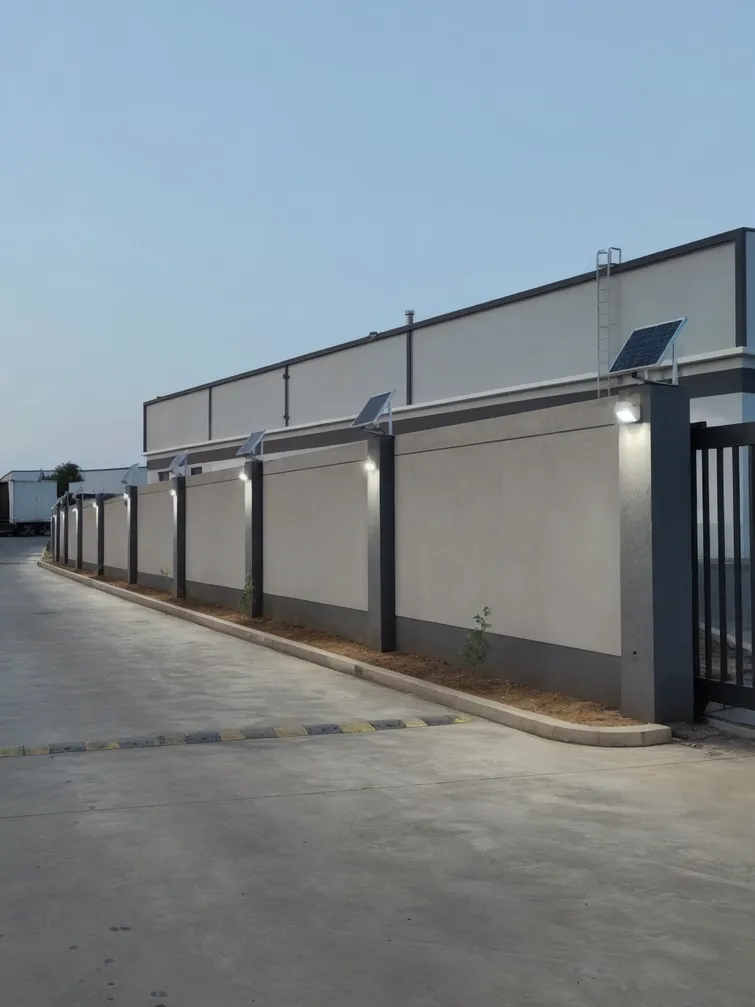
Perimeter Security Projects for Commercial and Industrial Facilities
Security integrators and electrical contractors installing perimeter lighting on commercial and industrial sites specify solar wall lighting with separate panel when the site has walls that can't guarantee adequate solar exposure. Logistics parks, manufacturing facilities, and distribution centers often have large footprints with walls facing every direction, and the security specification requires consistent illumination across the entire perimeter — not just the south-facing sections.
This segment is worth paying attention to if you're building a distribution business in the security channel. Security integrators tend to be loyal to suppliers who reduce their after-sales risk, and a separate-panel specification that performs reliably across a mixed-orientation perimeter is a strong reference for the next project.
Regional Growth Signal
This segment has grown consistently for our distributor accounts in the Middle East and Southeast Asia over the past three years — worth building a relationship with security integrators if you're in those markets.
Supplier Loyalty
Security integrators stay with suppliers who reduce after-sales risk on mixed-orientation perimeters
Specification Requirement
Consistent illumination across entire perimeter regardless of wall orientation
Rural and Off-Grid Building Projects
Project contractors working in areas without reliable grid access — rural development projects, agricultural facilities, remote community buildings — use separate-panel solar wall lighting as a primary lighting solution rather than a supplement to grid power. In these applications, battery autonomy and charging reliability are the primary specification concerns, and the separate-panel configuration allows the panel to be positioned for maximum sun exposure regardless of where the building walls face.
Extended battery autonomy — 3 to 5 consecutive cloudy days of operation — is a common requirement in this segment. That requires careful panel and battery sizing for the target latitude and seasonal irradiance profile, which we handle through the engineering review for OEM/ODM orders.
Regional Demand Signal
For buyers selling into rural development channels in Africa, South Asia, or Southeast Asia, this is a segment with consistent project-based demand and limited competition from grid-connected alternatives.
Shaded Garden Walls and Courtyard Perimeters for Retail and Hospitality Channels
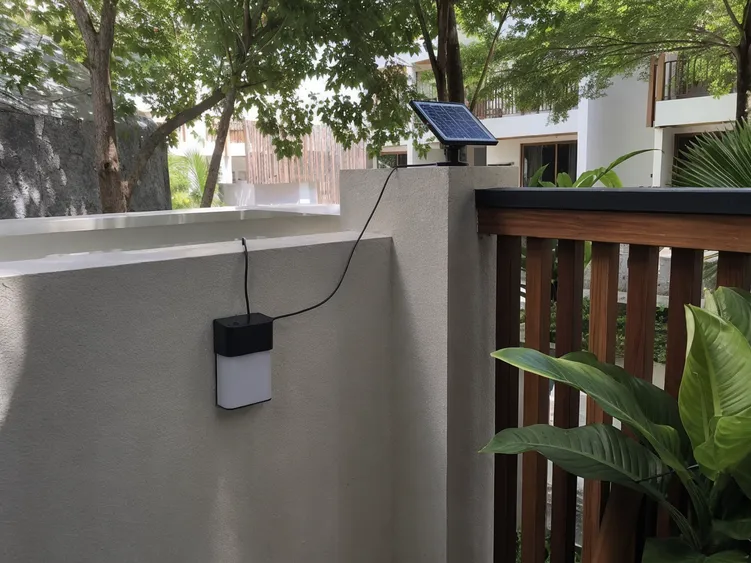
Hotels, resorts, and premium residential developments with mature tree cover or enclosed courtyards face the same shading problem as industrial sites, but in a context where aesthetics matter as much as performance. A separate-panel model allows the fixture to be positioned for visual effect on the garden wall while the panel is mounted on a nearby roof or fence top where it can charge effectively.
Buyers selling into hospitality procurement channels can use this configuration to solve a problem that integrated-panel models can't — and charge a premium for the solution.
Mixed-Orientation Project Sites for Electrical Contractors
Electrical contractors running multi-building projects — residential developments, commercial parks, campus facilities — often need a consistent product specification across buildings with different orientations. A two-SKU approach works well here: standard IP65 solar wall lights for walls with adequate sun exposure, and separate-panel models for shaded or north-facing walls.
Consistent carton labeling and accessory packs across both SKUs simplify site logistics and reduce the risk of installation errors.
Send us your target region, distribution channel, and first order quantity — we'll confirm the right model configuration and pricing for your market.
Request Configuration & PricingConfiguration Choices That Affect Landed Cost and Reorder Stability
Solar wall lights with separate panel have more configuration variables than standard integrated models, and the choices you make at the quoting stage affect both the unit cost and the product's performance in the field. Here's what can be adjusted, what requires engineering confirmation, and what affects reorder consistency.
Lumen Output
Adjustable within the LED module's design range without changing the housing. Standard tiers run from 400 lm for compact residential models to 1,800 lm for commercial perimeter applications.
We confirm the achievable range for each model during the engineering review. Lumen output is confirmed at the LED module assembly stage — not estimated from wattage — so the value in your spec sheet matches what ships.
Panel Wattage & Battery Capacity
These two parameters need to be sized together for the target autonomy. A 10W panel paired with a 10,000 mAh LiFePO4 battery will deliver different autonomy in northern Europe in December than in the Middle East in July.
We calculate autonomy estimates based on the buyer's target latitude and seasonal irradiance data during the engineering review.
Battery Chemistry: LiFePO4 vs Lithium-Ion
LiFePO4 cells have a longer cycle life (typically 2,000+ cycles vs 500–800 cycles for standard lithium-ion) and better thermal stability at elevated temperatures.
High-temperature markets (Middle East, South Asia, tropical Southeast Asia): LiFePO4 is the right specification — the higher cell cost is offset by lower field failure rates.
Temperate markets with higher cost sensitivity: Standard lithium-ion is a reasonable choice.
| Parameter | LiFePO4 | Standard Lithium-Ion |
|---|---|---|
| Cycle Life | 2,000+ cycles | 500–800 cycles |
| Thermal Stability | Superior at elevated temperatures | Standard |
| Cell Cost | Higher | Lower |
| Best Fit Markets | Middle East, South Asia, tropical SE Asia | Temperate climates, cost-sensitive projects |
| Field Failure Rate (hot climates) | Lower | Higher |
Cable Length
Standard cable length is 3–5 meters. Extended lengths are available but require engineering confirmation of cable gauge to prevent voltage drop.
If your project sites consistently require longer cable runs — 8–10 meters for large building facades or wide perimeter walls — flag this at the quoting stage so we can specify the correct cable cross-section.
A cable length change that looks minor on paper can create a charging problem that's expensive to fix in the field.
PIR Sensor Mode and Lighting Logic
For motion sensor configurations, PIR sensitivity, detection range, dim-to-bright ratio, and hold time are configurable. Standard configurations cover most security and perimeter applications.
Buyers with specific requirements — a particular detection range for a narrow entrance, a specific hold time for a high-traffic area — can specify parameters during the engineering review.
Configurable Parameters
- PIR sensitivity
- Detection range
- Dim-to-bright ratio
- Hold time
QC Commitment
We verify sensor function on every unit before shipment — not batch sampling, every unit.
For dedicated motion-sensor models, see our motion sensor solar wall lights page.
Color Temperature
3000K warm white, 4000K neutral white, and 6000K–6500K daylight are standard options. Intermediate values are available on request.
3000K
Warm White
Residential, hospitality
4000K
Neutral White
Mixed commercial & residential
6000K–6500K
Daylight
Security & industrial channels
Color temperature affects perceived brightness and market positioning — 4000K is the most neutral choice for mixed commercial and residential applications; 6000K is preferred in security and industrial channels where maximum perceived brightness matters.
Housing Color, Logo, and Private-Label Packaging
Standard housing colors are available across most models. Custom colors require a minimum run to justify the powder line changeover — confirm the minimum at the quoting stage.
OEM/ODM Program Includes
For buyers building a branded solar lighting line, we handle the full packaging specification. For full OEM/ODM program details, see our OEM/ODM solar lighting services page.
Have specific configuration requirements? Send us your parameters and target order volume — our engineering team will confirm what's achievable and outline the review process.
Send Configuration RequirementsFactory Controls for the Failure Points This Product Actually Has
Separate-panel solar wall lights have a specific set of failure modes that differ from integrated models. The panel-to-fixture cable connection, the panel mounting hardware, and the connector waterproofing are additional points of failure that don't exist on integrated models. Our production controls are built around these specific risks.
Solar Panel Electrical Output Testing
Every solar panel is tested for electrical output before it's paired with a fixture. We measure open-circuit voltage and short-circuit current against the panel's rated specification.
A panel that tests below spec at the factory will undercharge the battery in the field — catching it before assembly is the only point where the fix is free.
Rejection point: Panels that don't meet spec are rejected at incoming inspection, not discovered during aging tests.
Connector and Cable Gland Waterproof Inspection
The cable connector between the panel and the fixture is inspected on every unit. We check connector seating, cable gland compression, and IP rating compliance at the junction point.
A connector that's slightly misaligned or a gland that's under-torqued will pass a visual check and fail after a few months of rain cycling.
Inspection method: Our protocol includes a physical check of connector engagement, not just a visual inspection of the housing.
Battery Cell Matching and Charge/Discharge Testing
Battery cells are matched by capacity and internal resistance before pack assembly. Every pack goes through a charge/discharge cycle test before installation in the fixture.
This step adds time and equipment cost, and it's where lower-cost suppliers typically cut corners.
Failure mode prevented: Accelerated battery degradation from mismatched cells — doesn't show up until 6–12 months in the field, which is exactly when it's most expensive to address.
Separate-Panel Specific Risks
Panel-to-fixture cable connection, panel mounting hardware, and connector waterproofing — failure points that don't exist on integrated models.
6–12 Month Latent Failures
Battery cell mismatch degradation surfaces months after deployment — the most expensive window for warranty claims and field replacements.
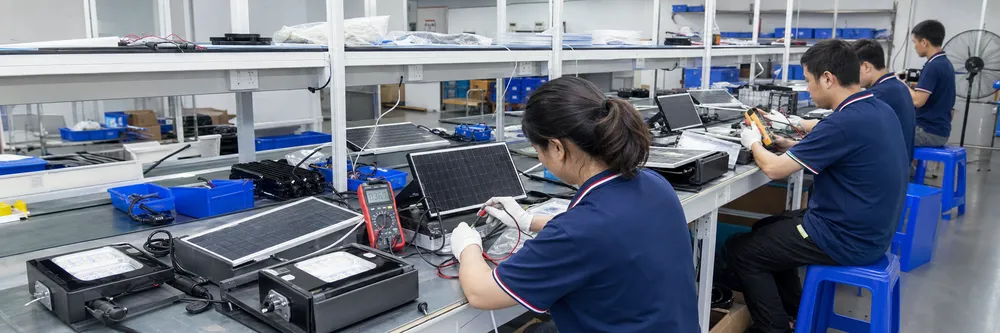
Controller and PIR Sensor Function Testing
For motion sensor configurations, every unit goes through controller and PIR function testing: detection range, sensitivity threshold, dim-to-bright transition, and hold time are verified against the specified parameters.
Failure Mode 1: False Triggering
Units that trigger without valid motion input — the most common complaint driver in the motion sensor category. Caught at this stage before final assembly.
Failure Mode 2: Missed Detection
Units that fail to detect valid motion within the specified range and sensitivity threshold. Both modes generate the most buyer complaints in this category.
Aging Tests and Full-Cycle Verification
Assembled units go through aging tests under load before final inspection. The aging test runs a full charge/discharge cycle to verify that the assembled system — panel, battery, controller, LED module — performs as specified.
Units that fail the aging test are pulled for diagnosis before they reach final inspection. This catches system-level integration failures that component-level testing alone cannot detect.
100% Outgoing Inspection
Every unit, every carton, every accessory pack, and every label is checked before the container is sealed.
Separate-Panel Model Accessory Pack Check Includes:
Panel Mounting Bracket
Cable Clips
Connector
All Mounting Hardware
These are the components most likely to be missing or mismatched if the packing line isn't running a specific check for this model.
We've been running 100% pre-shipment inspection since 2012. It adds time. It also means we catch a defective batch before it's on a ship, not after it's in your warehouse.
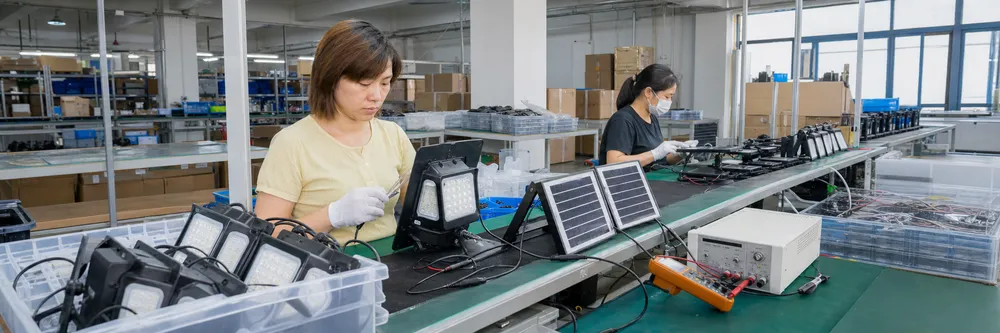
For factory background and full production capability details, see our JXSOL factory background page. For certification documentation, see our certification and quality documentation page.
Contact us if you need specific inspection documents — CE Declaration of Conformity, RoHS test reports, IP test certificates — for your import clearance requirements.
Compliance Documents and Export Packing for Distributor Orders
Certifications Available With the Order
Solar wall lights with separate panel from JXSOL are produced under ISO 9001:2015 quality management certification. CE Declaration of Conformity and RoHS test reports are available for EU import clearance and regulated market entry. IP65/IP67 test certificates are available for buyers who need waterproof rating documentation. IEC 62124 covers the solar photovoltaic performance requirements for the charging system.
All documentation is provided with the order — if your market requires specific compliance documents for import clearance, confirm the requirement before production so we can ensure the correct documentation is prepared.
RoHS Component-Level Traceability
RoHS compliance traces back to the component level. We source LED chips, battery cells, and electronic components from suppliers who provide material declarations, and we maintain records by batch. For buyers importing into the EU or markets with restricted substance requirements, the compliance documentation is available at the component level, not just the finished product.
ISO 9001:2015
CE Mark
RoHS
IP65/IP67
Export Packing for Separate-Panel Models
Separate-panel models require more careful packing than integrated models because the panel, cable, and connector are separate components that need to arrive undamaged and complete. Our export cartons for this product include:
- Fixture body in foam-lined inner carton
- Solar panel in separate foam-lined compartment or inner carton
- Cable coiled and secured to prevent connector damage
- Panel mounting bracket and hardware in labeled accessory bag
- Wall mounting hardware, screws, and cable clips in labeled accessory bag
- Installation guide in the buyer's required language
- Packing list checked against contents before carton sealing
Consistency guarantee: Carton dimensions are consistent across production runs for the same model — a reorder ships in the same carton configuration as the original order, which matters for buyers who have optimized their container loading or warehouse racking. Batch codes on carton labels allow traceability back to the production run.
Mixed-SKU Orders and Private-Label Packing
Mixed-SKU orders across separate-panel models and other solar wall lighting configurations are standard. A distributor running a solar wall lighting program that includes both standard integrated models and separate-panel models for shaded-wall applications can consolidate into a single container order with consistent documentation.
Private-label cartons, custom labeling, and branded accessory packs are available for buyers building a private-label solar lighting line. For palletized delivery, we configure pallet loads to your specification. Lead times are confirmed at order placement.
Mixed-SKU Consolidation
Private-Label Ready
Custom Palletization
Send your SKU mix, order volume, destination port, and any specific documentation requirements.
Choose the Right Solar Wall Light Configuration Before You Stock
The separate-panel model is the right choice for specific site conditions. For other installation environments and buyer channels, a different configuration in the solar wall lighting series will serve better. Here's how to match the configuration to the market.
Solar Wall Lights With Separate Panel This Page
The installation wall receives fewer than 4–5 hours of direct sunlight per day. The site has north-facing walls, overhangs, tree shading, or adjacent building obstructions. The buyer is a project contractor working on retrofit or mixed-orientation sites. The end customer needs reliable runtime across a perimeter with varying wall orientations. The extra installation step is acceptable in exchange for charging reliability.
Standard Solar Wall Lights
Broad catalog demand on unobstructed walls
The core catalog SKU for general outdoor wall demand. Integrated solar panel, dusk-to-dawn or motion-activated operation, IP65 construction. The right choice when the installation wall has adequate sun exposure and the buyer needs a straightforward, price-competitive product for retail or project channels. If the wall gets 5+ hours of direct sun, there's no reason to pay for the separate-panel configuration.
Motion Sensor Solar Wall Lights
Security and energy-saving channels on sun-exposed walls
PIR-triggered operation with configurable detection range and sensitivity. The right choice when the primary requirement is motion-activated security lighting and the installation wall has adequate sun exposure. If the wall is shaded, the motion sensor model has the same charging problem as any integrated-panel model — the separate-panel version of the motion sensor configuration solves both requirements simultaneously.
Up-Down Solar Wall Lights
Decorative facade and villa channels
Dual-beam output for architectural facade lighting. The right choice for hotel exteriors, resort pathways, and premium residential developments where the beam pattern matters as much as the lumen output. Higher perceived value supports better margin in decorative channels. If the facade wall is shaded, the separate-panel configuration is the better specification.
Waterproof Solar Wall Lights
High-rainfall and coastal markets
IP67-rated housing with reinforced sealing for exposed outdoor walls in tropical climates, coastal environments, and high-rainfall markets. The right choice when the primary risk is water ingress rather than shading. Note that separate-panel models are also available in IP67 configuration — if the site has both shading and high rainfall exposure, the separate-panel IP67 model covers both requirements.
Solar Porch Lights
Residential retail and home-improvement channels
Compact wall-mount fixtures for residential entrance, porch, and patio applications. The right choice for hardware chains, home improvement retailers, and e-commerce platforms where the buyer's customer is a homeowner. Lower lumen output, cleaner aesthetic, lower price point. Not the right choice for project or commercial channels.
Full Solar Wall Lighting Series
For the full product range and category-level guidance, see the solar wall lighting series overview.
View all configurationsFAQ for Separate-Panel Solar Wall Light Procurement
When should I choose solar wall lights with separate panel instead of an integrated model?
Choose the separate-panel configuration when the installation wall receives fewer than 4–5 hours of direct sunlight per day. The common cases include:
- North-facing walls
- Walls under overhangs or canopies
- Walls shaded by trees or adjacent buildings
- Recessed entrances
An integrated-panel model on a shaded wall will undercharge the battery and generate short-runtime complaints from the end customer. The separate-panel model adds a second mounting point and a cable run, but it solves the charging problem completely.
Contractor recommendation: For project contractors working on mixed-orientation sites, specify separate-panel models as the default for any wall where sun exposure is uncertain.
How many hours of direct sunlight does the panel need per day?
The panel needs a minimum of 4–5 hours of direct sunlight per day to charge the battery adequately for a full night of operation. "Direct sunlight" means unobstructed sun on the panel face — not bright ambient light or reflected light.
In practice, we size the panel and battery together for the target autonomy: a larger panel can compensate for fewer peak sun hours, and a larger battery provides more reserve for consecutive cloudy days.
High-latitude markets: For buyers targeting high-latitude markets or regions with significant seasonal irradiance variation, we calculate autonomy estimates based on the target latitude and seasonal data during the engineering review.
Can the cable length between the panel and fixture be customized?
Yes, but cable length changes require engineering confirmation. The standard cable is 3–5 meters. Extending beyond that introduces voltage drop that can reduce charging efficiency, and the cable gauge needs to be sized appropriately for the distance and the panel's output voltage.
We can supply extended cable lengths — 8–10 meters is achievable — but the specification needs to go through an engineering review to confirm the cable cross-section is correct.
Field risk: Requesting a longer cable without confirming the gauge is a common source of field charging problems that are expensive to fix after installation.
What IP rating is appropriate for solar wall lighting with separate panel?
IP65 is the standard specification and is sufficient for most outdoor wall applications — it covers dust ingress and water jets from any direction, which handles standard rain and cleaning.
For walls with direct exposure to driving rain, coastal salt spray, or tropical monsoon conditions, specify IP67. IP67 adds submersion resistance (30 minutes at 1 meter depth), which matters when a wall fixture is exposed to water pooling or flooding at the base.
- Dust-tight enclosure
- Water jets from any direction
- Standard rain and cleaning
- All IP65 protections
- Submersion: 30 min at 1 m depth
- Water pooling / flooding at base
The cable connector between the panel and fixture is rated IP65 minimum on our standard models — for IP67 applications, we use IP67-rated connectors throughout.
Market guidance: If you're selling into Southeast Asia, West Africa, or coastal markets, IP67 is the right default.
How do I size the battery and panel for sites with frequent cloudy days?
Battery and panel sizing for cloudy-day autonomy requires knowing the target latitude, the seasonal irradiance profile, and the required runtime per night. As a general guide:
- For 3 consecutive cloudy days of autonomy at full runtime, the battery capacity needs to be approximately 3× the nightly energy consumption.
- The panel needs to be sized to fully recharge the battery in 5–6 hours of peak sun on a clear day.
For buyers targeting northern European markets, high-altitude regions, or areas with extended monsoon seasons, we calculate the specific configuration during the engineering review.
Don't rely on the standard catalog configuration for these markets without confirming the autonomy calculation — the standard sizing is optimized for moderate-irradiance conditions.
What is the MOQ for standard and OEM separate-panel solar wall light orders?
Standard Catalog Models
100 units
Sufficient to validate a new SKU with your market before scaling.
OEM/ODM Orders
Confirmed at review
Based on customization scope — lumen output, cable length, battery capacity, panel wattage, sensor logic, housing color, private-label packaging.
For mixed-SKU orders, the 100-unit MOQ applies per model.
Most new buyers in this category start with a sample order of 2–4 units per configuration to test with their own customers before committing to a stocking order.
Have Technical Questions or Unresolved Site Conditions?
Our engineering team will review your project specifics and respond with a configuration recommendation tailored to your site conditions and market requirements.
Send Your Technical QuestionsQuote Path for Samples, Project Orders, and OEM Runs
Three ways to move forward, depending on where you are in the sourcing process.
Sample Order
For site testing or market validation
Most new buyers start with 2–4 units per configuration to test with their own customers before committing to a stocking order.
What to send us:
- Panel wattage
- Lumen output
- IP rating
- Cable length
- Target market
We'll confirm availability and ship samples with full documentation.
Project Order Quotation
For a specific project in hand
Send wall orientations, mounting heights, required lumen output, site location, and target runtime — we'll return a configuration recommendation and pricing.
Useful inputs:
- Site latitude
- Wall orientation (north/south/east/west)
- Daily sunlight hours if known
- Required IP rating
- Lighting mode (constant, dusk-to-dawn, PIR)
- Cable length requirement
- Expected order volume
The more site detail you provide, the more accurate the configuration recommendation.
OEM/ODM Review
For custom configurations
If you need private-label packaging, custom lumen output, specific battery capacity for extended autonomy, non-standard cable length, or a configuration not in our standard catalog — the engineering review is the starting point.
Send us:
- Target retail price
- Required certifications
- Expected first order quantity
- Site-specific constraints
Review typically covers:
- Panel and battery sizing for your target latitude
- Cable gauge confirmation for your required length
- Sensor logic configuration for your application
Contact Us Directly
Or use our RFQ form to submit your requirements. We respond with a specific configuration recommendation, not a generic catalog PDF.
Submit RFQExplore More Solar Wall Lighting
Related product categories from JXSOL