

Solar Spotlights Direct From Factory
Directional solar spotlights for feature illumination — trees, walls, signage, entrances, and resort landscapes — manufactured in-house at JXSOL.
Adjustable beam angles, 200–800 lm output range, IP65/IP67 construction, and 100% pre-shipment inspection. MOQ from 100 units for standard models; OEM/ODM available for private-label and project programs.
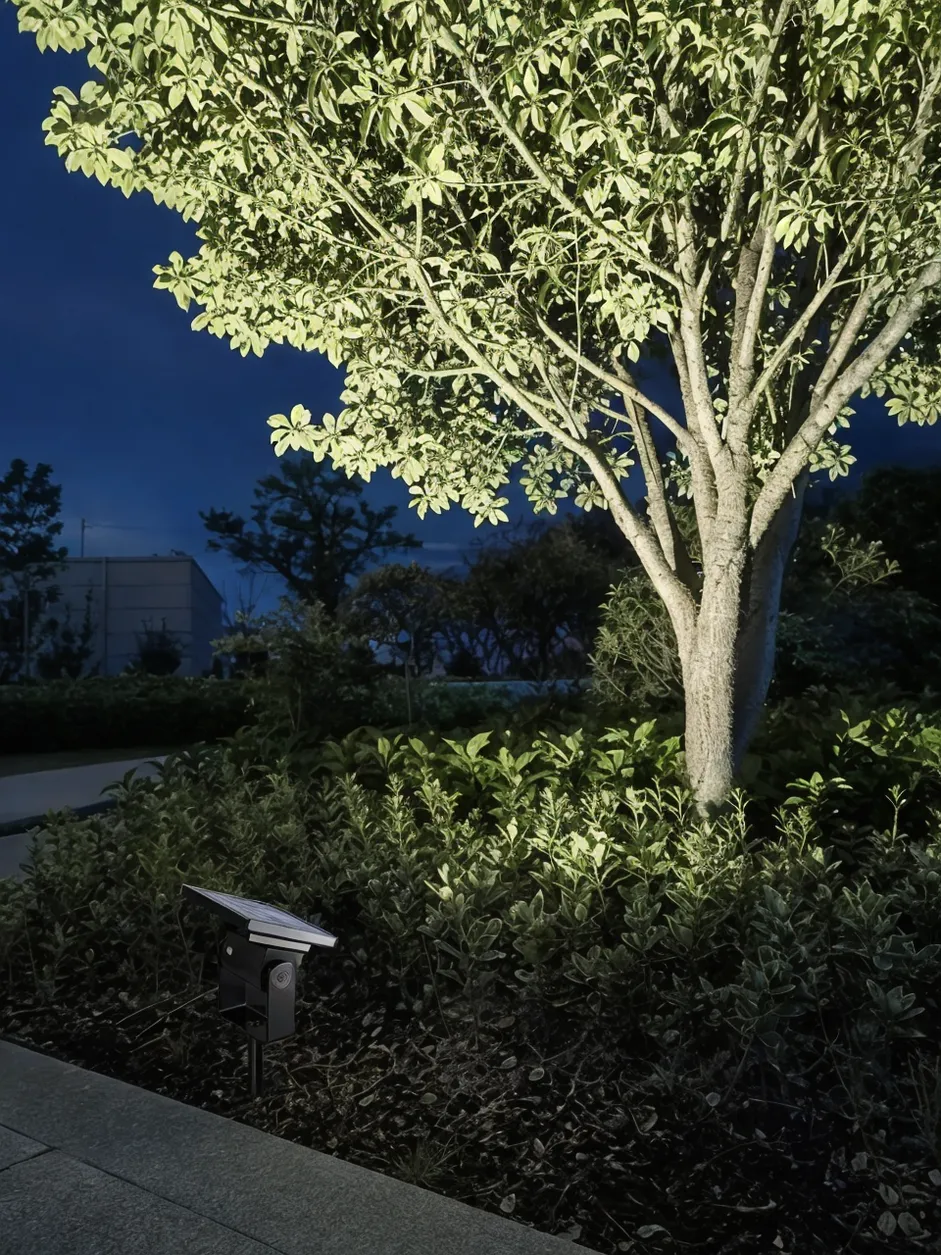
Solar Spotlights for Directional Outdoor Project Supply
Solar spotlights are the directional tier of the solar garden and landscape lighting range — not ambient garden fixtures, not broad pathway lights, but focused beams aimed at a specific target: a tree canopy, a stone wall, a resort entrance, a commercial sign, a garden focal point. If your project or catalog needs controlled illumination rather than general garden ambiance, this is the product.
We manufacture solar landscape spot lights at JXSOL's 12,000 m² facility in Guzhen Town, Zhongshan, alongside four other solar garden and landscape product lines. The spotlight line is built for buyers who need a higher-value SKU above basic garden lights — one that supports better margin in distributor catalogs and delivers reliable feature lighting in contractor and project supply. CE, RoHS, IP65/IP67, and IEC 62124 certifications are standard with export orders.
Product Position
-
Focused beams for specific targets — not ambient diffusion
-
200–800 lumen output range with adjustable beam angles
-
IP65/IP67 construction for exposed outdoor installation
-
Manufactured in-house at 12,000 m² Guzhen facility
-
MOQ from 100 units; OEM/ODM for private-label programs
Why Beam Control Makes This a Different SKU
The commercial distinction between solar spotlights and the other products in the solar garden and landscape range comes down to beam control and lumen class.
Solar Garden Lights
10–50 lumens · Wide diffused output
Ambient fixtures designed for general garden illumination and catalog volume. Wide, soft output with no directional control.
View solar garden lightsSolar Landscape Lighting
50–300 lumens · Controlled output
More controlled output for defined pathway and garden bed coverage. Sits between ambient and directional in the range.
View solar landscape lightingSolar Spotlights
200–800 lumens · Adjustable beam angles
Directional: designed to put light exactly where it's needed and nowhere else. Adjustable beam for precise target illumination.
Current pagePrevents Wrong-SKU Purchases
A contractor who orders landscape lights for tree uplighting gets a product that spreads light across the ground instead of up the trunk — the result is a callback and a replacement order. Specifying solar landscape spot lights from the start eliminates that mismatch.
Supports Better Margin
Spotlights carry a higher unit value than ambient garden lights because the application is more specific and the buyer's downstream customer is paying for a result — illuminated architecture, a lit entrance, a feature tree — not just a light in the garden.
Beam Angle: The Primary Selection Variable
Narrow Beam
Concentrates output for tall trees, flagpoles, and signage where the target is small and the fixture is placed at distance.
Medium Beam
Works for walls, garden features, and low-canopy trees where the target is wider and closer to the fixture.
Wide Beam
Closer to a floodlight pattern. Suits large wall washes or broad garden features requiring even coverage.
Most standard solar spotlight models have an adjustable head that covers a range rather than a fixed angle — confirm the beam range you need when you send the RFQ.
Adjustable Panel: The Feature That Separates Spotlights From Fixed-Panel Garden Lights
In shaded landscapes — under tree canopy, against north-facing walls, in enclosed courtyards — a fixed panel on the fixture body often can't capture enough sun. An adjustable or separate panel lets the installer orient the panel toward the best solar exposure while aiming the light head at the target.
For project buyers, this is the difference between a fixture that works and one that generates complaints after the first cloudy week.
Need broader ground-level coverage? Solar landscape lighting is the right product. For ambient catalog-volume SKUs, solar garden lights cover that tier. Send us your target application and required beam distance and we'll confirm the right configuration.
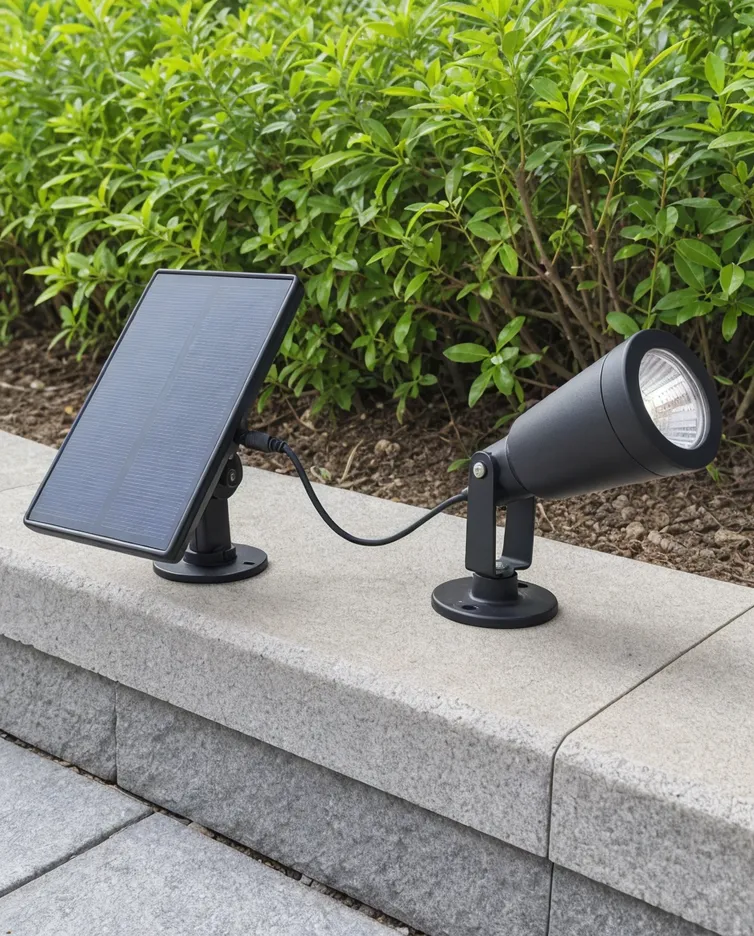
Quote-Ready Solar Spotlight Specification Table
The table below covers the typical specification range for our solar spotlight product family. These are product-family ranges — final values depend on the specific model and any OEM configuration. Use this table to confirm whether our range covers your requirements before requesting a detailed quote.
| Parameter | Typical Range | Notes |
|---|---|---|
| LED Power | 3W – 10W | Higher wattage for longer throw distances and larger targets |
| Lumen Output | 200 lm – 800 lm | Confirm target lumen at the illuminated surface, not just fixture output |
| Beam Angle | 15° – 120° (adjustable) | Narrow for signs/trees; wide for walls/garden features; confirm range per model |
| Solar Panel Type | Monocrystalline silicon | Higher conversion efficiency vs polycrystalline; standard across the line |
| Solar Panel Wattage | 3W – 8W | Sized to battery capacity and target runtime; confirm for installation latitude |
| Battery Chemistry | LiFePO4 / Li-ion | LiFePO4 for 2000+ cycle life; Li-ion for cost-sensitive programs |
| Battery Capacity | 2000mAh – 6000mAh | Matched to runtime target and lumen output; we do not use unmatched cells |
| Runtime (full charge) | 6 – 12 hours | Varies by lumen mode; dimming or motion-sensor mode extends runtime |
| Autonomy Days | 1 – 5 days | Consecutive cloudy days at full output; confirm for target market latitude |
| Color Temperature (CCT) | 2700K – 6500K | Warm white (2700–3000K), neutral white (4000K), cool white (5000–6500K) |
| IP Rating | IP65 / IP67 | IP65 standard; IP67 available for ground-level and high-exposure installations |
| Housing Material | ABS, die-cast aluminum | Die-cast aluminum for higher-spec and commercial project applications |
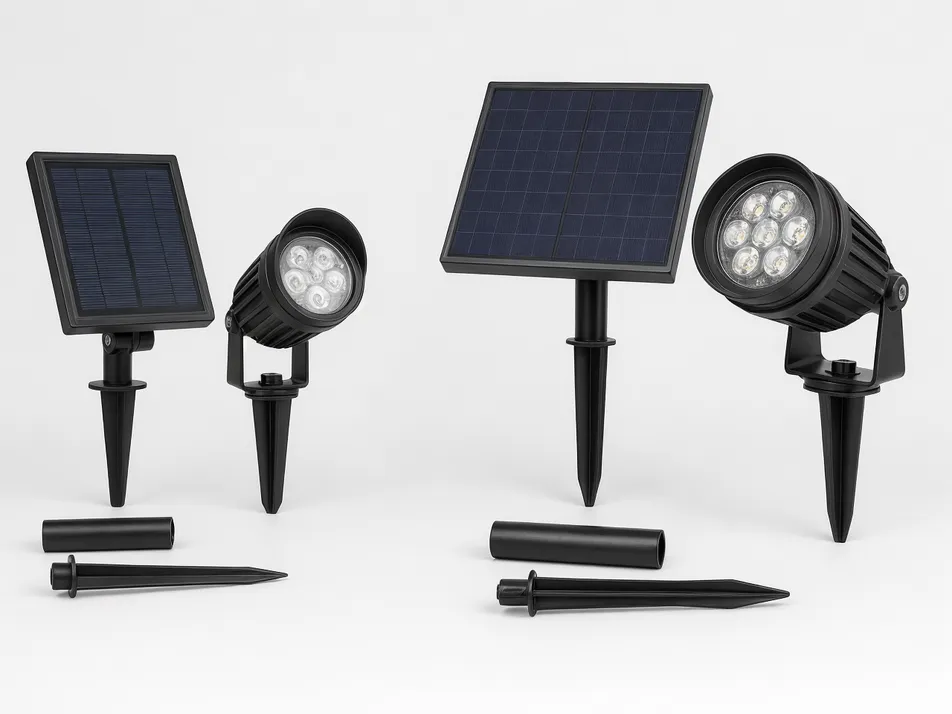
| Mounting Options | Ground stake, wall bracket, screw base | Separate panel option available on selected models; confirm at order stage |
| Sensor / Mode Options | Constant-on, dusk-to-dawn, PIR motion sensor, dimming | Confirm mode requirements at order stage |
| Finish / Color | Black, silver, bronze, custom RAL (OEM) | Standard colors available; custom colors on qualifying OEM run sizes |
| Packaging | Retail color box, plain brown carton, custom OEM packaging | Retail box dimensions confirmed per SKU |
Specifications shown are typical product-family ranges. Final values depend on the specific model and OEM configuration. Contact us for model-level datasheets and confirmed specifications.
CE, RoHS, IP65/IP67, and IEC 62124 documentation is available with export orders — see solar lighting certifications and quality standards for the full documentation list.
Include your lumen requirement, beam angle, mounting type, and target market.
Matching Solar Spotlights to Profitable Market Segments
Solar spotlights serve a narrower set of applications than ambient garden lights, which means the commercial opportunity is more concentrated — and more repeatable. Here are the segments where solar landscape spot lights generate consistent order volume.
Landscape Contractor Packages
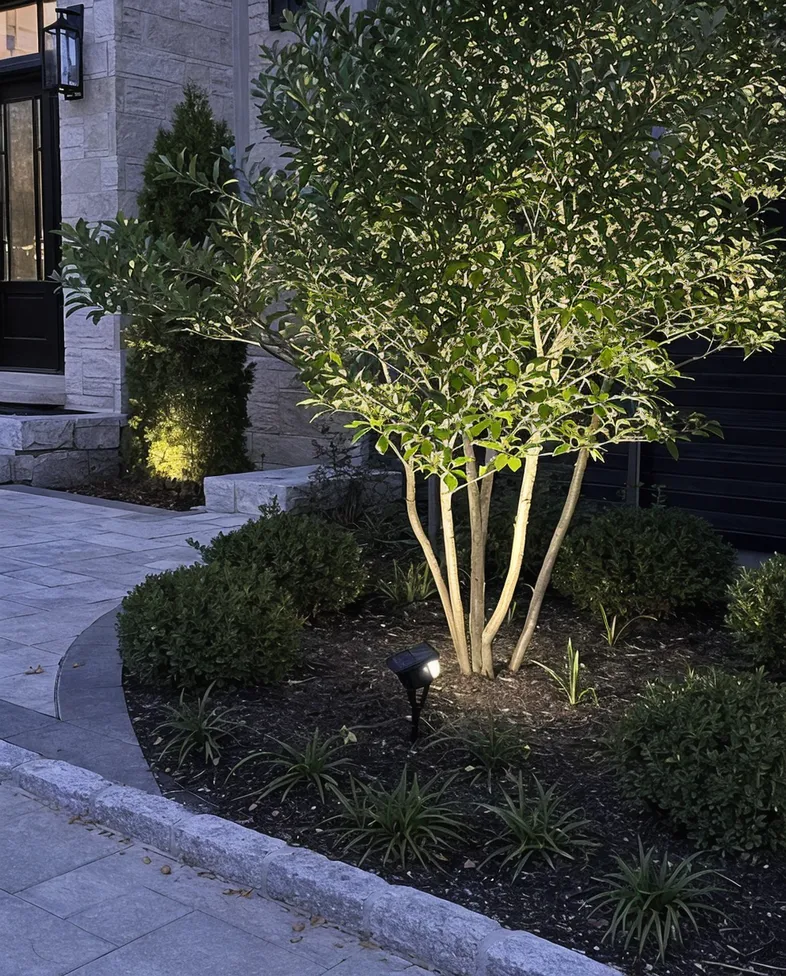
Landscape contractors installing solar lighting on residential and commercial properties typically run a base layer of pathway or landscape fixtures and add spotlights for feature trees, garden walls, and entrance elements.
The commercial logic for the contractor is upsell: a project that starts with pathway lights becomes a larger order when spotlights are included for the feature tree at the entrance or the stone wall along the driveway. For the contractor's supplier, this means solar spotlights and solar landscape lighting are natural package SKUs — the contractor buys both from the same source.
Specifications That Reduce Callback Risk
Contractors need fixtures that survive installation handling, hold their lumen output across seasons, and don't generate callbacks. The specifications that reduce callback risk in this segment:
- IP67 construction — survives ground-level moisture and irrigation overspray
- Die-cast aluminum housing — resists installation handling damage and seasonal expansion
- LiFePO4 battery chemistry — maintains capacity across temperature cycles without early degradation
The Reorder Mechanism
A contractor who installs 20 spotlights on a residential project and gets two warranty calls in the first season loses the reorder. A contractor who installs 20 and gets zero calls reorders for the next project. That's the commercial mechanism.
Hospitality and Resort Projects
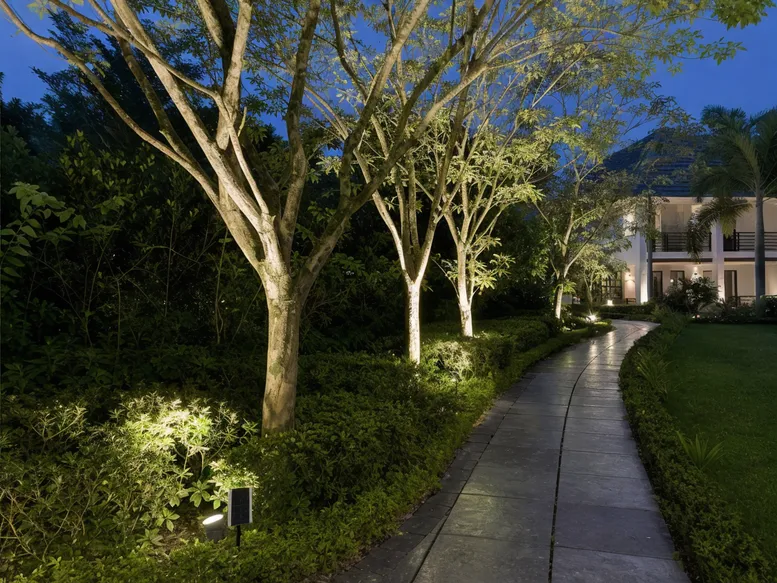
Resort and hotel buyers source solar spotlights for feature tree lighting, façade uplighting, garden entrance illumination, and outdoor dining area accents. The commercial concern is maintenance cost and guest-facing reliability — a spotlight that fails mid-season requires a technician visit, which costs more than the fixture. For the project supplier, this segment generates larger initial orders (a resort property may need 50–200 spotlights across the grounds) and reliable replacement orders when fixtures reach end of life.
For hospitality applications, specify at least 3 autonomy days and confirm the solar panel wattage is sized for the installation latitude. A resort in Southeast Asia at 5° latitude charges differently than one in southern Europe at 40° — the panel sizing needs to match the local irradiance.
Latitude-Specific Panel Sizing
We've had buyers in the Middle East specify panels sized for European irradiance levels and then wonder why the lights dim in December. The engineering review before production catches this. Our engineering team handles panel sizing calculations as part of the OEM/ODM review process.
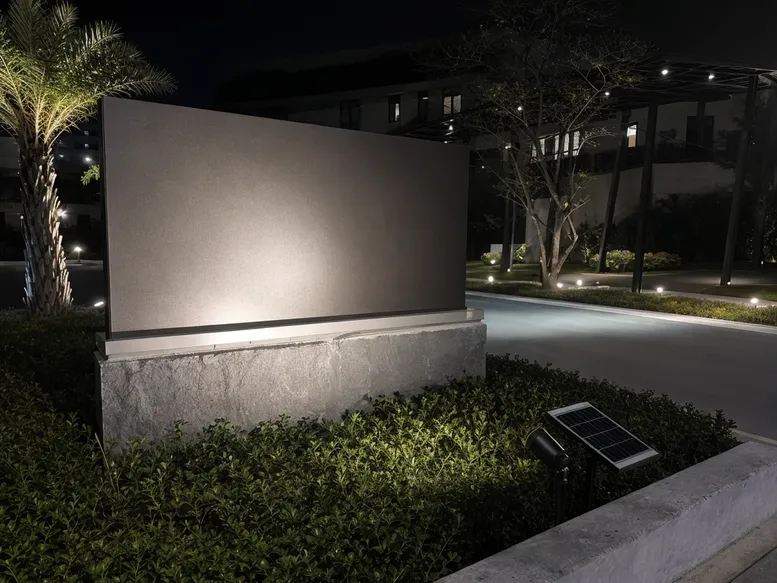
Signage and Entrance Lighting
Solar landscape spot lights are a cost-effective alternative to grid-connected fixtures for illuminating commercial signage, property entrances, and monument signs where trenching for electrical supply is expensive or impractical. A narrow-beam spotlight (15°–30°) aimed at a sign face from 2–4 meters delivers focused illumination without spill onto surrounding areas. For the buyer supplying sign companies, property developers, or commercial real estate projects, this is a segment where the solar value proposition is strongest — no trenching cost, no ongoing electricity cost, and a fixture that installs in under an hour.
Order patterns in this segment tend to be project-based: 10–50 units per site, with repeat orders as the buyer's client base grows. Consistent lumen output and CCT across batches matters here because signs installed at different times need to look the same.
LED Module Binning Consistency
Our LED module binning process ensures reorders match the original order within ±150K CCT and ±10% lumen output — so signs installed at different times look the same under illumination.
Retail Distributor SKU Programs
For distributors building a solar garden lighting catalog, solar spotlights are the higher-margin SKU above basic garden lights. The end customer buying a spotlight is paying for a specific result — a lit tree, a highlighted garden feature — and is less price-sensitive than the buyer of a basic stake light. A distributor who carries only ambient garden lights leaves the spotlight segment to competitors. Adding one or two solar spotlight SKUs to the catalog captures the higher-value end of the garden lighting purchase without requiring a separate supplier.
The practical catalog configuration is a standard-output model (300–500 lm, warm white, adjustable beam) for residential and garden center accounts, and a higher-output model (600–800 lm, neutral or cool white) for commercial and contractor accounts. Both can be sourced from the same factory with consistent quality standards and a single reorder contact.
Recommended Catalog Configuration
Residential / Garden Center Accounts
300–500 lm, warm white, adjustable beam
Commercial / Contractor Accounts
600–800 lm, neutral or cool white
Municipal Parks and Public Gardens
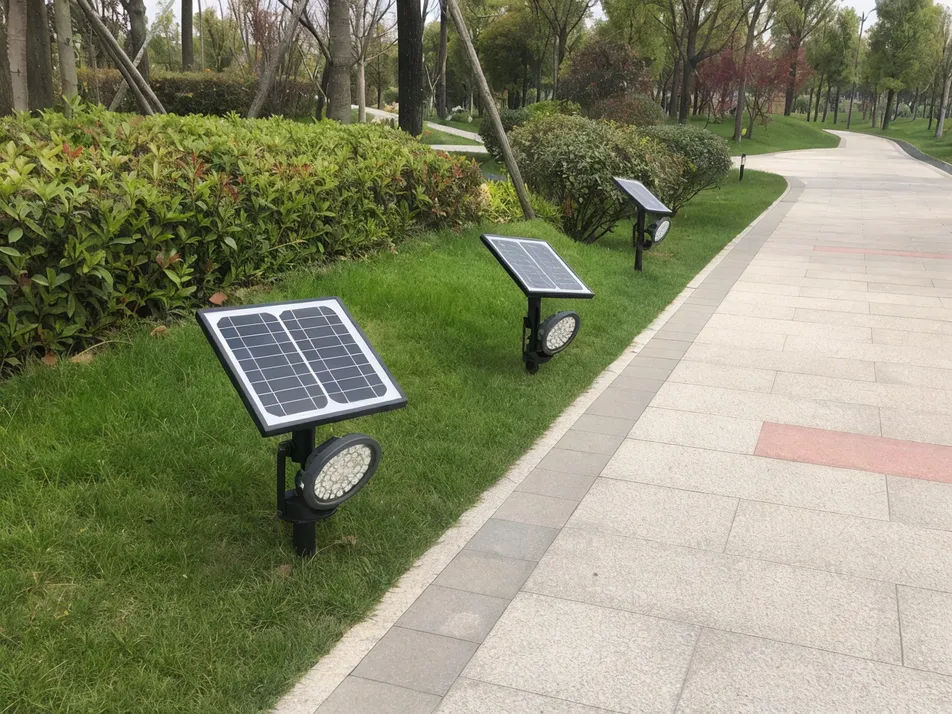
Municipal buyers sourcing solar spotlights for public parks, plazas, and garden spaces need IP67 construction, robust mounting options, and documentation for procurement compliance. CE certification and IEC 62124 compliance documentation are standard with our export orders.
For municipal projects, the relevant specification questions are:
Autonomy Days
Public lighting needs to work reliably through extended cloudy periods
Housing Durability
Public installations face more handling and environmental stress than residential
Replacement Availability
A municipality that installs 100 spotlights needs to be able to reorder the same model two years later
We confirm production schedule availability and model continuity at order placement. For project buyers who need a solar landscape lighting design guide before finalizing specifications, we have supporting content available.
Ready to Configure Your Spotlight Program?
Send your project layout or SKU target to JXSOL for configuration advice and a model-level quote.
Contact JXSOLBattery, Panel, and Runtime Choices That Prevent Returns
Solar spotlights draw more power than ambient garden lights — a 500 lm spotlight running at 5W drains a battery pack roughly three times faster than a 50 lm garden stake light at 0.5W. That load difference means the battery and panel sizing decisions that matter for garden lights matter even more for spotlights, and the consequences of getting them wrong are more visible: a spotlight that dims or cuts out early is immediately obvious in a way that a slightly dimmer garden stake light is not.
Runtime
Daily performance metric
How long the fixture runs at full output on a single full charge — typically 6–12 hours depending on battery capacity and lumen mode.
Runtime matters for daily performance. A spotlight specified for 8-hour runtime but only 1 autonomy day will dim noticeably after two cloudy days in a row — which is a warranty claim waiting to happen in northern European or Pacific Northwest markets.
Autonomy Days
Seasonal reliability metric
How many consecutive cloudy days the battery sustains full output without a recharge — typically 1–5 days depending on battery capacity and panel wattage.
Autonomy days matters for seasonal reliability in markets with extended overcast periods. Confirm this spec before ordering for northern climates.
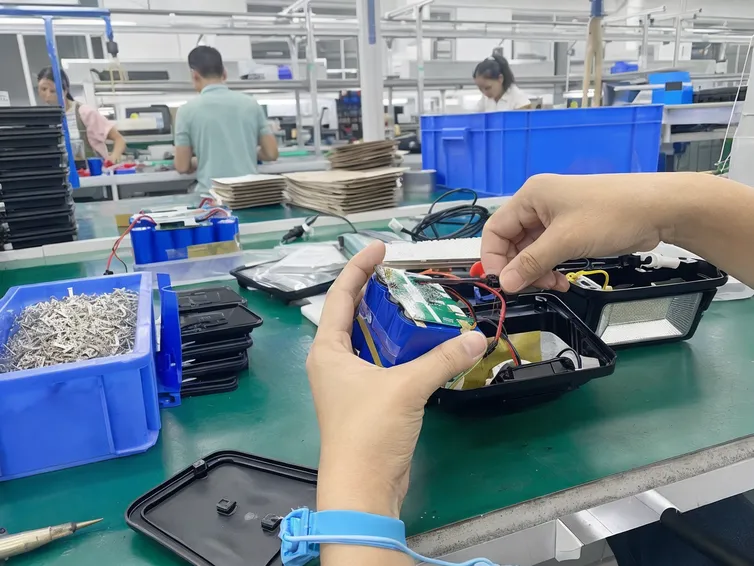
Battery Reliability at Three Points in Production
Cell Sourcing
Battery cells sourced from approved suppliers with capacity specifications and material declarations. No unvetted cell suppliers enter the production line.
Pre-Assembly Testing
Every cell tested for capacity and internal resistance. Cells matched within a defined tolerance — we don't mix cells from different batches in the same pack.
Pack Aging & Firmware
Every assembled battery pack goes through a charge/discharge cycle test on aging racks before installation. Charge controller firmware configured to match the specific battery chemistry and capacity — not a generic profile.
LiFePO4 vs Li-ion: Chemistry Recommendation
| Parameter | LiFePO4 | Standard Li-ion |
|---|---|---|
| Cycle Life | 2000+ cycles | 300–500 cycles |
| Battery Outlasts Product | Yes | Often not |
| Warranty Claims (Yr 2–3) | Fewer | Higher risk |
| Best Fit | Applications where cycle life matters | Cost-sensitive catalog programs |
| Price Positioning | Mid-to-premium tier | Price-point-driven programs |
We'll confirm the chemistry recommendation for your target market and price tier when you send the RFQ.
Confirm runtime and autonomy days before quotation
These are the specs your downstream customers will notice, and they're the ones that generate returns if they're wrong.
Installation Variables That Affect Project Cost
Solar spotlight installation is straightforward, but the variables that affect project cost are worth understanding before you quote a project or build a product spec. Getting these right at the sourcing stage reduces site delays, accessory shortages, and after-sales tickets.
Mounting Options
- Ground stake — standard for garden bed and lawn installation.
- Wall bracket — available on selected models for fence, wall, and post installation.
- Screw-base — suits paved surfaces and concrete installations.
For projects with mixed mounting requirements — some ground stakes, some wall brackets — confirm the mounting hardware configuration at order stage so the accessory pack matches the installation plan.
Panel Orientation & Cable Length
For models with a separate solar panel, the cable length between the panel and the fixture head determines how far the panel can be positioned from the light.
In shaded landscapes — under tree canopy, against north-facing walls, in enclosed courtyards — a longer cable allows the panel to be placed in full sun while the fixture head is aimed at the target.
Standard cable lengths: 3–5 meters. Confirm the cable length requirement for your installation environment before ordering.
We've had contractors order spotlights with integrated panels for a shaded courtyard installation and then call us about poor runtime. The separate-panel version solves this — it's worth asking about at the spec stage.
Beam Aiming & Fixture Spacing
For project buyers quoting a landscape installation, the beam angle and fixture placement distance determine how many spotlights are needed to cover the target area.
Coverage reference (30° beam):
3m distance
~1.6m circle
5m distance
~2.7m circle
Wider beams cover more area per fixture but with lower intensity at the edges. Confirm the beam angle and placement distance before finalizing the fixture count in your project quote.
Waterproofing & Connector Checks
The cable connector between the panel and the fixture head is a water ingress point if it's not rated to the same IP level as the housing.
Our separate-panel models use connectors rated to IP65 or IP67 to match the housing specification.
For project buyers: confirm the connector IP rating matches the installation environment — ground-level connectors in irrigated garden beds need IP67.
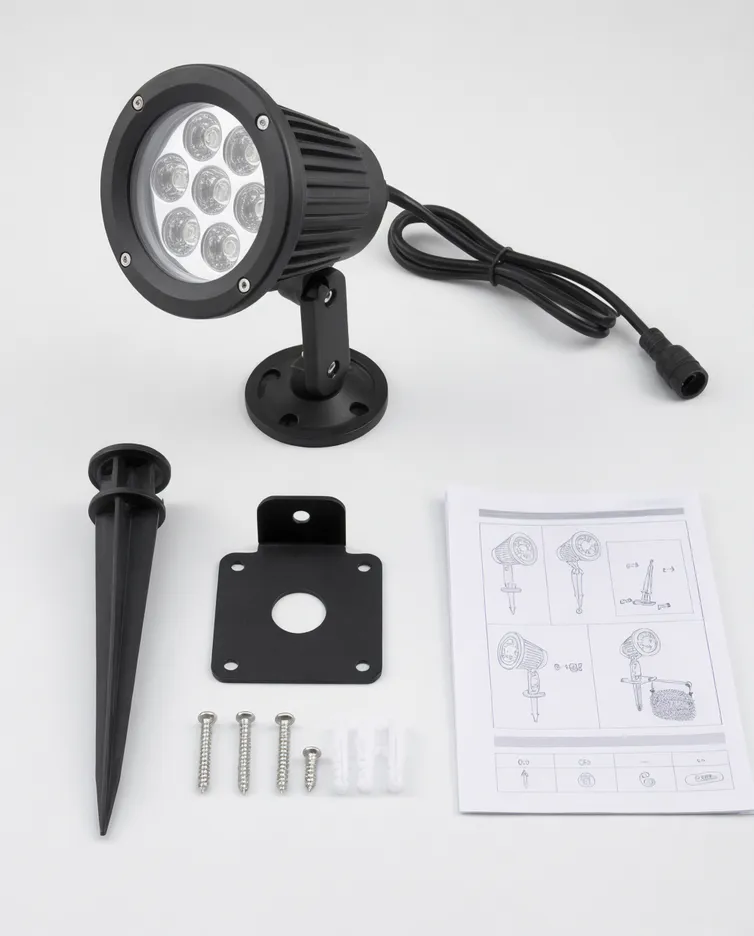
Accessory Checklist
Every carton ships with the main fixture, mounting hardware (stake, bracket, or screws as specified), and an instruction sheet in the required language.
Standard carton contents:
- Main fixture (spotlight head + arm)
- Mounting hardware (stake, bracket, or screws — as specified)
- Instruction sheet (in required language)
- Separate panel + cable (if applicable)
Confirm the accessory pack configuration at order stage — missing hardware is the most common complaint on spotlight orders and it's entirely a packing process issue.
Need a mounting recommendation?
Send installation photos or a project layout to JXSOL for a mounting recommendation and accessory configuration.
OEM/ODM Configuration for Distributor and Project Programs
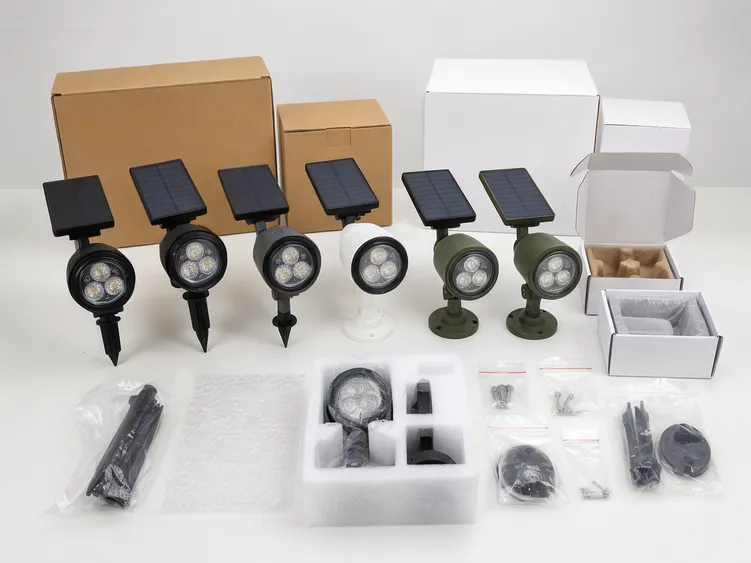
Solar spotlights are a strong candidate for private-label development — the product has enough visual and technical variation to support differentiated SKUs, and the higher unit value supports the margin needed to justify custom packaging investment. Our in-house R&D team of 15+ optical and electrical engineers handles OEM and ODM projects for the spotlight line.
Optical & Electrical Customization
- Lumen output adjustment within the LED module's design range — typically ±30% from the standard model output without housing changes
- Color temperature selection across 2700K–6500K: warm white (2700–3000K) for residential and hospitality, neutral white (4000K) for commercial and contractor, cool white (5000–6500K) for accent and feature applications
- Beam angle selection or adjustment within the model's optical range; fixed-angle optics available for applications where a specific beam is required
- Battery capacity sizing for target autonomy days and runtime — sized to the runtime target, not to a generic spec
- Solar panel wattage sizing for the buyer's target installation latitude
- Lighting mode configuration: constant-on, dusk-to-dawn, PIR motion sensor, dimming schedule, or combined modes
Physical & Structural Customization
- Housing color in standard options (black, silver, bronze) or custom RAL on qualifying run sizes
- Bracket and stake kit configuration for specific mounting requirements
- Separate panel option with specified cable length where the base model supports it
- Logo placement on housing where the model's surface geometry allows
Packaging Customization
- Retail color box design and printing for garden center, hardware store, and e-commerce programs
- Plain brown carton for project and contractor supply
- Private-label packaging with custom barcode, batch code, and instruction language
- Accessory pack configuration — mounting hardware, spare parts, instruction sheet language
MOQ & Engineering Review Process
MOQ for standard catalog models starts at 100 units — low enough to test a new SKU with your retail accounts or contractor customers before committing to a larger program.
For OEM/ODM projects with custom specifications, we run an engineering review before production to confirm the configuration is achievable and to lock the spec before component procurement.
New housing shapes or tooling require a separate engineering review and higher MOQ. Extreme lumen increases beyond the LED module's design range may require a larger battery, panel, and housing — the engineering review identifies these constraints before production starts, not during it.
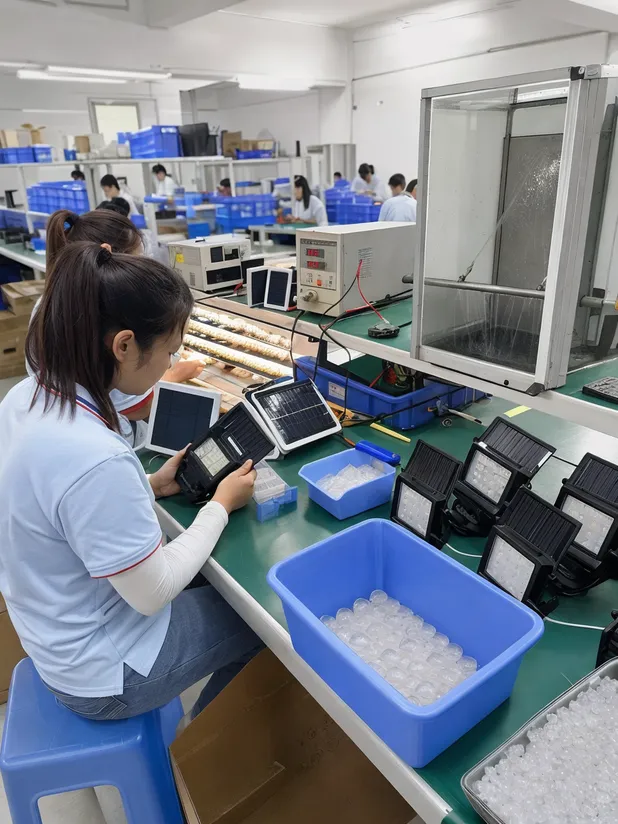
Spotlight Production Checks That Protect Reorders
The production checks that matter most for solar spotlights are the ones that affect reorder consistency — because a buyer who places a second order expecting the same product as the first order needs to get exactly that. Here's what we run at each stage.
LED Module Lumen & CCT Binning
Every LED module is measured for lumen output and color temperature before assembly. Modules are grouped within a defined tolerance band — a 3000K warm white order ships with modules within ±150K of the target CCT and within ±10% of the target lumen output.
This is the process that makes your reorder look like the original order. Without binning, the variation across a 200-unit batch can be visible to the naked eye under the same installation conditions.
Optical Alignment & Adjustable Head Checks
The adjustable head joint on a solar spotlight is a mechanical component that needs to hold its position after installation — a joint that slips means the beam drifts off target over time. We check the joint torque and holding force on every unit at final assembly.
The optical alignment between the LED module and the reflector or lens is verified at the module assembly stage to confirm the beam pattern matches the specified angle.
Battery Pack Matching & Charge/Discharge Testing
Every battery pack is assembled from cells matched by capacity and internal resistance, then cycled through a charge/discharge test on our aging racks before installation. The charge controller firmware is configured to match the battery chemistry and capacity of the specific product.
This is the process that prevents the battery degradation failures that generate warranty claims in the second season.
Solar Panel Electrical Output Testing
Every solar panel is tested for electrical output before assembly. Panels that don't meet the specified wattage are rejected.
A panel that outputs 80% of its rated wattage means the battery charges slower and the runtime falls short of spec.
IP65/IP67 Waterproof Structure Inspection
Every unit is tested at our waterproof inspection station before packing. Housing seals use UV-stable silicone gaskets. Cable entries use compression glands with defined torque specs.
For separate-panel models, the cable connector is rated to the same IP level as the housing.
100% Pre-Shipment Inspection
Every unit, every carton, every accessory pack, every label — before the container is sealed.
Learn about the JXSOL solar lighting factory for the full QC flow.
Compliance & Inspection Documents
CE Declaration of Conformity, RoHS test reports, and IP test certificates are available per order. Request inspection and compliance documents with your order for full traceability.
Packing, Accessories, and Mixed-SKU Shipping
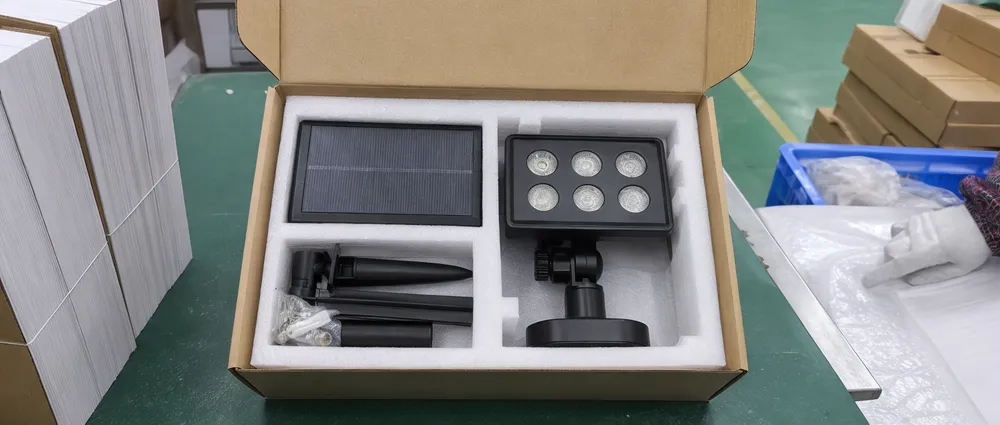
Solar spotlights have specific packing requirements that affect your damage rate and landed cost. The adjustable head, solar panel (integrated or separate), ground stake, and wall bracket are all components that can be damaged in transit if the inner protection isn't designed for them.
Inner Protection
Each spotlight ships in a retail color box or plain carton sized to the product dimensions, with foam or EPE inner protection for the solar panel, adjustable head, and accessory pack.
The adjustable head is the most vulnerable component — it's a precision joint that can be deformed by point pressure in transit. We use molded inner trays or foam cutouts that hold the head in a fixed position during shipping, not loose padding that allows movement.
Accessory Pack Verification
Every carton is packed against a packing list that includes the main fixture, mounting hardware (stake, bracket, or screws as specified), cable (for separate-panel models), and instruction sheet.
Accessory packs are checked before carton sealing. Missing hardware is the most common complaint on spotlight orders and it's entirely a packing process issue — the check takes 30 seconds and prevents a customer service call.
Retail Packaging vs Project Cartons
For buyers supplying garden centers, hardware retailers, or e-commerce channels, retail color box design and printing is available as part of the OEM/ODM service. Standard retail box dimensions are sized for shelf display and pallet stacking.
For project and contractor supply, plain brown cartons with SKU labeling and batch codes are the standard configuration.
Mixed-SKU Supply
We handle mixed-SKU orders combining solar spotlights with solar landscape lighting, solar garden lights, and other product lines from a single factory in a single shipment.
Each SKU ships in its own labeled carton with batch codes for traceability. Carton dimensions and weights are confirmed per SKU so you can plan your 20GP or 40HQ container loading before the order is placed.
Need carton dimensions and container loading plans?
For full logistics and container planning details, see shipping and delivery process.
Choose the Right Product Line in the Garden and Landscape Range
Solar spotlights are one of five product lines in the JXSOL solar garden and landscape lighting range. The table below helps you identify which product fits your application and commercial need — and where to go if solar spotlights aren't the right match.
| Product Line | Best For | Lumen Range | Beam Type | Typical Buyer |
|---|---|---|---|---|
| Solar Spotlights | Directional feature lighting: trees, walls, signage, entrances, resort landscapes | 200–800 lm | Directional, adjustable | Landscape contractors, hospitality project buyers, distributors building higher-margin SKUs |
| Solar Landscape Lighting | Ground-level and pathway coverage for contractor installations and developer projects | 50–300 lm | Controlled, ground-level | Landscape contractors, property developers, municipal buyers |
| Solar Garden Lights | Ambient garden illumination for distributor catalogs and residential developer packages | 10–50 lm | Wide, diffused | Distributors, hardware retailers, e-commerce sellers |
| Solar Tree Lights | Decorative string and wrap lighting for trees, outdoor structures, and seasonal programs | Decorative | Diffused/ambient | Garden retailers, seasonal importers, hospitality buyers |
| Decorative Solar Garden Lights | Novelty and themed garden fixtures for retail shelf programs and seasonal collections | 5–50 lm | Diffused/decorative | Garden center chains, gift and home décor distributors, seasonal importers |
Solar Spotlights
Directional feature lighting: trees, walls, signage, entrances, resort landscapes
Landscape contractors, hospitality project buyers, distributors building higher-margin SKUs
Solar Landscape Lighting
Ground-level and pathway coverage for contractor installations and developer projects
Landscape contractors, property developers, municipal buyers
Solar Garden Lights
Ambient garden illumination for distributor catalogs and residential developer packages
Distributors, hardware retailers, e-commerce sellers
Solar Tree Lights
Decorative string and wrap lighting for trees, outdoor structures, and seasonal programs
Garden retailers, seasonal importers, hospitality buyers
Decorative Solar Garden Lights
Novelty and themed garden fixtures for retail shelf programs and seasonal collections
Garden center chains, gift and home décor distributors, seasonal importers
Which product line fits your application?
If your application needs directional feature lighting with adjustable beam control, solar spotlights are the right product.
If you need broader ground-level coverage for pathways and garden beds, solar landscape lighting is the better fit.
If you're building a catalog-volume ambient garden lighting program, solar garden lights cover that tier.
For the full range, see solar garden and landscape lighting.
Based on your target market and catalog requirements
FAQ for Solar Spotlight Buyers
What lumen range is practical for solar spotlights in commercial landscape projects?
For most commercial landscape applications, 300–600 lm covers the working range. A 300 lm spotlight at a 3-meter placement distance illuminates a medium-sized garden feature or low-canopy tree adequately. A 500–600 lm fixture handles taller trees, larger wall sections, and commercial signage where the fixture is placed 4–6 meters from the target.
The 700–800 lm range is for large-scale feature lighting — tall trees, wide façades, monument signs — where the fixture is placed at distance and the target area is large.
For distributor catalogs: a 300–500 lm model covers the majority of residential and light commercial applications.
For project supply: confirm the target lumen level at the illuminated surface, not just the fixture output — a 500 lm fixture with a 30° beam delivers much higher surface illuminance than the same fixture with a 90° beam.
What beam angle should solar spotlights use for trees, walls, and signage?
For tall trees, flagpoles, and signage where the target is small and the fixture is placed at distance — the narrow beam concentrates output and extends the effective throw range.
For walls, low-canopy trees, and garden features where the target is wider and the fixture is closer.
For large wall washes or broad garden features where coverage area matters more than intensity.
Most of our standard solar spotlight models have an adjustable head that covers a range rather than a fixed angle, which gives the installer flexibility on site.
If your application requires a specific fixed beam angle — for consistent appearance across a large project installation — we can configure fixed-angle optics as part of the OEM/ODM process.
How many autonomy days should buyers specify for solar landscape spot lights?
For most markets, 2–3 autonomy days is the practical minimum for a solar spotlight that needs to perform reliably through normal weather variation. One autonomy day means the battery is depleted after a single cloudy day — which generates complaints in any market with regular overcast periods. Three autonomy days handles most weather patterns in temperate climates.
Latitude & Climate Guidance
Above 45° Latitude
Northern Europe, Canada, northern US — specify 3–5 autonomy days. Confirm solar panel wattage is sized for lower winter irradiance.
Extended Monsoon Seasons
Southeast Asia, parts of Africa — specify 3–5 autonomy days. Panel wattage must compensate for prolonged low-irradiance periods.
Tropical / High Irradiance
Year-round high solar resource — 2 autonomy days is typically sufficient.
We size battery capacity and panel wattage to the autonomy day target for the buyer's specified installation latitude — confirm the target market when you send the RFQ.
Are IP65 solar spotlights enough, or should project buyers specify IP67?
IP65 is sufficient for wall-mounted and elevated installations where the fixture is not exposed to standing water or direct irrigation. IP67 is the right specification for ground-level installations — spotlights installed in garden beds, lawn areas, or irrigated landscapes where the fixture base and cable entry can be submerged temporarily after heavy rain or irrigation.
IP65 — Elevated Installs
- Wall-mounted fixtures
- Elevated installations above splash zone
- No standing water or irrigation exposure
IP67 — Ground-Level Installs
- Garden beds and lawn areas
- Irrigated landscapes
- Temporary submersion after heavy rain
Recommendation for Landscape Contractor Supply
For project buyers supplying landscape contractors, IP67 is the safer default: it covers both elevated and ground-level installations, and the warranty claim reduction in high-rainfall or irrigated markets more than covers the unit cost difference. For coastal markets (Florida, UK, Southeast Asia), IP67 also provides better long-term seal integrity against salt air and humidity cycling.
Can JXSOL customize CCT, battery capacity, and packaging for solar spotlights?
Yes on all three. Color temperature is selectable across 2700K–6500K for any model:
Warm White
2700–3000K — residential and hospitality
Neutral White
4000K — commercial and contractor
Cool White
5000–6500K — accent and feature applications
Battery capacity can be sized to your target runtime and autonomy day requirements — we size to the performance target, not to a generic spec.
Custom retail packaging — color box design, logo printing, accessory pack configuration, instruction language — is available as part of the OEM/ODM service. MOQ for standard models with custom packaging starts at 100 units.
For custom CCT, lumen output, or battery capacity adjustments, the engineering team reviews the configuration before production to confirm it's achievable within the LED module's design range.
What is the MOQ for standard solar spotlight models?
100 units per SKU for standard catalog models. This is low enough to test a new spotlight SKU with your retail accounts or landscape contractor customers before committing to a larger program.
For OEM/ODM projects with custom specifications — housing color, packaging, lumen output, CCT, battery capacity — MOQ varies by customization type and is confirmed during the engineering review.
Mixed-SKU orders combining solar spotlights with other product lines are handled from a single factory with a single point of contact.
Ready to specify your solar spotlights?
Include your target application, lumen requirement, beam angle, and order quantity for a model-level response.
Send Your Spotlight Requirement for a Model-Level Quote
The fastest way to get a useful response is to send us the specifics. Here's what helps us configure the right model and give you accurate pricing.
What to Include in Your Request
-
Target market and climate Installation latitude and typical weather patterns — affects panel sizing and autonomy day configuration
-
Application Trees, walls, signage, entrances, garden features, or mixed
-
Lumen target At the fixture or at the illuminated surface
-
Beam angle Narrow, medium, wide, or adjustable
-
Color temperature Warm white, neutral white, or cool white
-
Runtime and autonomy days How long per night and how many consecutive cloudy days
-
Mounting type Ground stake, wall bracket, screw base, or separate panel
-
Packaging Retail color box, plain carton, or private label
-
Order quantity Per SKU and total
-
Certification or documentation requirements CE, RoHS, IP test certificates, IEC 62124
What You'll Receive
We'll respond with a configuration recommendation, available models that match your requirements, and pricing based on your quantities and customization needs.