The Grade Difference Is a Procurement Risk Decision
A residential-style solar street light can look attractive on a quotation sheet. The unit price is lower, the product photos look similar, and the supplier will often describe it using the same language — "solar street light," "IP65," "high lumen." The problem is not the label. The problem is what happens when that fixture goes onto a municipal road, a commercial campus access route, or a 200-pole parking lot project and the spec was never sized for the actual load.
The difference between commercial vs residential solar street lights is not a marketing tier. It is a system sizing decision. Commercial Solar Street Lights are engineered around project requirements: wattage and lumen output matched to road class and pole spacing, battery capacity calculated against nightly load and rainy-season autonomy, pole and bracket compatibility confirmed before production, and documentation available for tender review or import clearance. Residential models are built for a different job — driveways, private yards, garden paths, and retail single-unit demand where the failure cost is small and project documentation is not the buying standard.
The quick verdict: commercial solar street lights are the correct tier for municipal roads, commercial campuses, industrial access routes, parking areas, and repeat distributor programs. Residential models belong in lower-output private-property or retail channels. Some low-risk private sites can use residential-grade products, but not as substitutes for a solar street light for municipality, roadway, or bulk project procurement where lumen coverage, autonomy, compliance, and batch consistency are part of the acceptance criteria.
The rest of this article gives you the spec thresholds, the hidden cost logic, and the RFQ controls to tell the difference before you commit to a purchase order.
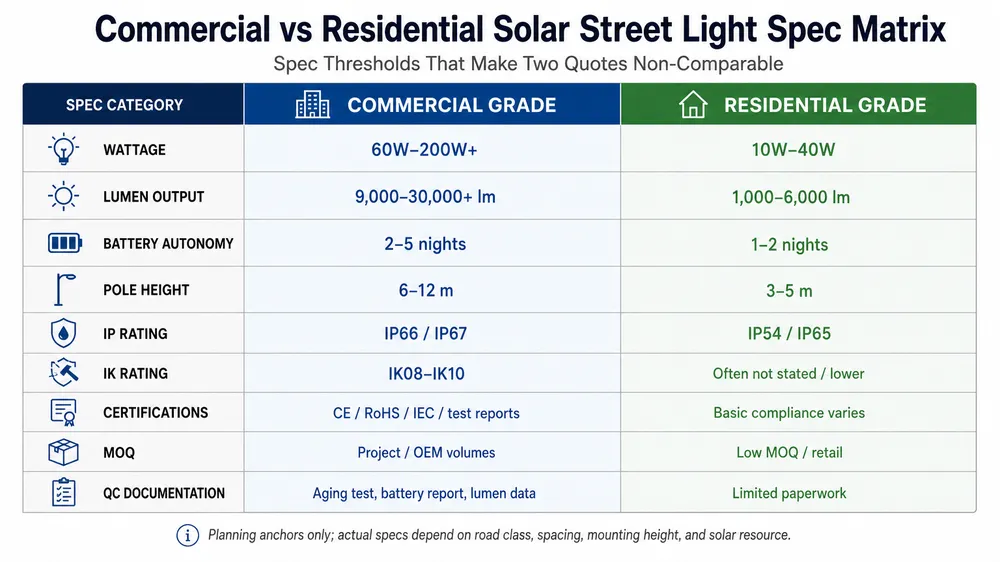
Spec Thresholds That Make Two Quotes Non-Comparable
The most common sourcing mistake we see is buyers comparing unit prices without first confirming that the two quotes are describing the same system. A 60W commercial fixture and a 20W residential fixture are not the same product with a different price — they are different systems with different coverage geometry, different battery sizing, and different failure profiles.
Here are the planning anchors we use when reviewing project specs:
| Criterion | Commercial-Grade Anchor | Residential-Grade Anchor | Buyer Consequence |
|---|---|---|---|
| LED power | 60W–200W typical project range | 10W–40W common retail range | Quotes are not comparable unless wattage and tested lumen output are both stated |
| Lumen output | 6,000–20,000 lm for road, campus, parking, and industrial layouts | 800–4,000 lm for driveway, yard, garden, or low-risk private use | Low lumens force more poles or create dark zones that generate project complaints |
| Battery sizing | Matched to nightly load, dimming schedule, and required autonomy days | Smaller pack with runtime often based on low-mode operation | Undersized batteries fail first during rainy-season or cloudy-week operation |
| Solar panel wattage | Sized to recover nightly discharge within the local peak sun hours | Often undersized relative to the battery capacity | Insufficient charging means the battery never fully recovers after consecutive cloudy days |
| Pole height and mounting | Roadway pole and bracket compatibility, typically 6–12 m mounting heights | Shorter private-property mounting or wall/post installation | Wrong mounting height changes beam spread, glare angle, and coverage uniformity |
| IP protection | IP65 minimum; IP67 where submersion risk exists | Basic waterproof claim or lighter-duty housing | Public-site water ingress becomes warranty cost and site-visit labor |
| IK rating | IK08–IK10 for public-exposure or vandalism-risk sites | Often not rated or not tested | Impact damage on public sites creates replacement cost and liability exposure |
| Certifications | CE, RoHS, IEC 62124, and order-level documentation where required | Often retail listing claims without project submittal files | Missing documents can delay tender approval or import review |
| QC evidence | Lumen binning, battery matching, aging test, waterproof inspection, 100% outgoing check | Limited final visual check or mixed-source assembly | Batch inconsistency becomes reorder and warranty risk |
| Order model | Bulk project, distributor reorder, OEM/ODM, MOQ planning | Single-unit or small retail purchases | Sourcing strategy affects landed cost, packaging, labels, and after-sales exposure |
The wattage and lumen thresholds above are planning anchors, not universal guarantees — actual project specs depend on road class, pole spacing, mounting height, and local solar resource. What the table shows is that a high wattage solar street light in the commercial range is a fundamentally different procurement object than a residential fixture, and comparing their unit prices without aligning the spec is how projects end up with dark roads and warranty disputes.
Lumen Output and Pole Height Decide Real Road Coverage
Wattage gets quoted. Lumens decide whether the road is actually lit.
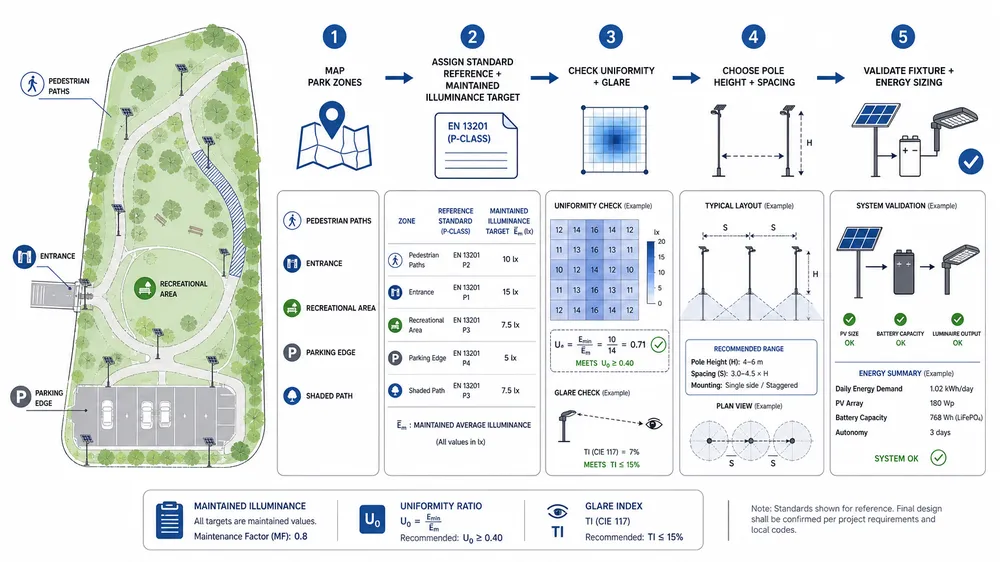
A 100W fixture with poor-quality LED binning can deliver fewer usable lumens on the road surface than a well-engineered 80W unit with matched optics and a proper beam distribution pattern. This is why solar street light lumen output comparison between two quotes needs to go beyond the headline number — you need tested lumen output, not rated input power, and you need to know how that output is distributed across the road width at your planned mounting height. Our solar street light lumen guide covers the calculation in detail, but the planning logic starts here.
For commercial projects, the coverage geometry matters because you are repeating the same pole layout across dozens or hundreds of positions. A 5% lumen shortfall per fixture becomes a systematic dark-zone problem across the entire installation. Residential models are typically designed to light a smaller patch — a driveway, a yard entrance, a garden path — where the coverage geometry is forgiving and a single fixture's performance variation doesn't cascade into a project acceptance dispute.
Here is how the spec variables change by application type:
| Application | Typical Lumen Range | Mounting Height | Key Spec to Confirm |
|---|---|---|---|
| Municipal road or public street | 8,000–20,000 lm | 8–12 m | Lumen output, beam distribution, autonomy days, CE/IEC 62124 docs |
| Commercial campus or factory road | 6,000–15,000 lm | 6–10 m | Lumen output, pole bracket compatibility, IP65/IP67 |
| Parking lot access lane | 4,000–10,000 lm | 5–8 m | Coverage uniformity, IK rating for exposed areas |
| Driveway or private commercial entrance | 2,000–6,000 lm | 4–6 m | Runtime, basic IP rating, unit price |
| Garden path or private yard | 800–3,000 lm | 2–4 m | Aesthetics, low-mode runtime, retail price point |
The practical rule: if your project requires predictable coverage across repeated pole positions, you need a commercial-grade fixture with confirmed lumen output and matched optics. Residential models are not engineered for that geometry — they are engineered for a single-point installation where "bright enough" is the acceptance standard.
(One thing we check on every commercial project quote: whether the lumen figure is measured at the fixture or at the road surface. The difference can be 20–30% depending on optics and mounting height — and that gap is where project complaints start.)
Battery Autonomy Is the Hidden Cost Behind the Cheap Unit Price
My signature observation after a decade of this work: a solar street light that fails in year one almost always traces back to a battery autonomy spec that wasn't sized for the buyer's actual rainy season.
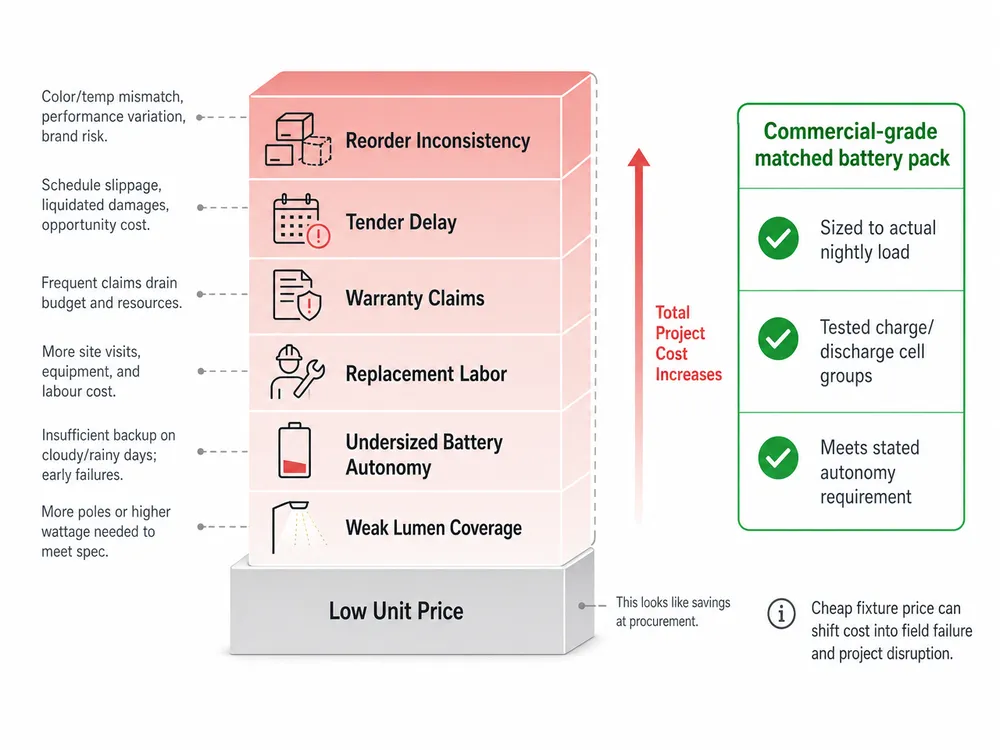
This is the hidden cost that makes a cheap residential-grade fixture expensive in a commercial setting. The unit price looks attractive. The battery failure shows up 8–14 months later, after the rainy season has run the pack down to a state it can't recover from. By then, you are paying for site visits, replacement units, and the labor to swap fixtures on poles — costs that were never in the original project budget.
Commercial battery autonomy sizing starts with a calculation, not a product listing. The inputs are: nightly load (wattage × operating hours, adjusted for dimming schedule), local peak sun hours for the installation latitude, rainy-season duration and typical consecutive cloudy days, and the target autonomy days the project requires. A project in Southeast Asia with a 15-day rainy season needs a meaningfully larger battery pack than the same fixture installed in the Middle East with 340 sunny days per year. Residential runtime claims are almost never calculated this way — they are typically based on low-mode operation under ideal conditions, which tells you nothing about how the fixture performs during a week of overcast weather.
The commercial risk runs in both directions. Undersized battery saves unit cost but creates field failure, warranty replacements, and project complaints. Oversized battery without calculation wastes margin and adds freight cost and housing weight without improving performance. The right answer is a battery pack sized to the actual load profile, not a round number chosen to look impressive on a spec sheet.
At JXSOL, battery matching is a production step, not an afterthought. We test charge/discharge cycles on matched cell groups before assembly, and we size the pack to the fixture's actual nightly load and the buyer's stated autonomy requirement. When a buyer tells us they need 3 autonomous days for a project in northern Europe, we calculate backward from that requirement — not forward from whatever cell inventory is cheapest that week. The full methodology is covered in our solar street light battery spec guide.
The IP rating solar street light commercial grade question connects here too. A battery pack that is properly sized but housed in a fixture with inadequate waterproofing will still fail — water ingress into the battery compartment is one of the most common causes of premature capacity loss. IP65 is the minimum for outdoor commercial use; IP67 is worth specifying for installations in flood-prone areas or where the fixture is mounted at low heights with standing water risk.

Ratings and Documents Decide Municipal Acceptance
A waterproof claim on a product listing is not the same as an IP65 rating backed by test documentation. For a solar street light for municipality, contractor, or infrastructure project, the difference between those two things can be the difference between a project that clears tender review and one that gets held at the import stage.
Here is what the ratings and documents actually mean in procurement terms:
IP65/IP67 — Ingress protection against dust and water. IP65 means the fixture is dust-tight and protected against water jets from any direction. IP67 adds submersion protection to 1 meter for 30 minutes. For public road and commercial site installations, IP65 is the baseline. IP67 is worth specifying for low-mounting or flood-risk locations. The rating needs to be backed by a test report, not just printed on the carton.
IK rating — Impact protection. IK08 means the fixture housing withstands 5 joules of impact; IK10 means 20 joules. For public-exposure sites — municipal roads, transit areas, commercial campuses with vehicle movement — an IK rating matters because vandalism and accidental impact are real failure modes. Residential fixtures are often not IK-rated at all, which is fine for a private garden but not for a public street pole.
CE and RoHS — Required for export to European markets and increasingly expected in other regulated markets. CE covers electromagnetic compatibility and low-voltage safety. RoHS restricts hazardous substances. Both require documentation that can be submitted with a tender package or import declaration. A supplier who cannot produce CE test reports on request is not a compliant source for European project procurement.
IEC 62124 — The international standard for stand-alone solar lighting systems. It covers system performance, battery sizing methodology, and field verification. For municipal and infrastructure buyers, IEC 62124 compliance documentation is increasingly part of the project specification — it is the standard that separates engineered solar lighting systems from assembled products with unverified runtime claims.
Batch traceability — For project orders, you need to be able to trace a warranty claim back to a production batch. That means lot numbers, test records, and inspection reports that travel with the shipment. Residential-grade supply chains rarely maintain this level of documentation because their buyers don't require it.
JXSOL holds ISO 9001:2015, CE, RoHS, IP65/IP67, and IEC 62124 certifications, and we can provide order-level documentation packages for project procurement. (We've had buyers come to us specifically because their previous supplier couldn't produce the IEC 62124 paperwork their municipal client required — that's a project delay that costs more than the price difference between suppliers.)
Factory Controls Behind Commercial-Grade Batch Consistency
Commercial grade is not a label you print on a carton. It is the output of a production system that controls the variables that matter — lumen output, battery capacity, waterproof integrity, and controller behavior — consistently across every unit in a batch and every batch in a reorder program.
We have been building solar-powered outdoor lighting since 2012. The factory is 12,000 square meters in Guzhen Town, Zhongshan — the center of China's lighting manufacturing industry — with 6 production lines and annual capacity of 1,200,000 units. That scale matters not because of the number itself, but because it means we run the same production controls on a 200-unit project order that we run on a 50,000-unit distributor program. The QC infrastructure doesn't change based on order size.
Here is what commercial-grade batch consistency actually requires at the production level:
LED module assembly and lumen binning — We sort LED chips by lumen output and color temperature before assembly, so the fixture you receive matches the spec sheet and the fixtures in your next reorder match the fixtures in your first order. Mixed-source assembly skips this step, which is why batch-to-batch lumen variation is one of the most common complaints in solar street light procurement.
Battery pack matching and charge/discharge testing — Cell groups are matched by capacity and internal resistance before assembly into packs. Every pack goes through a charge/discharge cycle test before it goes into a fixture. This is the step that catches weak cells before they become field failures. We switched to automated cell matching in 2021 after seeing too many early-life capacity drops traced back to unmatched cell groups in manually assembled packs.
Automated SMT production lines — Our 15+ optical and electrical engineers run automated surface-mount technology lines for the control board assembly. Manual soldering introduces joint variability that shows up as controller failures in the field — automated SMT eliminates that failure mode.
Aging tests and waterproof structure inspection — Assembled fixtures run through an aging test before final inspection. Waterproof integrity is checked on every unit, not sampled. A fixture that passes a visual check but has a compromised seal will fail in the field within one rainy season.
100% pre-shipment inspection — Every unit in every outgoing order is inspected before it ships. Not sampled — every unit. For project buyers, this means the inspection record travels with the shipment and is available for your incoming QC review.
MOQ starts at 100 units for standard models, which means you can validate a commercial spec on a real project quantity before committing to a full program. OEM customization — autonomy days, color temperature, wattage, pole mount configuration, packaging, and labeling — is available with engineering review before production lock-in.
Market Segment Winner Map for Project and Distribution Decisions
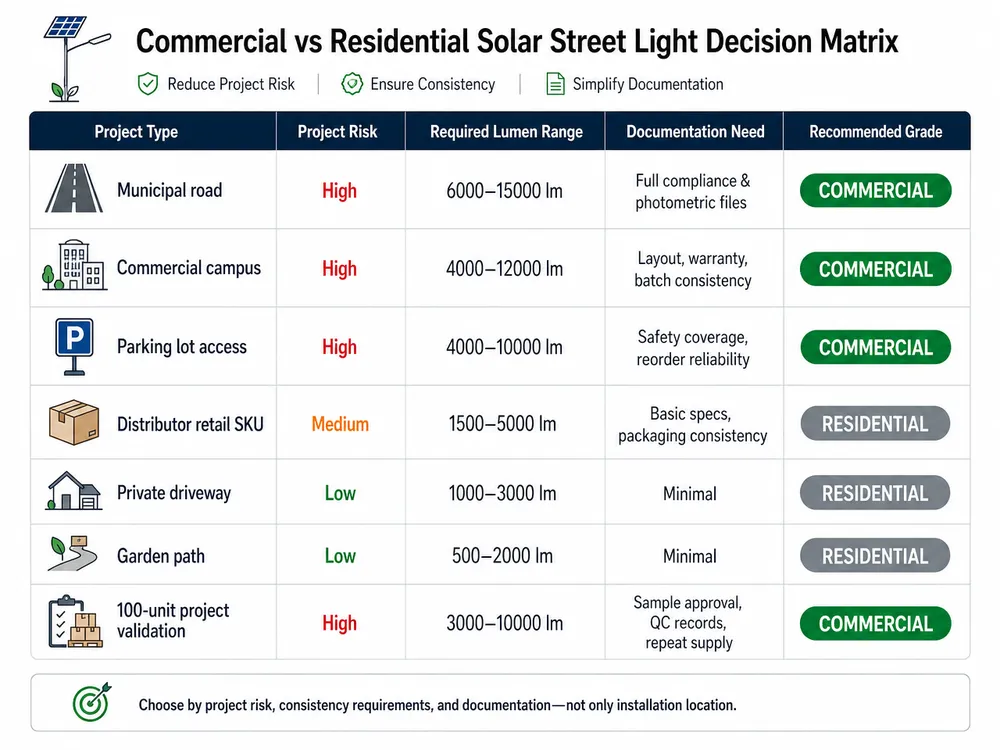
The right grade depends on what the project requires, not on what the supplier calls the product. Here is the decision by segment:
| Scenario | Recommended Grade | Spec Trigger | Commercial Reason |
|---|---|---|---|
| Municipal road or public street | Commercial | 8,000+ lm, IP65/IP67, CE/IEC 62124 docs, 3+ autonomy days | Lumen coverage, pole compatibility, documentation, and acceptance support are all required |
| Industrial park, logistics road, or commercial campus | Commercial | 6,000+ lm, IP65, autonomy sizing, batch consistency | Downtime and poor coverage create safety complaints, warranty cost, and repeat-order risk |
| Parking lot access lane or private commercial entrance | Commercial (residential only for low-risk small areas) | Depends on pole count, coverage area, and operating hours | Multiple poles mean batch consistency matters; safety requirements usually push to commercial grade |
| Distributor retail SKU line for homeowners | Residential | 800–4,000 lm, retail price point, single-unit packaging | Lower lumen and lower unit cost fit retail margin when documentation and project uptime are not the buyer expectation |
| 100-unit project validation order | Commercial with locked spec | Full spec documentation, autonomy calculation, CE/IEC 62124 | MOQ from 100 units lets buyers validate project-grade performance before scaling to full program |
| Garden path, yard, or decorative private property | Residential | 800–2,500 lm, aesthetic design, low-mode runtime | Lower output is acceptable where failure cost and coverage requirements are limited |
The solar street light spec for parking lot vs driveway question comes up often. The short answer: a parking lot with repeated poles and safety requirements is a commercial project. A private driveway with one or two fixtures is a residential application. The line is not about the physical space — it is about whether the project depends on consistent coverage, documentation, and reorder reliability.
For buyers building a distribution catalog, the two grades serve different channels and should be sourced and positioned separately. Mixing them under the same SKU program creates warranty exposure when a residential-grade fixture ends up in a commercial installation through a downstream customer.
Browse the full Solar Street & Roadway Lights Manufacturer category to see how commercial-grade specifications map to specific product configurations.
RFQ Spec Lines That Stop Residential-Grade Substitution
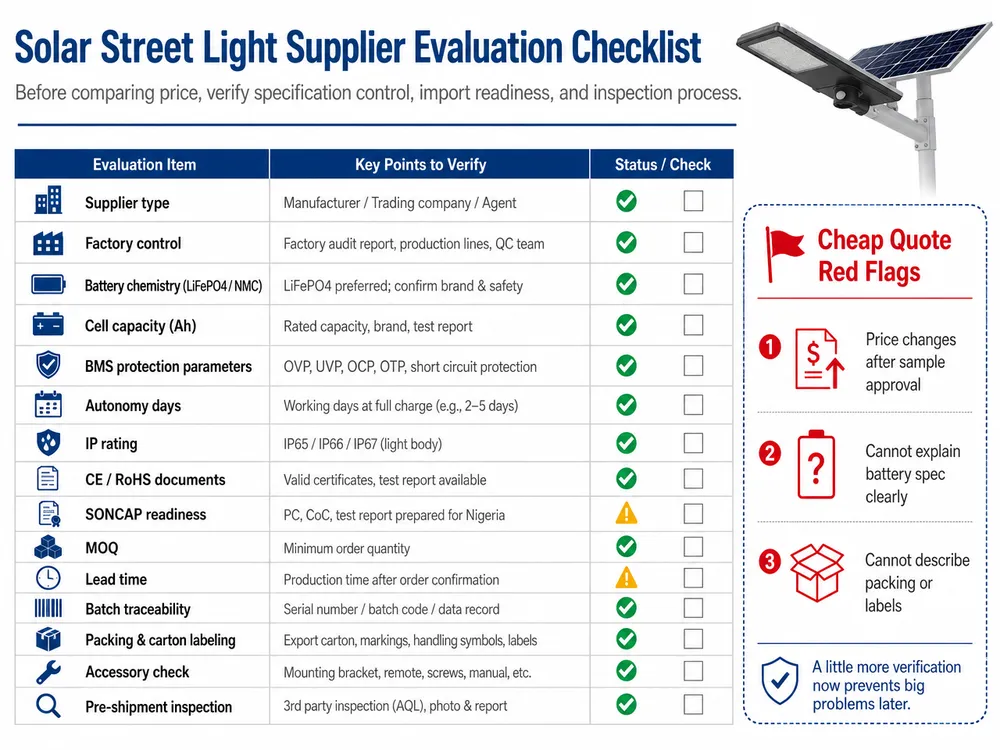
The most reliable way to prevent a residential-grade fixture from appearing in a commercial project quote is to make the spec explicit enough that a substitution is visible before you sign the purchase order. Vague RFQ language — "solar street light, 100W, IP65" — leaves room for a supplier to quote a residential-grade product at a commercial-grade price. Specific RFQ language closes that gap.
Here are the fields that should be locked in every commercial solar street light RFQ:
- LED wattage and tested lumen output — both numbers, not just wattage. Ask for the lumen figure from a third-party test report, not the supplier's spec sheet.
- Battery chemistry, Wh capacity, and autonomy target — state the required autonomy days and the dimming schedule used for the calculation. A supplier who cannot show the calculation is guessing.
- Solar panel wattage and charging assumptions — confirm the panel is sized to recover the nightly discharge within the local peak sun hours for your installation latitude.
- Pole height, arm, bracket, and mounting method — confirm compatibility before production, not after delivery.
- IP rating and IK rating — require test documentation, not just a printed claim. For public-exposure sites, specify IK08 minimum.
- CE, RoHS, IEC 62124, and IP documentation — ask whether these are available as order-level documents for your project file. A supplier who hedges on this question is not a compliant source for regulated markets.
- Aging test, battery matching, lumen binning, and outgoing inspection records — ask what QC steps are performed and whether records are available per shipment.
- MOQ, packaging, label, and OEM/ODM requirements — confirm these match your program before the quote is finalized.
A supplier quote that is significantly below project-grade pricing almost always means one of these spec lines has been quietly downgraded — smaller battery, lower-grade cells, no lumen binning, or no documentation. The price gap is real, but it is not a sourcing advantage. It is a cost that moves into your warranty budget and your project timeline.
JXSOL's OEM customization scope covers autonomy days, CCT, wattage, pole mount configuration, packaging, and labeling — all locked before production with an engineering review. If your project has specific inputs, submit them through our Request Quote page with your road classification, required lumen output, pole height, and target order volume.
FAQ: Commercial vs Residential Solar Street Light Selection
What wattage separates commercial solar street lights from residential models?
The practical planning threshold is 60W as the lower bound for commercial-grade fixtures. Commercial solar street lights typically run 60W–200W depending on road class, pole spacing, and lumen requirement. Residential models are generally 10W–40W, sized for driveways, yards, and garden paths where coverage geometry is forgiving. Wattage alone is not the full answer — a high wattage solar street light still needs confirmed lumen output and matched optics to deliver the coverage a commercial project requires. A 100W fixture with poor LED binning can underperform a well-engineered 80W unit on the road surface.
How many lumens do commercial solar street lights need compared with residential lights?
For a solar street light lumen output comparison: commercial-grade fixtures for road, campus, parking, and industrial applications typically deliver 6,000–20,000 lm depending on mounting height and pole spacing. Residential models are generally 800–4,000 lm, which is sufficient for a driveway or private yard but not for a repeated road layout where coverage uniformity across multiple poles is the acceptance standard. The lumen figure should come from a tested output measurement, not from the LED chip's rated input power.
Can residential solar street lights be used for a municipality?
Not reliably. A solar street light for municipality needs to meet lumen coverage standards for the road class, carry CE and IEC 62124 documentation for tender review, be sized for the local rainy-season autonomy requirement, and maintain batch consistency across the full installation. Residential models are not engineered or documented to those standards. Using them in a municipal project creates acceptance risk, warranty exposure, and documentation gaps that can delay project completion or trigger replacement costs within the first year.
What IP rating should a commercial-grade solar street light have?
IP65 is the minimum for outdoor commercial and public-site installations — it provides dust-tight protection and resistance to water jets from any direction. IP67 is worth specifying for low-mounting heights or flood-risk locations, as it adds submersion protection. The IP rating solar street light commercial grade requirement also extends to the battery compartment specifically — a fixture with an IP65 housing but a poorly sealed battery access panel will still fail from water ingress. Always ask for the test report, not just the printed rating.
Why do commercial solar street lights need larger batteries than residential models?
Because the load is larger and the autonomy requirement is real. A commercial fixture running at 80W–120W for 10–12 hours per night with a 3-day autonomy requirement needs a battery pack sized to that calculation — typically 400–800 Wh or more depending on the dimming schedule and local solar resource. Residential models are sized for a smaller load and shorter runtime, often under low-mode conditions that don't reflect actual project operating hours. The commercial solar street light battery autonomy days requirement is a calculated spec, not a product feature — and a supplier who cannot show the calculation is not sizing the battery correctly.