

OEM & ODM Solar Lighting Manufacturing Services
In-house OEM and ODM solar lighting manufacturing — from engineering review to bulk delivery.
6 production lines, 15+ optical and electrical engineers, and 100% pre-shipment inspection. Standard models from 100 units. Custom specifications reviewed before sampling begins.
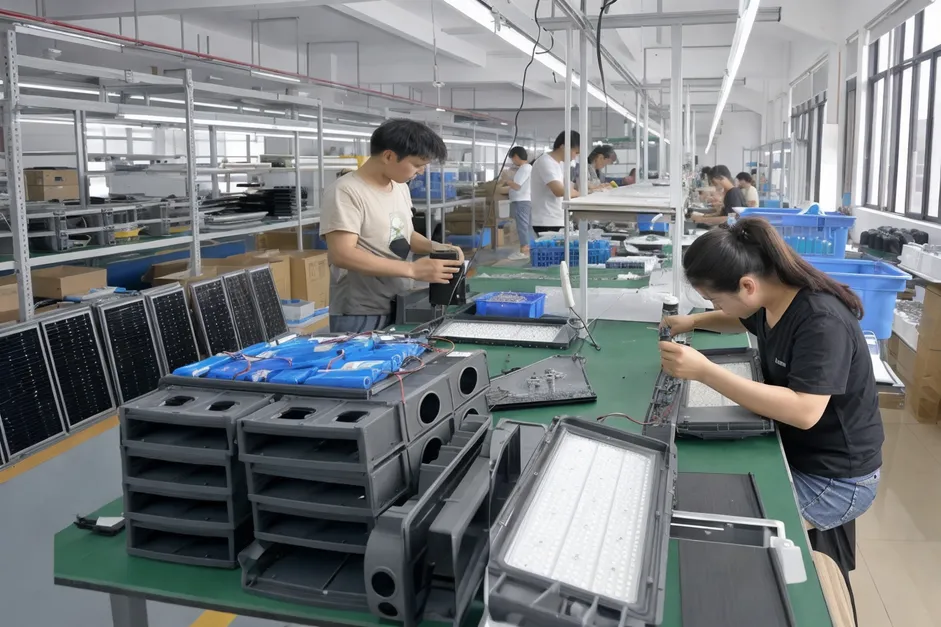
OEM ODM Solar Lighting Built Around Repeatable Factory Programs
JXSOL is the export brand of Zhongshan Century Juxing Optoelectronics Technology Co., Ltd., a solar lighting manufacturer in Guzhen Town, Zhongshan, Guangdong. We've been making solar-powered outdoor lighting for export since 2012 — street and roadway fixtures, parking lot and area lights, flood and security lights, garden and landscape products, pathway and bollard lights, wall lights, and smart solar systems. Solar fans and solar battery/portable power are handled as selected adjacent product lines for buyers who want to extend a solar-powered catalog.
OEM and ODM solar lighting is a core part of what we do, not a side service. The factory that builds your private-label SKU is the same factory that runs the standard catalog: 12,000 m², 6 production lines, 150 employees, 1,200,000-unit annual capacity. Engineering, SMT production, LED module assembly, battery matching, and final QC all happen under one roof. When you reorder, the spec is locked, the production record exists, and the same line runs your batch.
We supply distributors building a branded solar lighting range, project contractors who need custom autonomy specs for a specific region, and brand owners expanding into solar outdoor lighting without starting from scratch. If you need a factory you can reorder from — not a sourcing agent assembling orders from three different suppliers — that's the service we're describing here. For more on our solar lighting factory background, the About page covers production capacity, engineering team, and quality system in full.
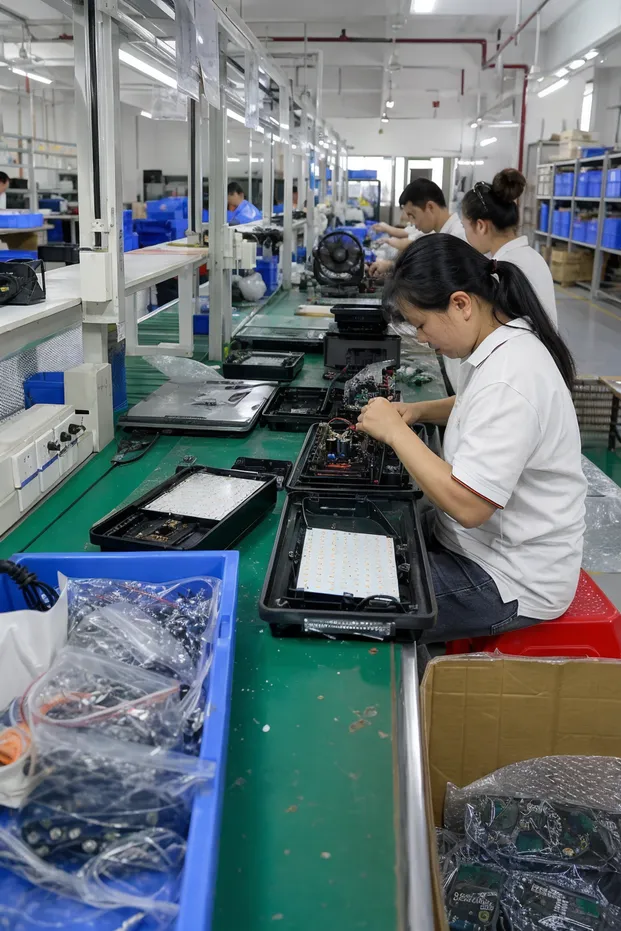
12,000 m² Facility
Single-site manufacturing with engineering, SMT, assembly, and QC under one roof.
6 Production Lines
Dedicated lines for different product families. Your batch runs on the same line every reorder.
150 Employees
Including 15+ optical and electrical engineers for specification review and product development.
1.2M Annual Capacity
Volume capacity to support scaling from trial orders to ongoing reorder programs.
OEM or ODM: Choose the Model That Fits Your Sales Channel
The distinction matters before you send a requirement sheet, because it affects how much engineering time your project needs, how quickly samples can be produced, and what your MOQ looks like.
OEM Solar Lights
OEM means you own the specification. You bring the design direction, the target performance parameters, the branding requirements, and any benchmark product you want us to match or improve on. We build to your confirmed spec after engineering review.
OEM suits buyers with a defined project requirement, an existing private-label range they're extending, or a specific product benchmark they're sourcing against.
The tradeoff: more control over the final product, but more confirmation steps before production begins.
ODM Solar Lighting
ODM means you start from our existing solar lighting platforms. You select the product family, adjust the technical parameters within the platform's design range, apply your branding and packaging, and go to market faster.
ODM suits buyers who want a solar lighting lineup without the design overhead — you're not starting from a blank spec, you're adapting a proven product.
The tradeoff: faster launch, but the product stays closer to our existing platforms.
| OEM Solar Lights | ODM Solar Lighting | |
|---|---|---|
| Starting point | Your spec / design brief | JXSOL's existing product platforms |
| Engineering input | Full review required | Adjustment within platform range |
| Time to sample | Longer — depends on spec complexity | Shorter — platform already validated |
| MOQ | Higher for significant spec changes | Lower — closer to standard catalog MOQ |
| Best for | Defined project specs, private-label with unique requirements | Faster market entry, catalog expansion, distributor private-label |
Which route should you start with?
Most buyers who are new to solar lighting sourcing start with ODM — it's lower risk and faster to validate with their customers. Buyers with an established product line or a specific project requirement typically move to OEM once they know what they need.
We've had buyers start ODM for a trial order and shift to OEM on the second program once they understood the spec they actually wanted. Both routes work — the question is where you are in your product development cycle.
Customization Boundaries That Matter Before You Request a Quote
Vague "full customization available" claims don't help you plan a sourcing program. Here's what we can actually adjust, what requires engineering review, and what affects your MOQ or lead time.
Technical Customization
| Customization Area | What Can Be Adjusted | Confirmation Required |
|---|---|---|
| Lumen output | Within the LED module's design range — no housing change required | Confirm target lumen and beam angle |
| Color temperature | Warm white (2700–3000K) through daylight (5000–6500K) | Confirm CCT for your market |
| Battery capacity | Cell count and configuration for target autonomy days | Confirm target region, irradiance season, and autonomy requirement |
| Solar panel sizing | Panel wattage matched to battery capacity and target latitude | Confirm installation region and seasonal charging conditions |
| Sensor & control logic | PIR sensitivity, dimming levels, timing modes, motion-triggered output | Confirm required lighting modes and trigger logic |
| Housing layout | Mounting bracket adjustments, pole diameter compatibility, tilt angle | Confirm installation environment and mounting spec |
| Waterproof structure | IP65 or IP67 confirmed on standard housings; modified housings require structure review | Confirm if housing changes are involved |
Parking Lot & Area Lights
Battery capacity, panel sizing, lumen output, and mounting configuration are the most common adjustment points.
View categoryFlood & Security Lights
Sensor logic, beam angle, and packaging for retail or project delivery are the typical customization requests.
View categorySmart Solar Lighting Systems
Control logic, IoT module integration, and system-level configuration require deeper engineering review before we can confirm feasibility.
View categoryWhat Requires Engineering Review Before Quoting
- New housing molds
- New PCB layouts
- Uncommon battery chemistries
- Any change that affects CE or IEC 62124 certification scope
We won't promise "any customization" — that's not how solar lighting engineering works, and it's not how we protect your project from spec mismatches.
Commercial Customization
Branding
Logo labels, nameplates, color boxes
Packaging
Master cartons, retail-ready, project delivery format
Documentation
Installation manuals, spec sheets, compliance statements
Channel Formats
Wholesale carton, distributor labeling, accessory packs
Market-Specific
Language, region compliance, installation guides
Engineering Review Before Sampling Prevents Costly Spec Mismatches
Our in-house R&D team includes 15+ optical and electrical engineers who work on standard product development and OEM/ODM project support. Before we produce a sample for a custom solar lighting project, the engineering team reviews the full configuration.
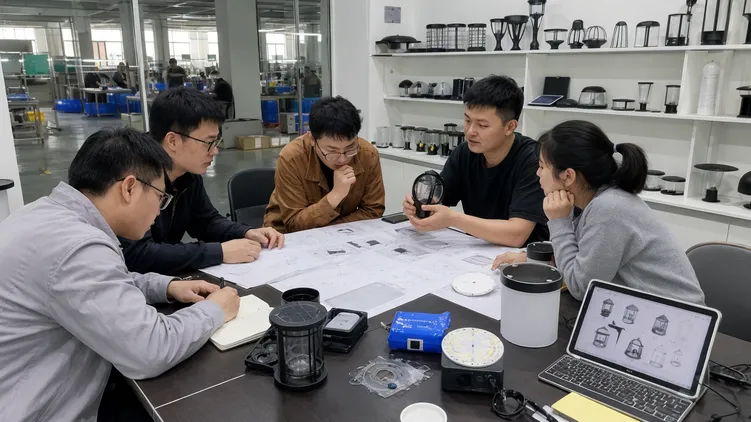
A spec mismatch caught at the review stage costs a few days; the same mismatch caught after sampling costs weeks and a sample fee.
What the Engineering Review Covers
LED Module Selection & Thermal Behavior
A module that hits target lumen output at 25°C may not hold it at 55°C in a Middle East installation. We verify thermal performance against your deployment environment.
Battery Capacity & Charge/Discharge Expectations
A 3-day autonomy spec in Northern Europe requires a different battery-to-panel ratio than the same spec in Southeast Asia. We check against your target region's irradiance data.
Solar Panel Sizing vs. Seasonal Charging
We've seen buyers spec a panel that works in summer and fails in winter because nobody checked the December irradiance numbers for their installation latitude. We verify year-round viability.
Controller, Sensor Logic & Lighting Modes
PIR sensitivity, dimming schedules, and motion-triggered output are validated against the lighting modes you actually need in the field.
Housing, Waterproof Structure & Packaging
Physical changes to housing or IP structure are reviewed for certification impact. Packaging and accessory requirements are aligned to your channel.
The Output: A Confirmed Spec Sheet
The engineering review produces a confirmed spec sheet that locks the configuration before tooling or component procurement begins. That spec sheet is what your sample is built to, and it's what mass production runs against.
We've seen buyers skip the engineering review to save time and then spend three times as long resolving spec mismatches during production. The review is faster.
Learn about our in-house engineering teamSpec Sheet
Locked before tooling
Production Baseline
Same spec, every run
Collaboration Workflow From Requirement Sheet to Bulk Delivery
This is the full process — what happens at each stage, what you provide, and what we confirm. The goal is that you know exactly what collaboration looks like before you send the first message.
Requirement Discussion
We review your target product, market, and program scope.
Product type, target market/region, order volume, target specs, packaging/branding needs, benchmark product if any
Feasibility, initial configuration direction, MOQ range, cost drivers
Engineering & Quotation Review
Engineering team checks configuration against your market requirements.
Irradiance data or installation region, autonomy requirement, mounting spec, certification/documentation needs
Confirmed spec, component selection, MOQ, lead time range, quotation
Sample Production
Sample built to confirmed spec sheet.
Approval of spec sheet before sample production begins
Sample function, appearance, packaging direction, documentation
Sample Approval & Spec Lock
You test and approve the sample; spec is locked.
Sample approval sign-off
Locked spec sheet — no changes after this point without a new review
Mass Production
6 production lines run your order: SMT, LED module assembly, battery matching, final assembly.
Production schedule confirmation
In-process QC at each checkpoint
Inspection & Packing
100% pre-shipment inspection, accessory pack check, labels, cartons, batch traceability.
Packing list confirmation
Every unit, every carton, every accessory pack before container sealing
Shipment & Reorder
Container dispatched; locked spec and production record retained for repeat orders.
Shipping instructions, destination port
Reorder runs against the same locked spec — no re-engineering required
Approximate Timeline Ranges
Subject to order scope and component availability.
ODM / Private-Label
Based on existing platforms. Sample production typically 2–3 weeks after spec confirmation; mass production 20–35 days after sample approval.
OEM Custom Specifications
Sample production 3–5 weeks depending on engineering complexity; mass production 30–45 days after sample approval.
New Tooling / Component Changes
Add tooling lead time, confirmed at engineering review stage. Exact timeline depends on mold complexity and component sourcing.
Exact lead time is confirmed after the engineering review, not estimated at inquiry. If a production schedule change affects your delivery window, we communicate it before it becomes a problem at your end.
MOQ, Samples, and Scaling From Trial Order to Reorder Program
Standard catalog models start from 100 units — low enough to test a new SKU with your customers before committing to a larger program. ODM and private-label programs based on existing platforms are typically the lowest-friction starting point: the product platform is already validated, the engineering review is lighter, and the MOQ stays closer to the standard catalog floor.
MOQ Is Confirmed at Engineering Review, Not Fixed on a Website
OEM programs with custom specifications may require a higher MOQ depending on what's being changed. Component changes that require special procurement, new packaging that requires minimum print runs, or custom tooling all affect the minimum viable order quantity.
We confirm the MOQ at the engineering review stage — because a lumen adjustment within an existing module has a different MOQ floor than a new housing mold.
Scaling Logic for a Typical Solar Lighting Program
Sample Order
Confirm technical performance, packaging, and market fit before bulk production. Most buyers in this category run 2–5 units for internal testing and 10–20 units for market testing with their customers.
Trial Order
First bulk run, typically 100–500 units depending on the product category. Validates demand, confirms reorder cycle, and locks the spec for the program.
Repeat Order
Runs against the locked spec and production record. No re-engineering, no re-sampling unless you're changing the configuration.
Larger Program
Multiple solar lighting categories from one factory — street lights, flood lights, garden lights, wall lights — with consistent quality standards and a single reorder contact.
Inventory Risk Management Built Into the Scaling Path
The commercial value of this scaling path is inventory risk management: you're not committing to a 5,000-unit order on a product you haven't tested with your market. The 100-unit floor exists specifically so you can validate before you scale.
Private Label, Packaging, and Market-Specific Documentation
Commercial presentation is a separate customization layer from technical specification — and it's one that directly affects how your product sells downstream. A solar street light with the right lumen output and battery spec still needs packaging that works for your channel, documentation in the right language, and labeling that supports your after-sales process.
What We Can Configure for Your Program
Logo and Labeling
Logo labels on the product body, nameplates where the housing supports it, and custom label artwork on cartons and accessories.
Packaging Format
Color boxes for retail or distributor presentation, plain cartons for project delivery, master carton configurations for container loading efficiency.
Installation Documentation
Manuals and specification sheets in your target market language, with compliance statements aligned to your region.
Accessory Packs
Mounting hardware, remote controls, installation tools, and accessory configurations matched to your product and channel.
Batch Codes and SKU Labeling
Traceability codes on cartons and units support reorder control and after-sales handling — when a buyer's customer reports a field issue, the batch code tells you exactly which production run it came from.
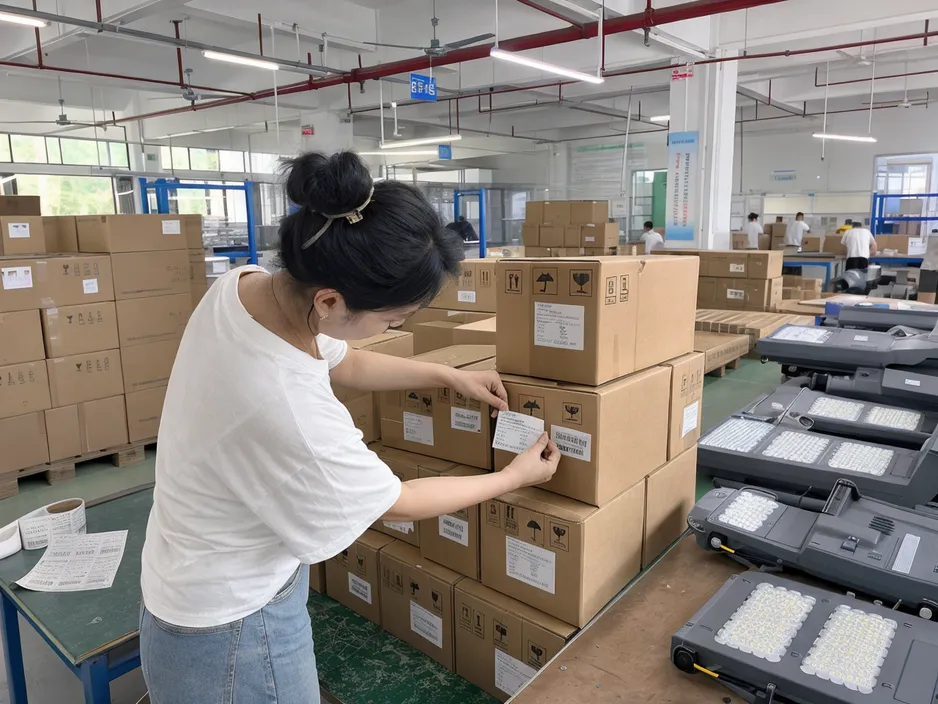
Plan Packaging Before Production
Packaging should be planned around your channel before production begins, not retrofitted after. We plan this at the sample stage so the first bulk order ships with the right presentation.
Channel-Specific Packaging Considerations
Retail / Distributor
A solar garden and landscape lighting SKU going into retail needs color box presentation with product imagery, feature callouts, and barcode placement designed for shelf display.
Project Contractor
The same product going into a project contractor's warehouse needs plain cartons optimized for stacking and container loading, with clear SKU identification on the outer case.
Branded Range Consistency
Solar wall lights for a distributor's branded range need consistent label placement and color box design across the SKU family. We coordinate this at the sample stage so every product in the range ships with unified visual identity.
IP Protection and Custom Project Confidentiality
When you share drawings, brand assets, custom specifications, or packaging artwork with a factory, you're sharing commercial assets that differentiate your product in your market. We handle those materials as project files, not as general reference.
NDA Before Engineering Review
Before detailed project files are reviewed, we sign an NDA. This applies to OEM projects where you're sharing a design brief or benchmark product, and to brand owners sharing logo files and packaging artwork for private-label programs.
The NDA covers the project scope and the materials shared — it's a standard step before engineering review begins, not something you need to request separately.
Tooling Ownership Agreement
For projects that require new tooling — custom housing molds, custom bracket tooling, custom packaging dies — mold and tooling ownership should be agreed before the project launches.
The standard position is that tooling paid for by the buyer belongs to the buyer. We retain the tooling at the factory for production use, but we don't use buyer-funded tooling for other customers' orders.
Design and Brand Confidentiality
Buyer-specific designs, private-label packaging, and custom product configurations are not published as named cases or used in marketing materials without permission.
If we describe a collaboration scenario as an example, it's anonymized and framed as a typical program type — not a named client reference.
Why This Matters Commercially
Your product differentiation stays yours. Channel conflict from a factory selling your private-label design to a competitor is a real risk in this industry, and the NDA and tooling ownership agreement are the practical mechanisms that prevent it.
Typical OEM/ODM Solar Lighting Program Scenarios
Anonymized examples of how different buyer types use our OEM and ODM service commercially — framed as typical program scenarios, not named client references.
Distributor Building a Private-Label Solar Street and Area Light Range
A distributor entering the solar outdoor lighting category wants a branded range of street lights and parking lot area lights to sell through their existing distribution network. They start with ODM — selecting from our existing solar street and roadway lighting platforms, adjusting lumen output and color temperature for their target market, and applying their brand packaging.
The first order is a trial run across 3–4 SKUs. After validating demand with their customers, they expand the range and lock a reorder program.
Commercial Output
- Faster market entry than starting from a custom design
- Consistent quality across the SKU family
- A single factory contact for reorders
Project Contractor With a Custom Autonomy and Battery Spec
A project contractor bidding on a solar street lighting installation in a region with a defined irradiance profile and a 5-day autonomy requirement needs a product configured to that spec — not a catalog product that approximates it.
They come in with the installation region, mounting height, required lumen output, and autonomy spec. Engineering review confirms the battery capacity, panel sizing, and controller logic. Sample approval locks the configuration. Mass production runs to the locked spec.
Commercial Output
- A product that meets the project specification
- Documentation to support compliance review
- A production record for warranty support
Brand Owner Extending Into Solar Outdoor Lighting
A brand owner with an existing outdoor lighting product line wants to add solar-powered versions of their flood, security, and wall light categories. They use ODM for the initial range — adapting our solar flood and security lighting platforms to their brand packaging and documentation standards — and OEM for a specific product where their existing design requires a custom housing configuration.
Commercial Output
- Consistent brand presentation across the solar range
- Faster launch than full custom development
- A factory that can handle both ODM and OEM within the same program
Smart Solar System Buyer With Integration Requirements
A buyer deploying solar lighting in a managed infrastructure project needs smart solar lighting systems with specific control logic, sensor configuration, and IoT integration requirements.
This is a deeper engineering engagement — control logic, communication protocols, and system integration are confirmed before sampling begins. The engineering review is longer, the sample approval process involves functional testing of the control system, and the MOQ reflects the component complexity.
Commercial Output
- A system that integrates with the buyer's infrastructure
- Engineering documentation to support deployment and after-sales support
Quality Gates for Custom Solar Lighting Orders
Custom specifications don't change the inspection process — they add a layer to it. The standard QC checkpoints run on every order; custom orders add confirmation that the custom parameters are hitting spec at each stage.
Incoming Inspection
Solar panels, LED modules and chips, battery cells, controllers, housings, fasteners, and packaging materials are checked against spec before they enter the production floor.
Custom Order Layer
Incoming inspection includes confirmation that custom-specified components — a specific battery capacity, a specific LED module, a custom panel wattage — match the locked spec sheet.
In-Process Inspection
SMT assembly, LED module output and color temperature, battery pack matching by capacity and internal resistance, controller and sensor function.
Custom Order Layer
Lumen output and color temperature are confirmed against the custom spec at the assembly stage — not assumed from the component spec sheet.
Reliability Checks
Aging tests, charge/discharge cycle tests, waterproof structure inspection, and lighting mode verification.
Custom Order Layer
For products with custom sensor logic or dimming modes, the lighting mode verification confirms the custom control behavior, not just the standard mode.
Outgoing Inspection
100% pre-shipment inspection — every unit, every carton, every accessory pack, every label — before the container is sealed. Batch traceability codes are applied at packing so any field issue can be traced back to the production run.
Certifications Covering Custom Orders
ISO 9001:2015
Quality Management System
CE Marking
EU Market Access
RoHS
Restricted Substance Compliance
IP65 / IP67
Ingress Protection (In-House Testing)
IEC 62124
PV Standalone System Standards
For custom configurations that involve changes to the electrical or photovoltaic system, we confirm whether the existing certification scope covers the modified configuration or whether additional testing documentation is needed.
For the complete certifications and quality standards documentation — including CE Declaration of Conformity, RoHS test reports, and IP test certificates — the Certifications page covers the full system. Custom orders ship with the same documentation package as standard catalog orders.
FAQ for OEM and ODM Solar Lighting Buyers
What is the difference between OEM and ODM solar lighting?
OEM means you own the specification — you bring the design brief, performance requirements, and branding, and we build to your confirmed spec after engineering review. ODM means you start from our existing solar lighting platforms, adjust the technical parameters within the platform's design range, and apply your branding.
OEM
- More control over the final product
- Requires more confirmation steps
- Best when you have a defined spec
ODM
- Faster to market
- Product platform already validated
- Best starting point for new buyers
Most buyers new to solar lighting sourcing start with ODM and move to OEM once they have a defined spec.
What is the MOQ for OEM solar lights?
Standard catalog models start from 100 units. ODM and private-label programs based on existing platforms stay close to that floor.
OEM programs with custom specifications — component changes, new packaging, custom tooling — may require a higher MOQ, confirmed at the engineering review stage.
Why no fixed OEM MOQ? It depends on what's being changed: a lumen adjustment within an existing module has a different MOQ floor than a new housing mold. The engineering review confirms the exact requirement based on your customization scope.
Can JXSOL adjust battery capacity and solar panel size for different markets?
Yes, and this is one of the most common customization requests we handle. Battery capacity and solar panel sizing are matched to your target region's irradiance data and your required autonomy days.
A 3-day autonomy spec in Northern Europe requires a different battery-to-panel ratio than the same spec in Southeast Asia or the Middle East. We confirm the configuration at the engineering review stage using the installation region and seasonal irradiance data you provide.
Common pitfall: We've seen buyers use a catalog spec that works in summer and fails in winter because nobody checked the December irradiance numbers. The engineering review catches this before sampling.
Can you customize lumen output and color temperature without changing the housing?
Lumen output can be adjusted within the LED module's design range without a housing change. Color temperature covers the standard range from warm white (2700–3000K) through daylight (5000–6500K). Both adjustments are confirmed at the engineering review and verified at the LED module assembly stage during production.
If your target lumen output requires a different LED module that changes the thermal load, we'll flag that at the review — it may affect the housing or heat dissipation design.
What files or information should I send for a custom solar lighting project?
The most useful starting point: target product type, installation region or market, required lumen output, autonomy requirement (days without sun), mounting height or use case, order volume, and any benchmark product you're sourcing against.
For branding and packaging, logo files and packaging artwork can come later — we don't need them for the engineering review. If you have a spec sheet or a product you want us to match, send it. If you're starting from a general requirement, describe the application and we'll recommend a configuration.
Do custom solar lights still support CE, RoHS, IP65/IP67, and IEC 62124 documentation?
Standard certifications cover our existing product platforms. For custom configurations, we confirm at the engineering review whether the modification affects the certification scope.
Lumen, color temperature, and battery/panel adjustments within the existing platform typically don't require new certification testing. Changes to the electrical system, housing structure, or photovoltaic configuration may require additional documentation. We flag this at the review stage so there are no surprises at the documentation stage.
See the full certifications and quality standards page for the complete documentation available per order.
How long does an OEM/ODM solar lighting project take from sample to bulk order?
ODM & Private-Label (Existing Platforms)
- Sample production: typically 2–3 weeks after spec confirmation
- Mass production: 20–35 days after sample approval
OEM With Custom Specifications
- Sample production: 3–5 weeks depending on engineering complexity
- Mass production: 30–45 days after sample approval
Orders involving new tooling add tooling lead time, confirmed at the engineering review. Exact lead time is confirmed after the engineering review, not estimated at inquiry.
To request a custom solar lighting quote with a timeline estimate for your specific program, send us your requirement details.
Start With a Requirement Sheet, Not a Guess
The fastest way to get an accurate configuration recommendation and quotation is to send us the information we need to review feasibility. A vague inquiry gets a vague response — a specific requirement sheet gets a specific quote.
What to Include in Your Requirement Sheet
- Target product category (street light, flood light, garden light, wall light, smart system, or mixed)
- Target market or installation region
- Required lumen output or illumination area
- Autonomy requirement (days without sun) and installation latitude if known
- Mounting height or use case
- Approximate order volume
- Packaging and branding requirements
- Certification or documentation requirements for your market
- Target shipping schedule or project timeline
Send Your Requirement Sheet
Send your requirement sheet to [email protected] or reach us directly on WhatsApp at +8613627818806. We'll review the configuration, confirm feasibility, and respond with a recommended spec, MOQ, and quotation direction.
Not Sure What Spec You Need?
Describe the application — the installation environment, the market you're selling into, and the performance outcome you need — and our engineering team will recommend a starting configuration. That's a faster path to a useful quote than guessing at specs and revising later.