

Solar Street Light
With Camera
One pole, one power system — LED street lighting and surveillance camera running from the same solar battery, sized as a single engineered package.
Designed for security-driven outdoor projects where separate grid wiring for CCTV is not practical. Camera load, battery capacity, panel wattage, and autonomy nights are calculated together — not bolted on after the fact.
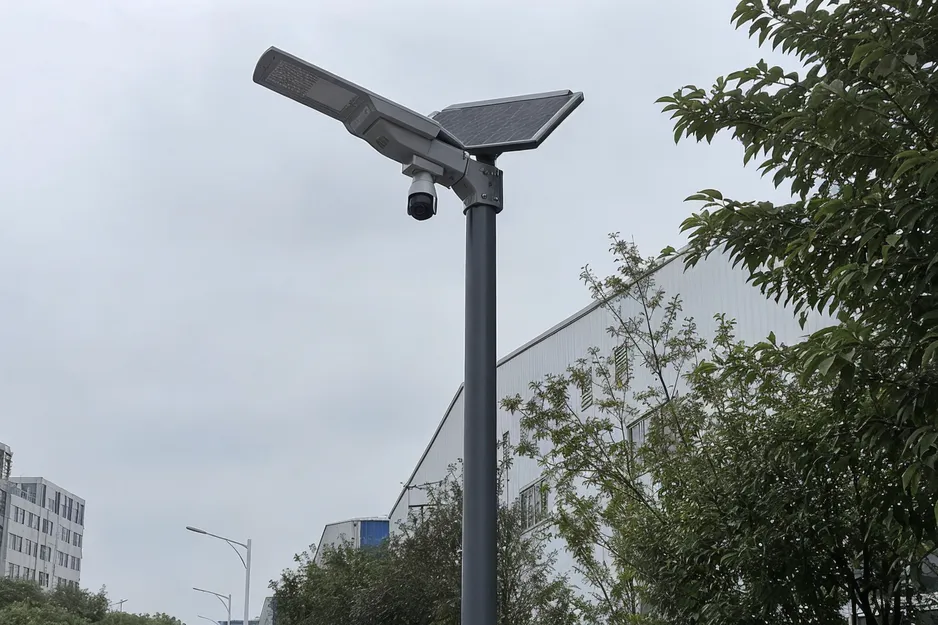
Solar Street Light With Camera for Security Projects
That Cannot Depend on Grid Power
A solar street light with camera is a project and resale SKU, not a consumer security light. The buyer's value is in the infrastructure it replaces.
The buyer's value is in the infrastructure it replaces: no grid wiring run to the pole, no separate CCTV power cable, no trenching for two independent systems, no duplicate pole installation. One installation workflow covers both lighting and surveillance. For distributors, that means a higher-value SKU than a standard solar street light. For project contractors, it means a simpler BOM and fewer subcontractors on site.
The product combines an LED street light fixture, solar panel, LiFePO4 battery pack, charge controller, and an integrated camera module — all mounted on a single pole, all powered from the same battery system. The camera runs continuously through the night alongside the LED load. That shared power budget is the engineering variable that separates a properly specified solar street light camera system from one that runs out of battery at 3 AM.
We've manufactured solar-powered outdoor lighting since 2012 at our factory in Zhongshan, Guangdong. The solar street light with camera is one of the more technically demanding products we run — the battery sizing calculation has to account for both the LED load and the camera load across the required autonomy nights, and the waterproof structure has to seal not just the fixture housing but the camera enclosure and every cable entry point. We handle all of that in-house, with 15+ optical and electrical engineers reviewing configurations before mass production and 100% pre-shipment inspection before the container closes.
Get a Quote for Solar Street Lights With Camera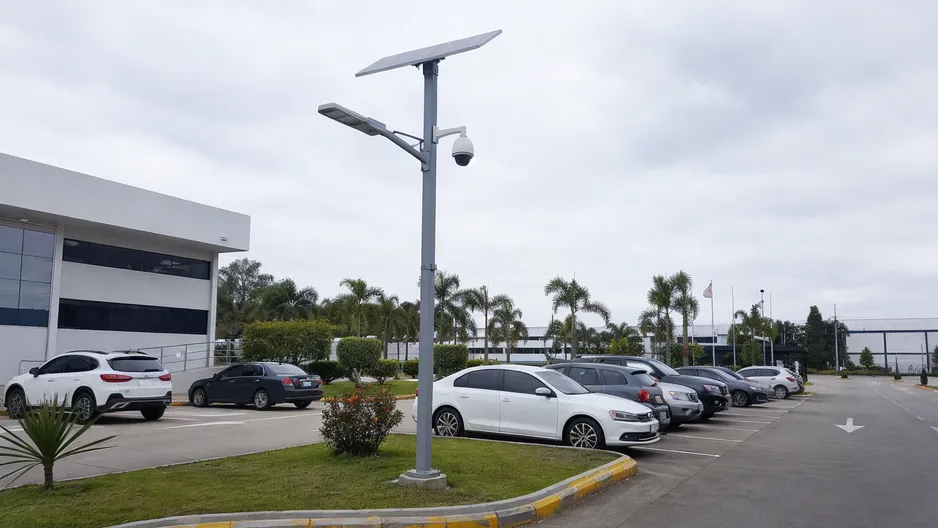
Core Deployment Segments
Each segment has a different configuration requirement — camera resolution, communication method, battery autonomy, mounting height — and we'll work through the specification with you before production starts.
The Camera Load Changes the
Whole System Specification
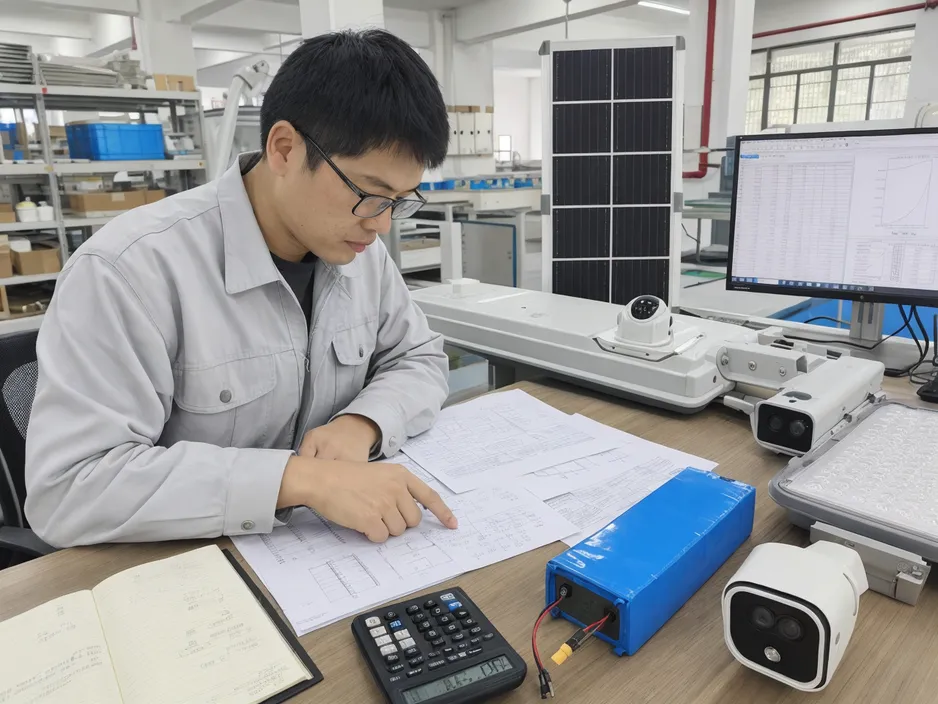
This is the point most product pages skip, and it's the one that causes the most field failures. A camera is not a passive accessory — it draws continuous power from the same battery that runs the LED fixture. If the battery was sized only for the lighting load, the camera will drain it before dawn.
Camera Power Draw by Type
| Camera Type | Continuous Draw | Notes |
|---|---|---|
| 2MP Fixed, IR Night Vision | 3–5W | Entry-level surveillance |
| 4MP Wide-Angle, Higher Resolution | 5–8W | Wider optics, more processing |
| PTZ (Pan-Tilt-Zoom, Motorized) | 10–15W | Motor draw included |
| 4G Communication Module | +1–3W | Continuous draw add-on |
| IR Illuminators (Night Vision) | +1–3W | Active when IR array on; range-dependent |
On a system running 10–12 hours per night, camera and modem load adds 40–100Wh of additional battery demand per night — before accounting for the LED fixture itself.
Combined System Sizing Formula
(LED wattage + camera wattage + comms module wattage)
× operating hours per night
× autonomy nights
÷ battery usable depth of discharge (80% for LiFePO4)
The solar panel is then sized to fully recharge that combined capacity within the available peak sun hours at the project latitude, with a margin for panel degradation over the warranty period.
A 4G modem in active data transmission draws more than in standby. For projects with continuous video streaming, the modem load is higher than for projects using local SD card storage with periodic 4G uploads. We factor the actual communication duty cycle into the battery sizing, not just the peak draw.
IR illuminatorsare active during the entire dark period, not just when motion is detected. On a 12-hour night, a 3W IR array adds 36Wh to the nightly battery demand — equivalent to running a small LED fixture for several hours. This is frequently omitted from competitor spec sheets.
- Battery sized for LED only — camera drains reserve before 3 AM
- Panel sized for low-latitude irradiance deployed at high-latitude site
- No autonomy buffer — two cloudy days cause complete system shutdown
- 4G modem continuous streaming load not included in battery calculation
- IR illuminators treated as zero-draw accessories in the spec sheet
Share your camera type, operating hours, site latitude, and autonomy requirement. We'll run the full combined load calculation and size the panel and battery correctly before quoting.
Request Load CalculationCamera Integration Architecture
How the camera connects to the pole, the battery controller, and the outside world determines the system's reliability, maintainability, and total cost. There are three primary integration architectures, each with different tradeoffs.
Camera, LED fixture, solar panel, battery, and controller are factory-assembled into a single housing. One SKU, one installation step, no field wiring between components.
- Fastest deployment — single pole mount
- No inter-component wiring errors
- Factory-tested as a complete system
- Camera upgrade requires full unit replacement
- Fixed camera angle at installation
Camera mounts separately on the pole arm or bracket, wired back to the solar controller's auxiliary output. Battery and panel are sized for the combined load at order time.
- Camera angle adjustable independently
- Camera can be upgraded without replacing lighting
- Supports PTZ and specialty camera types
- Field-serviceable camera replacement
- More installation steps than integrated unit
- Requires correct auxiliary wiring at install
Camera has its own dedicated solar panel and battery, co-located on the same pole. Lighting and surveillance systems are electrically independent — a camera fault cannot affect lighting, and vice versa.
- Full fault isolation between systems
- Each system optimized independently
- Camera can run 24/7 regardless of lighting schedule
- Higher unit cost — two complete power systems
- More complex pole mounting and cabling
We don't default to the cheapest architecture. We ask about your maintenance access, upgrade timeline, fault tolerance requirements, and budget before recommending an approach. Most commercial security deployments land on Architecture B. Critical infrastructure and 24/7 surveillance mandates typically require Architecture C.
Communication & Remote Monitoring Options
A camera that can't transmit footage is just a local recorder. The communication method determines how footage reaches your security team, how much battery it consumes, and what happens when connectivity drops.
SIM card in the camera or a dedicated modem in the controller box. Footage streams to cloud VMS or NVR over cellular. Works anywhere with mobile coverage.
Suitable for campus or compound deployments where a central Wi-Fi access point or mesh node is within range. Lower recurring cost than cellular — no SIM fees.
Low-bandwidth protocols for transmitting system health data — battery voltage, charge state, fault alerts — rather than video. Extremely low power draw; useful for remote monitoring dashboards.
Footage recorded locally to onboard SD card. No communication power draw. Periodic manual retrieval or scheduled 4G upload during off-peak hours to minimize battery impact.
Hybrid Communication Strategy
Most deployments benefit from combining methods. A common configuration: local SD card as primary storage with 4G for event-triggered uploads and real-time alerts, plus LoRaWAN for system health monitoring. This minimizes battery draw while maintaining situational awareness.
For fleet deployments of 10 or more units, we support integration with remote monitoring platforms that display per-unit battery state of charge, solar input, fault codes, and camera online/offline status on a single dashboard. Supported protocols include MQTT, Modbus, and proprietary cloud APIs depending on the controller specified.
We supply the hardware configured for the communication method you specify. SIM cards and data plans are sourced locally by the buyer — this ensures you use a carrier with coverage at your deployment site and maintain direct control of the data contract. We provide the APN configuration and modem setup documentation.
Product-Level Specification Table for Procurement Comparison
The values below are typical ranges for our solar street light with camera product line. Exact specifications depend on your project's LED wattage, camera resolution, communication requirement, target latitude, and autonomy nights. Contact us for a configuration-specific datasheet.
| Parameter | Typical Range / Standard Value |
|---|---|
| LED Power | 30W – 120W |
| Lumen Output | 3,600 lm – 15,000 lm (typical efficacy: 120–130 lm/W) |
| Color Temperature (CCT) | 3000K – 6500K (configurable before shipment) |
| LED Chip | High-efficiency SMD, lumen-binned at assembly |
| Solar Panel | 80W – 300W monocrystalline (matched to battery capacity and project latitude) |
| Battery Chemistry | LiFePO4 (standard); NMC available on lower-capacity configurations |
| Battery Capacity | 40Ah – 150Ah (sized to LED + camera combined load) |
| Autonomy Nights | 3 nights (standard); 5–7 nights (high-latitude or extended spec) |
| Camera Resolution | 2MP (standard); 4MP (available); 8MP (project-specific) |
| Camera Type | Fixed (standard); PTZ (available on request) |
| Lens Angle | 90°–120° wide-angle (standard); adjustable on PTZ models |
| Night Vision | IR illuminator, 10–20m range (standard); 30m+ available |
| Video Storage | Local microSD card (standard); 4G cloud upload (optional) |
| Communication | Standalone (no network); 4G/LTE; WiFi; NB-IoT (project-dependent) |
| Control Modes | Timer, PIR motion sensor, remote control, app/IoT (optional) |
| Dimming | Multi-stage programmable schedule, configured before shipment |
| IP Rating | IP65 (standard); IP67 (available on camera housing and select fixture models) |
| Operating Temperature | -20°C to +60°C |
| Mounting Height | 5m – 10m (standard); custom heights available |
| Pole Compatibility | Standard taper pole; side-arm bracket; custom configurations available |
| Certifications |
ISO 9001:2015
CE
RoHS
IP65/IP67
IEC 62124
|
| MOQ (Standard Models) | 100 units |
| MOQ (OEM/ODM) | 500 units (varies by customization scope) |
| Warranty | 3 years |
Specifications shown are typical values for this product line. Actual specifications depend on final configuration. Contact us for a project-specific datasheet and sizing calculation.
Camera, Communication, and Storage Options That Affect Your Tender Scope
Camera specification is where most buyers need the most guidance — and where the wrong choice creates the most downstream problems. Here's how we think through the main decisions.
2MP vs 4MP: the practical planning logic
For most parking lot, road, and perimeter applications, 2MP resolution is sufficient to identify vehicles and individuals at 8–12m range. The advantages are lower power draw (3–5W vs 5–8W), smaller file sizes for local storage, lower 4G data consumption if you're streaming or uploading, and lower unit cost.
4MP makes sense when the project requires license plate recognition, wider coverage area from a single camera, or higher-resolution footage for evidentiary purposes.
The power draw difference matters for battery sizing — on a 10-hour night, 2MP vs 4MP adds roughly 20–30Wh to the nightly battery demand. For high-latitude projects with limited winter irradiance, that difference can push you to a larger battery and panel configuration.
Lens angle and mounting height: coverage geometry
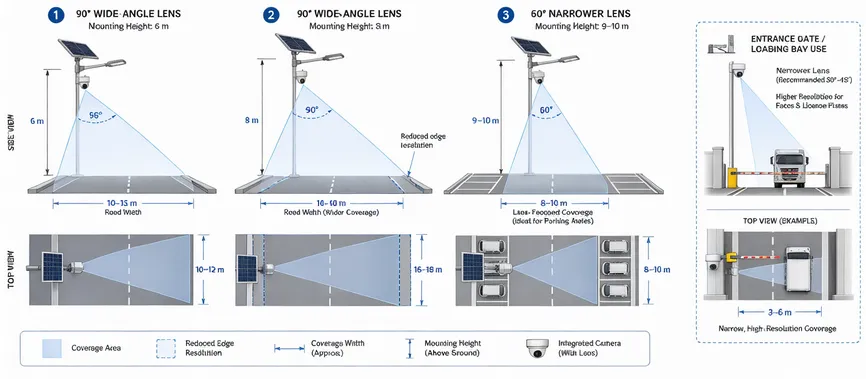
A 90° wide-angle lens at 6m mounting height covers roughly 10–12m of road width. At 8m mounting height, the same lens covers a wider ground footprint but with reduced resolution at the edges.
For parking aisles, a narrower 60° lens at higher mounting height gives better lane coverage. For entrance gates and loading bays where you need to capture faces and license plates, a narrower lens with higher resolution is the right choice.
We plan the camera angle and mounting height together — specifying a camera without knowing the mounting height gives you a number that may not match the actual coverage requirement.
Communication: 4G, WiFi, or local storage
4G / LTE
Right choice for remote sites, rural roads, and any location where a stable WiFi network doesn't exist. The 4G modem adds 1–3W continuous draw and requires a SIM card and data plan — costs that belong in your project BOM.
WiFi
Works where a reliable network is available within range — typically on campuses, commercial properties, and industrial parks with existing network infrastructure.
Local microSD
32GB–128GB standard. Works for projects where remote viewing is not required and footage is reviewed periodically on-site. For real-time alerts or remote monitoring, 4G with cloud storage is the practical choice.
Platform integration is project-specific. We support standard RTSP/ONVIF protocols for camera integration with third-party VMS platforms. For projects with specific platform requirements — a municipal management system, a security integrator's proprietary platform, or a cloud service — confirm the protocol compatibility before production. We can configure the camera firmware to match the platform's requirements, but that confirmation needs to happen at the engineering review stage, not after the units ship.
Local privacy and data regulations are your market responsibility. Camera systems are subject to surveillance and data protection laws that vary by country and application. We supply the hardware and documentation; compliance with local regulations is the buyer's obligation. We flag this not to avoid the topic but because we've seen buyers get caught by local regulations after the product was already in the field.
Installation Geometry That Protects Lighting Coverage and Video Coverage
Getting the installation geometry right before production is cheaper than fixing it after the units are in the ground. These are the variables that matter.
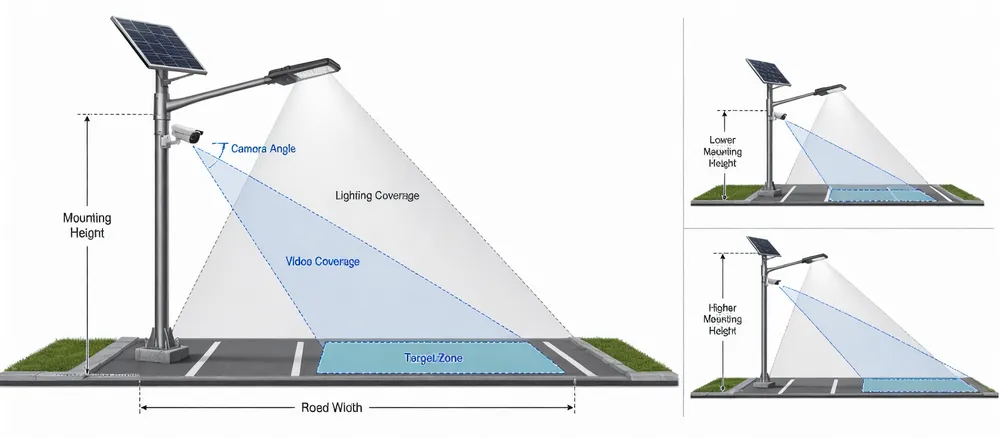
Mounting Height: The Shared Variable
Mounting height affects both the roadway illumination pattern and the camera field of view — and the two requirements don't always point to the same height. A 6m pole gives good camera coverage for a 6–8m wide road but may not meet the lux requirement for a wider road or parking area. An 8m pole improves lighting coverage but raises the camera angle, which reduces resolution at ground level.
We work through this trade-off at the configuration stage: send us the road width, target lux level, and camera coverage requirement, and we'll recommend the mounting height that balances both.
Camera Angle Planning
Camera angle should be planned for the specific target zone, not set to a generic default. For road surveillance, a slight downward tilt of 10–15° from horizontal gives the best balance of coverage distance and ground-level resolution. For entrance gates and loading bays, a steeper downward angle captures faces and license plates more reliably. For perimeter coverage, a near-horizontal angle maximizes detection range.
We configure the camera bracket angle before shipment based on your specified target zone — adjusting it in the field after installation is possible but adds contractor time.
Camera Angle by Target Zone
| Target Zone | Recommended Tilt | Primary Benefit |
|---|---|---|
| Road surveillance | 10–15° downward from horizontal | Best balance of coverage distance and ground-level resolution |
| Entrance gates & loading bays | Steeper downward angle | More reliable face and license plate capture |
| Perimeter coverage | Near-horizontal | Maximizes detection range |
Solar Panel Exposure
The solar panel must have unobstructed southern exposure (northern hemisphere) or northern exposure (southern hemisphere) for the majority of daylight hours. Shade from trees, buildings, walls, or the pole structure itself reduces charging efficiency and directly affects battery autonomy.
Real project example: A panel shaded by a nearby building for 3–4 hours per day caused the battery to run short on consecutive cloudy days — the effective charging window was shorter than the sizing calculation assumed.
If your site has potential shading sources, flag them at the inquiry stage and we'll adjust the panel wattage to compensate.
Network Signal Verification
For 4G-equipped units, verify network signal strength at the installation location before finalizing the communication module selection. In remote areas or locations with weak 4G coverage, a higher-gain antenna or a different carrier SIM may be needed.
For WiFi units, confirm the network coverage radius and signal strength at the pole location.
We can supply units with external antenna connectors for locations where the standard internal antenna is insufficient.
Cable Routing and Pole Specification
Camera cables, power cables, and communication antenna cables all need to route through the pole to the fixture and camera housing. The pole must have internal cable routing channels or conduit provisions — not all standard solar street light poles are designed for this.
We confirm pole diameter, wall thickness, cable routing path, and cable gland positions at the quote stage. Mounting brackets, base plate dimensions, and wind load rating should also be confirmed for the installation site's wind exposure category.
Geometry Variables to Confirm Before Production
These five inputs let us configure the unit correctly before shipment — avoiding field adjustments that add contractor time and cost.
Market Segments Where Camera-Equipped Solar Street Lights Protect Project Margin
The commercial logic for this product is straightforward: it replaces two separate infrastructure systems with one. The segments where that value is strongest are the ones where grid wiring for CCTV is expensive, impractical, or both.
Industrial Parks and Logistics Yards
Strongest segment — dual-budget coverage
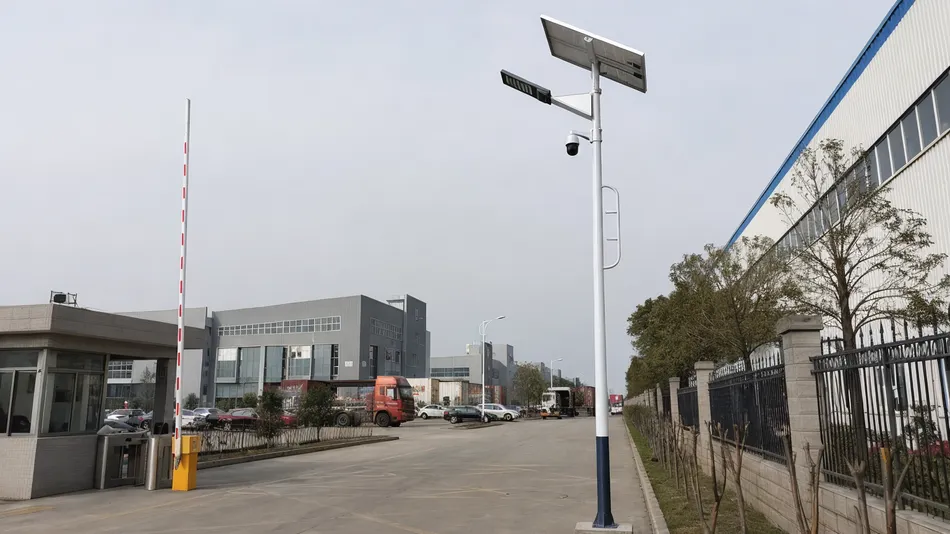
Industrial parks and logistics yards are the strongest segment for this product. The project value is higher than a standard solar street light order because you're covering both lighting and surveillance in a single line item. Camera coverage at entrances, loading bays, perimeter roads, and parking areas is a standard security requirement for industrial tenants — and the property developer or facility manager typically has budget for both lighting and CCTV as separate line items.
Combining them into one system reduces the total installation cost and the number of contractors involved, which is a selling point for both the developer and the contractor.
Typical Order Profile
Units per site
50–300
Order pattern
Repeat as park expands
Parking Lots and Commercial Properties
Strong retrofit segment — eliminates trenching cost
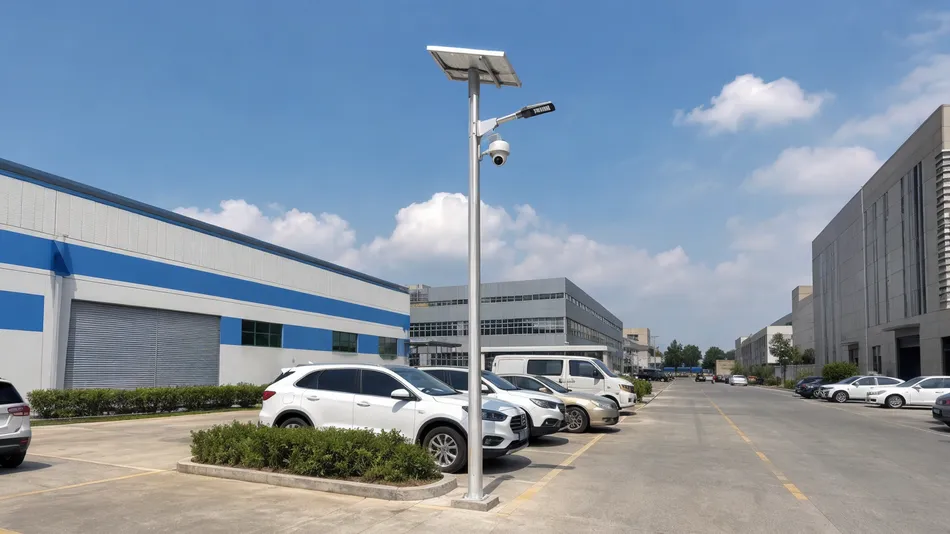
Parking lots are a strong retrofit segment. Existing parking lots often have aging grid-connected lighting that needs replacement, and running new CCTV power cabling through an existing paved surface is expensive. A solar street light camera system eliminates the trenching cost entirely — the camera runs from the same solar battery as the light, with no new electrical infrastructure required.
For distributors targeting commercial real estate developers, property management companies, or parking operators, this is a differentiated SKU that justifies a higher margin than a standard solar street light.
Typical Order Profile
Units per property
20–100
Key buyer types
CRE developers, parking operators
One System. Two Budget Lines.
In both segments, the margin advantage comes from the same source: the buyer has separate budget allocations for lighting and CCTV. A combined system captures both line items while reducing total installation cost — which means the distributor or contractor can price competitively and still hold margin.
Remote Roads and Rural Infrastructure
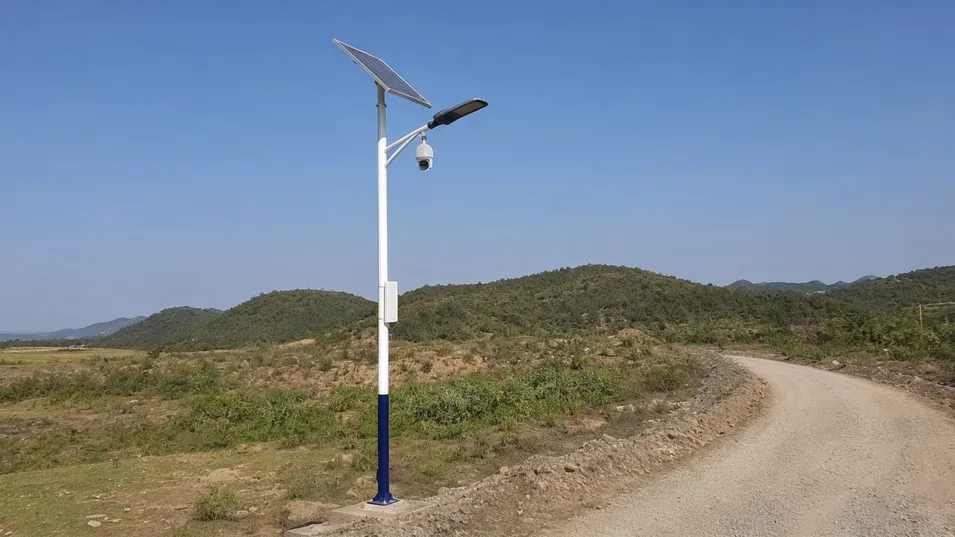
Remote roads and rural infrastructure are where the solar advantage is most commercially compelling — no grid connection means no grid extension cost, which can be the largest line item in a rural road lighting project.
Adding camera capability to remote road lighting supports road safety monitoring and incident documentation without requiring a separate CCTV infrastructure budget.
Buyer context:
For buyers supplying rural electrification programs, development-funded infrastructure projects, or government road safety initiatives, the combined lighting and surveillance capability strengthens the project proposal. IEC 62124 certification and CE documentation support procurement compliance requirements in these programs.
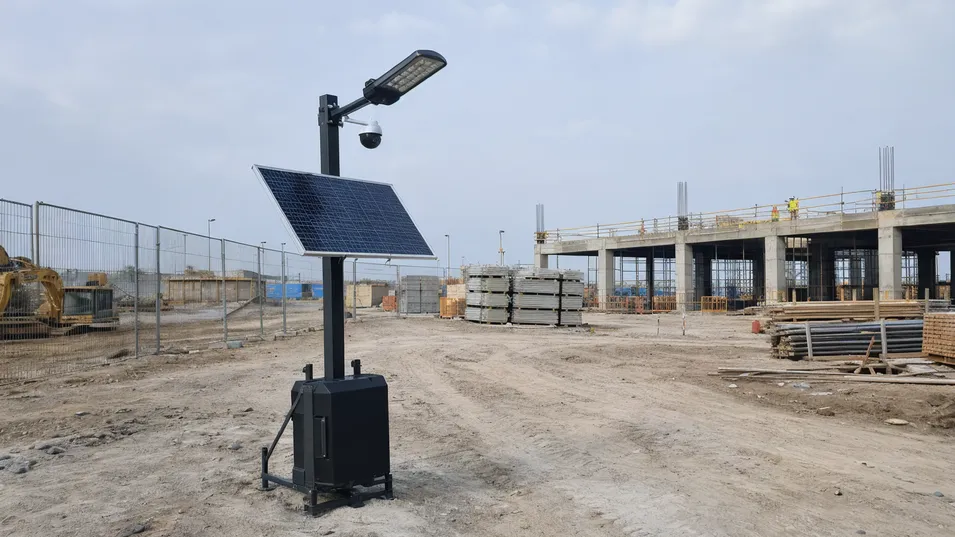
Construction Sites, Mining Sites, and Utility Substations
Temporary and semi-permanent security programs at construction sites, mining operations, and utility substations need lighting and surveillance that can be deployed quickly without grid connection and relocated as the project moves.
A solar street light with camera on a portable base or ground-mount bracket covers both requirements. The camera provides site security and incident documentation; the solar power system eliminates the need for generator power or temporary grid connection.
Distributor note:
For distributors supplying rental equipment companies or security service providers, this is a repeatable SKU with high utilization rates.
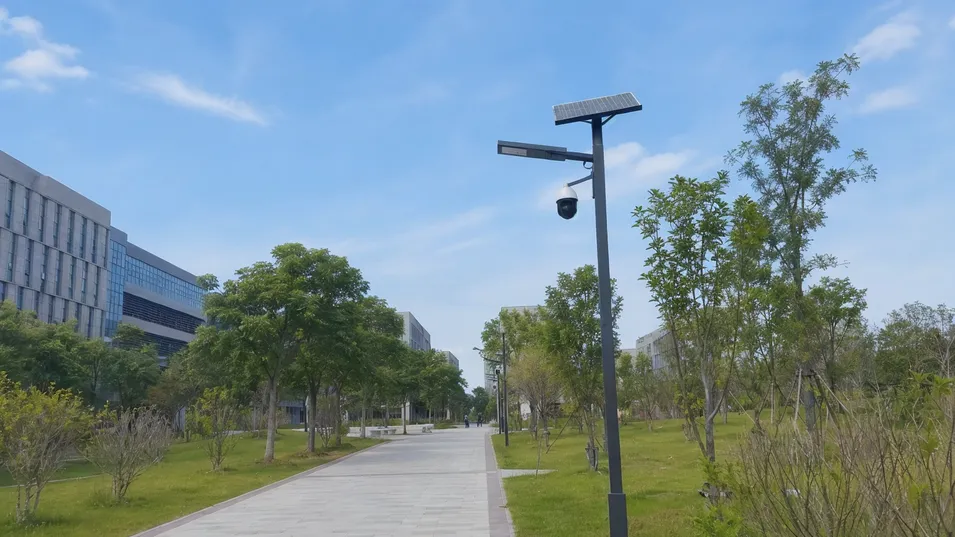
Campuses and Gated Communities
Universities, corporate campuses, hospital complexes, and gated residential communities are a strong segment for branded, visually consistent solar street light camera systems. The project typically involves a defined number of poles across a planned layout, with consistent CCT, mounting height, and camera coverage.
Repeat orders come as the campus expands or as older lighting is replaced. For distributors targeting facility management companies or campus infrastructure contractors, the OEM/ODM private-label option allows you to supply a branded product that the end customer associates with your company rather than the manufacturer.
Distributor note: Private-label supply on campus projects builds long-term brand equity with facility managers — repeat procurement cycles are predictable and margin-protective.
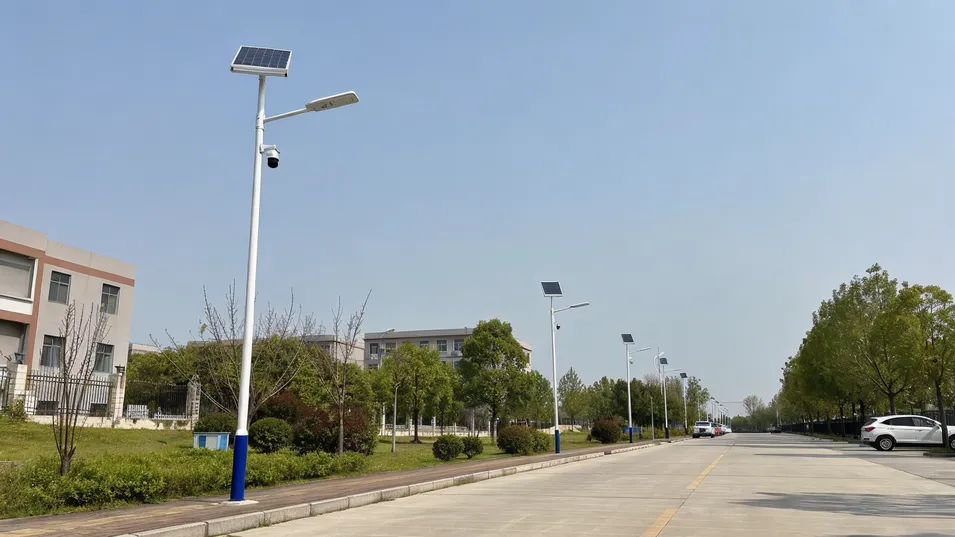
Municipal Pilot Programs
Municipal pilot programs are a growing procurement segment, particularly in Southeast Asia, the Middle East, and Africa. A municipality testing smart solar lighting with surveillance typically starts with 20–100 units on a specific road or district before committing to a wider rollout.
The documentation requirements for municipal procurement — CE declaration of conformity, RoHS compliance, IP test reports, IEC 62124 solar performance documentation — are standard in our export package. For distributors or system integrators bidding on municipal tenders, having a factory that can provide the full compliance documentation package is a bid qualification requirement, not a differentiator.
Growth trajectory: Municipalities that ran a 50-unit pilot in 2023 are now tendering 500-unit rollouts. This segment has grown significantly over the last three years.
Municipal Tender Documentation — Standard in Every Export Package
Bid qualification for municipal tenders requires a complete compliance documentation set. These are not optional add-ons — they are the baseline for entering the tender process.
Specify your target market and tender requirements
Waterproofing, Battery Matching, and Camera QC Before Shipment
Camera-equipped solar street lights fail at predictable points. We've built the factory controls around those failure points specifically.
Camera Enclosure and Cable Entry Sealing
The camera housing is a separate IP-rated enclosure integrated into the fixture assembly. The most common failure point on camera-equipped outdoor systems is not the camera itself — it's the cable entry where the camera power and data cables pass through the housing wall. A poorly seated cable gland passes a visual inspection but fails after the first heavy rain when water tracks along the cable jacket and enters through the gland thread.
We use compression-type cable glands torqued to spec, with a secondary sealant bead at the entry point. Every camera housing goes through a pressure test before final assembly — not a visual check, a pressure test.
IP67 camera housing options are available for installations in flood-prone areas or high-humidity environments where the additional submersion protection is worth the cost.
Battery Pack Matching for Combined LED and Camera Loads
Battery packs for camera-equipped units go through additional testing compared to lighting-only units because the camera creates a different discharge profile. The LED load is typically a stepped discharge — high brightness at dusk, reduced brightness after midnight, motion-triggered peaks. The camera load is continuous. That combination creates a more complex discharge curve, and mismatched cells in the pack degrade faster under this profile than under a simple lighting-only discharge.
Stepped profile — predictable peaks at dusk, reduced draw after midnight, motion spikes.
Continuous camera base load layered over stepped LED profile — more complex curve, higher cell-matching requirement.
We test every cell for capacity and internal resistance before pack assembly, match cells within ±2% internal resistance tolerance, and run finished packs through multi-cycle charge/discharge verification on our aging test racks. A pack that passes a single cycle test can still fail after 30–50 cycles if the cells were poorly matched — our aging protocol runs multiple cycles specifically to catch this.
Controller Board Assembly and Camera Communication Handshake
The controller board manages charge logic, LED dimming schedule, sensor response, and camera power management. On camera-equipped units, the controller also handles the communication handshake with the camera module and the 4G or WiFi modem.
Controller boards are assembled on automated SMT lines with AOI inspection after reflow — solder joint variation that causes intermittent failures after thermal cycling is caught at the assembly stage, not in the field.
Every controller goes through function testing that includes all three sequences before it goes into a housing.
LED Module Consistency
LED modules are lumen-binned at assembly and batch-matched so units in the same order ship from the same production run. For projects where multiple poles are installed in the same visual field, visible color variation between units is a complaint that generates warranty claims and damages your relationship with the end customer. Batch matching prevents it.
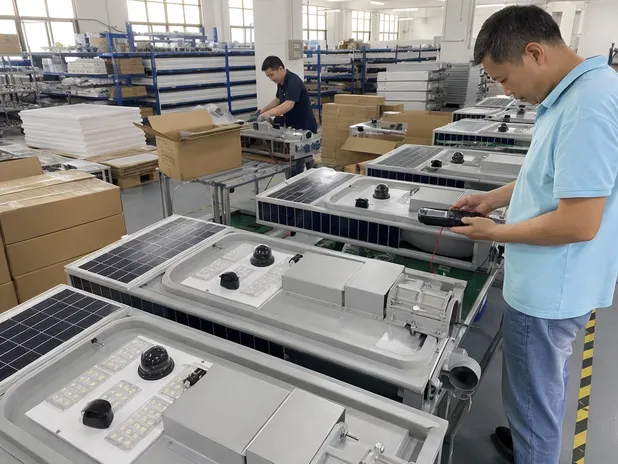
100% Pre-Shipment Inspection
Every unit is checked before the container loads. It adds time. It also means defective units don't reach your warehouse.
- Controller function and sensor response
- Dimming schedule execution
- Camera image quality and night vision activation
- Communication handshake (4G / WiFi)
- Battery charge state verification
- Waterproof structure pressure test
- Accessory count and carton labeling
- OEM firmware version and artwork verification
Factory & Certifications
All certifications available with every shipment. Zhongshan, China.
Learn more about our factory and QC processISO 9001:2015, CE, RoHS, IP65/IP67, and IEC 62124 certificates available. OEM firmware verification reports on request.
OEM/ODM Configuration for Distributors and Project Contractors
Most buyers in this category need something adjusted from the standard catalog configuration. The variables below are what we work with most often on solar street light camera system OEM/ODM orders.
| Configuration Variable | Adjustable Range | Notes |
|---|---|---|
| LED Power | 30W – 120W | Affects battery and panel sizing |
| Lumen Output | 3,600 lm – 15,000 lm | Tuned via LED module and driver current |
| Color Temperature (CCT) | 3000K – 6500K | Configured before shipment |
| Solar Panel Wattage | 80W – 300W | Matched to combined LED + camera load and project latitude |
| Battery Capacity | 40Ah – 150Ah | Sized to autonomy nights and combined load |
| Battery Chemistry | LiFePO4 (standard); NMC (lower-capacity option) | LiFePO4 recommended for camera-equipped units |
| Autonomy Nights | 3 nights (standard); up to 7 nights | Higher autonomy requires larger battery and panel |
| Camera Resolution | 2MP, 4MP, 8MP | Affects power draw and storage requirements |
| Camera Type | Fixed, PTZ | PTZ adds 10–15W load; requires larger battery |
| Lens Angle | 60°, 90°, 120° | Planned with mounting height |
| Night Vision Range | 10m, 20m, 30m+ | IR power draw included in sizing |
| Communication Module | None, 4G/LTE, WiFi, NB-IoT | Confirm local network compatibility before ordering |
| Video Storage | MicroSD (32GB–128GB), cloud via 4G | Storage capacity matched to camera resolution and retention period |
| Firmware / Dimming Schedule | Fully programmable | Configured before shipment; custom logic available |
| Pole Height | 5m – 10m standard; custom available | Confirm wind load rating for installation site |
| Housing Color | Standard silver/grey; custom RAL colors available | Custom colors on runs of 100+ units |
| Logo / Branding | Housing label, carton, manual | Private-label documentation available |
| Packaging | Standard export carton; custom carton artwork | Batch codes maintained for traceability |
MOQ and Engineering Review
Standard catalog models start at 100 units. OEM/ODM orders with custom specifications — camera resolution, battery capacity, communication module, firmware, branding — typically start at 500 units, depending on the scope of changes. Battery and panel changes must follow the combined LED + camera load calculation; we run the sizing review as part of the engineering process before production starts.
Custom Firmware and Platform Integration
Custom firmware or platform integration is confirmed before mass production — not during it. This protects your project timeline and ensures the configuration you approved is the configuration that ships.
Private-Label Support
Private-label support covers housing label, carton artwork, user manual, and CE/RoHS documentation under your brand name. We've handled private-label programs for distributors in North America, Europe, and the Middle East. The documentation workflow is straightforward once the configuration is locked.
Export Documentation, Packing, and Batch Traceability for Multi-Component Orders
A solar street light with camera ships as a multi-component system. Getting the packing right protects your margin on the receiving end.
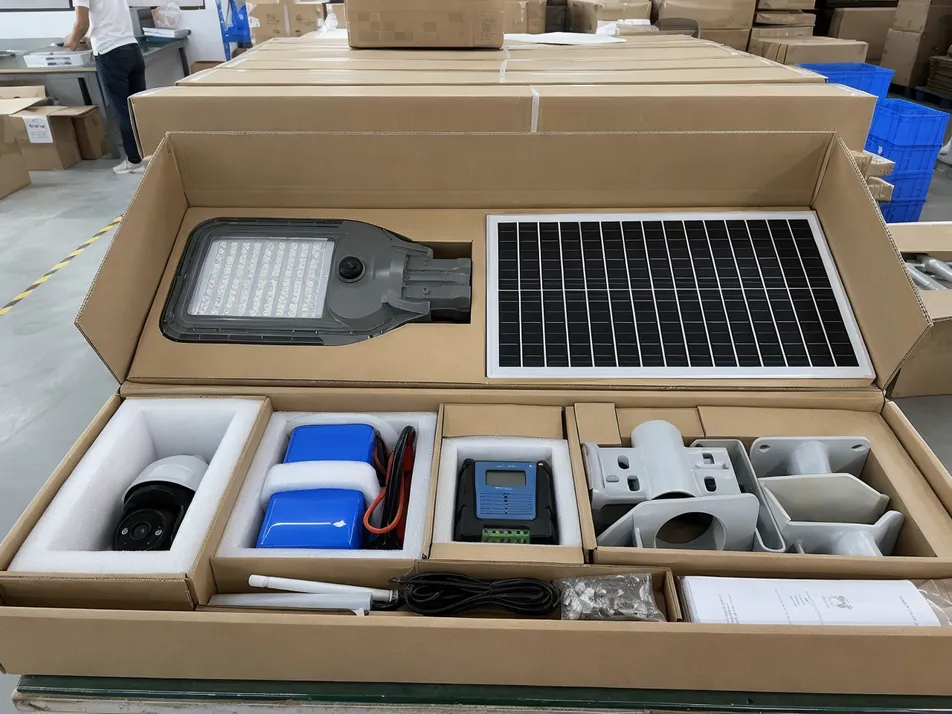
What Ships in the Carton
A standard unit ships with:
- LED fixture assembly (with integrated camera housing)
- Solar panel
- LiFePO4 battery pack
- Charge controller
- Mounting bracket set
- Pole hardware (if ordered with pole)
- Communication antenna (if 4G or WiFi equipped)
- MicroSD card (if local storage)
- Power and data cables
- Fastener pack
- Installation manual
Camera modules and electronics ship in anti-static foam-lined inner packaging within the outer carton. Battery packs ship with terminal protection and are packed to prevent short-circuit contact during transit.
Battery Shipment Documentation
LiFePO4 battery packs require UN38.3 test documentation for air freight and some sea freight shipments. We provide UN38.3 test reports on request — if your logistics route or destination market requires this documentation, flag it at the order stage so we can include it in the shipping package. For sea freight in standard containers, UN38.3 is not always required but is worth having in the documentation package for customs clearance.
Certifications Available With Every Shipment
- ISO 9001:2015 quality management certification
- CE declaration of conformity
- RoHS compliance statement
- IP65/IP67 test reports
- IEC 62124 solar simulation test documentation
For OEM orders with private-label packaging, CE and RoHS documentation can be issued under your brand name.
Batch Traceability
Every carton carries a batch code linking to the production run, component lot numbers, and inspection records. If a warranty issue surfaces in the field, you can isolate the affected production run without pulling the entire inventory. For OEM orders, the batch code is embedded in the label design so traceability is maintained without exposing the manufacturing source.
Container Loading
Carton dimensions are sized for 40HQ container loading efficiency. We plan pallet configurations to minimize wasted cubic space — on a 500-unit order, the difference between efficient and inefficient packing can be 5–8% of your landed cost per unit. Palletized delivery is available for buyers who need it.
Choose the Right Smart Solar Product Before You Quote
This product is one of four in our smart solar lighting systems category. If you're not certain this is the right product for your project, use the table below to navigate.
Match your requirement to the right product
| Your requirement | Right product |
|---|---|
| Lighting + camera surveillance from one solar power system | This page — solar street light with camera |
| Smart lighting with motion sensor, dimming schedule, IoT control — no camera | Smart solar lighting system |
| Pole-integrated design for urban infrastructure or smart-city projects | Smart solar poles |
| Centralized remote monitoring, group dimming, fault detection across multiple fixtures | Solar lighting control system |
Camera units + centralized monitoring
If your project needs both camera surveillance and centralized remote monitoring across a large installation, the solar street light with camera can be paired with the solar lighting control system. The camera-equipped units communicate via 4G or NB-IoT to the same management platform as the standard smart lighting units.
Perimeter flood lighting instead?
If your primary requirement is perimeter flood lighting rather than street-light form factor, see our solar flood and security lighting category for security-focused flood light options.
Questions Buyers Ask Before Ordering Solar Street Lights With Camera
These are the specification and sizing questions that come up most often during procurement. Each answer includes the technical reasoning so your team can apply the logic to your own project parameters.
How long can a solar street light with camera run at night?
Runtime depends on battery capacity, combined LED and camera load, and the number of consecutive cloudy days (autonomy nights) the system is sized for. A typical configuration — 60W LED, 2MP camera with IR, 4G modem, 3 autonomy nights, tropical latitude — requires roughly 80–100Ah LiFePO4 battery capacity and a 150–180W solar panel. At that sizing, the system runs 10–12 hours per night through 3 consecutive cloudy days without solar recharge.
Reference Sizing: Tropical Latitude, 3 Autonomy Nights
For high-latitude markets or extended autonomy requirements, battery capacity and panel wattage scale up accordingly.
Send us your project location, operating hours, and camera specification and we'll run the exact sizing calculation.
Can one battery support both the LED light and the camera?
Yes — that's the design intent of this product. The battery is sized to cover the combined LED load and camera load across the required autonomy nights. The key is that the sizing calculation must include the camera power draw from the start, not as an add-on to an existing solar street light spec.
Camera Power Draw Reference
We include all of those loads in the battery and panel sizing calculation for every configuration we quote.
Is 2MP or 4MP better for a solar street light camera system?
For most road, parking, and perimeter applications, 2MP is sufficient to identify vehicles and individuals at 8–12m range and is the more power-efficient choice. 4MP makes sense when the project requires license plate recognition, wider coverage from a single camera, or higher-resolution footage for evidentiary or compliance purposes.
2MP Fixed Camera
- Identifies vehicles and individuals at 8–12m range
- More power-efficient — lower battery and panel requirement
- Right starting SKU for most road, parking, and perimeter markets
3–5W continuous
4MP Camera
- License plate recognition capability
- Wider coverage from a single camera unit
- Higher-resolution footage for evidentiary or compliance use
5–8W continuous
Power draw difference: roughly 2–3W continuous, which translates to 20–30Wh additional battery demand per night — and may require a larger battery and panel configuration. If you're building a product line for resale, 2MP is the right starting SKU for most markets; 4MP is a premium option for buyers with specific resolution requirements.
Does the camera need 4G, WiFi, or a local storage card?
It depends on the project's remote monitoring requirement. Local microSD storage (32GB–128GB) works for projects where footage is reviewed periodically on-site and real-time alerts are not required — it's the lowest-cost option and adds no ongoing data cost.
32GB–128GB. Periodic on-site review. No real-time alerts. Lowest cost, no ongoing data cost.
Remote sites. Real-time viewing, cloud storage, or motion alerts where stable WiFi doesn't exist.
Campuses, commercial properties, and industrial parks with existing network infrastructure.
Practical configuration for remote road and rural infrastructure projects: 4G with local SD backup. This covers real-time monitoring while retaining local footage if connectivity is interrupted.
What IP rating should the camera and fixture have for outdoor projects?
IP rating requirements differ between the camera housing and the fixture housing. Both are tested on JXSOL's own waterproof inspection equipment, not assumed from housing design.
Protection against water jets from any direction. Handles rain, cleaning, and incidental water exposure.
Submersion protection to 1 meter for 30 minutes. Relevant because cable entry points are a common water ingress path on camera housings.
Testing note: Both IP65 and IP67 ratings are verified on JXSOL's own waterproof inspection equipment. Ratings are not assumed from housing design or supplier declarations.
Can JXSOL customize the camera, battery, solar panel, and lighting schedule?
Yes. The following parameters are all configurable:
Camera
- Resolution
- Lens angle
- Night vision range
- Communication module
- Storage method
Lighting
- LED power
- CCT
- Dimming schedule
- Firmware logic
- Custom platform integration
Power & Physical
- Battery capacity
- Autonomy nights
- Solar panel wattage
- Pole height
- Housing color, logo, packaging
Standard Models
MOQ starts at 100 units
OEM/ODM Custom Specifications
MOQ typically starts at 500 units
Battery and panel changes follow the combined load sizing calculation — JXSOL runs the engineering review before production to confirm the configuration is achievable. Custom firmware or platform integration is confirmed before mass production starts.
What information should I send to get an accurate quote?
The more detail you send, the more accurate the configuration and pricing JXSOL can return. Include the following:
Project Location
Country and city — needed for irradiance data and certification requirements
Installation Environment
Road, parking, perimeter, campus, or remote site
Geometry
Pole height and road width or coverage area
Lighting Schedule
Required lighting hours per night and dimming schedule
Autonomy Requirement
Number of consecutive cloudy nights the system must sustain
Camera Specification
Resolution, type (fixed or PTZ), and night vision range requirement
Communication Preference
Standalone, 4G, WiFi, or NB-IoT
Storage Method
Local SD card, NVR, or cloud
Order Quantity
Total units required for the project or initial batch
OEM/ODM Requirements
Custom lumen output, CCT, branding, or packaging needs
Send your project details for a configuration quote
JXSOL returns a configuration and pricing based on your actual project inputs.
Quote Inputs for a Solar Street Light Camera System
A useful quote for a solar street light with camera requires more inputs than a standard solar street light order. The more detail you send, the more accurate the configuration and pricing we can return.
Project & Site Details
- Project country and city — for irradiance data and certification requirements
- Installation environment — road, parking lot, industrial park, perimeter, campus, remote site, or construction site
- Pole height and road width or coverage area dimensions
- Target lux level or lighting class — if specified in the project tender
- Required operating hours per night and dimming schedule preference
- Autonomy nights required — how many consecutive cloudy days the system must run
Camera & Communication
- Camera resolution — 2MP, 4MP, or 8MP
- Camera type — fixed or PTZ
- Night vision range requirement
- Communication preference — standalone (local SD only), 4G/LTE, WiFi, or NB-IoT
- Video storage method — local microSD, cloud via 4G, or both
Order & OEM/ODM Requirements
- Order quantity
- OEM/ODM requirements — custom lumen output, CCT, battery capacity, firmware, branding, or packaging
- Target certification market — CE for Europe, or other regional requirements
What We Return
Once we receive your project details, we come back with a complete technical and commercial response:
- System configuration recommendation
- Component specifications
- Battery and panel sizing calculation
- Detailed quote
Ready to send your project details?
Request a quote or contact JXSOL directly. For a broader view of the smart solar lighting product range, return to the smart solar lighting systems category page.
Explore the Smart Solar Lighting Range