

Solar Powered Fan Kits With Matched Specs
Solar powered fan kits with matched panel wattage, battery capacity, and confirmed runtime — built by a solar manufacturer, not assembled from unrelated components.
We supply solar powered fans as a configured kit: fan, solar panel, battery, controller, and accessory pack with specs your buyers can verify. One factory for solar lighting and selected adjacent solar products, one QC standard, one shipment.
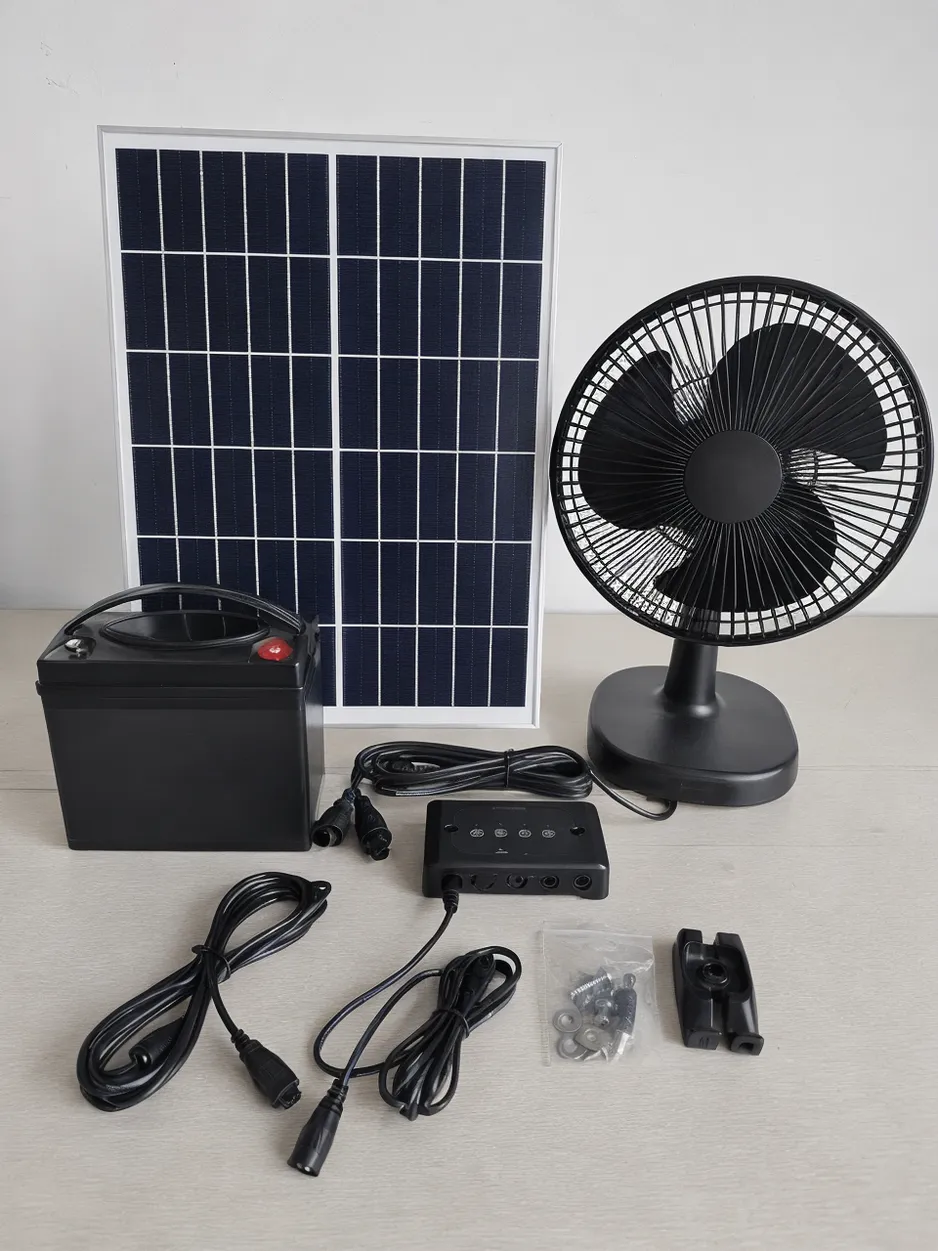
Solar Powered Fan Kits Built Around Matched Panel, Battery, and Motor Specs
A solar powered fan is only as reliable as the match between its panel wattage, battery capacity, and motor load. We've seen buyers source fans and panels separately, pair them based on catalog appearance, and then spend the next season managing runtime complaints from their downstream customers. That's the problem this product is designed to prevent.
JXSOL supplies solar powered fans as a matched kit: the panel wattage is selected against the motor load and battery charging requirement, the battery capacity is sized for the target runtime at actual operating speed, and the controller protection functions are verified before the carton closes. The same panel output testing and battery charge/discharge testing we run on our solar street lights runs on every solar powered fan batch — the infrastructure was already in place.
We're a solar lighting manufacturer, founded in 2012 in Guzhen Town, Zhongshan. Solar fans are a selected adjacent line we support because the core components — solar panels, lithium battery packs, DC motor controllers — overlap directly with what we already build and test. Adding solar powered fans to a solar lighting order means one factory relationship, one QC standard, and one shipping consolidation.
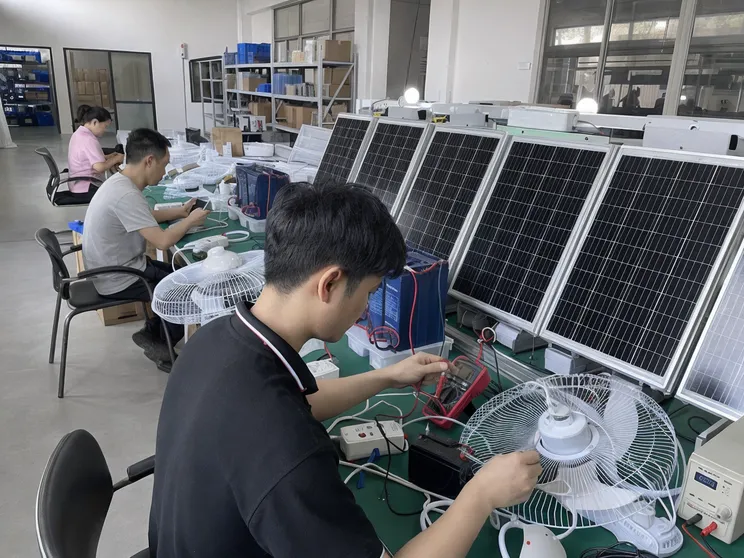
Why Matched Kits Matter
- Panel wattage selected against motor load and battery charging requirement
- Battery capacity sized for target runtime at actual operating speed
- Controller protection functions verified before carton closes
- Same QC infrastructure as solar street light production
Where This Solar Powered Fan Fits in Your Product Line
"Solar powered fan" covers a wide range of configurations — direct-panel operation, battery-backed overnight use, portable handheld units, pedestal stands, exhaust ventilation, and fan-plus-light kits. This page is for buyers who need a general solar fan kit with a defined solar panel and optional battery backup: a SKU with confirmed specs, a known accessory list, and a repeatable reorder configuration.
If your requirement is different, the table below routes you to the right product family without guessing.
| Your Requirement | Best Fit | Product Page |
|---|---|---|
| Broad solar fan catalog exploration, mixed SKU program | General solar fan family | Solar Fans |
| Pedestal or stand-mounted fan for household retail | Pedestal form factor | Solar Stand Fan |
| Compact, lightweight fan for camping, outdoor, or emergency retail | Portable and handheld | Portable Solar Fan |
| Combined fan and LED light on a single solar system | Fan + lighting kit | Solar Fan With LED Light |
| Attic, greenhouse, warehouse, or building ventilation | Daytime ventilation | Solar Exhaust Fan |
| Defined panel + battery + fan kit with confirmed runtime | This page | Solar Powered Fan |
The Commercial Case: SKU Clarity
Buyers who need to put a solar powered fan on a purchase order, a product listing, or a project spec sheet need confirmed panel wattage, battery capacity, runtime, and accessory contents — not a range of possibilities to sort through. This product is designed to give you that.
Not sure which configuration fits your channel and retail price point? Contact JXSOL with your target market and volume — we'll recommend the right starting SKU.
Specification Table Buyers Can Use for RFQ Comparison
The table below covers the standard planning ranges for our solar powered fan kits. These are industry-typical values for this product type — exact specifications depend on the model and configuration selected. Final datasheets are confirmed during quotation.
| Specification | Standard Range | Notes |
|---|---|---|
| Fan diameter | 8 inch – 16 inch | Model dependent; confirm at quotation |
| Motor type | Brushless DC (BLDC) | Brushed DC available for cost-sensitive programs; we flag the trade-off |
| Motor power | 5W – 30W | Matched to fan diameter and airflow target |
| Solar panel wattage | 10W – 40W | Sized against motor load + battery charging requirement |
| Battery chemistry | Li-ion or LiFePO4 | LiFePO4 for longer cycle life; Li-ion for lower cost and weight |
| Battery capacity | 5Ah – 20Ah | Sized for target runtime at full motor load |
| Runtime (battery-backed) | 4 hours – 12 hours | Stated at actual motor load, not no-load conditions |
| Charging input | Solar only; solar + USB-C; solar + AC adapter | Multi-input available on selected models |
| Speed control | 3-speed minimum; timer and remote available | Remote control and timer confirmed per model |
| Controller protection | Over-charge, over-discharge, short-circuit | Standard on all battery-backed models |
| Panel cable length | 1.5m – 5m | Longer cable available for rooftop or elevated panel placement |
| Housing / grille | ABS plastic; ABS + metal grille | Model dependent |
| IP rating | IP20 (indoor) – IP44 (outdoor) | Confirm for your deployment environment |
| Packaging contents | Fan unit, solar panel, battery (if separate), cable, mounting/accessory kit, manual — accessory pack contents confirmed per SKU at order stage | |
Specifications shown are standard planning ranges for this product type. Actual specifications vary by model and configuration. Contact us for exact datasheets and model-specific data.
The spec table is designed to give you enough data to build a comparison sheet and identify the right configuration before sending an RFQ. If you need a specific fan diameter, runtime target, or panel wattage, request the exact solar powered fan datasheet and we'll match the model to your requirement.
Panel and Battery Matching That Prevents Runtime Claims
This is the section most solar fan product pages skip, and it's the one that determines whether your buyers get the runtime they expect or file warranty claims after the first cloudy week.
The Commercial Risk of a Mismatched Kit
The commercial risk of a mismatched solar powered fan kit is not obvious at the time of purchase — it shows up 4–8 weeks after your buyers deploy the product. An under-sized panel can't fully recharge the battery in a normal day. Each cycle starts with less charge than the previous one. Runtime degrades progressively, and by the time your buyers notice, they've already sold the product downstream.
The return rate tells the story.
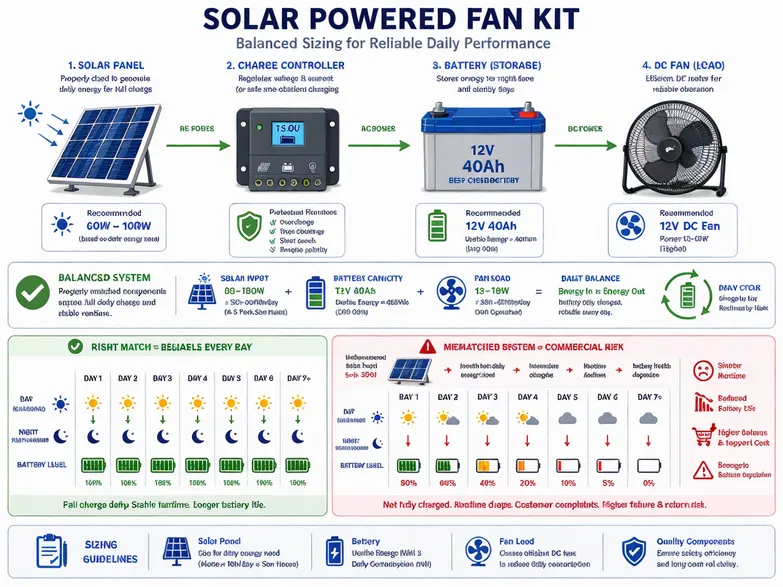
Panel Wattage Against Motor Load
A 10W DC motor fan needs at least 10W of panel output just to run — and that's before accounting for battery charging. The practical rule: panel wattage should be 1.5–2× the combined motor and LED load (if applicable) to ensure full battery charging within 6–8 hours of peak sun.
Example: For a 10W motor fan with a 10Ah battery, a 20W panel is the minimum for reliable daily charging in most markets.
Battery Capacity Against Runtime Target
A 10Ah battery at 10W draw gives roughly 8–10 hours of runtime, accounting for typical efficiency losses. If your buyers expect overnight operation, the battery must be sized for the full overnight load — not the fan's rated wattage under ideal conditions.
Key point: We specify runtime at actual motor load, not no-load or reduced-speed conditions.
Combined Load if LED Is Included
If the model includes an optional LED array, the battery capacity must be sized for the combined fan + LED load running simultaneously. A battery sized for the fan alone will deliver noticeably shorter runtime when the LED is on.
Our approach: We size battery capacity for the combined load at the design stage, not as an afterthought.
Regional Panel Sizing Guidance
Panel wattage requirements shift based on your target market's daily irradiance. For a 10W motor fan with a 10Ah battery:
15W Panel
Southeast Asia, Middle East
High daily irradiance
20W Panel
Most markets (baseline)
Minimum for reliable daily charging
25W Panel
Northern Europe, high-latitude N. America
Lower-irradiance months
Same QC Infrastructure as Our Solar Street Lights
The panel output testing and battery charge/discharge cycle testing we run on solar powered fans is the same infrastructure we use for our solar street lights — it's not a separate QC program built for fans. That means the panel wattage on the spec sheet reflects measured output under test conditions, not rated peak output under ideal lab conditions.
Related Reading
- Solar Fan With Battery vs Direct Solar Fan — detailed comparison of direct solar operation versus battery-backed configurations.
- How to Choose a Solar Powered Fan — broader selection guidance for sourcing teams.
Need a Market-Specific Configuration?
Send us your target country and required runtime — we'll match the panel wattage and battery capacity to your market's irradiance conditions and confirm the configuration before quotation.
Contact JXSOL With Your Target SpecsMarket Segments Where a Solar Powered Fan SKU Pays Back
The parent solar fan product family overview covers the full range of market segments across all solar fan types. Below are the segments where a general solar powered fan kit — matched panel, battery, and motor — is specifically the right SKU.
Off-Grid Household Retail
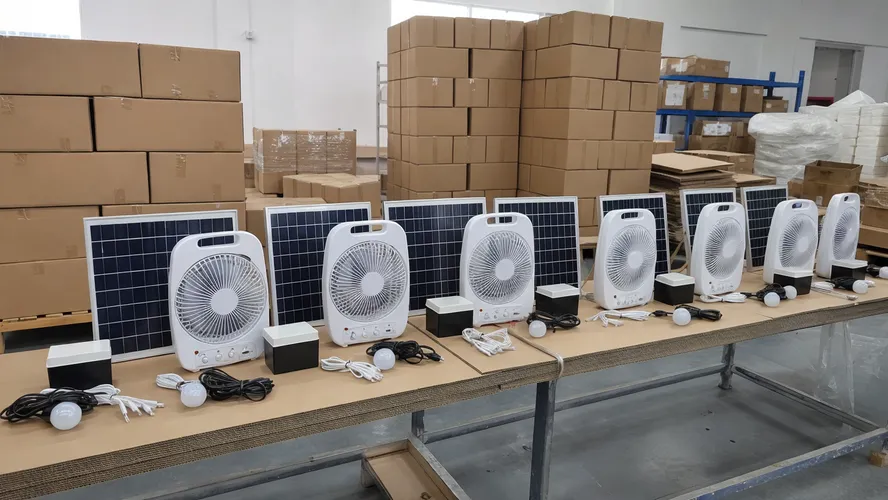
Distributors in markets with unreliable grid power — sub-Saharan Africa, rural Southeast Asia, parts of the Middle East — sell battery-backed solar powered fans as essential household items. The commercial pattern: repeat demand driven by daily need, not seasonal purchase.
Buyers in this segment typically start with a 200–500 unit trial order, confirm runtime performance with their retail network, and reorder on a quarterly cycle.
Key Spec Requirement
Reliable overnight runtime — 6–8 hours at medium speed is the standard expectation in this channel.
Solar Home System Distributors
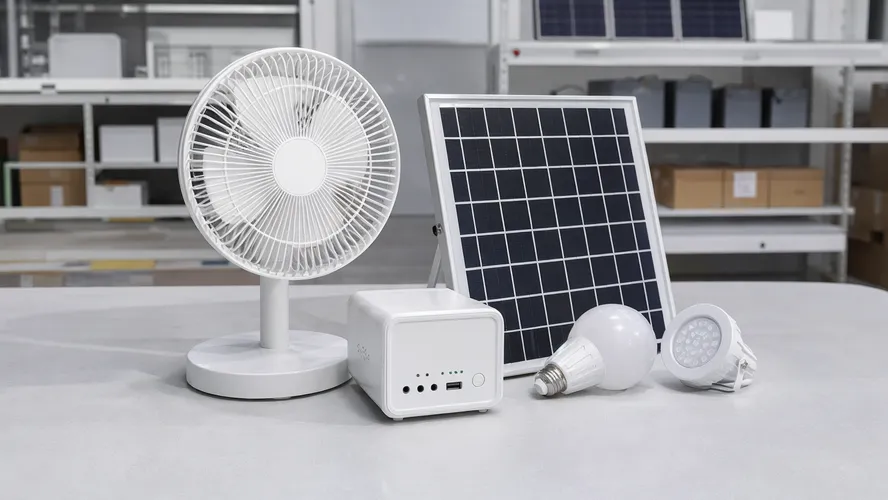
Buyers building solar home kit programs add solar powered fans as a natural companion SKU alongside solar lights and small battery systems. The fan kit doesn't need to be the anchor product — it's the add-on that increases average order value per household and reduces the number of suppliers the distributor manages.
Configuration Note
The solar panel and battery specs need to be compatible with the home system's existing power architecture — a configuration question we work through during quotation.
Emergency Preparedness & Backup-Power Retail
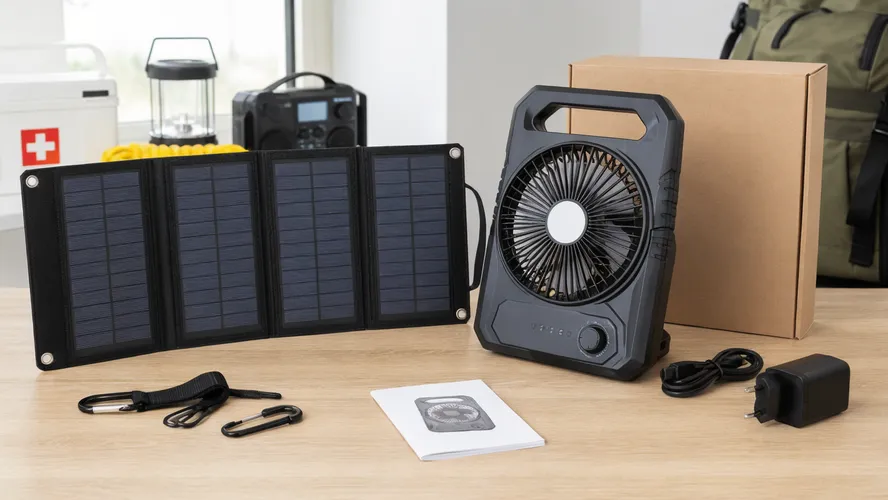
North American and European buyers sourcing for emergency kit programs and backup-power retail need solar powered fans with multi-input charging — solar plus USB-C or AC adapter — so the product works before, during, and after a grid outage.
Retail packaging, low accessory error rate, and a clean unboxing experience matter for this channel.
QC Focus
We confirm accessory pack contents per carton at outgoing inspection — the step that prevents the "missing cable" customer service calls.
NGO & Rural Electrification Procurement
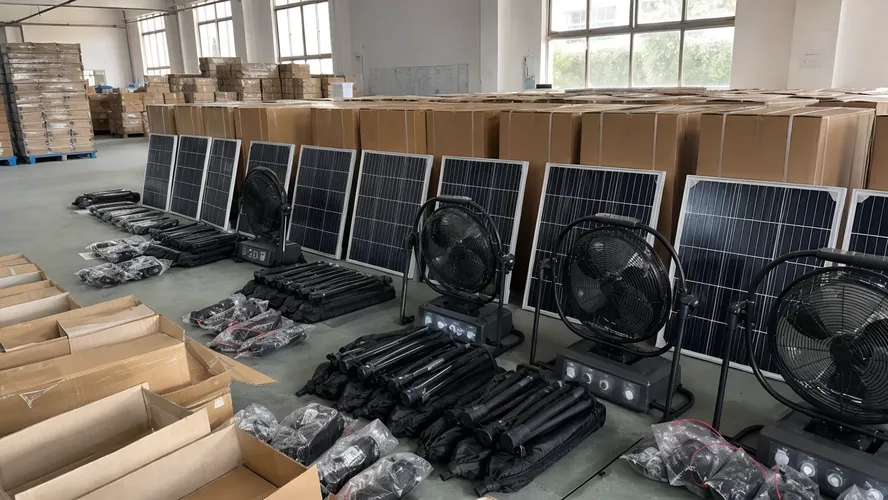
Procurement organizations sourcing for field operations, disaster relief, and rural electrification programs need solar powered fans that work without grid infrastructure, survive rough handling, and come with documentation for import clearance.
Entry Requirements
CE Declaration of Conformity, RoHS test reports, and IP-rated housing certificates. We've supplied this channel through our solar lighting programs and extend the same documentation package to solar fan orders.
Bulk order consistency — same runtime, same accessory pack, same carton weight — matters more than unit price for this segment.
Mixed Solar Catalog Orders Alongside Solar Lighting
Distributors already sourcing from our core solar street and roadway lighting catalog add solar powered fans to broaden their offering without adding a supplier. Same factory, same QC standard, same shipping consolidation.
Solar fans typically represent 10–20% of the order value in a mixed catalog program. The solar powered fan kit is the easiest SKU to add because the configuration is defined — there's no need to specify panel and battery separately.
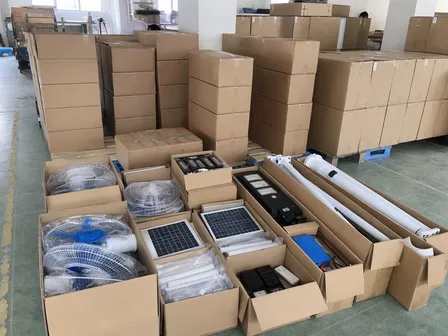
We'll recommend the right solar powered fan configuration for your market.
OEM/ODM Options Buyers Should Decide Before Quotation
Standard solar powered fan models are available from 100 units. If your program needs a private-label configuration — custom panel wattage, specific battery capacity, branded housing, or retail packaging in your language — that goes through our OEM/ODM program. The same engineering team that supports our solar lighting OEM work (15+ optical and electrical engineers on-site) manages solar fan customization.
The decisions that affect lead time and cost need to be locked before we source components. Here's what can be configured and what requires an engineering review:
Fan Configuration
- Fan diameter and blade count
- Motor power and speed settings (3-speed, variable, remote-controlled)
- Oscillation function and timer
- Housing color and logo placement on housing and grille
Solar Panel
- Panel wattage (affects battery charging rate and carton size)
- Panel dimensions and cable length
- Mounting bracket style (tabletop, wall-mount, stake-mount)
Battery
- Chemistry: Li-ion for lower cost and weight; LiFePO4 for longer cycle life and better performance in high-temperature markets
- Capacity: sized against your runtime target and motor load
- Cell brand specification available on larger programs
Charging Input
- Solar only
- Solar + USB-C
- Solar + AC adapter
- Multi-input (solar + USB-C + AC) for emergency preparedness and backup-power channels
LED Add-on
Available on models that support combined load; battery capacity is recalculated for the combined fan + LED load.
We don't add an LED to a fan model and leave the battery unchanged — that's how runtime claims fall apart. See Solar Fan With LED Light if LED integration is the primary requirement.
Branding & Packaging
- Logo on fan housing, grille, solar panel, and carton
- Retail box design and printing in your language
- User manual in your language and format
- Accessory kit contents (remote, carry bag, spare fuse, instruction card)
- Mixed-SKU carton packing for multi-model programs
What Requires Engineering Review
- Custom housing tooling requires a separate engineering review and tooling cost — confirm during quotation.
- Battery and panel changes affect runtime, carton dimensions, and lead time; these must be locked before component procurement.
- Changes after procurement affect both cost and schedule.
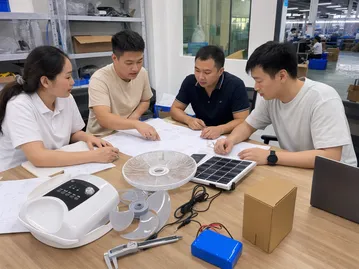
For the full scope of what we support across solar products, see our OEM and ODM solar lighting services.
To start a solar powered fan OEM inquiry, submit your requirements with target market, fan type, battery/runtime target, panel wattage, LED requirement, order quantity, and branding needs.
Submit OEM/ODM RequirementsQuality Checks for the Fan, Panel, Battery, and Accessory Pack
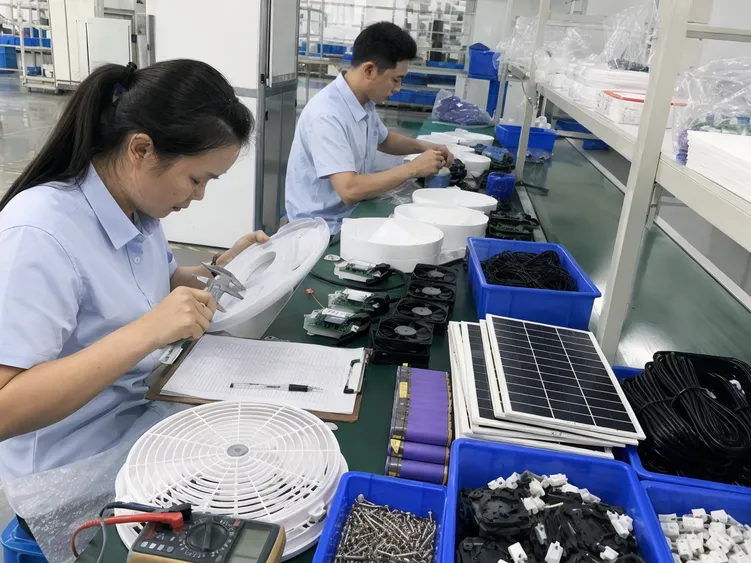
A solar powered fan ships as a kit. That means QC has to cover not just the fan motor and housing, but the panel output, battery capacity, controller protection, and every item in the accessory pack. The failure modes are different from a single-component product, and the ones that generate warranty claims are usually the ones that get skipped.
| Risk | How It Shows Up | Our Prevention |
|---|---|---|
| Panel output below rated wattage | Battery never fully charges; runtime degrades within weeks | Panel electrical output tested against rated wattage before packing |
| Battery capacity mismatch | Runtime varies between units in the same batch; some units fail after 50–100 cycles | Battery cells matched by capacity and internal resistance; charge/discharge cycle testing on every batch |
| Motor overheating or bearing noise | Fan runs hot at full speed; noise develops within 3–6 months | BLDC motor with thermal protection; motor load run at rated speed before shipment |
| Controller protection failure | Battery over-charges or over-discharges; controller fails in field | Over-charge, over-discharge, and short-circuit protection verified per batch |
| Inflated runtime claim | Spec sheet says 8 hours; buyer's customers get 4–5 hours | Runtime stated at actual motor load, not no-load or reduced-speed conditions |
| Combined load mismatch (fan + LED) | LED dims or fan slows when both run simultaneously | Battery capacity sized for combined load at design stage; combined load test before production sign-off |
| Missing accessory | Panel cable, mounting bracket, or remote missing on arrival | Accessory pack checklist verified per carton at outgoing inspection; packing list inside every carton |
| Panel damage in transit | Glass cracking or frame deformation on arrival | Panel wrapped in foam with corner protection; reinforced carton walls on panels 25W+ |
Stage 1: Incoming Inspection
Components checked on arrival — cells, panels, motors, controllers, housings — before they enter the production line.
Stage 2: In-Process Checks
Verification at motor assembly and battery integration steps to catch issues before they compound downstream.
Stage 3: Reliability Testing
Charge/discharge cycles, motor load run at rated speed, and combined load verification (fan + LED simultaneously).
Stage 4: 100% Outgoing Inspection
Every unit inspected before the container closes. Accessory pack checklist verified per carton with packing list enclosed.
Same QC System as Our Solar Lighting Line
The JXSOL factory quality system is the same system that covers our solar lighting products — solar fans go through the same checkpoints, not a lighter version.
IP-rated housing models carry IP test documentation. We do not claim product-specific certification numbers beyond what is confirmed at the factory level — if your market requires additional documentation, confirm during quotation and we'll advise what's available.
Packing, Carton Control, and Mixed-SKU Shipment Planning
Solar powered fans ship with more components per carton than most solar lighting products: fan unit, solar panel, battery pack (if separate), cable, mounting hardware, remote control (if applicable), manual, and spare accessories. Accessory control is where packing errors happen, and a missing panel cable or mounting bracket creates a customer service problem that costs more to resolve than the part itself.
Carton Layout
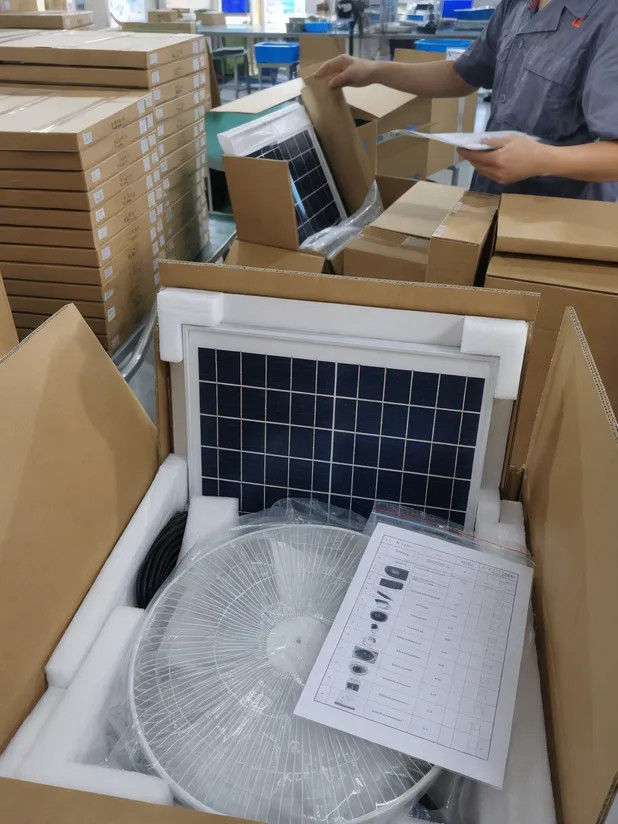
Fan unit, solar panel (folded or flat-packed depending on size), battery pack (if separate), cable, and accessories packed in a defined sequence with a packing list inside every carton. Carton dimensions are sized for container loading efficiency — CBM per carton and loading quantities are confirmed during quotation based on your selected models, because fan diameter and panel size vary significantly between configurations.
Panel Protection
Solar panels are wrapped in foam and packed flat or in a dedicated sleeve to prevent glass cracking during transit. For panels 25W and above, we use reinforced carton walls and corner protection.
We added the corner protection step after seeing panel frame deformation on a batch of larger panels shipped without it — the glass survived but the frame bent enough to affect the mounting bracket fit.
SKU Labeling & Batch Traceability
Every carton carries a SKU label with product code, batch number, quantity, and destination market. Batch codes trace back to production records, so a reorder can reference the previous batch spec to confirm consistency. If a component changes between batches — cell supplier, panel brand — we flag it before production, not after shipment.
Mixed-SKU Consolidation
If you're ordering solar powered fans alongside solar lighting products or other solar fan families, we consolidate into a single container with a master packing list. Mixed-SKU orders are common for distributors building a solar catalog — we manage the consolidation on our end so you receive one shipment with one set of documentation.
Confirmed During Quotation
- CBM per carton based on your selected fan diameter and panel size
- Container loading quantities (20ft / 40ft / 40HQ)
- Palletization options if required by your logistics
- Mixed-SKU master packing list for consolidated shipments
For shipping and delivery details, see our shipping and delivery page, or confirm carton and loading data directly with our team.
Solar Powered Fan FAQ for Sourcing Decisions
What panel wattage do I need for a solar powered fan?
Panel wattage needs to cover two loads simultaneously: running the fan motor and charging the battery. A practical rule: panel wattage should be 1.5–2× the combined motor and LED load (if applicable). For a standard 10W motor fan with a 10Ah battery, a 20W panel is the minimum for reliable daily charging in most markets.
Southeast Asia, Middle East, sub-Saharan Africa — a 15W panel often works for the same fan.
Northern Europe, high-latitude North America — size toward 25W to maintain runtime through winter months.
We confirm panel sizing during quotation based on your target market and runtime requirement — send us your target country and we'll calculate the right panel wattage.
How long can a solar powered fan run on battery?
Runtime depends on three variables: battery capacity (Ah), motor power (W), and whether an LED load is running simultaneously.
| Battery Capacity | Motor Load | Estimated Runtime |
|---|---|---|
| 10Ah | 10W | 8–10 hours |
| 5Ah | 10W | 4–5 hours |
Runtimes account for typical efficiency losses. We specify runtime at actual motor load, not no-load or reduced-speed conditions — the number on our spec sheet is what your buyers will experience in the field.
Custom runtime sizing: If your channel requires a specific overnight runtime (6 hours, 8 hours, 10 hours), tell us the target and we'll size the battery accordingly.
Is a solar fan with panel always battery-backed?
No. A direct solar fan runs only when the panel is generating power — no battery, no operation after dark or on heavily overcast days. It's the lower-cost configuration and works well for daytime ventilation applications (exhaust fans, greenhouse airflow, outdoor cooling during work hours).
A battery-backed solar powered fan stores energy during the day and runs through the evening or overnight. For household retail and off-grid home use, battery-backed is the expected configuration — buyers in those channels assume the fan works after dark.
Sourcing direct solar fans for a market that expects battery backup is one of the most common causes of returns in this category.
Direct Solar (No Battery)
- Lower unit cost
- Daytime-only ventilation
- Exhaust fans, greenhouses, outdoor work
- No operation after dark or heavy overcast
Battery-Backed
- Runs evening and overnight
- Expected for household retail / off-grid
- Reduces return rate in consumer channels
- Higher BOM cost
For a detailed comparison, see Solar Fan With Battery vs Direct Solar Fan.
What causes weak airflow or short runtime in low-cost solar powered fans?
Three root causes cover most of the failures we've seen:
Battery capacity mismatch
The spec sheet shows 10Ah but the actual cells test at 7–8Ah, so runtime is 20–30% below spec from day one.
Panel under-sizing
The panel can't fully recharge the battery in a normal day, so each cycle starts with less charge than the previous one — runtime degrades progressively over weeks.
Brushed DC motors losing efficiency
As brushes wear, airflow drops noticeably within 6–12 months of regular use.
How JXSOL addresses these
We address the first two through component testing (battery capacity verification, panel output testing) and the third by defaulting to brushless DC motors on all current models. Brushed DC is available for price-sensitive programs, but we flag the trade-off before production.
Can JXSOL customize solar powered fans for private label orders?
Yes. We handle private-label solar powered fans through our OEM/ODM program:
- Logo on housing, grille, and solar panel
- Custom carton design and printing
- User manual in your language
- Configuration-level customization: battery capacity, panel wattage, LED integration, charging input, housing color
The engineering team reviews the spec before production to confirm the configuration is achievable and to lock the spec before component procurement. Custom specs must be finalized before we source components — changes after procurement affect lead time and cost.
Standard catalog models are available from 100 units; OEM/ODM MOQ is confirmed based on the configuration.
What MOQ does JXSOL support for standard solar powered fan models?
Standard catalog models are available from 100 units — low enough to test a new SKU with your customers before committing to a larger program.
OEM/ODM programs with custom specifications go through an engineering review before production, and MOQ is confirmed based on the configuration.
Send Your Solar Powered Fan Requirements
If you're adding solar powered fans to a solar product catalog, building a private-label solar fan line, or sourcing for a specific project or distribution program, send us the details and we'll recommend the right configuration.
Useful Information to Include
Target market or country
Affects panel wattage sizing and documentation requirements
Battery-backed or direct solar operation
Determines system architecture and component selection
Runtime requirement
Hours of overnight or evening operation needed
Fan size or airflow target
If known — helps us match motor and blade configuration
Solar panel wattage preference or target landed cost
Guides panel sizing and overall BOM cost optimization
LED light requirement
Fan-only or fan + light combo unit
Charging input requirement
Solar only, solar + USB-C, or solar + AC adapter
Order quantity and reorder frequency
Helps determine pricing tier and production scheduling
Branding and packaging requirements
Private label, retail box, or bulk carton
What You'll Receive
- Configuration recommendation matched to your requirements
- Spec sheet for the relevant models
- Quote based on your volume and requirements
If you're already sourcing solar lighting from us, we can consolidate your solar powered fan order into the same shipment.
Direct Contact
Explore More Solar Fans
Browse related products in our solar fan range