Which Solar Fan Design Generates Fewer Returns — and Why Distributors Care
Return rates cut directly into your margin and damage your brand reputation with retail partners. A 5% return rate on a $30 wholesale solar fan costs you $1.50 per unit in reverse logistics, replacement stock, and lost relationship capital. When you're sourcing solar fans for distribution, the question isn't which design sounds better on paper — it's which one generates fewer warranty claims after six months in the field.
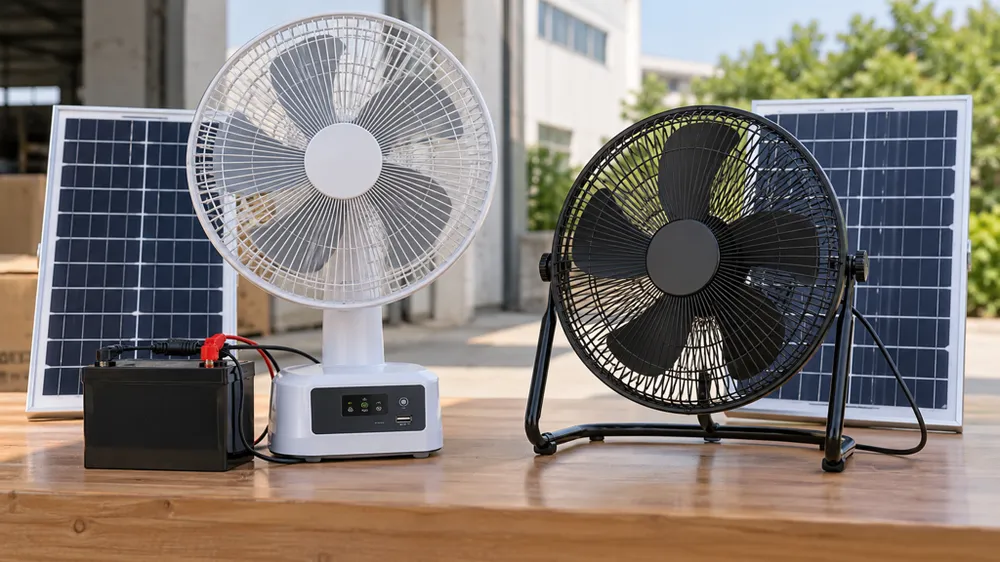
The trade-off between solar fan with battery vs direct solar fan designs breaks down to failure point count versus usability breadth. Battery-equipped models have more components that can fail: the battery pack itself (capacity fade after 6–12 months if cell matching is poor), the charge controller (MOSFET failure or inadequate heat dissipation), and the charge/discharge logic (firmware bugs that overcharge or over-discharge cells). Direct solar powered fans eliminate those failure modes entirely — no battery means no degradation risk, no charge controller means one less circuit board to malfunction. But that simplicity comes with a hard constraint: the fan only runs when the panel receives adequate irradiance. Cloudy days, indoor use, or shade operation all fail.
We've tracked incoming component rejection rates and field failure data across both architectures for eight years at JXSOL. Battery models have a higher component rejection rate at receiving inspection (4% for battery packs due to voltage mismatch or capacity fade), but when QC is done correctly, field failure rates drop to nearly the same level as direct solar models. Direct solar fans show a 2% panel rejection rate at incoming inspection, but the main return driver isn't hardware failure — it's customer expectation mismatch. Buyers thought the fan would work indoors or in partial shade, and it doesn't.
This article walks through the failure modes, QC requirements, and market fit logic for both designs so you can source the architecture that matches where you sell and what your customers expect. We're not arguing for one design over the other — we manufacture both, and both have defensible use cases. The question is which one reduces your support burden in your specific distribution channels.
Battery-Equipped Solar Fans — Failure Modes and QC Requirements
The main failure driver in solar fans with battery backup is battery capacity fade. A lithium-ion battery pack rated for 2000mAh will drop to 1600mAh or lower after 200–300 cycles if the individual cells aren't voltage-matched during assembly. Most factories source pre-assembled battery packs from third-party suppliers and don't verify cell-level matching. When cell voltage varies by more than 0.1V within a pack, the weakest cell degrades faster, pulls the entire pack down, and runtime drops from 8 hours to 3 hours within the first year. Your customers notice, and they return the product.
The secondary failure mode is charge controller component failure. Cheap charge controllers use undersized MOSFETs or inadequate heat dissipation, and they fail when ambient temperature exceeds 35°C — common in the exact markets where solar fans are most needed. The symptom is either a fan that won't charge (MOSFET stays open) or a battery that overcharges and vents (MOSFET stays closed). Both result in RMAs.
If you're sourcing battery-equipped solar fans, verify these QC checkpoints at the factory level before placing a production order:
- Request discharge cycle test reports for a sample batch — at least three full charge/discharge cycles with documented capacity retention. If the factory can't produce this report, they're not testing.
- Check cell voltage matching documentation. Cells within a pack should be matched to within 0.05V maximum variance. Anything looser than that and you'll see accelerated degradation in the field.
- Ask for charge controller thermal testing data at 45°C ambient. The controller should run continuously for at least 8 hours without entering thermal shutdown. If the factory hasn't tested this, they're hoping the product survives rather than engineering for it.
- Confirm battery chemistry and cycle life rating. Lithium iron phosphate (LiFePO4) chemistry costs 20% more than standard lithium-ion but delivers 2000+ cycles versus 500 cycles. For a product marketed as "long-lasting solar ventilation," the extra cost buys you credibility.
At JXSOL, we run every battery pack through a 3-cycle charge/discharge test before assembly. We match cells to within 0.03V, not 0.05V, because we've seen the field failure difference that extra 0.02V makes. Our charge controllers are tested at 45°C ambient for 8 hours as part of the production validation, not as a one-time design check. These aren't expensive tests — they add about 15 minutes per production batch — but most factories skip them to save time. The result is a 4% incoming rejection rate on battery packs, but a field failure rate that drops to under 2% after 12 months. That's the trade-off: higher unit cost and longer production time in exchange for fewer RMAs.
The honest framing is this: battery-equipped solar fans are more complex products with more potential failure points. If your factory doesn't have the QC infrastructure to test batteries and charge controllers properly, sourcing this design will cost you more in returns than you save on the lower wholesale price. If your factory does test correctly, battery models open up market segments that direct solar fans can't serve — and that incremental margin covers the higher unit cost.
Direct Solar Powered Fans — Simplicity vs. Usability Constraints
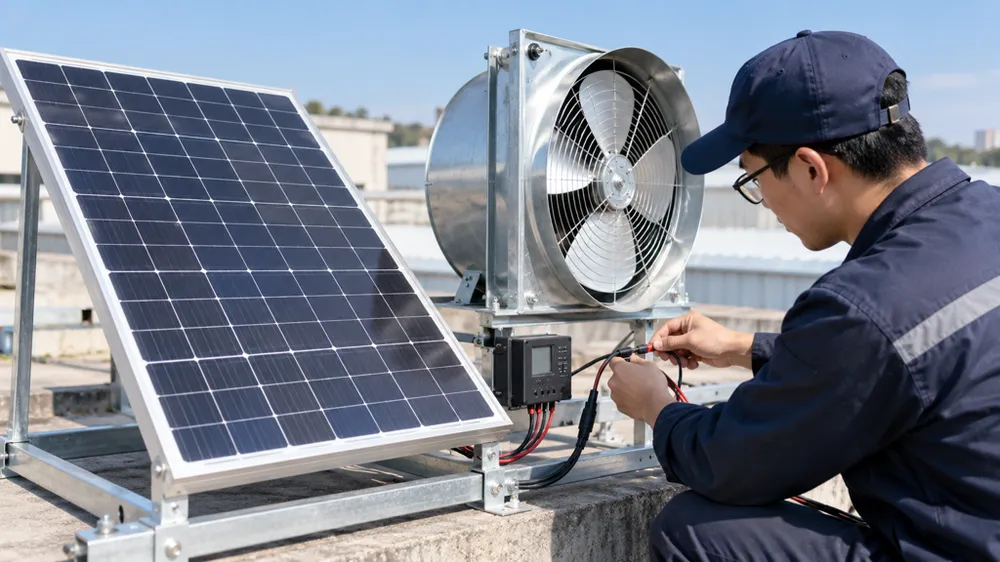
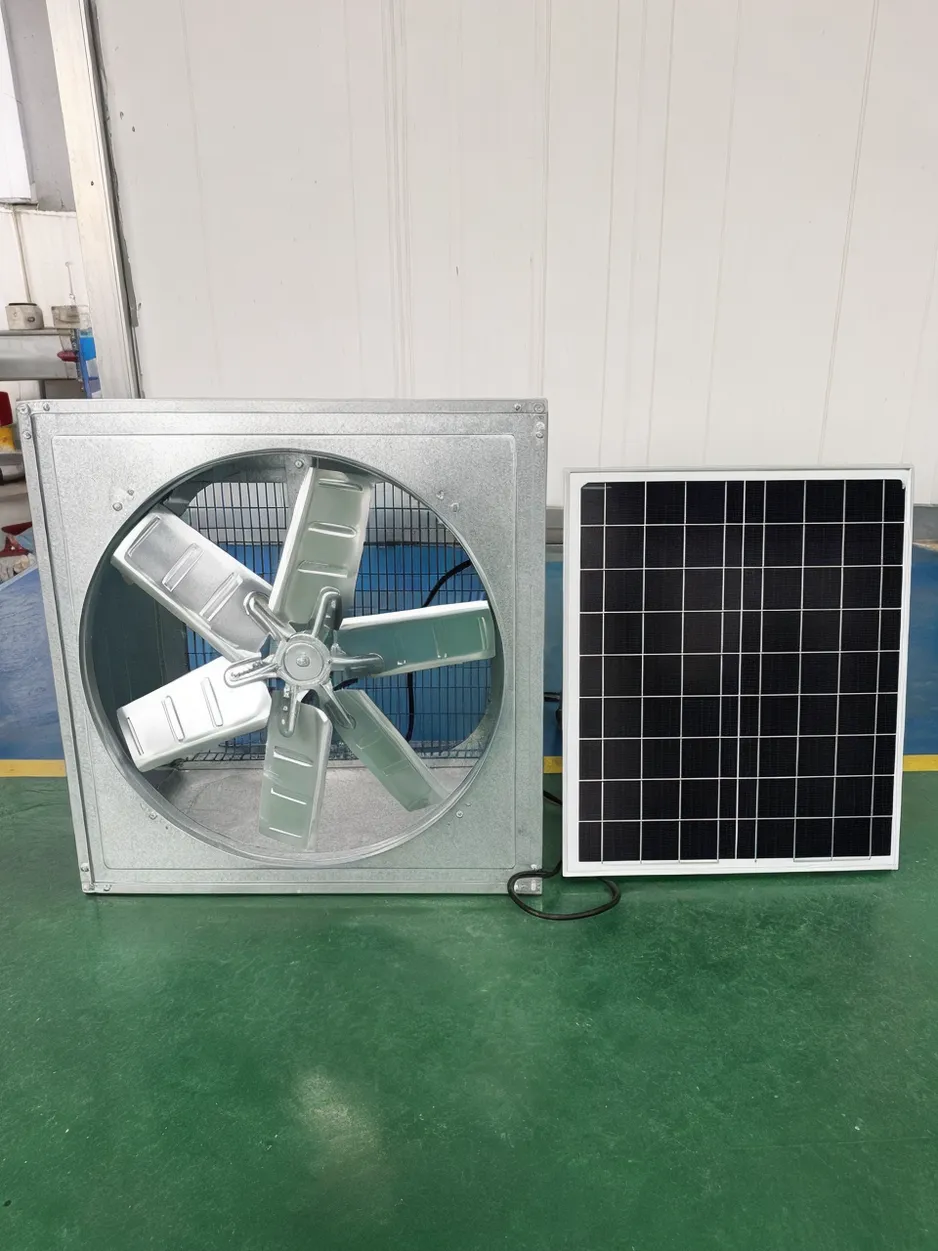
Direct solar powered fans have fewer components, which means fewer things that can break. No battery means no capacity fade. No charge controller means no MOSFET failure. The panel connects directly to the motor through a simple circuit, and the fan runs whenever the panel generates enough current to overcome the motor's startup threshold. That simplicity is the main commercial advantage: lower manufacturing cost, faster production time, and fewer field failures caused by component degradation.
The limitation is usability. A direct solar fan only runs when the panel receives adequate irradiance — typically 600 W/m² or higher for a small DC motor to start reliably. Anything below that threshold (cloudy day, partial shade, late afternoon, indoor placement near a window) and the fan either doesn't start or runs too slowly to move air effectively. Your end customer expected a fan that works indoors or on overcast days, and it doesn't. They return it, and you absorb the cost.
The most common sourcing mistake we see with direct solar fans is panel-motor mismatch. A factory pairs a 5W panel with a 3W motor, which sounds fine on paper — 5W is more than 3W, so it should work. But motor startup current is 2–3× the running current, which means that 3W motor needs 6–9W of instantaneous power to spin up. In anything less than full sun (1000 W/m² standard test conditions), the panel can't deliver that peak, and the fan stutters or fails to start. The customer assumes the product is defective, and it comes back.
If you're sourcing direct solar powered fans, verify these points during factory QC:
- Request panel output certification under standard test conditions (1000 W/m², 25°C cell temperature). The panel should deliver at least 120% of the motor's rated running power to account for startup current and real-world irradiance variation.
- Check motor startup current versus panel maximum output. Startup current should be no more than 80% of the panel's rated output. If the factory doesn't know the startup current spec, they haven't engineered the pairing — they guessed.
- Validate panel-motor compatibility under reduced irradiance. Ask the factory to demonstrate the fan starting at 600 W/m² irradiance (simulated with neutral density filters or reduced lamp distance). If it won't start below 800 W/m², your customers will complain about "doesn't work on cloudy days."
We test every direct solar fan model at 600 W/m² before releasing it for production. We've rejected panel-motor pairings that worked fine at 1000 W/m² but failed to start reliably at 700 W/m² because we know the real-world use case isn't always full sun. That rejection costs us about $200 per design iteration in wasted prototypes, but it eliminates the support calls about "fan only works at noon."
The return driver for direct solar fans isn't hardware failure — it's expectation mismatch. If your sales channel clearly communicates "outdoor use, full sun only," return rates stay under 3%. If your listing says "solar fan" without explaining the irradiance requirement, return rates hit 10% or higher because customers assume it works like a battery model. The product isn't defective; the commercial messaging failed. That's a fixable problem, but it requires honesty in how you describe the use case.
Spec Comparison — Battery vs. Direct Solar Design
The table below shows the typical spec ranges and failure characteristics for both architectures based on production data from our solar fan lines. These aren't theoretical maximums — they're the realistic performance and failure profiles you'll see when sourcing either design at commercial scale.
| Specification | Battery-Equipped Solar Fan | Direct Solar Powered Fan |
|---|---|---|
| Battery Capacity | 2000–5000 mAh (Li-ion or LiFePO4) | None |
| Runtime on Full Charge | 6–12 hours depending on speed setting | N/A (runs only during irradiance) |
| Solar Panel Wattage | 3–6W (charges battery, not directly powering motor) | 5–10W (directly drives motor, must exceed startup current) |
| Motor Power Consumption | 2–4W (can run from battery when panel output is low) | 2–5W (requires panel output ≥ startup current threshold) |
| Minimum Irradiance for Operation | Not applicable (battery allows operation in any condition) | 600–800 W/m² (below this, motor won't start reliably) |
| Typical Failure Modes | Battery capacity fade (6–18 months), charge controller MOSFET failure, cell voltage mismatch causing premature degradation | Panel output degradation (rare), motor bearing wear (same as battery models), customer expectation mismatch (most common return driver) |
| Field Failure Rate (12 months) | 2–5% with proper QC; 10–15% without cell matching and discharge testing | 1–3% for hardware; 7–12% for returns due to usability complaints |
| Incoming Component Rejection Rate | 4% (battery packs), 2% (charge controllers) | 2% (solar panels), <1% (motors) |
| Distributor Support Implications | Higher initial QC cost; replacement batteries needed for warranty claims; requires technical support for charge-related issues | Lower QC cost; fewer replacement parts needed; returns driven by sales channel messaging, not hardware defects |

The spec differences that matter most for return rate reduction are battery capacity fade timeline, panel-motor matching, and minimum irradiance threshold. Battery models need tighter incoming QC to avoid the 10–15% failure rate, but when QC is done correctly, they support broader use cases. Direct models have simpler QC requirements but a narrower usable market — and that market fit constraint is the main return driver, not component failure.
When you're comparing proposals from two factories, don't just look at the spec sheet. Ask for discharge test reports, cell matching documentation, and panel output certification under reduced irradiance. The factory that can produce those documents has engineered the product. The factory that can't is hoping you don't ask.
Climate and Market Fit — Which Design for Which Region
Solar fan with battery vs direct solar fan isn't a question of better or worse — it's a question of where you're selling and what irradiance conditions your market experiences. Battery-equipped models work in inconsistent sunlight climates (Northern Europe, cloudy tropical regions, four-season temperate zones) and support indoor or semi-indoor applications where the panel sits near a window but the fan operates in a shaded area. Direct solar models are built for high-irradiance markets (Middle East, North Africa, equatorial outdoor agriculture, Southern U.S. desert climates) where full sun is available most of the day and the use case is purely outdoor.
If your distribution footprint includes Northern Europe or the UK, battery models are the only defensible choice. Average daily irradiance in London peaks at 4–5 kWh/m² in summer and drops below 1 kWh/m² in winter. A direct solar fan won't run reliably for more than 2–3 hours per day in that climate, and your customers will return it. A battery model charges slowly but stores enough energy to run the fan for 6–8 hours regardless of cloud cover. The higher unit cost is offset by near-zero return rates.
If you're serving the Middle East or North Africa, direct solar fans make commercial sense. Average daily irradiance in Dubai exceeds 6 kWh/m² year-round, and outdoor agricultural or industrial ventilation use cases don't require runtime after sunset. The simplicity of a direct solar design reduces your landed cost by 20–30%, and the climate supports reliable operation. Battery models work in these markets too, but you're paying for a feature (stored energy) that your customers don't need. That margin difference matters when you're competing on price in cost-sensitive distribution channels.
Application scenarios by design:
- European camping and RV market → battery model. Buyers expect the fan to work inside the tent or RV, and they expect it to run after sunset. A direct solar model will generate returns because it doesn't match the use case, even if you explain the constraint in the listing.
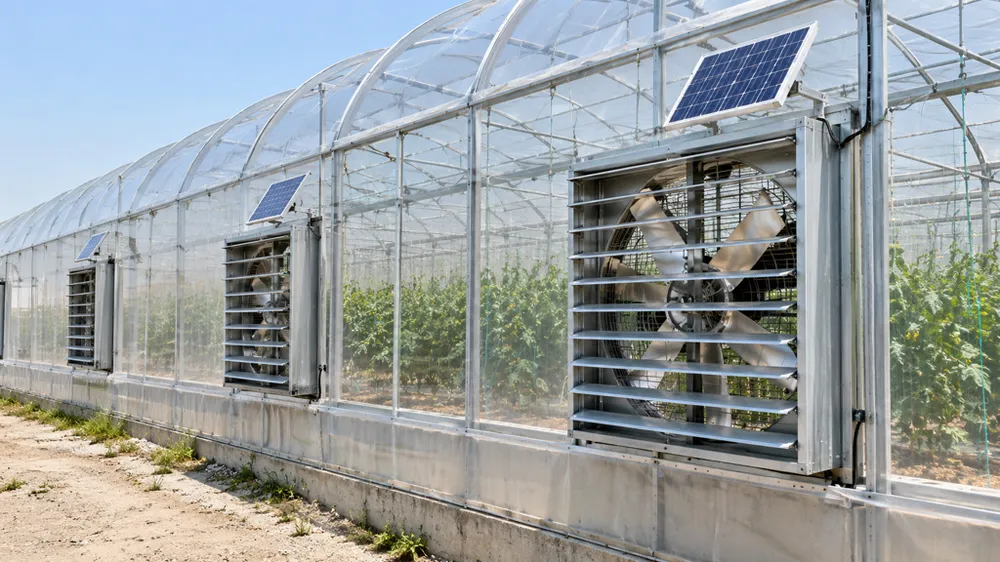
- Middle East greenhouse and agricultural ventilation → direct solar fan. The use case is daytime cooling in full sun. Battery storage adds cost without adding value, and the simpler design means fewer service calls.
- Southeast Asia street vendor and mobile cooling → battery model. Vendors operate in shaded market stalls or under tarps, and they need the fan to run when the panel isn't receiving direct sun. A direct solar model won't work in that environment.
- Southern U.S. outdoor industrial sites → direct solar fan. High irradiance, outdoor-only use, cost-sensitive buyers. Battery models work but cost more than the use case justifies.
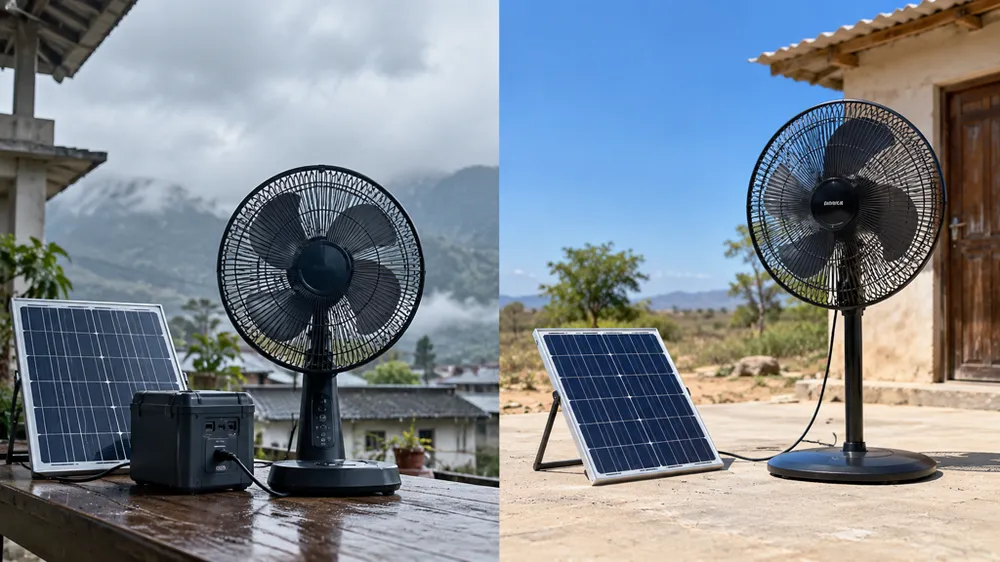
The sourcing recommendation is this: if your distribution footprint spans multiple climate zones, carry both designs and segment your catalog by target market. Don't try to sell one architecture everywhere. A battery model that performs well in Germany will be overpriced for a Dubai buyer, and a direct solar model that works perfectly in Arizona will fail in London. Your margin comes from matching the product architecture to the climate and use case, not from standardizing on one design to simplify inventory.
Sourcing Checklist — What to Verify at the Factory for Each Design
Spending 30 minutes on factory QC verification prevents a 30% increase in return rates. Most distributors skip this step because they assume the factory has already tested everything. Most factories haven't — they've tested enough to confirm the product turns on, not enough to confirm it survives 12 months in the field. The questions below separate factories that engineer products from factories that assemble components and hope for the best.
For battery-equipped solar fans, verify:
- Discharge test reports for sample batch. Ask to see at least three full charge/discharge cycles with documented capacity retention. If capacity drops by more than 10% after three cycles, the cells aren't matched properly or the charge logic is overcharging. Either way, field failure rates will be high.
- Cell voltage matching documentation. Individual cells within the battery pack should be matched to within 0.05V maximum variance, preferably 0.03V. If the factory doesn't measure this during incoming inspection, they're not controlling the main failure driver.
- Charge controller thermal testing data. Request proof that the charge controller ran continuously for at least 8 hours at 45°C ambient without entering thermal shutdown or derating output. If the factory hasn't tested this, the controller will fail in hot climates — which is where most solar fans are used.
- Battery chemistry and cycle life rating. Confirm whether the pack uses standard lithium-ion (500–800 cycles) or lithium iron phosphate (2000+ cycles). LiFePO4 costs more but reduces warranty claims. If your sales channel emphasizes "long-lasting" or "durable," the chemistry choice determines whether that claim is defensible.
For direct solar powered fans, verify:
- Panel output certification under standard test conditions. The panel should deliver at least 120% of the motor's rated running power when tested at 1000 W/m² and 25°C cell temperature. Anything less and the motor won't start reliably under real-world conditions.
- Motor startup current versus panel maximum output. Startup current is typically 2–3× the running current. The panel's maximum output should exceed startup current by at least 20% to account for real-world irradiance variation. If the factory doesn't know the startup current, they haven't engineered the pairing.
- Reduced irradiance startup test. Ask the factory to demonstrate the fan starting at 600 W/m² irradiance. This can be simulated with neutral density filters or by reducing the distance between the panel and the test lamp. If the fan won't start below 800 W/m², your customers will complain that it "doesn't work on cloudy days," even though the product is technically functioning as designed.
These aren't expensive tests. Discharge cycle testing takes 8–12 hours of bench time per sample. Cell voltage matching adds 2 minutes per battery pack during incoming inspection. Panel output certification is a one-time test per production batch using equipment that any solar product factory already owns. The factories that skip these tests are saving 30 minutes per production run and costing you 5–10% of your revenue in returns.
When you're evaluating factory quotes, the lowest price almost always correlates with skipped QC. A factory that quotes $22 per unit for a battery-equipped solar fan and a factory that quotes $26 per unit are not offering the same product. The $4 difference is discharge testing, cell matching, and thermal validation. You'll pay that $4 either as higher unit cost or as return logistics and replacement stock. The question is whether you pay it up front to a factory that engineers products or later to a logistics company that ships defective units back and forth.
JXSOL's Design and Testing Protocol for Both Architectures
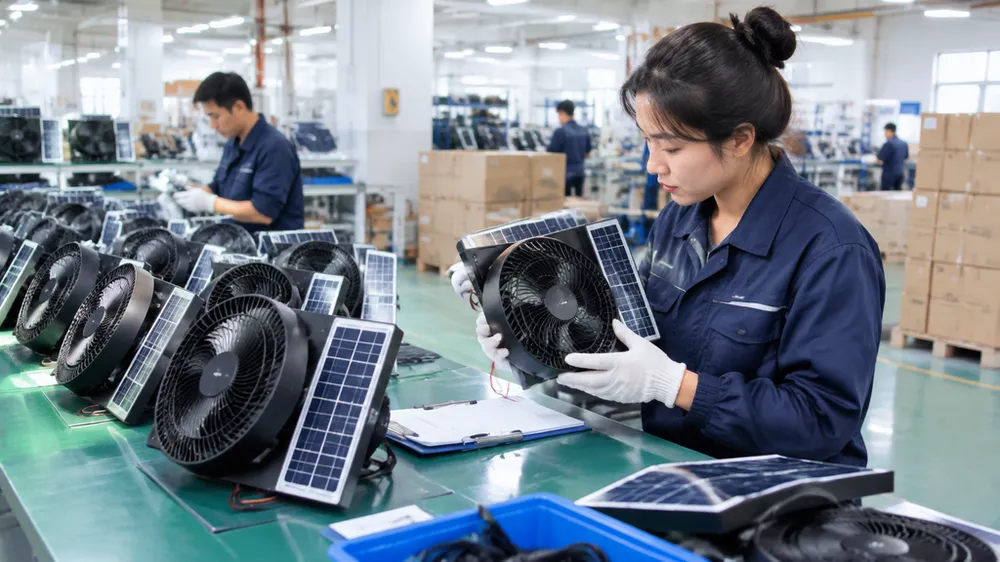
We manufacture both battery-equipped and direct solar fan models because different distribution channels need different architectures. Our testing protocol is the same regardless of design: every production batch goes through the validation sequence that eliminates the failure modes we've seen generate warranty claims over the last eight years.
For battery-equipped models, every battery pack runs through a 3-cycle charge/discharge test before it's approved for assembly. We measure capacity retention at each cycle and reject any pack that drops below 95% of rated capacity by the third cycle. Cell matching happens during incoming inspection — we open every battery pack, measure individual cell voltage with a calibrated multimeter, and reject any pack with voltage variance greater than 0.03V between cells. (Industry standard is 0.05V; we're tighter because we've tracked the field failure correlation.) Our charge controllers are tested at 45°C ambient for 8 hours as part of production validation, not as a one-time design check. If the controller enters thermal derating or shutdown during that 8-hour window, we don't ship it.
For direct solar models, we validate panel output at standard test conditions (1000 W/m², 25°C cell temperature) and then test motor startup at 600 W/m² to confirm the fan works under realistic cloudy-day irradiance. Panel-motor pairing is verified during design validation — we calculate motor startup current, confirm the panel can deliver at least 120% of that peak, and then physically test the pairing at reduced irradiance before releasing the design for production. Every production batch gets a sample test at 600 W/m² to catch panel output drift or motor tolerance variation.
Our incoming component rejection rates reflect how tightly we control these failure modes. Battery packs are rejected at approximately 4% during incoming inspection, mostly due to cell voltage mismatch or capacity fade that happened during storage at the supplier. Solar panels are rejected at approximately 2%, usually because output falls below the rated spec when measured under standard test conditions. Those rejection rates cost us about $8,000 per month in scrapped components, but they eliminate the failure modes that generate RMAs. When we track field failure rates 12 months after shipment, battery models sit around 2% and direct solar models around 1.5% — low enough that warranty claims don't erode margin.
The reason this matters to distributors is that most factories don't publish their incoming rejection rates. A factory that rejects 4% of incoming battery packs is controlling quality. A factory that rejects 0% of incoming battery packs isn't testing — they're hoping the cells are matched and hoping the capacity is within spec. You can't tell the difference from the product datasheet, but you'll see it in your return rate six months after your first container lands.
If you're comparing factory proposals, ask for incoming component rejection rate data, not just pass/fail claims. A factory that can show you their rejection rate data has a QC system. A factory that says "we inspect 100% of components" without quantifying how many fail that inspection doesn't. The data doesn't need to be precise — "we reject about 3–5% of battery packs for voltage mismatch" is enough to confirm they're measuring. "We inspect everything and it all passes" means they're not measuring anything.
Which Design Should You Source — Decision Framework
There's no universal winner between solar fan with battery vs direct solar fan. The right architecture depends on where you sell, what your customers expect, and how much margin you have to absorb support costs. The decision tree below is based on the commercial trade-offs we've seen play out across different distribution channels over the last eight years.
If your target market has inconsistent sunlight or indoor/semi-indoor use cases → source battery-equipped models. Northern Europe, four-season temperate climates, cloudy tropical regions, and any application where the fan needs to run when the panel isn't receiving direct sun all require stored energy. Direct solar fans will generate returns in these markets because they don't match the use case, even if you explain the constraint in the product listing. The higher unit cost of battery models is offset by lower return rates and fewer support calls.
If your target market is high-irradiance, cost-sensitive, and outdoor-only → source direct solar powered fans. Middle East, North Africa, Southern U.S. desert climates, and outdoor agricultural or industrial ventilation applications all have the irradiance to support direct solar operation. Battery models work in these markets too, but you're paying for a feature your customers don't need. The margin difference matters when you're competing on price, and the simpler design means fewer service calls. Your risk is customer expectation mismatch — if your sales channel doesn't clearly communicate "outdoor use, full sun only," you'll get returns. That's a fixable messaging problem, not a product defect.
If your buyers tolerate higher unit cost in exchange for broader usability → source battery models. This is the RV market, the camping market, and any channel where buyers are willing to pay 30% more for a product that works in more conditions. The trade-off is that battery models need tighter QC to avoid field failures, so you need a factory that tests discharge cycles, matches cell voltage, and validates charge controller thermal performance. If your factory doesn't do those tests, the higher unit cost won't buy you lower return rates — you'll just pay more for a product that fails faster.
If your buyers prioritize lowest landed cost and accept narrower usability → source direct solar fans. This is the bulk outdoor ventilation market, the agricultural market, and any channel where price is the primary purchase driver. The product works reliably when used as designed, but the use case constraint (full sun, outdoor only) must be communicated clearly. Your factory QC is simpler — validate panel output under standard test conditions, confirm motor startup at 600 W/m² irradiance, and verify panel-motor pairing math. If those three checks pass, field failure rates stay under 2%.
If your distribution footprint spans multiple climate zones or customer segments, the correct answer is to carry both designs and segment your catalog by use case. A battery model sold into Germany and a direct solar model sold into Dubai are both correct choices for their respective markets. Trying to standardize on one design to simplify inventory will cost you either margin (if you source battery models for high-sun markets where they're overpriced) or return rates (if you source direct models for cloudy markets where they don't work). The incremental complexity of managing two SKUs is smaller than the cost of sourcing the wrong architecture for half your markets.