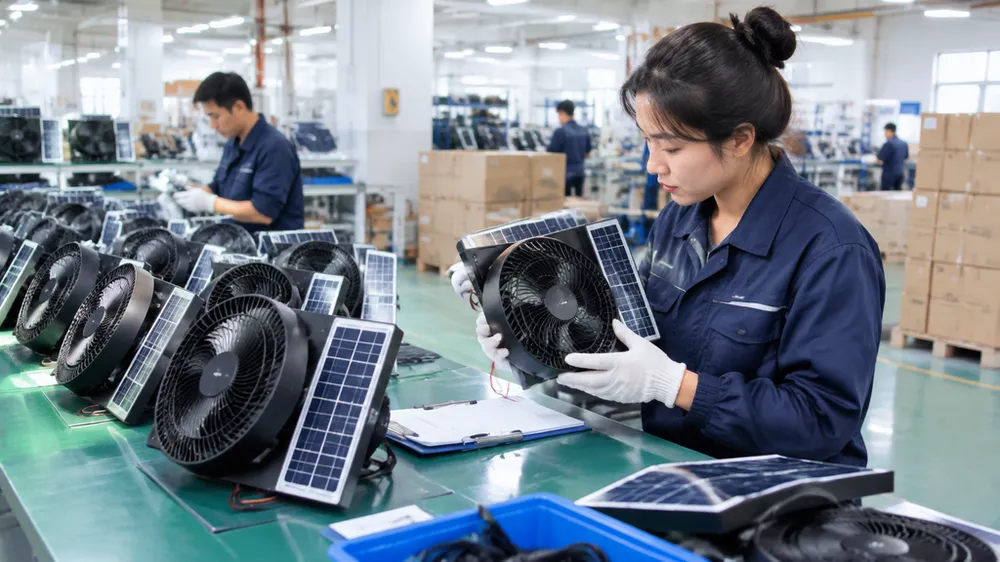
US distributors sourcing solar fans face a market compressed by commodity pricing and flooded with marketplace listings that don't distinguish between factories and trading companies. When a 12V solar fan retails for $35–50, your margin depends on landed cost control — and that starts with knowing whether you're ordering from a factory that owns its production lines or an agent who aggregates from three different workshops.
Factory-direct sourcing matters more for solar fans than for solar lighting because the product hit commodity economics faster. Simpler electronics, fewer regulatory barriers, and lower unit values mean distributors can't absorb middleman markups and still compete. The buyers who protect margin are the ones who verify factory ownership, lock MOQ flexibility for SKU testing, and confirm US compliance documentation before the first container ships.
Factory vs. Trading Company: Verification Checkpoints for US Importers
Most Alibaba and Made-in-China listings don't clarify whether you're dealing with a solar powered fan manufacturer or a sourcing agent. Trading companies aggregate orders from 3–5 factories depending on order size and product spec — which means quality variance between batches, lead time unpredictability, and reorder risk when they switch suppliers between your first and second order.
Factory verification starts with production line photos timestamped with a date card you specify in your request. Stock imagery from company profiles doesn't confirm current manufacturing capability. A real factory can send you photos of their SMT line, motor assembly station, solar panel testing bench, and aging test racks within 24 hours, with your specified date visible in frame.
Cross-check the business license registration scope. The license must explicitly include "manufacturing" or "production" in the business scope section — if it only lists "trading," "import/export," or "consulting," you're dealing with an agent. Request a utility bill matching the factory address. This eliminates office-only trading companies that list a factory address they don't own.
Why Alibaba "Gold Supplier" status doesn't confirm factory ownership: that badge validates payment history and platform engagement, not production capacity. We've seen agents with Gold Supplier status who've never owned a production line — they coordinate orders across multiple workshops and present themselves as integrated manufacturers.
Supply chain continuity risk compounds when agents switch factories between orders. Your first batch ships from Factory A with 20W solar panels and brushless motors. Your reorder ships from Factory B with 15W panels and brushed motors because the agent found a cheaper supplier. Specs drift, warranty claims increase, and your distributor brand takes the hit.
JXSOL operates a 12,000 m² facility in Guzhen Town, Zhongshan — the center of China's lighting manufacturing cluster. Six production lines dedicated to solar-powered products, with solar panel integration, battery matching, motor assembly, and charge controller testing in the same building. Utility bills, business license with manufacturing scope, and production line access available for audit. When you reorder, the same lines produce your units with the same component suppliers we've used since 2018.
MOQ Reality Check Across Manufacturer Tiers
MOQ determines whether you can test a solar fan OEM supplier with a trial SKU or commit to container-load inventory before validating market fit. US distributors need flexibility to test regional demand, confirm quality with actual customers, and avoid dead stock on untested models.
Tier 1 (1,000+ unit MOQ): Large-scale factories optimized for container loads. Lowest per-unit FOB cost, typically $8–12 for standard 12V models at 1,000+ units. Production scheduling favors high-volume repeat orders — small test orders queue behind container programs. If your target is national retail distribution with confirmed purchase orders, Tier 1 pricing matters. If you're testing a new market segment or validating a private-label concept, 1,000-unit commitment before customer feedback is high-risk.
Tier 2 (100–500 unit MOQ): Mid-scale factories with batch flexibility. FOB cost runs $12–18 per unit at 100–200 units, scaling down toward Tier 1 pricing at 500+ units. This tier fits US distributors who need to test SKU viability before scaling, validate quality with regional buyers, or serve project-based demand where order sizes vary. We see most factory direct solar fans programs start here — 100–200 units to test, then scale to 500–1,000 once the SKU proves itself.
Tier 3 (50–100 unit MOQ): Small workshops or trading companies aggregating orders from multiple small buyers to meet factory minimums. Per-unit cost looks attractive ($15–25), but reorder consistency becomes the issue. Your first batch might come from Workshop A, your second from Workshop B when the agent switches to a cheaper source. Component substitution (different battery brand, lower-grade solar cells, motor torque variance) and assembly quality variance increase warranty claim risk. For distributors building a brand, inconsistent reorders destroy customer trust faster than they save on first-order cost.
Why 100-unit MOQ matters: you can test one SKU per major region (Northeast, Southeast, Southwest, West Coast) with 25 units each, gather real sell-through data and warranty feedback, then commit to a scaling order with confidence. Or test three fan configurations (direct solar, battery-backed, LED combo) with 30–35 units each and let actual customer preference decide your main SKU — instead of guessing and over-committing inventory.
JXSOL's 100-unit MOQ on standard models (12V battery-backed solar fans, 20W panel, brushless motor) gives US distributors that testing flexibility. Once your SKU validates, we scale to container pricing at 500+ units with the same component specs and the same QC protocol — no switching factories, no component substitution, no reorder surprises.
US Market Compliance: Certifications That Matter for Import Clearance
US customs and retail channel requirements create compliance barriers that eliminate suppliers without proper documentation. FCC Part 15 Class B applies to solar charge controllers — any electronic device that generates radio frequency energy requires FCC certification for US market sale. Without it, your container clears customs but you can't legally sell the product, and major retailers (Home Depot, Lowe's, Tractor Supply) won't stock it.
ETL or UL listing confirms electrical safety for products with battery charging circuits and AC-to-DC components. Required by major retail chains and many commercial project specs. CE certification is the European standard — it doesn't satisfy US customs requirements, but it signals factory export maturity and quality system capability. If a factory has CE, adding FCC/ETL is a process they understand. If they have no export certifications at all, adding US compliance becomes a longer, riskier path.
RoHS compliance (lead-free solder, restricted hazardous substances) matters for California Prop 65 and federal e-waste regulations. Some states require RoHS documentation at point of sale. For US buyers managing import compliance across multiple states, RoHS certification simplifies legal risk.
Documentation requirement: per-order test reports, not generic certificates. A factory might have FCC/ETL certification for one solar fan model but not for the configuration you're ordering. Request test reports that match your actual order spec — solar panel wattage, battery capacity, charge controller model, motor type. Generic certificates from a different product don't protect your import clearance.
JXSOL's compliance package includes ISO 9001:2015 quality management certification, CE for European markets, and RoHS with per-order material declarations. For US buyers requiring FCC or ETL, we coordinate third-party testing and certification as part of OEM program setup — test reports issued per order, not reused from unrelated product runs. We've supported US distributors through import compliance for solar lighting since 2012; solar fans follow the same certification workflow with the same documentation standards.
OEM and ODM Engineering Capability by Manufacturer Type
OEM means you provide the design and the solar powered fan manufacturer produces to your spec — no engineering input required from the factory beyond feasibility review. ODM means the factory's engineering team modifies their reference design to match your brand requirements — you're customizing an existing platform rather than starting from scratch.
In-house engineering vs. outsourced design determines response time, IP control, and iteration cost. A factory with 15+ engineers on-site can run a design review, modify CAD files, adjust motor torque or panel wattage, and produce a prototype within 7–14 days. A factory that outsources design to an external agency quotes 30+ days for the same changes because coordination layers add time. When you need to adjust airflow CFM after the first prototype doesn't match field performance, in-house engineering iterates faster.
Customization scope for solar fans includes solar panel wattage (10W, 20W, 40W), motor torque rating (affects startup performance in low-sun conditions), airflow CFM (cubic feet per minute — the actual cooling capacity), battery capacity (determines runtime after sunset), and charge controller logic (direct solar vs. battery-backed, low-voltage cutoff settings). For distributors building a private-label line, custom housing colors, logo placement, and packaging design extend differentiation beyond standard catalog models.
Tooling cost for modified housing molds runs $500–2,000 depending on complexity — one-time cost amortized over your MOQ. If you're ordering 500 units and tooling costs $1,500, that adds $3 per unit to first-order cost. Reorders use the same tooling at no additional charge. Prototype turnaround: 7–14 days for factories with in-house engineering, 30+ days when design work is outsourced. Speed matters when you're testing multiple configurations to finalize your SKU before committing to production volume.
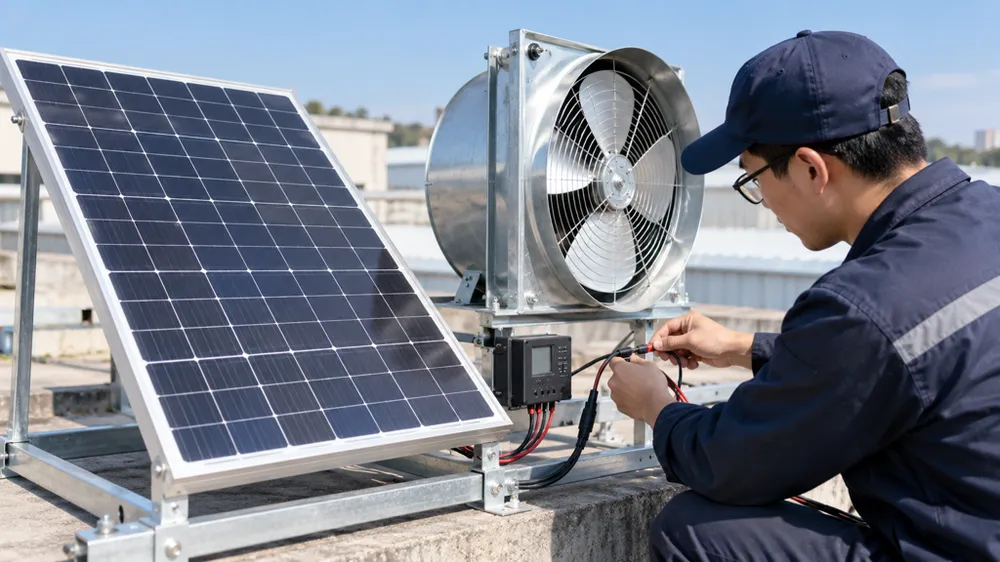
JXSOL's engineering team includes 15+ optical and electrical engineers who handle both our core solar lighting line and adjacent solar-powered products like fans and portable battery systems. Seven-day prototype turnaround for modified designs — motor spec changes, panel wattage adjustments, airflow rating modifications, charge controller logic updates. Customization scope covers the full solar fan configuration: panel, battery, motor, controller, housing. We don't outsource engineering, which means iteration cycles stay fast and design IP stays in-house.
Lead Time and Reorder Reliability Across Supply Chain Models
Standard lead time for factory-direct orders runs 15–25 days when components are in stock, 30–40 days for custom builds that require component procurement or tooling. Trading company lead time adds 10–15 days because the agent coordinates between your order, the factory's production schedule, and other buyers' orders in the same batch. If the factory prioritizes a larger buyer's order, your shipment delays — and the agent's leverage over factory scheduling is limited.
Reorder reliability risk surfaces when agents switch factories between orders. Your first batch used 20Ah lithium batteries from Supplier X. Your second batch uses 18Ah batteries from Supplier Y because the agent found a cheaper factory. Battery capacity drops, runtime decreases, customer complaints increase — but the spec sheet still says "20Ah" because the agent didn't update documentation. Motor torque variance and LED binning inconsistency follow the same pattern when factories change between orders.
Factory reorder advantage: same production line, same component suppliers, same inspection protocol. Batch control records let us trace every unit back to its component lot numbers, assembly date, and inspection results. When you reorder 500 units six months after your first order, we pull the same battery supplier, the same solar cell grade, the same motor spec — because we're not switching factories or aggregating from multiple workshops.
Why lead time matters for US distributors: solar fans are seasonal cooling products with narrow demand windows. If your lead time extends from 25 days to 45 days because the agent is coordinating multiple factories, you miss the regional peak season and carry unsold inventory into fall. Project timelines for commercial solar fan installations (greenhouses, warehouses, off-grid facilities) have fixed completion dates — late delivery means penalty clauses and lost future bids.
JXSOL lead time: 20 days for standard models (12V battery-backed, 20W panel, brushless motor), 35 days for OEM orders requiring custom configuration. Reorder specs guaranteed through batch control records retained for three years — when you reorder, we reference your original production batch and replicate component specs exactly. No factory switching, no component substitution, no "close enough" configurations.
10 Solar Fan Manufacturers US Buyers Can Verify and Compare

The suppliers below represent verified manufacturers and established trading companies serving US buyers. Ranking reflects factory verification signals, MOQ flexibility, US compliance readiness, and OEM engineering capability — not subjective quality claims we can't test remotely. Evidence comes from official company websites, business registration cross-checks, and publicly available certification documentation.
This is not a "Top 10 Best" ranking. It's a sourcing landscape map that helps you understand supplier models, commercial trade-offs, and verification checkpoints before your first order. JXSOL appears as a mid-list benchmark based on 100-unit MOQ flexibility and in-house engineering — positioned where our factory capabilities place us, not where self-promotion would prefer.
1. Quanzhou Yihua Electronic Co., Ltd.
Official URL: www.yihua-electric.com Location: Quanzhou, Fujian, China Supplier Type: Verified factory — business license confirms manufacturing scope, production facility photos available on company site
MOQ: 500 units for standard models, 1,000 units for OEM configurations. Tier 1 pricing structure optimized for container-load buyers.
Certifications: CE, RoHS, ISO 9001:2015. FCC and ETL available on request for US-bound orders — add 4–6 weeks to first-order lead time for third-party testing.
OEM/ODM Capability: In-house engineering team handles motor selection, panel sizing, and battery configuration modifications. Design partner relationships for custom housing molds. Prototype turnaround quoted at 15–20 days.
Lead Time: 25–30 days for standard models, 40–50 days for OEM orders including certification documentation.
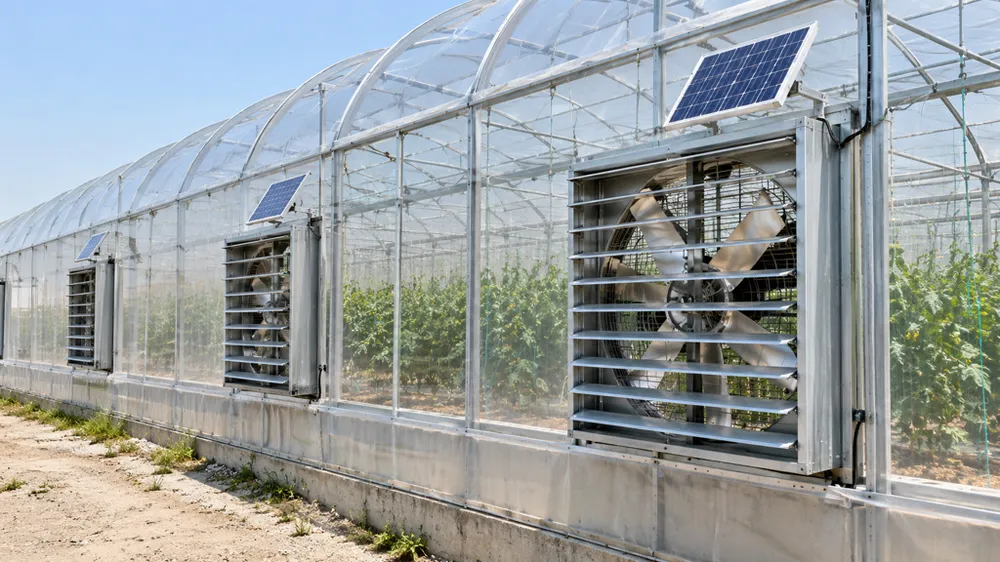
Specialty: High-capacity industrial exhaust fans (40W–60W panels, 3,000+ CFM airflow) for greenhouse, warehouse, and agricultural applications. Strong technical documentation and installation support for commercial project buyers.
US Buyer Fit: Best for distributors with confirmed container-load purchase orders and commercial project pipelines where high-CFM exhaust fans justify the higher MOQ commitment. Not ideal for SKU testing or low-volume regional trials.
2. Shenzhen Jutai New Energy Co., Ltd.
Official URL: www.jutai-energy.com Location: Shenzhen, Guangdong, China Supplier Type: Verified factory with integrated solar panel and battery pack production — component sourcing risk lower than factories that purchase all parts externally
MOQ: 300 units standard models, 500 units OEM. Mid-tier pricing with slight volume discount flexibility at 300+ units.
Certifications: CE, RoHS, ISO 9001, ISO 14001. FCC Part 15 Class B available for US market — factory maintains FCC test partnership, adds $0.80–1.20 per unit to base cost.
OEM/ODM Capability: 10+ engineers focused on solar-powered ventilation and cooling products. Customization scope includes panel wattage, battery chemistry (lithium vs. LiFePO4), motor type (brushless vs. brushed), and airflow CFM tuning. Prototype turnaround 10–15 days.
Lead Time: 20–28 days standard models, 35–45 days OEM including certification prep.
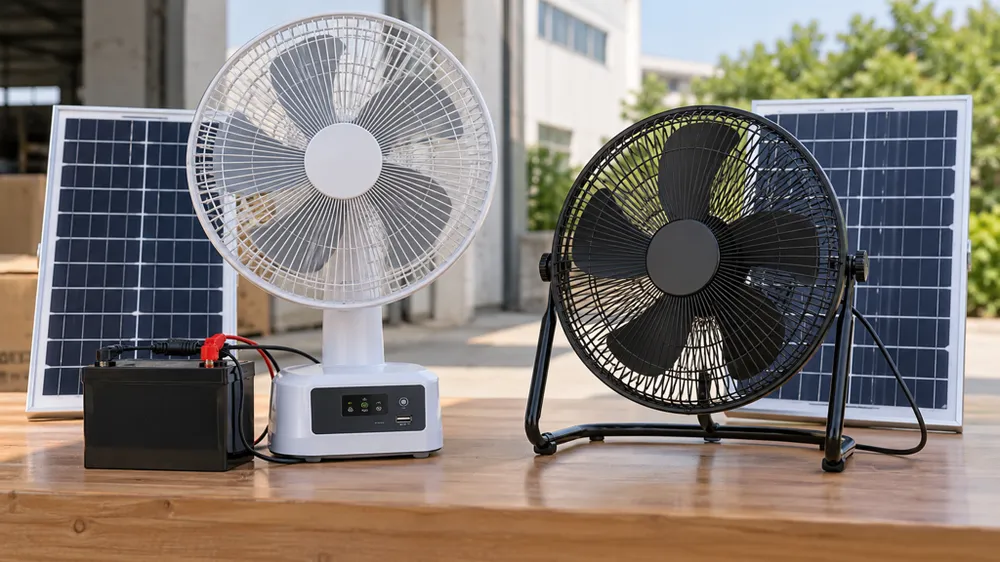
Specialty: Portable solar fans with integrated LED lighting and USB charging ports — multi-function designs for off-grid residential and RV markets. Strong consumer packaging and retail-ready presentation.
US Buyer Fit: Distributors targeting outdoor recreation, camping, RV accessories, and off-grid residential markets. Multi-function designs command higher retail margins but require buyer education on feature value. 300-unit MOQ balances testing flexibility with reasonable per-unit cost.
3. JXSOL (Zhongshan Century Juxing Optoelectronics Technology Co., Ltd.)
Official URL: www.jxsol.com Location: Guzhen Town, Zhongshan, Guangdong, China — center of China's lighting manufacturing cluster Supplier Type: Verified factory, 12,000 m² facility, 6 production lines dedicated to solar-powered lighting and adjacent solar products
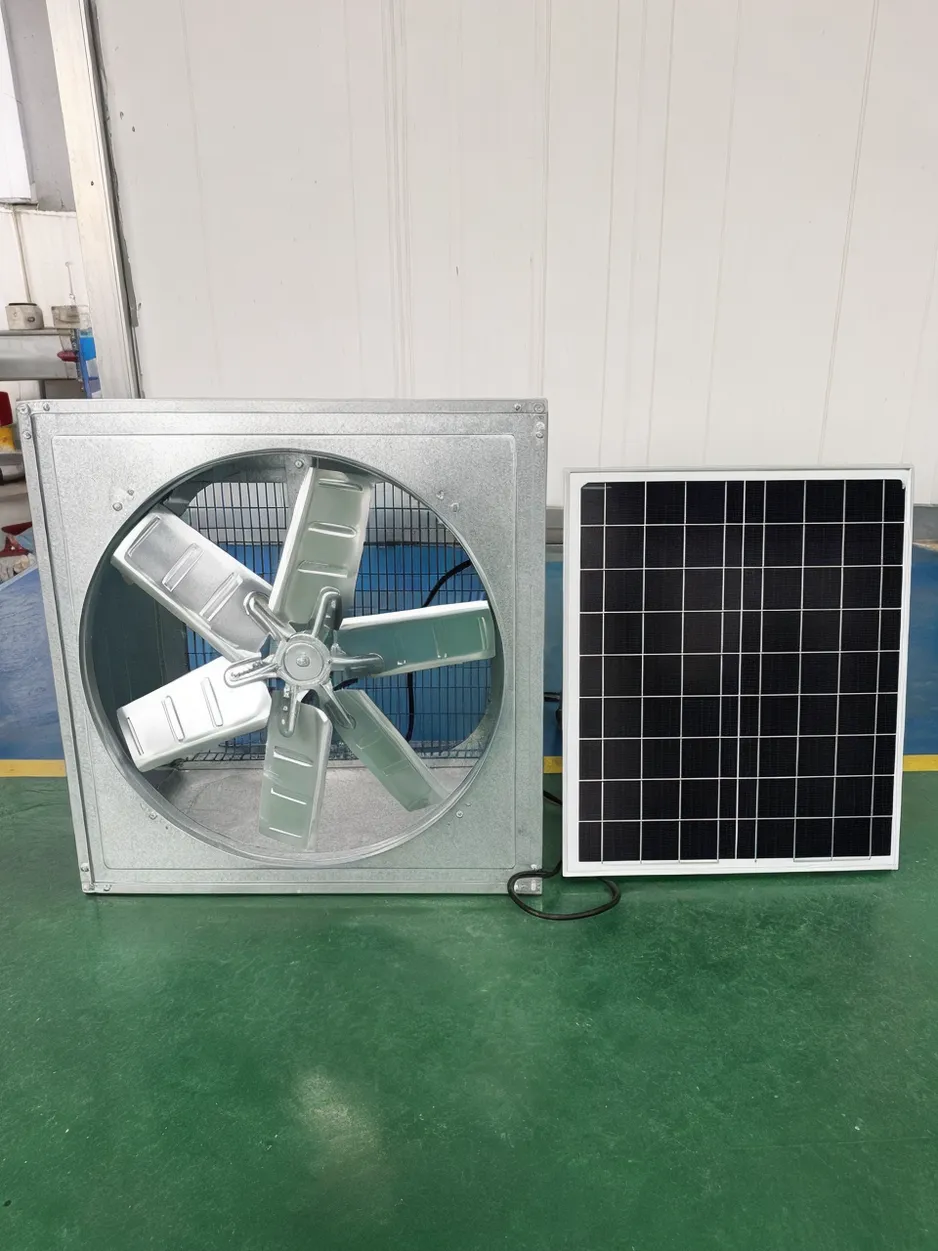
MOQ: 100 units for standard models (12V battery-backed solar fans, 20W panel, brushless motor). Scales to container pricing at 500+ units. Lowest MOQ among verified factories in this comparison.
Certifications: ISO 9001:2015, CE, RoHS with per-order material declarations. FCC and ETL available for OEM programs — coordinated through established third-party test lab relationships, adds 3–4 weeks to first-order timeline.
OEM/ODM Capability: 15+ optical and electrical engineers on-site. Core expertise is solar-powered outdoor lighting (13+ years), with solar fans supported as adjacent catalog extension for existing buyers. Customization scope: panel wattage (10W–40W), motor specs (brushless recommended for service life), airflow CFM adjustments, battery capacity sizing, charge controller logic. Seven-day prototype turnaround for modified designs — fastest in this comparison due to in-house engineering with no outsourced coordination.
Lead Time: 20 days standard models, 35 days OEM orders. Reorder specs guaranteed via batch control records retained 3 years — component substitution and spec drift eliminated through documented production tracking.
Primary Product Line: Solar-powered outdoor lighting (street lights, flood lights, security lights, garden lights). Solar fans positioned as catalog extension for buyers who want to broaden product mix without changing factory relationships. Not a dedicated solar fan specialist — a solar-powered product factory that supports fans within a broader solar catalog.
US Buyer Fit: Distributors testing SKU viability before scaling to container volume. Project buyers needing verifiable factory relationship and OEM flexibility without 500+ unit commitment. Private-label programs where 7-day prototype iteration speed matters for finalizing design before production. Best match for buyers who value supply chain continuity (same factory, same component suppliers, same QC protocol on reorders) over absolute lowest per-unit cost.
Contact: [email protected], +8615398807118 (WhatsApp)
4. Dongguan Sunworth Solar Energy Co., Ltd.
Official URL: www.sunworth-solar.com Location: Dongguan, Guangdong, China Supplier Type: Factory with strong solar panel manufacturing focus — motors and controllers sourced from component suppliers
MOQ: 500 units standard, 1,000 units OEM. Tier 1 structure similar to Yihua but with stronger emphasis on panel quality and solar efficiency.
Certifications: CE, RoHS, TÜV for solar panel components, ISO 9001:2015. US-specific certifications (FCC, ETL) available through OEM program but require 1,000+ unit commitment to justify testing cost amortization.
OEM/ODM Capability: Engineering team specializes in solar panel efficiency optimization and charge controller logic. Motor and airflow customization handled through design partner coordination — slower iteration than factories with full in-house mechanical engineering.
Lead Time: 28–35 days standard models, 45–55 days OEM with certification documentation.
Specialty: Solar panel efficiency and charge performance in low-light conditions. Buyers in northern latitudes or regions with frequent cloud cover benefit from panel optimization focus. Less emphasis on motor selection and airflow tuning compared to Yihua or Jutai.
US Buyer Fit: Commercial buyers prioritizing solar charging reliability over fan motor performance. Agricultural and greenhouse applications where panel efficiency matters more than peak CFM output. MOQ and OEM minimums favor established programs over test orders.
5. Foshan Hua Shang New Energy Technology Co., Ltd.
Official URL: www.huashang-solar.com Location: Foshan, Guangdong, China Supplier Type: Factory with dual focus on solar fans and solar-powered pumps — shared component platform reduces lead time for battery and controller procurement
MOQ: 200 units standard models, 400 units OEM. Mid-tier with better MOQ flexibility than Tier 1 factories but higher per-unit cost than 500+ container programs.
Certifications: CE, RoHS, ISO 9001. FCC available for US buyers, ETL requires buyer-initiated third-party testing coordination (factory provides technical documentation and samples).
OEM/ODM Capability: Engineering team handles panel sizing, battery configuration, and controller logic. Motor and housing customization through external design partner — adds coordination time. Prototype turnaround 12–18 days.
Lead Time: 22–30 days standard, 38–48 days OEM.
Specialty: Battery management and low-voltage protection logic — useful for off-grid applications where battery longevity matters more than peak cooling performance. Controller programming allows custom charge/discharge curves.
US Buyer Fit: Off-grid residential and portable power buyers who prioritize battery service life and charge management over maximum CFM output. 200-unit MOQ provides testing flexibility without dropping to workshop-tier suppliers. Better for niche off-grid markets than mainstream cooling distribution.
6. Ningbo Eternal Energy Technology Co., Ltd.
Official URL: www.eternal-energy.com Location: Ningbo, Zhejiang, China Supplier Type: Trading company with long-term factory partnerships — verified through business license (scope lists "trading" not "manufacturing"), but maintains consistent supplier relationships per company documentation
MOQ: 100 units mixed models (allows combining fan types in one order). Lower MOQ achieved through order aggregation across multiple buyers.
Certifications: CE, RoHS available through partner factories. FCC and ETL require buyer coordination directly with partner factory — trading company facilitates but doesn't control certification timeline.
OEM/ODM Capability: OEM programs coordinated through partner factories. Design iteration and prototype timelines depend on which factory the trading company assigns to your order — less predictable than direct factory engineering. Customization scope limited to configurations partner factories already support.
Lead Time: 25–35 days standard models, 50–60 days OEM due to coordination layers between buyer, trading company, and factory.
Specialty: Product breadth and mixed-order flexibility. Buyers who want to test multiple fan types (direct solar, battery-backed, exhaust, portable) without meeting separate MOQs per model. Useful for distributors building initial catalog breadth before committing to focused SKUs.
US Buyer Fit: First-time importers who want product variety without high per-model MOQ commitment. Accept longer lead time and coordination complexity in exchange for order flexibility. Not ideal for buyers prioritizing reorder consistency or long-term supply chain continuity — trading company may switch factories between orders if partner relationships change.
7. Guangzhou Anern Energy Technology Co., Ltd.
Official URL: www.anern-solar.com Location: Guangzhou, Guangdong, China Supplier Type: Verified factory with broad solar-powered product portfolio — fans are one category within larger solar lighting and power systems catalog
MOQ: 300 units standard models, 600 units OEM. Mid-tier with slight volume discount at 500+ units.
Certifications: CE, RoHS, ISO 9001, SASO (Saudi Arabia), SONCAP (Nigeria). Strong Middle East and Africa export focus with region-specific certifications. FCC and ETL available for US market through established testing partnerships.
OEM/ODM Capability: In-house engineering team with solar lighting background (similar to JXSOL positioning). Customization scope includes panel, battery, motor, controller. Prototype turnaround 10–14 days. Housing and mechanical design modifications require external tooling partner coordination.
Lead Time: 25–32 days standard, 40–50 days OEM.
Specialty: High-temperature and dusty environment adaptations — IP65 sealing, reinforced motor bearings, dust-resistant housing vents. Useful for Middle East, Africa, and Southwest US desert applications where environmental durability matters as much as cooling performance.
US Buyer Fit: Distributors serving Southwest US, Texas, Arizona, New Mexico markets where high heat and dust exposure require ruggedized designs. Commercial agricultural buyers in arid regions. 300-unit MOQ balances testing flexibility with factory-tier pricing. Export certifications for Middle East and Africa signal factory export maturity and documentation capability.
8. Shenzhen Tycorun Energy Co., Ltd.
Official URL: www.tycorun.com Location: Shenzhen, Guangdong, China Supplier Type: Verified factory specializing in lithium battery pack manufacturing — solar fans are application products for battery pack sales, not primary product focus
MOQ: 500 units standard models, 1,000 units OEM. High-tier MOQ reflects battery pack specialization and component integration complexity.
Certifications: CE, RoHS, UL 1642 (lithium cell safety), UN 38.3 (lithium battery transport), ISO 9001, ISO 14001. Strong battery-specific certifications. FCC and ETL for complete solar fan systems available through OEM program.
OEM/ODM Capability: Battery chemistry (lithium-ion, LiFePO4), capacity sizing, BMS (battery management system) programming, charge/discharge curve customization. Motor and fan engineering through design partner — battery integration is core strength, fan performance tuning is secondary.
Lead Time: 30–40 days standard, 50–60 days OEM.
Specialty: Battery service life, charge cycle longevity, and BMS protection features. Best match for buyers who prioritize battery performance (off-grid systems running on stored solar energy after sunset) over peak daytime cooling CFM. High-capacity battery configurations (40Ah+) for extended runtime applications.
US Buyer Fit: Off-grid power system distributors, solar battery pack buyers expanding into solar-powered appliances, buyers targeting extended-runtime applications where battery capacity matters more than motor specs. High MOQ and battery focus make this a poor match for general cooling distribution or low-volume testing programs.
9. Jiangsu SunRa Solar Technology Co., Ltd.
Official URL: www.sunra-solar.com Location: Yangzhou, Jiangsu, China Supplier Type: Verified factory with strong domestic China market presence and growing export portfolio — solar fans positioned as residential and small commercial cooling products
MOQ: 200 units standard models, 500 units OEM. Mid-tier with flexibility at 300+ units.
Certifications: CE, RoHS, ISO 9001, CCC (China Compulsory Certification — signals domestic market compliance capability). FCC and ETL available through OEM program coordination.
OEM/ODM Capability: Engineering team handles panel sizing, motor selection, battery configuration. Housing design modifications through external partner. Prototype turnaround 12–15 days. Documentation and technical support available in English but engineering communication primarily Mandarin — may require buyer to coordinate translation for detailed OEM specs.
Lead Time: 24–32 days standard, 40–50 days OEM.
Specialty: Residential and small office cooling — design emphasis on quiet motor operation and compact form factor rather than maximum CFM output. Useful for buyers targeting indoor or near-window installations where noise level matters.
US Buyer Fit: Distributors serving residential, small office, or bedroom cooling markets where quiet operation and compact design justify slightly lower CFM performance. CCC certification signals factory capability with domestic regulatory compliance — useful indicator for buyers evaluating quality system maturity. English communication may require additional coordination for detailed OEM programs.
10. Xiamen Solar First Energy Technology Co., Ltd.
Official URL: www.solarfirst-energy.com Location: Xiamen, Fujian, China Supplier Type: Factory with strong engineering culture and R&D investment focus — positioned as innovation-forward supplier with proprietary charge controller designs
MOQ: 400 units standard models, 800 units OEM. Higher MOQ reflects R&D investment recovery model and engineering resource allocation.
Certifications: CE, RoHS, ISO 9001, multiple utility patents for solar charge controller designs. FCC and ETL available for US market through established testing relationships.
OEM/ODM Capability: In-house engineering team with electrical engineering strength. Charge controller customization, panel efficiency optimization, low-light performance tuning. Motor and mechanical design through partner coordination. Prototype turnaround 14–18 days. Engineering documentation and technical depth strongest in this comparison group — useful for buyers with complex OEM requirements or proprietary feature needs.
Lead Time: 28–35 days standard, 45–55 days OEM.
Specialty: Charge controller innovation and low-light solar performance. MPPT (maximum power point tracking) charge controllers optimize panel output in variable sun conditions — useful for northern latitude markets or installations with partial shading. Higher engineering focus means slightly higher per-unit cost but better technical support for complex applications.
US Buyer Fit: Technical buyers and engineering-led distributors who value charge performance optimization and proprietary controller features. Northern US markets (Pacific Northwest, Northeast) where low-light performance matters. OEM programs requiring detailed technical collaboration and custom controller logic. Higher MOQ and cost justify when charge performance differentiation creates retail margin opportunity.
How to Audit a Solar Fan Manufacturer Before First Order
Remote factory verification eliminates 80% of marketplace suppliers who can't pass documentation and transparency checks. Request production photos with a date card you specify — printed or handwritten date visible in frame, showing SMT line, motor assembly station, solar panel testing bench, battery matching equipment, and aging test racks. Stock photos from company profiles don't confirm current production capability or factory ownership.
Cross-check business license registration scope. The license document must explicitly state "manufacturing" or "production" in the business scope field. If it only lists "trading," "import/export," "technology consulting," or "business services," you're dealing with an agent or trading company, not a factory. Request English translation of the business scope section if the original document is in Mandarin.
Ask for utility bill or property tax receipt matching the factory address listed on company website and business license. Office-only trading companies can't provide utility bills for manufacturing facilities they don't own. This single document eliminates most agent-disguised-as-factory listings.
Request sample with full inspection report — battery capacity discharge test (should match rated Ah within 5%), solar panel output test (should match rated wattage at standard test conditions), motor torque measurement, airflow CFM verification, charge controller function test. Sample cost ($50–150 including shipping) is insurance against ordering 500 units from a supplier who can't document QC protocol.
Video call factory tour verifies production lines, assembly stations, and testing equipment in real time. Request live walkthrough showing SMT line operation, motor assembly in progress, battery matching station with test equipment visible, aging test racks with units under load, and final inspection area. Recorded or edited videos don't confirm current capability — live call with specific requests (show the motor assembly station, walk to the solar panel testing area) confirms factory access.
Reference check: ask for 2–3 current US buyers — distributors or project contractors, not end consumers. Contact them directly and ask about reorder consistency, spec accuracy between batches, lead time reliability, and communication responsiveness. A factory confident in reorder quality provides customer references without hesitation. A factory that avoids reference sharing or only provides consumer testimonials raises supply chain continuity risk.

Pricing Structure and Payment Terms Across Manufacturer Tiers
FOB pricing for standard 12V solar fans (20W panel, 10–12Ah lithium battery, brushless motor, 1,500–2,000 CFM airflow) ranges from $8–15 per unit at 500-unit container-load MOQ, $12–20 per unit at 100–200 unit testing MOQ. Per-unit cost drops as order volume increases because factory fixed costs (line setup, component procurement, tooling amortization) spread across more units.
Price components that drive cost variance: solar panel wattage (20W panels cost $3–4 each, 40W panels cost $6–8), motor type (brushless motors add $2–3 per unit vs. brushed but deliver 3–5× service life), battery capacity (10Ah lithium packs cost $8–10, 20Ah packs cost $15–18), charge controller sophistication (basic PWM controllers cost $1–2, MPPT controllers add $3–5 but improve charge efficiency 15–25%).
Component quality tier affects long-term warranty cost more than first-order pricing. A-grade solar cells deliver rated wattage ±3% over 5+ years. B-grade cells might test within spec on arrival but degrade faster — 10–15% output loss after 18–24 months. The $1 per unit you save on B-grade cells costs you 20–30% warranty claim rate when customer fans stop charging properly after one year. For distributors building brand reputation, A-grade component cost is warranty insurance, not premium waste.
Payment terms for new buyers: 30% deposit via wire transfer when order is confirmed, 70% balance before shipment. Factory books production capacity and procures components after deposit clears. Balance payment triggers final inspection, container loading, and Bill of Lading issuance. For orders above $20,000, some factories accept Letter of Credit (LC) at sight — bank-backed payment that releases when shipping documents are presented.
Why pricing varies between factories at the same MOQ: Tier 1 factories achieve lower per-unit cost through volume scale and component purchasing power. Tier 2 factories accept slightly higher cost for MOQ flexibility and batch customization capability. Trading companies add 8–15% margin vs. factory-direct pricing because they coordinate orders across multiple buyers and factories — their margin is the convenience and aggregation service fee.
Hidden cost watch: some factories quote ex-works pricing (Shenzhen factory door, excludes domestic transport to port). Add $0.30–0.60 per unit for trucking to port and export handling to reach FOB Shenzhen or FOB Guangzhou pricing. Confirm whether quoted price includes domestic transport to port before comparing supplier costs.
Compliance documentation cost: FCC Part 15 Class B testing costs $800–1,500 per model, ETL listing costs $1,200–2,000. Amortized over 500 units, FCC adds $1.60–3.00 per unit, ETL adds $2.40–4.00 per unit to first-order cost. Reorders using the same certified model don't incur retesting cost — compliance investment pays back over subsequent orders.
Reorder Consistency and Long-Term Supplier Relationship Signals
Reorder consistency risk surfaces when component substitution, spec drift, or assembly quality variance occurs between your first and second order. Different battery brand (original order used Brand A 12Ah cells, reorder uses Brand B 11Ah cells marked as 12Ah), lower-grade solar cells (A-grade degraded to B-grade to reduce factory cost), motor torque variance (original brushless motor replaced with brushed to save $2 per unit) — your spec sheet stays the same but product performance degrades.
Factory signals for reorder reliability: batch control records that trace every unit to component lot numbers, assembly date, inspection results, and QC sign-off. Request batch control documentation for your first order — if factory can't provide traceability records, they're not tracking component sources or assembly quality systematically. Reorder consistency depends on records, not promises.
Component supplier contracts (not spot buys) indicate factory sources batteries, solar cells, motors, and controllers from the same suppliers across multiple orders. Spot purchasing saves factory cost short-term but introduces component variance between batches. Ask whether factory maintains annual or multi-year supply contracts with component vendors — long-term contracts signal reorder consistency prioritization.
Inspection lab on-site (not outsourced) means battery capacity testing, solar panel output verification, motor torque measurement, and charge controller function checks happen before units leave the production floor. Outsourced inspection adds time, cost, and coordination layers — and it's easier for factory to skip when schedule pressure increases. On-site inspection with dedicated QC team and test equipment signals quality commitment that survives production volume fluctuations.
Why reorder matters for US distributors: customer warranty claims reflect on distributor brand, not factory. Your customer doesn't care that the factory substituted a cheaper battery — they care that the fan stopped working after six months, and your company name is on the product. Brand damage from inconsistent reorders costs more than the $1–2 per unit the factory saved through component substitution.
Long-term relationship red flags: factory changes business name frequently (suggests legal issues or reputation reset), no repeat US buyers after 2+ years (suggests reorder problems drove customers away), warranty claim process undefined (no clear path for defect replacement or credit), sales contact turnover every 6–12 months (institutional knowledge and account continuity lost).
JXSOL reorder protocol: batch control records retained three years, component supplier relationships maintained since 2018 for solar cells and battery packs (same vendors, same grade specifications), 100% pre-shipment inspection with test report per order (battery discharge test, panel output verification, motor function check, charge controller validation), warranty process documented with defect replacement policy and credit terms for confirmed manufacturing defects. We track reorder customers by name, not order number — when you contact us for your second or fifth order, we reference your original production batch and component specs to ensure consistency without requiring you to re-specify everything.
When Local Supply Makes Sense vs. When Factory-Direct Import Improves Economics
Local US suppliers (importers, distributors, warehouse stockists) provide speed, predictability, and inventory access without container-load commitment. If you need 20 solar fans for a project that breaks ground in three weeks, local supply ships in 3–5 days vs. 25–40 days for factory-direct import. Emergency replacement orders, small test quantities, and fast-turnaround projects favor local convenience.
Factory-direct import becomes financially smarter at repeat volume, private-label programs, and cost-sensitive competitive bidding. If you're distributing solar fans across 15–20 retail accounts, importing 500 units at $12 FOB vs. buying 500 units locally at $22 delivered saves $5,000 per order — enough margin difference to fund marketing, absorb one warranty claim batch, or undercut competitor pricing and still protect margin.
Local premium (the cost difference between local distributor pricing and factory-direct landed cost) typically runs 40–80% depending on product category, supplier tier, and order volume. That premium pays for warehousing, inventory risk, credit terms, and domestic shipping speed. When your business model depends on rapid inventory turns and small per-account orders, local premium is supply chain efficiency cost. When you're building catalog depth and can commit to container-load replenishment cycles, factory-direct margin improvement compounds over multiple orders.
Quality control advantage for factory-direct: you specify component grades, review pre-production samples, and approve batch production before shipment. Local supply means accepting whatever spec the importer chose — often optimized for their cost structure, not your quality requirements. For distributors building brand reputation on product reliability, factory-direct control over component quality prevents warranty claim exposure that local supply can't address.
OEM and private-label programs require factory-direct relationships. Local suppliers can't modify motor specs, adjust panel wattage, customize housing colors, or add logo placement — they stock what they stock. If your margin strategy depends on differentiation through private-label branding or custom configurations, factory-direct sourcing is the only path.
Scenario fit guide: local supply for urgent orders under 50 units, initial market tests under $3,000 order value, emergency replacement when customer projects can't wait; factory-direct import for repeat programs above 200 units, private-label development, competitive bids where landed cost determines win/loss, catalog expansion where 40–80% margin improvement funds growth.
The buyers who win in compressed-margin solar fan distribution are the ones who use both channels strategically — local supply for speed and flexibility when time matters more than cost, factory-direct import for volume programs where margin improvement funds market expansion.
JXSOL positions as factory-direct alternative for US buyers who've tested local supply, validated SKU fit, and now need margin improvement and OEM flexibility to scale. Our 100-unit MOQ lets you transition from local test orders to factory-direct production without jumping to 500+ container commitment before your distribution network is ready. Seven-day prototype turnaround and in-house engineering support OEM programs that local suppliers can't accommodate. We're not competing with local suppliers on 20-unit emergency orders — we're competing on repeat volume where landed cost and reorder consistency determine your profitability over the next 12–24 months.
Send us your solar fan specs, target order volume, required certifications, and any OEM or private-label requirements. We'll respond with configuration options, factory-direct pricing, lead time confirmation, and compliance documentation plan. If your program requires FCC or ETL certification, we coordinate third-party testing and provide per-order test reports — not generic certificates from unrelated product runs.