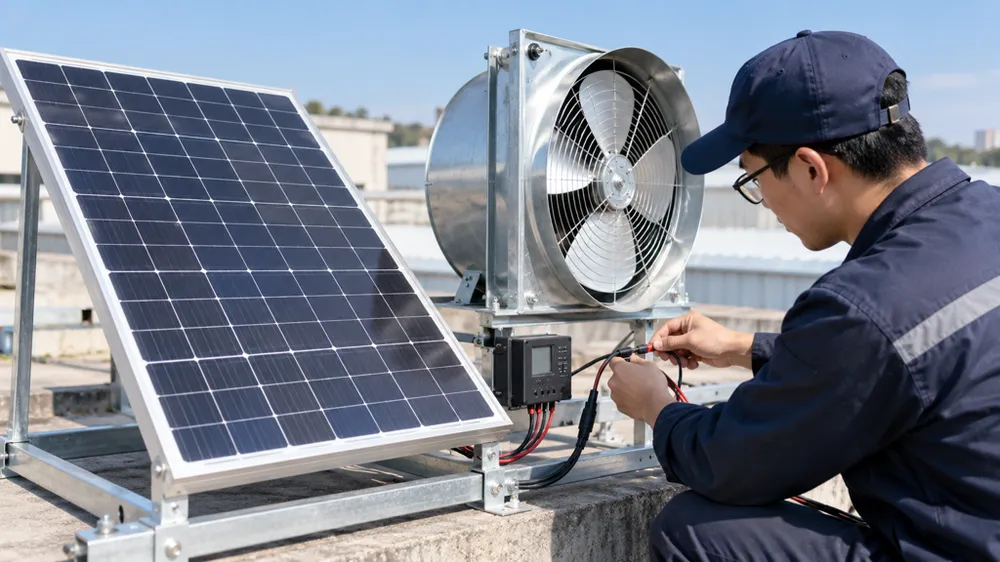
The Core Formula — Panel Wattage Equals Fan Load Times Three Derating Layers
Solar fan panel sizing starts with a formula that accounts for three realities your fan manufacturer may not mention: motors draw more power during startup than steady operation, every wire and connection bleeds efficiency, and the sun doesn't shine at rated panel output for 12 hours a day.
The base formula is:
Panel Wp = (Fan rated watts × Motor derating factor × System loss factor) / Peak sun hours
Each variable carries real-world consequences. The motor derating factor accounts for inrush current — the surge a motor demands when it spins up from a standstill. For DC brushless fans (the type used in most solar applications), this factor runs between 1.2× and 1.5× the nameplate wattage. Larger fans and those with sealed bearings sit at the high end of that range.
The system loss factor covers wiring resistance, controller inefficiency, and temperature derating. Solar panels lose 10-15% of rated output when surface temperature climbs above 25°C (standard test condition), which happens in real installations. Add cable voltage drop and charge controller conversion losses, and you're looking at a 1.25× multiplier minimum.
Peak sun hours vary by latitude and season. Northern Europe in winter delivers around 3.5 hours of usable solar production per day. The Middle East in summer can hit 5.5 hours. Most B2B buyers size systems for the worst-case season at their deployment latitude, not annual averages — a fan that stops working in December because you calculated for June is a warranty claim waiting to happen.
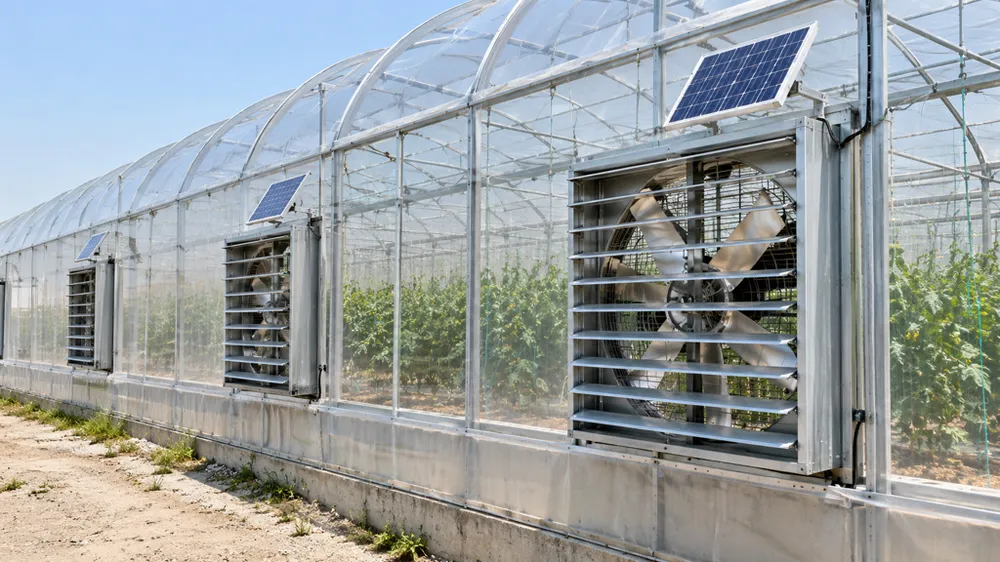
Here's a worked example: You're sourcing a 20W fan for greenhouse ventilation. Motor derating for a brushless fan is 1.3×. System losses are 1.25×. Your site gets 4.5 peak sun hours during the target season.
(20W × 1.3 × 1.25) / 4.5 hours = 7.2W minimum panel capacity
Round up to 10W to account for panel aging and dust accumulation over the product's service life. That's the actual spec you send in an RFQ, not the 20W number on the fan motor label.
Worked Examples for Common Fan Motor Loads
Sizing accuracy starts with reference points. Below are baseline panel specs for four common fan wattages deployed in commercial and agricultural applications. These figures assume full-sun conditions, standard MPPT controller efficiency, and conservative peak sun hours.
| Fan Wattage | Motor Type | Derating Factor | Peak Sun Hrs | Minimum Panel Wp | Recommended Panel Wp |
|---|---|---|---|---|---|
| 10W | Small ventilation (brushless DC) | 1.2× | 4.5 | 3.3W | 5W |
| 20W | Residential exhaust (brushless DC) | 1.3× | 4.5 | 7.2W | 10W |
| 30W | Greenhouse circulation (brushless DC) | 1.3× | 4.5 | 10.8W | 15W |
| 50W | Livestock barn (brushed DC) | 1.5× | 4.0 | 23.4W | 30W |
The "Recommended" column adds 20% margin for two factors that reduce panel output over time: photovoltaic cell degradation (0.5-0.7% annually for monocrystalline panels) and surface dust accumulation. Buyers who size to the minimum often face premature battery failures or motor stalling after 18-24 months when panel output drops below the threshold needed to fully charge the battery during available sunlight.
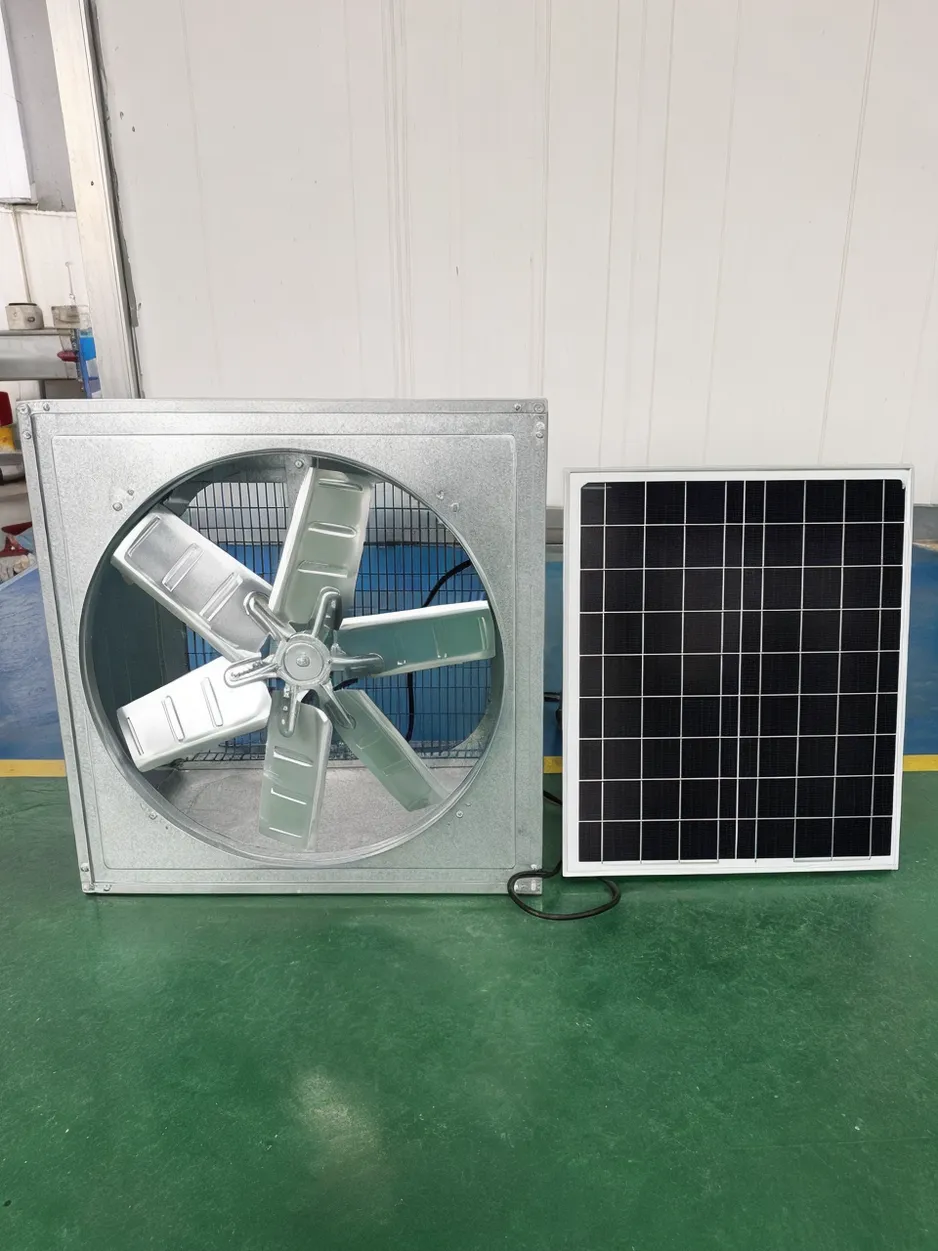
One note on brushed vs. brushless motors: brushed DC motors (still common in higher-wattage agricultural fans) have higher inrush current due to mechanical commutation and require the upper end of the derating range. If your fan supplier can't specify motor type, assume brushed and use 1.5× to avoid undersizing.
These are baseline calculations. Deployment in partial-shade conditions, high-latitude winter operation, or sites with extended cloudy periods requires further adjustment covered in the sections below.

Why MPPT vs. PWM Controller Choice Changes Your Panel Spec
The charge controller sitting between your panel and battery determines how much of the panel's rated output actually reaches the battery. There are two types in common use, and the efficiency gap between them directly affects panel sizing.
MPPT (Maximum Power Point Tracking) controllers continuously adjust electrical load to harvest maximum power from the panel across varying irradiance and temperature conditions. In real-world testing, MPPT controllers extract 15-25% more usable power from the same panel compared to PWM, with the largest gains in cold weather or partial-shade scenarios.
PWM (Pulse Width Modulation) controllers are simpler and cheaper — they regulate battery charging by switching panel current on and off at high frequency. They work, but they don't optimize panel voltage to match battery state, so you lose harvesting efficiency whenever panel voltage exceeds battery voltage (which is most of the time in full sun).
Here's the sizing impact: if your system uses PWM instead of MPPT, increase panel wattage by 20% to compensate for lower conversion efficiency. That 10W panel recommendation for a 20W fan becomes a 12W panel with PWM. The controller cost difference is $8-15 at factory pricing, but the panel wattage increase to make up for PWM losses costs more than that — so MPPT usually wins on total BOM.
Most factory-integrated solar fan systems use MPPT because the controller cost is amortized across the entire product configuration. DIY buyers often cheap out with PWM and then undersize the panel because they're calculating from panel nameplate ratings without accounting for controller losses. That combination — undersized panel plus inefficient controller — is the leading cause of "solar fan stopped working after three months" complaints we see in distributor warranty returns.
If you're sourcing from a manufacturer who integrates the controller into the fan assembly (like JXSOL does for OEM solar fan configurations), MPPT is standard and you can size panels using the baseline formulas above. If you're buying components separately and assembling systems yourself, verify controller type and adjust panel specs accordingly.
Battery Autonomy and Its Effect on Panel Sizing
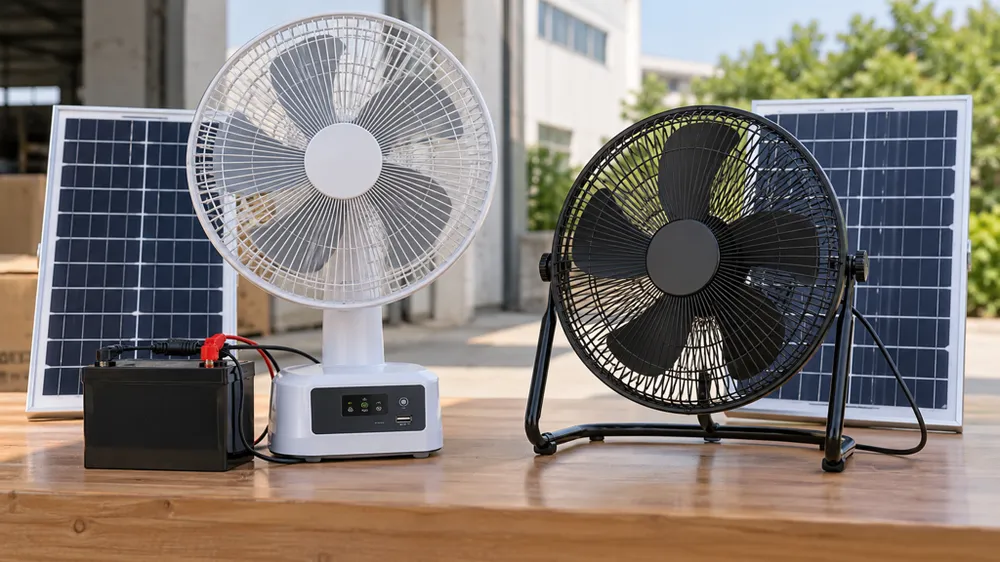
Panel sizing changes dramatically when the fan must run 24/7 with multi-day battery autonomy. Applications like livestock barn ventilation, poultry house exhaust, and greenhouse humidity control can't tolerate gaps in airflow — which means the battery must store enough energy to cover nighttime operation plus 1-2 days of cloudy weather, and the panel must be large enough to replenish that reserve.
The calculation sequence is: determine daily fan consumption, multiply by required autonomy days, size the battery to that capacity, then size the panel to recharge the battery within available peak sun hours.
Here's an example: a 20W fan running 24 hours per day consumes 480 watt-hours (Wh) daily. If the application requires 2 days of autonomy (fan must keep running through two consecutive cloudy days), the battery must store 1,440Wh minimum. To recharge that capacity in 4.5 peak sun hours, the panel must deliver 320W — before system losses and derating. After applying the 1.25× system loss factor and 1.15× safety margin for panel aging, the real spec is closer to 460W.
That's a 46:1 ratio between panel wattage and fan wattage, versus the 1:2 ratio for a fan that only runs during daylight hours with no autonomy requirement. Many buyers underestimate autonomy needs because they're thinking about average weather, not the worst-case scenario that defines system reliability. A greenhouse fan that stops during a three-day storm causes crop loss worth 50× the cost of properly sizing the system upfront.
JXSOL's OEM process includes autonomy requirement intake before finalizing panel and battery specs. If your RFQ specifies "fan must run continuously with 48-hour autonomy," the engineering team sizes the battery for that load profile and then calculates panel wattage to maintain battery state of charge across your deployment latitude and season. You receive a validated system, not a component list you have to integrate and hope works.
One autonomy detail that catches buyers: if you're sizing for 24/7 operation with 2-day autonomy, you need 3 days' worth of battery capacity, not 2. The battery must hold enough energy to cover two full cloudy days PLUS the overnight discharge that happens every night. Miss that and your "2-day autonomy" system fails on the second night of a storm.
Partial-Shade and Low-Irradiance Derating
Solar panel wattage ratings assume 1000 W/m² irradiance and 25°C cell temperature — laboratory conditions that don't match most real-world installations. If your deployment site sees consistent shading from nearby structures, trees, or terrain, or if you're installing at high latitude with low winter sun angles, panel output can drop to 40-60% of nameplate ratings.
The derating multiplier depends on how much irradiance the panel actually receives. If site conditions deliver less than 70% of rated irradiance (verified with a solar pathfinder tool or PVGIS simulation), increase panel wattage by 1.5× minimum. For sites with heavy shade or extreme high-latitude winter deployments, you may need 2× or more.
Partial shade is more destructive to panel output than uniform low light. When one section of a panel is shaded and the rest is in sun, the shaded cells act as resistive loads that drag down the entire string. Bypass diodes mitigate this somewhat, but you still lose 30-50% of total panel output from shading just 20% of the panel surface. That's why partial-shade installations require either significant panel oversizing or a redesign that moves the panel to a location with consistent full-sun exposure.
There's no controller efficiency gain that can compensate for insufficient photon input. If your panel isn't receiving enough light, an MPPT controller will extract every available watt more efficiently than PWM — but "efficient harvesting of inadequate input" still results in an undercharged battery and a stalled fan.
Buyers sourcing for high-latitude or shaded applications should provide site irradiance data in their RFQ. A PVGIS output report (free tool, covers global locations) shows monthly irradiance and peak sun hours for your specific coordinates. That data allows factory engineering to calculate realistic panel specs instead of guessing. If you send an RFQ that says "greenhouse in Norway" without irradiance data, the factory will either quote conservatively (expensive) or optimistically (underperforms), because there's no shared baseline.
What Happens When You Undersize the Panel
Chronic undercharging from an undersized panel creates a failure cascade that shows up 6-18 months after installation. The battery never reaches full charge during daylight hours, so it operates in a partial state-of-charge cycle. Lead-acid and AGM batteries develop sulfation — crystalline lead sulfate deposits on the plates that permanently reduce capacity. Lithium batteries fare better but still degrade faster under chronic shallow-discharge cycling.
As battery capacity drops, available runtime shrinks. A fan that initially ran through the night starts cutting out a few hours before sunrise. If the load is a brushless DC fan with low-voltage cutoff protection, the motor stops cleanly. If it's an older brushed motor without cutoff protection, the controller may allow the battery to deep-discharge, which accelerates degradation further.
Eventually the battery voltage sags below the controller's startup threshold even during daytime, and the fan won't spin up at all. At that point the buyer faces a field service call to diagnose the issue, a replacement battery (often expedited shipping because the fan is mission-critical), and possible panel replacement if the original spec was too far off.
Warranty claims from undersized systems are rarely covered. The failure mode is misapplication — wrong component spec for the duty cycle — not a manufacturing defect. The buyer owns that risk, and the total cost of fixing an undersized system in the field runs 3-5× the upfront cost difference between "minimum" and "recommended" panel specs.
We've seen this pattern repeatedly in distributor returns: buyer sources a 20W fan and a 10W panel based on "fan wattage equals panel wattage" advice from a generic solar forum, deploys 50 units in a project, and 18 months later half the systems are failing. The fix is straightforward — swap in 15W panels — but now you're paying for truck rolls, warranty labor, and customer relationship damage that didn't need to happen.
The Cost of Over-Spec'ing vs. Under-Spec'ing
Panel wattage decisions come down to balancing upfront BOM cost against field failure risk. Over-spec'ing adds 10-15% to the panel line item but eliminates the failure modes described above. Under-spec'ing saves less than 5% on total system cost (panels are cheap compared to controllers and batteries) but creates a 20-30% probability of premature battery replacement within the first two years.
For project deployments — 50+ units going into a commercial or agricultural installation — the cost of one truck roll for troubleshooting exceeds the savings from undersizing 50 panels. Field service rates for electrical contractors run $150-300 per site visit before parts and labor. If 10 out of 50 undersized systems fail and require service calls, you've spent $1,500-3,000 fixing a problem that would have cost $200 upfront to prevent (10W panel vs. 15W panel, $20 delta per unit at distributor pricing).
Distributors and contractors should default to the "Recommended" column in sizing tables, not the "Minimum." The margin covers panel degradation, dust accumulation, and provides headroom for sites that turn out to have slightly less irradiance than expected. Brand owners sourcing for resale should specify recommended specs in product configurations — your end customers don't know the difference between minimum and recommended, but they'll remember if the product stops working after a year.
The buyers who most often undersize are those comparing quotes from multiple suppliers and choosing based on lowest landed cost without understanding what's behind the BOM differences. A $95 solar fan with a 10W panel looks like a better deal than a $110 unit with a 15W panel until you factor in the field failure rate and warranty cost. Total cost of ownership favors correct sizing, not minimum BOM.
How Factory-Level Panel-Motor Matching Reduces Buyer Risk
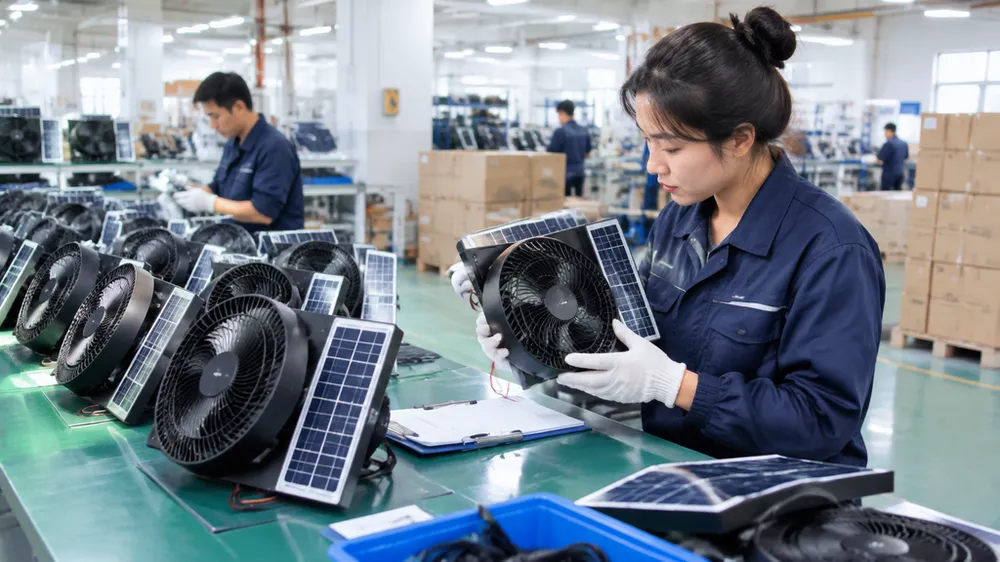
When you source a solar fan from a manufacturer who integrates panels, controllers, batteries, and motors in-house, panel sizing is validated during product configuration — not left as a calculation problem for the buyer to solve. Factory engineering reviews target duty cycle, deployment latitude, and autonomy requirements before finalizing the BOM. What ships is a system that's been load-tested as an assembly, not a collection of components you hope will work together.
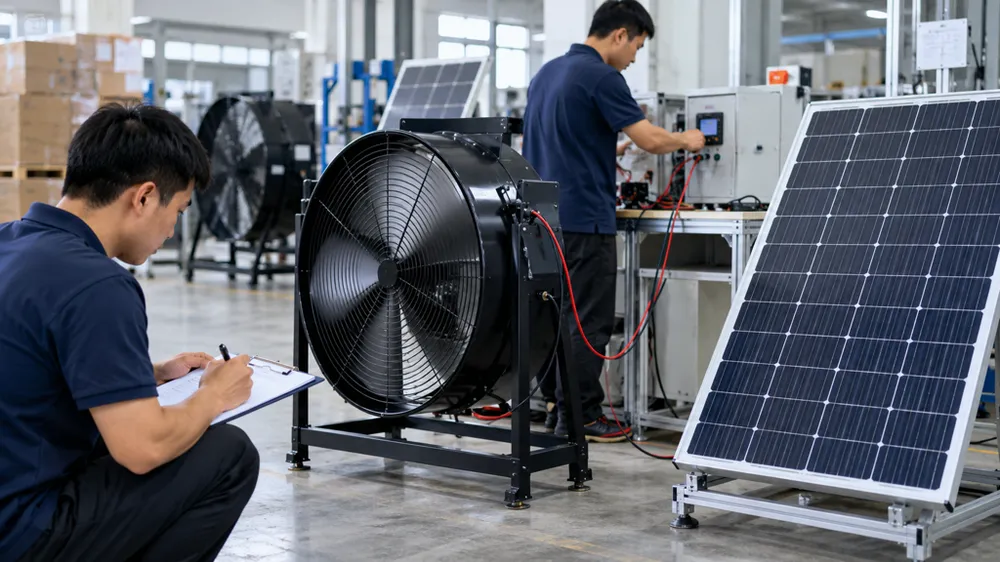
At JXSOL, solar fan configurations go through a pre-production validation cycle that includes motor startup inrush measurement, controller efficiency confirmation under varying input voltage, and battery charge/discharge cycling over simulated cloudy periods. If a buyer specifies "30W fan, greenhouse deployment in Northern France, 18-hour summer duty cycle, 2-day autonomy," the engineering team models that scenario and sizes the panel to maintain battery state-of-charge across June-August irradiance patterns at 48-49°N latitude. The system that ships has documentation showing actual power draw, charge recovery time, and autonomy runtime under those conditions.
Contrast that with buying a fan motor from Supplier A, a solar panel from Supplier B, and a charge controller from Supplier C, then assembling them yourself or handing the parts to an electrician. If the system underperforms — fan stalls after two cloudy days, battery dies after 18 months, controller overheats under load — which supplier is responsible? Supplier A will say the panel was undersized. Supplier B will say the controller was inefficient. Supplier C will say the motor inrush exceeded spec. You own the integration risk, and there's no warranty coverage because no single supplier sold you a complete system.
Factory-integrated systems arrive with a system-level warranty. If the fan stops working due to inadequate panel capacity, that's the manufacturer's problem — the panel spec was part of the validated configuration, so the manufacturer either fixes it under warranty or issues a replacement. That shifts accountability from the buyer to the factory, which is where it belongs when you're paying for an engineered product rather than buying discrete components.
For OEM and ODM orders, JXSOL's engineering team can model panel sizing for deployment scenarios that don't match our standard catalog. If you're a distributor entering a new geographic market and need solar fans configured for your region's irradiance and temperature conditions, we run the calculations using your site data and adjust panel and battery specs accordingly. That configuration becomes your SKU, and reorders pull from the validated BOM. You're not guessing and hoping — you're sourcing a product that's already been proven to work in your target environment.
The value of factory-level panel-motor matching isn't convenience. It's validated system performance and clear warranty accountability. If something fails, there's one supplier to call, and that supplier has full documentation of the system design and test results. Compare that to a field failure where you're coordinating between three suppliers who all claim the other guy's component was the problem.
What to Specify in Your RFQ for Solar Fan Systems
Accurate panel sizing requires site-specific data that most buyers don't think to include in an RFQ. If you send a request that only lists "need 100 units of 20W solar fan," the supplier has to guess at duty cycle, autonomy requirements, and deployment conditions. That guess is either conservative (you pay for oversized panels you don't need) or optimistic (the system underperforms in the field).
Here's the minimum data set for an RFQ that allows factory engineering to calculate correct panel and battery specs:
- Fan rated wattage (motor nameplate, not airflow CFM)
- Daily run hours (e.g., "daylight only," "18 hours," "24 hours continuous")
- Required battery autonomy in days (e.g., "must run through 2 cloudy days")
- Deployment latitude or city name (determines peak sun hours and seasonal variation)
- Shading conditions (full sun, partial shade from structures/trees, or unknown)
Optional but useful data:
- Site irradiance from PVGIS or similar solar resource tool (monthly kWh/m²)
- Altitude (affects panel temperature derating — panels lose efficiency at high altitude due to thinner atmosphere and lower air cooling)
- Controller preference (MPPT vs. PWM, or "factory recommendation")
If you're sourcing for project deployment rather than resale, specify worst-case duty cycle and autonomy — not average conditions. A fan that runs 12 hours per day on average but needs to handle 18-hour summer days should be spec'd for 18 hours. A system that normally sees 4.5 peak sun hours but occasionally goes through week-long storms should be sized for the extended cloudy period, not typical weather.
JXSOL's RFQ template includes fields for duty cycle, latitude, and autonomy. Buyers who fill those fields receive a panel-motor configuration validated by the engineering team against their specific deployment scenario. Buyers who skip those fields get a standard catalog configuration that may or may not match their needs — we can't engineer what we don't know about.
One RFQ detail that affects lead time: custom panel sizing (outside our standard 10W/15W/30W catalog specs) adds 7-10 days to production schedule because panels are sourced to match the validated BOM. If your order timeline is tight, check whether your requirements fit within standard configurations before committing to delivery dates.
Panel Sizing as Part of System Validation, Not a Standalone Calculation
Solar fan panel sizing isn't an isolated math problem you solve once and forget. It's one variable in a system design that includes battery charge/discharge behavior, controller efficiency curves, motor load profiles, and environmental conditions that change seasonally. Treating panel selection as "just pick a wattage from a calculator" sets you up for field failures that no single component swap can fix.
The buyers who run into trouble are those who assume solar components are interchangeable commodities — any 20W panel will work with any 20W fan as long as the numbers match. That ignores motor inrush current, controller losses, temperature derating, and a dozen other factors that separate a system that works from one that fails after the first cloudy week. If you're assembling a solar fan system from separate suppliers, you need an electrical engineer to validate the design before you order 500 units. If you're sourcing from a factory that handles panel-motor matching in-house, that validation is part of the product development process and the cost is already built into your unit price.
The value proposition is clear: integrated systems from a manufacturer like JXSOL cost 10-15% more per unit than buying the cheapest fan and panel you can find on Alibaba and hoping they work together. But integrated systems arrive with load test data, warranty coverage, and accountability. DIY-assembled systems cost less upfront and frequently cost more over the product lifecycle once you factor in field failures, troubleshooting time, and warranty disputes between suppliers.
Your sourcing decision comes down to where you want the risk to sit. If you have in-house engineering capacity and want to own system integration, buy components separately and validate the design yourself. If you're a distributor, contractor, or brand owner who needs products that work without requiring an electrical engineering review for every order, source from a factory that does panel-motor matching as part of product configuration. Both paths can work — but they require different levels of technical resource on your end, and that difference should inform which supplier relationship makes sense for your business.