

Commercial Solar Flood Lights Direct From Factory
Project-grade commercial solar flood lights — configurable output, IP65/IP67 construction, and factory-direct supply from 100 units.
Built for outdoor commercial and industrial sites where grid trenching adds cost and installation complexity. Backed by 13+ years of solar lighting production, in-house engineering, and 100% pre-shipment inspection.
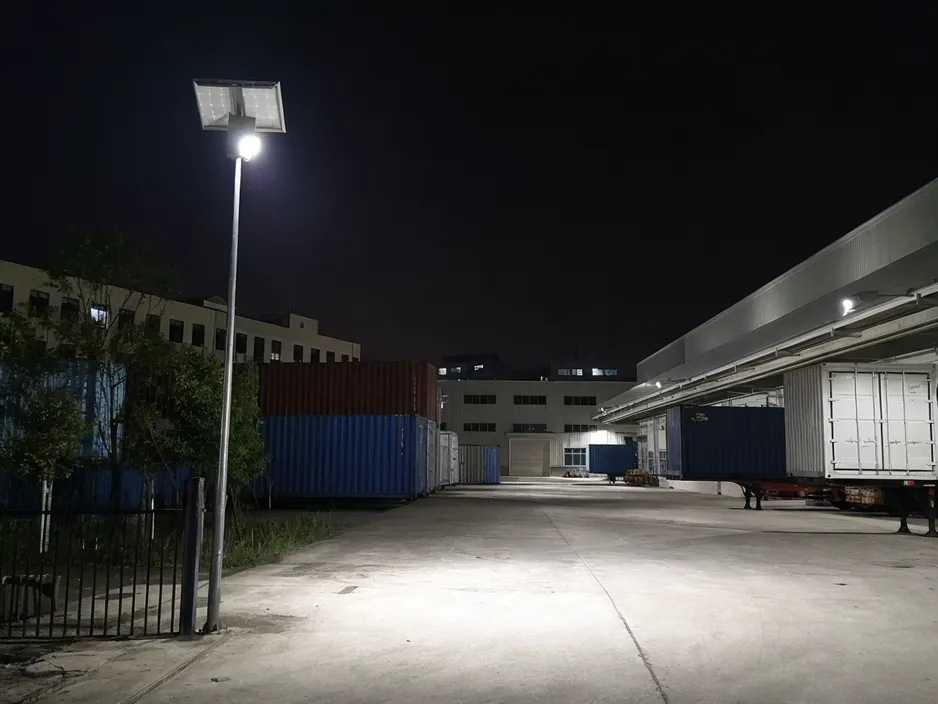
Project-Grade Commercial Solar Flood Lights for Bulk Deployment
Commercial solar flood lights are outdoor area lighting fixtures that run entirely on solar power — no grid connection, no trenching, no ongoing electricity cost at the installation site. The buyer case for this product is straightforward: any outdoor commercial or industrial site where running conduit and wiring adds significant project cost is a candidate for solar flood lighting. That includes logistics yards, warehouse perimeters, construction compounds, agricultural facilities, rural commercial properties, and security-sensitive sites where grid access is limited or expensive.
What separates commercial solar flood lights from household solar flood lights is the specification level. Commercial and industrial solar flood lights are sized for higher lumen output, longer battery autonomy, larger solar panels, and more robust housing — because the buyer is deploying them in bulk across a project site, not mounting one unit above a residential garage. The configuration decisions (panel wattage, battery capacity, lumen output, sensor logic, mounting bracket) need to match the site's actual conditions, not a retail product's default settings.
We are JXSOL, the export brand of Zhongshan Century Juxing Optoelectronics Technology Co., Ltd., a solar lighting manufacturer based in Guzhen Town, Zhongshan, Guangdong. We have been producing solar outdoor lighting since 2012 — flood and security lights, street lights, parking lot lights, and the full range of outdoor solar categories. Our production is in-house, our engineering team is on-site, and our inspection lab is in the same building where the product is assembled.
If you are sourcing commercial solar flood lights for a project, a distribution catalog, or a private-label program, send us your project details and quantity — we will recommend a configuration and quote based on your site requirements.
Logistics & Warehousing
Perimeter and yard lighting for 24-hour operations without grid extension.
Construction Compounds
Temporary site lighting that relocates with the project phase.
Agricultural Facilities
Rural properties where grid access is limited or cost-prohibitive.
Security-Sensitive Sites
Perimeter deterrence and surveillance support with motion-triggered modes.
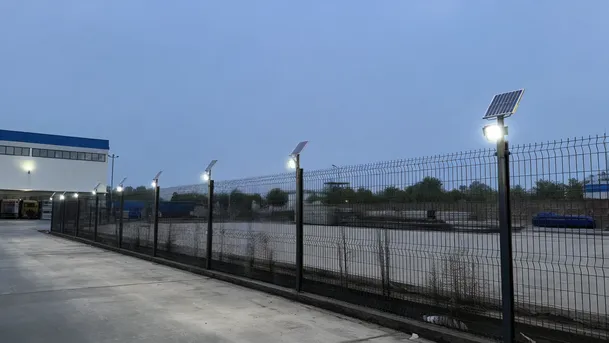
Specification Fields Buyers Can Put Into a Quote Sheet
The table below covers the standard configuration range for our commercial solar flood lights. These are industry-typical values for this product type. Exact specifications depend on model selection and project requirements — request the exact specification sheet for your model before procurement approval.
| Parameter | Standard Configuration Range |
|---|---|
| Lumen Output | 3,000 lm – 20,000 lm (model dependent) |
| LED Module | High-efficiency SMD LEDs, lumen-binned at assembly |
| Solar Panel | Monocrystalline, 20W – 100W (sized to battery and autonomy target) |
| Battery Type | LiFePO4 lithium iron phosphate (standard); Li-ion available |
| Battery Capacity | 20Ah – 80Ah (model and autonomy dependent) |
| Controller | MPPT charge controller with programmable lighting modes |
| Color Temperature (CCT) | 4000K – 6500K standard; 3000K warm white available |
| Beam Angle | 90° – 120° standard; adjustable optics available on select models |
| Sensor Options | PIR motion sensor (standard on security configurations); remote control; timer; dusk-to-dawn |
| Autonomy (Rainy Days) | 3 – 5 days typical; configurable by battery capacity |
| Charging Time | 6 – 8 hours (full sun, standard panel) |
| Mounting Height | 4 m – 12 m recommended (model and lumen output dependent) |
| IP Rating | IP65 standard; IP67 available |
| Housing Material | Die-cast aluminum alloy; tempered glass lens |
| Working Temperature | -20°C to +60°C |
| Certifications | ISO 9001:2015, CE, RoHS, IP65/IP67, IEC 62124 |
| Warranty | 3 years |
| MOQ | 100 units (standard models); OEM/ODM by engineering review |
Energy Budget: The Most Common Configuration Mistake
A note on lumen output: the number on the spec sheet is only part of the procurement decision. Panel wattage, battery capacity, and control logic must be matched to the site's daily sun hours, seasonal variation, and required operating hours. A 10,000-lumen fixture with an undersized panel and battery will dim or shut off before the end of the night in a low-irradiance season. We size the system, not just the fixture.
This is the most common configuration mistake we see in project orders — buyers specify lumen output and forget to confirm the energy budget.
Request System Sizing Review3,000 – 20,000 lm
Lumen output range across standard commercial models.
LiFePO4 Standard
20Ah – 80Ah capacity with 3–5 day rainy-day autonomy.
20W – 100W Panel
Monocrystalline panels sized to battery and autonomy target.
MPPT Controller
Programmable lighting modes with maximum power point tracking.
Battery, LED, and Waterproof Checks That Protect Reorder Quality
The reliability problems that have historically plagued solar flood lights in commercial deployments fall into three categories: battery failure after one or two rainy seasons, lumen output that drops between batches, and waterproof housings that fail in the field despite IP ratings on the spec sheet. We built our production system around those three failure points specifically.
Battery Cell-Level Matching
We test each battery pack for capacity and internal resistance before it goes into a unit. Packs that fall outside tolerance are pulled — not averaged into the batch.
This matters for commercial buyers because a mixed-quality battery batch means some units in your project will fail earlier than others, generating warranty claims and site callbacks that are expensive to manage at scale.
LED Lumen Binning at Assembly
LED module assembly runs through lumen binning before integration. We confirm lumen output and color temperature at the assembly stage, not just at the component spec level.
Batch-to-batch consistency is the commercial value here: if you reorder 500 units six months after your first shipment, the lumen output and color temperature should match. Distributors who have had to explain to their customers why the second batch looks different from the first understand why this checkpoint matters.
Waterproof Structure Inspection
IP65 and IP67 ratings are verified on our own IP testing equipment before units leave the line — not assumed from housing design.
The housing is die-cast aluminum with sealed cable entry points and a tempered glass lens. The failure modes we watch for are seal compression inconsistency and cable gland torque variation, both of which can pass a visual inspection but fail in sustained rain exposure.
Full Production Flow — 100% Unit Inspection
Every unit that moves to the next stage has passed the previous checkpoint — not a sample, every unit.
Automated SMT for control boards
LED module assembly with lumen & CCT confirmation
Battery pack matching & capacity testing
Solar panel electrical output testing
Controller & PIR sensor function checks
Aging tests under load
Waterproof structure inspection
100% final packing inspection
15+ optical & electrical engineers in our in-house R&D team
Commercial Segments Where Flood Lights Sell as Project Packages
The commercial value of solar flood lights is highest in segments where grid wiring cost is a significant share of total project cost, or where installation speed and site flexibility matter. These are the segments where your buyers — whether they are project contractors, facility managers, or procurement teams — are most likely to specify solar over grid-connected alternatives.
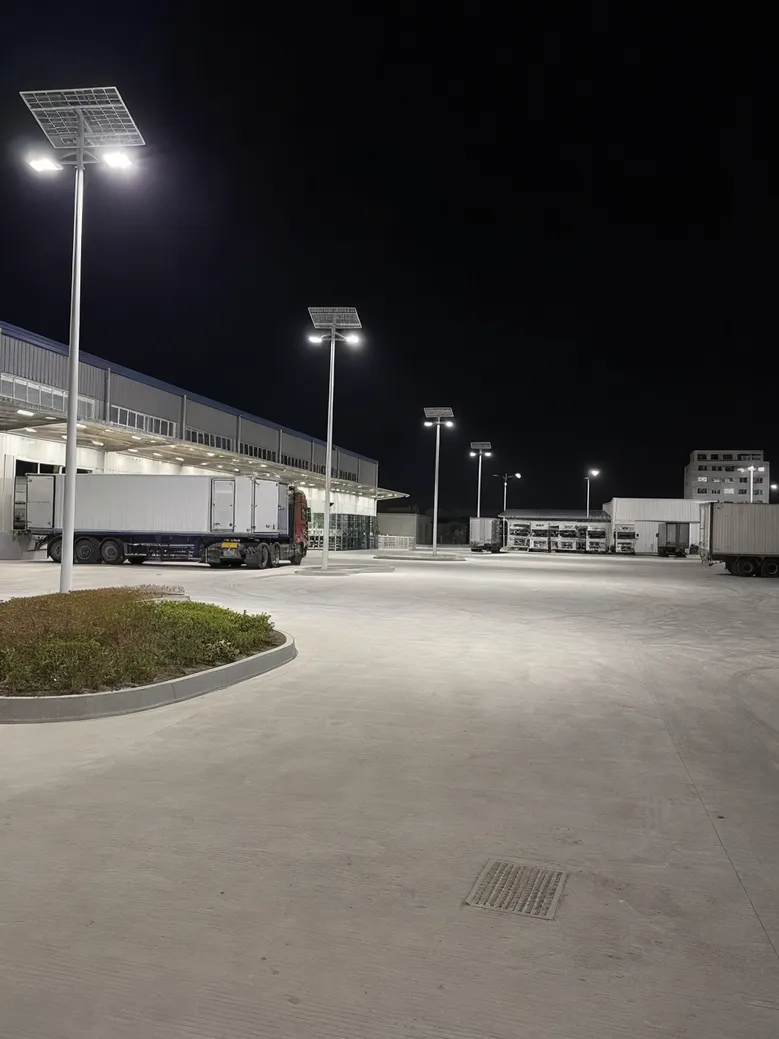
Logistics Yards and Loading Docks
Lighting at truck gates, trailer staging areas, and loading zones is a repeatable project type for distributors and electrical contractors. The typical requirement is 5,000–10,000 lumens per fixture at 6–8 m mounting height, with dusk-to-dawn operation and optional motion sensing at entry points.
Grid trenching across a large yard can cost more than the lighting fixtures themselves — solar eliminates that line item.
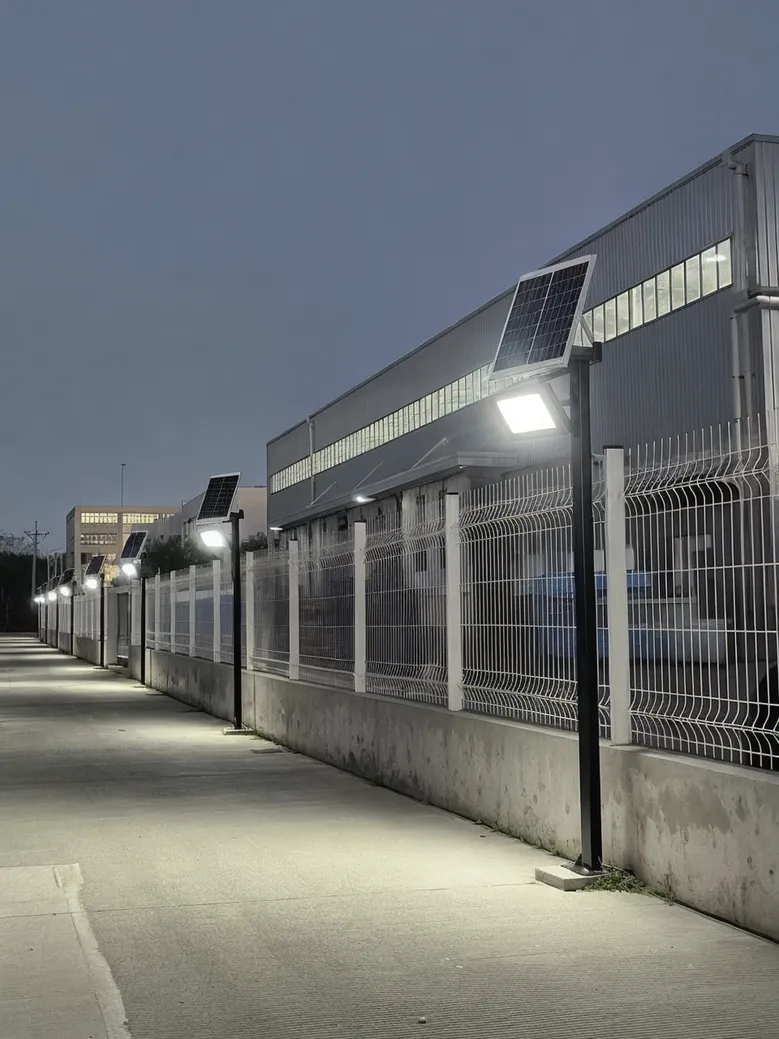
Warehouse and Factory Perimeters
Perimeter lighting for manufacturing facilities and warehouses requires consistent beam direction, batch-to-batch lumen consistency, and housing that survives industrial environments. Buyers in this segment often specify IP67 over IP65 because of wash-down exposure near loading areas.
The commercial argument for solar is strongest at facilities where the perimeter extends beyond the existing electrical infrastructure — adding grid circuits to cover a new warehouse extension can take weeks; solar flood lights can be installed in a day.
Distributors supplying industrial electrical contractors find this a high-volume, repeatable segment.
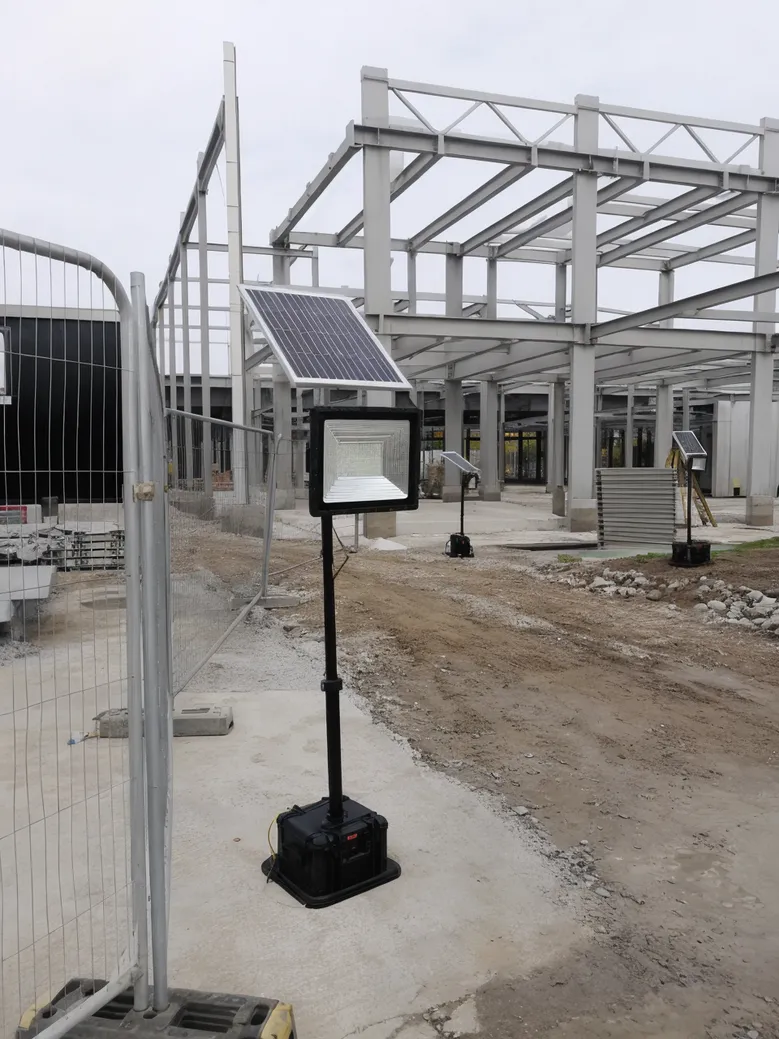
Construction Sites and Temporary Compounds
Construction site lighting is a strong segment for solar flood lights because the installation is temporary by definition. Running temporary grid power to a site adds cost and requires coordination with the utility; solar flood lights can be deployed immediately, moved as the site develops, and recovered at project completion.
The typical configuration for construction sites prioritizes battery autonomy (3–5 rainy days) and robust housing over maximum lumen output.
Rental companies and construction supply distributors have found this a growing category — sites that previously used diesel-powered temporary lighting are switching to solar for cost and logistics reasons.
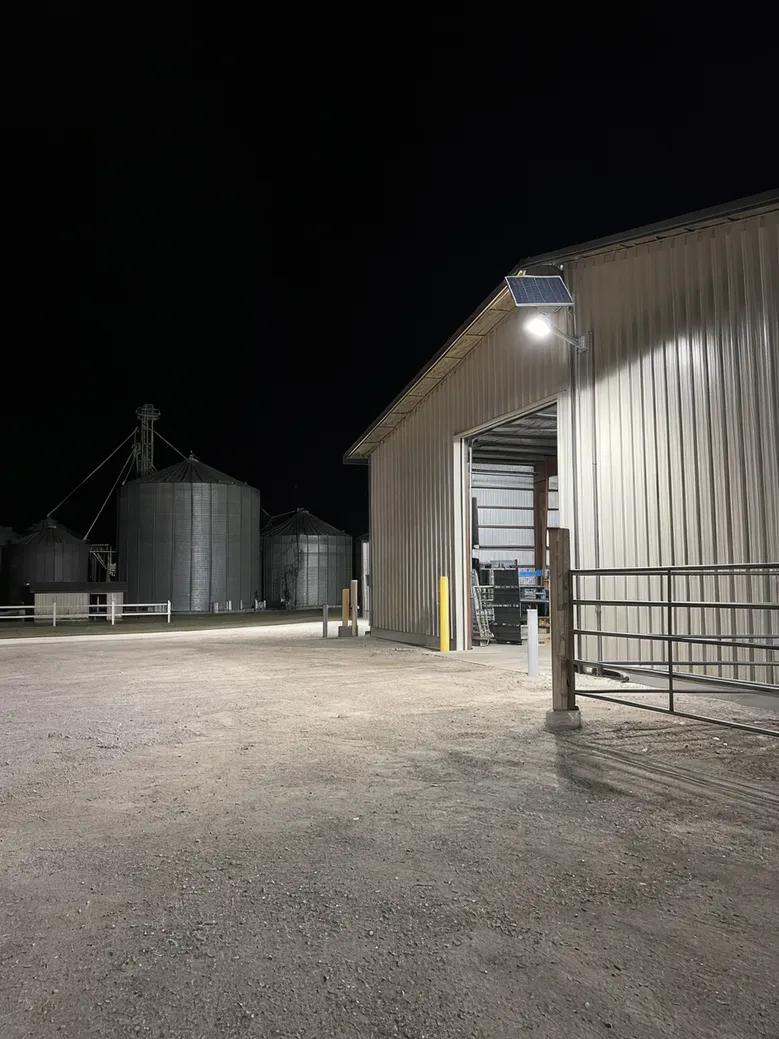
Agricultural Facilities and Rural Commercial Sites
Large agricultural properties — grain storage, livestock facilities, processing plants — often have significant distances between buildings and limited electrical infrastructure. Solar flood lights eliminate the cost of running underground cable across open ground.
The configuration concern in this segment is autonomy: agricultural sites in regions with extended cloudy seasons need larger battery capacity and panel sizing for the target latitude.
We size battery and panel to the buyer's installation country and seasonal irradiance data, not to a generic "3 days autonomy" default. We have shipped to buyers in Northern Europe and Sub-Saharan Africa in the same month — the panel and battery specs are meaningfully different for each.
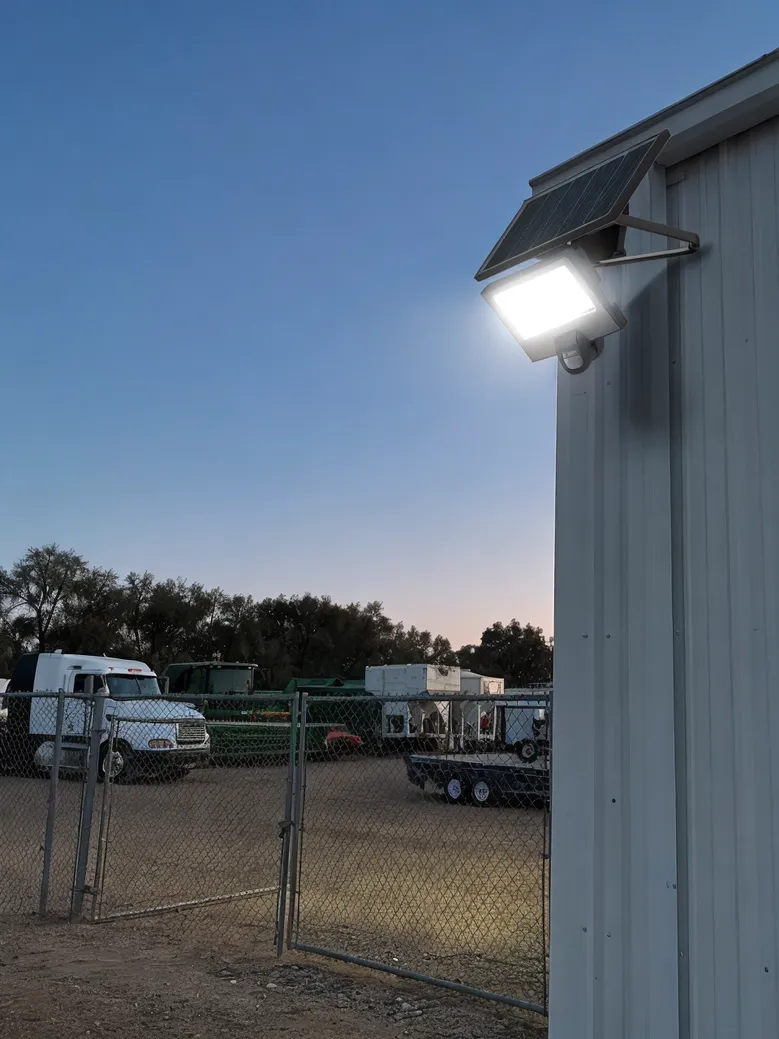
Parking, Storage Yards, and Equipment Compounds
Security visibility is the primary requirement for parking areas, equipment storage yards, and vehicle compounds. Motion sensor configurations reduce power draw during low-traffic hours while maintaining full output when activity is detected.
The commercial value for distributors in this segment is the combination of security positioning and solar economics — buyers can present solar flood lights as both a security upgrade and a cost reduction compared to grid-connected alternatives.
Send your site type & quantity for a configuration recommendationConfiguration Choices That Change Landed Cost and Field Risk
Commercial solar flood lights are not a fixed product — the configuration decisions you make before ordering directly affect your landed cost, your installation complexity, and your after-sales risk. Here is what can be adjusted, what the tradeoffs are, and where the limits are.
Lumen Output & LED Module
Output can be adjusted within the LED module's design range without changing the housing. Higher lumen output requires more power, which means larger panels and batteries — the system cost scales with the output target, not just the fixture cost.
Color Temperature
Standard range is 4000K–6500K. Warm white (3000K) is available for buyers whose markets prefer warmer light for commercial environments. Color temperature is confirmed at the assembly stage, so batch consistency is maintained across reorders.
Beam Angle
Standard optics run 90°–120°. Narrower beam angles (60°–80°) are available for applications requiring concentrated illumination at greater distances — tall pole mounting, signage lighting, or perimeter spotlighting. Beam angle selection affects the fixture's effective coverage area and should be confirmed against mounting height before ordering.
Battery Capacity & Autonomy
Battery capacity is the most commercially significant configuration variable. More autonomy days means larger, heavier battery packs — which increases component cost, carton weight, and freight cost. Most commercial buyers in temperate climates specify 3 days autonomy; buyers in regions with extended rainy seasons or lower irradiance should specify 5 days or more. We calculate the battery and panel sizing based on your installation latitude and target operating hours.
Integrated vs. Separate Solar Panel
Integrated panels (panel mounted directly on the fixture) simplify installation and reduce cable runs. Separate panels (panel on an independent bracket or pole) allow optimal panel orientation independent of fixture mounting direction — important when the mounting surface faces away from the sun. Separate panel configurations add installation complexity but improve charging reliability on north-facing walls or shaded mounting positions.
Sensor & Control Logic
PIR motion sensor, dusk-to-dawn, timer, and remote control options are available. Motion sensor configurations reduce battery draw during low-activity periods, extending effective autonomy. For security applications, motion sensing is typically specified; for general area lighting, dusk-to-dawn or timer modes are more common.
OEM/ODM and Branding
Custom housing finish, logo, carton design, manual language, and accessory pack configuration are available for buyers building a private-label solar lighting line. MOQ for standard models starts at 100 units.
OEM/ODM projects with custom specifications go through an engineering review before production — we confirm lumen target, battery/panel match, target latitude, and branding requirements before any tooling or component procurement.
Custom housing tooling, unusual beam optics, and special packaging configurations may affect lead time and MOQ.
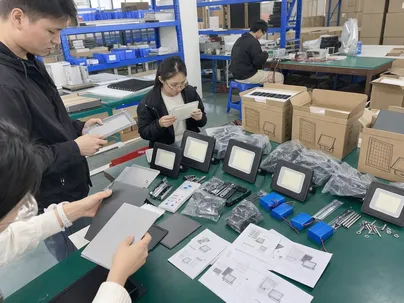
Installation Variables That Decide Project Margin Before Shipment
Getting the installation variables right before the order ships is cheaper than resolving them after the product is on site. These are the decisions that affect your project margin and your after-sales exposure.
Mounting Height & Lumen Selection
Mounting height determines the required lumen output for adequate ground-level illumination. A 5,000-lumen fixture at 4 m mounting height covers a different area than the same fixture at 8 m. Confirm mounting height before finalizing lumen output — undersized output at a tall mounting height is the most common cause of "the lights aren't bright enough" callbacks.
Solar Panel Orientation & Shading
The panel must face the sun for the majority of the day. On wall-mounted installations, the wall orientation determines whether an integrated or separate panel is the right choice. Shading from trees, adjacent buildings, or roof overhangs reduces charging efficiency and shortens effective battery life. For project orders, share site photos or drawings so we can flag panel placement issues before shipment.
Cable Length Between Panel and Fixture
Separate panel configurations require a cable run between the panel and the fixture. Longer cable runs increase resistance and reduce charging efficiency — cable cross-section must be sized to the run length. We specify cable length and cross-section as part of the configuration for separate panel orders.
Bracket & Pole Selection
Wall brackets, pole top mounts, and side-arm brackets have different load ratings and installation requirements. Bracket selection affects accessory planning and the installation labor cost. For project orders with specific pole or wall mounting requirements, confirm bracket type before production.
Rainy-Day Autonomy Planning
Autonomy should be planned for the worst-case season in the installation market, not the average. A 3-day autonomy spec that works in Southern California may be insufficient in Northern Europe or Southeast Asia during monsoon season.
We recommend buyers share the installation country and target operating months so we can confirm the battery and panel sizing is appropriate.
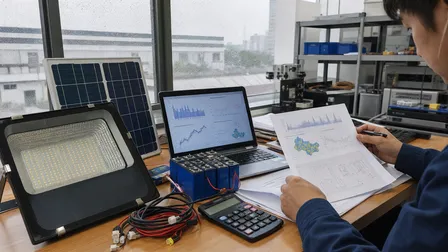
Compliance, Waterproofing, and Export Documents for Regulated Markets
For buyers importing into regulated markets or submitting products for tender approval, documentation is part of the procurement decision — not an afterthought. Here is what we hold and what we can provide.
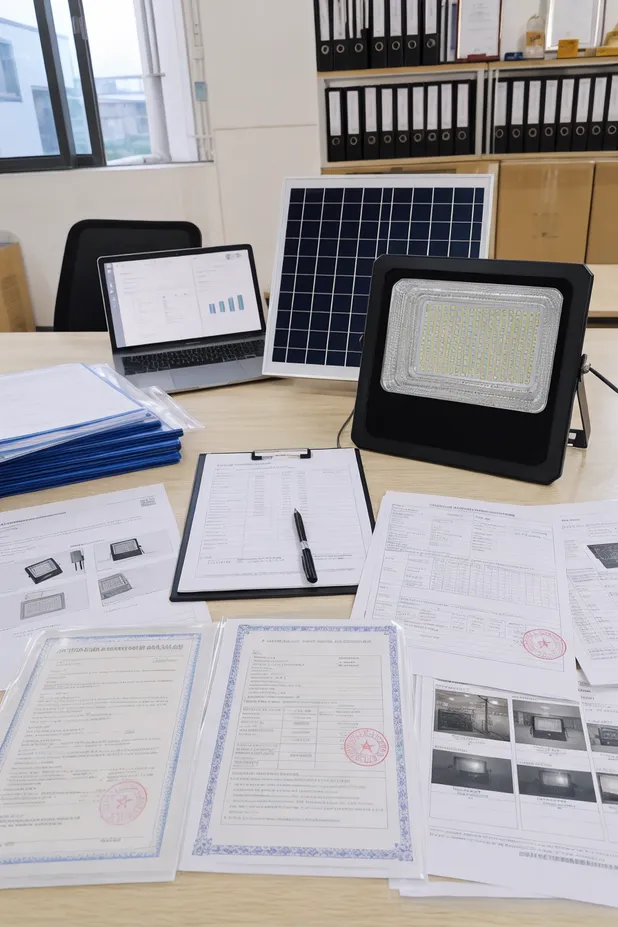
Confirmed Certifications
ISO 9001:2015, CE, RoHS, IP65/IP67 Ingress Protection, IEC 62124. These are documented certifications held by JXSOL, not aspirational claims.
CE Certification
Covers electrical safety and electromagnetic compatibility requirements for European market entry. We provide the CE Declaration of Conformity with the order for buyers importing into the EU or CE-required markets.
RoHS Compliance
Built into our component sourcing — LED chips, battery cells, and electronic components are sourced from suppliers who provide material declarations, and we maintain records by batch. We provide test reports tracing compliance to the component level.
IP65 / IP67 Ingress Protection
Tested on our own waterproof inspection equipment. IP65 covers dust-tight construction and protection against water jets — sufficient for most outdoor commercial installations. IP67 adds submersion protection to 1 m depth for 30 minutes, relevant for flood-prone areas, wash-down zones, or markets specifying IP67 as minimum for outdoor commercial lighting. We confirm which IP rating applies to a specific model before order placement.
IEC 62124
Covers performance requirements for stand-alone photovoltaic lighting systems — relevant for buyers in markets where photovoltaic lighting performance standards are referenced in tender specifications or procurement guidelines.
Export Documentation by Region
For buyers exporting to North America, Europe, the Middle East, Southeast Asia, or Africa, we are familiar with the documentation requirements in each region. If your market requires specific test reports, declarations, or compliance records beyond the standard documentation package, confirm the requirement at the inquiry stage and we will advise on availability.
View Full Certifications & Quality StandardsChoosing the Right Flood and Security Lighting SKU
The solar flood and security lighting category has several close product pages. Here is a practical guide to which page fits which buying situation.
| Product | Best Fit |
|---|---|
| Commercial Solar Flood Lights (this page) | Project-grade outdoor flood lighting in commercial quantities. Configurable output, autonomy, and OEM/ODM. The right starting point for bulk procurement, distribution catalogs, and private-label programs. |
| Solar Flood Lights | Broader general-purpose solar flood light category. Start here if you are evaluating the full product range before narrowing to a specific configuration. |
| Solar LED Flood Lights | Choose when LED module efficiency and LED-focused product positioning are the primary search intent for your market. |
| Solar Motion Sensor Flood Lights | Choose when PIR detection logic is the main buying criterion — security-focused deployments where motion activation is the primary feature. |
| Solar Security Lights | Choose when security positioning is broader than flood illumination — perimeter security, deterrence lighting, and mixed security lighting programs. |
| Waterproof Solar Security Lights | Choose when IP rating and wet-environment positioning are the primary buying signal for your market. |
| PIR Solar Security Lights | Choose when PIR sensor specification is the lead feature — buyers who specify sensor sensitivity, detection range, and response time as primary criteria. |
For the full range, see the solar flood and security lighting category.
Browse All Solar Flood & Security LightingExport Packaging, MOQ, and Reorder Planning for Distributors
Low entry MOQ, container-optimized cartons, and scheduled production lines that keep your reorder cycle predictable.
Minimum Order Quantity
Standard MOQ starts at 100 units for catalog models — low enough to test a new SKU with your market before committing to a larger program. For distributors building a solar lighting catalog, this means you can validate commercial solar flood lights alongside other SKUs without a large initial commitment.
A 500-unit repeat order for a distributor does not displace a 5,000-unit project order — production is scheduled in advance on dedicated lines.
Factory Scale & Scheduling
The factory runs 6 production lines across a 12,000 m² facility with 150 employees and daily output above 5,000 units. Annual capacity is 1,200,000 units. That scale means your reorder runs on a scheduled production line, not in a queue behind new customer onboarding.
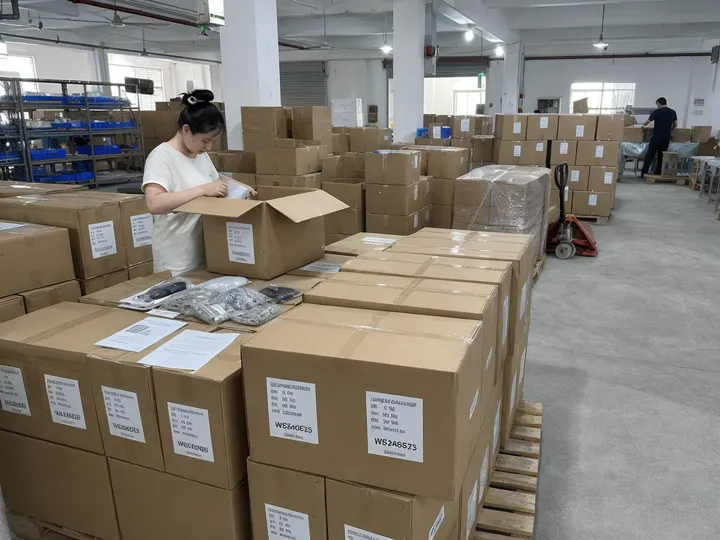
Container-Optimized Export Packaging
Export cartons are sized for standard 20GP and 40HQ container loading. Each carton includes a packing list, and accessory packs (mounting hardware, brackets, cables, installation guides) are checked against the packing list before carton sealing.
Batch traceability: Batch codes on carton labels provide traceability back to the production run — useful for warranty management and for buyers who need to track which batch went to which project or customer.
Palletized delivery: Available for buyers who need palletized shipments for warehouse receiving or FBA/distribution center intake.
OEM/ODM packaging: White-label packaging, custom carton design, and language-specific installation guides are available for OEM/ODM programs.
Lead Time Confirmed at Order Placement
For distributors planning seasonal stock or project replenishment, we confirm lead times at order placement — not at shipment. If a production schedule change affects your delivery window, we communicate it before it becomes a problem at your end.
Proactive schedule communication protects your downstream commitments and warehouse planning.
FAQ for Commercial Solar Flood Light Procurement
Answers to the specification and sourcing questions that come up most often during project quoting and tender preparation.
How many lumens do commercial solar flood lights need for yards, loading docks, or perimeter lighting?
For general yard and perimeter lighting at 6–8 m mounting height, 5,000–10,000 lumens per fixture is the typical range. Loading dock areas with active vehicle movement often specify 8,000–12,000 lumens for adequate visibility at ground level.
The right number depends on mounting height, spacing between fixtures, and the reflectance of the surrounding surfaces. A higher mounting height requires more lumens to achieve the same ground-level illuminance.
Key action: Confirm mounting height before finalizing lumen output in your quote sheet.
Are integrated or separate solar panels better for industrial solar flood lights?
Integrated panels are simpler to install and work well when the mounting surface faces south (or north in the southern hemisphere) with minimal shading.
Separate panels are the better choice when the fixture mounting direction is constrained — north-facing walls, shaded locations, or installations where the fixture and the best panel position are not the same point. The tradeoff is installation complexity: separate panels require a cable run and an additional mounting bracket.
Project order recommendation: For orders with mixed mounting conditions, separate panels as the default avoids charging reliability issues on unfavorable orientations.
Is IP65 enough for commercial solar flood lights, or should buyers specify IP67?
IP65 is sufficient for the majority of outdoor commercial installations — it covers dust-tight construction and protection against water jets from any direction, which handles rain, cleaning, and normal outdoor exposure.
IP67 adds submersion protection and is worth specifying for:
- Installations near wash-down areas
- Flood-prone locations
- Markets where buyers or tender specifications require IP67 as a minimum
Warranty consideration: If your downstream customers are in coastal or high-humidity environments, IP67 provides a stronger warranty argument against moisture ingress claims.
How many rainy days of battery autonomy should a project require?
Three days is the standard specification for most commercial projects in temperate climates with reasonable sun hours. Five days is appropriate for markets with extended cloudy seasons — Northern Europe, parts of Southeast Asia during monsoon season, and high-latitude installations where winter sun hours are significantly reduced.
Sizing methodology: We calculate battery and panel sizing based on the installation country and target operating hours, not a generic default. Share your installation location and we will confirm whether the standard configuration is adequate or whether a larger battery is needed.
Temperate Climates
3 Days
Standard specification
Extended Cloudy / High Latitude
5 Days
Monsoon, Northern Europe, winter-limited sites
Can solar flood lights replace grid-powered flood lights for commercial sites?
For most outdoor commercial applications — perimeter lighting, yard lighting, parking areas, loading zones — yes, solar flood lights can replace grid-powered alternatives at comparable lumen output levels.
Practical Limit
Applications requiring very high sustained output (above 20,000 lumens) for extended hours in low-irradiance climates — the panel and battery size required becomes impractical. For the majority of commercial flood lighting applications below this threshold, the solar configuration is viable and eliminates the grid connection cost.
Total Project Cost Comparison
The total project cost comparison should include the grid trenching and wiring cost that solar eliminates — in many cases, that cost exceeds the premium for a solar system over a grid-connected fixture. Factor in civil works, conduit, switchgear, and ongoing electricity charges for an accurate like-for-like assessment.
What is the MOQ for custom or private-label commercial solar flood lights?
Standard catalog models start at 100 units. OEM/ODM projects with custom specifications — housing modifications, custom lumen output, private-label packaging, or non-standard sensor configurations — go through an engineering review before production to confirm the configuration is achievable.
MOQ for custom projects depends on the scope of modification; contact us with your target spec and we will confirm the minimum and lead time.
Request a custom configuration quoteWhat documents can JXSOL provide for import, tender, or resale approval?
We provide CE Declaration of Conformity, RoHS test reports, IP test certificates (IP65/IP67), IEC 62124 compliance documentation, and ISO 9001:2015 certification. Product data sheets with confirmed specifications are available per model.
For buyers with specific documentation requirements — market-specific compliance records, material safety declarations, or custom test reports — confirm the requirement at the inquiry stage and we will advise on availability.
Send Site Specs for a Buildable Quote
A useful quote for commercial solar flood lights requires more than a quantity and a lumen number. Send us the following and we will come back with a configuration recommendation and pricing.
Information We Need
- 1 Site type (yard, perimeter, loading dock, construction site, agricultural, other)
- 2 Installation country and target operating months
- 3 Quantity required
- 4 Target lumen output per fixture (or mounting height and coverage area)
- 5 Mounting method (pole top, wall bracket, side arm) and mounting height
- 6 Panel placement constraints (integrated or separate panel preference)
- 7 Required autonomy days
- 8 Sensor requirement (motion sensor, dusk-to-dawn, timer, remote control)
- 9 Branding or packaging requirements (standard or OEM/ODM)
- 10 Target delivery date
Contact JXSOL
Phone / WhatsApp
+8613627818806Address
9th Floor, Houda Industrial, No. 65 Pinghe Road, Guzhen Town, Zhongshan, Guangdong, 528421, China