

Solar Motion Sensor Flood Lights Direct From Factory
Motion-triggered solar flood lighting for security-focused resale, project deployment, and private-label programs.
PIR-activated flood coverage with configurable detection range, IP65/IP67 construction, and LiFePO4 battery packs matched and tested before shipment — built for accounts where battery complaints and warranty returns are not acceptable.
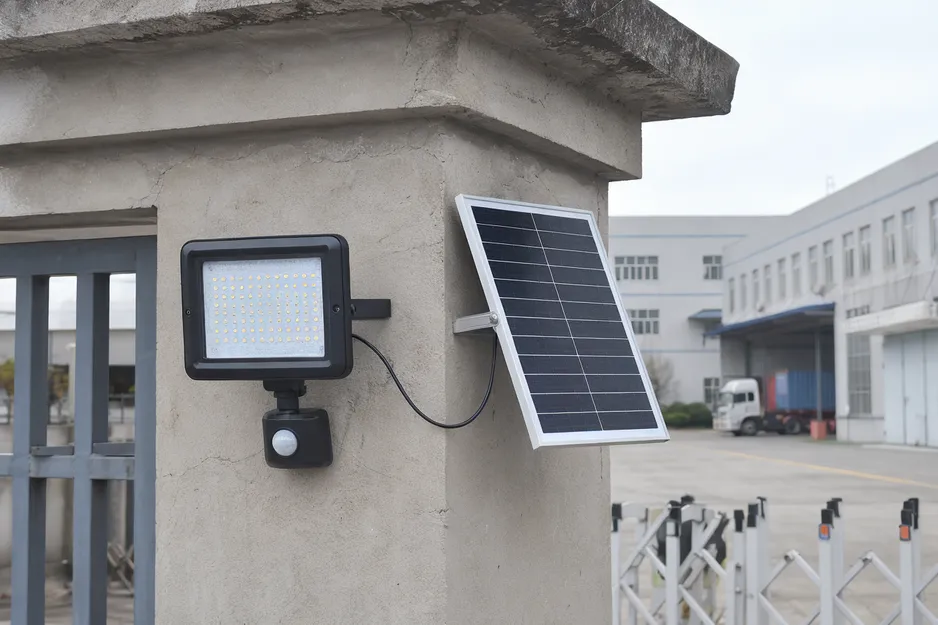
Solar Motion Sensor Flood Lights Built for Security SKUs That Sell Cleanly
A solar motion sensor flood light is a specific product with a specific commercial logic: wide-beam flood coverage, PIR-triggered activation, no grid wiring, and battery autonomy that holds up across seasons. It is not a general-purpose solar flood light with a sensor bolted on. The distinction matters because buyers who source the wrong SKU — an always-on flood light for a security application, or a compact wall light where flood coverage is needed — generate warranty claims and lose accounts.
This page covers JXSOL's solar motion sensor flood light range: die-cast aluminum housings, monocrystalline solar panels, LiFePO4 battery packs, and PIR sensors with configurable detection range and sensitivity. The product sits in the solar flood and security lighting category alongside seven sibling products, and its positioning is specific: motion-triggered flood coverage for perimeter security, entrances, yards, warehouse gates, parking edges, and rural sites where grid installation is expensive or unavailable.
If your accounts need security lighting that activates on detection, conserves battery between events, and delivers enough lumen output to cover a driveway, loading area, or building perimeter — this is the SKU.
Ready to source?
Get a quote for solar motion sensor flood lights with your target mounting height and coverage area.
PIR-Triggered Activation
Wide-beam flood coverage activates on motion detection — not always-on draw that depletes batteries before dawn.
LiFePO4 Battery Packs
Matched and tested before shipment. Built for accounts where battery complaints and warranty returns are not acceptable.
IP65/IP67 Construction
Die-cast aluminum housings with monocrystalline solar panels rated for outdoor perimeter deployment year-round.
Configurable Detection
PIR sensors with adjustable detection range and sensitivity — tuned per installation type to prevent false triggers.
Where Motion-Triggered Flood Lighting Protects Battery Autonomy
The commercial case for PIR-triggered solar flood lighting comes down to one variable: battery capacity.
The Always-On Problem
An always-on solar flood light draws from the battery continuously from dusk to dawn. In winter months with 9–10 hours of darkness and only 4–5 hours of effective charging, the math doesn't work for most mid-range battery configurations — the pack depletes before dawn, and your customer calls with a complaint about a light that goes dark at 2 AM.
A motion-triggered solar motion sensor flood light changes that equation. The light runs at a low standby level — typically 10–20% output — and activates to full brightness on PIR detection. Depending on the detection frequency at the installation site, this can reduce active draw by 60–80% compared to always-on operation.
The same battery pack that struggles through a winter night in always-on mode handles the same night comfortably in motion-triggered mode, with reserve capacity for multiple detection events.
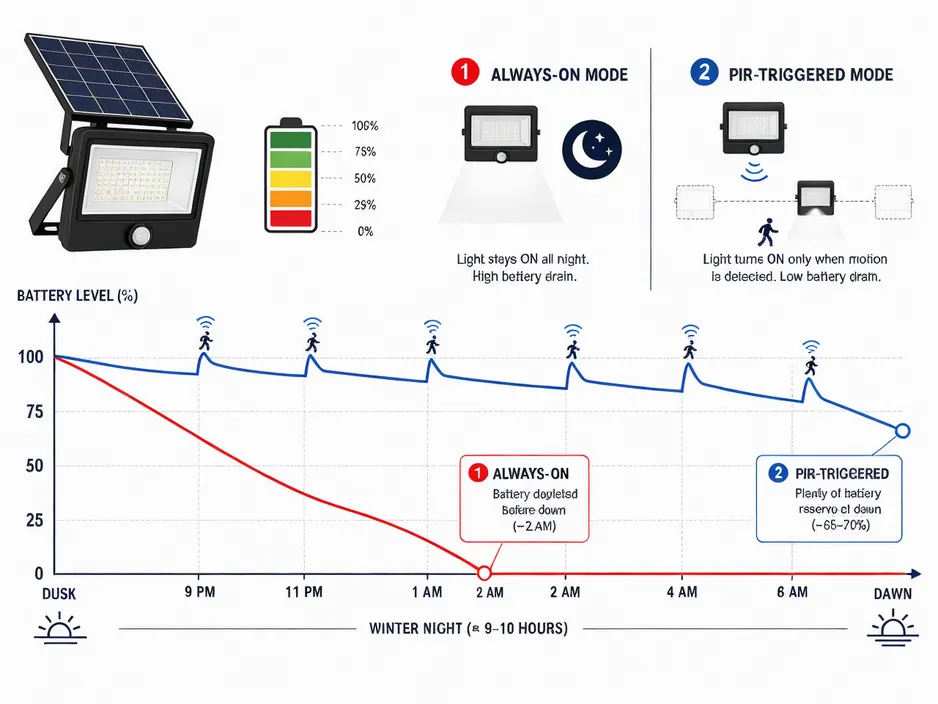
Always-On vs. PIR-Triggered: The Battery Math
9–10 hrs
Winter darkness duration
4–5 hrs
Effective winter charging
10–20%
Standby output level
60–80%
Reduced active draw vs. always-on
Field Evidence: Northern Europe & Canada
We've seen this play out in orders from buyers in Northern Europe and Canada who switched their security lighting line from always-on to PIR-triggered after one winter of battery complaints. The product didn't change — the operating mode did. That's the kind of sourcing decision that protects your margin and your account relationships simultaneously.
The dim-to-bright activation also has a deterrent effect that always-on lighting doesn't. A light that's already on is background noise. A light that activates when someone approaches is a signal — and that signal is what security-focused end customers are actually paying for. For distributors positioning this product in the security channel, that's a selling point your downstream customers can explain to their own clients.
Controller Modes & False-Trigger Prevention
Beyond the standard dim-to-bright mode, the controller supports timer-based operation and configurable detection sensitivity — useful for installations near roads or in areas with animal movement where false triggers would drain the battery.
See our motion sensor solar lights page for detailed configuration guidance by installation type.
Need region-specific guidance?
Send your target market and battery autonomy requirements — we'll recommend the battery capacity and panel wattage for your region's solar irradiance.
The Deterrent Advantage
A light that's already on is background noise. A light that activates when someone approaches is a signal — and that signal is what security-focused end customers are actually paying for. For distributors positioning this product in the security channel, that's a selling point your downstream customers can explain to their own clients.
Product-Level Specification Range for RFQ Comparison
These are typical values for JXSOL's solar motion sensor flood light range. Exact specifications depend on the selected model and order configuration. Use this table to confirm whether our range covers your requirements before requesting a datasheet.
| Parameter | Typical Range / Value |
|---|---|
| LED Output | 1,000 lm – 6,000 lm (configurable by model) |
| Solar Panel Type | Monocrystalline silicon |
| Solar Panel Capacity | 10W – 30W (sized to battery and output) |
| Battery Chemistry | Lithium iron phosphate (LiFePO4) |
| Battery Capacity | 8,000 mAh – 20,000 mAh |
| Charging Time | 6–8 hours (full sun) |
| Working Time (motion mode) | 8–15 hours per charge cycle |
| PIR Detection Range | 5 m – 12 m (adjustable) |
| PIR Detection Angle | 90° – 120° |
| Controller Modes | Standby dim + motion-triggered, always-on, timer-based |
| Color Temperature | 4,000K – 6,500K (neutral to daylight; warm white available) |
| IP Rating | IP65 standard; IP67 available |
| Housing Material | Die-cast aluminum |
| Lens Material | Tempered glass or PC (model-dependent) |
| Mounting Options | Wall bracket, pole mount (model-dependent) |
| Certifications | ISO 9001:2015, CE, RoHS, IP65/IP67, IEC 62124 |
| Custom Labeling | Available on OEM/ODM orders |
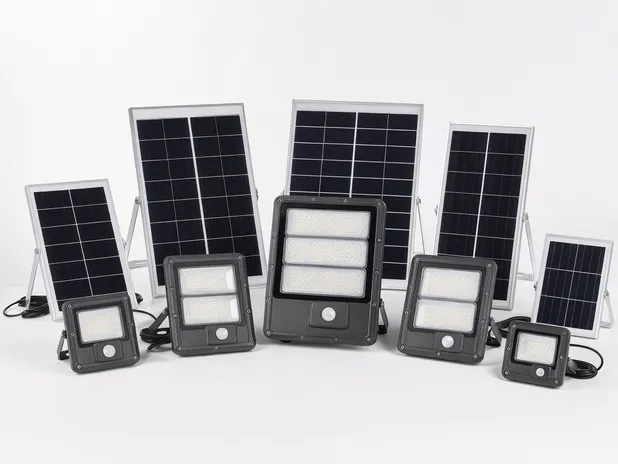
Specifications shown are typical values for this product range. Actual specifications vary by model and configuration. Contact us for product-specific datasheets.
Send Specs for a DatasheetInclude your target lumen output, mounting height, and market for a configuration recommendation.
Choosing Output, Mounting Height, and PIR Detection Range
Three variables determine whether a solar motion sensor flood light works in a given installation: lumen output relative to mounting height, PIR detection range relative to the coverage area, and panel-to-battery sizing for the target latitude. Getting any one of these wrong creates a warranty claim. Here's the decision logic.
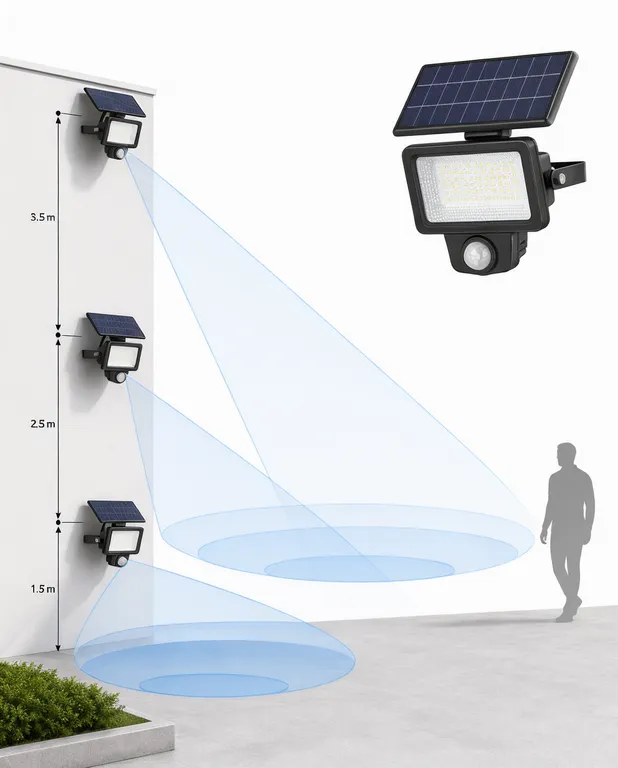
Lumen Output and Mounting Height
For wall-mounted installations at 2.5–4 meters — residential driveways, small commercial entries, garden perimeters — a 1,000–2,500 lumen model covers the area without glare.
For 4–6 meter mounting heights covering warehouse gates, loading areas, or parking edges, 2,500–4,500 lumens with a 120° beam angle is the practical range.
Above 6 meters, you're moving into commercial flood territory where 4,500–6,000+ lumens and a narrower beam angle are needed to maintain ground-level illuminance.
Over-speccing creates glare complaints from adjacent properties; under-speccing creates security gaps. If your accounts are contractors specifying for a project, confirm the mounting height before quoting — it's the single variable that determines whether the product works.
PIR Detection Range and Angle
A 5–8 meter detection range covers most residential and small commercial entries. For warehouse gates, parking lot edges, and larger perimeters, 8–12 meter range with a 120° angle is the standard spec.
The detection angle matters as much as the range: a narrow-angle sensor on a wide driveway misses lateral movement. We configure PIR sensitivity and angle at the factory — if your accounts have specific coverage requirements, include them in the RFQ and we'll confirm the sensor configuration.
False-Trigger Management
Installations near roads, in areas with heavy tree movement, or adjacent to HVAC exhaust can generate false triggers that drain the battery. The controller's sensitivity adjustment handles most of these cases — lower sensitivity reduces false triggers without eliminating legitimate detection.
We've had buyers in suburban markets request lower-sensitivity configurations specifically for this reason. It's a standard adjustment, not a custom modification.
For buyers supplying contractors who need higher always-on output for active work areas, our commercial range is sized for continuous operation at higher lumen levels.
View Commercial Solar Flood LightsNot sure which configuration fits your project? Send your mounting height, coverage area, and target market — we'll confirm the right model and sensor setup.
Send Project Specs to JXSOLMarket Segments Where This SKU Creates Repeat Orders
Motion sensor solar security lighting moves well in specific commercial segments because the value proposition is concrete: security coverage without grid trenching, battery autonomy that holds through winter, and fast installation that reduces labor cost for your accounts.
Warehouse Gates & Loading Dock Perimeters
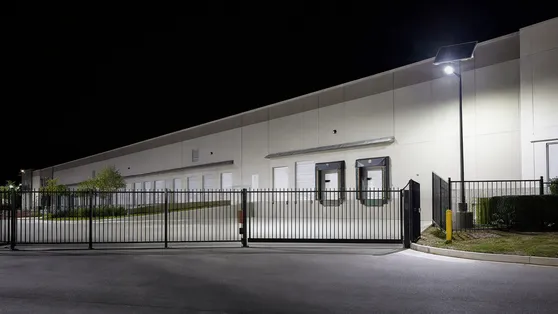
Logistics facilities and industrial properties need security lighting at entry points, loading areas, and yard perimeters. The no-grid-connection advantage is significant here — running conduit to a warehouse perimeter can cost more than the lighting itself.
Solar motion sensor flood lights at 3,000–5,000 lumens cover standard loading dock widths and gate entries.
Repeat order driver: Facilities managers who specify solar for one site typically roll it out across multiple locations, so initial project orders convert to repeat supply.
Parking Lot Edges & Commercial Perimeters
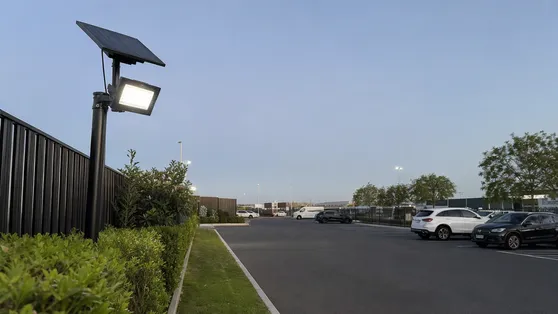
Property management companies and retail chains use motion-triggered solar security lighting for parking perimeter coverage where grid power is available at the building but not at the perimeter.
The motion-triggered activation reduces energy draw and extends battery life, which matters for property managers responsible for maintenance across multiple sites.
Repeat order driver: Distributors who supply property management accounts can build a repeatable SKU around this segment.
Farms & Rural Properties
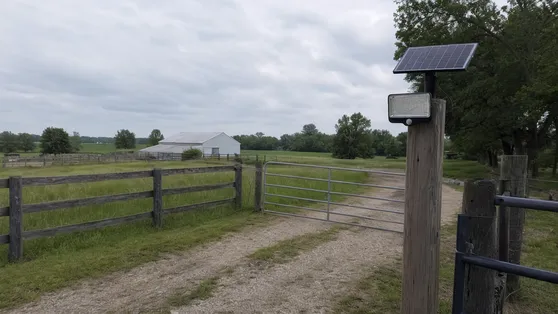
Agricultural buyers need perimeter and yard lighting across large areas where grid power is unavailable or expensive to extend. Solar motion sensor security lighting is the default solution for farm gates, equipment storage areas, and outbuildings.
Battery autonomy and cold-weather performance are the key spec questions for this segment — buyers in northern markets need extended-capacity packs.
Growth note: This segment has grown consistently over the past three years, particularly in North America and Northern Europe. Worth building into your product line if you're not already there.
Construction Sites
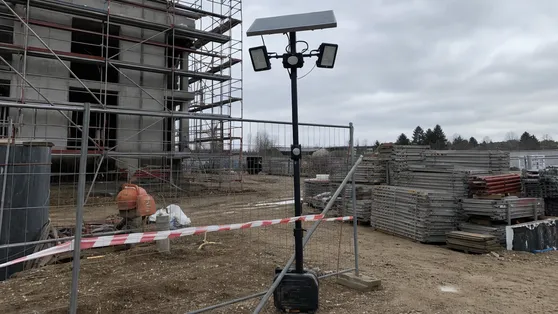
Temporary security lighting for active construction sites is a high-volume, repeatable segment. Sites need lighting for the duration of the project, then it moves to the next site.
Contractors who stock solar motion sensor flood lights as a standard site setup item reorder regularly — the product is consumable in the sense that it gets deployed, recovered, and redeployed across projects.
Decisive advantage: The no-wiring advantage is decisive here: temporary grid connections on construction sites are expensive and require permits.
Schools, Campuses & Community Projects
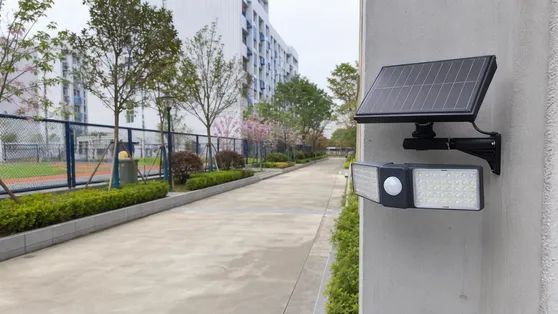
Government and institutional buyers specify motion sensor solar security lighting for pathway and perimeter coverage. These projects often run on annual procurement budgets with defined SKU requirements — a clean fit for distributors who can supply consistent product across multiple sites.
The motion-triggered mode is preferred for campus applications because it reduces light pollution in residential-adjacent areas while maintaining security coverage.
Gated Communities & Residential Security Resale
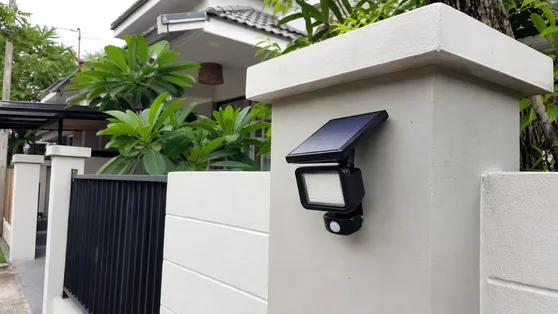
Compact solar motion sensor flood lights in the 1,000–2,500 lumen range are a high-velocity SKU for hardware distributors and home improvement channels. The end customer installs them without an electrician, which reduces the barrier to purchase and keeps your return rate low.
The security positioning — motion-triggered activation as a deterrent — is easier to sell than general outdoor lighting.
For compact solar security lights suited to smaller perimeter accounts, see our dedicated product page.
Sensor, Battery, and Waterproof QC Before Shipment
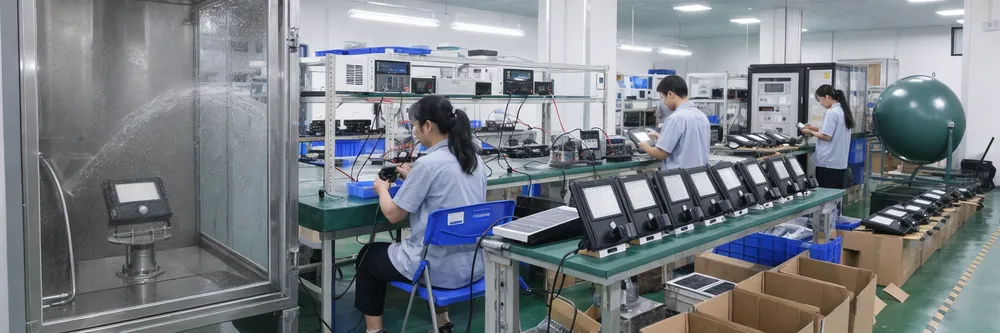
The three failure modes that generate most warranty claims in solar motion sensor security lighting are: PIR sensors that don't trigger reliably, battery packs that lose capacity after 3–6 months, and water ingress at cable entry points. We've been manufacturing in this category since 2012, and our production system is built around preventing all three.
PIR Sensor & Controller Function Testing
Every PIR sensor and controller goes through a dedicated function test bench before assembly. We verify detection range, sensitivity setting, lighting mode sequence (standby dim, full-brightness trigger, return to standby), and timer function.
A sensor that passes visual inspection but fails on the test bench doesn't move to assembly. The test bench catches intermittent failures — sensors that trigger inconsistently under specific temperature or voltage conditions — that a visual check misses entirely.
For motion sensor solar security lighting, a sensor that doesn't trigger is a warranty claim and a credibility problem for your account. We catch it before it ships.
Battery Cell Matching & Charge/Discharge Testing
LiFePO4 cells in a pack need to be matched by capacity and internal resistance before assembly. Mismatched cells degrade unevenly — the weakest cell in the pack limits the whole pack's capacity, and the degradation accelerates over charge cycles.
We match cells by capacity and internal resistance before pack assembly, then run every pack through a charge/discharge cycle test on our aging racks. The test confirms actual capacity against spec and catches cells with elevated self-discharge rates.
This step adds time to the production flow. It also means we catch a bad batch before it ships, not after your customer calls about a light that goes dark in November.
Waterproof Structure Inspection
Water ingress in solar flood lights almost never comes from the housing body — it comes from cable entry glands, lens seals, and the junction between the solar panel frame and the housing.
We test every unit's waterproof structure on dedicated IP inspection equipment before it leaves the line. IP65 and IP67 ratings are verified on our own test benches, not assumed from housing design.
The cable gland torque spec and gasket material are part of the assembly checkpoint — not a visual inspection, a measured checkpoint.
LED Lumen Binning & Output Confirmation
LED modules are sorted by lumen output and color temperature before installation. We confirm output against spec before units move to final assembly.
Your second container matches your first — lumen inconsistency between batches is one of the most common complaints we hear from buyers who switched to us from other suppliers.
Certifications Covering This Product
ISO 9001:2015
CE
RoHS
IP65/IP67
IEC 62124
CE Declaration of Conformity, RoHS test reports, and IP test certificates are available per order. Learn more about our manufacturing and inspection practices at the JXSOL solar lighting factory.
OEM/ODM Configuration for Your Market Position
Standard catalog models cover most sourcing requirements. For buyers building a private-label solar security lighting line or sourcing for a specific project specification, our in-house engineering team handles configuration before production — not during it.
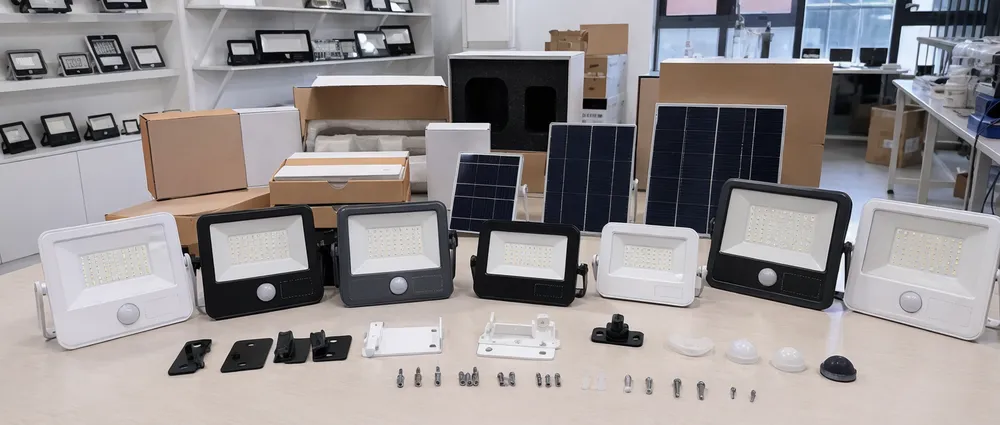
What's Configurable on Solar Motion Sensor Flood Lights
| Parameter | Configurable Range | MOQ / Lead Time Impact |
|---|---|---|
| Lumen output | Adjustable within LED module design range | No housing change for most adjustments |
| Color temperature | 3,000K – 6,500K | Standard option, no MOQ impact |
| Battery capacity | Sized for target autonomy days by market irradiance | Confirmed in engineering review |
| Solar panel wattage | Sized to battery and output requirements | Confirmed in engineering review |
| PIR detection range | 5 m – 12 m, sensitivity adjustable | Standard configuration option |
| Lighting mode sequence | Standby dim %, trigger brightness, return delay | Firmware configuration, no MOQ impact |
| Housing color | Custom colors available | Minimum 100 units for powder line changeover |
| Logo and labeling | Custom logo on housing and packaging | Standard OEM/ODM option |
| Packaging | Custom carton design, insert, accessory pack | Confirmed in engineering review |
| Compliance documentation | CE, RoHS, IP test certificates per order | Standard; additional market docs on request |
Low MOQ Entry
MOQ for standard catalog models starts at 100 units — low enough to test a new SKU with your accounts before committing to a larger program.
Engineering Review First
OEM/ODM projects go through an engineering review before production to lock the spec before component procurement. Configuration happens before production — not during it.
Market-Specific Configurations
We've configured extended-autonomy battery packs for buyers in the Middle East and Africa who need 5–7 days of backup during low-irradiance seasons, and adjusted PIR sensitivity profiles for buyers in suburban markets with high false-trigger risk.
Ready to Configure Your SKU?
Send your target retail price point and market — we'll spec the version that protects your margin.
Sibling Product Selection Guide Inside the Solar Security Range
If this product isn't the exact fit, here's where the other products in the solar flood and security lighting range are the cleaner choice:
Solar Flood Lights
General area illumination where continuous output matters more than motion activation — yards, driveways, general perimeter lighting without a security focus.
Commercial Solar Flood Lights
High-output always-on applications: warehouse yards, large parking lots, construction perimeters where 5,000+ lumens and continuous operation are required.
Solar LED Flood Lights
Buyers sourcing specifically for LED module efficiency and consistent lumen output across retrofit and new-install flood lighting projects.
Solar Security Lights
Compact perimeter security for smaller commercial properties, building entries, and residential accounts where flood-light form factor is more than needed.
Motion Sensor Solar Lights
Broader compact motion sensor SKUs for residential security resale and small commercial perimeters where a full flood-light form factor isn't required.
Waterproof Solar Security Lights
Coastal installations, ground-level mounting, and high-humidity environments where IP67 submersion resistance is the primary specification requirement.
PIR Solar Security Lights
Sensor-specific sourcing where PIR detection configuration — adjustable angle, sensitivity, and mode — is the primary decision variable rather than flood-light output.
When This Product Is the Right Choice
The solar motion sensor flood light is the right choice when the buyer needs flood-level coverage (wide beam, 1,000–6,000 lm), motion-triggered activation for battery conservation and security deterrence, and a product that works in both residential and light commercial security applications. If the requirement is higher continuous output, a more compact form factor, or IP67 as the primary spec, the sibling products above are the cleaner fit.
Export Packing, Batch Traceability, and Reorder Control
Solar motion sensor flood lights have specific packing requirements that affect damage rates and receiving efficiency.
Component-Level Protection
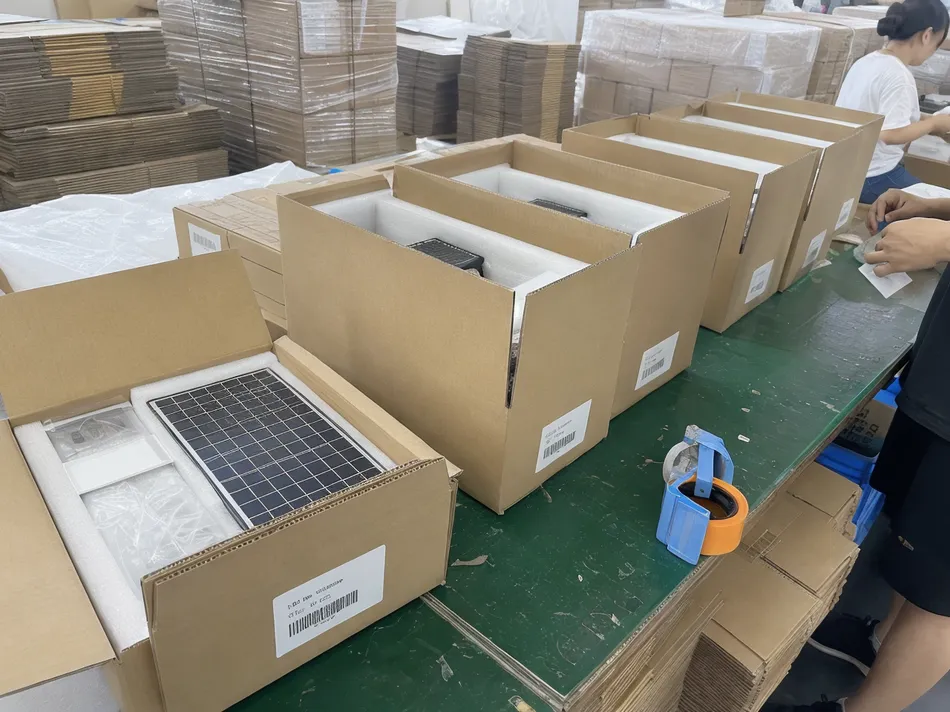
The solar panel is the most fragile component — it needs foam-cushioned carton sections, not just bubble wrap. The housing and bracket need to be packed to prevent scratching during transit.
Accessory packs — mounting hardware, screws, anchors, cable ties, installation guides — are counted against a packing list before carton sealing. We switched from visual accessory checks to counted checks after a run of containers arrived with missing hardware packs. The count adds 30 seconds per carton. It also eliminates the customer service call.
Batch Traceability
Each carton carries a batch code for traceability. If a quality issue surfaces in the field, you can trace it back to the production batch and we can pull the inspection records for that run.
Carton labeling includes product code, lumen output, IP rating, certification marks, and batch number — the information your receiving team and downstream customers need without opening the carton.
Production Capacity & Reorder Control
Six production lines running automated SMT assembly, with daily output above 5,000 units and annual capacity at 1,200,000 units — your reorder runs on a scheduled line, not in a queue.
Mixed-SKU Consolidation
For distributors running mixed-SKU orders across multiple products in the solar flood and security lighting range, we consolidate at the carton level with a master packing list. Pallet configurations are available for buyers who need palletized delivery for warehouse receiving.
FAQ for Solar Motion Sensor Flood Light Buyers
What PIR detection range is practical for a solar motion sensor flood light?
What PIR detection range is practical for a solar motion sensor flood light?
For most residential and small commercial applications — driveways, garden entries, building corners — a 5–8 meter detection range covers the area without triggering on street traffic or adjacent properties.
For warehouse gates, loading areas, and larger perimeters, 8–12 meters with a 120° detection angle is the standard spec.
The practical limit on PIR range in outdoor flood lights is false-trigger management: a 12-meter sensor on a busy street will drain the battery on vehicle movement.
Factory configuration: We configure PIR sensitivity and range at the factory — if your accounts have specific coverage requirements, include the mounting height and site description in the RFQ and we'll confirm the sensor configuration.
How do I choose lumen output for a motion sensor solar security lighting project?
How do I choose lumen output for a motion sensor solar security lighting project?
Match lumen output to mounting height and coverage area:
2.5–4 m Wall Mount
1,000–2,500 lm
Driveway or entry coverage
4–6 m Mount
2,500–4,500 lm
Loading area or parking edge, 120° beam
Above 6 m
4,500–6,000+ lm
Narrower beam to maintain ground illuminance
The beam angle matters as much as the lumen number — a high-lumen light with a narrow beam creates a bright spot and dark edges.
Contractor supply note: If you're supplying contractors, confirm mounting height before quoting. It's the variable that determines whether the product works or generates a warranty claim.
Does motion-triggered lighting really extend battery autonomy compared to always-on solar flood lights?
Does motion-triggered lighting really extend battery autonomy compared to always-on solar flood lights?
Yes, significantly. An always-on solar flood light draws from the battery continuously from dusk to dawn — typically 8–12 hours of full-brightness draw. A motion-triggered model runs at 10–20% standby output and activates to full brightness only on detection.
Depending on detection frequency at the site, active draw can be reduced by 60–80% compared to always-on operation. In winter months with short charging windows and long nights, this difference determines whether the battery holds through the night or depletes before dawn.
Market-Specific Guidance
For security applications in markets with seasonal irradiance variation — Northern Europe, Canada, northern China — PIR-triggered models are the correct spec. Always-on models are appropriate for applications where continuous illumination is required regardless of movement.
Motion-Triggered
10–20% standby draw, full brightness on detection only. 60–80% less active draw. Holds through long winter nights.
Always-On
Continuous full-brightness draw for 8–12 hours dusk to dawn. Appropriate only where constant illumination is mandatory.
What IP rating should I specify for outdoor solar motion sensor security lights?
What IP rating should I specify for outdoor solar motion sensor security lights?
IP65 covers the majority of outdoor flood and security lighting applications — it handles rain, dust, and direct water spray from any direction. Specify IP67 if your installations include ground-level mounting, coastal environments, or any position where water pooling is possible. IP67 adds submersion resistance to 1 meter for 30 minutes.
| Rating | Protection Level | Recommended For |
|---|---|---|
| IP65 | Rain, dust, direct water spray from any direction | Standard wall-mounted or bracket-mounted perimeter security lighting |
| IP67 | All IP65 protections + submersion to 1m for 30 minutes | Ground-level mounting, coastal properties, flood-prone areas |
For standard wall-mounted or bracket-mounted perimeter security lighting, IP65 is sufficient. If your accounts include coastal properties, flood-prone areas, or ground-mounted installations, specify IP67 — our waterproof solar security lights carry IP67 ratings verified on our own test equipment.
Verification available: IP test documentation and certifications are available for distributor review upon request.
When should I choose PIR solar security lighting instead of always-on solar flood lighting?
When should I choose PIR solar security lighting instead of always-on solar flood lighting?
Choose PIR-triggered solar motion sensor security lighting when the application is security-focused and battery autonomy matters — perimeter security, entry points, gates, and any installation where the light needs to last through the night without grid backup.
Choose always-on solar flood lighting when continuous illumination is required regardless of movement: active loading docks, work areas, or applications where the light needs to be on for safety rather than security.
The motion-triggered activation also provides a deterrent effect that always-on lighting doesn't — the sudden activation signals detection, which is the core value proposition for security-focused end customers.
For PIR solar security lighting with adjustable detection configuration, see our PIR solar security lights.
What is the MOQ for JXSOL solar motion sensor flood lights?
What is the MOQ for JXSOL solar motion sensor flood lights?
100 units for standard catalog models. This is low enough to test a new SKU with your accounts before committing to a larger program.
OEM/ODM projects with custom specifications — lumen output, battery capacity, PIR configuration, housing color, private-label packaging — go through an engineering review before production to confirm the spec and MOQ for your specific requirements.
Request a quote with your target model, volume, and market.
Send Mounting Height, Output Target, and Order Volume
Tell us your target market, mounting height, coverage area, required lumen range, lighting mode (motion-triggered or always-on), IP rating requirement, order volume, and whether you need private-label packaging. We'll come back with a configuration recommendation and pricing — not a generic catalog PDF.
Address
9th Floor, Houda Industrial, No. 65 Pinghe Road, Guzhen Town, Zhongshan, Guangdong, 528421, China