

PIR Solar Security Lights Motion-Triggered
Passive infrared solar security lights with adjustable detection, configurable lighting modes, and verified IP65/IP67 weatherproof construction.
Built for distributors, project contractors, and private-label buyers who need a motion-triggered security SKU with dependable sensor activation and longer battery autonomy than always-on flood models.
100%
Pre-Shipment Inspection
MOQ 100
Units Minimum
OEM/ODM
Available
12,000 m²
Zhongshan Facility
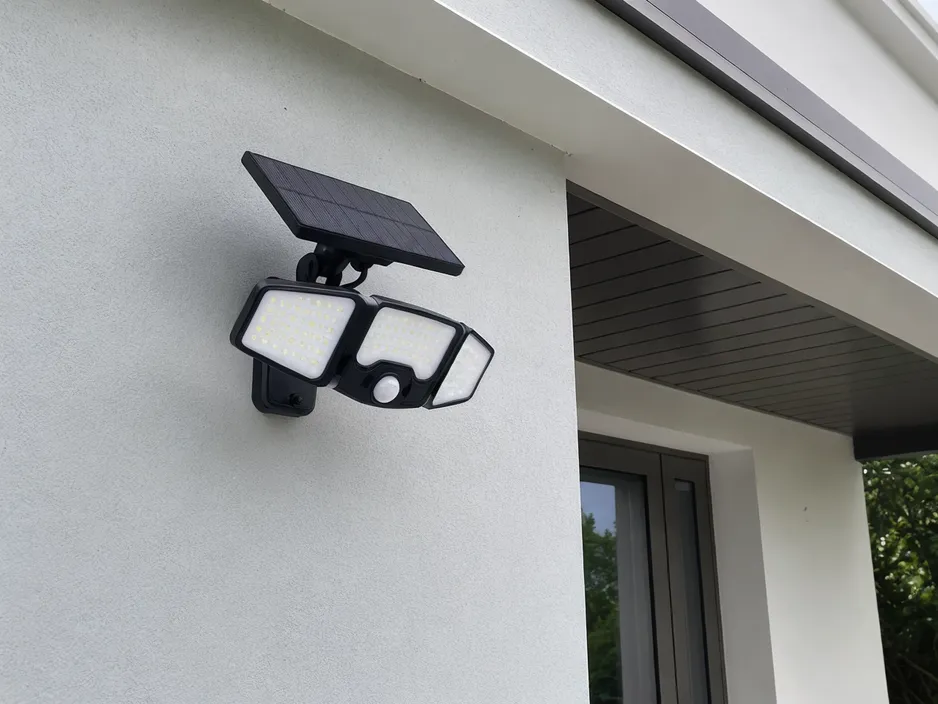
PIR Solar Security Lights for Motion-Triggered Security Supply
PIR solar security lights are the motion-triggered SKU in our solar flood and security lighting range. The defining feature is passive infrared detection: the light stays in standby or dim mode until the sensor detects heat movement in its field of view, then activates to full output. That activation pattern is what separates this product from always-on solar flood lights and from general motion sensor models — the PIR sensor is the primary control mechanism, not a secondary feature.
For distributors and project buyers, that distinction matters commercially. A PIR-triggered security light draws a fraction of the battery power of an always-on model during standby, which extends autonomy significantly — especially in markets with shorter winter charging windows. Fewer battery complaints, fewer warranty claims, and a cleaner security SKU positioning for your downstream accounts. We've been manufacturing PIR solar security lighting since the early years of the product category, and the buyers who switch from always-on models to PIR-triggered rarely go back.
This product is manufactured in-house at our 12,000 m² Zhongshan facility across 6 dedicated production lines. Standard models are available from 100 units. OEM/ODM configurations — custom lumen output, battery capacity, sensor logic, private-label packaging — go through an engineering review before production. Request a quote for PIR solar security lights or read on for full specifications, application segments, and customization details.
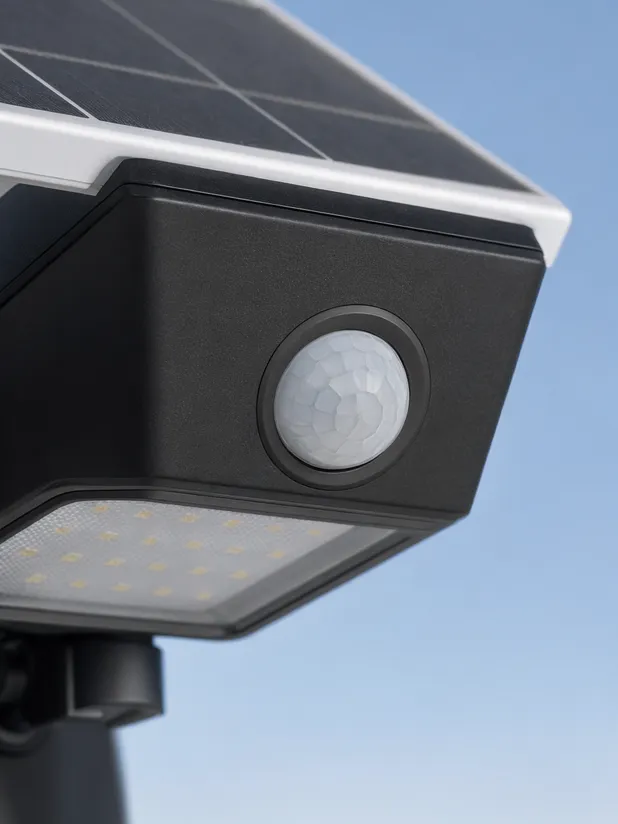
Key Differentiator
PIR sensor is the primary control mechanism, not a secondary feature. The light activates only on heat-movement detection — drawing a fraction of battery power compared to always-on flood models.
PIR Detection Logic That Protects Battery Life and Reduces Returns
The commercial case for PIR solar security lights over always-on solar flood lighting comes down to one number: battery draw. An always-on model at 1,500 lumens runs the LED continuously from dusk to dawn — typically 10–12 hours. A PIR-triggered model at the same output runs the LED only when motion is detected, spending the rest of the night in standby at 5–10% output or fully off. In a typical residential or small commercial security application, that means the LED is at full output for 30–90 minutes per night rather than 10–12 hours. The battery lasts proportionally longer, and the autonomy buffer for cloudy days is much wider.
Always-On Model
Full output 10–12 hours per night. Battery depletes rapidly. Shorter autonomy in cloudy conditions. Higher warranty claim rate.
PIR-Triggered Model
Full output only 30–90 minutes per night. Battery lasts proportionally longer. Much wider autonomy buffer for cloudy days. Fewer returns.
That's the battery math. The sensor performance is what determines whether the product actually works in the field — and it's where most of the quality variation in this category lives.
Detection Range and Angle
Detection range and angle are the two parameters buyers most often under-specify. For a compact PIR solar security light mounted at 2.5–3.5 meters on a wall or post, a detection range of 5–8 meters covers a standard driveway entry or building corner. For mounting heights of 4–5 meters covering a wider perimeter zone, 8–12 meters detection range is the practical spec.
Detection angle on our standard models runs 90°–120° — wide enough to cover a gate or doorway approach without requiring precise sensor aiming.
Buyer note: We've seen buyers spec a 90° sensor for a corner mounting position and then get complaints about coverage gaps. The fix is usually a 120° model or a bracket that allows sensor angle adjustment — worth confirming before you quote a project.
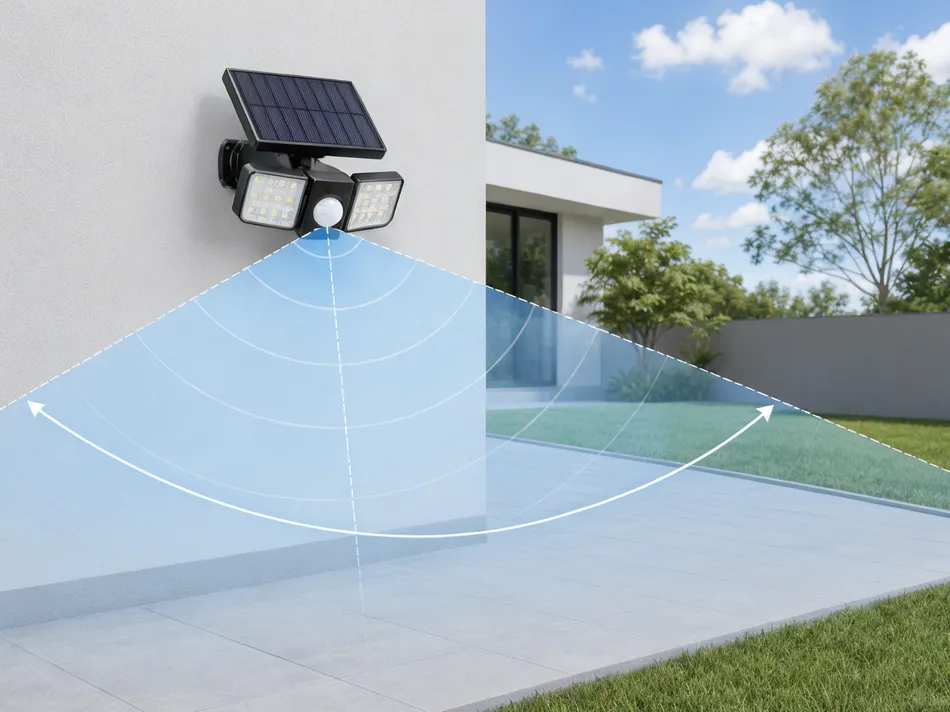
5–12 m
Detection Range
90°–120°
Detection Angle
Configurable Lighting Modes
Lighting modes are the other variable that separates a well-specified PIR security light from a commodity motion sensor product. The modes we configure on our standard and OEM models:
Off-to-Bright
Full standby off, activates to full output on detection. Maximum battery savings, highest deterrent impact.
Dim-to-Bright
Standby at 10–20% output for ambient lighting, activates to 100% on detection. Useful for applications where some continuous light is needed.
Timer + Motion
Full output for a set period after dusk, then switches to motion-triggered mode for the rest of the night.
Emergency High-Output
Activates to maximum output on detection regardless of battery state — useful for high-security applications where the light must trigger even on a partially depleted battery.
Adjustable Delay Time
Delay time — how long the light stays at full output after the last motion event — is adjustable on our standard models, typically 10–120 seconds. Shorter delay saves battery; longer delay is better for applications where continuous coverage after detection matters.
Commercial Value of Correct Sensor Specification
The commercial value of getting these parameters right: fewer false-trigger complaints, fewer "light doesn't stay on long enough" returns, and a product that your downstream accounts can install and forget. For buyers comparing PIR solar motion sensor lighting options, the sensor spec is where the real differentiation lives — not the lumen number on the box.
Specification Table for Procurement Sheets and Project Quotes
These specifications cover our standard PIR solar security light configurations. Values shown are typical for the product range — exact parameters depend on the specific model and configuration. Contact us with your target output, mounting height, and market for a confirmed datasheet.
| Parameter | Typical Specification |
|---|---|
| LED Output | 800 lm – 3,000 lm (configurable) |
| Solar Panel Type | Monocrystalline silicon |
| Solar Panel Capacity | 6W – 20W (sized to battery and output) |
| Battery Chemistry | Lithium iron phosphate (LiFePO4) |
| Battery Capacity | 5,000 mAh – 15,000 mAh |
| PIR Detection Range | 5 m – 12 m (adjustable) |
| PIR Detection Angle | 90° – 120° |
| Recommended Mounting Height | 2.5 m – 5 m |
| Lighting Modes | Off-to-bright, dim-to-bright, timer + motion, emergency high-output |
| Delay Time | 10 s – 120 s (adjustable) |
| Color Temperature (CCT) | 3,000K – 6,500K (warm white to daylight) |
| IP Rating | IP65 / IP67 |
| Housing Material | Die-cast aluminum |
| Working Temperature | -20°C to +50°C |
| Charging Time | 6–8 hours (full sun) |
| Autonomy (standby mode) | 3–7 days depending on battery capacity and usage pattern |
| Mounting Method | Wall bracket, pole mount (bracket included) |
| Certifications | ISO 9001:2015, CE, RoHS, IP65/IP67, IEC 62124 |
| MOQ (standard models) | 100 units |
| Warranty | 3 years |
Specifications shown are typical values for this product range. Actual specifications vary by model and configuration. Contact us for a confirmed product datasheet with your target output, battery capacity, and sensor requirements.
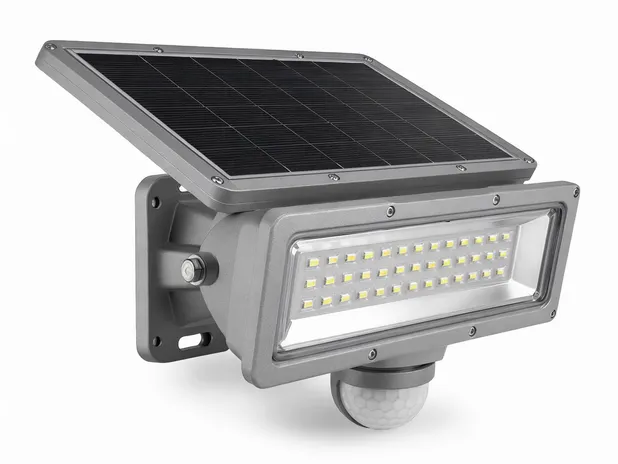
Key Highlights
- LiFePO4 battery — 3–7 day autonomy in standby mode
- IP65/IP67 — die-cast aluminum housing rated -20°C to +50°C
- PIR adjustable — 5–12 m range, 90°–120° angle
- 4 lighting modes — off-to-bright, dim-to-bright, timer + motion, emergency
- Certified — ISO 9001:2015, CE, RoHS, IEC 62124
Need a Confirmed Datasheet?
Send your target lumen output, panel capacity, and battery requirements for a configuration quote.
Request Configuration QuoteMOQ from 100 units · 3-year warranty
CE, RoHS, IP65/IP67, and IEC 62124 documentation available per order.
View Certifications →Market Segments Where PIR Solar Security Lighting Sells Cleanly
The commercial logic for PIR solar security lighting is consistent across segments: motion-triggered activation, no grid wiring, fast installation. The segments below are where the product generates repeatable revenue for distributors and project buyers.
Residential Security Resale
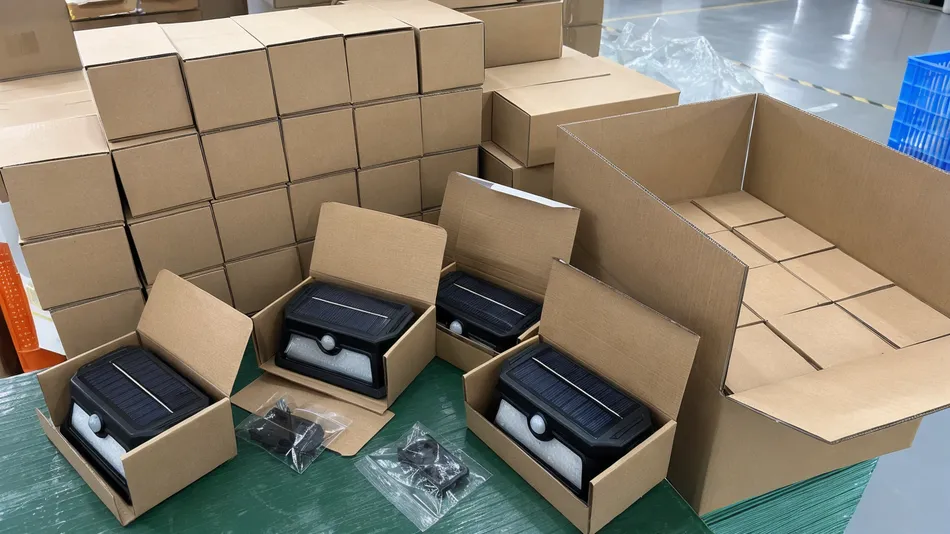
Compact PIR solar security lights are a high-velocity SKU for hardware distributors, home improvement channels, and e-commerce sellers. The end customer installs without an electrician — wall bracket, two screws, done. That low installation barrier keeps sell-through high and return rates low.
For distributors building a solar security lighting catalog, this is the entry-level SKU that drives volume.
Order Pattern Profile
- Initial stocking: 500–2,000 units per SKU
- Reorders: Tied to sell-through velocity
- Packaging: Private-label standard for buyers building their own brand
Small Commercial Entrances and Service Doors
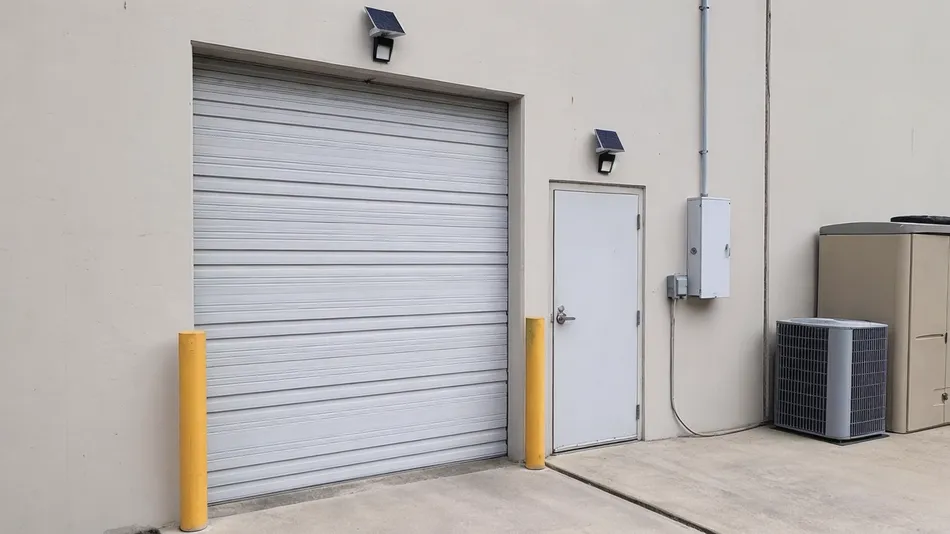
Loading doors, side entrances, storage room access points, and back-of-house areas are a consistent project segment for electrical contractors and facilities suppliers. The value proposition is straightforward: motion-triggered security lighting at access points where running conduit is expensive or the landlord won't approve electrical work.
PIR solar security lights cover this application cleanly — compact form factor, wall-mount bracket, no wiring. Contractors who stock this SKU as a standard solution for tenant improvement projects reorder regularly.
Order Pattern Profile
- Per site: 10–50 units per project
- Account depth: Multiple sites per contractor account
- Reorder cycle: Regular, driven by new tenant improvement projects
Warehouse and Perimeter Blind Spots
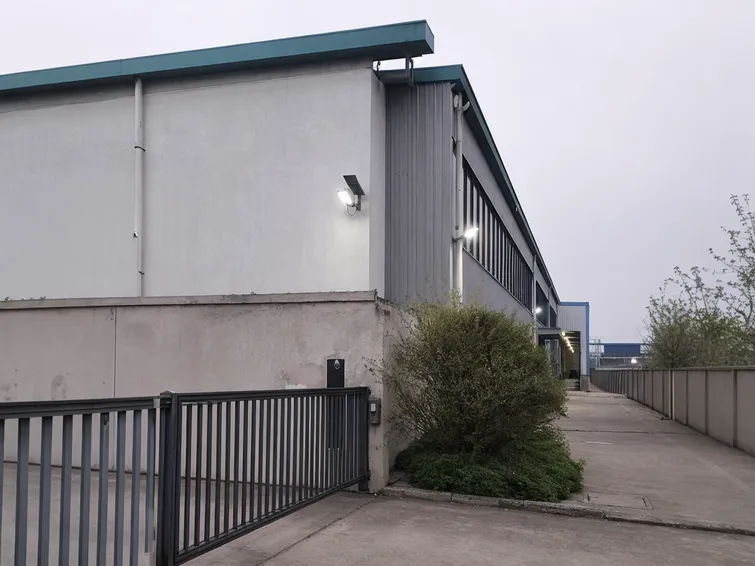
Larger warehouse and industrial perimeter projects use commercial solar flood lights for primary coverage, but PIR solar security lights fill the secondary zones: corners, gate approaches, secondary access points, and areas where the main flood light beam doesn't reach. These are add-on units in a larger project order — typically 20–100 units alongside a primary flood lighting specification.
The PIR-triggered activation is preferred for these positions because the lights are in low-traffic areas and always-on models would drain battery without purpose.
Field Observation
We've had project buyers spec always-on models for corner positions and then replace them with PIR units after the first winter. The battery math catches up fast in low-irradiance months.
Rural and Agricultural Properties
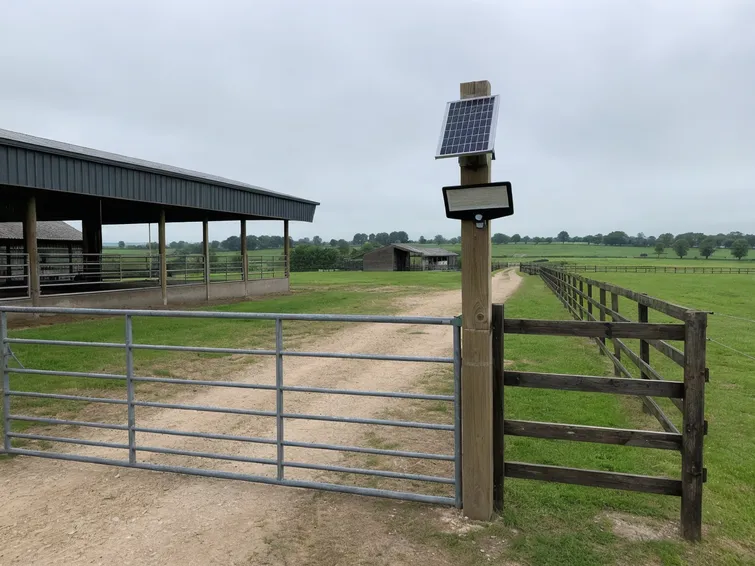
Off-grid barns, equipment storage yards, gate approaches, and perimeter fencing are a natural fit for PIR solar security lighting. Grid extension to these locations is expensive — often more expensive than the lighting itself. Solar eliminates that cost entirely.
Battery autonomy is the key spec question for this segment: buyers in northern markets or high-latitude regions need extended battery capacity to handle short winter days. We configure battery packs for 5–7 day autonomy for buyers in these markets.
Order Pattern Profile
5–30
Units per site
5–7 day
Battery autonomy (high-latitude)
Repeat
Multi-property, multi-season
Order patterns tend to be smaller per site but repeat across multiple properties and seasons — a steady reorder channel for distributors serving agricultural markets.
Temporary Site Security
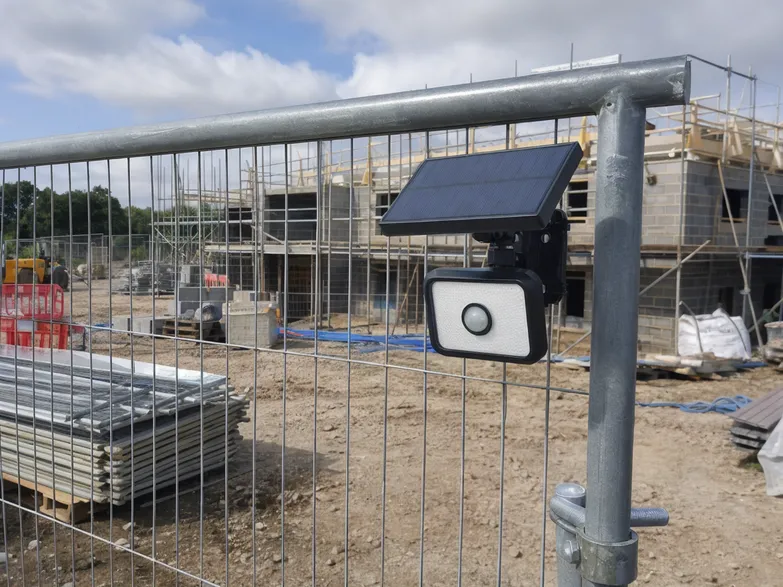
Construction sites, event venues, and short-term installations need security lighting for the duration of the project, then the equipment moves to the next site. Solar security lights are the practical choice: no wiring, no electrician, no infrastructure left behind. Contractors who stock PIR solar security lights as a standard site setup item reorder every season.
The reusable nature of the product — move it, remount it, done — is a selling point your accounts can use with their clients. Typical stocking quantities for active contractors run 50–200 units.
Community and Campus Projects
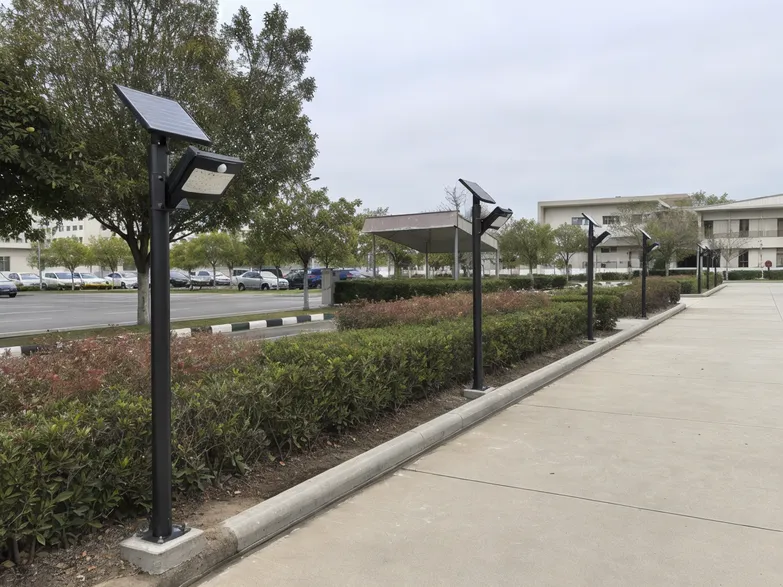
Controlled perimeter points, walkway edges, parking lot corners, and maintenance access areas on school campuses, housing developments, and community facilities are a steady project segment. These projects often run on annual procurement budgets with defined SKU requirements — a clean fit for distributors who can supply consistent product across multiple sites.
The PIR-triggered activation is preferred for these applications because it reduces light pollution complaints while maintaining security coverage. Government and institutional buyers in this segment typically require CE documentation and RoHS compliance records for import and project submission.
For higher-output perimeter coverage on larger sites, see our commercial solar flood lights. For general security lighting SKUs without PIR as the primary feature, see our solar security lights.
Installation Variables That Decide PIR Performance
PIR performance in the field depends more on installation decisions than on the sensor spec itself. Getting these variables right before the product ships reduces after-sales support and warranty claims for your accounts.
Mounting Height & Sensor Orientation
The PIR sensor detects heat movement across its field of view — side-crossing motion (a person walking across the detection zone) is detected more reliably than straight-on approach (a person walking directly toward the sensor).
Practical Guidance
For gate and driveway applications, mount the sensor so the approach path crosses the detection field rather than heading straight at it.
2.5–3m Height
90°–120° sensor covers a standard entry zone
4–5m Height
Wider angle or longer detection range needed for ground-level coverage
False Trigger Sources
The most common installation complaint in PIR solar motion sensor lighting. The sensor responds to heat movement — which means multiple environmental sources can trigger the light unintentionally.
Common False Trigger Sources:
- HVAC exhaust vents directing warm air across the sensor field
- Moving tree branches within the detection zone
- Vehicles on a nearby road passing through the sensor field
- Reflective surfaces that redirect heat signatures
For Buyers Supplying Contractors
Including this guidance in the installation documentation reduces support calls significantly. Aim the sensor away from HVAC exhaust and road traffic, trim vegetation that moves in the sensor field, and avoid mounting positions where the sensor faces a reflective wall or window at close range.
Solar Panel Exposure
Solar panel exposure determines charging performance and, by extension, battery autonomy. The panel needs unobstructed sun exposure for 4–6 hours daily to maintain rated autonomy.
Positions That Reduce Charging Efficiency:
- Under roof overhangs
- Between buildings with limited sky exposure
- Facing away from the sun's path
Variable Irradiance Markets
For buyers supplying markets with variable irradiance — northern Europe, high-latitude North America, or monsoon-season Southeast Asia — confirm the panel sizing and battery capacity for the target location before quoting.
Accessory Planning
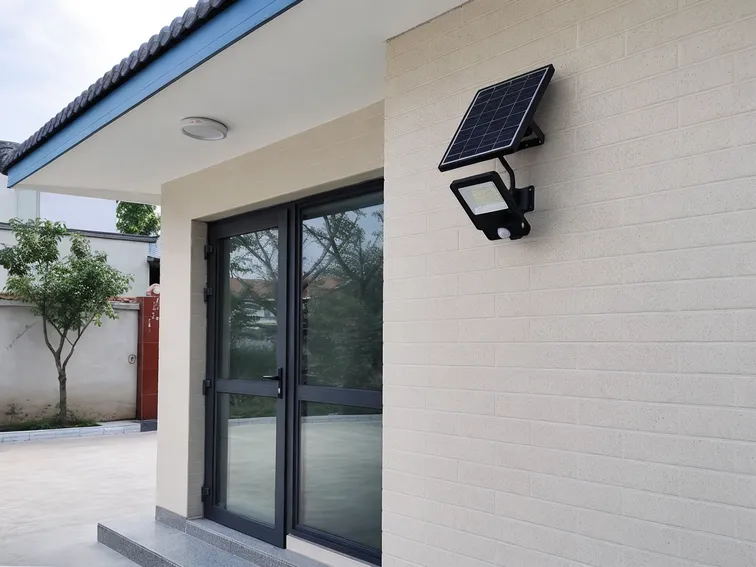
Missing or incompatible mounting hardware is one of the most common sources of installation complaints, and it's entirely preventable at the order stage.
Standard Mounting Hardware Includes:
Confirm Before Order Ships
Pole mount adapters are available for post-mounting applications. If your accounts need specific bracket configurations — adjustable tilt, extended arm, or pole diameter compatibility — confirm before the order ships.
For detailed installation planning guidance, see our solar security lighting installation guide.
Send Project Photos for Configuration ConfirmationQC Checks for Sensor, Battery, Lumen, and Waterproof Reliability
The parent category page covers our general production controls for solar flood and security lighting — battery matching, lumen binning, waterproof inspection, and 100% pre-shipment checks. This section covers the checks specific to PIR solar security lights, where the sensor and controller add a layer of testing that standard flood lights don't require.
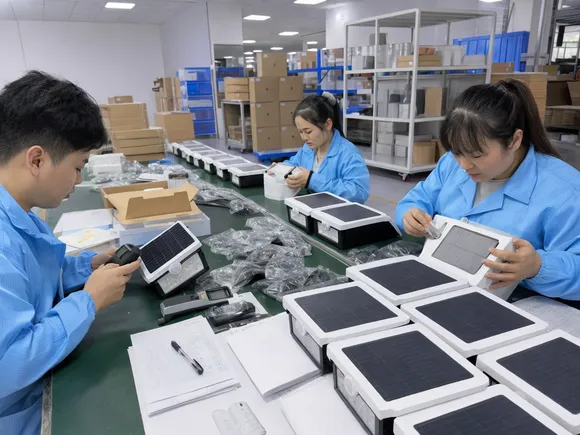
PIR Sensor & Controller Function Testing
Dedicated Bench Equipment — Pre-Assembly
Each sensor is tested for trigger response time, sensitivity threshold, detection range confirmation, and delay time accuracy on dedicated bench equipment before assembly.
Controller Test Sequence:
- 1 Off-to-bright mode verification
- 2 Dim-to-bright mode verification
- 3 Timer + motion mode verification
- 4 Detection zone boundary behavior
- 5 Full mode-switching sequence (all transitions)
Why full-sequence testing: We added the full-sequence test after seeing a batch of controllers that passed single-mode testing but had a firmware issue in the mode-switching logic. A controller that works in off-to-bright mode but fails to switch correctly in dim-to-bright mode will generate warranty claims from accounts that use that configuration. Caught it before shipment.
Battery Pack Matching
Capacity & Internal Resistance — Pre-Assembly
Cells from the same batch are matched within a defined tolerance by capacity and internal resistance before pack assembly. We don't mix cells from different production runs in the same pack.
Aging Rack Process:
- Every assembled pack goes through a charge/discharge cycle on aging racks before installation
- Aging test confirms actual capacity against rated capacity
- Catches cells that are within spec individually but underperform in a matched pack
Non-negotiable for PIR security lights: The battery is the primary autonomy buffer. This step is non-negotiable because PIR lights depend entirely on stored energy for nighttime operation and motion-triggered response.
LED Module Lumen & CCT Confirmation
Module Assembly Stage
Modules are sorted by lumen output and color temperature before installation. The lumen output confirmed at this stage is what goes on the datasheet — not the theoretical chip maximum.
Container-to-container consistency: Your second container matches your first because the binning tolerance is set at the module stage, not assumed from the chip spec.
Waterproof Structure Inspection
IP Test Bench Verified
Each unit is tested on our IP inspection equipment — not a visual check. IP65/IP67 ratings are verified on our own test benches.
Inspection Points:
- Lens seal
- Cable entry glands (torque spec and gasket material verified)
- Solar panel junction
- Sensor window seal (PIR-specific additional inspection point)
- Housing seam
PIR-specific risk: The sensor aperture is a potential ingress point if the seal spec is wrong. This is an additional inspection point that standard flood lights don't have.
100% Pre-Shipment Inspection
Every unit, every carton, every accessory pack, and every label is inspected before the container is sealed. Batch codes are assigned at the production stage and carried through to the carton label, so any field issue can be traced back to the specific production run and inspection records.
OEM/ODM Options for PIR Security Light Programs
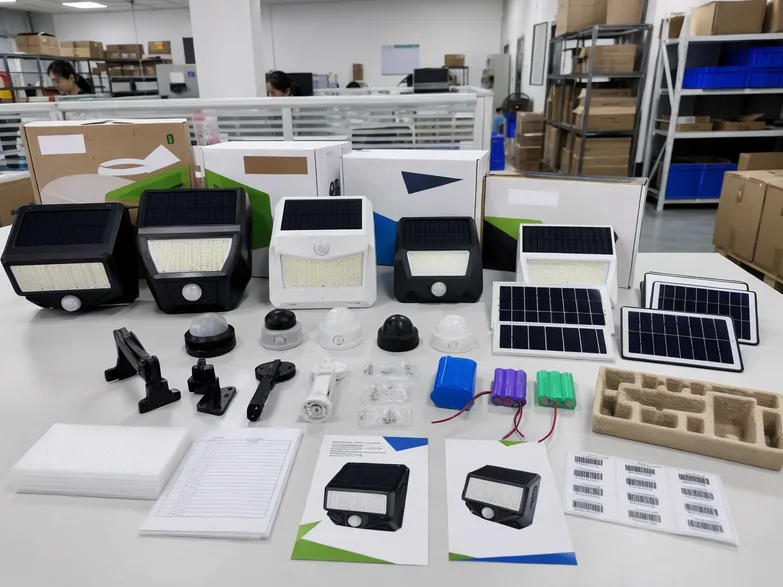
PIR solar security lights are a common private-label SKU for distributors building a branded solar lighting line. The product is compact, installation is simple, and motion-triggered activation is easy to communicate to downstream customers.
What You Can Configure
Lumen Output
Adjustable within the LED module's design range — typically 800–3,000 lm for this product type. Most adjustments don't require a housing change.
Color Temperature
3,000K–6,500K, selectable per order. Warm white (3,000K–4,000K) is standard for residential security applications; daylight (5,000K–6,500K) is preferred for commercial perimeter and industrial applications.
Battery Capacity
Sized for target autonomy days based on your market's average solar irradiance. We've configured 12,000 mAh and 15,000 mAh packs for buyers in northern Europe and high-latitude North America who need 5–7 day autonomy buffers.
Solar Panel Capacity
Matched to battery and output requirements for your target latitude. Buyers in lower-irradiance markets need proportionally larger panels to maintain charging performance.
PIR Sensitivity & Delay Time
Adjustable within the controller's design range. Sensitivity threshold and delay time can be set at the factory for your target application — useful for buyers who want a consistent out-of-box experience for their customers.
Lighting Mode Configuration
The default mode sequence can be set per order. If your market prefers dim-to-bright over off-to-bright as the default, we configure it before shipment.
Housing Color
Custom colors available on runs over 100 units. Below that, the powder line changeover cost doesn't make sense for either side.
Logo & Packaging
Custom carton printing, product labels, SKU codes, and instruction manuals in your brand and language. Accessory pack contents can be adjusted — some buyers add their own installation hardware or remove items that their market doesn't need.
Regional Compliance Documentation
CE Declaration of Conformity, RoHS test reports, and IP certificates provided per order. Additional market-specific documentation on request.
Practical Limits
Major changes to the PIR sensor angle or housing geometry require tooling review — the sensor aperture position and lens geometry are part of the housing mold, and changing them is a tooling project, not a configuration adjustment.
Battery capacity upgrades beyond the standard range may require a larger housing or a different panel size to maintain the charge balance.
Custom colors below 100 units are possible but rarely cost-effective given the powder line changeover.
We'll tell you upfront if a requested configuration requires an engineering review or tooling investment.
Engineering Review
In-house R&D team
MOQ for standard catalog models starts at 100 units. OEM/ODM projects with custom specifications go through an engineering review before production to confirm the configuration is achievable and to lock the spec before component procurement.
Our in-house R&D team of 15+ optical and electrical engineers handles the review — the same team that develops our standard product line.
Choose PIR, Waterproof, Motion Sensor, or Commercial Flood Models
PIR solar security lights are the right choice for motion-triggered security applications where battery autonomy and sensor reliability are the primary requirements. If your application or market points in a different direction, here's how the sibling products compare.
PIR Solar Security Lights
Best For
Motion-triggered security at gates, driveways, building perimeters
Key Differentiator
Adjustable PIR detection range and angle; configurable lighting modes; extended battery autonomy
You are hereSolar Motion Sensor Flood Light
Best For
Broader area flood coverage with motion activation
Key Differentiator
Higher lumen output; wider beam angle for larger coverage zones
View productWaterproof Solar Security Lights
Best For
Coastal, high-humidity, or ground-level installations
Key Differentiator
IP67 rated; housing and cable entry points tested under pressure submersion
View productCommercial Solar Flood Lights
Best For
High-output perimeter lighting for warehouses, parking lots, large sites
Key Differentiator
3,000–8,000+ lm output range; designed for 5–8 meter mounting heights
View productSolar Security Lights
Best For
General security lighting where PIR is not the primary requirement
Key Differentiator
Broader security category; compact form factor; easy bracket mounting
View productQuick Decision Guide
If you need broader flood coverage with motion activation rather than focused PIR security detection, the solar motion sensor flood light is the closer fit.
If your accounts include coastal or high-humidity installations where IP67 is a hard requirement, the waterproof solar security lights are the right spec.
For large perimeter projects requiring high-output continuous or motion-triggered flood lighting, see our commercial solar flood lights.
Export Packing, Mixed-SKU Orders, and Reorder Control
PIR solar security lights are a channel-ready SKU — compact, self-contained, and straightforward to receive, warehouse, and distribute. Here's how we handle packing and logistics for this product.
Unit Packing Contents
Each unit ships with the following components, verified against a packing list before carton sealing — not a visual check:
- Lamp body
- Solar panel (integrated or separate depending on model)
- Wall bracket
- Mounting screws and anchors
- Installation guide
Key quality note: Accessory packs are counted against a packing list before carton sealing. Missing accessories are one of the most common sources of customer complaints in this product category, and it's a problem that happens at the packing stage, not in the field.
Carton Labeling & Container Loading
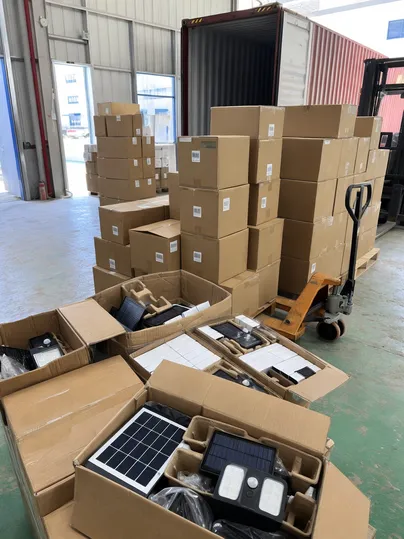
Carton dimensions are sized for standard 20GP and 40HQ container loading. Each carton carries the information your receiving team needs without opening the carton:
- Batch code
- SKU label
- Lumen output
- IP rating
- Certification marks
Private-label orders: Carton printing and product labels are produced in your brand and language.
Mixed-SKU Orders & Catalog Consolidation
Mixed-SKU orders combining PIR solar security lights with other products in our solar flood and security lighting range are standard. We consolidate at the carton level with a master packing list, and pallet configurations are available for buyers who need palletized delivery.
If you're building a mixed solar security lighting catalog order, send us the SKU list and quantities — we'll confirm container loading efficiency and lead time.
FAQ for PIR Solar Security Light Buyers
What PIR detection range should I specify for outdoor solar security lights?
Match detection range to mounting height and the coverage zone you need. For compact models mounted at 2.5–3.5 meters covering a standard driveway entry, gate approach, or building corner, a 5–8 meter detection range is the practical spec. For mounting heights of 4–5 meters covering a wider perimeter zone or larger access area, specify 8–12 meters.
The detection range on our standard models is adjustable via the sensitivity control — you can dial it back if the mounting position picks up traffic from an adjacent road or public area. If you're supplying contractors who install at variable heights, specify a model with an adjustable range rather than a fixed-range unit.
Are PIR solar security lights better than always-on solar flood lights for security applications?
For security-focused applications, PIR-triggered models have two advantages over always-on flood lighting: battery autonomy and deterrent effect.
Battery autonomy is the practical one — a PIR model in standby draws 5–10% of the power of a continuously-lit model, which means the battery lasts proportionally longer and the autonomy buffer for cloudy days is much wider.
The deterrent effect is the secondary advantage: sudden activation when someone enters the detection zone is more noticeable than a light that's already on.
Always-on flood lighting is the right choice when continuous illumination is required regardless of activity — loading docks, active work areas, or applications where the light needs to be on for safety rather than security. For most perimeter security applications, PIR-triggered is the better spec.
- 5–10% standby power draw
- Wider cloudy-day autonomy buffer
- Sudden activation deters intruders
- Continuous illumination
- Loading docks & active work areas
- Safety-first applications
What mounting height works best for PIR solar motion sensor lighting?
The practical range for compact PIR solar security lights is 2.5–5 meters. Below 2.5 meters, the detection field is too close to the ground and the sensor is more likely to pick up small animals or ground-level heat sources. Above 5 meters, the detection range needs to be proportionally longer to maintain ground-level coverage, and the beam angle needs to be wider to avoid a narrow coverage cone.
Recommended Heights by Application
Residential & Small Commercial
Driveways, gates, building corners, service entrances
2.5–3.5 m (sweet spot)
Warehouse & Larger Commercial
Perimeter security, loading areas, parking zones
4–5 m with 10–12 m detection range
How do I reduce false triggering on PIR solar security lights?
False triggers come from heat sources that move in the sensor's field of view: HVAC exhaust vents, vehicles on nearby roads, moving vegetation, and reflective surfaces that redirect heat signatures.
Practical Fixes for Installation
Aim away from HVAC exhaust — hot air plumes register as moving heat signatures and trigger the sensor continuously.
Angle away from road traffic — passing vehicles produce large heat differentials that overwhelm standard sensitivity thresholds.
Trim vegetation in the detection field — wind-blown branches and leaves create intermittent heat movement that mimics human-scale motion.
Avoid reflective walls or windows at close range — these redirect heat signatures from outside the intended detection zone back into the sensor's field of view.
Product-Side Solution: Adjustable Sensitivity
Adjustable sensitivity lets you reduce the detection threshold so the sensor only responds to larger heat signatures — useful for installations near roads or in areas with frequent small-animal activity. If false triggering is a known issue for your target market, specify a model with adjustable sensitivity and include the adjustment guidance in your installation documentation.
What IP rating is needed for PIR solar security lights used outdoors?
IP65 is sufficient for the majority of outdoor PIR solar security light applications — wall-mounted or post-mounted perimeter lighting, gate approaches, building corners, and standard commercial entries. IP65 handles rain, dust, and direct water spray from any direction.
Specify IP67 if your installations include ground-level mounting, coastal environments, or any position where water pooling is possible. IP67 adds submersion resistance to 1 meter for 30 minutes.
For PIR security lights specifically, the sensor window seal is an additional inspection point beyond the standard housing waterproofing — confirm that the IP rating covers the sensor aperture, not just the housing body.
Verification note: Our IP ratings are verified on our own test equipment, not assumed from housing design.
Can JXSOL customize lighting modes, battery capacity, and packaging for bulk orders?
Yes. Lighting modes, PIR sensitivity, and delay time are configurable at the factory for your target application. Battery capacity is sized for target autonomy days based on your market's solar irradiance — we've configured extended-autonomy packs for buyers in northern Europe and high-latitude North America.
Custom packaging, product labels, and instruction manuals in your brand and language are standard for private-label orders.
Send Your Detection Range, Lighting Mode, and Order Volume
Tell us your target market, mounting height, required detection range, lumen output, preferred lighting mode, IP rating requirement, order volume, and whether you need private-label packaging. We'll come back with a configuration recommendation and pricing based on your specific requirements — not a generic catalog PDF.
Not Sure Which Configuration Fits?
If you're not sure which configuration fits your market, send us the application details — the type of installation, the mounting position, the coverage area, and the downstream customer profile.
We've configured PIR solar security lights for residential hardware distributors, project contractors, government procurement programs, and private-label brands across North America, Europe, the Middle East, Southeast Asia, and Africa. We can recommend a starting configuration based on what's working for buyers in your region.
Reach Us Directly
Phone / WhatsApp
+8613627818806Address
9th Floor, Houda Industrial, No. 65 Pinghe Road, Guzhen Town, Zhongshan, Guangdong, 528421, China
Explore More Solar Flood & Security Lighting
Solar Flood Lights
General-purpose solar flood lighting for area coverage
Commercial Solar Flood Lights
High-output flood lights for commercial installations
Solar Motion Sensor Flood Lights
Motion-activated flood lighting for perimeter security
Solar Security Lights
Dedicated security lighting with dusk-to-dawn and motion modes
Waterproof Solar Security Lights
IP65/IP67 rated for harsh weather environments
All Flood & Security Lights
View the full solar flood and security lighting category