

Solar Flood Lights Direct From Factory
General-purpose solar flood lights built for distributors, contractors, and catalog buyers who need a reliable, reorderable outdoor solar powered lights SKU.
Die-cast aluminum housing, LiFePO4 battery, monocrystalline panel, IP65/IP67 rated — manufactured in-house at our Zhongshan facility with 100% pre-shipment inspection. MOQ from 100 units.
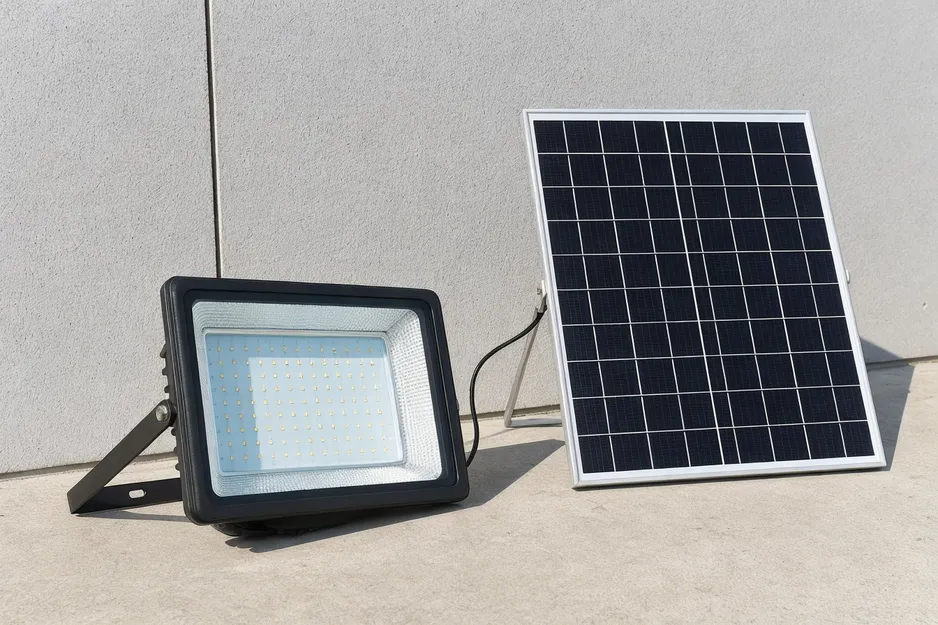
Solar Flood Lights Built as a Flexible Stock SKU
JXSOL solar flood lights are general-purpose outdoor solar powered lights for buyers who need a dependable flood lighting SKU across multiple small-to-mid outdoor applications. These are not niche products — they're the workhorse of a solar lighting catalog: broad channel fit, straightforward installation, and consistent batch-to-batch output that makes reordering predictable.
We manufacture in-house at our 12,000 m² Zhongshan facility, founded in 2012. Six production lines, 150 employees, 1,200,000-unit annual capacity. Standard models start at 100 units MOQ — low enough to test a new SKU with your accounts before committing to a larger program.
If you already know your target lumen range, mounting height, and order volume, send us the details and we'll quote the configuration.
12,000 m²
Zhongshan production facility
6 Lines
Dedicated production lines
1.2M Units/Year
Annual production capacity
100% Inspected
Pre-shipment QC on every unit
Where This Model Fits in Your Flood Lighting Line
The solar flood and security lighting category has eight product types. Knowing where this one sits saves you from quoting the wrong spec.
Right Fit When
- Your buyer needs general outdoor flood coverage for yards, driveways, small commercial entries, or perimeter zones — not a high-output industrial installation
- You're building a mixed solar lighting catalog and need a flood light SKU that works across multiple channel types without requiring a specialist sale
- Your accounts are in hardware distribution, rural property supply, or small commercial contracting — segments where a clean, mid-range solar powered lights product moves without heavy technical support
- You need a reorderable SKU with consistent specs across batches, not a one-off project configuration
Not the Right Fit When
- The application requires 5,000+ lumens for warehouse yards or large parking perimeters — that's commercial solar flood lights territory
- Motion detection is the primary purchase driver — the solar motion sensor flood light page covers that positioning in full
- Your buyer needs IP67 for coastal or ground-level installations — the waterproof solar security lights page owns that spec
The full solar flood and security lighting range covers flood, security, motion-sensor, waterproof, and PIR product types if you're still deciding which SKU fits your market.
Product-Level Specification Table for Quoting
These are standard configuration values for JXSOL solar flood lights. Exact values are confirmed by model and order configuration — contact us for a specific datasheet before finalizing a quotation.
| Parameter | Standard Configuration |
|---|---|
| LED Output | 800 lm – 3,000 lm (model-dependent) |
| LED Module | High-efficiency SMD LED, lumen-binned at assembly |
| Solar Panel Type | Monocrystalline silicon |
| Solar Panel Capacity | 6W – 20W (sized to battery and output tier) |
| Battery Chemistry | Lithium iron phosphate (LiFePO4) |
| Battery Capacity | 5,000 mAh – 15,000 mAh |
| Typical Autonomy | 2–4 nights (always-on); 5–8 nights (motion-triggered) |
| Working Modes | Always-on, motion-triggered, dim-to-bright |
| Beam Angle | 90° – 120° (wide flood coverage) |
| Color Temperature | 3,000K – 6,500K (warm white to daylight) |
| Housing Material | Die-cast aluminum |
| IP Rating | IP65 standard; IP67 available on request |
| Mounting | Adjustable wall bracket (standard); pole mount available |
| Operating Temperature | -20°C to +60°C |
| Certifications | ISO 9001:2015, CE, RoHS, IP65/IP67, IEC 62124 |
| MOQ (Standard Models) | 100 units |
| Warranty | 3 years |
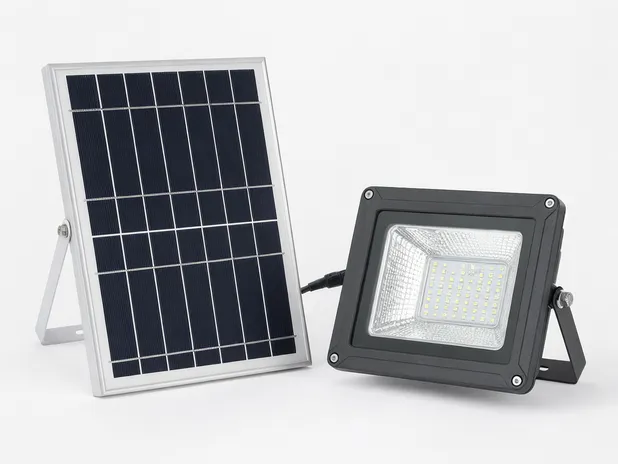
Specifications shown are standard configuration values for this product line. Actual values vary by model and order configuration. Contact us for a detailed datasheet before quoting.
A Note on Lumen Claims
The output figures above are tested module output from our assembly stage, not theoretical LED chip maximums. A chip rated at 5,000 lm at junction temperature doesn't deliver 5,000 lm in a finished fixture at operating temperature.
We test at the module level and report what the unit actually produces. We've seen buyers get burned by chip-spec lumen claims from other suppliers — the number looks good on paper until the product is in the field.
Lumen, Battery, and Panel Matching That Protects Your Margin
The most common sourcing mistake with solar flood lights is treating configuration as a single variable — "I need a 2,000-lumen solar flood light" — without matching the battery and panel to the application. Wrong configuration means either over-spec costs that hurt your landed price or under-spec performance that generates warranty claims. Neither is good for margin.
Lumen Output & Mounting Height
Under 3 meters — Small entry, driveway, garden perimeter
800–1,500 lumens is the practical range.
3–5 meters — Small commercial yard, storage area, rural perimeter
1,500–3,000 lumens with a wide beam angle is the correct spec.
Over-speccing creates glare complaints from downstream customers; under-speccing creates dark spots and security gaps that come back as warranty claims.
Battery Capacity & Lighting Mode
Always-on mode
Draws battery continuously through the night. In markets with 10–12 hours of darkness and shorter winter charging windows — Northern Europe, Canada, higher-latitude North America — always-on mode needs a larger battery pack to maintain 2–3 nights of autonomy.
Motion-triggered mode
Extends battery life significantly because the light only activates on detection. For buyers supplying markets with variable solar irradiance, motion-triggered mode is the safer default spec: it protects autonomy without requiring a larger, more expensive battery pack.
Panel Wattage & Market Latitude
A 10W monocrystalline panel sized for a Middle East or Southeast Asian market will underperform in Northern Europe or Canada during winter months.
We size panels to battery capacity and target autonomy for the buyer's market. If you're supplying multiple regions from the same SKU, tell us — we'll recommend the panel configuration that covers the worst-case market without over-speccing for the others.
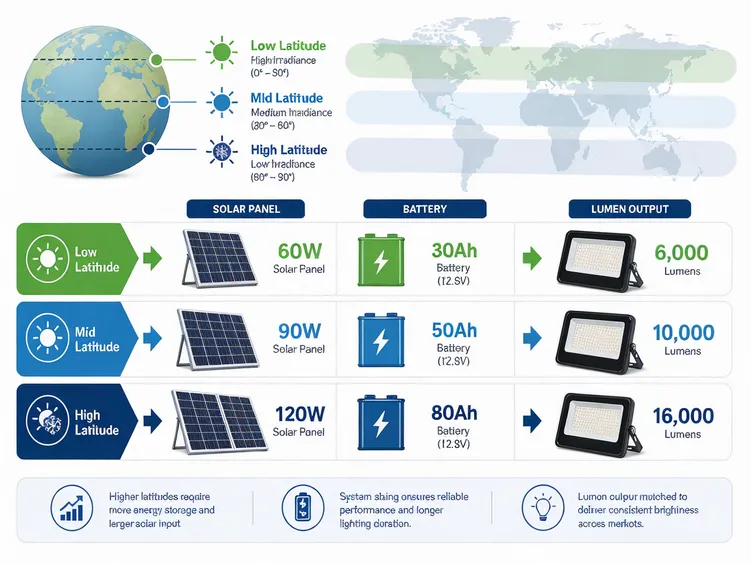
Key Takeaway for Multi-Region Buyers
If you're sourcing a single SKU for multiple markets with different solar irradiance profiles, the panel and battery configuration must be sized for the worst-case market. We handle this sizing as part of the quoting process — provide your target markets and autonomy requirement, and we'll spec the configuration that works across all of them.
Commercial Segments That Can Reorder This SKU
Solar flood lights move well in specific commercial segments because the value proposition is clean: outdoor illumination without grid trenching, fast installation, and no ongoing electricity cost. Here's where this product generates repeatable revenue.
Hardware & Building-Material Distributors
General-purpose outdoor solar powered lights are a natural fit for hardware distribution channels — they sit alongside extension cords, security cameras, and outdoor electrical products. The SKU doesn't require a specialist sale, the installation is straightforward enough that end customers handle it themselves, and the product moves on seasonal promotions and home improvement cycles.
Typical reorder pattern:
200–500 units per SKU per season, with consistent demand across spring and autumn.
Rural Property & Farm Supply Channels
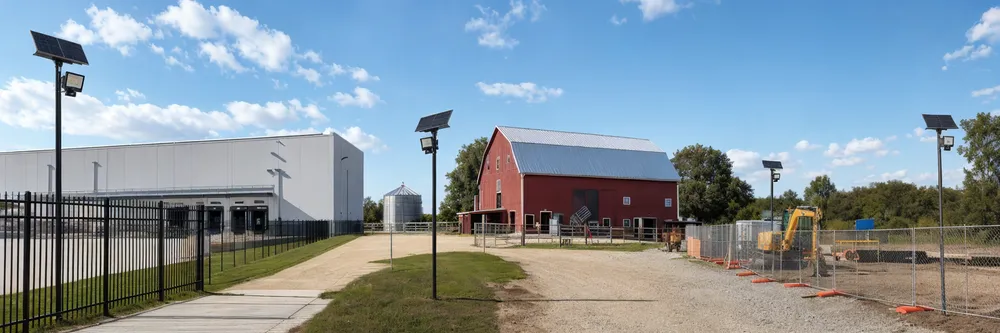
Agricultural buyers need perimeter and yard lighting across large areas where grid power is unavailable or expensive to extend. Solar flood lights are the default solution for barn entrances, equipment storage areas, and property perimeters. Battery autonomy and cold-weather performance are the key spec questions for this segment — buyers in Northern markets need to confirm winter performance before committing.
Typical reorder pattern:
Annual reorders. Tends to consolidate with a single supplier once they find a product that performs.
Small Commercial Perimeter Projects
Contractors specifying lighting for small warehouses, storage yards, commercial entries, and access roads where running conduit is expensive or impractical. The no-grid-connection advantage reduces installation cost significantly, which makes the ROI case easy to present to the end client.
Typical reorder pattern:
50–300 units per site, with repeat orders following new-site builds and facility expansions.
Temporary & Semi-Permanent Site Lighting
Construction sites, event venues, and temporary facilities need lighting for the duration of the project, then it moves to the next site. Solar flood lights are the practical choice: no electrical contractor required, no conduit to pull, no ongoing electricity cost. Contractors who stock solar powered lights as a standard site setup item reorder regularly.
Typical reorder pattern:
High-frequency, lower-volume segment that builds steady revenue.
Mixed Solar Lighting Catalog Programs
Distributors building a solar lighting catalog across multiple product types — street lights, garden lights, wall lights, flood lights — benefit from sourcing from one factory. Mixed-SKU orders across our solar flood and security lighting range are standard for us. We handle consolidation and batch coding on our end, which simplifies your receiving and inventory management.
Sourcing advantage:
Single-factory consolidation across multiple solar lighting SKUs. Batch coding and mixed-SKU container loading handled at origin.
Factory QC Points That Matter for This Product
The parent category page covers the full failure mode analysis for solar flood and security lighting. Here's what that means specifically at the production level for this product.
LED Module Lumen Binning
Assembly-Stage Sorting
Every LED module is sorted by lumen output and color temperature before installation. Modules that fall outside the target bin don't go into production units — they go back.
This is the step that prevents the batch-to-batch inconsistency problem where your second container doesn't match your first.
Why at assembly, not procurement: Chip-level binning doesn't account for module assembly variation. We run this at the assembly stage to catch real-world output differences.
Battery Cell Matching
Capacity & Internal Resistance
LiFePO4 cells in a pack need to be matched before assembly. Mismatched internal resistance causes uneven charge/discharge cycling, which accelerates capacity degradation — you get a battery that drops to 60% capacity after 6 months instead of the rated cycle life.
We match cells by capacity and internal resistance before pack assembly, then run every pack through a charge/discharge cycle test on our aging racks.
Trade-off: This step adds time to the production flow. It also means we catch a bad batch before it ships, not after your customer calls.
Controller Function Testing
Dedicated Test Bench
Every controller goes through a dedicated function test bench before assembly. Lighting modes, sensitivity settings, and timing sequences are verified against spec.
A solar flood light that doesn't hold its programmed mode is a warranty claim and a credibility problem for your account.
Waterproof Structure Inspection
IP65/IP67 Verified On-Site
IP65/IP67 ratings are verified on our own test equipment, not assumed from housing design. The inspection covers housing seals, cable entry glands, lens seals, and the junction between the solar panel frame and the housing body.
These are the actual failure points — not the housing itself. We've seen units from other factories pass a visual IP inspection and fail in the first rainy season because the gland torque spec wasn't part of the assembly checkpoint.
100% Pre-Shipment Inspection
Every unit, every carton, every accessory pack, every label — before the container is sealed.
Our 6 production lines and 5,000+ daily output capacity mean this inspection doesn't create a bottleneck. It's built into the production schedule.
OEM/ODM Options for Catalog and Private-Label Orders
Standard models are available from 100 units. OEM/ODM configurations go through an engineering review before component procurement — this is the step that prevents spec mismatches during production.
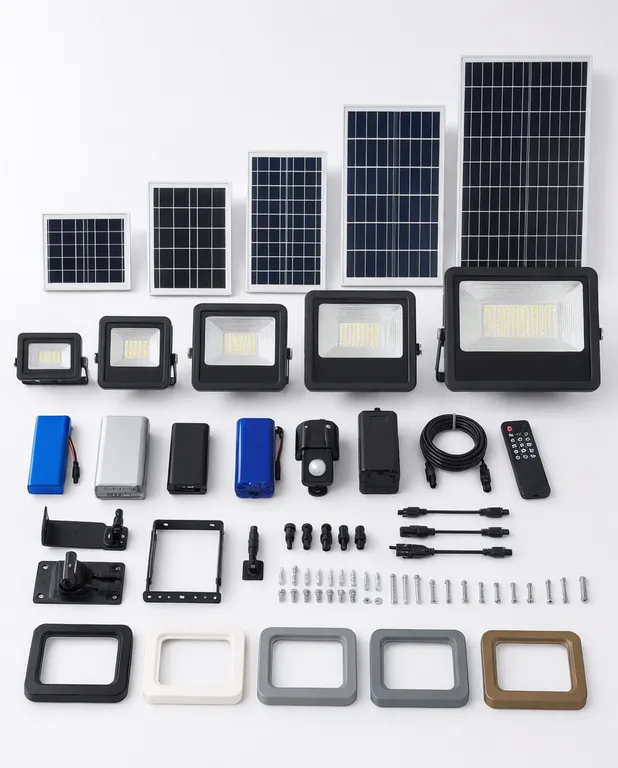
What's Configurable on Solar Flood Lights
Lumen Output
Adjusted within the LED module's design range. Most adjustments don't require a housing change, which keeps tooling costs out of the equation.
Color Temperature
3,000K–6,500K, selectable per order. Warm white for residential and hospitality channels; daylight for commercial and security applications.
Battery Capacity
Sized for target autonomy days based on your market's average solar irradiance. We've configured extended-autonomy packs for buyers in the Middle East and Africa who need 5–7 days of backup during low-irradiance seasons.
Solar Panel Capacity
Sized to match battery and output requirements for your target latitude. A panel sized for Dubai doesn't work the same way in Stockholm.
Lighting Modes
Always-on, motion-triggered, dim-to-bright, and timer-based modes are configurable on sensor-equipped models.
Housing Color
Custom colors available on runs over 100 units. Below that, the powder line changeover cost doesn't make sense for either side.
Logo and Packaging
Custom packaging, labeling, accessory configurations, and installation guide language for private-label programs.
Accessory Kits
Mounting hardware, cable ties, and installation guides can be configured per market requirements.
What Affects MOQ and Lead Time
Housing tooling changes — new form factors, modified mounting points, non-standard panel angles — require tooling investment and affect MOQ and lead time. Configuration changes within the existing housing (lumen, CCT, battery, panel, mode, color, packaging) don't require tooling and can be handled from 100 units.
The engineering review at the start of an OEM/ODM project confirms which category your requirements fall into before any commitment.
Packing, Labeling, and Reorder Control
Solar flood lights have more components to pack than a simple fixture: housing, solar panel, mounting bracket, battery (integrated or separate), cable assembly, fasteners, and installation guide. Each of those components is a potential damage or missing-item claim if the packing isn't controlled.
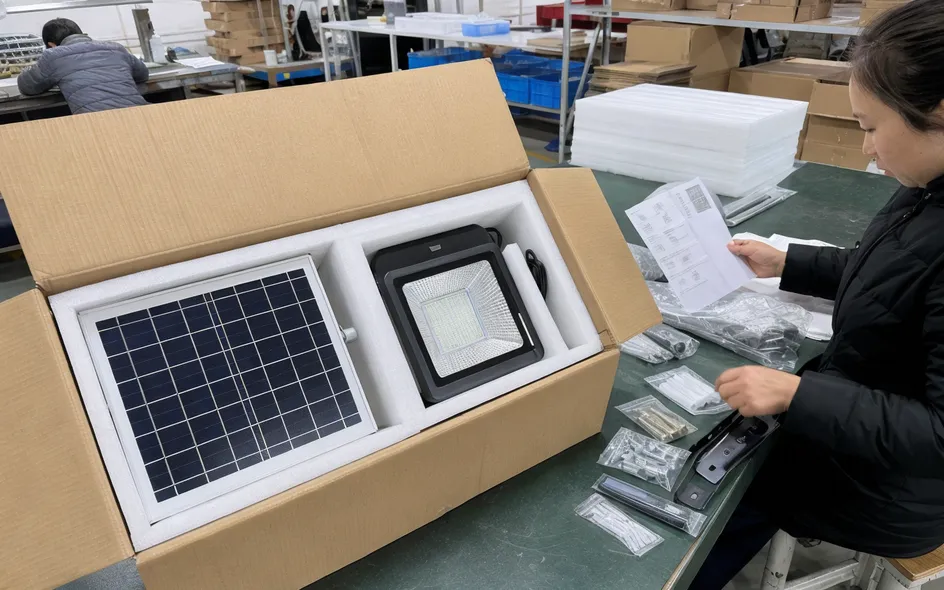
Export Carton Design
Our standard export carton for solar flood lights uses foam-cushioned sections for the solar panel and housing, with brackets and hardware packed separately to prevent scratching. Accessory packs — screws, anchors, cable ties, installation guides — are verified against a packing list before carton sealing.
We count, not just visually check. We've had containers arrive with missing accessory packs because the check was visual rather than counted. We count.
Batch Traceability
Each carton carries a batch code for traceability. If a quality issue surfaces in the field, you can trace it back to the production batch and we can pull the inspection records for that run.
SKU Label Information
Product code, lumen output, IP rating, and certification marks — the information your receiving team and downstream customers need without opening the carton.
Mixed-SKU Consolidation
For distributors running mixed-SKU orders across multiple product types, we consolidate at the carton level with a master packing list.
Pallet configurations are available for buyers who need palletized delivery for their warehouse receiving process.
Foam-Cushioned
Panel & housing protected
Counted Verification
Not visual — counted
Batch Coded
Full production traceability
Pallet Ready
Warehouse-optimized delivery
When to Choose a Different JXSOL Flood or Security Light
If your application doesn't match the general-purpose solar flood lights profile, here's where to look instead.
Commercial Solar Flood Lights
High-output industrial or large perimeter coverage (5,000+ lm, warehouse yards, large parking areas).
View productSolar LED Flood Lights
LED module efficiency and lumen-per-watt positioning as the primary selling point.
View productSolar Motion Sensor Flood Light
Motion-triggered security lighting as the primary application.
View productSolar Security Lights
Compact perimeter security with easy bracket mounting.
View productMotion Sensor Solar Lights
Residential security resale with consumer-accessible form factor.
View productWaterproof Solar Security Lights
Coastal, ground-level, or high-humidity installations requiring IP67.
View productPIR Solar Security Lights
Adjustable PIR detection range and configurable sensor logic.
View productIf you're still deciding which product fits your market, the solar flood and security lighting category page has the full range with use-case descriptions for each product type.
FAQ for Solar Flood Light Buyers
Technical and commercial answers for distributors, contractors, and procurement teams specifying solar flood lights.
What lumen output should I choose for solar flood lights?
What lumen output should I choose for solar flood lights?
Match lumen output to mounting height and coverage area. For mounting heights under 3 meters — small entries, driveways, garden perimeters — 800–1,500 lumens covers the area without over-speccing. For 3–5 meter mounting heights covering small commercial yards, storage areas, or rural property perimeters, 1,500–3,000 lumens with a wide beam angle is the correct range.
Over-speccing creates glare complaints from your downstream customers; under-speccing creates dark spots that come back as warranty claims.
If you're supplying contractors, confirm the mounting height and coverage area before quoting — it's the single most important variable.
How many autonomy days should I specify for solar powered lights?
How many autonomy days should I specify for solar powered lights?
The standard target for most markets is 2–3 nights of autonomy in always-on mode, or 5–8 nights in motion-triggered mode.
For markets with shorter winter daylight hours — Northern Europe, Canada, higher-latitude North America — specify 3–4 nights of always-on autonomy to cover the worst-case winter charging window. For Middle East and African markets with strong year-round irradiance, 2 nights of always-on autonomy is typically sufficient.
We size battery capacity and panel wattage to your target autonomy and market latitude — send us the destination and required lighting mode and we'll confirm the configuration.
Is IP65 enough for outdoor solar LED lighting?
Is IP65 enough for outdoor solar LED lighting?
For most outdoor flood lighting applications — wall-mounted or bracket-mounted perimeter lighting, yard coverage, small commercial entries — IP65 is sufficient. It handles rain, dust, and direct water spray from any direction.
Specify IP67 if your installations include ground-level mounting, coastal environments, or any position where water pooling is possible. IP67 adds submersion resistance to 1 meter for 30 minutes.
If you're unsure, IP65 covers the majority of commercial applications; our waterproof solar security lights carry IP67 ratings for applications that need it.
Should I choose always-on or motion-triggered solar flood lights?
Should I choose always-on or motion-triggered solar flood lights?
Always-on mode is the right choice when continuous illumination is required: loading docks, active work areas, or any application where the light needs to be on regardless of movement.
Motion-triggered mode is the right choice when the application is security-focused and battery autonomy matters — the light only activates on detection, which extends battery life significantly. For buyers supplying markets with variable solar irradiance or shorter winter charging windows, motion-triggered mode is the safer default spec.
If your accounts need both options, we can configure both modes on the same product — the controller supports mode selection.
Can JXSOL customize battery capacity, color temperature, and packaging for solar flood lights?
Can JXSOL customize battery capacity, color temperature, and packaging for solar flood lights?
Yes. Battery capacity is sized for target autonomy days based on your market's solar irradiance. Color temperature is selectable from 3,000K to 6,500K per order. Custom packaging, labeling, and accessory configurations are available for private-label programs.
These configurations don't require housing tooling changes and are available from 100 units. OEM/ODM projects with custom housing or form factor changes go through an engineering review before production to confirm MOQ and lead time.
What is the MOQ for standard solar flood lights?
What is the MOQ for standard solar flood lights?
100 units for standard catalog models. This is low enough to test a new SKU with your accounts before committing to a larger program.
Mixed-SKU orders across multiple product types in our solar flood and security lighting range are standard — we handle consolidation on our end. OEM/ODM projects with custom specifications have MOQs that depend on the configuration; the engineering review at the start of the project confirms the MOQ and lead time for your specific requirements.
Send Your Target Lumen Range and Order Volume
Tell us your target market, required lumen range, mounting height, lighting mode (always-on or motion-triggered), IP rating requirement, order volume, and whether you need private-label packaging. We'll come back with a configuration recommendation and pricing — not a generic catalog PDF.
New to This Product Category?
Tell us your target market and volume expectations — we'll suggest a starter SKU configuration based on what's moving for our existing distributors in that region.
Address
9th Floor, Houda Industrial, No. 65 Pinghe Road, Guzhen Town, Zhongshan, Guangdong, 528421, China