

Solar LED Flood Lights Direct From Factory
LED module binning, battery cell matching, and 100% pre-shipment inspection built into every production run — so your second container matches your first.
Solar LED flood lights manufactured in-house for consistent lumen output, repeatable batch quality, and reliable reorder supply.
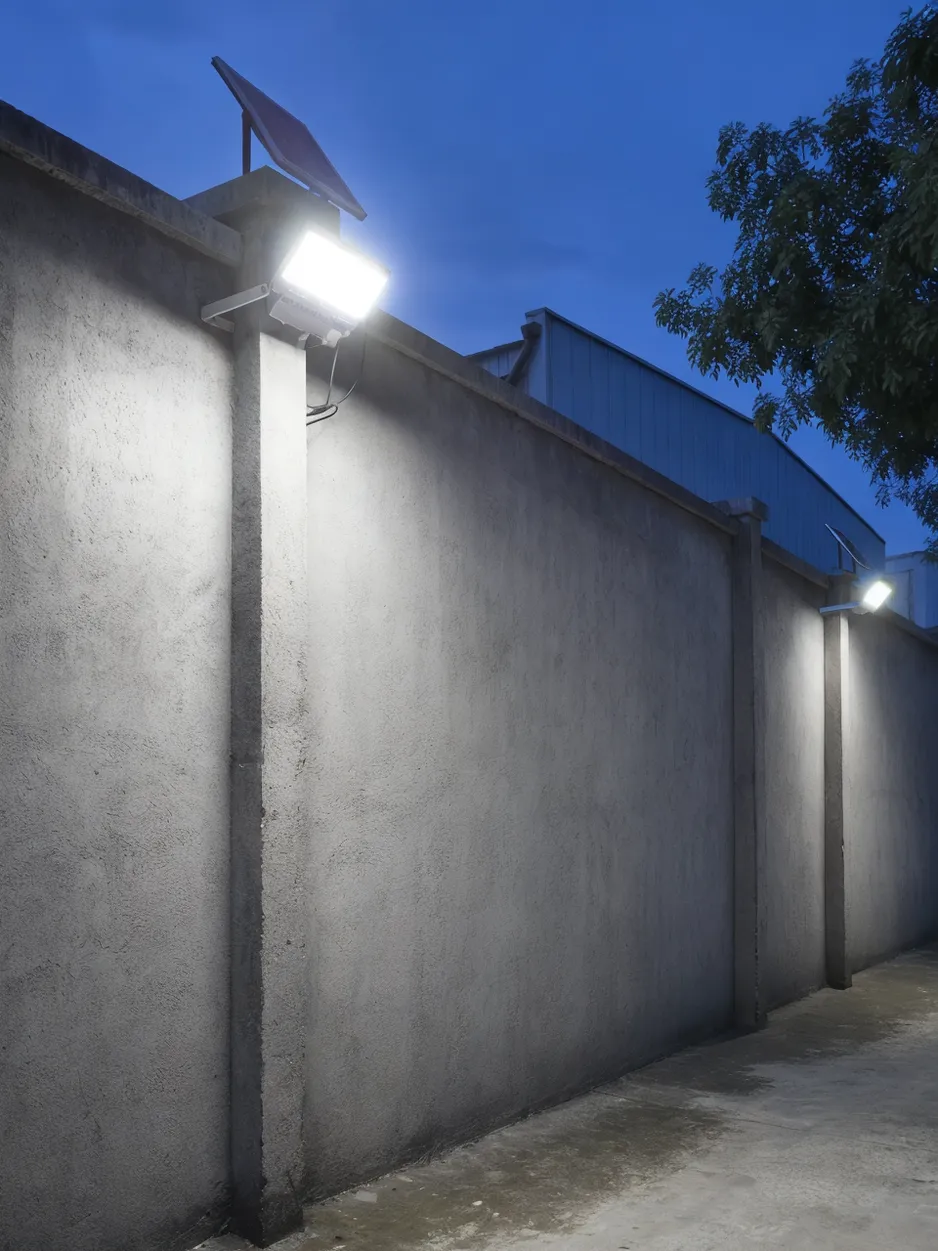
Solar LED Flood Lights Built for Stable Batch Output
JXSOL manufactures solar LED flood lights for outdoor flood and security applications — wall-mounted perimeter lighting, pole-mounted yard coverage, bracket-mounted building entries, and mixed-SKU distributor programs. We've been making solar outdoor lighting since 2012 at our 12,000 m² facility in Zhongshan, and solar LED flood lighting has been part of the production line from the start.
The commercial problem this product solves is straightforward: buyers who reorder solar LED flood lights from inconsistent sources end up with batches that don't match — different lumen output, different color temperature, different appearance on the same installation. That mismatch generates complaints from downstream customers and complicates warranty handling. We address it at the production stage through LED module lumen binning and color temperature confirmation before assembly, so the units in your third order look and perform the same as the units in your first.
This is the broad-channel LED flood and security SKU in our range — practical output levels for resale and standard project supply, configurable for different markets, and available from 100 units on standard catalog models. If you're building a solar security lighting catalog or quoting a mixed commercial project, this is the SKU that covers the widest range of accounts without over-speccing.
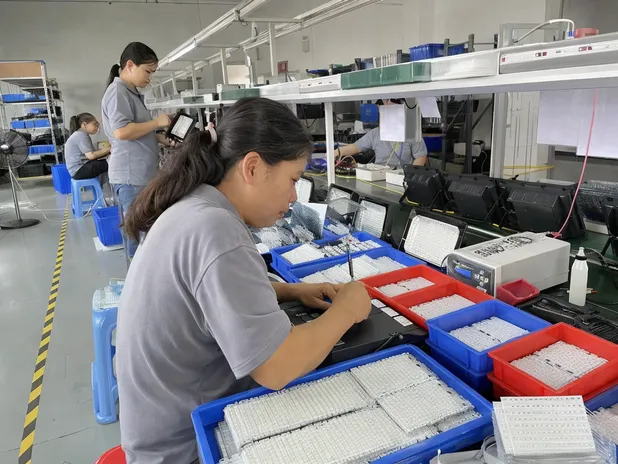
LED modules sorted by lumen bin and CCT before assembly — ensuring batch-to-batch consistency for reorders.
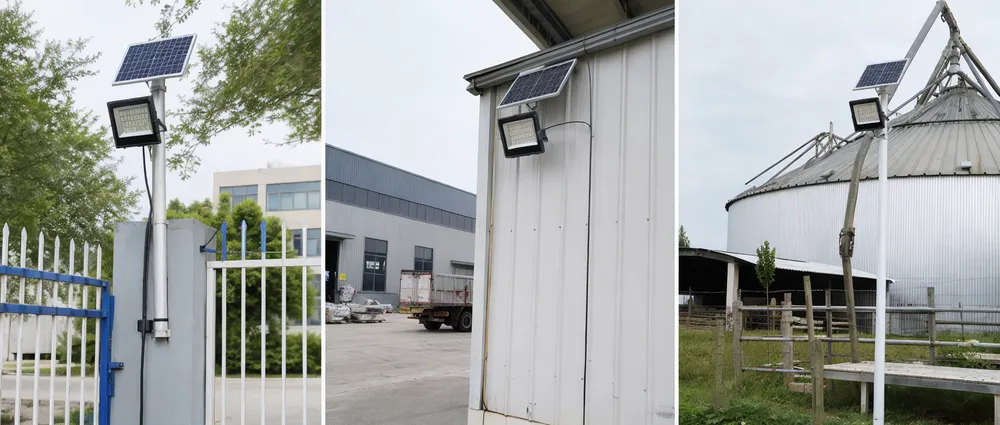
Wall-Mounted Perimeter
Commercial building perimeters, warehouse exteriors, and compound walls requiring consistent flood coverage.
Pole-Mounted Yard
Storage yards, logistics compounds, and open-area coverage where pole-top mounting provides wide beam distribution.
Bracket-Mounted Entries
Building entries, loading docks, and access points where bracket mounting provides targeted illumination.
Mixed-SKU Distributor
Distributor programs requiring a versatile SKU that covers multiple account types without over-speccing individual orders.
Ready to configure your order?
Send us your target lumen range, market, and order volume — we'll confirm the configuration and lead time.
Where This SKU Fits in Your Flood and Security Lighting Line
The solar flood and security lighting range covers eight product types. Buyers who land on this page are usually comparing options before deciding which SKU to quote or stock. Here's the practical selection logic.
| Product | Best Commercial Fit | When to Choose It |
|---|---|---|
| Solar LED Flood Lights (this page) | Broad resale, standard commercial perimeters, mixed distributor programs | LED output consistency matters; you need a versatile SKU that covers multiple account types |
| Solar Flood Lights | Entry-level broad flood lighting for price-sensitive channels | Your accounts prioritize unit cost over LED module spec |
| Commercial Solar Flood Lights | Warehouses, parking lots, large industrial perimeters | Your project requires 5,000+ lumens and high-output LED modules |
| Solar Motion Sensor Flood Light | Security flood lighting with motion-triggered beam activation | Flood beam coverage plus motion activation is the primary spec requirement |
| Solar Security Lights | Compact perimeter security for commercial properties and campuses | Compact form factor and easy bracket mounting matter more than flood beam width |
| Motion Sensor Solar Lights | Residential security resale, small commercial perimeters | Consumer-accessible form factor with commercial-grade IP rating |
| Waterproof Solar Security Lights | Coastal installations, ground-level mounting, flood-prone environments | IP67 submersion resistance is a hard requirement |
| PIR Solar Security Lights | Adjustable passive infrared detection for driveways, gates, building perimeters | Configurable PIR detection range and sensitivity are the primary spec |
Selection Guidance
Solar LED flood lights are the right choice when your accounts need reliable LED output across a range of outdoor applications and you want a single SKU that handles most of them.
When the requirement is specifically high-output industrial coverage, dedicated PIR detection, IP67 coastal exposure, or consumer-accessible form factor, the sibling products above are the cleaner fit.
View the full solar flood and security lighting range for side-by-side product positioningQuote-Sheet Specifications for Solar LED Flood Light Orders
These are typical values for this product type. Exact output, battery capacity, and panel sizing depend on your target market, required autonomy days, and mounting height — confirm specific model datasheets by inquiry.
| Parameter | Typical Value / Range |
|---|---|
| LED Output | 800 lm – 6,000 lm (configurable by model) |
| LED Module Type | High-efficiency SMD LED, lumen-binned at assembly |
| Color Temperature (CCT) | 3,000K – 6,500K (warm white to daylight) |
| Beam Angle | 90° – 120° (wide flood coverage) |
| Solar Panel Type | Monocrystalline silicon |
| Solar Panel Capacity | 10W – 40W (sized to output and autonomy requirements) |
| Battery Chemistry | Lithium iron phosphate (LiFePO4) |
| Battery Capacity | 8,000 mAh – 25,000 mAh (sized to target autonomy days) |
| Controller Modes | Always-on, motion-triggered, dim-to-bright, timer-based |
| IP Rating | IP65 standard; IP67 available on request |
| Housing Material | Die-cast aluminum |
| Operating Temperature | -20°C to +50°C |
| Mounting Options | Wall bracket, pole mount, adjustable angle bracket |
| Certifications | ISO 9001:2015, CE, RoHS, IP65/IP67, IEC 62124 |
| MOQ (Standard Models) | 100 units |
| OEM/ODM | Available — lumen output, CCT, battery, panel, housing color, logo, packaging |
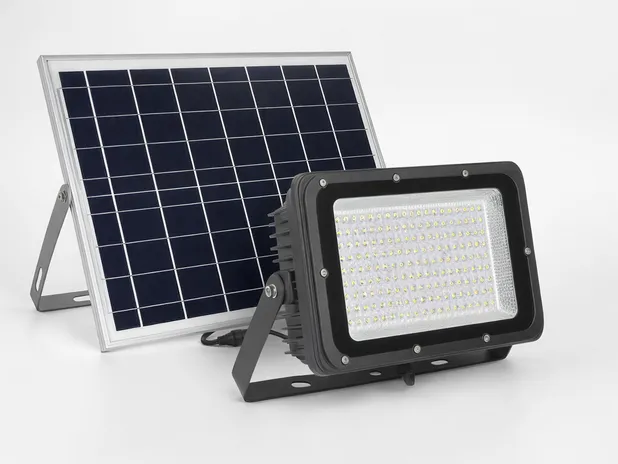
Specifications shown are typical values for this product type. Actual specifications vary by model and configuration.
Request Exact Datasheets & QuoteCertifications Verified In-House
IP ratings are confirmed on dedicated ingress protection test benches, not assumed from housing design.
LED Module Binning and Thermal Control That Protect Reorders
The most common complaint we hear from buyers who've switched suppliers is that their reorder doesn't match the original shipment — the new units are visibly cooler or warmer in color temperature, or the lumen output is noticeably different. This is a binning problem, and it's entirely preventable at the production stage.
Lumen Binning at Assembly Stage
We run LED module lumen binning at the assembly stage on our automated SMT production lines. Modules are sorted by lumen output and color temperature before installation. The tolerance we hold is tight enough that units from different production runs are visually indistinguishable when installed side by side.
This matters when your contractor accounts are adding fixtures to an existing installation, or when your distributor customers reorder for a second site. We've had buyers come to us specifically because a previous supplier's reorder looked different under the same mounting conditions. That's a warranty conversation nobody wants to have.
Color Temperature Confirmation at Module Stage
Color temperature confirmation happens at the module stage, not at final inspection. By the time a unit reaches final assembly, the LED module has already been confirmed against the CCT spec.
This means we catch out-of-spec modules before they're built into a housing — not after the unit is assembled and the rework cost is higher.
Thermal Path and Lumen Maintenance
The thermal path between the LED module and the die-cast aluminum housing is a detail that affects long-term lumen maintenance, not just initial output. We use thermal interface material between the module and the housing heat sink surface, and we verify contact quality during assembly.
Poor thermal contact causes junction temperature to rise under load, which accelerates lumen depreciation — the light gets dimmer faster than the rated L70 life. Our 15+ optical and electrical engineers set the thermal spec and the assembly checkpoint; the production team executes it.
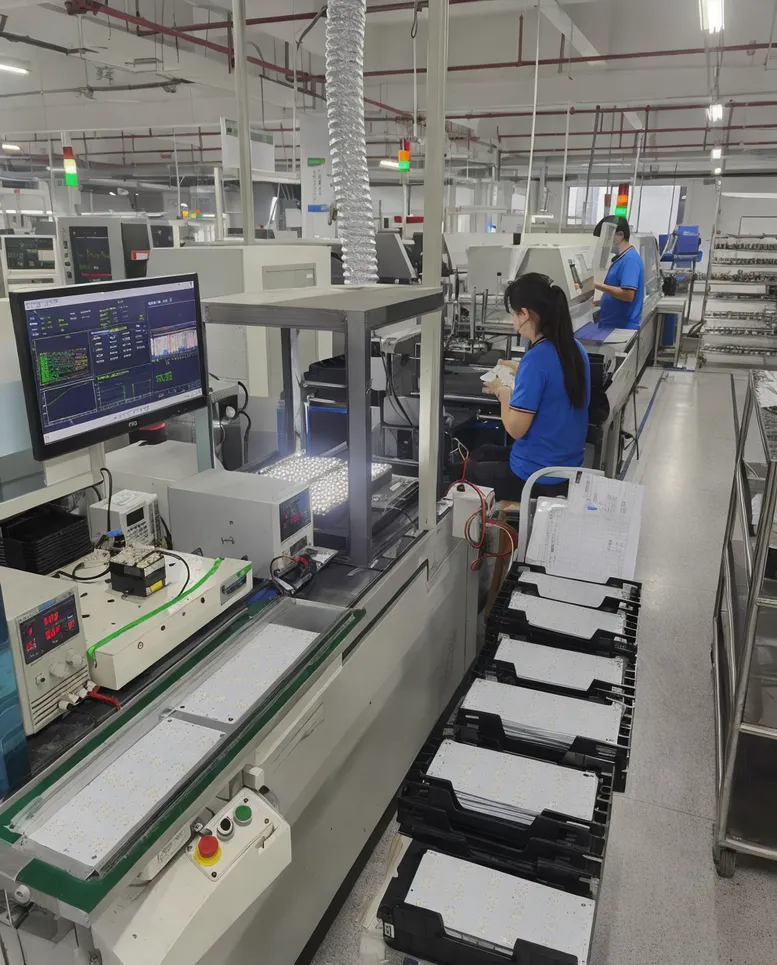
Driver & Controller Function Testing
Driver and controller function testing runs on a dedicated bench before assembly. Lighting modes, PWM dimming behavior, and motion sensor response (where applicable) are verified against spec. A controller that passes visual inspection but fails under load is a field return waiting to happen — we catch it before it ships.
100% Pre-Shipment Inspection
Every unit goes through 100% pre-shipment inspection before carton sealing. Lumen output, color temperature, IP structure, controller function, and physical condition are all checked. The inspection records are tied to the batch code on the carton, so if a quality question comes up after delivery, we can pull the records for that specific production run.
Need LED module test details or sample inspection reports for your procurement team?
Battery, Panel, and LED Load Matching by Market
Lumen output is the number buyers focus on, but it's the LED load relative to battery capacity and solar panel size that determines whether the product actually performs in the field. A 3,000-lumen fixture running always-on from a 10,000 mAh battery in a northern European winter will drain the battery before sunrise. The same fixture in the Middle East with a 20W panel and 15,000 mAh battery runs fine. The spec has to match the market.
The variables we work through with buyers before confirming a configuration:
Mounting Height & Coverage Area
Mounting height and coverage area determine the lumen output and beam angle you need. Getting this wrong in either direction creates problems — under-specced units generate security complaints, over-specced units create glare and waste battery capacity.
Wall-Mounted | 3–4 m
800–2,000 lumens with a 120° beam covers entries and small perimeters without glare.
Pole-Mounted | 5–8 m
3,000–5,000 lumens with a tighter beam angle is the practical range for yard and parking coverage.
Daily Run Time & Autonomy Days
Daily run time and autonomy days set the battery capacity requirement. Always-on operation for 10–12 hours per night requires significantly more battery than a motion-triggered mode that activates for 30 seconds per event.
Low-Irradiance Markets
Northern Europe, parts of Southeast Asia during monsoon — size the battery for 3–5 days of autonomy at the target run time.
High-Irradiance Markets
Middle East, Gulf states, sub-Saharan Africa — the panel-to-battery ratio can be optimized differently.
Controller Mode Selection
Controller mode selection is a load-control decision, not just a feature. For security applications where the deterrent effect matters, dim-to-bright mode often outperforms both always-on and pure motion-triggered configurations.
Dim-to-Bright Mode
Runs at 20–30% output continuously and steps up to full output on motion detection — extends battery life significantly compared to always-on full output, while maintaining continuous low-level illumination.
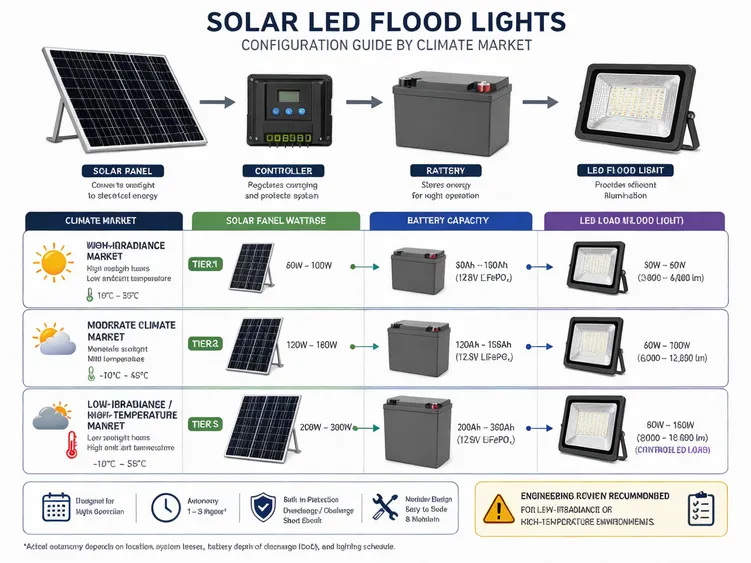
Engineering Review Recommended
For buyers in low-irradiance markets or high-temperature environments where battery degradation is faster, we recommend an engineering review before confirming the configuration.
Market Segments Where LED Solar Security Lighting Sells Cleanly
Solar LED flood lights move well in specific commercial segments because the value proposition is concrete: outdoor flood and security coverage without grid wiring, consistent LED output across reorders, and a form factor that installs in under an hour. Here's where this SKU generates repeatable revenue.
Hardware & Home-Improvement Resale
High-velocity SKU in hardware distribution because the end customer installs without an electrician. LED output consistency across batches matters — retail accounts notice when a reorder looks different on the shelf.
Private-label packaging available on runs over 100 units, letting you build brand equity in this channel without a housing change.
Small Commercial Perimeters
Shops, storage yards, gated entries, building entrances, and small parking areas where running conduit is expensive or impractical. These accounts typically need 2–6 fixtures per site.
Contractors who stock this SKU as a standard offering reorder regularly as they add new accounts. The no-grid-connection advantage makes the ROI case easy to present to property owners.
Warehouse Secondary Zones
Loading dock areas and main yard perimeters often use high-output commercial fixtures, but the side yards, access paths, and perimeter gaps between primary lighting zones are a natural fit for solar LED flood lights.
Contractors already supplying commercial solar flood lights for primary zones can add this SKU for secondary coverage without sourcing from a second supplier.
Rural & Agricultural Accounts
Off-grid yards, barn entries, equipment storage areas, and farm perimeter paths where grid power is unavailable or expensive to extend. Battery autonomy and cold-weather performance are the key spec questions for this segment.
We've configured extended-autonomy packs for buyers supplying agricultural accounts in northern climates — ask us about the battery sizing for your target region.
Campus & Community Projects
Schools, municipal facilities, and community housing projects specify solar security lighting for pathway and perimeter coverage. These projects often run on annual procurement budgets with defined SKU requirements.
A distributor who can supply consistent product across multiple sites with matching documentation has a structural advantage. LED output consistency across batches is directly relevant — a campus that adds fixtures two years after the initial installation needs them to match.
Construction & Temporary Project Supply
Contractors who need security lighting for active construction sites reorder regularly — the fixtures move from site to site as projects complete. Fast bracket installation and reliable motion-triggered operation are the practical requirements.
Solar Security Lights are the compact alternative for this segment if form factor is the primary constraint.
OEM/ODM Choices That Change Cost Without Reworking the Housing
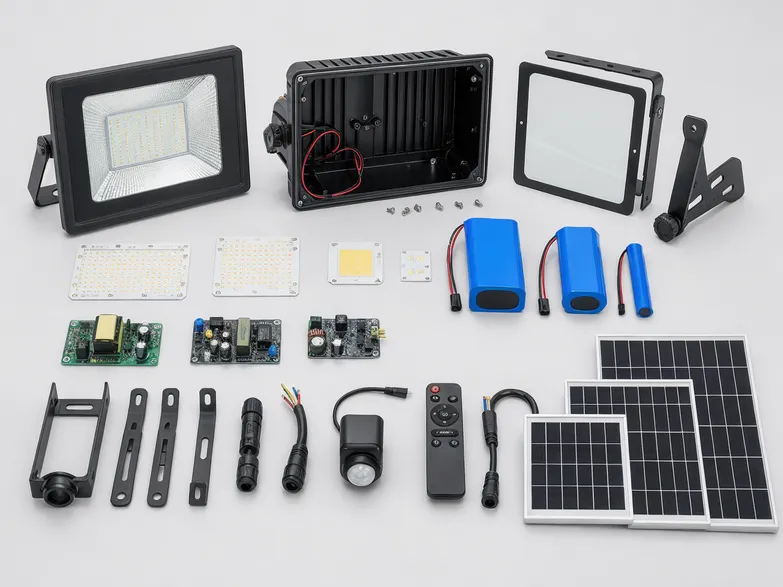
Most of the configuration options buyers need for different markets can be handled within the existing housing design — no tooling change, no extended lead time. Here's what's adjustable and where the limits are.
Within Standard Housing — No Tooling Change Required
Lumen Output
Adjusted within the LED module's design range. Most output adjustments between 800 lm and 6,000 lm don't require a housing change — the LED module and driver are swapped, the housing stays the same.
Color Temperature
3,000K–6,500K, selectable per order. Warm white (3,000K–3,500K) for residential and hospitality channels; neutral white (4,000K–4,500K) for commercial perimeters; daylight (5,000K–6,500K) for security and work-area applications.
Battery Capacity
Sized for target autonomy days based on your market's solar irradiance data. We've configured extended-autonomy packs for buyers in the Middle East and Africa who need 5–7 days of backup during low-irradiance seasons.
Solar Panel Capacity
Sized to match battery and output requirements for your target latitude. Panel capacity is confirmed through an engineering review, not estimated.
Controller and Lighting Modes
Always-on, motion-triggered, dim-to-bright, and timer-based modes are configurable. PIR detection range and sensitivity are adjustable on sensor-equipped models.
Housing Color
Custom colors available on runs over 100 units. Below that, the powder line changeover cost doesn't make sense for either side — standard black or dark grey is the practical choice for smaller orders.
Logo and Packaging
Custom carton printing, product labeling, and accessory kit configuration for private-label programs. Available from 100 units on standard models.
MOQ and Engineering Review
- Standard catalog models: 100 units MOQ
- OEM/ODM MOQ depends on configuration — confirmed during engineering review
- Engineering review locks specification before component procurement
- Prevents mid-production spec changes that delay shipment and add cost
Where to Move to a Sibling SKU Instead
If your project requirements exceed what the standard housing accommodates, these sibling products are purpose-built for those specifications:
Commercial Solar Flood Lights
Sustained output above 6,000 lumens for large industrial perimeters or high-mounting-height coverage. Housing and thermal design built for that output level.
View productPIR Solar Security Lights
Dedicated PIR detection with adjustable sensitivity as the primary requirement. More configuration depth on the sensor side than standard flood models.
View productWaterproof Solar Security Lights
Coastal, ground-level, or positions where water pooling is possible. IP67 ratings verified under pressure for full submersion protection.
View productCompliance, Packing, and Batch Traceability Before Shipment
Certifications This Product Carries
These are the certifications confirmed for JXSOL's solar lighting production — not claimed from a third-party supplier's documentation.
For export buyers, CE and RoHS are the baseline for European market entry. IEC 62124 covers solar photovoltaic standalone systems — relevant for buyers supplying projects where the solar system specification is part of the tender documentation. IP65/IP67 ratings are verified on our own test equipment, with test certificates available per order.
Review certification documentsWhy Compliance Matters Commercially
A container held at customs for missing CE documentation costs more than the documentation itself.
A product that fails RoHS screening in a European distribution center creates a recall situation.
We provide the documentation set with each order so your receiving team and compliance team have what they need without chasing us after shipment.
Packing for Solar LED Flood Lights
Packing covers a few specific challenges that affect landed cost and after-sales claims.
Solar Panel Protection
Solar panels are the most fragile component — they ship in foam-cushioned carton sections, separated from the housing.
Hardware Separation
Mounting brackets and hardware are packed separately from the housing to prevent surface scratching during transit.
Counted Verification
Accessory packs — screws, anchors, cable ties, installation guides — are counted against a packing list before carton sealing, not visually checked. We switched to counted verification after a run of containers arrived with missing accessory packs. The visual check missed short-packed kits. Counting doesn't.
Batch Traceability and Carton Labeling
Each carton carries a batch code for production traceability. If a quality question surfaces in the field, you can trace it back to the production batch and we pull the inspection records for that run.
Carton labeling includes product code, lumen output, IP rating, and certification marks — the information your warehouse receiving team needs without opening the carton.
For mixed-SKU orders across multiple product types in this category, we consolidate at the carton level with a master packing list. Palletized delivery is available for buyers whose warehouse receiving process requires it.
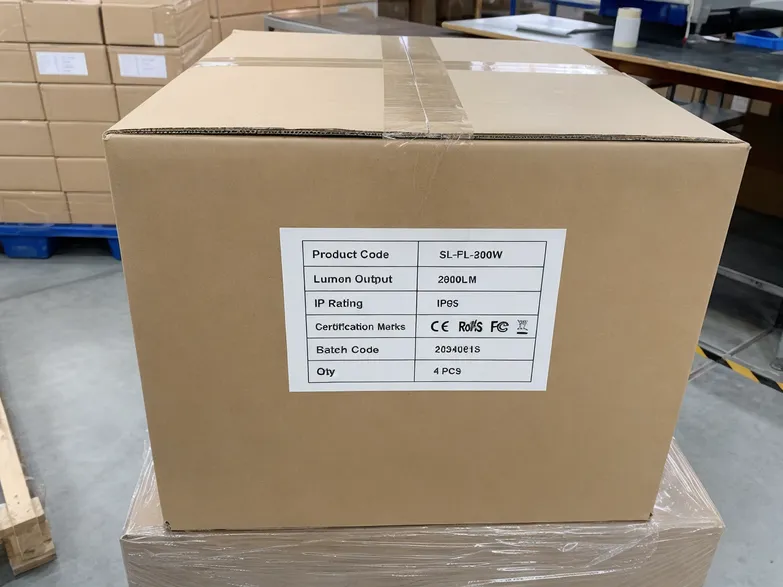
Carton Label Includes:
- Product code
- Lumen output
- IP rating
- Certification marks
- Batch code
- Quantity
FAQ for Solar LED Flood Light Procurement
What is the difference between solar LED flood lights and standard solar flood lights?
The distinction is in the LED module specification and production controls, not the housing. Solar LED flood lights use high-efficiency SMD LED modules that are lumen-binned at the assembly stage — modules are sorted by output and color temperature before installation. Standard solar flood lights in the entry-level segment often use lower-efficiency LED packages without binning, which means lumen output and color temperature can vary between units in the same batch and between reorders.
For buyers who need consistent appearance across multiple sites or reorders, the LED module spec and binning process are the practical difference.
If unit cost is the primary driver and output consistency is secondary, Solar Flood Lights may be the right fit.
What lumen output should I choose for wall-mounted or pole-mounted solar LED flood lights?
Match lumen output to mounting height and coverage area.
800–2,000 lumens with a 120° beam angle. Covers small entries, driveways, or building perimeters.
3,000–5,000 lumens with a tighter beam angle. Covers parking areas, yards, or larger perimeters.
Over-speccing creates glare complaints from downstream customers; under-speccing creates security gaps and warranty claims from contractors. If you're supplying contractors who are quoting projects, confirm the mounting height and coverage area before specifying — it's the single most important variable in the selection.
Why do LED solar security lights lose brightness after several months?
The two most common causes are thermal management failure and battery capacity degradation.
Thermal Management Failure
If the LED module doesn't have proper thermal contact with the housing heat sink, junction temperature rises under load and accelerates lumen depreciation — the light gets dimmer faster than the rated L70 life. We use thermal interface material between the module and the housing and verify contact quality during assembly.
Battery Capacity Degradation
Mismatched battery cells degrade unevenly, and capacity drops faster than the rated cycle life. We match cells by capacity and internal resistance before pack assembly and run every pack through a charge/discharge cycle test before installation.
Overstated Lumen Claims
A third cause is overstated lumen claims at the chip spec level — we test actual module output in our own test conditions, not the theoretical maximum of the LED chip.
Review our certification and inspection documentation for test methodology details.
Do solar LED flood lights need IP65 or IP67 for outdoor installation?
IP65 is sufficient for the majority of outdoor flood and security lighting applications — it handles rain, dust, and direct water spray from any direction.
IP65 — Standard Outdoor
- •Wall-mounted perimeter lighting
- •Pole-mounted installations
- •Standard rain, dust, and direct spray
IP67 — Harsh Environments
- •Ground-level mounting
- •Coastal environments
- •Positions where water pooling is possible
- •Submersion resistance to 1m for 30 min
For standard wall-mounted or pole-mounted perimeter lighting, IP65 covers the application. If your accounts include coastal properties, flood-prone areas, or exposed ground-level positions, Waterproof Solar Security Lights carry IP67 ratings verified under pressure on our own test equipment.
Can JXSOL customize color temperature, battery capacity, and lighting modes for solar LED flood lights?
Yes. Color temperature is selectable from 3,000 K to 6,500 K per order. Battery capacity is sized for target autonomy days based on your market's average solar irradiance — we've configured extended-autonomy packs for buyers in the Middle East and Africa who need 5–7 days of backup during low-irradiance seasons.
Lighting modes (always-on, motion-triggered, dim-to-bright, timer-based) are configurable on sensor-equipped models. Lumen output can be adjusted within the LED module's design range without a housing change.
These configurations go through an engineering review before production to confirm the spec is achievable before component procurement.
What is the MOQ for standard solar LED flood light models?
100 units for standard catalog models. This is low enough to test a new SKU with your accounts before committing to a larger program.
OEM/ODM projects with custom specifications — battery sizing, panel capacity, housing color, private-label packaging — have MOQs that depend on the configuration. The engineering review at the start of the project confirms the MOQ and lead time for your specific requirements.
Send the Output Range, Market, and Order Volume
Tell us your target lumen range, mounting height, coverage area, lighting mode (always-on, motion-triggered, or dim-to-bright), IP rating requirement, market and region, order volume, and whether you need private-label packaging. We'll come back with a configuration recommendation and pricing — not a generic catalog PDF.
Address
9th Floor, Houda Industrial, No. 65 Pinghe Road, Guzhen Town, Zhongshan, Guangdong, 528421, China