

All-in-One Solar Street Light Ready to Mount
Integrated solar street lighting — panel, LED, battery, controller, and sensor in one fixture, ready to mount.
Fewer parts to handle, fewer accessories to track, and no wiring runs between components. For distributors and contractors who need a stockable, repeatable solar street light that installs fast and reorders clean.
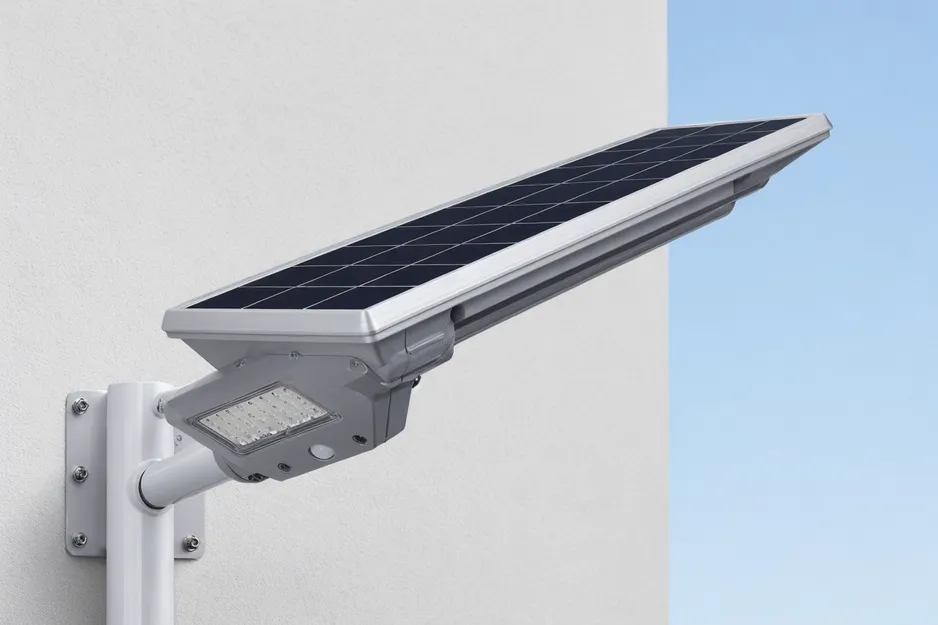
Integrated Design That Reduces Handling, Wiring, and SKU Complexity
An all in one solar street light puts the solar panel, LED module, lithium battery, charge controller, and PIR or microwave sensor into a single housing — one part number, one carton, one installation step at the pole. There is no separate panel to mount, no cable run between panel and fixture, no battery box to position on the pole shaft. The bracket goes on the pole, the fixture clips to the bracket, and the job is done.
For your business, that integration changes three things:
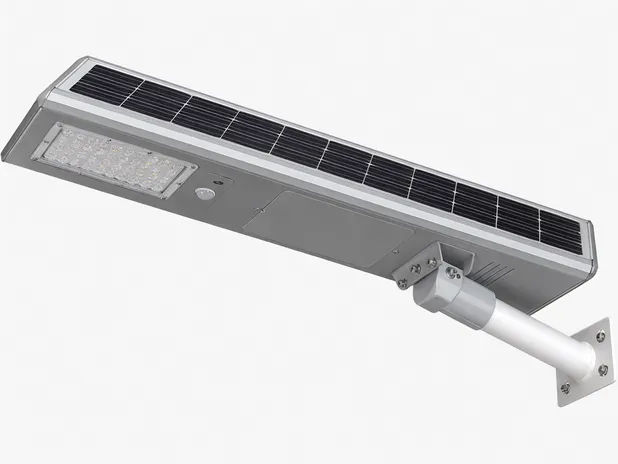
Accessory Dispute Rate Drops
Split-type solar street lights generate a disproportionate share of after-sales complaints from missing or mismatched components — a panel bracket that doesn't fit the pole diameter, a cable that's 30 cm short, a battery box that arrives in a separate carton that got separated in transit. All-in-one eliminates those variables.
Warehouse Handling Simplifies
One SKU covers the complete fixture, so your team isn't cross-referencing component lists or assembling kits before dispatch.
Installation Labor Is Lower
Contractors working on local road or compound lighting projects can mount and commission a fixture in a fraction of the time a split-type system requires — and that labor saving is a real selling point when you're quoting against grid-connected alternatives.
Trade-Off Worth Stating Plainly
The integrated structure does have a trade-off: the solar panel size is constrained by the fixture housing. For projects in low-irradiance regions or requiring extended autonomy beyond 3–4 rainy days, a split solar street light with an oversized independent panel may be the better fit.
We'll tell you which configuration makes sense when you send us your project location and runtime requirements.
Specification Range Buyers Can Use for Quotation Comparison
The table below covers our standard all-in-one solar street light model range. These are typical values across the product line — final specifications are confirmed during quotation based on your target lumen output, pole height, project location, and autonomy requirements.
| Parameter | Typical Range |
|---|---|
| LED Power | 20W – 200W |
| Lumen Output | 2,000 lm – 24,000 lm |
| LED Efficacy | ≥160 lm/W (standard chip bin) |
| Solar Panel Type | Monocrystalline silicon |
| Solar Panel Wattage | 30W – 300W |
| Battery Type | LiFePO4 (lithium iron phosphate) |
| Battery Capacity | 20Ah – 200Ah (12V or 24V system) |
| Color Temperature (CCT) | 3000K / 4000K / 5000K / 6000K (selectable) |
| Charging Time | 6–8 hours (full sun) |
| Working Time / Autonomy | 10–14 hours per night; 3–5 rainy days backup (model-dependent) |
| Lighting Modes | Full power / 50% dim / motion-activated / time-scheduled |
| Sensor Options | PIR motion sensor / microwave sensor / none |
| Mounting Height | 5m – 12m (pole height recommendation) |
| Pole Arm Diameter | 40mm – 60mm (standard bracket range) |
| Housing Material | Die-cast aluminum alloy |
| Surface Treatment | Powder coat, 60–80μm, salt spray tested |
| IP Rating | IP65 / IP67 (model-dependent) |
| Working Temperature | -20°C to +60°C |
| Certifications | CE, RoHS, IP65/IP67, IEC 62124, ISO 9001:2015 |
| Warranty Support | 3 years |
Specifications shown are typical values for this product line. Actual specifications vary by model and configuration. Contact us for detailed datasheets and project-specific recommendations.
Project Segments Where Integrated Solar Street Lighting Sells Cleanly
The commercial case for all-in-one solar street lighting is strongest where installation speed, simplified logistics, and repeatable SKU supply matter more than maximum panel flexibility. Four segments consistently produce clean, repeatable orders.
Local Roads, Village Streets, and Municipal Lighting Programs
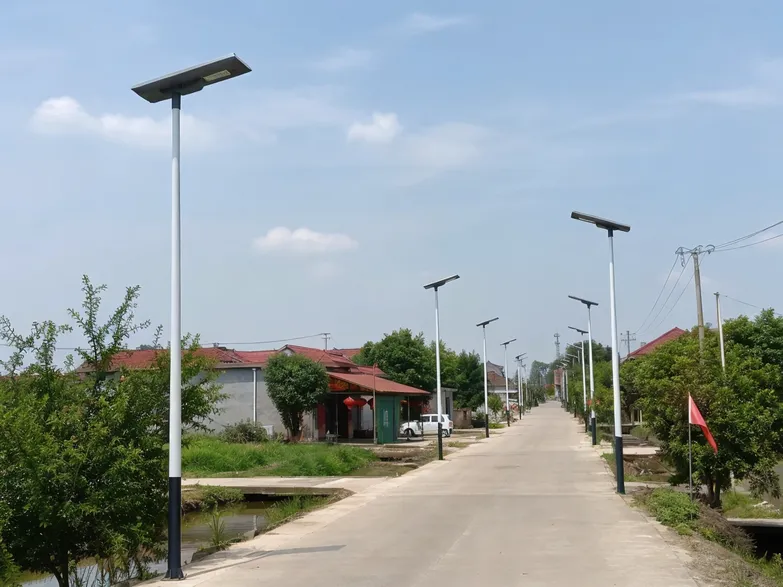
Municipal and rural electrification projects in Southeast Asia, Africa, and the Middle East are the highest-volume segment for this product type. A typical village road project runs 50–300 fixtures along a 2–5 km stretch, with pole heights of 6–8 meters and a standard 30W–60W output requirement.
The integrated design is the right call here because installation crews are often local contractors without specialized solar system experience — the fewer connections they have to make, the lower the commissioning error rate, and the lower your after-sales exposure. Government tender programs in these markets frequently specify all-in-one configurations precisely because of the simplified installation and maintenance profile.
We've shipped to municipal programs in Nigeria, Kenya, Pakistan, and the Philippines where the all-in-one spec was written directly into the tender document — worth knowing if you're building a distribution program in those regions.
Order patterns in this segment tend to run 200–1,000 units per project, with repeat orders tied to phase rollouts. A distributor who wins one municipal supplier relationship in this segment can expect 2–4 reorders per year as the program expands.
Typical Project Parameters
Fixtures per Project
50–300
Road Stretch
2–5 km
Pole Height
6–8 m
Output Range
30W–60W
Order Volume
200–1,000 units
Reorder Cycle
2–4× per year
Industrial Parks, Factory Compounds, and Private Road Networks
Private infrastructure projects — industrial parks, logistics hubs, factory compounds, gated communities — are a strong segment for all-in-one solar street lighting because the decision-maker is a facilities manager or developer who is comparing total project cost, not just fixture price. Grid trenching for a 500-meter internal road in an industrial park can cost more than the lighting fixtures themselves. An all-in-one solar street light eliminates that cost entirely. The value proposition is easy to quantify, which makes it easy for your customer to justify the purchase internally.
Projects in this segment typically run 20–150 fixtures, with higher lumen requirements (60W–120W range) and a preference for motion-sensor modes to reduce battery draw during low-traffic hours. Repeat orders come when the park expands or when a second phase of development starts — a reliable reorder pattern for distributors serving the construction and real estate sector.
Segment Snapshot
- Order size: 20–150 fixtures per project
- Wattage range: 60W–120W
- Key feature: motion-sensor dimming for low-traffic hours
- Reorder trigger: park expansion or phase-two development
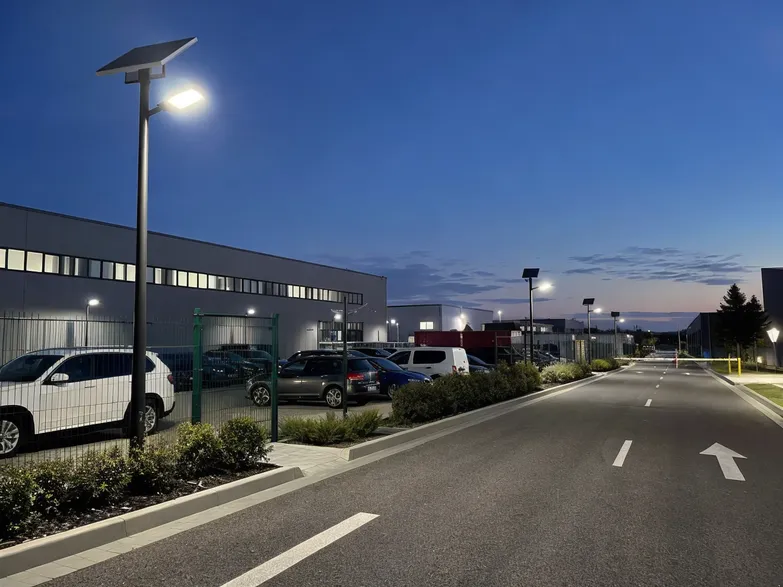
Parking Lots, Access Roads, and Perimeter Lighting
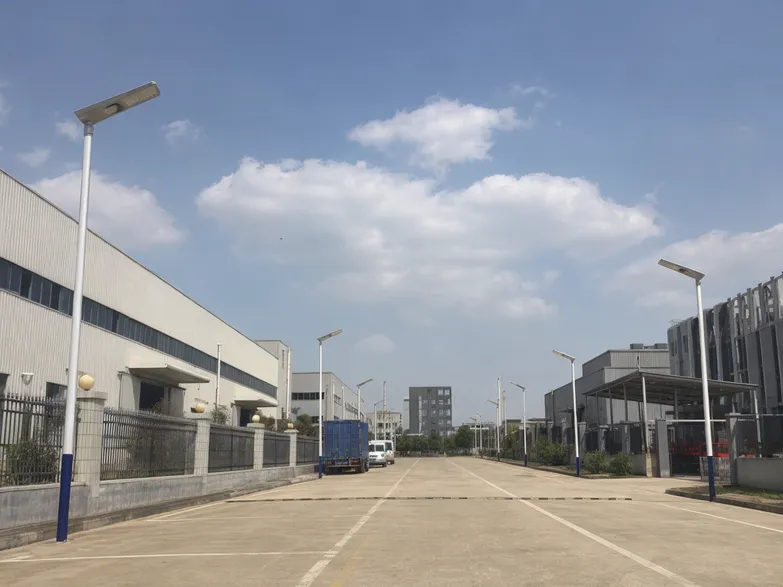
Parking lot perimeter and access road lighting is a stockable SKU segment — distributors serving electrical contractors, property developers, or facility management companies can carry 30W–80W all-in-one models as a standard line item. The fixture handles the full range of small-to-mid parking and access road applications without requiring project-specific engineering, which means your sales team can quote and close without a technical review cycle.
This segment has a higher reorder frequency than municipal programs because parking lot and access road projects are smaller (10–50 fixtures per site) and more numerous. A distributor with 20 active contractor accounts in this segment can move 500–2,000 units per year from a single SKU. The key stocking consideration is CCT: 5000K–6000K is the standard preference for parking and security applications, so carrying that variant in depth reduces lead time for your customers.
Stockable SKU
30W–80W covers the full parking and access road range from a single model line
Reorder Velocity
500–2,000 units/year achievable with 20 active contractor accounts
CCT Preference
5000K–6000K standard for parking and security — stock in depth to cut lead time
No Engineering Review
Quote and close without a technical review cycle for standard applications
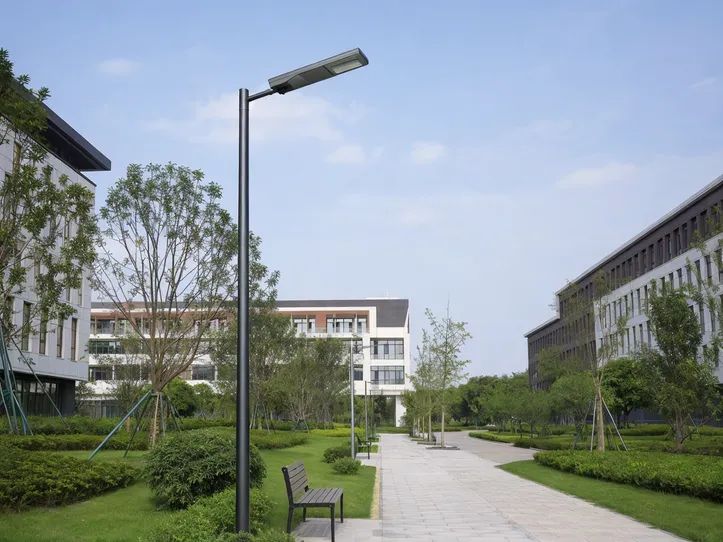
Campuses, Parks, Community Paths, and Recreational Areas
Campus and public green space lighting is a segment where the all-in-one design's clean aesthetic and zero-wiring installation are genuine selling points for the end buyer. Universities, hospitals, housing estates, and municipal parks specify solar street lighting partly for sustainability credentials and partly because trenching through landscaped areas is expensive and disruptive. The integrated fixture installs on an existing or new pole without disturbing the surrounding ground.
Order sizes in this segment run 30–200 fixtures, with a preference for warmer CCT options (3000K–4000K) and lower pole heights (5–7 meters). Landscape architects and facilities managers in this segment tend to be repeat buyers once they've had a successful installation — the reorder cycle follows campus expansion, new development phases, or fixture replacement programs. For distributors building a public sector or institutional account base, this segment offers consistent margin and low after-sales complexity.
30–200 units
3000K–4000K
5–7 meters
Configuration Choices That Affect Landed Cost and Field Performance
Most buyers don't order a catalog spec — they adjust it. The table below covers the configuration dimensions we handle regularly, along with the practical constraints that affect MOQ, lead time, and housing compatibility.
| Configuration Dimension | Standard Options | Custom Range | Notes |
|---|---|---|---|
| LED Power / Lumen Output | 20W, 30W, 40W, 60W, 80W, 100W, 120W, 150W, 200W | Intermediate wattages available | Lumen output adjustable within LED module design range |
| Solar Panel Wattage | Matched to LED power and target autonomy | Oversized panel for low-irradiance regions | Panel size constrained by housing; split type for very large panels |
| Battery Capacity | Standard autonomy (3 rainy days) | Extended autonomy (5–7 days) | Extended capacity may change housing dimensions |
| Battery Chemistry | LiFePO4 standard | — | LiFePO4 preferred for cycle life and thermal stability |
| Color Temperature | 5000K standard; 3000K, 4000K, 6000K available | — | No MOQ premium for standard CCT options |
| Beam Angle / Optics | Type II road optics standard | Type III, Type V, asymmetric available | Optic selection affects road width coverage |
| Sensor Logic | PIR standard; microwave available; sensor-off option | Custom sensitivity and delay settings | Sensor mode affects battery draw calculation |
| Working Mode | Full / 50% dim / motion-activated | Time-scheduled, multi-stage dimming | Controller firmware configurable |
| Housing Color | Silver-gray standard | Custom RAL color on runs ≥300 units | Powder coat changeover cost applies below 300 units |
| Logo / Branding | Blank standard | Laser engraving or label on runs ≥100 units | — |
| Packaging | Standard export carton | Custom box, color print, private label | Custom packaging MOQ and lead time confirmed at order |
| Accessory Pack | Bracket, hardware, installation guide standard | Remote control, spare fuse, extended cable | Accessory additions checked against packing list |
| Certifications | CE, RoHS, IP65/IP67, IEC 62124 standard | Additional market-specific certs on request | Confirm requirements before production |
MOQ and Lead Time Notes
Standard catalog models start at 100 units with a typical production lead time of 15–25 days after order confirmation.
Custom configurations — non-standard wattage, extended battery, custom housing color, or OEM packaging — go through an engineering review before production. That review adds 3–5 days but prevents spec mismatches during production.
OEM/ODM programs with full private-label requirements are handled through our OEM and ODM solar lighting services.
Installation Factors That Protect Your Project Margin
The all-in-one design reduces installation complexity, but the variables that determine whether a project performs as specified are worth understanding before your customer commits to a configuration.
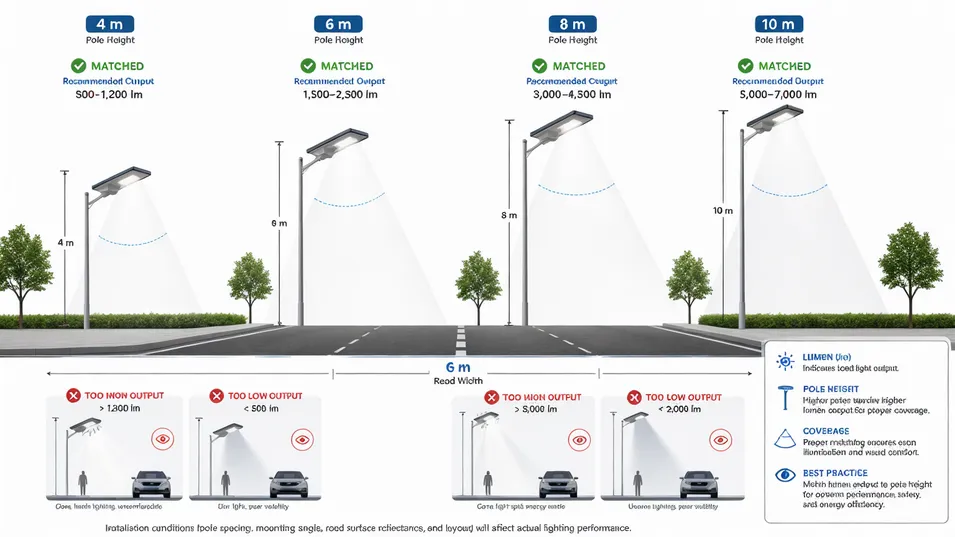
Pole Height and Lumen Matching
The fixture's lumen output needs to match the pole height and road width. A 30W fixture at 8 meters will underperform on a 6-meter-wide road; a 100W fixture at 5 meters will create glare and uneven distribution.
We provide a basic lumen-to-pole-height recommendation table with every quotation — send us your road width and pole height and we'll confirm the right output range.
Solar Panel Orientation and Shading
The integrated panel faces upward at a fixed angle relative to the fixture. For installations in the northern hemisphere, the fixture should be oriented so the panel faces south; in the southern hemisphere, north.
Shading from trees, buildings, or adjacent structures within a 3-meter radius of the panel will reduce charging efficiency and shorten effective autonomy. This is the most common cause of underperformance complaints we see from the field — not a product defect, but a site selection issue that's easy to avoid with a basic site check before installation.
Pole Diameter and Bracket Fit
Our standard bracket range covers 40mm–60mm pole arm diameters. If your project uses non-standard poles, confirm the diameter before ordering — a bracket mismatch is a simple fix at the factory and an expensive problem in the field.
We've had contractors order 200 units and discover on-site that their poles were 65mm. We now ask for pole specs upfront on every project order.
Battery Autonomy Sizing for Your Target Region
Autonomy is calculated based on average peak sun hours for the installation latitude. A 3-rainy-day autonomy spec that works in Southeast Asia may be insufficient for northern Europe or high-altitude regions with extended overcast periods.
Send us your project country and we'll confirm whether the standard configuration covers your seasonal low or whether an extended battery option is needed.
Accessory Checklist Before Dispatch
Every carton ships with bracket hardware, mounting bolts, and an installation guide. For project orders, we recommend confirming the accessory pack against your installation team's requirements before the container closes — adding a missing component after shipment is a logistics cost that erodes your margin.
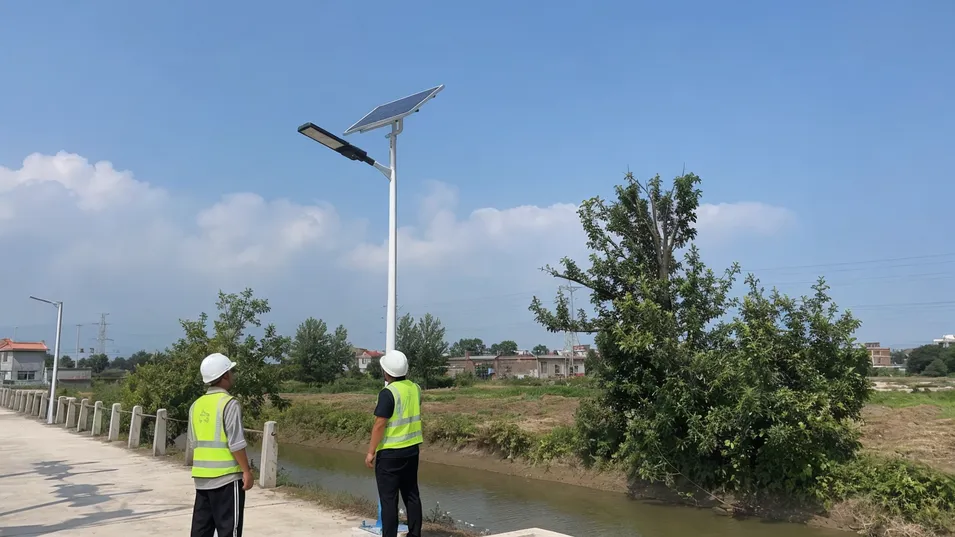
Battery, LED, Controller, and Waterproof Checks Before Shipment
The three failure modes that drove the most buyer complaints in solar street lighting when we started in 2012 were battery degradation after one rainy season, lumen output inconsistency between batches, and waterproof failures in the field. We built our production system around those three points, and they're still the core of how we run QC on every all in one solar street light that leaves the factory.
Battery Cell Matching & Cycle Testing
Battery consistency starts at the cell level. We match battery cells by capacity and internal resistance before pack assembly — cells that fall outside the tolerance band don't go into production packs.
After assembly, every battery pack goes through a charge/discharge cycle test on our aging racks before it's installed in a fixture. The test confirms actual capacity against rated capacity and flags packs that show early degradation.
This step adds time to the production cycle, but it's the reason our battery-related warranty claims run well below the category average. A distributor who has had to handle a batch of early battery failures knows exactly what that claim rate costs in customer service time, replacement logistics, and account credibility.
LED Lumen Binning & CCT Sorting
LED module consistency is controlled at the lumen binning stage. We sort LED chips by lumen output and color temperature before module assembly, so the CCT and lumen output of your batch matches the spec you ordered — not a range that spans 200K in color temperature or 15% in lumen output.
For buyers building a branded product line or supplying a project where visual consistency across fixtures matters, this is the step that prevents the "why do two fixtures on the same street look different" complaint.
Controller & Sensor Function Check
The controller and sensor function check runs on every unit before final assembly. We verify charging logic, lighting mode switching, PIR or microwave sensor trigger response, and dimming function where applicable.
A controller that passes the function check at the factory is not going to arrive at your customer's site with a mode that doesn't switch or a sensor that doesn't trigger.
IP65/IP67 Waterproof Verification
IP65/IP67 waterproof verification is done on our own inspection equipment, not assumed from housing design. The housing seal, cable entry points, and bracket connection points are all checked.
We've seen fixtures from other factories pass visual inspection and fail in the first rainy season because the cable gland wasn't torqued correctly or the housing gasket wasn't seated. Our waterproof check catches those before the unit is packed.
Full Production QC Flow — 100% Pre-Shipment
Every unit, every carton, before the container closes:
SMT for control board
LED module assembly with lumen binning
Battery pack matching & cycle testing
Solar panel electrical output testing
Controller & sensor function checks
Aging test
Waterproof inspection
Final packing
Packing, Labeling, and Reorder Control for Distribution Programs
Export Carton Design
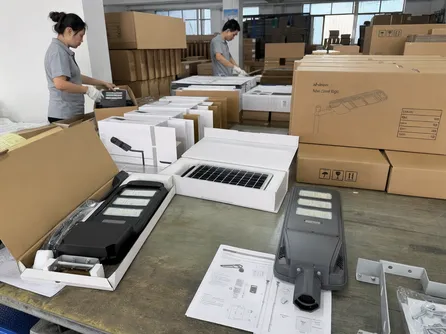
Export cartons for all-in-one solar street light fixtures are sized for the fixture housing plus bracket hardware and accessories, with foam or EPE padding protecting the LED panel face and housing corners.
Carton dimensions are planned for 20GP and 40HQ container loading — we confirm loading quantities per model during quotation so you can plan your container utilization before the order is placed.
Packing List & Accessory Verification
Every carton ships with a packing list that covers the fixture, mounting bracket, hardware pack, and installation guide. Accessory packs are checked against the packing list before carton sealing — this is a specific QC step, not a general assembly check.
Missing accessories are the most common source of installation-site complaints on solar street light projects, and catching them at the factory is faster and cheaper than shipping replacements.
Batch Code Traceability
Batch codes are printed on every carton and on the fixture label, traceable back to the production run.
For distributors running ongoing programs, batch traceability means that if a quality issue surfaces in the field, you can identify which shipment it came from and whether the issue is isolated or systemic — that's the difference between a targeted replacement and a full recall.
Private Label & OEM/ODM Packaging
Private label packaging — custom box design, brand logo, product name, and language-specific installation guides — is available for OEM/ODM programs. Minimum quantities and lead time for custom packaging are confirmed during the engineering review.
For buyers building a branded solar lighting line, we can also configure SKU labeling to match your warehouse management system's barcode format.
Choose All-in-One, Split, Smart, or Roadway Models Without Guesswork
The solar street and roadway lighting range covers several product types with different structural designs and commercial use cases. The table below is a decision guide — not a ranking.
All-in-One Solar Street Light
Best Fit: Local roads, compounds, parking, campuses; fast installation; stockable SKU; standard pole heights 5–12 m.
Consider Instead When: You need an oversized independent panel, extended battery box, or advanced IoT monitoring.
Solar Street Lights
Best Fit: Broad model selection across output ranges and configurations.
Consider Instead When: You need a specific integrated or split structure.
View rangeCommercial Solar Street Lights
Best Fit: Higher-output project specs, commercial-grade applications, larger project volumes.
Consider Instead When: Standard residential or light municipal applications.
View rangeSplit Solar Street Light
Best Fit: Projects requiring large independent panels, separated battery boxes, or low-irradiance regions needing maximum panel area.
Consider Instead When: Installation simplicity and single-carton logistics are priorities.
View rangeSmart Solar Street Light
Best Fit: IoT-connected projects, remote monitoring, adaptive dimming, networked control.
Consider Instead When: Basic on/off or motion-sensor control is sufficient.
View rangeSolar Road Lights
Best Fit: Roadway-focused projects with road-class lighting requirements.
Consider Instead When: Compound, campus, or parking applications.
View rangeSolar Highway Lights
Best Fit: Higher-speed road applications, higher pole heights, road-class photometric requirements.
Consider Instead When: Local roads, compounds, or lower-output applications.
View rangeSolar Park Lighting
Best Fit: Public green spaces, parks, recreational areas with landscape-sensitive installation.
Consider Instead When: Road or compound applications requiring higher output.
View rangeSolar Street Lighting Pole
Best Fit: Pole-matched projects where the pole is specified separately.
Consider Instead When: Complete fixture-and-pole supply from one SKU.
View rangeNot sure which product fits your project or distribution program?
Send us the application details — road type, pole height, target lumen, project country, and order volume — and we'll recommend the right configuration.
FAQ for All-in-One Solar Street Light Procurement
What is the difference between an all-in-one solar street light and a split solar street light?
What is the difference between an all-in-one solar street light and a split solar street light?
An all-in-one solar street light integrates the solar panel, LED module, battery, controller, and sensor into one housing. A split solar street light separates the panel from the fixture, with the panel mounted independently on the pole or a separate structure and the battery typically housed in a separate box.
All-in-One Advantages
- Installs faster
- Ships in fewer cartons
- Fewer accessory variables
Split Advantages
- Allows a larger independent panel
- Useful for low-irradiance regions
- Extended autonomy beyond integrated housing limits
For most standard street, compound, and parking applications, all-in-one is the more efficient choice. For projects in northern latitudes or with 5+ rainy-day autonomy requirements, discuss the split configuration with us.
What pole height works best for all-in-one solar street lighting?
What pole height works best for all-in-one solar street lighting?
The standard range is 5–12 meters, with the most common configurations at 6–8 meters for local roads and compounds and 8–10 meters for wider roads and parking areas. Pole height selection depends on road width, required illuminance level, and fixture lumen output.
Quick Reference
30W fixture covers 4–5m road width
80W–120W to maintain same illuminance at ground
Send us your road width and pole height and we'll confirm the right output range — getting this wrong is the most common cause of underperformance on solar street light projects.
How many cloudy or rainy days can an integrated solar street light support?
How many cloudy or rainy days can an integrated solar street light support?
Standard configurations are designed for 3 consecutive rainy days of autonomy at full working hours. Extended battery configurations can reach 5–7 days. The actual autonomy depends on battery capacity, LED power draw, working mode (full power vs. dimmed or motion-activated), and the average peak sun hours at the installation location.
For projects in regions with extended overcast seasons — northern Europe, high-altitude areas, or monsoon-heavy climates — we recommend specifying the extended battery option or using a motion-sensor mode to reduce average nightly draw.
Tell us your project location and we'll calculate the right battery size for your climate conditions and required autonomy days.
What IP rating should I request for outdoor solar street lights?
What IP rating should I request for outdoor solar street lights?
IP65 is the minimum for any outdoor solar street light application — it covers dust-tight construction and protection against water jets from any direction. IP67 adds submersion protection to 1 meter for 30 minutes, which is relevant for fixtures in flood-prone areas or installations where standing water can reach the fixture housing.
Our standard all-in-one models are available in both IP65 and IP67 configurations; the IP rating is confirmed per model during quotation.
Sufficient for most road and compound applications. Dust-tight plus water jet protection from any direction.
Specify for coastal, tropical, or flood-risk installations where submersion or standing water contact is possible.
Can JXSOL customize lumen output, battery capacity, color temperature, and packaging?
Can JXSOL customize lumen output, battery capacity, color temperature, and packaging?
Yes. Lumen output is adjustable within the LED module's design range without changing the housing. Battery capacity can be increased for extended autonomy, though very large battery packs may affect housing dimensions.
Color temperature options cover 3000K, 4000K, 5000K, and 6000K with no MOQ premium for standard options. Custom housing colors are available on runs of 300 units or more.
Private label packaging, custom box design, and OEM branding are available through our OEM and ODM solar lighting services.
All custom configurations go through an engineering review before production to confirm the spec is achievable and to lock it before component procurement.
What is the MOQ for standard all-in-one solar street light models?
What is the MOQ for standard all-in-one solar street light models?
100 units for standard catalog models. This is low enough to test a new SKU with your customers or validate a configuration for a project before committing to a larger program.
For OEM/ODM configurations with custom specifications, MOQ is confirmed during the engineering review and depends on the degree of customization. Most custom programs run from 300 units upward.
Send Your Road Width, Pole Height, and Target Runtime
The fastest way to get an accurate quote is to send us the project or product details that actually determine the configuration.
Details We Need for Your Quote
Provide these inputs and we can confirm the right LED power, panel wattage, battery capacity, and sensor configuration — then send back a detailed quote with specifications, lead time, and documentation list.
-
Target Country or Region For irradiance data and compliance requirements
-
Road Width and Pole Height Determines beam angle and mounting configuration
-
Target Lumen Output or Wattage LED power selection for your application
-
Required Working Hours Per Night Affects battery capacity and panel sizing
-
Rainy-Day Autonomy Target Backup days without solar charging
-
Order Quantity MOQ 100 units for standard catalog models
-
Branding or Packaging Requirements OEM/ODM programs supported from engineering through export packing
What You Get Back
With those inputs, we confirm the right LED power, panel wattage, battery capacity, and sensor configuration — and send back:
- Detailed quote with full specifications
- Lead time confirmation
- Documentation list for import clearance