

Solar Street Lights Direct From Factory
Factory-direct solar street lights for residential roads, public lighting programs, and distributor stock — built for repeat orders, not one-off projects.
LiFePO4 battery, IP65/IP67 weatherproof construction, and 100% pre-shipment inspection on every unit. Standard models from 30W to 200W, MOQ 100 units.
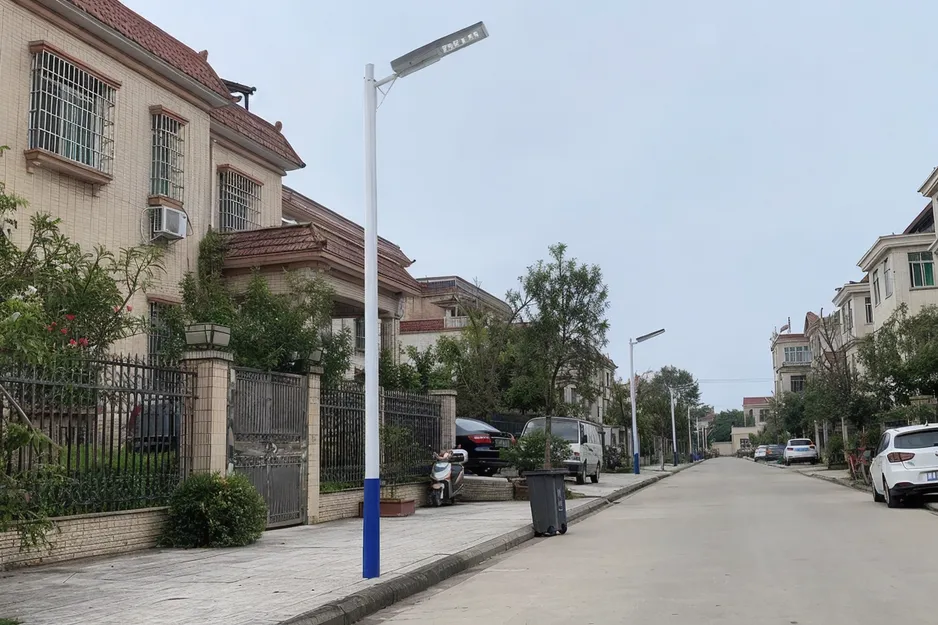
13+ Years
Solar Lighting Manufacturing
1,200,000
Annual Unit Capacity
IP65/IP67
Weatherproof Construction
100%
Pre-Shipment Inspection
Standard Solar Street Lights for Road and Public Lighting Orders
This page covers JXSOL's standard solar street lights — the product family built for residential streets, secondary roads, village roads, township public lighting programs, and distributor catalog SKUs. If you're sourcing for a municipal tender, building a distributor stock program, or quoting a road project where the spec calls for dependable LED solar street lighting at manageable MOQ, this is the right starting point.
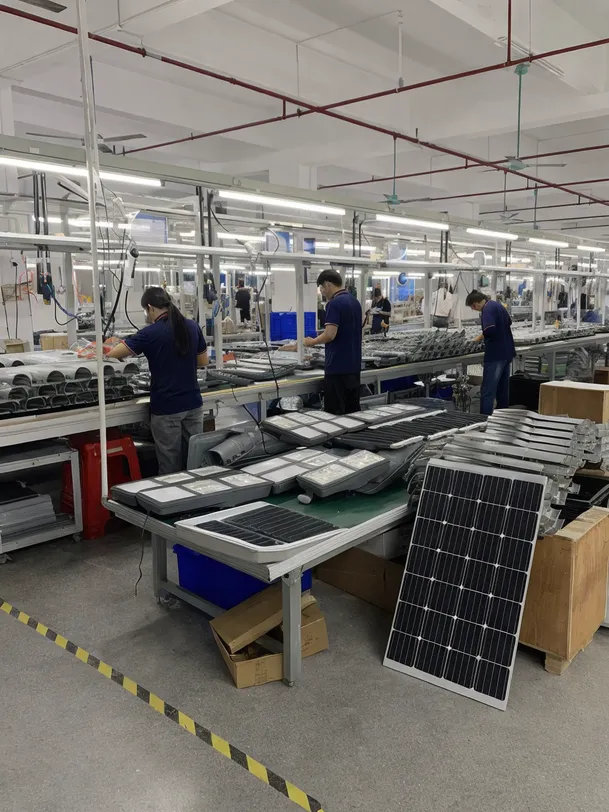
We've been manufacturing solar street lights since 2012. The production is in-house — LED module assembly, battery pack matching, controller testing, waterproof inspection, and final packing all happen in our 12,000 m² factory in Guzhen Town, Zhongshan. We don't assemble from third-party sub-suppliers and call it manufacturing. The engineering team, the QC lab, and the production lines are in the same building.
Standard models run from 30W to 200W LED output, with LiFePO4 battery packs sized for 3–5 autonomy days and monocrystalline solar panels matched to the battery capacity and your installation latitude. IP65 is standard; IP67 is available for harsher environments. Every unit ships with CE, RoHS, and IEC 62124 documentation available on request.
Quick Specification Summary
LED Output Range
30W – 200W
Battery Type
LiFePO4 (3–5 autonomy days)
Solar Panel
Monocrystalline, latitude-matched
IP Rating
IP65 standard / IP67 available
Certifications
CE, RoHS, IEC 62124
MOQ
100 units
What to Include in Your Inquiry
- Road width and pole height
- Required operating hours per night
- Target autonomy days
- Destination market
- Order quantity
If you're earlier in the process, send what you have — we'll work from there.
Request a QuoteWhere This Product Fits in the Street Lighting Range
Standard solar street lights cover the broadest segment of road lighting demand — residential streets, secondary roads, village access roads, public squares, and distributor catalog programs where buyers need a reliable, reorderable SKU rather than a specialized configuration.
Before going deeper into specs and customization, here's how this product family sits relative to the siblings in the range:
Solar Street Lights
Standard residential or secondary road lighting, distributor stock SKUs
Commercial Solar Street Lights
Higher lumen output for commercial developments, business parks, or private roads
All-in-One Solar Street Light
Compact integrated form factor, simplest installation, lowest per-unit cost
Split Solar Street Light
Larger panel or battery bank — high latitude, 5+ autonomy days, 200W+ output
Smart Solar Street Light
Remote monitoring, dimming schedules, fault reporting, or IoT integration for municipal networks
Solar Road Lights
Engineered arterial road layouts with specified pole height, road width, and lux level
High-mast, high-output fixtures for expressways, interchanges, and toll plazas
Solar Parking Lot Lights
Wide-area flood distribution for open lots, logistics yards, and commercial parking
Technical Specifications
The table below shows the standard configurations we hold in production. Each row is a tested, certified combination — not a mix-and-match menu. If your project needs a parameter outside these ranges, we can adjust during engineering review.
| Model | LED Power | Luminous Flux | Solar Panel | Battery | Autonomy | Pole Height | Application |
|---|---|---|---|---|---|---|---|
| JX-SSL-30 | 30W | 4,500 lm | 60W Mono | 30Ah LiFePO4 | 3 nights | 4–5m | Village paths, walkways |
| JX-SSL-50 | 50W | 7,500 lm | 100W Mono | 50Ah LiFePO4 | 3 nights | 5–6m | Residential streets |
| JX-SSL-60 | 60W | 9,000 lm | 120W Mono | 60Ah LiFePO4 | 3–4 nights | 6–7m | Secondary roads, compounds |
| JX-SSL-80 | 80W | 12,000 lm | 150W Mono | 80Ah LiFePO4 | 3–4 nights | 7–8m | Collector roads, public squares |
| JX-SSL-100 | 100W | 15,000 lm | 200W Mono | 100Ah LiFePO4 | 4 nights | 8–10m | Urban distributor roads |
| JX-SSL-120 | 120W | 18,000 lm | 250W Mono | 120Ah LiFePO4 | 4–5 nights | 9–12m | Wide roads, industrial zones |
LED Chip
Bridgelux or Lumileds 3030 SMD, 150–170 lm/W efficacy. Color temperature 4000K (neutral white) or 5700K (cool white).
Battery Chemistry
LiFePO4 (lithium iron phosphate), 2000+ cycle life at 80% DoD. Operating range: −20°C to +60°C. Built-in BMS with over-charge, over-discharge, and short-circuit protection.
Controller
MPPT charge controller with intelligent dimming profiles. Dusk-to-dawn auto on/off. Configurable time-period dimming (e.g., 100%→50%→30%).
Housing Material
Die-cast aluminum body with powder-coated finish. Tempered glass lens. Stainless steel hardware. UV-resistant cable glands.
Wind Resistance
Designed for sustained wind speeds up to 150 km/h (Category 1 hurricane equivalent). Pole and bracket rated accordingly.
Warranty
3-year standard warranty covering LED module, battery, and controller. Extended 5-year warranty available on request.
How We Configure to Your Project
Every site is different. Rather than offering a fixed catalog, we size the system to your actual conditions. Here's what drives the configuration:
Solar Irradiance
Your site's peak sun hours determine panel wattage. A location with 5.5 PSH needs less panel than one with 3.5 PSH to charge the same battery. We reference NASA POWER data for your coordinates.
Autonomy Requirement
How many consecutive rainy or overcast days must the light operate without recharging? Standard is 3 nights. Tropical monsoon regions or high-latitude winter sites may need 5–7.
Road Geometry
Road width, pole spacing, and mounting height define the optical distribution needed. A 6m-wide village road at 7m pole height has very different requirements from a 12m collector road at 10m.
Operating Hours
Dusk-to-dawn in equatorial regions is ~12 hours. At 55°N latitude in winter, it can exceed 16 hours. Longer nights require more battery capacity or intelligent dimming profiles.
Temperature Range
LiFePO4 batteries lose capacity below 0°C. For sites with harsh winters, we can add battery heating or oversize the bank to compensate for cold-weather derating.
Aesthetic & Branding
Custom RAL colors, logo printing on the lamp head or pole, decorative pole options for urban beautification projects. MOQ applies for custom finishes.
Not sure which configuration fits?
Send us your project location and basic requirements. Our engineering team will return a recommended spec sheet within 24 hours.
Standard Features Across All Models
Regardless of wattage or configuration, every solar street light in this range ships with the following as standard:
MPPT Charge Controller
Maximum power point tracking for 15–20% more energy harvest vs. PWM controllers.
Dusk-to-Dawn Auto Sensing
Light sensor triggers automatic on at dusk and off at dawn. No manual switching or timers needed.
Multi-Period Dimming
Programmable brightness profiles (e.g., 100% → 60% → 30%) to extend battery life through low-traffic hours.
Built-in BMS Protection
Over-charge, over-discharge, short-circuit, and over-temperature protection integrated into the battery pack.
Surge Protection
Built-in SPD (surge protective device) rated to 10kV for lightning-prone regions.
Quick-Connect Wiring
Pre-wired MC4 or aviation-grade connectors. Tool-free electrical connections reduce installation time.
Aerodynamic Low-Profile Design
Reduced wind load coefficient extends pole life and lowers foundation requirements.
Tool-Free Maintenance Access
Battery and controller compartment accessible without specialized tools for field servicing.
Anti-Theft Hardware
Security screws and locking brackets to deter panel and battery theft in unmonitored installations.
Installation & Deployment
Solar street lights eliminate trenching and grid connection, but proper installation still matters for long-term performance. Here's what the process looks like:
Foundation
Pour concrete foundation with embedded anchor cage. Size depends on pole height and local wind load. We provide foundation drawings with every order.
Pole Erection
Bolt pole to foundation flange. Thread pre-wired cables through the pole before raising. A small crane or gin pole is sufficient for poles up to 8m.
Mount Components
Attach solar panel to bracket arm, mount lamp head, and secure battery box. All mounting hardware is pre-drilled and included.
Connect & Commission
Plug quick-connect cables between panel, controller, battery, and LED. System auto-detects dusk and begins operating the same evening.

2–3 hrs
Typical install time per unit
0
Trenching required
2 people
Minimum crew size
Same day
Operational after install
Deployment Support Available
For large-scale projects (50+ units), we offer on-site installation supervision, crew training, and commissioning assistance. Our field engineers can travel to your project location to ensure everything is set up correctly.
Ask about deployment supportCertifications & Quality Assurance
Every unit undergoes rigorous testing before shipment. Our manufacturing facilities hold the following certifications:
ISO 9001:2015
Quality Management
ISO 14001:2015
Environmental Management
CE / RoHS
European Compliance
IEC 60598 / IEC 61215
Luminaire & PV Standards
Quality Control Process
Incoming raw material inspection
In-process assembly audits
100% electrical function test
IP rating waterproof test
72-hour burn-in aging test
Final visual & packaging inspection
Warranty & After-Sales Support
We stand behind our products with comprehensive warranty coverage and responsive support throughout the product lifecycle.
Solar Panel
25 years
Linear power output warranty. ≥80% output at year 25. Covers material and workmanship defects.
LiFePO4 Battery
5 years
Capacity warranty guaranteeing ≥70% of rated capacity. Covers cell defects and BMS failures.
LED & Controller
3 years
Full replacement warranty on LED module and charge controller. Covers dead LEDs, driver failure, and controller malfunction.
After-Sales Support Includes
Dedicated project manager for orders 100+ units
Remote diagnostics via optional IoT module
Spare parts inventory for fast replacement
Technical documentation in English, French, Spanish, Arabic
Video installation guides and troubleshooting library
48-hour response time on warranty claims
Product Specifications Buyers Can Use in RFQ Sheets
The table below covers the typical specification range for JXSOL standard solar street lights. These are the parameters buyers use to build comparison sheets and confirm project fit. Exact values vary by model and configuration — contact us with your project inputs for a confirmed data sheet.
| Specification | Typical Range | Buyer Decision Note |
|---|---|---|
| LED Power | 30W – 200W | Match to road width and pole height. A 6m pole on a 6m-wide road typically needs 60–80W; an 8m pole on an 8m road typically needs 100–120W. |
| Lumen Output | 3,000 lm – 22,000 lm | Confirmed at the LED module assembly stage, not assumed from chip datasheet. Lumen output at the fixture is what matters for road illuminance. |
| LED Efficacy | Typical 140–160 lm/W | Higher efficacy means more light per watt, which reduces the panel and battery size needed for the same output — directly affects unit cost. |
| Solar Panel | 40W – 250W monocrystalline | Panel wattage is sized to battery capacity and daily operating hours. Oversizing the panel without matching battery capacity wastes cost without improving autonomy. |
| Battery Type | LiFePO4 (lithium iron phosphate) | Standard across our range. 2,000+ cycle life, wider operating temperature range (−20°C to 60°C), and safer chemistry than lead-acid or standard lithium. |
| Battery Capacity | 20Ah – 120Ah | Sized for target autonomy days and daily operating hours. Confirm your autonomy requirement before RFQ — it's the primary driver of battery cost. |
| Autonomy Days | 3 – 5 days | 3 days covers most standard road applications. 5 days is common for monsoon regions or markets with variable solar irradiance. |
| Color Temperature | 3000K – 6500K | 4000K–5000K is standard for road and public lighting. 3000K warm white is available for community areas or markets with warm CCT preferences. |
| IP Rating | IP65 / IP67 | IP65 is standard for outdoor road lighting. IP67 is available for flood-prone or coastal installations. Both are tested on our own waterproof inspection equipment. |
| Pole Height Compatibility | 4m – 10m | Standard street light configurations. For poles above 10m or engineered road layouts, see Solar Road Lights. |
| Lighting Modes | Full power / 50% dim / PIR motion-activated / dusk-to-dawn | Standard models include full power and 50% dim. PIR motion sensing and dusk-to-dawn timing are available on most configurations. |
| Housing Material | Die-cast aluminum, powder-coated | Standard colors: silver grey, black, dark green. Custom colors available on runs of 100+ units. |
| Operating Temperature | −20°C to +50°C | Covers most export markets. Confirm if your installation environment has extreme temperature conditions. |
| Warranty | 3 years | Covers manufacturing defects. Battery warranty is tied to cycle life — LiFePO4 packs are rated for 2,000+ cycles under normal operating conditions. |
| Certifications | CE, RoHS, IP65/IP67, IEC 62124 | Documentation provided with order. ISO 9001:2015 covers the production quality system. |
LED Power
30W – 200WMatch to road width and pole height. A 6m pole on a 6m-wide road typically needs 60–80W; an 8m pole on an 8m road typically needs 100–120W.
Lumen Output
3,000 – 22,000 lmConfirmed at the LED module assembly stage, not assumed from chip datasheet. Lumen output at the fixture is what matters for road illuminance.
LED Efficacy
140–160 lm/WHigher efficacy means more light per watt, which reduces the panel and battery size needed for the same output — directly affects unit cost.
Solar Panel
40W – 250WPanel wattage is sized to battery capacity and daily operating hours. Oversizing the panel without matching battery capacity wastes cost without improving autonomy.
Battery Type
LiFePO4Standard across our range. 2,000+ cycle life, wider operating temperature range (−20°C to 60°C), and safer chemistry than lead-acid or standard lithium.
Battery Capacity
20Ah – 120AhSized for target autonomy days and daily operating hours. Confirm your autonomy requirement before RFQ — it's the primary driver of battery cost.
Autonomy Days
3 – 5 days3 days covers most standard road applications. 5 days is common for monsoon regions or markets with variable solar irradiance.
Color Temperature
3000K – 6500K4000K–5000K is standard for road and public lighting. 3000K warm white is available for community areas or markets with warm CCT preferences.
IP Rating
IP65 / IP67IP65 is standard for outdoor road lighting. IP67 is available for flood-prone or coastal installations. Both are tested on our own waterproof inspection equipment.
Pole Height Compatibility
4m – 10mStandard street light configurations. For poles above 10m or engineered road layouts, see Solar Road Lights.
Lighting Modes
MultipleFull power / 50% dim / PIR motion-activated / dusk-to-dawn.
Standard models include full power and 50% dim. PIR motion sensing and dusk-to-dawn timing are available on most configurations.
Housing Material
Die-cast AlDie-cast aluminum, powder-coated. Standard colors: silver grey, black, dark green. Custom colors available on runs of 100+ units.
Operating Temperature
−20°C to +50°CCovers most export markets. Confirm if your installation environment has extreme temperature conditions.
Warranty
3 yearsCovers manufacturing defects. Battery warranty is tied to cycle life — LiFePO4 packs are rated for 2,000+ cycles under normal operating conditions.
Certifications
CE / IECCE, RoHS, IP65/IP67, IEC 62124. Documentation provided with order. ISO 9001:2015 covers the production quality system.
Specifications shown are typical values for this product family. Actual specifications vary by model and project configuration. Contact us for a confirmed data sheet and quote.
Request Confirmed Data Sheet & QuoteConfiguration Choices That Protect Landed Cost and Warranty Risk
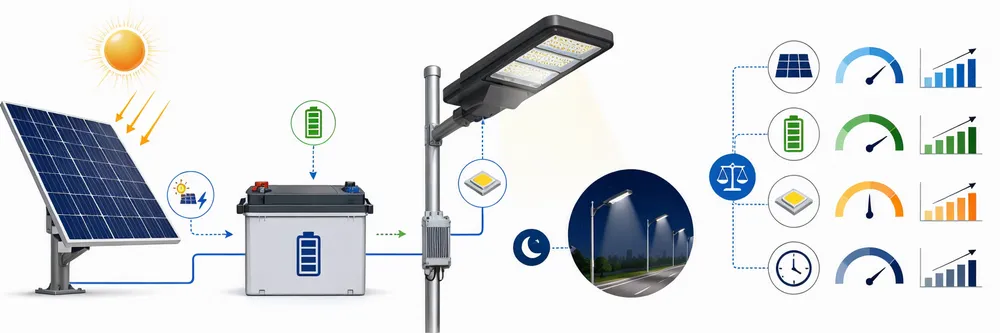
The most common spec error we see in solar street light orders is mismatched battery and panel sizing. A buyer specifies a 100W LED output, then selects a battery capacity sized for 3 autonomy days at 8 hours per night — but the panel wattage is sized for a 60W system. The battery doesn't fully recharge on a normal day, autonomy days drop to one or two in practice, and the warranty claim arrives six months after installation.
The fix is straightforward: panel wattage, battery capacity, LED output, and daily operating hours have to be sized together as a system, not selected independently.
Battery Capacity & Autonomy Days
The battery needs to store enough energy to run the fixture for your target operating hours across your target autonomy days. For a 100W fixture running 10 hours per night with 3 autonomy days, the battery needs to hold roughly 3,000Wh of usable capacity — accounting for LiFePO4 depth of discharge (typically 80%) and system efficiency losses.
We calculate this as part of the configuration process. If you send us your operating hours and autonomy requirement, we'll confirm the battery spec before production.
Panel Wattage & Installation Latitude
The panel needs to recharge the battery within the available peak sun hours at your installation location. A system sized for Southeast Asia (5–6 peak sun hours per day) will underperform in Northern Europe (2–3 peak sun hours in winter).
We ask for the installation location or target latitude as a standard input for any solar energy street lighting order — it's the variable that determines whether the system performs year-round or only in summer.
We've seen buyers skip this step and then wonder why their fixtures go dark in November. The latitude input takes 30 seconds to provide and prevents a field problem that takes months to resolve.
Lumen Output & Pole Height
Lumen output should be matched to pole height, road width, and beam angle — not selected by wattage alone. A 100W fixture at 6m pole height with a narrow beam angle will produce a bright spot under the pole and dark zones between poles.
The same 100W fixture with a wide-angle beam at 8m pole height will distribute light more evenly across a wider road. We can confirm the beam angle and photometric distribution for your pole height and road width before you quote the project.
For detailed photometric planning guidance, see our solar street lighting design planning resource.
IP Rating Selection
IP65 handles rain, road spray, and pressure washing — it's the right baseline for standard outdoor road lighting.
IP67 adds temporary immersion protection and is worth specifying for coastal installations with heavy salt spray, flood-prone areas, or any site where standing water is a regular condition.
The housing design alone doesn't guarantee IP performance — gasket compression, fastener torque, and cable entry sealing all affect the actual rating. We test both on our own waterproof inspection equipment, not by visual check.
Color Temperature for Your Market
4000K–5000K neutral white is the standard for road and public lighting in most export markets — it provides good visibility and color rendering without the harshness of 6500K daylight.
Some markets in Southeast Asia and the Middle East have a preference for 6500K. Community areas, village roads, and markets with warm-light preferences often specify 3000K.
If you're building a distributor catalog, stocking two CCT options (4000K and 5700K) covers most project requirements without overcomplicating your SKU list.
CCT Quick Reference
Need a configuration recommendation?
Send your operating hours, autonomy requirement, and installation latitude. We'll confirm battery, panel, and beam angle specs before production.
Market Segments for Standard Solar Street Light Supply
Standard solar street lights serve five distinct market segments, each with different buying patterns, volume profiles, and specification priorities. Understanding which segments your buyers operate in helps you stock the right configurations and position the product correctly.
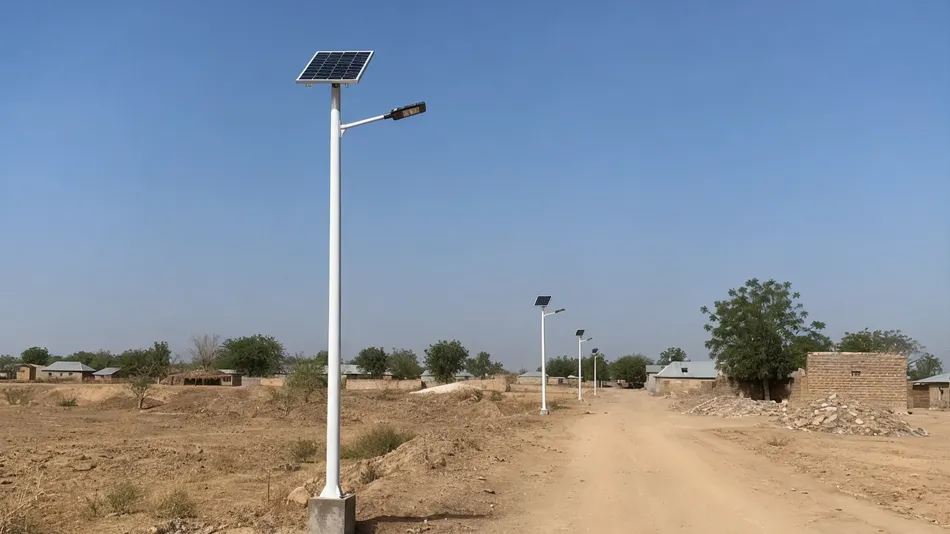
Residential and Township Road Lighting
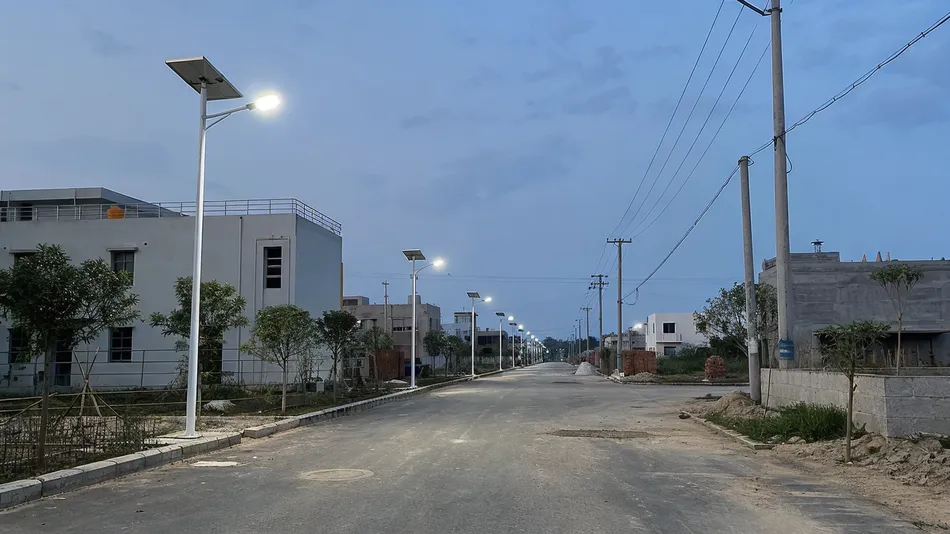
Residential streets and township roads are the highest-volume segment for standard solar street lights in most developing markets. Projects typically run 50–500 units per road section, with repeat orders as the township expands.
Buyers in this segment are price-sensitive on a per-unit basis but need reliable battery autonomy — a fixture that goes dark after two cloudy days generates complaints that damage the distributor's reputation faster than a higher unit price would.
Typical Specification
LED Output
60–100W
Autonomy
4–5 days
CCT
4000K–5000K
IP Rating
IP65
Pole Height
6–8m
Order Volume
50–500 units
This is the core SKU for most distributor catalog programs in Southeast Asia, Africa, and the Middle East.
Village and Rural Road Lighting
Off-grid village roads and rural access roads are a distinct segment from township roads — the buying driver is grid unavailability rather than cost comparison with grid-connected alternatives.
Buyers in this segment prioritize battery autonomy (5+ days is common), robust housing for high-temperature or dusty environments, and low maintenance requirements.
Segment Profile
Order Volume
20–200 units
Autonomy Need
5+ days
Key Priority
Low maintenance
Environment
High-temp / dusty
The segment is geographically broad and generates consistent demand in Africa, South and Southeast Asia, and parts of the Middle East.
For distributors serving rural electrification programs or NGO-funded infrastructure projects, this segment has predictable reorder cycles tied to project phases.
Municipal Public Solar Street Lighting Programs
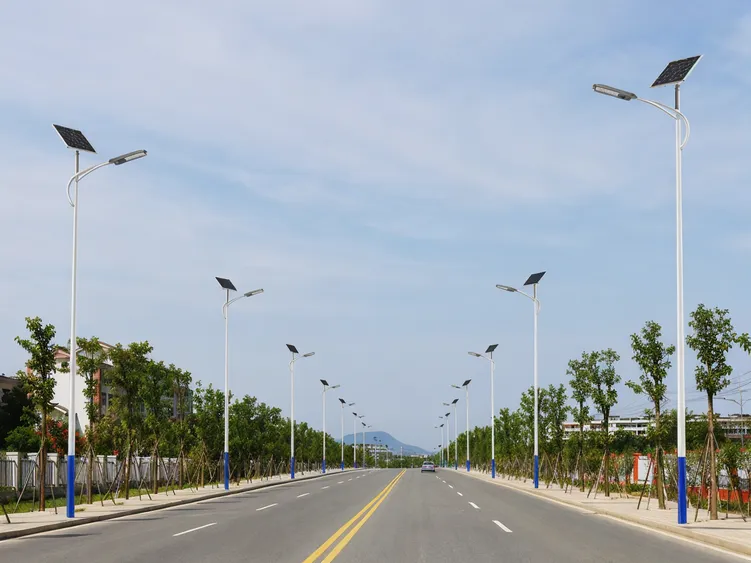
Municipal governments replacing grid-connected street lighting with solar energy street lighting are the largest single-volume buyers in most regulated markets. Projects range from a few hundred fixtures for a district upgrade to multi-thousand-unit city programs.
Municipal buyers work from road classification standards that specify lux levels, pole heights, and spacing — they need a supplier who can match those specs and provide the compliance documentation for the procurement process. CE, IEC 62124, and IP certification documentation are standard requirements for regulated market entry.
Batch consistency across phases is critical: a city that installs 500 fixtures in Phase 1 and reorders 500 in Phase 2 expects the new fixtures to match the ones already installed. This is where our lumen binning and batch traceability controls matter commercially — not just as a QC practice, but as a reorder guarantee.
Distributor Catalog Programs
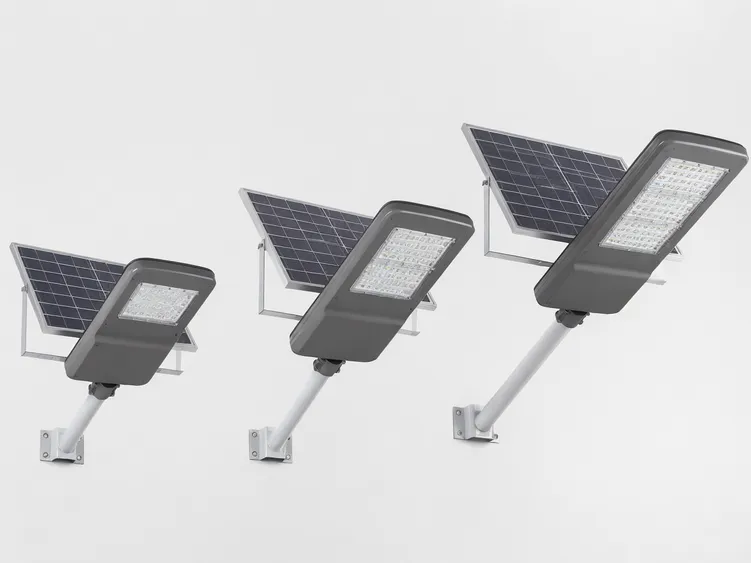
Distributors building a solar street lighting catalog typically start with two or three standard SKUs covering the most common wattage steps in their market — typically a 60W, 100W, and 150W configuration — then add split or smart configurations as their customer base grows.
The key sourcing requirement for this segment is batch consistency and reorder reliability: your customers expect the fixtures they reorder to match the ones already installed, and your business depends on a factory that can deliver the same spec six months later without renegotiating.
We work with distributors across North America, Europe, the Middle East, Southeast Asia, and Africa who run mixed-SKU programs with reorder cycles of 3–6 months. MOQ from 100 units per SKU makes it practical to test a new wattage step with your market before scaling.
Light Commercial Access Roads and Private Developments
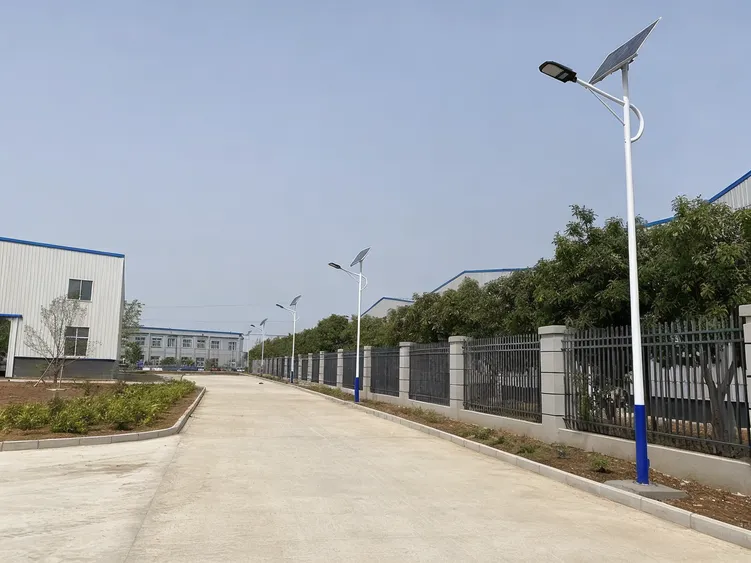
Private developers, industrial park operators, factory campuses, and logistics facility owners install public solar street lighting as part of site infrastructure — access roads, perimeter roads, and internal circulation routes.
These buyers are cost-sensitive on a per-unit basis but value installation simplicity and low maintenance. Standard all-in-one or split configurations in the 60–120W range cover most private development requirements. Order volumes typically run 30–300 units per project, with repeat orders as the development expands.
For higher-output commercial developments or business parks with more demanding specifications, see Commercial Solar Street Lights.
Ready to discuss your project requirements?
Tell us your market segment, volume, and target specs — we'll confirm configuration fit and pricing.
OEM/ODM Options Without Losing Standard Product Control
Standard catalog models cover most distributor and project requirements. When they don't, our in-house engineering team handles the customization — lumen output adjustment, battery sizing, panel configuration, controller logic, housing color, private label, and packaging. OEM/ODM work is a significant part of what we do, and the engineering review process is designed to lock the spec before production, not discover mismatches during it.
Lumen Output & CCT
Lumen output can be adjusted within the LED module's design range without changing the housing. For most standard street light models, a 100W housing can typically be configured from 80W to 120W without tooling changes.
Color temperature covers 3000K through 6500K. If your market has a specific CCT preference or your project spec calls for a non-standard CCT, confirm it at order placement — we test and confirm CCT at the module assembly stage, not just at the chip datasheet level.
Battery Capacity & Panel Sizing
Battery capacity is sized to your target autonomy days and daily operating hours. Panel wattage is calculated against the peak sun hours at your installation latitude.
We treat these as a system — increasing battery capacity without matching panel wattage is a common spec error that leads to underperformance in the field.
Send us the installation location and we'll confirm the panel and battery sizing before production.
Controller Modes & Sensor Logic
Standard models include PIR motion sensing and 50% dim mode. Custom controller configurations can include:
- Scheduled dimming profiles
- Dawn-to-dusk timing
- Multi-level dimming (100%/50%/30%)
- Remote control options
For municipal projects requiring network integration or fault reporting, see Smart Solar Street Lights — that product family is built for those requirements.
Housing Color & Finish
Standard colors: silver grey, black, and dark green.
Custom colors are available on runs of 100+ units — below that, the powder line changeover cost doesn't make sense for either side.
Custom color matching to RAL or Pantone references is available with a color sample confirmation step before production.
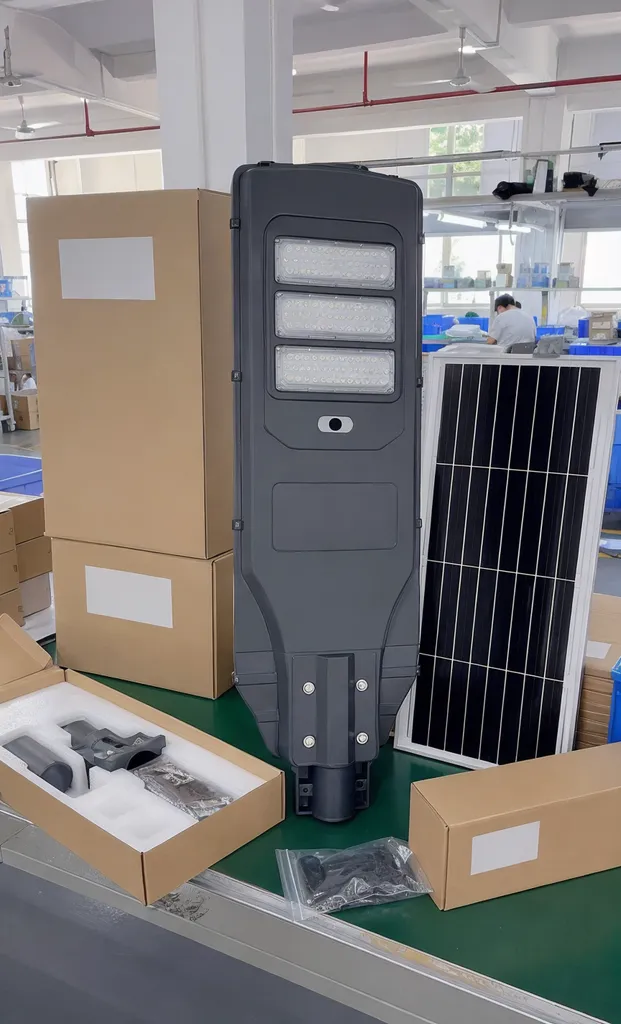
Private Label & Packaging
Custom logo, brand labeling, packaging design, and accessory configuration for buyers building a branded LED solar street lighting line.
We handle the packaging engineering alongside the product engineering — carton dimensions, insert design, accessory pack contents, and labeling format are all confirmed before production starts.
What Requires a Separate Engineering Review
The following configurations go through an engineering review before production. The review confirms the configuration is achievable, locks the spec, and prevents the kind of mid-production spec changes that cost more time than the review takes.
Custom housing designs
Non-standard pole mounting configurations
Extreme autonomy specs (7+ days in low-irradiance regions)
Wattage requirements outside the standard model range
MOQ for standard catalog models starts at 100 units.
OEM/ODM projects with custom specifications are reviewed before production to confirm the configuration and lock the spec before component procurement.
Battery, LED Module, and Waterproof Controls Before Shipment
The three failure modes that generate the most warranty claims in solar street lighting are battery capacity degradation after one or two seasons, lumen inconsistency across batches, and waterproof structures that fail in the field. We built our production system around those three problems. Here's what that looks like at the production stage for this product family.
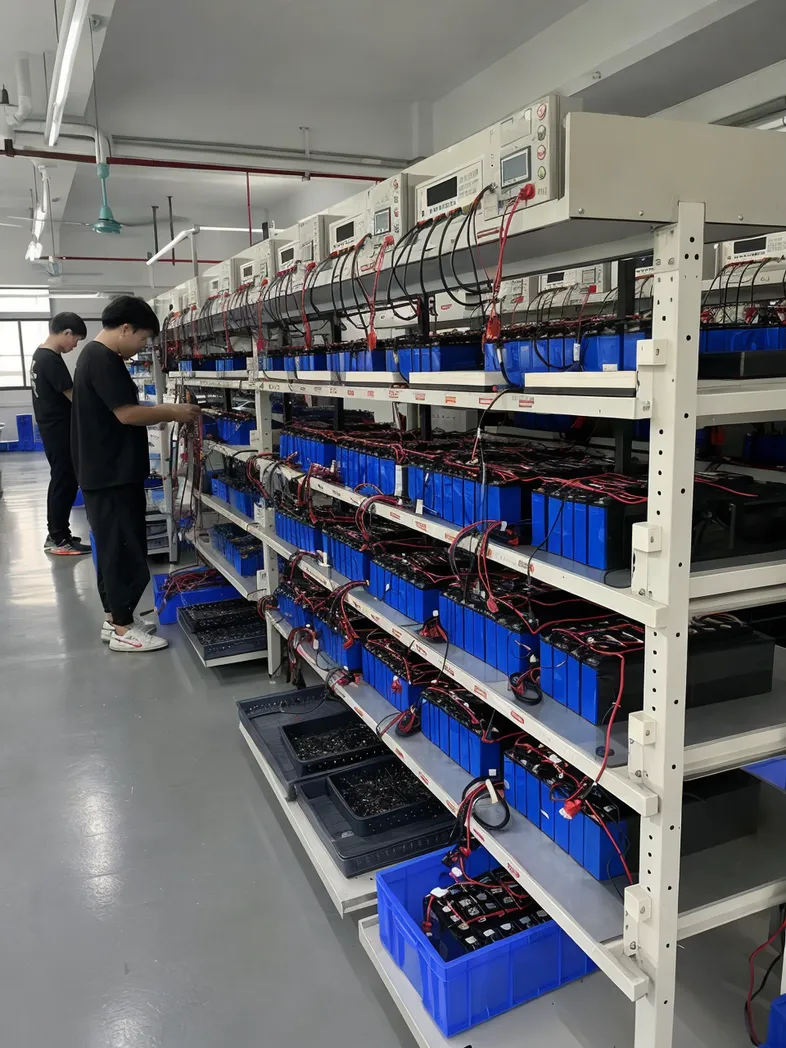
Battery Cell Matching and Charge/Discharge Testing
Battery failure in solar street lighting is almost never a single-cell defect — it's a matching problem. When LiFePO4 cells with different internal resistance values are assembled into a pack, the weaker cells discharge faster and degrade faster, pulling down the whole pack within one or two seasons. The fixture dims progressively, the customer complains, and the distributor absorbs the warranty cost.
We match battery cells by capacity and internal resistance before pack assembly. Every completed pack goes through a full charge/discharge cycle test on our aging test racks before it moves to final assembly — not a quick continuity check, a full cycle under load. Packs that don't hold their rated capacity within tolerance are pulled before they reach the fixture.
This step adds time to the production schedule. It also means we don't ship battery packs that will fail in the field after one rainy season. We've kept it as a non-negotiable since the early years, and it's the single production control that has the most direct impact on your warranty claim rate.
2,000+
Charge/Discharge Cycles
5–7 Years
Daily Cycling Lifespan
LiFePO4
Standard Chemistry
300–500
Lead-Acid Cycle Limit
Why LiFePO4 Is Standard Across Our Range
The LiFePO4 chemistry we use across the standard solar street light range is rated for 2,000+ charge/discharge cycles under normal operating conditions — roughly 5–7 years of daily cycling. Lead-acid alternatives are cheaper per unit but typically degrade significantly after 300–500 cycles, which means replacement costs that your downstream customers will attribute to the product, not the chemistry choice. We switched to LiFePO4 as the standard across our range because the total cost of ownership argument is straightforward, and because battery replacement in a pole-mounted fixture is a labor cost that falls on whoever sold the product.
LED Module Lumen Binning and CCT Confirmation
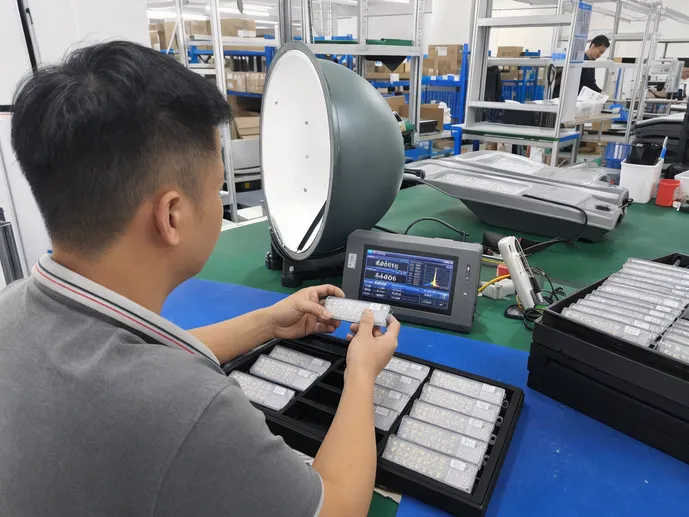
Lumen inconsistency across batches is a sourcing problem that shows up as a field problem. Your customer installs 50 fixtures and notices that some are visibly brighter or cooler than others. The root cause is LED chip binning: chips from the same production run can vary in lumen output and color temperature if they're not sorted and matched before assembly.
We run lumen binning at the LED module assembly stage. Chips are sorted by lumen output and color temperature bin before they're assembled into modules, and lumen output is confirmed at the module level before the module moves to final assembly. Color temperature is confirmed against the specified CCT range — not assumed from the chip datasheet.
This is the step that keeps your batches consistent across reorders, which matters when your customer is expanding a road project in phases and expects the new fixtures to match the ones already installed. For distributors running catalog programs, batch consistency is the difference between a reorder and a supplier switch.
Why Lumen Binning Matters for Multi-Phase Projects
Batch-to-Batch Match
Chips sorted by output and CCT bin before module assembly — reorders match original installations.
CCT Confirmed at Module Level
Color temperature verified against specified range — not assumed from chip datasheet values.
Module-Level Verification
Lumen output confirmed at assembled module stage before final fixture assembly proceeds.
IP65/IP67 Waterproof Inspection
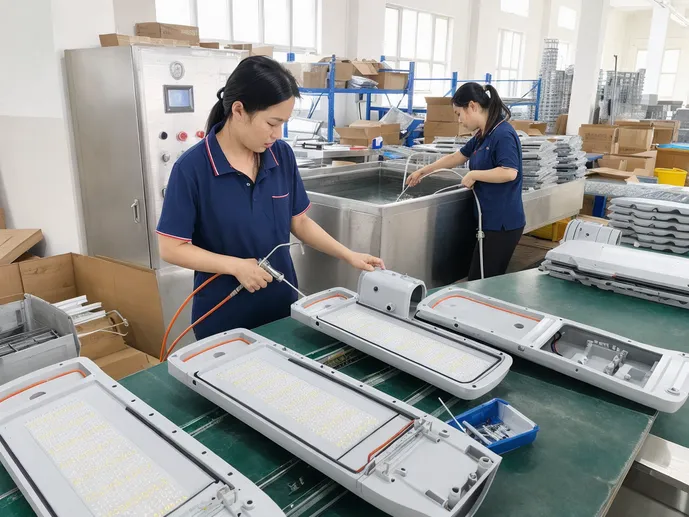
Waterproof claims in solar lighting are easy to make and hard to verify without the right equipment. Housing design alone doesn't guarantee IP performance — the seal integrity depends on gasket compression, fastener torque, cable entry sealing, and the consistency of the assembly process. We test waterproof structure on our own IP inspection equipment, not by visual check or by assuming the housing design is sufficient.
Every unit goes through waterproof structure inspection before final packing. IP65 units are tested for dust ingress protection and water jet resistance. IP67 units are tested for temporary immersion. Units that fail inspection are pulled, the failure mode is identified, and the assembly process is corrected before the batch continues. This is 100% inspection on the waterproof structure — not a sample check.
IP65 Inspection Scope
- Dust ingress protection verified
- Water jet resistance confirmed
- 100% unit inspection — not sample-based
IP67 Inspection Scope
- Temporary immersion test performed
- Gasket compression and fastener torque verified
- Cable entry sealing confirmed per unit
Failure protocol: Units that fail inspection are pulled, the failure mode is identified, and the assembly process is corrected before the batch continues.
Full Quality System: Four-Stage Inspection
The full quality system runs four stages covering every critical assembly point from incoming materials to container sealing.
Incoming Inspection
Solar panels, LED chips, battery cells, controllers, housings — all verified before entering production.
In-Process Inspection
SMT, LED module assembly, and battery matching stages — each checked before advancing.
Reliability Checks
Aging tests and lighting mode verification confirm long-term performance before packing.
100% Outgoing Inspection
Every unit inspected before the container is sealed — waterproof structure, function, and cosmetics.
Compliance and Export Documentation for Public Lighting Buyers
For buyers importing solar street lights into regulated markets or qualifying products for public tender, here's the certification and documentation picture for this product family.
ISO 9001:2015
Covers the production quality management system — incoming inspection, in-process controls, outgoing inspection, and traceability. It's the foundation that the product-level certifications sit on.
CE Marking
Covers the Low Voltage Directive and EMC Directive requirements for the electrical components. CE is required for European market entry and is commonly accepted in Middle East and African project tenders as evidence of electrical safety compliance.
RoHS Compliance
Covers restricted substance requirements — lead, mercury, cadmium, hexavalent chromium, and brominated flame retardants. Required for EU import and affects import clearance in an expanding list of markets. Our RoHS compliance is built into component sourcing, not added at the documentation stage — we source LED chips, battery cells, and electronic components from suppliers who provide material declarations, and we maintain records by batch.
IP65/IP67 Ingress Protection
Tested on our own waterproof inspection equipment and documented with test certificates. For buyers whose markets or project specs require IP certification documentation rather than just an IP rating claim, we provide the test certificates with the order.
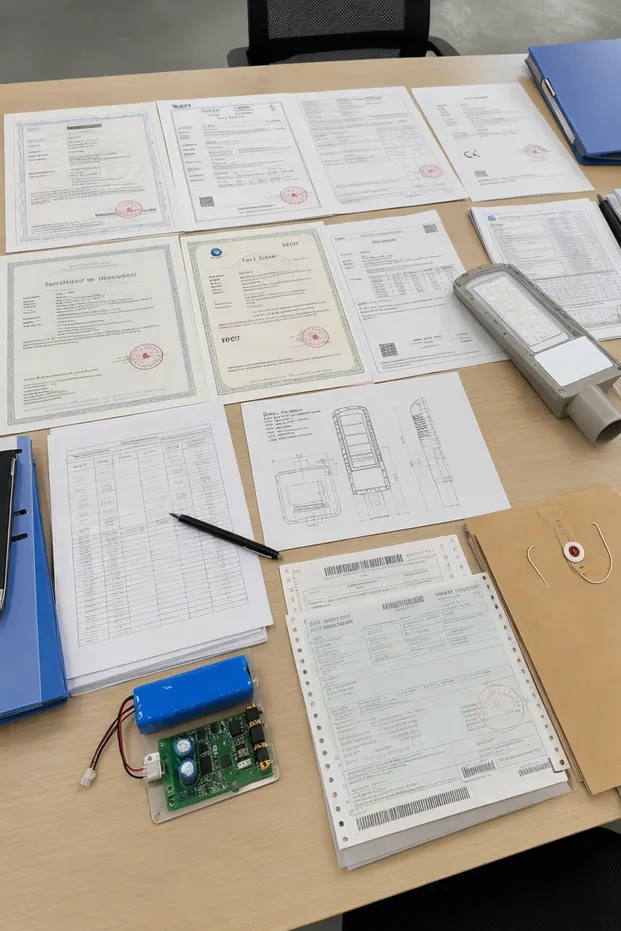
IEC 62124
Covers photovoltaic standalone system performance requirements and is increasingly referenced in project specifications for photovoltaic street lighting, particularly in European and regulated market tenders. IEC 62124 documentation is available with orders for markets that require it.
North American Markets
Requirements vary by state and application — some projects specify UL listing, others accept CE with test reports. If your market has specific certification requirements beyond the above, confirm at inquiry and we'll advise on what documentation is available and what may require additional testing.
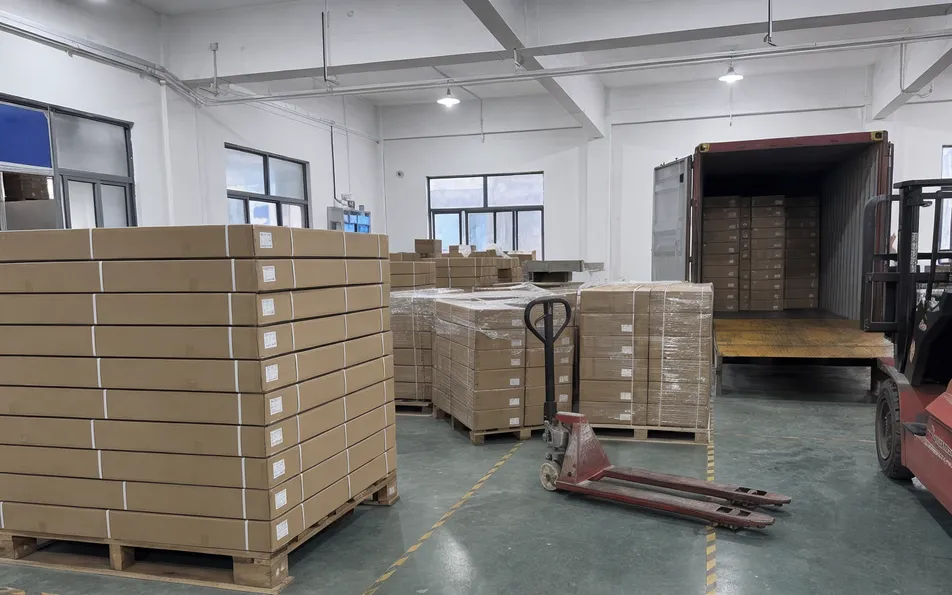
Packing, Accessories, and Reorder Control
Solar street light fixtures are bulky, and mixed-SKU orders add complexity to packing and documentation. Here's how we manage export shipments for this product family.
Carton Planning
Carton dimensions are sized for standard 20GP and 40HQ container loading. Fixtures, mounting brackets, fasteners, and accessory packs are packed separately with clear labeling. Mixed-SKU orders are organized by product family and labeled by batch code so your receiving team can sort and verify without unpacking everything.
Accessory Pack Verification
Every carton includes a packing list, and accessory packs — mounting brackets, fasteners, remote controls for applicable models, installation guides — are checked against the packing list before carton sealing. Missing accessories are one of the most common causes of installation delays on project sites. We check them before the container closes.
Batch Traceability
Every carton carries a batch code that traces back to the production run, component lot, and QC records. If a field issue surfaces after installation, the batch code lets us identify the production window and pull the relevant inspection records. For buyers running large project deployments, this traceability is the foundation of any warranty claim process.
Palletized Packing
Available for buyers who need palletized delivery for warehouse receiving or project site logistics. Pallet configurations are confirmed at order placement.
Reorder Consistency
SKU specifications are locked at order placement and maintained in our production records. When you reorder the same SKU six months later, the spec doesn't drift. This is the sourcing reliability that distributor catalog programs depend on.
RFQ Checklist for Solar Street Light Projects
The most useful inquiry gives us enough to confirm the right configuration and provide a detailed quote without a back-and-forth that delays your project timeline. Here's what to include:
Quantity
Total units required, and whether this is a single project order or the first of a recurring program.
Destination Market
Country and region — affects certification requirements, packaging language, and configuration recommendations.
Road Width & Pole Height
The two primary inputs for lumen output and beam angle selection.
Pole Spacing
If known from the project brief — helps confirm photometric coverage.
Operating Hours per Night
Typically 8–12 hours; affects battery sizing.
Target Autonomy Days
How many consecutive cloudy days the system needs to operate without recharging.
Color Temperature
4000K–5000K for most road applications; confirm if your market has a specific preference.
Lighting Mode
Full power only, 50% dim after midnight, PIR motion-activated, or dusk-to-dawn.
Branding & Packaging
Standard JXSOL packaging, private label, or custom packaging.
Certification Requirements
CE, RoHS, IP documentation, IEC 62124, or market-specific requirements.
Installation Location or Latitude
For panel and battery sizing confirmation.
Earlier in the Process?
If you're comparing configurations, building a distributor catalog, or evaluating us as a supplier — send what you have. We can recommend a configuration from incomplete specs if you give us the project context.
Ready to Send Your RFQ?
FAQ for Solar Street Light Buyers
Practical answers to the sizing and configuration questions that come up most often during project quoting.
What wattage solar street light do I need for a standard road?
The wattage depends on three inputs: pole height, road width, and required illuminance level. As a practical starting point:
6m pole on a 6m-wide road with 20m pole spacing — achieves 15–20 lux average illuminance
8m pole on an 8m-wide road with 25m spacing
10m pole on a 10m-wide road with 30m spacing
These are starting points — the actual wattage depends on the beam angle and photometric distribution of the specific fixture, not just the wattage number.
If you're working from a project brief with pole height, road width, and a lux requirement, send it to us and we'll confirm the fixture spec before you quote.
How many autonomy days should public solar street lighting use?
Autonomy day requirements vary by project context and climate conditions:
Covers a typical sequence of overcast days without the system going dark. Suitable for most road lighting applications.
Common for projects in regions with monsoon seasons, variable solar irradiance, or high-latitude winters where consecutive low-irradiance days are more frequent.
Specified for critical infrastructure or locations where maintenance access is difficult.
The trade-off is direct: more autonomy days require a larger battery bank, which increases unit cost and, for integrated configurations, may require moving to a split solar street light to accommodate the larger battery.
We size battery capacity against your target autonomy days and daily operating hours as part of the configuration process.
What is the difference between standard solar street lights and all-in-one solar street lights?
The terms overlap in common usage, but there's a practical distinction worth understanding. All-in-one solar street lights integrate the solar panel, battery, LED module, and controller into a single compact housing — everything is in one unit, installation is straightforward, and there's no wiring between panel and fixture. Standard solar street lights may use the same integrated form factor or a semi-integrated design where the panel is mounted separately on the fixture arm.
The key difference is configuration flexibility: all-in-one designs are optimized for simplicity and cost at standard wattage ranges, while standard street light configurations can accommodate larger panels or battery banks when the project requires it.
Choosing the right configuration:
- For the simplest installation and lowest per-unit cost for standard road applications, see All-in-One Solar Street Lights.
- For projects requiring larger panel or battery sizing, see Split Solar Street Lights.
Is IP65 enough for outdoor solar street lights?
IP65 is the correct baseline for standard outdoor road lighting — it covers dust ingress protection and water jet resistance from any direction, which handles rain, road spray, and pressure washing. For most residential streets, secondary roads, and township public lighting applications, IP65 is sufficient.
IP67 adds temporary immersion protection (up to 1 meter for 30 minutes) and is worth specifying for installations in flood-prone areas, coastal locations with heavy salt spray, or any site where standing water is a regular condition.
IP65 — Standard Applications
- • Residential streets
- • Secondary roads
- • Township public lighting
- • Standard outdoor environments
IP67 — Harsh Environments
- • Flood-prone areas
- • Coastal / heavy salt spray
- • Sites with standing water
- • Submersion risk zones
Important caveat: The IP rating on the label is only as good as the inspection process behind it. We test both IP65 and IP67 on our own waterproof inspection equipment — not by visual check or by assuming the housing design is sufficient. If you're unsure which rating your installation environment requires, send us the site conditions and we'll confirm.
Why do solar street light batteries fail early?
The most common cause is cell mismatch in the battery pack. When LiFePO4 cells with different internal resistance values are assembled together, the weaker cells discharge faster and degrade faster, pulling down the whole pack within one or two seasons. The fixture dims progressively, and the failure looks like a battery problem when it's actually an assembly problem.
A secondary cause is undersized battery capacity relative to the actual operating hours and autonomy requirement — the system was spec'd for 8 hours per night but the controller is running it for 10, and the battery never fully recovers.
We address both at the production stage: cells are matched by capacity and internal resistance before pack assembly, and every completed pack goes through a full charge/discharge cycle test before it moves to final assembly.
If you're seeing early battery failures on fixtures from another supplier, the failure mode is almost always one of these two — and both are preventable at the manufacturing stage.
What is JXSOL's MOQ for standard solar street light models?
100 units for standard catalog models. That's low enough to run a market test with your customers before committing to a larger program.
For OEM/ODM projects with custom specifications — custom lumen output, battery sizing, housing color, private label — MOQ depends on the customization scope and goes through an engineering review before production.
Most new buyers in this category start with a mixed sample order of 2–5 units across configurations to test with their own customers or confirm project fit before placing the first production order. We can ship samples ahead of a production order.
If you're building a distributor catalog and want to test two or three wattage steps before committing to stock quantities, that's a common starting point — tell us your target market and we'll suggest a starting SKU mix based on what's moving for our existing distributors in that region.
Have a project-specific question?
Send your specs and our engineering team will respond with configuration guidance within one business day.
Send Your Project Specs for a Factory Quote
The most useful inquiry gives us enough to confirm the right configuration and provide a detailed quote without a back-and-forth that delays your project timeline. Here's what to include:
What to Include in Your Inquiry
Quantity
Total units required, and whether this is a single project order or the first of a recurring program
Destination Market
Country and region — affects certification requirements, packaging language, and configuration recommendations
Road Width and Pole Height
The two primary inputs for lumen output and beam angle selection
Pole Spacing
If known from the project brief — helps confirm photometric coverage
Required Operating Hours
Typically 8–12 hours per night; affects battery sizing
Target Autonomy Days
How many consecutive cloudy days the system needs to operate without recharging
Color Temperature
4000K–5000K for most road applications; confirm if your market has a specific preference
Lighting Mode
Full power only, 50% dim after midnight, PIR motion-activated, or dusk-to-dawn
Branding and Packaging
Standard JXSOL packaging, private label, or custom packaging
Certification Requirements
CE, RoHS, IP documentation, IEC 62124, or market-specific requirements
Installation Location or Latitude
For panel and battery sizing confirmation
Earlier in the process?
If you're comparing configurations, building a distributor catalog, or evaluating us as a supplier — send what you have. We can recommend a configuration from incomplete specs if you give us the project context.
Contact JXSOL Directly
Phone / WhatsApp
+86 153 9880 7118Address
9th Floor, Houda Industrial, No. 65 Pinghe Road, Guzhen Town, Zhongshan, Guangdong, 528421, China
Typical Response Time
Complete inquiries with the specs above receive a detailed configuration and quote within 24 business hours.