

Motion Sensor Solar Wall Lights Direct From Factory
PIR-triggered solar wall lighting built for security-focused perimeter and entrance programs. Integrated panel, battery, LED module, and PIR controller in a single wall-mount fixture — no wiring trench, no grid connection, motion-activated output that protects battery runtime and reduces after-sales complaints.
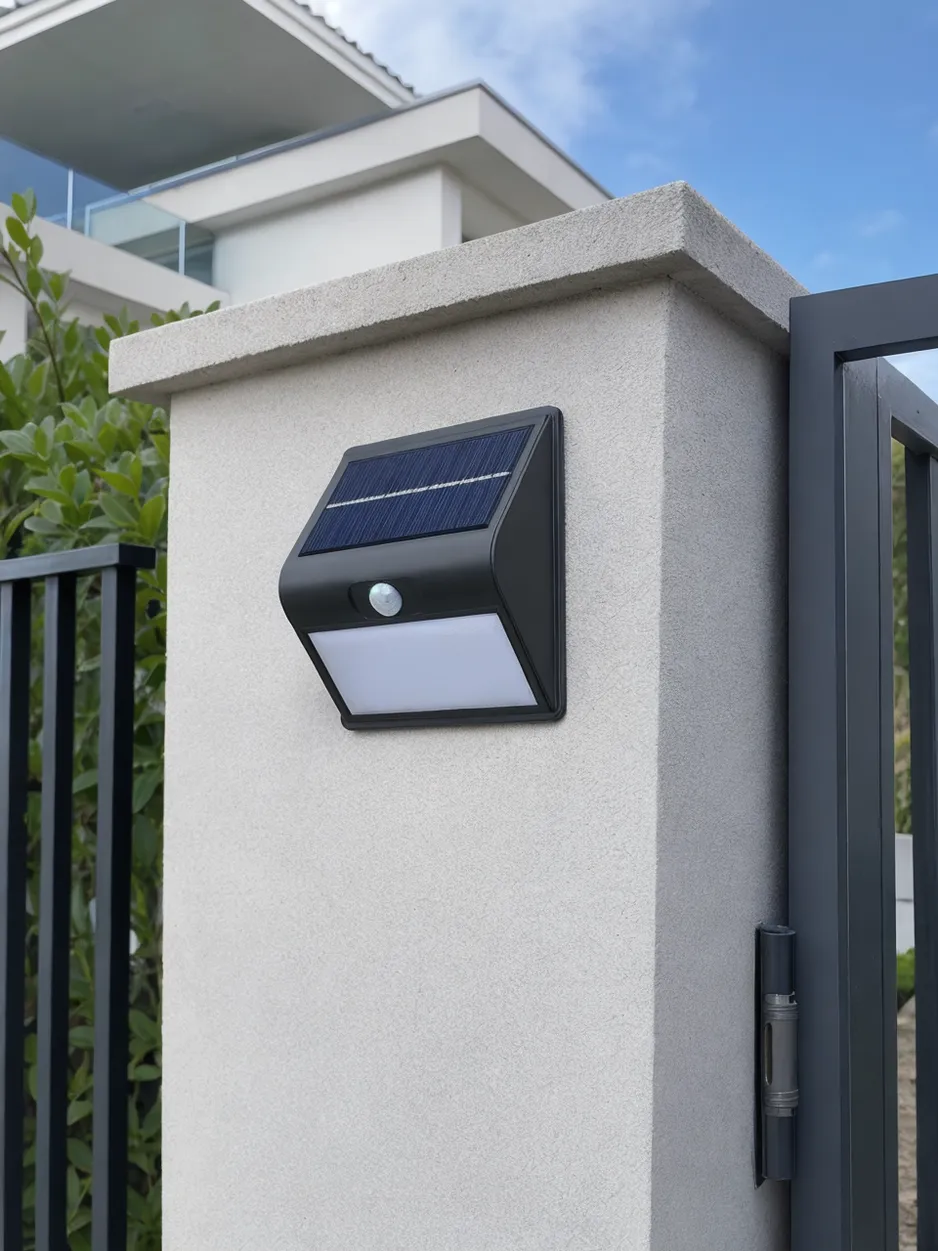
Motion Sensor Solar Wall Lights Built for Security-Focused Wall Lighting Programs
Motion sensor solar wall lights are wall-mounted outdoor fixtures that combine a solar panel, lithium battery, LED module, controller, and PIR sensor in a single housing. The sensor logic is what separates them commercially from basic solar wall lights: the fixture runs at low standby output through the night and switches to full brightness when movement is detected, then returns to standby after a set delay. That operating pattern extends battery runtime, reduces energy waste, and gives the product a clear security-lighting story that downstream customers understand and pay for.
Within the solar wall lighting range, this is the SKU for buyers who need a product with a defined activation trigger — entrances, service doors, perimeter walls, compound gates, and any location where continuous full-output lighting is unnecessary but instant bright light on movement is the requirement. We've been producing solar outdoor lighting since 2012, and motion-sensor wall lights are one of the higher-margin SKUs in the wall lighting category because the feature story is easy to communicate and the installation cost advantage over wired alternatives is real.
Entrances & Service Doors
Instant activation on approach, standby between events.
Perimeter Walls & Compound Gates
Security-grade response without wiring infrastructure.
No Wiring Trench Required
Eliminates grid connection cost and civil works.
Higher-Margin SKU
Clear feature story that's easy to communicate downstream.
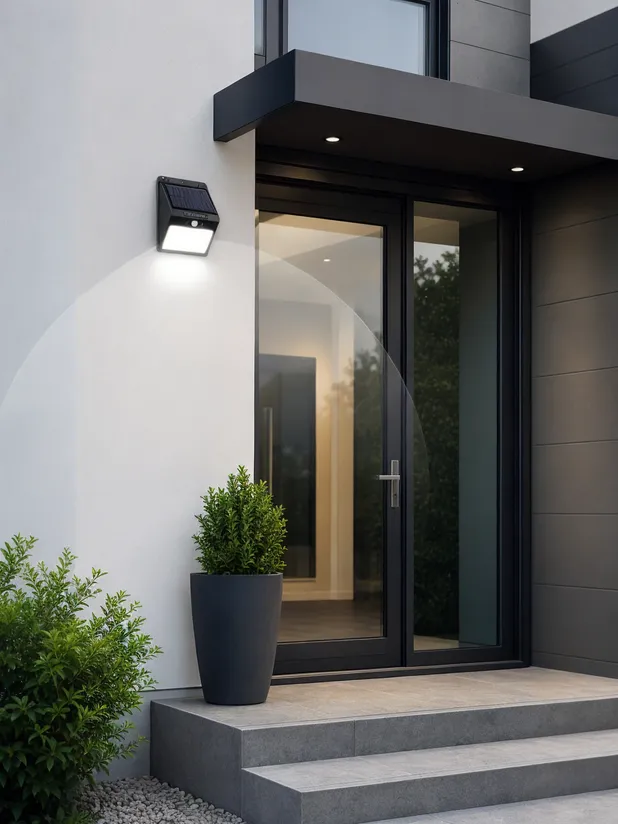
PIR Sensor Logic That Protects Battery Runtime and After-Sales Margin
The PIR sensor is the commercial core of this product, and it's worth understanding how the logic works before specifying it for a project or building it into a product line.
Standard Three-State Operating Mode
1. Standby
Fixture outputs at roughly 10–30% of rated lumen — enough to mark the location and provide minimal ambient light, but low enough to preserve battery charge through the night.
2. Triggered (Full Output)
When the PIR sensor detects movement within its detection zone, the controller switches the LED module to full output instantly.
3. Delay & Return
After the set delay period — typically 20 to 60 seconds, configurable on most models — the fixture returns to standby. This cycle repeats through the night without manual input.
Commercial Implication: Battery Sizing and Warranty Claims
The commercial implication is straightforward: a fixture running standby-trigger-standby cycles uses significantly less battery capacity per night than one running at full output continuously. That means a smaller battery can achieve the same number of operating nights, or the same battery can extend autonomy in low-irradiance seasons.
For buyers sourcing for markets with variable winter sun — Northern Europe, Canada, higher-altitude Middle East locations — this matters for warranty claim prevention. A product that dims out at 3 AM in January because the battery was undersized for continuous operation is a returns problem. A PIR-triggered product with a properly matched battery is not.
Common spec mistake: Buyers specify the highest lumen model assuming it will perform better, then get runtime complaints because the battery wasn't sized for the activation frequency at that site. The right spec is matched to the site's expected daily trigger count, not just the peak lumen number.
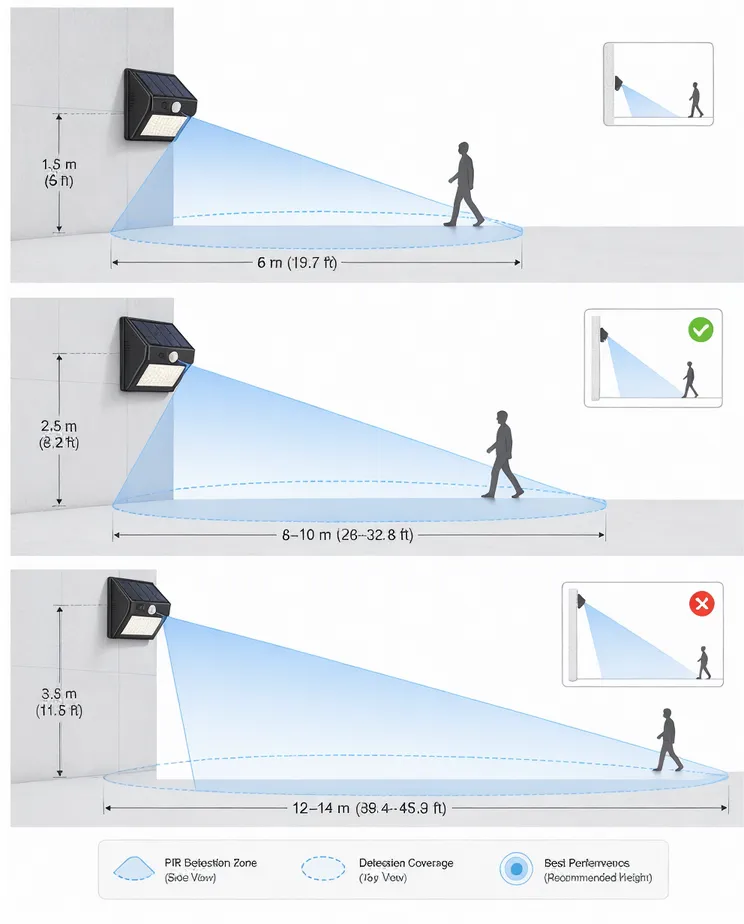
Detection Range and Coverage Parameters
The practical coverage zone depends on mounting height and the direction of expected movement — a fixture at 2.5 meters covering a pedestrian path behaves differently from the same fixture at 4 meters covering a vehicle entrance. We configure detection sensitivity and delay time based on the buyer's deployment scenario; these are not one-size parameters.
For buyers who need wider-area security coverage beyond what a wall-mounted fixture can provide, solar motion sensor flood lights cover larger zones from a single mounting point.
Technical Specification Range for Bulk RFQs
The table below reflects industry-typical ranges for this product type. Exact specifications depend on the selected model and configuration — send your target lumen output, region, mounting height, and daily activation pattern and we'll return a matched datasheet with the quotation.
| Parameter | Typical Range |
|---|---|
| LED Power | 5W – 30W |
| Lumen Output | 400 lm – 2,800 lm |
| Solar Panel | 5W – 20W monocrystalline |
| Battery Type | Lithium iron phosphate (LiFePO4) |
| Battery Capacity | 5,000 mAh – 20,000 mAh |
| PIR Detection Range | 5 m – 10 m (mounting height dependent) |
| PIR Detection Angle | 90° – 120° |
| Lighting Modes | Standby dim + full-brightness trigger; some models support full-night mode |
| Color Temperature (CCT) | 3000K / 4000K / 5000K / 6500K (model dependent) |
| Charging Time | 6 – 8 hours (full sun) |
| Working Time | 8 – 15 nights (region and activation frequency dependent) |
| IP Rating | IP65 / IP67 |
| Housing Material | Die-cast aluminum or ABS+PC |
| Mounting Height (recommended) | 2.0 m – 4.5 m |
| Operating Temperature | -20°C to +50°C |
| Warranty | 3 years |
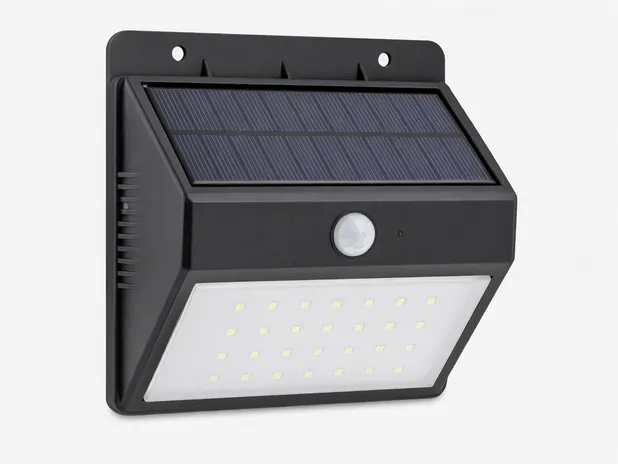
Specifications shown are industry-standard ranges for this product type. Actual specifications vary by model and configuration. Contact us for detailed datasheets and exact model parameters.
Where This SKU Makes Commercial Sense
Motion sensor solar wall lighting fits several distinct market segments, each with its own order pattern and commercial logic.
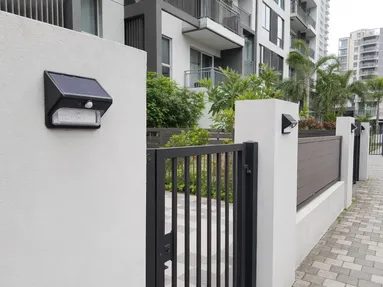
Residential Compound & Apartment Entrance Lighting
The highest-volume segment for this product type. Multi-unit residential developments — gated communities, apartment blocks, townhouse estates — need entrance and pathway lighting at every unit or building entry point. Wired installation across a 200-unit development means trenching, conduit, and electrician labor at every mounting point. Solar wall lights with PIR sensors eliminate that cost entirely.
Developers and property management contractors typically order 2–6 fixtures per building entry, which translates to 400–1,200 units for a mid-size residential project.
Reorder frequency is high because new phases and new developments follow the same spec once it's been validated.
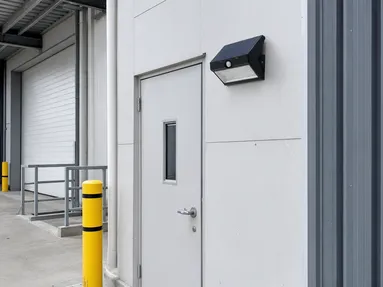
Warehouse & Logistics Facility Access Points
A strong segment for the 15W–30W range. Loading dock side doors, pedestrian access gates, and service corridors need reliable lighting when staff approach but don't need continuous full-output illumination.
The motion-trigger logic reduces energy draw and extends battery life in environments where the fixture may not receive full sun every day due to roof overhangs or adjacent structures.
For heavily shaded mounting positions, we'd redirect buyers to separate-panel models — but for standard warehouse perimeter walls with reasonable sun exposure, integrated-panel fixtures work well.
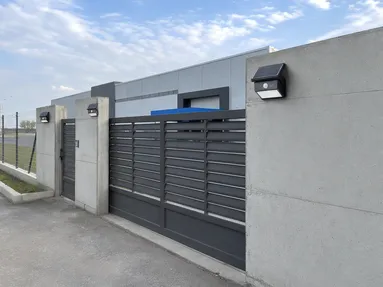
Perimeter Wall & Boundary Gate Lighting
A retrofit-friendly segment for commercial and industrial properties. Replacing wired perimeter lighting with solar wall lights eliminates the ongoing maintenance cost of underground cable runs and reduces the risk of cable theft — a real issue in parts of Africa, the Middle East, and Southeast Asia.
Buyers in these markets often order in quantities of 50–200 units per site, with repeat orders as facilities expand.
The PIR trigger is a selling point here because it signals movement at the perimeter, which is the security function the buyer actually needs.
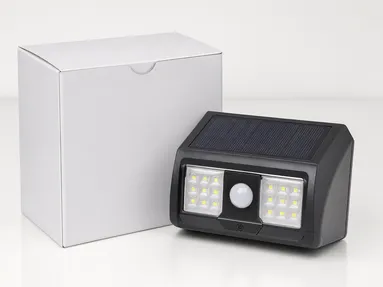
Retail & E-commerce Security Lighting SKUs
A different channel. Compact motion sensor solar wall lights in the 5W–15W range photograph well, have a clear feature story, and carry a price point that works for online retail.
Private-label packaging, custom color options, and retail-ready carton design make this a viable product for distributors building a branded solar security lighting line.
The PIR feature differentiates the SKU from basic solar wall lights on the same shelf.
Hospitality & Small Commercial Properties
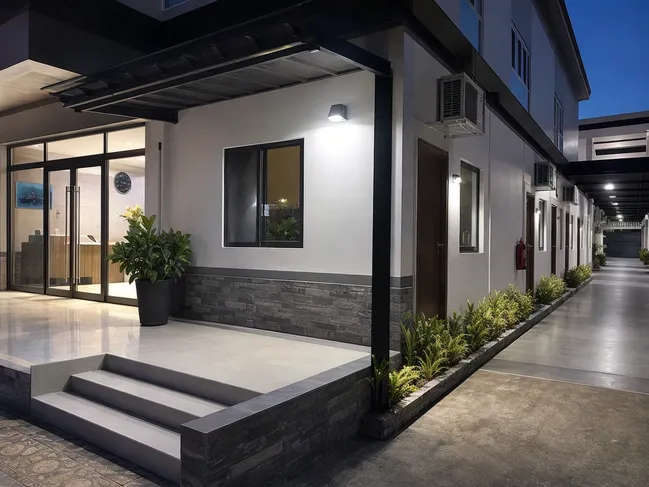
Hotels, guesthouses, restaurants, small office buildings — these properties need entrance, exterior corridor, and back-of-house lighting without the cost of a full electrical installation.
These buyers often purchase through local distributors or contractors in quantities of 10–50 units per property, making them a reliable mid-volume segment for regional distributors.
Mounting Height, Solar Exposure, and Sensor Coverage Decisions
Getting these three variables right before the order is placed prevents the majority of after-sales complaints on this product type. We include this guidance because mismatched installations generate returns, not because the product is difficult to deploy.
Solar Panel Exposure
Integrated-panel solar wall lights require the fixture location to receive direct sun for at least 4–6 hours per day. A wall that faces north in the northern hemisphere, sits under a roof overhang, or is shaded by adjacent buildings for most of the day will not charge the battery adequately.
If the mounting wall is shaded but a nearby surface receives full sun, solar wall lights with separate panels allow the panel to be positioned independently of the light fixture — that's the right product for shaded walls, not a higher-capacity battery in an integrated model.
Mounting Height
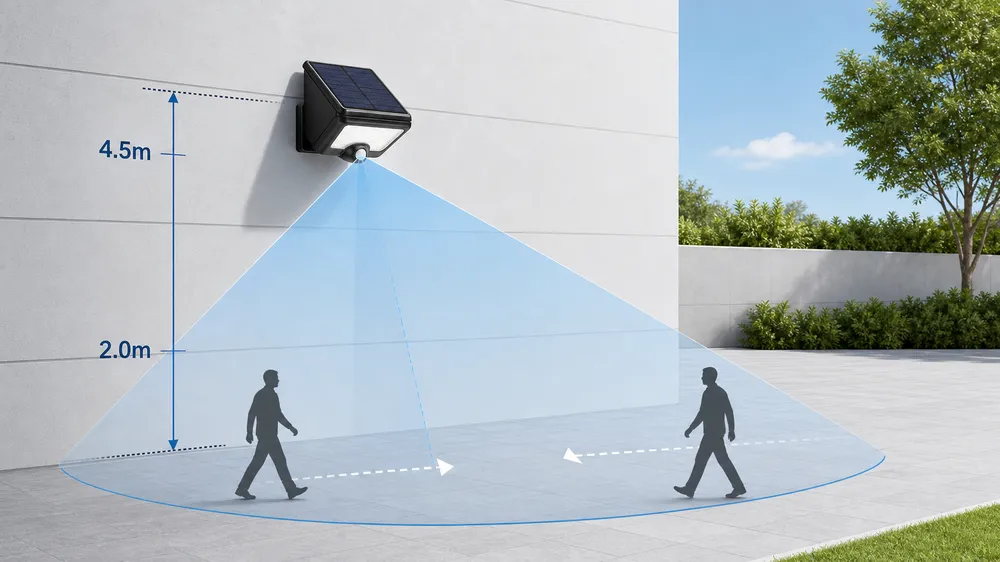
The recommended range for PIR solar wall lights is 2.0–4.5 meters. Mounting height affects both sensor coverage and light distribution.
Below 2 m: Detection zone too shallow for reliable pedestrian coverage; fixture vulnerable to tampering.
Above 4.5 m: PIR detection angle may miss low-profile movement; lumen output at ground level drops below useful illumination for most models in this range.
For vehicle entrance coverage at heights above 4 m, specify a model with a wider detection angle and higher lumen output — we can advise on the right configuration once we know the mounting height and expected traffic type.
Sensor Angle & Traffic Direction
PIR sensors detect movement crossing the detection beam, not movement directly toward the sensor. This is a geometry issue, not a product defect.
Fixture mounted on a wall parallel to a pedestrian path → triggers reliably.
Fixture mounted at the end of a path where people walk directly toward it → shorter effective detection distance.
Worth communicating to downstream installers to prevent misattributed complaints.
Coverage Area Too Large?
For projects where the coverage area is too large for wall-mounted fixtures — open yards, parking areas, large perimeter zones — the right product is a flood or security light, not a higher-power wall light.
Send a Site Photo for Configuration AdviceQuality Controls Behind Sensor, Battery, LED, and Waterproof Performance
The failure modes that generate returns on solar wall lights are predictable: battery capacity that degrades faster than expected, PIR sensors that trigger inconsistently or stop responding, LED modules that shift color temperature between batches, and waterproof housings that admit moisture after a season of thermal cycling. Our production system is built around those four failure points specifically.
Battery Matching
Cell-Level Tolerance Control
We test incoming battery cells for capacity and internal resistance, then match cells within tight tolerance bands before pack assembly.
Why it matters: A battery pack built from mismatched cells degrades unevenly — the weakest cell limits the pack's effective capacity within a few hundred cycles. Matched packs maintain consistent capacity through the warranty period, which is the difference between a 3-year warranty that holds and one that generates claims in year two.
PIR Sensor & Controller Testing
Dedicated Test Bench Verification
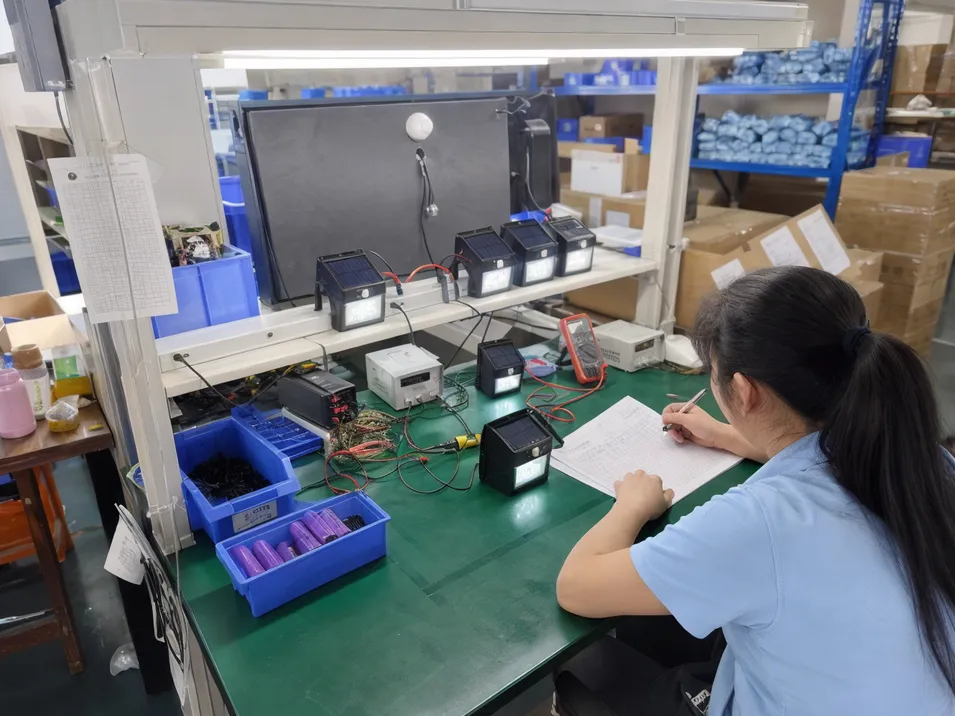
Each unit's detection distance, trigger response time, delay period, and standby/full-brightness switching are verified on dedicated test benches after assembly before the unit moves to final assembly.
Why it matters: We've seen batches from other suppliers where sensor sensitivity drifts between units because the controller calibration wasn't checked at the unit level — that produces inconsistent field performance that's hard to diagnose and expensive to resolve through returns.
LED Module Verification
Integrating Sphere Measurement
LED module lumen output and color temperature are confirmed at the assembly stage using integrating sphere measurement. We bin LED chips by CCT and lumen output before assembly and confirm the finished module against the spec before it goes into the housing.
Why it matters: Batch-to-batch CCT variation is one of the most common complaints in solar lighting — a distributor who reorders 500 units and gets a noticeably different color temperature than the first batch has a downstream customer problem.
IP65/IP67 Waterproof Structure
Compression-Fit Gasket Design
IP65/IP67 waterproof structure inspection is done on our own test equipment, not assumed from housing design. We use housing designs with compression-fit gaskets and stainless steel fasteners rather than adhesive-only sealing.
Why it matters: Thermal cycling and UV exposure affect seal integrity over time. Every unit passes waterproof inspection before packing.
Full Quality System
The full quality system — incoming inspection, in-process checkpoints, aging tests, and 100% pre-shipment inspection — is the same system described in our manufacturing capabilities overview. For this product type, the sensor and battery stages are the ones that matter most for after-sales performance.
- Incoming material inspection
- In-process checkpoints at sensor & battery stages
- Aging tests for battery cycle performance
- 100% pre-shipment inspection
OEM/ODM Options for Distributors and Project Orders
Standard catalog models are available from 100 units with no customization required. For buyers building a private-label solar security lighting line or specifying a custom configuration for a project, the following dimensions are available for OEM/ODM orders.
Lumen Output
Can be adjusted within the LED module's design range without changing the housing. If your target retail price point or project spec requires a specific lumen value, we adjust the driver current and confirm the output against the spec before production.
Color Temperature
Options cover warm white (3000K), neutral white (4000K), natural white (5000K), and daylight (6500K). Most security lighting applications land on 5000K or 6500K for maximum visibility; warm white is more common in hospitality and residential entrance applications where ambiance matters alongside security.
Sensor Mode Configuration
Standby output level, trigger duration, and detection sensitivity can be set at the controller level on supported models. If your market has a specific preference for how long the light stays at full brightness after a trigger, or what percentage of rated output the standby mode uses, we can configure that before production. This is worth specifying upfront because it affects battery sizing.
Battery & Solar Panel Sizing
Sized for your target region and autonomy requirement. A buyer sourcing for Northern Europe needs a different battery-to-panel ratio than one sourcing for the Middle East or Southeast Asia. We size the configuration based on the target latitude, expected daily sun hours, and the buyer's minimum autonomy requirement (typically 3–5 consecutive cloudy days for most markets).
Housing, Logo & Packaging
Standard housing colors are black and dark grey; custom RAL colors are available on runs that justify the powder line changeover. Logo marking can be applied to the housing or the packaging. Retail-ready carton design, multilingual instruction sheets, and accessory pack configuration are all available for buyers building a branded product line.
MOQ & Process
MOQ for standard models starts at 100 units. OEM/ODM projects with custom specifications are reviewed case by case — send your requirements and we'll confirm feasibility and MOQ before the engineering review. For our full OEM and ODM solar lighting services, the engineering team handles the spec review before any tooling or component procurement is committed.
Choosing the Right Solar Wall Light in the JXSOL Range
If you're evaluating multiple wall light types, this table maps each product to its primary use case so you can confirm the right fit before sending an RFQ.
| Product | Best For | Key Differentiator |
|---|---|---|
| Motion Sensor Solar Wall Lights (this page) | Security lighting, entrances, perimeter walls, demand-triggered illumination | PIR activation, standby/full-brightness modes, battery runtime efficiency |
| General Solar Wall Lights | Standard wall-mounted illumination, continuous night lighting | Simpler operation, full-night output, lower unit cost |
| Up Down Solar Wall Lights | Architectural facade lighting, decorative wall effect | Dual-direction light distribution, aesthetic appeal for hospitality and commercial facades |
| Solar Wall Lights With Separate Panel | Shaded wall locations where the fixture can't receive direct sun | Panel and fixture mounted independently, suitable for north-facing or obstructed walls |
| Waterproof Solar Wall Lights | High-rainfall environments, coastal installations, IP67-priority projects | Enhanced waterproof construction as the primary selection criterion |
| Solar Porch Lights | Porch, patio, and entrance retail channels, residential-focused distribution | Compact form factor, residential aesthetic, retail-friendly packaging |
If you're not certain which type fits your project or distribution channel, send us the application details and we'll recommend the right product — or a combination if the project covers multiple use cases.
Export Documentation, Packaging, and Reorder Support
JXSOL holds ISO 9001:2015, CE, RoHS, IP65/IP67 Ingress Protection, and IEC 62124 certifications. For buyers importing into regulated markets, we provide CE Declaration of Conformity, RoHS test reports, and IP test certificates with the order.
ISO 9001:2015
Quality Management
CE
European Conformity
RoHS
Hazardous Substances
IP65/IP67
Ingress Protection
IEC 62124
PV System Performance
IEC 62124 — What It Covers
IEC 62124 covers photovoltaic standalone system performance requirements — relevant for buyers whose projects or import markets require solar system performance documentation beyond basic CE marking. If your market requires specific test reports or compliance declarations beyond the standard set, confirm that at the RFQ stage and we'll include it in the quotation.
Full solar lighting certification documents are available for review.
Export Regions
We export to North America, Europe, the Middle East, Southeast Asia, and Africa. Each region has different documentation requirements, and we're familiar with what's needed for standard import clearance in each.
Standard Documents Provided
- CE Declaration of Conformity
- RoHS test reports
- IP test certificates
- IEC 62124 performance documentation (on request)
If your market requires specific test reports or compliance declarations beyond the standard set, confirm that at the RFQ stage and we'll include it in the quotation.
Export Packaging
Container Optimized
Export cartons sized for container loading efficiency in standard 20GP and 40HQ configurations.
Double-Wall Construction
Double-wall corrugated board with internal foam or molded pulp protection for the fixture and accessories.
Packing List Verified
Each carton checked against a packing list — fixture, mounting hardware, instruction sheet, and any accessories — before sealing.
Batch Traceability
Batch codes on carton labels allow traceability back to the production run if a field issue requires investigation.
Reorder Support — Scheduled Production Lines
For reorders, our 6 production lines and 1,200,000-unit annual capacity mean your repeat order runs on a scheduled line rather than waiting behind new customer onboarding. Lead times are confirmed at order placement.
If a production schedule change affects your delivery window, we communicate it before it becomes a logistics problem at your end.
6
Production Lines
1.2M
Annual Unit Capacity
FAQ for Motion Sensor Solar Wall Light Buyers
What PIR detection range is practical for solar wall lights?
For wall-mounted fixtures at 2.5–3.5 meters mounting height, a detection range of 5–8 meters is practical for pedestrian coverage.
Rated detection distances of 10–12 meters are achievable under ideal conditions:
- Clear line of sight
- Ambient temperature below 25°C
- Movement crossing the beam at a 90-degree angle
Real-world performance in warm climates or with oblique movement angles is typically 60–70% of the rated figure. Specify based on the realistic coverage need, not the maximum rated distance.
Practical note: For vehicle entrance coverage or wider zones, a flood-type security light will outperform a wall-mounted fixture at any detection range.
What mounting height works best for PIR solar wall lighting?
2.5–3.5 meters is the practical sweet spot for pedestrian detection and useful ground-level illumination.
At this height, the PIR detection zone covers a 4–6 meter radius in front of the fixture, and the lumen output reaches the ground at a useful level for most models in the 10W–20W range.
Vulnerable to tampering. Detection zone too shallow.
Optimal range for pedestrian detection and ground illumination.
Detection reliability drops. Ground-level lux may be insufficient for lower-power models.
Above 4 meters: Specify a higher-lumen model and confirm the detection angle covers the intended zone. Lower-power models (10W–15W) may not deliver sufficient lux at ground level from this height.
How do I choose battery capacity for a solar motion sensor wall light?
Start with the target region's average daily sun hours in the worst month (typically December for northern hemisphere markets, June for southern hemisphere). Then estimate the expected daily activation count — a busy entrance might trigger 50–100 times per night; a remote perimeter wall might trigger 5–10 times.
Multiply the full-brightness wattage by the trigger duration and count, add the standby wattage for the remaining hours, and that gives you the daily energy draw. The battery capacity should cover 3–5 days of that draw without recharging to handle consecutive cloudy days.
We do this calculation for buyers who send us their region and deployment scenario — it takes five minutes and prevents the most common runtime complaint.
Are IP65 motion sensor solar wall lights sufficient for outdoor projects?
IP65 is adequate for most outdoor wall-mounting applications — it covers dust ingress protection and water jet resistance from any direction. IP67 adds submersion resistance to 1 meter for 30 minutes, which is relevant for fixtures in flood-prone areas, ground-level installations, or locations where pressure washing is part of routine maintenance.
For standard wall-mounted security lighting at 2–4 meters height, IP65 is the practical minimum and IP67 is the conservative choice for coastal or high-rainfall markets.
- Dust-tight enclosure
- Water jet resistance (all directions)
- Wall-mount at 2–4 m height
- Practical minimum for outdoor use
- All IP65 protections included
- Submersion to 1 m for 30 min
- Flood-prone / ground-level sites
- Pressure-wash maintenance areas
Both ratings are available across our motion sensor solar wall light range. Specify your deployment environment and we can recommend the appropriate ingress protection level for your order.
Should I choose integrated-panel or separate-panel solar wall lighting?
Integrated-panel models are simpler to install and stock — one SKU, one mounting point, no cable between panel and fixture. They work well when the wall receives at least 4–6 hours of direct sun per day.
If the mounting wall is shaded by a roof overhang, adjacent building, or dense vegetation for a significant part of the day, the battery will undercharge and runtime will be shorter than specified. In that case, solar wall lights with separate panels allow the panel to be positioned on a sunny surface while the fixture mounts on the shaded wall.
The separate-panel option adds installation complexity but solves the shading problem definitively. When in doubt, ask the buyer or installer to check the wall's sun exposure at the worst time of year before specifying.
What MOQ does JXSOL support for standard motion sensor solar wall lights?
Standard catalog models start at 100 units per model. This is low enough to test a new SKU with your customers or validate a project specification before committing to a larger program.
OEM/ODM orders with custom specifications — lumen output, CCT, sensor mode, housing color, private-label packaging — are reviewed case by case, and MOQ depends on the scope of customization. Send your requirements and we'll confirm the minimum and lead time before the engineering review.
Have a technical question not covered here?
Send your technical questions alongside your RFQ and our engineering team will respond within one business day.
Request a Factory Quote for Motion Sensor Solar Wall Lights
Send us the details below and we'll return a model recommendation, datasheet, packaging options, and quotation — typically within 24 hours.
Information to Include
-
Order Quantity
Units per model or total program volume
-
Target Market / Destination Country
Affects battery sizing, documentation, and compliance requirements
-
Lumen Range or Wattage
Or describe the application and we'll recommend
-
Lighting Mode Preference
Standby + trigger, full-night, or configurable
-
Battery Autonomy Requirement
Minimum consecutive cloudy days
-
Housing Color
Standard black or dark grey, or custom RAL
-
Packaging Needs
Standard export carton, retail-ready, or private-label
OEM/ODM Inquiries
For custom branding and product development projects, please also include:
- Your logo files (vector preferred)
- Target retail price point
- Any specific sensor or controller requirements