

Up Down Solar Wall Lights Direct From Factory
Dual-beam solar wall fixtures for decorative facade, villa, and hospitality programs — no grid wiring required.
Upward and downward illumination from a single wall-mounted solar unit. IP65/IP67 construction, CE and RoHS certified, 3-year warranty. Factory-direct from JXSOL.
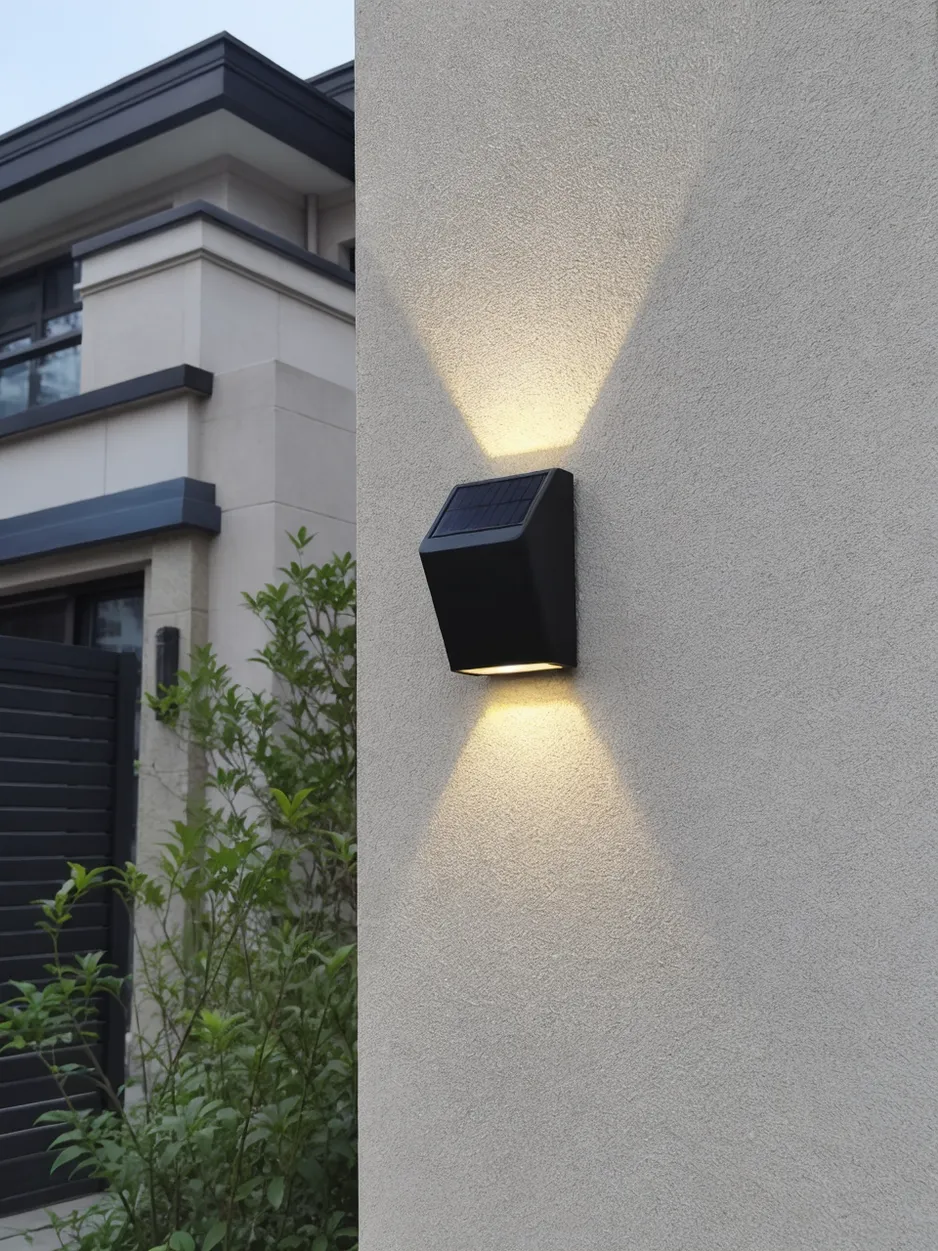
Up Down Solar Wall Lights for Higher-Margin Facade Programs
Up down solar wall lights are wall-mounted solar fixtures that cast light simultaneously upward and downward from a single housing, creating a dual-beam wall wash effect without any grid connection or trenching. Within the solar wall lighting range, this is the decorative and architectural SKU — not the security perimeter model, not the entry-level porch light, but the fixture that earns its place in hotel exteriors, villa developments, and commercial facade upgrade programs where the beam pattern itself is part of the product's value.
The commercial logic is straightforward: buyers selling into hospitality, premium residential, and facade renovation channels can position up down solar wall lighting at a higher price point than a standard downward-only wall light because the visual effect reads as architectural rather than utilitarian. The solar installation advantage — no electrician, no conduit, no grid connection — reduces project cost and opens up walls that would otherwise require expensive wiring work. That combination of higher perceived value and lower installation cost is what makes this SKU worth stocking for the right channels.
Request a Quote for Up Down Solar Wall LightsHigher Price Point
Dual-beam visual effect reads as architectural, not utilitarian — supports premium positioning in hospitality and villa channels.
Lower Install Cost
No electrician, no conduit, no grid connection. Opens up walls that would otherwise require expensive wiring work.
Facade-Ready
Designed for hotel exteriors, villa developments, and commercial facade upgrade programs where beam pattern is part of the value.
Dual-Beam Optics That Sell as Architectural Lighting
The defining feature of up down solar wall lighting is the beam split: one optical path directs light upward along the wall surface, the other directs it downward. The result is a fixture that defines wall height, creates visual depth on a facade, and draws attention to architectural features — columns, entrance gates, garden walls, perimeter boundaries — in a way that a single-direction fixture doesn't.
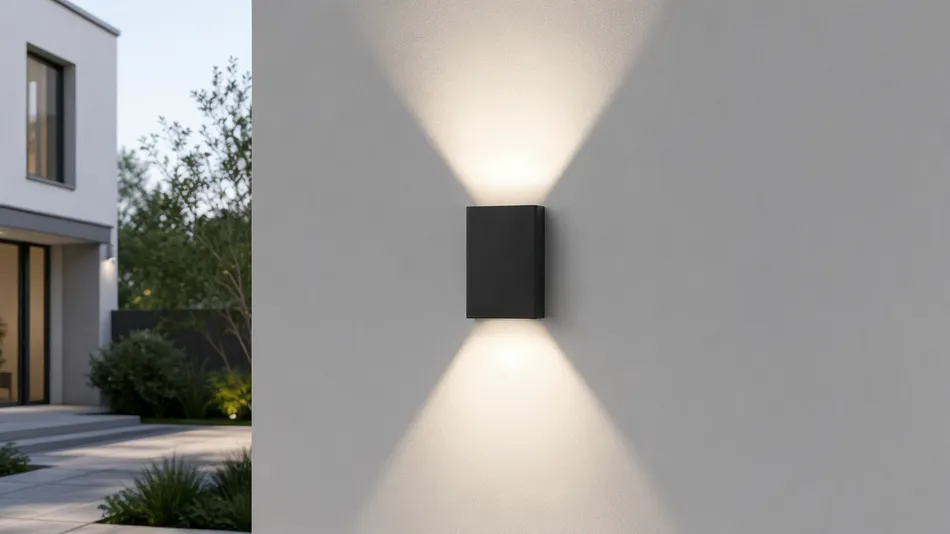
Lens Configurations
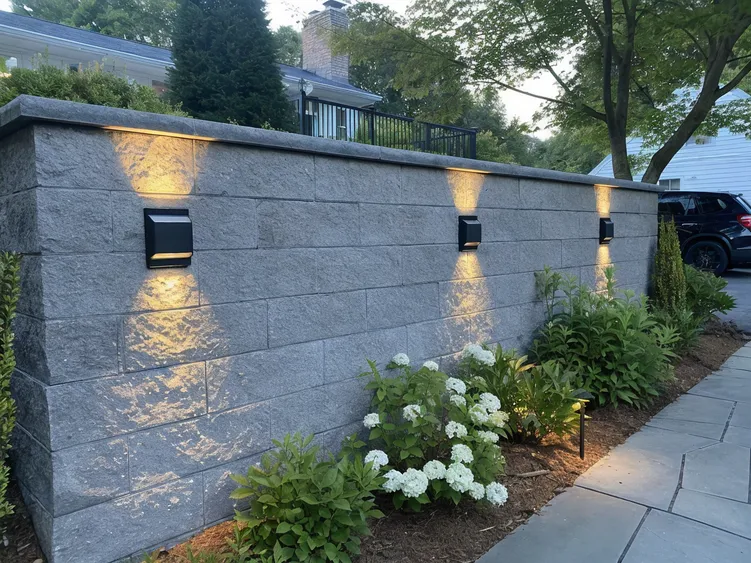
We run two lens configurations on this product. The symmetrical beam — equal spread upward and downward — suits clean rendered or painted walls where the buyer wants a balanced, formal appearance. The asymmetric option, with a wider downward spread and a tighter upward wash, suits textured stone or brick walls where the upward beam is meant to graze the surface and show the texture rather than flood it.
Beam angle is configurable within the tooling limits of the lens assembly; we confirm the achievable range during the engineering review for OEM orders.
Color Temperature Selection for Facade Applications
Color temperature matters more in this product category than in security lighting. The right CCT choice determines whether the fixture reads as intentional, designed lighting or as functional illumination.
Warm White
The right choice for hospitality and premium residential programs. Reads as intentional, designed lighting. Photographs well for property marketing materials.
Neutral White
Works for commercial exteriors where the buyer's end customer wants a cleaner, more contemporary appearance.
Daylight
Available but less common in decorative facade applications. Tends to flatten wall texture rather than enhance it.
This product is not a high-output security or flood fixture.
The lumen range is calibrated for decorative wall wash, not perimeter illumination. Buyers who need maximum brightness for security or safety applications should look at the motion sensor solar wall lights or flood lighting range. The up-down SKU earns its margin in channels where appearance and architectural effect are the primary purchase criteria.
Send us your wall height, fixture spacing, and target beam effect — we'll confirm the right lens configuration and CCT for your project.
Specification Sheet Buyers Can Put Into a Quote File
These are industry-typical values for this product configuration. Exact specifications vary by model tier and customization scope. Request a confirmed datasheet before finalizing procurement quantities.
| Parameter | Typical Specification |
|---|---|
| Housing Material | Die-cast aluminum (standard tier) / ABS+PC (economy tier) |
| Solar Panel Type | Monocrystalline silicon, integrated on housing top |
| Solar Panel Wattage | 3W–8W (typical range; varies by battery and runtime target) |
| Battery Type | LiFePO4 or lithium-ion, matched by capacity and internal resistance |
| Battery Capacity | 1,500–4,000 mAh (varies by model and target autonomy) |
| LED Lumen Output | 200–800 lm (decorative wall wash range) |
| Color Temperature | 3000K / 4000K / 6000K–6500K |
| Beam Direction | Upward + downward dual output |
| Beam Angle | Configurable within lens tooling limits (typically 60°–120° per direction) |
| IP Rating | IP65 standard; IP67 available on request |
| Lighting Mode | Dusk-to-dawn constant; timer mode; optional dim-to-bright with motion trigger |
| Operating Temperature | -20°C to +50°C |
| Charging Time | 6–8 hours full sun (typical) |
| Autonomy | 2–4 consecutive cloudy days (varies by battery capacity and mode) |
| Mounting | Wall surface bracket, hardware included |
| Certifications | CE, RoHS, IP65/IP67, ISO 9001:2015, IEC 62124 |
| Warranty | 3 years |
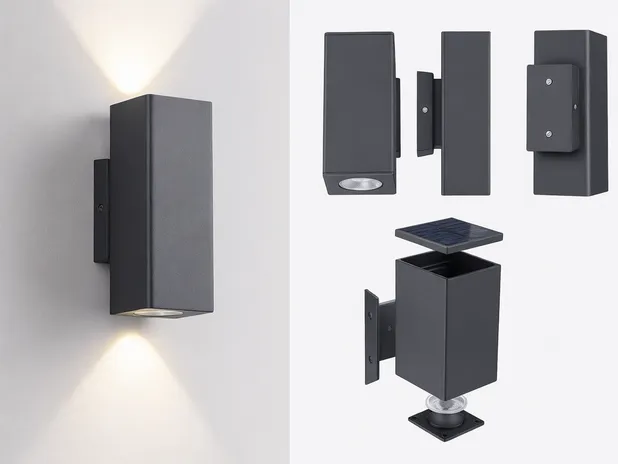
Key Procurement Specs
-
IP65 / IP67
Standard and upgraded ingress protection
-
2–4 Day Autonomy
Continuous operation through cloudy periods
-
200–800 lm
Decorative wall wash output range
-
CE, RoHS, IEC 62124
Export-ready certification package
Specifications shown are industry-standard values for this product type. Actual specifications depend on model configuration and customization scope. Contact us for a confirmed datasheet before procurement.
Certification Documentation Available With Order
CE Declaration of Conformity, RoHS test reports, and IP test certificates ship with every order. See our certifications and quality standards for the full documentation list.
Application Segments Where the Up-Down SKU Earns Its Place
Each segment below represents a market your buyers can sell into profitably, not a description of where the product looks nice. The commercial logic — order pattern, margin position, and reorder potential — is what makes a segment worth targeting.
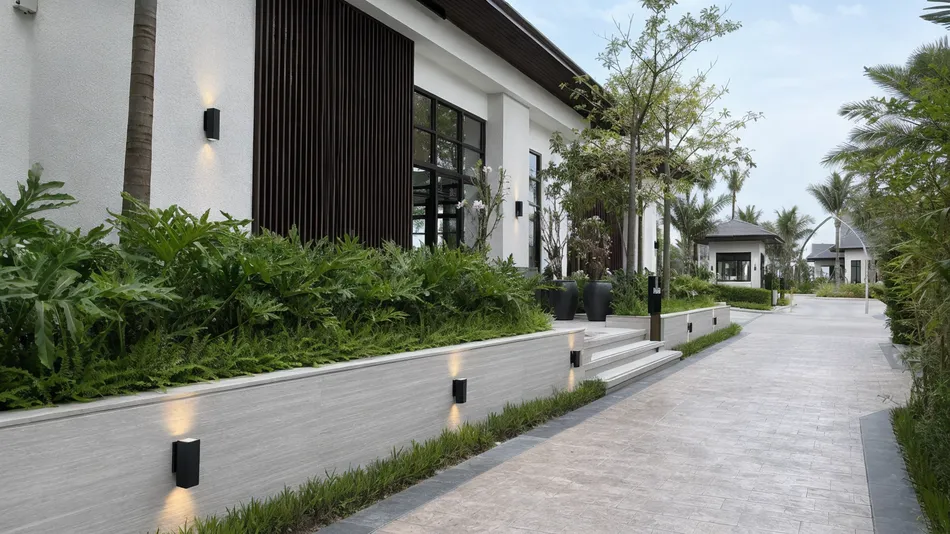
Hotels, Resorts, and Hospitality Exteriors
Hotel and resort procurement teams specify exterior wall lighting as part of facade and landscape packages, typically on a project-by-project basis with quantities ranging from 50 to 500 units per property.
The up-down configuration is the right fit here because hospitality buyers are specifying for visual effect and brand impression, not just functional illumination. Solar installation eliminates the need for grid wiring on garden walls, perimeter features, and pathway-adjacent walls — which reduces project cost and makes the fixture viable on walls that would otherwise require expensive electrical work.
Margin Position
Margin is better in this segment than in commodity security lighting because the buyer's end customer is evaluating appearance, not just price per lumen.
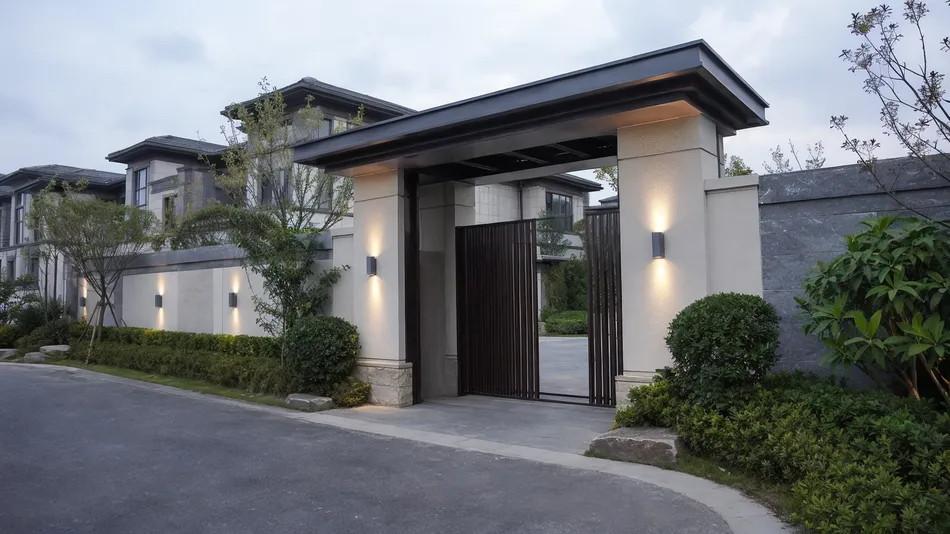
Villa and Premium Residential Developments
Developers building villa communities, gated residential estates, and premium apartment complexes use up down solar wall lighting on entrance gates, garden walls, perimeter boundaries, and building facades.
Order patterns follow construction phases — a 200-unit initial order for a single development, followed by repeat orders as additional phases complete. The decorative beam effect supports the developer's marketing materials and show-home presentation, which makes the fixture a line item that's easy to justify in the project budget.
Color Consistency at Scale
Consistent appearance across a large installation is critical here; we address this through LED module binning and CCT confirmation at the assembly stage so a 300-unit order doesn't show visible color variation across the facade.
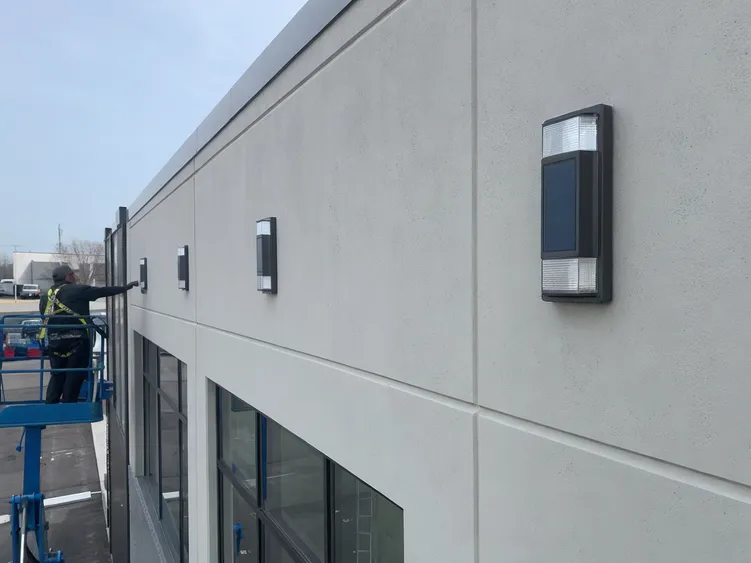
Commercial Facade Upgrades and Retrofit Projects
Commercial property owners and facility managers upgrading building exteriors face a common constraint: adding new lighting to an existing facade means either running new conduit or accepting a wireless solar solution. Up down solar wall lighting solves the retrofit problem cleanly — no trenching, no electrician coordination, no disruption to the building's existing electrical system.
Contractors working on facade renovation programs can include this fixture as a value-add line item that improves the building's appearance without adding significant installation complexity.
Typical Order Volume
50–200 units per project, with repeat orders as the contractor builds a portfolio of facade upgrade clients.
Landscape Contractors and Garden Wall Programs
Landscape contractors building outdoor packages for residential and commercial clients use up down solar wall lighting on garden walls, retaining walls, and feature walls as part of a broader landscape lighting specification. The fixture adds visible upgrade value to a landscape package — it's a line item the contractor can mark up and the client can see immediately.
Solar installation means the contractor doesn't need to coordinate with an electrician, which simplifies project scheduling and reduces the number of subcontractors on site.
Repeat Order Driver
Contractors who establish a preferred supplier relationship for this SKU can build a consistent product into their standard landscape package, which supports repeat orders as they take on new projects.
Property Management and Gated Communities
Property management companies maintaining gated communities, business parks, and multi-building residential complexes need consistent facade and entrance lighting across multiple buildings. The up-down configuration provides a uniform appearance across a property without requiring grid wiring at every installation point.
Order patterns in this segment are typically annual or semi-annual maintenance and expansion orders — a property manager who has standardized on a specific fixture will reorder the same model as the property grows or as fixtures reach end of life. Consistent batch appearance across reorders is the key supply chain requirement; we maintain production records by batch to support traceability and spec consistency across repeat orders.
Batch Traceability for Multi-Phase Projects
We maintain production records by batch so that fixtures ordered in Year 3 of a phased development match the color temperature, finish, and beam geometry of fixtures installed in Year 1. This eliminates the visual inconsistency that erodes property value in managed communities.
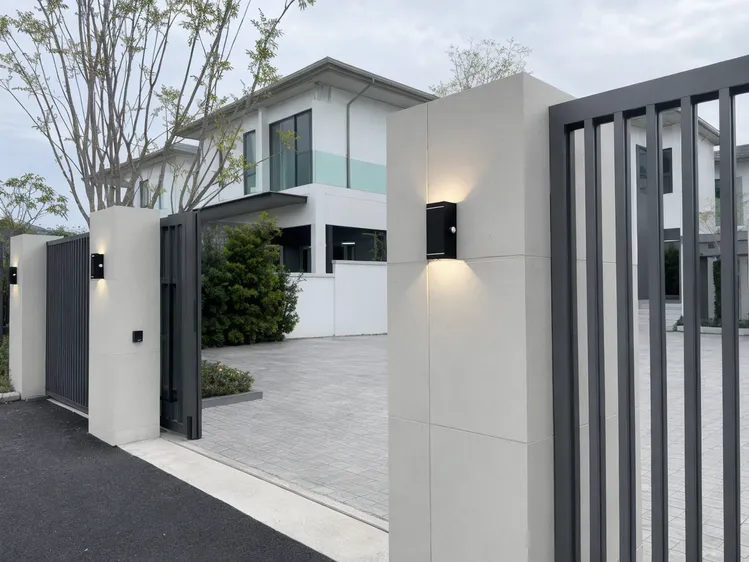
Installation Variables That Decide Whether the Beam Looks Right
The beam effect on an up-down solar wall light depends on more than the fixture spec. Wall conditions, mounting height, and sun exposure all affect whether the installation performs as expected — and getting these wrong is the most common source of buyer complaints in this product category.
Solar Panel Exposure — The Non-Negotiable Constraint
The integrated monocrystalline panel on this fixture needs direct sunlight to charge reliably. A wall that receives less than 4–5 hours of direct sun per day — north-facing walls, walls shaded by adjacent buildings, walls under overhangs or tree canopy — will undercharge the battery and generate short-runtime complaints.
If your buyers are working on installations where the wall sun exposure is uncertain, route them to separate-panel solar wall lights for shaded walls, where the panel can be positioned independently from the fixture.
We've seen buyers specify integrated-panel models on shaded walls and then spend months managing warranty claims that were entirely avoidable.
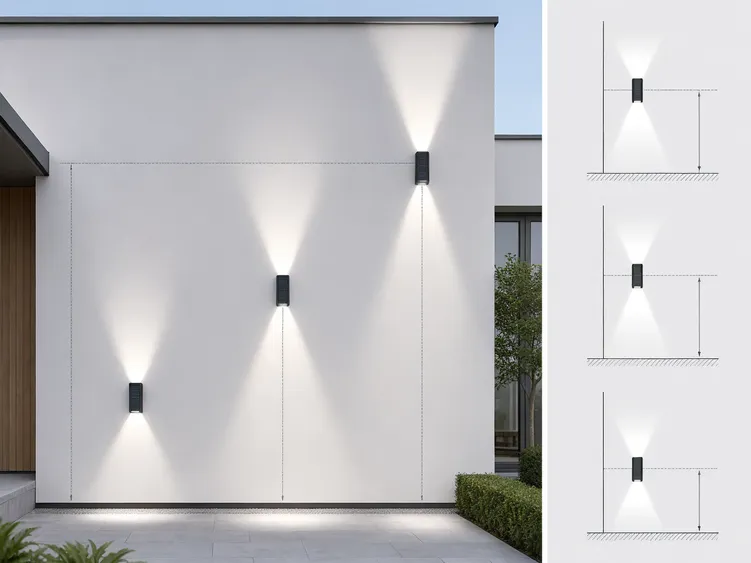
Mounting Height Changes Beam Spread and Visual Balance
At 2.5–3 meters, the upward beam reaches the roofline or wall top cleanly and the downward beam covers the ground zone at the fixture base.
- Lower mounting heights: The upward beam may not reach the wall top, which can look unfinished on tall facades.
- Higher mounting heights: The downward beam spread widens and the ground illumination becomes more diffuse.
Confirm mounting height against wall height and target beam effect before finalizing the fixture spec — a lens angle that looks right at 2.5 m may not work at 4 m.
Wall Texture Affects Beam Visibility
Smooth rendered or painted walls show the beam pattern cleanly and work well with the symmetrical lens configuration.
Rough stone, brick, or textured cladding benefits from a grazing beam angle that highlights the surface texture — this typically means a tighter upward beam and a wider downward spread.
If your buyers are specifying for textured walls, confirm the lens configuration during the order review.
Fixture Spacing Should Be Calculated, Not Guessed
The beam spread from a single fixture covers a defined wall area; spacing fixtures too far apart creates dark zones between them, and spacing them too close wastes fixtures and budget.
The right spacing depends on beam angle, mounting height, and the minimum illuminance level the buyer's end customer expects.
For project buyers who need a spacing calculation, send us the wall dimensions, mounting height, and target lux level — we'll run the numbers.
Need a Configuration Check?
Send a wall photo or elevation drawing and we'll confirm the right lens angle, mounting height, and fixture spacing for your project before you commit to a specification.
Send Wall Photo for ReviewCustomization Options That Protect Your Channel Positioning
The up-down solar wall light is one of the more customizable SKUs in the solar wall lighting range because the buyers who stock it are typically building a differentiated product line, not sourcing a commodity. Here's what we can adjust and where the practical limits are.
Lumen Output
Adjustable within the LED module's design range — typically 200–800 lm — without changing the housing.
Higher lumen output requires a larger battery and panel to maintain the same autonomy, which affects unit cost. We confirm the achievable range and cost impact during the engineering review.
Color Temperature
Standard options: 3000K warm white, 4000K neutral white, and 6000K–6500K daylight. Intermediate values available on request.
For hospitality or premium residential product lines, we recommend 3000K as the default — it generates the fewest complaints in decorative facade applications and the most positive end-customer feedback.
Housing Finish
Standard: black, white, and gray across most models.
Custom finish colors — RAL or Pantone matched — are available on runs that justify the powder line changeover. The changeover cost is real; below a certain quantity it doesn't make sense for either side. We'll tell you the threshold honestly during the review.
Beam Angle & Lens Configuration
Adjustable within existing tooling for standard programs.
New tooling for a completely custom beam pattern is possible for OEM programs with sufficient volume to amortize the tooling cost.
Battery & Panel Sizing
Adjusted for your target region and runtime expectations.
- Northern Europe / Canada: More battery capacity and panel wattage for shorter winter daylight hours.
- Middle East / Southeast Asia: LiFePO4 chemistry specified for high-temperature performance.
We calculate autonomy days based on the buyer's target latitude and seasonal irradiance data during the engineering review.
Logo, Label & Packaging
Standard for private-label programs: carton design, label printing, instruction sheet translation, and accessory pack configuration.
MOQ for standard catalog models: 100 units. OEM/ODM programs with custom specifications are reviewed separately — see our OEM/ODM solar lighting services for full program details.
One Limitation Worth Stating
This product is not the right SKU for buyers who need very high lumen output for security or safety applications. The housing and panel size are calibrated for decorative wall wash, not flood-level illumination.
If your market needs both decorative and high-output wall lighting, we recommend stocking this SKU alongside the motion sensor solar wall lights rather than trying to push the up-down model beyond its design range.
Ready to Customize?
Send your target retail price, finish color, and first order quantity to start the engineering review.
Production Controls for Appearance, Runtime, and Waterproof Reliability
Decorative wall lights are installed at eye level on visible facades. Appearance consistency — color uniformity across a batch, finish quality, lens clarity — matters more here than in a security fixture mounted at 5 meters. We run specific controls on this product that go beyond the standard solar lighting inspection protocol.
LED Module Binning & CCT Confirmation
Happens at the assembly stage, not just at final inspection. LED chips from different production lots can have different lumen output and color temperature even at the same wattage.
For a 300-unit facade installation, visible color variation between fixtures is a serious complaint — the kind that generates returns and damages the buyer's relationship with their end customer.
We bin LED modules by lumen output and CCT before assembly and confirm the values against the order spec. A batch that ships from us will look consistent across the installation.
Battery Cell Matching
Runs before pack assembly on every order. Cells are matched by capacity and internal resistance; a pack assembled from mismatched cells degrades faster than a matched pack, and the degradation accelerates in high-temperature environments.
Every pack goes through a charge/discharge cycle test before it's installed in a fixture.
This is the step where lower-cost suppliers cut corners — it adds time and equipment cost, and the failure doesn't show up until the product is in the field, which is exactly when it's most expensive to fix.
Waterproof Structure Inspection
Covers the lens seal, the cable entry gland, the panel junction, and the housing back plate screw holes.
We test IP65/IP67 structure on our own inspection equipment — unit-level, not sample-level — before any fixture moves to final packing.
The entry points for water ingress on a wall-mounted solar fixture are predictable; we check all of them.
Lighting Mode & Controller Function Verification
Confirms that dusk-to-dawn switching, timer logic, and any motion trigger functions operate to spec before the unit is packed.
A fixture that ships with incorrect mode settings generates an immediate complaint from the end customer and a return request from the buyer.
Finish Consistency
Housing finish is checked visually and against a reference sample for each production run. Powder coat adhesion is tested at weld seams — the most common failure point for coating adhesion — before the housing moves to assembly.
We switched to a phosphate pre-treatment step on the housing surface before powder coating after seeing adhesion failures at weld seams on earlier production runs.
The pre-treatment adds a step, but the salt spray results improved significantly.
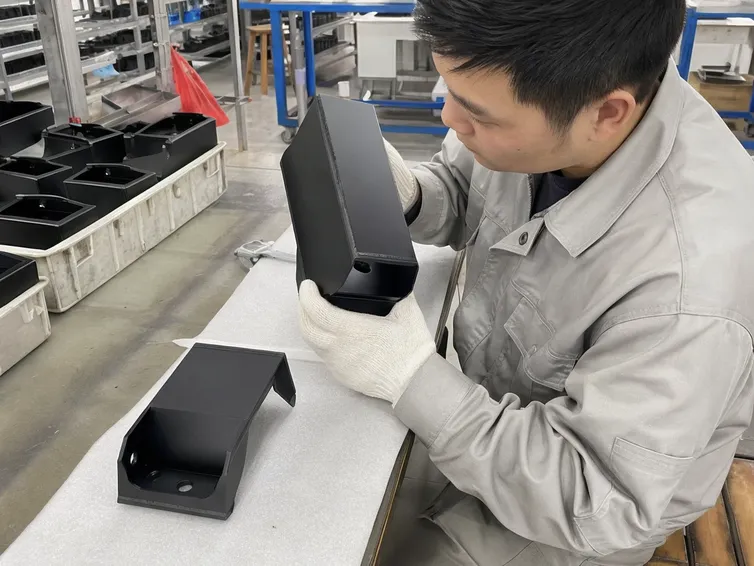
100% Pre-Shipment Inspection
Covers every unit, every carton, and every accessory pack before the container is sealed. For full factory and inspection system details, see the JXSOL factory and inspection system.
Compliance and Export Documentation for Regulated Markets
Up down solar wall lighting sold into regulated markets needs documentation that clears customs and satisfies project approval requirements. The certifications JXSOL holds for this product category are confirmed credentials — not claimed without documentation.
CE Marking
Covers electromagnetic compatibility and low-voltage directive requirements for EU market entry.
The CE Declaration of Conformity is available with the order. For buyers importing into the EU or markets that recognize CE marking, this is the primary import clearance document.
RoHS Compliance
Covers restricted substance requirements — lead, mercury, cadmium, hexavalent chromium, and brominated flame retardants — that affect import clearance in the EU and increasingly in other regulated markets.
Our RoHS compliance traces back to the component level: LED chips, battery cells, and electronic components are sourced from suppliers who provide material declarations, and we maintain records by batch.
IP65/IP67 Ingress Protection
Tested on our own waterproof inspection equipment, not assumed from housing design. IP test certificates are available with the order.
For project buyers who need to submit documentation for building permit or project approval, the IP certificate is typically the required document for outdoor fixture specifications.
IEC 62124
Covers the photovoltaic performance requirements for the solar charging system — relevant for buyers whose markets require solar product performance documentation.
ISO 9001:2015
Covers the quality management system for the full production process. For buyers whose procurement process requires supplier quality system certification, the ISO certificate is available on request.
Market-Specific Requirements
If your destination market has specific compliance requirements beyond these — local safety standards, additional test reports, or documentation in a specific format — confirm the requirement before production. We can advise on what's achievable and what requires third-party testing.
Need documentation for a specific destination market?
Send your destination market and required certificates — we'll confirm what's available before production.
Packaging, SKU Mixing, and Sample Orders for Distribution
Export cartons for up down solar wall lights are sized for standard 20GP and 40HQ container loading. Carton dimensions are consistent across production runs for the same model — a reorder ships in the same carton configuration as the original order, which matters for buyers who have optimized their container loading or warehouse racking around a specific carton size.
Complete Accessory Packs
Every carton ships with a complete accessory pack: mounting bracket, screws and anchors, instruction sheet, and any required documentation. Accessory packs are checked against a packing list before the carton is sealed.
Batch Traceability
Batch codes on carton labels allow traceability back to the production run, which simplifies warranty claim management if a field issue appears.
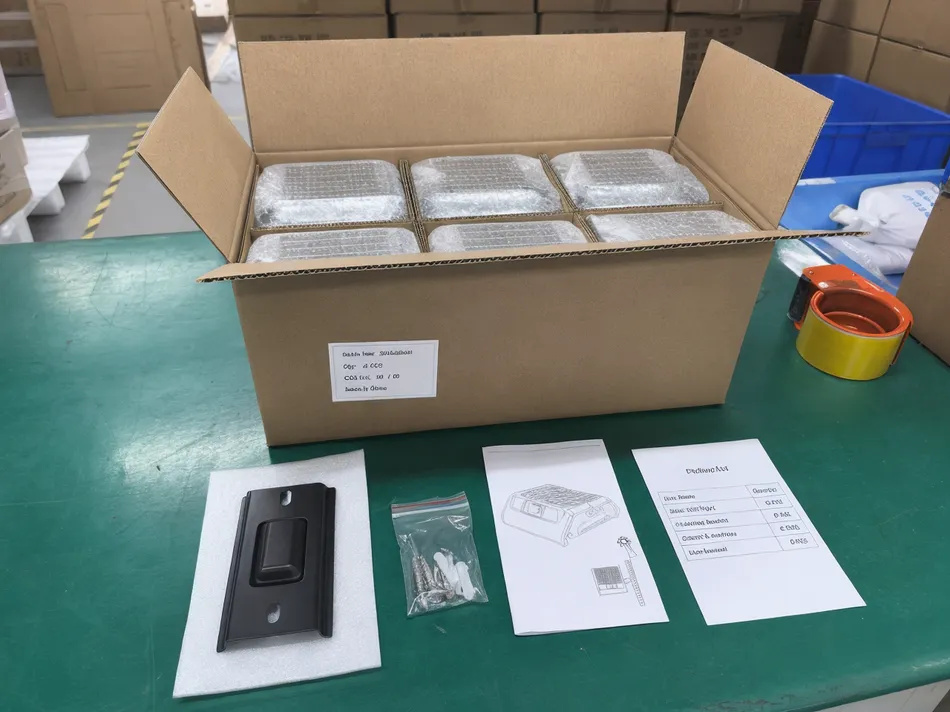
Private-Label Packaging
Available for distributors and e-commerce sellers who need branded cartons. We handle carton design, label printing, instruction sheet translation into your required language, and accessory pack configuration.
For buyers selling through Amazon FBA or similar fulfillment programs, we can configure cartons and labels to meet warehouse receiving requirements.
Mixed-SKU Orders
A distributor building a solar wall lighting catalog can combine up-down models with adjacent configurations in a single container order:
- Standard solar wall lights
- Motion sensor solar wall lights
- Waterproof solar wall lights
- Solar porch lights
Consistent documentation and a single point of contact for reorders across all configurations.
Sample Orders
The standard starting point for new buyers in this category. Most buyers request 2–4 units of the up-down model alongside 1–2 units of adjacent configurations to test with their own customers before committing to a stocking order.
We ship samples with full documentation — CE Declaration of Conformity, IP test certificate, and product datasheet — so you have everything needed for a market evaluation.
Choose This SKU or Another Solar Wall Light
Up down solar wall lights are the right choice for specific channels. If your market or project requirements point elsewhere, here's how the sibling products in the solar wall lighting range compare.
| Your Situation | Recommended Product |
|---|---|
| Decorative facade, villa, hotel, or premium residential exterior | Up down solar wall lights — this page |
| General outdoor wall demand, broad market fit, entry-level price point | Standard solar wall lights |
| Security, perimeter, or entrance applications where motion detection matters | Motion sensor solar wall lights |
| Shaded walls, north-facing walls, or walls under overhangs | Solar wall lights with separate panel |
| High-rainfall, coastal, or tropical markets requiring IP67 | Waterproof solar wall lights |
| Compact residential retail, home-improvement, or e-commerce programs | Solar porch lights |
Common Decision Points Worth Clarifying
Up-Down vs. Motion Sensor: Not Mutually Exclusive
The up-down model and the motion sensor model serve different channels. A distributor building a complete solar wall lighting line will typically stock both: the up-down for decorative and hospitality accounts, the motion sensor for security and perimeter accounts. The two SKUs don't compete with each other in the same channel.
Up-Down vs. Separate Panel: Installation Constraints
The up-down model and the separate-panel model address different installation constraints. If the buyer's wall gets adequate sun, the up-down integrated model is simpler and cleaner. If the wall is shaded, the separate-panel model is the only reliable option — no amount of battery capacity compensates for a panel that can't charge.
FAQ for Up Down Solar Wall Light Procurement
What are up down solar wall lights used for in B2B projects?
Up down solar wall lights are used in projects where the buyer needs a decorative facade effect without grid wiring — hotel and resort exteriors, villa and premium residential developments, commercial facade upgrades, garden wall installations, and gated community entrance features.
The dual-beam output creates an architectural wall wash effect that reads as designed lighting rather than functional security illumination.
Commercial value for B2B buyers: The ability to sell into higher-margin channels where the end customer is evaluating appearance and project value, not just lumen output per dollar.
What IP rating should up down solar wall lighting use outdoors?
IP65 is the standard specification for most outdoor wall applications — it covers dust ingress and water jets from any direction, which handles standard rain, cleaning, and typical outdoor exposure.
For walls with direct exposure to driving rain, coastal salt spray, or tropical monsoon conditions, specify IP67. The difference is submersion resistance: IP67 housing survives temporary water immersion, which matters when a wall fixture is exposed to pooling water or flooding at the base.
Dust-tight + water jets from any direction. Suitable for sheltered and semi-exposed wall positions in temperate climates.
Dust-tight + temporary immersion resistance. Required for coastal, tropical monsoon, and flood-prone installations.
Market guidance: If you're selling into Southeast Asia, West Africa, or coastal markets, IP67 is the safer default.
We offer both ratings on this product. Confirm your market's exposure conditions before finalizing the spec.
How much sunlight does an integrated up-down solar wall light need to charge reliably?
The integrated monocrystalline panel needs a minimum of 4–5 hours of direct sunlight per day for reliable charging. Walls that receive less than this — north-facing walls, walls shaded by adjacent buildings or trees, walls under overhangs — will undercharge the battery and generate short-runtime complaints.
If your buyers are working on installations where wall sun exposure is uncertain, the right product is solar wall lights with separate panel, where the panel can be positioned on a sun-exposed surface while the fixture stays on the shaded wall.
Don't try to compensate for a shaded wall by specifying a larger battery — the battery will still undercharge, just more slowly.
What color temperature works best for hotel or villa facade projects?
3000K warm white is the standard recommendation for hospitality and premium residential facade applications. It reads as intentional, designed lighting — the kind that photographs well for property marketing and creates a welcoming appearance at entrances and garden walls.
4000K neutral white works for contemporary commercial exteriors where the buyer's end customer wants a cleaner, more modern look.
6000K–6500K daylight is available but less common in decorative facade applications; it tends to flatten wall texture and create a harsher appearance that most hospitality buyers avoid.
If you're building a product line for the hospitality channel, 3000K is the right default CCT to stock.
Can the beam angle, finish color, and packaging be customized?
Yes, within the limits of the existing tooling and production minimums. Beam angle can be adjusted within the lens assembly's configurable range — we confirm the achievable angles during the engineering review.
Housing finish is available in standard black, white, and gray; custom RAL or Pantone colors are available on runs that justify the powder line changeover.
Private-label packaging — carton design, label printing, instruction sheet language, accessory pack configuration — is standard for OEM/ODM programs. Battery and panel sizing can be adjusted for your target region's irradiance profile.
For full OEM/ODM program details, see our OEM/ODM solar lighting services page.
What is the MOQ for standard JXSOL up down solar wall lights?
MOQ for standard catalog models is 100 units. That's low enough to validate a new SKU with your market before scaling to a stocking order.
For OEM/ODM programs with custom specifications — lumen output, CCT, housing color, private-label packaging, battery sizing — MOQ is confirmed during the engineering review based on the customization scope.
Mixed-SKU orders that combine up-down models with other solar wall light configurations are standard; the 100-unit MOQ applies per model.
Submit your requirements via the RFQ form and we'll confirm availability and lead time.
Quote Path for Samples, Standard SKUs, or OEM Programs
Three ways to move forward, depending on where you are in the sourcing process.
Sample Order for Market Testing
Send us your target market, preferred CCT (3000K or 4000K for most facade applications), and finish color. We'll confirm availability and ship samples with full documentation.
Included with samples:
- CE Declaration of Conformity
- IP test certificate
- Product datasheet
Most new buyers in this category start with 2–4 units to test with their own customers before committing to a stocking order.
Standard SKU Quotation
If you have a target market, required lumen level, preferred CCT, finish color, and order volume in mind, send those details and we'll return a configuration recommendation and pricing.
Useful inputs to include:
- Destination market
- Distribution channel (project, retail, e-commerce)
- Required certifications
- Wall sun exposure conditions
- Expected first order quantity
OEM/ODM Program
If you need private-label packaging, custom specifications, or a configuration that isn't in our standard catalog — the engineering review is the starting point.
Custom options include:
- Custom beam angle
- Specific battery sizing for your target latitude
- Branded cartons
Send your target retail price, required certifications, and expected first order quantity. Our engineering team will confirm what's achievable and outline the review process.
Contact Us Directly
Or use our RFQ form to submit your requirements. We respond with a configuration recommendation and confirmed pricing, not a generic catalog PDF.