Why Capacity and Paperwork Matter More Than Wattage in Indian Sourcing
Most sourcing problems in Indian solar street lighting don't start with the product — they start with the supplier model. A 40W all-in-one fixture from a marketplace aggregator and the same spec from a manufacturer with a documented production line are not the same purchase. The wattage is identical. The batch consistency, the certification trail, and the reorder reliability are not.
Indian project buyers — whether they're running a municipal tender, an EPC contract, or a distributor program — face a specific pressure: aggregators on IndiaMART and TradeIndia offer the lowest headline price, but they assemble orders from whoever has stock that week. Domestic brands with strong BIS positioning often have the compliance paperwork sorted, but their production capacity can create lead-time friction on large orders. Neither model is wrong for every situation. The question is which one fits your order size, your compliance requirements, and your reorder cadence.
This article maps the solar street light manufacturers india landscape across those dimensions — production scale, certification depth, MOQ, and OEM support — so you can shortlist on criteria that actually predict field performance, not just price per unit.
The Comparison Matrix Buyers Need Before They Shortlist a Supplier
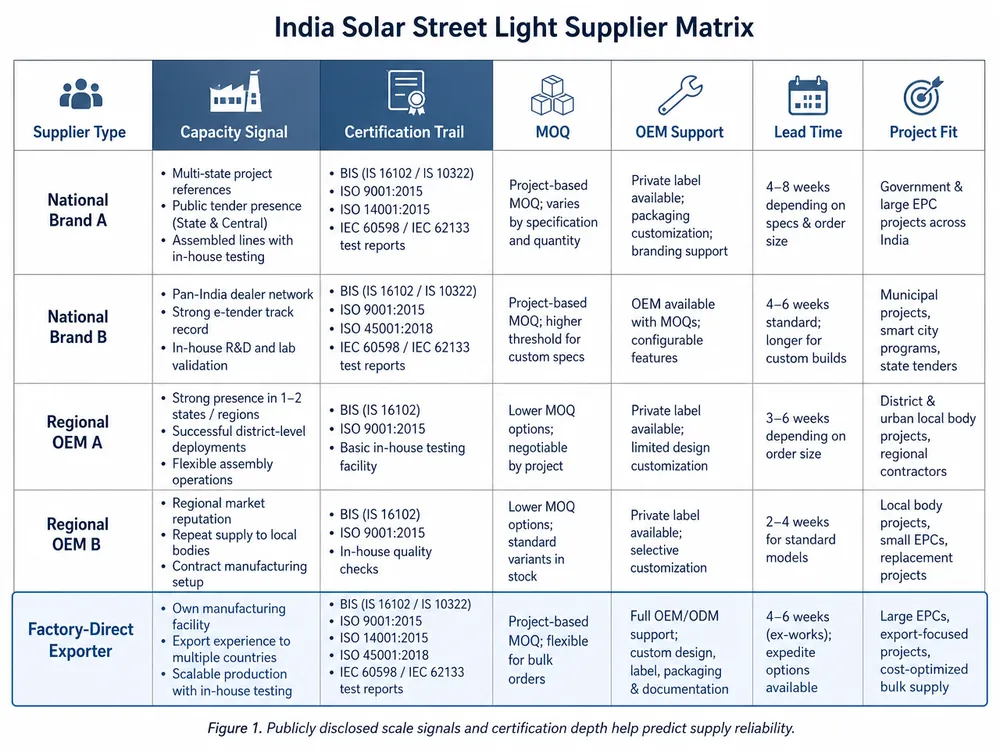
Before profiling individual companies, it helps to see the landscape in one view. The table below uses disclosed scale signals rather than invented capacity numbers — where a company hasn't published annual output, the column shows the scale indicator that is publicly available.
| Manufacturer | Scale Signal | Key Certifications | MOQ | OEM Support | Lead Time Signal |
|---|---|---|---|---|---|
| Waaree Energies | National solar manufacturer, broad product line | BIS, MNRE, ISO | Not published | Limited | Standard domestic |
| Servotech Power Systems | Listed company, integrated + 2-in-1 lines | IP66, ISO, CE | Not published | Limited | Standard domestic |
| Instapower | 2M+ lights supplied, 70 patents, 150 staff | ISO, CE, RoHS | Not published | Selective | Standard domestic |
| Triveni Solar | ISO 9001/14001, BIS, NSIC, GeM registered | BIS, ISO, NSIC | Not published | Available | Standard domestic |
| Fevino Industries | All-in-one + semi-integrated lines | ISO, CE, RoHS, ERDA, BIS | Not published | Available | Standard domestic |
| N.Light Solar | IP66, ISO 9001, MSME/NABL accreditation | IP66, ISO, NABL | Not published | Limited | Regional |
| Urja Saur Electronics | 28 units/day disclosed output | IP65, ISO | Low | Available | 7-day quoted |
| Sugam Energy | 50,000 SSL + 80,000 semi-integrated capacity | ISO, CE | 50–100 units | OEM focus | Standard |
| AD POWER | Integrated + semi-integrated, IP65/IP66, IK08 | IP65/IP66, IK08 | Not published | Available | Standard |
| Aura Energy | All-in-one + hybrid lines, global footprint | IP65, CE | Not published | Available | Standard |
| JXSOL (factory-direct) | 1,200,000 units/year, 6 lines, 12,000 m² | ISO 9001:2015, CE, RoHS, IP65/IP67, IEC 62124 | 100 units | Full OEM/ODM | Ex-factory quoted |
(Note: domestic supplier MOQ and lead time data is drawn from public disclosures only — contact each supplier directly for current project pricing.)

For all-in-one solar street light specifications and how to read the technical parameters in this table, that guide covers the fixture-level detail.
National-Scale Brands with the Deepest Public Compliance Trail
These four companies operate at national scale with documented compliance positioning. For government tenders where BIS registration or MNRE empanelment is a hard requirement, they are the natural shortlist.
Waaree Energies — waaree.com
Waaree is one of India's largest solar manufacturers, with a product line that extends from panels into all-in-one solar street lights. Their BIS and MNRE positioning makes them a default consideration for government-facing tenders. The trade-off is that their solar street light line sits alongside a much larger panel business — it's not their primary engineering focus, and buyers sourcing at volume sometimes find lead times less predictable than the brand scale suggests.
Servotech Power Systems — servotech.in
Servotech is a listed company with integrated and 2-in-1 solar street light lines rated at IP66 and above 105 lm/W. The listed-company structure means public financial disclosure, which matters for buyers who need supplier stability documentation for tender submissions. Their product range covers the mid-to-high efficiency band that municipal projects typically specify.
Instapower — instapower.com
Instapower's public profile shows over 2 million lights supplied across two manufacturing units, 150 personnel, and 70 patents. That installed-base number is the most useful signal here — it means field data exists across multiple project types and climate zones. For buyers who want a domestic supplier with a long track record rather than a newer entrant, Instapower's depth is worth the conversation.
Triveni Solar — trivenisolar.com
Triveni holds ISO 9001, ISO 14001, BIS, NSIC, and GeM registration — the GeM listing in particular is relevant for government procurement teams who need suppliers on the Government e-Marketplace. Their solar street light line covers standard municipal specifications. NSIC registration also opens access to certain government financing and procurement schemes that non-registered suppliers can't access.
Regional Manufacturers That Fit Smaller Tenders, OEM Runs, and Faster Replenishment
These six companies operate at regional or mid-scale, with profiles that suit different procurement needs: lower MOQ, OEM flexibility, faster local replenishment, or specific certification combinations.
Fevino Industries — fevino.com
Fevino runs both all-in-one and semi-integrated solar street light lines with a certification stack that includes ISO, CE, RoHS, ERDA testing, and BIS references. The ERDA (Electrical Research and Development Association) testing reference is worth noting — it's a credible Indian testing body that some state-level tenders accept as an alternative to full BIS certification. For buyers navigating state government projects where BIS is preferred but not always mandatory, Fevino's documentation trail covers more ground than most regional suppliers.
N.Light Solar — nlightsolar.com
N.Light holds IP66, ISO 9001, and MSME/NABL accreditation. The NABL accreditation signals that their testing lab meets national standards — relevant when buyers need test reports that hold up under tender scrutiny rather than self-declared specs. Regional supplier, so replenishment lead times for smaller orders tend to be faster than national brands.
Urja Saur Electronics — urjasaurelectronics.com
Urja Saur publishes a 28-unit daily output figure and quotes 7-day delivery on their product pages. That's a small-batch, fast-turnaround profile — useful for emergency replacement orders, pilot installations, or situations where you need product on-site before a larger factory order arrives. Don't use them for a 5,000-unit infrastructure program; do consider them when you need 50 units in a week.
Sugam Energy — sugamenergy.com
Sugam discloses 50,000 solar LED street light capacity and 80,000 semi-integrated capacity — one of the few Indian regional suppliers to publish actual output numbers. Their OEM focus is explicit on their site, which means they're set up for private-label runs rather than just selling their own brand. For Indian EPC firms building a branded solar lighting program without investing in their own manufacturing, Sugam's disclosed capacity and OEM orientation make them a credible conversation.
AD POWER — adpower.in
AD POWER covers integrated and semi-integrated solar street lights with IP65/IP66 and IK08 impact resistance ratings. The IK08 rating — mechanical impact protection — is relevant for installations in high-traffic or vandalism-prone areas where fixture durability matters beyond weatherproofing. Not every supplier tests to IK standards, so if your project spec includes impact resistance, AD POWER's documentation is worth requesting.
Aura Energy — auraenergy.com
Aura Energy runs all-in-one and hybrid solar street light lines with a global distribution footprint. Their hybrid line — combining solar with grid backup — addresses a real gap in Indian project specifications: sites where solar irradiance is insufficient for full autonomy but grid connection is available as a fallback. If your project includes locations with partial shading or inconsistent irradiance, a hybrid-capable supplier is worth including in your shortlist.
How to Read BIS, CE, IEC 62124, IP65, and IP66 Without Guessing
The certification question trips up more Indian project buyers than any other sourcing decision. Here's the practical breakdown.
BIS (Bureau of Indian Standards) registration under IS 16077 is required for solar street lights in most central government tenders and many state government programs. If your project is government-funded and the tender document specifies BIS, there is no substitute — CE alone will not satisfy the requirement. Check the tender document first, not the supplier's marketing page.
CE marking is a European conformity declaration, not an Indian government certification. It signals that the product meets EU safety and performance directives, which is useful evidence of engineering discipline, but it does not replace BIS for Indian government procurement. For private projects — EPC contracts, commercial developments, private infrastructure — CE is often sufficient and sometimes the only certification the project owner requires.
IEC 62124 is the international standard for standalone solar electric systems, covering performance testing under real-world conditions. It's the most technically rigorous of the three for solar-specific performance claims. Suppliers who hold IEC 62124 documentation have had their systems tested against actual charge/discharge cycles, not just component-level specs. For high-value infrastructure projects where system performance over a 5–7 year horizon matters, IEC 62124 test reports are worth requesting even when they're not mandatory.
IP65 vs IP66: IP65 means dust-tight with protection against water jets. IP66 adds protection against powerful water jets. For most Indian installations — including monsoon-exposed roadway fixtures — IP65 is the minimum acceptable spec. Coastal installations or fixtures in areas with high-pressure cleaning should specify IP66. (We've seen IP65-rated fixtures from suppliers who test the housing but not the cable entry points — always ask for the full test report, not just the rating label.)
For a full breakdown of certification requirements by project type, the solar street light certifications guide covers the documentation chain in detail.
Battery Autonomy for Monsoon, Coastal, and High-Irradiance Indian Sites
A solar street light that fails in year one almost always traces back to a battery autonomy spec that wasn't sized for the buyer's actual rainy season. I've seen this pattern across projects in Kerala, Maharashtra, and the Northeast — the fixture spec looks fine on paper, but the battery was sized for 2–3 autonomy days when the site gets 10–14 consecutive overcast days during peak monsoon.
The autonomy day calculation is straightforward once you know your site's worst-case consecutive cloudy days. Kerala and the Northeast need 5–7 autonomy days minimum. The Gangetic plains and Rajasthan can often work with 3–4 days because irradiance recovery is faster. Coastal Karnataka and Andhra Pradesh sit in the middle — 4–5 days is the safe spec.
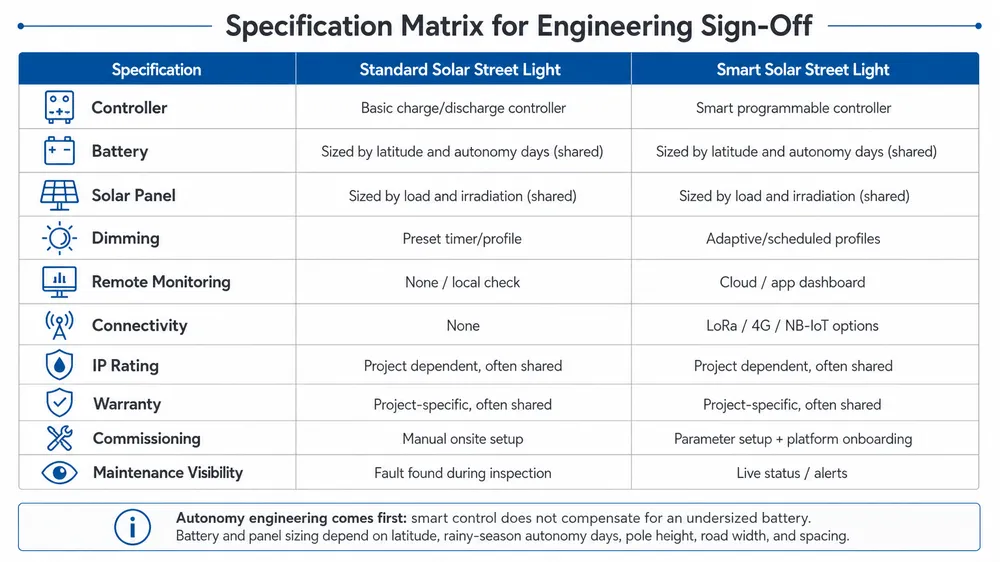
The second variable is the depth of discharge (DoD) limit on the battery. Lithium iron phosphate (LiFePO4) cells can safely discharge to 80–90% DoD, which means a smaller battery pack delivers more usable capacity than lead-acid at the same nominal rating. Most of the domestic suppliers in this list offer both chemistries — specify LiFePO4 if your project has a 5-year performance expectation, because lead-acid degradation in high-temperature Indian summers compresses the effective autonomy window within 18–24 months.
The third variable is the solar panel tilt and orientation. Fixed-tilt panels at the wrong angle for the installation latitude lose 10–15% of annual yield — which directly reduces the effective charging window and forces you to oversize the battery to compensate. For projects above 25°N latitude, a 15–20° tilt toward south is the standard recommendation. Below 15°N, near-flat mounting is often more efficient because the sun angle is high year-round.
For the full autonomy calculation methodology and climate-zone reference tables, battery autonomy days explained walks through the numbers.
When Factory-Direct China Beats Local Buying on Landed Cost and Batch Control
Local suppliers have real advantages: faster emergency replenishment, easier communication, no import logistics, and no currency exposure. For urgent small orders — 50 units to replace failed fixtures on a live road — a domestic supplier with stock is the right answer. Don't import for that.
The economics shift at repeat volume. At 500 units and above, the landed cost of a factory-direct order from a manufacturer like JXSOL — including sea freight, customs duty, and local delivery — typically comes in below the ex-works price from a domestic trading company, not just below the domestic retail price. The reason is structural: a trading company buying from a Chinese factory and reselling into India carries two margins. A direct factory relationship carries one.
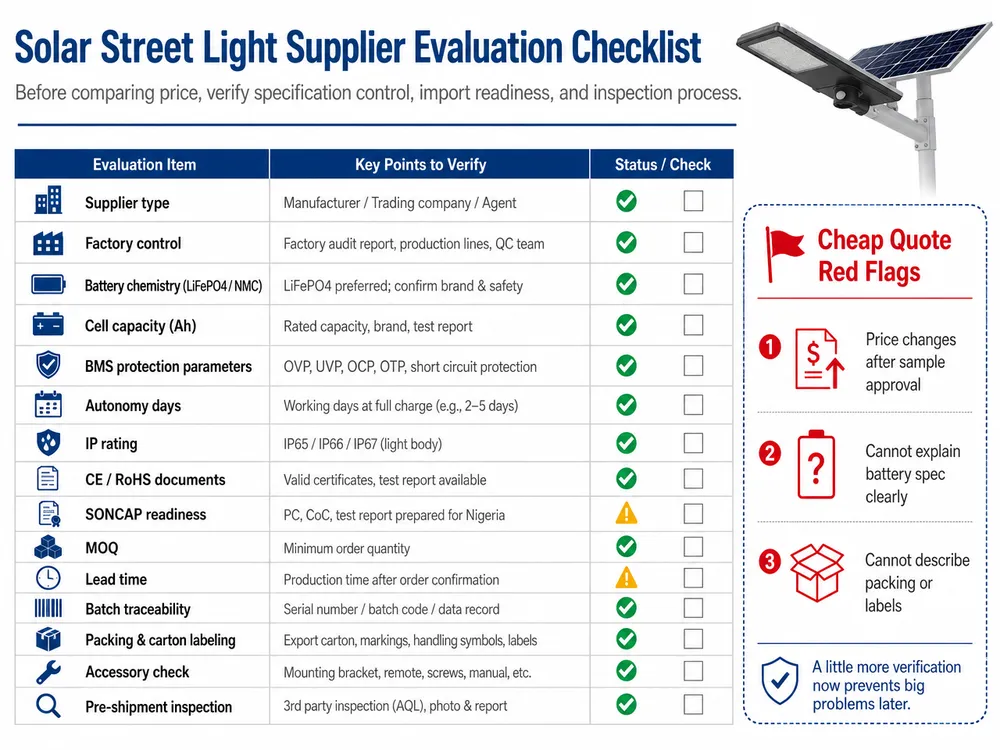
The quality control argument is separate from the cost argument, and it's often more important. We run 100% pre-shipment inspection on every order — every unit is tested for lumen output, battery charge/discharge performance, and IP integrity before it leaves our facility. The inspection report travels with the shipment. When a batch arrives at your warehouse, you have documentation for every unit, not a sample-based certificate that covers 5% of the order.
JXSOL's 1,200,000-unit annual capacity across 6 production lines means a 10,000-unit Indian infrastructure order is schedulable without displacing other accounts. Smaller domestic manufacturers running 50,000–80,000 units annually face a real capacity constraint when a large tender lands — your order either waits or gets split across production runs with different component batches. Batch consistency matters for large installations because lumen output variation between batches creates visible inconsistency on the road.
Our MOQ starts at 100 units for standard models, so Indian distributors can run a test SKU before committing to tender volumes. OEM and private-label support is available for EPC firms building a branded solar lighting program — we handle the engineering specification lock-in, the certification documentation, and the production scheduling. The Solar Street Light OEM Program covers the process in detail.
Certifications for Indian project use: CE, RoHS, IP65/IP67, and IEC 62124 are standard on our solar street light line. BIS registration is a separate process that we can support for buyers with ongoing Indian government tender programs — the timeline and documentation requirements depend on the specific IS standard and product category.
Which Sourcing Route Fits Your Order Size, Timeline, and Compliance Risk
The decision isn't local vs. import — it's which supplier model fits the specific order in front of you.
Urgent replacement orders under 100 units: domestic supplier with stock. Import lead time doesn't work here.
Government tenders requiring BIS: domestic BIS-registered suppliers are the path of least resistance. Waaree, Servotech, Triveni, and Fevino all carry BIS references. Verify the specific IS standard against your tender document before shortlisting.
Private EPC projects, commercial developments, or highway contracts where CE and IEC 62124 are sufficient: factory-direct import is competitive on both price and documentation quality. Request the full test report package, not just the certificate.
Distributor test orders before tender commitment: JXSOL's 100-unit MOQ is designed for this. Test the SKU with your own customers or on a pilot installation before you commit to the tender volume.
Repeat-volume programs above 500 units per order: run a landed-cost comparison that includes freight, duty, and inspection cost. The factory-direct economics are usually clear at this scale.
OEM or private-label programs: domestic OEM capacity is limited to a handful of suppliers. Factory-direct gives you full specification control, consistent batch documentation, and a single engineering contact for the life of the program.
Send your project type, required wattage and lumen output, target autonomy days, order volume, and any certification or OEM requirements to Request Quote — we'll respond with a configuration recommendation sized for your specific Indian climate zone and a factory price that lets you run the landed-cost comparison yourself.