Nigeria's Off-Grid Reality Changes the Supplier Filter
Grid unreliability, ambient temperatures that regularly exceed 35°C, a rainy season that can run five to six months in the south, and a port clearance process that punishes incomplete documentation — these four factors together mean that a solar street light quote that looks competitive on paper can become a warranty problem or a customs delay before the first unit is installed.
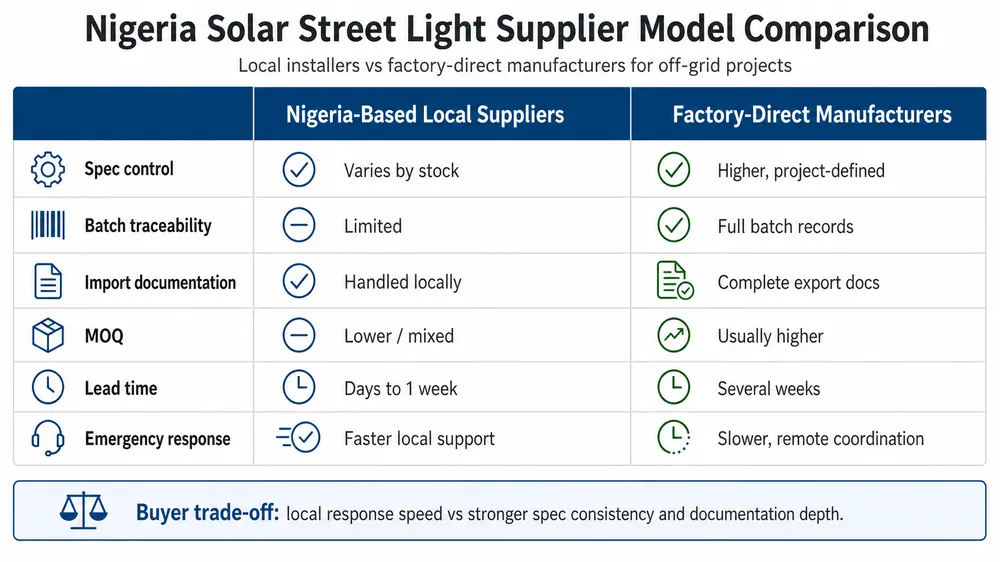
Local suppliers solve real problems. If you need 20 units for an emergency replacement on a municipal contract, a Lagos-based distributor who can deliver next week is the right call. If your project requires on-site installation, commissioning, and a local service contact, a Nigerian project installer is worth the premium. Speed, familiar communication, and local accountability are genuine advantages that factory-direct sourcing cannot replicate for urgent or installation-heavy work.
But when you are comparing quotes for a 500-unit distributor order, a tender batch, or a repeat container import, the filter changes. Battery chemistry, autonomy-day sizing for your specific region, IP rating verification, pre-shipment inspection records, and SONCAP-ready documentation become the criteria that separate a reliable supplier from a cheap quote that costs more over three years.
This article maps 10 verified solar street light suppliers active in or serving the Nigerian market, grouped by supplier model and buyer fit. The comparison logic is: off-grid spec strength, import readiness, and reorder reliability — not a trophy ranking.
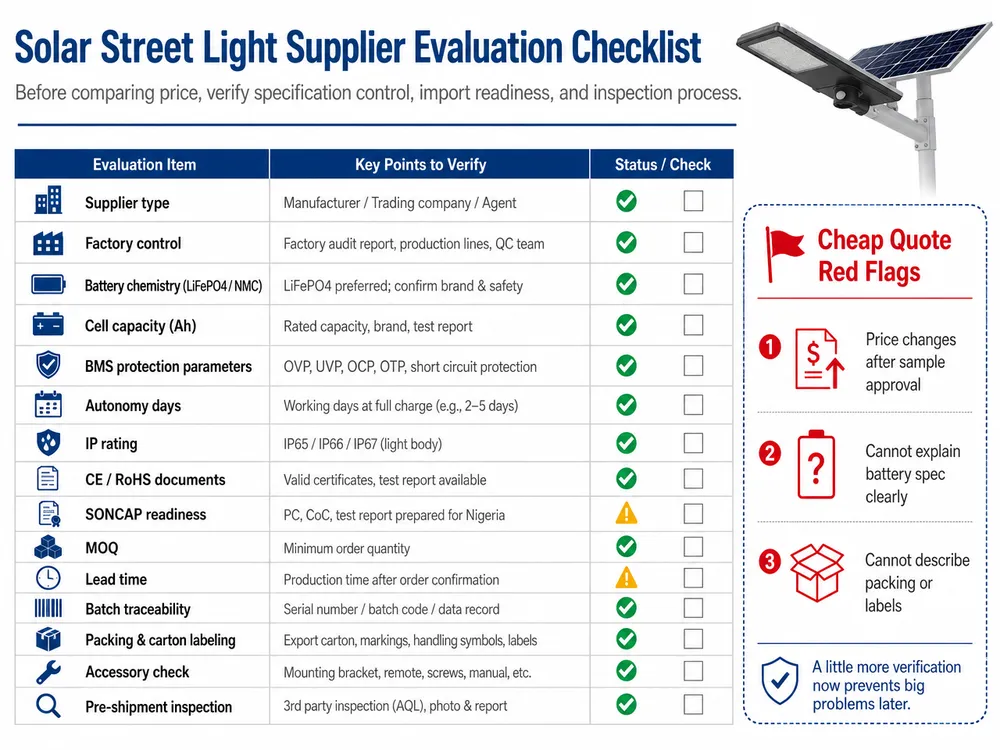
A cheap quote is incomplete until you know the battery chemistry, the autonomy days sized for your location, the IP rating test record, the inspection process, and the document set that will clear Nigerian customs.
The 10 Verified Suppliers, Grouped by Control and Buyer Fit
These 10 companies were verified through their official websites. Descriptions stay conservative where detail certainty is limited — no invented capacities, certifications, or lead-time claims for external companies.
Nigeria-Based Local Suppliers and Installers
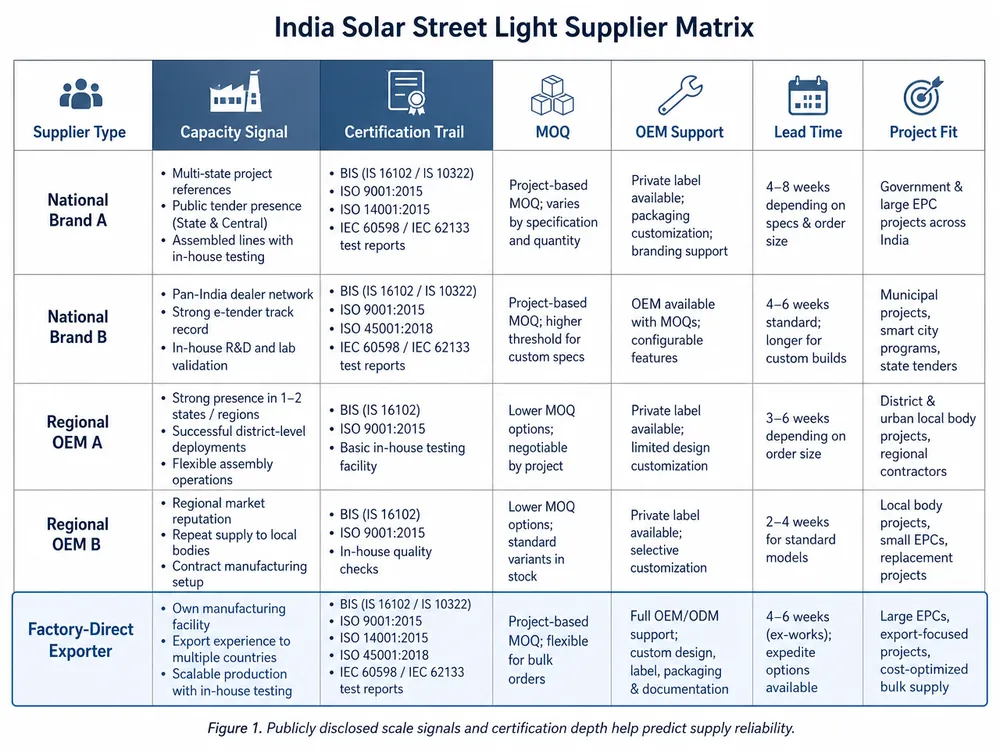
Six of the ten are Nigeria-based, ranging from product distributors to full project installers. Their shared advantage is local presence: faster emergency supply, site response, and familiar communication. Their shared limitation is that factory-level spec control, batch traceability, and import documentation are harder to verify from the buyer's side.
| Company | Supplier Model | Best-Fit Buyer Situation | What to Verify Before Ordering | Import/Spec Risk to Watch |
|---|---|---|---|---|
| D.O Green Solar Energy Ltd (solarstreetlight.company) | Nigeria-based all-in-one solar street light supplier | Local distributor orders, emergency supply, small municipal projects | Battery chemistry and capacity, autonomy-day sizing basis, warranty claim process | Spec sheet may not tie to a specific factory or batch |
| J & W Solar Nigeria Ltd (jwsolar.co) | Nigeria-based solar engineering installer | Installation-heavy projects requiring local site support and commissioning | Product source factory, battery test records, IP rating documentation | Installation-focused; product spec control depends on upstream supplier |
| JRB Solar (jrbsolar.com) | Nigeria-based project installer and supplier | Municipal and public infrastructure projects with local execution requirements | Factory origin of supplied units, certificate traceability per model | Project track record visible; product-level batch inspection less clear |
| Meldon Energy Solutions (meldonenergysolutions.com) | Nigeria-based manufacturer and installer | Buyers wanting local design-to-installation capability | In-house manufacturing scope vs. assembled/sourced components, test records | Manufacturing claims should be verified against actual production capability |
| Ensky Solar Nigeria (enskysolarng.com) | Nigeria-based solar product supplier | Local product supply, Lagos-area distribution | Battery spec and chemistry, IP rating test basis, autonomy-day calculation method | Product range visible; factory-level traceability unclear |
| PSC Solar UK / PSC Industries (pscsolaruk.com) | Solar integrator with Nigeria presence | Buyers needing a supplier with both UK/international and Nigerian market reach | Nigeria-specific stock availability, product certificate origin, lead time from UK vs. local | Multi-market positioning; verify which entity and stock location applies to your order |
Factory-Direct and Global Manufacturers
Four of the ten are factory-direct manufacturers supplying Nigeria through direct import. Their advantage is spec control, batch consistency, and documentation depth. Their limitation is lead time — a factory order takes weeks, not days, and requires import coordination.
| Company | Supplier Model | Best-Fit Buyer Situation | What to Verify Before Ordering | Import/Spec Risk to Watch |
|---|---|---|---|---|
| Inlux Solar (inluxsolar.com) | Factory-direct solar street light manufacturer | OEM/ODM buyers, project tender supply, repeat import orders | Battery chemistry, autonomy-day sizing support, CE/IP test records per model | Verify that certificate applies to the exact model and configuration ordered |
| HRLUX Solar (hrluxsolar.com) | China-based outdoor lighting manufacturer | Africa-market importers, distributor reorders | Africa-specific product range, battery spec for tropical heat, pre-shipment inspection policy | Confirm IP rating test records and battery aging test documentation |
| Gillson Lights (gillsonlights.com) | Factory-direct commercial solar street lighting manufacturer | Municipal and commercial-scale buyers, global project supply | Commercial-grade spec documentation, batch traceability, inspection records | Verify autonomy-day sizing support for Nigerian irradiance zones |
| JXSOL (jxsolarlight.com) | Factory-direct solar lighting manufacturer, Zhongshan, China | Repeat-volume importers, distributors piloting a SKU, quality-critical tenders | See Section 7 for full factory profile | 100% pre-shipment inspection; documentation package supports SONCAP clearance |
Autonomy Days by Nigerian Irradiance Zone
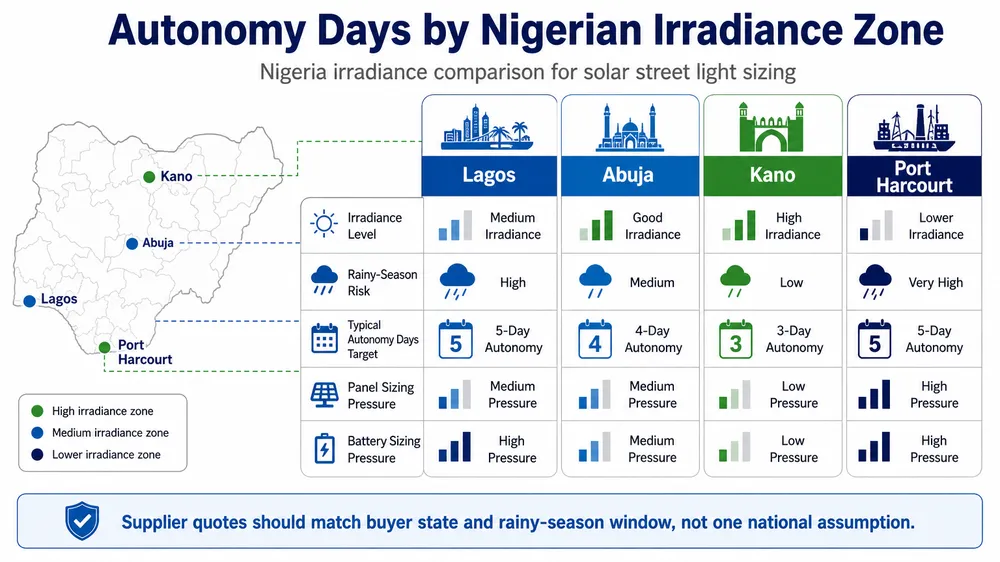
One national "Nigeria spec" is too loose to be useful. A solar street light sized for Kano's dry-season irradiance will underperform in Port Harcourt's rainy season. The difference is not marginal — it changes battery capacity, panel wattage, landed cost per unit, and carton weight.
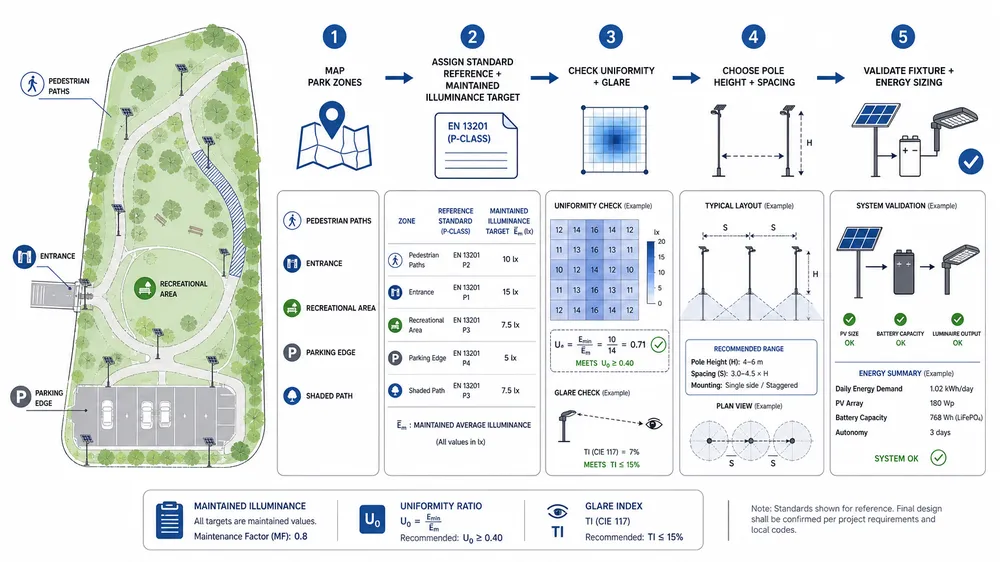
Nigeria spans roughly 4°N to 14°N latitude. The north receives stronger and more consistent solar irradiance year-round. The south — Lagos, Port Harcourt — faces a longer rainy season with more consecutive low-irradiance days. That rainy-season window is the design constraint. A system that cannot sustain rated output through five consecutive overcast days in Lagos will generate warranty claims and replacement orders.
(We size every Nigeria project quote against the buyer's specific state and rainy-season window — not a single national assumption. It takes one extra question at the RFQ stage and prevents a first-year failure.)
| Location | Solar Resource Pattern | Rainy-Season Risk | Autonomy-Day Implication | Battery/Panel Sizing Note |
|---|---|---|---|---|
| Kano | High irradiance, long dry season, short rainy window (Jun–Sep) | Lower consecutive low-irradiance days | 3–4 autonomy days typically sufficient | Smaller battery pack viable; panel wattage can be moderate |
| Abuja | Moderate-high irradiance, transitional zone | Medium rainy-season risk (Apr–Oct) | 4 autonomy days recommended baseline | Mid-spec battery; verify rainy-season depth for project location |
| Lagos | Moderate irradiance, long rainy season (Apr–Oct, peak Jun–Jul) | Higher consecutive overcast days | 5 autonomy days recommended for reliable operation | Larger battery pack; higher panel wattage to recover charge faster |
| Port Harcourt | Lower average irradiance, longest rainy season (Mar–Nov) | Highest consecutive low-irradiance risk | 5–6 autonomy days for critical applications | Largest battery requirement; panel sizing must account for reduced daily harvest |
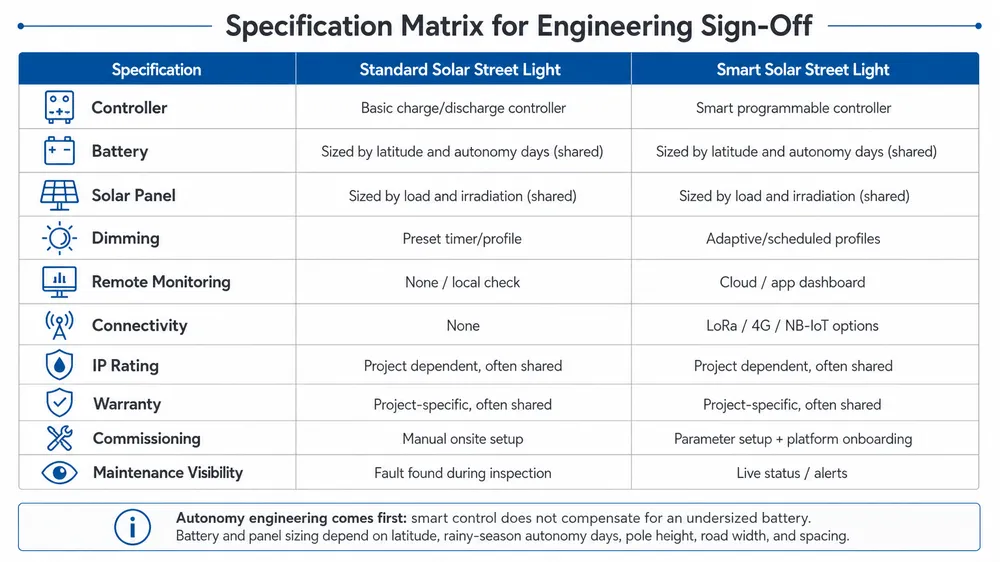
The jump from 3-day to 5-day autonomy adds battery capacity, increases carton weight, and raises landed cost per unit. A supplier who quotes a single spec for all of Nigeria is either not sizing for your location or is padding the battery to cover the gap — both outcomes affect your margin.
For a detailed breakdown of how autonomy days are calculated against real irradiance data, see solar street light autonomy days. For all-in-one unit configurations and how panel and battery are integrated, all-in-one solar street light specifications covers the spec decisions in detail.
SONCAP, Product Certificates, and the Import Paper Trail
Import readiness is a supplier capability, not a paperwork afterthought. A container that arrives at Apapa or Tin Can Island without the correct document set can sit for weeks while certificates are corrected — and the cost of that delay lands on the importer, not the factory.
The Standards Organisation of Nigeria (SON) administers the SONCAP (Standards Organisation of Nigeria Conformity Assessment Programme) for regulated products entering Nigeria. As of March 31, 2026, SON has mandated migration of SONCAP and import permit processes to the National Single Window (NSW) platform. Buyers and their clearing agents should confirm that their supplier's documentation workflow is aligned with the NSW process before shipment.
The document set to request from any supplier before paying a deposit:
- Product model specification sheet — must match the exact model being shipped, not a generic catalog page
- Commercial invoice and packing list — with model numbers, quantities, unit weights, and carton dimensions that match the physical shipment
- CE and RoHS test reports — tied to the specific model, not a blanket certificate covering a product family
- IP rating test documentation — IP65 or IP67 test record per model, not a self-declared label
- Product Certificate and SONCAP/Shipment Certificate — issued through an accredited conformity assessment body; confirm the model is covered
- Form M and PAAR coordination — your clearing agent handles these, but the supplier's invoice and packing list must be accurate for the Form M to clear without amendment
- Batch traceability records — serial number ranges or production batch codes that link the shipped units to inspection records
NAFDAC is not the primary approval path for standard solar street lights. It applies to food, drugs, cosmetics, and related regulated products. Mentioning NAFDAC to a solar street light supplier is a signal that the buyer may be working from incomplete compliance guidance — a credible supplier will clarify this without being asked.
A supplier who cannot produce model-specific CE and IP test reports, or who offers a generic certificate that covers a broad product family rather than the exact configuration ordered, is a documentation risk. Port delays caused by certificate mismatches are common and entirely avoidable.
LiFePO4 vs. Lead-Acid in Nigeria's Heat
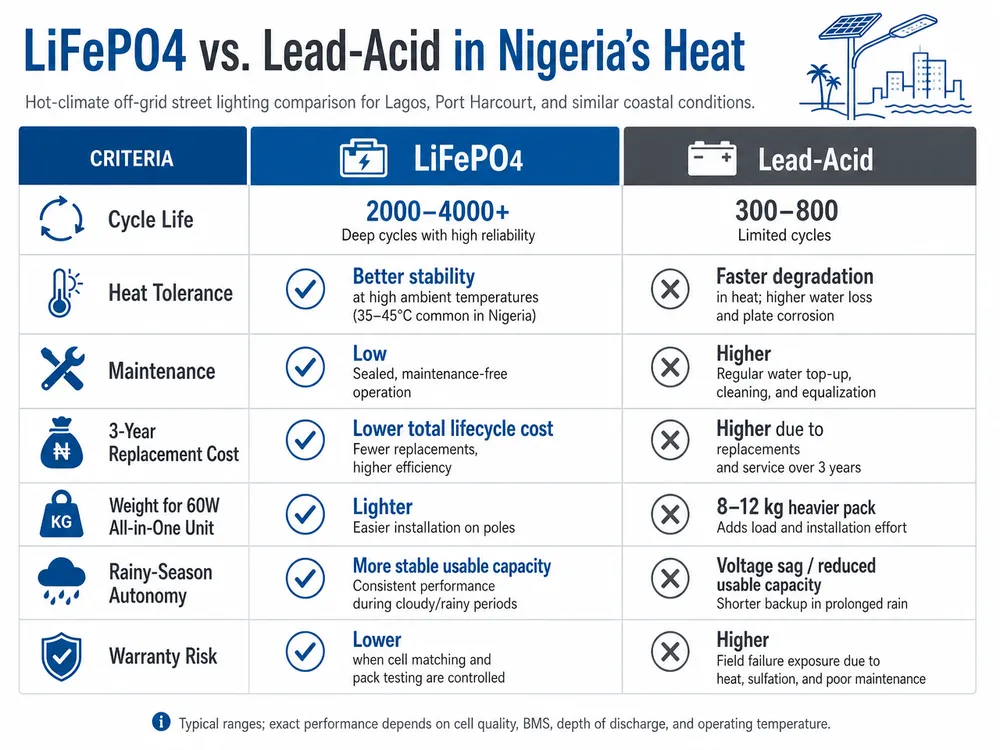
Battery chemistry is the highest-impact commercial decision in a solar street light order for Nigeria. The wrong chemistry does not fail immediately — it degrades over 12 to 24 months, then generates replacement orders, warranty disputes, and reputational damage for the distributor or contractor who specified it.
| Battery Chemistry | Heat Behavior | Cycle-Life Implication | Maintenance/Replacement Risk | Best-Fit Buyer Scenario |
|---|---|---|---|---|
| LiFePO4 | Stable thermal performance up to ~60°C; minimal capacity loss at sustained high ambient temps | 2,000–3,000+ cycles at 80% depth of discharge; multi-year service life under Nigerian conditions | Low maintenance; no electrolyte topping; sealed unit | Repeat-volume importers, rural deployments, quality-critical tenders, buyers who cannot service units in the field |
| Lead-Acid (VRLA/GEL) | Accelerated capacity loss above 35°C; heat shortens effective cycle life significantly | 300–500 cycles under real-world tropical conditions; effective service life often 12–18 months in Nigeria | Higher replacement frequency; weight penalty increases freight cost | Short-term or pilot projects where first cost is the primary constraint and replacement logistics are manageable |
Lead-acid looks cheaper in the first quote. Over a three-year project horizon in Lagos or Port Harcourt, the replacement cycle and service cost typically reverse that advantage. The weight difference also matters at scale: a lead-acid battery pack for a 60W all-in-one unit can weigh 8–12 kg more than an equivalent LiFePO4 pack, which adds freight cost per container.
We run charge/discharge cycle testing on every battery pack before it leaves our facility — not as a quality theater exercise, but because we have seen what happens when a batch with inconsistent cell matching reaches a hot climate. A pack that tests fine at 25°C can show 15–20% capacity variance at 45°C if the cells were not matched properly. That variance shows up as uneven street light performance across a project, and it shows up in year one.
For a full breakdown of battery chemistry options and how they interact with panel sizing and dimming schedules, see solar street light battery spec.
MOQ, Lead Time, and the Red Flags Behind a Cheap Quote
MOQ and lead time should be evaluated together against your order type, not as standalone numbers.
| Order Type | Typical Buyer Need | Supplier Fit |
|---|---|---|
| Urgent small replacement (1–50 units) | Same-week delivery, local stock | Nigeria-based distributor or installer |
| Pilot SKU for resale (100–300 units) | Low MOQ, clear spec, sample approval | Factory-direct supplier with MOQ from 100 units |
| Tender batch (500–2,000 units) | Spec lock-in, batch inspection, certificate package | Factory-direct manufacturer with QC documentation |
| Repeat distributor reorder (1,000+ units) | Consistent batch quality, reorder reliability, documentation | Factory-direct with ISO 9001 and pre-shipment inspection |
| Container-scale import (FCL) | Landed cost optimization, packing efficiency, full document set | Factory-direct with export experience and SONCAP support |
A trading company can be useful for mixed-product sourcing — if you need solar street lights alongside other product categories from different factories, a trading company consolidates the order. The trade-off is that batch consistency and spec control are weaker. The trading company does not control the production line, and when a batch has a defect, the resolution path runs through an intermediary rather than directly to the engineering team that built the product.
Factory audit red flags — apply these to any supplier, including JXSOL:
- Cannot define battery chemistry or capacity — "lithium battery" without specifying LiFePO4 vs. NMC vs. LFP, or capacity stated in Wh without cell count or voltage
- Autonomy days stated without location or dimming logic — "5-day autonomy" without specifying the irradiance assumption, dimming schedule, or load wattage
- Generic certificate not tied to the exact model — a CE certificate covering a product family rather than the specific SKU being ordered
- No battery test records — no aging test, no charge/discharge cycle data, no cell-matching records
- No waterproof inspection records — IP65/IP67 claimed but no test report per model
- No batch traceability — cannot provide serial number ranges or production batch codes for the shipped units
- Price changes after sample approval — sample price and production price diverge without a clear material or specification change
- Cannot explain packing, accessory checks, or carton labeling — a factory that controls its own production can describe exactly what goes in each carton and how it is labeled for customs
(The battery chemistry question alone filters out a significant portion of low-quality quotes. A supplier who cannot immediately tell you whether the pack is LiFePO4 or NMC, the cell capacity in Ah, and the BMS protection parameters is not controlling their own production.)

Where JXSOL Fits as the Factory-Direct Alternative
JXSOL is the export brand of Zhongshan Century Juxing Optoelectronics Technology Co., Ltd., a solar lighting manufacturer in Guzhen Town, Zhongshan, Guangdong — the center of China's lighting manufacturing industry. Founded in 2012, the factory covers 12,000 square meters, runs 6 production lines, employs 150 people including 15+ optical and electrical engineers, and produces 1,200,000 units annually. Certifications include ISO 9001:2015, CE, RoHS, IP65/IP67, and IEC 62124.
What that means for a Nigerian buyer specifically:
Battery and panel sizing for your location. Our engineering team sizes battery capacity and solar panel wattage against the buyer's actual project location — Lagos, Kano, Abuja, or any specific state — using real irradiance data and the buyer's target autonomy days and dimming schedule. We do not quote a single national spec and hope it works. A Lagos buyer asking for 5-day autonomy gets a different battery and panel configuration than a Kano buyer asking for 3-day autonomy, and the price difference is real and explained.
100% pre-shipment inspection. Every unit is inspected before it leaves the factory — lumen output, color temperature, waterproof integrity, battery charge/discharge performance, and carton labeling. We run automated SMT production lines with daily output of 5,000+ units and an integrated battery and LED module testing lab in the same building where the product is assembled. The inspection is not a sampling exercise — it is a 100% check. For a Nigerian importer who has no local recourse if a defective batch arrives at Apapa, that distinction matters.
Documentation package for import clearance. We provide model-specific CE and RoHS test reports, IP65/IP67 test documentation, ISO 9001:2015 certification, and commercial invoice and packing list formats that align with Nigerian customs requirements. For buyers navigating the SONCAP process through the National Single Window, we coordinate the product certificate documentation per order. Our Certifications & Quality Standards page lists the current certificate set.
MOQ from 100 units. A 100-unit pilot order lets you test a SKU with your own customers or on a small project before committing to a container. Most of our Nigerian distributor relationships start with a 100–300 unit pilot, then move to FCL reorders once the product is proven in the field. OEM and ODM options — custom lumen output, color temperature, housing color, or label — are available through our OEM & ODM Solar Lighting Services for buyers building a private-label product line.
The honest trade-off: factory-direct from China means 25–35 day lead time from order confirmation to port of departure, plus shipping and clearance time. If you need units in Lagos next week, we are not the right call. If you are planning a tender, building a distributor catalog, or setting up a repeat import program, the economics and spec control are worth the lead time.
FAQ: What Buyers Usually Miss When Comparing Suppliers
What should I check first when comparing solar street light suppliers in Nigeria?
Start with battery chemistry and autonomy-day sizing. Ask every supplier: what is the battery chemistry (LiFePO4 or lead-acid), what is the capacity in Wh, and how many autonomy days is the system sized for — and at what location and dimming schedule? If a supplier cannot answer those three questions with specific numbers, the quote is incomplete regardless of price.
How many autonomy days should a solar street light have for Lagos or Kano?
For Lagos and Port Harcourt, 5 autonomy days is the recommended baseline for reliable operation through the rainy season. For Kano, 3–4 days is typically sufficient given the shorter rainy window and stronger average irradiance. Specifying fewer autonomy days than the location requires is the most common cause of first-year performance failures in Nigerian solar street light projects.
Is LiFePO4 worth the higher first cost for Nigerian solar street light projects?
For any order where the units will be in service for more than 18 months — which is most distributor and project work — yes. Lead-acid degrades faster in sustained heat above 35°C, and the replacement cycle in a Nigerian climate typically erases the first-cost advantage within two years. For short-term or pilot projects where replacement logistics are manageable, lead-acid may be acceptable. For rural deployments or projects where field service is difficult, LiFePO4 is the lower-risk choice.
What documents should I ask for before importing solar street lights into Nigeria?
Request: model-specific CE test report, RoHS declaration, IP65/IP67 test record, ISO 9001 certificate, commercial invoice and packing list matching the exact shipment, and the Product Certificate for SONCAP. Confirm that the supplier's documentation workflow is aligned with SON's National Single Window platform, which became mandatory for SONCAP and import permit processes as of March 31, 2026. A generic certificate covering a product family rather than the specific model ordered is a clearance risk.
What MOQ is reasonable for testing a new solar street light supplier?
100–300 units is a workable pilot range for most distributors. It is enough to test the product with real customers or on a small project, verify that the spec matches what was quoted, and assess the supplier's documentation and communication before committing to a container. A supplier who requires a full FCL minimum for a first order is asking you to take all the risk — that is a negotiating signal, not a fixed constraint.
When is a local Nigerian supplier better than factory-direct import?
Local is the right call for urgent small orders (under 50 units), emergency replacements on active projects, installation-heavy work requiring on-site commissioning and local service response, and situations where the project timeline cannot accommodate a 6–8 week import cycle. Factory-direct becomes the better economics for repeat-volume orders, tender batches, and any situation where spec control, batch consistency, and documentation depth matter more than delivery speed.
Which Supplier Type Fits Your Order Size and Risk
| Buyer Situation | Best Supplier Type | Key Criteria |
|---|---|---|
| Urgent small replacement (1–50 units, needed within days) | Nigeria-based distributor or installer | Local stock availability, delivery speed |
| Installation-heavy municipal or project order | Nigeria-based project contractor | Site execution capability, local service response |
| Pilot SKU for resale or small project (100–300 units) | Factory-direct with low MOQ and clear specs | Battery chemistry, autonomy sizing, sample approval process |
| Repeat-volume distributor import (1,000+ units, FCL) | Factory-direct manufacturer with batch testing | ISO 9001, pre-shipment inspection, reorder consistency, documentation |
| Quality-critical tender or infrastructure project | Engineering-led factory with certificate and inspection records | IEC 62124, CE/IP test records per model, battery aging test, SONCAP document support |
The sourcing decision is not a permanent choice between local and factory-direct — most serious distributors and project contractors in Nigeria use both. Local suppliers handle emergency and installation work. Factory-direct handles the volume that builds margin.
If you are at the stage of comparing configurations for a specific project or building a distributor catalog, the most useful next step is to send the project parameters — location (state or region), required lumen output or wattage, pole height, target autonomy days, and order volume — and get a Nigeria-specific configuration and pricing back. That comparison is more useful than a generic quote, and it takes one email. Request Quote with those details and we will respond with a sized configuration.