Most portable power station spec sheets list two wattage numbers — continuous and peak — but buyer confusion around those numbers causes 60% of the field-performance complaints we see from distributors. You order a 1000W unit expecting it to run a 900W device, it trips on startup, and you're left wondering if the inverter failed QC or if your load calculation missed something fundamental.
The distinction matters because wattage determines what you can power, how long your runtime lasts, which price tier you're sourcing from, and whether your buyer's deployment succeeds or generates warranty returns. This guide walks through the factory-level mechanics of how portable power station wattage ratings are set, tested, and matched to real device loads — the technical clarity you need before committing to MOQ.
Continuous vs Peak Wattage — The Factory QC Distinction Buyers Miss
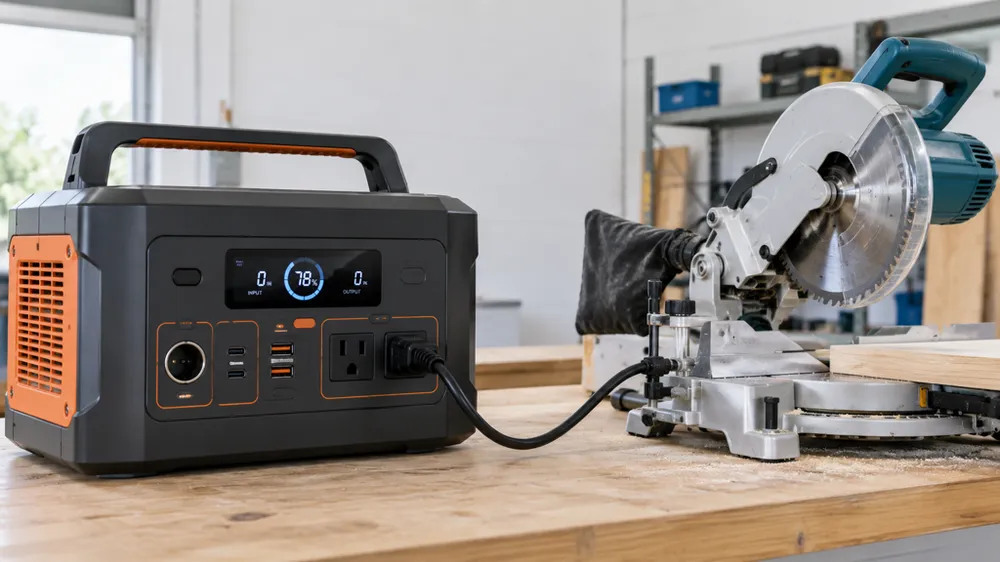
Continuous wattage is the sustained inverter output your unit can deliver under thermal limits, typically tested at 25°C ambient temperature for 30+ minutes during factory quality control. This is your working budget — the load you can run until the battery depletes. Peak wattage is short-duration overload capacity, usually 2–5 seconds, designed to handle motor or compressor startup inrush current without tripping the inverter protection circuit.
Consumer marketing emphasizes peak numbers because they're larger and sound more capable, but procurement specs should anchor on continuous wattage. If your target device draws 800W continuously, you need a unit rated for at least 1000W continuous output — not a 600W continuous / 1200W peak model, which will run your device for 10 minutes and then shut down from thermal overload.
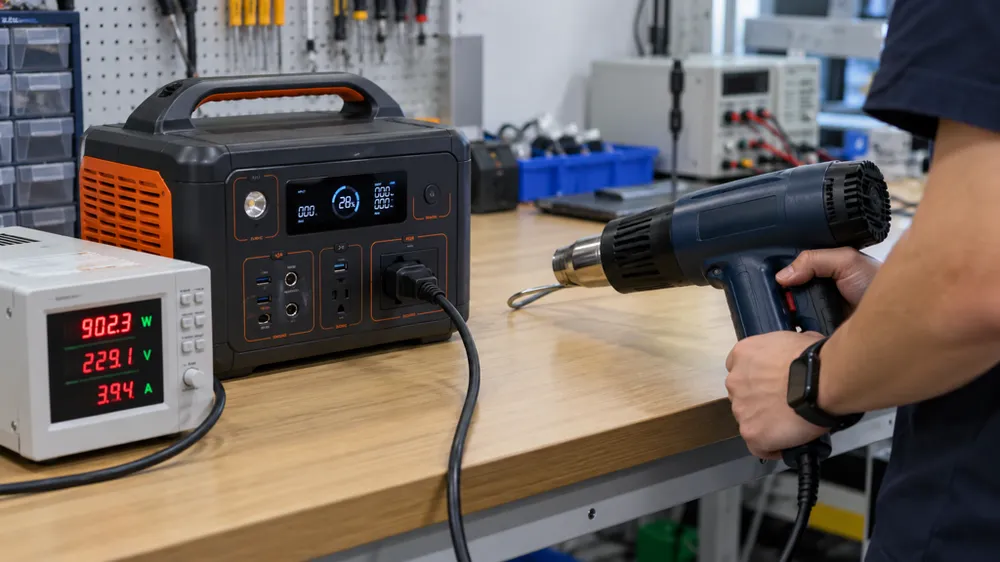
We test continuous ratings by running the inverter at full rated load for 30 minutes minimum, monitoring internal MOSFET temperature and checking that thermal cutoff doesn't trigger before the 30-minute mark. Pass/fail threshold is typically 65°C internal temperature — if the inverter hits that before 30 minutes, it fails continuous rating validation. Peak capacity is tested with a 3-second surge load applied during the continuous test to confirm the DC bus capacitor bank and gate driver can handle the transient without voltage sag or overcurrent trip.
One technical note that matters for sensitive electronics: pure sine wave inverters deliver AC output with <3% total harmonic distortion, suitable for medical devices, audio equipment, and variable-frequency motor drives. Modified sine wave inverters (cheaper, lighter) output a stepped waveform that works fine for resistive loads like heaters and incandescent bulbs but can cause humming in transformers, reduced efficiency in switching power supplies, and outright failure in CPAP machines. If your catalog targets medical, audio, or industrial buyers, pure sine wave topology is non-negotiable — the 15–20% inverter cost premium is insurance against field failures you can't afford.

Buyers often assume the unit can handle any device below the peak rating, but that's only true if surge duration and current waveform match the capacitor bank design. A 1HP air compressor drawing 750W continuous with 3× surge (2250W inrush for 2–3 seconds) will trip a 1000W continuous / 2000W peak unit because the inrush exceeds the inverter's short-term capacity, even though the steady-state load is well within limits. The fix is either sizing up to a higher peak-capacity tier or testing with the actual device before finalizing your order — most factories will run a pre-production sample test if you provide the device specs in advance.
Device Load Reference Table — What Actually Draws Power in B2B Use Cases
Matching portable power station wattage to your deployment requires knowing what your equipment actually draws, not what the nameplate says. Nameplate ratings are often input power or maximum theoretical load; real-world continuous draw can differ by 20–30%. Here's a reference table covering the B2B equipment categories we see most often in distributor and contractor orders:
| Device Category | Typical Continuous Load (W) | Startup Surge Factor |
|---|---|---|
| Power Tools | ||
| Angle grinder (7-inch) | 1200 | 1.2× |
| Circular saw (7.25-inch) | 1400 | 1.3× |
| Jobsite LED array (500W-equivalent) | 150 | 1.0× |
| Medical/Emergency | ||
| CPAP machine | 40 | 1.0× |
| Portable oxygen concentrator | 120 | 1.5× |
| Vaccine refrigerator (12V DC compressor) | 80 | 3.0× |
| Field Equipment | ||
| Drone charging station (6-battery hub) | 200 | 1.0× |
| 4G router + signal repeater | 25 | 1.0× |
| Portable projector (3000-lumen) | 250 | 1.1× |
| Event/Staging | ||
| PA system (500W RMS) | 300 | 1.2× |
| LED wash lights (8-fixture array) | 180 | 1.0× |
| Drip coffee maker (12-cup) | 1000 | 1.0× |
The surge factor applies only at device startup — once the motor or compressor is running, you're back to continuous load for runtime calculations. Refrigeration and motor-driven equipment carry the highest surge risk because compressor inrush can hit 3–5× continuous draw for the first second or two of startup. If you're assembling rental kits or emergency response carts, map your full equipment list to this table and size your portable power station output capacity to handle the highest continuous load plus the highest surge factor in your stack. (We've seen buyer orders fail field deployment because they matched to average load instead of peak simultaneous load — runtime math only works if the inverter doesn't trip first.)
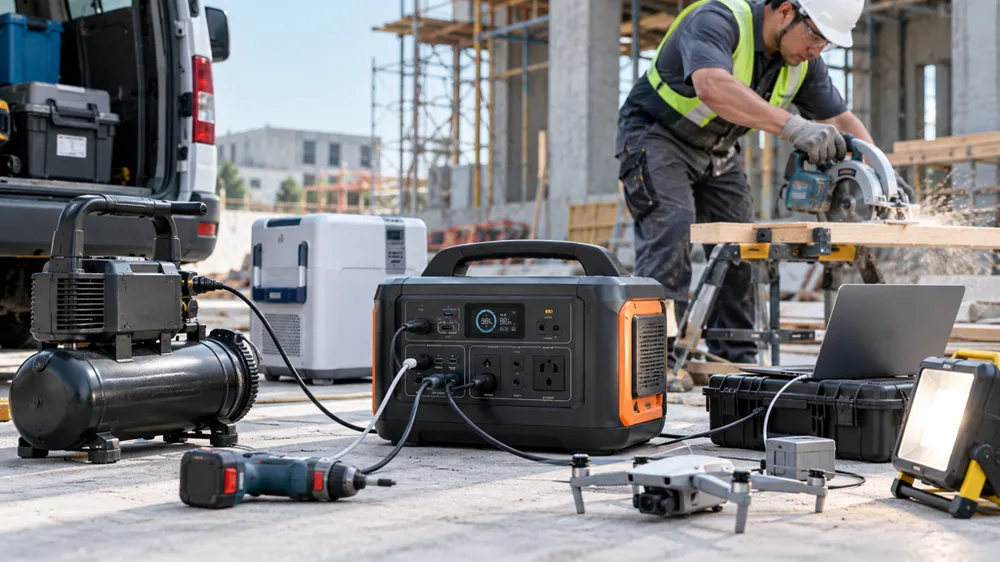
One pattern we see in failed deployments: buyers assume USB-C and DC outputs don't count against the AC inverter rating. They don't — DC outputs run directly from the battery through a buck converter, bypassing the inverter entirely. But if you're powering a laptop via USB-C PD (60W) and a drone charger via DC barrel jack (100W) while running a projector on AC (250W), your total battery drain is 410W-equivalent even though the inverter only sees 250W. Runtime calculations need to account for all simultaneous loads across all output types, not just what's plugged into AC sockets.
Inverter Overload Mechanics — Why Units Trip and How to Avoid It
When your portable power station shuts down under load, the inverter protection circuit followed a specific sequence: current sense → MOSFET gate shutdown → LCD fault code or audible beep alert. Understanding why that sequence triggers helps you size correctly and troubleshoot field failures without unnecessary warranty claims.
Two overload types cause inverter shutdown. Continuous overload happens when your load exceeds the rated wattage for more than 5–10 seconds — the inverter's internal temperature climbs past the thermal cutoff threshold (typically 65–70°C), and the microcontroller shuts down the MOSFET gate driver to prevent component damage. Startup surge overload happens when inrush current exceeds the unit's peak capacity — the DC bus voltage sags below the minimum threshold the inverter needs to maintain AC output, or the current sense circuit detects overcurrent and trips the gate driver before the motor completes its startup phase.
Factory inverter design determines peak capacity through two components: the DC bus capacitor bank (larger capacitance = more energy storage for short-duration surges) and the MOSFET switching headroom (higher-rated MOSFETs = higher transient current handling). Units with larger capacitor banks can handle higher surge loads but add 0.5–1 kg to the unit weight and 10–15% to inverter cost. That's why you'll see two units with the same continuous rating (1000W) but different peak ratings (2000W vs 2500W) — the higher-peak unit has a beefier capacitor bank and MOSFET array to support motor-heavy applications.
The most common buyer mistake we see in field failures: assuming a 1000W continuous / 2000W peak unit can start any device rated under 2000W. In reality, surge duration and current waveform shape determine whether the inverter can deliver that peak. A real-world example from a distributor's warranty return: 1HP air compressor, 750W nameplate, 3× surge rating. Buyer calculated 750W × 3 = 2250W surge, saw the unit's 2000W peak spec, assumed it would work. It didn't — the compressor's inrush lasted 2.5 seconds (longer than the capacitor bank could sustain), and the inverter tripped every time. The fix was either stepping up to a 1500W continuous / 3000W peak unit or reducing the compressor size to 0.75HP.
For motor-heavy applications — compressors, pumps, refrigeration, power tools with universal motors — add 20–30% margin above your calculated surge requirement, or request a factory pre-shipment test with your actual device. We can load-test pre-production samples with customer-provided equipment before you commit to MOQ, and that 30-minute test catches 90% of surge-related mismatches before they become field problems.
Battery Chemistry and Sustained Output — Why LiFePO4 Matters for High-Wattage Loads
Your inverter's wattage rating assumes the battery can deliver sufficient discharge current. If the battery can't supply the required amps, the inverter will voltage-sag or current-limit below its rated output — you'll see the LCD display show full wattage initially, then drop to 60–70% of rated capacity as the battery struggles to maintain voltage under load.
LiFePO4 (lithium iron phosphate) battery chemistry supports higher continuous discharge rates — typically 1C to 2C, meaning a 1000Wh LiFePO4 pack can safely deliver 1000–2000W continuously without voltage sag. Ternary lithium (NMC or NCA chemistry, common in consumer-grade units) typically supports 0.5C to 1C discharge, meaning a 1000Wh ternary pack can deliver 500–1000W continuously before you start seeing voltage droop and inverter current limiting.
From a factory sourcing perspective, units rated for 1500W+ continuous output almost always use LiFePO4 cells to avoid mid-discharge voltage sag. Lower-wattage units (500–1000W continuous) may use ternary lithium if the C-rate matches the inverter tier — a 1000Wh ternary pack at 1C discharge rate can sustain 1000W output, which is adequate for a 1000W continuous inverter. The buyer implication: if you're speccing white-label or OEM units above 1000W continuous, confirm battery chemistry and C-rate in the factory spec sheet. An undersized C-rate will cause the inverter to current-limit below nameplate rating once battery state of charge drops below 50%, and your buyers will report "power output drops halfway through runtime" as a defect when it's actually a design mismatch.
Our factory QC protocol includes a full-load inverter test at 20% state of charge to confirm the battery can sustain rated output throughout the discharge curve, not just when the pack is fully charged. That test catches battery C-rate mismatches before the unit ships — if the inverter can't hold rated output at 20% SOC, the unit fails QC and we either swap to a higher-C-rate battery or derate the inverter nameplate to match what the battery can actually deliver.
One procurement note for buyers comparing quotes: LiFePO4 adds 15–20% to battery cell cost compared to ternary lithium, but it eliminates the mid-discharge performance drop that causes field complaints. For high-wattage rental equipment or professional-use catalogs where buyers expect consistent output from 100% to 0% SOC, the LiFePO4 premium is worth it — fewer warranty returns and stronger reorder rates from buyers who trust the product performs as rated.
Wattage Tier Selection for Catalog Planning — Sourcing Logic by Market Segment
Distributors assembling a portable power station catalog face a wattage tier decision that affects MOQ, unit cost, inventory turn, and which buyer segments you can serve. We see three common wattage tiers in B2B sourcing, each with different commercial dynamics:
300–500W tier: Targets personal electronics, CPAP backup, small office UPS replacement. Lowest MOQ (typically 100–200 units for white-label orders), fastest inventory turn because the price point attracts consumer and light-commercial buyers, but thinnest margin because competition is heavy and buyers price-shop aggressively. This tier works for distributors building volume through e-commerce or retail channels where turn rate matters more than per-unit margin.
1000–1500W tier: Covers power tools, jobsite lighting, event staging, field medical equipment. Mid-volume MOQ (200–500 units typical), best margin-per-unit-times-volume balance for most distributors. Buyers in this tier are often contractors, rental companies, or institutional procurement — they're comparing total cost of ownership (runtime per charge, cycle life, warranty support) rather than just sticker price, so you have room to position on quality and support rather than competing purely on cost. This is the tier we recommend for first-time importers testing the market.
2000–3000W tier: Handles heavy tools, whole-home backup, large medical equipment, field generator replacement. Higher MOQ (500–1000 units or custom tooling for OEM), but buyers are project-driven or institutional, and purchase decisions run on performance specs and supply chain reliability rather than price sensitivity. Margin per unit is higher, but inventory turn is slower — you're selling capability and factory support, not volume.
Factory cost scaling doesn't double when wattage doubles. The inverter PCB and capacitor bank scale sub-linearly (a 2000W inverter costs about 1.6× what a 1000W inverter costs), but battery capacity (Wh) is the dominant cost driver. If you compare a 1000W/1000Wh unit to a 2000W/2000Wh unit, the second unit costs roughly 1.8× the first — not 2.0× — because inverter cost spread across double the battery capacity dilutes the per-unit premium.
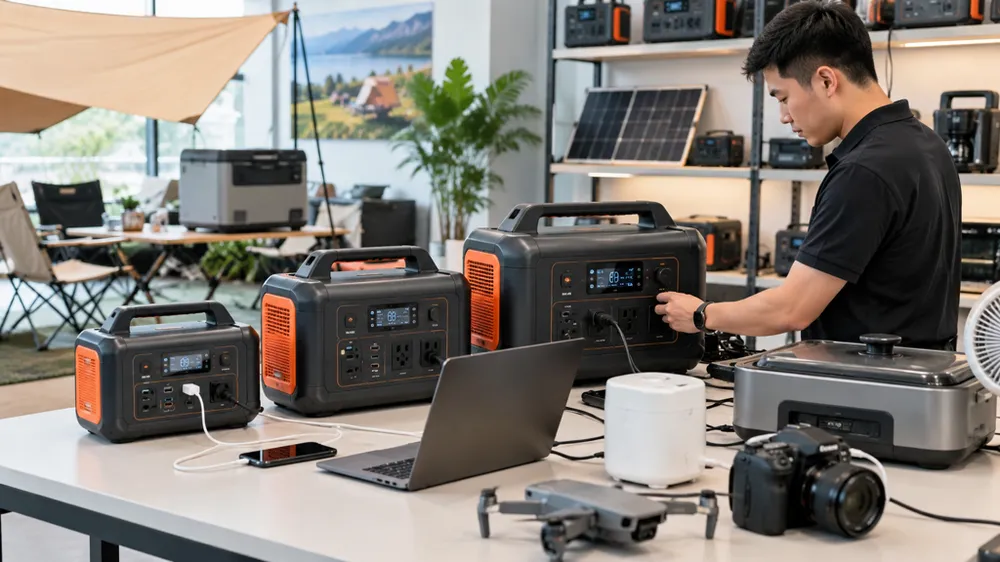
Your sourcing decision tree: single-tier catalog (one wattage class, deep inventory, targeted buyer segment) or multi-tier catalog (broader market coverage, higher capital requirement, more complex inventory management). Single-tier works well for distributors focused on a specific vertical — construction rental fleets standardizing on 1500W units, emergency medical suppliers stocking 1000W units for field clinics. Multi-tier works for distributors serving mixed buyer bases where a regional sales rep needs 500W units for retail accounts and 2000W units for municipal RFQs.
For project-specific procurement — 200 units for a telecom backup deployment, 500 units for a disaster relief agency — size portable power station wattage to your actual device load list, not to generic "high power" positioning. Every 500W increment you over-spec adds battery capacity you're paying for but not using, and that cost doesn't deliver ROI to your end buyer. Use the device load table from earlier in this guide to map your project's equipment list to the minimum wattage tier that covers your highest simultaneous load plus 15–20% margin, then lock that as your spec.
Interpreting Wattage Specs in Factory Documentation — What to Ask Before MOQ Commitment
Factory spec sheets vary in completeness, and missing details cause sourcing disputes after deposit. Here are the critical fields you should confirm before committing to MOQ, with guidance on what each one tells you about real-world performance.
Continuous (rated) output: Should be stated in watts with ambient temperature condition — for example, "1000W continuous at 25°C ambient." If the spec sheet only lists wattage without temperature, ask for the test condition. Some factories rate continuous output at 20°C (easier to pass QC) but your buyers will deploy in 35°C field conditions where the inverter thermal-limits at 80% of rated output. We test at 25°C because it's the ISO standard ambient for power electronics, and we provide a derating curve for higher temperatures in the technical manual.
Peak (surge) output: Should include both wattage and duration — "2000W peak for 3 seconds" tells you the capacitor bank can sustain that load for the stated time. If the spec sheet lists peak wattage without duration, assume 1–2 seconds maximum, which may not be enough for compressor or pump startup. Ask the factory for capacitor bank specs (total capacitance in μF) if you're sourcing for motor-heavy applications.
Inverter waveform: Pure sine wave or modified sine wave. Pure sine is required for medical devices, audio equipment, and variable-speed motor drives. Modified sine is acceptable for resistive loads (heaters, incandescent lights) and most switching power supplies, but will cause audible hum in transformers and reduced lifespan in some AC motors. If your target market includes medical or industrial buyers, pure sine wave is non-negotiable.
Battery chemistry and C-rate: LiFePO4 or ternary lithium (NMC/NCA), plus discharge rate at rated wattage. A 1000Wh LiFePO4 pack at 1C discharge rate can sustain 1000W continuously; a 1000Wh ternary pack at 0.5C can only sustain 500W without voltage sag. If the factory spec sheet doesn't list C-rate, calculate it yourself: divide inverter continuous wattage by battery capacity (Wh), then ask the factory to confirm their cells support that discharge rate throughout the SOC range.
Overload protection threshold: Current limit (in amps) and thermal cutoff set point (in °C). Tells you how much margin exists between rated output and protection trip. Tighter protection (110% of rated current) means the unit is more conservative and less likely to handle brief overloads; looser protection (130% of rated current) gives more transient headroom but risks thermal runaway if the buyer sustains the overload too long.
Questions to ask the factory during pre-production sample evaluation:
- "Can you provide a test report showing 30-minute continuous load at rated wattage with internal temperature logged?"
- "What is your surge duration, and what capacitor bank size supports it?"
- "At what battery SOC does the unit begin to current-limit under full inverter load?"
Red flags that indicate incomplete or unreliable specs: spec sheet lists only peak wattage without continuous rating; no temperature derating curve provided; surge duration not specified; battery chemistry listed as "lithium" without specifying LFP vs ternary. Any of those gaps means you're buying on partial information, and field performance may not match your expectations.
Buyer protection before MOQ commitment: request a factory load-test video with a calibrated AC power meter showing the pre-production sample running at rated continuous load for 30 minutes, then applying a surge load that matches your target application. That video confirms the inverter and battery can deliver what the spec sheet claims, and it gives you documentation to reference if production units don't match sample performance.
Field Troubleshooting — When Rated Wattage Doesn't Match Real-World Performance
Most wattage-related field complaints stem from application mismatches rather than inverter defects, but distinguishing between the two requires systematic diagnosis. Here's the troubleshooting sequence we walk distributors through when they report portable power station wattage failures.
"Unit trips immediately when I plug in my device": Two likely causes. First, startup surge exceeds peak capacity — measure the device's actual inrush current with a clamp meter or check the manufacturer's startup current spec. If inrush is above the unit's peak rating, you've exceeded design limits and need to step up to a higher-peak-capacity tier. Second, defective current sense calibration in the inverter — this is rare (under 2% of units in our production) but happens if the current sense resistor drifted during assembly. Distinguish between these by testing with a resistive load (incandescent bulb bank) at the same wattage — if the resistive load works but the motor load trips, it's a surge issue; if both trip, it's likely a calibration defect.
"Unit runs my device for 10 minutes then shuts down": Three possible causes. Thermal overload is most common — the inverter hit its 65–70°C internal cutoff because ambient temperature is too high, ventilation is blocked, or the continuous load actually exceeds the rating. Check ambient temp with a thermometer (should be under 30°C for rated performance) and ensure the cooling vents aren't obstructed. If ambient and ventilation are fine, measure the device's actual continuous draw with a plug-in power meter — nameplate ratings can under-report real load by 20–30%, and what you thought was a 900W device might actually pull 1100W continuously.
"Power output drops when battery is below half charge": Battery C-rate is inadequate for the inverter load, causing voltage sag and current limiting. This happens when the factory paired a high-wattage inverter with a low-C-rate battery — typically ternary lithium at 0.5C discharge paired with a 1000W+ inverter. Test by running the device at full charge (100% SOC) and again at 20% SOC while monitoring output wattage with a power meter. If output drops by more than 10% between high and low SOC, the battery can't sustain the inverter's rated output throughout the discharge curve. Fix requires either reducing your load or sourcing a unit with LiFePO4 chemistry rated for higher discharge.
Diagnostic steps for distributors and resellers handling field complaints:
- Measure actual device load with a plug-in AC power meter — don't rely on nameplate ratings
- Verify ambient temperature and ventilation — inverter thermal cutoff typically triggers at 60–70°C internal, which corresponds to 35–40°C ambient with poor airflow
- Test with a resistive load (incandescent bulb bank) at the same wattage to isolate inverter behavior from reactive/motor load characteristics
- Check battery SOC and monitor output wattage — if output drops below 90% of rated as SOC decreases, you have a battery C-rate issue
Factory warranty protocol for field failures: we require (1) video of the failure event with power meter showing load and output, (2) device load specification or measured wattage, (3) ambient temperature at time of failure and confirmation that vents were unobstructed. That data helps us distinguish application mismatch (buyer's load exceeded design limits) from manufacturing defect (inverter failed within rated specs). Genuine defects get warranty replacement; application mismatches get technical support to help the buyer re-size or adjust their deployment.
Most wattage-rating complaints — about 80% based on our warranty data — trace to surge miscalculation (buyer didn't account for motor startup) or thermal conditions (buyer deployed in 40°C direct sun with blocked vents). Proper load matching using the device table earlier in this guide and attention to thermal environment prevent the majority of field issues without requiring warranty intervention.
Wattage Customization for OEM/ODM Orders — What's Fixed and What's Flexible
Buyers sourcing white-label or OEM portable power stations often ask if we can customize the wattage rating to hit a specific price point or market positioning. The factory reality: inverter wattage is determined by PCB design — MOSFET count and rating, gate driver IC topology, transformer core size, DC bus capacitor bank. Changing the wattage rating requires a different inverter board, not a firmware adjustment or component swap on the existing design.
Most factories, including ours, offer 3–5 standard inverter platforms — typically 500W, 1000W, 1500W, 2000W, 3000W — with fixed continuous and peak ratings per platform. Battery capacity (Wh) is flexible within the same inverter platform because it's a matter of cell quantity and parallel/series configuration, but the inverter wattage is locked to the platform design. If you want 1200W continuous output and we offer 1000W and 1500W platforms, your realistic options are (1) accept the 1000W platform and increase battery capacity for longer runtime at lower power, or (2) accept the 1500W platform and position it as a premium tier with power headroom.
Customization scope for OEM buyers within a standard platform:
Flexible (low MOQ, 100–200 units typical):
- Battery capacity (Wh) by adding or removing cell groups
- Output socket mix — number and type of AC outlets, DC barrel jacks, USB-A ports, USB-C PD ports
- LCD display content and layout (wattage readout, SOC indicator, input/output icons)
- Enclosure color, material finish, logo placement, and branding
Fixed or high-MOQ (500–1000 units, often requires custom tooling):
- Inverter continuous and peak wattage ratings
- Pure sine wave vs modified sine wave topology
- Cooling fan size and CFM rating (tied to inverter thermal design)
- Battery chemistry change from ternary lithium to LiFePO4 (requires BMS recalibration and safety re-cert)
Example from a recent OEM inquiry: buyer wanted 1200W continuous for a jobsite power tool rental catalog, positioned between consumer-grade 1000W units and professional 1500W units. We offer 1000W and 1500W standard platforms. Buyer's options were (1) take the 1000W platform, increase battery to 1500Wh (vs standard 1000Wh) to extend runtime, and position on "longest runtime in class" rather than highest wattage; or (2) take the 1500W platform, accept the higher inverter cost, and position as premium tier with power headroom for future tool additions. Buyer chose option 1 because their target rental accounts cared more about all-day runtime than peak power, and the 1000W inverter covered 90% of their tool list.
MOQ implications for custom wattage: if you need an inverter rating that's not on the factory's standard platform list, expect 500–1000 unit minimum order because the factory has to design and prototype a new inverter PCB, run thermal validation testing, and submit the design for safety certification (UL, CE, FCC/IC for different export markets). Custom inverter design also adds 8–12 weeks to lead time vs 4–6 weeks for standard platform orders with custom enclosure branding.
Sourcing recommendation for first-time OEM buyers: select from the factory's standard wattage platforms and customize battery capacity and enclosure branding. That approach reserves your capital for inventory instead of tooling, gets you to market faster, and lets you test buyer response before committing to custom inverter development. Once you've validated demand and have reorder data, you can revisit custom wattage as a second-generation product if the market gap justifies the MOQ and lead time.