

Commercial Solar Area Lights Built for Fixed Outdoor Installation
Parking perimeters, industrial yards, logistics zones, campuses, and remote commercial sites. Configurable by lumen output, battery autonomy, solar panel wattage, and control logic.
IP65/IP67 construction, CE and RoHS certified, 100% pre-shipment inspection. 13+ years solar lighting manufacturing.
13+ Years Manufacturing
IP65/IP67 Rated
100% Pre-Shipment Inspection
LiFePO4 Standard
Commercial Solar Area Lights for Repeatable Project Supply
Commercial solar area lights are pole-mounted solar-powered fixtures designed for open outdoor spaces where running grid power is expensive, slow, or impractical. The product sits between general solar area lights and solar parking lot lights in terms of application scope — it's built for commercial and industrial fixed installations where the buyer needs a configurable, documentable, and repeatable SKU rather than a one-off residential fixture.
The commercial framing matters for sourcing decisions. A buyer building a distribution catalog or supplying a project tender needs fixtures that can be specified by lumen output, battery autonomy, and mounting configuration, then reordered consistently across batches. That's the product this page covers.
If your project is a parking lot with defined vehicle circulation zones, solar parking lot lights may be a closer fit. If you need temporary or mobile lighting for a jobsite, the solar lighting tower is a different product category entirely.
We've been manufacturing solar-powered outdoor lighting for export since 2012. Commercial solar lighting for open-area applications — parking perimeters, industrial compounds, logistics yards, campuses — is one of the segments we supply most consistently. The configuration logic for these sites is well-understood, and the failure modes are predictable enough that we've built our production controls around them.
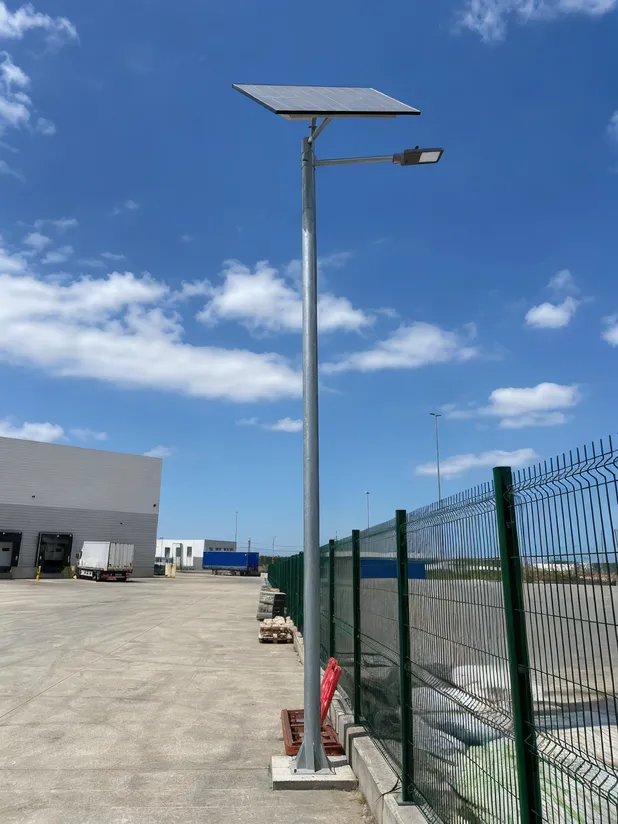
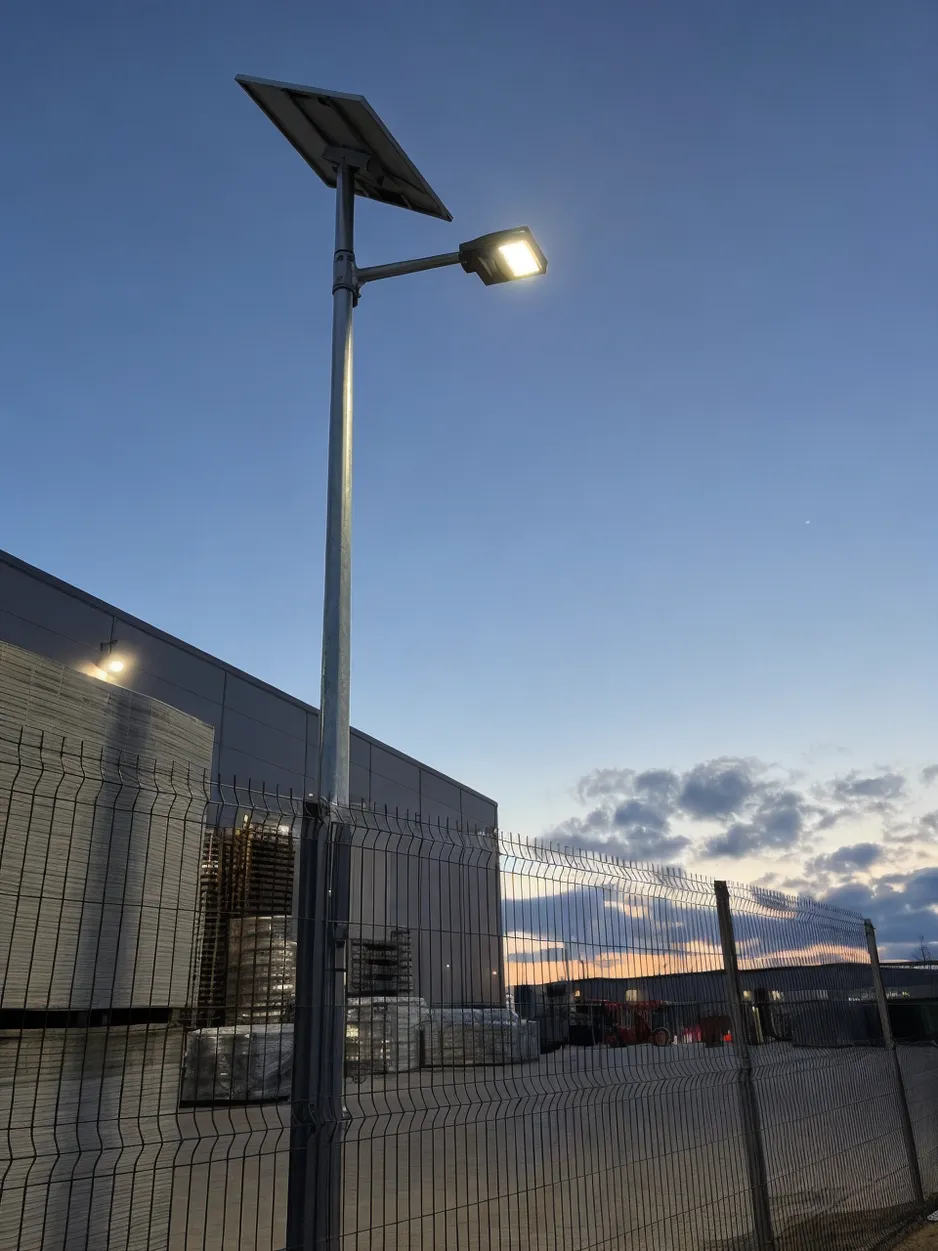
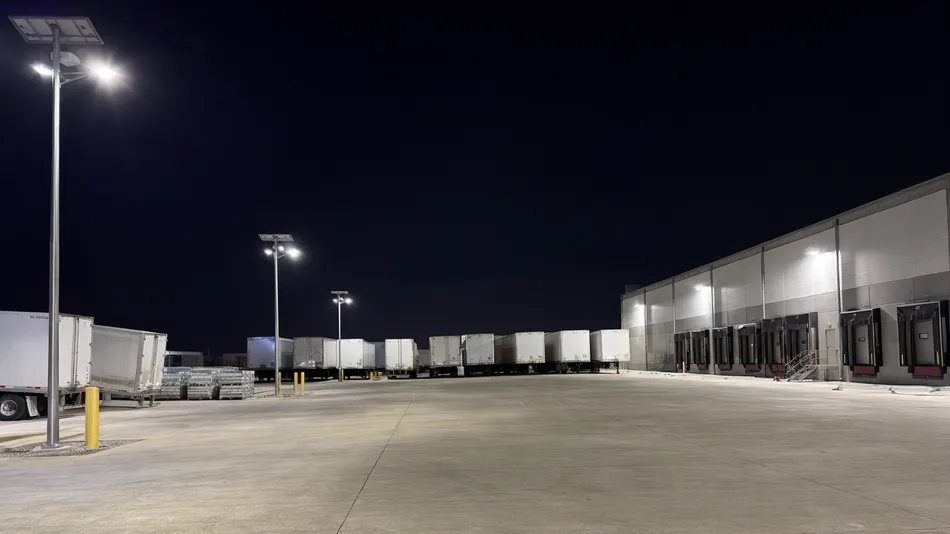
Pole-mounted commercial solar area light — typical configuration for logistics and industrial compound perimeters.
Configuration Data Buyers Need Before Pricing
Pricing a commercial solar area light order without locking the configuration first is how buyers end up with a quote that doesn't match the project. The table below covers the typical specification fields for this product type. Use it to build your comparison sheet or tender document — then send us the target values and we'll confirm the matching model and pricing.
| Specification | Typical Range / Options |
|---|---|
| LED Power | 30W – 200W (project dependent) |
| Lumen Output | 3,000 lm – 24,000 lm (typical; varies by LED efficacy) |
| Solar Panel | 40W – 300W monocrystalline, integrated or split-panel options |
| Battery Type | LiFePO4 (lithium iron phosphate), standard configuration |
| Battery Capacity | 20Ah – 200Ah (sized to autonomy requirement and latitude) |
| Autonomy Days | 2–5 rainy days (project and latitude dependent) |
| Charge Time | 6–10 hours full sun (typical) |
| Color Temperature (CCT) | 3000K / 4000K / 5000K / 6000K (custom available) |
| Beam Angle | 60° – 150° (model dependent; asymmetric options available) |
| Mounting Height | 5m – 12m pole height (typical commercial range) |
| Mounting Options | Pole top, side arm, wall bracket (model dependent) |
| Control Modes | Dusk-to-dawn, dimming schedule, motion sensor, time control |
| IP Rating | IP65 standard; IP67 available on specified models |
| Working Temperature | -20°C to +60°C (typical) |
| Housing Material | Die-cast aluminum, powder-coated finish |
| Warranty | 3 years standard |
Specifications shown are typical values for this product type. Exact parameters vary by model and configuration. Contact us for detailed data sheets and project-specific configuration confirmation.
Why LiFePO4 Is Standard on Commercial Area Lights
We moved away from lead-acid and standard lithium configurations on commercial area lights several years ago because the cycle life difference is significant in outdoor deployment. LiFePO4 cells typically deliver 2,000+ charge/discharge cycles at 80% depth of discharge, which translates to 5–7 years of battery service life under normal commercial use.
That matters for your warranty exposure and for the downstream customer's total cost of ownership argument.
Industrial Solar Lighting — Higher Lumen Configurations
For industrial solar lighting applications with higher lumen requirements — logistics yards, warehouse exteriors, large industrial compounds — the 100W–200W range with 150Ah–200Ah battery capacity and 200W–300W solar panel is the typical configuration direction. We'll confirm the exact sizing once you provide the target latitude and operating hours.
Send your target lumen output and pole height for a configuration quoteMatching Lumen, Pole Height, and Autonomy to Site Economics
The most common over-specification mistake on commercial solar area light projects is sizing the battery and panel for worst-case weather without accounting for the freight cost of the larger fixture. A 150Ah battery pack adds meaningful weight and carton volume — on a 500-unit project order, that difference in container loading can shift your landed cost by more than the battery upgrade saves in warranty callbacks.
Practical Planning Framework
| Site Type | Pole Height | Lighting Priority | Configuration Direction |
|---|---|---|---|
| Commercial parking perimeter | 6m – 8m | Perimeter security, pedestrian safety | 60W–100W, 2–3 autonomy days, dusk-to-dawn or dimming |
| Logistics yard / loading area | 8m – 12m | Wide-area illumination, vehicle movement | 100W–200W, 3–4 autonomy days, full-night or scheduled dimming |
| Industrial compound exterior | 8m – 10m | Security perimeter, access control zones | 80W–150W, 3–5 autonomy days, motion sensor or scheduled |
| Campus / business park | 6m – 8m | Pedestrian paths, open plazas | 40W–80W, 2–3 autonomy days, dimming schedule |
| Remote commercial site | 6m – 10m | Basic area coverage, minimal grid dependency | 60W–120W, 4–5 autonomy days, dusk-to-dawn |
Autonomy Planning by Climate Zone
2–3 rainy days covers most tropical and subtropical markets. For buyers supplying Northern Europe, Canada, or high-latitude markets where winter irradiance drops significantly, 4–5 autonomy days with a larger panel is the safer spec.
We've shipped both configurations to buyers in Scandinavia and the Gulf — the Gulf buyers typically land on 3 autonomy days with a larger panel for summer heat management, while Northern European buyers need the extra battery capacity for short winter days.
Heat management note: LiFePO4 cells perform better in high-temperature environments than standard lithium, but solar panel output still drops above 45°C cell temperature. Panel sizing for hot climates needs to account for that derating.
Control Logic and Battery Consumption
Control logic affects battery consumption more than most buyers expect. A full dusk-to-dawn schedule at 100% output draws the battery down faster than a dimming schedule that runs 100% for the first 4 hours and 30% for the remainder.
For commercial sites where full-brightness coverage isn't needed all night, a dimming schedule extends autonomy by 30–40% without changing the battery or panel spec.
Pre-configured before shipment: Send us your operating hours and we'll set the controller logic. No field programming required on site.
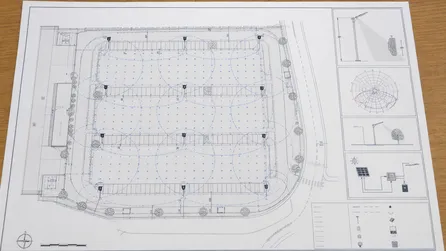
For detailed site layout and spacing guidance, the solar parking lot lighting design guide covers fixture spacing, pole placement, and illuminance calculation methods.
Send a Site Drawing for Engineering ReviewCommercial Segments Where This SKU Can Move Volume
Commercial solar area lights aren't a single-project product. The segments below represent repeatable demand patterns — buyers who have built distribution programs or project supply relationships in these areas reorder consistently because the underlying demand is structural, not one-off.
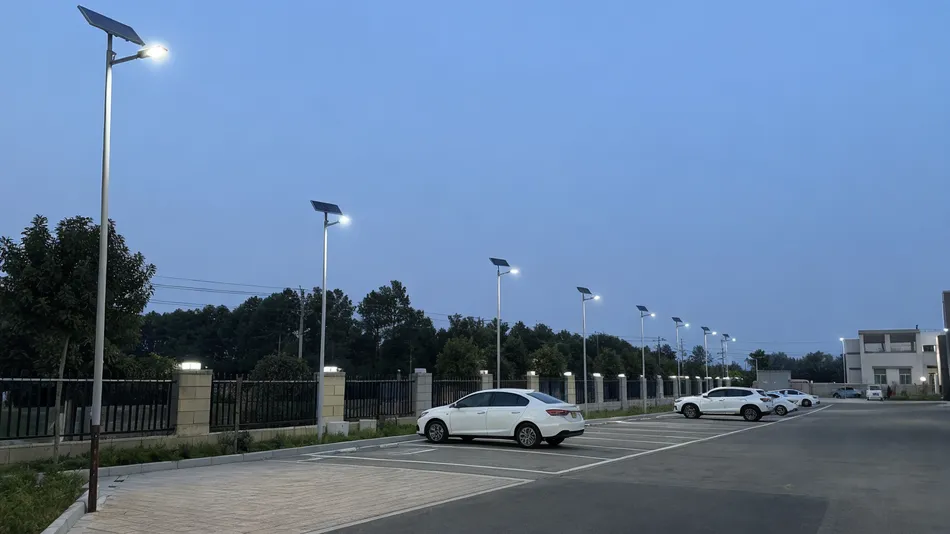
Commercial Parking and Perimeter Zones
Property management companies, retail chains, and commercial real estate developers need perimeter and parking area lighting that doesn't require trenching or utility coordination for each new site. A distributor supplying this segment can build a standard SKU — typically 60W–100W, 6m–8m pole height, dusk-to-dawn or dimming schedule — and quote it across multiple properties without custom engineering per site.
Typical Segment Parameters
Order sizes in this segment typically run 50–300 units per property, with reorder cycles tied to new site openings or property upgrades.
Margin argument to end buyer: No trenching cost, no utility connection fee, faster installation.
Logistics Yards and Loading Areas
Warehouses, distribution centers, and freight yards need high-output area lighting for vehicle movement, loading dock access, and security coverage. This is the segment where the 100W–200W configuration earns its cost — the alternative is running grid power to a large outdoor yard, which involves significant civil work.
Typical Segment Parameters
Industrial solar lighting for logistics applications typically requires 3–4 autonomy days and full-night operation, which drives the battery and panel spec up. Order sizes here tend to be larger per site (100–500 units for a major distribution center), and the buyer is often a contractor or EPC firm rather than a distributor.
Documentation requirements: CE, IP ratings, and sometimes IEC 62124 compliance for the solar component.
Industrial Compounds and Warehouse Exteriors
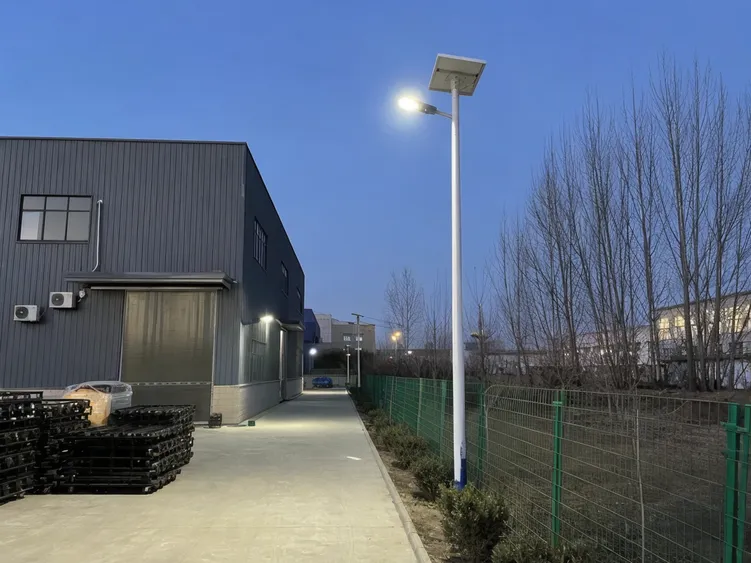
Manufacturing plants, processing facilities, and industrial parks need exterior lighting for security perimeters, access roads, and equipment yards. Grid cable runs across large industrial sites are expensive and slow — solar area lights eliminate the cable run entirely.
Typical Configuration for Industrial Solar Lighting
- Power range: 80W–150W
- Control: Motion sensor or scheduled control
- Mounting: 8m–10m on existing or new poles
Buyers supplying this segment often work through industrial distributors or EPC contractors who need consistent batch quality across a multi-site rollout.
Lumen Consistency Between Batches
A 10% lumen variance between the first and second shipment creates visible inconsistency across a site. Buyers in this segment require tight batch-to-batch lumen control to avoid patchwork lighting across perimeters and access roads.
Campuses, Business Parks, and Municipal Lots
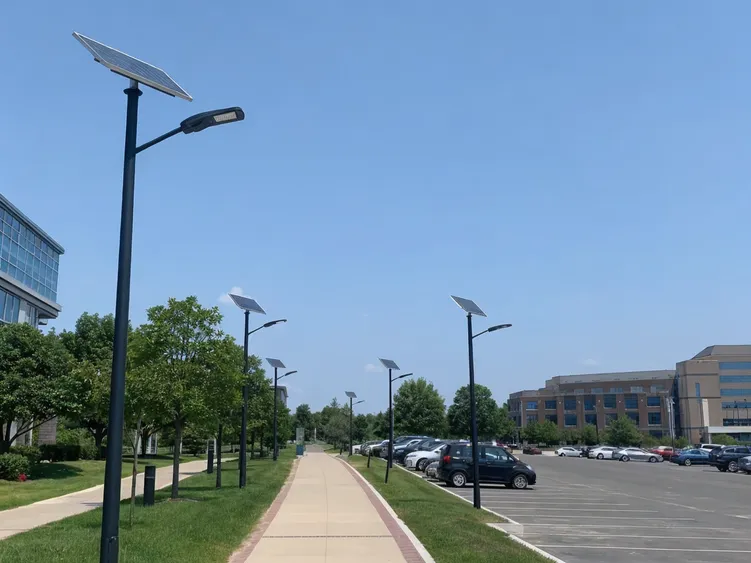
Universities, corporate campuses, and municipal parking authorities run procurement through tender processes that require documentation: CE Declaration of Conformity, RoHS compliance records, IP test certificates, and sometimes IEC 62124 for the solar panel.
Fixture Spec for This Segment
- Power range: 40W–80W
- Pole height: 6m–8m
- Control: Dimming schedule
The documentation requirement is higher than for private commercial sites. Buyers supplying this segment need a factory that can provide the full compliance file, not just a CE mark on the label.
Documentation Readiness
We've had buyers lose a tender because their supplier couldn't produce the CE Declaration of Conformity on request. We provide it with the order — along with RoHS compliance records, IP test certificates, and IEC 62124 documentation when specified.
Off-Grid Operations Where Solar Is the Only Practical Option
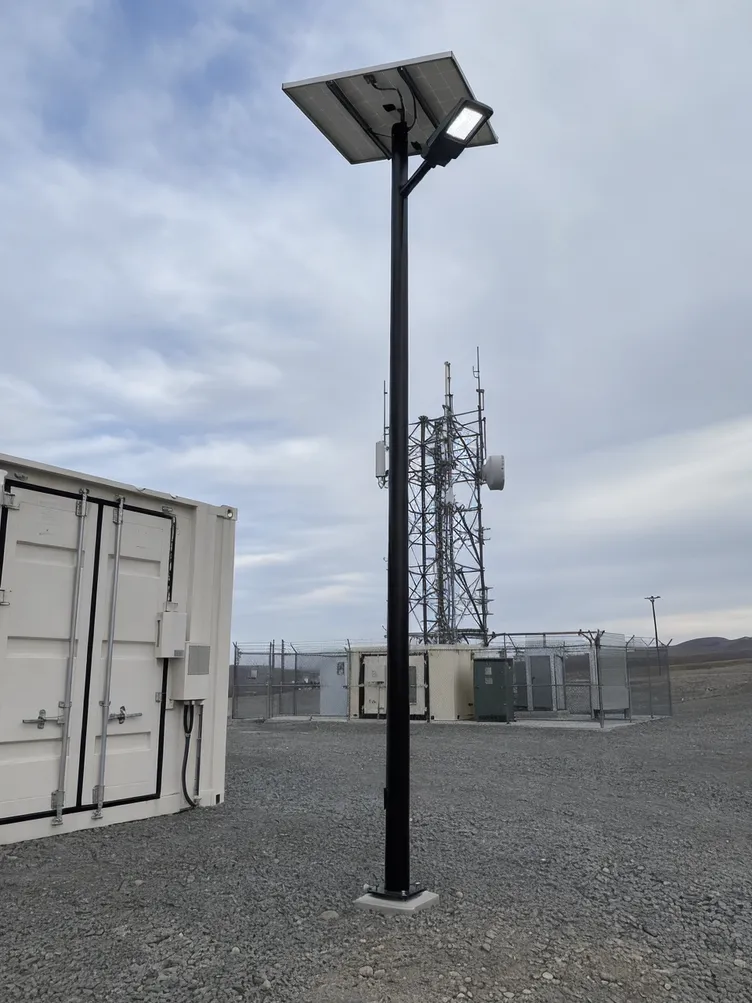
Farms, mining operations, telecom infrastructure yards, and temporary commercial facilities in areas without reliable grid access represent a segment where solar area lighting isn't a cost-saving choice — it's the only practical option.
The configuration for remote sites prioritizes autonomy: 4–5 rainy days, larger battery, and a panel sized for the site's latitude. Order sizes are smaller per site but the buyer base is broad — agricultural distributors, telecom infrastructure contractors, and mining supply companies all have this need. The reorder pattern is project-driven rather than catalog-driven, but the per-unit margin is typically higher because the alternative (generator or grid extension) is significantly more expensive.
Configuration Priority for Remote Sites
Battery, LED, Controller, and Waterproof Checks Before Shipment
The three failure modes that generate the most warranty claims on commercial solar area lights are battery failure after the first rainy season, lumen inconsistency between batches, and waterproof housing failures in outdoor installation. We've been tracking these failure patterns since 2012, and our production controls are built around preventing all three.
Battery Matching and Aging Tests
Battery cells from the same production batch can vary in capacity and internal resistance by more than the spec sheet suggests. We match cells by capacity and internal resistance before assembling battery packs — a pack built from mismatched cells will have one cell reaching full discharge before the others, which accelerates degradation and shortens the pack's service life.
After assembly, every battery pack goes through a charge/discharge cycle test on our aging racks before it's installed in a fixture. A pack that doesn't hold its rated capacity at the test stage doesn't ship.
This is the step that most factories skip because it adds time — it's also the step that prevents the "battery dead after one winter" complaint.
LED Module Lumen and CCT Confirmation
LED chips from the same bin code can still vary in lumen output and color temperature by 5–10% across a production run. We confirm lumen output and CCT at the module assembly stage, before the module is installed in the fixture housing.
For commercial area light orders where the buyer is supplying multiple sites or a large single site, this confirmation step is what keeps the second shipment visually consistent with the first.
Lumen binning at assembly is standard practice in quality solar lighting production — it's not standard practice at every factory.
Waterproof Structure Inspection
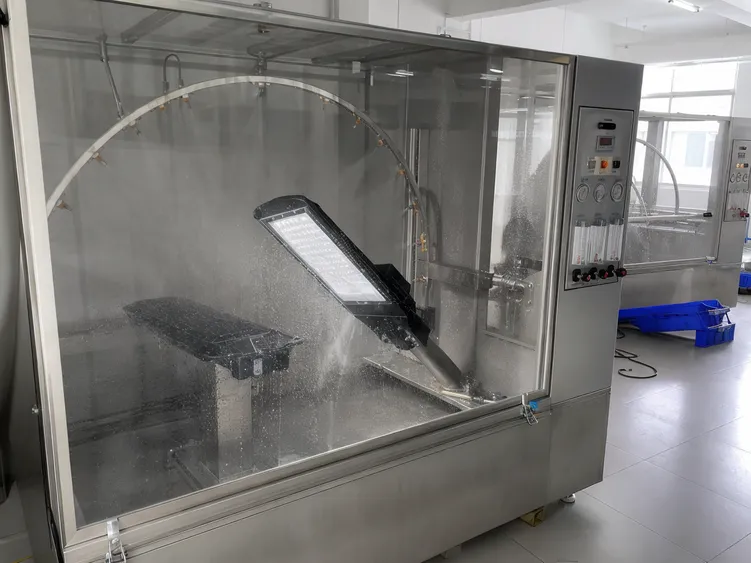
IP65 and IP67 ratings are tested on our own waterproof inspection equipment, not assumed from housing design. Every fixture goes through a waterproof structure check before final packing.
The most common waterproof failure point on solar area lights is the cable entry gland and the junction between the LED module and the housing — both are checked at the inspection stage.
We've seen fixtures from other factories arrive with IP65 markings that failed a basic water ingress test. Our IP test certificates are available with the order.
Controller and Sensor Function Verification
Every controller is function-tested before installation: lighting mode, dimming schedule, motion sensor response (where applicable), and charge/discharge logic.
A controller that passes the function test at the bench stage is less likely to generate a field callback than one that's only checked at final assembly.
100% Pre-Shipment Inspection
Every unit, every carton, every accessory pack, every label — checked before the container is sealed. This is a non-negotiable part of our production process. It adds time. It also means defective units are caught before they're on a ship, not after they're in your warehouse or on a project site.
Customization That Changes the Quote
Standard catalog models cover most commercial solar area light applications. When the standard spec doesn't match your project or distribution requirements, the customization options below are available — with the caveat that anything outside the standard configuration requires an engineering review before production.
| Customization Parameter | Options / Range | Notes |
|---|---|---|
| Lumen Output | Adjustable within LED module design range | Significant changes may require different LED module or driver |
| Color Temperature (CCT) | 3000K / 4000K / 5000K / 6000K | Standard options; other CCT on request |
| Battery Capacity | Sized to autonomy requirement | Larger capacity changes housing/panel spec |
| Solar Panel Wattage | Sized to battery and latitude | Panel size affects fixture dimensions and freight volume |
| Lighting Mode / Control Logic | Dusk-to-dawn, dimming schedule, motion sensor, time control, remote | Configured before shipment; specify operating hours |
| Beam Angle | 60° – 150°; asymmetric options | Affects pole spacing and illuminance distribution |
| Housing Color | Standard black/grey; custom RAL on request | Custom color requires minimum run |
| Logo / Label | Custom label, packaging insert, or housing marking | OEM/ODM terms apply |
| Packaging | Standard export carton; custom box, insert, or label | Minimum run for custom packaging |
| Installation Accessories | Pole adapter, mounting bracket, remote controller | Specify at order stage |
MOQ Structure
Standard catalog models: MOQ starts at 100 units — low enough to test a new SKU with your market before committing to a larger program.
Custom configurations (non-standard lumen output, battery capacity, housing color, or OEM packaging): typically require a minimum of 200–500 units depending on the complexity of the change.
The engineering review for custom specs is included — we'd rather spend the time confirming the configuration is achievable before production than resolve a spec mismatch after the first batch ships.
Preparing an RFQ That Gets a Useful Response
To prepare an RFQ that gets a useful response rather than a generic price list, include:
- Target site type
- Pole height
- Required lumen output or illuminance level
- Operating hours per night
- Autonomy days
- Destination market
- Order quantity
- Certification or documentation requirements
If you have a project drawing or existing fixture spec, send that too — it's faster than translating requirements into a spec sheet from scratch.
Export Documentation, Compliance, and Weatherproof Construction
The certifications we hold on commercial solar area lights: ISO 9001:2015, CE, RoHS, IP65/IP67 Ingress Protection, and IEC 62124. Each one covers a specific compliance requirement that affects your ability to import, sell, or deploy the product in regulated markets.
CE Marking
Covers electrical safety and electromagnetic compatibility requirements for the European market and markets that accept CE as a compliance baseline. The CE Declaration of Conformity is available with the order — not on request after a customs hold.
RoHS Compliance
Covers restricted substance requirements for the EU and markets with equivalent regulations. Our RoHS compliance traces back to the component level: LED chips, battery cells, and electronic components are sourced from suppliers who provide material declarations, and we maintain records by batch. For buyers importing into the EU or supplying tenders with RoHS requirements, compliance documentation is available at the component level, not just as a finished-product declaration.
IP65 / IP67
Ratings are tested on our own waterproof inspection equipment. IP65 is the standard configuration for commercial solar area lights; IP67 is available on specified models for applications with higher water ingress risk (flood-prone areas, high-pressure wash environments). IP test certificates are available with the order.
IEC 62124
Covers the performance requirements for stand-alone solar systems, including the photovoltaic component. This is the certification that matters for buyers supplying tenders or regulated infrastructure projects where the solar panel's electrical performance needs to be documented.
Markets Outside the EU
For buyers supplying markets outside the EU — North America, the Middle East, Southeast Asia, Africa — we can advise on which certifications are relevant for your specific market and what additional documentation may be needed for customs clearance or project tender compliance.
Packing, Project Delivery, and Reorder Control
Commercial solar area light orders involve more than the fixture itself. A typical shipment includes the fixture head, solar panel (integrated or separate depending on model), battery pack, mounting hardware, pole adapter or bracket, controller (where applicable), remote (where applicable), and installation guide.
Accessory Pack Verification
Every accessory pack is checked against a packing list before the carton is sealed — missing accessories on a project site create installation delays that cost more than the accessory itself.
Container Loading
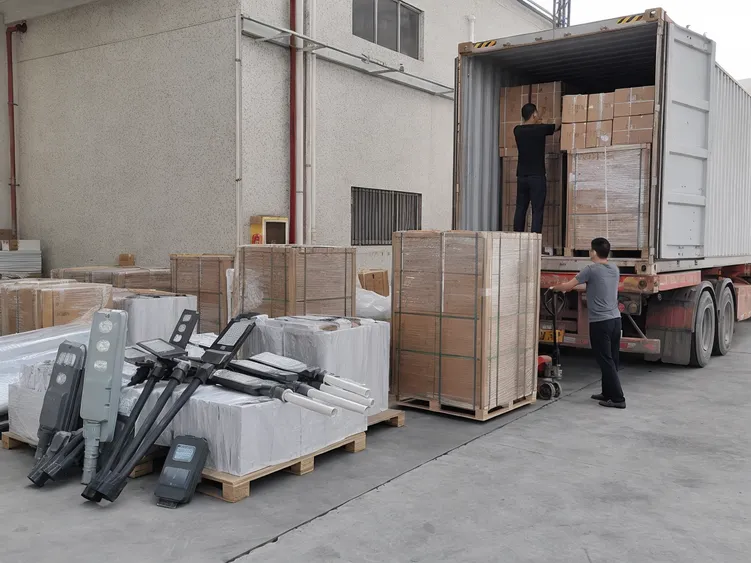
Export cartons are sized for standard 20GP and 40HQ container loading. Exact loading quantities depend on the fixture model, panel size, and pole configuration — we confirm container loading details at the quotation stage, not after the order is placed. Palletized delivery is available for buyers who need palletized receiving at their warehouse or project site.
SKU & Batch Traceability
SKU labeling includes batch codes for traceability. If a quality issue surfaces in the field, the batch code lets you trace the affected units back to the production run and isolate the scope of the problem. For distributors managing multiple SKUs across multiple orders, batch traceability is the difference between a targeted recall and a full inventory review.
Mixed-SKU Consolidated Shipments
Mixed-SKU orders are handled regularly — distributors building a solar lighting catalog often combine commercial solar area lights with solar parking lot lights, solar pole lights, or other products from the same category in a single container. We coordinate the production schedule across SKUs to keep the shipment consolidated.
Choose the Right Area Lighting Product Under This Category
The products under the solar parking lot and area lighting category cover different application scopes and buyer needs. Use the table below to confirm this page is the right match for your project, or navigate to the product that fits better.
| Product | Best Fit | When to Choose |
|---|---|---|
| Solar Parking Lot Lights | Parking lot vehicle circulation and stall lighting | Defined parking layout, vehicle-area illuminance requirements, lot-specific pole spacing |
| Solar Area Lights | General outdoor open-space lighting | Broader open-area coverage without commercial/industrial specification requirements |
| Commercial Solar Area Lights This Page | Commercial and industrial fixed installation, project supply, distributor SKUs | Commercial property, industrial yards, logistics zones, campuses, tender supply, repeatable B2B orders |
| Solar Pole Lights | Pole-mounted fixture sourcing with decorative or architectural requirements | Aesthetic pole-top fixtures for plazas, campuses, or streetscape applications |
| Solar Yard Lights | Smaller property and yard lighting | Residential, farm, or small commercial property with lower lumen requirements |
| Solar Lighting Tower | Temporary or mobile lighting for jobsites and events | Portable deployment, no fixed installation, temporary infrastructure |
Solar Parking Lot Lights
Parking lot vehicle circulation and stall lighting
Defined parking layout, vehicle-area illuminance requirements, lot-specific pole spacing
Solar Area Lights
General outdoor open-space lighting
Broader open-area coverage without commercial/industrial specification requirements
Commercial Solar Area Lights
This PageCommercial and industrial fixed installation, project supply, distributor SKUs
Commercial property, industrial yards, logistics zones, campuses, tender supply, repeatable B2B orders
Solar Pole Lights
Pole-mounted fixture sourcing with decorative or architectural requirements
Aesthetic pole-top fixtures for plazas, campuses, or streetscape applications
Solar Yard Lights
Smaller property and yard lighting
Residential, farm, or small commercial property with lower lumen requirements
Solar Lighting Tower
Temporary or mobile lighting for jobsites and events
Portable deployment, no fixed installation, temporary infrastructure
If you're not certain which product fits your project, send us the site type, pole height, and lumen requirement — we'll point you to the right configuration.
Procurement FAQ for Commercial Solar Area Lights
Answers to the specification and configuration questions buyers ask most frequently when sourcing commercial solar area lights for project supply.
What lumen output is typical for commercial solar area lights?
What lumen output is typical for commercial solar area lights?
For most commercial applications — parking perimeters, business park paths, campus open areas — the 6,000–12,000 lm range covers the majority of projects at 6m–8m pole height. Logistics yards and industrial compounds with higher illuminance requirements typically run 12,000–20,000 lm at 8m–12m pole height.
The right lumen output depends on your pole spacing, mounting height, and the illuminance level required by the project spec or local standard.
Send us your pole layout and we'll calculate the required output.
How many rainy days of autonomy should I specify for commercial solar area lights?
How many rainy days of autonomy should I specify for commercial solar area lights?
For tropical and subtropical markets (Southeast Asia, Middle East, Africa, Latin America), 2–3 rainy days is the standard specification for commercial solar lighting. For temperate markets with longer overcast periods (Northern Europe, Canada, northern China), 3–5 rainy days is more appropriate.
Autonomy is a function of battery capacity, operating hours, and lumen output — increasing autonomy without adjusting the operating schedule or dimming logic increases battery size, which increases fixture weight and freight cost.
We size the battery to your target autonomy and latitude; tell us both and we'll confirm the configuration.
Are commercial solar area lights suitable for industrial yards and warehouse exteriors?
Are commercial solar area lights suitable for industrial yards and warehouse exteriors?
Yes — industrial solar lighting for yards, loading areas, and warehouse exteriors is one of the primary applications for this product. The key configuration differences for industrial applications are:
Lumen Output
100W–200W range
Autonomy
3–4 days minimum
IP Rating
IP65 / IP67
Robust housing spec is required for environments with dust, vibration, or chemical exposure. IP65 is the standard; IP67 is available for higher-exposure environments.
For large industrial sites with multiple poles, we can supply a consistent batch spec across the full order to avoid lumen variance between poles.
What IP rating should outdoor commercial solar lighting use?
What IP rating should outdoor commercial solar lighting use?
IP65 is the minimum for any outdoor commercial solar lighting installation — it covers dust ingress protection and water jet resistance. For installations in flood-prone areas, coastal environments with salt spray, or sites where fixtures may be exposed to high-pressure washing, IP67 (temporary immersion up to 1m) provides additional protection.
We test IP ratings on our own waterproof inspection equipment and provide IP test certificates with the order. Don't accept an IP rating that's only marked on the label without a test certificate to back it up.
Can the battery capacity, solar panel wattage, and lighting mode be customized?
Can the battery capacity, solar panel wattage, and lighting mode be customized?
All three are configurable. Battery capacity is sized to your autonomy requirement and operating hours. Solar panel wattage is sized to the battery capacity and your target latitude's peak sun hours. Lighting mode — dusk-to-dawn, dimming schedule, motion sensor, time control — is configured in the controller before shipment.
Standard catalog models cover the most common configurations; non-standard specs require an engineering review and a minimum order quantity that depends on the complexity of the change. MOQ for standard models starts at 100 units.
What documents can JXSOL provide for export or project tenders?
What documents can JXSOL provide for export or project tenders?
We provide: CE Declaration of Conformity, RoHS test reports, IP test certificates, IEC 62124 compliance documentation, ISO 9001:2015 certification, and product data sheets.
For buyers supplying regulated markets or project tenders, specify the documentation requirements at the quotation stage and we'll confirm what's available and what can be prepared for your order. We don't provide documentation after the container ships — it's confirmed and included with the order.
What is the MOQ for standard commercial solar area light models?
What is the MOQ for standard commercial solar area light models?
100 units for standard catalog models. This is low enough to test a new SKU with your market or validate a configuration for a project before committing to a larger run.
Custom configurations — non-standard lumen output, battery capacity, housing color, OEM packaging — typically require 200–500 units depending on the scope of the customization. We'll confirm the MOQ for your specific configuration at the quotation stage.
Ready to configure your order?
Send your site requirements for a recommended configuration and confirmed pricing.
Quote Checklist for Faster Engineering Review
The more specific your inquiry, the faster we can return a configuration recommendation and pricing. Generic inquiries take longer because we have to ask the same questions anyway.
Send Us These Details for a Specific Configuration and Quote
Site Type
Parking lot, logistics yard, industrial compound, campus, remote site, or other
Quantity
Number of fixtures per order
Pole Height
Target mounting height in meters
Lumen Requirement
Target lumen output or illuminance level (lux) if known
Operating Hours
Full-night, partial-night, or dimming schedule
Autonomy Days
Target rainy-day backup: 2, 3, 4, or 5 days
Color Temperature
3000K / 4000K / 5000K / 6000K
Destination Market
Country or region — affects certification and documentation requirements
Certification Requirements
CE, RoHS, IP test certificates, IEC 62124, or other
Packaging / Branding
Standard export carton, custom packaging, or OEM label
Have Supporting Documents?
If you have a project drawing, existing fixture spec, or a sample of what you're currently sourcing, send that too — our engineering team will review it and recommend the configuration that matches your requirement.
Contact Engineering
Phone / WhatsApp
+8613627818806Explore more solar area lighting products
Back to Solar Parking Lot & Area Lights© 2026 JXSOL. All rights reserved.