

Solar Lighting Tower Direct From Factory
Mobile, self-contained solar lighting towers — no grid, no fuel, no trenching, deployable in under an hour.
Built for construction sites, mining operations, emergency response, and rental fleets. Every tower ships with 100% pre-shipment inspection and full export documentation. MOQ from 100 units. OEM/ODM supported.
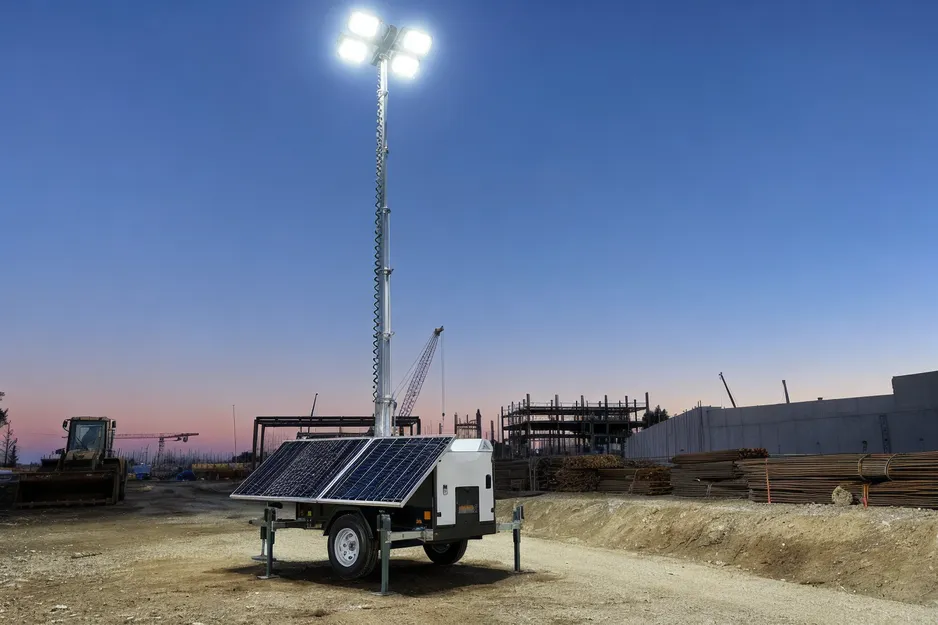
Solar Lighting Tower: Mobile Site Illumination Without Grid Dependency
A solar lighting tower is a self-contained, movable outdoor lighting system — solar panel, battery storage, LED floodlights, charge controller, mast, and trailer or mobile base, all in one unit. It generates and stores its own power, deploys without grid connection or fuel supply, and repositions as the site changes. That combination is what separates it from every other product in the solar parking lot and area lighting series.
The rest of the products in this category — parking lot lights, area lights, pole lights, yard lights — are fixed installations. You set the pole, you wire the fixture, and it stays there. A solar light tower is different by design. The mast telescopes or folds, the base rolls or lifts, and the whole unit moves with the work. For buyers supplying construction contractors, rental companies, emergency management agencies, or mining operators, that mobility is the product's commercial value — not the lumen output, not the panel wattage, but the ability to put light exactly where it's needed and move it tomorrow.
We've been manufacturing solar lighting since 2012, and the tower category has grown faster than any other segment in our area lighting line over the last three years. The driver isn't novelty — it's the economics. Diesel light towers require fuel logistics, generator maintenance, and exhaust management. Grid-connected temporary lighting requires trenching permits and electrical contractors. A portable solar lighting tower eliminates all three cost centers. For buyers building a rental fleet or supplying project contractors, that cost structure is the selling argument, and it's one that holds up across markets.
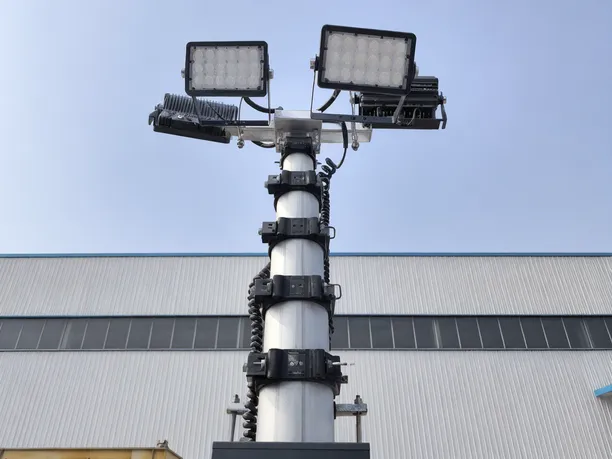
What Makes It Different
- Mast telescopes or folds; base rolls or lifts — moves with the work
- Self-contained power: solar panel + battery + charge controller
- Zero grid connection, zero fuel supply required
- Deployable in under an hour by a two-person crew
Deployment Economics: What Buyers Actually Pay For
The unit price of a solar lighting tower is higher than a comparable diesel tower on a per-unit basis. That's the first number buyers see, and it's the wrong number to anchor on. The commercial case for a portable solar lighting tower is built on the costs it removes from the deployment equation.
No Fuel Logistics
A diesel tower running 10 hours per night consumes roughly 3–5 liters of fuel per hour depending on generator load. On a 90-day construction project, that's 2,700–4,500 liters of diesel per tower — procurement, delivery, on-site storage, and spill management included.
A solar lighting tower's fuel cost is zero. For buyers supplying remote sites, mining operations, or emergency response staging areas where fuel delivery is a logistical problem, this is the number that closes the conversation.
No Grid Connection
Temporary grid-connected lighting requires an electrical contractor, a permit, a trenching crew, and a disconnection at project end. In most markets, that process adds $2,000–$8,000 per installation point before the first light turns on.
A solar light tower arrives on a trailer, the mast goes up, and the lights come on the same day. For rental companies, that deployment speed is a direct margin driver — faster setup means more billable days per unit per year.
Lower Maintenance Overhead
Diesel generators have oil changes, filter replacements, spark plug cycles, and fuel system maintenance. Solar towers have none of those. The maintenance items on a solar lighting tower are the battery pack (typically 3–5 year replacement cycle depending on chemistry and cycle depth) and the LED modules (50,000+ hour rated life).
For rental fleet operators, fewer maintenance events per unit per year means higher utilization and lower operating cost per rental day.
Faster Site Setup
A two-person crew can deploy a portable solar lighting tower in under an hour with no specialized tools.
That speed matters on construction sites where the lighting position changes weekly, on emergency response deployments where setup time is measured in minutes, and on event sites where the lighting layout changes between events.
We've had rental fleet buyers tell us their solar towers pay back the price premium over diesel in 18–24 months on fuel savings alone, before accounting for maintenance. We don't publish that as a guarantee — site conditions vary — but the math is consistent enough that it's worth running for your specific market.
Solar Lighting Tower Specifications Buyers Can Put Into an RFQ
The table below covers the standard configuration range for our solar lighting towers. Values marked as "configurable" vary by model and project specification — include your target parameters in your RFQ and we'll confirm the exact configuration.
| Parameter | Standard Range / Options |
|---|---|
| LED Power | 100W – 400W per fixture |
| Lumen Output | 10,000 lm – 40,000 lm (total, all fixtures) |
| Number of Fixtures | 2–4 LED floodlights per tower |
| Beam Angle | 60°, 90°, 120°; adjustable fixture angle |
| Color Temperature | 4000K, 5000K, 5700K, 6500K |
| Solar Panel Wattage | 200W – 800W (monocrystalline) |
| Battery Chemistry | LiFePO4 (lithium iron phosphate) |
| Battery Capacity | 500Wh – 3,000Wh (configurable) |
| Autonomy (no sun) | 1–3 nights at full output; 3–5 nights at 50% dimming |
| Charging Time | 6–10 hours (full sun) |
| Mast Height | 6m – 12m (telescoping or folding) |
| Mast Material | Hot-dip galvanized steel or powder-coated aluminum |
| Base / Mobility | Trailer with tow hitch, skid base, or wheeled frame |
| IP Rating | IP65 (standard); IP67 available on specified models |
| Housing Material | Die-cast aluminum, powder-coated |
| Operating Temperature | -30°C to +60°C |
| Wind Resistance | Rated to withstand 100–120 km/h wind (mast deployed) |
| Working Modes | Full-night, 50% dimming after midnight, motion-activated, manual |
| Charge Controller | MPPT (maximum power point tracking) |
| Warranty | 3 years |
| Certifications | CE, RoHS, IP65/IP67, IEC 62124, ISO 9001:2015 |
Note: Specifications shown are standard configuration ranges. Actual values depend on model selection and project requirements. Contact us for a detailed product data sheet and configuration recommendation.
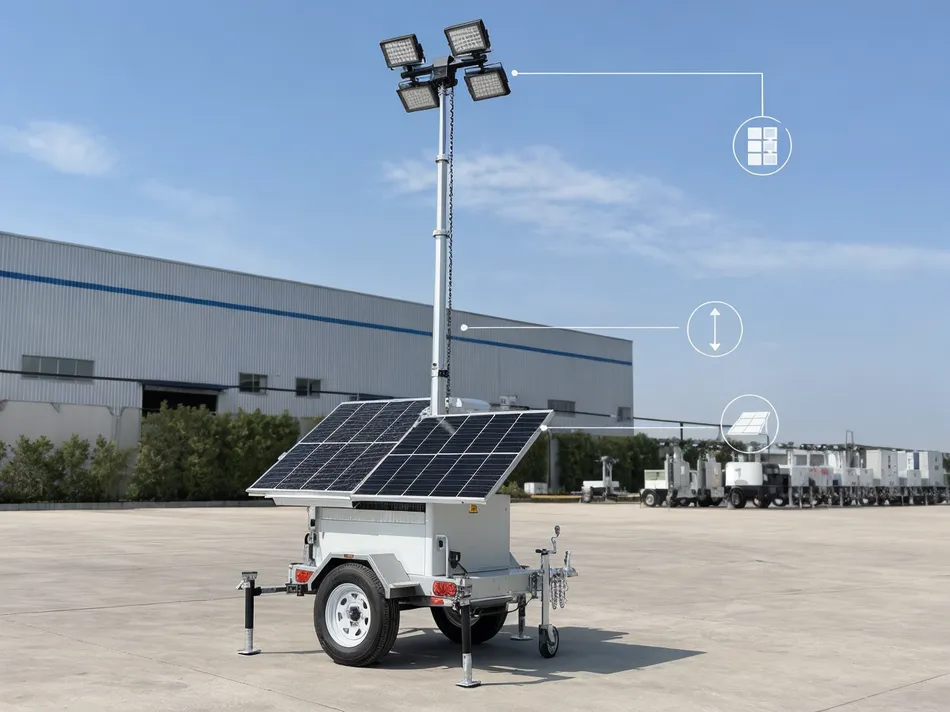
Compliance Documentation for Regulated Markets
For buyers importing into regulated markets, CE Declaration of Conformity, RoHS test reports, and IP test certificates are available with the order. Documentation is prepared per-shipment and can be customized to your market's import requirements.
Ready to Specify Your Configuration?
Include your target lumen output, mast height, autonomy requirement, and destination market in your RFQ — we'll return a confirmed configuration within 48 hours.
Portable Solar Lighting Tower Use Cases That Create Repeat Orders
The commercial value of a portable solar lighting tower changes by market segment. The segments below are the ones where we see consistent repeat order patterns — buyers who stock or deploy one tower come back for more because the product solves a recurring problem in their market.
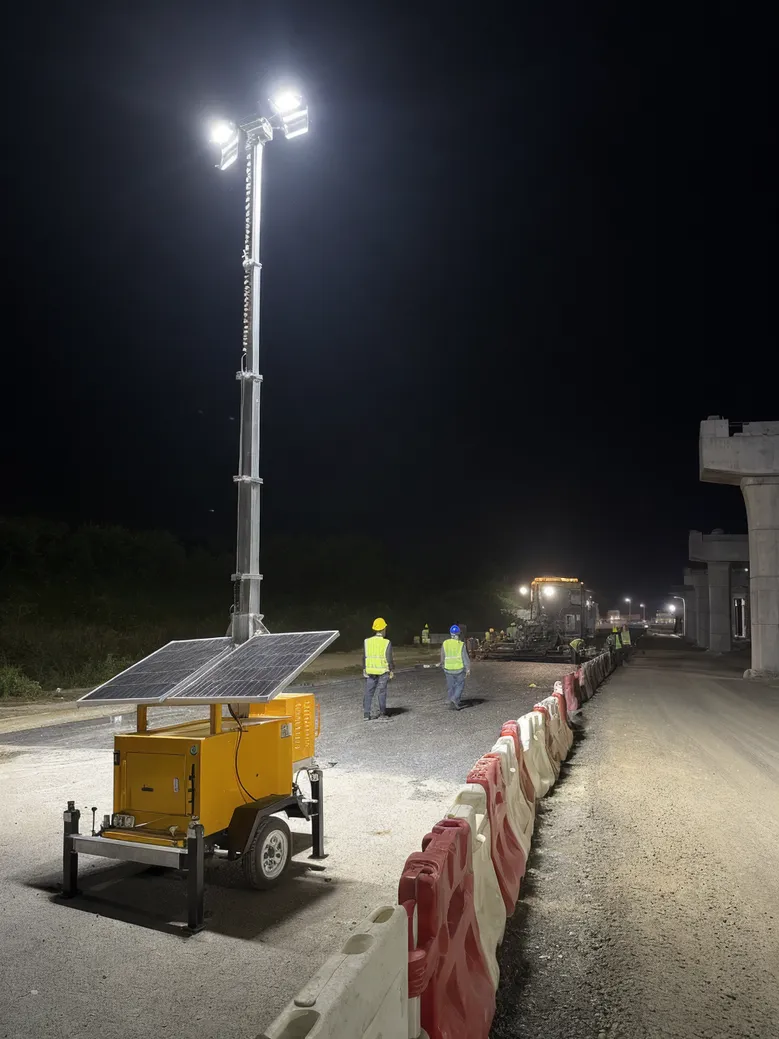
Road Construction and Civil Works
Road construction projects move. The lighting position that covers the active work zone on Monday is wrong by Friday. A portable solar lighting tower repositions with the crew — no electrician, no permit, no delay.
Contractors running night shifts on highway projects, bridge construction, or utility trenching typically need 2–6 towers per active work zone, and a project running 6–12 months generates multiple reorder cycles as towers are added, repositioned, or replaced after site damage.
Distributor Insight
For distributors supplying construction contractors, this is a high-frequency, project-driven segment with predictable volume. Each active work zone represents 2–6 units, and multi-month timelines create natural reorder cycles.
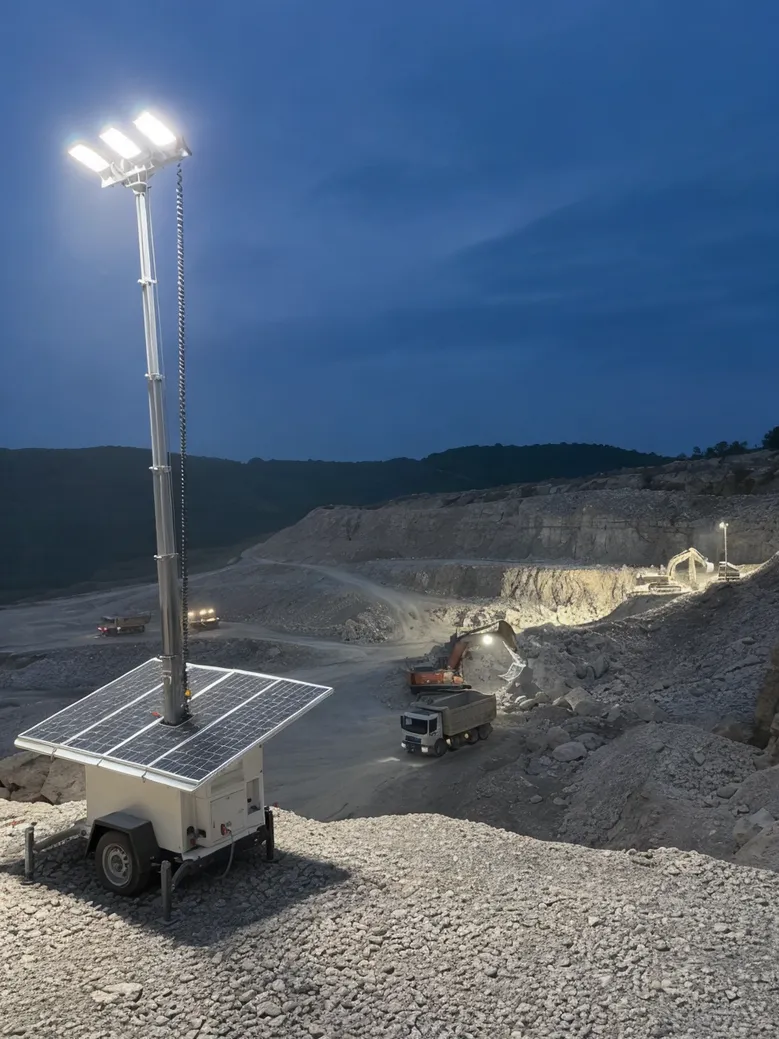
Mining and Quarry Operations
Mining sites combine the worst conditions for fixed lighting infrastructure: remote locations, no grid access, heavy equipment traffic that damages fixed poles, and work zones that shift as extraction progresses. A solar light tower on a wheeled or skid base survives the environment that destroys fixed installations.
Mining operators typically run 24-hour operations with lighting requirements across multiple active zones — a single mine site can represent 10–30 tower units, and the replacement cycle is driven by battery life and physical wear rather than obsolescence.
Growth Segment
This segment has grown significantly for us over the last three years — worth building into a catalog if you're not already covering it. A single mine site can represent 10–30 tower units with replacement cycles driven by battery life and physical wear.
Emergency Response and Disaster Recovery
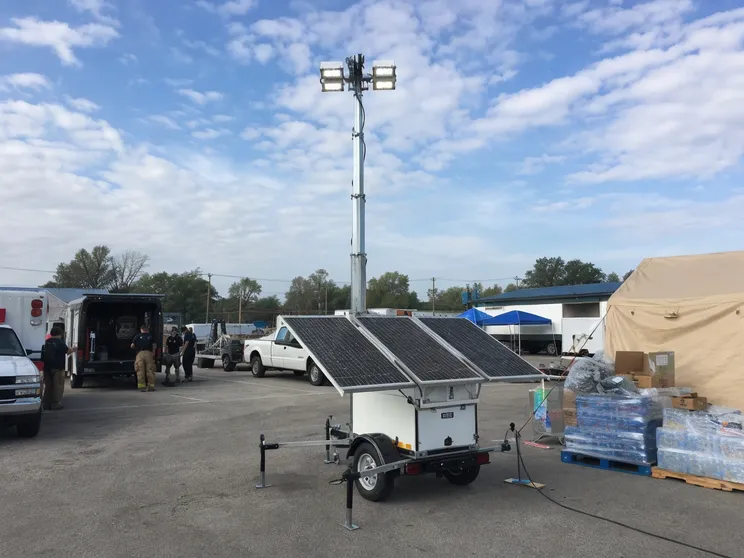
Emergency management agencies, military logistics units, and disaster relief organizations need lighting that deploys in minutes, runs without infrastructure, and works in conditions where the grid is down. A portable solar lighting tower checks all three requirements.
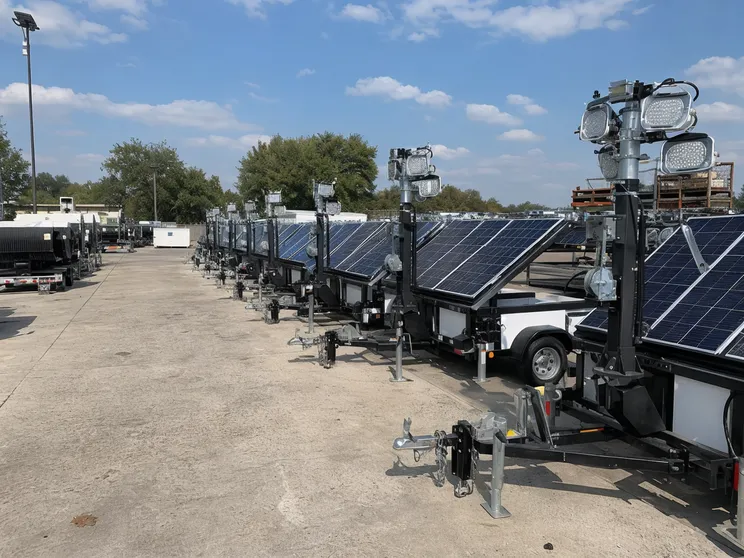
The procurement pattern in this segment is different from construction — agencies buy in advance for stockpile, not for an active project. A single emergency management agency can represent a 20–50 unit order for regional stockpile, with replacement orders every 5–7 years as battery packs age out.
Distributor Insight
For distributors with government procurement relationships, this is a low-frequency but high-value segment. Stockpile orders of 20–50 units per agency, with battery replacement cycles generating follow-on revenue every 5–7 years.
Rental Fleet Operations
Rental companies are the highest-volume repeat buyers in this category. A rental fleet operator who stocks solar lighting towers rents them to construction contractors, event organizers, utility maintenance crews, and emergency response teams — the same unit serves multiple customer segments.
Fleet utilization rates for solar towers typically run higher than diesel towers because the absence of fuel logistics makes short-term rentals more practical. A rental company building a 20-unit fleet will reorder as utilization data confirms demand, and battery replacement cycles generate service revenue.
Why Rental Fleets Drive Recurring Revenue
-
Single unit serves construction, events, utilities, and emergency segments
-
Higher utilization rates than diesel towers due to zero fuel logistics
-
Short-term rentals become practical without refueling coordination
-
Battery replacement cycles create ongoing service revenue stream
-
Fleet expansion follows utilization data — reorders compound as demand confirms
For distributors with rental company accounts, stocking solar lighting towers opens a recurring revenue stream that compounds as the fleet grows.
Temporary Parking and Outdoor Events
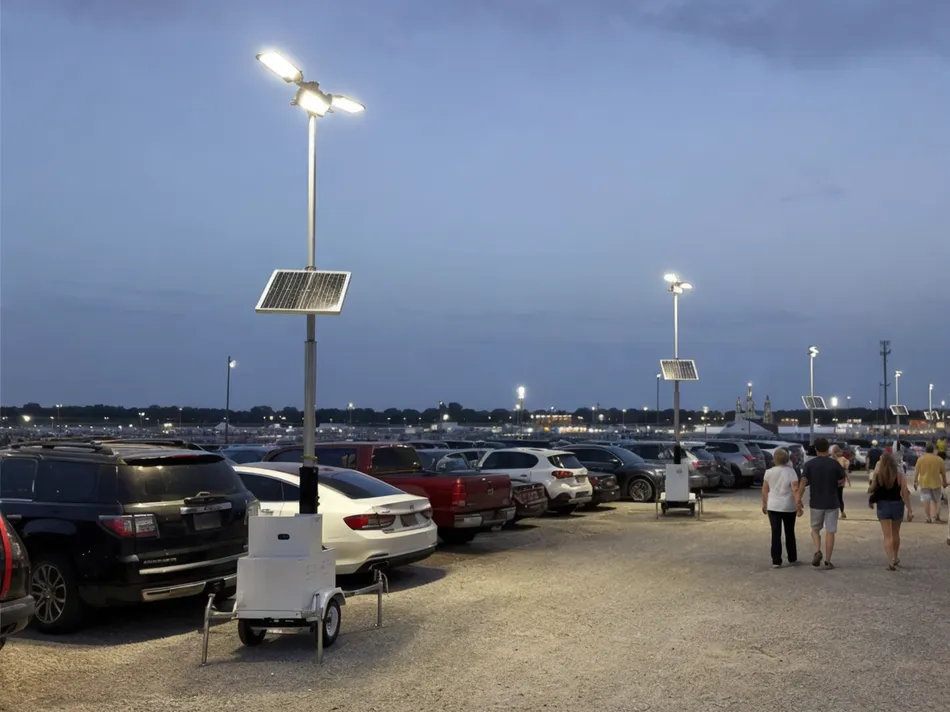
Temporary parking lots for stadiums, fairgrounds, seasonal markets, and outdoor festivals need lighting that goes up before the event and comes down after. Grid connection for a temporary lot is rarely cost-justified.
A solar light tower covers a 20m × 20m area at standard mast height — a 500-car temporary lot typically needs 8–15 towers depending on layout.
Event organizers and venue operators who run recurring events reorder as their event calendar grows. This segment has shorter rental cycles (days to weeks) and higher per-day rental rates than construction, which improves fleet utilization economics for rental operators.
Quick Sizing Reference
500-car lot → 8–15 towers. Shorter rental cycles (days to weeks) with higher per-day rates than construction deployments.
Remote Industrial Yards and Off-Grid Facilities
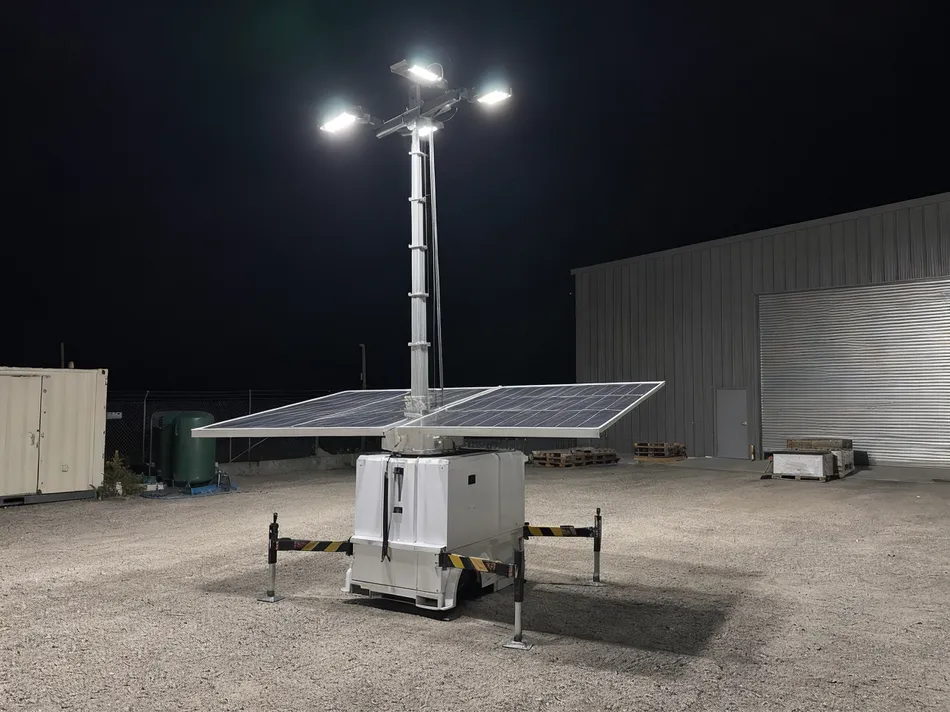
Warehouses, agricultural processing facilities, border crossings, and remote industrial sites that operate after dark without grid access are a steady-volume segment for solar lighting towers.
Unlike construction or events, these are semi-permanent deployments — the tower stays in one position for months or years, functioning as a fixed light without the fixed infrastructure.
For buyers supplying off-grid industrial operators, the solar lighting tower bridges the gap between a portable fixture and a permanent installation, and the repeat order pattern follows the customer's facility expansion.
Deployment Profile
Semi-permanent: months to years in one position. Repeat orders track facility expansion rather than project cycles.
Match Your Market Segment to a Starter Configuration
Send us your target market segment and volume expectations — we'll suggest a starter configuration based on what's moving for our existing distributors in that region.
Request Configuration GuidanceBattery, Solar Panel, and LED Matching: Where Field Performance Is Built
The most common complaint we hear from buyers who've sourced solar lighting towers from other suppliers is inconsistent runtime — towers that perform to spec in the first month and then fall short of rated autonomy by month three. The cause is almost always the same: battery cells that weren't matched before pack assembly, or a panel-to-battery ratio that was sized for ideal conditions rather than the buyer's actual deployment latitude.
Battery Cell Matching
We run battery cell matching by capacity and internal resistance at the pack assembly stage — every pack, not a sample. Tower batteries are larger than standard fixture batteries (500Wh–3,000Wh versus 20Wh–200Wh for a typical parking lot fixture), and the consequences of a mismatched pack are proportionally larger.
A mismatched cell in a 3,000Wh pack limits the usable capacity of the entire pack and accelerates degradation with each charge cycle. By the time the buyer's customer notices the runtime shortfall, the pack has already degraded past the point where cell replacement is practical.
We match cells before assembly because replacing a pack in the field is expensive and damages the buyer's relationship with their customer.
Solar Panel Sizing by Deployment Region
Solar panel sizing for a lighting tower is not a fixed calculation — it depends on the LED load, the target autonomy days, and the deployment latitude. A tower configured for a construction site in Southern California needs a different panel-to-battery ratio than the same tower deployed in Northern Europe or Central Africa.
Our engineering team sizes the panel and battery configuration for the buyer's target deployment region. Send us the latitude or country and the required autonomy days, and we'll run the calculation before production.
We've seen buyers order a standard configuration for a market with lower irradiance than the spec assumed, then come back after the first cloudy week. The sizing conversation is worth having before the order, not after.
LED Module Testing & Batch Consistency
LED module testing runs at the assembly stage with lumen output and color temperature confirmation against the specified tolerance. For solar lighting towers, where the fixture is often the only light source on a remote site, lumen consistency between units in the same order matters more than it does for a parking lot installation where multiple fixtures overlap.
We hold CCT and lumen output within a defined tolerance across the batch — tighter than what most buyers specify in their purchase orders, because we've found that buyers who don't specify a tolerance often discover they need one when the second shipment arrives.
MPPT Charge Controllers
MPPT (maximum power point tracking) is standard on all our solar lighting towers. MPPT extracts more usable energy from the solar panel under partial shading and low-light conditions compared to PWM controllers — the difference is meaningful on overcast days, which are exactly the days when battery autonomy is most critical.
Controller function is tested on dedicated test benches before final assembly, and aging tests under load confirm that the charge logic holds through a full charge/discharge cycle.
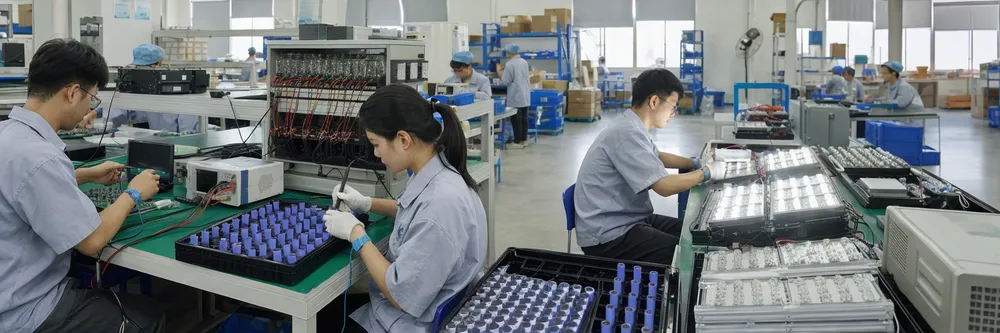
Learn more about our battery matching, LED testing, and inspection process at the JXSOL factory testing process page.
Mast, Base, and Housing Construction for Site Conditions
A solar lighting tower operates in conditions that would destroy a standard outdoor fixture in weeks: construction site vibration, equipment impact, wind loading at full mast extension, repeated transport cycles, and temperature swings from desert heat to sub-zero nights. The physical construction of the tower — mast, base, housing, cable routing, and finish — determines whether the unit survives those conditions long enough to justify the purchase price.
Mast Construction and Stability
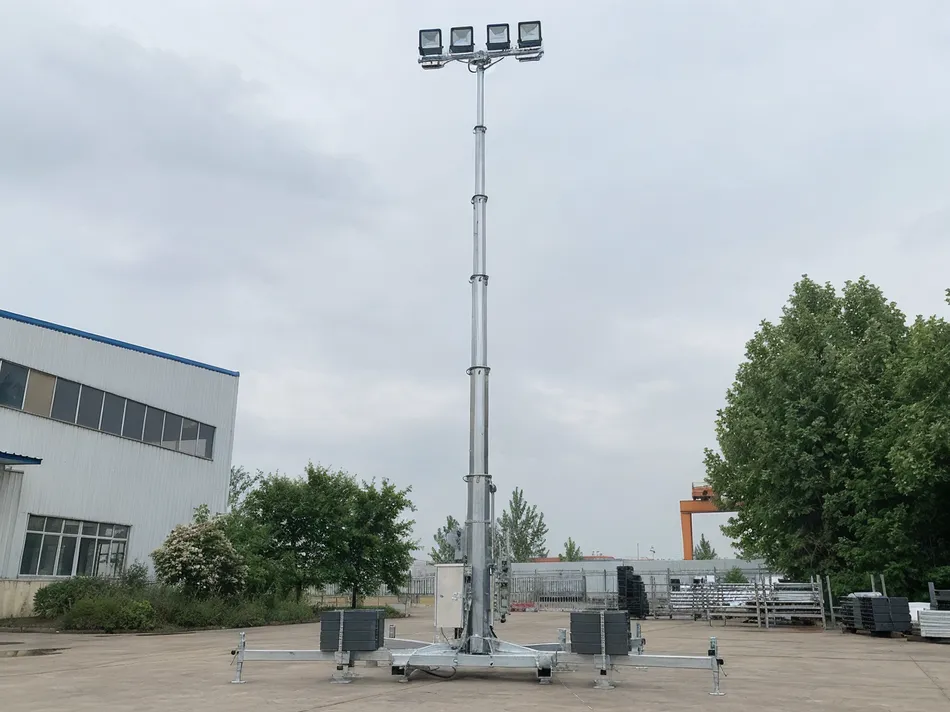
Our standard mast is hot-dip galvanized steel or powder-coated aluminum, telescoping or folding to the specified height. At full extension (6m–12m), the mast is the primary structural element under wind load.
Equivalent of a strong tropical storm. Deployed masts are rated to this threshold at full extension height.
The base footprint and ballast configuration are sized to match the mast height and wind rating; a taller mast requires a wider base or heavier ballast to maintain the same stability margin.
Buyer note: Buyers specifying towers for high-wind environments (coastal sites, open plains, elevated terrain) should confirm the wind rating and base configuration before ordering.
Base and Mobility Options
Three base configurations cover most deployment scenarios.
Trailer Base
Standard tow hitch for road-towed deployment. Tows behind a standard pickup truck and deploys without lifting equipment.
Most common for construction & rentalSkid Base
Moved by forklift or crane. Preferred for mining and industrial sites where forklifts are available and road towing is impractical.
Mining & industrial preferredWheeled Frame
Manual repositioning on flat surfaces. Suitable for sites requiring frequent short-distance moves without heavy equipment.
Flat-surface repositioningConfiguration note: We've had buyers order the trailer configuration for a mining site and then discover the access roads don't support towing — the skid base conversation is worth having before production.
Housing and Weatherproof Construction
LED fixture housings are die-cast aluminum with powder coat finish — the same construction we use across our commercial area lighting line.
Cable routing between the solar panel, battery enclosure, controller, and fixtures is sealed at every entry point, with UV-resistant cable jacket rated for outdoor exposure.
The battery enclosure is a separate sealed housing with its own IP rating, ventilated for thermal management but sealed against water ingress.
Corrosion Protection
For coastal deployments and high-humidity environments, we apply a salt spray-tested powder coat to all steel components and use stainless steel hardware at all fastener points.
Standard powder coat passes this threshold. Upgraded hardware and coating spec available for environments where standard protection isn't sufficient.
Target environments for upgraded corrosion spec:
- Coastal construction sites
- Port facilities
- Offshore support operations
RFQ tip: Confirm the corrosion specification in your RFQ — we can upgrade the hardware and coating spec for environments where standard protection isn't sufficient.
Have project-specific structural requirements?
Send your wind rating, base configuration, IP class, and corrosion environment details for a matched specification.
Customization Boundaries for OEM, Rental, and Project Orders
Solar lighting towers are more frequently customized than standard fixtures because deployment requirements vary significantly by application. A rental fleet operator needs a different configuration than a mining company, and an emergency response agency has different requirements than a construction contractor.
Standard Options
Configurable without engineering review
Lumen Output
Adjusted by LED module selection within the housing design range. Standard options from 10,000 lm to 40,000 lm total output.
Color Temperature
4000K, 5000K, 5700K, or 6500K. 5700K is the most common for construction and industrial applications; 4000K is preferred for event and temporary parking applications where warmer light is acceptable.
Battery Capacity & Autonomy
Sized for your target deployment latitude and required autonomy days. Standard options from 500Wh to 3,000Wh.
Solar Panel Wattage
Configured for your target irradiance region. We size the panel-to-battery ratio for the deployment latitude you specify.
Working Mode
Full-night, 50% dimming after midnight, motion-activated, or manual on/off. Dimming schedules and PIR sensitivity are configurable.
Mast Height
6m, 8m, 10m, or 12m. Taller masts require base configuration review.
Base Type
Trailer, skid, or wheeled frame.
Housing Color
Standard powder coat colors or custom RAL color on runs over 100 units.
OEM/ODM Options
Require engineering review
Custom Fixture Count
2, 3, or 4 fixtures per tower. Fixture count affects panel sizing, battery capacity, and mast load calculation.
Custom Controller Logic
Programmable dimming schedules, remote monitoring integration, GSM/IoT connectivity for fleet management.
Custom Mast Design
Non-standard heights, hydraulic mast lift, or integrated winch for single-operator deployment.
Private Label
Logo on housing, custom carton printing, branded installation guides and accessory kits.
Market Documentation
CE Declaration of Conformity, RoHS records, and installation guides in your required language.
MOQ & Lead Time Notes
Standard catalog configurations start at 100 units — low enough to test a new SKU with your rental customers or project buyers before committing to a larger fleet order.
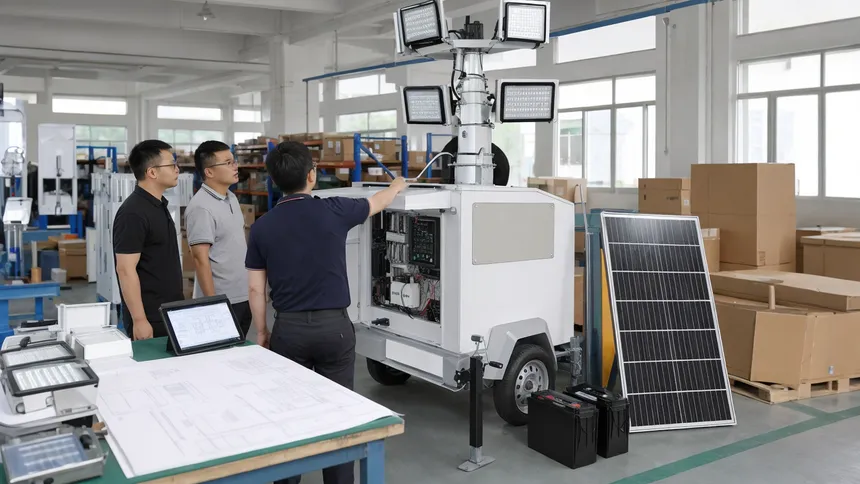
OEM/ODM projects with custom specifications go through an engineering review before production to confirm the configuration is achievable and to lock the spec before component procurement.
Custom configurations typically add 2–3 weeks to the standard lead time for the engineering review and component sourcing.
Customizations that change the mast height, fixture count, or controller logic may affect CE documentation — confirm the certification scope in your RFQ.
100+
Unit MOQ for standard configs
2–3 wks
Added lead time for OEM/ODM
For buyers building a private-label solar lighting line, combining solar lighting towers with solar parking lot lights, commercial solar area lights, and solar pole lights in one OEM program means consistent branding and a single factory relationship for the full outdoor solar lighting catalog.
Compliance Documentation and Pre-Shipment Inspection
The certifications JXSOL holds for solar lighting towers — ISO 9001:2015, CE, RoHS, IP65/IP67 Ingress Protection, and IEC 62124 — cover the compliance requirements for most regulated import markets.
CE Marking
Covers the electrical safety and electromagnetic compatibility requirements for the European market and markets that accept CE as a compliance reference. For solar lighting towers, CE documentation includes the Declaration of Conformity and the technical file covering the LED driver, charge controller, and battery system. If your project requires CE documentation for a tender submission or import clearance, we provide it with the order.
RoHS Compliance
Covers restricted substance requirements for the EU and markets that align with EU import standards. Our component sourcing traces RoHS compliance to the material declaration level — LED chips, battery cells, and electronic components are sourced from suppliers who provide material declarations, and we maintain records by batch. For buyers importing into the EU or markets with restricted substance requirements, the compliance documentation traces back to the component level.
IP65/IP67 Ingress Protection
Ratings are tested on our own waterproof inspection equipment, not assumed from housing geometry. IP65 is standard on all solar lighting towers; IP67 is available on specified models. If your project specification requires IP67, confirm it in your RFQ — it affects the housing design and adds to the unit cost.
IEC 62124
Covers the performance requirements for stand-alone solar photovoltaic systems, which is the relevant standard for the solar panel and charge controller combination in a solar lighting tower. This certification is increasingly required for project tenders in regulated markets and for import clearance in markets that reference IEC standards.
100% Pre-Shipment Inspection
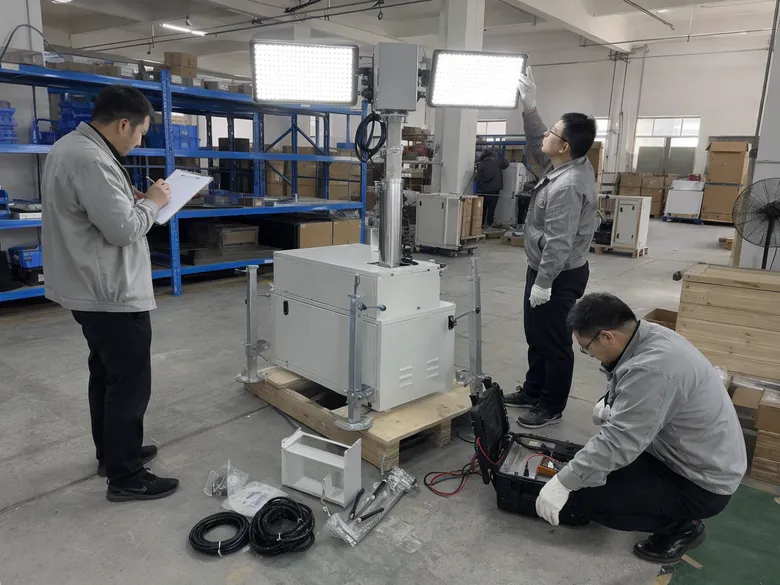
Every tower, every accessory pack, every carton label — before the container is sealed. Defective units are pulled before shipment, not discovered at your warehouse.
Choosing Between a Solar Light Tower and Fixed Area Lighting
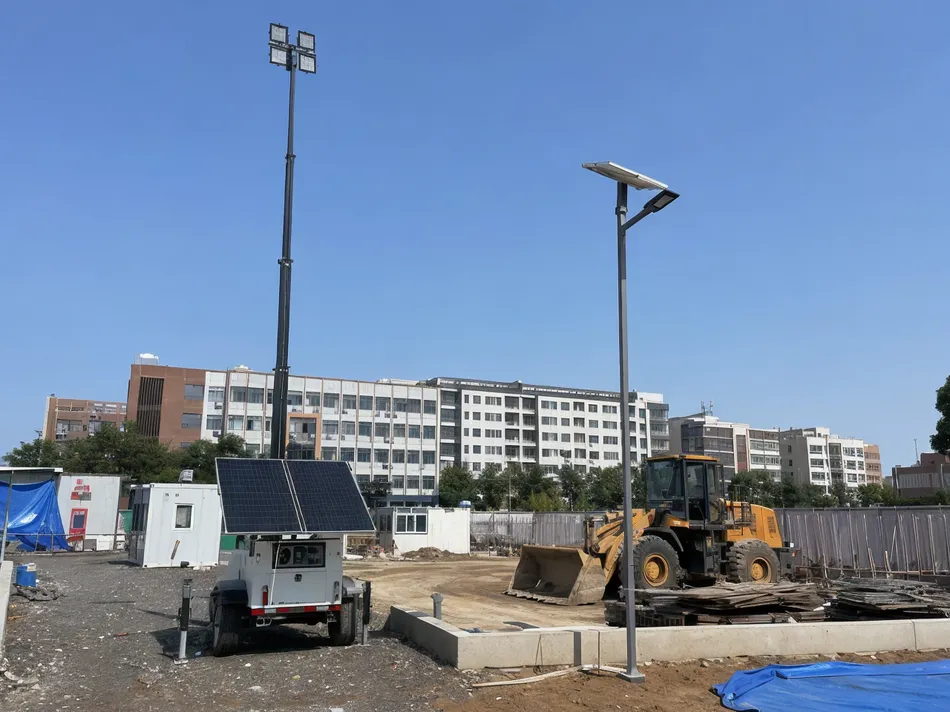
The decision comes down to one question: does the lighting position need to change? If the answer is yes — or even maybe — the tower is the right product. If the answer is definitively no, a fixed installation is more cost-effective and provides better long-term performance.
| Requirement | Solar Lighting Tower | Fixed Solar Area Light |
|---|---|---|
| Site is temporary (< 2 years) | Preferred | Not practical |
| Lighting position changes as work progresses | Preferred | Not practical |
| No fixed infrastructure available | Preferred | Requires pole installation |
| Rental fleet application | Preferred | Not applicable |
| Emergency response / rapid deployment | Preferred | Not applicable |
| Permanent installation, fixed position | Higher cost than needed | Preferred |
| Long-term (5+ year) deployment | Battery replacement cycle adds cost | Preferred |
| Highest lumen output per dollar | Higher unit cost | Preferred |
Fixed Lighting Alternatives for Permanent Sites
For permanent parking lots, fixed industrial yards, and long-term facility lighting, fixed solar products deliver better long-term value. The right product depends on the mounting scenario and coverage area required.
- Solar parking lot lights — dedicated parking area coverage
- Commercial solar area lights — industrial and commercial yards
- Solar area lights — open-area coverage, more ground per fixture
- Solar pole lights — standard pole-mounted fixed installations
- Solar yard lights — smaller perimeter and property lighting
Not sure which product fits your buyer's project?
Send us the site description and we'll recommend the right configuration — whether that's a mobile tower or a fixed installation from our area lighting range.
Quote Checklist for a Buildable Solar Lighting Tower Offer
A solar lighting tower quote that we can actually build to requires more information than a standard fixture quote. The variables that affect the configuration — and the price — are specific to the deployment scenario.
Required for a Buildable Quote
- 1 Target lumen output or lighting area dimensions (length × width in meters)
- 2 Required mast height
- 3 Autonomy requirement (how many nights without sun must the tower run at full or partial output)
- 4 Deployment location or latitude (affects solar panel sizing)
- 5 Order quantity
- 6 Base type preference (trailer, skid, or wheeled frame)
Helpful for Configuration Optimization
- Typical nightly operating hours
- Preferred working mode (full-night, dimming, motion-activated)
- Destination port and any import certification requirements
- Packaging or branding requirements (OEM/private label)
- Timeline and delivery requirements
Send Your Requirements
We'll respond with a detailed configuration recommendation and pricing.
Submit your RFQ directly and we'll respond with a configuration recommendation.
FAQ for Solar Lighting Tower Buyers
Direct answers to the sizing, runtime, and specification questions that come up during procurement review.
How long can a solar lighting tower run at night?
Runtime depends on battery capacity, LED load, and working mode. A standard configuration with a 1,500Wh LiFePO4 battery and 200W total LED load runs approximately 7–8 hours at full output. With 50% dimming after midnight, the same battery extends to 10–12 hours.
Autonomy — the number of consecutive nights the tower runs without recharging — depends on the battery-to-load ratio and the deployment latitude. A tower sized for 2 autonomy days in Southern California may only deliver 1 autonomy day in Northern Europe because the panel charges less per day at lower irradiance.
Sizing note: We size battery and panel together for your target deployment region — send us the latitude and required autonomy days and we'll confirm the configuration.
What information do you need to size a solar light tower for my project?
The minimum we need:
- Target lumen output or lighting area dimensions
- Required mast height
- Autonomy requirement (nights without sun)
- Deployment location or latitude
- Order quantity
If you have a project specification document or an existing diesel tower spec you're trying to match, that speeds up the configuration review.
Important: Without the autonomy and latitude data, any quote we provide is based on assumptions that may not match your deployment conditions — and the price difference between a 1-day and a 3-day autonomy configuration can be 40–60% on the battery alone.
Is a portable solar lighting tower a replacement for a diesel light tower?
For most temporary lighting applications, yes — with the qualification that the economics depend on deployment duration and fuel access.
Payback scenarios:
- 90-day construction project with reliable fuel supply: The solar tower's higher upfront cost is offset by fuel savings over the project duration.
- Remote site where fuel delivery adds $500–$1,000 per delivery: Payback is faster.
Where solar does NOT replace diesel:
- Sites with no sun exposure — underground mining, enclosed structures
- Applications where required runtime significantly exceeds what the battery can store
Bottom line: For open-air sites with 4+ hours of daily sun, a portable solar lighting tower is a direct operational replacement for a diesel tower with lower total cost over a 12–24 month deployment.
What IP rating should I require for an outdoor solar lighting tower?
IP65 is the minimum for any outdoor solar lighting tower — it covers dust ingress and water jet resistance, which handles rain, site washdown, and most outdoor exposure.
Dust-tight + water jet resistance. Handles rain, site washdown, and most outdoor exposure.
Adds submersion protection to 1 meter for 30 minutes. Required for flood-prone areas, low-lying construction sites, or sites with regular pressure washing.
Critical check: The battery enclosure and controller housing are the most critical components for IP protection. A fixture housing that passes IP65 but a battery enclosure that doesn't is a field failure waiting to happen. We test both the fixture and the battery enclosure on our own waterproof inspection equipment.
Coastal and high-humidity environments: Also confirm that the mast hardware and fasteners are stainless steel — IP rating covers water ingress, not salt corrosion.
How do I choose between a fixed solar area light and a solar lighting tower?
The deciding factor is whether the lighting position needs to change. Fixed solar area lights — our solar parking lot lights, commercial solar area lights, and solar area lights — are more cost-effective for permanent installations where the pole position is fixed.
A solar lighting tower costs more per unit and has a higher maintenance cost over time (battery replacement, transport wear) than a fixed fixture. The tower's value is mobility and rapid deployment — if you don't need those, you're paying for capability you won't use.
If the site is temporary, if the lighting position changes as work progresses, or if the product is going into a rental fleet, the tower is the right choice.
Can JXSOL customize battery capacity, mast height, and branding?
Yes to all three. Battery capacity is configurable from 500Wh to 3,000Wh — we size it for your target deployment latitude and required autonomy days. Mast height options are 6m, 8m, 10m, and 12m; non-standard heights are available through OEM engineering review.
Branding options include logo on the housing, custom carton printing, and branded installation guides.
Custom configurations go through an engineering review before production to confirm the spec is achievable and to lock it before component procurement. For full OEM/ODM program details, see our OEM and ODM solar lighting support.
What is the MOQ for solar lighting tower orders?
Standard catalog configurations start at 100 units. OEM/ODM orders with custom specifications — non-standard battery capacity, custom mast height, private-label branding — are discussed during the engineering review, and MOQ may vary depending on the customization scope.
For buyers testing a new SKU with their rental customers or project buyers, 100 units is low enough to validate demand before committing to a larger fleet order. Most of our rental fleet buyers start with a 20–50 unit trial order and scale from there as utilization data confirms demand.
Ready to Spec a Solar Lighting Tower?
Get a buildable quote with battery sizing, mast height, and compliance documentation matched to your deployment site.
Explore the Full Solar Parking Lot & Area Lighting Series
Related products from the same category — all manufactured in-house by JXSOL.
Solar Parking Lot Lights
Fixed-mount solar luminaires sized for parking lot pole spacing and photometric coverage.
Commercial Solar Area Lights
High-output solar area fixtures for commercial properties, campuses, and public spaces.
Solar Area Lights
Versatile solar area lighting for pathways, perimeters, and general outdoor illumination.
Solar Pole Lights
All-in-one and split-type solar pole lights for roadways, compounds, and perimeter security.
Solar Yard Lights
Compact solar fixtures for yards, courtyards, and low-mount residential or commercial areas.
View All Solar Area Lighting
Browse the complete solar parking lot and area lighting category.