

Solar Yard Lights Direct From Factory
Fixed outdoor solar fixtures for yards, courtyards, residential developments, small commercial compounds, and distributor catalog programs. Every unit ships with 100% pre-shipment inspection and full export documentation.
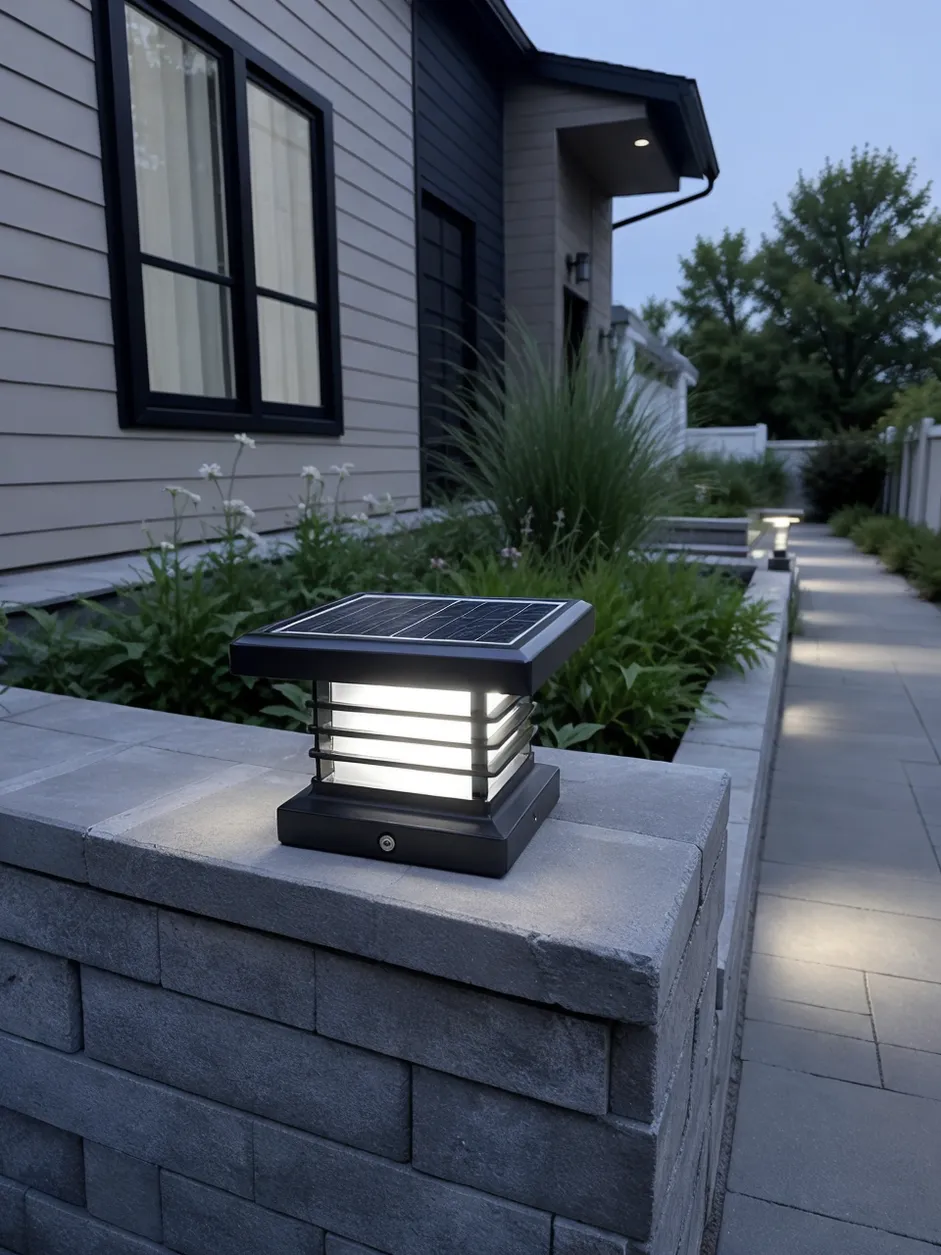
Solar Yard Lights as the Mid-Range Outdoor Lighting SKU
Solar yard lights occupy a specific position in the outdoor solar lighting product family: more output and coverage than pathway bollards, lower cost and lighter installation than parking lot fixtures or commercial area lights. That positioning matters commercially. A distributor building a solar outdoor lighting catalog needs a product that covers residential developments, small commercial yards, farm compounds, and community spaces without requiring the pole heights, battery capacities, or project budgets that parking lot lights demand.
We manufacture solar yard lights at our 12,000 m² factory in Guzhen Town, Zhongshan — the same facility where the product is engineered, assembled, and inspected. The production lines, the engineering team, and the inspection lab are in the same building. This is not a sourcing arrangement.
The typical buyer for this product is sourcing for one of three purposes: stocking a distributor catalog with a mid-range solar outdoor SKU, supplying a residential development or villa compound project with repeatable fixture packages, or building a private-label solar backyard lights program for retail or hardware channels. Each of those use cases has different configuration priorities, and the sections below are organized around those decisions.
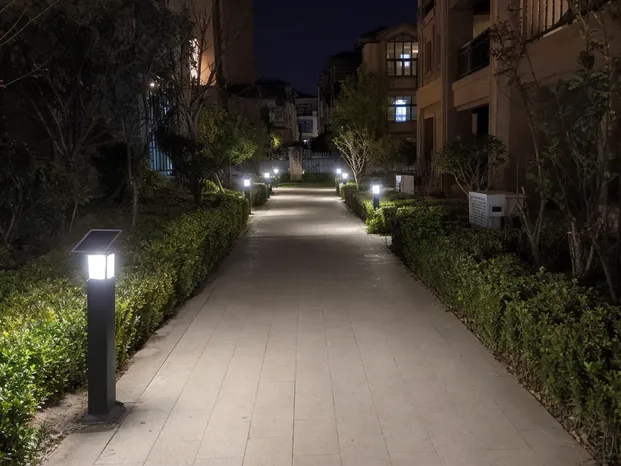
Where Yard Lights Sit in the Product Family
Pathway Bollards
Lower output, decorative focus. Accent lighting for walkways and garden borders.
Solar Yard Lights
Mid-range output and coverage. Residential developments, small commercial yards, community spaces.
Parking Lot / Area Lights
Higher output, taller poles, larger batteries. Commercial lots, roads, industrial compounds.
Three Typical Buyer Purposes
Distributor Catalog
Stocking a mid-range solar outdoor SKU that fills the gap between decorative bollards and full commercial fixtures.
Residential Development
Supplying villa compounds and housing projects with repeatable fixture packages at consistent specifications.
Private-Label Program
Building a branded solar backyard lights line for retail or hardware channels with OEM/ODM support.
If you already know your target lumen output, mounting height, and destination market — send us the details and we'll come back with a configuration recommendation.
Specification Band Buyers Can Build a Quote Around
The table below covers the typical product-level specification range for solar yard lights. These are the parameters that determine whether a fixture fits your project or catalog program. Values are typical for this product type — exact specifications vary by configuration, battery sizing, and solar panel selection. Contact us for a detailed data sheet on any specific configuration.
| Parameter | Typical Range / Options |
|---|---|
| LED Power | 10W – 60W |
| Lumen Output | 800 lm – 2,500 lm |
| Solar Panel Wattage | 15W – 80W (monocrystalline) |
| Battery Chemistry | LiFePO4 (lithium iron phosphate), Li-ion |
| Battery Capacity | 15Wh – 120Wh |
| Mounting Height | 2.5m – 5m |
| Color Temperature (CCT) | 3000K, 4000K, 5000K, 5700K, 6500K |
| Beam Angle | 90°, 120°, 150° |
| Working Modes | Full-night, 50% dimming after midnight, motion-activated, programmable schedule |
| Charging Time | 6–8 hours (full sun) |
| Autonomy Days | 2–3 days (standard); 3–5 days (extended battery configuration) |
| IP Rating | IP65 (standard); IP67 available on specified models |
| Housing Material | Die-cast aluminum, powder-coated; stainless steel hardware |
| Operating Temperature | -30°C to +60°C |
| Certifications | ISO 9001:2015, CE, RoHS, IP65/IP67, IEC 62124 |
LiFePO4 — Recommended for Longevity
Our recommendation for projects where cycle life matters — residential developments, municipal installations, and any program where the fixtures will run for 5+ years without battery replacement. Higher upfront cost, significantly lower total cost of ownership.
Li-ion — Available atLower Price Point
Suitable for cost-sensitive programs, shorter-lifecycle retail products, or markets where battery replacement is part of the maintenance plan. We can configure either chemistry depending on your program requirements.
Need a spec sheet for a specific configuration? Tell us your target wattage, battery preference, and mounting height — we'll send a detailed data sheet within one business day.
How Solar Yard Lights Work
Understanding the operating cycle helps buyers specify the right panel-to-battery ratio and select appropriate working modes for their target climate and application.
Solar Harvest
Monocrystalline panel converts sunlight to DC current during daylight hours.
Charge Control
MPPT or PWM controller regulates charging current to protect battery and maximize efficiency.
Energy Storage
LiFePO4 or Li-ion battery stores energy for nighttime operation and cloudy-day autonomy.
LED Output
Dusk-to-dawn sensor triggers LED array. Working mode determines brightness profile through the night.
Available Working Modes
Full-Night Mode
100% brightness from dusk to dawn. Best for security applications and well-lit pathways.
Dimming Mode
100% until midnight, then dims to 50%. Extends battery life while maintaining visibility.
Motion-Activated
Low-level ambient light with PIR sensor triggering full brightness on motion detection.
Programmable Schedule
Custom time-based profiles set via controller. Ideal for municipal or commercial projects with specific lighting ordinances.
Design & Customization Options
Solar yard lights serve both functional and aesthetic purposes. We offer multiple design families and customization paths so buyers can match fixtures to their project's architectural language.
Modern / Minimalist
Clean geometric forms, slim profiles, matte finishes. Suited for contemporary residential developments and commercial campuses.
Traditional / Classic
Lantern-style heads, decorative poles, ornamental details. Ideal for heritage districts, parks, and upscale residential communities.
Industrial / Utility
Function-first design, maximum output, robust construction. Warehouses, logistics yards, and infrastructure projects.
Customization Parameters
Color & Finish
RAL color matching, anodized, powder-coated, or textured finishes.
Pole Height & Style
2.5m to 5m standard; tapered, straight, or fluted profiles available.
Panel Integration
Top-mounted, side-arm, or separate panel with cable connection for shaded installations.
Optics & Distribution
Type II, III, or V distribution patterns. Custom lens options for specific coverage requirements.
Branding & Labeling
OEM logo placement, custom packaging, private-label documentation and warranty cards.
Smart Features
Optional Bluetooth/Zigbee control, remote monitoring, and group scheduling capabilities.
MOQ for custom configurations: Standard models are available from 50 units. Custom color, branding, or electrical configurations typically require 100–200 unit minimums depending on complexity. Contact us for exact MOQ on your specific requirements.
Installation & Site Planning Guidance
Proper installation planning ensures optimal performance. These guidelines help buyers and their installation teams get the most from each fixture.
Solar Access Requirements
- Minimum 5 hours of direct sunlight per day for rated performance
- Panel orientation: true south (northern hemisphere) or true north (southern hemisphere)
- Avoid locations with tree canopy, building shadows, or obstructions above 30° elevation
- Panel tilt angle should match local latitude ±10° for year-round optimization
Spacing & Layout
- Typical spacing: 3–4× mounting height for pathway lighting (e.g., 10–15m for 3.5m poles)
- Reduce spacing by 20–30% for security-grade illumination levels
- Staggered (zigzag) placement provides more uniform coverage than single-side rows
- We provide photometric layouts for projects over 20 fixtures upon request
Foundation & Mounting
Concrete Foundation
Standard for permanent installations. Foundation cage and anchor bolts included with pole assembly.
Ground Screw
No-dig option for soft ground. Faster installation, relocatable. Suitable for temporary or event lighting.
Surface / Flange Mount
Bolts to existing concrete pads or hardscape. Ideal for retrofit projects and paved areas.
Quality & Durability
Solar yard lights operate outdoors year-round with no grid backup. Every component must withstand UV exposure, temperature cycling, moisture ingress, and wind loading without degradation.
IP65/IP67 Sealed
Full dust protection and water jet / immersion resistance depending on model.
-30°C to +60°C
Wide operating temperature range covers desert heat and northern winter conditions.
Wind Rated
Pole and fixture assemblies engineered for sustained wind loads up to 150 km/h.
2,000+ Cycles
LiFePO4 batteries rated for 2,000+ charge cycles at 80% depth of discharge.
Testing & Certification
Salt Spray Testing
Housing and hardware tested per ASTM B117 for coastal and high-humidity environments.
Surge Protection
Built-in SPD rated to 6kV/3kA protects electronics from lightning-induced surges.
CE & RoHS Compliant
All fixtures meet EU safety and environmental directives. Additional certifications available on request.
IEC 62124 Compliance
Stand-alone photovoltaic system design verification per international standard.
Ordering & Lead Time
From initial inquiry to delivery, here's what the process looks like and what timelines to expect.
Inquiry
Share your project scope, location, and lighting requirements via form or email.
Solution Design
We recommend fixture models, wattages, pole heights, and layout based on your site conditions.
Quotation
Detailed quote with unit pricing, shipping estimate, and lead time within 1–2 business days.
Production
Manufacturing and QC inspection. Standard lead time 15–25 days depending on quantity.
Delivery
Sea freight (20–35 days) or air freight (5–7 days). DDP and FOB terms available.
Typical Lead Times
| Order Size | Production | Sea Freight | Total (Approx.) |
|---|---|---|---|
| Sample (1–5 units) | 5–7 days | Air: 5–7 days | 10–14 days |
| Small (10–50 units) | 15–18 days | 20–30 days | 35–48 days |
| Medium (50–200 units) | 18–22 days | 25–35 days | 43–57 days |
| Large (200+ units) | 22–30 days | 25–35 days | 47–65 days |
Ready to Light Your Project?
Tell us about your site and requirements. We'll recommend the right solar yard light configuration and provide a detailed quotation within 1–2 business days.
Market Segments Where Yard Lights Protect Margin
The commercial value of solar yard lights is not uniform across segments. Some generate repeatable volume; others are project-driven with higher per-unit margins. Understanding which segment you're selling into shapes which configuration and packaging options are worth specifying.
Residential Developments & Villa Compounds
Most Repeatable Segment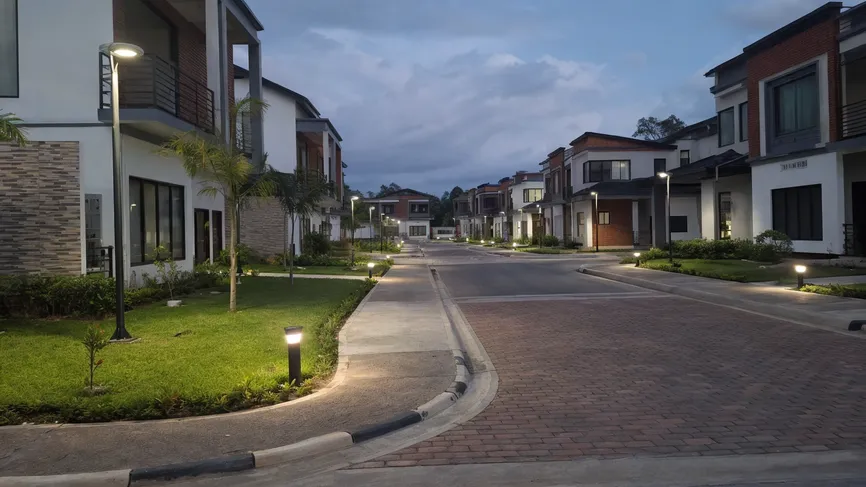
A developer building 50–200 residential units needs outdoor lighting for yards, driveways, and common areas. Solar yard lights eliminate the trenching cost that grid-connected fixtures require, which makes them attractive to developers managing tight site budgets.
The order pattern is predictable: one fixture package per unit, replicated across phases. A distributor with a reliable solar yard light SKU and a track record of consistent quality can build a recurring account base in this segment — developers who approve a fixture for Phase 1 typically reorder the same spec for Phase 2 and Phase 3 without re-quoting.
Rural Homes, Farms & Off-Grid Compounds
Grid-Absence Driven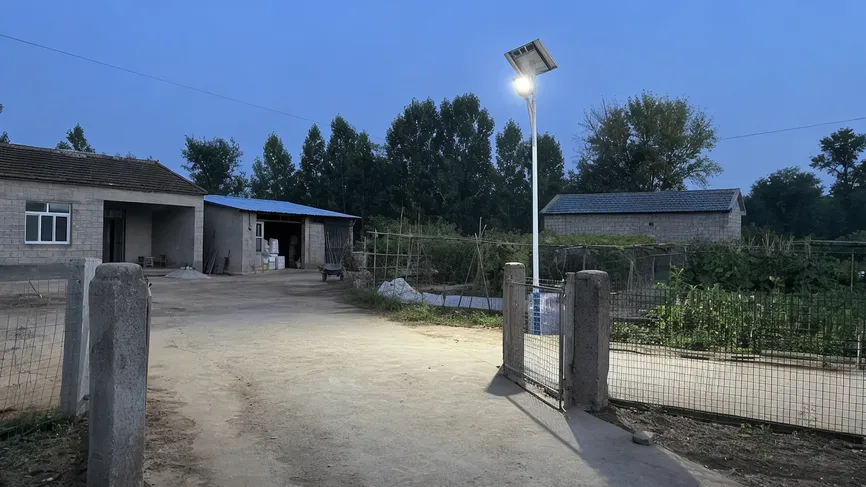
This segment is driven by the absence of grid infrastructure. Trenching and grid extension costs in rural areas often exceed the cost of the solar fixture itself, which means solar yard lights win on total cost of ownership without needing to compete on unit price.
Order sizes tend to be smaller — 20 to 100 units per project — but the buyer's alternative is a generator or a grid extension, so price sensitivity is lower than in urban residential programs.
Small Commercial Yards & Storage Areas
Contractor-Driven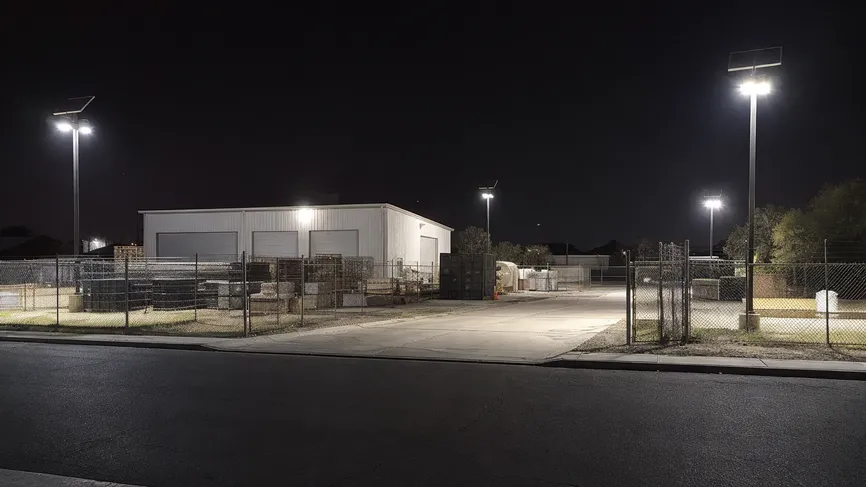
Light industrial perimeters, small warehouses, agricultural storage, and service yards need outdoor lighting that covers moderate areas without the output or cost of commercial area lights. Solar yard lights in the 1,500–2,500 lumen range at 4–5 meter mounting height cover most of these applications.
The buyer in this segment is often a contractor or facilities manager sourcing for a specific site, not a distributor building a catalog. Order sizes are typically 10–50 units per site, but contractors who work across multiple sites can represent consistent volume.
Garden Center, Hardware & Distributor Catalog Programs
Retail / Private-Label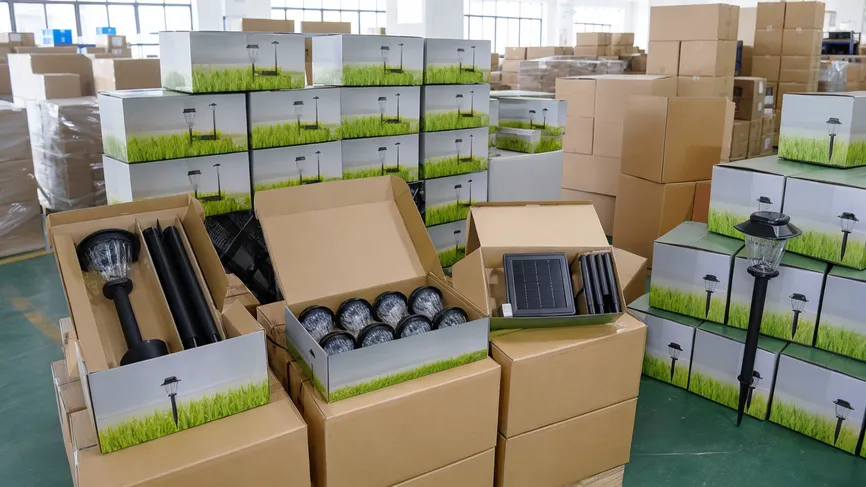
This is where the secondary keyword "solar backyard lights" becomes commercially relevant. Distributors selling through garden centers, hardware chains, or online retail channels need a solar outdoor lighting SKU that photographs well, ships without damage, and generates low return rates.
Private-label packaging, retail-ready cartons, and consistent lumen output across batches are the configuration priorities here. Buyers who started with a single private-label SKU have expanded to full solar outdoor lighting lines — worth building into a catalog if you're not already covering it.
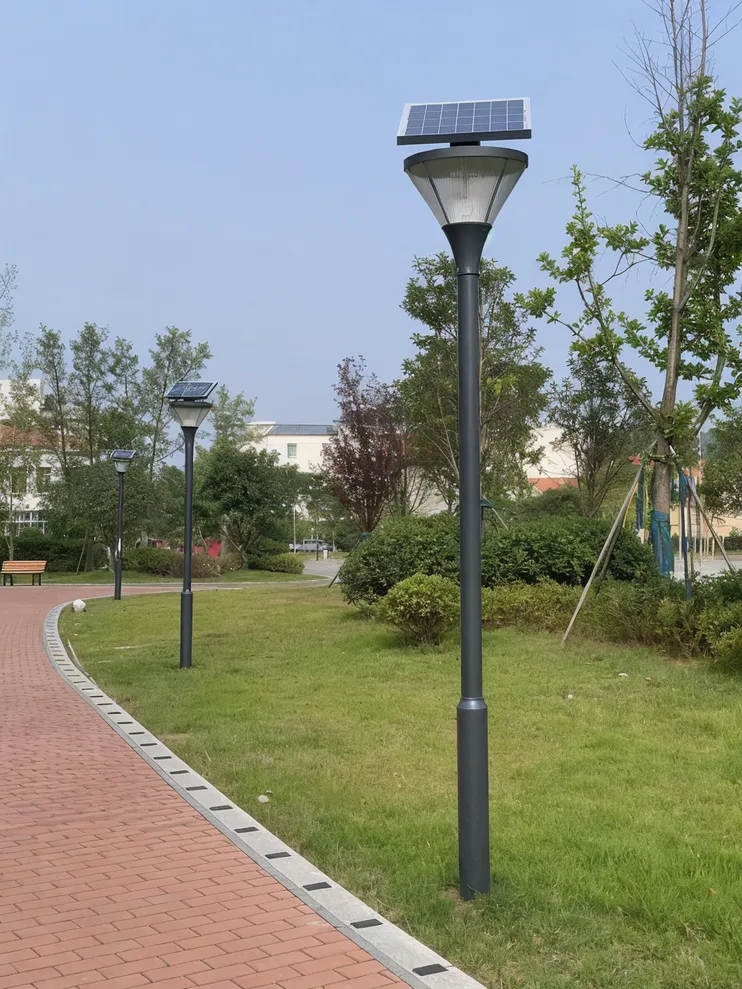
Municipal & Community Yards, Small Public Spaces
Standardized ProcurementParks, community centers, housing authority properties, and small public facilities run standardized procurement programs. Once a specification is approved, the same fixture gets ordered across multiple sites on annual or multi-year contracts.
Getting on an approved vendor list is the entry point; consistent quality on the first order is what keeps you there.
Documentation requirements in this segment are higher than in residential programs — CE Declaration of Conformity, RoHS records, and IP test certificates are typically required at the procurement stage.
Request a Yard-Light SKU Recommendation for Your Market
Tell us your target segment and order volume and we'll suggest the right configuration.
Get SKU RecommendationConfiguration Choices That Change Runtime, Cost, and Reorder Success
The most common sourcing mistake in this product category is comparing unit prices without aligning the configuration first. A solar yard light quoted at a lower price may carry a smaller battery, a lower-wattage solar panel, or a shorter autonomy rating — and none of that shows up in a line-item price comparison. The difference surfaces in a warranty claim or a reorder conversation, not in the original quote.
Lumen Output & Mounting Height
Lumen output and mounting height work together. Specifying one without confirming the other leaves the coverage calculation incomplete.
| Mounting Height | Typical Application | Lumen Range |
|---|---|---|
| 2.5–3 m | Residential yard, small compound | 800–1,200 lm |
| 4–5 m | Larger yard, small commercial perimeter | 1,500–2,500 lm |
If you're replacing existing fixtures, the existing fixture's lumen output is a useful baseline; solar replacements should match or exceed it to avoid visible downgrade complaints from downstream customers.
Battery Autonomy
Battery autonomy is where most solar lighting failures originate. Autonomy days refer to how many consecutive cloudy days the battery can sustain full or partial output without recharging.
| Market Type | Regions | Autonomy Days |
|---|---|---|
| Predictable weather | North America, Europe, Middle East | 2–3 days |
| Extended rainy seasons | Equatorial SE Asia, West Africa, monsoon regions | 3–5 days |
The battery sizing conversation is worth having before production, not after the first wet season.
Solar Panel Sizing
Solar panel sizing is tied to both the lumen output and the target latitude. A fixture designed for Southern California needs a different panel-to-battery ratio than the same fixture deployed in Northern Europe or Central Africa.
Send us the destination country or latitude and we'll size the solar panel and battery configuration for your deployment region. This is not a generic calculation — we run it for each order.
Control Mode
Control mode affects both energy balance and buyer expectations. The control mode should match the site's actual usage pattern, not just the lowest-cost option.
Full output all night. Draws the most battery capacity and requires the largest battery for a given autonomy target.
Typically 50% output from midnight to dawn. Reduces nightly energy consumption by 30–40%, allowing the same battery to support more autonomy days or a smaller battery at the same autonomy level.
Most energy-efficient option. Works well for yards and compounds where continuous illumination is not required.
Sample Specs Should Match the Planned Reorder Market
We see this regularly: a buyer requests a sample configured for the cheapest possible spec to test the product, then places a reorder for a different market with different lumen and autonomy requirements. The sample passes, the reorder fails in the field.
The sample configuration should reflect the actual deployment conditions — destination latitude, required autonomy days, and runtime mode — not just the lowest trial cost.
We'll configure the right spec before you commit to a sample order.
Mounting and Site Planning Before Samples
Yard lights are frequently mis-specified around mounting height, fixture spacing, and solar panel exposure. Getting these decisions right before production prevents after-sales cost — for you and for your downstream customers.
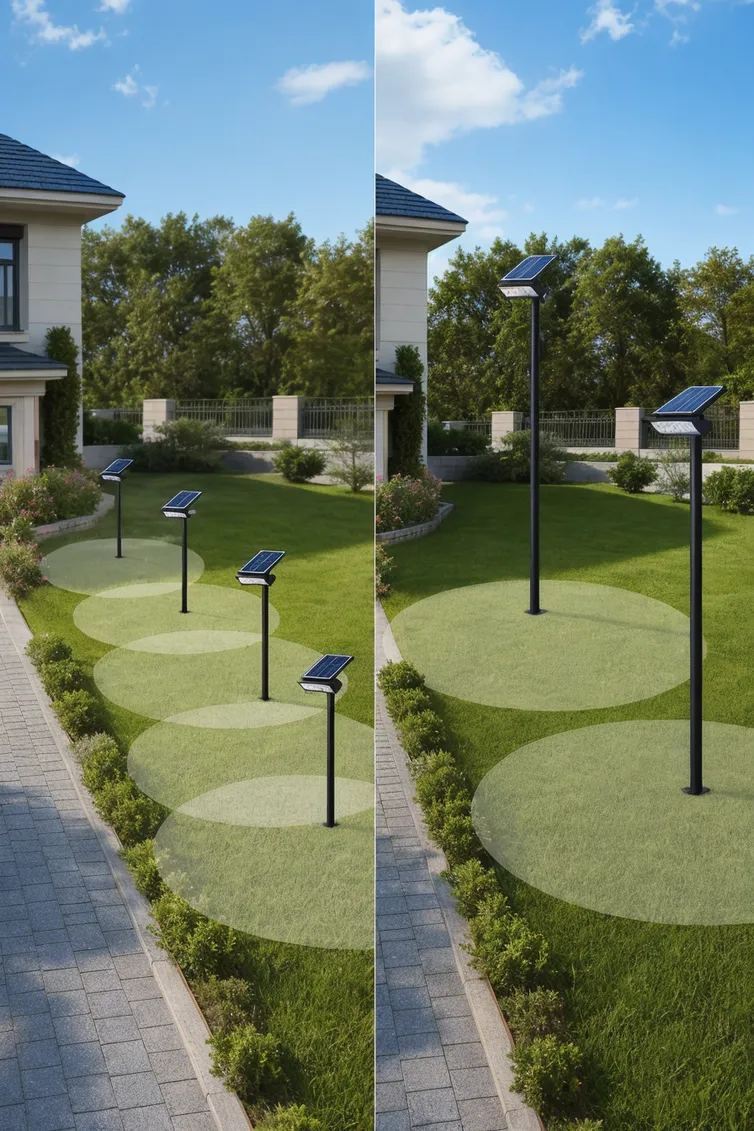
Mounting Height Determines Coverage Area and Fixture Count
A residential yard that needs 4 fixtures at 3-meter mounting may only need 2 fixtures at 5-meter mounting — which changes the per-site cost significantly. Confirming the mounting height before production also determines the bracket and pole specification, which affects the accessory kit packed with each unit.
Mounting Height
120° beam → 8–10 m diameter coverage
Mounting Height
120° beam → 12–15 m diameter coverage
Mounting Configurations
Confirm the mounting type before production; bracket mismatches on arrival create receiving problems and delay installation.
Pole-Mounted
Standard for open yards and compounds where a ground-mounted pole is practical. Most common configuration for residential and commercial programs.
Wall / Bracket-Mounted
Works for perimeter walls, building facades, and sites where ground installation is not feasible. Requires compatible bracket specification.
Integrated Design
Solar panel built into the fixture head. Reduces installation complexity and is common in residential programs where the installer is not a specialist.
Solar Panel Shading Is a Real Failure Source
A yard light installed under a tree canopy or adjacent to a building that shades the panel during peak sun hours will underperform regardless of how well the battery and LED are specified.
Buyers supplying residential developers or contractors should confirm that the installation sites have adequate solar exposure — typically 4–6 hours of direct sun per day — before committing to a configuration.
We can advise on panel tilt angle and orientation for specific installation environments.
Accessory Kit Completeness
Each unit ships with its corresponding mounting hardware, bracket, fasteners, and installation guide. Confirm the bracket type and pole diameter compatibility before production.
Compatibility note: A bracket designed for a 60mm pole diameter won't fit a 76mm pole without an adapter. For projects where the buyer is supplying poles separately, send us the pole specification and we'll confirm bracket compatibility before the order is placed.
For projects where the mounting structure drives the product selection — pole-first projects where the pole height and diameter are already specified — solar pole lights may be a better fit than yard lights. The distinction is whether the fixture or the pole is the primary specification constraint.
We'll confirm bracket compatibility and accessory kit configuration before production.
Factory Checks Focused on Yard-Light Failure Points
Solar yard lights fail in predictable ways. We've been watching the same failure modes since 2012, and the production controls we run are built around them specifically — not around a generic QC checklist.
Battery Capacity Mismatch
Most common cause of early field failure
A battery pack that tests at rated capacity on day one may perform significantly below spec after 50–100 charge/discharge cycles if the cells were not matched by capacity and internal resistance before assembly.
Our Control
We match battery cells by capacity and internal resistance at the pack assembly stage — every pack, not a sample. Packs that fall outside tolerance are pulled before they reach final assembly.
For distributors: fewer warranty claims from downstream customers and more consistent autonomy performance across your batch.
LED Lumen & Color Temperature Inconsistency
Second most common complaint from switching buyers
Shows up when a reorder arrives and the brightness or color temperature is visibly different from the first shipment — a problem that's difficult to explain to downstream customers and expensive to resolve after the container is open.
Our Control
We run lumen output and color temperature confirmation at the LED module assembly stage, with binning controls that keep CCT and lumen output within a defined tolerance across the batch.
Reorder reliability depends on this step more than on any other single process.
Controller & PIR Sensor Malfunction
Surfaces after installation, not before
Dimming schedules that reset after a power interruption, PIR sensors that trigger inconsistently, or charge controllers that don't regulate correctly under high-temperature conditions — these failures generate field complaints that are hard to diagnose remotely.
Our Control
Controller and PIR sensor function checks on dedicated test benches before final assembly, and aging tests under load confirm that the control logic holds through a full charge/discharge cycle.
Water Ingress
Most feared failure mode — most commonly misrepresented
An IP65 or IP67 rating is a test result, not a design claim. We test waterproof structure on our own IP inspection equipment — not assumed from housing geometry or gasket specification.
Our Control
Units that don't pass the waterproof inspection don't move to final packing. IP rating is verified on our equipment, not assumed from design drawings.
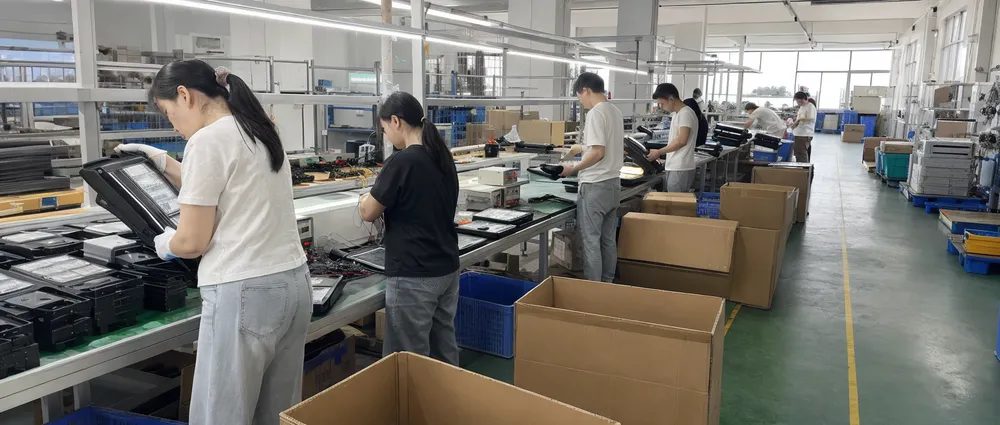
100% Outgoing Inspection — Every Unit, Every Carton
The full outgoing inspection covers every unit, every carton, every accessory pack, every label — before the container is sealed. That process adds time to the production schedule. It also means defective units are caught before they're on a ship, not after they're in your warehouse.
Our 12,000 m² factory, 6 production lines, and 1,200,000-unit annual capacity support this process without creating a bottleneck on standard order sizes.
12,000
m² Factory
6
Production Lines
1.2M
Annual Capacity
100%
Outgoing QC
OEM/ODM Options for Distributor and Private-Label Yard Light Programs
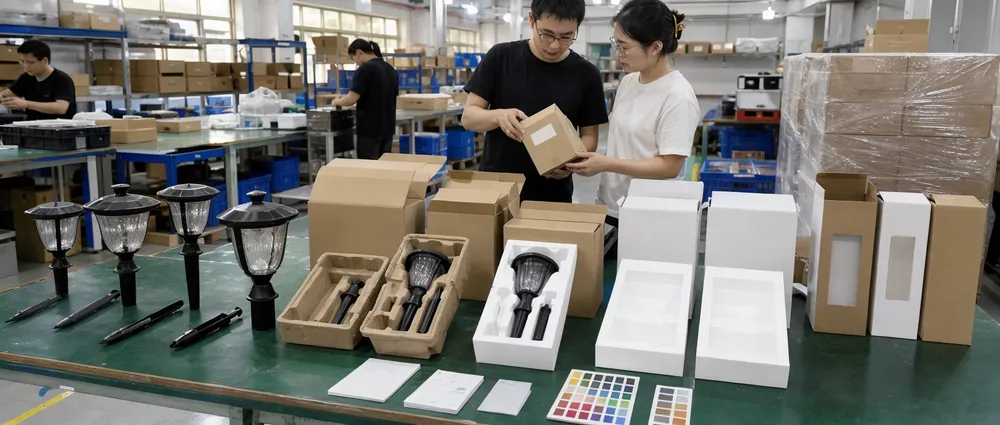
Standard catalog models cover most residential and light-commercial applications. When they don't — because your market has specific lumen requirements, your retail channel needs private-label packaging, or you're building a branded solar backyard lights line — our in-house engineering team handles the customization.
The R&D team includes 15+ optical and electrical engineers who work on both standard product development and OEM/ODM project support.
Lumen Output
Adjusted within the LED module's design range — typically 800–2,500 lm for this product type — without changing the housing.
Color Temperature
Full range from 3000K warm white through 6500K daylight. 4000K and 5000K are the most common for residential and commercial programs.
Battery & Autonomy
Sized for your target deployment latitude and required autonomy days. LiFePO4 or Li-ion depending on cycle life requirements.
Solar Panel Wattage
Configured for your target irradiance region — a panel sized for Southeast Asia is not the same as one sized for Northern Europe.
Sensor Logic & Dimming
PIR sensitivity, trigger distance, dimming percentage, and schedule timing. Programmable schedules available for buyers with specific runtime requirements.
Housing Finish
Standard powder coat colors or custom RAL color on runs over 100 units.
Logo & Labeling
Private-label packaging, carton printing, and accessory kit configuration for retail and distributor channels.
Market Documentation
CE Declaration of Conformity, RoHS records, and installation guides in your required language.
MOQ & Testing
MOQ for standard catalog models starts at 100 units — low enough to test a new SKU with your customers before committing to a larger program.
OEM/ODM projects go through an engineering review before production to confirm the configuration is achievable and to lock the spec before component procurement.
Engineering Review
Skipping the engineering review to save time is the most reliable way to extend your lead time.
The review confirms the configuration is achievable, locks the spec before component procurement, and prevents mid-production changes that delay shipment.
Build a Full Outdoor Solar Lighting Catalog — One Factory
For distributors building a solar outdoor lighting catalog, combining solar yard lights with sibling products in one OEM program means consistent branding, consistent documentation, and a single factory relationship for the full outdoor solar lighting line.
Include your target market, channel type, and packaging requirements when you submit.
Export Packing and Mixed-SKU Control for Yard Light Orders
Solar yard lights ship as multi-component orders: fixtures, solar panels (where separate), mounting brackets, poles or pole sections, hardware kits, and installation guides. A missing bracket or an unlabeled accessory pack creates a receiving problem at your warehouse and a delay on the installation site. We treat packing completeness as part of the QC process.
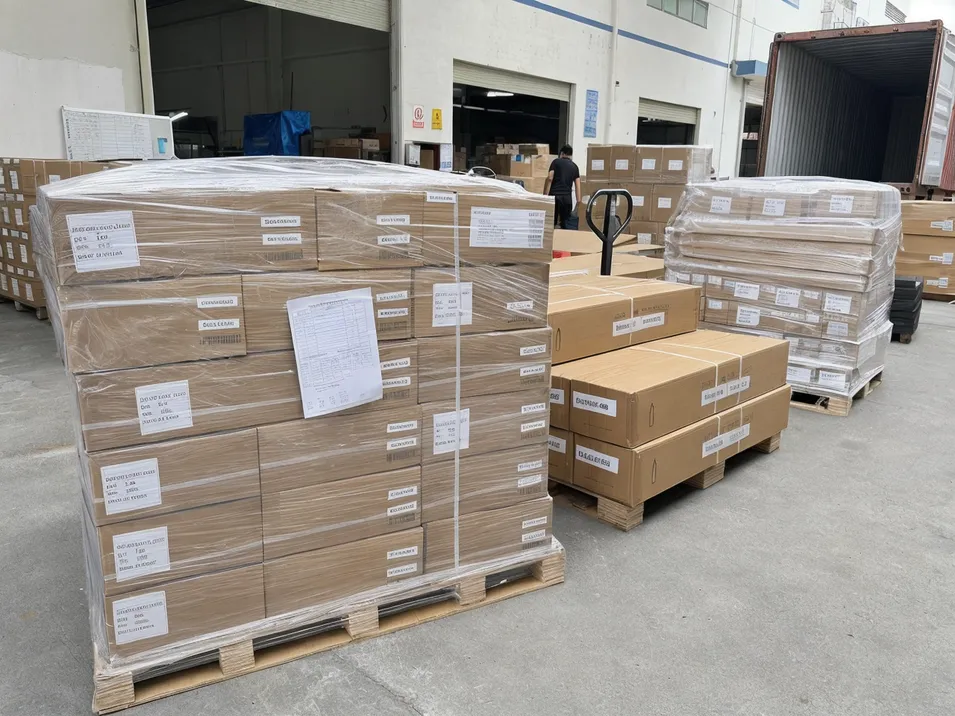
Carton-Level Traceability
Each carton is packed with the fixture, its corresponding accessories, and a packing list that matches the carton label. Batch codes on carton labels trace back to the production run — if a question comes up after delivery about a specific unit's test record or a batch's certification documentation, we can pull the records by batch code.
Private-Label Carton Printing
For private-label programs, carton printing and labeling are configured to your brand requirements before production. Your logo, SKU codes, and compliance marks appear on every carton and inner pack — ready for direct distribution without relabeling at your warehouse.
Mixed-SKU Order Control
Mixed-SKU orders — a common pattern for distributors sourcing yard lights alongside area lights, pole lights, and parking lot lights in one container — are managed with a consolidated packing list that maps each carton to its SKU, quantity, and batch code. This makes warehouse receiving straightforward and simplifies reorder tracking when you're restocking individual SKUs at different rates.
Container-Optimized Carton Sizing
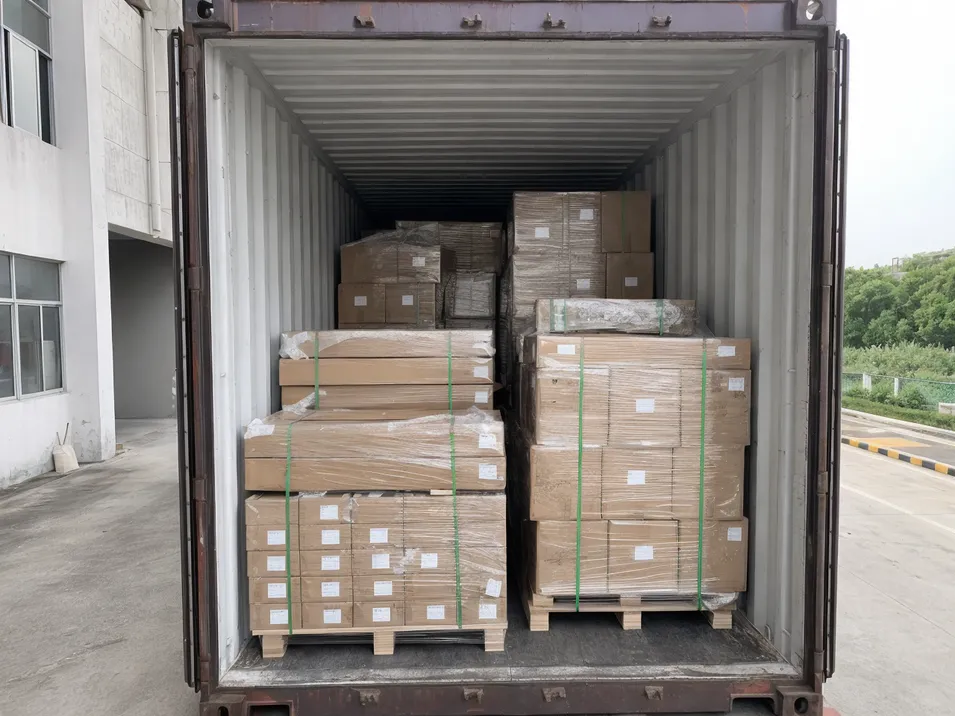
Carton dimensions are sized for standard 20GP and 40HQ container loading. Pallet configurations are available for buyers who need palletized delivery. For specific container loading quantities by configuration, include your destination port and pallet preference in your RFQ.
Export Documentation Available Per Order
Commercial Invoice
Packing List
Bill of Lading
CE Declaration of Conformity
RoHS Test Reports
IP Test Certificates
IEC 62124 Documentation
Pre-Production Confirmation
For buyers importing into North America, Europe, or other regulated markets, we confirm the documentation package before production begins.
Choose Yard Lights or a Sibling Product Before You Quote
Solar yard lights are one of six product types in the solar parking lot and area lighting line. The table below helps you confirm whether yard lights are the right fit, or whether a sibling product better matches your project or catalog requirements.
| Product | Best Fit | Lumen Range | Mounting Height |
|---|---|---|---|
| Solar Yard Lights (this page) | Residential yards, small compounds, distributor catalog SKUs, private-label backyard programs | 800–2,500 lm | 2.5–5m |
| Solar Parking Lot Lights | Fixed overhead lighting for retail lots, campus parking, municipal areas | 3,000–8,000 lm | 5–10m |
| Solar Area Lights | Broader open-area coverage for perimeter lighting, community spaces, distributed outdoor areas | 3,000–10,000 lm | 4–8m |
| Commercial Solar Area Lights | Industrial yards, logistics parks, warehouse perimeters, security zones | 8,000–20,000 lm | 6–12m |
| Solar Pole Lights | Pole-format projects where mounting structure drives selection — pathways, campus roads, compounds | 1,500–4,000 lm | 4–8m |
| Solar Lighting Tower | Portable or temporary site lighting — construction, emergency response, events, mining | 10,000–30,000 lm | 6–20m (adjustable) |
Yard Lights vs. Pole Lights — When to Choose Which
The distinction between solar yard lights and solar pole lights is worth clarifying: yard lights are selected by coverage need and output range; pole lights are selected when the pole format and mounting structure are the primary specification constraint.
- If your project starts with a pole height and diameter already specified, solar pole lights may be the better starting point.
- If your project starts with a yard size and a lumen target, yard lights are the right product to configure.
If you're building a distributor catalog and need to cover multiple outdoor solar lighting segments, view the full solar parking lot and area lighting line — all six product types share the same production standards and can be combined in a single order.
FAQ for Solar Yard Light Buyers
What lumen output is suitable for solar yard lights?
It depends on mounting height and coverage area.
2.5–3 m mounting height
Standard residential yard — 800–1,200 lumens is typically adequate.
4–5 m mounting height
Larger yard or small commercial perimeter — 1,500–2,500 lumens is more appropriate.
If you're replacing existing fixtures, use the existing fixture's lumen output as a baseline — solar replacements should match or exceed it to avoid visible downgrade complaints from downstream customers.
Distributor catalog programs: 1,000–1,500 lm at 3–4 meter mounting height covers the widest range of residential and light-commercial applications without over-specifying the battery.
How many autonomy days should solar yard lights be configured for?
For most residential and light-commercial programs in markets with predictable weather — North America, Europe, Middle East — 2–3 autonomy days is sufficient.
For markets with extended rainy seasons — equatorial Southeast Asia, West Africa, monsoon regions — 3–5 days is more appropriate.
Autonomy days are determined by battery capacity relative to nightly energy consumption, which means the control mode and the autonomy spec need to be confirmed together. A fixture running at 50% power after midnight needs significantly less battery than one running at full output all night.
Specify both values when requesting a quote
Provide both the autonomy target and the runtime mode. Without both, any configuration we provide is based on assumptions.
Are solar backyard lights different from commercial solar yard lights?
The hardware can be identical — the difference is in configuration, packaging, and channel.
- Lower lumen outputs: 800–1,200 lm
- Retail-ready packaging
- Private-label branding
- Garden center and retail distribution
- Configured for higher autonomy
- Specific IP ratings per project spec
- Export documentation requirements
- Residential developments, small facilities, municipal programs
We supply both channels from the same production line — the configuration and packaging are adjusted to match the channel.
If you're building a private-label solar backyard lights program for retail distribution, the customization options in the OEM/ODM section above apply directly.
What IP rating should outdoor solar yard lights use?
Covers dust ingress protection and water jet resistance — handles rain, cleaning, and standard outdoor exposure.
Best for
Most residential and light-commercial yard light programs
Adds submersion protection to 1 meter for 30 minutes — matters for fixtures in flood-prone areas, low-lying yards, or sites with regular pressure washing.
Best for
Coastal or flood-prone deployments
We test both ratings on our own waterproof inspection equipment.
Coastal Environment Note
If your project is in a coastal environment with salt spray exposure, confirm that the housing material and hardware are also rated for corrosion resistance — IP rating covers water ingress, not salt corrosion. Specify IP67 in your RFQ for coastal or flood-prone deployments.
Why do some solar yard lights fail after one rainy season?
The most common cause is battery capacity degradation from cell mismatch — if the cells in the battery pack were not matched by capacity and internal resistance at assembly, the weakest cell limits the pack's usable capacity, and the degradation accelerates with each charge cycle.
The second cause is LED lumen depreciation from inadequate thermal management — the LED junction temperature runs too high because the heat sink is undersized or the thermal interface between the LED module and the housing is poorly executed.
A third cause is solar panel soiling or shading — panels that accumulate dust or are partially shaded during peak sun hours lose output over time, reducing the charge delivered to the battery each day.
We address the first two through battery cell matching at assembly and heat sink design validation. The panel exposure issue is a site planning decision that should be confirmed before installation.
What information should I send to get an accurate solar yard light quote?
The minimum we need: target lumen output or mounting height, required autonomy days, destination country or latitude, order quantity, and any certification requirements for your market.
If you're sourcing for a specific project, include the site type (residential development, small commercial yard, municipal space) and whether you need private-label packaging.
If you're building a distributor catalog SKU, include your target retail price point and channel type — we'll configure the version that protects your margin.
Without the autonomy and latitude data, any quote we provide is based on assumptions that may not match your deployment conditions.
Get a Quote for Solar Yard Lights
Tell us your destination country, target lumen output, mounting height, runtime mode, order quantity, and whether you're sourcing for project installation or resale. If you have packaging or private-label requirements, include those as well.
We'll respond with a configuration recommendation, a spec sheet for the relevant model, and a quote.
Submit Your RFQ Online