

Solar Fence Lights Built for Repeatable Boundary Lighting Programs
Compact solar-powered fixtures for fence posts, perimeter walls, deck rails, and garden boundaries. No grid wiring, no trenching cost, consistent lumen output batch to batch.
Factory supply · MOQ 100 units · OEM/ODM supported
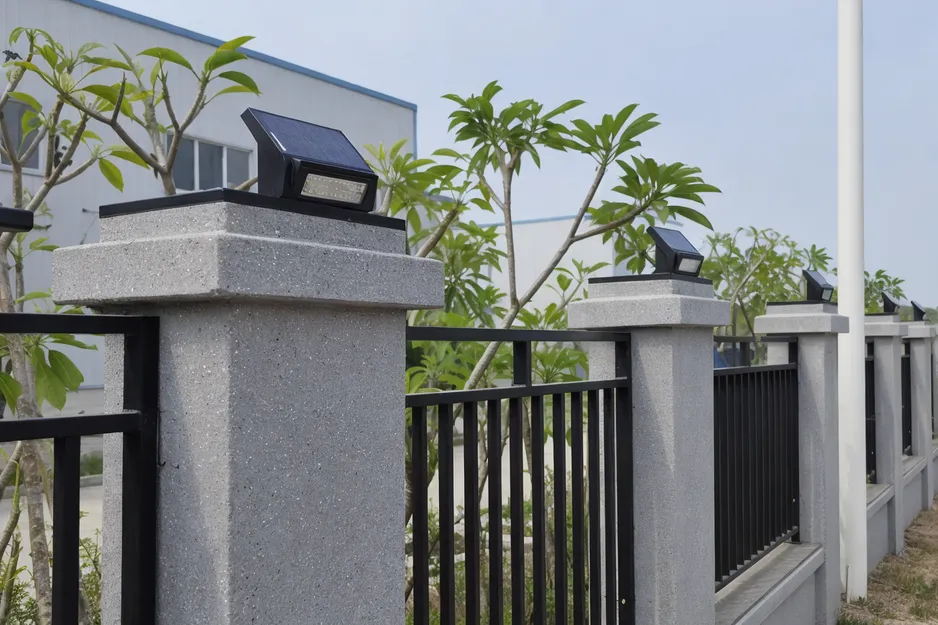
Solar Fence Lights for Repeatable Outdoor Boundary Lighting Programs
Solar fence lights are compact, self-contained fixtures designed to mount on fence posts, perimeter walls, deck rails, balcony edges, and garden boundary structures where running grid wiring is expensive or impractical. Each unit integrates a solar panel, LED module, battery, and controller into a single housing — no electrician, no conduit, no ongoing energy cost for the end installation.
We've been making outdoor solar lighting since 2012. Solar fence lights sit in a specific commercial niche: they're bought in multiples — often 20 to 200 units per project — and they're reordered when a distributor's customer comes back for the next phase of a compound, resort, or residential development. That repeat-order pattern is what we build for.
Consistent lumen output between batches, reliable battery performance across seasons, and waterproof construction that holds up in the field are the three things that determine whether your customer reorders from you or finds a different supplier.
Batch Consistency
Consistent lumen output and housing finish between production runs — critical for phased development projects.
IP65/IP67 Waterproof
Sealed construction rated for sustained outdoor exposure — rain, dust, humidity, and UV cycling.
Zero Grid Wiring
Self-contained solar panel, LED, battery, and controller. No electrician, no conduit, no energy cost.
Where Solar Fence Lighting Creates Commercial Demand
The market for outdoor solar fence lighting isn't one segment — it's several, each with its own order pattern and margin logic. Understanding which segments your distribution or contracting business serves helps you spec the right fixture configuration from the start.
Residential Compound & Villa Developers
One of the highest-volume repeatable segments. A developer building 50 to 200 villas typically specifies perimeter fence lighting as a standard amenity. Each villa might take 8 to 20 fixtures along its boundary fence, and the developer reorders for each new phase.
The buying decision is made by a procurement team comparing landed cost, warranty terms, and visual consistency across the development — not by the end homeowner.
Fencing & Landscape Contractors
Contractors add solar fence lights as a margin-positive line item on installation projects. A contractor who installs 500 meters of timber or aluminum fencing can upsell solar post-cap lights or side-mount fixtures on every post.
Order size per project is modest — 20 to 80 units — but the frequency is high and the contractor controls the product specification. These buyers want fixtures that install in under five minutes per post, come with all hardware included, and don't generate callbacks.
Garden Centers & Outdoor Living Retailers
The retail channel wants compact, attractively packaged units with clear lumen and runtime claims on the box, neutral or branded packaging options, and a price point that supports a 2.5× to 3× retail markup.
Reorder cycles follow the spring and summer selling season, and a reliable factory supply with consistent product quality is the difference between a profitable SKU and a return-rate problem.
Resort, Hotel & Hospitality Projects
Outdoor solar fence lighting for perimeter paths, pool enclosures, garden boundaries, and villa compound edges. Project quantities run from 100 to 500+ units per site.
The specification is typically driven by a lighting designer or project manager who needs CE documentation, IP rating certificates, and a confirmed lead time before the order is placed. We've shipped to resort projects in Southeast Asia and the Middle East where the buyer needed both IP67 waterproof certification and a housing that handles sustained 45°C ambient temperatures — worth confirming your target climate when you send the inquiry.
Distributors Building Multi-SKU Solar Lighting Catalogs
Solar fence lights are a natural complement to pathway lights, deck lights, and garden lights. A distributor who already carries our pathway and bollard range can add fence lights as a catalog extension without adding a new supplier relationship — same quality standards, same documentation, same reorder process.
Send your target market and order volume to get a configuration recommendation tailored to your segment.
Specification Points Buyers Should Confirm Before Sampling
The table below shows industry-typical values for solar fence lights in the standard commercial range. Actual specifications depend on the model selected and are confirmed in the product datasheet before production.
| Parameter | Typical Value / Range |
|---|---|
| Solar Panel Type | Monocrystalline silicon |
| Solar Panel Output | 1W – 3W (model dependent) |
| Battery Chemistry | LiFePO4 (lithium iron phosphate) or Li-ion 18650 |
| Battery Capacity | 1,200 mAh – 2,600 mAh |
| LED Wattage | 0.5W – 2W |
| Lumen Output | 30 lm – 200 lm (model dependent) |
| Color Temperature | 2700K / 3000K / 4000K / 6000K (selectable) |
| Housing Material | ABS, PC, or die-cast aluminum |
| Surface Finish | Matte black, brushed silver, antique bronze, custom RAL |
| IP Rating | IP65 standard; IP67 available on request |
| Charging Time | 6–8 hours (full sun) |
| Working Time | 8–12 hours (standard mode); 3–5 nights with motion sensor mode |
| Lighting Modes | Constant on (dim) / Motion-activated full brightness / Dusk-to-dawn |
| PIR Sensor Option | Available; detection angle 120°, range 3–5 m |
| Mounting Method | Fence-top cap mount, side-wall screw mount, or post-bracket mount |
| Mounting Hardware | Stainless steel screws and anchors included |
| Warranty | 3 years standard |
| Certifications | CE, RoHS, IP65/IP67, ISO 9001:2015, IEC 62124 |
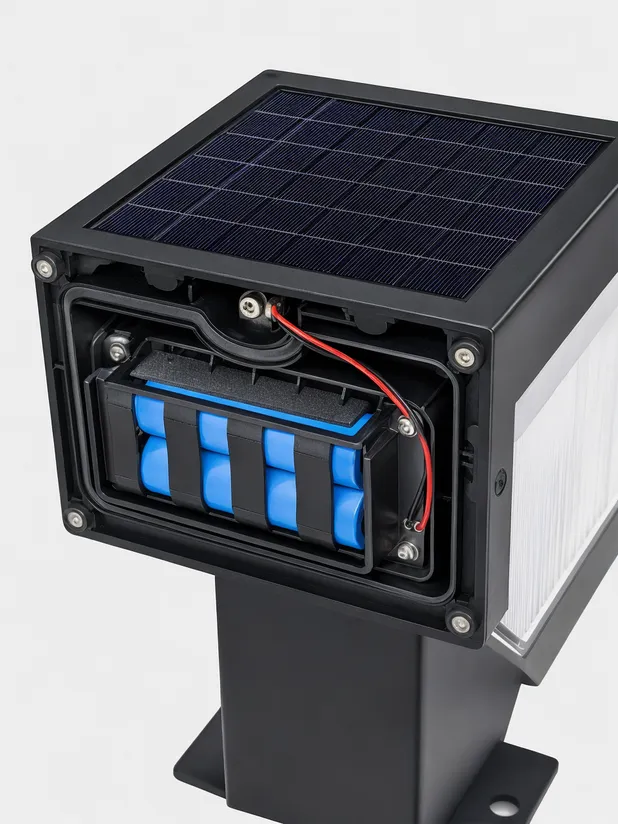
Specifications shown are industry-standard values for this product type. Actual specifications vary by model. Contact us for the current datasheet before sampling.
Battery Chemistry: LiFePO4 vs Li-ion 18650
We run LiFePO4 battery cells as our default recommendation for export markets — the chemistry handles deep discharge cycles better than standard Li-ion, which matters in markets with extended cloudy seasons or high-temperature summers where the battery is working harder.
For buyers targeting price-sensitive retail channels, Li-ion 18650 cells are available at lower cost with a slightly shorter cycle life. We'll tell you which configuration makes sense for your market when you send the inquiry.
Better deep-cycle life, high-temp tolerance. Recommended for export and harsh-climate markets.
Lower unit cost, shorter cycle life. Suitable for price-sensitive retail channels.
Mounting Format, Solar Exposure, and After-Sales Risk
How a solar fence light is mounted and where it's positioned on the fence line determines whether it performs as specified or generates warranty claims. This is the section most buyers skip — and the one that causes the most after-sales problems.
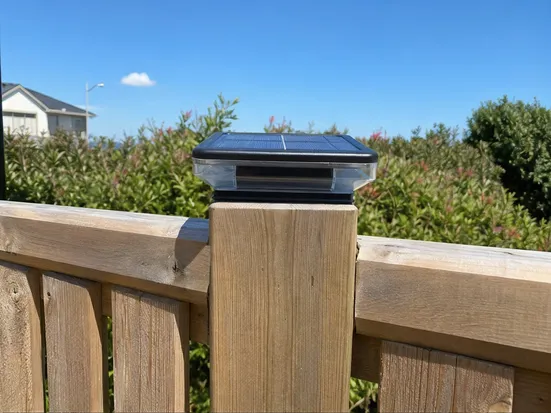
Fence-Top Cap Mounting
The most common format for timber and aluminum post fences. The fixture sits on top of the post, solar panel facing skyward. This gives the best solar exposure but requires the post cap to be flat and level.
If the fence line runs east-west, the panel gets full sun. If it runs north-south in the northern hemisphere, the south-facing posts get better charging than the north-facing ones — worth noting if your buyer is specifying a long perimeter fence in a northern latitude market.
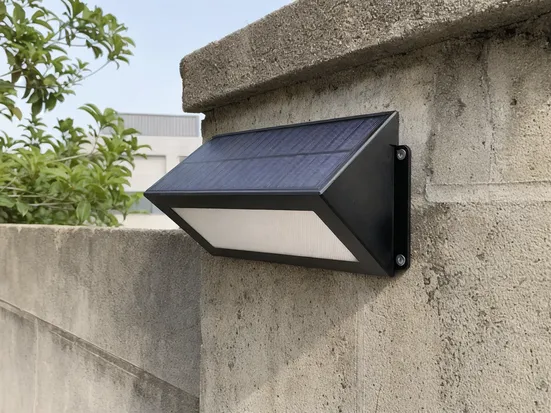
Side-Wall Mounting
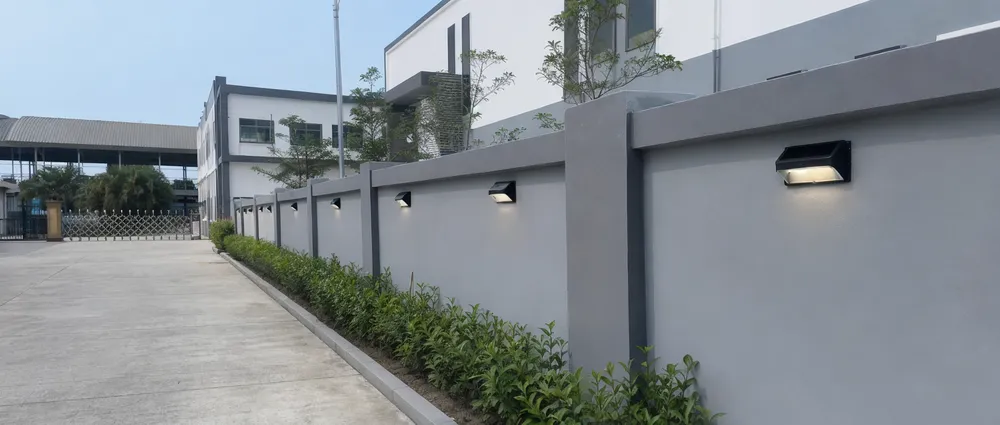
Attaches the fixture to the face of a wall, fence panel, or post using screw anchors. The solar panel is typically angled upward at 15–30° from the housing face. Works well on masonry walls and concrete fence panels.
The panel angle is fixed — if the wall faces north in a northern hemisphere installation, charging performance will be reduced. We recommend confirming the wall orientation with your buyer before specifying side-mount fixtures for high-latitude markets.
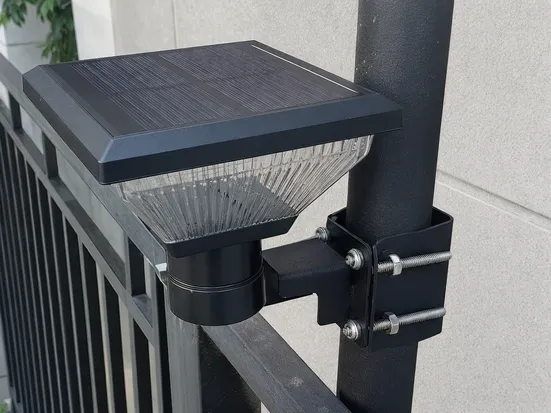
Post-Bracket Mounting
Bracket-mounted fixtures clamp to round or square posts, offering flexibility for metal fence systems and retrofit installations where the post cap is not flat or accessible.
Stainless steel screws and anchors are included with all mounting configurations. Hardware is rated for outdoor exposure and corrosion resistance.
Panel Shading — The #1 Cause of Underperformance Claims
Most common after-sales issue from the field
Overhanging tree branches, fence rail caps that shadow the panel in the afternoon, or fixtures mounted under a roof overhang all reduce charging time. A fixture that charges for 4 hours instead of 6 will run for 5–6 hours instead of 8–10.
The fix is positioning, not the product — but the warranty claim lands on your desk either way.
We include a shading advisory in the installation guide for all fence light models.
Drainage and Standing Water
IP rating ≠ submersion tolerance
The housing is IP65 or IP67 rated, but that doesn't mean it should sit in a puddle. Fence-top cap mounts should have a drainage gap between the fixture base and the post top. Side-mount fixtures should be positioned so water runs off the face rather than pooling at the screw entry points.
We design the housing with drainage channels, but installation positioning matters.
Need Higher Output for Wall-Mounted Applications?
For higher-output wall-mounted applications where the fixture needs to cover a larger area, solar wall lights carry larger panels and higher lumen outputs than fence-format fixtures.
Battery, LED, and Waterproof Checks That Protect Reorders
The three failure modes that generate the most warranty claims in solar fence lighting are battery degradation after one or two seasons, lumen output inconsistency between batches, and waterproof failure in sustained rain or high-humidity environments. We built our production QC system around these three points specifically.
Battery Matching & Charge/Discharge Testing
Runs on every battery pack before it enters assembly. We match cells by capacity and internal resistance within a ±3% tolerance — mismatched cells in a pack degrade faster because the weaker cell limits the pack's effective capacity and takes more stress on each cycle.
After matching, every pack goes through a charge/discharge cycle test on our aging racks to confirm actual capacity against spec. A pack that tests below 95% of rated capacity doesn't go into production.
We switched to this protocol after seeing field returns from a batch where the cell supplier had shipped a mixed lot. The matching step adds time, but it's the difference between a 2-year battery life and a 4-year battery life in the field.
LED Module Output Confirmation
Happens at the assembly stage, not just at incoming inspection. Every LED module is tested for lumen output and color temperature before it's installed in the housing.
We bin modules within ±10% lumen tolerance and ±150K color temperature tolerance — so a 3000K warm white order doesn't arrive with a mix of 2800K and 3200K units that look different side by side on the same fence line.
For buyers supplying residential developers or hospitality projects where visual consistency across a long fence run matters, this is the check that prevents the most complaints.
IP65/IP67 Waterproof Verification
Done on our own test equipment, not assumed from housing design. Every production batch goes through waterproof structure inspection — we test the seal integrity at the panel-to-housing joint, the cable entry points, and the lens-to-housing interface.
- IP65: Sustained water jets from any direction
- IP67: Temporary immersion to 1 meter for 30 minutes
For buyers in markets with heavy monsoon seasons or coastal installations, we recommend specifying IP67 as the standard.
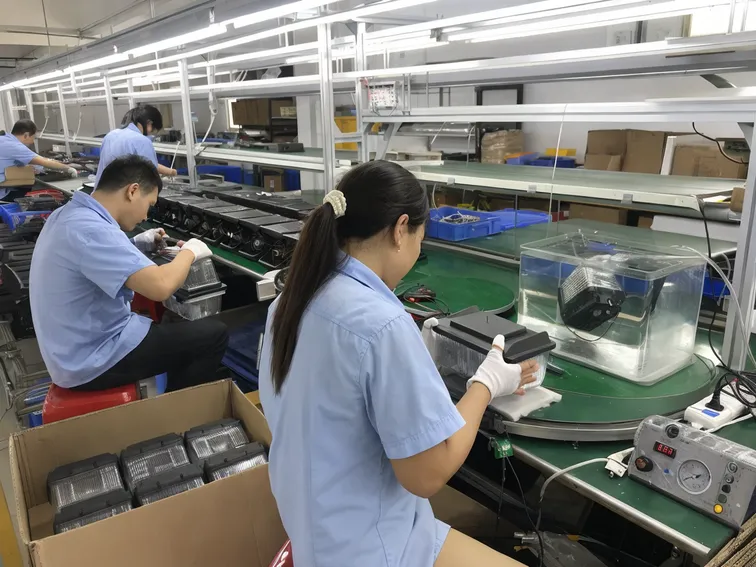
100% Pre-Shipment Inspection
Covers every unit, every carton, every accessory pack before the container is sealed. CE, RoHS, IP65/IP67, and IEC 62124 certifications are available with documentation per order.
Fewer returns from your downstream customers means your reorder cycle stays intact. That's the commercial logic behind the QC investment.
OEM/ODM Options for Private-Label Solar Fence Light Lines
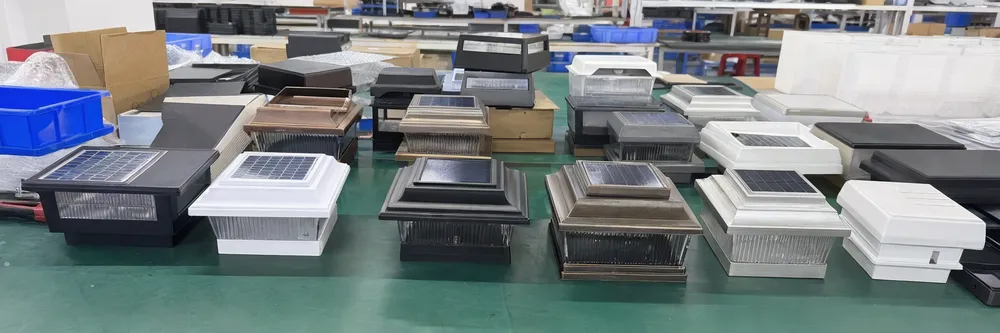
Solar fence lights are one of the more customization-friendly products in the outdoor solar lighting range — the compact housing and relatively simple electronics make appearance and configuration changes achievable without major tooling investment.
| Customization Option | Details |
|---|---|
| Housing Color | Standard: matte black, brushed silver, antique bronze. Custom RAL colors available on runs of 500+ units |
| Surface Finish | Matte, gloss, textured powder coat |
| Logo | Laser engraving, pad printing, or label on housing or packaging |
| Carton Artwork | Full custom print, neutral brown kraft, or white box with label |
| Color Temperature | 2700K / 3000K / 4000K / 6000K — selectable at order stage |
| Lumen Output | Adjustable within LED module design range without housing change |
| Lighting Mode | Constant dim / motion-activated / dusk-to-dawn / programmable — confirmed at order stage |
| PIR Sensor | Optional; detection angle and sensitivity configurable |
| Battery Capacity | Upgradeable within housing volume constraints |
| Solar Panel Size | Standard integrated panel; larger panel requires housing modification (engineering review) |
| Accessory Pack | Custom screw kit, mounting bracket, installation guide language |
| Manual Language | English, French, Spanish, German, Arabic, or other on request |
MOQ — Standard Models
100 units
MOQ — Custom Color / Packaging
500 units
MOQ — New Housing / Tooling
Engineering review required; tooling cost and timeline confirmed before commitment
Full OEM/ODM Process — Engineering Review Is Not Optional
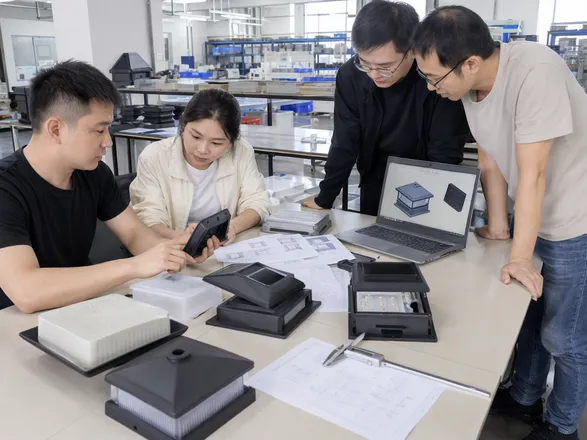
For buyers building a private-label solar lighting line, we handle the full OEM/ODM process: engineering review, sample confirmation, production, inspection, and export documentation.
The engineering review step is not optional for new housing designs — we've seen buyers skip it to save two weeks and then spend six weeks resolving spec mismatches during production. The review is faster.
Packaging, Labeling, and Mixed-SKU Order Planning
Solar fence lights are compact, multi-unit SKUs where packaging decisions directly affect your landed cost and damage claim rate. A fixture that arrives with a cracked lens or a bent mounting bracket because of inadequate inner packaging generates a return, a replacement shipment, and a customer service conversation — all of which cost more than the packaging upgrade.
Standard Export Cartons
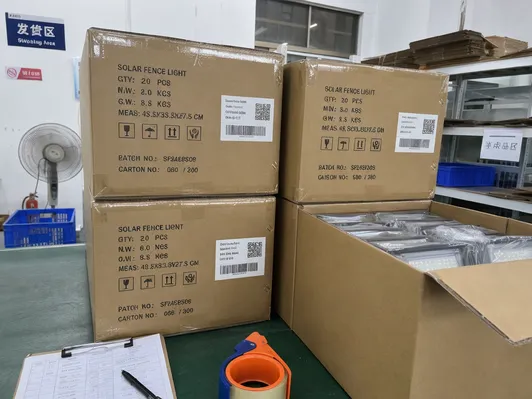
Standard export cartons are sized for 4 or 6 units per master carton, with individual inner boxes and foam or molded pulp inserts to prevent movement during transit.
Carton dimensions are planned for 20GP and 40HQ container loading efficiency — we confirm the CBM and loading quantity at order placement so you can calculate your landed cost accurately before committing.
Retail-Ready Inner Packaging
For retail channel buyers, we offer retail-ready inner packaging: printed color boxes with product photography, lumen and runtime claims, barcode placement for shelf scanning, and accessory pack verification before carton sealing.
Neutral packaging (plain white or kraft box with your label) is available for buyers who apply their own retail labels at the warehouse.
Batch Coding & Traceability
Batch coding on cartons and individual units supports traceability — if a quality issue surfaces in the field, you can identify the production batch and isolate the affected units without a full recall.
We include a packing list in every carton and a master packing list with the shipment documentation.
Mixed-Container Order Consolidation
Mixed-container orders combining solar fence lights with solar deck lights, pathway lights, or wall lights are straightforward to plan — all products in our range use compatible carton dimensions and packing standards.
A distributor building a mixed solar lighting container can consolidate SKUs from one factory with one set of documentation, one inspection report, and one shipment.
One Set of Documentation
One Inspection Report
One Shipment
One Factory Source
Choosing Between Fence, Deck, Pathway, Bollard, and Wall Fixtures
Solar fence lights are one of seven fixture types in the pathway and bollard lighting range. The table below helps you match the right product to the installation surface and commercial use case.
| Fixture Type | Mounting Surface | Typical Lumen Range | Primary Commercial Use | Link |
|---|---|---|---|---|
| Solar Fence Lights | Fence post top, wall face, deck rail | 30–200 lm | Perimeter boundary lighting, compound/villa programs, retail SKU | This page |
| Solar Deck Lights | Deck boards, step risers, rail posts | 10–80 lm | Deck and step accent lighting, outdoor living retail | Solar Deck Lights |
| Solar Pathway Lights | Ground stake, garden bed edge | 20–100 lm | Garden path marking, landscape contractor add-on | Solar Pathway Lights |
| Solar Walkway Lights | Ground stake, paved surface | 30–150 lm | Pedestrian route lighting, community and park projects | Solar Walkway Lights |
| Solar Bollard Lights | Ground anchor, concrete base | 100–500 lm | Freestanding commercial guidance, parking and plaza | Solar Bollard Lights |
| Solar Post Top Lights | Decorative post top | 200–800 lm | Entrance columns, decorative post programs | Solar Post Top Lights |
| Solar Driveway Lights | Ground flush or edge stake | 10–50 lm | Vehicle edge marking, driveway delineation | Solar Driveway Lights |
| Solar Wall Lights | Masonry wall, building facade | 200–1,500 lm | Security and area lighting, higher-output wall applications | Solar Wall Lights |
Fence Lights vs. Wall Lights — The Key Distinction
The key distinction between solar fence lights and solar wall lights is output level and panel size. Fence lights are compact fixtures optimized for repeated installation along a fence line — lower lumen output, smaller panel, lower unit cost. Wall lights carry larger panels and higher lumen outputs for applications where the fixture needs to cover a wider area or provide security-level illumination.
Solar wall lights are the right product.
Solar fence lights are the right product.
Procurement Checklist Before You Request a Quote
A complete inquiry gets a faster, more accurate response. Before you send the RFQ, confirm the following points to ensure your quote reflects exact project requirements.
Target Market
Country or region — affects CE documentation requirements, voltage, and climate configuration.
Installation Environment
Fence-top cap mount, side-wall mount, or deck rail — affects housing format and panel angle.
Expected Order Quantity
Initial order and estimated annual volume — affects MOQ tier and pricing.
Lumen Requirement
30–80 lm for accent/boundary marking, 80–200 lm for functional perimeter lighting.
Color Temperature
Warm white (2700–3000K) for residential/hospitality, neutral or cool white (4000–6000K) for commercial/security.
Battery & Runtime Requirement
Standard 8–10 hour runtime, or extended autonomy for markets with limited winter sun.
IP Rating
IP65 for standard outdoor use, IP67 for coastal, monsoon, or high-humidity markets.
Sensor Mode
Constant dim with motion-activated boost, dusk-to-dawn constant, or programmable.
Packaging Type
Retail color box, neutral box with label, or bulk export carton.
Logo & Branding
None, label, pad print, or laser engrave.
Certification Documents Needed
CE Declaration of Conformity, RoHS test report, IP test certificate, IEC 62124.
Sample Timeline
Whether samples are needed before bulk order, and target delivery date for samples.
Ready to Submit Your RFQ?
Include as many of the above points as you have confirmed. If you want to discuss configuration options before submitting a formal RFQ, contact JXSOL sales directly.
Solar Fence Lights FAQ
Answers to the specification and performance questions B2B buyers ask most often when sourcing solar fence lighting at volume.
What IP rating should outdoor solar fence lights use?
IP65 is the minimum for any outdoor solar fence light installation. IP65 means the fixture is protected against sustained water jets from any direction — sufficient for rain, garden irrigation, and standard outdoor exposure.
For coastal installations, monsoon climates, or locations where the fixture may be exposed to wave splash or flooding, specify IP67, which covers temporary immersion to 1 meter for 30 minutes.
We test both ratings on our own waterproof inspection equipment and provide IP test certificates with the order. If you're unsure which rating your market requires, IP67 is the safer default — the cost difference at the factory level is small, and the warranty claim risk reduction is significant.
Rain, irrigation, standard outdoor exposure. Minimum for any fence light deployment.
Coastal, monsoon, flood-risk zones. Temporary immersion to 1 m for 30 min. Recommended default.
How many lumens are suitable for solar fence lighting?
It depends on the application. The right lumen level is determined by whether the fence line serves a decorative or functional purpose, and by fixture spacing.
Lumen Ranges by Application
30–80 lm
Marking a fence line or garden perimeter where the goal is visual definition rather than functional illumination. Best with warm white CCT.
80–200 lm
Security boundary or pedestrian path edge. Particularly effective with a motion-activated mode that boosts to full brightness on detection.
Spacing vs. Lumen Output
| Fixture Spacing | Recommended Output | Result |
|---|---|---|
| 2-meter spacing | 50 lm per fixture | Well-lit, continuous fence line |
| 4-meter spacing | 100+ lm per fixture | Avoids dark gaps between fixtures |
We can help you calculate the right lumen level and spacing for your buyer's specific fence length and use case. Share the project parameters when requesting a quote.
Ready to get started?
Request pricing for standard or custom solar fence light configurations.
Can solar fence wall lighting work on shaded fence lines?
Partial shading reduces charging time and therefore runtime. A fixture that normally charges for 6–8 hours in full sun may only charge for 3–4 hours under partial tree shade, reducing nightly runtime from 8–10 hours to 4–5 hours. This is a positioning issue, not a product defect — but it generates warranty claims if the buyer doesn't account for it.
Recommendations for Shaded Fence Lines
- Specify a higher battery capacity — 2,200–2,600 mAh instead of the standard 1,200–1,500 mAh — to buffer the reduced daily charge.
- Use motion-sensor mode rather than constant-on to extend runtime across the full night.
Full shade — where the panel receives less than 2 hours of direct sun per day — is not suitable for any solar fence light regardless of battery size.
What battery type is better for solar fence lights in export markets?
LiFePO4 (lithium iron phosphate) is our standard recommendation for export markets, particularly for buyers supplying regions with hot summers, cold winters, or extended rainy seasons.
| Parameter | LiFePO4 | Li-ion 18650 |
|---|---|---|
| Operating Temp Range | −20°C to +60°C | Narrower range |
| Cycle Life | 2,000+ cycles | 500–800 cycles |
| Thermal Stability | High — suited for direct-sun fixtures in hot climates | Moderate |
| Unit Cost | Higher | Lower |
| Best Fit | Long-life projects, harsh climates, premium channels | Price-sensitive retail, 2–3 year replacement cycle |
For price-sensitive retail channels where the end customer is replacing the fixture every 2–3 years anyway, Li-ion 18650 cells are a reasonable alternative. We'll recommend the right chemistry for your target market when you send the inquiry.
Not sure which chemistry fits your market? Include your target region and retail price point in your inquiry and our engineering team will recommend the optimal cell configuration.
Can JXSOL customize housing color, logo, and retail packaging for solar fence lights?
Yes. Standard housing colors (matte black, brushed silver, antique bronze) are available from MOQ 100 units. Custom RAL colors require a minimum of 500 units due to powder line changeover cost.
Logo & Packaging Options
Logo Application
Pad printing, laser engraving, or label — all from MOQ 100 units on standard models
Retail Packaging
Printed color box with product photography, barcode, and accessory pack — custom artwork from MOQ 500 units
Neutral Packaging
With your own label applied — available from MOQ 100 units
Full OEM/ODM
Custom housing design programs available
For full OEM/ODM programs including custom housing design, see our OEM and ODM solar lighting services.
What is the MOQ for standard solar fence light models?
100 units for standard catalog models with standard housing colors and neutral or label packaging. 500 units for custom housing colors, custom retail packaging artwork, or custom accessory configurations.
New housing designs or tooling modifications require an engineering review before MOQ and tooling cost are confirmed — we don't quote tooling blind.
Typical buyer approach: Most buyers in this category start with a 100-unit sample order across 2–3 housing styles to test with their market before committing to a larger program. We can ship samples before the bulk order to confirm the specification.
Explore Related Solar Lighting Categories
Browse other product lines in our pathway, walkway, and bollard solar lighting range to find the right fixture for your project scope.