

Solar Deck Lights Direct From Factory
Compact, IP-rated solar deck lights built for bulk sourcing — retail packs, project add-ons, and private-label programs.
Stair risers, railing mounts, post edges, patio surfaces, boardwalks — consistent battery runtime and lumen output across every pack in your order.
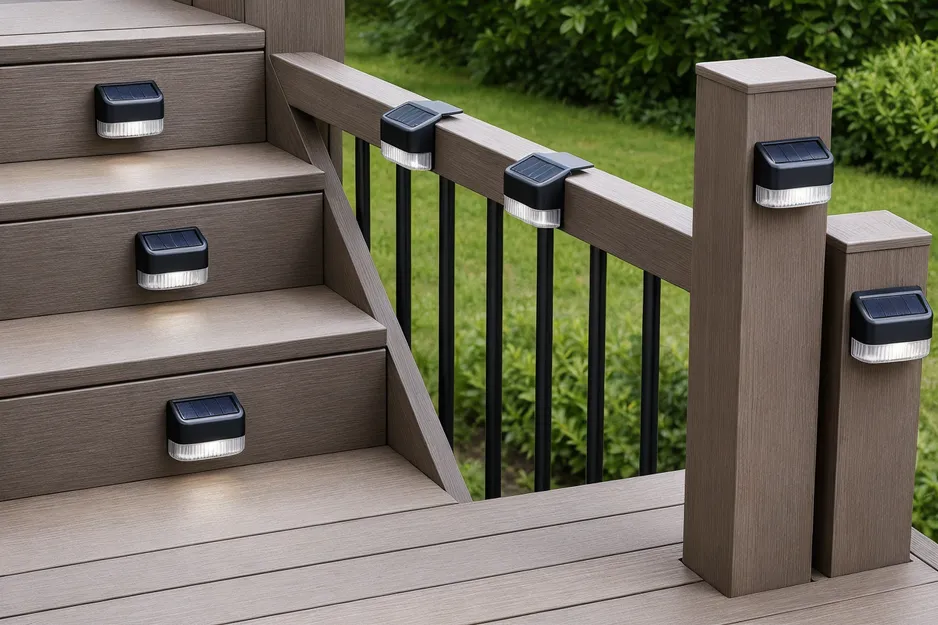
Solar Deck Lights for Retail Packs and Project Add-Ons
Solar deck lights are compact, self-contained solar fixtures for deck edges, stair risers, railings, posts, patio borders, and raised outdoor platforms where running conduit is either cost-prohibitive or structurally impractical. For a distributor or outdoor living brand, they're one of the more versatile SKUs in the solar lighting category — small enough to ship as multi-pack retail units, simple enough for end-user installation, and repeatable enough to anchor a seasonal program.
We've been manufacturing solar-powered outdoor lighting since 2012. The 12,000 m² factory in Guzhen Town runs 6 production lines with 150 employees and an annual capacity of 1,200,000 units. Solar deck lights sit within our pathway and bollard lighting range — the same production infrastructure, the same battery matching and waterproof inspection protocols, applied to a smaller, lower-output fixture format. MOQ starts at 100 units for standard models, which means you can test a new SKU with your buyers before committing to a full program.
The commercial case for stocking solar deck lights is straightforward: outdoor living is a high-margin, seasonally driven category, and deck lights are a natural add-on to any deck board, railing, or patio system sale. They're also one of the few solar lighting formats that moves well through both e-commerce and brick-and-mortar channels without requiring a separate product line for each.
Factory Scale
- 12,000 m² facility
- 6 production lines
- 150 employees
- 1,200,000 units/year
Low Entry Barrier
MOQ from 100 units on standard models — test a new SKU with your buyers before committing to a full program.
Deck-Light Formats Buyers Should Separate Before Quoting
"Solar deck lights" covers several distinct mounting formats, and mixing them in a single SKU inquiry is the fastest way to get a quote that doesn't match what you actually need. Here's how we break them down:
Stair / Riser Lights
Vertical face mountMounting: Vertical face of stair riser or step edge
Output Role: Step visibility, low ambient fill
Channel Fit: Outdoor living retail, building materials, e-commerce
Packaging: 4-pack, 6-pack, 8-pack
Customization: CCT, LED color, housing finish, logo
Railing Lights
Bar or post side mountMounting: Horizontal or vertical railing bar, post side
Output Role: Accent and edge marking
Channel Fit: Outdoor living, hospitality, residential development
Packaging: 4-pack, 6-pack
Customization: Clamp or screw mount options
Post / Edge Lights
Post cap or pier edgeMounting: Post cap side, deck post face, pier edge
Output Role: Perimeter marking, low ambient
Channel Fit: Outdoor living, marina, boardwalk
Packaging: 2-pack, 4-pack
Customization: Housing shape may require tooling
Surface-Mounted Deck Markers
Flat surface mountMounting: Flat deck board or patio surface
Output Role: Ground-level marker, path edge
Channel Fit: Building materials, landscape, e-commerce
Packaging: 4-pack, 6-pack
Customization: Flush or raised profile
Compact Wall / Deck Lights
Wall face or fasciaMounting: Vertical wall face, deck fascia
Output Role: Ambient fill, step approach
Channel Fit: Hospitality, residential, retail
Packaging: 2-pack, 4-pack
Customization: Lumen output, CCT, finish
Low-Profile Patio Markers
Patio edge or platform borderMounting: Patio edge, raised platform border
Output Role: Perimeter definition
Channel Fit: Garden centers, outdoor living retail
Packaging: 4-pack, 6-pack, 8-pack
Customization: Pack count, packaging, logo
The format determines the mounting hardware, the housing profile, the panel angle, and the accessory pack — which means it also determines the sample you need to test before placing a production order. Sending us the mounting surface and the channel you're selling into (retail shelf, e-commerce listing, project spec) gets you a more accurate quote than a generic "solar deck light" inquiry.
If your application is a driveway edge marker that needs to handle vehicle load, that's a different product — see solar driveway lights for driveway edge and surface marker needs. If you need broader pedestrian route guidance rather than deck-edge marking, solar walkway lights for pedestrian route guidance are the better fit.
Procurement Specs for Low-Profile Outdoor Solar Deck Lights
The table below covers typical specification ranges for solar deck lights by format. These are industry-standard values for this product type — exact specifications vary by model and should be confirmed against the product datasheet during RFQ. Use these ranges to build your comparison sheet and identify which parameters need to be locked before sampling.
| Parameter | Typical Range / Options |
|---|---|
| LED output | 5–30 lm (marker/accent); 30–80 lm (step/ambient fill) |
| CCT options | 2700K, 3000K, 4000K, 6000K |
| LED color options | Warm white, cool white, RGB (select models) |
| Solar panel type | Monocrystalline silicon |
| Solar panel output | 0.5W–2W |
| Battery chemistry | LiFePO4 or NiMH (select models) |
| Battery capacity | 200–800 mAh |
| Charging time | 6–8 hours (full sun) |
| Working time | 8–12 hours (typical); 6–8 hours (high-output modes) |
| Housing material | ABS, PC, or stainless steel (select models) |
| Lens material | PC or frosted glass |
| IP rating | IP65 or IP67 |
| Mounting method | Screw-mount, clamp-mount, adhesive (select models) |
| Accessory pack | Screws, anchors, mounting template (select models) |
| Operating temperature | -20°C to +60°C |
| MOQ (standard models) | 100 units |
| Warranty support | 3 years |
| Certifications | CE, RoHS, IP65/IP67, IEC 62124 |
Specifications shown are industry-standard values for this product type. Actual specifications vary by model. Contact us for detailed product datasheets and packing information.
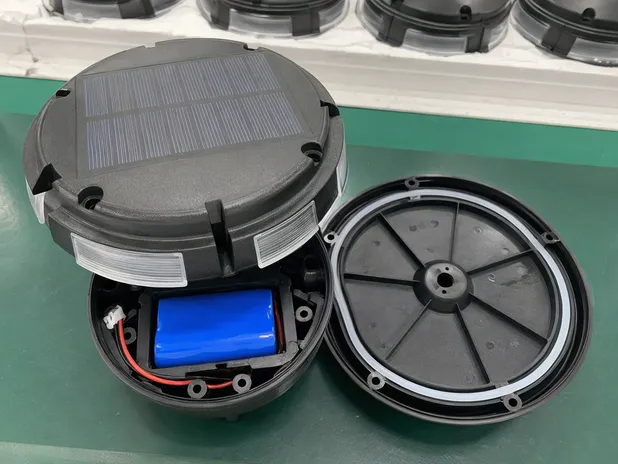
Key Takeaways for RFQ
- LiFePO4 preferred over NiMH for cycle life and temperature stability
- IP67 required for surface-mounted or submerged-edge applications
- Confirm anchor type for composite or metal surfaces before finalizing accessory kit
- MOQ from 100 units; OEM/ODM MOQ reviewed by project scope
Mounting Variables That Decide After-Sales Cost
Installation is where most solar deck light returns originate — not from product failure, but from a mismatch between the mounting environment and the product configuration. Getting this right before your first container ships is cheaper than managing warranty claims after.
Mounting Surface
First variable to lock before accessory kit finalization
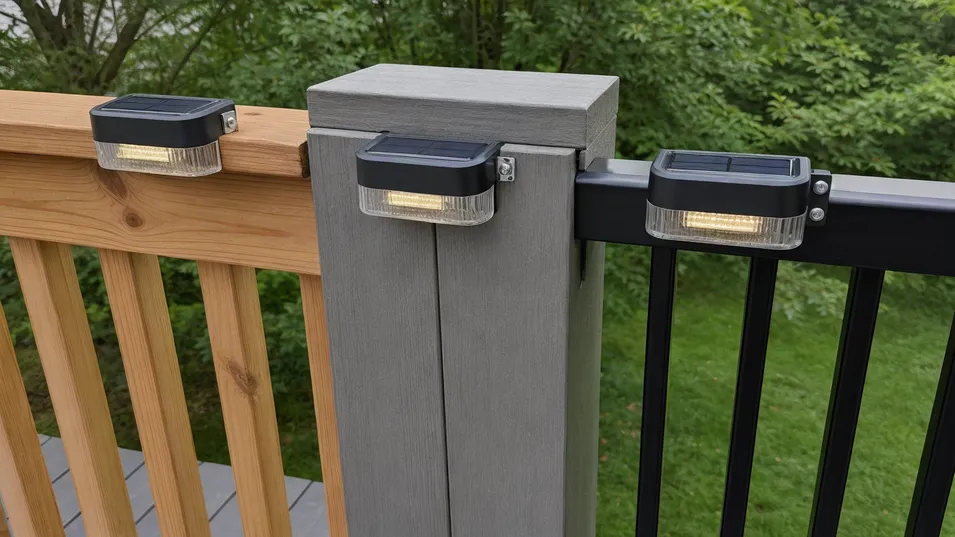
Wood deck boards, composite decking, metal railings, concrete patio edges, and stair risers all have different fastener requirements. A screw pack designed for wood won't anchor cleanly into composite or hollow-profile aluminum railing without the right anchor type.
We include a standard screw and anchor pack, but if your buyers are installing on composite or metal surfaces, confirm the anchor spec before finalizing the accessory kit.
Panel Exposure
The variable that generates the most complaints
A solar deck light on a north-facing deck under a pergola or tree canopy will undercharge in winter, and a buyer who doesn't know this will attribute the short runtime to a battery defect.
We can configure a larger panel or higher-capacity battery for installations with limited sun exposure, but there's a housing size limit — at some point, the panel needed to charge a useful battery in low-irradiance conditions is larger than the fixture housing allows.
If your target market includes heavily shaded outdoor spaces, send us the installation description and we'll tell you whether the product is a fit or whether a different configuration makes more sense. (We'd rather lose a SKU than have your buyers return a product that was never going to work in their specific installation.)
Stair & Edge Placement
Visibility, glare, and trip-hazard considerations
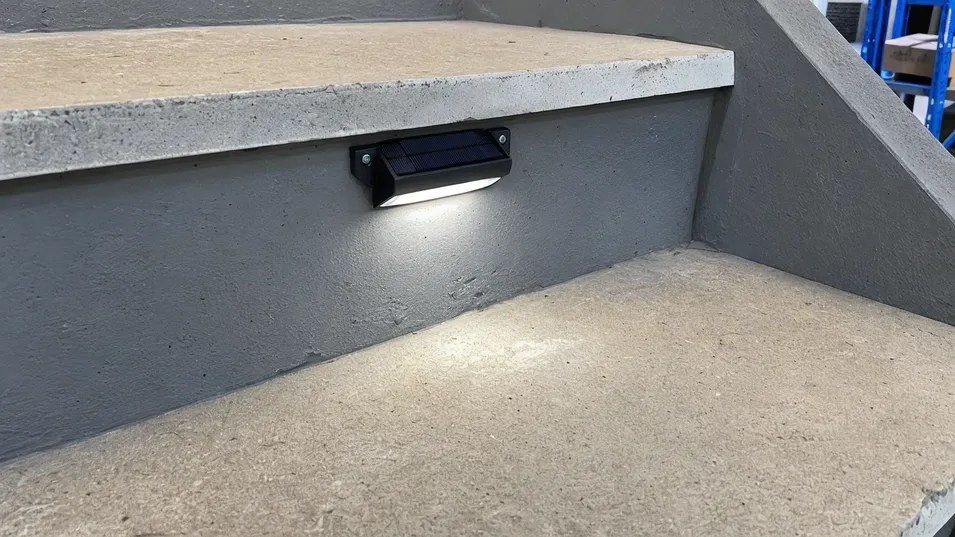
Riser-mounted lights on outdoor stairs should be positioned to illuminate the tread without creating glare at eye level when someone is descending. Surface-mounted deck markers on flat boards need to be recessed or low-profile enough that they don't become a trip hazard.
These are installation details your end users need in the manual — and the manual is something we can customize for your market and language.
Sample Testing
Replicate the actual mounting environment
A sample tested on a sunny south-facing deck in summer will perform differently than the same unit installed on a shaded north-facing deck in winter. Build that into your sample evaluation before you commit to a production run.
Recommendation: Test samples in worst-case installation conditions (shaded, north-facing, winter) to validate runtime before committing to a production order.
Need a configuration recommendation?
Send your mounting surface and target market details. We'll confirm whether the product fits or suggest a better configuration.
Market Segments Where Solar Deck Lights Sell as Repeatable SKUs
The commercial value of solar deck lights isn't in any single sale — it's in the repeat order pattern. Here are the segments where we see consistent reorder volume from our existing buyers.
Outdoor Living Retailers and Garden Centers
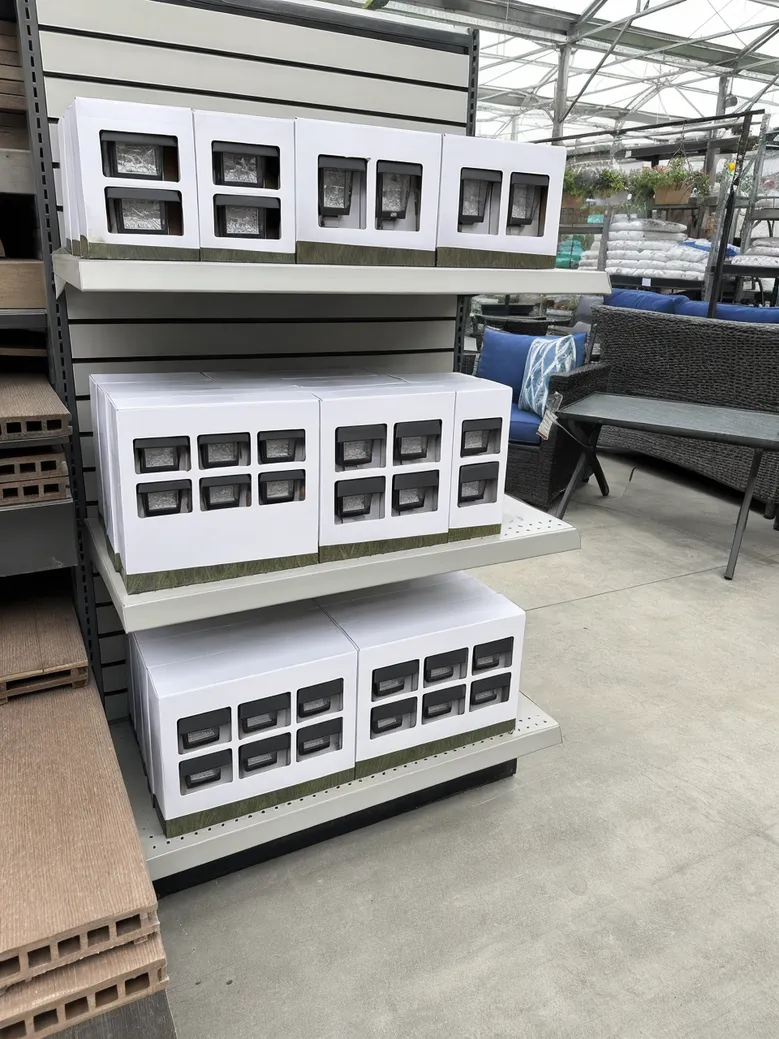
The highest-volume channel for solar deck lights. Seasonal demand peaks in spring and early summer, and multi-pack SKUs (4-pack, 6-pack, 8-pack) are the standard retail format.
A garden center that stocks deck boards, railings, and patio furniture is a natural distribution point for deck lights as an accessory upsell — the buyer is already in the store for the deck project, and a 4-pack of solar stair lights is an easy add-on.
Seasonal reorder cycles mean you're placing 2–3 orders per year with predictable volume, which makes this segment worth building a dedicated SKU for rather than sourcing ad hoc.
Building-Material and Decking Distributors
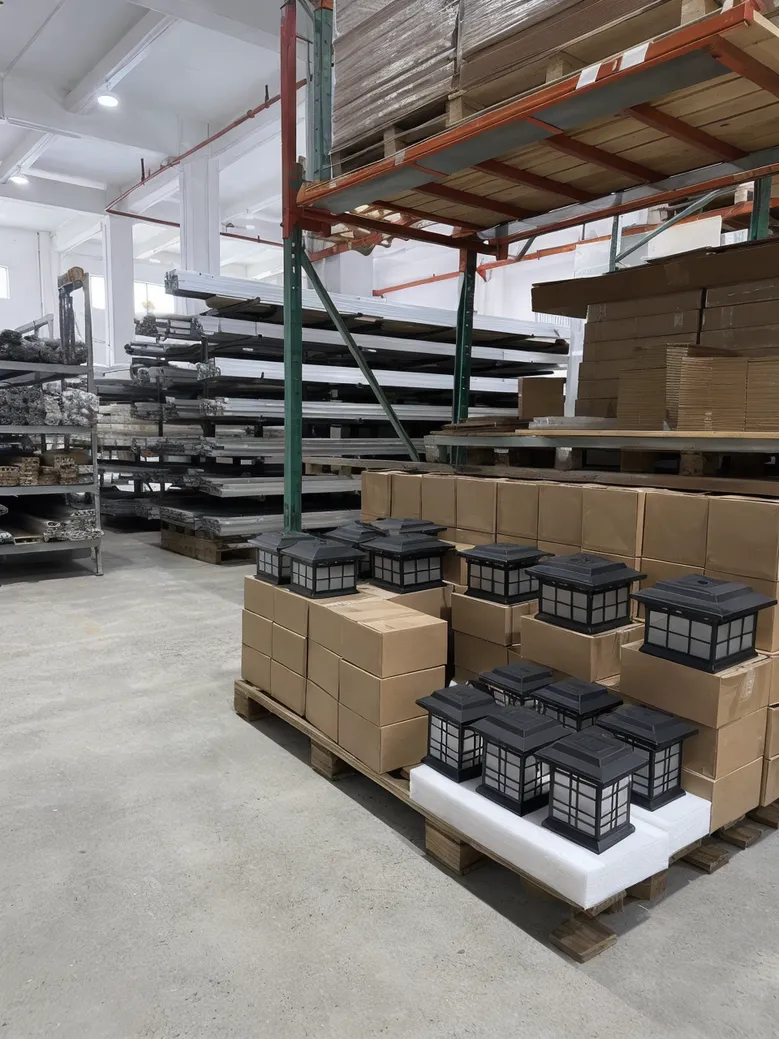
A channel that's often underserved by solar lighting suppliers who focus on garden retail. A distributor who sells composite decking, railing systems, and outdoor hardware to contractors and home improvement stores is already in front of the buyer who needs deck lights — they just need a solar lighting supplier who can provide consistent product, clean documentation, and a pack format that fits their warehouse and delivery system.
We've supplied this channel with both branded and private-label SKUs. The order pattern tends to be larger and less seasonal than garden retail, with more emphasis on documentation and consistent batch quality.
E-Commerce Private Label
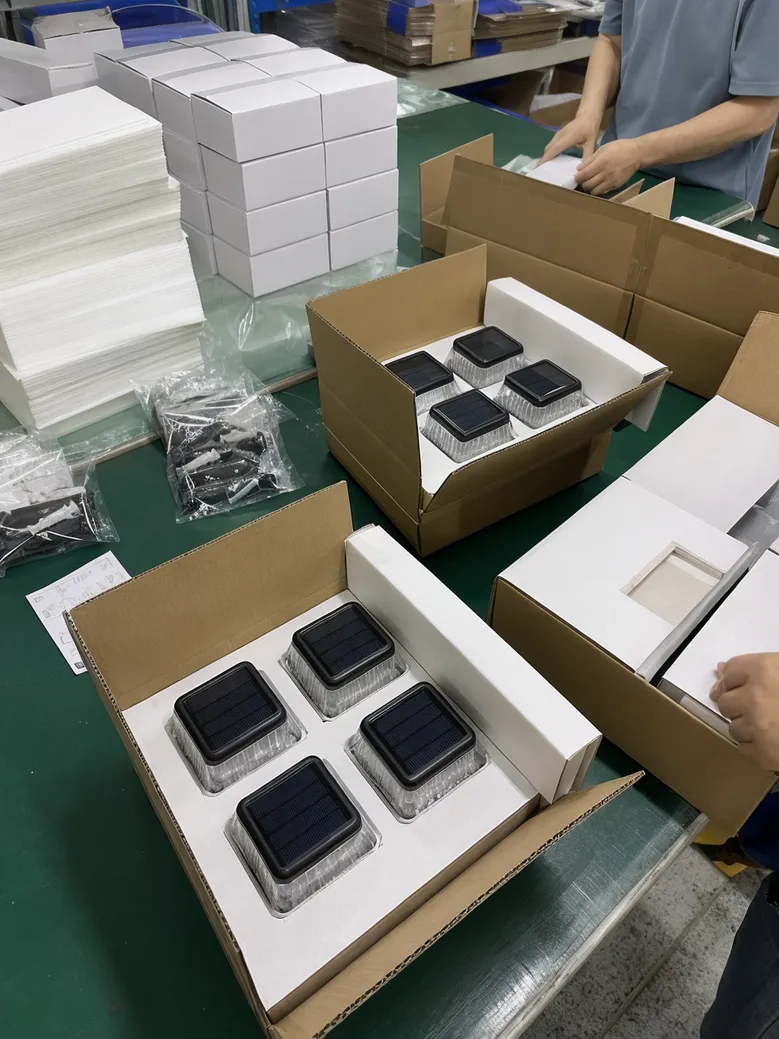
Solar deck lights perform particularly well in e-commerce because the product is compact, visually appealing in listing photos, and easy for end users to install without professional help.
Key variables for this channel:
- Carton size — affects FBA storage fees and shipping cost
- Pack count — affects average order value and review volume
- Review-risk control — comes down to battery consistency and waterproof reliability across the full production run, not just the sample
We can configure pack counts, packaging, and accessory kits specifically for e-commerce fulfillment.
Return insight: The most common e-commerce return reason for solar deck lights is "stopped working after rain" — which is a waterproof failure, not a battery failure. Our IP67 models address this directly.
Hospitality and Resort Decks
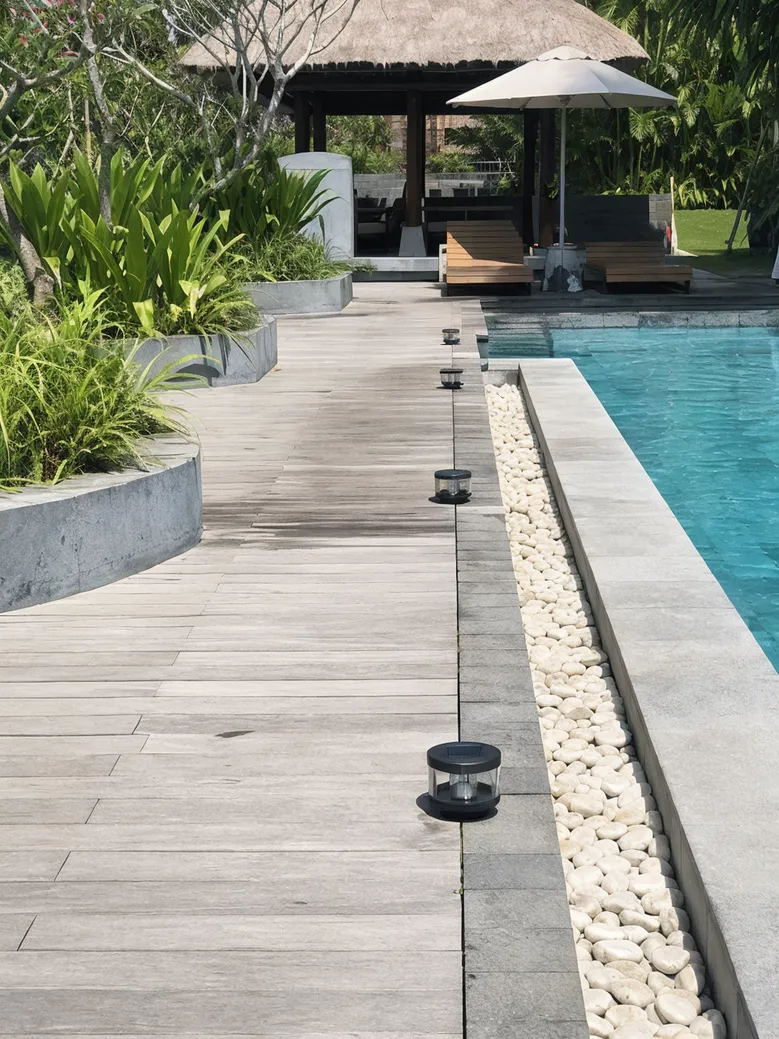
A project-based segment with higher per-unit value and longer sales cycles. A resort or hotel adding solar deck lighting to pool terraces, boardwalks, or outdoor dining areas is typically buying 50–500 units per project, with a preference for consistent appearance across the installation.
This segment values housing finish options, CCT consistency across batches, and the ability to reorder matching units for replacements.
We can hold a production spec for a hospitality account so replacement orders match the original installation.
Residential Developers and Property Managers
Buy solar deck lights as part of outdoor amenity packages for villas, townhouses, shared deck areas, and exterior common spaces. The order pattern is project-driven — tied to construction phases or renovation cycles — but developers who build multiple projects per year become repeat buyers.
The value proposition here is a complete outdoor lighting package from one supplier: deck lights, pathway lights, and wall lights all from the same factory, with consistent quality and documentation.
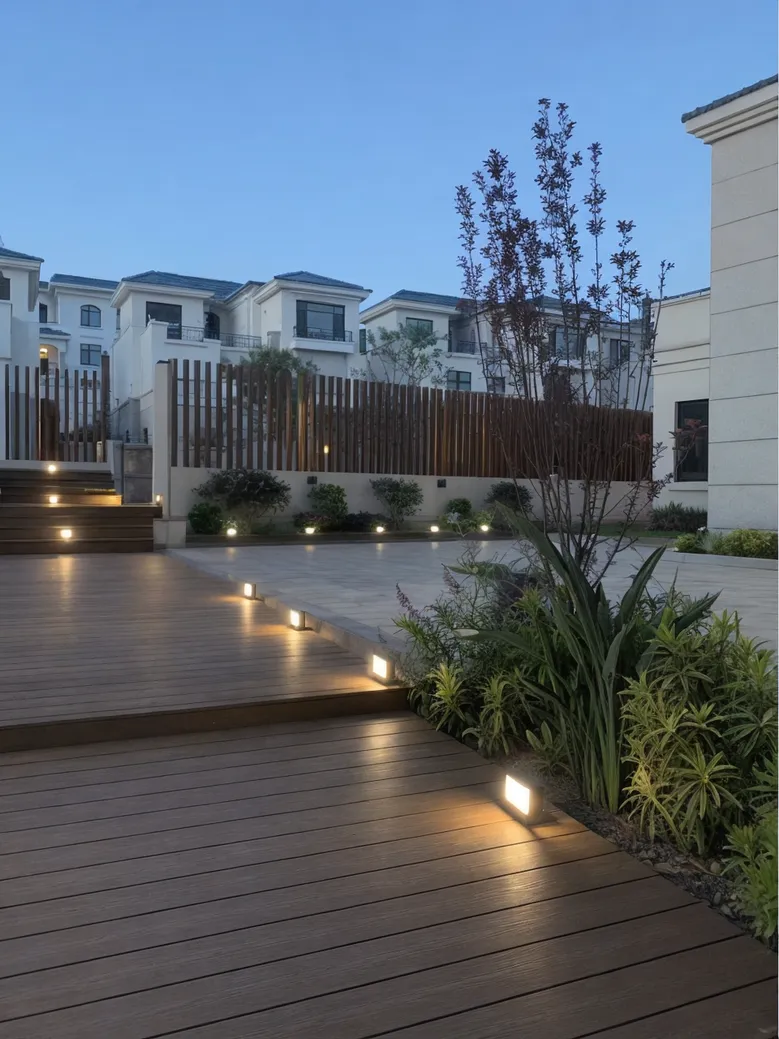
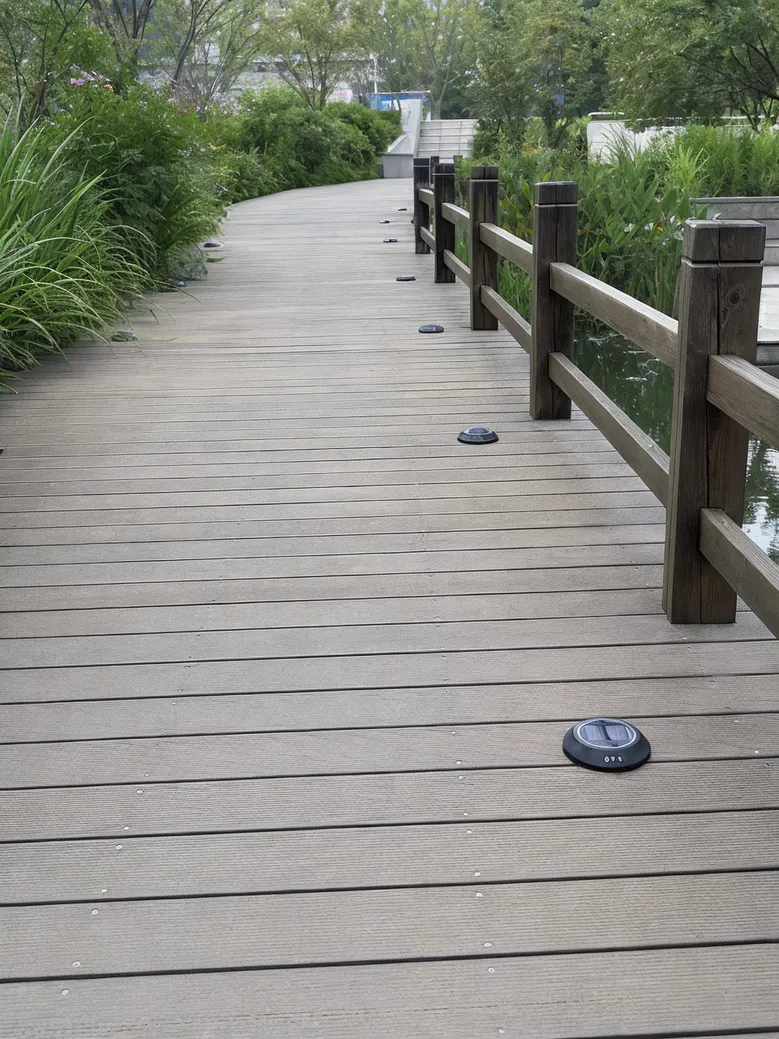
Municipal Parks and Boardwalk Projects
Solar deck lights work well as low-profile surface markers and step lights in locations where trenching for wired lighting is expensive or environmentally restricted.
Project suitability depends on the specific installation environment and local procurement requirements — confirm with us before including solar deck lights in a project specification, and we'll advise on the appropriate IP rating, battery configuration, and documentation package.
Battery, LED, and Waterproof Checks Behind Reorder Consistency
The three failure modes that generate the most returns in solar deck lights are battery inconsistency across a multi-pack, LED color mismatch between reorder batches, and waterproof failure after the first wet season. Our production system is built around these three points specifically — not because they're unusual problems, but because they're the ones that damage buyer relationships most directly.
Battery Matching
The process most compact solar lighting suppliers skip because it adds time and cost. In a 6-pack of solar deck lights, all six batteries need to be matched by capacity and internal resistance before assembly.
Why it matters:
If batteries aren't matched, units in the pack will have different runtimes — some will run 10 hours, some will run 6 — and the buyer's end customer will assume the product is defective.
We run capacity and internal resistance matching on every battery pack before it goes into a housing. For a multi-pack retail SKU, that consistency is what keeps your reviews clean.
LED Lumen Binning & CCT Confirmation
Happens at the module assembly stage, before the LED is sealed into the housing. We bin LEDs by lumen output and CCT so that units within a production run stay within a defined range.
Binning tolerances:
- Lumen output: ±10% within production run
- CCT: ±150K within production run
- Reorder batches: bin spec held so replacement stock matches original
We've seen buyers source from suppliers who don't bin — the result is a deck installation where half the lights look warm white and half look cool white. That's a visible problem that generates returns even when the product is technically functional.
Waterproof Structure Inspection
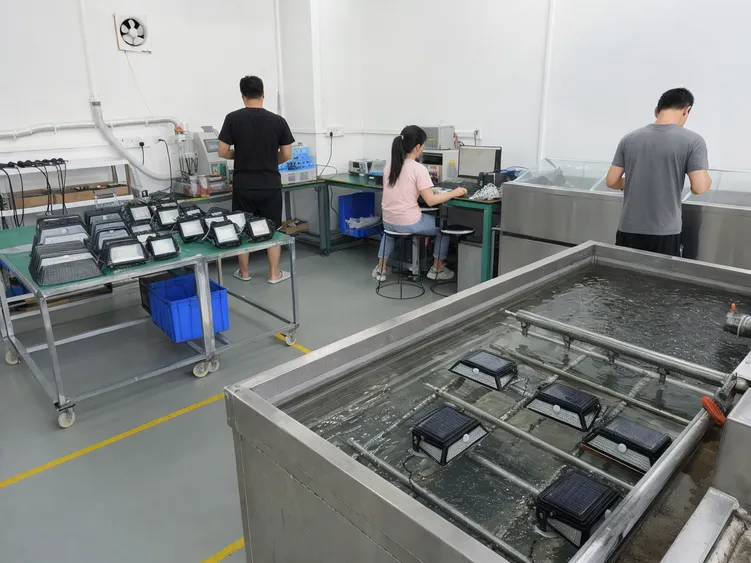
Run on every unit before final packing. For IP65-rated models, we test the housing seal under water spray. For IP67-rated models, we run immersion testing.
Critical failure point addressed:
The cable entry where the solar panel connects to the housing — a seal that looks fine in the factory but fails after thermal cycling in the field.
IP test equipment is in-house, not outsourced to a third-party lab for batch sampling — every unit gets tested, not a statistical sample.
Full Production QC Flow Beyond the Three Core Checks
Beyond battery matching, LED binning, and waterproof inspection, our production flow includes additional verification stages that cover the complete unit before it ships:
Factory capacity: 6 production lines, 150 employees, in-house R&D team of 15+ optical and electrical engineers. The engineering team is involved in both standard product development and in resolving production issues when they arise — not just in new product design.
Packaging Choices That Protect Retail and E-Commerce Margin
Packaging is where margin gets lost after the product leaves the factory. A solar deck light that arrives with a cracked lens, a missing screw pack, or a damaged retail box generates a return or a negative review — and neither of those is recoverable at the unit level. We treat packaging as part of the product specification, not an afterthought.
Pack Count Options
Single & 2-Pack
Entry-level or trial configurations for new product listings and sample orders.
4-Pack & 6-Pack
Retail shelf programs — typical for price-point positioning. E-commerce programs often run 4-pack depending on platform AOV targets.
8-Pack & Project Cartons
E-commerce high-AOV programs and contractor/project supply in bulk cartons with higher unit count per carton.
Pack count can be configured to match your channel without changing the product itself.
Packaging Format Options
Color Retail Box
Your design or our standard — brand, barcode, and product information printed on box
Neutral White/Brown Box
For private-label programs requiring unbranded packaging
Mail-Order Carton
Internal cushioning for direct-to-consumer e-commerce — configurable to meet FBA drop-test requirements with FBA-compliant labeling
Master Carton
For distributor and project supply — higher unit count per carton
Accessory Pack Planning
The accessory checklist is confirmed at order placement and packed against a packing list — every carton is checked before sealing. Missing accessories are one of the most common sources of negative reviews for solar deck lights.
A packing list check adds less than a minute per carton — eliminates the most common negative review source.
Export Handling Protection
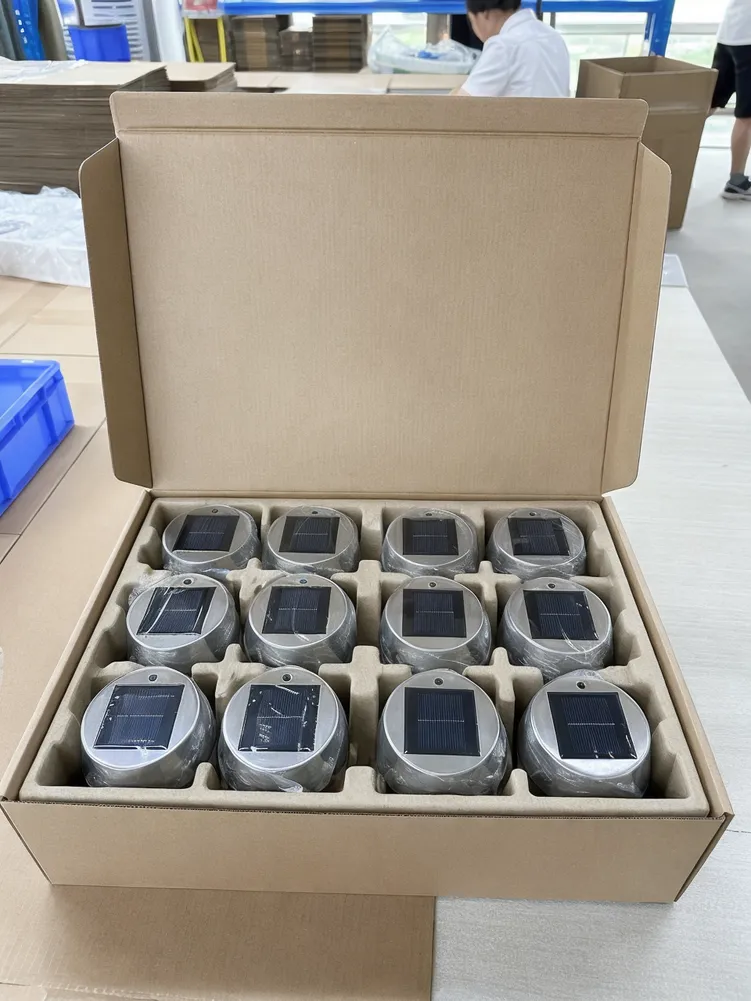
Export handling protection for solar deck lights focuses on the lens, the solar panel surface, and the housing finish. Small lenses and panel surfaces scratch easily in transit if the inner packaging doesn't hold units in position.
Formed Inner Trays or Individual Unit Sleeves
Depending on pack format — prevents contact damage during container handling
Protective Film on Housing Finish
Particularly for brushed stainless steel or painted models — applied before packing, removed by end user
OEM/ODM Options and the Limits That Need Engineering Review
Solar deck lights are one of the more customizable formats in our range because the housing is compact and the electrical system is relatively simple. Here's what's straightforward to customize, what requires engineering review, and what has hard limits.
Straightforward Customization
Available on standard MOQ with lead time adjustment
- CCT: 2700K, 3000K, 4000K, 6000K
- LED color: warm white, cool white, RGB (select models)
- Lumen output: adjustable within the LED module's design range without housing changes
- Battery capacity: adjustable within the housing volume limit
- Solar panel size: adjustable within the housing footprint
- Housing finish: standard colors, custom RAL colors on runs over 300 units
- Logo: laser engraving, pad printing, or label on housing or packaging
- Pack count: 1, 2, 4, 6, 8, or custom count
- Packaging: color box, neutral box, private-label box, mail-order carton
- Manual: custom language, custom brand, custom installation diagrams
- Accessory kit: screw type, anchor type, spare parts, mounting template
Engineering Review Required
Feasible but needs confirmation before quoting
- New housing shape or profile (requires tooling; lead time and cost depend on complexity)
- Special mounting bracket or clamp design (may require new tooling or modified accessory pack)
- Non-standard lens shape or diffusion pattern
- Unusual panel placement (affects waterproof structure and may require retest)
- Battery capacity increase beyond housing volume (may require housing modification)
- IP67 rating on a model currently rated IP65 (requires structural review and retest)
Hard Limits
Non-negotiable constraints
- Waterproof rating must be retested after any structural change to the housing — we don't carry over an IP rating from a previous design without testing the modified version
- Very small housings (under 60mm diameter) have limited battery volume, which caps runtime regardless of panel size
- RGB and color-changing modes require a separate controller that adds to housing volume and cost — not all compact deck light housings can accommodate it
In-House R&D Team
Our in-house R&D team of 15+ optical and electrical engineers handles OEM/ODM project reviews. Standard model MOQ starts at 100 units. OEM/ODM projects with new tooling or structural changes are reviewed case by case — send us your target spec and we'll confirm feasibility and provide a tooling cost estimate before you commit.

Compliance Documents Buyers Should Confirm by SKU
JXSOL holds ISO 9001:2015 factory certification, CE, RoHS, IP65/IP67 Ingress Protection ratings, and IEC 62124 solar photovoltaic system certification. These cover the core compliance requirements for solar deck lights entering European markets and regulated markets in North America, the Middle East, and Southeast Asia.
CE Certification
Covers electrical safety and EMC requirements that affect EU market entry.
RoHS Compliance
Built into component sourcing — LED chips, battery cells, and electronic components are sourced from suppliers who provide material declarations, with batch-level records maintained.
IP65/IP67 Ratings
Tested on in-house waterproof inspection equipment, not assumed from housing design.
IEC 62124
Covers the photovoltaic performance requirements relevant to solar-powered products.
Practical Value for Your Business
- Pre-qualified compliance documentation reduces customs review delays
- Supports retail listing requirements (particularly for EU and UK markets)
- Reduces the compliance questions you'll receive from your downstream accounts
- For buyers entering new markets, we can advise on which documents are typically required and provide them with the order
SKU-Level Confirmation
Exact certificates, declarations of conformity, and test reports are confirmed by model and destination market during RFQ — not all certifications apply to every model, and some markets require additional documentation beyond our standard package.
The 3-year warranty support covers manufacturing defects and is confirmed in the order terms.
Choose Deck Lights or Another Pathway and Bollard Product
Solar deck lights are the right choice for deck edges, stair risers, railings, posts, patio borders, and raised outdoor platforms where compact, low-output solar fixtures are the fit. If your application is different, here's where to look:
Solar Deck Lights
Best for: Deck edges, stairs, railings, posts, patios, boardwalks, compact retail packs
You are here
Solar Pathway Lights
Best for: Garden paths, landscape borders, residential walkways
Key difference: Ground-stake mounting; higher ambient output for path navigation
Solar Walkway Lights
Best for: Pedestrian routes, commercial walkways, public paths
Key difference: Broader ground-level illumination; pedestrian guidance focus
Solar Bollard Lights
Best for: Public paths, parks, commercial landscapes, resort grounds
Key difference: Taller bollard body; higher output; post-foundation installation
Solar Post Top Lights
Best for: Post caps, pier caps, column tops, entrance posts
Key difference: Cap-mount format; higher output; architectural appearance
Solar Driveway Lights
Best for: Driveway edges, surface markers, vehicle-adjacent applications
Key difference: Reinforced for vehicle proximity; surface or flush-mount format
Solar Fence Lights
Best for: Fence tops, wall caps, vertical boundary lighting
Key difference: Fence or wall cap mount; perimeter and boundary focus
Building a Mixed Outdoor Lighting Program?
If you're combining deck lights plus pathway lights plus bollards for a resort or residential development, we can quote the full package from one factory. Consolidated sourcing simplifies logistics, aligns lead times, and gives you volume leverage across SKUs.
FAQ for Solar Deck Light Bulk Buyers
What IP rating should solar deck lights use for outdoor resale programs?
IP65 is the minimum for any outdoor solar deck light sold into a resale program. IP65 protects against water jets from any direction, which covers rain, hose-down cleaning, and most outdoor exposure conditions.
For surface-mounted deck markers that sit flush with or near the deck surface — where standing water can pool — IP67 is the better specification. IP67 covers temporary immersion up to 1 meter for 30 minutes, which handles the pooling and drainage conditions that surface-mounted fixtures encounter.
For coastal or marine environments (marina boardwalks, beachfront resort decks), specify a stainless steel housing in addition to IP67 — the housing material matters as much as the IP rating in salt-air environments.
Testing note: We test IP ratings on our own in-house equipment, and the rating is confirmed per model, not assumed from housing design.
How bright should solar deck lights be for stairs, railings, and deck edges?
For stair risers and step edges, 10–30 lm is sufficient for visibility without creating glare for someone descending the stairs. The goal is step definition, not area illumination — a stair light that's too bright creates a glare problem at eye level.
For railing and post lights used as perimeter markers, 5–20 lm is typical.
For deck surface markers on a patio or boardwalk where you want slightly more ambient fill, 30–60 lm is a reasonable range.
Important distinction: Solar deck lights are not area lighting fixtures — if your application requires meaningful illumination of a deck surface for activity use, you need a higher-output wall light or flood light, not a deck marker.
We can help you spec the right output for your application if you send us the installation description and the end-use scenario.
Are solar deck lights suitable for shaded decks?
Partially shaded decks are manageable; heavily shaded decks are a product mismatch. A solar deck light needs 4–6 hours of direct or near-direct sun per day to charge the battery to a level that supports 8–10 hours of runtime. A deck that's under a pergola, dense tree canopy, or building overhang for most of the day will undercharge the battery, and the runtime will be shorter than the product specification — which generates returns and complaints that aren't actually product defects.
Engineering Adjustment for Partial Shade
We can configure a larger panel or higher-capacity battery to extend the charging window for partially shaded installations, but there's a housing size limit.
If your target market includes heavily shaded outdoor spaces, tell us the installation description before sampling — we'll advise on whether the product is a fit or recommend a different configuration.
What battery and solar panel options matter most for multi-pack deck lights?
For multi-pack retail SKUs, battery consistency across the pack matters more than raw capacity. A 6-pack where all six units have matched battery capacity and internal resistance will deliver consistent runtime across the pack — which is what keeps your end-customer reviews clean. We run capacity and internal resistance matching on every battery pack before assembly.
Battery Chemistry Comparison
LiFePO4 (Recommended)
- 2,000+ charge/discharge cycles
- Better cold-temperature performance
- No memory effect degradation
NiMH (Legacy)
- 500–800 cycles typical lifespan
- Reduced output in cold winters
- Memory effect degrades capacity over time
For markets with cold winters, LiFePO4 is the specification to confirm.
Panel Sizing Principle
The panel needs to be sized to the battery capacity and the target runtime — a larger battery with an undersized panel will undercharge in winter. We size the panel and battery together as a system, not independently.
Can JXSOL customize pack count, logo, and retail packaging for solar deck lights?
Yes. Pack count, logo, and retail packaging are all straightforward customizations that don't require tooling or structural changes.
Pack Count
Single units to 8-packs or custom counts for project cartons.
Logo Application
Laser engraving, pad printing, or label on the housing or packaging.
Retail Packaging
Full custom color box, neutral box for private-label, or mail-order carton for e-commerce fulfillment.
For e-commerce programs, we can configure the packaging to meet FBA drop-test requirements and include FBA-compliant labeling.
These customizations are available on standard MOQ (100 units for standard models) with a lead time adjustment for packaging production.
For OEM/ODM programs with housing or electrical changes, see the OEM/ODM solar lighting customization page.
What information should I send to get an accurate solar deck light quote?
The more specific your inquiry, the faster we can return a useful quote. Key inputs include:
Tip: If you have a reference product or a competitor sample you're trying to match or improve on, send us a photo or spec sheet — that's often the fastest way to align on the right configuration.
RFQ Checklist for Faster Solar Deck Light Pricing
Send us the following and we'll return a configuration recommendation and pricing within 24 hours.
Target Market & Destination Port
Affects compliance documentation and shipping configuration.
Mounting Position
Stair riser, railing, post, flat surface, wall, or boardwalk.
Housing Format & Material
Preferred format and material: ABS, PC, or stainless steel.
Pack Count & Packaging Type
Retail box, neutral box, mail-order carton, or project carton.
Order Quantity
Total units or packs required for your order.
Lumen Output or Brightness Target
Specify your desired brightness level for the application.
CCT or LED Color
Warm white, cool white, or RGB.
Runtime Target
Required hours of operation per night.
Housing Finish
Standard, custom RAL color, or brushed stainless.
Logo & Labeling Requirements
Branding placement, print method, and artwork specs.
Certification & Documentation
CE, RoHS, IP test reports, IEC 62124, or other requirements.
Installation Environment
Shaded, coastal, high-temperature, or cold climate conditions.