A solar street light that passes its first sunny-season test can still fail three months later. The failure almost always traces back to the same place: a battery autonomy spec that wasn't sized for the buyer's actual rainy season. The light ran fine when the panels were charging daily. Then the clouds came, the battery ran down, and the road went dark.
Solar street light autonomy days is the number of consecutive low-sun or no-sun nights a system can sustain its required lighting schedule before the battery drops below its minimum usable threshold. It is not a marketing claim. It belongs in the spec sheet, and it needs to be defined precisely enough that two factories quoting the same project are actually quoting the same thing.
The problem with most "3 days backup" claims in supplier catalogs is that they leave out the variables that determine whether that number is real: what load, what dimming schedule, what battery chemistry, what usable depth of discharge, and under what test conditions. Without those inputs, you cannot compare quotes, and you cannot hold a supplier accountable when the lights go dark in week two of the rainy season.
We build Solar Street & Roadway Lights as our core product line, and battery autonomy sizing is where we spend the most engineering time on project orders. This article explains how to calculate the right autonomy target, how climate and road type should shape that target, and what factory controls actually determine whether the rated autonomy is delivered in the field.
The battery sizing math that belongs in your quote review
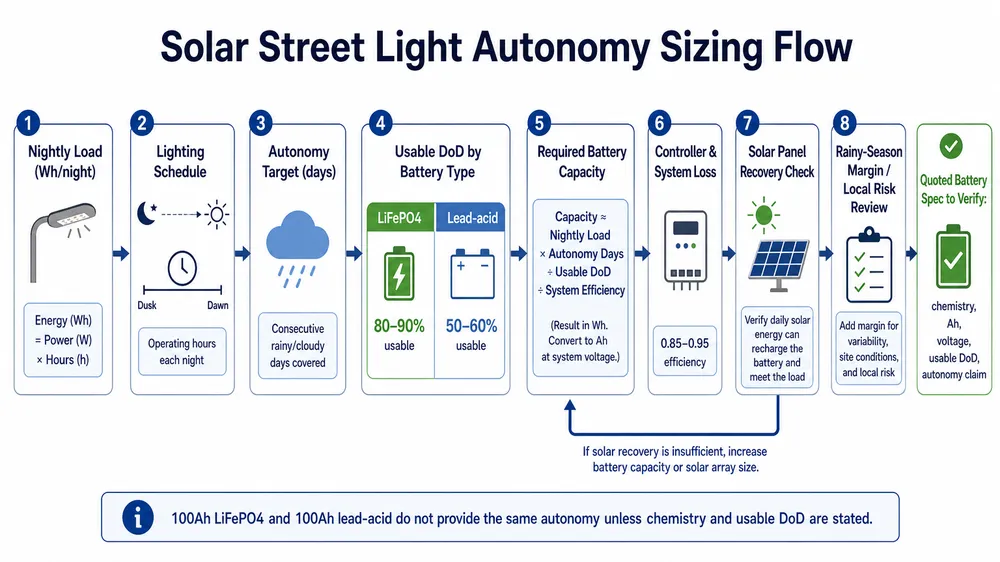
Autonomy days are not a single number you pick from a catalog. They are the output of a calculation that starts with your nightly energy demand and works backward to the battery capacity required to sustain that demand across the target number of no-sun nights.
The core logic:
| Step | Variable | Notes |
|---|---|---|
| 1 | Nightly energy consumption (Wh) | Fixture wattage × operating hours × dimming profile factor |
| 2 | Required stored energy (Wh) | Nightly consumption × target autonomy days |
| 3 | Usable battery capacity (Wh) | Required stored energy ÷ usable depth of discharge (DoD) |
| 4 | Nominal battery capacity (Wh) | Usable capacity ÷ system efficiency factor (controller loss, wiring loss) |
| 5 | Battery pack spec | Convert to Ah at system voltage, then add temperature margin |
The dimming schedule matters more than most buyers expect. A 60W fixture running full output from dusk to dawn draws roughly 480Wh per night on a standard 8-hour schedule. The same fixture on an adaptive dimming profile — full output for 4 hours, 50% for the remaining 4 — draws around 360Wh. That 25% difference compounds across every autonomy day in the calculation. A 3-day autonomy spec on the full-output profile requires a meaningfully larger battery than the same spec on an adaptive profile.
Usable depth of discharge is the other variable that separates real autonomy from nameplate capacity. LiFePO4 cells are typically sized at 80–90% usable DoD in solar street light applications. Lead-acid packs are usually derated to 50–60% to protect cycle life. A 100Ah LiFePO4 pack and a 100Ah lead-acid pack do not deliver the same autonomy — the lead-acid pack is effectively half the size for this calculation. (We see this misunderstanding in quote comparisons regularly. Two factories quote "100Ah battery" and the buyer assumes they're equivalent. They're not, unless the chemistry and DoD assumption are both stated.)
Oversizing the calculation wastes budget and adds weight and freight cost. Undersizing creates the rainy-season failure risk you're trying to avoid. The right answer is a calculation anchored to your actual project inputs, not a round number from a catalog.
For buyers working through full system design beyond battery autonomy, the solar street lighting design guide covers panel sizing, pole load, and road standard compliance together.
Climate zone and road type set the backup target
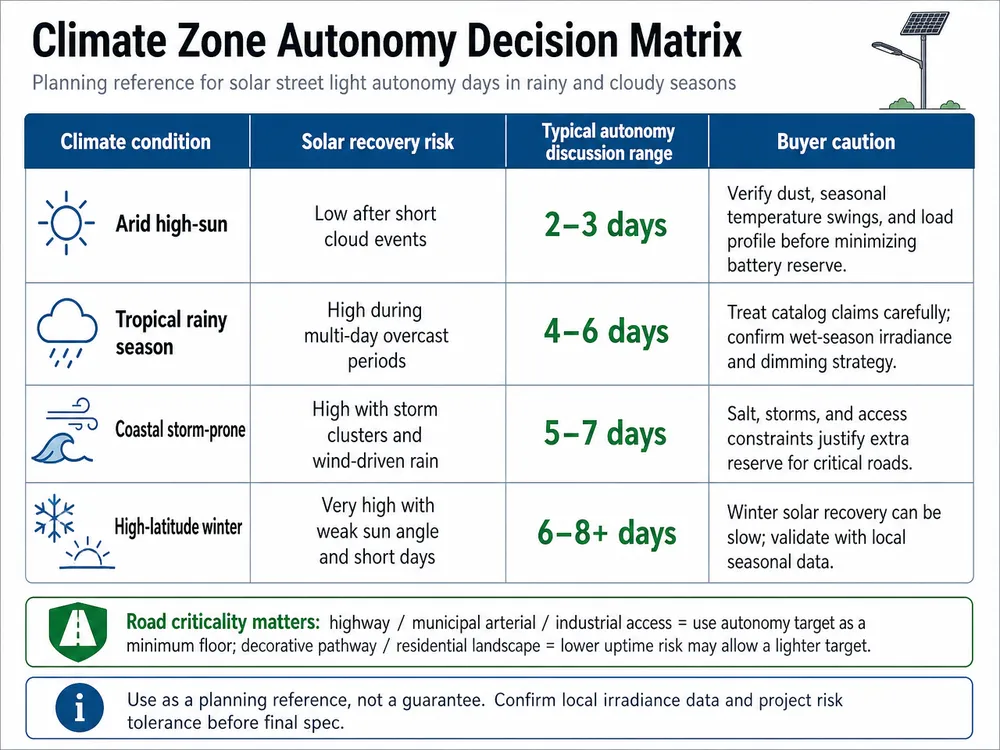
There is no universal answer to "how many autonomy days for a solar street light in rainy season." The right target depends on where the project is, how long the low-sun period runs, and what happens to the road if the lights go dark.
Use this as a planning reference, not a guarantee. Local irradiance data and project risk tolerance should always be confirmed before finalizing the spec.
| Climate condition | Solar recovery risk | Typical autonomy discussion range | Buyer caution |
|---|---|---|---|
| Arid / high-sun (Middle East, North Africa) | Low | 1–2 days often sufficient for low-risk roads | Dust accumulation on panels can reduce effective charging — factor in cleaning schedule |
| Tropical rainy season (Southeast Asia, West Africa, Central America) | High during monsoon | 3–5 days is the practical discussion range for municipal roads | Consecutive overcast days can exceed 5 in some zones — confirm local weather data |
| Coastal storm-prone (typhoon belts, hurricane corridors) | High, episodic | 3–5 days minimum; consider panel tilt and IP67 housing | Storm surge and salt spray add failure modes beyond battery autonomy |
| High-latitude winter (Northern Europe, Canada, northern China) | Very high in winter months | System redesign may be needed; autonomy alone may not solve the problem | Short winter days reduce daily charge input significantly — panel capacity often needs to increase alongside battery |
Road criticality is the other axis. A highway or municipal arterial road has a different uptime requirement than a decorative pathway in a residential development. For highways and industrial access roads, we recommend treating the autonomy target as a minimum floor, not a midpoint. A project failure on a highway — lights out for three nights during a storm — creates acceptance disputes, warranty claims, and sometimes safety liability. The cost of an extra day of battery capacity is small compared to that risk.
For lower-criticality applications like park paths or decorative streetscaping, a tighter autonomy spec is commercially reasonable. The goal is matching the spec to the actual project risk, not defaulting to the largest number available.

Extra backup days change cost, housing, and freight
Every additional autonomy day adds battery capacity, and battery capacity has a direct cost chain: more cells, heavier pack, larger enclosure, higher shipping weight, and sometimes a different carton dimension that affects container loading efficiency.
A 3-day autonomy spec on a 30W fixture in a tropical climate might require a 60–80Ah LiFePO4 pack. Pushing that to 5 days on the same fixture and schedule could require 100–120Ah. That difference affects the housing design, the pole bracket load calculation, and the per-unit landed cost. For a 500-unit project order, the cost difference is not trivial.
The risk runs in both directions. Undersizing creates field failure and warranty exposure. Oversizing reduces your margin and can make your quote uncompetitive against a supplier who sized correctly for the same project. The buyer who automatically selects the largest backup claim in a catalog comparison is not necessarily buying the best product — they may be buying an oversized battery that adds cost without adding reliability for their specific climate.
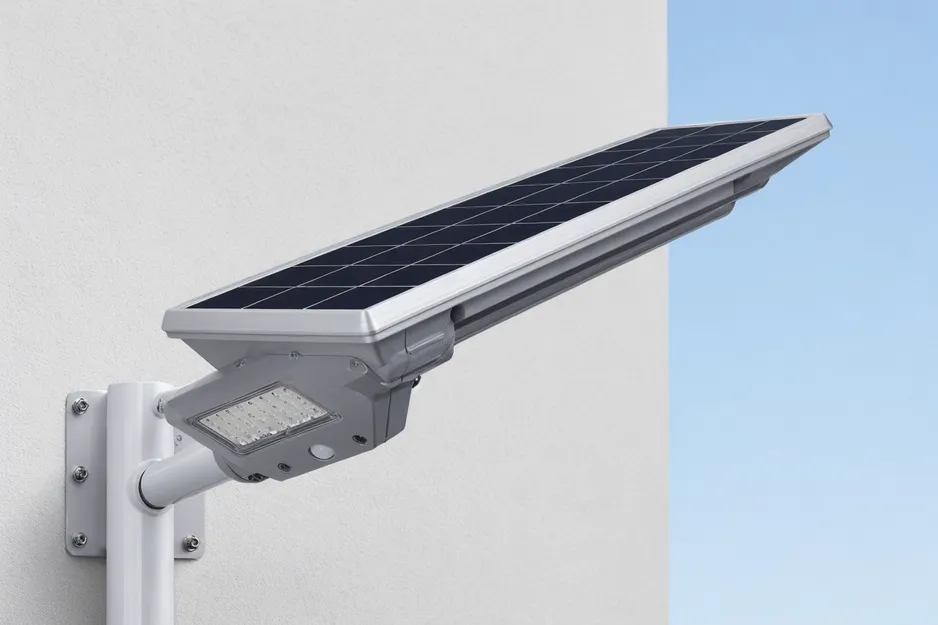
All-in-one solar street lights have an additional constraint worth noting: the battery compartment is integrated into the fixture housing, so thermal management and physical space limit how much capacity can be packed in. If your project requires 5+ days of autonomy in a compact all-in-one form factor, confirm the battery chemistry, pack configuration, and heat dissipation design before committing. The all-in-one solar street light specifications guide covers these constraints in detail.
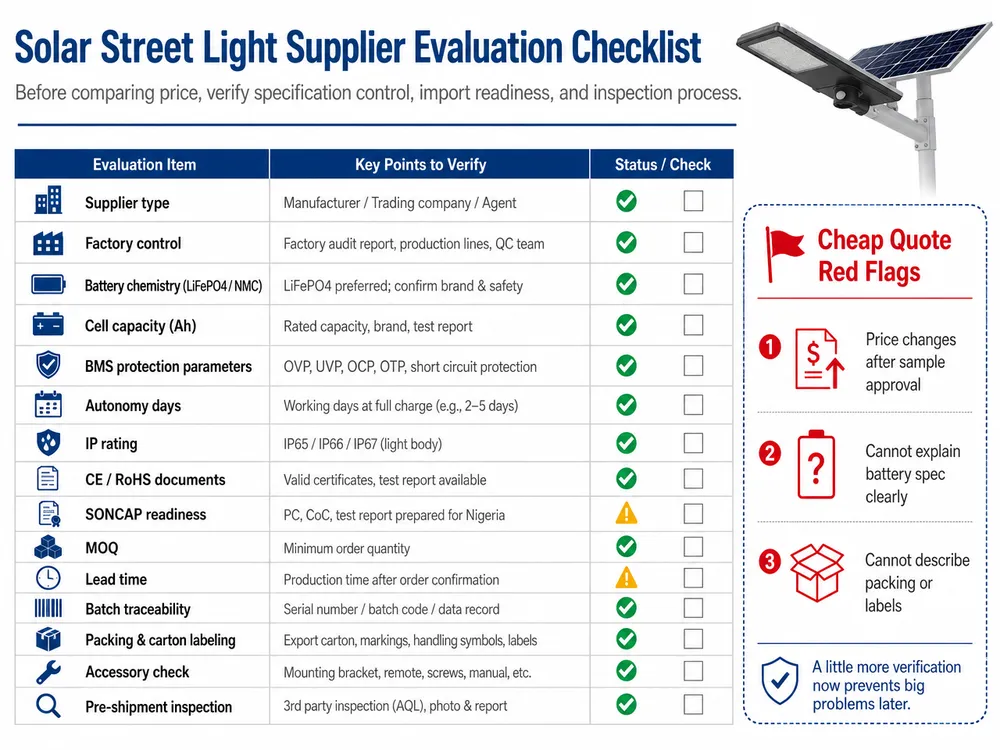
When comparing quotes, confirm that all suppliers are working from the same autonomy definition: same load profile, same dimming schedule, same battery chemistry, same usable DoD assumption. A quote comparison without those inputs aligned is not a real comparison.
Factory battery matching decides whether rated autonomy is real
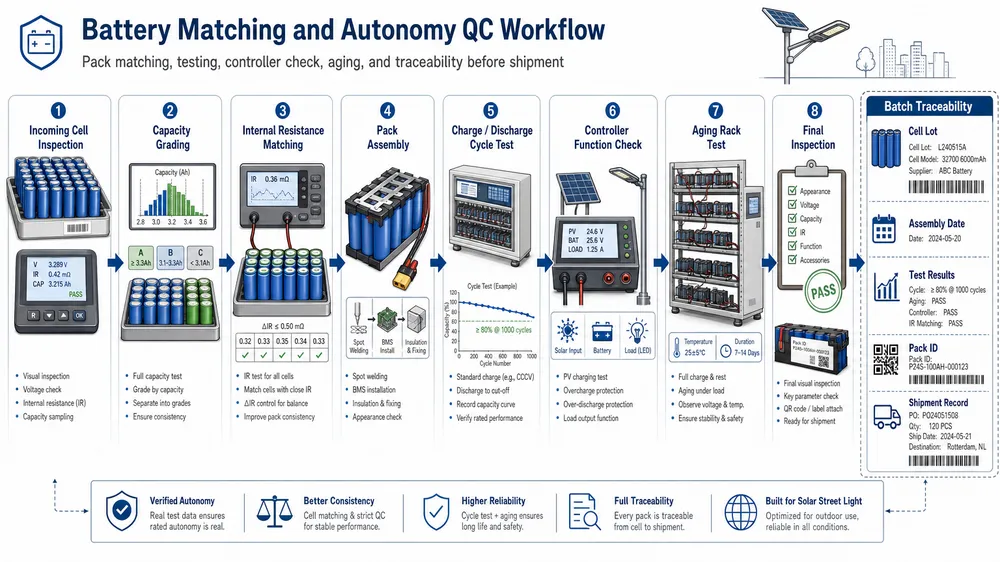
This is where most autonomy failures actually originate — not in the calculation, but in the battery pack assembly.
A battery pack's real capacity is limited by its weakest cells. If a 100Ah pack is assembled from cells with 5% capacity variance and no internal resistance matching, the pack will behave like a 90–95Ah pack in the field, and it will degrade unevenly. After 200–300 charge cycles — roughly one to two years of operation — the weakest cells will have degraded further, and the effective autonomy will have dropped below the rated spec. That's the failure pattern we saw repeatedly in early solar street light deployments, and it's why we built our production system around battery matching from the start.
We started in 2012 with a narrow focus on solar-powered outdoor lighting for export markets. Battery failures after one rainy season were one of the three original failure points we built our production system around. The others were inconsistent lumen output between batches and waterproof claims that didn't survive field conditions. Battery matching and charge/discharge testing became non-negotiable parts of our process because we saw what happened when they were skipped.
The factory controls that determine whether rated solar street light autonomy days are actually delivered:
- Cell capacity grading: incoming cells are sorted by measured capacity before pack assembly. Cells within a pack should be matched to within a tight tolerance — we target ±2% capacity variance within a pack.
- Internal resistance matching: high internal resistance in one cell creates heat and accelerates degradation. Resistance matching at assembly prevents the weak-cell failure pattern.
- Charge/discharge cycle testing: assembled packs are cycled under load before installation into fixtures. This catches capacity shortfalls and cell defects that don't appear in static measurements.
- Controller function verification: the charge controller determines how the battery is charged and discharged. A misconfigured or defective controller can undercharge the pack, reducing effective autonomy even when the battery itself is correctly sized.
- Aging test under load: packs are held on aging racks at operating temperature before shipment. This screens out early-life failures that would otherwise appear in the field during the first rainy season.
- Batch traceability: every pack is traceable to its cell lot, assembly date, and test results. If a field failure occurs, we can identify whether it's a batch issue or an isolated unit.
- 100% pre-shipment inspection: every unit is inspected before it leaves the factory. For battery-related checks, this includes a final capacity verification and a controller function test.
Our in-house testing lab handles battery pack testing alongside lumen verification and IP65/IP67 ingress protection checks. CE, RoHS, and IEC 62124 certification covers the system-level compliance requirements, but those certifications don't substitute for the pack-level matching and cycle testing that determines real-world autonomy. A certified fixture with a poorly matched battery pack will still fail in year one.
RFQ inputs that prevent autonomy misunderstandings
The most common source of autonomy disputes in project orders is not a dishonest supplier — it's an RFQ that didn't define the spec clearly enough for two factories to quote the same thing. "3 days backup" without supporting inputs is not a specification. It's a starting point for a misunderstanding.
When you send an RFQ for a project that requires defined solar street light autonomy days, include these inputs:
- Project city or latitude — solar irradiance varies significantly by location; this is the foundation of any autonomy calculation
- Rainy season or cloudy season pattern — how many consecutive low-sun days does the worst-case period typically produce?
- Required lighting hours per night — dusk-to-dawn, or a defined schedule?
- Full-output and dimming schedule — what percentage of output, and for which hours?
- Target lumen output or road class — this determines fixture wattage, which drives the load calculation
- Required autonomy days — state this as a minimum, not a preference
- Mounting height and pole spacing — affects fixture selection and sometimes battery sizing for adaptive systems
- Battery chemistry preference — LiFePO4 or lead-acid, if already specified by the project
- Certification or documentation requirements — CE, IEC 62124, DLC, or local market requirements
- Sample testing expectations — will you test autonomy on samples before production approval?
A clear RFQ forces every factory to quote against the same spec. It also gives you a basis for holding the supplier accountable if the delivered product doesn't meet the stated autonomy under the stated conditions. Without it, you're comparing catalog claims, not engineering commitments.
When your project inputs are ready, you can submit them directly through our Request Quote page — our engineering team reviews location, load profile, and autonomy target before confirming the battery and panel configuration.
Where to spend on backup and where to control cost
Not every project needs the same autonomy target, and not every way to improve rainy-season reliability requires a larger battery.
Municipal and roadway projects carry the highest acceptance risk. A road that goes dark during a storm creates a public safety issue and a contract dispute. For these projects, treat the autonomy target as a floor and build in margin. The cost of an extra 20Ah of battery capacity is small compared to the cost of a failed acceptance test or a warranty replacement campaign.
Highway and remote road projects have a different problem: service access is expensive. If a light fails on a remote highway, the repair cost — travel, labor, logistics — can exceed the cost of the fixture. Higher autonomy and more conservative battery sizing make commercial sense here even if the climate doesn't strictly require it.
Industrial parks and logistics roads usually have a defined security lighting requirement. The autonomy target should be set to cover the longest expected low-sun period in the project's climate zone, with enough margin that a single extended cloudy period doesn't trigger a service call.
Distributor stock SKUs are a different calculation. You're not sizing for one project — you're choosing a spec that works across the range of climates your buyers operate in. A practical middle spec (typically 3 days for tropical and subtropical markets) covers most use cases without the cost and weight penalty of a 5-day configuration. If your distribution territory spans both arid and tropical climates, consider stocking two SKUs rather than over-specifying one.
One point worth making directly: if your project is in a high-latitude winter market where daily solar input drops to 3–4 hours, adding more battery capacity alone may not solve the problem. The panel needs to be sized to recover the battery within the available charge window. Sometimes the right answer is a larger panel and a moderate battery, not a larger battery with an undersized panel. We've seen projects where buyers specified 5-day autonomy but the panel was too small to recover the battery in winter — the system ran down progressively over the season regardless of battery size.
FAQ
Is 3-day autonomy enough for solar street lights in rainy season?
It depends on the climate and the road type. For tropical markets with monsoon seasons, 3 days covers most normal rainy periods but may not cover extended storm events. For municipal roads and highways, we recommend treating 3 days as a minimum and confirming local weather data for the worst-case consecutive overcast period. For lower-criticality applications in moderate climates, 3 days is often sufficient. The number only means something when the load profile, battery chemistry, and usable DoD are also stated.
What is the difference between autonomy days and battery backup days?
In practice, suppliers use both terms, but they don't always mean the same thing. "Battery backup days" in a catalog often refers to the theoretical number of nights the nameplate battery capacity could sustain the fixture — without specifying the load, the dimming schedule, or the usable depth of discharge. "Autonomy days" as an engineering spec should include all of those inputs. When reviewing a quote, ask the supplier to state the autonomy calculation: fixture wattage, operating hours, dimming profile, battery chemistry, usable DoD, and the resulting backup duration. If they can't provide that, the number in the catalog is not a reliable spec.
Should I increase the battery or the solar panel first for cloudy climates?
Start with the panel. A larger battery stores more energy, but if the panel can't recover that energy within the available daily charge window, the battery will run down progressively over a multi-day cloudy period. The right approach is to size the panel for the worst-case daily charge input in your climate, then size the battery for the target autonomy days at that load. In high-latitude winter markets especially, panel capacity is often the binding constraint, not battery capacity.
How does dimming mode change the autonomy calculation?
Significantly. A fixture running full output all night draws roughly 25–40% more energy than the same fixture on an adaptive dimming profile. That difference compounds across every autonomy day. A 3-day autonomy spec on a full-output schedule requires a larger battery than the same spec on an adaptive schedule. When comparing quotes, confirm that both suppliers are using the same dimming assumption — a supplier quoting adaptive dimming against your full-output requirement will appear to offer better autonomy at lower cost, but the comparison isn't valid.
What proof should a supplier provide for a solar street light autonomy claim?
At minimum: the battery capacity specification (chemistry, Ah, voltage), the usable depth of discharge assumption, the fixture wattage and operating schedule used in the calculation, and charge/discharge test results from the assembled pack. For project orders, ask for a sample unit and test the autonomy yourself under controlled conditions before approving production. A supplier who can't provide the calculation inputs or the test data is quoting a catalog claim, not an engineering commitment. IEC 62124 covers solar home system testing methodology and is sometimes referenced for solar street light battery performance — ask whether the supplier's testing protocol aligns with it.