

Solar Park Lighting Direct From Factory
Pedestrian-scale outdoor solar park lighting built for public spaces — parks, trails, plazas, campuses, and recreational areas.
Lower pole heights, warm CCT options, decorative housing configurations, and glare-controlled beam distribution — factory-direct from JXSOL, with 100% pre-shipment inspection.
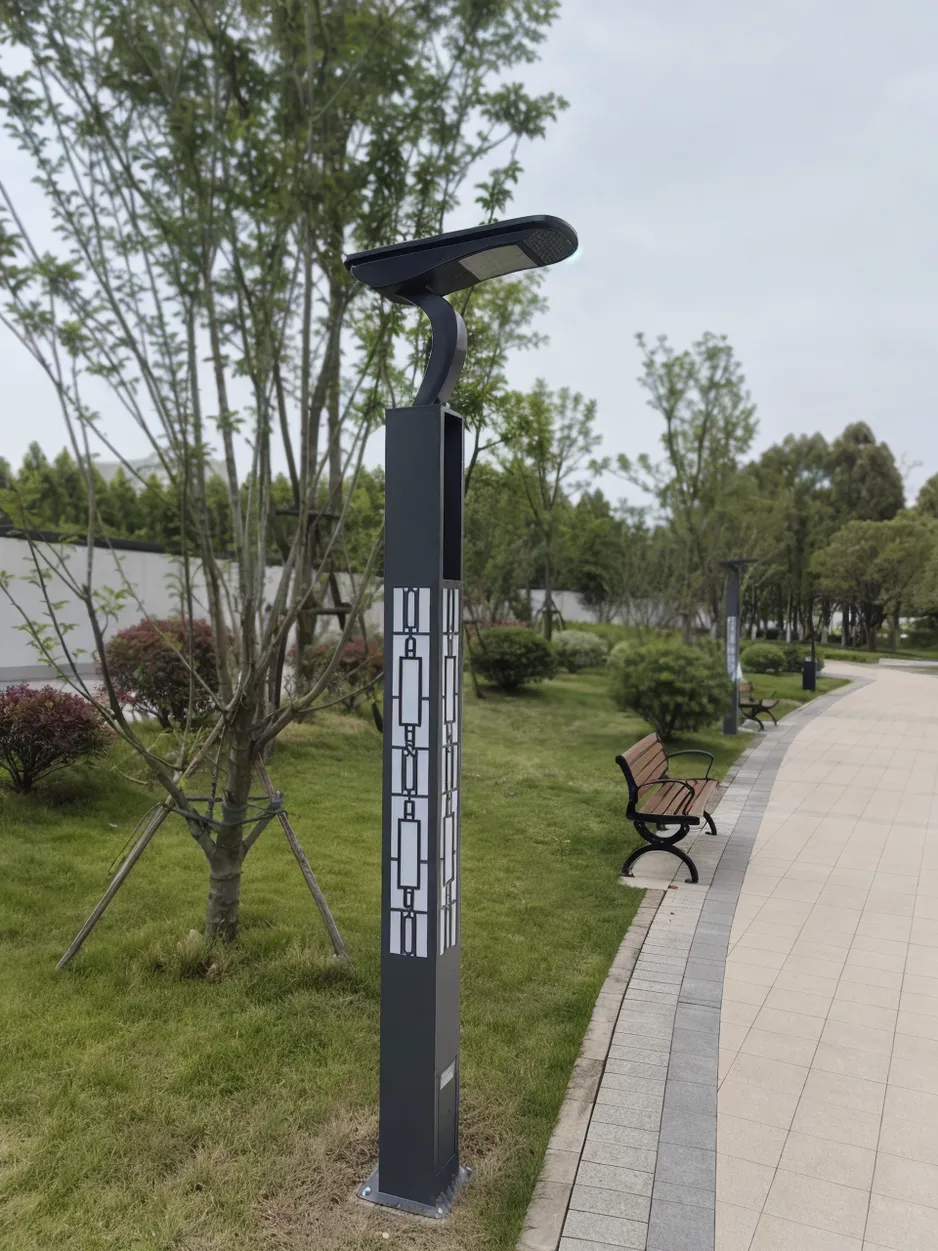
Solar Park Lighting for Pedestrian-Scale Public Projects
Solar park lighting is a distinct product category from road and highway lighting. The fixture design, beam angle, lumen output, and housing aesthetics are all calibrated for pedestrian-scale environments — parks, greenways, cycling trails, public plazas, campus walkways, resort grounds, and residential community paths — where the priorities are visual comfort, decorative appearance, and reliable off-grid operation rather than maximum road-surface illuminance.
The difference matters commercially. A road-grade all-in-one solar street light mounted at 4 meters on a park path will over-illuminate the path, create glare for pedestrians, and look out of place in a landscaped environment. Municipal parks departments and landscape contractors know this — and they'll reject a fixture that doesn't fit the visual and photometric requirements of the space. Solar park lighting is specified for these environments because it's engineered for them: lower mounting heights (typically 3–6 meters), softer beam distribution, 3000K–4000K warm white options, and housing profiles that complement outdoor public spaces rather than dominate them.
We've been manufacturing outdoor solar park lighting alongside our road and highway range since the early years. The two product families share the same battery, LED, and waterproof QC systems — but the park lighting line has its own housing tooling, beam angle configurations, and CCT options that road fixtures don't carry. If your project or catalog requires both, we can supply them from the same factory with consistent documentation.
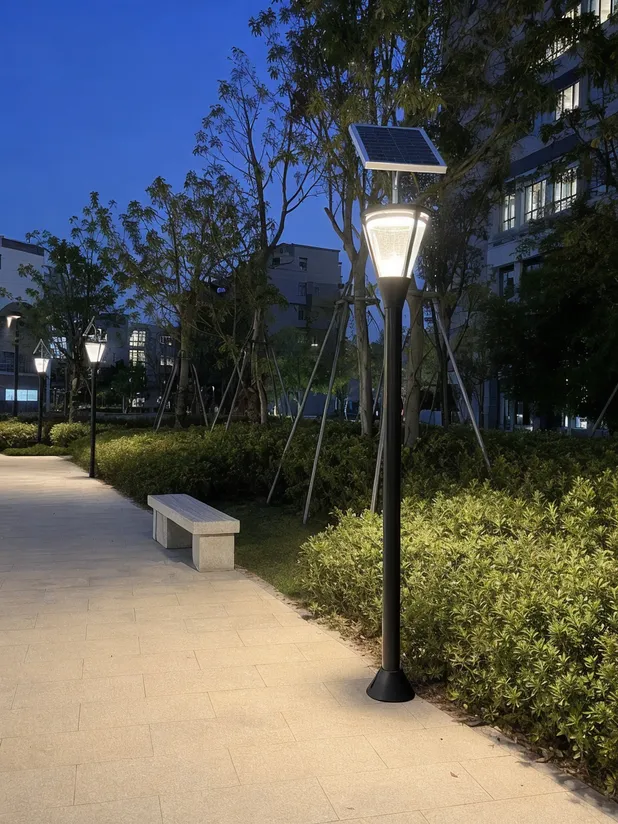
3–6m Pole Heights
Pedestrian-scale mounting designed for parks and paths, not highway overshoot.
3000K–4000K Warm White
Visual comfort for pedestrians. No harsh cool-white glare in landscaped environments.
Softer Beam Distribution
60°–120° beam angles calibrated for path widths and plaza coverage, not road-surface throw.
Decorative Housing
Die-cast aluminum profiles that complement public spaces. Custom powder-coat colors on 100+ unit runs.
Ready to specify park lighting for your project?
Send your project requirements — location, pole height, pathway width, operating hours — and we'll configure the right fixture.
Park-Specific Specs Buyers Can Put Into an RFQ
The table below covers the typical and configurable specification ranges for our solar park lighting range. These are park-specific values — not the category-wide ranges from the solar street and roadway lighting overview. Use them to confirm product fit before sending an RFQ.
| Specification | Typical / Configurable Range | Buyer Note |
|---|---|---|
| LED Power | 10W – 80W | Park paths and plazas rarely need more than 40–60W. Overspecifying output raises cost and creates glare. |
| Lumen Output | 1,000 lm – 10,000 lm | Confirm at fixture level, not chip level. We test lumen output at the LED module assembly stage. |
| Solar Panel | 20W – 120W monocrystalline | Sized to battery capacity and daily operating hours. Panel wattage is calculated against your installation latitude. |
| Battery Type | LiFePO4 (lithium iron phosphate) | Standard across our range — 2,000+ cycle life, wide operating temperature range, safer chemistry than lead-acid. |
| Battery Capacity | 15Ah – 80Ah | Sized for target autonomy days and nightly operating hours. Confirm both before RFQ. |
| Autonomy Days | 3 – 5 days | 3 days covers most park applications. 5 days for coastal, monsoon-season, or lower-irradiance locations. |
| Color Temperature | 3000K – 5000K | 3000K–4000K warm white is standard for parks and pedestrian paths. 5000K available for security-priority areas. |
| Beam Angle | 60° – 120° | Narrower for path lighting; wider for plaza and open-area coverage. Confirm pathway width and pole spacing. |
| Pole Height Compatibility | 3m – 6m | Standard park lighting range. Higher poles available; confirm with us if your project specifies above 6m. |
| IP Rating | IP65 / IP67 | IP65 standard. IP67 for coastal, flood-prone, or irrigation-exposed installations. |
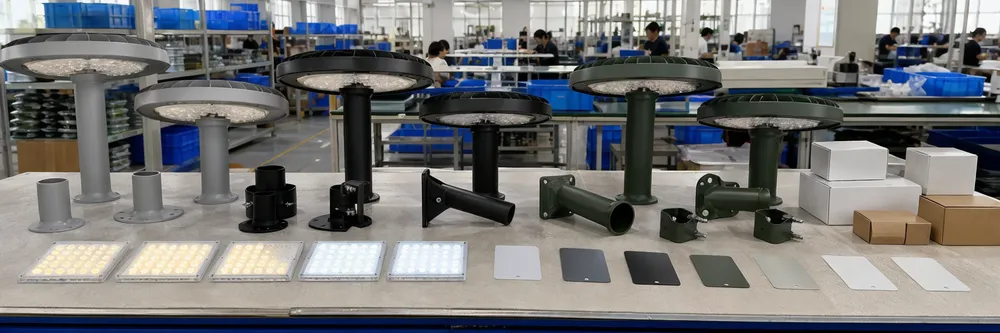
| Housing Material | Die-cast aluminum | Powder-coated finish. Standard colors: silver grey, black, dark green. Custom colors on 100+ unit runs. |
| Sensor / Control Mode | Full power / 50% dim / PIR motion-activated / scheduled dimming | Standard models include full power and 50% dim. Motion-activated and scheduled dimming available. |
| Mounting Type | Top-of-pole / side arm / wall bracket | Confirm mounting configuration at order placement. |
| Certifications | ISO 9001:2015, CE, RoHS, IP65/IP67, IEC 62124 | Documentation provided with order. |
| Warranty Support | 3 years | Covers LED module, battery pack, and waterproof structure. |
Specifications shown are typical and configurable values for this product range. Exact specifications depend on project location, daily operating hours, and target illumination level. Contact us for a detailed configuration and quote.
Certification Documentation Ready at Order Placement
Certification documentation — CE Declaration of Conformity, RoHS test reports, IP test certificates, IEC 62124 — is provided with every order. For public-space projects that go through a procurement process, having the documentation ready at order placement saves time when the tender office asks for it.
Ready to put these specs into an RFQ?
Send us your project location, pole height, pathway width, and nightly operating hours. We'll return a configured specification sheet and quote.
How We Configure Park Lighting to Your Site
Every park project has different conditions — latitude, shading, operating hours, pathway geometry. We size the solar panel, battery, and LED output to match your specific site rather than offering a one-size-fits-all product. Here's how the configuration process works.
You Send Site Parameters
Project location (latitude/longitude or city), pole height, pathway width, nightly operating hours, and any autonomy-day requirements. If you have a lighting design or lux-level target, include that too.
We Calculate Solar Input
Using your latitude and local irradiance data, we determine the minimum solar panel wattage needed to fully recharge the battery each day — including a margin for cloudy-day sequences.
We Size the Battery
Battery capacity is calculated from nightly energy consumption multiplied by your required autonomy days. We factor in depth-of-discharge limits to protect cycle life.
We Select LED Power and Optics
LED wattage and beam angle are matched to your pole height and pathway width to deliver uniform illumination without over-lighting or dark spots between poles.
We Return a Configuration Sheet
You receive a one-page specification sheet showing the configured fixture — panel wattage, battery capacity, LED power, beam angle, color temperature, and mounting details — along with a unit price and lead time.
You Confirm and We Produce
Once you approve the configuration, we move to production. Standard lead time is 15–25 days depending on quantity and any custom finish requirements.
Typical turnaround: specification sheet within 2 business days
Send your site parameters and we'll return a configured spec sheet and quote within 48 hours.
Common Park Lighting Scenarios
These example configurations show how we match fixture specifications to real park conditions. They illustrate the range of what's possible — your project will get its own site-specific configuration.
Pedestrian Pathway
2m wide path, 4m poles, 15m spacing
Open Plaza / Gathering Area
Wide coverage, 5m poles, 20m spacing
Coastal Park / High-Autonomy
Monsoon region, 4m poles, IP67 required
These are illustrative configurations. Your project will receive a site-specific specification based on your actual location, operating hours, and illumination requirements.
Related Product Categories
Park lighting is one application within our solar street and roadway lighting range. If your project includes areas beyond parks, these related categories may also be relevant.
Solar Street & Roadway Lighting
Full category overview — higher-power fixtures for roads, highways, and urban streets. 30W–200W range.
Residential & Community Lighting
Lower-profile fixtures for neighborhoods, gated communities, and residential streets. 15W–60W range.
Commercial & Industrial Lighting
High-output fixtures for parking lots, warehouses, and industrial perimeters. 60W–200W range.
Get a Park Lighting Configuration for Your Project
Send your project parameters — location, pole height, pathway width, operating hours — and we'll return a site-specific specification sheet and quote within 2 business days.
Where Solar Park Lighting Creates Repeatable Project Demand
The commercial logic of solar park lighting is different from road lighting. Road projects are often one-time infrastructure bids. Park lighting generates repeat demand — phased park development, campus expansion, resort additions, community upgrades — and the buyers who serve these segments build ongoing supplier relationships rather than one-off procurement events.
Municipal Parks and Public Green Spaces
Most consistent volume segment for outdoor solar park lighting
Municipal parks departments are the most consistent volume segment for outdoor solar park lighting. City governments upgrade parks in phases — a district at a time, a trail section at a time — and they return to the same supplier for each phase because fixture consistency across the park matters visually and operationally.
The Reorder Logic
A parks department that installs 200 units in Phase 1 and comes back for 300 more in Phase 2 needs the new fixtures to match the installed ones in CCT, lumen output, and housing appearance. Batch consistency across reorders is the sourcing requirement that keeps this segment loyal.
How JXSOL Protects Batch Consistency
We run lumen binning and CCT confirmation at the LED module assembly stage specifically to protect this — your Phase 2 order matches Phase 1.
Municipal buyers also need documentation for procurement compliance. We provide the full documentation package with every order, which removes a friction point that slows down public-sector procurement.
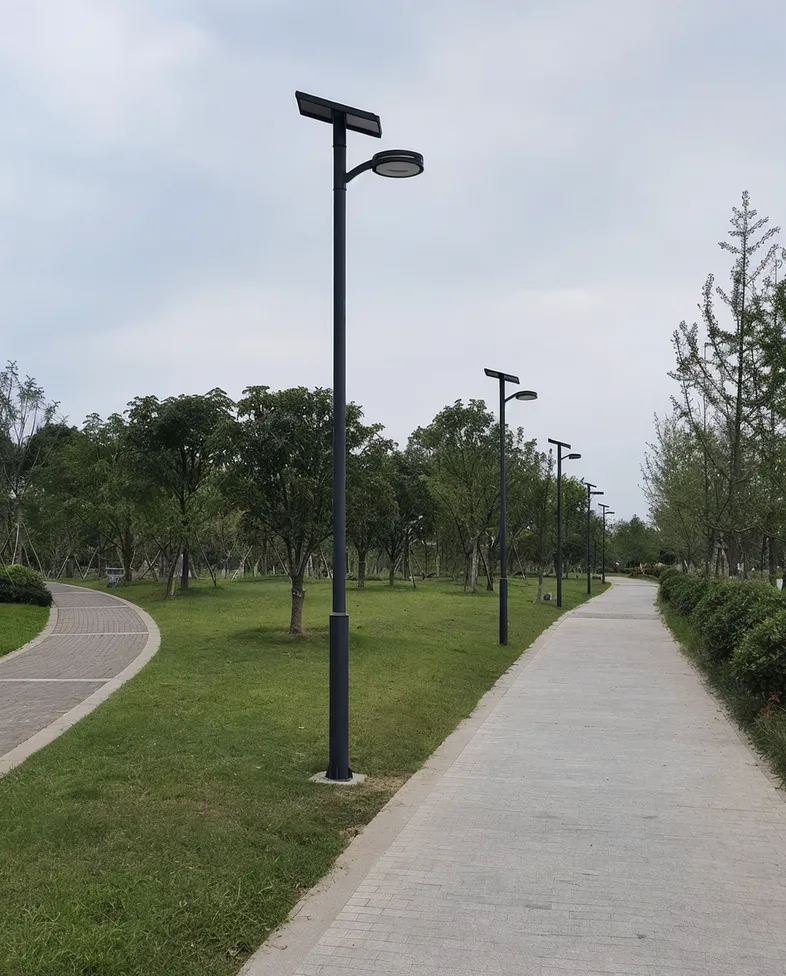
Why Phased Parks Stay Loyal
Visual consistency across phases requires matched CCT and lumen output
Switching suppliers mid-project creates visible mismatches
Documentation packages pre-built for public procurement compliance
Greenways, Trails, and Cycling Paths
Greenway and trail projects are linear — long runs of poles at consistent spacing, often procured in a single order for the full route. Order volumes for a single trail project can run 100–500 units depending on the route length, and the specification is typically tight: a defined pole height, spacing, and lux level from the project brief.
The buyer is usually a contractor working from a landscape architect's specification, and they need a supplier who can confirm photometric performance against the spec before production.
Project Example
We've had trail projects where the landscape architect specified 3000K warm white at 4-meter poles with 20-meter spacing. That's a specific enough brief that we can run the configuration, confirm the lumen output and beam angle, and send back a photometric layout before the contractor commits to the order. That kind of pre-production confirmation is what keeps contractors coming back.
100–500
Units per trail order
Single SKU
Consistent spec across route
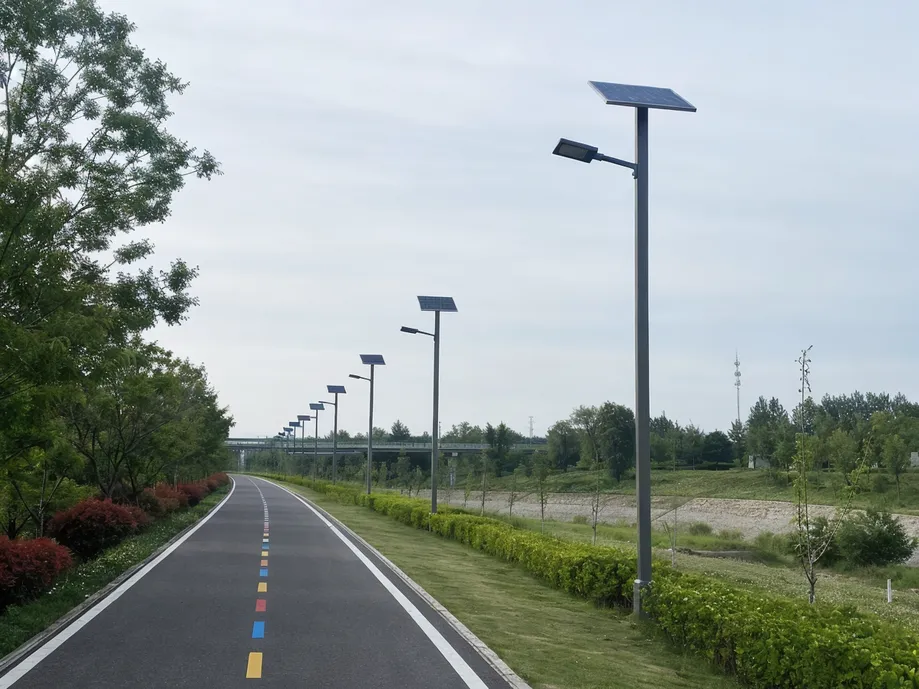
Campuses and Residential Communities
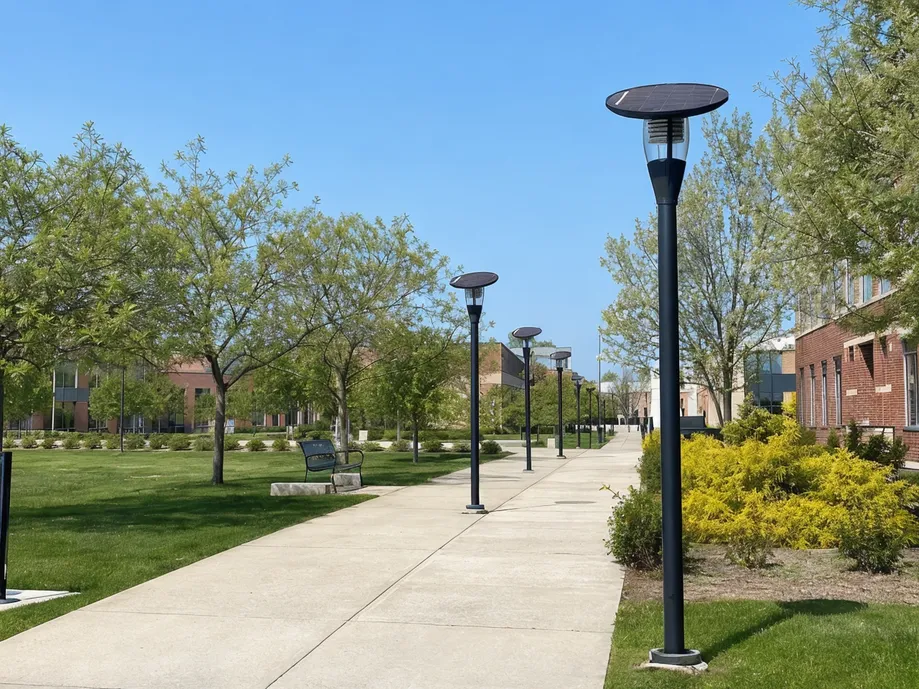
University campuses, corporate campuses, and gated residential communities install solar park lighting as part of site infrastructure — and they expand it as the site grows. The buying pattern is standard SKU plus repeat replenishment: a facilities manager specifies a fixture model, installs it across the site, and reorders the same model as the site expands or fixtures need replacement.
For distributors, this is a high-value segment because the reorder cycle is predictable and the buyer is not price-shopping on every order — they're buying the same fixture they already have installed.
Margin Protection Note
Campuses tend to have aesthetic requirements: the fixture needs to fit the site's visual identity. Decorative housing options and custom finish colors become a margin-protection tool rather than a cosmetic option — the buyer locks into your SKU because switching means a visible mismatch across the site.
Predictable
Reorder cycle
Standard SKU
Same model, repeat orders
Resorts, Hospitality Landscapes, and Tourist Areas
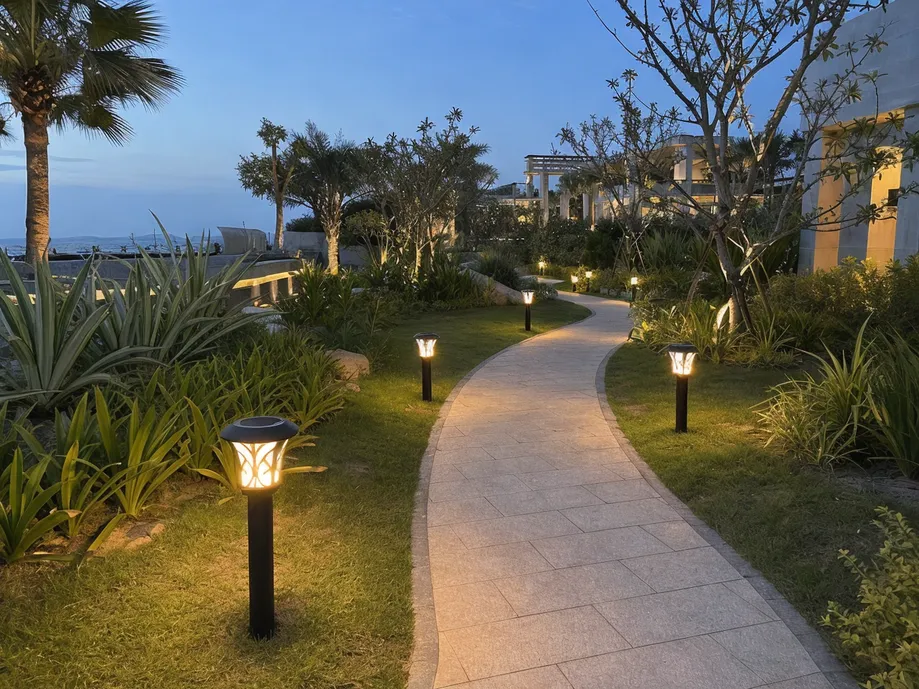
Resort and hospitality projects are the highest-margin segment in solar park lighting. Landscape architects for resorts specify fixtures by appearance first — the housing profile, finish color, and warm CCT are the primary selection criteria, with photometric performance secondary. This is where decorative housing options and 3000K warm white CCT command a price premium over commodity road fixtures.
Order volumes for resort projects are typically smaller (50–200 units per property) but the per-unit value is higher, and resort groups with multiple properties generate repeat orders across locations. Distributors who position themselves in the hospitality and landscape segment can build a catalog around decorative solar park lighting with better margin than standard road fixtures.
Hospitality Margin Advantage
Decorative housing + warm 3000K CCT = higher per-unit value than standard road fixtures. Multi-property resort groups generate repeat orders across locations.
Public Plazas and Recreational Areas
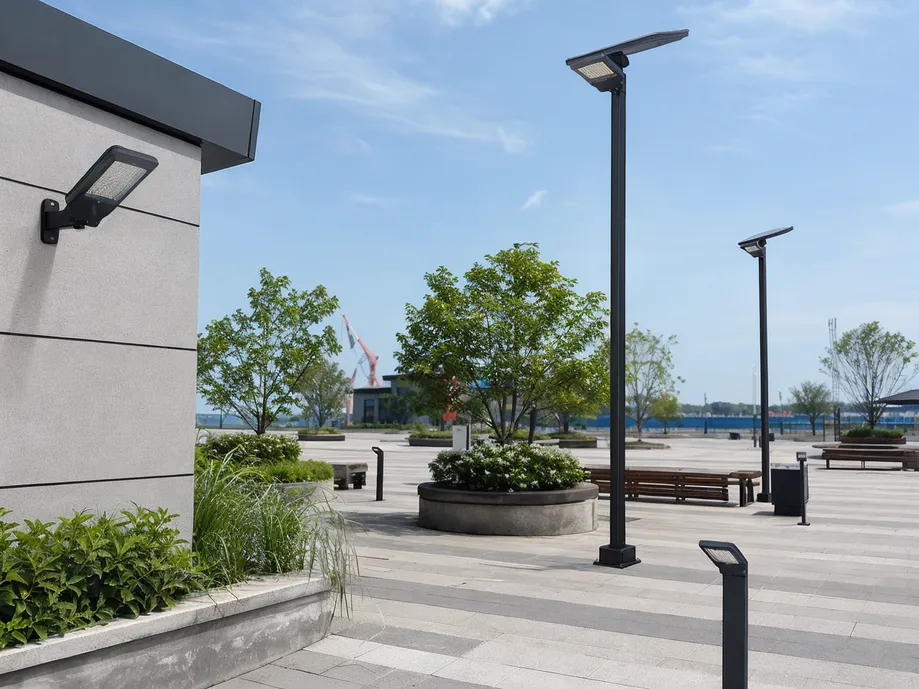
Public plazas, sports parks, outdoor event spaces, and recreational facilities need solar park lighting that handles high pedestrian traffic, vandal exposure, and variable weather. The fixture needs to be robust — IP65 or IP67 rated, with a housing that resists impact and a finish that holds up to coastal air or irrigation spray — while still fitting the visual requirements of a public space.
This segment often involves mixed pole and bracket configurations: some fixtures on poles, some wall-mounted, some on low bollard-style mounts. We supply all three mounting configurations from the same product family.
IP65 / IP67
Weather & vandal rated
3 Mount Types
Pole, wall, bollard
One Family
Unified product line
Ready to specify for your target segment?
Send your target segment and expected order volume for a tailored quote.
Configuration Choices That Protect the Project Budget
Getting the configuration right for a park lighting project protects your margin and your customer's satisfaction. The most common mistake is applying road-lighting logic to park applications — specifying too much output, too high a pole, or the wrong CCT. Here's how we think through the main configuration inputs.
Pole Height and Pathway Width
Park lighting pole heights typically run 3–6 meters. The right height depends on the pathway width and the desired coverage pattern.
3 m pole
On a 2-meter-wide path gives intimate, close-range illumination — appropriate for garden paths and resort walkways.
5–6 m pole
On a 4–6 meter-wide plaza or trail gives broader coverage with fewer poles, reducing installation cost on longer runs.
Pole spacing is calculated from the pole height, beam angle, and target lux level — we run this calculation as part of the configuration process when you send us the project brief.
We also supply solar street lighting poles alongside fixtures, so if your project needs poles and fixtures from the same source, we can supply both.
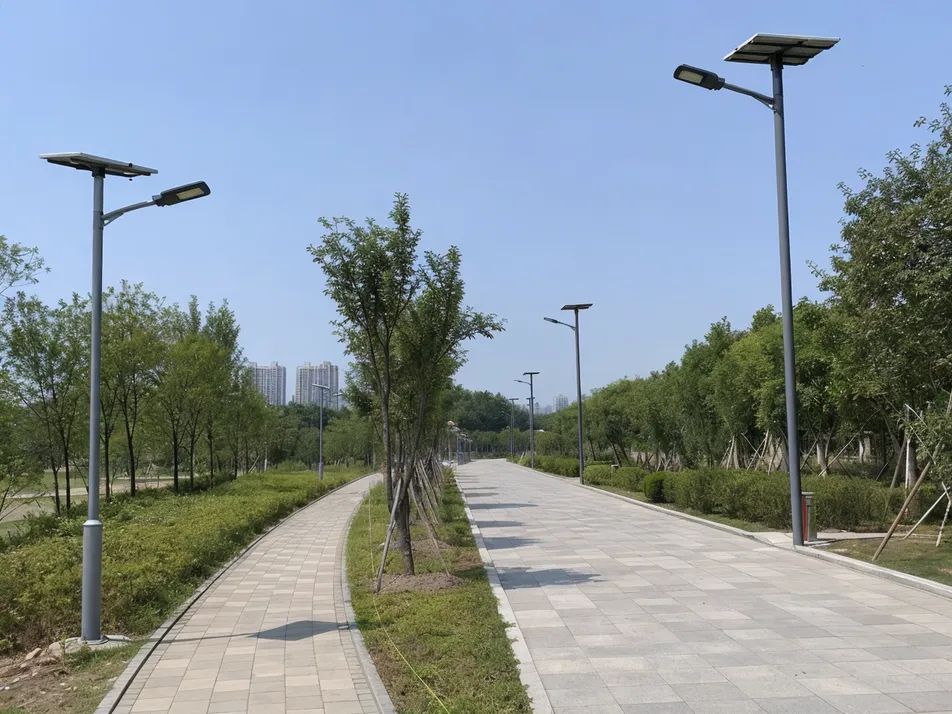
Pole height selection depends on pathway width and desired coverage pattern for the project.
Color Temperature: 3000K–4000K for Most Park Applications
For parks and pedestrian paths, 3000K–4000K warm white is the standard specification. Warm CCT reduces the harsh, clinical appearance of 5000K+ daylight white in a public outdoor space, and it's what landscape architects and parks departments typically specify.
3000K
Warm white — garden paths, resort walkways
4000K
Neutral white — plazas, recreational areas
5000K+
Daylight white — road/security only
4000K neutral white is a reasonable middle ground for plazas and recreational areas where some visibility priority exists alongside aesthetics.
Avoid specifying 5000K+ for park paths
Unless the project has a specific security or visibility requirement that overrides the aesthetic consideration. Over-bright, cool-white lighting on a park path generates glare complaints and can create a visual environment that discourages use of the space — which is the opposite of what the project is trying to achieve.
Field note: We've seen this happen on a few projects where the buyer defaulted to road-lighting CCT specs. The parks department came back asking for replacements. Specifying the right CCT from the start is cheaper than replacing fixtures.
Motion Sensing and Dimming Logic
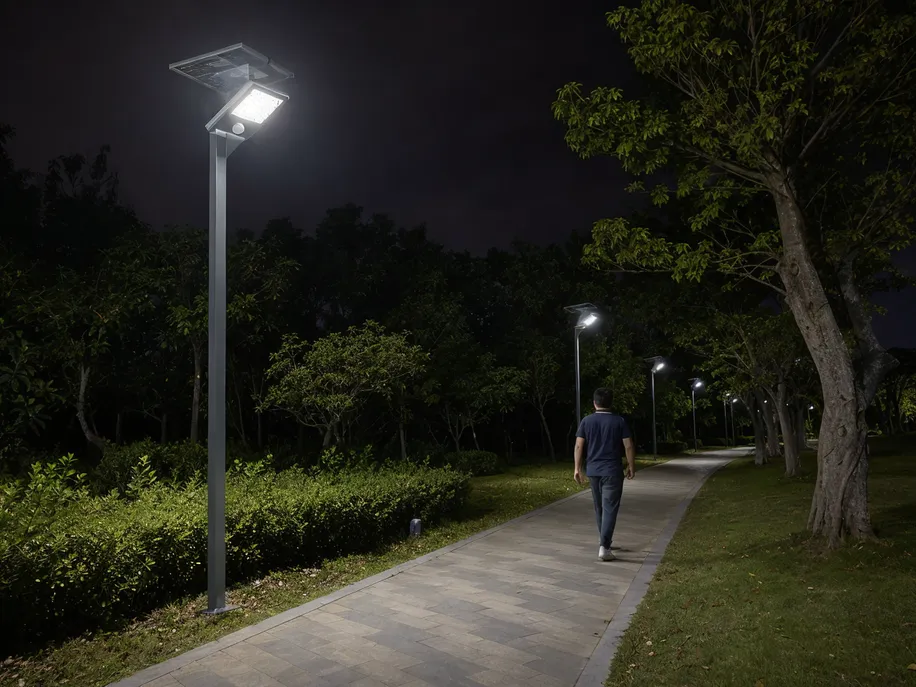
Motion-activated dimming is a practical tool for park lighting because pedestrian traffic is intermittent — paths are empty for long stretches, especially late at night. A fixture running at 50% dim when no one is present and stepping up to full power when a PIR sensor detects movement can extend battery autonomy by 30–40% compared to full-power operation all night.
That means you can either reduce the battery size (lower unit cost) or extend the autonomy days (better performance in low-irradiance conditions) for the same system cost.
Standard vs. Scheduled Dimming
Standard models include PIR motion sensing and 50% dim mode. If your project needs scheduled dimming profiles — full power from dusk to 11 PM, 30% from 11 PM to dawn, for example — that's a controller configuration we can set at the factory before shipment.
30–40%
Battery autonomy extension with PIR dimming vs. full-power all night
50%
Standard dim level when no motion detected
100%
Full power on PIR trigger — instant step-up
All-in-One vs. Split for Park Applications
For most park lighting applications at 3–6 meter pole heights and 10–60W LED output, all-in-one solar street lights are the practical choice — compact, clean installation, no wiring between panel and fixture. The integrated form factor also looks better on a park pole than a separate panel mounted above the fixture.
All-in-One
Recommended for most park projects
- 3–6 meter pole heights, 10–60W LED output
- Compact, clean installation — no external wiring
- Better visual integration on park poles
- Lower installation labor cost
Split System
For low-irradiance or high-autonomy specs
- Lower-irradiance regions (higher latitudes, monsoon climates)
- Panel larger than integrated housing allows
- 5+ autonomy days with higher LED output
- Northern Europe, Canada, high-latitude markets
Smart Solar Street Lights
For park projects with remote monitoring requirements or networked dimming schedules, smart solar street lights add that capability at a higher per-unit cost.
If your project is in Northern Europe, Canada, or a high-latitude market, send us the location and operating hours — we'll confirm whether all-in-one covers the spec or whether split is the right call.
Custom Park Lighting Without Turning Every Order Into a New Project
Most park lighting projects have some customization requirement — a specific housing color to match site furniture, a warm CCT that the landscape architect specified, a private label for a distributor's branded catalog. We handle these without treating every variation as a full engineering project.
What We Can Configure
Lumen Output & CCT
Lumen output is adjustable within the LED module's design range without changing the housing. CCT covers 3000K through 5000K — confirm the target CCT at order placement and we verify it at the LED module assembly stage.
For phased projects, we record the CCT bin used in Phase 1 so Phase 2 matches.
Housing Color & Decorative Style
Standard colors: silver grey, black, and dark green. Custom RAL colors available on runs of 100+ units — below that, the powder line changeover cost doesn't make sense for either side.
Decorative housing profiles (lantern-style, contemporary, traditional post-top) available depending on the model; confirm the housing style at inquiry stage.
Battery Autonomy & Panel Sizing
If your project location has lower solar irradiance or requires extended autonomy, we size the battery and panel together against your target operating hours and autonomy days.
Common spec error: increasing battery capacity without matching panel wattage — we catch it during the engineering review.
Sensor Mode & Controller Configuration
PIR sensitivity, dimming levels, scheduled dimming profiles, and dawn-to-dusk timing can be set at the factory.
If your project has a specific operating schedule, send it with the RFQ and we configure the controller before shipment.
Pole & Bracket Configuration
Top-of-pole, side arm, and wall bracket mounting are all available. If your project mixes mounting types — some poles, some wall mounts — we supply both configurations in the same order with consistent fixture appearance.
Private Label & Packaging
Custom logo, brand labeling, and packaging design for distributors building a branded solar park lighting line. We handle packaging engineering alongside product engineering.
Accessory kits (mounting hardware, installation guides, remote controls) are configured per order.
Customization Limits
OEM/ODM projects with custom housing tooling or non-standard mechanical designs go through an engineering review before production. The review confirms the configuration is achievable, locks the spec before component procurement, and prevents mismatches during production.
Minor changes — CCT, lumen output, label, packaging — are straightforward. New housing tooling or structural changes require more lead time and a higher MOQ to justify the tooling cost.
MOQ & Lead Time
- Standard model MOQ starts at 100 units, consistent with our catalog.
- Custom specifications confirmed during engineering review — MOQ and lead time depend on the customization scope.
- Custom RAL colors available on runs of 100+ units.
Waterproof, Battery, and Finish Controls for Outdoor Public Spaces
Park lighting faces a specific set of field risks that road lighting doesn't always encounter: irrigation spray, coastal salt air, public contact, vandal exposure, and the visual consistency requirement of phased projects. Our QC system addresses each of these at the production stage.
Battery Matching and Field Failure Prevention
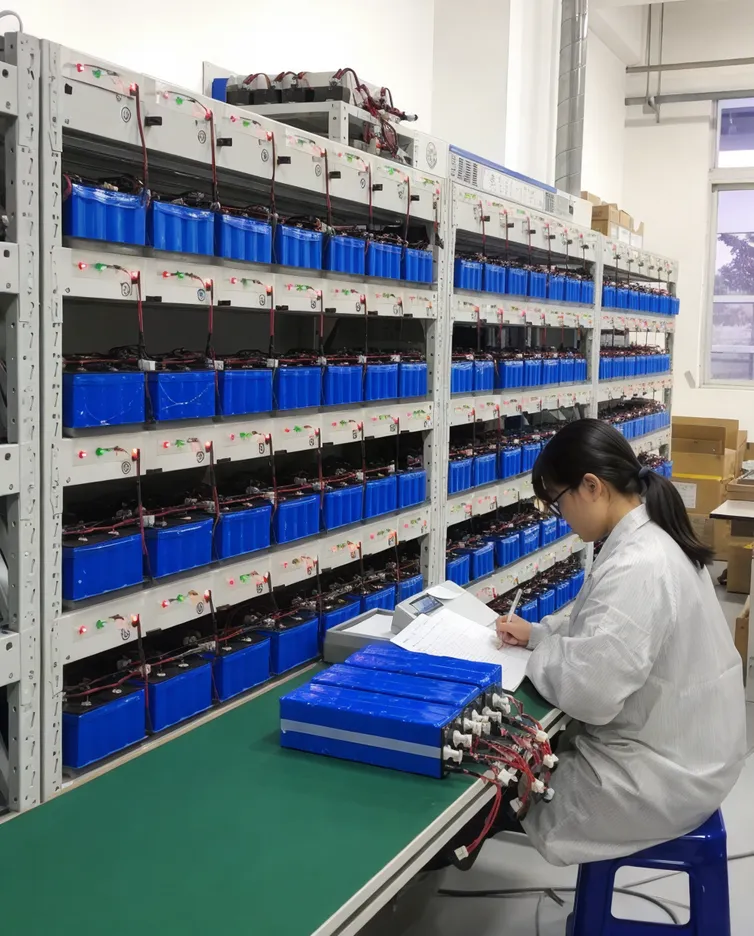
Battery failure in solar park lighting is almost always a matching problem, not a single-cell defect. Cells with different internal resistance values assembled into a pack degrade unevenly — the weaker cells discharge faster, pulling down the whole pack within one or two seasons.
We match battery cells by capacity and internal resistance before pack assembly, and every completed LiFePO4 pack goes through a full charge/discharge cycle test on our aging racks before it moves to final assembly.
Why This Matters More for Park Lighting
Park fixtures are often in locations where maintenance access is difficult — a trail 2 kilometers from the nearest road, a resort garden where a service vehicle can't reach. A battery failure in that location means a service call that costs more than the fixture. Battery matching and pre-shipment cycle testing is the step that prevents that call.
IP65/IP67 Waterproof Inspection
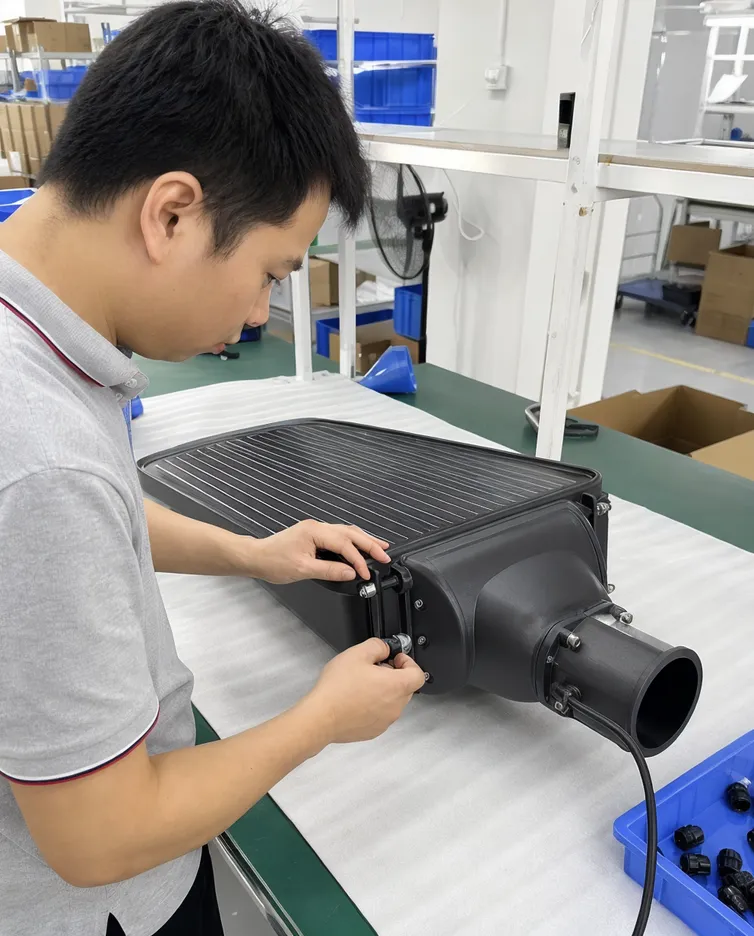
Every unit goes through waterproof structure inspection before final packing — not a sample check, 100% inspection. IP65 units are tested for dust ingress protection and water jet resistance. IP67 units are tested for temporary immersion.
For park lighting specifically, the cable entry points and gasket compression at the housing joints are the most common failure locations — we check both as part of the waterproof inspection, not just the housing design.
Coastal & Irrigation Environments
Park fixtures in coastal locations or near irrigation systems are exposed to conditions that accelerate seal degradation. IP67 is worth specifying for those environments. If you're unsure which rating fits your installation, send us the site description and we'll confirm.
Lumen and CCT Consistency for Phased Projects
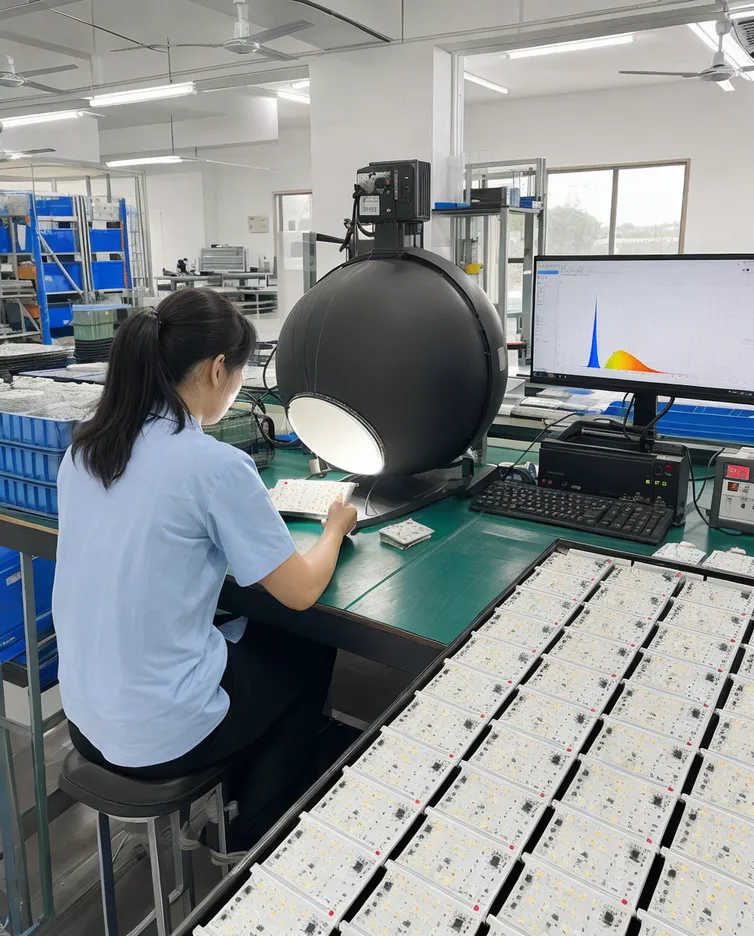
The most commercially damaging quality failure in park lighting is CCT mismatch between project phases. A parks department that installs 200 fixtures in Phase 1 and receives 300 fixtures in Phase 2 with a visibly different color temperature will reject the Phase 2 order — or worse, install them and then complain.
We run lumen binning and CCT confirmation at the LED module assembly stage, and we record the CCT bin used in each production run. When you reorder, we pull the same bin specification.
Finish Consistency on Decorative Housings
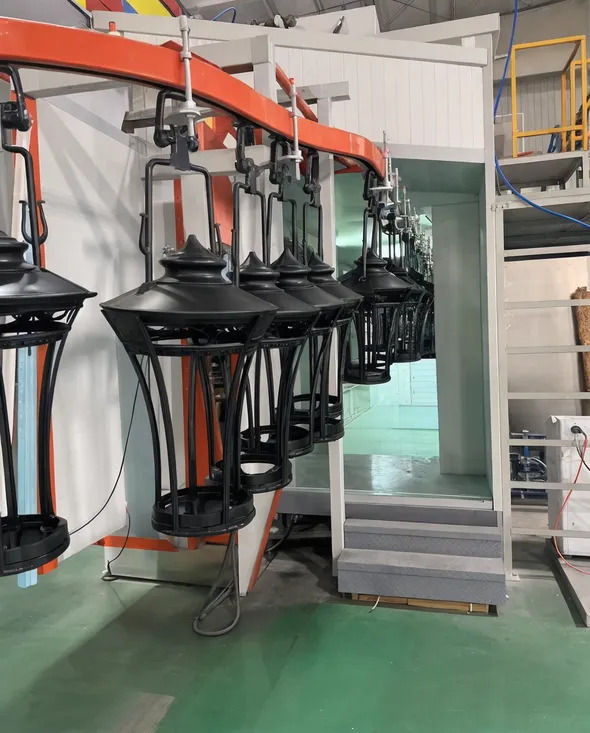
Decorative housing finishes are more visible than road fixture finishes — a park fixture at 4 meters is at eye level, not 8 meters overhead. Powder coat adhesion failure or color variation between batches is immediately visible in a park environment.
We run automated powder coating with consistent film thickness across the batch, and finish consistency is checked at the outgoing inspection stage. For custom colors, we record the RAL specification and powder supplier batch used in Phase 1 so subsequent orders match.
Cell Matching
Capacity & IR matched
100% IP Test
Every unit inspected
CCT Binning
Phase-to-phase match
Finish Control
RAL batch recorded
Choose This Product or Move to a Sibling Fixture
Solar park lighting is the right choice for pedestrian-scale public spaces. If your project or catalog requirement falls outside that scope, the table below maps the right product family.
Solar Park Lighting (You Are Here)
Lower pole heights, warm CCT, decorative housing, glare-controlled beam for pedestrian-scale spaces — parks, trails, plazas, campuses, resort grounds, pedestrian paths.
Solar Street Lights
Best for: Standard residential or secondary road replacement
Road-optimized beam distribution, standard pole heights, distributor stock SKUs.
View productCommercial Solar Street Lights
Best for: Business parks, private roads, commercial developments needing higher output
Higher lumen output, longer nightly hours, commercial-grade configuration.
View productAll-in-One Solar Street Light
Best for: Compact installation, distributor catalog programs
Integrated panel/battery/fixture, simple installation, standard road applications.
View productSplit Solar Street Light
Best for: Higher latitude, longer autonomy, or 200W+ output requirements
Separate panel and battery for larger sizing requirements.
View productSmart Solar Street Light
Best for: Municipal projects with remote monitoring or networked dimming
IoT integration, dimming schedules, fault reporting.
View productSolar Road Lights
Best for: Arterial roads and urban road projects with specified pole height and road width
Road-width coverage, specified pole heights, photometric-matched configurations.
View productSolar Highway Lights
Best for: High-speed roads and expressways
High-mast configurations, wide beam distribution, extended nightly operation.
View productSolar Street Lighting Pole
Best for: Poles alongside fixtures
Galvanized steel poles in standard heights, flange or anchor bolt base.
View productFAQ for Solar Park Lighting Buyers
What pole height is typical for solar park lighting?
What pole height is typical for solar park lighting?
3–6 meters covers the majority of park lighting applications. A 3-meter pole suits narrow garden paths, resort walkways, and intimate pedestrian spaces where close-range illumination is the goal. A 4–5 meter pole is the most common specification for standard park paths and greenways — it gives enough mounting height for reasonable coverage without the visual dominance of a road-height fixture. A 6-meter pole is appropriate for wider plazas, open recreational areas, or locations where fewer poles with broader coverage is the priority.
Above 6 meters, you're moving into road lighting territory and the fixture specification changes accordingly.
If your project brief specifies a pole height outside this range, send it to us — we'll confirm whether the park lighting configuration covers it or whether a different product family is the better fit.
What color temperature is best for parks and pedestrian paths?
What color temperature is best for parks and pedestrian paths?
3000K–4000K warm white is the standard specification for parks, trails, and pedestrian paths.
Warmest, most residential feel — appropriate for resort grounds, garden paths, and spaces where ambiance is a priority.
Practical middle ground for municipal parks and campus walkways where some visibility priority exists alongside aesthetics.
Generally not recommended for park paths — creates a clinical, over-bright appearance that generates glare complaints and can make a public space feel less welcoming.
The exception is security-priority areas within a park (parking areas, entry points, underpass lighting) where visibility takes precedence over ambiance.
For mixed projects, we can supply both CCT options in the same order with consistent housing appearance.
How many autonomy days should outdoor solar park lighting be designed for?
How many autonomy days should outdoor solar park lighting be designed for?
Three days is the standard minimum for most park lighting applications — it covers a typical sequence of overcast days without the system going dark. Five days is worth specifying for coastal locations, monsoon-season climates, or higher-latitude installations where consecutive low-irradiance days are more frequent.
The trade-off is direct: more autonomy days require a larger battery, which increases unit cost.
Maintenance access factor
For park lighting specifically, the maintenance access factor matters — a fixture on a remote trail or in a resort garden is harder to service than a road fixture, so erring toward 4–5 days autonomy is a reasonable risk-reduction choice even in moderate-irradiance locations.
We size battery capacity against your target autonomy days and daily operating hours as part of the configuration process.
Is IP65 enough for park lighting, or should I specify IP67?
Is IP65 enough for park lighting, or should I specify IP67?
IP65 is sufficient for most park lighting installations — it covers dust ingress protection and water jet resistance from any direction, which handles rain, irrigation spray, and pressure washing.
IP67 adds temporary immersion protection and is worth specifying for three specific scenarios:
Coastal installations
Heavy salt spray and wave splash exposure
Flood-prone locations
Standing water is a regular condition
Aggressive irrigation
Fixture directly sprayed at close range
For standard municipal parks, campuses, and trail installations, IP65 is the right specification. For resort grounds near water features, coastal parks, or any site where the fixture will be regularly exposed to more than rain, specify IP67.
Testing note: Both ratings are tested on our own waterproof inspection equipment — not assumed from housing design.
What is the difference between solar park lighting and solar street lighting?
What is the difference between solar park lighting and solar street lighting?
The difference is in the fixture design, beam angle, lumen output, and housing aesthetics — not just the application label.
Solar Street Lighting
- Pole heights: 6–12 meters
- Wider asymmetric beam distribution for road width
- Lumen output: 5,000–30,000 lm
- Utilitarian housing profiles
Solar Park Lighting
- Pole heights: 3–6 meters
- Symmetric or semi-symmetric beam for path and plaza coverage
- Lumen output: 1,000–10,000 lm
- Housing profiles that complement outdoor public spaces
Key point: Using a road-grade solar street light on a park path over-illuminates the path, creates glare for pedestrians, and looks visually out of place. Using a park fixture on a road under-illuminates the road surface and fails to meet road lighting standards. The two product families are not interchangeable — the right choice depends on the application, not just the preference for "solar lighting."
Can JXSOL customize housings, CCT, logo, and packaging for park lighting orders?
Can JXSOL customize housings, CCT, logo, and packaging for park lighting orders?
Yes, within defined parameters. Here is what is adjustable and what requires engineering review:
Standard Model Adjustments (No Housing Change)
- CCT: 3000K–5000K
- Lumen output configuration
- Sensor mode selection
- Controller configuration
Housing & Branding Customization
- Custom RAL color shades — available on runs of 100+ units
- Decorative housing styles — model-dependent, confirm at inquiry stage
- Private label (custom logo, brand labeling, packaging design) — available for distributors building a branded solar park lighting line
OEM/ODM Projects
Custom housing tooling or non-standard mechanical designs go through an engineering review before production to confirm feasibility and lock the spec.
MOQ guidance: Standard model MOQ starts at 100 units. Custom specification MOQ depends on the customization scope and is confirmed during the engineering review.
Send Park Lighting Requirements for a Factory Quote
The most useful inquiry includes: project location or installation latitude, installation environment (coastal, inland, irrigation-exposed), pathway or plaza width, pole height, target CCT, nightly operating hours, target autonomy days, order quantity, destination market, and any branding or private-label requirements. With those inputs, we can confirm the right configuration, run the photometric layout if needed, and send back a detailed quote with the spec locked before production.
What to Include in Your Inquiry
- Project location or installation latitude
- Installation environment (coastal, inland, irrigation-exposed)
- Pathway or plaza width
- Pole height and target CCT
- Nightly operating hours and target autonomy days
- Order quantity and destination market
- Branding or private-label requirements
Earlier in the Process?
If you're comparing configurations, building a distributor catalog, or evaluating us as a supplier for park lighting — send what you have. We'll work from there.
+8615398807118
9th Floor, Houda Industrial, No. 65 Pinghe Road, Guzhen Town, Zhongshan, Guangdong, 528421, China
© 2026 JXSOL. All rights reserved.