

Solar Street Lighting Pole
Galvanized steel solar street lighting poles — matched to fixture weight, panel size, and project site before production.
Standard heights from 4m to 12m, flange or anchor bolt base, single or double arm. Supplied alongside fixtures or as standalone pole orders for project contractors and distributors.
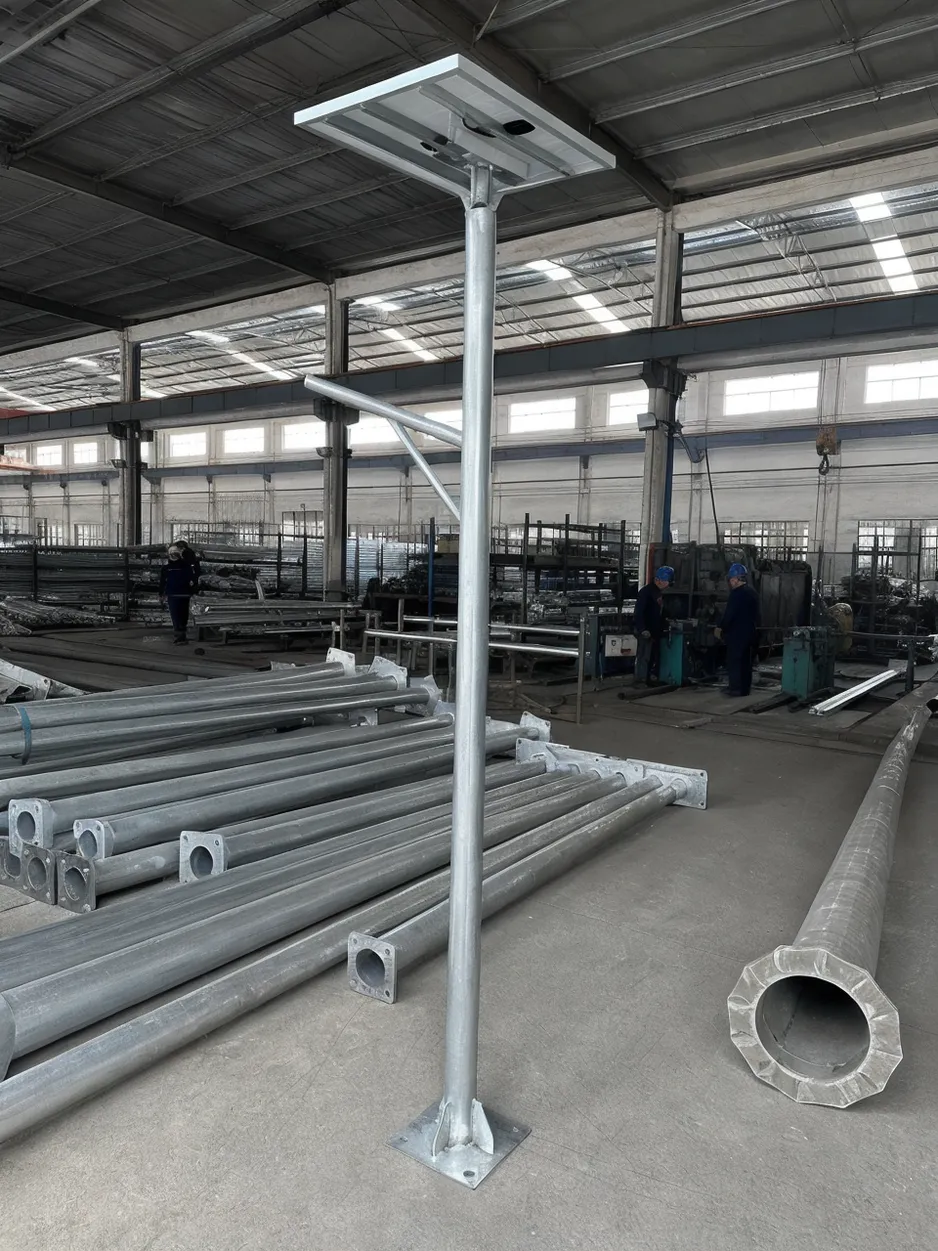
Solar Street Lighting Poles Matched to the Fixture, Panel, and Project Site
A solar street lighting pole is not a standalone purchase — it is the structural decision that determines fixture mounting height, solar panel clearance, arm reach over the road, foundation depth, wind load exposure, and how much the whole installation costs to put in the ground. Get the pole wrong and you're either re-engineering the foundation on site or sending back hardware that doesn't fit the fixture bracket.
We supply solar lighting poles as part of complete solar street and roadway lighting project packages, and also as standalone pole orders for contractors who are sourcing fixtures elsewhere or replacing poles on existing sites. Either way, the conversation starts the same: pole height, road width, fixture type, arm configuration, installation country, and base type. Those six inputs determine everything else — wall thickness, base plate dimensions, anchor bolt pattern, and packing method.
Most buyers who come to us for poles are already working from a project brief. They know the road classification, the required mounting height, and the fixture they're pairing. What they need from us is confirmation that the pole spec matches the fixture load, the arm length covers the road width, and the base hardware matches the foundation plan. That's the conversation we're set up to have.
6 Inputs That Determine Your Pole Spec
- 1 Pole height — road classification and lux requirement
- 2 Road width — determines arm reach
- 3 Fixture type — weight and mounting collar
- 4 Arm configuration — single, double, straight, curved
- 5 Installation country — wind load zone
- 6 Base type — flange or direct burial
These six inputs determine wall thickness, base plate dimensions, anchor bolt pattern, and packing method.
Pole Specifications Buyers Need Before Quoting a Road Project
The table below covers the standard specification range for our solar street lighting poles. These are industry-typical values — exact specifications for your project are confirmed before production and documented in a product data sheet.
| Specification | Typical Range / Options | Buyer Note |
|---|---|---|
| Pole Height | 4m, 5m, 6m, 7m, 8m, 10m, 12m | Standard heights; intermediate heights available on request |
| Shaft Material | Q235 / Q345 steel | Q345 for taller poles (8m+) and higher wind load zones |
| Shaft Shape | Round tapered, octagonal tapered | Round tapered is standard; octagonal available for decorative projects |
| Wall Thickness | 3.0mm – 5.0mm (height-dependent) | Confirmed per project based on pole height and wind load zone |
| Base Type | Flange base with anchor bolts | Standard; direct burial available on request for rural/off-grid projects |
| Base Plate | 200×200mm – 350×350mm | Sized to pole height and foundation load |
| Anchor Bolt Cage | M20 – M30, 4-bolt pattern | Bolt size and pattern confirmed per project; cage supplied with pole |
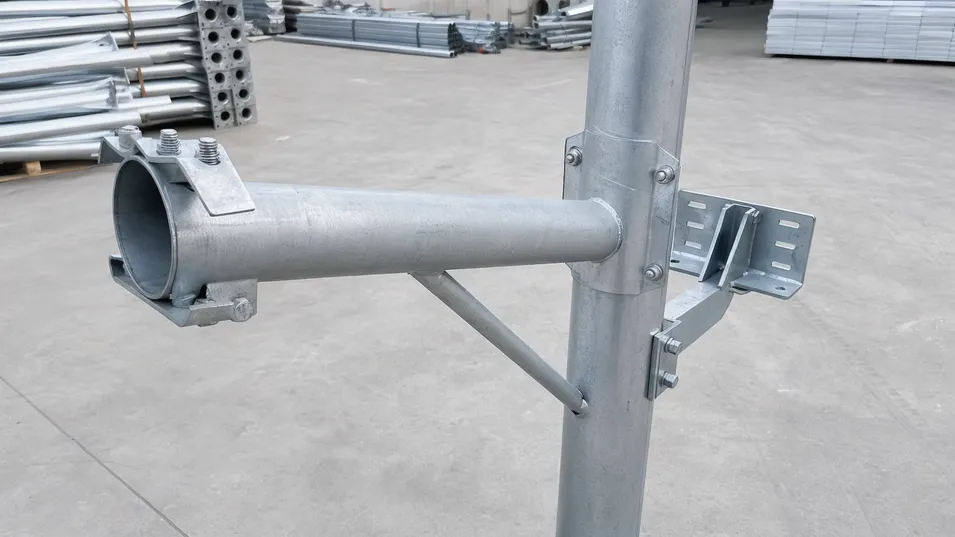
| Arm / Bracket | Single arm, double arm, straight, curved | Arm length 1.0m – 3.0m; custom arm length available |
| Arm Diameter | 60mm – 76mm | Matched to fixture mounting collar |
| Surface Finish | Hot-dip galvanized (standard), powder coat over galvanized | Galvanized zinc layer ≥85μm; powder coat color confirmed per order |
| Fixture Compatibility | All-in-one, split, road, highway, commercial solar street lights | Arm collar and bracket matched to fixture mounting spec |
| Panel Mounting | Side-mount bracket on shaft or arm-top mount | Panel tilt angle and orientation confirmed per installation latitude |
| Packing | Bundle-packed in steel strapping, arms packed separately | Poles bundled 3–6 per bundle depending on height; arms and hardware in labeled cartons |
| Documentation | Material certificate, coating inspection report, dimensional drawing | Available per order; project-specific data sheets on request |
Specifications shown are industry-standard values for this product type. Exact wall thickness, base plate dimensions, anchor bolt pattern, and coating specification are confirmed per project before production. Contact us for a project-specific data sheet.
Request a Pole Data Sheet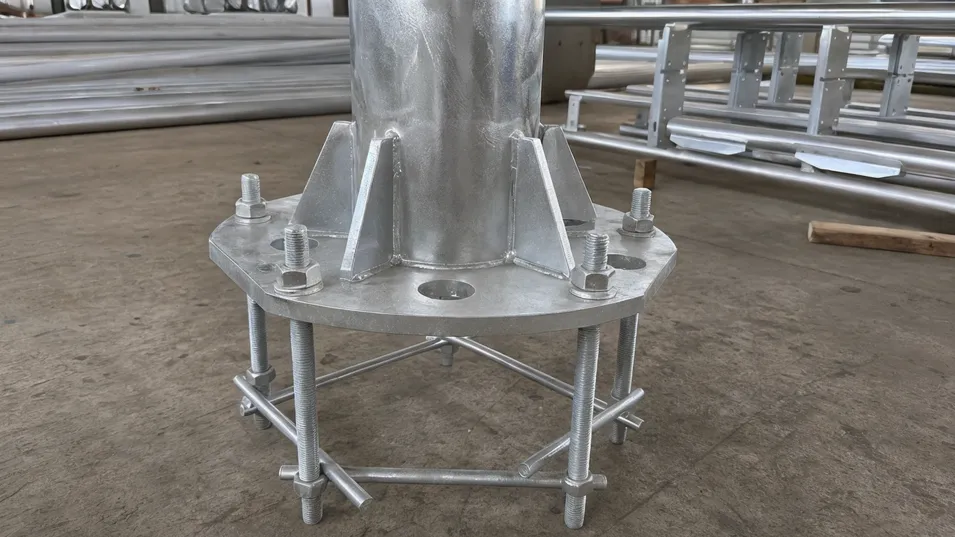
Height, Arm Length, and Base Type Decide More Than the Pole Price
Pole selection is where project margin gets protected or lost. A pole that's 1m too short means the fixture beam angle doesn't cover the road width. A base plate that doesn't match the foundation bolt pattern means a site crew is drilling new holes or pouring a new foundation — both of which cost more than the pole itself.
Pole Height and Road Coverage
The standard logic: pole height is roughly 1/3 of the road width for single-sided installation, or 1/2 of the road width for staggered or opposite-side installation. These are starting points — the fixture's beam angle and the required lux level at road surface are the confirming inputs. If you're working from a photometric specification, send it to us and we'll confirm the pole height before you quote.
| Road Width | Typical Pole Height | Application |
|---|---|---|
| 6m | 4m–5m | Residential, village roads |
| 12m | 6m–8m | Secondary roads, commercial |
| Dual-carriageway | 8m–12m | Arterial roads, highways |
For arterial road and highway projects, see solar road lights matched to pole height and road width and solar highway lights for taller pole configurations — those pages cover the fixture side of the height-and-coverage calculation.
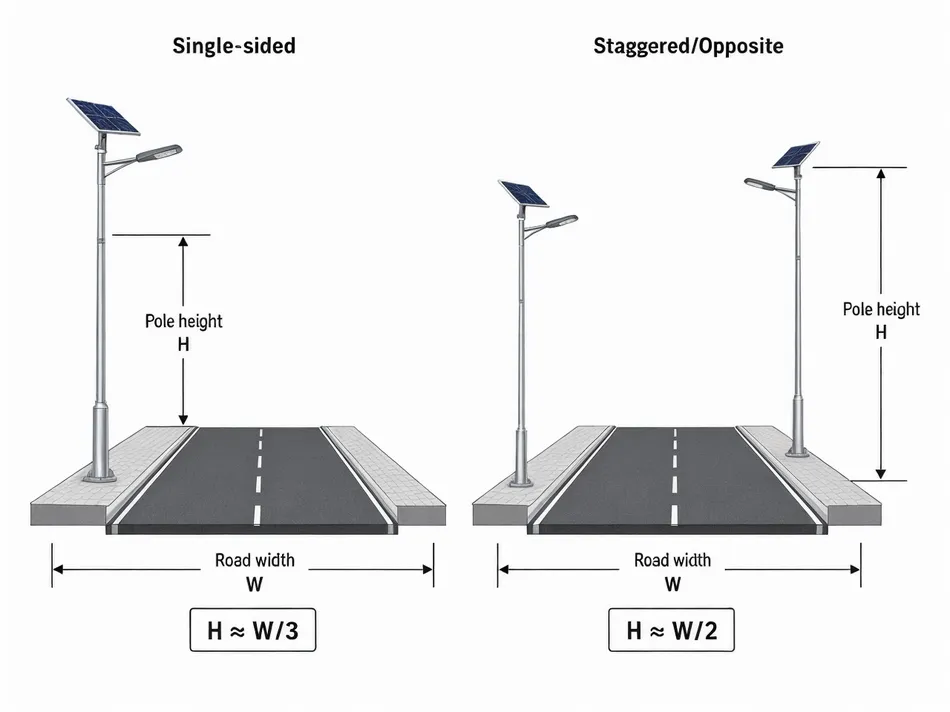
Height Selection Rule
Single-sided: pole height ≈ 1/3 road width. Staggered/opposite: pole height ≈ 1/2 road width. Confirm with photometric spec before quoting.
Arm Length and Fixture Overhang
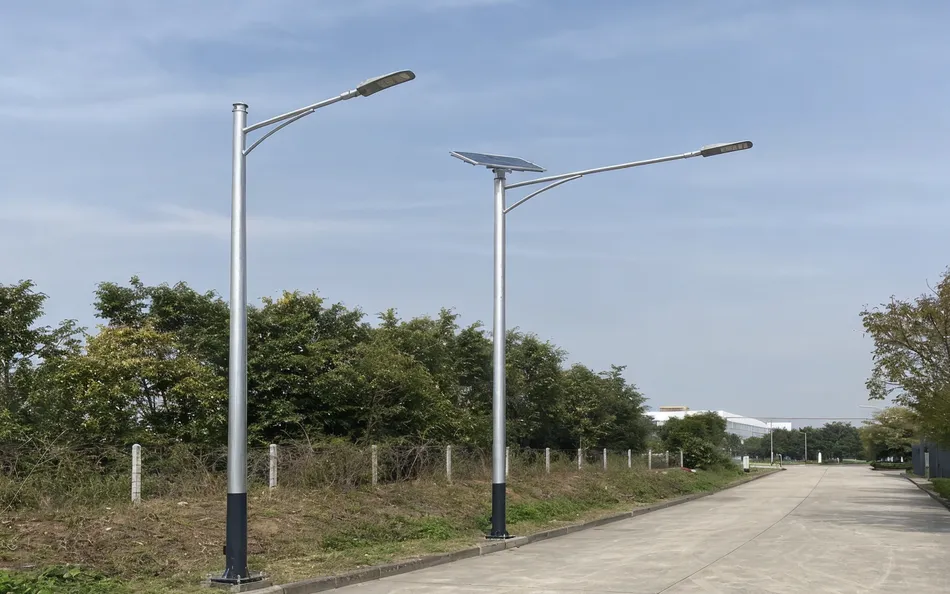
Arm length determines how far the fixture extends over the road. Double-arm configurations are used for roads where fixtures are mounted on both sides from a single pole, or where a solar panel is mounted on one arm and the fixture on the other.
Residential & Secondary Roads
Standard arm lengths: 1.0m to 2.0m
Commercial Roads & Arterials
Standard arm lengths: 2.0m to 3.0m
We supply arms as part of the pole package — arm length, diameter, and mounting collar are matched to the fixture spec before production.
Flange Base vs. Direct Burial
Flange Base with Anchor Bolts
The standard for most road projects. The foundation is poured with the anchor bolt cage set in concrete; the pole flange bolts onto the cage after the concrete cures.
Best for
Urban roads, arterials, projects with maintenance infrastructure
Direct Burial
Simpler to install — no foundation formwork, no anchor bolt cage. Common for rural roads and off-grid projects where maintenance access is infrequent and installation cost is the priority.
Best for
Rural roads, off-grid sites, projects prioritizing installation cost
Project Cost Note
We've had buyers specify flange base for a rural off-grid project and then realize the foundation cost exceeded the pole cost. For remote sites with no maintenance infrastructure, direct burial often makes more commercial sense — worth confirming before the project bid goes out.
Surface Treatment and Structural Details That Reduce Field Claims
The pole is in the ground for 15–20 years. The surface treatment decision at the factory determines whether you're fielding corrosion complaints in year three or year fifteen.
Steel Grade and Shaft Fabrication
We use Q235 steel for poles up to 7m and Q345 for 8m and above. Q345 has higher yield strength — relevant for taller poles in higher wind load zones where the bending moment at the base is the governing structural load.
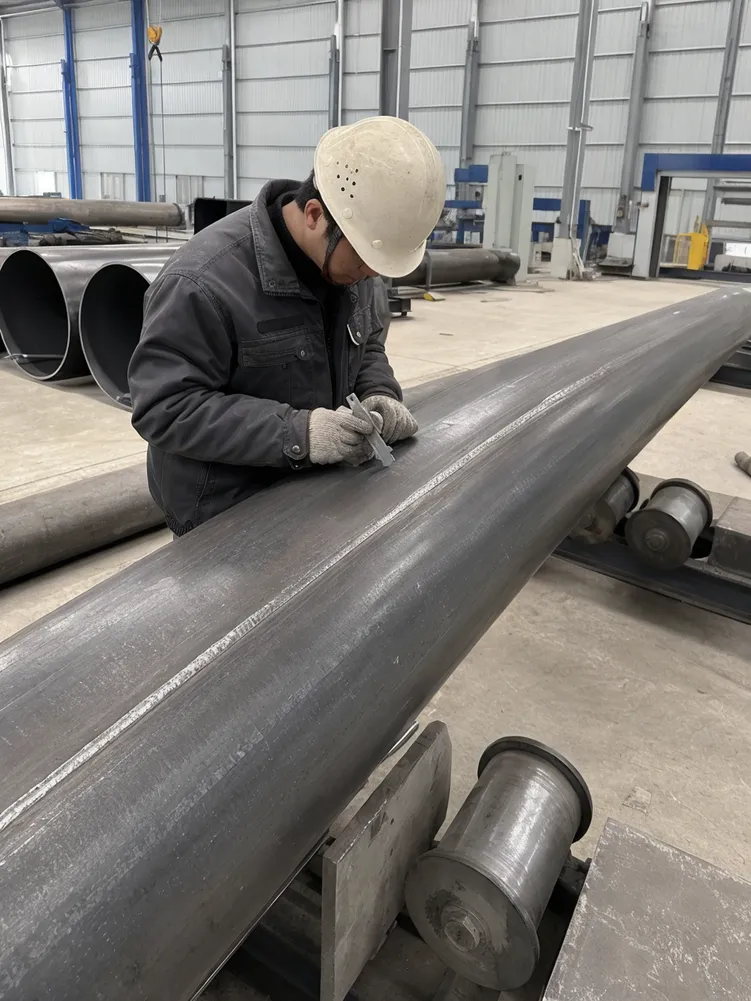
Shaft sections are cut to length on CNC equipment, rolled to the taper profile, and seam-welded with full-penetration welds.
Weld inspection: We grind and inspect every weld seam before the shaft moves to the base plate welding stage — weld quality at the shaft-to-base plate joint is the most common structural failure point in street light poles, and it's not visible after the pole is installed.
Base plate welding: Fillet welds on both faces, then dimensional check — base plate flatness, bolt hole pattern, and shaft verticality are all confirmed before the pole moves to surface treatment.
Final prep: Drilled holes for cable entry and arm mounting are deburred and checked for position before coating.
Q235
Poles ≤ 7m
Q345
Poles 8m+
Hot-Dip Galvanizing
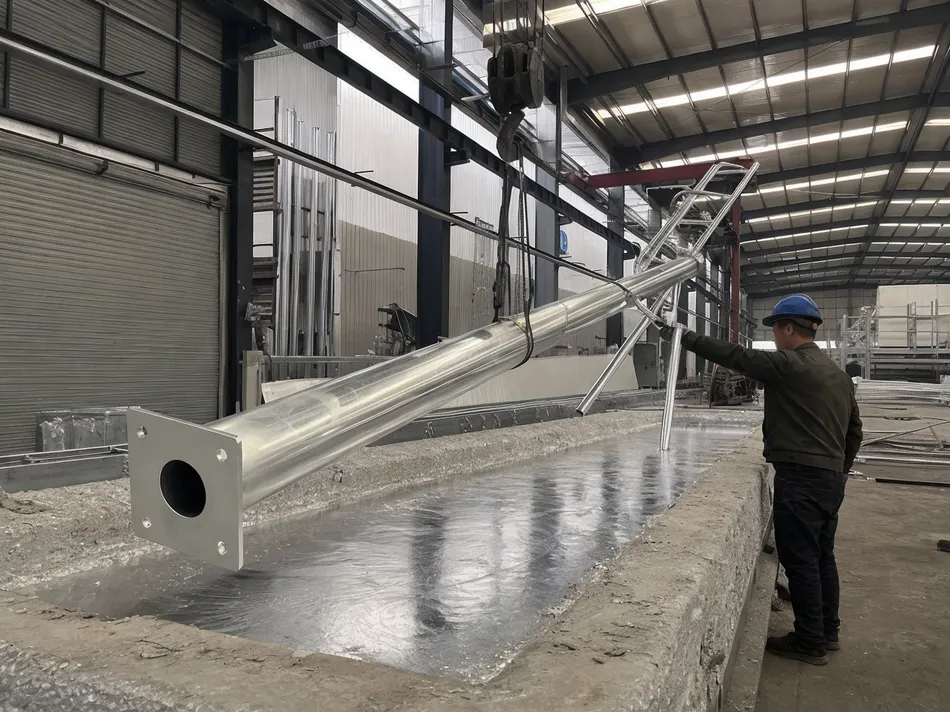
Hot-dip galvanizing is our standard surface treatment for solar street lighting poles. The pole is cleaned, fluxed, and dipped in molten zinc at approximately 450°C — the zinc bonds metallurgically to the steel surface, not just as a coating layer. This is the treatment that handles coastal salt air, tropical humidity, and the temperature cycling that causes adhesion failure in paint-only finishes.
Zinc Layer Thickness (Confirmed by Magnetic Gauge)
For projects that specify a color finish, we apply powder coat over the galvanized surface. The galvanizing provides the corrosion barrier; the powder coat provides the color and UV resistance. Powder coat thickness runs 60–80μm, applied after the galvanized surface is prepared with a chromate conversion treatment for adhesion.
Market Warning
Powder coat directly on bare steel without galvanizing is a common cost-cutting move in the market — it looks the same on day one and fails in year two. We don't offer that configuration.
Complete Coating System
Hot-Dip Galvanizing
Corrosion barrier (≥85μm shaft)
Chromate Conversion
Adhesion prep for powder coat
Powder Coat
Color + UV resistance (60–80μm)
Application Segments Where Pole Choice Protects Project Margin
Municipal Street Upgrade Programs
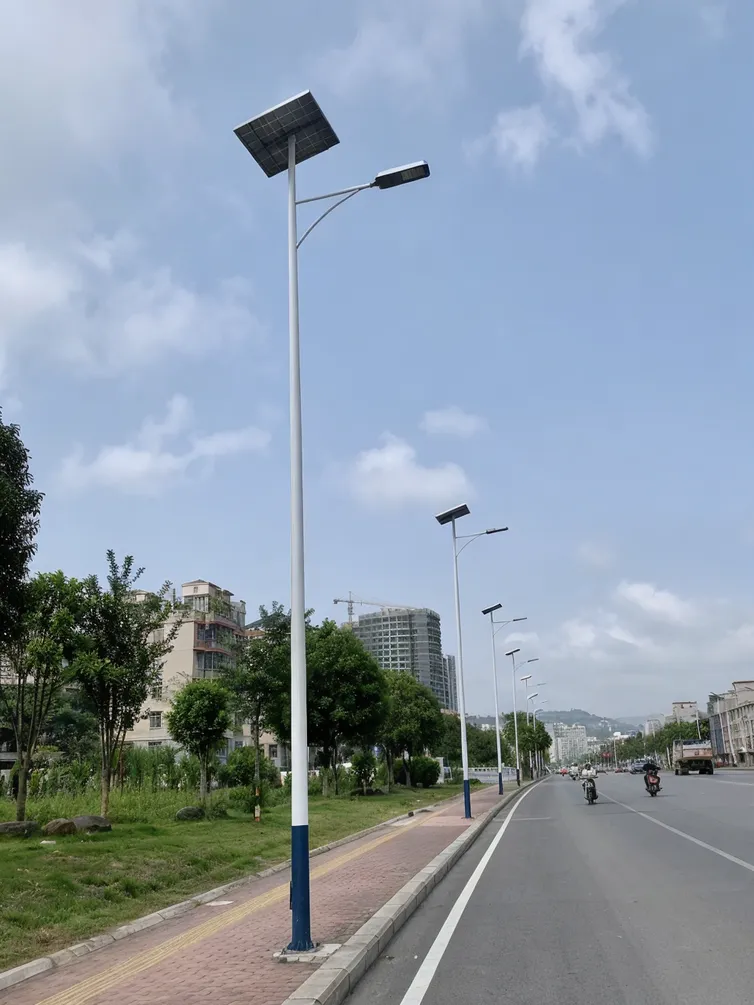
Municipal street lighting replacement is the highest-volume segment for solar lighting poles. City and district governments replacing grid-connected poles with solar typically work from a road classification standard that specifies mounting height, pole spacing, and lux level. Pole orders in this segment run 200–2,000 units per project phase, with repeat orders as the program expands district by district.
The commercial risk here is specification mismatch — a pole that doesn't match the foundation standard or the fixture bracket spec generates site rework that comes back to the supplier. We supply dimensional drawings and anchor bolt cage specifications before production so your project team can confirm foundation compatibility before the first pole ships.
Key Risk: Specification Mismatch
Foundation incompatibility or bracket misalignment causes site rework that erodes project margin. Pre-production dimensional drawings and anchor bolt cage specs eliminate this risk before the first pole ships.
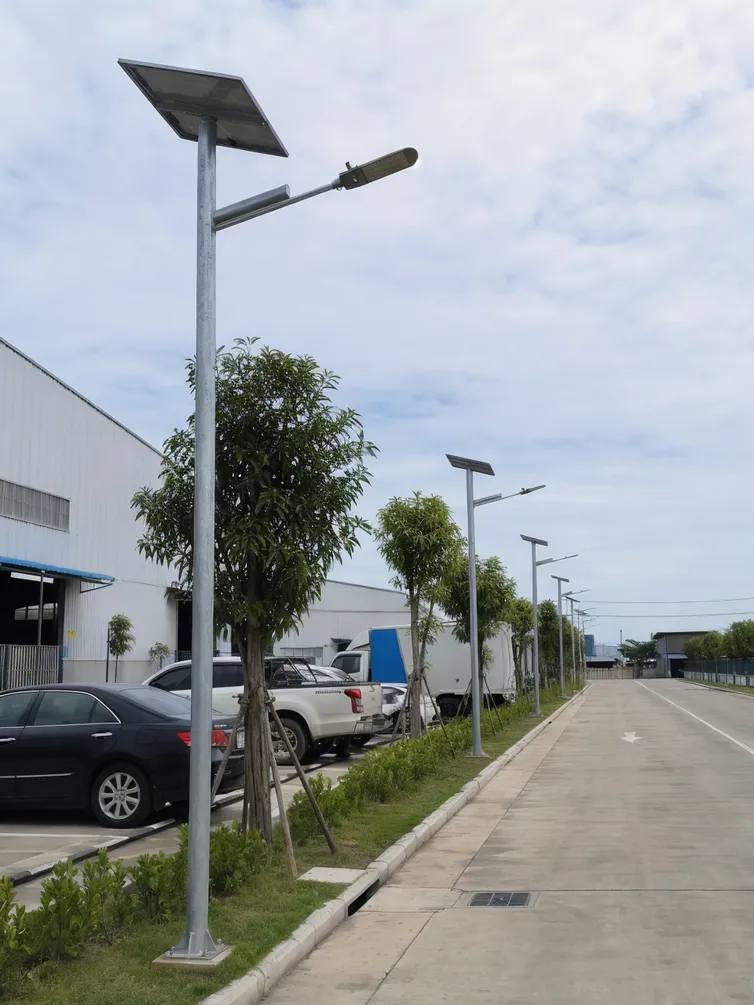
Commercial Roads and Private Site Lighting
Commercial developers, industrial park operators, and logistics facility owners install solar lighting poles for private roads, parking areas, and site perimeter lighting. Order volumes typically run 50–300 units per project. This segment is price-sensitive on a per-unit basis but values installation simplicity — flange base with a standard anchor bolt pattern, arms pre-assembled, hardware labeled and packed by pole.
Commercial solar street lights for private roads and site lighting are the most common fixture pairing in this segment. The margin opportunity is in the complete package: pole, fixture, and hardware supplied together reduces the contractor's sourcing complexity and justifies a package price over commodity pole pricing.
50–300
Units per project
Flange Base
Standard bolt pattern
Complete Kit
Pole + fixture + hardware
Rural and Off-Grid Road Projects
Rural electrification and off-grid road lighting in Africa, Southeast Asia, and parts of the Middle East represent a high-volume, cost-sensitive segment where solar is often the only practical option. Pole specifications in this segment lean toward direct burial (lower installation cost, no foundation formwork), shorter heights (4m–6m for village access roads), and simpler arm configurations.
Split solar street lights for larger panel and battery configurations are common in this segment because the battery autonomy requirements for off-grid sites often exceed what an all-in-one housing can accommodate.
Pole orders here are frequently mixed with fixture orders in a single container — we pack and document mixed shipments with separate labeling by component type so your receiving team can sort without unpacking everything.
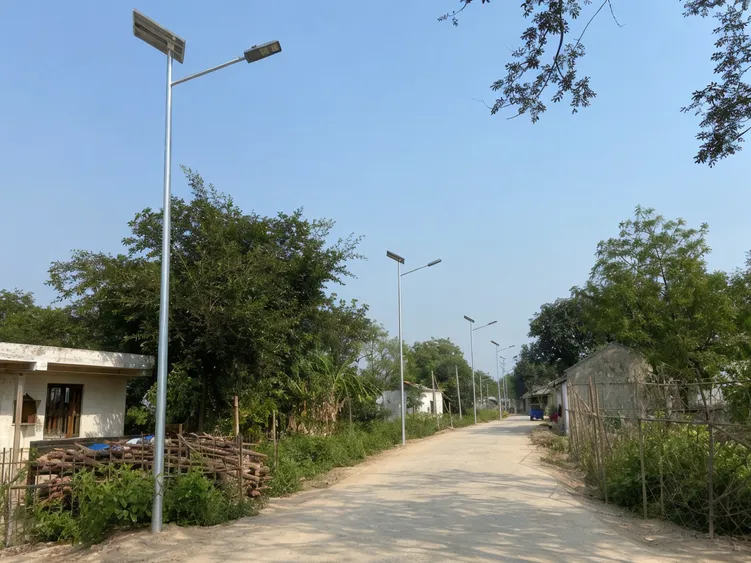
Typical spec: 4m–6m height, direct burial base, single arm, mixed pole + fixture container shipment
Parks, Pathways, and Recreational Areas
Park and pathway lighting uses shorter poles (3m–5m), often with decorative shaft profiles and warm-finish color options. The fixture pairing is typically solar park lighting for lower and decorative pole projects — lower lumen output, warmer color temperature, and a housing design that fits the landscape context.
Municipal parks departments and landscape contractors who supply this segment often run repeat orders as park development phases progress.
The pole specification for this segment is less about structural load and more about aesthetic consistency across the site — shaft profile, color, and arm style need to match across phases, which means locking the spec at the first order and reordering to the same drawing.
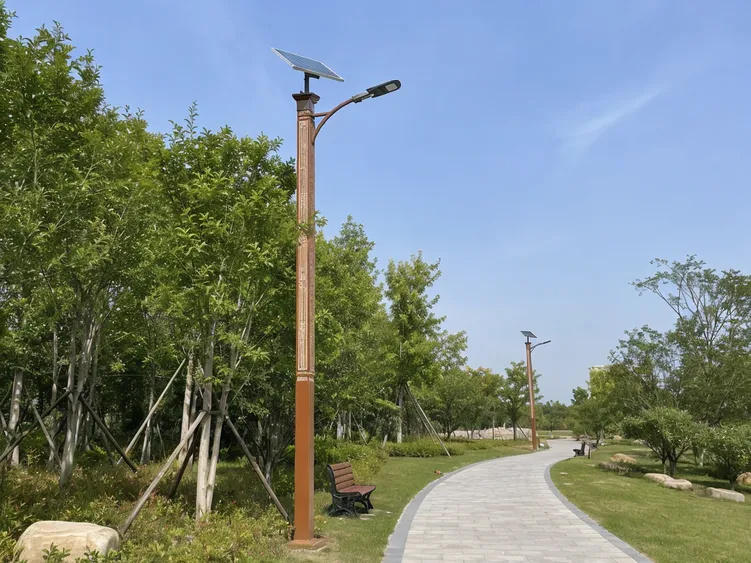
Typical spec: 3m–5m height, decorative shaft, warm-finish color, aesthetic consistency across phases
Arterial Roads and Highway Projects
Arterial road and highway projects use taller poles (8m–12m), heavier wall thickness (4.0mm–5.0mm), and wider arm configurations to cover multi-lane road widths. Wind load is the governing structural input at these heights — a 12m pole in a coastal or high-wind zone requires a different wall thickness and base plate specification than the same height pole in a sheltered inland location.
We ask for the installation country and wind zone as part of the RFQ for poles above 8m. Solar highway lights for taller pole configurations cover the fixture side of this segment.
The margin in highway projects comes from the complete supply package — poles, fixtures, arms, anchor bolt cages, and project documentation supplied together reduces the contractor's coordination risk and supports a higher project price.
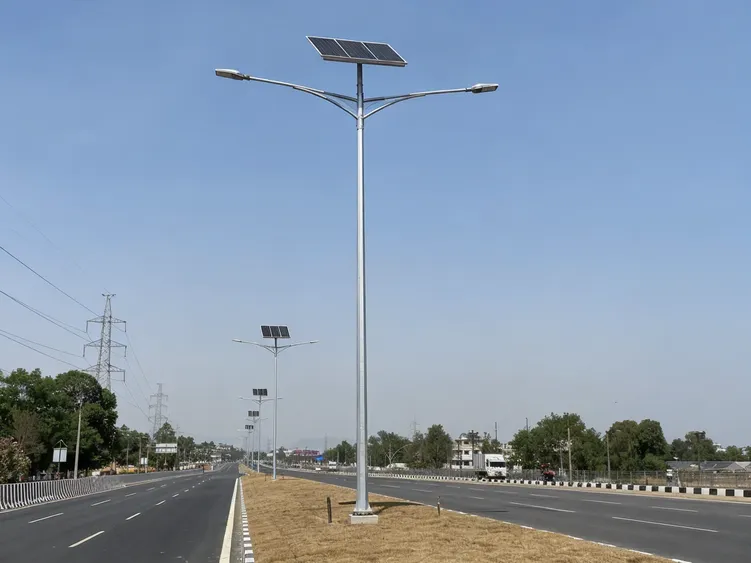
Typical spec: 8m–12m height, 4.0–5.0mm wall, wide arm, wind zone–rated base plate, full supply package
| Segment | Height Range | Base Type | Key Spec Driver | Fixture Pairing |
|---|---|---|---|---|
| Rural / Off-Grid | 4m–6m | Direct burial | Cost, installation simplicity | Split solar street light |
| Parks / Pathways | 3m–5m | Flange or decorative | Aesthetic consistency | Solar park lighting |
| Arterial / Highway | 8m–12m | Anchor bolt cage | Wind load, wall thickness | Solar highway lights |
Fixture Compatibility Guide Across JXSOL Solar Street Lighting Products
The pole is only half the decision. The fixture, panel size, and arm configuration need to match. The table below maps pole decisions to the fixture families in our solar street and roadway lighting range.
| Fixture Family | Typical Pole Height | Arm Configuration | Pole Notes | Link |
|---|---|---|---|---|
| Standard Solar Street Lights | 5m – 8m | Single arm, 1.0m – 2.0m | Standard round tapered, Q235, flange base | View |
| Commercial Solar Street Lights | 6m – 10m | Single or double arm, 1.5m – 2.5m | Q235/Q345 depending on height; confirm arm collar diameter | View |
| All-in-One Solar Street Lights | 5m – 8m | Single arm or direct mount | Lighter fixture load; standard Q235 shaft sufficient for most heights | View |
| Split Solar Street Lights | 6m – 10m | Double arm or side-mount panel bracket | Panel bracket mounting point on shaft must be specified; heavier combined load | View |
| Smart Solar Street Lights | 6m – 10m | Single or double arm | Controller housing may require additional mounting bracket on shaft | View |
| Solar Road Lights | 8m – 12m | Single arm, 2.0m – 3.0m | Q345 shaft, 4.0mm+ wall thickness; confirm wind load zone | View |
| Solar Highway Lights | 10m – 12m+ | Single or double arm, 2.5m – 3.0m | Q345, 4.5mm – 5.0mm wall; wind load engineering required for 12m+ | View |
| Solar Park Lighting | 3m – 5m | Short single arm or direct mount | Decorative shaft profiles available; lighter structural spec | View |
Height: 5m – 8m
Arm: Single arm, 1.0m – 2.0m
Pole: Standard round tapered, Q235, flange base
Height: 6m – 10m
Arm: Single or double arm, 1.5m – 2.5m
Pole: Q235/Q345 depending on height; confirm arm collar diameter
Height: 5m – 8m
Arm: Single arm or direct mount
Pole: Lighter fixture load; standard Q235 shaft sufficient for most heights
Height: 6m – 10m
Arm: Double arm or side-mount panel bracket
Pole: Panel bracket mounting point on shaft must be specified; heavier combined load
Height: 6m – 10m
Arm: Single or double arm
Pole: Controller housing may require additional mounting bracket on shaft
Height: 8m – 12m
Arm: Single arm, 2.0m – 3.0m
Pole: Q345 shaft, 4.0mm+ wall thickness; confirm wind load zone
Height: 10m – 12m+
Arm: Single or double arm, 2.5m – 3.0m
Pole: Q345, 4.5mm – 5.0mm wall; wind load engineering required for 12m+
Height: 3m – 5m
Arm: Short single arm or direct mount
Pole: Decorative shaft profiles available; lighter structural spec
If you're sourcing poles and fixtures together, send us the fixture model and the project pole height — we'll confirm the arm collar diameter, bracket mounting points, and combined load before production.
Mismatched arm collars are the most common hardware problem on mixed-source projects, and it's a five-minute check at the quoting stage versus a two-week delay on site.
Custom Pole Orders, Packing, and Export Control
What Can Be Customized
Pole orders are frequently project-specific. The customization dimensions we handle regularly:
Height & Wall Thickness
Any height from 3m to 15m. Wall thickness is calculated against pole height and wind load zone — we don't let buyers specify wall thickness independently of height and wind zone because the combination determines structural adequacy.
If you have a local wind load standard (AS/NZS 1170, EN 40, AASHTO, or equivalent), send it with the RFQ and we'll confirm the wall thickness against it.
Shaft Profile
Round tapered is standard. Octagonal tapered is available for projects where the shaft profile is specified in the design brief — common in municipal projects with a defined streetscape standard. Straight (non-tapered) shafts are available for specific applications.
Arm Design
Single arm, double arm, straight arm, curved arm, swan-neck arm. Arm length from 1.0m to 3.0m. Custom arm profiles for projects with a defined aesthetic standard. Arms are supplied as part of the pole package — arm and pole are matched and packed together.
Base Plate & Anchor Bolt Pattern
Base plate dimensions and bolt pattern are confirmed against the project's foundation drawing. We supply the anchor bolt cage with the pole so the foundation contractor has the correct hardware before the concrete is poured.
We've seen projects where the pole supplier and the foundation contractor used different bolt patterns. The result is a poured foundation that doesn't match the pole. It's avoidable if the anchor bolt cage comes from the same source as the pole.
Surface Finish Color
Standard is hot-dip galvanized. Powder coat color is available in any RAL color on runs of 50 poles or more — below that, the powder line setup cost doesn't make sense for either side.
Color samples are available on request.
Logo & Labeling
Pole shaft labeling, project identification markings, and custom documentation are available for branded or project-specific orders.
Packing and Container Planning
Poles are long, heavy, and easily damaged in transit if not packed correctly. Our standard packing and loading approach:
Bundling
Poles are bundled in groups of 4–8 depending on diameter and wall thickness. Bundles are strapped with steel banding and separated with timber dunnage to prevent surface contact between poles. Arms and anchor bolt cages are packed separately in the same container, labeled to match their corresponding pole bundle.
Container Selection
Poles up to 6m fit in a standard 20ft container. Poles from 6m to 12m require a 40ft container or open-top container. Poles above 12m are typically shipped as two-section poles (slip-joint or flange-joint) to fit standard containers, or shipped in flat-rack containers for single-piece delivery.
We provide a container loading plan with every order showing pole placement, weight distribution, and securing points. This is included in the shipping documentation package.
Quantity per Container
Typical loading quantities as a planning reference:
- 6m poles: 80–120 pieces per 40ft container
- 8m poles: 50–80 pieces per 40ft container
- 10m poles: 30–50 pieces per 40ft container
- 12m poles: 20–35 pieces per 40ft container
Actual quantities depend on wall thickness, arm count, and whether accessories are packed in the same container. We confirm exact container counts at the quoting stage.
Export Documentation and Compliance
Every shipment includes a complete documentation package. What's included as standard:
Standard Documentation
- Commercial invoice and packing list
- Bill of lading (ocean) or airway bill
- Certificate of Origin (CO)
- Material test certificates (mill certs)
- Galvanizing thickness report
- Container loading photos
Available on Request
- Third-party inspection reports (SGS, BV, TÜV)
- Fumigation certificate (for timber dunnage)
- Form E, Form F, or other preferential origin certificates
- Insurance certificate (CIF terms)
- Structural calculation report (PE-stamped where required)
- Weld procedure qualification records (WPQR)
Import duty and HS codes: Solar street light poles typically fall under HS 7308.90 (structures and parts of structures, of iron or steel) or HS 9405.50 (non-electrical luminaires) depending on whether the pole is shipped with or without the fixture. We mark the commercial invoice with the correct HS code for the destination country. If your customs broker needs a specific classification, let us know at the quoting stage.
Lead Times
Production lead times depend on order size, customization level, and current factory loading:
| Order Size | Standard Poles | Custom Poles |
|---|---|---|
| 50–100 poles | 15–20 days | 20–25 days |
| 100–500 poles | 20–30 days | 25–35 days |
| 500–1000 poles | 30–40 days | 35–45 days |
| 1000+ poles | 40–55 days | 45–60 days |
Lead times are ex-factory. Add transit time based on destination port. We provide a production schedule with milestone dates at order confirmation.
Ready to Specify Your Solar Street Light Poles?
Send us your project parameters — pole height, wind zone, fixture model, and quantity — and we'll return a detailed quotation with structural confirmation, packing plan, and delivery schedule within 48 hours.
No minimum order for quotations. We respond to every RFQ within one business day.
Factory Supply Notes for Project and Distributor Buyers
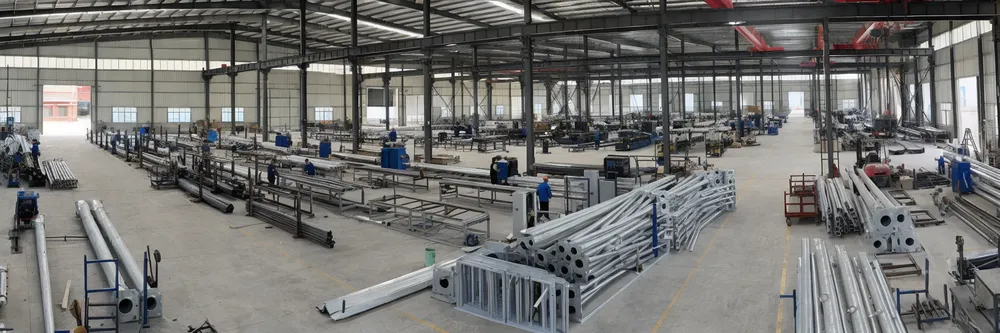
JXSOL has been manufacturing solar lighting since 2012 — poles are part of the supply package, not a sourced-in commodity we pass through.
Production Facility
The 12,000 m² factory in Guzhen Town runs six production lines with 150 employees and 1,200,000-unit annual capacity.
Inspection Discipline
Poles go through the same inspection discipline as fixtures: dimensional check, weld inspection, coating thickness measurement, and packing verification before the container closes.
- Dimensional check
- Weld inspection
- Coating thickness measurement
- Packing verification
For Project Buyers
The practical value is a single factory conversation that covers poles, fixtures, arms, anchor bolt cages, and project documentation. You're not coordinating between a pole supplier and a fixture supplier and hoping the arm collar diameters match.
Single-source supply: Poles + fixtures + arms + anchor bolt cages + documentation — one factory, one conversation.
For Distributors
Standard pole SKUs in common heights are available from 100 units — low enough to stock a range without committing to a full container before you know which heights your market uses.
Low MOQ stocking: From 100 units per SKU — test your market's height preferences without full-container risk.
Engineering Team Coverage
Our 15+ optical and electrical engineers handle fixture configuration; the structural side of pole specification is handled by the same team that manages the fixture-pole matching review. If your project has a local structural standard or a wind load requirement, we work from it — not from a generic spec sheet.
Ready to discuss your pole and fixture package?
One factory conversation covers poles, fixtures, arms, anchor bolt cages, and project documentation.
FAQ for Solar Street Lighting Pole Buyers
What height should I choose for a solar street lighting pole?
Pole height is determined by road width, fixture beam angle, and the required illuminance level at road surface. The standard starting point: for single-sided installation, pole height is roughly 1/3 of road width; for staggered or opposite-side installation, roughly 1/2 of road width.
Quick Reference by Road Width
6m-wide road
4m – 5m pole
12m-wide road
6m – 8m pole
Dual-carriageway arterial
8m – 12m poles
These are starting points — the confirming inputs are the fixture's beam angle and the lux specification from the project brief. If you're working from a road classification standard with a specified lux level, send it to us and we'll confirm the pole height before you quote.
Should I use a flange base or direct-buried pole for solar street lighting?
Flange base with anchor bolts is standard for most road projects. The foundation is poured with the anchor bolt cage set in concrete; the pole bolts on after curing. Replacement is straightforward — unbolt and lift — which matters for maintenance planning on large deployments.
Flange Base
- Standard for municipal road projects
- Easy replacement: unbolt and lift
- Best for projects with maintenance programs
- Requires foundation formwork and anchor bolt cage
Direct Burial
- Simpler and cheaper to install
- No foundation formwork or anchor bolt cage needed
- Common for rural roads and off-grid projects
- Harder to replace if damaged
Decision logic: For municipal projects with a maintenance program, flange base is the right choice. For remote off-grid sites where the installation cost savings are significant, direct burial often makes more commercial sense.
What material is normally used for outdoor solar lighting poles?
Q235 carbon steel is standard for poles up to 7m. Q345 steel is used for 8m and above — it has higher yield strength, which matters for the bending moment at the base of taller poles in higher wind load zones. Both grades are hot-dip galvanized as standard surface treatment.
Aluminum poles exist in the market but are less common for solar street lighting because the fixture, panel, and battery loads require a structural section that is heavier and more expensive in aluminum than in steel.
For decorative applications (parks, pedestrian paths), aluminum or cast iron decorative poles are sometimes specified — those are a different product family from structural road lighting poles.
Q235 Carbon Steel
Standard for poles ≤ 7m height
Q345 Steel
Required for poles 8m and above — higher yield strength for wind load resistance
Do solar lighting poles need hot-dip galvanizing?
For outdoor road lighting applications, yes — hot-dip galvanizing is the correct surface treatment. The zinc layer bonds metallurgically to the steel surface and provides corrosion protection from the inside out, not just as a surface coating.
Paint-only or powder-coat-only finishes on bare steel will fail in coastal, tropical, or high-humidity environments within a few years.
Industry Standard
Hot-dip galvanizing with a zinc layer of ≥85μm is the industry standard for poles expected to last 15–20 years in outdoor conditions.
For projects that require a color finish, powder coat is applied over the galvanized surface — the galvanizing provides the corrosion barrier, the powder coat provides the color.
Cost-Cutting Risk
Powder coat directly on bare steel without galvanizing is a cost-cutting shortcut that generates corrosion complaints within 2–3 years. Always verify the galvanizing layer is present beneath any color finish.
| Surface Treatment | Expected Outdoor Life | Verdict |
|---|---|---|
| Hot-dip galvanized (≥85μm zinc) | 15–20 years | Correct |
| Galvanized + powder coat | 15–20 years (with color) | Correct |
| Powder coat only (no galvanizing) | 2–3 years before corrosion | Avoid |
Can one pole support both the solar panel and the LED fixture?
Yes — this is the standard configuration for split solar street lights. The solar panel is mounted on a side-bracket on the shaft or on a second arm, and the LED fixture is mounted on the main arm.
The pole specification for a split configuration needs to account for the combined load: fixture weight, panel weight, arm weight, and wind load on the panel surface area. Panel wind load is often the governing input — a 200W monocrystalline panel has significant surface area, and in a high-wind zone, the lateral force on the panel can exceed the fixture load.
We ask for panel size and installation wind zone as part of the RFQ for split configurations so the wall thickness and base plate are sized correctly.
What information should I send for a solar street lighting pole quote?
The inputs that determine the pole specification:
If you have a foundation drawing with the anchor bolt pattern already specified, include it — we'll confirm the bolt cage matches before production.
If you're earlier in the process and don't have all of these yet, send what you have and we'll identify the missing inputs.
Send Pole Height, Fixture Type, and Project Location for a Quote
The most useful RFQ for a solar street lighting pole includes the details below. Send what you have — we'll confirm the rest during technical review.
RFQ Checklist
- Pole height (or road width if height is not yet confirmed)
- Fixture type and approximate weight
- Solar panel size (for split configurations)
- Arm length and configuration (single, double, straight, curved)
- Base type (flange or direct burial)
Logistics & Finish
- Installation country and wind zone (or local structural standard)
- Surface finish (galvanized only, or powder coat color)
- Quantity
- Destination port
- Packing preference (standard bundle, palletized)
If you're comparing configurations or building a distributor pole range, send your target market and volume expectations — we'll suggest a starter height mix based on what's moving for our existing buyers in that region.
Phone / WhatsApp
+8613627818806