

Solar Wall Lights Direct From Factory
Factory-direct solar wall lights for distributors, contractors, and private-label programs — the core catalog SKU for general outdoor wall demand.
Integrated solar panel, IP65 construction, dusk-to-dawn or motion-activated operation. CE and RoHS certified, 100% pre-shipment inspection, MOQ from 100 units.
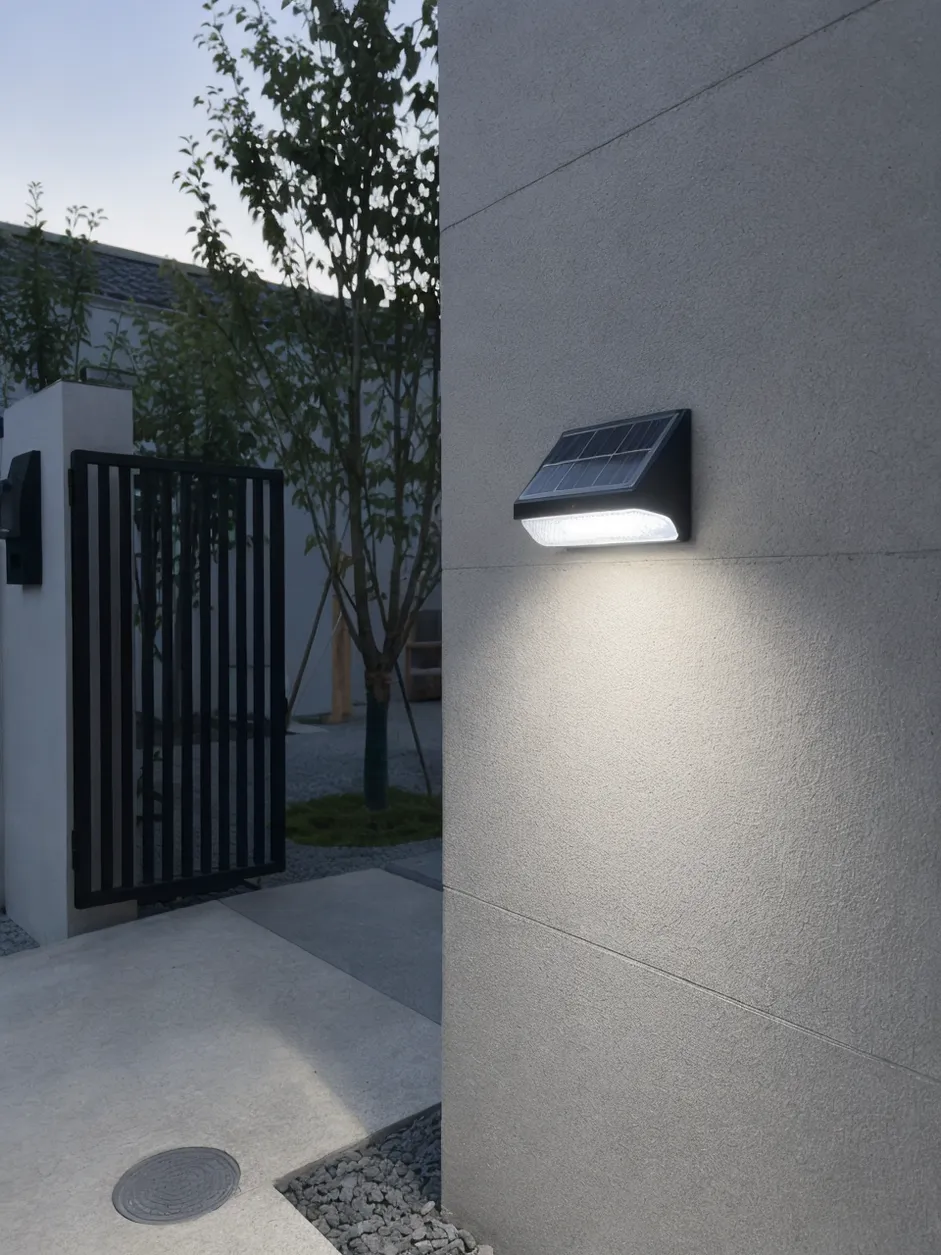
Solar Wall Lights as the Core Stocking SKU
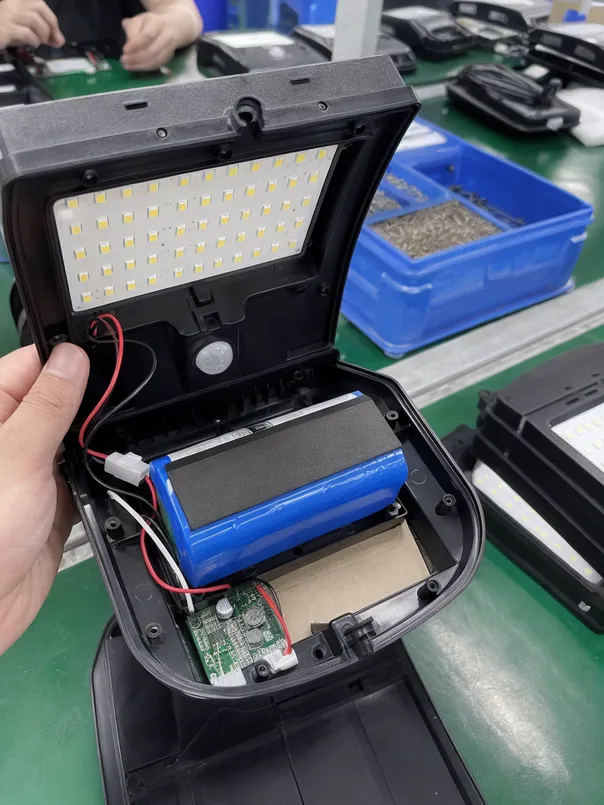
JXSOL's standard solar wall lights are integrated, wall-mounted outdoor solar fixtures built for broad commercial and distributor use. The solar panel, LED module, battery, and controller are housed in a single unit — mount it to any south-facing wall, and it charges by day and illuminates by night without wiring or grid connection. That simplicity is the commercial point: low installation friction, wide market fit, and a price tier that works across retail, project, and mixed-distribution channels.
This page covers the standard integrated solar wall light — the volume SKU in our full solar wall lighting product line. It's the right starting point for buyers entering the solar wall lighting category, distributors building a stocking assortment, and contractors specifying outdoor wall lighting for residential or small commercial projects.
If your application involves shaded walls, high-security PIR requirements, decorative facade demand, or IP67 wet-climate specifications, the sibling configurations further down this page will point you to the right product.
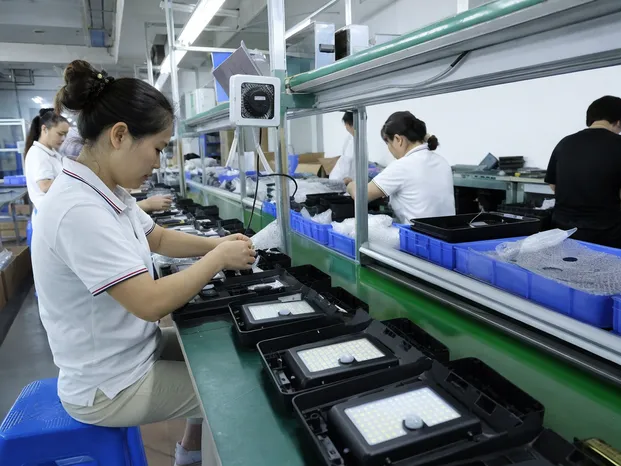
We've been manufacturing solar wall lights since 2012 from our 12,000 m² factory in Guzhen Town, Zhongshan — 6 production lines, 150 employees, 1,200,000-unit annual capacity, and 100% pre-shipment inspection on every unit before the container closes. The standard solar wall light is one of our highest-volume SKUs, which means the production process is well-established and reorder consistency is predictable.
Who This SKU Serves
- Buyers entering the solar wall lighting category
- Distributors building a stocking assortment
- Contractors specifying outdoor wall lighting for residential or small commercial projects
Quote-Ready Specifications for Standard Wall-Mount Models
The table below covers three practical tiers for standard solar wall lights: a compact retail tier suited for home-improvement and e-commerce channels, a standard distributor tier for general outdoor wall demand, and a higher-output project tier for commercial exteriors and perimeter walls. These are industry-typical values for this product type — contact us to confirm exact specifications for your target market and order volume.
| Parameter | Compact Retail Tier | Standard Distributor Tier | Higher-Output Project Tier |
|---|---|---|---|
| LED Wattage | 5–8 W | 10–15 W | 18–25 W |
| Lumen Output | 200–400 lm | 500–800 lm | 900–1,200 lm |
| Solar Panel | 5–8 W monocrystalline | 10–15 W monocrystalline | 15–20 W monocrystalline |
| Battery Type | Lithium-ion or LiFePO4 | LiFePO4 (recommended) | LiFePO4 |
| Battery Capacity | 1,500–2,500 mAh | 3,000–5,000 mAh | 6,000–10,000 mAh |
| IP Rating | IP65 | IP65 | IP65 |
| Housing Material | ABS or PC | ABS or die-cast aluminum | Die-cast aluminum |
| Lighting Mode | Dusk-to-dawn or motion-activated | Dusk-to-dawn, motion-activated, or dim-to-bright | Dusk-to-dawn, motion-activated, or dim-to-bright |
| Color Temperature | 6000–6500K (daylight) | 3000K / 4000K / 6000K | 3000K / 4000K / 6000K |
| Charging Time | 6–8 hours (full sun) | 6–8 hours (full sun) | 7–9 hours (full sun) |
| Working Time | 8–10 hours (dusk-to-dawn) | 10–12 hours (dusk-to-dawn) | 10–14 hours (dusk-to-dawn) |
| Operating Temperature | -20°C to +50°C | -20°C to +50°C | -20°C to +50°C |
| Mounting Style | Wall surface mount | Wall surface mount | Wall surface mount with bracket |
| Certifications | CE, RoHS | CE, RoHS, IP65 test documentation | CE, RoHS, IP65 test documentation |
| Warranty | 3 years | 3 years | 3 years |
| Typical Carton Qty | 10–20 units/carton | 6–12 units/carton | 4–8 units/carton |
Specifications shown are industry-standard values for this product type. Actual specifications may vary by model. Contact us for detailed product data sheets and exact parameters for your order.
Battery Chemistry: Specify at the Quoting Stage
LiFePO4 cells outperform standard lithium-ion in high-temperature environments — if you're selling into the Middle East, South Asia, or tropical Southeast Asia, specify LiFePO4 from the start. The cost difference is small; the field failure rate difference is not. Battery chemistry is worth specifying at the quoting stage, not after.
Commercial Segments Where This SKU Turns Over
Standard solar wall lights generate repeat volume in specific market segments. The segments below are where our distributor and contractor accounts see consistent reorder cycles — not one-time project orders, but programs with predictable demand.
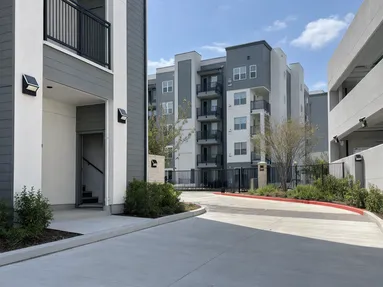
Residential Development & Property Management
Developers and property managers installing outdoor solar wall lighting on building entrances, stairwell exteriors, parking structure walls, and perimeter fencing.
- 150–400 units per development across multiple building phases
- Annual maintenance reorder cycles for multi-site portfolios
- Standard IP65 wall-mount: broad compatibility, low maintenance
- Consistent lumen output across batches — variation is visible across multi-building installations
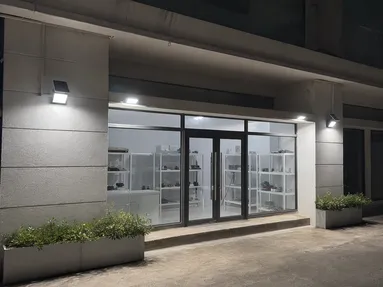
Small Commercial Exteriors & Retail Storefronts
Retail chains, small commercial buildings, and mixed-use developments specifying solar wall lights for entrance illumination, signage wall lighting, and exterior facade coverage.
- 50–300 units per project, repeat orders as new locations open
- Key requirement: reliable dusk-to-dawn operation — a storefront dark at 2 AM generates complaints
- Standard distributor tier: 10–12 hour working time on full charge
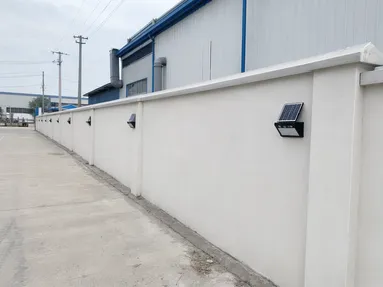
Perimeter & Boundary Wall Lighting
Industrial facilities, logistics parks, gated communities, and agricultural properties installing solar wall lights along boundary walls and access roads.
- 300–1,000 units for a single facility perimeter
- Reorders when expanding or replacing aging fixtures
- Primary spec concern: consistent lumen output across full perimeter
- Frequent upgrade path to motion sensor solar wall lights for security
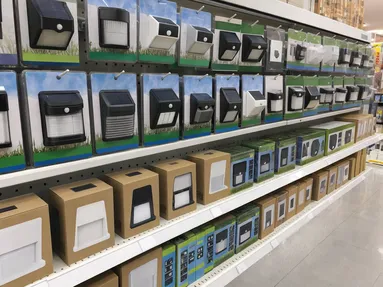
Hardware Retail & E-commerce Assortments
Hardware chains, home improvement retailers, and e-commerce platforms stocking solar wall lights as a core SKU in their outdoor lighting assortment.
- Compact retail tier: lower lumen output, clean aesthetic, retail-friendly price point
- Private-label programs common — exclusive SKUs not available from competing retailers
- 500–5,000 units per SKU for established retail programs
- Seasonal reorders ahead of spring and summer selling periods
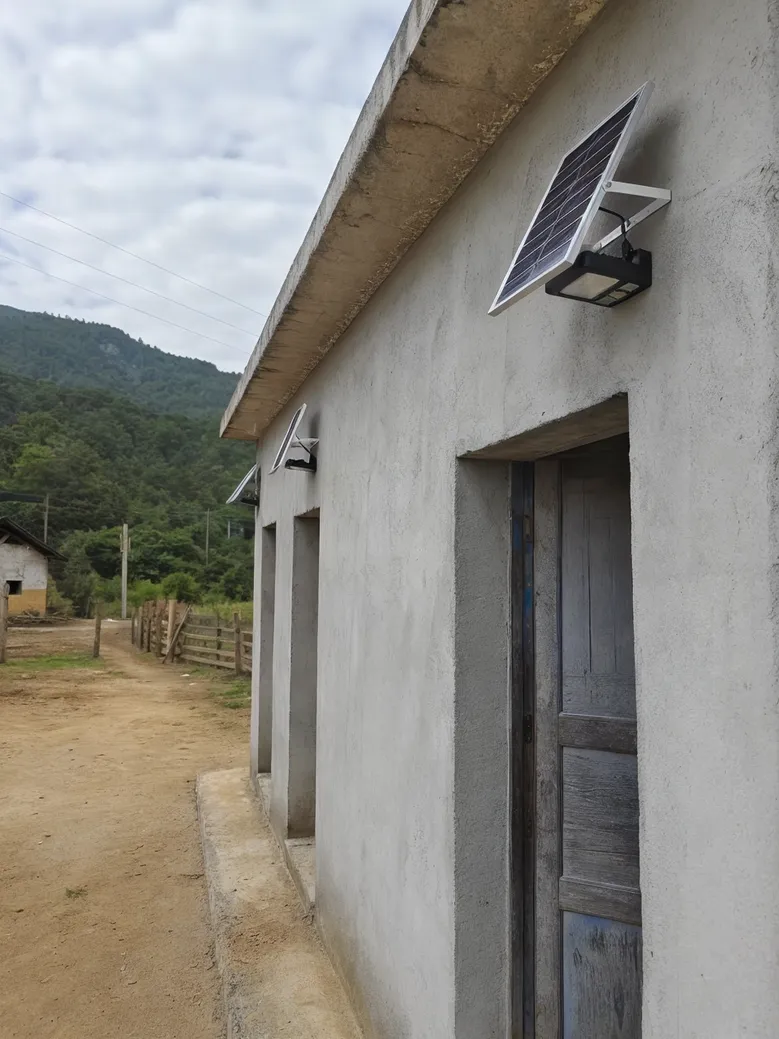
Rural & Off-Grid Building Projects
Project contractors working in areas without reliable grid access — rural housing programs, agricultural facilities, remote community buildings. Solar wall lights are often the only practical outdoor lighting option in these locations.
Primary Specification Concern: Battery Autonomy
Buyers in this segment typically need 3–5 consecutive cloudy days of operation, which requires careful panel and battery sizing for the target latitude. We advise on panel and battery configuration during the engineering review for these orders.
- No grid dependency — solar is the only viable outdoor lighting solution
- Engineering review included for panel/battery configuration at target latitude
150–400
Units / Residential Dev
50–300
Units / Commercial Project
300–1,000
Units / Perimeter Install
500–5,000
Units / Retail Program
We'll recommend a configuration based on what's moving for our existing accounts in your region.
Factory Controls That Protect Your Reorders
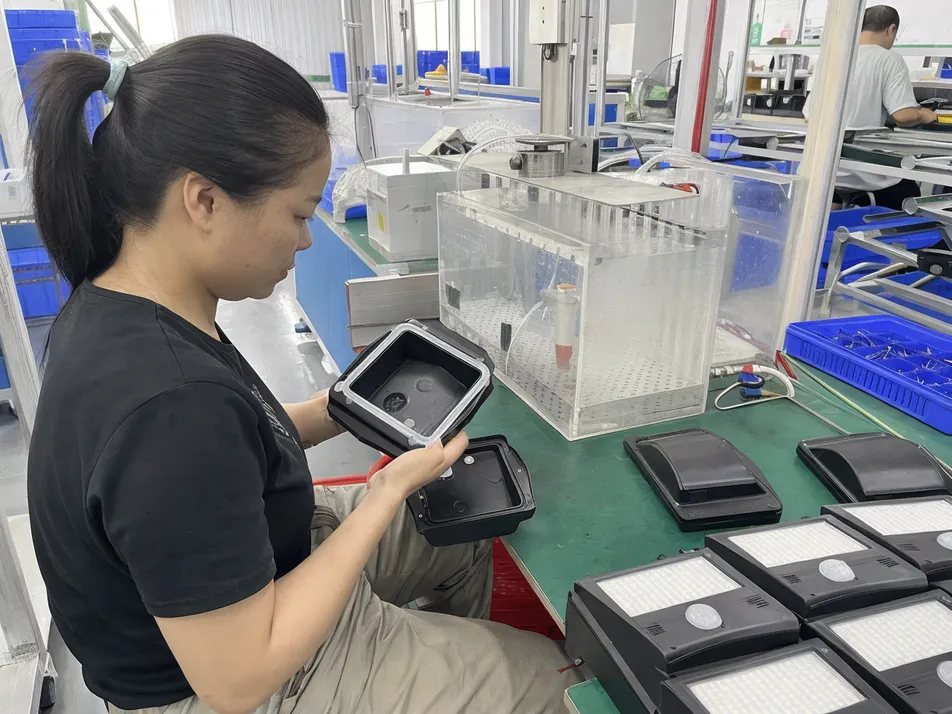
The standard solar wall light looks simple from the outside. Inside, there are four components that each have their own failure mode: the battery pack, the LED module, the controller and sensor, and the waterproof housing structure. We run specific production controls on each one — not because it's in the quality manual, but because we've seen what happens when they're skipped.

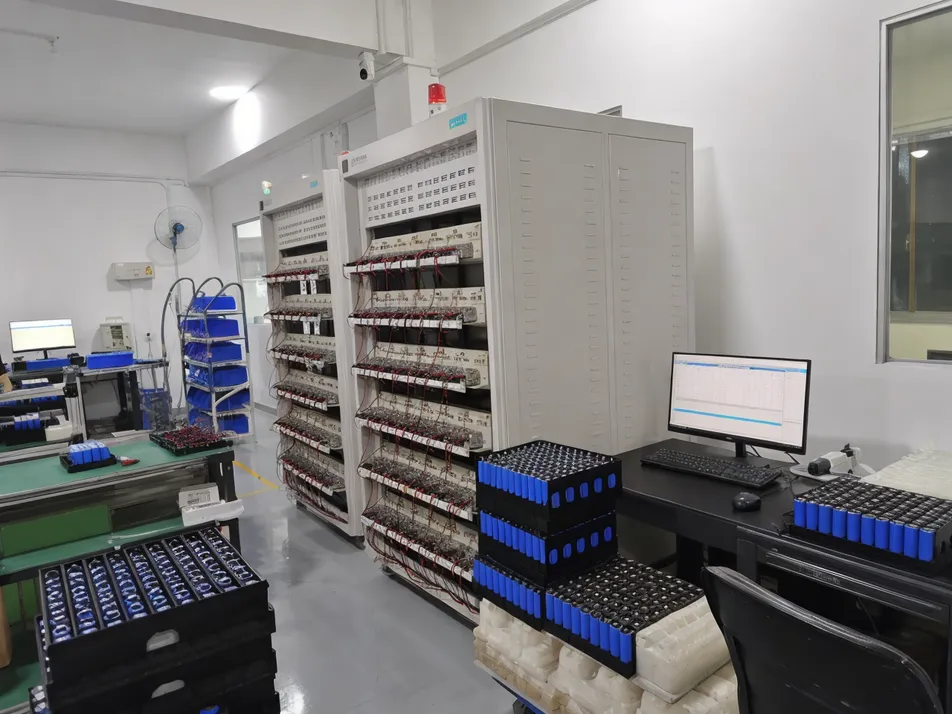
Battery Cell Matching & Charge/Discharge Testing
This is where most low-cost solar wall light failures originate. A battery pack assembled from cells with mismatched capacity or internal resistance degrades faster than a matched pack, and the degradation accelerates in high-temperature environments.
Our Process:
- Cells matched by capacity and internal resistance before pack assembly
- Every pack runs through a full charge/discharge cycle test before installation
- Adds time and equipment cost — separates a 3-year warranty product from one that fails in the first rainy season
For buyers placing repeat orders, this control is what makes batch-to-batch consistency predictable rather than variable.
LED Module Lumen & Color Temperature Confirmation
Runs at the assembly stage, not just at final inspection. LED chips from different production lots can have different lumen output even at the same wattage. Without binning and confirmation at the module assembly stage, batch-to-batch lumen variation can be significant enough for end customers to notice the difference across a multi-unit installation.
Our Process:
- Lumen output and color temperature confirmed at LED module assembly stage
- Modules outside specified tolerance are rejected before fixture assembly
Why we switched to assembly-stage confirmation: A distributor's end customer installed units from two different production runs side by side. The lumen difference was visible. It's not a problem we've had since implementing this control.
Controller & Sensor Function Verification
Covers lighting mode operation, dusk-to-dawn trigger timing, and — for motion-activated models — PIR detection range and sensitivity. Every unit is tested against the specified parameters before moving to final assembly.
Parameters Verified:
- Lighting mode operation across all programmed modes
- Dusk-to-dawn trigger timing accuracy
- PIR detection range and sensitivity (motion-activated models)
Common failure mode prevented: False triggering from wind-blown vegetation or passing vehicles drains the battery and generates end-customer complaints. Sensitivity calibration at the factory prevents this; function testing on every unit confirms it.
IP65 Waterproof Structure Inspection
Run on our own inspection equipment before any unit leaves the line. Not a simplified internal procedure, not a sample check — every unit tested against the IP65 standard.
Water Ingress Entry Points Tested:
- Lens seal
- Cable entry gland
- Panel junction on integrated models
- Screw holes on the housing back plate
A fixture that passes a basic splash test can still fail after six months of rain cycling as the sealant degrades or the housing flexes under thermal expansion. The unit-level test catches housing assembly defects before they become field failures.
Aging Test & Final Outgoing Inspection
Closes the production loop. Every unit goes through an aging test under load before final packing, and outgoing inspection covers the fixture, the carton, the accessory pack, and the label — 100% of units, not a statistical sample.
100%
Unit-Level Inspection
Since 2012
Protocol in Operation
3-Year
Warranty Supported
That's the inspection protocol we've run since 2012, and it's why our warranty claim rate stays low enough to support a 3-year warranty.
Production Control Sequence
Battery Cell Matching
Capacity & resistance pairing
LED Module Binning
Lumen & CCT confirmation
Controller & Sensor Test
Mode, timing & PIR calibration
IP65 Waterproof Test
Unit-level seal verification
Aging & Final QC
100% outgoing inspection
Battery Cell Matching
Capacity & resistance pairing
LED Module Binning
Lumen & CCT confirmation
Controller & Sensor Test
Mode, timing & PIR calibration
IP65 Waterproof Test
Unit-level seal verification
Aging & Final QC
100% outgoing inspection
For the full certification and inspection documentation, see our certifications and quality standards page. Factory background is on our About JXSOL page.
Installation Variables That Decide After-Sales Cost
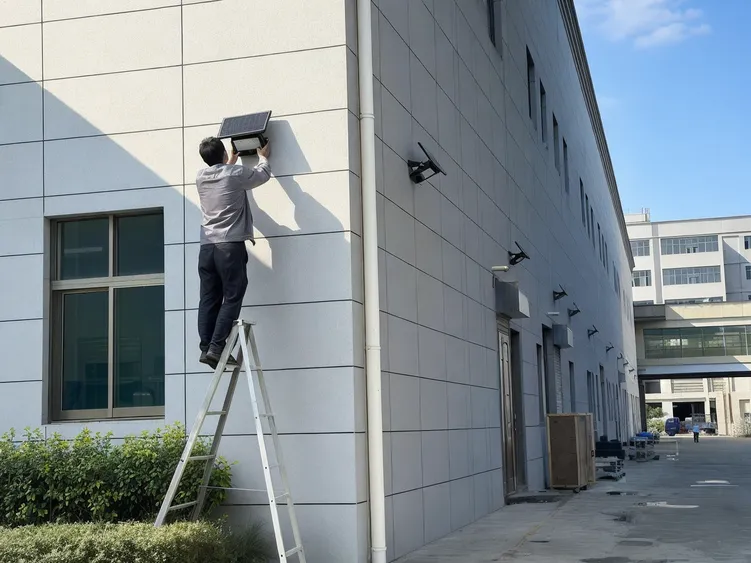
Wall-mounted solar lighting has one variable that determines whether the product works or generates warranty claims: solar exposure on the installation wall. Everything else — mounting height, fixture spacing, screw fixing — is straightforward. Solar exposure is where buyers and contractors need to make the right call before the order is placed.
Wall Orientation & Daily Sun Hours
A south-facing wall in a mid-latitude location typically receives 5–7 hours of direct sunlight per day in summer — sufficient for standard integrated solar wall lights.
A north-facing wall, a wall shaded by adjacent buildings, or a wall under a deep overhang may receive fewer than 3 hours of usable sunlight — not enough to fully charge the battery for a full night's operation.
Decision Threshold
If the installation wall can't guarantee 4–5 hours of direct sunlight per day, the standard integrated model is the wrong product. The right product is a separate-panel solar wall light, where the panel mounts independently on a surface with adequate sun exposure while the fixture stays where the light is needed.
Mounting Height
Mounting height affects both illumination coverage and solar panel charging angle.
For standard outdoor wall lighting, mounting heights of 2.5–4 meters provide adequate ground-level illumination for most applications.
Above 4 meters, lumen output requirements increase to maintain useful ground-level illuminance — buyers specifying fixtures for high-wall mounting should confirm lumen output against their target illuminance level.
Panel tilt angle on integrated models is fixed by the housing design. For installations at latitudes above 40°N or below 40°S, panel tilt may affect winter charging performance.
Surface Type & Fixing Method
Surface type and fixing method affect installation time and long-term fixture stability.
Concrete and masonry walls are the standard installation surface — expansion anchors provide secure fixing and the installation is straightforward.
Hollow block walls, timber cladding, and metal panel facades require different fixing hardware and may need backing plates to distribute load.
We include standard mounting hardware in every accessory pack. Buyers specifying installation on non-standard surfaces should confirm hardware requirements before the project starts.
Spacing & Coverage Planning
Multi-unit installations should account for the fixture's beam angle and lumen output.
Standard solar wall lights with a 120° beam angle at 500–800 lm provide adequate illumination for a 3–5 meter coverage radius at 3-meter mounting height.
For perimeter wall installations requiring continuous coverage, spacing units at 6–8 meters is a typical starting point — adjust based on the target illuminance level and the specific lumen output of the model specified.
Quick Reference: Installation Decision Matrix
| Variable | Standard Model OK | Use Separate Panel |
|---|---|---|
| Daily sun hours | ≥ 4–5 hours direct | < 3 hours direct |
| Wall orientation | South / East / West facing | North facing or deep shade |
| Mounting height | 2.5–4 m | > 4 m (confirm lumen spec) |
| Perimeter spacing | 6–8 m at 500–800 lm / 120° beam | |
For detailed layout calculations and panel orientation guidance, see our solar wall lighting design guide.
OEM/ODM Options for SKU Ownership
A significant share of our solar wall light volume ships under private label. The standard catalog model is the starting point — buyers who want exclusive SKUs, custom specifications, or branded packaging use our OEM/ODM program to build a product line they own.
What We Can Customize for Standard Solar Wall Lights
Lumen Output
Adjustable within the LED module's design range without changing the housing. Typically ±20–30% from the standard model's output. Confirmed during engineering review.
Color Temperature
3000K warm white, 4000K neutral white, and 6000K–6500K daylight are standard options. Intermediate values available on request.
Lighting Mode & Sensor Logic
Dusk-to-dawn timing, PIR sensitivity, detection range, dim-to-bright ratio, and hold time can be configured to your specification. Useful for specific energy-saving profiles or security behavior.
Housing Color & Finish
Standard colors available across most models. Custom colors require a minimum run to justify the powder line changeover — confirm the minimum during engineering review.
Logo, Label & Retail Carton
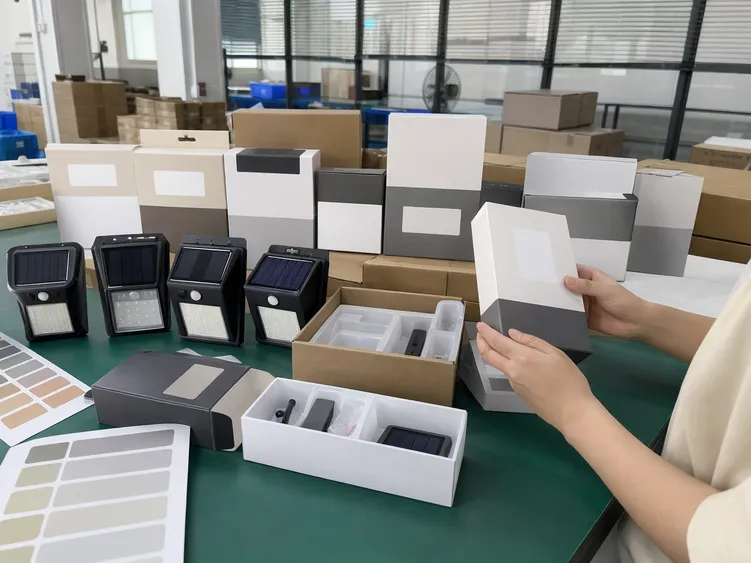
Private-label packaging, instruction sheets in your required language, and accessory pack configuration are standard OEM services. We handle carton design, label printing, and accessory sourcing.
Battery Capacity & Panel Wattage
For buyers targeting specific regions, we adjust battery capacity and panel wattage to hit target autonomy days for the local irradiance profile. A buyer selling into Northern Europe needs a different panel-to-battery ratio than one selling into the Gulf — we calculate this during engineering review.
What Has Limitations
Structural Housing Changes
New mounting configurations, different lens profiles, or housing dimensions outside the standard mold require tooling review and may involve tooling costs and longer lead times. We confirm feasibility and cost during engineering review before any commitment.
Electrical Changes Affecting Certification
Electrical changes that affect CE certification scope require re-testing. We manage this process but it adds lead time to the project schedule.
100
MOQ — Standard Catalog Models
100
MOQ — Custom Specs & Private Label
Lumen adjustment, sensor logic, packaging
TBC
MOQ — Structural / Electrical Changes
Confirmed during engineering review
Start Your OEM/ODM Project
For full OEM/ODM program details, see our OEM/ODM solar lighting services page.
Send us your target retail price, required certifications, and expected first order quantity — our engineering team will confirm what's achievable and outline the review process.
Request OEM/ODM ReviewCompliance, Packing, and Reorder Documentation
Complete certification, export packing, and traceability documentation ships with every order — confirmed before production starts.
Certifications and Compliance Documentation
Standard solar wall lights ship with CE and RoHS certification as baseline. CE covers electrical safety and electromagnetic compatibility requirements for EU market entry. RoHS compliance covers restricted substance requirements — our component sourcing traces material declarations back to the component level, not just the finished product, which matters for buyers importing into the EU or markets with restricted substance requirements.
IP65 test certificates are available with the order. IEC 62124 covers the solar photovoltaic performance standard for the charging system. ISO 9001:2015 certification covers our quality management system across the full production process.
If your market or procurement process requires specific documentation — CE Declaration of Conformity, RoHS test reports, IP test certificates, or factory audit reports — confirm the requirement before production and we'll include the documentation with the order.
North America
CE not required for market entry. RoHS compliance and IP test certificates commonly requested by retail buyers and project specification teams.
Middle East & Africa
CE and RoHS typically sufficient. Some government procurement programs require additional documentation — confirm with us if your project has specific compliance requirements.
Available Certifications
-
CE Certification
Electrical safety & EMC for EU market entry
-
RoHS Compliance
Component-level material declarations
-
IP65 Test Certificate
Ingress protection verification
-
IEC 62124
Solar PV performance standard for charging system
-
ISO 9001:2015
Quality management system — full production process
Export Packing and Container Loading
Consistent Carton Dimensions
Export cartons sized for standard 20GP and 40HQ container loading. Carton dimensions are consistent across production runs for the same model — a reorder ships in the same carton configuration as the original order, which matters for buyers who have optimized their container loading or warehouse racking around a specific carton size.
Complete Accessory Packs
Every carton ships with a complete accessory pack — mounting hardware, screws, instruction sheet, and any required documentation — checked against a packing list before the carton is sealed.
Batch Code Traceability
Batch codes on carton labels allow traceability back to the production run, which simplifies warranty claim management if a field issue appears after delivery.
Mixed-SKU Orders and Reorder Traceability
Mixed-SKU orders across solar wall light tiers are standard. A distributor running a solar wall lighting program across compact retail, standard, and higher-output models can consolidate into a single container order with consistent documentation and a single point of contact for reorders.
Private-label cartons are available for buyers who need branded packaging across their SKU range.
Reorder traceability runs through batch codes on carton labels and production records on our end. If a field issue appears in a specific batch, we can trace it back to the production run, the component lot, and the inspection records.
This makes warranty claim resolution faster and more specific than a blanket replacement.
We'll confirm compliance documentation availability and packing configuration before production.
When to Move to a Sibling Wall-Light Configuration
Standard solar wall lights are the right default for broad outdoor wall demand. When the application has specific requirements that the standard model doesn't address, the sibling configurations below are the right fit. This is a selection guide, not a ranking — each configuration is optimized for a different channel or installation condition.
| Your Situation | Recommended Configuration | Why |
|---|---|---|
| Security emphasis, perimeter walls, entrance gates | Motion Sensor Solar Wall Lights | PIR-triggered operation extends battery autonomy 3–4x compared to constant-on; configurable detection range and sensitivity for security applications. |
| Decorative facade, hotel exteriors, villa developments | Up-Down Solar Wall Lights | Dual-beam output reads as architectural lighting; supports higher margin in premium residential and hospitality channels. |
| Shaded walls, north-facing walls, walls under overhangs | Solar Wall Lights With Separate Panel | Panel mounts independently where sun exposure is adequate; solves the charging problem that integrated models can't address on shaded walls. |
| High-rainfall climates, coastal markets, tropical regions | Waterproof Solar Wall Lights | IP67 housing with reinforced sealing; submersion resistance reduces RMA rate in wet-climate markets where IP65 is marginal. |
| Compact residential retail, home-improvement channels | Solar Porch Lights | Smaller form factor, lower lumen output, cleaner aesthetic; right-sized for consumer-facing retail programs where over-specifying adds cost without adding shelf value. |
Notes From Mixed-Configuration Orders
Contractors — Multi-Building Projects
Contractors running multi-building projects often need both standard wall lights and separate-panel models — standard for sheltered walls, separate-panel for exposed or north-facing elevations. We can ship both configurations in a single container with consistent carton labeling and accessory packs, which simplifies site logistics.
Distributors — Building an Assortment
Distributors building a solar wall lighting assortment typically start with the standard model and motion sensor model as the two-SKU core, then add up-down or waterproof models once they have sales data from the first two. That sequence works well because the standard and motion sensor models cover the broadest demand and generate the fastest initial turnover.
Not sure which configuration fits your market? Send us your target region, distribution channel, and price tier — we'll recommend a starter SKU mix based on what's moving for our existing accounts in that market.
Solar Wall Lights FAQ for Procurement Decisions
What lumen range should I choose for standard solar wall lights?
For residential entrance and garden wall applications, 200–500 lm is sufficient — enough to illuminate a 3–4 meter radius at 2.5–3 meter mounting height without over-lighting the space.
For commercial exteriors, perimeter walls, and security-oriented applications, 500–900 lm is the practical range — adequate ground-level illuminance across a 4–6 meter coverage radius at 3–4 meter mounting height.
Above 900 lm, you're in the higher-output project tier, which is appropriate for large commercial facades, industrial perimeter walls, and applications where the fixture needs to cover a wide area from a single mounting point.
Key variable: mounting height
Higher mounting requires more lumens to maintain useful ground-level illuminance. If you're specifying for a project with defined illuminance requirements, send us the mounting height and coverage area — we'll confirm the right lumen tier.
Are integrated solar wall lights suitable for shaded walls?
No — and this is the most common specification mistake we see. An integrated solar wall light needs 4–5 hours of direct sunlight per day on the panel to fully charge the battery for a full night's operation.
North-facing walls, walls shaded by adjacent buildings or trees, and walls under deep overhangs typically can't provide that.
If the installation wall has less than 4 hours of direct sun per day
Specify a separate-panel solar wall light instead. The panel mounts independently on a surface with adequate sun exposure — a roof edge, an adjacent south-facing wall, or a ground-mounted bracket — while the fixture stays where the light is needed.
The installation is more complex, but the product works. An integrated model on a shaded wall generates short-runtime complaints and warranty claims.
Is IP65 enough for outdoor solar wall lighting?
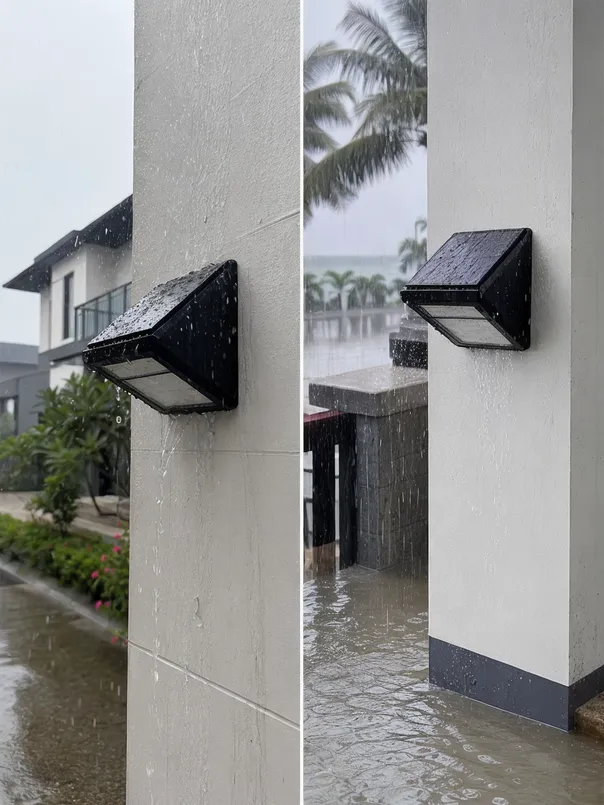
IP65 is sufficient for most outdoor wall applications — it covers dust ingress and water jets from any direction, which handles standard rain, cleaning, and typical outdoor exposure.
For walls with direct exposure to driving rain, coastal salt spray, or tropical monsoon conditions, IP67 is the right specification. IP67 adds submersion resistance (30 minutes at 1 meter depth), which matters when a wall fixture is exposed to water pooling or flooding at the base.
The housing cost difference between IP65 and IP67 is real, but the RMA rate difference in wet-climate markets is larger. If you're selling into Southeast Asia, West Africa, or coastal markets with heavy seasonal rainfall, consider our waterproof solar wall lights with IP67 construction.
- Dust-tight enclosure
- Water jets from any direction
- Standard rain & cleaning
- No submersion rating
- Dust-tight enclosure
- Water jets from any direction
- Submersion: 30 min at 1 m
- Monsoon & coastal rated
What battery type is better for hot export markets?
LiFePO4 (lithium iron phosphate) is the right specification for high-temperature markets — Middle East, South Asia, tropical Southeast Asia, and sub-Saharan Africa.
LiFePO4 cells have a longer cycle life at elevated temperatures and better thermal stability than standard lithium-ion. In practice, a LiFePO4 pack in a 45°C environment will retain usable capacity significantly longer than a lithium-ion pack under the same conditions.
The cost difference at the unit level is modest; the field failure rate difference in hot climates is substantial. We specify LiFePO4 as the default for buyers targeting these markets and can confirm the chemistry in the product documentation.
LiFePO4 Default Markets
Middle East · South Asia · Tropical Southeast Asia · Sub-Saharan Africa — any region with sustained ambient temperatures above 40°C during peak season.
- Superior thermal stability
- Longer cycle life at 45°C+
- Lower field failure rate
- Modest unit cost premium
- Lower unit cost
- Faster capacity fade at heat
- Higher RMA rate in tropics
- Thermal runaway risk higher
Can JXSOL customize solar wall lights for private-label orders?
Yes. The standard customization options — lumen output, color temperature, lighting mode, housing color, logo, label, retail carton, instruction sheet language, and battery/panel configuration — are available from 100 units for most options. Structural changes to the housing or electrical changes that affect CE certification scope require an engineering review and may carry higher MOQ or longer lead time.
The engineering review is the starting point for any OEM/ODM program: send us your target retail price, required certifications, and expected first order quantity, and our engineering team will confirm what's achievable.
See our OEM/ODM solar lighting services page for the full program details.
What is the MOQ for standard solar wall lights?
MOQ for standard catalog models is 100 units per model. That's low enough to validate a new SKU with your market before scaling to a stocking order.
For mixed-SKU orders, the 100-unit MOQ applies per model — a distributor ordering 100 units of the compact retail tier and 100 units of the standard distributor tier can consolidate both into a single container shipment.
OEM/ODM programs with custom specifications are confirmed during the engineering review; MOQ for custom options depends on the scope of customization.
Get a Quote for Solar Wall Lights
Send us your target market, required lumen range, order quantity, packaging requirements, and certification needs — we'll respond with a configuration recommendation and pricing.
Useful Inputs for a Faster Quote
-
Target region and distribution channel
Retail, project, e-commerce, or private label
-
Required lumen output or application type
Entrance, perimeter, or facade
-
Preferred lighting mode
Dusk-to-dawn, motion-activated, or dim-to-bright
-
Required certifications
CE, RoHS, IP documentation
-
Expected first order quantity and reorder frequency
Standard catalog models available from 100 units
-
Standard catalog supply or OEM/ODM private-label
OEM/ODM programs start with an engineering review — no commitment required at that stage
Contact Us Directly
We respond with a configuration recommendation and pricing, not a generic catalog PDF.
Submit RFQ FormStandard catalog models from 100 units · OEM/ODM engineering review at no commitment