Why Lumen Output Matters More Than Wattage for Commercial Solar Flood Lights
Wattage measures power consumption. Lumen measures light output. For solar flood lights, wattage is a cost input — it determines battery capacity and solar panel sizing. Lumen is the performance output your end users actually experience. Buyers who compare commercial solar flood light specifications by wattage alone miss the efficiency variable that separates functional systems from expensive failures.
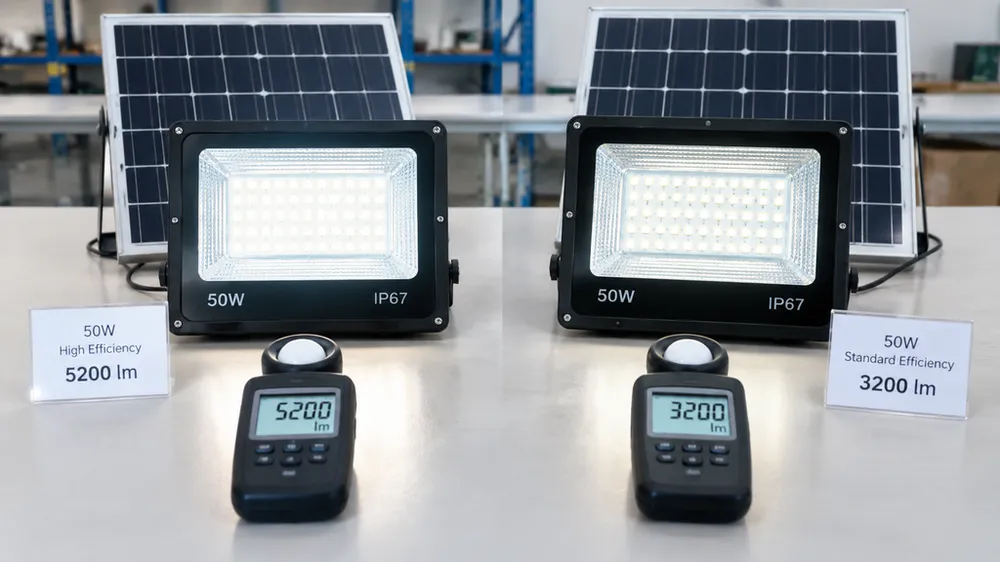
Two 50W solar flood lights can deliver 4,000 lumens or 7,000 lumens depending on LED efficiency and driver quality. Datasheets list wattage because it's easy to measure and sounds impressive, but it tells you nothing about whether the fixture will light a parking lot or just illuminate the pole beneath it. The metric that connects power consumption to actual performance is lumens per watt (lm/W) — the efficiency ratio that lets you compare solar versus grid-tied economics and identify suppliers using outdated LEDs or poor thermal management.

In 2026, 100 lm/W is baseline for decent commercial solar flood light lumen output. Mid-to-high-tier fixtures with proper LED binning and active thermal management reach 120–140 lm/W. Anything claiming over 150 lm/W for outdoor solar flood lights deserves scrutiny — either the supplier is inflating lumen numbers or they're quoting lab conditions that won't hold up once the fixture spends three months in 40°C ambient heat with dust buildup on the lens.
For project buyers, the correct procurement sequence is: define required lumen output based on your application and coverage area, then work backward to determine the wattage and battery capacity needed to deliver that output for your target runtime. This approach prevents over-speccing (which inflates cost) and under-speccing (which results in complaints and rework). Distributors who lead with wattage in their product listings are either repeating what their supplier told them or they don't understand the difference between input and output.
Lumen Requirements by Commercial Application Type
Commercial solar flood light specifications vary by application type, mounting height, and coverage area. Using the wrong lumen range wastes money on over-powered fixtures or creates coverage gaps that require additional units to fix. The table below shows starting ranges for common commercial applications — adjust upward for high-latitude sites or locations with heavy tree cover that reduces solar charging efficiency.
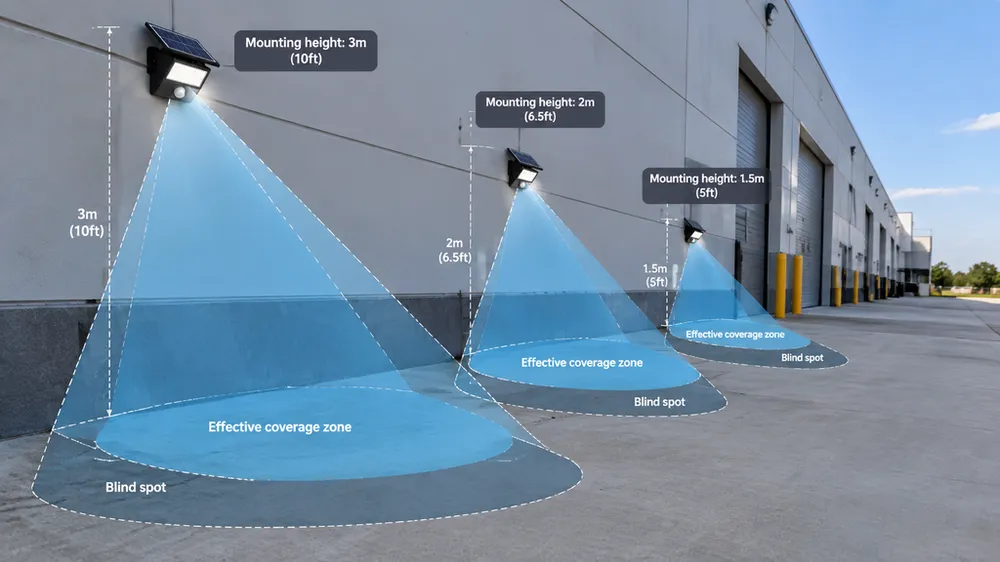
Perimeter security lighting (3,000–5,000 lm): Fence lines, property boundaries, and perimeter patrol routes. The priority is even distribution without dark zones where gaps create security vulnerabilities. Mount at 3–5 meters. Spacing depends on beam angle — narrow spots need closer placement than wide floods, but most buyers default to 120° beam angles for perimeter work because they reduce the number of poles. If you're lighting a linear perimeter, calculate total lumens needed for the full run length, then divide by fixture count to determine per-unit spec.
Facade and signage lighting (2,000–6,000 lm): Building fronts, monument signs, and architectural features where the goal is visibility or brand presence after dark. Lumen output matters less than beam angle and color temperature in this category. A 3,000-lumen fixture with a 30° spot can make a sign readable from 100 meters; a 5,000-lumen wide flood will wash the same sign into the background. Mount 5–10 meters from the target surface and adjust lumen spec based on surface reflectivity — dark brick or timber facades need more lumens than white stucco or aluminum panels.
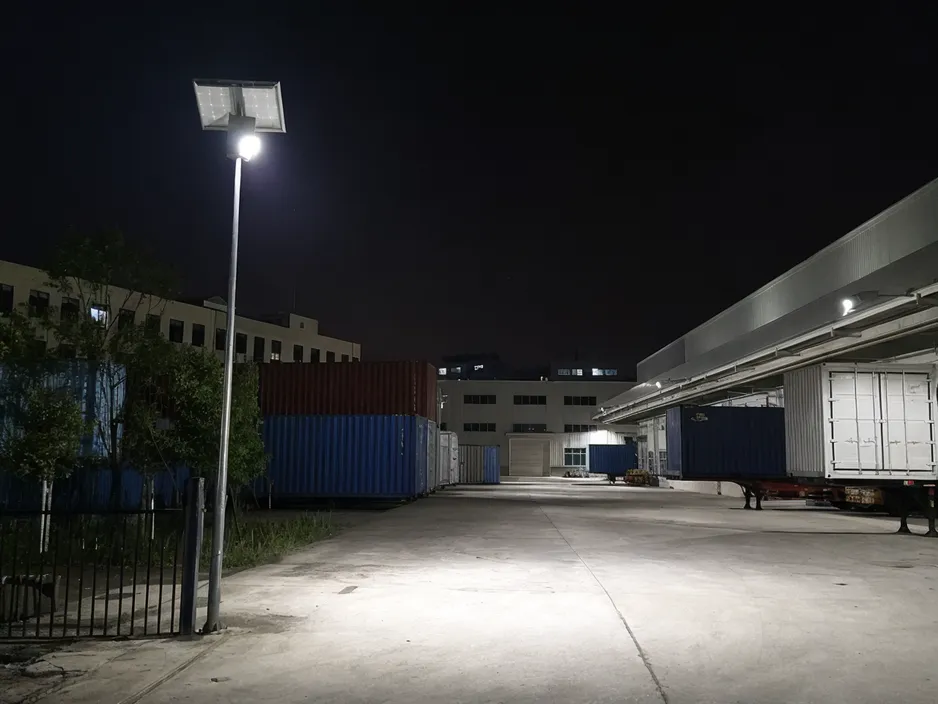
Parking lot and area lighting (8,000–15,000 lm): High-output requirement for safety and liability reasons. Most jurisdictions specify minimum footcandle levels for commercial parking (typically 0.5–1.0 fc maintained), which translates into lumen-per-square-foot calculations you can't shortcut without a lighting audit. Pole height runs 6–10 meters, spacing 20–30 meters depending on distribution pattern. Industrial solar flood light specs for parking lots should include uniformity ratio (maximum-to-minimum illuminance) — anything above 4:1 creates hot spots and shadows that undermine the purpose of the lighting. If your supplier can't provide photometric files (IES or LDT format), you're guessing on coverage.
Construction and temporary site lighting (10,000–20,000 lm): High output, portability, and rapid deployment. Battery autonomy matters more than aesthetics in this category because construction sites don't pause for three rainy days. Some buyers over-spec wattage here thinking bigger is safer, but the real spec to confirm is battery amp-hours and panel wattage — a 20,000-lumen fixture with a 30 Ah battery won't make it through one 10-hour night, let alone provide backup autonomy.
These ranges assume average site conditions — roughly 35–45° latitude with moderate seasonal variation and no significant obstructions blocking solar panel exposure. Buyers in high-latitude regions (above 50° N/S) or heavily shaded locations should size up one lumen tier or increase battery capacity to compensate for lower solar yield during winter months. JXSOL's engineering team adjusts panel and battery sizing based on your target latitude and autonomy requirements, which is relevant for distributors serving multiple climate zones from one catalog SKU (we size the battery and panel, you keep the same fixture model number).
Lumen-Per-Watt Efficiency: The Quality Signal Buyers Miss
Lumen-per-watt (lm/W) ratio = total fixture lumen output ÷ LED module wattage. A higher ratio means more light per unit of battery energy consumed. For commercial solar flood light lumen output, this ratio is the single clearest indicator of whether you're buying current-generation LEDs and competent driver design or last year's surplus components repackaged into new housings.
Why it matters for solar: battery capacity and solar panel size are the two largest cost drivers in any solar lighting system. A 120 lm/W fixture needs 20% less battery capacity than a 100 lm/W fixture to deliver the same lumen output and runtime. Over a 500-unit order, that difference compounds into lower shipping weight, smaller panel area per fixture, and faster ROI for your end customer. Distributors who ignore lm/W when comparing suppliers end up competing on price against more efficient products that actually cost less to manufacture once you account for battery and panel savings.
Suppliers who cannot provide lm/W data are either sourcing pre-assembled fixtures from multiple factories (so they genuinely don't know) or they're deliberately avoiding the comparison. Suspiciously high claims — anything over 150 lm/W for outdoor solar flood lights in 2026 — deserve a second look. Ask for the test report and check the conditions: was it measured at 25°C in a lab, or at 40°C after two hours of operation? LED efficiency drops as junction temperature rises; a fixture rated 150 lm/W in lab conditions might deliver 110 lm/W once it's been running for an hour in July in Phoenix.
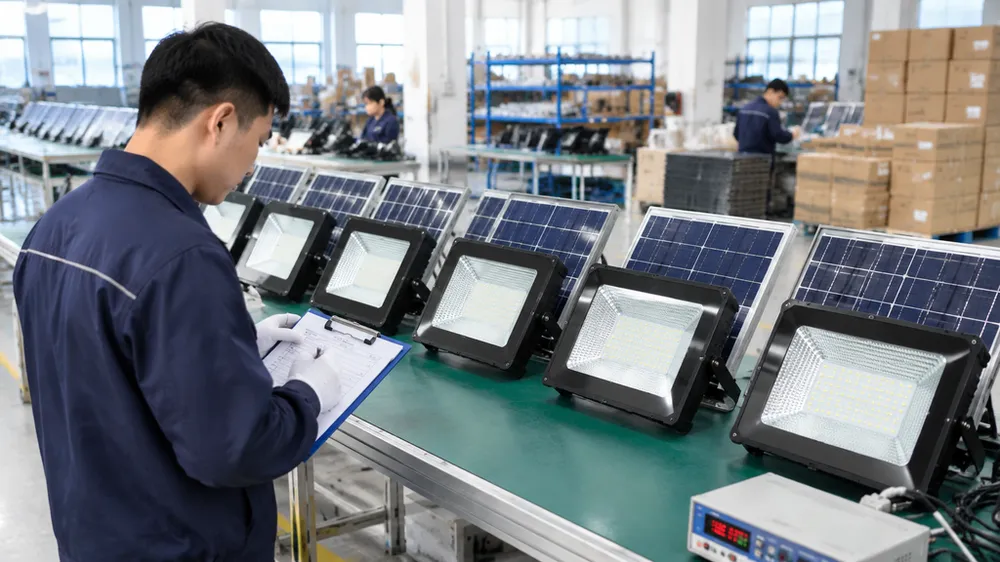
JXSOL performs lumen binning and output confirmation at assembly, not just on sample units. Every production batch passes through our integrating sphere; you receive the actual fixture lm/W for your order, not the theoretical maximum from the LED datasheet. This matters when you're deciding between a 50W fixture at 100 lm/W (5,000 lm) versus a 40W fixture at 125 lm/W (5,000 lm). The 40W option has lower battery drain, longer autonomy per charge cycle, and lower total system cost — but only if the lm/W claim is real and measured under operating conditions.
Here's the practical comparison distributors use when deciding which supplier to stock: if two solar flood light wattage guide specs deliver the same lumen output, the fixture with higher lm/W will have lower lifetime battery replacement cost, fewer warranty claims for "dim after six months" failures, and higher gross margin because your landed cost is lower per delivered lumen. That calculation only works if you're comparing verified lm/W numbers, not catalog marketing claims.
Battery Capacity and Autonomy Days — The Specs That Determine System Reliability
Battery capacity is measured in amp-hours (Ah) and determines how many hours the fixture can run each night without solar input. Autonomy days = how many consecutive cloudy or rainy days the system can operate before the battery depletes below safe discharge levels. These are the commercial solar flood light specifications that separate systems that work for three years from systems that fail after one winter.
Standard commercial configuration: 2–3 autonomy days. High-reliability applications — remote sites, regions with extended rainy seasons, or locations where lighting downtime creates liability exposure — should specify 4–5 days. Anything below 2 days is acceptable only for low-stakes decorative lighting where a dark night doesn't matter. Project buyers should ask suppliers what autonomy assumption is built into the standard battery spec, because "3 days" from one factory might mean "3 days at 6 hours/night in summer" while another factory means "3 days at 10 hours/night year-round."
Battery sizing formula (simplified for RFQ planning): Required Ah = (fixture wattage × nightly runtime hours × autonomy days) ÷ battery voltage ÷ usable depth-of-discharge limit. Most LiFePO4 systems use 80% depth of discharge (DoD); lead-acid should stay at 50% to avoid accelerated degradation. Suppliers who don't specify DoD assumptions in their battery sizing are either guessing or they're deliberately under-sizing to hit a price point.
Example: a 50W fixture running 10 hours per night with 3-day autonomy needs 50W × 10h × 3 days = 1,500 watt-hours. At 12.8V LiFePO4 with 80% usable capacity, this translates to roughly 146 Ah. Round up to 150 Ah to account for battery aging and temperature derating (LiFePO4 capacity drops about 10% at 0°C). Buyers should confirm their supplier's battery sizing matches this logic rather than accepting arbitrary "bigger battery = better system" claims that don't account for actual load and runtime requirements.
Solar panel sizing interacts with battery capacity: a larger panel can reduce required battery Ah by recharging faster during short daylight windows, but only if the buyer's site gets adequate sun exposure. JXSOL's engineering team sizes panel and battery together based on your latitude, typical weather patterns, and target autonomy days. For distributors serving multiple regions, this means one fixture model can be adapted with different panel/battery configurations rather than requiring separate SKUs for each climate zone (we adjust the components, you keep the same catalog page).
Procurement risk: many suppliers list battery Ah without specifying chemistry, voltage, or DoD assumptions. Buyers who don't verify this end up with systems that fail after the first rainy season because the battery was undersized from the start. When you see "100 Ah battery" on a datasheet, ask: what chemistry (LiFePO4, ternary lithium, lead-acid), what nominal voltage (12.8V, 11.1V, 12V), what usable DoD, and what temperature range is that capacity guaranteed across? If the supplier can't answer all four questions, they didn't engineer the system — they assembled components from a spec sheet.
Solar Panel Sizing and Seasonal Performance
Solar panel wattage must be sufficient to fully recharge the battery during available daylight hours, accounting for seasonal variation and site latitude. Under-sizing the panel creates a slow battery drain that buyers don't notice until three months after installation when the system starts dimming or shutting off early. Over-sizing wastes cost and mounting area. The correct spec depends on where the fixture will be deployed and how many peak sun hours (PSH) the site receives during the worst month of the year.
Rule of thumb: panel wattage should be 1.5–2× fixture wattage for mid-latitude sites (30–45° N/S) with average sun exposure. High-latitude or heavily shaded sites need 2.5–3× to compensate for shorter winter days and lower solar angle. This is a starting point, not a guarantee — actual panel sizing requires knowing your site's peak sun hours, which vary by season and weather patterns.
Peak sun hours (PSH) represent equivalent hours of 1,000 W/m² irradiance — not the same as daylight hours. A site at 40°N might get 5–6 PSH in summer but only 2–3 PSH in winter. Solar flood light procurement decisions should be based on winter PSH unless the application only operates seasonally. Example: a 50W fixture in a 40°N location needs to deliver 50W × 10h = 500 watt-hours per night. At 3 PSH (winter conditions), the panel must generate at least 500 Wh ÷ 3 hours ÷ 0.85 system efficiency ≈ 196W. Most suppliers would recommend a 200–250W panel to ensure consistent winter performance and leave headroom for dust accumulation or panel aging.
JXSOL provides panel sizing recommendations based on your latitude and target autonomy days. For distributors serving multiple regions, this flexibility means you can offer the same fixture model with regionally optimized panel/battery configurations rather than maintaining separate inventory for each climate zone. Buyers should ask suppliers: "What latitude and PSH assumptions are built into your standard configuration?" If the supplier doesn't know or says "it works everywhere," the system is probably optimized for their home region (southern China, in most cases) and under-sized for higher latitudes.
Temperature affects both panel output and battery capacity. Panel efficiency drops about 0.4% per degree Celsius above 25°C, which matters in desert climates where panel surface temperature can hit 70°C. Battery capacity drops 10–20% at freezing temperatures depending on chemistry. Industrial solar flood light specs for extreme climates should account for both derating factors by increasing panel wattage or battery Ah beyond the nominal calculation. We've sized systems for buyers in northern Canada (where winter PSH drops below 2) and the Middle East (where summer panel temperatures exceed 75°C) — both require custom panel/battery configurations that standard catalog specs don't address.
How to Validate Lumen Claims During Supplier Evaluation
Lumen inflation is common enough in solar lighting catalogs that buyers should treat any spec as unverified until proven. Suppliers list "theoretical maximum" or "initial lumen" without accounting for driver efficiency loss, thermal degradation, or battery voltage sag. The difference between catalog lumen and field lumen can be 20–30% on poorly engineered fixtures, which means your coverage calculations are wrong from the start.
Three validation methods for commercial solar flood light lumen output:
Request integrating sphere test reports: Should show total fixture output in lumens, not just LED chip manufacturer spec. Report should be dated within six months (LED binning and driver components change frequently) and reference a recognized test standard such as IEC 62124 or LM-79. The report should specify test conditions — ambient temperature, input voltage, stabilization time — because LED output varies with all three. If the supplier provides a test report for a 100W fixture but you're buying 50W units, that report is irrelevant; ask for the report that matches your order spec.
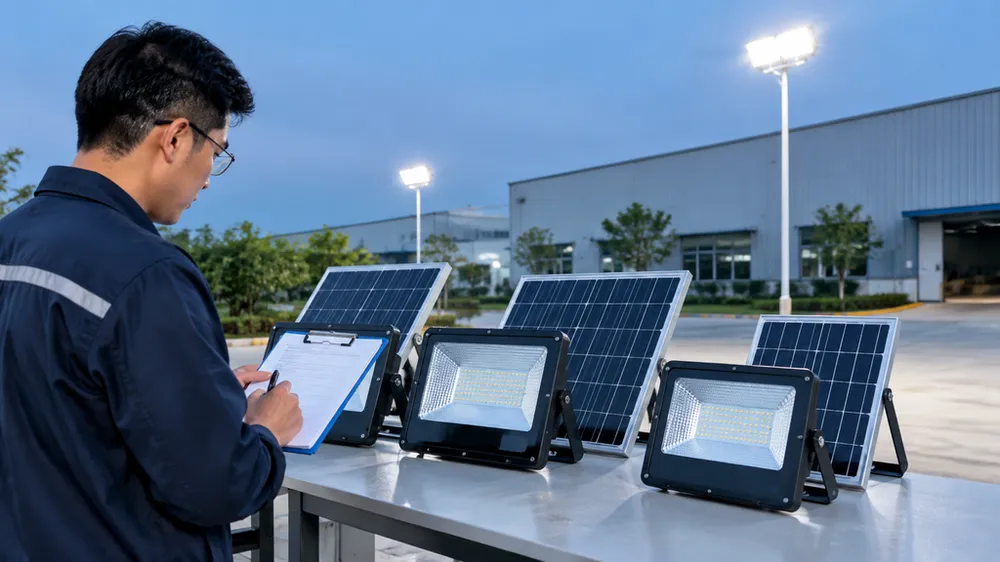
Sample validation with lux meter: Buyers can measure illuminance (lux) at a known distance and reverse-calculate approximate lumen output using inverse-square law and fixture beam angle. This isn't lab-precise, but it catches egregious inflation. Example: a fixture claiming 10,000 lumens with a 120° beam angle should produce roughly 250–300 lux at 5 meters. If you measure 150 lux, the fixture is either under-spec or the beam angle claim is also inflated. We've seen distributors cancel orders after sample validation revealed 40% lumen shortfall versus datasheet claims.
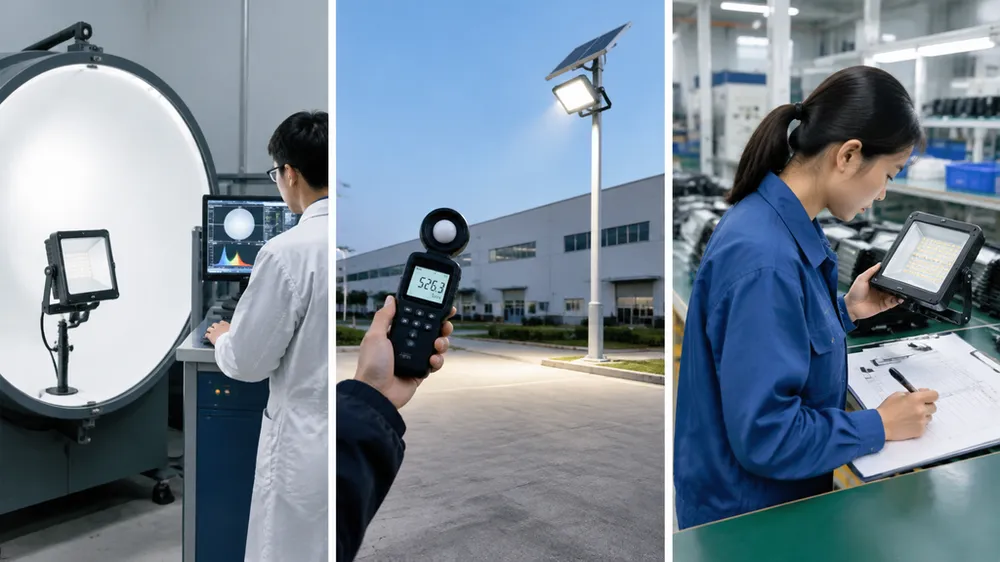
Factory QC documentation: Ask what percentage of production units are tested (not just samples), and whether test results are logged per batch. JXSOL tests 100% of assembled fixtures for lumen output and color temperature before shipment; buyers receive batch test summaries showing actual output range for their specific order. Factories that only test samples are gambling that production units match the sample, which is a safe bet if they control component sourcing and assembly but a risky assumption if they're assembling from multiple subcontractors.
Red flags during solar flood light procurement: Supplier claims lumen output but refuses to provide test reports, or provides reports for a different model/wattage and says "it's similar." Supplier's lm/W ratio is significantly higher than the LED chip manufacturer's published efficiency for the same LED series (check the chip datasheet yourself if you know the LED model). Supplier changes LED supplier between sample and production without notifying you — this happens more often than buyers expect and can shift lumen output by 15–20% even if the nominal wattage stays the same.
JXSOL operates an in-house integrating sphere and lumen testing lab. Buyers can request pre-shipment inspection data for their specific order, not generic catalog claims that may or may not reflect current production. This matters when you're deciding between suppliers at similar pricing — the factory that can document actual lumen output per batch gives you enforceable recourse if the shipment arrives dim.
IP Rating, Operating Temperature, and Real-World Durability Specs
IP65 is minimum for outdoor commercial solar flood lights; IP67 is preferred for coastal environments, high-humidity regions, or applications where the fixture might be exposed to wash-down or pressure cleaning. IP rating measures ingress protection (dust and water resistance), not impact resistance. Buyers in vandal-prone areas or high-wind zones should also confirm IK rating (impact resistance, typically IK08 or higher for commercial fixtures) and fixture weight plus mounting hardware robustness.
Operating temperature range: most solar flood lights specify -20°C to +60°C, which covers the majority of commercial installations. Buyers in extreme climates — desert sites where daytime surface temperatures exceed 50°C, or arctic installations where winter temperatures drop below -30°C — should verify that battery chemistry can handle temperature extremes without capacity loss. LiFePO4 performs better than lead-acid in both cold and heat, but even LiFePO4 needs thermal management (insulated battery compartments or active heating elements) for reliable operation below -20°C.
JXSOL's standard configuration is IP65 housing with IEC 62124 compliance (the international standard for stand-alone photovoltaic lighting systems). IP67 and custom operating temperature ranges are available for OEM/ODM orders starting at 100-unit MOQ. Industrial solar flood light specs for harsh environments should also address UV resistance of the housing material (polycarbonate degrades faster than die-cast aluminum in high-UV regions) and corrosion protection for coastal installations (salt spray accelerates contact corrosion on low-grade aluminum alloys).
Durability is not just about the IP rating printed on the datasheet — it's whether the factory's quality control catches seal failures, loose terminals, and poor solder joints before the fixture ships. We run 100% pre-shipment inspection including IP test chamber verification (water spray test for IP65, temporary submersion for IP67) and thermal cycling for battery and controller modules. Buyers receive test documentation per order, which is relevant for project bids that require compliance records or for distributors who need defensible specs when handling warranty claims.
One procurement note: suppliers who list IP ratings without providing test reports are either repeating what their component supplier claimed or they're assuming the rating applies because the housing gasket looks adequate. IP ratings must be tested on the complete assembled fixture, not inferred from component specs. Ask for the IP test report and confirm it matches your order's housing configuration — a factory that swaps gasket suppliers between batches might lose IP rating without realizing it.
Procurement Checklist — Questions to Ask Every Solar Flood Light Supplier
Use this checklist during RFQ drafting or supplier evaluation calls to ensure you're comparing commercial solar flood light specifications on equal terms. Each question ties back to a spec dimension that affects system performance, lifecycle cost, or warranty risk.
Lumen and efficiency:
- What is the total fixture lumen output (not LED chip spec)? Is this initial lumen or maintained lumen after 1,000 hours?
- What is the fixture's lm/W ratio under operating conditions (not lab cold-start)?
- Can you provide integrating sphere test reports dated within six months for the exact model and wattage I'm ordering?
- What percentage of production units are tested for lumen output — samples only, or every fixture?
Battery and autonomy:
- What is the battery capacity in amp-hours, chemistry (LiFePO4, ternary lithium, lead-acid), and nominal voltage?
- How many autonomy days is the system sized for, and what nightly runtime hours does that assume?
- What depth-of-discharge limit is used in your battery sizing calculation (e.g., 80% for LiFePO4)?
- What temperature range is the stated battery capacity guaranteed across?
Solar panel:
- What is the panel wattage and what latitude or peak sun hours (PSH) assumptions are built into the standard configuration?
- Can the panel be resized for my target region without changing the fixture SKU or requiring retooling?
- How does panel output derating (temperature, dust, aging) factor into your sizing recommendation?
Quality and compliance:
- What percentage of production units are tested for lumen output (not just samples)? Do you provide batch test summaries or per-order inspection reports?
- What certifications and test reports are available: ISO 9001, CE, RoHS, IEC 62124, IP rating test reports?
- Can I request pre-shipment inspection by my own QC agent or third-party inspector?
Flexibility and support:
- What is your MOQ for standard models versus custom battery/panel configurations?
- Do you have in-house engineering support for sizing systems based on my latitude and application, or do I need to specify battery/panel myself?
- What is the lead time for sample validation orders before committing to production quantity?
- If my order underperforms on lumen output or autonomy in the field, what is your investigation and resolution process?
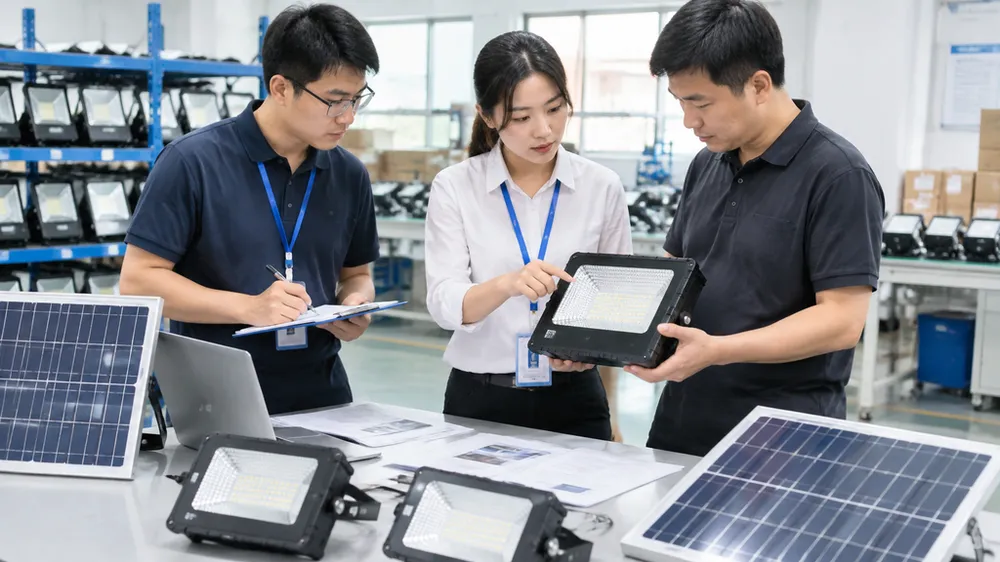
Suppliers who cannot answer these questions clearly either lack in-house engineering (they're reselling assembled units from other factories) or they're assembling from multiple subcontractors without consistent component control. Buyers who need reliable reorder capability and spec validation should prioritize factories with integrated production and testing. Trading companies can be useful for small mixed orders, but they add a layer of separation between you and the entity that controls component quality — which becomes a problem when you need to resolve a warranty claim or adjust specs for a follow-on order.
How JXSOL Supports Spec Validation and Custom Sizing for Commercial Projects
JXSOL is a factory, not a trading company. Production, assembly, and testing happen in the same 12,000 m² facility in Guzhen, Zhongshan — the center of China's lighting manufacturing industry. Our in-house engineering team (15+ optical and electrical engineers) sizes battery, panel, and lumen output based on your latitude, application type, and target autonomy days. This is relevant for distributors who serve multiple regions from one catalog and for project buyers who need custom configurations without the retooling costs or long lead times that custom work usually requires.
Lumen binning and output confirmation happen at assembly, not just on sample units. Every fixture passes through our integrating sphere and color temperature testing station before it's packed. Buyers receive batch test summaries showing the actual lumen output range for their specific order, not generic catalog maximums. This documentation is directly relevant for project buyers who need compliance records for bidding or final inspection, and for distributors who face warranty claims and need defensible evidence that the product met spec at time of shipment.
Flexible MOQ: 100 units for standard models, with custom battery/panel sizing available for OEM/ODM orders at the same minimum. We don't require retooling fees for battery or panel adjustments because those components are selected during assembly, not molded into the housing. For distributors, this means you can validate a new market or application with a 100-unit test order rather than committing to 1,000+ units before you know whether the spec fits your customer base.
IEC 62124 compliance documentation, IP65/IP67 test reports, and CE/RoHS certificates are available per order. These aren't generic factory certificates — they're order-specific documentation you can provide to your customer or submit with project bids. Most factories provide one set of certificates that covers their entire product range; we provide per-order documentation because battery chemistry, LED binning, and panel suppliers can shift between production runs, and your customer's compliance requirement is tied to what they actually received, not what the factory was certified for two years ago.
Three-year warranty with engineering support. If a batch underperforms on lumen output or autonomy days, our engineering team investigates root cause — LED binning shift, battery batch variation, panel output below supplier spec — and adjusts future production parameters to prevent recurrence. This is different from the standard warranty process where you get a replacement shipment but no explanation or process improvement. Buyers who plan to reorder need a supplier that treats spec deviation as a process failure, not just a one-time replacement issue.
JXSOL is the supplier for buyers who need a factory they can reorder from, not a sourcing agent who assembles components from three different subcontractors depending on which one has inventory that week. Spec consistency and engineering support are the differentiation, not lowest unit price. If your procurement priority is reliable reorder capability with documented spec validation, you're comparing factories with integrated production and testing, not trading companies that add margin without adding control.