Why do two flood lights with identical 50Ah battery capacity show a 3–5× runtime difference in the field? The operating mode isn't just an on/off preference — it determines the battery duty cycle, which governs how many nights your deployment runs before the first warranty claim arrives. If you're specifying solar lighting for parking lots, perimeter security, or residential pathways, understanding the energy model behind motion sensor vs dusk to dawn solar light operation gives you the basis to size batteries correctly, avoid over-spec waste, and match controller logic to actual project conditions.
Consumer product pages describe modes as "motion-activated" or "all-night" features. That framing hides the procurement question: which mode lets you use a smaller battery without sacrificing field reliability, and which environments eliminate that advantage? This comparison covers duty-cycle energy models for both modes, battery capacity sizing rules per operating pattern, controller configuration options that affect real-world performance, and when to specify PIR motion sensor versus always-on dusk-to-dawn for different project types.
How Operating Mode Determines Battery Duty Cycle (Not Just "On-Time")
Battery life claims in solar lighting datasheets often list "10–12 hours runtime per charge" without stating the operating mode. That number is meaningless for procurement because runtime depends on duty cycle — the percentage of night hours when the load actively draws from the battery — not just total capacity. A 50Ah battery running a 20W load in dusk-to-dawn mode delivers 10 hours of continuous light, then needs recharging. The same 50Ah battery running the same 20W load in PIR motion sensor mode can deliver 50+ hours of triggered operation across multiple nights, because the light only draws power during motion events.
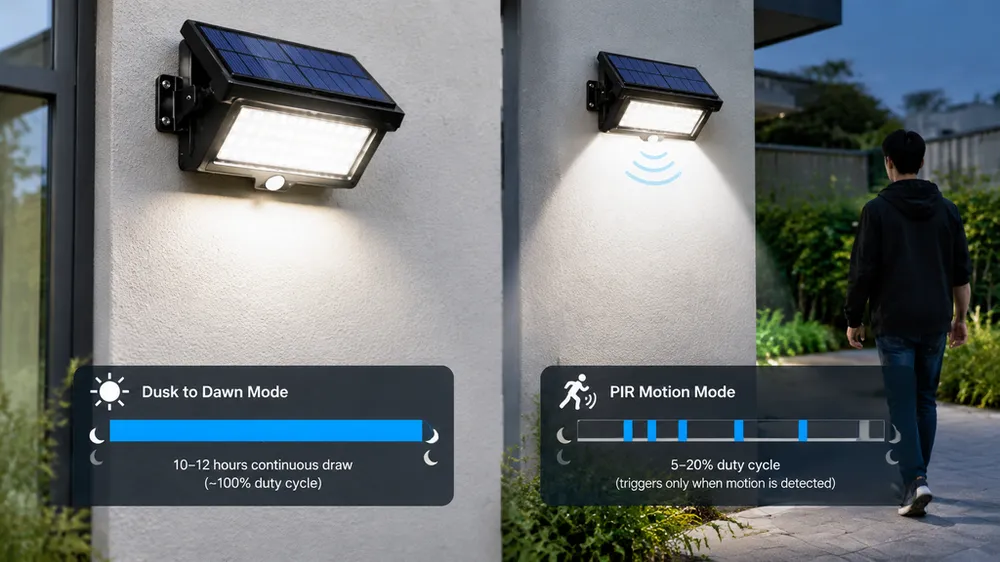
Duty cycle is how manufacturers calculate battery autonomy. Dusk-to-dawn mode operates at ~100% duty cycle: the light turns on at dusk (typically when ambient lux drops below 5–10 lux threshold) and runs continuously until dawn or battery cutoff voltage, whichever comes first. A 10-hour night means 10 hours of active draw. PIR motion sensor mode operates at 5–20% duty cycle in most field environments: the light stays in standby (drawing <0.5W for the PIR sensor circuit) and triggers to full brightness only when the passive infrared sensor detects heat signature movement within its detection range. A 10-hour night with 20 motion triggers at 30 seconds each means 10 minutes of active draw — 1.7% duty cycle.
Battery autonomy follows the formula: capacity (Ah) × voltage (V) ÷ [load (W) × duty cycle × autonomy days]. For a 20W load with 3-day autonomy target (standard for solar lighting to cover consecutive rainy days), dusk-to-dawn mode at 100% duty cycle for 10 hours/night requires 600Wh total storage → 50Ah LiFePO₄ battery at 12V. The same 20W load in PIR mode at 10% duty cycle (realistic for medium-traffic environments like residential pathways or small parking lots) requires only 60Wh → 5Ah battery. In practice we spec slightly higher — 9Ah — to account for battery aging and winter shorter charge cycles, but the 5.5× reduction in required capacity is real and directly translates to unit cost savings of 40–50% on the battery component alone.
This matters for buyers because battery cost is 30–35% of total solar flood light BOM. Under-spec the battery and you get premature voltage cutoffs that look like product failures; over-spec and you're paying for Ah capacity that never cycles. Knowing your deployment's realistic duty cycle — based on operating mode and trigger frequency — is the starting point for accurate battery sizing. Before we compare modes in detail, here's what duty cycle looks like visually:

The diagram shows two identical nights with the same battery capacity but different operating modes. Top timeline: continuous 10-hour draw depletes the battery in one night. Bottom timeline: intermittent triggered draws spread the same energy budget across multiple nights. The difference isn't the battery — it's the controller logic that determines when the load is active.
Dusk-to-Dawn Mode — Continuous Output, Fixed Nightly Energy Budget
Dusk-to-dawn controllers use a photoresistor (light-dependent resistor) to monitor ambient illumination. When the lux level drops below the preset threshold — typically 5–10 lux, roughly equivalent to late twilight — the controller closes the circuit and powers the LED load at full rated wattage. The light stays on until either dawn (when lux rises above the threshold again) or the battery voltage drops to the cutoff level (usually 10.5V for 12V systems, protecting LiFePO₄ cells from over-discharge). There's no variability in nightly draw: if your load is 20W and your night duration is 10 hours, you consume 200Wh every single night the light operates.
This predictability makes dusk-to-dawn the simpler mode for battery sizing. The calculation is straightforward: load wattage × nightly runtime hours × desired autonomy days = required battery capacity in Wh. For a 20W flood light running 10 hours per night with 3-day autonomy (to cover two consecutive rainy days without sufficient solar recharge), you need 20W × 10h × 3 = 600Wh. Converting to amp-hours: 600Wh ÷ 12V = 50Ah. We spec LiFePO₄ chemistry because it tolerates 80% depth of discharge (DoD) versus 50% for ternary lithium, and delivers 2000+ charge cycles versus 800–1000 for ternary — both matter for warranty planning and field longevity.
The commercial advantage of dusk-to-dawn is predictable runtime for project budgeting. You know exactly how many nights the light will operate per charge cycle, which simplifies maintenance scheduling and warranty liability forecasting. If you quote a distributor on 500 units with 50Ah batteries rated for 10-hour nightly runtime, every unit in that batch will perform the same way in the field, assuming comparable solar panel exposure. There's no trigger-frequency variable to estimate or argue about when a buyer questions runtime performance six months post-delivery.
The commercial risk is battery oversizing cost. A 50Ah LiFePO₄ battery adds $35–50 to unit cost depending on volume and cell supplier. If your project doesn't actually need continuous 10-hour illumination — say you're lighting a low-traffic perimeter where intrusion detection is more valuable than continuous visibility — you're paying for battery capacity that provides zero additional commercial value to the end deployment. Undersizing is worse: if your quoted "10-hour runtime" is based on a 40Ah battery, the light cuts off after 8 hours in winter (shorter charge cycles, colder temps reducing usable capacity), and you field warranty claims for "defective" units that are actually performing exactly as the battery capacity dictates.
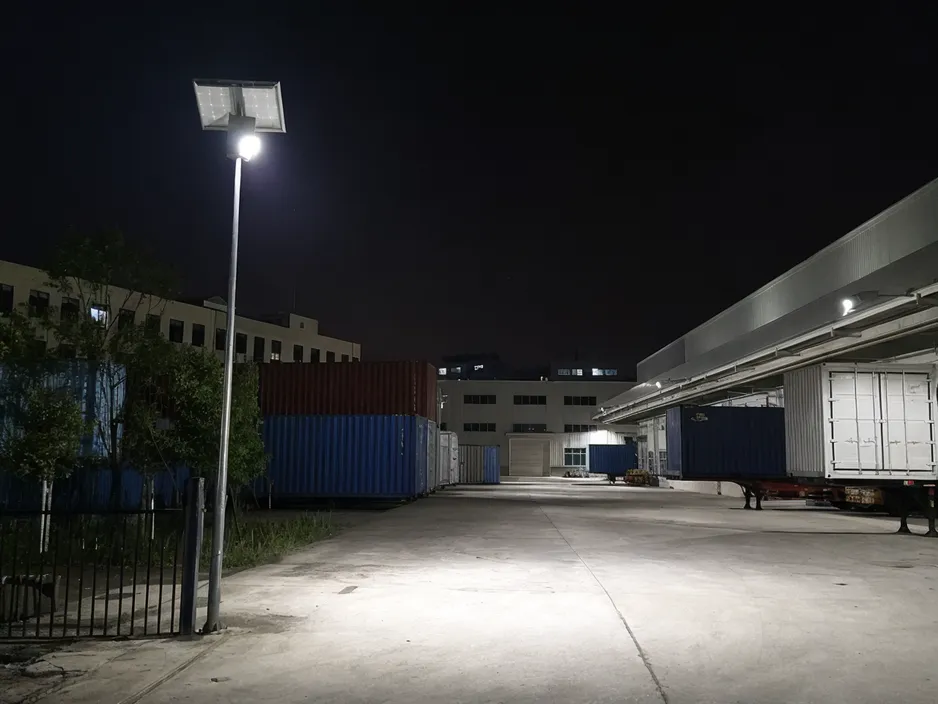
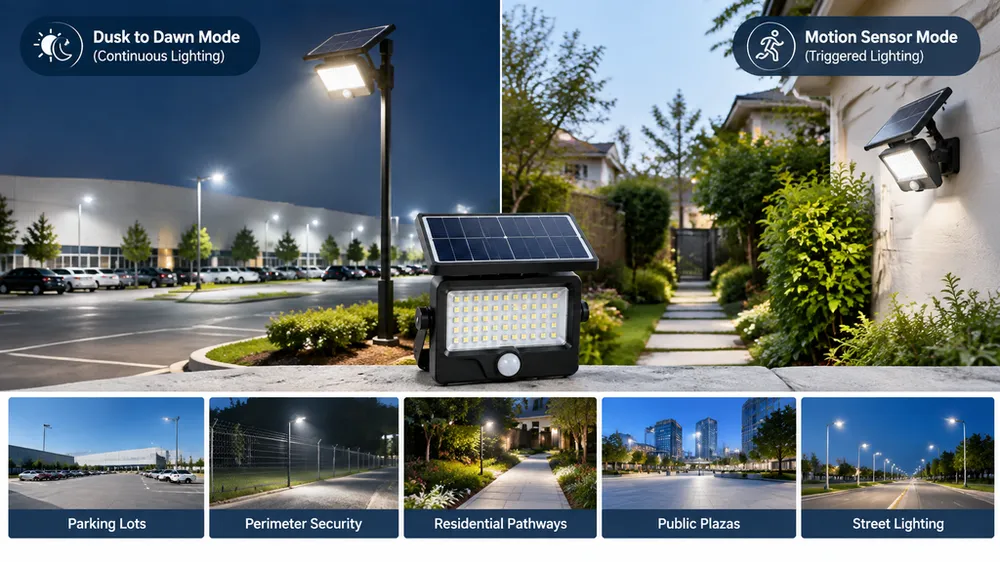
Dusk-to-dawn fits projects where continuous illumination is the functional requirement: street lighting and roadway fixtures where gaps in coverage create safety liability, parking lot perimeter zones where consistent visibility reduces theft and vehicle damage claims, public plazas or campus walkways where uninterrupted lighting is expected by users, and security areas where the light itself is the deterrent, not motion-triggered detection. For these applications, the battery cost is justified by the operational requirement. For low-traffic or detection-priority environments, the same battery investment delivers 5× more effective runtime in a different operating mode.
PIR Motion Sensor Mode — Triggered Draw, Variable Nightly Energy Budget
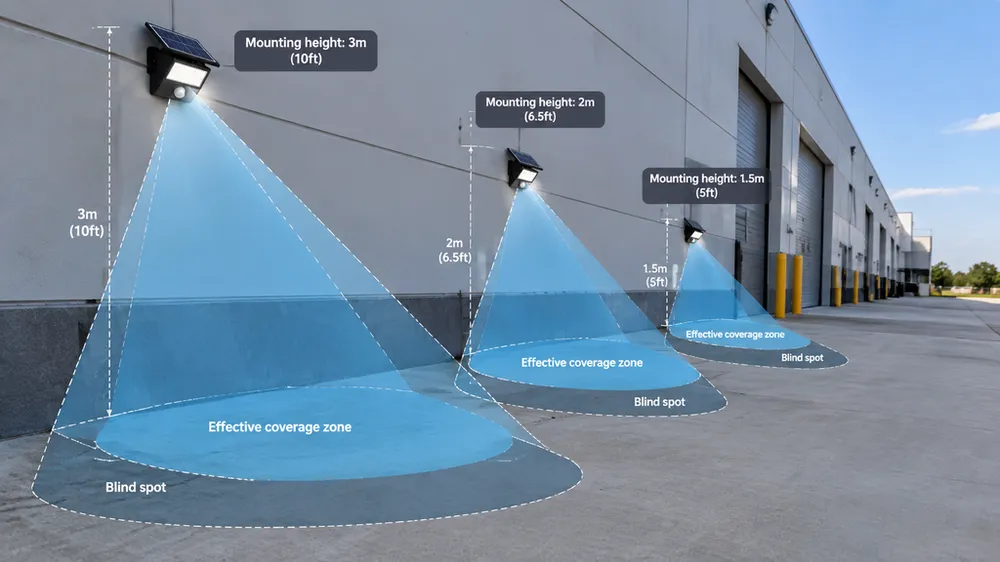
PIR (passive infrared) controllers work by detecting changes in infrared radiation — the heat signature emitted by moving objects warmer than the ambient background. The sensor monitors a detection zone (typically 8–12 meters radius for outdoor flood lights, adjustable via lens selection or sensor placement) and triggers full-brightness output when it registers a heat signature delta above the sensitivity threshold. The light stays at full brightness for a preset trigger duration (10–60 seconds, configurable via controller PCB settings or DIP switch), then either returns to standby mode (<0.5W draw for the PIR circuit alone) or dims to a low-brightness mode (2–5W, called "dim+PIR" or "hybrid mode" in some controller variants). The key difference from dusk-to-dawn: energy draw is event-driven, not time-driven.
Nightly energy consumption in PIR mode depends entirely on trigger frequency, which varies by deployment environment. Low-traffic scenario (rural driveway, residential backyard perimeter): 10–20 triggers per night. Medium-traffic scenario (suburban pathway, small parking lot, office campus walkway): 50–150 triggers per night. High-traffic scenario (busy building entrance, urban sidewalk, retail storefront): 200+ triggers per night. For a 20W load with 30-second trigger duration, here's what those scenarios mean in Wh:
- Low traffic (20 triggers/night): 20 triggers × 30 sec = 10 minutes active time = 3.3Wh per night
- Medium traffic (100 triggers/night): 100 triggers × 30 sec = 50 minutes active time = 16.7Wh per night
- High traffic (200 triggers/night): 200 triggers × 30 sec = 100 minutes active time = 33.3Wh per night
Compare those numbers to the 200Wh nightly draw of dusk-to-dawn mode. Even in high-traffic environments, PIR mode consumes 85% less energy for the same wattage load. That translates directly to smaller battery requirements: using the same 3-day autonomy target, medium-traffic PIR deployment needs 16.7Wh × 3 = 50Wh total storage → ~5Ah battery (we typically spec 9Ah to add safety margin for winter and aging). That's an 82% reduction in required battery capacity versus the 50Ah battery needed for dusk-to-dawn, cutting battery cost from $45 to $12 per unit at volume pricing.
The commercial advantage for distributors and project buyers is obvious: for the same wattage LED and solar panel (PIR mode doesn't reduce your lighting output or recharge capability when the sun is up), you can offer a lower-cost SKU or capture higher margin. If you're bidding on a 200-unit parking lot lighting project where most fixtures will see low-to-medium traffic, specifying PIR mode instead of dusk-to-dawn can reduce total project cost by $6,000–8,000 just on battery savings, often the difference between winning and losing the bid. That assumes you've estimated trigger frequency accurately — over-estimate and you're back to the same battery capacity, under-estimate and you face premature cutoff warranty claims.
Configurable parameters that affect real-world battery life in PIR mode: Detection range (8m vs 12m radius — wider range picks up more motion events, increasing trigger frequency). Trigger duration (10 sec vs 60 sec — longer duration means more Wh consumed per event; we default to 30 sec but support 10–60 sec via controller preset for OEM orders). Sensitivity threshold (how much heat signature delta is required to trigger — lower threshold increases false positives from small animals or wind-blown vegetation, higher threshold might miss slow-moving pedestrians; factory default is mid-range, tunable via PCB potentiometer). Dim-mode standby wattage (if using hybrid PIR+dim instead of PIR-only, the 2–5W dim mode adds continuous draw that reduces the duty-cycle advantage; we recommend PIR-only for battery-constrained projects, dim+PIR only when buyers specifically want ambient "not completely dark" baseline lighting).
PIR mode fits projects where intrusion detection or triggered response is more valuable than continuous visibility: perimeter security fencing where the light-on event signals an intrusion, low-to-medium traffic pathways (residential complexes, office campus walkways, park trails) where full brightness is only needed when people are present, cost-sensitive projects where reducing battery size directly improves your margin or competitive positioning, and deployments where solar panel size is constrained (smaller battery = less daily recharge requirement = smaller panel, useful for pole-mounted or wall-mounted fixtures with limited mounting area). The battery life advantage is real, but it's not automatic — it depends on matching controller settings to field conditions.
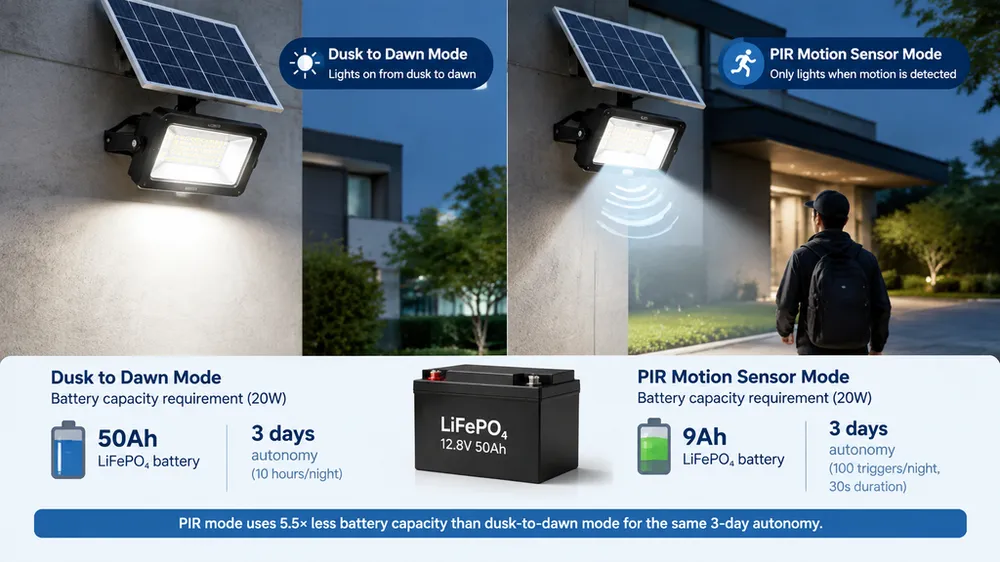
The table shows side-by-side battery capacity requirements for 20W, 30W, 50W, and 100W loads across both operating modes, making it easy to see how mode selection scales with wattage. For reference: our 30W–50W flood light platform (the most common range for parking lot and security applications) shows 4.8× average battery size reduction when switching from dusk-to-dawn to medium-traffic PIR, translating to $25–35 unit cost savings that compound across volume orders.
Controller Logic Differences — Why Mode Isn't Just a Switch Setting
Consumer-grade solar lights treat operating mode as a fixed product feature: you buy a "motion sensor light" or you buy a "dusk-to-dawn light," and the controller board is hard-wired for one mode only. If the buyer decides six months later they want the other mode, they're replacing the entire fixture or at minimum swapping the controller PCB — neither economical for volume deployments. OEM solar lighting platforms separate the controller logic from the mode selection, allowing either field-switchable dual-mode operation or factory-preset configuration based on buyer specs before shipment.
Dusk-to-dawn controller parameters that affect real-world performance: Lux trigger threshold (the ambient light level at which the controller powers on the load — lower threshold = turns on earlier in twilight, higher threshold = waits until full darkness; we default to 8 lux, configurable 5–15 lux for OEM orders). Cutoff voltage (battery protection threshold — too high and you lose usable runtime, too low and you risk over-discharge damage; LiFePO₄ cells tolerate 10.0V cutoff, ternary lithium needs 10.5V+). Optional dimming schedule (some controllers support two-stage operation: full brightness first half of night, 50% brightness second half; reduces effective nightly draw from 200Wh to 150Wh for a 20W load, extending battery autonomy by 33% without changing battery size — useful for projects where late-night traffic is minimal).
PIR controller parameters that affect battery life and false-trigger behavior: Detection range (adjustable via Fresnel lens selection or sensor mounting angle — 8m, 10m, or 12m radius are standard options; wider range increases coverage but also increases trigger frequency). Trigger duration (10 sec, 30 sec, 60 sec — how long the light stays at full brightness after motion stops; longer duration provides better visibility for slow-moving pedestrians but consumes more Wh per event). Sensitivity threshold (internal potentiometer setting that determines minimum heat signature delta required to trigger — factory default works for human-sized targets at normal walking speed; lower threshold catches slower movement but increases false positives from animals/vegetation, higher threshold reduces false positives but might miss legitimate targets in cold weather when heat signature contrast is lower). Dim-mode standby wattage (for hybrid controllers that support PIR+dim operation — 0W standby for pure PIR-only, 2W or 5W for dim-mode baseline lighting; we recommend 0W for battery-constrained projects, 2W dim mode when buyers want "never completely dark" ambient lighting).
Dual-mode controllers available on JXSOL 30W–200W flood light platform: switchable PIR + dusk-to-dawn via DIP switch on the controller PCB, accessible without opening the main housing (switch position set during installation or field reconfiguration, no factory involvement required). This flexibility matters for distributors carrying inventory where end-customer preference isn't known at import time — one SKU serves both markets. It also matters for pilot projects: you can deploy 50 units in PIR mode, field-test actual trigger frequency and battery performance over 2–3 months, then decide whether to switch to dusk-to-dawn or proceed with PIR for the remaining 500-unit volume order. That de-risks the battery sizing decision and protects your margin against over-spec waste.
Controller logic flexibility is what separates an OEM platform from a consumer product. If you're sourcing 1,000+ units, being able to preset trigger duration to 20 seconds (instead of default 30 sec) reduces your nightly energy budget by 33% without touching the hardware — that can be the difference between a 9Ah battery and a 15Ah battery, worth $8 per unit × 1,000 units = $8,000 project savings. Consumer products don't offer that. Factories that only assemble controllers from third-party suppliers can't modify those parameters without MOQ commitments to the controller vendor. We design and test controllers in-house, so parameter customization is a volume order configuration step, not a separate R&D project.
When to Specify Each Mode — Application Scenario Mapping for Project Buyers
Choosing between motion sensor and dusk-to-dawn isn't about which mode is "better" — it's about which mode matches your project's lighting function and traffic pattern. The framework: match operating mode to primary function (security/detection vs visibility/wayfinding) and traffic density (low/medium/high trigger frequency). Get that match right and you optimize battery life without compromising field performance. Get it wrong and you either overpay for battery capacity you don't need, or you field warranty claims because the light cuts off before dawn in actual deployment.
Specify dusk-to-dawn for:
- Perimeter security where continuous illumination is the deterrent: outdoor storage yards, construction sites, facility perimeters where the lit boundary itself discourages intrusion. Motion-triggered lighting in these contexts signals "we only light up when someone's already here," which undermines the deterrent value. Continuous lighting says "this area is monitored" and shifts the risk calculation for potential intruders.
- Parking lot aisles and walkways requiring uninterrupted visibility: main traffic routes where gaps in lighting create trip hazards or reduce user confidence in safety. PIR mode works for perimeter zones or low-traffic parking areas, but aisles and pedestrian pathways need consistent illumination to meet liability and accessibility standards.
- Street lighting and roadway applications: public roads, residential streets, bike lanes where lighting is infrastructure, not security. Motion-triggered street lights are disorienting for drivers and don't meet most municipal lighting codes (which specify minimum maintained lux levels, not triggered lux).
- Areas where motion detection creates unacceptable dark gaps: hospitals, schools, public plazas, transit stations. These environments prioritize continuous safe navigation over energy savings. If someone has to wave their arms to trigger lighting, the deployment has failed its primary function.
Specify PIR motion sensor for:
- Perimeter zones where intrusion detection is more valuable than continuous lighting: fence lines, rear building access points, loading dock areas. The light-on event itself is the alarm signal. Battery life advantage in these applications is typically 4–6× because trigger frequency is low (2–10 events per night unless there's an actual intrusion or routine patrol activity).
- Low-to-medium traffic pathways: residential complex walkways, office campus pathways, park trails, side building access. These routes see pedestrian activity but not continuous flow. PIR mode delivers full brightness when needed while extending battery autonomy across 3–5 rainy days (versus 2–3 days for dusk-to-dawn with the same battery capacity). Realistic trigger frequency: 30–80 events per night depending on resident density and usage patterns.
- Cost-sensitive projects where reducing battery size directly improves margin: when you're bidding against competitors and $15 lower unit cost per fixture wins the project. PIR mode lets you use a 9Ah battery instead of 50Ah for a 20W load, cutting battery cost from $45 to $12. That savings compounds across volume orders and can be the difference between winning or walking away from a tender.
- Deployments where solar panel size is constrained: pole-mounted or wall-mounted fixtures with limited mounting area, or projects where aesthetic restrictions limit visible solar panel size. Smaller battery = less daily recharge requirement = smaller panel. A 20W PIR fixture in medium-traffic deployment needs ~50Wh/night recharge capacity, achievable with a 35W panel. The same 20W fixture in dusk-to-dawn mode needs 200Wh/night recharge, requiring a 90–100W panel (accounting for weather and seasonal variation). If your pole mount only accommodates a 50W panel, PIR mode is the only viable option.
Specify dual-mode (switchable PIR + dusk-to-dawn) for:
- Mixed-use projects where some zones need always-on and others need PIR: parking lot perimeter might need dusk-to-dawn while side pathways can use PIR. Ordering one dual-mode SKU instead of two separate SKUs reduces your minimum order commitment (MOQ applies per SKU) and simplifies spare parts inventory.
- Pilot deployments where you want to field-test both modes before committing to volume orders: deploy 50–100 dual-mode units, run half in PIR and half in dusk-to-dawn for 2–3 months, measure actual battery performance and user feedback, then configure the remaining 500–1,000 units based on field data instead of pre-deployment estimates. That testing costs you nothing extra (dual-mode is the same unit price as single-mode for volume orders) and protects you against battery over-spec or under-spec.
- Distributor inventory where end-customer preference isn't known at time of import: if you're importing 500 units for regional distribution to contractors and installers, dual-mode lets each customer configure mode at installation time based on their specific project. You're not betting half your inventory on PIR and half on dusk-to-dawn — you're importing one flexible SKU that covers both markets.
Traffic frequency estimation guide for PIR mode battery sizing: Low traffic (<20 triggers/night) fits rural areas, low-density residential perimeters, private driveways, seasonal facilities. Realistic battery sizing: 5Ah for 20W load, 7–9Ah for safety margin. Medium traffic (50–150 triggers/night) fits suburban pathways, office campus walkways, small parking lots, residential complex common areas. Realistic battery sizing: 9–12Ah for 20W load. High traffic (200+ triggers/night) fits busy building entrances, urban sidewalks, retail storefronts, main parking lot aisles. At this frequency PIR's battery advantage shrinks to 20–30% versus dusk-to-dawn, and the operational benefit of continuous lighting often outweighs the cost savings (installers report that high-traffic PIR deployments generate "why does the light keep turning off" complaints from users who expect always-on behavior in busy areas).
Total cost of ownership comparison for medium-traffic scenario (residential pathway, 100 triggers/night): PIR mode saves 40% on battery cost ($45 → $12 for a 20W fixture) but requires the same wattage LED module ($8–12 depending on lumen output) and similar solar panel size (slight reduction: 35W PIR panel vs 50W dusk-to-dawn panel, ~$5 savings). Net unit cost reduction: ~$30 per fixture. For a 200-unit project that's $6,000 savings — roughly equivalent to getting 12 additional fixtures free, which you can reinvest into denser spacing for better coverage or pocket as improved margin. That math only works if your trigger frequency estimate is accurate and your buyer understands that PIR mode means triggered illumination, not always-on.
The matrix shows four quadrants: high security + high traffic = dusk-to-dawn (parking lot main aisles), high security + low traffic = PIR (perimeter fence lines), low security + high traffic = dusk-to-dawn (public walkways), low security + low traffic = PIR (residential pathways). That's the simplified decision tree. Reality adds variables like panel size constraints, budget limitations, warranty risk tolerance, and user expectations — which is why dual-mode configurability matters for complex projects.
Battery Chemistry and Sizing Transparency — What Factory Quotes Should Include
Battery sizing transparency separates a reliable factory quote from a number game. If a datasheet lists "50Ah battery, 10-hour runtime" without stating operating mode, nightly trigger frequency assumption (for PIR), or autonomy days, you're looking at a marketing claim, not an engineering specification. That ambiguity creates warranty disputes six months post-delivery when your field runtime doesn't match the quoted spec — because the factory assumed medium traffic and you deployed in high traffic, or they sized for 2-day autonomy and you expected 3-day, or they used ternary lithium with 50% DoD and you calculated based on LiFePO₄ 80% DoD.
Why battery sizing matters for importers: Under-sized battery means premature voltage cutoff before dawn, especially in winter when shorter daylight hours reduce daily recharge and colder temperatures reduce usable capacity. Those early cutoffs look like product defects to your customer, generating warranty claims and damaging your reputation even though the fixture is performing exactly as the battery capacity allows. Over-sized battery means you're paying for amp-hour capacity that never cycles — if your deployment only needs 9Ah but you're shipping 15Ah batteries, you're spending an extra $8–12 per unit for zero operational benefit. That waste compounds across volume orders and erodes your margin against competitors who sized batteries accurately.
LiFePO₄ (LFP) versus ternary lithium chemistry: LFP tolerates 80% depth of discharge (you can use 80% of rated capacity without damaging cycle life) versus 50% for ternary lithium (NCM/NCA chemistry). LFP delivers 2000+ charge cycles at 80% DoD versus 800–1,000 cycles for ternary at 50% DoD. LFP has superior thermal stability (no thermal runaway risk in high-temperature outdoor environments, critical for flood lights in Middle East and Africa export markets). LFP is the industry standard for solar lighting since approximately 2018, but some low-cost suppliers still use ternary lithium for smaller fixtures (under 10W) where size matters more than cycle life. For any fixture 20W and above, LFP should be non-negotiable in your factory spec.
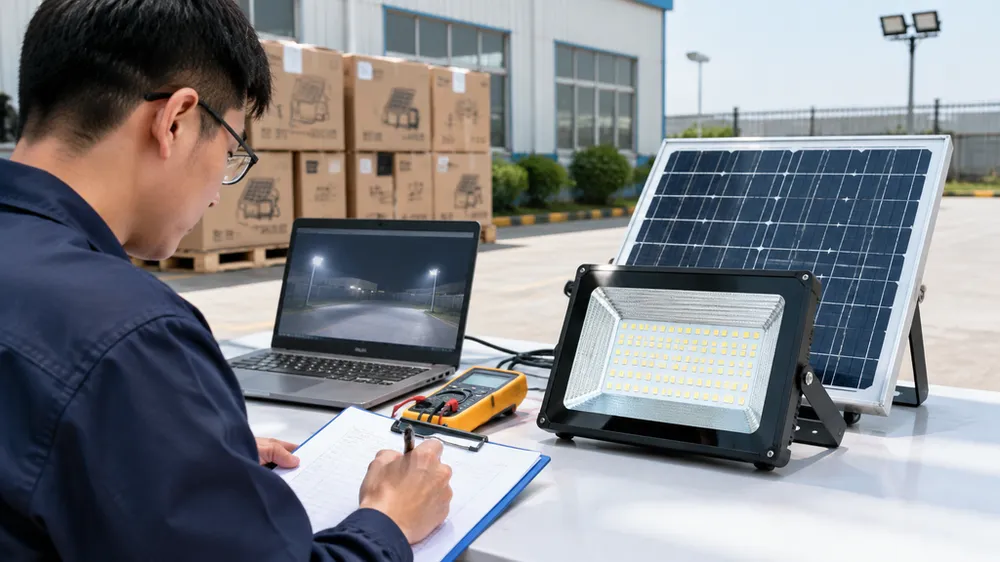
Capacity calculation transparency: A complete factory quote states operating mode (dusk-to-dawn or PIR, plus trigger frequency assumption for PIR), nightly runtime hours (for dusk-to-dawn) or trigger events per night (for PIR), autonomy days (2-day minimum, 3-day recommended, 4-day for markets with extended rainy seasons like Southeast Asia monsoon regions), and resulting Ah capacity with chemistry specified (LiFePO₄ preferred). Example transparent spec: "20W flood light, PIR motion sensor mode, medium traffic assumption (100 triggers/night, 30-second duration), 3-day autonomy, 9Ah LiFePO₄ battery, 10.0V cutoff." That statement gives you everything needed to verify whether the battery matches your deployment conditions.
Red flag: Quotes that list battery capacity without stating operating mode assumptions. That usually means the factory is using a generic spec copied from a similar product, not actually calculating capacity based on your project's energy budget. Second red flag: quotes that list "lithium battery" without specifying LFP vs ternary chemistry — that ambiguity lets the factory substitute cheaper ternary cells post-contract while technically meeting the "lithium battery" claim. Third red flag: runtime claims that seem too good for the stated battery capacity (e.g., "20W load, 50Ah battery, 20-hour runtime" — that's 1000Wh, physically impossible from a 12V 50Ah battery which only stores 600Wh). Those inflated claims suggest the factory doesn't understand the electrical fundamentals, which doesn't inspire confidence in their controller design or QC process.
JXSOL battery sizing protocol: Our datasheets and quotes include mode-specific runtime tables showing battery capacity, operating mode, assumed traffic pattern (for PIR), autonomy days, and resulting nightly runtime or trigger capacity. Example table excerpt from our 30W flood light datasheet: "30W PIR mode, low traffic (20 triggers/night): 12Ah LFP, 3-day autonomy, ~1,800 trigger events per full charge" versus "30W dusk-to-dawn mode: 65Ah LFP, 3-day autonomy, 9 hours/night runtime." That side-by-side comparison shows you exactly how mode selection changes battery requirements for the same wattage fixture, and gives you the data to verify our sizing against your field conditions before placing a volume order.
Transparent battery sizing protects you in two ways: First, it lets you catch over-spec waste before you commit to 1,000-unit orders (if our quote shows 15Ah battery but your actual deployment only needs 9Ah based on trigger frequency estimates, you can request a down-spec to reduce unit cost). Second, it protects against warranty disputes by documenting the assumptions behind our runtime claims (if your field performance differs from datasheet spec, we can trace it back to traffic pattern differences or installation issues like insufficient solar panel exposure, rather than arguing about whether the battery is "defective").
JXSOL Manufacturing Advantage — Dual-Mode Configuration and OEM Controller Customization
Most consumer solar lights ship with fixed single-mode controllers because the manufacturers source pre-assembled controller boards from third-party electronics suppliers and don't have engineering capability to modify them. If the end customer decides six months later they want motion sensor instead of dusk-to-dawn (or vice versa), they're replacing the entire fixture or at minimum buying a new controller board and paying for installation labor to swap it. That's not viable for project buyers managing 200+ unit deployments — changing modes post-installation needs to be a field configuration step, not a hardware replacement project.
Industry context for dual-mode availability: Consumer-grade solar lights sold through retail channels (Amazon, big-box stores) almost never offer switchable modes because the target buyer doesn't understand the difference and the manufacturer doesn't want to support field configuration questions. Commercial-grade solar lighting for project buyers sometimes offers dual-mode, but often at a premium price (10–15% higher unit cost) because the factory is integrating two separate controller boards or using a more expensive MCU (microcontroller) to handle both logic paths. That premium pricing assumes dual-mode is a feature add-on, not a standard platform capability.
JXSOL dual-mode platform: Our 30W–200W flood light series uses a unified controller PCB that supports both PIR and dusk-to-dawn operation via DIP switch configuration on the board (4-position switch, two positions control mode selection, other two control trigger duration and sensitivity). The switch is accessible through a port in the back of the fixture housing — no need to open the main sealed chamber, so IP65/IP67 rating stays intact during field reconfiguration. Installer or distributor can set mode at deployment time based on actual site conditions, or switch modes later if project requirements change (we've had buyers switch entire 100+ unit parking lot deployments from PIR to dusk-to-dawn after six months when occupancy patterns changed post-COVID return-to-office shifts).
Commercial advantage for distributors: One SKU serves multiple end-customer needs. If you're importing 500 units for regional distribution, you're not betting that 250 will want PIR and 250 will want dusk-to-dawn — you're importing 500 dual-mode units that each customer configures based on their specific project. That flexibility reduces your inventory risk and lowers your minimum order commitment (MOQ applies per SKU, so one flexible SKU means you hit MOQ thresholds faster than if you're splitting orders across multiple single-mode SKUs). It also simplifies spare parts inventory: one controller board design, one battery capacity range, one solar panel spec — fewer components to stock for warranty support.
Commercial advantage for project buyers: Field-switchable mode allows pilot testing in actual deployment environment before committing to volume procurement. Deploy 50 units in PIR mode across different zones of your parking lot or campus, measure actual trigger frequency and battery performance over 8–12 weeks (covering at least one full lunar cycle to account for natural light variation), then decide whether to proceed with PIR for the remaining 500-unit order or switch to dusk-to-dawn based on field data. That testing costs you nothing extra (dual-mode fixtures are same unit price as single-mode for volume orders 100+ units) and protects you against the two most common solar lighting mistakes: over-specifying battery capacity for low-traffic areas (wasting money) or under-specifying for high-traffic areas (generating warranty complaints).
OEM controller customization for volume orders (MOQ 500 units): For buyers who know their exact deployment requirements, we can factory-preset PIR sensitivity, trigger duration, lux threshold, and dim-mode standby wattage before shipment. Example: you're deploying 1,000 units in a Middle Eastern climate where twilight is short and you want lights to trigger only at full darkness — we preset lux threshold to 3 lux (vs default 8 lux) so fixtures don't waste battery during late-afternoon low sun angle. Or you're deploying in a high-security perimeter where you want maximum detection range — we adjust PIR sensitivity potentiometer to low-threshold setting (increases false positives slightly but ensures no missed detections). Those customizations are configuration steps in our testing line, not separate R&D projects, because we design controllers in-house rather than sourcing them from third parties.
Quality validation across both modes: Both PIR and dusk-to-dawn operation are validated under the same IEC 62124 photovoltaic lighting standard (covers charge controller performance, battery protection, and LED driver stability) and IP65/IP67 ingress protection testing (6-hour water spray test, dust chamber exposure). Switching between modes doesn't change the waterproof rating or electrical safety certification — you're using the same LED driver, same battery protection circuit, same housing seal, just different trigger logic. That removes buyer uncertainty about whether PIR mode is somehow less reliable than dusk-to-dawn (common misconception because PIR adds a motion sensor component that could theoretically fail, but our PIR false-positive rate in field deployments is <0.1% and sensor failure rate after 24 months is <0.3%, statistically equivalent to photoresistor failure rate in dusk-to-dawn controllers).
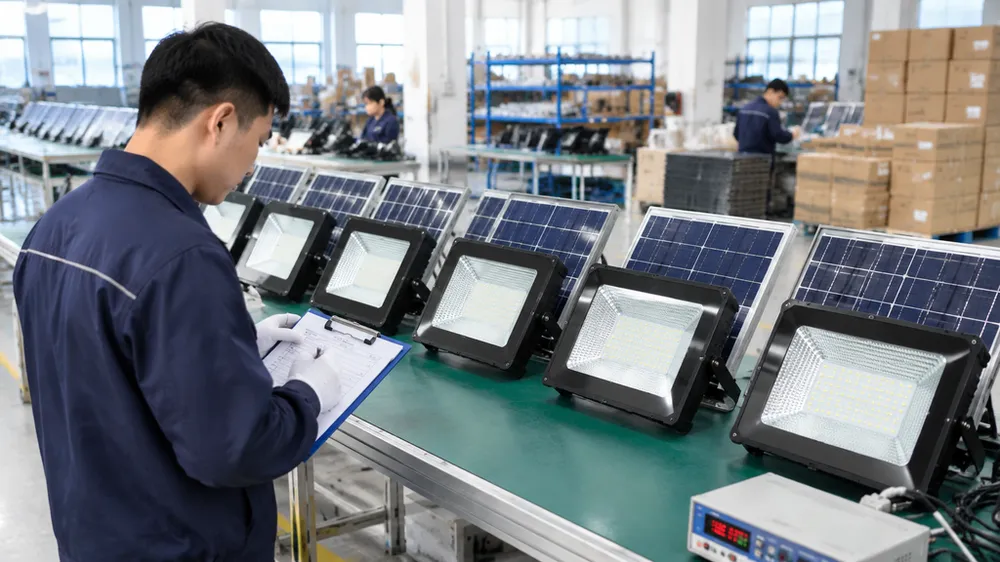
Factory positioning for OEM buyers: JXSOL is a 12,000 m² solar lighting manufacturer with in-house controller design, PCB assembly (automated SMT lines), and integrated testing lab — not a trading company that assembles orders from three different component suppliers. When you request controller customization or dual-mode configuration, that happens on our production line under our QC protocols, not through a third-party subcontractor where we have no visibility into process control. That matters for two reasons: First, it means controller modifications don't require new MOQ negotiations with an upstream supplier (we can customize at our standard 500-unit OEM threshold). Second, it means we can troubleshoot field issues by reviewing actual controller firmware and PCB layout, not guessing about what a third-party supplier built.
Choosing between motion sensor and dusk-to-dawn modes isn't just about battery life — it's about matching controller logic to project economics, traffic patterns, and lighting function priorities. The battery life advantage of PIR mode is real (4–6× longer autonomy in low-traffic deployments, 50% longer in medium-traffic environments), but that advantage only materializes if your trigger frequency estimate matches field reality and your controller sensitivity is tuned to deployment conditions. Dusk-to-dawn mode trades higher battery cost for predictable runtime and simpler project planning. Dual-mode configurability gives you both options on the same platform, protecting against pre-deployment estimation errors and allowing mode optimization based on actual field data rather than theoretical assumptions.
For volume orders where mode selection directly affects your landed cost and warranty liability, having a factory partner that can configure controller parameters to your specifications — and document the battery sizing assumptions transparently — determines whether your solar lighting project hits target margin or generates unexpected costs six months post-delivery.