Why Commercial Solar Flood Lighting Specifications Determine Field Performance, Not Just Data Sheet Compliance
The cost of a spec failure in commercial solar flood lighting isn't just product replacement. It's site revisit labor, customer trust loss, and the margin you lose when a project requires a second fix. We see it often: a buyer orders 200 units based on a data sheet that looks fine, deploys them across a parking lot or industrial yard, and three months later half the lights aren't making it through the night. Or the first rainy season causes electrical shorts because the waterproof seal wasn't what it claimed to be.
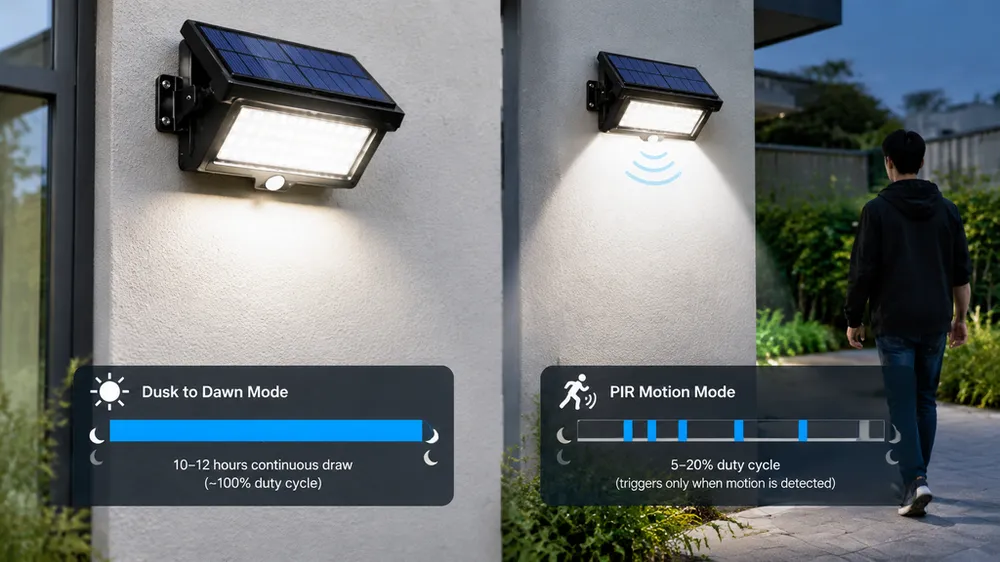
Residential-grade solar floods can pass basic spec sheets but fail under commercial duty cycles. The difference isn't just scale — it's the runtime expectations (10-12 hours per night instead of 6-8), the weather exposure (roof mounting with no shelter versus backyard eaves), and the lumen maintenance standards (consistent output across a 500-unit batch, not just the sample you tested). Most commercial solar flood lighting returns we track come from three failure modes: battery depletion before dawn in the target latitude, waterproof seal failure causing electrical shorts, and lumen output degradation across batches or over the warranty period.
This article is a procurement checklist organized by the specs that prevent each failure mode. "Verify before placing an order" doesn't mean comparing data sheet claims — it means requesting test reports, factory process evidence, and sample validation at the stages where you still have leverage. If you're sourcing for a project where field performance matters, these are the spec categories worth your time during RFQ and sampling.
Lumen Output and Beam Angle — Matching Light Distribution to Commercial Application Requirements
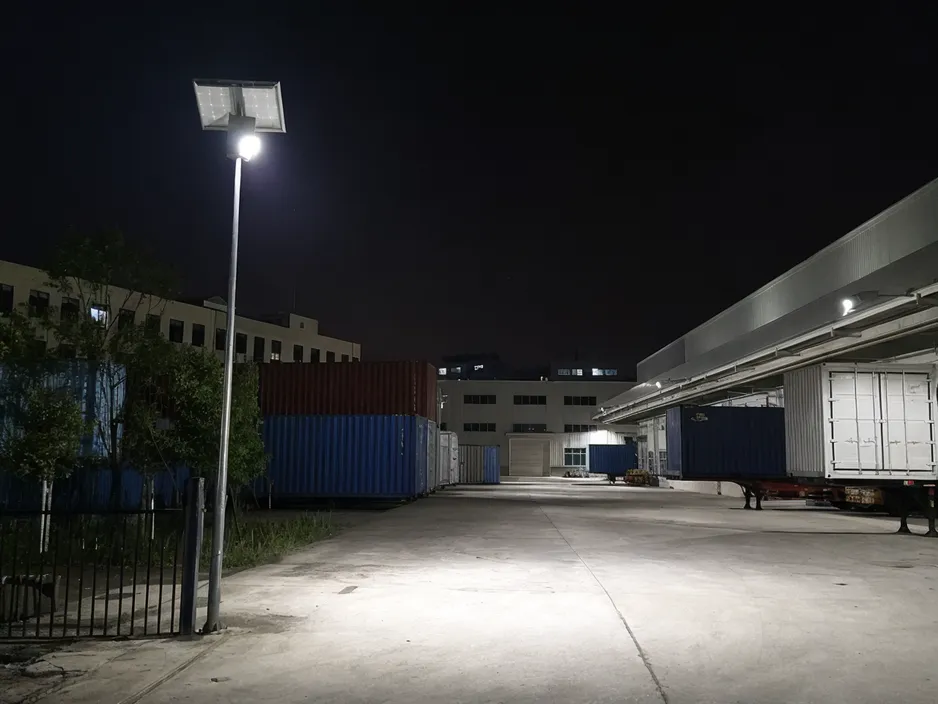
Lumen output determines how much light the fixture produces; beam angle determines where that light goes. For commercial solar flood lights, the application segment drives both numbers. Small commercial perimeters and parking lots typically need 2,000-4,000 lumens per fixture. Industrial yards and loading docks require 4,000-8,000 lumens. Large area coverage or high-mounting installations (over 8 meters) can justify 8,000-12,000 lumens, though at that output you're trading battery capacity and solar panel size for brightness.
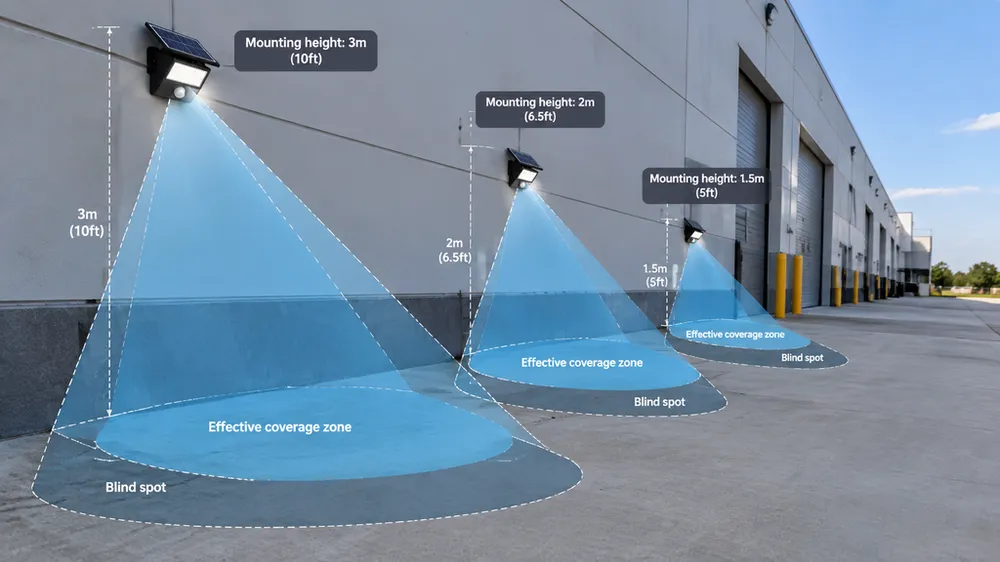
Beam angle determines coverage geometry, and this is where most spec mismatches happen. Narrow beam angles (15-30°) throw light farther and work for distance applications or facade lighting, but they create hotspots and leave gaps if you're trying to cover a wide area. Medium beam angles (60-90°) handle general area coverage — parking lots, walkways, commercial perimeters. Wide beam angles (120° or more) flood a large space but lose intensity fast, so they only work for short mounting heights or applications where you need even wash lighting over precision throw.
The common buyer error: speccing high lumens with a narrow beam, then wondering why ground coverage is poor. Or mounting a wide-beam flood on an 8-meter pole and wondering why the center intensity is weak. The two specs interact, and your mounting height and coverage requirement determine the right pairing.
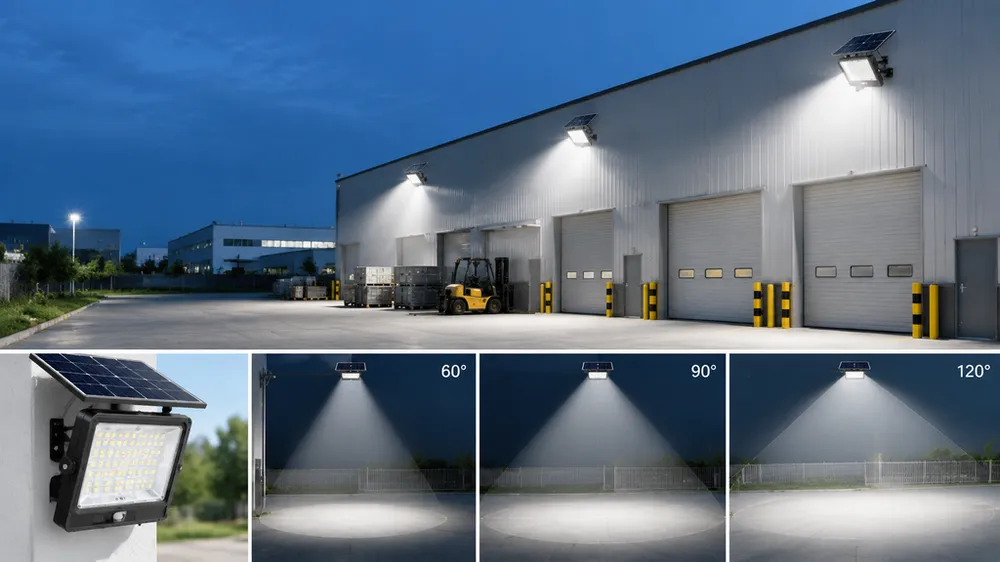
When you're evaluating suppliers, ask for IES photometric test reports showing actual lumen output and beam distribution — not just LED chip datasheet calculations. A factory that tests assembled fixtures catches batch inconsistency before shipment. A factory that only quotes chip specs is hoping the assembly process doesn't lose efficiency, and that's a gamble with your field performance.
We test lumen output and color temperature on every production batch before shipment. It adds time, but it's the only way to catch the 3-5% of units that fall outside spec due to LED binning variation or driver inefficiency. If a supplier can't provide photometric test reports for the actual product (not just the LED chip), that's a process gap that shows up as performance variance in your deployment.
Battery Capacity and Solar Panel Sizing — Engineering for Target Latitude and Autonomy Days
Battery capacity determines how many hours the flood can run per charge; solar panel wattage determines how quickly it recharges. For commercial deployments, the critical spec is autonomy days — how many consecutive overcast days the light can still operate through the full night. Residential solar lighting typically targets 1-2 autonomy days. Commercial and industrial solar flood lights need 3-5 autonomy days because the cost of a dark site (security risk, contractual penalties, customer complaints) is higher than the cost of a larger battery.
Battery capacity is measured in watt-hours (Wh) or amp-hours (Ah at a specified voltage). A 40Wh battery running an 8W LED array for 8 hours per night uses 64Wh per cycle, so it needs to recharge fully during the day or it depletes over time. Solar panel wattage determines recharge speed, but that speed depends on your deployment latitude and seasonal insolation. The same battery and panel combination that works in a 30°N latitude climate might underperform at 45°N latitude because winter sunlight hours and angle reduce panel efficiency.
The procurement error we see most: buyers copy battery and solar panel specs from one project to a different latitude, then wonder why lights don't last through the night after a week of overcast weather. Or they assume "3-5 sunny hours per day" from the spec sheet without checking local solar maps for their target market.
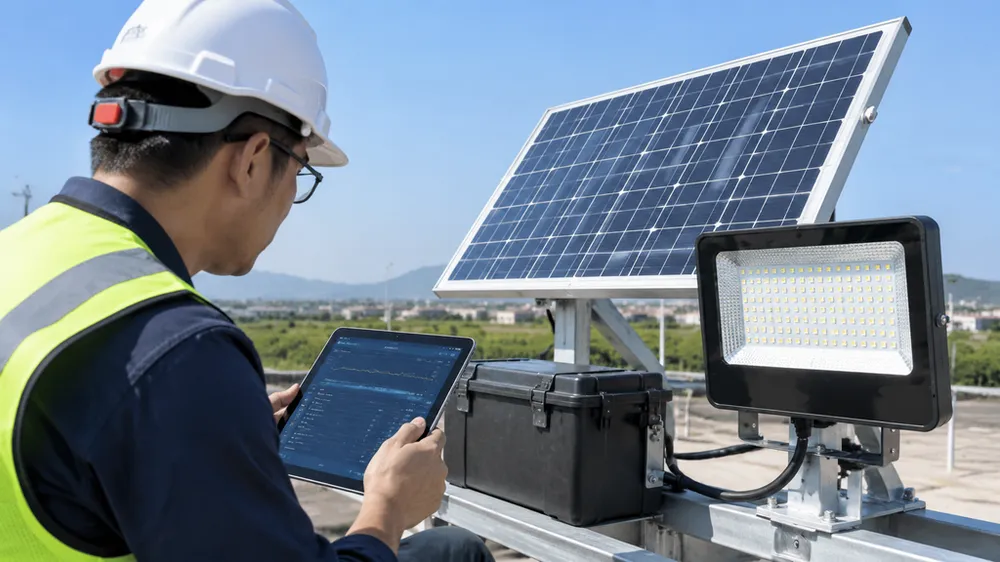
Here's a practical example: a 40Wh battery paired with a 20W solar panel gives you 3 autonomy days at 8-hour nightly runtime in a 30°N latitude region (roughly the southern U.S., North Africa, Middle East). Move that same configuration to a 45°N latitude region (northern Europe, northern U.S., Canada) and winter months drop your effective solar charging by 30-40%, so you need a 25W panel to maintain the same autonomy. If you're sourcing for multiple markets, you either need different configurations per region or you oversize the panel for the worst-case latitude and accept the cost.
When you're requesting quotes, ask the factory engineering team to calculate battery autonomy days and solar panel sizing for your specific deployment latitude and target runtime. If the supplier responds with a one-size spec sheet and no latitude discussion, that's a signal they're not engineering the system — they're reselling a fixed configuration and hoping it works. Our in-house engineering team sizes battery and panel combinations for buyer geography because the spec sheet default doesn't account for latitude variance, and that variance determines whether your lights work year-round or fail in winter.
IP Rating and Waterproof Construction — Preventing Electrical Failures in Commercial Outdoor Environments
IP rating defines ingress protection against dust and water. For commercial solar flood lights, the two ratings you'll encounter are IP65 and IP67. IP65 is water jet resistant — it can handle rain and hose-down cleaning, suitable for most commercial outdoor mounting under eaves or with moderate weather exposure. IP67 is submersion resistant up to 1 meter for 30 minutes — required for ground-level mounting, coastal salt spray environments, or heavy rain climates where water pooling is common.
The difference matters because commercial installations face harsher exposure than residential. Rooftop mounting means direct weather with no shelter. Industrial yards add dust, moisture, and temperature cycling. Public infrastructure sites risk vandalism and impact. If you're mounting lights in a high-humidity coastal region or an industrial zone with frequent washdowns, IP65 might not hold up. If you're doing ground-level perimeter lighting where water can pool during storms, IP67 is the baseline.
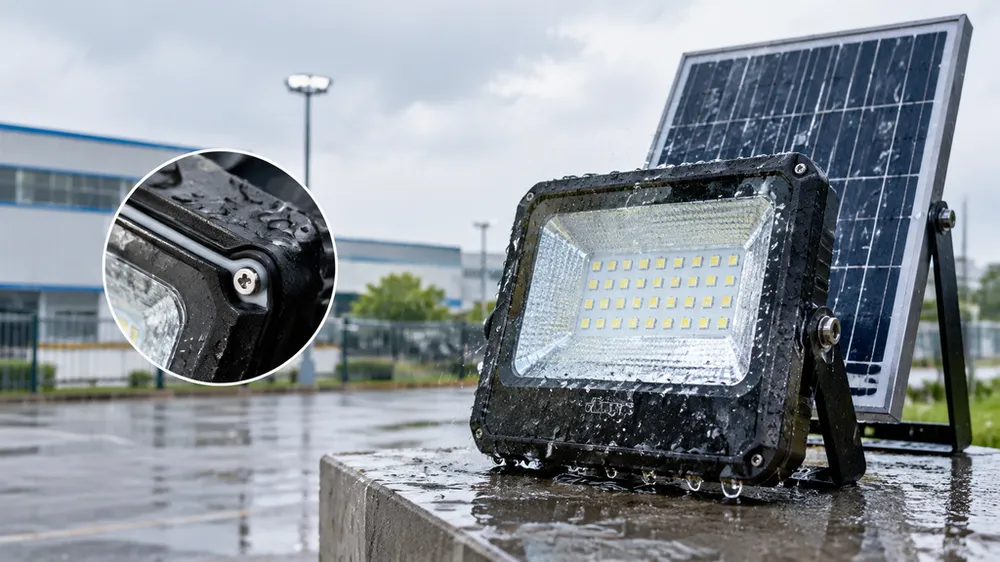
The common waterproof failure: battery compartment seals degrade after 6-12 months, moisture enters, and you get a short circuit or battery corrosion. The root cause is usually gasket material — cheap rubber gaskets harden and crack under UV exposure and temperature cycling, while silicone gaskets stay flexible longer. Most data sheets just say "IP65" without specifying gasket material or whether the rating was tested on the assembled unit or just assumed from component ratings.
When you're evaluating suppliers, ask for IP rating test reports from IEC 60529 accredited labs, not just an "IP65 claim" on the data sheet. Ask what gasket material they use and whether it's been tested for UV and temperature aging. Ask if they test waterproof integrity on assembled units before shipment, or if they're trusting component ratings and hoping assembly doesn't compromise the seal.
We run 100% pre-shipment waterproof inspection on assembled units because component-level IP ratings don't guarantee assembled-unit performance. A battery compartment can be IP67-rated in isolation, but if the lid screw torque is inconsistent or the gasket seats unevenly during assembly, you lose the seal. Catching that before the product ships is the difference between a reliable deployment and a batch return after the first rainy season. Our IP65/IP67 certification documentation is included per order because regulated market procurement and project tenders often require it in bid packages.
LED Chip Type, Color Temperature, and CRI — Ensuring Consistent Illumination Quality Across Batches
LED chip brand and bin selection affect two things buyers care about: lumen maintenance over the warranty period and color consistency across production batches. For commercial solar flood lighting, lumen degradation and batch color mismatch are the quality complaints that show up six months after deployment, not during initial testing.
LED chip brands vary in quality tier. Bridgelux, Samsung, and Osram are tier-1 suppliers with tight binning and long-term lumen maintenance data. Epistar and other tier-2 suppliers offer decent performance at lower cost but with wider binning tolerances. Generic LED chips can meet initial lumen specs but degrade faster — the difference between 90% lumen maintenance at 3 years versus 70% lumen maintenance at 3 years.
Color temperature is measured in Kelvin (K) and determines the visual appearance of the light. For commercial applications: 3000K warm white works for hospitality and residential-adjacent commercial where you want a softer appearance; 4000-5000K neutral white is the standard for general commercial and parking lots; 5700-6500K cool white suits industrial yards and security applications where you want maximum visibility and a "bright" perception.
CRI (Color Rendering Index) measures how accurately colors appear under the light. It matters for retail facades, public plazas, and anywhere color accuracy affects visibility or aesthetics. For pure security or perimeter lighting, CRI is less critical — you're optimizing for brightness and coverage, not color fidelity.
The batch inconsistency problem: a buyer orders 100 units, first shipment measures 5000K, reorder six months later measures 5500K, and the lights look visibly different when installed on the same site. This happens when the factory doesn't bin-match LEDs across production runs. LED manufacturers produce chips in "bins" — batches with slight color temperature and brightness variation. A responsible factory buys from the same bin or uses tighter bin tolerances to keep color consistent across orders.
When you're requesting quotes, specify LED chip brand (e.g., Bridgelux, Epistar, Samsung) and color temperature bin tolerance (±200K or tighter). Ask the factory if they bin-match LEDs across production runs or if they source from whatever bin is available at order time. If the supplier can't commit to bin-matching, expect color drift across reorders.
We control LED sourcing and bin chips for color consistency because reorder batch mismatches damage buyer relationships. Automated color temperature testing before shipment catches units outside tolerance. It's a cost, but it's cheaper than handling returns or losing repeat orders because the second batch doesn't match the first.
Certifications and Compliance Documentation — Meeting Regulated Market and Project Tender Requirements
ISO 9001:2015 certifies the factory's quality management system — documented processes, traceability, corrective action procedures. It's not a product spec, but it matters for buyers who need supplier audit trails or who source for regulated markets where factory process compliance is part of bid requirements. CE marking is required for European import. RoHS compliance covers lead-free and hazardous substance restrictions in the EU and other regulated markets. IEC 62124 is the international standard for solar lighting system performance. IP65/IP67 ratings come from IEC 60529.
Many project tenders — government infrastructure, commercial real estate, utility-scale deployments — require certification documentation in the bid package. If you can't provide it, you're not in the running. The question isn't just "Is the factory certified?" but "Can they issue per-order certification documents when you need them for a specific tender?"
Factory capability matters here. A factory with in-house testing labs can generate reports and certification documents faster than a factory that relies on third-party batch testing. If you're working on a project with a tight tender deadline, turnaround time on certification paperwork can determine whether you make the submission window.
We hold ISO 9001:2015, CE, RoHS, IP65/IP67, and IEC 62124 certifications with per-order documentation support. Our in-house testing lab — battery charge/discharge cycling, lumen and color temperature measurement, waterproof pressure testing — means we can generate test reports without waiting on external labs. When a buyer needs certification documents for a tender, we can turn that around in days, not weeks.
MOQ, Sampling, and Spec Customization Options — Validating Specifications Before Full Project Commitment
Minimum order quantity (MOQ) determines your risk exposure during spec validation. A 500-1,000 unit MOQ forces you to commit to full project volume before you've tested the product in field conditions. A 100-unit MOQ lets you validate lumen output, battery autonomy, and waterproof performance in your actual deployment environment before scaling to bulk orders.
Sample orders — typically 5-10 units — let you bench-test specs and verify build quality, but they don't tell you how the product performs over weeks or months in field conditions. A low-MOQ production run gives you enough units to deploy across a representative site and monitor real-world performance (battery autonomy through overcast periods, waterproof integrity through rain cycles, lumen output consistency across the batch).

OEM/ODM spec customization becomes relevant when your target market or project requirements don't align with standard catalog specs. Lumen output tuning (adjusting LED array size or driver current), battery capacity adjustment (oversizing for higher autonomy days or longer runtime), custom color temperature (matching existing site lighting or regional preferences), and mounting bracket modifications for specific installation conditions.
The procurement strategy: use a low-MOQ supplier for your spec validation batch, confirm field performance over 4-6 weeks, then scale to full project volume. If the product fails validation, you've risked 100 units and a few thousand dollars, not 1,000 units and a full project budget.
When you're evaluating suppliers, confirm the MOQ for standard specs and for custom specs. Ask if they support paid sample orders where the sample cost is credited toward the bulk order if you proceed. Some factories won't credit samples; others will if the bulk order exceeds a threshold. Know the terms before you commit.
We set a 100-unit MOQ for standard models specifically to support spec validation before full commitment. For OEM/ODM customization — lumen output, battery capacity, color temperature, mounting brackets — we involve our engineering team to confirm feasibility and provide adjusted specs based on your target application. Sample orders are supported, and sample cost credits toward bulk orders over 500 units.
Pre-Shipment Inspection and Warranty Support — Reducing Post-Delivery Failures and Replacement Costs
Pre-shipment inspection determines what percentage of your order arrives defect-free. The two approaches: in-house 100% inspection where every unit is tested, or third-party AQL (Acceptable Quality Limit) sampling where a statistical sample is tested and the batch is accepted or rejected based on defect rate. AQL sampling is faster and cheaper, but it misses batch defects that fall outside the sample.
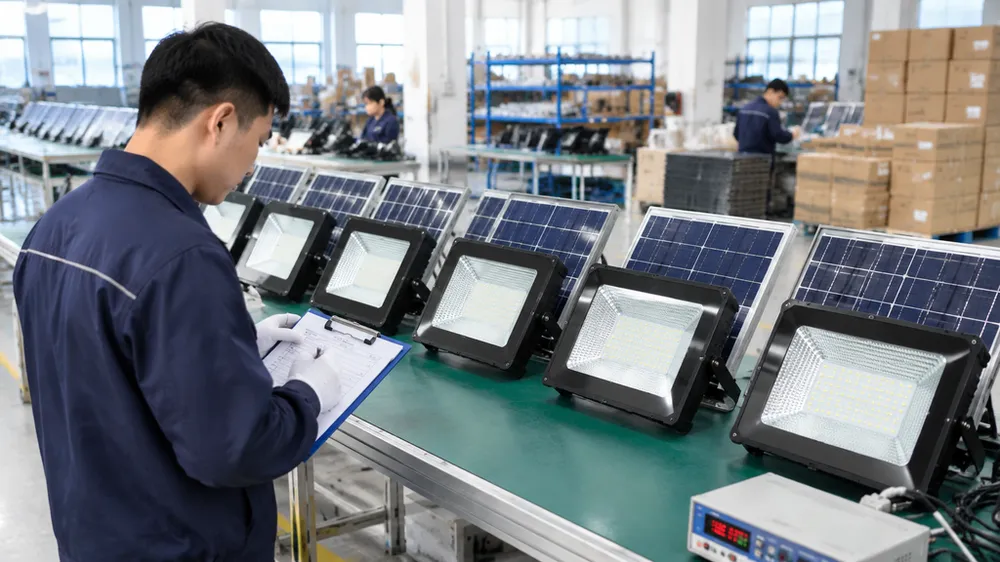
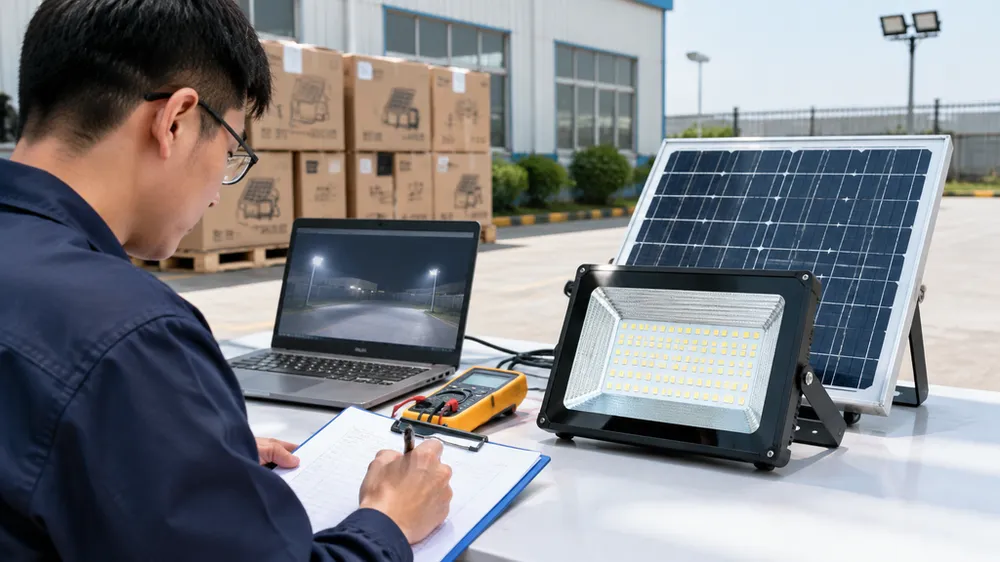
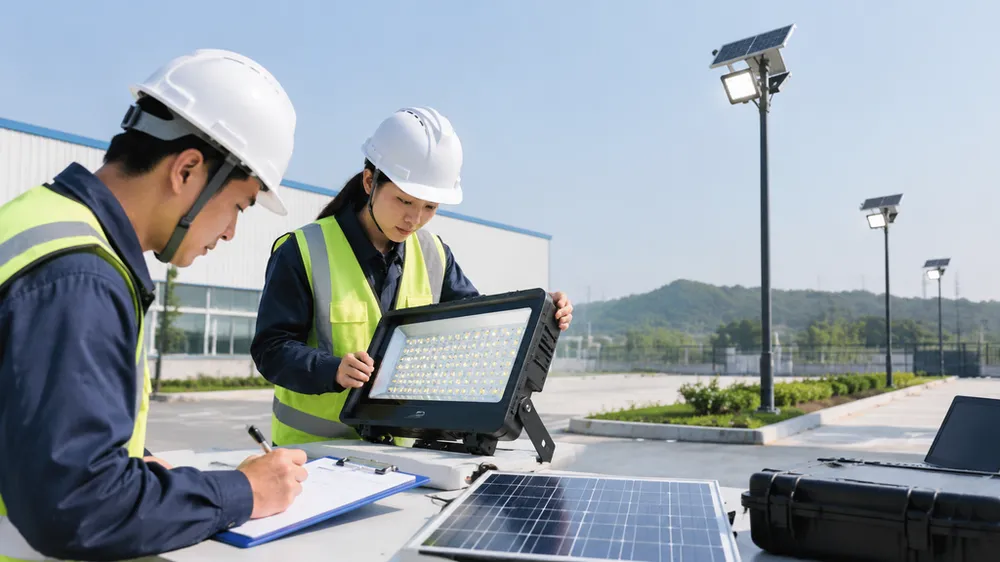
For commercial solar flood lighting, the inspection scope should cover lumen output testing, battery charge/discharge cycle verification, waterproof pressure testing, and color temperature measurement. A factory with in-house testing equipment can inspect 100% of units without relying on external labs. A factory without testing equipment either skips inspection or pays for third-party AQL sampling, which adds cost and time but doesn't catch every defect.
Warranty structure for commercial deployments: 3 years is market standard, but verify what the warranty covers. Full unit replacement versus component-only replacement (where you're responsible for labor and shipping). Who pays return shipping and field labor if a unit fails on-site. What the claim process looks like and what the turnaround time is from claim submission to replacement shipment.
Post-delivery failure cost in a commercial project isn't just product replacement. It's site revisit labor (often more expensive than the unit itself), downtime during replacement (security risk or contractual penalties if lights are out), and potential loss of the customer relationship if the failure rate is high enough to erode trust.
When you're evaluating suppliers, ask them to specify their pre-shipment inspection protocol and provide sample test reports. Ask what their warranty covers, who handles return logistics, and what the average turnaround time is from claim to replacement. If the supplier can't articulate a clear inspection process or warranty claim procedure, that's a cost risk you'll carry post-delivery.
We run 100% pre-shipment inspection with in-house battery, lumen, and waterproof testing because AQL sampling doesn't catch the 2-3% of units that fail under load despite passing visual inspection. Our 3-year warranty covers full unit replacement including shipping for manufacturing defects, and our documented claim process averages 7-10 days from claim submission to replacement shipment. The inspection cost is built into our pricing because preventing field failures is cheaper than handling returns and warranty claims after deployment.