Most US buyers sourcing commercial solar flood lights start on Alibaba or Made-in-China, scroll through pages of similar-looking listings, and end up confused about which suppliers actually manufacture the product versus which ones are trading companies listing other factories' inventory. The aggregator model works for browsing, but it creates two problems for repeat buyers: you can't verify QC depth from a product photo, and your second order might come from a different factory than your first.
This article explains how to evaluate solar flood light manufacturers beyond price, what QC protocols separate reliable suppliers from resellers, and where factory-direct relationships improve cost control and reorder consistency for distributors, project contractors, and brand owners building private-label solar lighting programs.
What US Buyers Should Verify Before Sourcing Solar Flood Lights from Any Manufacturer
The sourcing decision for commercial-grade solar flood lights comes down to five verification criteria that matter more than the initial quote: production capacity proof, in-house versus outsourced QC, engineering team location, MOQ structure, and certification documentation workflow.
Production capacity proof means asking for specifics: how many lines, daily output per line, and what inspection rate. A factory claiming 100,000-unit monthly capacity should be able to explain how that number breaks down. Six lines running 800 units per day with 100% pre-shipment inspection means realistic lead time is calculable — 5,000 units ships in roughly a week, not "3-5 days" pulled from nowhere. If the supplier can't explain the math, the capacity claim is marketing.
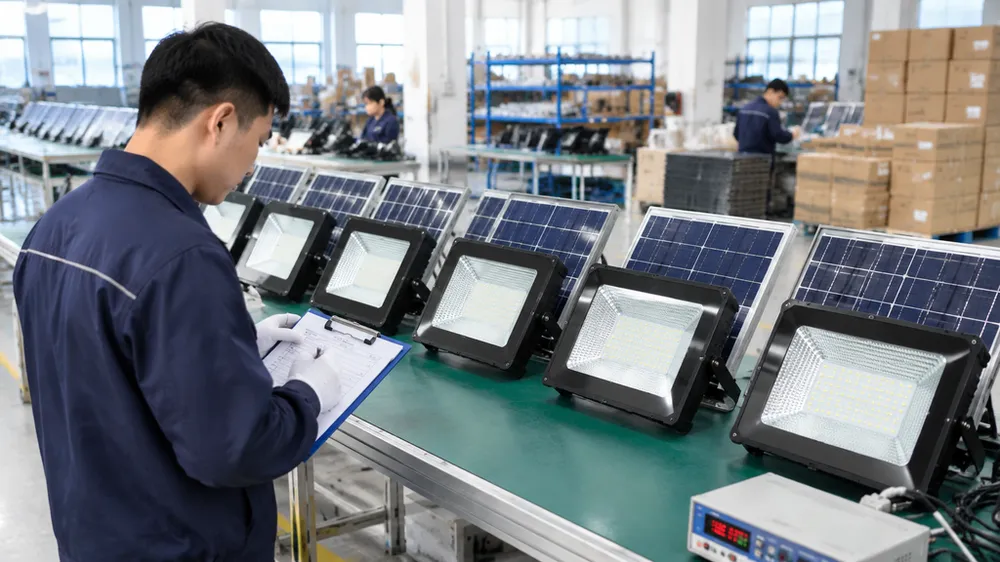
In-house versus outsourced QC determines whether the factory controls quality or discovers problems after assembly. IP waterproof testing, battery charge/discharge cycle verification, and lumen binning require dedicated equipment. If the factory sends samples to a third-party lab 40 kilometers away for every custom spec check, your OEM project timeline just doubled. We run IP65/IP67 pressure tank testing, aging racks, and lumen measurement on-site — same-day spec verification during product development, not "we'll send it out and get back to you next week."
Engineering team location matters for OEM and ODM buyers. A 15-engineer in-house R&D team can adjust charge controller logic for northern US winter daylight, resize battery packs for target autonomy days, or modify lumen output without outsourcing the work. Distributed engineering (factory in one city, design team in another) adds communication lag and cost to every custom request.
MOQ structure reveals whether the supplier wants project buyers only or supports distributors testing new SKUs. High-volume factories often require 500-1,000 units minimum, which works for contractors deploying parking lot lighting across multiple sites but kills inventory flexibility for distributors validating a new product with their customers before scaling. Our standard models start at 100 units — low enough to test market fit without container commitment.
Certification documentation workflow separates factories from trading companies. Ask when you receive CE, RoHS, IP rating certificates, and UN38.3 battery shipping compliance reports. If the answer is "available upon request after payment clears," you're dealing with a middleman who will chase the actual manufacturer for documents while your container sits at the port. Factories provide certification packages with the order because they generated the test reports during production.
The aggregator problem is not that the platforms list bad suppliers — it's that listings don't communicate these five criteria. A product photo, an FOB price, and a gold supplier badge tell you nothing about whether the factory can deliver your second order with the same lumen consistency as your first.

10 Solar Flood Light Manufacturers US Buyers Source From
This list covers suppliers serving different buyer profiles — US-based assemblers with local inventory, China factories with US sales infrastructure, and direct export manufacturers. Selection criteria include verifiable production capacity, commercial-grade product lines, and direct factory access. The goal is not to rank these suppliers against each other but to explain what kind of sourcing relationship each one supports and where their operational model fits different buyer needs.
1. Senstar (Ontario, Canada / US Operations)
Senstar manufactures perimeter security lighting including solar-powered flood and area lights for commercial security applications. Their product line integrates with intrusion detection systems, which matters for buyers deploying solar flood lights as part of a larger security infrastructure rather than standalone illumination. US buyers working with Senstar typically source through their security distribution channel, not as a lighting-only purchase.
The advantage here is integration support — if you're specifying solar flood lights for a fence line that already runs Senstar perimeter sensors, the lighting can tie into the same control platform. The limitation is that this is a security-first supplier, not a high-volume commercial lighting factory. MOQ and lead time reflect security project cycles, not distributor inventory programs.
Official site: senstar.com
2. Qualite (Guangdong, China — Export Focus)
Qualite is a China-based manufacturer with a commercial solar lighting catalog covering street, area, and flood lighting. They run dedicated production lines for export markets and hold ISO 9001, CE, and RoHS certifications. Their flood light range covers 20W through 200W configurations with LiFePO4 battery options and IP65/IP67 housing.
US buyers source from Qualite when they need commercial-grade specs with factory-direct pricing and are comfortable managing container imports. MOQ typically runs 200-500 units depending on configuration. Lead time sits around 25-35 days for standard models, longer for OEM modifications. The limitation is that QC depth and engineering responsiveness vary — this is a high-volume factory optimized for large repeat orders, not rapid OEM prototyping.
Official site: qualite.com.cn
3. Shenzhen Spark Optoelectronics S&T Co., Ltd. (Shenzhen, China)
Spark specializes in commercial and industrial LED lighting including solar flood lights for warehouses, parking lots, and perimeter security. Their factory holds TUV, CE, RoHS, and IP65/IP67 certifications, and they maintain a dedicated solar lighting production division. Product range covers integrated solar flood lights from 30W to 300W with motion sensor and remote control options.
US buyers working with Spark typically run project-based procurement — municipal lighting upgrades, commercial parking lot installations, industrial site security lighting. The factory supports OEM with custom lumen output, color temperature, and battery sizing. MOQ for OEM projects runs higher (500+ units), but they offer flexibility for repeat buyers once the spec is locked. The advantage is engineering depth for custom projects; the limitation is that this is not a distributor-friendly low-MOQ supplier.
Official site: ledsparkle.com
4. ALLTOP Lighting (Zhongshan, China)
ALLTOP operates a solar lighting factory in Zhongshan, Guangdong, with a catalog focused on street lighting, flood lights, and garden lighting. They hold ISO 9001, CE, RoHS, and IP65 certifications. Their flood light line covers residential through commercial wattage with integrated and split-panel configurations.
The company markets heavily to US and European distributors through trade shows and online platforms. MOQ for standard models starts around 100-200 units, which fits distributors testing new SKUs. Lead time runs 20-30 days for catalog products. The limitation is that quality consistency feedback from US buyers is mixed — some report good experiences, others flag batch-to-batch lumen variance. This is a volume-oriented factory where your order size and reorder frequency likely determine the QC attention your product receives.
Official site: alltopsolarlighting.com
5. JXSOL — Zhongshan Century Juxing Optoelectronics (Zhongshan, China)
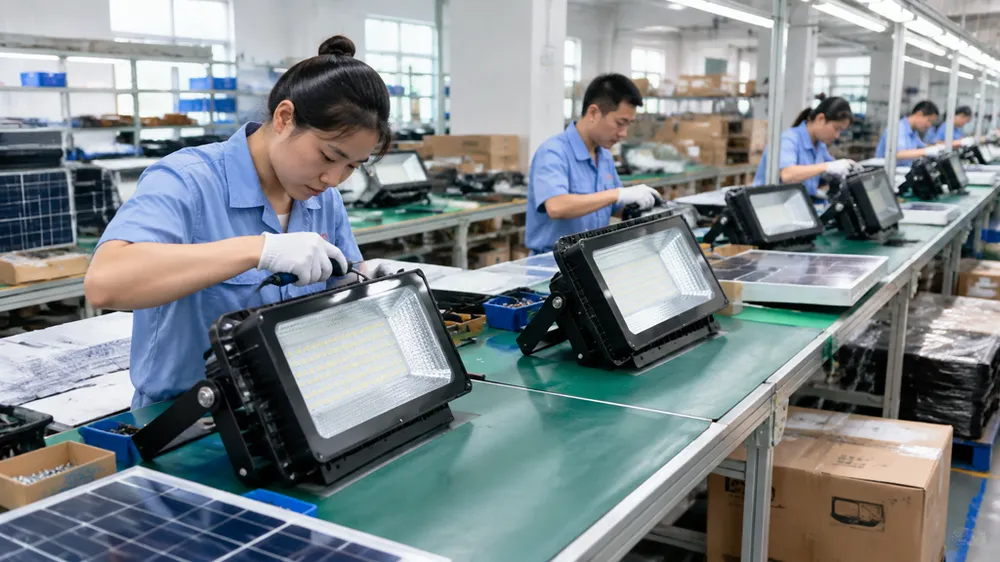
We manufacture solar flood lights and security lighting from a 12,000 m² factory in Guzhen Town, Zhongshan — the center of China's lighting manufacturing cluster. Six production lines support 1,200,000-unit annual capacity, with in-house engineering (15+ optical and electrical engineers), integrated QC lab, and 100% pre-shipment inspection.
Our solar flood lighting line covers 20W through 300W commercial-grade configurations with LiFePO4 battery systems, IP65/IP67 waterproof construction, and optional PIR motion sensors. We hold ISO 9001:2015, CE, RoHS, IP65/IP67, and IEC 62124 certifications, with full documentation packages including UN38.3 battery shipping compliance provided with every order.
MOQ starts at 100 units for standard models, which lets US distributors validate a new SKU before committing to container quantities. For OEM/ODM programs — private label, custom lumen output, regional battery sizing, or modified housing — our engineering team handles spec work in-house without outsourcing, so turnaround from concept to sample approval runs faster than factories that send design work to external agencies.
The sourcing advantage is QC depth and reorder consistency. 100% pre-shipment inspection (not spot-checking) means every unit is functionally tested before it leaves the line. In-house battery testing lab runs charge/discharge cycle verification on every batch, and lumen binning keeps color temperature and brightness variance within ±5% across your order. For US buyers building a solar lighting program with repeat procurement cycles, that consistency protects your warranty rate and customer trust.
We've supplied distributors in North America, Europe, and the Middle East since 2012. Most new buyers start with a 100-200 unit trial order to test with their own customers, then scale based on sell-through. Project contractors typically order 500-2,000 units per site deployment, and brand owners developing private-label solar flood light lines work through our OEM process with engineering review included.
Lead time for standard configurations runs 25-30 days from order confirmation. OEM projects add 10-15 days for engineering review and sample approval before production. If you need to double your order mid-season, our capacity across six lines supports that without pushing your lead time from 30 days to 90 — we schedule production in advance so reorders don't queue behind new customer onboarding.
Official site: jxsol.com
6. Shenzhen Juho Lighting Technology Co., Ltd. (Shenzhen, China)
Juho Lighting manufactures commercial LED lighting with a dedicated solar product division covering flood lights, street lights, and high-bay fixtures. They hold CE, RoHS, FCC, and IP65 certifications. Their solar flood light range targets industrial and municipal applications with high-lumen configurations (100W-400W) and extended battery autonomy for northern climates.
US buyers source from Juho when they need high-output commercial flood lighting for large-area coverage — warehouse perimeters, municipal park lighting, industrial yard security. MOQ runs 300-500 units for standard models, higher for custom specs. The factory supports OEM with engineering for lumen output adjustment and battery system sizing. Lead time sits around 30-40 days. The limitation is that this is a project-focused manufacturer, not optimized for distributor-friendly low-volume reorders.
Official site: juho-led.com
7. SolarMax Technology (Jiangsu, China)
SolarMax operates a solar lighting factory in Jiangsu Province with production lines dedicated to street lighting, flood lighting, and garden products. They hold ISO 9001, CE, RoHS, and IP66 certifications. Their flood light catalog covers residential through commercial wattage with both integrated and split-panel designs.
The company markets primarily through B2B platforms and has a US customer base spanning distributors and contractors. MOQ for catalog products starts around 200 units. Lead time runs 25-35 days. Quality feedback from US buyers is generally positive for standard configurations, but OEM support is limited — this factory is optimized for catalog sales, not custom engineering projects. If you need off-the-shelf commercial solar flood lights at volume pricing, SolarMax fits. If you need lumen adjustment or battery resizing for a specific climate zone, expect longer lead times and higher MOQ.
Official site: solarmaxled.com
8. GreenShine New Energy (California, USA — Imports + Assembly)
GreenShine is a US-based solar lighting company that imports components and assemblies from China, then handles final configuration, testing, and distribution from California. They serve US municipal and commercial buyers who want a domestic point of contact with local inventory for faster replenishment.
The advantage is speed and communication — you're dealing with a US office, not a China factory 12 hours ahead. Lead time for in-stock configurations can run as low as 3-5 days for small orders, and warranty service routes through California rather than international shipping. The trade-off is cost: US-based assemblers typically carry 40-65% markup over factory-direct China pricing because they're covering domestic overhead, inventory holding cost, and margin on both the import and distribution sides.
For urgent small orders, emergency replacement needs, or buyers who value local support over unit cost, GreenShine fits. For distributors building repeat-volume inventory programs where landed cost determines margin, factory-direct sourcing usually makes more financial sense.
Official site: greenshine.com
9. SOKOYO (Guangdong, China)
SOKOYO manufactures solar street lights, flood lights, and garden lighting from a factory in Guangdong Province. They hold CE, RoHS, FCC, and IP65 certifications. Their flood light range covers 20W through 200W with LiFePO4 and Li-ion battery options.
US buyers source from SOKOYO when they need a mid-tier factory with reasonable pricing and acceptable quality for distributor inventory programs. MOQ starts around 100-200 units depending on configuration. Lead time runs 20-30 days for standard models. The limitation is that engineering support for OEM projects is thin — this is a volume production factory optimized for catalog sales. QC depth is standard for the price range (spot-checking, not 100% inspection), which means field failure rates sit slightly higher than top-tier manufacturers but still acceptable for cost-sensitive distribution channels.
Official site: sokoyo.com
10. BBE Solar (Florida, USA — Import Distribution + Light Assembly)
BBE Solar operates as a US importer and distributor of solar lighting products with light assembly operations in Florida. They source components from China factories, handle quality inspection stateside, and serve US contractors and municipalities who prefer a domestic supplier for procurement compliance or faster support cycles.
Like GreenShine, the advantage is local inventory, US-based customer service, and faster replenishment for small orders. The trade-off is pricing — domestic distribution layers carry markup that compresses margin for distributors or increases project bid cost for contractors. BBE's model fits buyers who prioritize procurement speed and local warranty service over unit cost optimization.
For large repeat programs where cost control matters, factory-direct relationships usually deliver better economics. For spot purchases, emergency replacements, or public projects with domestic supplier preferences, BBE's US presence provides value.
Official site: bbesolar.com
Why US Distributors and Contractors Work Directly with China-Based Solar Lighting Factories
The landed cost structure explains most of it. US-based assemblers and importers who warehouse and distribute solar flood lights carry 40-65% markup over China factory-direct FOB pricing. That markup covers their overhead, inventory holding cost, warranty handling, and profit margin. For a distributor building a solar lighting catalog, that 40-65% markup sits between your cost of goods and your selling price — it compresses your margin or forces you to price above market.
Factory-direct import shifts that markup into your own margin. A 50W solar flood light that costs you $85 through a US distributor might cost $45-55 FOB from a China factory, depending on configuration and order volume. Your landed cost after freight, customs, and import fees typically runs $55-65. That $20-30 difference per unit determines whether your margin supports growth or just covers operational cost.
Customization access is the second driver. US distributors often rebrand or request spec modifications — different lumen output for a specific application, adjusted battery capacity for a regional climate, or private-label packaging for a branded solar lighting line. Factory-direct relationships let you work with the engineering team that designs the product. US-based importers usually can't modify specs because they're reselling another factory's catalog — they don't control the tooling or component sourcing.
Reorder consistency matters more than most buyers realize until they experience the alternative. Aggregator-sourced products may come from different factories batch to batch. Your first 500-unit order performs well, your customers reorder, and your second batch has different color temperature or shorter runtime because the trading company switched suppliers. That inconsistency undermines warranty reliability and customer trust. Factory-direct relationships lock you to one manufacturer — your second order comes from the same production line as your first, with the same QC process and component sourcing.
Documentation control is the fourth reason. CE, RoHS, IP rating certificates, and UN38.3 battery shipping compliance reports trace back to the factory's testing lab. When you work factory-direct, you receive those documents from the source. When you source through a middleman, you receive scanned copies that the trading company collected from the factory — sometimes delayed, sometimes incomplete, occasionally generic certs that don't match your specific product batch.
The trade-off is not invisible. Factory-direct sourcing requires you to manage container imports, handle customs clearance, plan inventory 30-40 days ahead, and absorb MOQ commitments that US distributors handle for you. For buyers ordering 50 units twice a year, that operational cost doesn't justify the margin improvement. For buyers running 500+ unit orders quarterly, the economics shift decisively toward factory-direct procurement.
QC Protocols That Separate Reliable Suppliers from Resellers Listing Other Factories' Products
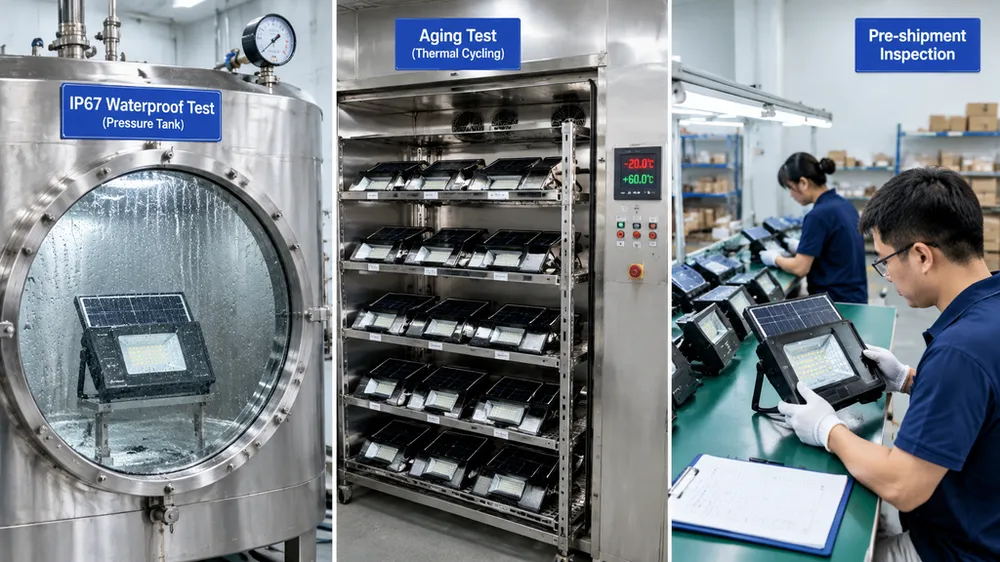
IP waterproof testing is where most solar flood light field failures originate, and it's where QC shortcuts show up first. An IP65 or IP67 rating printed on a specification sheet means the design was tested once during certification. It does not mean every unit off the line meets that standard. Reliable factories run waterproof structure inspection with pressure tank testing and aging rack simulations on production batches, not just certification samples.
Our IP testing protocol runs every housing through pressure differential verification to confirm gasket seal integrity, then moves units to aging racks for thermal cycling (high heat followed by rapid cool-down) to catch seal degradation that occurs after 6-12 months in the field. Spot-checking (random sample testing) catches catastrophic QC failures but misses batch-level variance. 100% inspection (every unit tested) catches the 3-5% of housings that pass visual inspection but fail under pressure — those are the units that leak after the first rainy season and generate warranty claims.
Resellers can't verify waterproof structure because they don't control assembly. They receive finished product from the factory, repack it, and ship it. If the factory ran spot-checking and 5% of the batch has compromised gasket seals, the reseller has no way to know until your customer reports a failure three months after installation.
Battery matching determines field lifespan consistency. Solar flood lights use lithium battery packs (LiFePO4 or Li-ion), and battery cell capacity variance within a batch drives early failures. A 20Ah battery pack assembled from cells with 5% capacity variance performs predictably — all units in your order degrade at similar rates. A pack assembled from cells with 15% variance means half your units fail early because the weakest cells in each pack hit end-of-life while stronger cells are still functional.
The QC checkpoint is charge/discharge cycle testing on every batch before assembly. We run capacity matching with internal resistance measurement to bin cells within ±3% before pack assembly. Factories that skip this step (common at the low-cost end of the supply spectrum) assemble packs from mixed-capacity cells because battery matching adds cost and slows throughput. The savings show up as higher field failure rates 18-24 months after installation — your warranty cost, not theirs.
Lumen binning controls brightness and color temperature consistency between units in the same order. LED output varies slightly chip to chip even from the same production batch. Commercial-grade solar flood lights should hold color temperature within ±500K and lumen output within ±5% across your order. Wider variance looks unprofessional in parking lot or building facade installations where multiple fixtures are visible simultaneously — customers notice when three lights on the same wall have different color tones or brightness levels.
The QC protocol is lumen and color temperature measurement during LED module assembly, with binning to group similar-output modules before final fixture assembly. Factories optimized for volume throughput often skip binning because it requires dedicated photometric testing equipment and slows the line. You don't discover the variance until the installation is complete.
Pre-shipment inspection documentation tells you whether the factory treats QC as a production checkpoint or a paperwork exercise. Reliable suppliers provide inspection photos, test result summaries, and batch sampling methodology before the container ships. You should see waterproof test results, battery capacity verification data, lumen output confirmation, and packing list reconciliation — not generic statements like "all products inspected and approved."
If the supplier can't provide pre-shipment documentation or says it's "available upon request after delivery," they're either reselling product they didn't manufacture or running minimal QC. Either way, you're accepting field failure risk that could have been caught before the product left China.
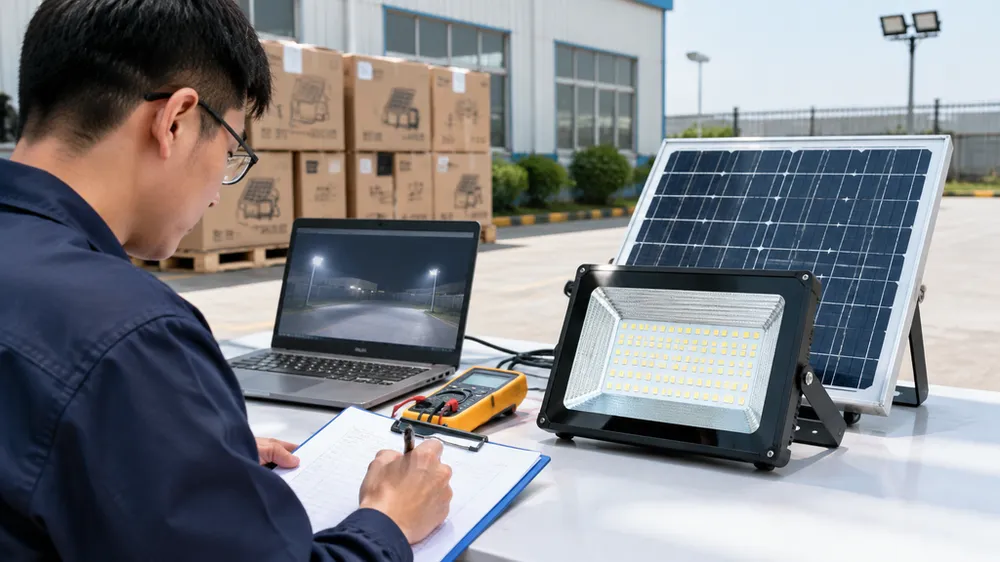
In-house versus outsourced testing affects OEM project timelines and cost. If the factory sends samples to a third-party lab for every custom spec verification, you're adding 5-10 days per iteration and paying lab fees on top of production cost. Our integrated testing lab handles IP verification, battery testing, and lumen measurement on-site — same-day results during OEM development, zero external lab charges, and faster turnaround from spec submission to sample approval.
How to Evaluate Battery Systems and Lumen Performance When Comparing Solar Flood Light Suppliers
Battery chemistry determines cycle life and cold-weather performance. LiFePO4 (lithium iron phosphate) offers 2,000-3,000 charge cycles with stable performance down to -20°C, which matters for northern US installations where winter temperatures drop below freezing. Standard Li-ion batteries deliver 500-1,000 cycles and lose capacity faster in cold climates. Some suppliers list "lithium battery" without specifying chemistry — that vagueness usually means cost-optimized Li-ion cells, not LiFePO4.
Ask suppliers to specify battery chemistry, brand (if they source name-brand cells), and cycle life rating. Generic "lithium battery" specs with no cycle count or temperature range listed signal a factory optimizing for first-cost, not field longevity.
Capacity matching within batches is the invisible QC step that determines whether your entire order performs consistently or 20% fails early. We covered this in the QC section, but it's worth repeating because most buyers don't think to ask about it until they've experienced the problem. Request the supplier's capacity binning tolerance — 5% variance is acceptable for commercial-grade products, 10-15% variance is cost-optimized mass production that will generate higher warranty claims.
Lumen depreciation curves show how LED output declines over time. All LEDs lose brightness gradually — the question is how fast and how predictably. Commercial-grade solar flood lights should specify L70 or L80 lifespan: the number of hours until output drops to 70% or 80% of original brightness. A 50,000-hour L70 rating means the fixture still delivers 70% of its initial lumens after 50,000 hours of operation — roughly 13 years at 10 hours per night.
Suppliers who list lumen output without stating L70/L80 lifespan are either selling consumer-grade products or hiding depreciation data. Ask for it explicitly. If they can't provide a lumen maintenance curve or L70 rating, assume the LEDs are unrated chips optimized for first-cost rather than long-term performance.
Color temperature consistency matters for installations where multiple fixtures are visible together. ±500K variance within a batch is industry-standard — 5000K daylight white should fall between 4750K and 5250K across your order. Wider variance (±1000K) makes the installation look inconsistent, which reflects poorly on your quality standards if you're the contractor or distributor who sold it.
During the RFQ stage, ask what color temperature tolerance the supplier bins to. If they don't understand the question, they're not binning — you'll receive whatever came off the line.
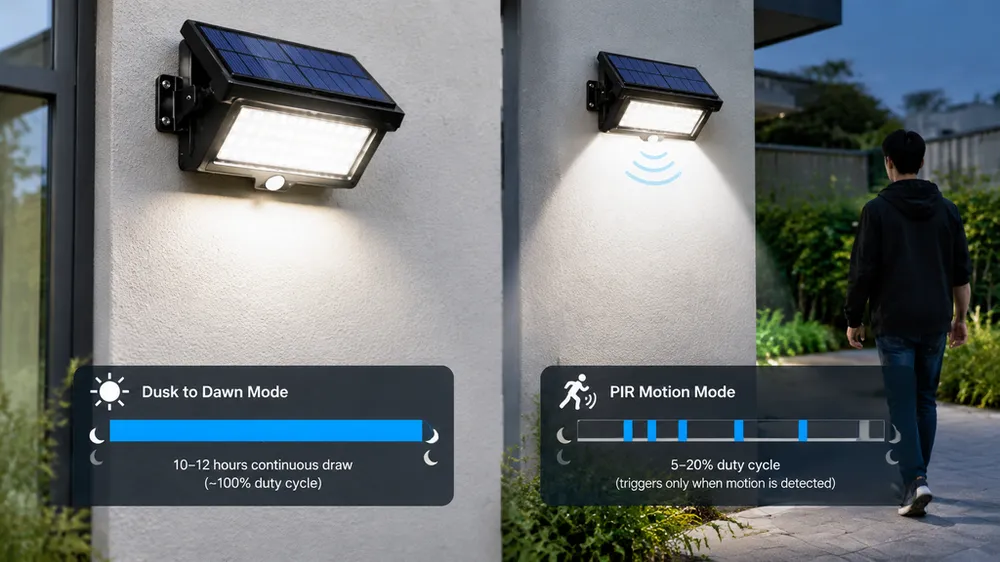
Charge controller logic affects battery utilization efficiency. MPPT (maximum power point tracking) controllers extract more energy from the solar panel than PWM (pulse width modulation) controllers, which matters in northern US climates with shorter winter daylight. The difference is 15-20% charging efficiency, which translates to better battery state-of-charge during low-irradiance months.
Higher-end solar flood lights use MPPT controllers; budget models use PWM. Neither is wrong — it depends on your target market and installation latitude. Ask which controller type the product uses, and if the supplier offers both options, request pricing for each so you can decide whether the efficiency improvement justifies the cost difference for your specific application.
Our in-house battery testing lab runs charge/discharge cycle verification on every production batch, and our 15-engineer R&D team can adjust charge controller logic during OEM development if your target market requires different battery management parameters for regional climate conditions. That level of customization support requires engineering access — it's not available from resellers or trading companies who don't control product design.
MOQ, Lead Time, and OEM Support Considerations for US Buyers
MOQ ranges reveal which suppliers target distributors versus project contractors. High-volume factories often require 500-1,000 units minimum, which works for contractors deploying parking lot lighting across multiple commercial sites or municipalities buying for infrastructure programs. That order size kills inventory flexibility for distributors who want to test a new SKU with their customers before committing container quantities.
Flexible-MOQ factories start at 50-200 units. Our standard models begin at 100 units — enough to validate market response without tying up $10,000-15,000 in untested inventory. For distributors building a solar lighting catalog, low MOQ lets you test 3-4 SKUs simultaneously instead of betting your entire import budget on one configuration.
Why MOQ matters for distributors comes down to inventory risk. You don't know if a 30W solar flood light will outsell a 50W model in your market until customers vote with their orders. Committing to 1,000 units of an untested SKU means you're either stuck with dead inventory or running clearance pricing that destroys margin. Starting with 100-200 units lets you validate sell-through, then scale the reorder based on real demand data.
Lead time factors include whether production is in-house or assembled from outsourced components, standard versus custom specs, and peak season timing. Factories that control component sourcing (our solar panels, LED modules, and battery packs are produced in-house or through locked-rate suppliers) maintain more consistent lead times than factories that procure components from spot markets.
Standard configurations typically ship in 25-35 days from order confirmation. Custom specs add 10-15 days for engineering review, sample production, and buyer approval before full production starts. Peak season for US buyers runs September through November — orders placed during that window target spring installation season. If you're planning a Q1 product launch, submit your RFQ by August to avoid competing with end-of-year project rushes.
OEM/ODM turnaround determines how fast you can bring a private-label or custom-spec product to market. The timeline runs: spec submission → engineering review → cost estimate → sample production → buyer approval → full production. Factories with in-house engineering (our 15+ engineer R&D team handles all OEM work on-site) complete the review and sample stages faster than factories that outsource design work to external agencies.
Typical OEM timeline for a custom lumen output or battery-resizing project: 3-5 days for engineering review, 7-10 days for sample production, 25-30 days for full production after sample approval. Total time from spec submission to container shipment runs 40-50 days. Factories without in-house engineering can add 2-4 weeks to that timeline.
Reorder reliability becomes critical once you've validated a SKU and need to scale. If demand doubles mid-season, can the factory increase your order without pushing lead time from 30 days to 90? Capacity across multiple production lines determines that flexibility. Our six lines support 1,200,000-unit annual output — a distributor's 1,000-unit reorder and a contractor's 10,000-unit project order run simultaneously without competing for the same line capacity.
Single-line factories or suppliers who outsource production to contract manufacturers often can't scale fast reorders because they're already running at capacity. Your reorder joins a queue behind other customers, and lead time inflates unpredictably. That scheduling uncertainty makes forward inventory planning impossible.
Certifications and Documentation US Importers Should Receive from Solar Lighting Factories
CE marking is required for products sold in the European Union and serves as a compliance signal for US buyers working with EU-based partners. It covers electrical safety and electromagnetic compatibility requirements. RoHS (Restriction of Hazardous Substances) compliance limits lead, mercury, cadmium, and other restricted materials in electronic components — required for EU import and increasingly expected in US procurement even though it's not federally mandated.
IP65/IP67 (Ingress Protection) ratings verify waterproof and dust resistance. IP65 means dust-tight and protected against water jets (suitable for outdoor installations under roof eaves or with partial weather protection). IP67 means dust-tight and protected against temporary immersion up to 1 meter — full weather exposure including standing water. For outdoor solar flood lights, IP67 is the safer spec unless you're certain the installation environment provides partial protection.
IEC 62124 covers safety requirements for photovoltaic modules. Solar flood lights use small solar panels (typically 20-50W), and IEC 62124 certification confirms the panel meets electrical safety standards for wiring, junction boxes, and diode protection. Not every solar flood light manufacturer provides this certification, but it's worth requesting if you're sourcing for markets with strict import compliance requirements.
ISO 9001 is a factory-level quality management certification, not a product certification. It signals that the factory maintains documented QC processes, corrective action procedures, and management review systems. ISO 9001 doesn't guarantee product quality, but it indicates the factory has invested in structured quality control rather than running ad-hoc inspection. For US buyers evaluating suppliers they haven't worked with before, ISO 9001 certification reduces risk.
UN38.3 battery test report is required for shipping lithium batteries by air or sea freight. Solar flood lights contain lithium battery packs (LiFePO4 or Li-ion), and freight carriers require UN38.3 compliance documentation before accepting the shipment. This is not optional — without UN38.3 certs, your container may be rejected at the port or delayed for compliance verification.
Documentation workflow expectations: Reliable factories provide certification packages before the container ships, not "available upon request after delivery." You should receive CE Declaration of Conformity, RoHS test reports, IP rating certificates, IEC 62124 panel certs (if applicable), ISO 9001 certificate, and UN38.3 battery shipping compliance reports with the final shipment invoice. If the supplier says documents will be provided "after payment clears" or "upon request," they're either a trading company collecting certs from the actual manufacturer or running minimal compliance.
Test report details matter. Ensure reports match your product SKU and batch, not generic certificates from a different model or production run. We've seen buyers receive CE certs that listed a completely different solar panel wattage than what was in their order — the trading company reused documents from a previous shipment. Verify the model number, wattage, and test date on every cert before accepting the shipment.
We hold ISO 9001:2015, CE, RoHS, IP65/IP67, and IEC 62124 certifications and provide the full documentation package including UN38.3 battery shipping compliance as a standard pre-shipment deliverable. You receive cert copies with your proforma invoice, and final signed documents ship with the container.
Application-Based Supplier Selection Guide for Different Buyer Types
Distributors building solar lighting inventory should prioritize MOQ flexibility, broad wattage range, reorder consistency, and private-label support. You need a factory that lets you test multiple SKUs without container-minimum commitments, maintains lumen and color temperature consistency across reorders, and can add your branding to packaging without requiring 5,000-unit minimums.
Our 100-unit MOQ for standard commercial solar flood lights lets you validate 3-4 configurations simultaneously — 30W, 50W, 100W — and scale the one that sells. Private-label packaging is available from 200 units with your logo, and reorders pull from the same component sourcing and QC process as your initial order, so batch consistency stays tight.
Project contractors deploying parking lot lighting, building facade illumination, or public space security lighting should prioritize bulk pricing, single-batch lumen consistency, fast lead time, and technical support for installation planning. You're bidding fixed-price projects where margin depends on unit cost and field failure rate. A 2% warranty claim rate might kill project profitability if you're responsible for service calls.
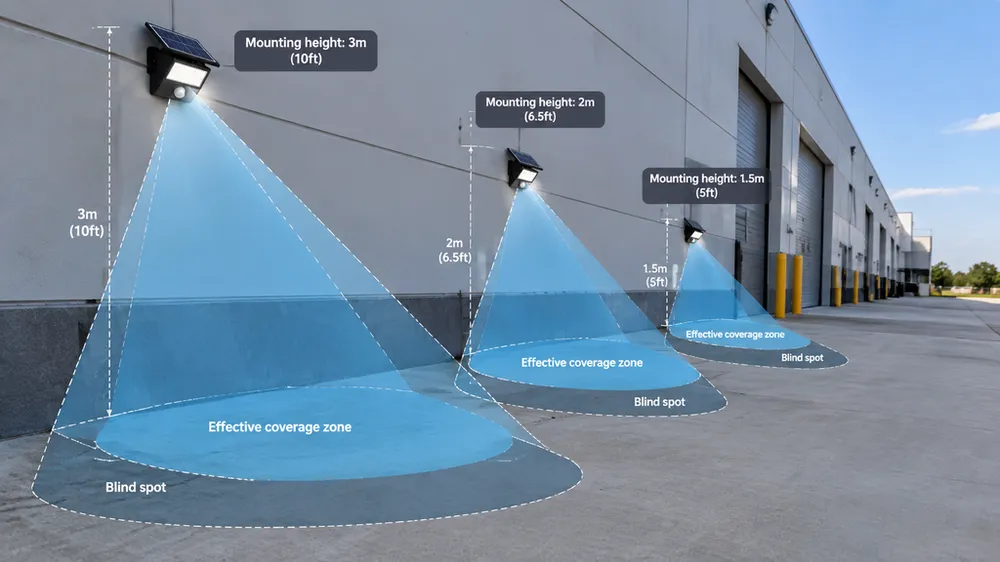
High-volume factories with in-house engineering can provide application support — lumen output recommendations for mounting height and spacing, battery sizing for target autonomy days in your installation latitude, and IP rating selection for the specific exposure environment. We've supported contractors deploying 2,000+ unit parking lot lighting projects with pre-installation photometric analysis and post-installation runtime verification.
Brand owners developing OEM solar flood light lines should prioritize engineering responsiveness, custom spec turnaround, IP/certification flexibility, and mold tooling access for housing design modifications. You're building a differentiated product, not reselling catalog items, so you need a factory that can adjust lumen output, resize battery packs, modify charge controller logic, and potentially customize housing geometry without outsourcing the design work.
Our 15-engineer R&D team handles OEM projects in-house. Typical custom spec timeline: 3-5 days for engineering review, 7-10 days for sample production, buyer approval, then 25-30 days for full production. If you need housing modifications (mounting bracket changes, lens angle adjustment, custom cable length), we can quote mold tooling cost and lead time — that level of customization requires access to a factory with in-house tooling capabilities, not a trading company.
Fit assessment questions to ask yourself before selecting a supplier:
- What's your typical order size? (50 units, 500 units, 5,000 units — this determines which factories you fit)
- Do you need custom specs or off-shelf models? (Custom specs require in-house engineering; catalog-only suppliers can't modify product)
- How critical is reorder timing? (Seasonal buyers need fast lead time; project buyers can plan 60-90 days ahead)
- Are you building a brand or flipping inventory? (Brand builders need private-label support; inventory flippers need fast turns)
If you're a distributor testing a new solar lighting category, start with a 100-200 unit trial order from a flexible-MOQ factory, validate sell-through with your customers over 90 days, then scale reorders based on real demand data. If you're a contractor bidding a 2,000-unit municipal lighting project, request photometric analysis and battery autonomy calculations for your specific installation parameters before finalizing your bid — the wrong lumen output or insufficient battery sizing turns a profitable project into a service-call nightmare.
If you're a brand owner launching a private-label solar security lighting line, invest the time in engineering review with a factory that controls product design. Trying to customize a reseller's catalog product wastes months and usually fails because the reseller doesn't control the tooling or component sourcing.
Send us your project specs — target lumen output, IP rating requirements, battery autonomy days, order volume, or OEM customization needs — and we'll respond with a configuration recommendation and factory-direct pricing that reflects your actual order parameters, not generic catalog quotes.