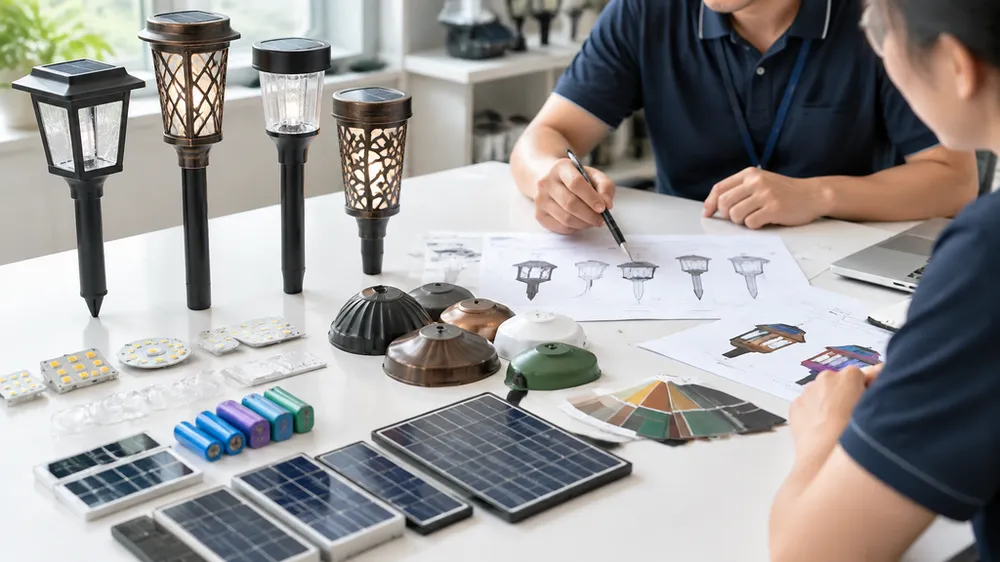
Most supplier directories list "OEM available" without defining what that means for decorative solar garden fixtures specifically. You see catalog photos, MOQ ranges that span two orders of magnitude, and contact prompts that route to a sales team who then needs three days to check with engineering. If you're sourcing for a private-label program, you need the engineering boundaries upfront — what's adjustable within existing platform constraints, what requires tooling investment, and where certification becomes a variable cost instead of documentation you receive with the shipment.
This article walks through the customizable parameters in decorative solar garden lights, the MOQ tiers that determine whether you're catalog-modifying or platform-developing, the validation process that happens before production, and the certification implications of changing specs. The worked example at the end shows how a standard private-label program translates from spec sheet to delivered product with certificate documentation.
OEM Scope for Decorative Solar Garden Lights — What Factory Control Means
OEM in the context of decorative solar garden fixtures means parameter adjustment within an existing lighting platform, not ground-up custom development. The distinction matters because decorative garden lights prioritize visual design over pure lumen output — the fixture needs to look good during the day and provide accent lighting at night, but it's not replacing pathway illumination or security flood coverage. That design priority determines what's practical to customize without retooling the entire assembly.
Factory control in this category means the engineering review, component sourcing, assembly, and validation testing happen in-house, not through a sourcing agent who coordinates three different subcontractors. At JXSOL, our 15 optical and electrical engineers sit in the same building as the production lines and the testing lab. When you submit a custom spec for a decorative solar garden light, the optical engineer who reviews your lumen and color temperature request can walk to the assembly floor, pull the LED module you're planning to use, and confirm the runtime calculation matches the battery capacity you selected — all in the same afternoon. That's not a faster communication process; it's a different engineering structure. Outsourced design agencies can produce renderings and spec sheets, but they can't walk to the testing lab and run a 72-hour waterproof validation on the housing seal you want to modify.
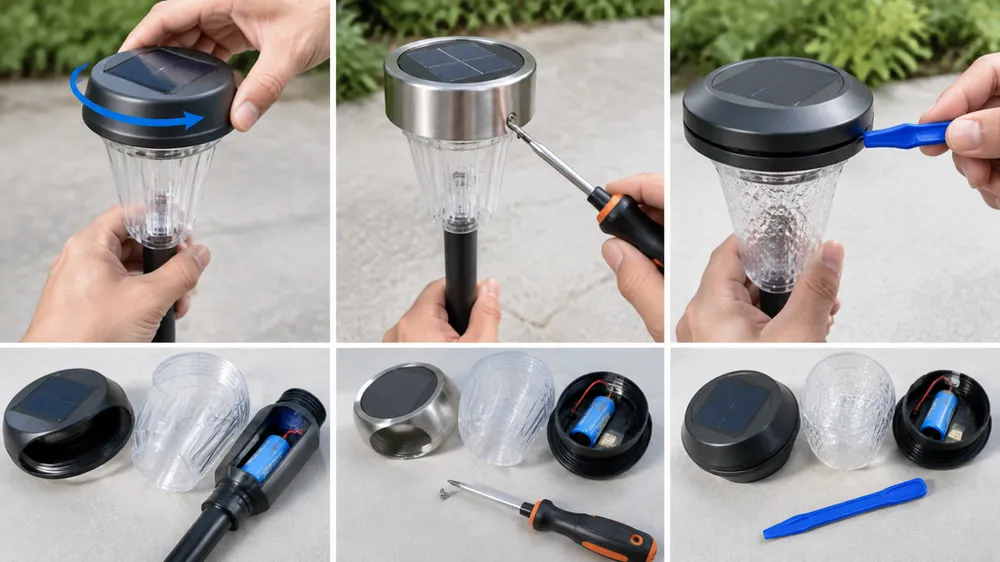
The practical boundary of decorative solar garden light OEM is: you can adjust optical output, housing finish, battery capacity within enclosure limits, solar panel wattage, and all packaging/labeling elements. You cannot change the core LED driver logic (that's the platform stability that keeps failure rates predictable), you cannot redesign the enclosure mold without a 5,000+ unit commitment to amortize tooling cost, and you cannot alter the waterproof gasket design without triggering recertification — because IP65/IP67 ratings are tied to tested assembly methods, not just material specs.
What follows is the detailed breakdown: which parameters adjust within the platform, how MOQ tiers determine what's available, how the engineering review and validation process reduces your market-launch risk, and what happens to CE/RoHS/IP65 documentation when you change specifications.
Customizable Parameters in Decorative Solar Garden Fixtures
Optical Output — Lumen Range, Color Temperature, Beam Angle
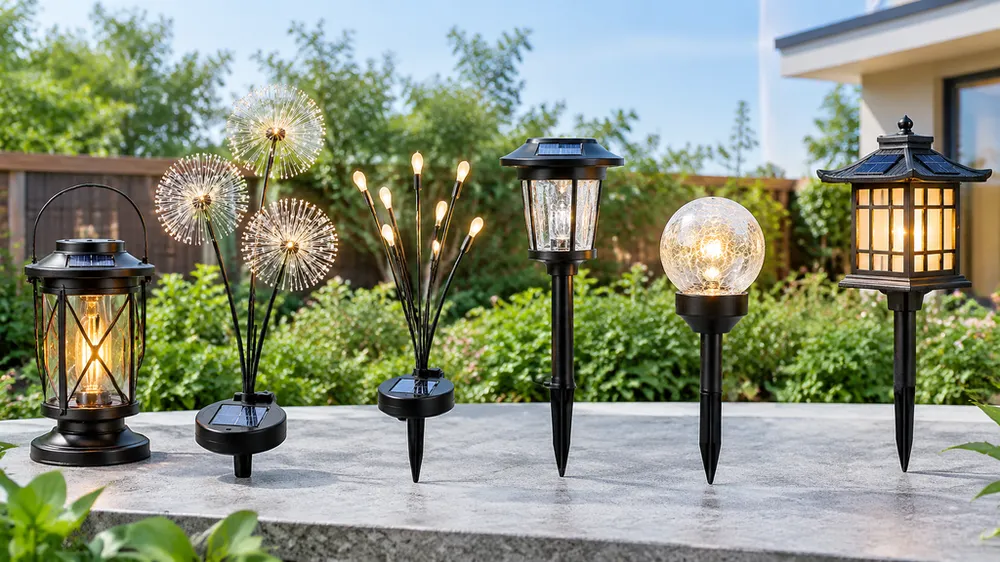
Decorative solar garden lights typically operate in the 20–100 lumen range. That's not a technical limitation — it's a design choice. Higher lumen output requires larger battery capacity, which increases enclosure size and weight, which changes the visual proportion of the fixture. If you're sourcing a solar dandelion or solar lantern, the fixture needs to stay lightweight enough that the stake holds it upright in soft soil, and the housing needs to stay compact enough that the decorative element (fiber optic strands, frosted globe, metal cage) remains the visual focus. We can adjust lumen output within that 20–100 range by changing the LED module, but moving beyond 100 lumens usually means redesigning the entire fixture around a larger battery and enclosure.
Color temperature adjusts more freely: 2700K warm white through 6000K cool white, plus RGB options if your market prefers color-changing modes. The LED module swap is straightforward, but color temperature affects perceived brightness — a 60-lumen warm white fixture (2700K) looks dimmer to the human eye than a 60-lumen cool white fixture (5000K), even though the measured lumen output is identical. If you're matching a brand signature tone, we confirm the color temperature in the sample approval stage, not just the lumen specification, so you see what your end customers will see when the fixture lights up at dusk.
Beam angle determines whether the light pools near the fixture (narrow 25–40° beam) or spreads across a wider area (60–120° beam). For decorative garden lights, most buyers choose a wider beam because the goal is ambient accent lighting, not focused task illumination. Beam angle adjusts through the LED lens or reflector design, and we stock multiple options for each lumen tier, so this parameter rarely adds lead time unless you need a custom beam pattern that requires new tooling.
Housing and Finish — Color, Material Texture, Logo Placement
Housing color is the most common private-label customization. Standard catalog finishes are black, white, and bronze (Pantone 874C equivalent or similar oil-rubbed bronze tone). Custom Pantone color matching becomes available at MOQ 500+ units because it requires a dedicated powder-coating or painting batch, and setup cost for color matching equipment is $300–$400. Below 500 units, we offer color selection from our expanded palette — typically 8–12 additional finishes that don't require custom mixing — without the color-match surcharge.
Material finish (matte, gloss, textured) changes the perceived quality more than color alone. A matte black decorative solar lantern reads as modern residential; the same fixture in gloss black reads as commercial or hospitality. Textured finishes (hammered metal effect, brushed aluminum look) add tooling time because the texture needs to survive outdoor UV exposure and temperature cycling without flaking. If your brand positioning requires a specific texture, we validate the finish durability through a 500-hour UV chamber test before approving it for mass production — that's part of the sample approval cycle, not an extra charge, but it does add 7–10 days to the timeline.
Logo placement options: silk-screen printing on the housing body, embossing on the stake or base, or laser etching on metal components. Silk-screen is the most common for private labels because it's durable, weather-resistant, and economical (setup cost $250–$300 for a single-color logo). Embossing requires a metal die ($400–$600) and works best on flat surfaces like the stake shaft. Laser etching is permanent and works on stainless steel or aluminum components, but it's limited to monochrome and requires a higher MOQ (800+ units) to justify the laser setup time.
Battery and Runtime — Capacity Selection Within Enclosure Constraints
Battery capacity directly determines runtime and charge time. Decorative solar garden lights typically use 600–1200mAh 18650 lithium-ion cells or 3.7V lithium polymer packs. The enclosure size limits how large a battery you can fit — a solar dandelion with a 40mm diameter housing can't accommodate a 2000mAh battery without redesigning the entire fixture.
Runtime calculation: a 60-lumen LED module drawing 1W will run approximately 6–8 hours on a fully charged 1200mAh battery (accounting for discharge efficiency and controller overhead). If you want 10–12 hour runtime, you need either a larger battery (requires larger enclosure, higher cost) or lower lumen output (less visible accent lighting). Most buyers choose the 6–8 hour runtime window because it covers dusk-to-midnight operation in residential gardens, and extending beyond that adds more cost than commercial value for decorative fixtures.
Charge time under full sun: a 1W solar panel will fully charge a 1200mAh battery in 6–8 hours of direct sunlight. If your target market experiences frequent overcast conditions (Northern Europe, Pacific Northwest), you may want to increase solar panel wattage to 1.5W or reduce battery capacity to 800mAh so the fixture still reaches full charge on partially cloudy days. We run charge-time validation tests during sample approval to confirm your selected solar panel and battery combination performs in real-world conditions, not just in the laboratory calculation.
One common specification error: requesting extended runtime without increasing solar panel wattage. A 2000mAh battery paired with a 0.8W panel will take 12–15 hours of sun to fully charge, which means the fixture never reaches full charge in winter months at higher latitudes. Our engineering review catches that mismatch before you commit to production, but it's worth understanding the relationship upfront — battery capacity, lumen output, and solar panel wattage form a triangle, and you can adjust two corners but not all three independently.
Solar Panel Wattage — Matching Charge Speed to Battery Capacity
Solar panel wattage in decorative garden lights ranges from 0.5W to 2W. Below 0.5W, charge time becomes impractically long except for very low-capacity batteries (under 400mAh). Above 2W, the panel size starts to dominate the fixture's visual design — a large solar panel on top of a delicate decorative housing looks unbalanced, and it increases manufacturing cost by $1.20–$1.80 per unit.
Panel wattage must match battery capacity and lumen output. The engineering rule: your solar panel should deliver at least 1.2× the energy your LED consumes per night, accounting for charge efficiency loss (typically 15–20%). If your LED draws 1W and runs 8 hours per night, it consumes 8Wh of energy. A 1W solar panel delivering 6 hours of effective sun provides roughly 6Wh after efficiency loss. That's not enough to maintain daily operation — the battery will gradually deplete over a week. You need a 1.5W panel to sustain that load.
We stock monocrystalline and polycrystalline panel options. Monocrystalline panels are 18–22% efficient and perform better in low-light conditions (cloudy days, partial shade), but they cost $0.40–$0.60 more per unit. Polycrystalline panels are 15–18% efficient and work fine in regions with consistent sun. If your target market is Northern Europe or the Pacific Northwest, monocrystalline is worth the cost difference. If you're serving the Middle East or Southern California, polycrystalline delivers the same real-world performance at lower cost.
Packaging and Labeling — Full Private-Label Customization
Packaging is the most flexible private-label element because it doesn't affect product certification. You control box design, insert cards, barcode placement, compliance labels, and all printed materials. Standard catalog packaging is neutral white or kraft brown boxes with minimal branding — functional for bulk shipments but not retail-ready.
Private-label packaging options: full-color printed box with your brand identity, hanging tab for retail display, window cutout to show the fixture, protective foam or molded pulp insert, instruction card with your company contact details and QR code linking to installation videos or warranty registration. Box printing setup cost is $400–$600 depending on color count and whether you need custom die-cutting for window or hanging tab features.
Compliance labeling is part of the private-label package. We print CE, RoHS, IP65/IP67 marks, model number, barcode, and your company name on the label affixed to the product and the box. If you're importing to the EU or North America, the importer of record details (your company name and address) must appear on the product label — that's a legal requirement, not optional branding. We handle the label design and printing as part of the private-label program; you just provide the text and logo files.
Instruction card customization: most buyers replace our generic installation instructions with their own branded version that includes customer service contact details and warranty terms specific to their market. We can print and insert your custom card at $0.08–$0.12 per unit if you provide the print-ready PDF. If you need us to design the card, that's an additional $150–$200 design fee, but it's a one-time cost — subsequent orders use the same card design at the printing cost only.
Non-Customizable Elements — Platform Stability and Certification Boundaries
Three elements stay fixed across OEM programs: LED driver/controller logic, core enclosure mold, and waterproof seal design.
LED driver and controller logic use a tested circuit board that manages charge cycles, discharge protection, and photocell activation. We don't customize the controller firmware for decorative garden light OEM programs because every firmware change requires a new round of safety testing (overcharge protection, short-circuit protection, thermal runaway prevention). The controller we use has been in production since 2019, has a field failure rate under 0.3%, and is certified under IEC 62124 standards. Changing it introduces risk without commercial benefit — buyers choose decorative solar garden lights for reliability and cost-effectiveness, not custom firmware features.
Core enclosure mold requires $8,000–$15,000 in tooling investment and is only justified at 5,000+ unit annual volume. Below that threshold, you select from our existing housing molds and customize the color, finish, and logo placement. If your annual program exceeds 10,000 units and you need a proprietary housing shape that differentiates your product line from competitors, custom mold development becomes viable — but that's an ODM program, not standard OEM.
Waterproof gasket and seal design is tied to IP65/IP67 certification. The gasket material (silicone or EPDM rubber), compression fit, and screw torque specification have all been validated through third-party testing labs. If you change the housing depth, add a new cable entry point, or modify the lens mounting method, the waterproof seal needs revalidation — that's a $1,200–$2,000 testing cost and 15–20 days added to the timeline. For decorative garden lights, waterproof integrity is the primary field-failure risk (water ingress ruins the battery and corrodes circuit boards), so we don't modify seal designs without retest confirmation.

MOQ and Program Tiers — When OEM Makes Commercial Sense
OEM programs scale across three tiers, each with different lead times, tooling costs, and parameter flexibility. The tier you choose depends on your annual volume forecast and how much differentiation you need from standard catalog products.
Catalog OEM (100–500 Units) — Fast Market Testing Without Tooling Investment
Catalog OEM adjusts lumen output, color temperature, and packaging/labeling only. You select a housing design and color from our existing catalog, specify the optical output within the standard range for that fixture, and provide your brand identity for packaging and labels. No housing color customization (you choose from black, white, or bronze), no custom battery specification (you use the standard capacity for that housing size), no logo placement on the fixture body (only on packaging and labels).
This tier exists for distributors and brand owners who need to test a SKU in their market before committing to larger private-label investment. Lead time is 15–20 days after sample approval because we're not creating custom tooling or running validation tests beyond our standard production QC. Tooling cost is minimal — just the packaging printing plate ($400–$600) — so your landed cost is close to catalog pricing plus the packaging delta.
MOQ floor: 100 units at JXSOL, but we recommend 300+ units to absorb the packaging plate cost without excessive per-unit burden. At 100 units, the plate cost adds $4–$6 per unit; at 300 units, it's $1.30–$2.00 per unit. Most buyers use the catalog OEM tier to validate product-market fit with a single container load (typically 500–800 units depending on fixture size), then move to standard private label once the SKU proves.
Standard Private Label (500–2,000 Units) — Housing Color, Logo, and Packaging Differentiation
Standard private label adds housing color customization from an expanded palette (or custom Pantone match at 500+ units), logo silk-screen on the fixture housing or stake, and full private-label packaging design. You still use the standard battery capacity and solar panel wattage for the selected housing platform, but the visual identity is fully yours.
Lead time: 25–30 days after sample approval. The additional time covers powder-coating or painting setup for custom colors, silk-screen plate creation and test prints for logo placement, and packaging printing with your full brand design. Tooling costs: packaging plate ($400–$600) plus silk-screen plate ($250–$300) plus custom color setup if needed ($300–$400). Total one-time tooling: $950–$1,300 depending on whether you choose a stock expanded-palette color or custom Pantone match.
This tier is the most common for private-label programs because it delivers visible product differentiation without the tooling investment of custom mold development. You can launch a branded decorative solar garden light line that doesn't look like repackaged catalog stock, and your per-unit cost stays within $1.50–$2.50 of catalog pricing once you amortize the tooling over 500–1,000 units.
Commercial logic: if your annual forecast is 2,000–5,000 units across 2–3 SKUs, standard private label gives you brand control at sustainable landed cost. The fixtures look proprietary to your brand, the packaging reinforces your positioning, and you're not locked into 10,000-unit minimums that strain your cash flow or warehouse capacity.
Full ODM (2,000+ Units) — Custom Housing, Battery Spec, and Engineering Validation
Full ODM unlocks custom housing mold development, battery and solar panel specifications outside the standard catalog range, and engineering validation through pre-production batch testing. This tier is for buyers who need a fixture that doesn't exist in the standard catalog or who need performance specifications (extended runtime, higher lumen output, specific IP rating) that require platform modification.
Lead time: 45–60 days after sample approval. The timeline includes mold design and fabrication (20–25 days), first molding samples and dimensional inspection (5–7 days), pre-production batch assembly and validation testing (10–15 days), and mass production setup (10–15 days). Tooling investment: custom housing mold ($8,000–$15,000 depending on complexity), plus validation testing fees if your spec requires certification updates ($1,200–$2,000).
The commercial threshold for ODM is 10,000+ units annually. Below that volume, the tooling cost per unit becomes a margin problem. At 2,000 units, a $12,000 mold investment adds $6 per unit to your cost — that's often more than the housing and assembly labor combined. At 10,000 units, it's $1.20 per unit, which is manageable. At 20,000+ units, it's negligible, and the proprietary housing design becomes a defensible differentiator that competitors can't source from the same factory catalog.
When ODM makes sense: you're launching a private-label brand with multi-year retail distribution commitments, and product exclusivity is part of your market positioning. You can't afford to have a competitor buy the same fixture from the same catalog and undercut your pricing. The custom mold investment becomes a moat — it's not just product differentiation, it's supply chain control.
Engineering Review and Pre-Production Validation
Every OEM order above catalog spec adjustment goes through engineering review and sample approval before production. The process exists to catch specification mismatches that look viable on paper but fail in real-world operation — battery capacity that doesn't support the requested runtime, solar panel wattage that can't charge the battery in your target climate, housing seal modifications that compromise waterproof integrity.
Specification Review Checkpoint — Optical Engineer Confirms Feasibility
When you submit a custom spec for a decorative solar garden light, the optical engineer checks three relationships: lumen output vs. battery capacity, solar panel wattage vs. charge time requirement, and runtime expectation vs. energy consumption. If any corner of that triangle doesn't close, the engineer flags it before sample production.
Common spec conflicts we catch in this stage: requesting 10-hour runtime with a 60-lumen output and 800mAh battery (the math doesn't work — you need 1200mAh minimum or you need to drop lumen output to 40). Requesting custom color temperature (2200K ultra-warm) that requires a specialty LED module we'd need to source externally (adds 10–15 days to lead time and $1.80–$2.40 per unit cost). Requesting IP68 submersion rating when the fixture is designed for IP65 splash protection (requires complete housing redesign, not feasible under standard OEM).
The review takes 2–3 business days for straightforward specs, longer if we need to consult with battery or solar panel suppliers about availability of components outside our standard stock range. If we identify a conflict, we propose an alternative spec that achieves your commercial goal (e.g., if you want extended runtime, we show the cost and lead time impact of upgrading to a larger battery vs. reducing lumen output). You make the tradeoff decision; we don't auto-substitute components without confirmation.
Sample Approval Cycle — Testing Before Tooling Commitment
First sample ships 7–10 days after spec lock. We assemble the fixture with your specified LED module, battery, solar panel, and housing configuration, apply the finish and logo placement you selected, and ship it for your review. You test the fixture in your environment — confirm the lumen output matches your expectation, check the color temperature under real-world conditions, validate the runtime against your market needs.
Revision cycle: if you need changes (warmer color temperature, brighter output, longer stake, different logo placement), we produce a revised sample. That adds 5–7 days to the timeline. Most buyers approve the first sample or request one minor adjustment; if we're on the third sample revision, that usually signals a deeper spec issue that should loop back to engineering review rather than iterative sample tweaking.
Sample approval matters more in private-label programs than in catalog orders because once we create tooling (packaging plates, silk-screen plates, custom color batches), changes become expensive. Revising a silk-screen logo after we've made the plate costs $250–$300 for a new plate. Changing housing color after we've mixed a custom batch and coated 1,000 housings is not reversible — you're buying those 1,000 units. Sample approval is the gate that prevents costly mid-production changes.
Pre-Production Batch — Validation Testing for Volume Orders and Custom Specs
For orders of 1,000+ units or any custom battery/solar panel spec outside catalog range, we run a 50-unit pre-production batch before mass production. We assemble the batch using production tooling and components (not hand-built samples), then test 10 units through full charge/discharge cycles and waterproof validation.
Charge/discharge cycle testing: we fully charge the battery via the solar panel under simulated sun (solar simulator lamp calibrated to 1000 W/m²), then run the LED at full output until the battery depletes. We measure actual runtime, confirm it matches the calculated spec, and check that the low-battery cutoff engages before the battery drops below safe discharge voltage (2.8V for lithium-ion cells). We repeat the cycle three times to confirm the battery holds capacity and the charge controller doesn't drift.
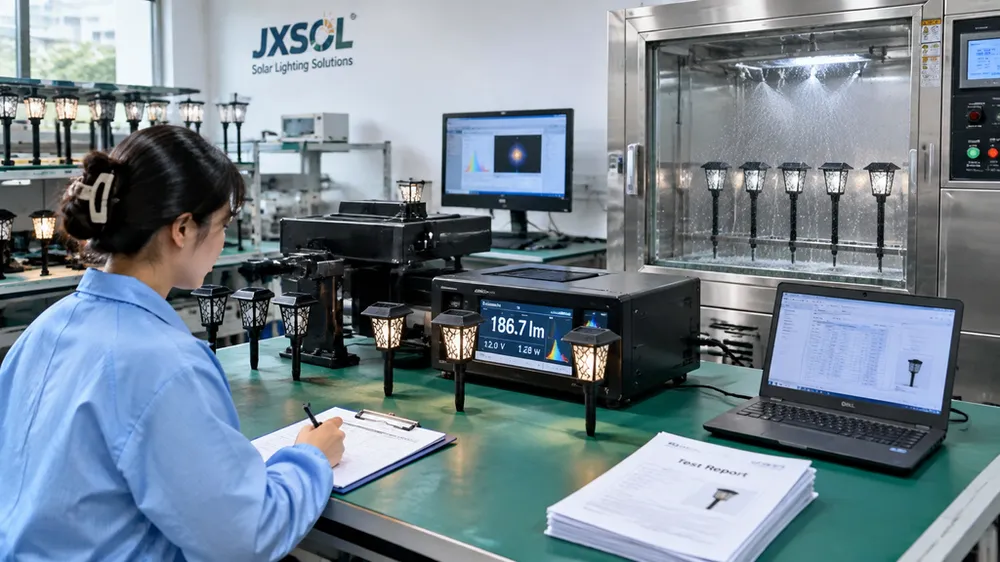
Waterproof validation: we spray the assembled fixture from all angles for 72 hours at IP65 test pressure (6.3 mm/min water flow, 12.5 liters per minute from 3 meters distance). After the test, we disassemble the fixture and inspect for water ingress around the battery compartment, LED module, and circuit board. If we find moisture inside any sealed component, that's a failure — we identify the leak point, revise the gasket or seal design, and retest. We don't ship fixtures that fail waterproof validation; that's non-negotiable.
Test report: after pre-production validation passes, we provide a test report with measured lumen output, color temperature, runtime data, and waterproof inspection photos. That report becomes part of your product documentation — you can share it with your customers as evidence of performance claims, and you can reference it if you need to defend product liability or warranty claims.
Why pre-production batch reduces your risk: it catches manufacturing defects and spec drift before you've committed to 2,000 units. If the housing color doesn't match the approved sample (batch-to-batch variation in powder coating), we correct it before mass production. If the actual runtime is 20% shorter than calculated (LED module draws more current than the datasheet specified), we adjust the battery capacity before you're stuck with underperforming inventory. The 50-unit batch costs you 3–5 days of lead time and the material cost of the test units, but it prevents the scenario where you receive a container of fixtures that don't meet the spec you approved.
Certification and Compliance for Custom Specifications
Product certification affects your ability to clear customs, your liability exposure if a fixture fails and causes property damage, and your credibility with distribution partners who require documented compliance. Understanding which certifications stay valid when you customize specs — and which require retest — determines your true landed cost and timeline.
Catalog Spec OEM — Existing Certificates Apply
When you adjust lumen output and color temperature within the tested range of an existing catalog fixture, the CE, RoHS, and IP65/IP67 certificates issued for that platform remain valid. The certificate specifies a product family (e.g., "decorative solar garden light, model JX-SG series, 20–100 lumen output, 2700K–6000K color temperature, IP65 ingress protection"), not a single SKU configuration. As long as your custom spec falls within that certified range, we provide a copy of the certificate with your shipment and you're covered.
RoHS compliance (Restriction of Hazardous Substances, EU Directive 2011/65/EU) applies to the materials and components — lead content in solder, cadmium in housing coatings, mercury in any component. Changing color or logo placement doesn't affect RoHS status as long as we use compliant powder coating and ink. We source all housing finishes and printing materials from RoHS-certified suppliers, and we maintain the material declaration documentation that proves compliance if a customs inspector or downstream buyer requests it.
IP65 and IP67 ratings (Ingress Protection against dust and water) are tied to the housing assembly method, not the electrical specifications. If you change lumen output but keep the same housing and seal design, the IP rating stays valid. Standard decorative garden lights are IP65 (protected against water jets from any direction, suitable for outdoor exposed installation) or IP67 (protected against immersion up to 1 meter depth for 30 minutes, suitable for ground-level installation in areas that may flood temporarily). Most decorative fixtures target IP65 because IP67 requires thicker gaskets and more robust sealing, which increases cost and housing size.
Custom Battery or Housing Change — When Recertification Is Required
If you change battery capacity beyond the range tested in the original certificate, or if you modify the housing shape or seal design, the certificate no longer covers your configuration and we need to retest. The testing lab evaluates the new assembly under the same standards (IEC 62124 for solar lighting safety, IEC 60529 for IP ingress protection, EN 62471 for photobiological safety of LEDs), issues an amended certificate or a new certificate specific to your model, and provides the test report that documents compliance.
Retest cost: $1,200–$2,000 depending on the test lab and whether we're amending an existing certificate (lower cost, only retest the changed parameter) or issuing a completely new certificate (full test suite). EU-recognized test labs (TÜV, Intertek, SGS) charge $1,500–$2,000; China-based labs with international accreditation charge $1,200–$1,500. Both deliver certificates accepted by EU and North American customs authorities; the cost difference is service speed (EU labs typically take 15–20 days, China labs take 10–15 days).
Timeline impact: add 15–20 days to your lead time for the retest process. We submit the pre-production sample to the lab, they run the test protocol (overcharge protection, short-circuit safety, temperature cycling, waterproof validation, lumen and color temperature measurement), and they issue the certificate. Production doesn't start until we receive the certificate, because we can't ship fixtures that lack documentation — you can't clear customs without a CE declaration of conformity, and the declaration references the test certificate.
When retest is worth the cost: if you're launching a private-label brand with retail distribution agreements that require proprietary product specifications, the certificate becomes part of your brand moat. Competitors can't replicate your exact fixture configuration without commissioning their own testing, and most small buyers won't invest $2,000 in certification for a 500-unit test order. The certificate also protects you from product liability claims — if a fixture fails and causes property damage, you have documented evidence that it met safety standards at the time of sale.
Private-Label Packaging and Certification Labels
Packaging changes don't affect product certification, but you must ensure your packaging claims align with the certified specifications. Common compliance error: your marketing team designs packaging that says "IP67 waterproof, 12-hour runtime, 80-lumen output" when the actual certified spec is IP65, 8-hour runtime, 60-lumen output. That's a legal problem — you're making performance claims the product can't defend, and if a buyer challenges you (especially in the EU or North America where consumer protection enforcement is strict), you're liable for misrepresentation.
We review your packaging proof against the product certificate before printing to catch spec mismatches. It takes 10 minutes and prevents expensive recalls or legal disputes. If your packaging lists features the product doesn't have, we flag it and you revise the design before we print the plates.
Importer of record labeling: EU and North American markets require the product label and packaging to show the company responsible for the product (the importer of record, which is your company if you're buying from us and selling into those markets). The label must include your company name, address, and contact details. We print that information on the product label affixed to the housing and on the box. You provide the text; we format it to meet legal requirements (minimum font size, contrast requirements, placement where it remains legible after outdoor installation).
Target Market Compliance — US, EU, and Other Export Requirements
EU market (CE marking): requires CE declaration of conformity, test reports from an ISO 17025 accredited lab, and technical documentation that proves the product meets Low Voltage Directive (2014/35/EU), EMC Directive (2014/30/EU), RoHS (2011/65/EU), and REACH (EC 1907/2006) where applicable. Our standard decorative garden lights come with CE certificates covering those directives. We provide the declaration of conformity document with your shipment, and we maintain the technical file at the factory (EU law requires the manufacturer or importer to retain the file for 10 years after the product is placed on the market).
US market: no federal certification requirement for decorative solar garden lights, but some buyers request FCC Part 15 for electromagnetic interference (EMI) or UL listing for product safety. FCC Part 15 is relevant if the fixture includes wireless control (Bluetooth, Wi-Fi), which is uncommon in basic decorative garden lights. UL certification (UL 2108 for low voltage lighting) is voluntary but may be required by certain retailers or project specifications. If you need FCC or UL, we source certified LED modules and controllers from approved suppliers, assemble the fixture, and provide the component certificates. That adds $0.80–$1.50 per unit for certified components.
Middle East and North African markets: often require SASO (Saudi Standards, Metrology and Quality Organization) certification or equivalent national standards. SASO testing is similar to CE — we submit samples to a SASO-approved lab, they test for safety and EMC compliance, and they issue a certificate of conformity. Cost: $1,500–$2,200. Timeline: 20–25 days. We handle SASO certification for buyers shipping to Saudi Arabia, UAE, Egypt, and other Gulf Cooperation Council markets.
Why this matters for brand owners: certification documentation is your defense against customs delays, product recalls, and liability claims. If you import 2,000 decorative solar garden lights and one of them fails in a way that causes a fire or injury, the first question from your insurer or a plaintiff's attorney is "Did the product meet safety standards at the time of sale?" The test certificate and declaration of conformity are your answer. Factories that provide complete documentation upfront reduce your compliance risk and give you confidence the shipment will clear customs without holds or inspections that delay your market launch.
Worked Example — Private-Label Solar Dandelion Landscape Light for EU Brand
This example walks through a real-world private-label program from initial specification to delivered product with certification documentation. The scenario: a garden décor brand in the EU wants to add a decorative solar dandelion light to their catalog, differentiated from generic imports through brand packaging and a signature warm color temperature.
Starting Point — Catalog Product and Custom Requirements
Base product: JXSOL catalog model JX-SG-DD60, solar dandelion light with 150 fiber optic strands, 60-lumen warm white LED (3000K), black ABS housing, 1200mAh battery, 1W monocrystalline solar panel, IP65 rating, 8-hour runtime. Catalog pricing: $8.40 per unit FOB Zhongshan for 500+ unit orders.
Buyer's requirements:
- Color temperature: 2700K instead of 3000K (warmer tone, matches the brand's other outdoor lighting products)
- Housing color: bronze finish (Pantone 874C equivalent) instead of black
- Logo placement: brand logo silk-screened on the stake, 20mm diameter
- Packaging: full private-label box with brand identity, insert card with QR code linking to installation video and warranty registration
- Certifications: CE, RoHS, IP65 documentation required for EU customs
Program tier: Standard private label. MOQ: 800 units (first order to test EU distribution, with reorder plan for 2,000 units if the SKU performs).
Specification Review and Sample Approval
Engineering review confirms the 2700K LED module is a direct swap from the standard 3000K module — both operate at 1W, both fit the existing housing, no change to battery or runtime calculation. Bronze housing finish is available from our expanded color palette without custom Pantone mixing (the buyer accepts our standard bronze, which is close enough to Pantone 874C that the difference isn't visible unless fixtures are side-by-side). Logo silk-screen placement on the stake is straightforward — flat surface, no curve or texture interference.
First sample ships 10 days after spec confirmation. The buyer tests it in their office garden for 5 days, confirms the color temperature and brightness meet their expectation, approves the bronze finish, and requests one change: enlarge the logo from 20mm to 25mm diameter for better visibility. Revised sample with larger logo ships 6 days later, approved without further changes.
Total sample approval timeline: 16 days.
Tooling Setup and Lead Time
Tooling costs:
- Packaging printing plate (4-color box with brand design, hang tab, window cutout): $580
- Logo silk-screen plate (single-color logo, 25mm diameter, weather-resistant UV ink): $270
Total one-time tooling investment: $850.
Amortized over 800 units: $1.06 per unit. At 2,000 units (planned reorder), tooling amortizes to $0.43 per unit.
Production lead time after sample approval: 18 days (bronze powder coating adds 3 days vs. standard black housing; silk-screen logo adds 2 days; private-label packaging printing and assembly adds 3 days vs. neutral box).
Cost Structure and Landed Price
Per-unit cost breakdown (800-unit order):
- Base catalog fixture: $8.40
- LED module upgrade to 2700K: +$0.15 (different binning, same module platform)
- Bronze powder coating: +$0.40 (expanded palette color, no custom mixing)
- Silk-screen logo on stake: +$0.35 (setup amortized, ink and labor)
- Private-label packaging: +$0.30 (custom box vs. neutral box, includes insert card printing)
- Tooling amortization: +$1.06 (one-time cost spread over 800 units)
- Total per-unit cost: $10.66 FOB Zhongshan
Shipping and import (estimated, buyer responsibility):
- Ocean freight Zhongshan to Rotterdam: $0.85 per unit (LCL, 800 units = 6.5 cubic meters)
- EU customs duty (solar lighting, HS code 9405.40): 3.7% = $0.39 per unit
- VAT and import processing: handled by buyer's freight forwarder
- Estimated landed cost: $11.90 per unit before domestic distribution
Buyer's retail positioning: EU garden décor brand sells the fixture at €34.90 retail (approximately $37 USD equivalent at time of order). Distributor margin, retail margin, and brand overhead absorb the difference between $11.90 landed cost and retail price.
Certification Documentation and Customs Clearance
Existing CE, RoHS, and IP65 certificates cover the JX-SG-DD60 platform. Changing color temperature from 3000K to 2700K stays within the tested range (certificate specifies 2700K–6000K). Changing housing color from black to bronze doesn't affect electrical or waterproof certification. No retest required.
Documents provided with shipment:
- CE declaration of conformity (signed by JXSOL as manufacturer, listing buyer's company as importer of record)
- Test report from TÜV Rheinland (IEC 62124 photovoltaic safety, IEC 60529 IP65 ingress protection, EN 62471 photobiological safety)
- RoHS material declaration (component-level documentation proving compliance with EU 2011/65/EU)
- Packing list and commercial invoice
The buyer's freight forwarder submits the CE declaration and test report to EU customs along with the commercial invoice. The shipment clears Rotterdam customs in 2 days without inspection or holds.
Outcome and Reorder Economics
The buyer tests the first 800-unit order through their EU distribution network (garden centers, online retail, landscape contractors). The SKU performs well — the 2700K warm tone differentiates it from cheaper 6000K cool white imports, the bronze finish matches their brand's aesthetic, and the private-label packaging supports their premium positioning.
Six months later, the buyer places a 2,000-unit reorder with one change: add a second SKU with matte white housing instead of bronze (same color temperature, same logo, same packaging design). Because the packaging plate and silk-screen plate are already created, the only new tooling cost is $0 (white powder coating is a standard catalog finish). Per-unit cost drops to $9.95 ($8.40 base + $0.15 color temp + $0.30 white finish + $0.35 logo + $0.30 packaging + $0.43 tooling amortization across 2,000 units for the original $850 setup + $0.02 logo plate amortization).
The reorder demonstrates the commercial logic of standard private-label programs: tooling investment is front-loaded on the first order, then amortizes down as volume scales. The buyer now has a differentiated product line (two housing colors, signature warm tone, brand packaging) that competitors can't replicate by ordering from the same catalog, and the per-unit cost has moved closer to catalog pricing while maintaining visual brand control.