If you source solar decorative lighting for resale or project deployment, you've seen both product types flood your inbox. Tree lights with multi-branch fixtures. String lights with centralized panels and long wire runs. They look similar in catalogs, but they deploy differently, fail differently, and scale differently. The choice affects your landed cost per illuminated square meter, your warranty claim rate, and how fast your installation crew finishes the job.
Most comparison content online addresses homeowners choosing between two Amazon listings. That's not your decision context. You need coverage-area data for project costing, battery autonomy specs for low-irradiance markets, IP rating verification so you're not eating warranty replacements after the first rainy season, and MOQ flexibility so you can test a product line without committing to a container. This breakdown gives you those data points, organized around the trade-offs that matter when you're buying 500 units or 5,000.
We manufacture both product types at JXSOL. We've seen buyers choose wrong and come back six months later asking why their field failure rate spiked or why their per-project labor cost doubled. The pattern is consistent: they optimized for unit price without mapping the product architecture to their deployment scenario. Here's how to avoid that.
Product Definition — Fixture Architecture and Commercial Deployment Topology
Solar tree lights and solar string lights are both decorative solar lighting products, but their power architectures are opposite. That difference drives everything else — coverage scaling, labor cost, failure modes, and which product type fits which commercial project.
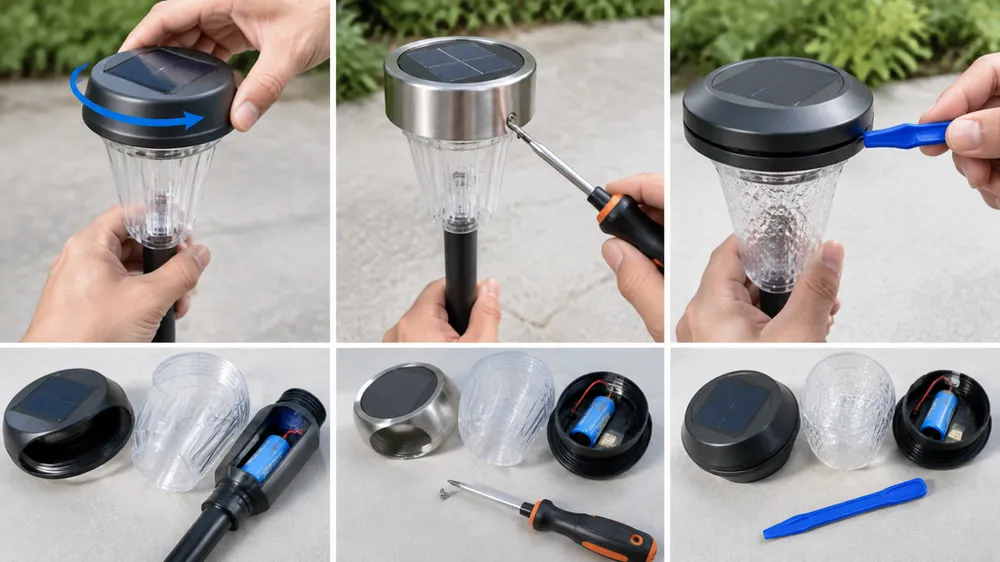
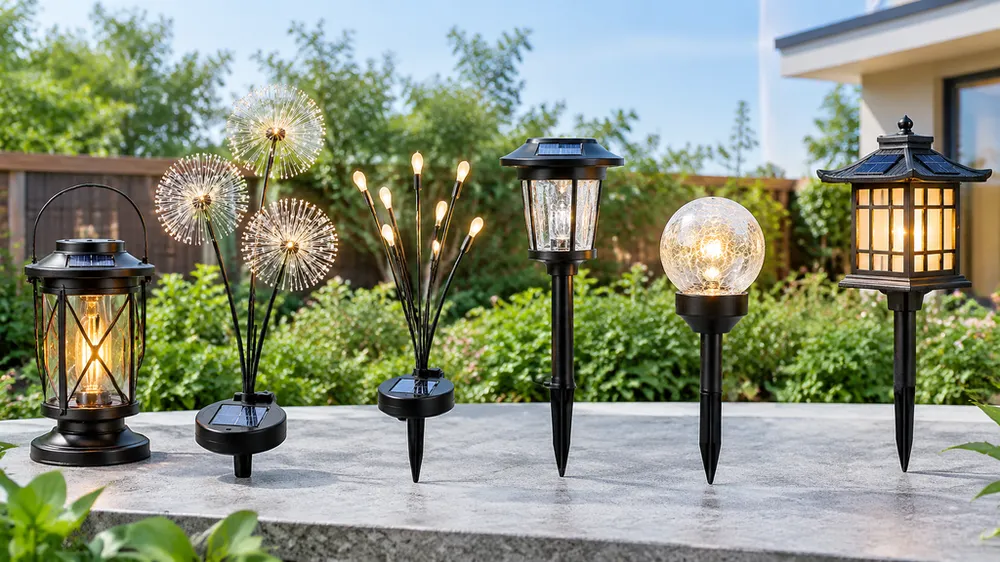
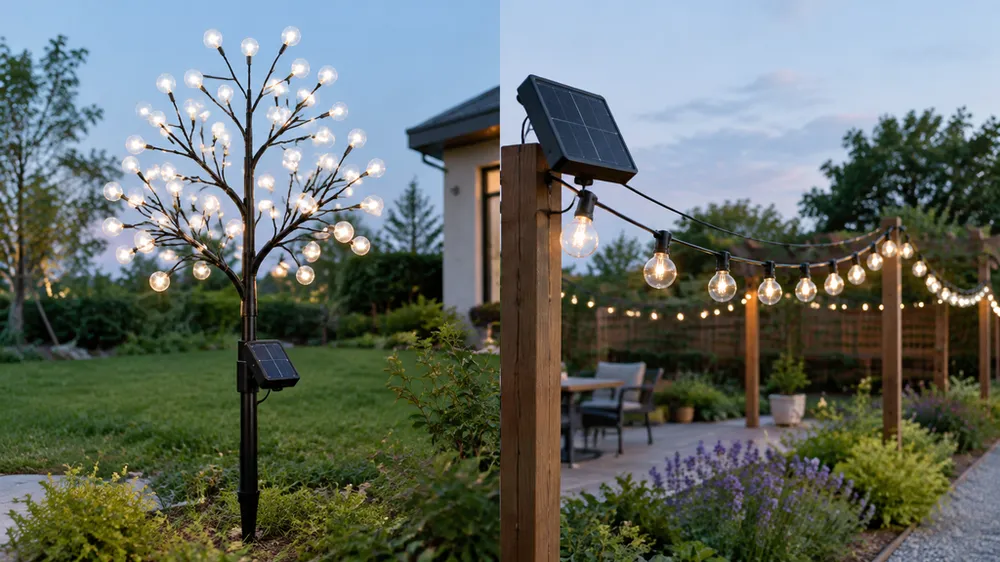
Tree lights are multi-branch fixtures with an integrated solar panel and battery in each unit. One fixture = one power island. The typical configuration is 8-12 branches per fixture, each branch carrying 10-30 lumens of LED output. The panel charges the battery during the day; the battery powers all branches on that fixture at night. If you need to cover more area, you add more fixtures. Each fixture is an independent lighting node.
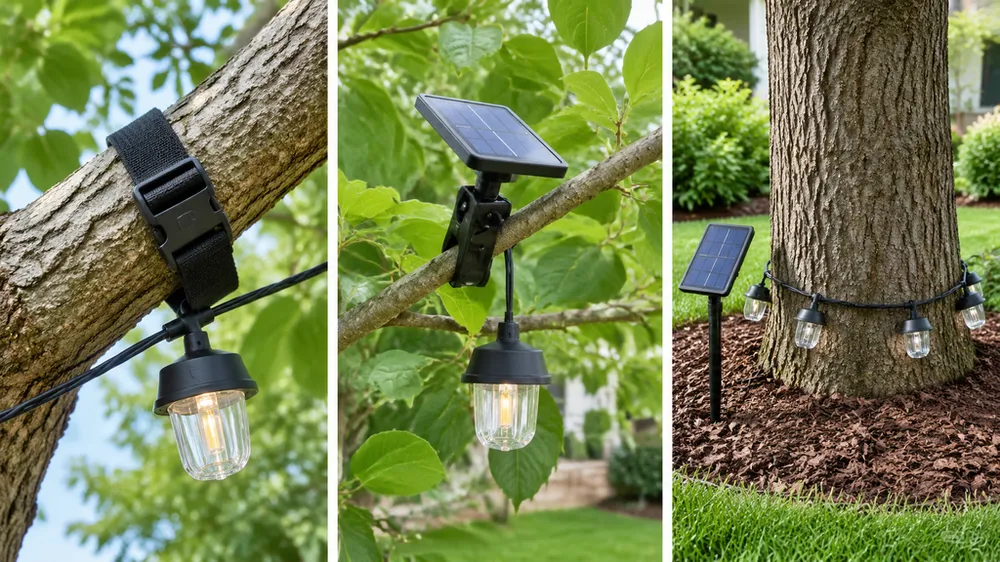
String lights are distributed LED arrays on a single wire, powered by one centralized solar panel and battery per run. One panel/battery = one power island serving 5-20 meters of wire. The LEDs are spaced 15-30 cm apart along the wire. If you need to cover more area, you extend the wire run or add another complete panel/battery/wire set. The entire wire run depends on one central power source.
The topology difference translates directly to deployment labor. Tree lights require more fixture installation points (each unit needs a stake or mounting bracket), but there's no wire to route or manage. String lights require fewer anchor points (just the panel/battery unit and end-of-run termination), but the wire must be routed along the coverage path — through hooks, clips, or conduit — which adds labor hours. If your installation crew charges by the hour, that routing time shows up in your project P&L.
Failure modes are also opposite. In a tree light installation, one fixture failure affects only that fixture's coverage zone. In a string light installation, a battery or panel failure kills the entire wire run. For projects where uptime is contractual (municipal lighting with penalty clauses, hospitality sites where ambiance affects guest ratings), distributed redundancy reduces your risk exposure. For projects where cost-per-lumen is the only KPI and downtime is tolerated, centralized power per run reduces upfront fixture cost.

When you're evaluating quotes from multiple suppliers, ask which power topology each product uses. Some suppliers call both products "solar garden lights" without clarifying whether the battery is per-fixture or per-run. That ambiguity hides the deployment cost difference. Get the spec sheet, find the battery location, and map the topology before you compare unit prices.
Coverage Area and Lumen Spread — Project Planning Data
Coverage area is where most buyers miscalculate cost. You can't directly compare a tree light fixture to a string light wire run by unit price — they don't illuminate the same geometry. One covers area (circular zones), the other covers perimeter (linear paths). Your cost-per-illuminated-square-meter depends on which geometry your project site requires.
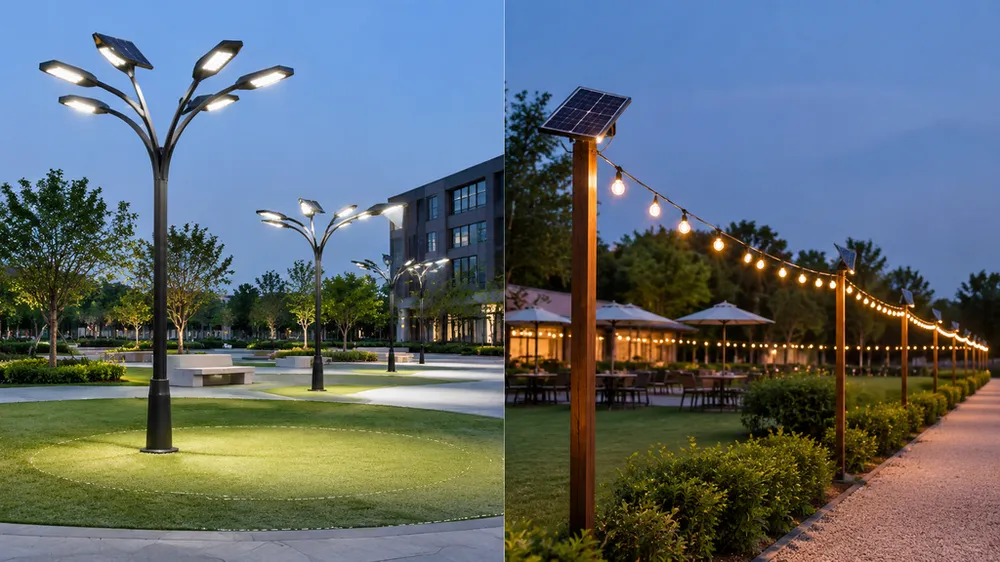
Tree lights illuminate in roughly circular zones. A typical 8-12 branch fixture with 10-30 lumens per branch produces a soft accent glow with an effective radius of 2-4 meters, depending on branch angle and LED beam spread. That's 12-50 square meters of coverage per fixture. If your project site is an open area — garden beds, parking lot edges, plaza zones, poolside accent lighting — tree lights give you predictable area coverage. To calculate fixture count, divide your site area by coverage-per-fixture, add 10% for edge overlap, and that's your order quantity.
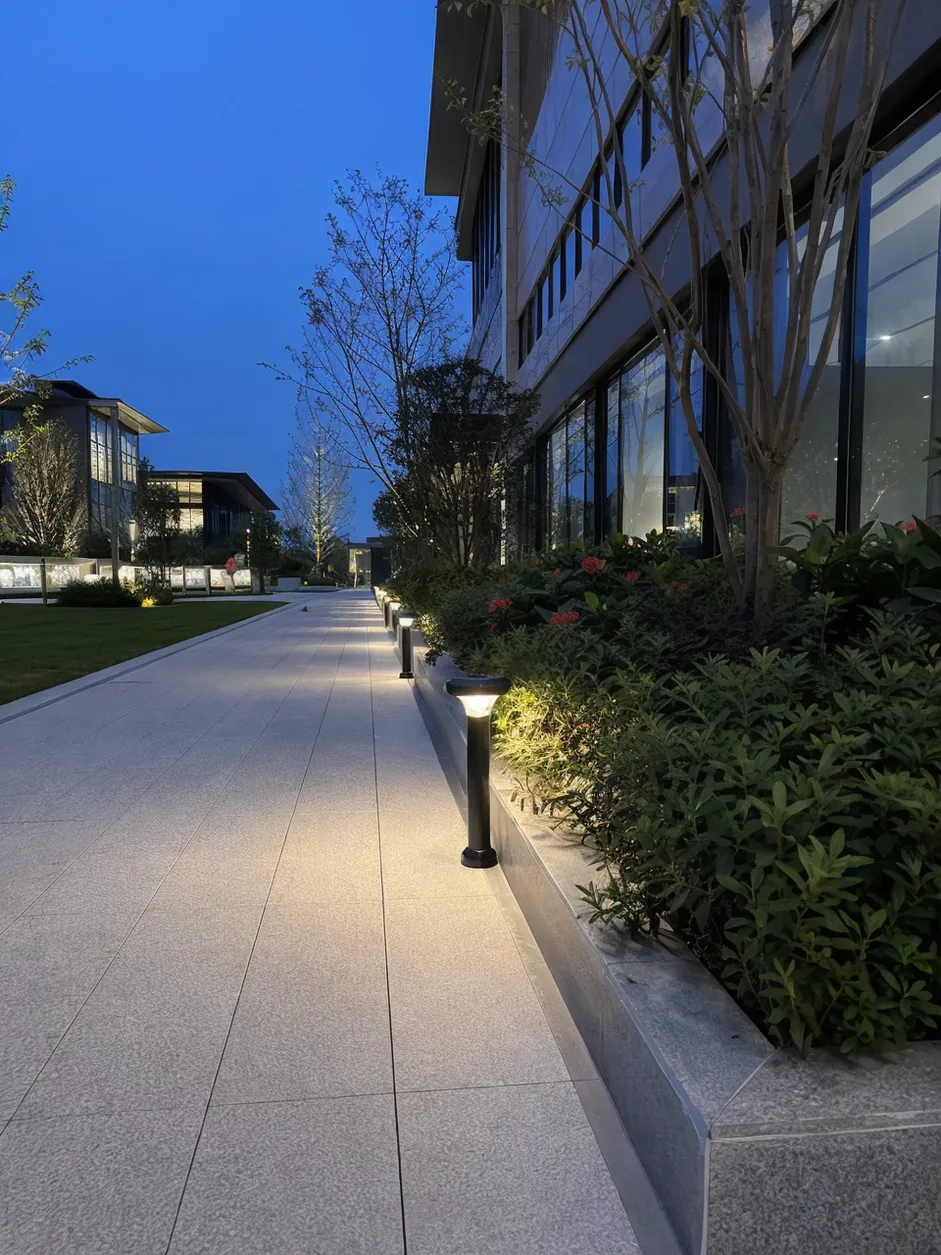
String lights illuminate along a linear path. A 10-meter wire run with LEDs spaced every 20 cm and 50-150 lumens per meter creates a lit perimeter, not an area. The "coverage" is the wire length multiplied by the effective glow width (typically 0.5-1 meter on each side of the wire, so 1-2 meters total width). For fence lines, pathways, building perimeters, roof edges, or any site where the goal is to define a boundary or guide a route, string lights deliver lower fixture count and faster installation than placing tree lights every few meters along the same path.
The cost calculation is completely different. For tree lights, you're buying coverage per fixture — calculate cost per square meter by dividing fixture price by illuminated area. For string lights, you're buying coverage per meter of wire — calculate cost per linear meter of illuminated perimeter. If your project is 200 square meters of open garden, tree lights will likely win on total cost. If your project is 100 linear meters of pathway, string lights will likely win. Mix the two formulas and your quote will be wrong by 30-50%.
We've shipped orders where the buyer originally spec'd tree lights for a linear pathway project, then realized mid-installation that string lights would have cut fixture count by 60%. The reverse happens too — buyers spec string lights for an open plaza, then discover they need three parallel wire runs to get full coverage, tripling the panel/battery count. The fix is simple: before you request a quote, sketch your site layout, identify whether you're covering area or perimeter, and match the product topology to the geometry.
For bulk orders over 500 units, we provide coverage-area calculation as part of the quoting process. Send us your site plan (even a rough sketch with dimensions), tell us your target lumen density, and we'll recommend fixture count and layout for both product types so you can compare total landed cost including installation labor. Most buyers don't ask for this — they guess fixture count from the catalog specs — but the service is included and it prevents the mid-project realization that you ordered the wrong product mix.
Battery Capacity and Runtime Autonomy — Sourcing Risk Factors
Battery capacity determines how many hours the fixture runs per night and how many consecutive cloudy days it survives before going dark. For buyers in high-irradiance markets (Middle East, Southern Europe, Southwest US), any reasonable battery will work. For buyers in low-irradiance markets (Northern Europe, Pacific Northwest, winter deployment anywhere), battery sizing is the difference between a product that works and a product that generates warranty claims.
Tree lights carry 1200-2400 mAh per fixture (3.7V Li-ion is standard). At full brightness, that's 8-12 hours of runtime on a full charge. After 500 charge/discharge cycles — roughly 18-24 months of daily use — capacity drops to 70-80% of original, which means runtime shortens to 6-9 hours. If your buyer expects all-night illumination year-round, the standard battery will fail that expectation after the first winter. The fixture still works; it just doesn't run long enough. That's when you get the warranty call.
String lights use a centralized battery per wire run, typically 3000-6000 mAh (3.7V or 7.4V depending on wire length and LED count). Runtime is 6-10 hours at full brightness. The capacity advantage is offset by single-point-of-failure risk: if the battery dies, the entire wire run goes dark. With tree lights, one failed battery affects one fixture; with string lights, one failed battery affects 5-20 meters of coverage. The field repair is also different — tree lights require replacing the entire fixture (battery is integrated), while string lights require only replacing the central battery/controller unit. Your maintenance cost model depends on which failure mode you can absorb.
Autonomy days is the spec that matters most for commercial projects in variable weather. Autonomy is how many consecutive cloudy days the system runs before blackout. Standard configurations for both product types give you 1-2 days of autonomy — enough for most climates most of the time, but not enough for a week of overcast skies in December in Seattle or Hamburg. For projects where uptime is contractual or where the site is difficult to access for maintenance, you need higher autonomy. That means custom battery sizing.
We offer OEM/ODM battery upsizing for orders starting at 500 units. Common requests: 2-day autonomy for hospitality and resort projects (guest experience can't tolerate dark zones), 3-day autonomy for municipal contracts with uptime SLAs, and 4-day autonomy for remote sites where maintenance visits are expensive. The trade-off is cost (larger battery, slightly larger enclosure) and weight (matters for pole-mounted tree lights, less relevant for ground-stake models). The upsize typically adds 15-25% to unit cost but cuts your warranty claim rate by 40-60% in low-irradiance markets.
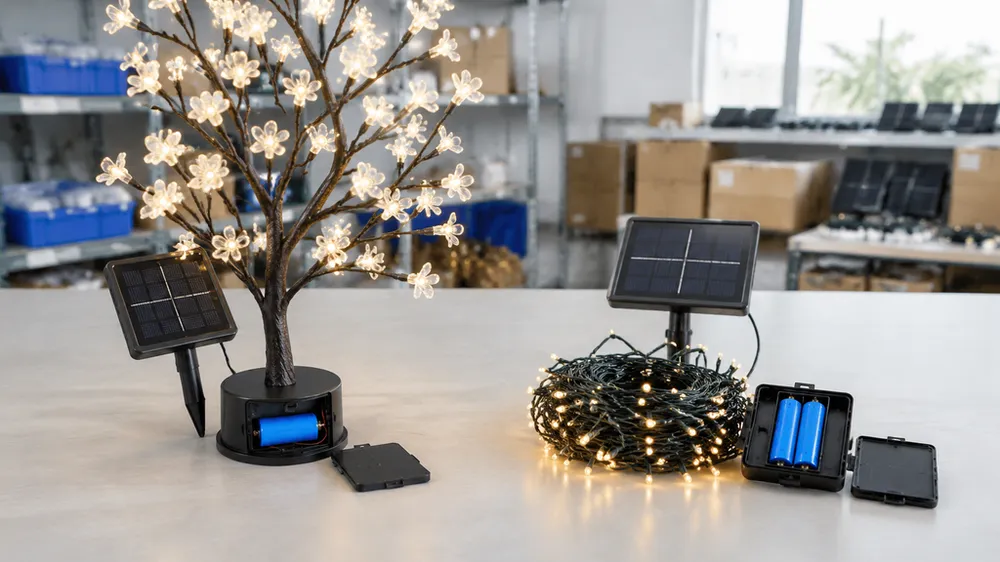
Before we ship any order, every battery goes through a full charge/discharge cycle in our testing lab. That's not an inspection sample — it's 100% of the order. We catch the 2-3% of batteries that arrive from our supplier with internal resistance outside spec, which would cause premature capacity loss in the field. Most competitors skip this step to save two days of lead time. You pay for those two days later, in warranty replacements six months after delivery. The testing adds $0.15-0.30 per fixture to our cost structure, but it's why our field failure rate for battery-related issues runs below 1.5% while the industry average is 4-6%. You see that difference in your warranty reserve calculation.
Weatherproofing and Field Durability — IP Rating Verification
IP rating is the spec that separates tested products from products with optimistic datasheets. Both tree lights and string lights get deployed in exposed outdoor environments — coastal humidity, seasonal flooding, high-temperature summer sun, freeze-thaw cycles in winter. The housing might look sealed, but if the IP rating isn't verified per batch, you're gambling on whether the product survives its first rainy season.
Tree lights typically carry IP65 rating: dust-tight, protected against water jets from any direction. The entire fixture — panel, battery, controller, LED branches — is sealed in one housing. Achieving consistent IP65 across a production batch requires gasket compression testing, cable gland torque verification, and water ingress testing on finished units. Some suppliers claim IP65 based on housing design without testing each batch. That's when variance creeps in — one batch seals correctly, the next batch has a gasket sourcing change or an assembly tolerance shift, and suddenly your field failure rate doubles.
String lights have a harder time achieving consistent IP ratings because the product has more potential failure points. The panel/battery enclosure can be IP65 or IP67 without much difficulty. The problem is the wire connectors and junction points along the wire run. Every connection between LED segments is a potential water entry point. Lower-cost string light models use simple twist connectors or heat-shrink sleeves, which work in dry climates but fail in high-humidity or wet environments. Better models use IP-rated junction boxes or potted connections, but that adds cost and weight. When you're comparing string light quotes, ask specifically about the IP rating of the wire connectors, not just the main enclosure. If the supplier can't answer or says "the wire is waterproof," that's a red flag.
We test IP65/IP67 ingress protection in-house on both product types. The test protocol: submerge the fixture in water for 30 minutes (IP67) or spray it with a 12.5 liter/minute water jet for 3 minutes from all angles (IP65), then power it on and check for internal moisture or electrical faults. For string lights, we test the panel/battery unit, plus five random wire junction points per production batch. If any junction fails, we rework the entire batch. That's the only way to guarantee that your buyer isn't the one discovering the waterproofing failure.
The sourcing risk difference between tree lights and string lights: tree lights have one sealed enclosure per fixture, so IP rating is easier to maintain and verify. String lights have multiple connection points per wire run, so IP rating variance is higher unless the supplier tests junction points specifically. For projects in coastal, high-humidity, or wet environments, tree lights reduce your waterproofing risk exposure. For projects in dry climates, string lights' lower unit cost makes them the better margin play — just verify that the wire connectors are actually rated, not just "weatherproof."
Sourcing and Customization Trade-offs — MOQ, Lead Time, OEM/ODM Options
MOQ and lead time determine whether you can test a product line with a small order or whether you're committing to a container before you know if it sells. Customization options determine whether you can differentiate your catalog from the 15 other distributors selling the same product, or whether you're competing purely on price.
MOQ for standard models: JXSOL starts at 100 units for both tree lights and string lights in our catalog configurations. That's low enough to test a market, validate a project spec, or offer a new product line without capital risk. Most factories set MOQ at 500-1000 units for standard models; we lowered ours because we saw too many buyers stuck between wanting to try a product and not being able to afford the test order. The 100-unit MOQ costs you 8-12% more per unit than a 1000-unit order, but it eliminates the guessing risk.
MOQ for OEM/ODM customization: Custom battery sizing, lumen output changes, color temperature adjustment, or private-label packaging starts at 500 units. That's where we cross the line from standard production to custom tooling or testing protocols. The most common custom request is battery upsizing for higher autonomy — if you're sourcing for a market with long winters or frequent overcast weather, the standard 1-2 day autonomy won't satisfy your buyers. We can upsize to 3-day or 4-day autonomy with a larger battery and slightly adjusted enclosure. The MOQ covers the engineering validation and the battery procurement commitment.
Lead time: Standard catalog models ship 15-20 days ex-works after order confirmation. Custom battery configurations add 10-15 days for battery sourcing and charge/discharge testing. Custom lumen or color temperature specs (if they require different LED sourcing) add another 5-10 days. Total lead time for full customization: 30-35 days. That's still faster than most competitors because our LED and battery suppliers are in Guangdong — we're not waiting for components to cross the country or clear customs from overseas. Lead time matters when you've sold a project and your installation date is fixed. A supplier who ships two weeks late costs you penalty fees or pushes your cash flow back by a month.
Factory-direct advantage: You're reading this on a factory site, not a trading company or sourcing agent site. That eliminates the 15-25% markup that agents layer on top of factory pricing. It also eliminates the communication lag — when you ask a technical question about battery capacity or IP rating verification, you're asking the engineering team that designs and tests the product, not a sales rep who forwards your question and waits for a translated answer. For custom orders, that communication speed cuts iteration cycles from weeks to days.
Certifications included: CE, RoHS, and ISO 9001:2015 are included in standard pricing. These reduce your import compliance risk and customs clearance delays. Some buyers also request IEC 62124 (solar lighting performance) or IP65/IP67 third-party test reports; we provide those on request for orders over 1000 units. The cost is built into volume pricing, not itemized separately.
When to choose tree lights vs string lights from a sourcing perspective: Tree lights give you higher unit cost but lower installation labor (no wire routing), distributed redundancy (one fixture failure doesn't kill the zone), and easier IP rating consistency (one sealed housing per fixture). Choose tree lights when your buyers deploy in open areas, when uptime is contractual, when labor cost is high, or when you need predictable field durability with low warranty exposure. String lights give you lower unit cost but higher installation labor (wire routing and junction management), centralized battery maintenance (easier to replace, but single point of failure), and harder IP rating verification (test the connectors, not just the enclosure). Choose string lights when your buyers deploy along perimeters, when cost-per-lumen drives purchase decisions, when labor cost is low, or when you can absorb centralized battery replacement as a maintenance event rather than a warranty claim.
We recommend sourcing both product types from the same factory if your market has mixed project types. That consolidates your shipping (combine both SKUs in one container), consolidates payment terms (one invoice, one LC, one wire transfer), and consolidates your technical support relationship. If you split sourcing across two factories, you're managing two QC protocols, two lead time schedules, and two sets of engineering contacts. The efficiency loss usually outweighs any per-unit price advantage you negotiated by splitting the order.
Application Scenario Segmentation — Which Product Type Fits Which Commercial Use Case
The right product choice depends on what your buyer is building and how they make money from it. Here's how the topology trade-offs map to common commercial deployment scenarios.
Hospitality and resort properties: These buyers prioritize aesthetics, uptime, and maintenance simplicity. Tree lights work well for garden beds, pool decks, and open courtyard areas where the goal is ambient accent lighting across a zone. The distributed redundancy means one fixture failure doesn't create a dark spot that guests notice and complain about. String lights work well for pathways, pergola perimeters, and building facades where the goal is to define a route or highlight an architectural edge. The lower fixture count reduces visual clutter. In practice, most resort projects use both product types — tree lights for area zones, string lights for linear features. If you're quoting a hospitality project, recommend a mixed deployment and show the coverage calculation for each product type so the buyer sees how the total fixture count and labor hours break down.
Municipal and public space projects: These buyers prioritize uptime (often with contractual penalties for dark fixtures), vandal resistance, and long warranty periods. Tree lights win on uptime because of distributed redundancy and sealed housing construction that's harder to tamper with. String lights are used mainly for seasonal or temporary event lighting — holiday displays, festival perimeters, temporary pathway marking — where the installation is short-term and the centralized battery makes setup and teardown faster. If you're sourcing for a municipal RFP, read the uptime clause carefully. If there's a penalty for fixture failures above a threshold percentage, the distributed redundancy of tree lights reduces your contractual risk. If the RFP specifies temporary or seasonal deployment, string lights' faster installation gives your buyer a labor cost advantage.
Retail and commercial property: These buyers prioritize total cost of ownership over three years — upfront cost, installation labor, maintenance cost, and warranty replacements all factor into the ROI calculation. Tree lights fit parking lot edges, building accent lighting, and landscape feature illumination where the coverage is area-based and uptime affects customer experience (dark parking lots reduce foot traffic). The 3-year warranty we offer on tree lights covers battery degradation and weatherproofing failures, so the buyer's TCO calculation can assume zero warranty cost if they accept our recommendation on battery sizing for their climate. String lights fit facade perimeters, signage accent lighting, and property boundary marking where the coverage is linear and the aesthetic goal is to define edges. The lower upfront cost makes them the better margin play for price-sensitive property owners, but the centralized battery means the buyer should budget for one battery replacement per wire run over a 3-year deployment (cost is $15-25 per replacement unit, plus labor).
Event rental and temporary installation: String lights dominate this segment because setup and teardown speed drives profitability. The centralized panel and battery reduce the number of components to transport, install, and retrieve. Tree lights are used only when the event requires freestanding accent fixtures that don't need wire routing infrastructure. If you're sourcing for a rental business, prioritize string lights and ask about battery swappability — rental operators want to keep the wire and fixtures in rotation while cycling batteries back to the warehouse for recharging. We offer a version of our string light controller with a quick-release battery tray specifically for rental use; MOQ is 200 units because it's a non-standard configuration.
The pattern across all these scenarios: tree lights cost more per unit but reduce deployment risk (labor, uptime, warranty exposure). String lights cost less per unit but shift risk to the deployment phase (installation labor, centralized failure mode, connector waterproofing). Your product choice should match your buyer's risk tolerance and which cost category they're optimizing. If they're optimizing for upfront landed cost, recommend string lights and document the trade-offs. If they're optimizing for TCO or contractual risk, recommend tree lights and show the warranty and uptime advantage.
Spec Comparison Table — Coverage, Runtime, IP Rating, MOQ
Here's the side-by-side data for project costing and risk assessment. Use this when you're comparing quotes from multiple suppliers or deciding which product type to stock for your market.
| Specification | Solar Tree Lights | Solar String Lights |
|---|---|---|
| Form Factor | Multi-branch fixture, integrated panel + battery per unit | Wire run with distributed LEDs, centralized panel + battery per run |
| Coverage Type | Area (circular zones, 2-4m radius per fixture) | Perimeter (linear path, 5-20m per run) |
| Branch Count / Wire Length | 8-12 branches per fixture | 5-20 meters per run (typical) |
| Lumen Output | 10-30 lm per branch, 80-360 lm per fixture | 50-150 lm per meter, 250-3000 lm per run |
| Battery Capacity | 1200-2400 mAh (3.7V Li-ion) per fixture | 3000-6000 mAh (3.7V or 7.4V) per run |
| Runtime (full charge) | 8-12 hours at full brightness | 6-10 hours at full brightness |
| Autonomy Days (standard) | 1-2 days (cloudy weather) | 1-2 days (cloudy weather) |
| Autonomy Days (custom battery) | 2-4 days (OEM/ODM option, MOQ 500 units) | 2-3 days (OEM/ODM option, MOQ 500 units) |
| IP Rating | IP65 (dust-tight, water jet protected) | IP44-IP65 (verify wire connectors separately) |
| Failure Mode | Distributed (one fixture = one failure zone) | Centralized (one battery = entire run fails) |
| Installation Labor | Higher (more fixture points, no wire routing) | Lower (fewer anchor points, wire routing required) |
| MOQ (standard models) | 100 units | 100 units |
| MOQ (OEM/ODM custom) | 500 units | 500 units |
| Lead Time (standard) | 15-20 days ex-works | 15-20 days ex-works |
| Lead Time (custom battery) | 25-35 days ex-works | 25-35 days ex-works |
| Warranty | 3 years (battery + weatherproofing) | 3 years (battery + weatherproofing, verify connector coverage) |
| Certifications | CE, RoHS, ISO 9001:2015, IP65 verified | CE, RoHS, ISO 9001:2015, IP rating varies |
For custom battery sizing, coverage-area calculations, or technical questions on deployment topology, contact our engineering team directly at [email protected] or +86 153 9880 7118 (WhatsApp available). For bulk orders over 1000 units, we provide site-specific fixture layout recommendations and TCO modeling at no charge — send us your project site plan and target lumen density, and we'll show you the cost breakdown for both product types so you can compare total landed cost including installation labor.