What PIR Solar Security Light Sensitivity Actually Controls (Technical Foundation)
PIR solar security light sensitivity isn't a single dial you turn up or down. It's a composite of three parameters: detection range (measured in meters), detection angle (measured in degrees), and lux threshold (the ambient light level below which the sensor activates). When buyers ask about "sensitivity," they're usually asking about detection range — how far away the sensor picks up movement. Higher sensitivity extends that range, but it also lowers the heat differential required to trigger the light. That means the sensor starts responding to smaller temperature changes, which includes non-target movement.
In solar security lights, PIR sensitivity interacts with battery state and LED output in ways that fixed-power AC lights don't experience. A battery at 40% charge may not supply enough current to drive the LED array at full brightness, which effectively reduces the useful detection range even if the PIR module's electrical spec hasn't changed. We've seen units in the field where the PIR sensor technically worked fine — it detected movement at the rated 8-meter range — but the light output was so dim that the coverage didn't match the detection zone. The buyer thought it was a sensor problem; it was actually a battery problem.
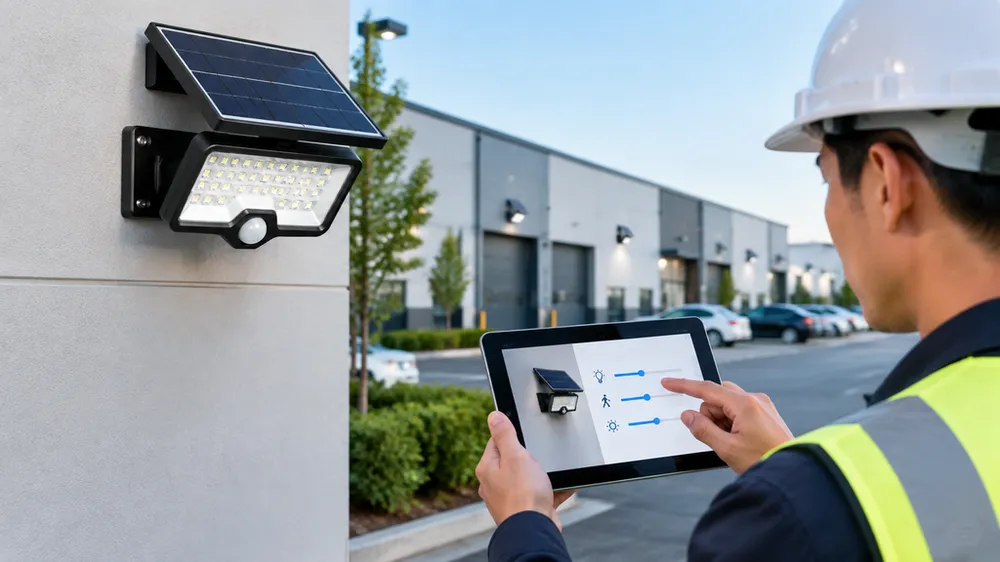
Most off-the-shelf solar security lights ship with fixed sensitivity set at the factory. The manufacturer chooses a detection range, angle, and lux threshold based on the most common residential use case, then hard-wires those settings into the PIR module. Commercial-grade units sometimes include DIP switches or potentiometers for field adjustment — usually three positions (Low/Medium/High range) or a continuous dial for fine-tuning. But even with field-adjustable units, you're still working within the physical limits of the PIR sensor's Fresnel lens and the pyroelectric element behind it.
Temperature compensation is another factor that separates commercial-grade PIR modules from basic consumer sensors. A pyroelectric sensor detects infrared radiation differentials — it's comparing the heat signature of a moving object against the ambient temperature of the detection zone. At dusk or dawn, when ambient temperature is changing rapidly, cheap sensors lose accuracy because they don't have a stable thermal baseline. Better PIR modules include an NTC thermistor that provides a real-time ambient temperature reference, so the sensor can adjust its trigger threshold as the environment heats up or cools down. JXSOL's commercial-grade units use thermistor-compensated PIR modules on all models rated for perimeter security or parking lot deployment, because those applications can't tolerate the false-alarm spikes that happen at twilight with uncompensated sensors.
Factory-set sensitivity vs. field-adjustable is a sourcing decision you make at order time, not something you retrofit later. If you're deploying 200 units across a parking lot and you want surgical precision without installer variability, factory-set sensitivity calibrated to your project spec is the better path. If you're running a pilot with 20 units and you want to test different settings on-site before scaling, field-adjustable units give you that flexibility — but you pay for it in installer labor and documentation overhead.
Why False Alarms Increase When You Raise Sensitivity (And What That Costs B2B Buyers)
Raising PIR sensitivity extends detection range, but it also reduces the sensor's ability to distinguish between target movement and environmental noise. The sensor's job is to detect heat differentials above a certain threshold — when you lower that threshold (which is what "higher sensitivity" does electrically), the sensor starts responding to smaller heat signatures. Small animals, wind-blown plastic bags, thermal reflections from parked cars, even large insects near the Fresnel lens — all of these become viable triggers.
In residential settings, a false alarm is a minor nuisance. In commercial deployments, false alarms have measurable operational cost. If you're running perimeter security with 20 solar flood lights and your false-alarm rate is 10%, that's 2 units cycling unnecessarily every night. Each unnecessary cycle drains battery capacity that could have been reserved for legitimate detections or longer runtime. Over a full season, that 10% false-alarm rate can shorten battery lifespan by 15–20% because you're adding charge/discharge cycles that serve no security function.
For buyers who dispatch security personnel to investigate perimeter alerts, the cost multiplies. A security guard responding to a false alarm wastes 10–15 minutes per incident — travel time to the perimeter, visual inspection, radio confirmation that it's a false positive, return to station. If that happens twice per night across a 50,000-square-meter industrial site with 40 solar security lights, you're burning 20–30 minutes of paid security labor on sensor noise instead of actual patrol duties. Some of our wholesale buyers calculate this cost explicitly when they're deciding between high-sensitivity units with broad coverage vs. medium-sensitivity units with tighter focus. The high-sensitivity option looks cheaper on the invoice, but the TCO (total cost of ownership) over 12 months includes the false-alarm labor burden.
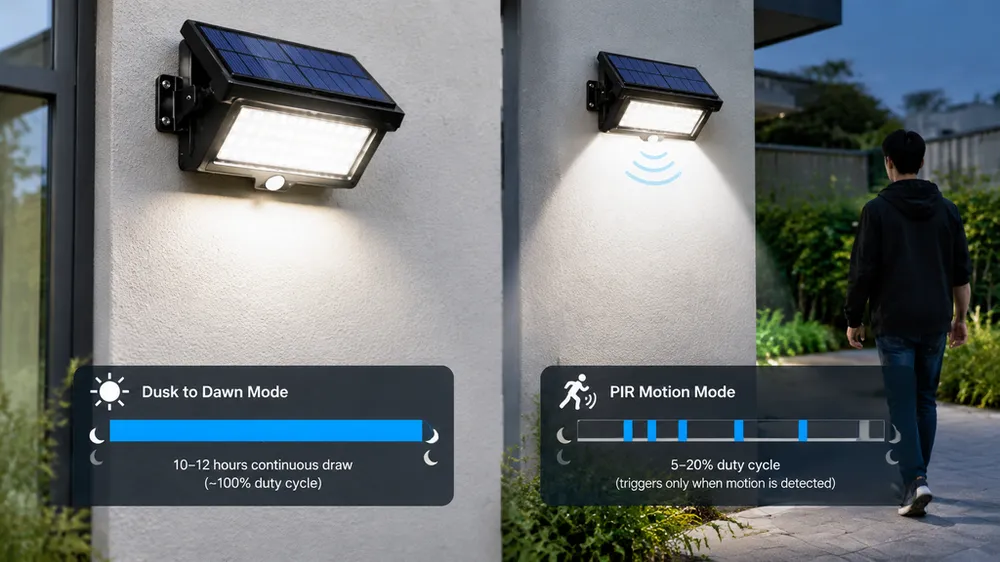
Energy waste is another hidden cost. Solar security lights are designed to run off stored battery capacity, and the battery is sized based on expected runtime — usually 8–10 hours of standby plus 100–150 activation cycles per night. When false alarms push you above that cycle budget, one of three things happens: the battery depletes before dawn (leaving you with no security lighting in the last few hours of darkness), the LED brightness drops as the battery voltage sags (reducing effective coverage), or the battery enters deep-discharge territory and its cycle life shortens (forcing earlier replacement). We track warranty claims by failure mode, and "premature battery degradation" claims are 40% higher on units deployed in high-false-alarm environments compared to installations with properly tuned sensitivity.
The sourcing decision comes down to false-alarm tolerance vs. coverage gaps. Do you need maximum detection range because missing an intrusion is worse than responding to 10 false alarms? Then high sensitivity is the right trade-off. But if your security model depends on personnel response, and false alarms erode response discipline, then medium sensitivity with more units to cover the same area is the better investment. A 200-unit order with medium-sensitivity units costs more upfront than a 150-unit order with high-sensitivity units, but the 200-unit deployment has 30–40% fewer false alarms and the security team stays responsive because they're not conditioned to ignore alerts.
How to Specify PIR Sensitivity for Different Commercial Applications
Detection range, detection angle, and lux threshold need to be matched to the application, not copied from a datasheet. A parking lot has different coverage requirements than a warehouse loading dock, and a perimeter security installation has a completely different false-alarm tolerance than a residential HOA project. Here's how we configure PIR settings for the four most common commercial use cases we see in OEM orders.
Perimeter security installations prioritize long detection range and accept higher false alarms because the cost of a missed intrusion is higher than the cost of investigating a false positive. Typical spec: 12-meter detection range, 120° detection angle, lux threshold below 10 lux (sensor activates in twilight, not just full darkness). The 120° angle is narrower than area lighting because you're focused on linear coverage along a fence line or property boundary — you don't need 180° coverage that picks up movement inside the secured area. The 12-meter range ensures that the sensor detects movement before an intruder reaches the fence, giving security personnel or surveillance cameras time to respond. JXSOL's default perimeter-security profile uses a 12m range with a dual-element PIR sensor that reduces false alarms from small animals by requiring two sequential triggers within 500 milliseconds — a human walking toward the fence will trip both elements in sequence, but a cat jumping across the detection zone usually only triggers one.
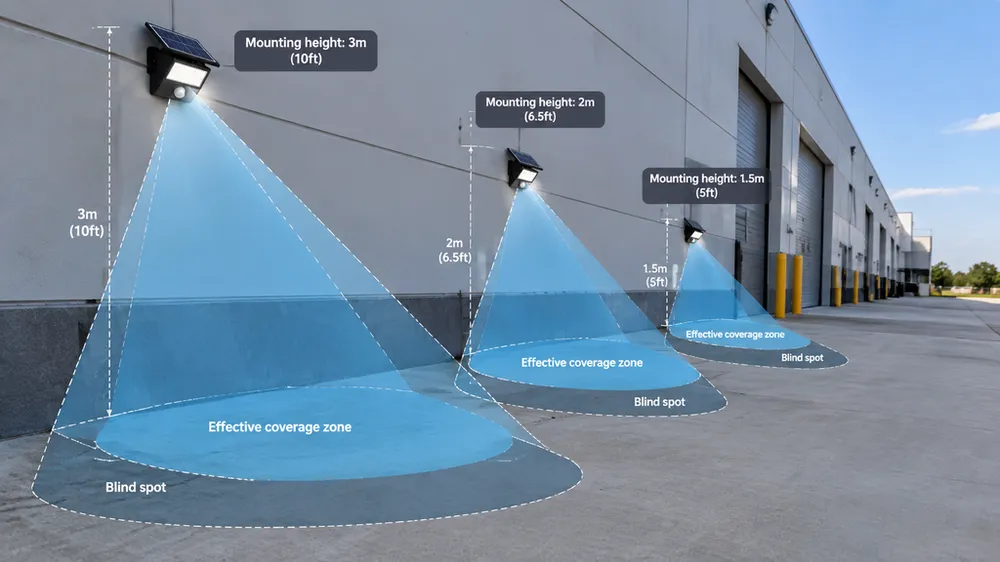
Parking lot and area lighting deployments need wide-angle coverage with medium range, because you're lighting active zones where vehicles and pedestrians are moving constantly. Typical spec: 6-meter detection range, 160° detection angle, lux threshold below 5 lux (full darkness only, no twilight activation). The 160° angle provides broad coverage so one unit can serve a 10×10-meter zone without gaps. The 6-meter range is calibrated to avoid triggering on pedestrians outside the lit area — if your detection range is 12 meters but your LED only lights a 6-meter radius, you're wasting battery on activations that don't improve visibility. We recommend mounting height of 4–5 meters for parking lot installations, which puts the detection cone's center at 2.5–3 meters from the ground — high enough to filter out ground-level foliage movement but low enough to catch human-scale movement reliably.
Warehouse loading docks are high-traffic zones where forklifts, pallets, and personnel create large, constant heat signatures. You don't need hair-trigger sensitivity — you need wide-angle coverage and short-to-medium range so the light activates when someone enters the work zone, not when they're 10 meters away in the parking area. Typical spec: 4-meter detection range, 180° detection angle, lux threshold below 3 lux (darkness only). The 180° angle is often achieved with dual PIR sensors mounted at opposite ends of the fixture, giving you seamless coverage across the entire loading dock entrance. The 4-meter range keeps the detection zone tightly focused on the immediate work area, which reduces false alarms from vehicle traffic in adjacent lanes. JXSOL's loading-dock profile uses a slightly longer activation duration (light stays on for 90 seconds vs. 30 seconds in other profiles) because forklift operators need consistent lighting while they're maneuvering, not pulsed on/off cycles.
Residential project installations — HOAs, gated communities, apartment complexes — need to balance security coverage with nuisance reduction. Residents complain if lights trigger constantly from cats, wind-blown branches, or neighbors walking on adjacent properties. Typical spec: 6-meter detection range, 140° detection angle, lux threshold below 5 lux. The 140° angle is wide enough for driveway or walkway coverage but narrow enough to exclude peripheral zones where non-target movement happens. The 6-meter range is calibrated to detect human-scale movement (adults, teenagers, large dogs) but filter out smaller heat signatures (cats, raccoons, possums). JXSOL's residential profile uses a slightly higher trigger threshold — the PIR requires a 10°C heat differential instead of 5°C — which effectively filters out small animals without reducing detection reliability for human-sized targets.
| Application | Detection Range | Detection Angle | Lux Threshold | False-Alarm Tolerance |
|---|---|---|---|---|
| Perimeter Security | 12m | 120° | <10 lux | High (missing intrusion worse than false alarm) |
| Parking Lot / Area Lighting | 6m | 160° | <5 lux | Medium (balance coverage and battery life) |
| Warehouse Loading Dock | 4m | 180° | <3 lux | Low (high traffic, need tight focus) |
| Residential Project (HOA) | 6m | 140° | <5 lux | Very Low (nuisance complaints damage reputation) |

These specs are starting points, not absolute rules. A parking lot in a windy coastal area may need tighter angle settings to exclude movement from adjacent roadways. A perimeter installation with heavy foliage may need higher mounting to keep branches out of the detection cone. The table gives you the factory-default profile we use when a buyer orders without specifying custom PIR settings, but we adjust range, angle, and threshold based on site photos or deployment descriptions when buyers provide them.
Factory-Configurable vs. Field-Adjustable PIR Settings (OEM Sourcing Advantage)
Most off-the-shelf solar security lights ship with fixed PIR sensitivity — the manufacturer sets detection range and angle at the factory, solders the PIR module into the circuit board, and that's the configuration you get. No adjustment, no field calibration, no customization. This works fine for residential buyers who want plug-and-play installation, but it creates problems for commercial buyers who need consistent performance across 100+ units or who have site-specific requirements that don't match the manufacturer's default profile.
Commercial-grade solar security lights sometimes include field-adjustable sensitivity — usually DIP switches on the PIR module or potentiometers accessible through the housing. A three-position DIP switch gives you Low/Medium/High range settings (typically 5m / 8m / 12m). A potentiometer gives you continuous adjustment across the sensor's full range, which is useful for pilots or installations where you're still testing optimal coverage. But field adjustment has trade-offs: it requires trained installers who understand what they're adjusting, it introduces variability if different installers set different units to different positions, and it adds 5–10 minutes per unit to installation time. For a 200-unit parking lot deployment, that's 16–30 hours of extra labor just dialing in sensitivity.
OEM and ODM orders give you a third option: factory-configured PIR sensitivity set to your project spec before shipment. JXSOL can calibrate detection range, angle, and lux threshold to match your deployment requirements, then lock those settings at the factory so installers don't need to touch them. Minimum order for custom PIR configuration is 500 units, because it requires dedicated PIR module sourcing and batch testing to verify that every unit in your order meets the specified range and angle. We've done this for parking lot contractors who need every unit set to exactly 6-meter range with 160° angle, and for perimeter security buyers who need 10-meter range with 110° angle and dual-element triggering to reduce false alarms.
When to use factory configuration: large projects where you want precision without field labor. If you're installing 500 units across a corporate campus and you need every light to perform identically, factory configuration eliminates installer error and reduces commissioning time. You're paying for consistency — every unit is tested on the same PIR bench, every unit has the same Fresnel lens orientation, every unit meets the same trigger threshold. The cost premium vs. off-the-shelf units is 8–12% at 500-unit volume, which is less than the labor cost of field-adjusting 500 units manually.
When to use field-adjustable units: smaller orders, pilot projects, or installations where you're not certain what sensitivity profile you need until you see the site. If you're deploying 50 units at a new facility and you haven't worked with that site's environmental conditions before (wind patterns, nearby traffic, foliage density), field-adjustable units let you tune each zone without reordering hardware. The trade-off is installer skill and documentation — you need to record what settings you used in each zone, because six months later when you're troubleshooting a false-alarm complaint, you won't remember whether Unit 23 is set to Medium or High.
JXSOL's default PIR profile for off-the-shelf units is 8-meter range, 140° angle, <5 lux threshold. That's based on 13 years of warranty claims and field feedback — it's the profile that generates the fewest complaints across the widest range of deployment types. We tuned the default trigger threshold to filter out cats and small dogs (heat signatures below 30cm diameter) while catching human-sized movement reliably. If your project needs something different — tighter range to reduce false alarms, wider angle for area coverage, higher lux threshold to delay activation until full darkness — we can factory-configure that at 500-unit minimum, or you can order field-adjustable units and tune them on-site.
One note on field adjustment: if you're buying units with potentiometer-adjustable range, make sure your installer marks the potentiometer position with paint or a label after adjustment. Potentiometers can drift if they're not lock-washer secured, and vibration from wind or nearby traffic can shift the setting over time. We've had buyers call in with "sensitivity changed after three months" complaints, and when we walked them through diagnosis, the potentiometer had rotated 15–20° from its original position. Commercial-grade units use multi-turn potentiometers with detent locks to prevent drift, but even those should be marked so maintenance personnel can verify settings during annual inspections.
Common False-Alarm Triggers in Solar Security Lights and How to Eliminate Them Without Reducing Coverage
False alarms in PIR solar security lights come from environmental factors that mimic the heat differential signature of human movement. The sensor can't distinguish between a person walking toward the light and a heat signature that happens to match the same pattern — it only knows "temperature change detected in detection zone." Eliminating false alarms without reducing legitimate detection range means understanding what's creating the false signature, then changing the installation or sensor configuration to exclude that specific trigger without narrowing the overall detection cone.
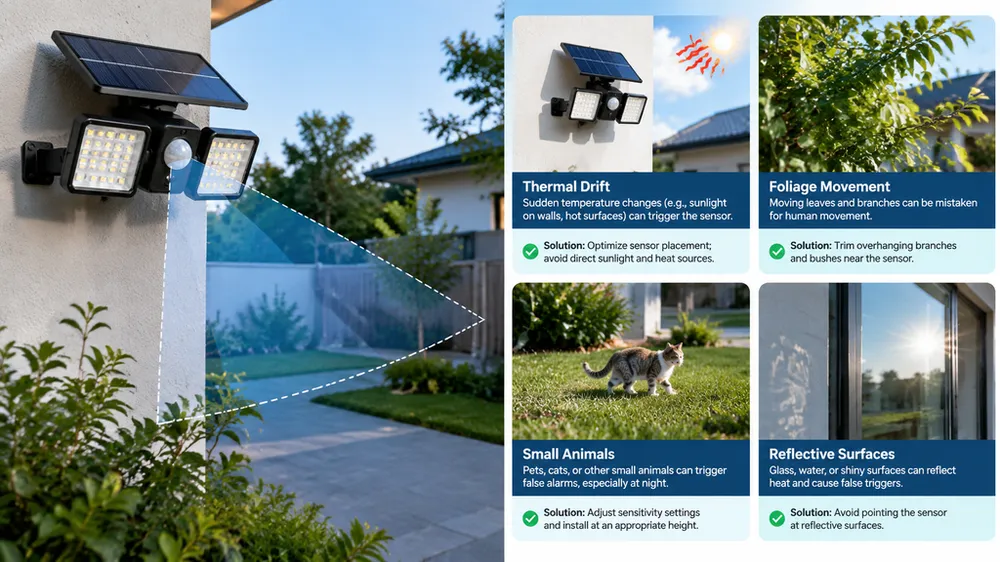
Thermal drift at dusk and dawn is the most common false-alarm trigger we see in warranty diagnostics. PIR sensors detect infrared radiation differentials — the difference between a moving heat source and the ambient background temperature. At dusk, the ground and surrounding surfaces are cooling down after absorbing solar heat all day, but they're cooling at different rates depending on material (asphalt cools faster than concrete, metal surfaces radiate heat faster than wood). This creates moving thermal gradients that the PIR sensor interprets as movement. At dawn, the reverse happens — surfaces start warming at different rates, creating the same false-movement pattern.
Basic pyroelectric PIR sensors don't compensate for this. They assume ambient temperature is stable, so any heat differential above the trigger threshold activates the light. Commercial-grade sensors include an NTC thermistor that provides real-time ambient temperature reference, so the sensor can adjust its trigger threshold as the environment changes. JXSOL's commercial units use thermistor-compensated PIR modules on all models rated IP65 or higher, because outdoor installations can't avoid thermal drift — it's a fact of solar heating and radiative cooling. If you're buying off-the-shelf units and you're seeing false alarms clustered around dusk or dawn, check the spec sheet for "temperature compensation" or "ambient reference." If it's not listed, the sensor probably doesn't have it, and you'll need to raise the lux threshold (delay activation until ambient light drops further into darkness) to reduce twilight false alarms.
Moving foliage and tree branches trigger false alarms when they're at the edge of the detection zone and wind moves them intermittently. Leaves and branches don't have significant heat signatures during the day, but at night they cool down to ambient temperature, and when wind moves them across the detection cone, the PIR sensor sees a temperature differential between the branch and the background (usually sky or a building). This is worse in installations where the light is mounted low (2–3 meters) and foliage is within 1–2 meters of the Fresnel lens.
Solution: mount the light higher (4–5 meters) so the detection cone's lower edge starts above ground-level foliage, or trim foliage back so branches are outside the detection angle. Do not reduce sensitivity to filter out foliage — that also reduces your detection range for legitimate targets. If mounting height and foliage trimming aren't options (rental property, municipal right-of-way restrictions), you can narrow the detection angle by masking part of the Fresnel lens with opaque tape. Mask the outer 10–15° on each side of the lens to exclude peripheral foliage while keeping the center detection cone at full range. We've had buyers do this successfully on perimeter installations where trees overhang the fence line — they masked the side zones that picked up branches, kept the forward-facing zone at full 12-meter range for intrusion detection.
Small animals (cats, raccoons, possums, rabbits) are persistent false-alarm sources in semi-rural and suburban commercial sites. A cat walking across a parking lot generates a heat signature large enough to trigger most PIR sensors, especially if the cat is moving perpendicular to the detection cone (maximum differential). Raising detection range to filter out small animals doesn't work reliably, because the sensor's trigger threshold is based on temperature differential, not object size — a cat 3 meters from the sensor can generate the same differential as a human 8 meters away.
Better solution: raise mounting height so the detection cone starts 1–1.5 meters above ground. A cat at ground level won't enter the cone if the cone's lower edge is 1.5 meters up. This works for most four-legged animals but still catches human-sized movement because humans are taller. JXSOL offers size filtering on OEM orders at 1000-unit minimum — the PIR module rejects heat signatures smaller than 30cm diameter, which filters out cats and small dogs while catching humans reliably. This is done with a dual-element PIR sensor and logic that requires both elements to trigger within 500 milliseconds — a human walking through the zone trips both elements in sequence, but a small animal usually only triggers one element because its heat signature isn't large enough to span both detection zones.
Reflective surfaces (parked cars, metal sheds, HVAC enclosures) create false alarms through thermal re-radiation. During the day, metal and glass surfaces absorb solar heat. At night, they radiate that heat back into the environment, and if they're within the PIR detection zone, the sensor sees a heat source that wasn't there an hour ago. Worse, if wind moves the reflective surface slightly (a car door opening and closing in an adjacent parking spot), the radiated heat signature moves, and the PIR interprets that as movement.
Solution: aim the PIR sensor away from large reflective surfaces, or mount the light so reflective surfaces are outside the detection angle. If that's not possible (parking lot where every zone has parked cars), use a Fresnel lens with tighter focus to exclude distant reflections. Some commercial PIR modules use a segmented Fresnel lens that divides the detection zone into near-field (0–4m) and far-field (4–12m) segments, with higher trigger thresholds for far-field detection. This reduces false alarms from distant reflections while maintaining sensitivity for near-field movement. JXSOL uses segmented Fresnel lenses on parking lot and area lighting models, because those applications always have reflective surfaces in the detection zone and standard single-zone lenses generate too many false positives.
Insects on or near the Fresnel lens are less common but more annoying when they happen. Moths, beetles, and other insects attracted to warmth from the electronics housing can land on the Fresnel lens or hover near it, and their body heat at close range triggers the sensor. This is seasonal — worst in late spring and summer when insect populations peak.
Solution: ensure the fixture has IP65 or IP67 sealing with insect-resistant Fresnel lens cover. JXSOL's outdoor fixtures use polycarbonate lens covers with smooth surfaces (no texture that insects can grip) and gasket-sealed housings so insects can't enter the PIR chamber. If you're seeing insect-triggered false alarms on older units, the gasket seal may have degraded — replace the gasket or apply silicone sealant around the lens perimeter. Maintenance protocol for high-insect environments: wipe the Fresnel lens quarterly with a damp cloth to remove any dead insects or debris that could create close-range heat signatures.
Diagnostic checklist when you're troubleshooting false alarms: check mounting height (is foliage or ground-level movement in the detection cone?), check for reflective surfaces in the detection zone (metal, glass, parked vehicles), check Fresnel lens for debris or insects, check battery voltage (weak battery can cause erratic PIR behavior as voltage sags), check lux threshold setting if the unit is field-adjustable (is it activating too early in twilight when thermal drift is highest?). Most false-alarm problems can be traced to one of these five factors, and fixing the environmental trigger is faster and cheaper than replacing the PIR module.
How JXSOL Tests PIR Sensitivity Before Shipment (And What Buyers Should Verify On Receipt)
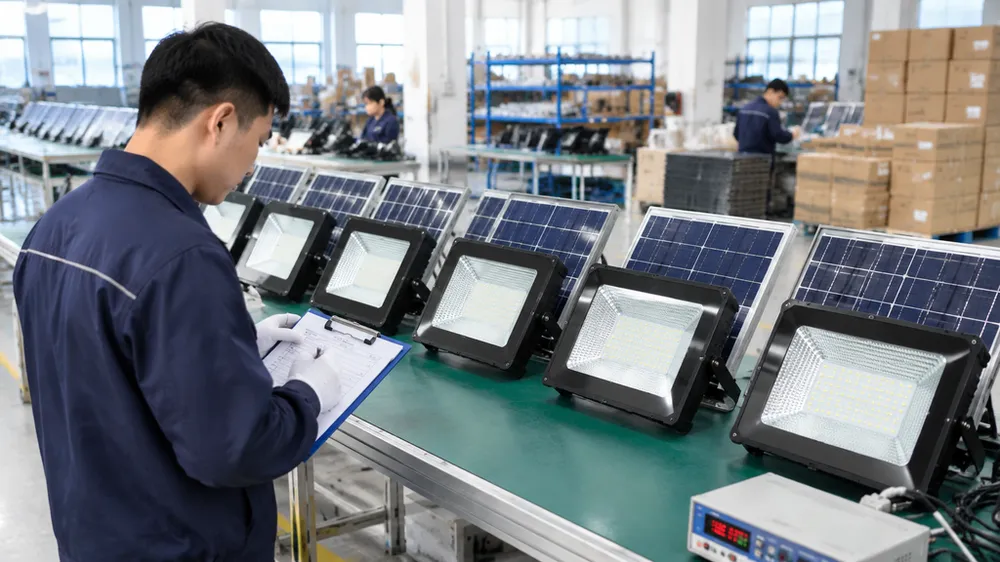
We test PIR function on every production batch before shipment — not sample testing, not random spot checks, but 100% batch testing where every unit in your order goes through the same PIR verification protocol. The test bench measures detection range at three temperature differentials (5°C, 10°C, 15°C above ambient), detection angle confirmation with a moving heat source at four distances (1m, 3m, 5m, 8m), and lux threshold verification (sensor must NOT activate above threshold, MUST activate below threshold). This takes 4–6 minutes per unit, which is why most aggregator suppliers skip it and ship based on PIR module datasheet specs instead of measured performance.
The test bench uses a calibrated infrared emitter mounted on a motorized track. The emitter produces a controlled heat signature (human body temperature equivalent, 36°C surface temp, 30cm diameter), and the track moves it through the detection zone at walking speed (1.2 meters per second). We record the distance at which the PIR triggers — that's the measured detection range for that unit. We repeat the test at three ambient temperatures (15°C, 25°C, 35°C) to verify that the PIR's temperature compensation is working (detection range shouldn't vary more than 5% across that ambient range). If a unit fails range verification — detection range is more than 10% below the rated spec — it goes back to assembly for PIR module replacement or Fresnel lens realignment.
Detection angle is tested by moving the heat source laterally across the detection zone at 5-meter distance. We start at the centerline (0° offset) and move the emitter left and right until the PIR stops triggering. The angle between the two trigger-loss points is the measured detection angle. For a unit rated at 140°, we expect trigger loss at ±70° from centerline. If we see trigger loss at ±60°, the Fresnel lens is misaligned or the PIR module is mounted off-center — that unit goes back for rework.
Lux threshold testing is simpler but just as critical. We cover the solar panel (simulating night) and verify that the PIR activates when the heat source enters the detection zone. Then we uncover the solar panel and shine a calibrated light source at the sensor to simulate twilight — the PIR should NOT activate. We test at the rated threshold (e.g., 5 lux for parking lot profile) and at 50% above threshold (7.5 lux) to confirm there's margin. If the sensor activates above threshold, it'll generate false alarms at dusk, and that unit doesn't ship until the lux sensor is recalibrated or replaced.
Test data is recorded in the batch inspection report, which we share with buyers on orders of 500+ units. The report includes pass/fail rate (target is 98% first-pass yield), average detection range across the batch, detection angle deviation (standard deviation from rated angle), and lux threshold accuracy. For OEM orders with custom PIR configuration, the batch report becomes your spec-compliance documentation — if your end client requires factory validation that the units meet the specified 6-meter range and 160° angle, you have a signed test report with measured data for every unit in the batch.
Why this matters: unchecked solar security lights from aggregator suppliers often have 20–30% range variance within the same shipment. You order 200 units rated for 8-meter detection, you receive 200 units, but when you install them you discover that 40 units only detect at 5–6 meters and 15 units detect at 10–11 meters. That creates coverage gaps in multi-unit installations — some zones have overlapping coverage, other zones have gaps, and you can't predict which until you've installed and tested every unit. JXSOL's batch testing ensures <5% range variance, which means you can design coverage with confidence that the installed performance will match the spec.
Buyer-side verification on receipt: we recommend unpacking and testing a 5% sample for orders of 200+ units, or 10-unit minimum for smaller orders. Mount the units at the specified height in a controlled environment (indoor warehouse with low ambient light works fine for initial testing). Use a heat source — a person walking through the detection zone is the simplest method, or a portable electric heater if you want a repeatable heat signature — and confirm that detection range matches the rated spec. Walk toward the sensor from 12 meters out and note the distance where the light activates. Repeat from different angles to verify the detection cone shape. Check lux threshold by testing activation in twilight (if testing outdoors) or by covering/uncovering the solar panel (if testing indoors).
If variance is more than 10% from rated spec — detection range is 7 meters when spec is 8 meters, or detection angle is 125° when spec is 140° — escalate to us before installing the full order. We'll either provide replacement units for the out-of-spec samples or work with you to determine if the variance is acceptable for your deployment (some buyers accept 10–15% under-range if it reduces false alarms, others need strict spec compliance for insurance or liability reasons). The 5% sample test takes 2–3 hours for a 200-unit order, which is minor compared to the cost of discovering coverage gaps after you've installed all 200 units and commissioned the system.
For OEM orders with custom PIR configuration, we provide the signed batch test report at shipment, and we recommend that you store it with your project documentation. If you're installing solar security lights for a municipal contract or a corporate campus, the facilities manager may ask for factory validation data during commissioning or during annual safety audits. The batch report shows that every unit was tested before installation, which satisfies most compliance requirements without requiring you to test every unit on-site.
When to Use Multiple Units with Lower Sensitivity vs. Fewer Units with Higher Sensitivity (Coverage Strategy for B2B Projects)
The trade-off between unit count and sensitivity is a total-cost-of-ownership calculation, not just a purchase-price comparison. Fewer high-sensitivity units cost less upfront — smaller invoice, less installation labor, fewer mounting points to engineer. More low-to-medium sensitivity units cost more upfront but deliver lower false-alarm rates, more predictable coverage, and easier troubleshooting when something goes wrong. For residential buyers, the upfront cost usually wins. For commercial buyers who care about operational cost over 3–5 years, the TCO calculation flips.
Example 1: Parking lot, 50 meters × 30 meters, asphalt surface, open layout with no obstructions. Option A: 6 units with 12-meter detection range, high sensitivity. Total purchase cost lower by 30–35% vs. Option B. Installation labor: 6 mounting points, 6 electrical connections (if hybrid solar/AC), 6 commissioning tests. Coverage: each unit covers a 12-meter radius, so zones overlap significantly in the center, but edge zones near the 50-meter perimeter have marginal coverage. False-alarm rate: high, because 12-meter range with high sensitivity picks up pedestrian movement on adjacent sidewalks and vehicle headlights from the access road 15 meters away. Battery life: 15–20% shorter than rated lifespan because false alarms increase nightly cycle count.
Option B: 10 units with 8-meter detection range, medium sensitivity. Total purchase cost higher, but per-unit cost is similar (volume discount offsets some of the unit-count increase). Installation labor: 10 mounting points, 10 connections, 10 commissioning tests — 60% more labor than Option A. Coverage: each unit covers an 8-meter radius, zones have minimal overlap, perimeter coverage is solid with no gaps. False-alarm rate: 40% lower than Option A because 8-meter range with medium sensitivity doesn't pick up movement outside the parking lot boundary. Battery life: matches or exceeds rated lifespan because cycle count stays within design budget.
TCO over 3 years: Option A has lower year-1 cost but higher year-2 and year-3 cost due to battery replacements (2–3 units need new batteries after 18 months vs. 0–1 units in Option B) and maintenance callouts (false alarms generate tenant complaints, which generate service calls to "fix" the lights). Option B has higher year-1 cost but near-zero maintenance cost in years 2–3, and battery replacements happen on the normal 3-year schedule, not prematurely. For a buyer who's operating the parking lot (property manager, facility owner), Option B has better ROI. For a buyer who's installing the system and handing it off to someone else (contractor, distributor), Option A has better margin on the initial sale — but that buyer may lose the maintenance contract when the lights start generating complaints.
Example 2: Warehouse perimeter, 200 meters linear, chain-link fence, adjacent to public road with vehicle traffic. Option A: 20 units with 12-meter detection range, high sensitivity. Covers the full 200-meter perimeter with some overlap (each unit covers 10 meters of fence line). False-alarm problem: 12-meter range picks up vehicle headlights and pedestrian movement on the public road 10–15 meters from the fence. Security team starts ignoring perimeter alerts because 60–70% are false positives from road traffic. After three months, an actual intrusion goes unnoticed because the alert pattern looks identical to the false alarms they've been seeing nightly.
Option B: 25 units with 8-meter detection range, medium sensitivity. Covers the full 200-meter perimeter with tighter spacing (each unit covers 8 meters of fence line). False-alarm rate: 50% lower than Option A because 8-meter range keeps the detection zone focused on the fence line and the 5-meter zone inside the perimeter. Road traffic 12 meters away doesn't trigger the sensors. Security team response discipline stays high because false-alarm rate is low enough that every alert is treated as legitimate. When an intrusion happens, security responds within 2 minutes because they haven't been conditioned to ignore perimeter alerts.
TCO consideration: Option B has 25% higher hardware cost and 20% higher installation cost, but it preserves the operational value of the security system. A perimeter security system that generates constant false alarms is worse than no system at all, because it trains security personnel to ignore alerts. The $3,000 cost difference between Option A and Option B is trivial compared to the liability exposure if an intrusion happens and your security team didn't respond because they assumed it was another false alarm.
Option B also has a troubleshooting advantage. If one unit fails (PIR sensor dies, battery degrades, LED driver shorts out), the coverage gap in Option B is 8 meters, which is noticeable but not catastrophic. In Option A, a single unit failure creates a 10-meter gap, and because the adjacent units are also spaced 10 meters apart, you now have a 20-meter dead zone until you replace the failed unit. Tighter unit spacing with shorter detection range means smaller failure impact and easier diagnosis — when you walk the perimeter and find a dark zone, you immediately know which unit failed.
Rule of thumb: if false alarms have operational cost — security response labor, tenant complaints, maintenance callouts, erosion of response discipline — use more units with lower sensitivity. If coverage gaps have higher cost than false alarms — high-value inventory, liability risk, insurance requirements — then fewer units with higher sensitivity may be acceptable, but you'll need a mitigation plan for the false-alarm burden (automated filtering, security personnel trained to distinguish real alerts from noise, regular PIR recalibration to tighten trigger thresholds).
JXSOL provides two-option quotes for project buyers by default: "economy coverage" (minimum unit count, higher sensitivity, accepted false-alarm rate) and "precision coverage" (higher unit count, medium sensitivity, factory-calibrated to reduce false alarms). We show the upfront cost difference and the projected false-alarm rate for each option, then let the buyer decide based on their operational model. Most buyers who operate the facility choose precision coverage. Most buyers who install and hand off choose economy coverage, unless they're also bidding for the maintenance contract — in that case, precision coverage improves their long-term revenue because fewer service calls means lower cost to fulfill the maintenance agreement.