What "Smart Solar Lighting System Cost" Actually Measures
When buyers ask about smart solar lighting system cost, they're usually comparing quotes that range from $180 to $480 per unit for what appear to be similar products. The confusion comes from treating "smart solar lighting" as a fixed category with standard pricing, when the cost is actually the sum of spec choices you control.
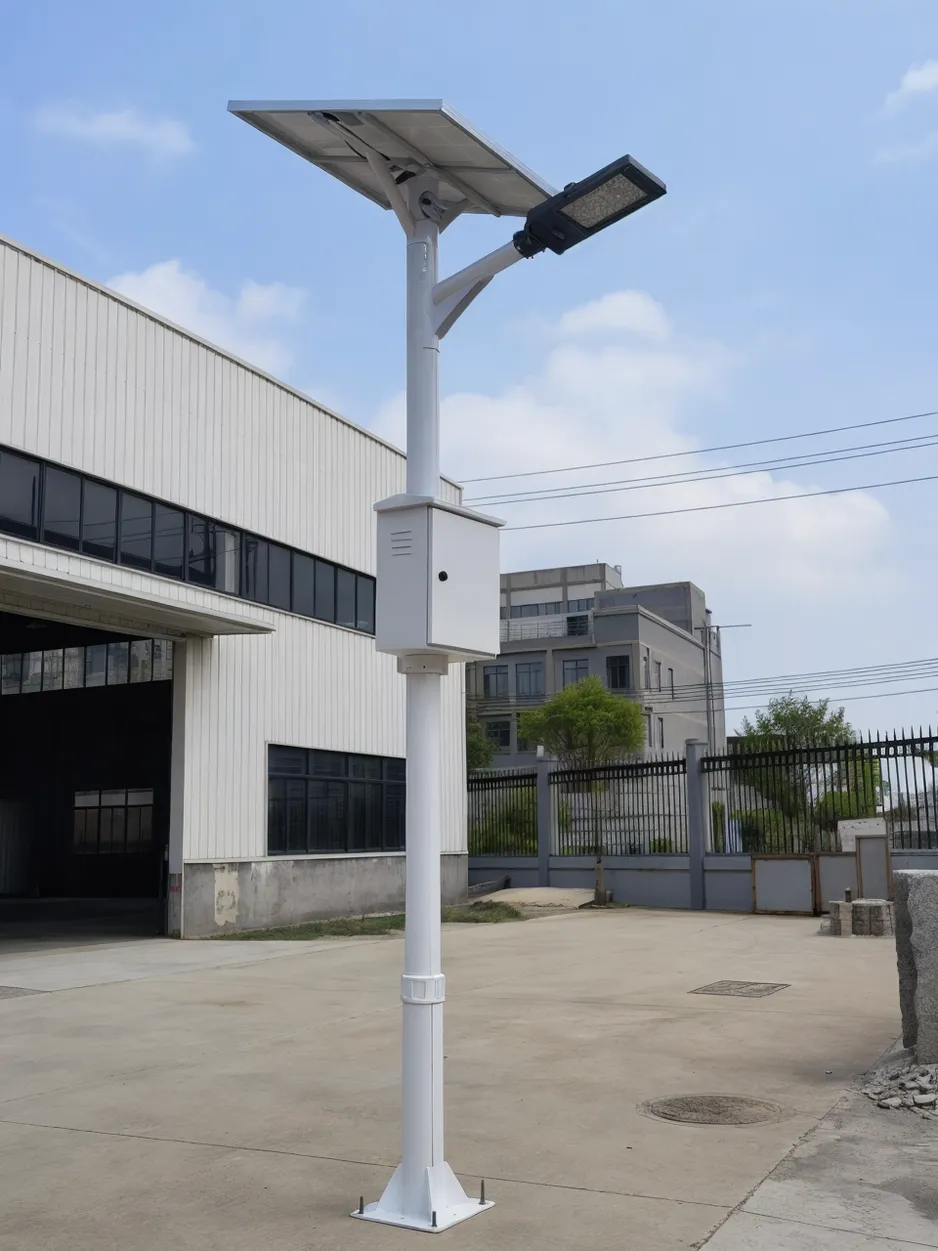
"Smart" in this context means IoT-enabled monitoring and remote control — real-time data on battery state of charge, panel voltage, lumen output, plus the ability to adjust dimming schedules or diagnose failures without sending a truck. That's distinct from standard solar lighting with a timer or motion sensor, which operates independently once installed. Standard solar street lights run $120–$240 per unit depending on lumen output and battery capacity. Smart systems add $60–$240 to that baseline, but the premium isn't arbitrary — it reflects component choices, monitoring protocol, and the operational infrastructure your deployment requires.
In B2B purchasing, "system cost" means per-unit factory cost plus the variables that affect your landed cost: shipping method (sea freight adds 4–8 weeks but costs $0.80–$1.50 per kg vs air freight at $4–$7 per kg), import duties (0–15% depending on destination country), and order volume tier. A distributor ordering 100 units to test a new SKU pays a different effective price than a contractor buying 500 units for a municipal parking lot project, even if the base unit is identical.
This article shows which cost variables you control during the RFQ phase and which are locked in by your application requirements. Battery chemistry, IoT protocol, panel sizing logic, and order volume are all negotiable levers. Your geographic location, required autonomy days, and lumen output are fixed by where you're deploying and what light level your customer expects — you can't reduce cost by under-delivering on those without creating a field failure.
Component-Level Cost Breakdown for Smart Solar Lighting
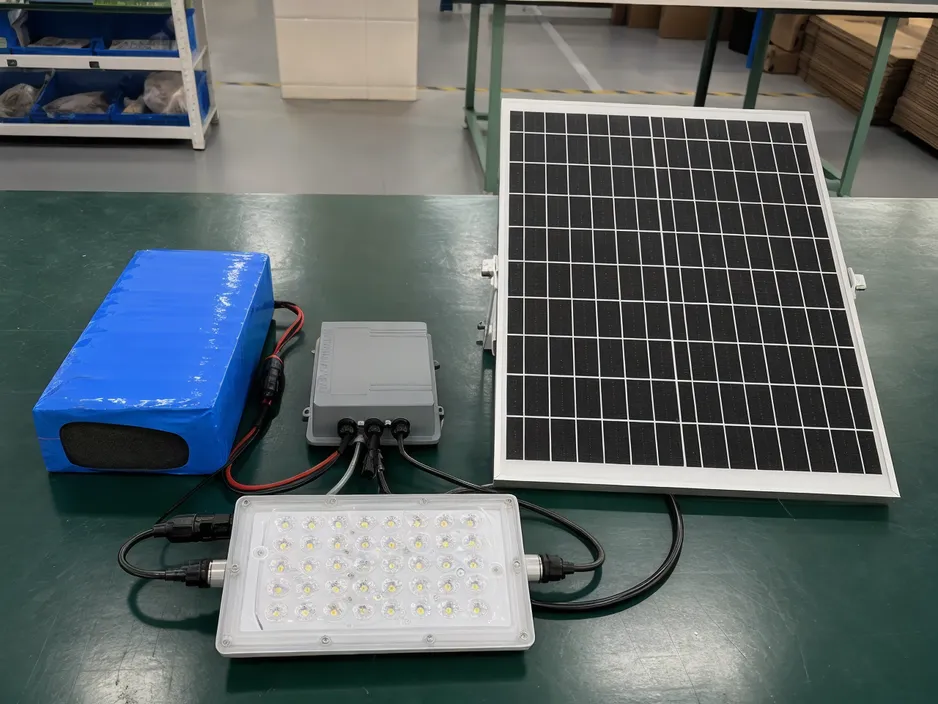
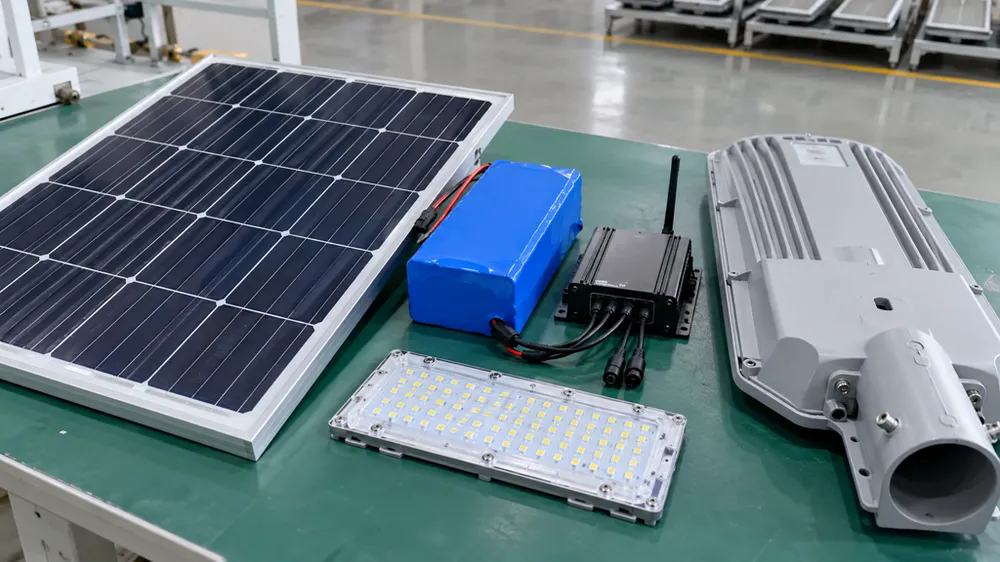
Smart solar lighting system cost is the sum of six component categories, each with a cost range determined by spec choices. Here's what affects the price of each part and where you have room to optimize without compromising field performance.
Solar panel: $18–$45 per unit Panel cost scales with wattage (30W to 120W for most street lighting applications) and cell efficiency. Monocrystalline panels deliver 20–22% efficiency and cost 25–35% more than polycrystalline panels at 16–18% efficiency. For street lighting, you're constrained by wind load and pole mounting space — a 6-meter pole in a high-wind area can't safely support a panel larger than about 80W. If your lumen target requires more solar input than that, you need higher-efficiency cells. Most buyers over-spec panel size as insurance against cloudy weather, but the smarter approach is to right-size the panel based on actual solar irradiance data for your latitude and let battery capacity handle short-term weather variation (battery capacity per watt-hour is cheaper than panel capacity per watt-hour once you're past the minimum panel size needed to recharge the battery within available daylight).
Battery pack: $35–$95 per unit Battery accounts for 20–30% of total smart solar lighting system cost and presents the clearest lifecycle cost trade-off. Lithium iron phosphate (LiFePO4) batteries cost $65–$95 for a typical 40–60Ah street light battery, while standard lithium-ion batteries cost $35–$55 for the same amp-hour rating. LiFePO4 delivers 2,000–2,500 charge/discharge cycles vs 800–1,200 cycles for Li-ion, which means a LiFePO4 battery lasts 6–8 years in typical use vs 3–4 years for Li-ion. If your project has an expected service life of 8+ years, LiFePO4 shows lower total battery cost even though upfront price is 60–80% higher — you avoid a mid-life battery replacement that includes not just the battery cost but also labor to access the fixture, dispose of the old battery, and recommission the unit.
The other major cost driver is capacity, specified in amp-hours (Ah) and tied to your autonomy requirement — how many nights the light operates without recharge. A 40Ah battery supports roughly 2 days of autonomy for a 30W LED load, while a 60Ah battery supports 3 days. Most buyers default to 3–5 days of autonomy based on worst-case winter weather, but actual field data from deployed systems shows that most locations rarely see more than 2 consecutive cloudy days. Working with an engineering team that models solar irradiance data for your specific latitude lets you right-size battery capacity to realistic autonomy needs rather than theoretical maximums, typically reducing battery cost by 20–30%.
LED module and driver: $22–$50 per unit LED cost is a function of lumen output (3,000 to 12,000 lumens for street lighting), color rendering index (CRI 70 for roadways, CRI 80+ for pedestrian areas where color recognition matters), and chip brand. A 4,000-lumen module with Bridgelux or Lumileds chips costs $28–$35, while a 6,000-lumen module costs $38–$45. The main buyer mistake here is speccing higher lumen output than the application actually requires. Municipal lighting standards specify minimum maintained illuminance in lux, not total lumen output — a 4,000-lumen fixture with the right optics and mounting height often meets the same ground-level lux requirement as a 6,000-lumen fixture with poor optical distribution. Before locking in lumen output, confirm your lighting design calculations account for actual pole height, pole spacing, and luminaire distribution pattern, not just a rule-of-thumb lumen-per-meter formula.
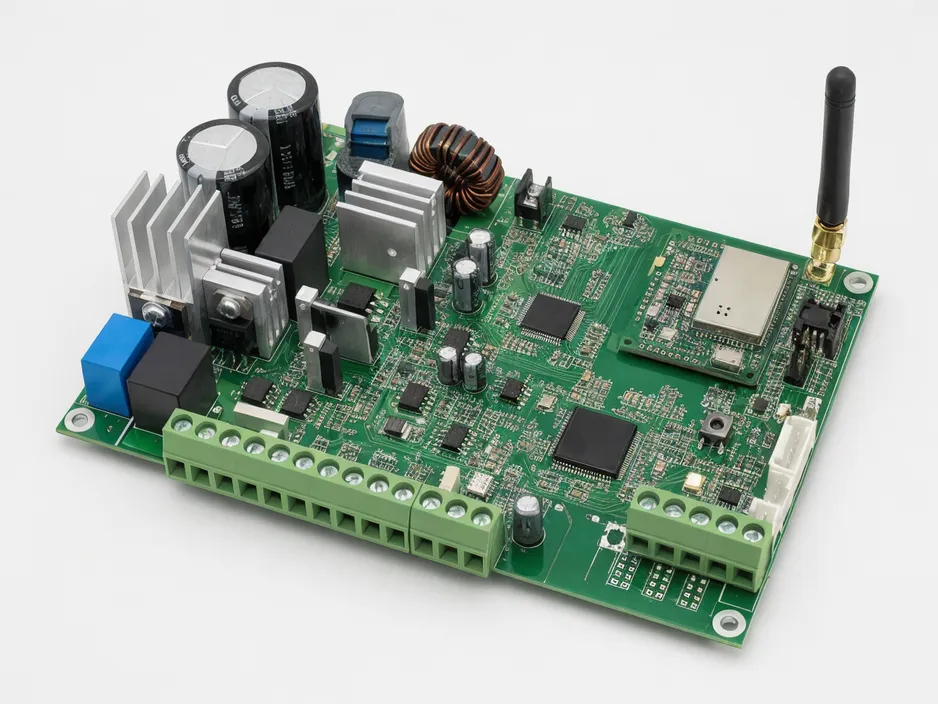
IoT module: $35–$90 per unit IoT capability is what separates smart solar lighting from standard solar, and this component shows the widest cost spread based on protocol choice. LoRa modules cost $35–$50 per unit but require a gateway ($800–$1,500 per gateway, with each gateway covering roughly 2–5 km radius depending on terrain). NB-IoT modules cost $50–$70 per unit and use existing cellular infrastructure, eliminating gateway cost but adding recurring SIM fees ($2–$5 per unit per month). 4G modules cost $70–$90 per unit with similar SIM fees but faster data transmission and better penetration in urban areas with tall buildings that block NB-IoT signals.
For small deployments under 100 units, NB-IoT or 4G makes sense — you avoid upfront gateway investment and can start monitoring immediately. For 200+ unit projects, LoRa shows better economics. A 300-light parking lot deployment with LoRa costs $10,500–$15,000 for IoT modules plus $2,400–$4,500 for three gateways (total $12,900–$19,500), while the same project with 4G costs $21,000–$27,000 for modules plus $7,200–$18,000 in SIM fees over a 4-year period (total $28,200–$45,000). LoRa breaks even around month 18 and saves $15,000–$25,000 over the project lifetime.
Housing and mounting hardware: $15–$35 per unit Housing cost depends on ingress protection rating (IP65 vs IP67), material (die-cast aluminum vs injection-molded composite), and mounting type (pole-top vs wall-mount). IP65 housings cost $15–$22 and handle rain, dust, and normal outdoor conditions — adequate for 95% of street lighting applications. IP67 housings cost $28–$35 and withstand temporary submersion, which matters if you're mounting fixtures in flood-prone areas or below-grade parking structures, but adds cost without functional benefit for typical pole-mounted installations. Die-cast aluminum costs 30–40% more than composite but dissipates heat better, extending LED lifespan in hot climates (relevant if you're deploying in Middle East or North Africa where ambient temperatures exceed 45°C in summer). Most buyers can use IP65 composite housings and allocate the cost difference to better battery chemistry or higher-efficiency panels where it affects actual performance.
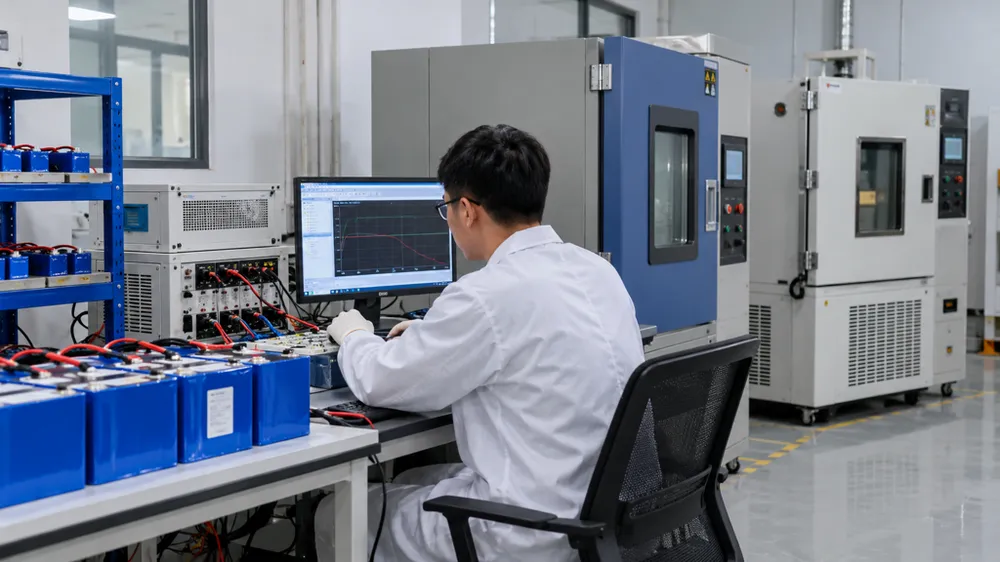
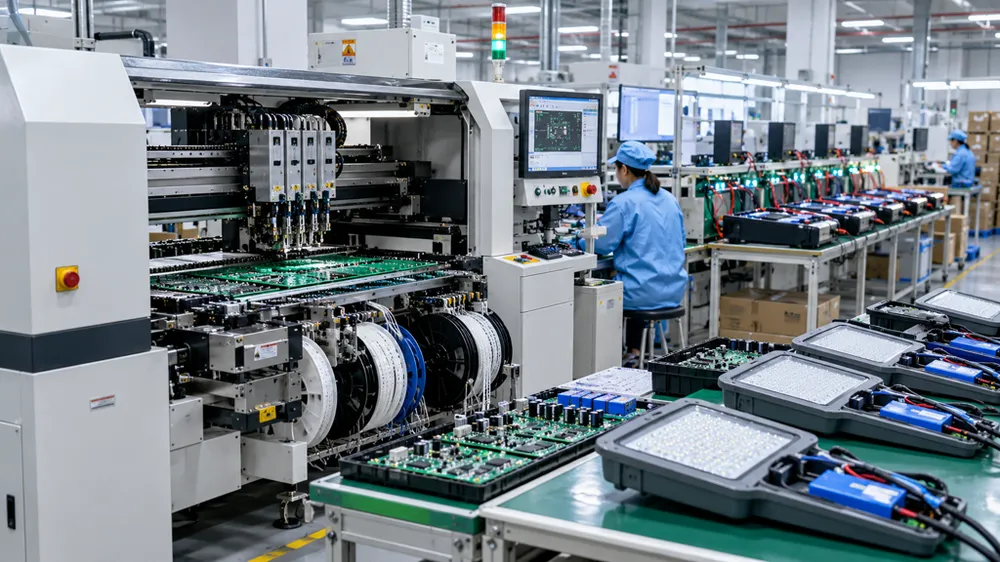
Assembly, testing, and quality assurance: $12–$25 per unit This line item separates factories with in-house production and testing from trading companies that consolidate components from multiple suppliers. At JXSOL, this cost includes battery charge/discharge testing (every battery tested to confirm rated capacity and internal resistance), lumen output verification (every assembled unit tested against spec before it leaves the production line), and weatherproof seal inspection (pressure testing on 10% of each production batch, with full batch re-inspection if any unit fails). Buyers sometimes see quotes $30–$50 below comparable specs and assume they've found better pricing — usually they've found a supplier that skips batch testing and ships based on component supplier certificates rather than finished-product verification. The hidden cost shows up as field failures in the first rainy season or lumen degradation in the first 6 months, which costs far more to fix than the $15–$20 you saved per unit at purchase.

Smart System Premium: Cost vs Value for IoT-Enabled Lighting
The IoT module adds $35–$90 to the base cost of a solar street light, which raises the question every project buyer asks: does remote monitoring justify a 20–40% price increase over standard solar lighting? The answer depends entirely on your operational context — specifically, what you're currently spending on reactive maintenance and whether your deployment scale supports the fixed costs of monitoring infrastructure.
Start with the cost side. A 200-unit parking lot deployment with LoRa-based smart lighting costs $7,000–$10,000 more for IoT modules plus $1,500–$2,500 for a gateway, total incremental cost around $8,500–$12,500. That same project with standard solar lighting (timer-based operation, no remote monitoring) costs $24,000–$36,000 for fixtures alone, so the smart premium represents roughly a 30% increase in upfront capital. The value equation asks what operational cost that premium eliminates or reduces.
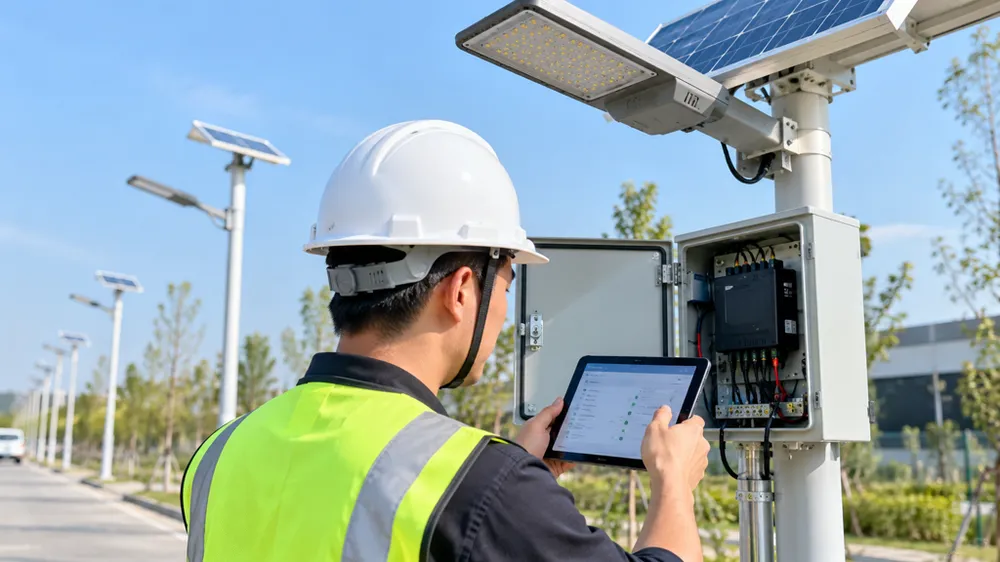
Municipalities and infrastructure buyers benefit most from real-time outage alerts. Standard solar lighting operates autonomously until it fails — the typical discovery path is a resident complaint followed by a diagnostic truck roll to identify whether the failure is battery depletion, panel shading, LED driver fault, or vandalism. Each truck roll costs $80–$150 depending on local labor rates and travel distance. A 200-light deployment with a 5% annual component failure rate (typical for outdoor lighting) generates 10 failures per year, costing $800–$1,500 annually in diagnostic labor alone. Smart lighting with battery state-of-charge monitoring and voltage fault detection eliminates diagnostic trips — the system tells you which unit failed and what component needs replacement before you send a truck. Over a 5-year period, that saves $4,000–$7,500 in labor cost, recovering 30–60% of the IoT premium before accounting for any other operational benefits.
Parking lot operators and private infrastructure owners gain value from remote dimming and scheduling. Battery wear is primarily a function of depth of discharge — a battery that cycles from 100% to 30% capacity nightly wears faster than one that cycles from 100% to 50%. Smart lighting lets you run at 60% brightness during low-traffic hours (11 PM to 5 AM for most commercial parking), reducing nightly discharge depth and extending battery cycle life by 20–30%. If your project uses standard Li-ion batteries with a 3.5-year service life, that dimming strategy can push replacement out to year 4 or 5, avoiding or deferring a $7,000–$11,000 battery replacement expense across 200 units.
Contractors and turnkey project suppliers use commissioning data as risk reduction. Smart lighting generates real-time confirmation that every unit is operating at spec — panel generating expected voltage, battery accepting charge, LED module delivering rated lumens. That data set becomes your handover documentation to the client, eliminating arguments about whether underperformance is a factory defect, installation error, or site condition issue. For fixed-price contracts where warranty claims come out of your margin, that's worth the IoT cost even if the client never logs into the monitoring platform after commissioning.
The cases where smart lighting doesn't justify its premium: deployments under 50 units where fixed gateway cost overwhelms per-unit savings, residential or low-stakes applications where manual inspection is faster than logging into a monitoring dashboard, and locations where cellular coverage is unreliable and LoRa infrastructure doesn't exist (remote rural areas more than 5 km from the nearest gateway candidate). If your project fits any of those profiles, you're better off with standard solar lighting and allocating the cost difference to higher-capacity batteries or better LED chips.
How Order Volume and MOQ Affect Unit Economics
Solar street light price per unit isn't a fixed number — it's a function of order quantity because component procurement, production setup, and inspection processes all have batch-level costs that get amortized across the units you're ordering. Here's how that works in practice and what it means for buyers at different volume tiers.
Why 100-unit MOQ exists Batteries and IoT modules are procured from component suppliers in minimum order quantities — typically 100-unit reels for IoT modules and 50-unit pallets for battery packs. A factory ordering components for your 30-unit trial order still pays for 100 IoT modules and 50 batteries, with the excess going into stock for the next order. That inventory carrying cost gets passed to you as a small-order premium. Production line setup follows similar logic: configuring SMT equipment for a specific LED driver model, programming battery testers for a specific chemistry and capacity, and setting up inspection fixtures for a specific housing type takes 2–3 hours regardless of whether the production run is 50 units or 500 units. At 50 units, that setup time adds $8–$12 per unit to labor cost; at 500 units it's under $1 per unit.
The result is that buyers ordering 10–50 units pay 25–40% more per unit than the 100-unit baseline price. That's not punitive pricing — it's actual cost recovery for the inefficiency of small-batch manufacturing. Some factories offer no-MOQ pricing to capture small buyers, but they're either eating that cost (unlikely for a factory you'll want to reorder from) or cutting corners on component quality or testing to get the cost structure down (much more common and much worse for your field performance).
Volume tiers and cost reduction at scale Once you're past the 100-unit MOQ threshold, cost reductions come from two sources: component volume discounts and production efficiency. At 500 units, we can negotiate 8–12% better pricing from battery suppliers and LED module suppliers, which flows through to your unit cost. Panel suppliers offer similar volume breaks around 300–500 units. IoT modules are the exception — LoRa and NB-IoT modules have relatively flat pricing up to about 2,000 units because the chip manufacturers themselves have high MOQs.
Production efficiency gains show up around 300–500 units. At that volume, we can dedicate a production line to your order for 2–3 days rather than batching your order with other SKUs, which eliminates changeover time and reduces quality risk from configuration errors. Inspection cost per unit also drops — we're running the same tests but spreading setup time and tester calibration cost across more units. Combined, these factors typically deliver 15–20% cost reduction at 1,000 units vs 100 units for the same spec.
Factory-direct vs distributor pricing Distributors add 30–50% margin to factory cost because they're providing value-added services: mixed SKU orders (you can order 20 units each of five different models rather than 100 of one model), warehousing and fast fulfillment (order today, ships tomorrow vs 25–35 day lead time from factory), and localized support (returns, warranty claims, and technical support in your language and time zone). For catalog sellers and small contractors who need that flexibility, distributor pricing makes sense even with the margin layer.
For project contractors bidding 200+ unit deployments, factory-direct pricing removes that 30–50% margin and lets you either bid more competitively or keep more margin in your own pocket. The trade-off is lead time (you're ordering 4–6 weeks before you need the units) and minimum order commitment (you can't easily return 50 units if your project gets downsized). If your project pipeline supports that planning horizon and volume commitment, factory-direct is the better economics. If you're quoting projects speculatively and need inventory flexibility, distributors earn their margin.
OEM and custom configuration cost Standard catalog products ship at the volume-tier pricing discussed above. Custom configurations — specific lumen output between standard steps, non-standard color temperature (2700K or 5000K instead of 3000K or 4000K), custom housing color, or modified mounting brackets — add engineering and tooling cost to the first order. Typical premium is 10–15% for the initial order due to custom driver programming, optical simulation to verify the non-standard configuration meets photometric requirements, and first-article inspection to validate the custom spec. Second and subsequent orders of that same custom configuration ship at standard pricing because the engineering work is already done.
This makes OEM viable if you have repeat project pipeline. A distributor buying 500 units every 6 months can amortize the 10–15% first-order premium across multiple orders and end up with a differentiated SKU their competitors don't have. A contractor buying 200 units once for a single project pays that premium with no follow-on benefit, so standard catalog specs are usually the smarter choice.
Total Cost of Ownership: Smart Solar vs Grid-Connected Lighting
Project buyers and infrastructure planners evaluate solar lighting against grid-connected LED alternatives over 8–12 year project lifetimes. Upfront cost is higher for solar, but the total cost picture changes dramatically when you account for avoided grid connection infrastructure and the ongoing operational cost difference.
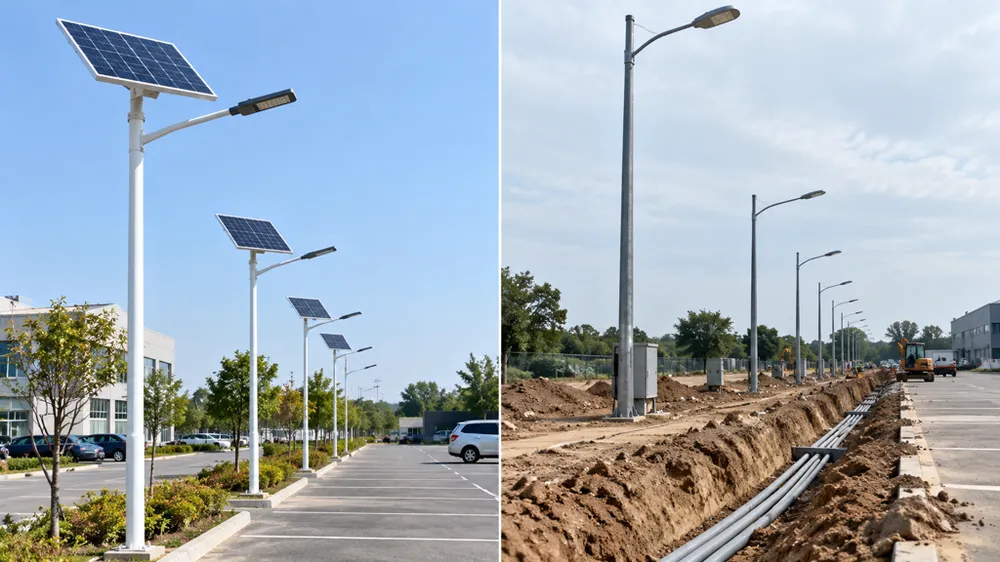
Upfront cost comparison Smart solar street lights run $180–$480 per unit installed, depending on lumen output, battery chemistry, and IoT protocol. Installation labor is minimal — bolt the fixture to an existing pole or install a new pole if needed, with no trenching or electrical work required. Total installed cost for a typical 60W smart solar street light is $200–$520 per pole including mounting hardware and labor.
Grid-connected LED street lights cost $150–$280 per fixture, which looks cheaper until you add infrastructure cost. Each pole needs an electrical connection, which means trenching from the nearest grid access point (often 50–200 meters away for parking lot or roadway projects), conduit installation, junction boxes, and grid connection hardware. Infrastructure cost runs $1,200–$3,500 per pole depending on distance to the grid, local labor rates, soil conditions (rocky soil costs more to trench), and whether you need to cross paved surfaces (asphalt cutting and repair adds $40–$80 per linear meter). For a typical parking lot with 20-meter spacing between poles, average infrastructure cost is around $2,000 per pole. Total installed cost for grid-connected lighting is $2,150–$2,780 per pole.
The math flips when you're installing in locations where grid infrastructure already exists at every pole — dense urban streets with existing grid-connected fixtures being replaced. In that scenario, solar upfront cost is higher and you're not avoiding any infrastructure expense. That's the narrow use case where grid-connected makes economic sense, and even then only if local utility rates are low (under $0.08/kWh).
Operating cost over 10 years Solar lighting has zero electricity cost. The sun is free, and the battery stores enough energy for 2–3 days of operation, so short-term weather variation doesn't affect performance. Annual operating cost is essentially zero aside from occasional cleaning (maybe once a year in dusty environments, less often in most locations) and battery replacement at year 5–7 depending on chemistry and cycle depth.
Grid-connected lighting consumes 30–60 watts per fixture for 10–12 hours per night depending on seasonal variation and dimming schedules. At $0.12/kWh (typical commercial rate in North America and Western Europe), that's $15–$30 per fixture per year in electricity cost. Over 10 years, that's $150–$300 per fixture. Higher utility rates in some European countries ($0.18–$0.25/kWh) push that to $225–$450 per fixture over 10 years. Lower rates in Middle East and parts of Asia ($0.05–$0.08/kWh) reduce it to $60–$120 per fixture, which is the only scenario where grid-connected operating cost is competitive with solar.
Maintenance cost difference Smart solar lighting with IoT monitoring shifts maintenance from reactive to predictive. The system alerts you when battery state of charge drops below threshold or panel voltage indicates shading or dirt accumulation, so you send a crew to address specific issues before they become failures. Typical maintenance schedule is battery replacement every 5–7 years ($35–$95 per battery depending on chemistry) and LED driver replacement every 8–10 years ($15–$25 per driver), both scheduled during low-demand periods when labor cost is lower.
Grid-connected lighting requires reactive maintenance when outages occur — someone notices the light is out, reports it, and you send a diagnostic crew. Outage causes range from LED driver failure (most common) to grid supply interruption to vandalism. Each diagnostic trip costs $80–$150, and you're averaging 3–5% of fixtures failing per year in typical outdoor conditions. A 100-light installation generates 3–5 diagnostic calls per year, costing $240–$750 annually just for diagnostics before you factor in repair parts and follow-up labor to replace failed components.
Over 10 years, grid-connected maintenance cost runs $2,400–$7,500 per 100-fixture deployment. Solar maintenance cost runs $3,500–$9,500 for battery replacement across 100 fixtures plus occasional panel cleaning. The difference is predictability — solar maintenance is scheduled work you can plan and optimize, while grid-connected maintenance is reactive work that happens when the client calls to complain.
Payback calculation for typical project A 100-light parking lot in suburban North America shows typical economics. Smart solar installed cost: $200 × 100 = $20,000. Grid-connected installed cost: $2,200 × 100 = $220,000 including trenching and grid connection. Solar avoids $200,000 in upfront infrastructure cost, making payback immediate. Over 10 years, solar adds $3,500–$9,500 in battery replacement cost (depending on chemistry and whether you're doing preventive replacement or running batteries to end of life). Grid-connected adds $15,000–$30,000 in electricity cost plus $2,400–$7,500 in maintenance labor. Total 10-year cost: solar $23,500–$29,500, grid-connected $237,400–$257,500.
The only scenario where grid-connected shows better economics is urban street retrofits where grid infrastructure already exists at every pole and your local utility rate is under $0.08/kWh. In that narrow case, grid-connected 10-year total cost is around $160,000–$190,000 per 100 fixtures (fixture cost plus electricity and maintenance, no infrastructure cost because it's already there), while solar is still $23,500–$29,500. Solar still wins, but the margin is smaller and you could argue for grid-connected based on familiarity and lower perceived risk.
For new construction, parking lots, roadways, or any location more than 50 meters from existing grid access, solar lighting system total cost of ownership is decisively lower even before you factor in the avoided permitting cost and construction timeline delays associated with trenching and grid connection work.
Where Buyers Can Reduce Cost Without Sacrificing Performance
Most buyers approach solar lighting cost as fixed — you pick a lumen output and battery size from a catalog and accept whatever price comes back. In reality, five specific decisions during the RFQ phase let you reduce smart solar lighting system cost by 20–35% without compromising field performance or service life.
Right-size battery capacity to actual site conditions Standard solar street light specs default to 3–5 days of autonomy (how many nights the light operates without recharge), which sounds prudent but usually over-specs battery cost. Autonomy requirements should be based on actual weather patterns at your installation latitude, not worst-case assumptions. We work with buyers to model solar irradiance data from sources like NASA POWER or local meteorological databases — the data shows that most locations rarely see more than 2 consecutive cloudy days even in winter. A 60Ah battery supporting 3 days of autonomy costs $50–$70 depending on chemistry; a 40Ah battery supporting 2 days costs $35–$50. That's a $15–$20 per unit savings, which compounds to $1,500–$2,000 across a 100-unit project.
The counterargument is risk — what if you get an unusual weather pattern? The smart approach is to size battery for realistic autonomy and use IoT monitoring to alert you if state of charge drops below threshold during extended cloudy periods. At that point you can either accept one night of reduced brightness (dimming to 60% extends battery life by another night) or send a crew to check panel shading or cleaning needs. Either response costs less than carrying 30% extra battery capacity across every unit for 10 years to avoid a scenario that occurs less than once per year in most climates.
Choose battery chemistry based on lifecycle cost, not upfront price LiFePO4 batteries cost $65–$95 for a typical street light application vs $35–$55 for standard Li-ion. Buyers see that price difference and default to Li-ion to hit a lower per-unit cost target. That optimization breaks down when you look at total battery cost over project lifetime. LiFePO4 delivers 2,000–2,500 cycles before capacity drops below 80% of rated, while Li-ion delivers 800–1,200 cycles. In a typical installation with nightly discharge to 50% depth, LiFePO4 lasts 6–8 years and Li-ion lasts 3–4 years.
A 100-fixture project with Li-ion batteries costs $3,500–$5,500 for initial batteries plus $3,500–$5,500 for replacement batteries in year 4, total battery cost over 10 years $7,000–$11,000. The same project with LiFePO4 costs $6,500–$9,500 for initial batteries with no replacement needed until year 7–8 (outside the typical project evaluation window), total battery cost $6,500–$9,500. LiFePO4 saves $500–$1,500 in total battery cost and eliminates the labor cost and project disruption of mid-life battery replacement. The only scenario where Li-ion makes sense is projects with expected service life under 4 years or deployments where you're planning to replace the entire fixture before battery end-of-life.
Match IoT protocol to deployment scale IoT solar lighting cost varies by protocol, but the right answer depends on your deployment size. LoRa modules cost $35–$50 per unit but require a gateway infrastructure investment of $800–$1,500 per gateway (each gateway covers 2–5 km radius depending on terrain and building density). NB-IoT and 4G modules cost $50–$90 per unit with no gateway required but add recurring SIM fees of $2–$5 per unit per month.
For deployments under 100 units, cellular protocols make sense — you avoid the upfront gateway cost and your recurring SIM fee over 4 years is $960–$2,400 per 50 units, lower than the $800–$1,500 gateway cost you'd need for LoRa. For 200+ unit deployments, LoRa economics flip. A 300-unit project with LoRa costs $10,500–$15,000 for modules plus $2,400–$4,500 for gateways (total $12,900–$19,500). The same project with 4G costs $21,000–$27,000 for modules plus $28,800–$72,000 in SIM fees over 4 years (total $49,800–$99,000). LoRa saves $36,900–$79,500 over project lifetime.
The break-even point is around 150–200 units depending on local SIM rates and whether you need multi-year data retention (LoRa data stays on your server, cellular data often has service provider retention limits after 1–2 years). Most buyers don't run this calculation and default to whatever protocol their monitoring platform vendor supports, which often means paying 2–3× more than necessary for IoT infrastructure.
Standardize SKU selection to qualify for volume pricing Buyers ordering three different lumen outputs in quantities of 80, 100, and 120 units pay more per unit than buyers ordering 300 units of a single SKU, even though total volume is similar. Component suppliers offer volume breaks based on single-part-number order quantity, not total order value. A battery supplier gives 10% volume discount at 500 units of a specific capacity and chemistry, but ordering 250 units each of two different capacities doesn't trigger that discount.
If your application allows flexibility in lumen output (say, 4,000–6,000 lumens all work for your light level requirement), standardizing on one SKU unlocks volume pricing earlier. A 300-unit order split across three SKUs (100 units each of 4,000 lm, 5,000 lm, and 6,000 lm models) gets you 100-unit tier pricing. The same 300 units as a single 5,000 lm SKU gets you 300-unit tier pricing, typically 8–12% lower cost per unit. Across 300 units at $250 average, that's $6,000–$9,000 in cost reduction just from order consolidation.
This works for distributors building a catalog — instead of offering every lumen increment, focus your initial order on two or three high-volume SKUs and plan to add variations once you've established baseline volume. For contractors, it means specifying the same fixture type across an entire project rather than mixing 4,000 lm for parking areas, 6,000 lm for roadways, and 3,000 lm for pathways when a single 5,000 lm fixture with different mounting heights achieves similar light levels everywhere.
Negotiate component upgrades at volume At 500+ units, component suppliers often have inventory of premium-grade components they'll release at minimal incremental cost if you're committing to volume. We've negotiated LiFePO4 battery upgrades (from standard Li-ion) for $8–$12 per unit incremental cost instead of the usual $30–$40 premium, simply because our battery supplier had 500-unit inventory of LiFePO4 cells and preferred to move them at lower margin rather than carry the inventory for another 3 months. Similarly, panel efficiency upgrades (from 18% to 20% monocrystalline) sometimes cost only $5–$8 per unit at volume instead of the $15–$20 catalog premium.
These opportunities are opaque unless you ask. Most buyers assume premium components mean proportional premium cost and don't inquire. The question to ask during RFQ: "At 500-unit volume, what component upgrades are available at reduced incremental cost?" That signals you're a serious buyer and gives the factory room to offer margin-compressed upgrades that improve your product without blowing your cost target. It's not guaranteed, but it costs nothing to ask and the savings can be $4,000–$10,000 across a 500-unit order.
Cost Transparency and How to Evaluate Competitor Quotes
Solar street light price per unit varies by 2–3× across quotes for ostensibly similar specs. Some of that spread is legitimate (different battery chemistry, component brand, testing rigor), but a significant portion reflects suppliers quoting incomplete or under-rated specs and counting on buyers not knowing how to audit the details. Here's what separates genuine cost-competitive offers from quotes that will fail in the field.
Red flags in below-market quotes Quotes significantly below the component cost floor — roughly $180 for a smart solar street light with 4,000 lumen output, 40Ah LiFePO4 battery, and LoRa IoT module — indicate either missing components or misrepresented specifications. The most common tactics: battery capacity under-rated (a "60Ah" battery that actually delivers 45Ah because it's using recycled or B-grade cells), LED module using low-grade chips with rapid lumen degradation (you get rated output for the first 3 months, then it drops 20–30% by month 12), or IoT module that's a radio transmitter with no actual monitoring capability (it reports presence but not operational data like battery state of charge or panel voltage).
Another version is suppliers claiming "factory-direct" pricing when they're actually trading companies buying from multiple component suppliers and assembling without integration testing. You're paying for assembly labor but not for the engineering and QC work that makes the components function reliably together. These orders often ship on time and look fine at delivery, then generate 20–30% field failure rates in the first year because battery charge controller isn't properly matched to panel voltage curve, or LED driver isn't configured for the actual battery chemistry being used.
If a quote is 30%+ below comparable specs from multiple other suppliers, request component brand names (battery cell manufacturer, LED chip brand, IoT module model number) and ask for batch testing data from a prior order. Legitimate factories provide that information readily because it's how they differentiate from trading companies. Suppliers who deflect or provide vague "equivalent to [brand name]" answers are usually assembling gray-market or off-spec components.
What to ask when comparing quotes Beyond base price, the questions that reveal true cost and risk:
Battery chemistry and cycle life rating: Is the battery lithium-ion or LiFePO4, and what's the rated cycle life to 80% capacity? Standard Li-ion batteries rated for 800 cycles are defensible at $35–$50 for 40Ah capacity; anything cheaper is likely under-rated or recycled cells. LiFePO4 should be explicitly stated — if the quote just says "lithium battery," assume standard Li-ion.
LED chip brand and lumen maintenance spec: What brand LED chips (Bridgelux, Lumileds, Osram, Cree), and what's the L70 or L80 rating (time to 70% or 80% of initial lumens)? Branded chips with L80 > 50,000 hours are the standard for outdoor lighting. Generic or unbranded chips often have L70 around 20,000 hours, meaning you're replacing or rerating the fixture after 3–4 years instead of 8–10 years.
IoT protocol and recurring fees: Is the IoT module LoRa, NB-IoT, or 4G, and are SIM fees included for cellular protocols? Some quotes include "smart lighting" with 4G modules but don't mention that SIM service costs $2–$5 per month per fixture, adding $2,400–$6,000 per year for a 100-fixture deployment. That's not dishonest if disclosed, but it significantly changes total cost comparison.
Inspection and testing process: Does the quote include 100% unit testing or batch sampling? We test every battery for capacity and internal resistance, verify lumen output on every assembled fixture, and pressure-test weatherproof seals on 10% of each batch (with full batch re-inspection if any unit fails). Some factories test 5–10% of a batch and ship the rest assuming they're equivalent. That approach is faster and cheaper, but it's also why some buyers experience 10–15% DOA or early failure rates that eat into the cost savings.
Warranty terms: What's covered and for how long? Standard warranty is 3 years on LED modules and housing, 2 years on battery, 1 year on IoT module. Batteries are the contentious component — many suppliers exclude battery from warranty after year 1 because battery failures are the most common warranty claim and they don't want to absorb that cost. If battery is excluded or has a shorter warranty than the rest of the fixture, that's a signal the supplier isn't confident in their battery sourcing or matching process.
Why JXSOL's pricing includes cost transparency We provide component-level breakdowns in every quote (panel wattage and efficiency, battery chemistry and rated cycles, LED chip brand and lumen output, IoT protocol and module model, housing IP rating and material) because that's the information you need to compare quotes accurately. Some buyers find that level of detail unnecessary, but the buyers who know how to read it use it to audit competitor quotes — if another supplier is quoting $40 less per unit for "equivalent" specs but won't disclose battery chemistry or LED chip brand, that's a cost trap not a cost savings.
Inspection data ships with every order: battery capacity test results for every unit, lumen output verification showing each fixture meets rated spec, and IP rating test certificates for the housing batch. You can use that data as commissioning documentation or as your defense if a client claims underperformance. Most importantly, it's our incentive to ship product that actually matches the quote — if we claim 60Ah LiFePO4 batteries and ship 45Ah Li-ion, the test data will expose that and you'll refuse delivery. That discipline forces internal quality control rigor that factories without transparent documentation can skip.
How to calculate landed cost for comparison Unit price is only part of your actual cost. Landed cost includes shipping method (sea freight costs $0.80–$1.50 per kg and takes 4–8 weeks, air freight costs $4–$7 per kg and takes 5–10 days), import duties (vary by destination country and product HS code — solar lighting under HS code 9405.40 typically faces 0–15% duties depending on country), and payment terms (30% deposit plus 70% before shipment is standard for factory-direct orders; letter of credit terms add $800–$2,000 in bank fees for typical 100–500 unit orders).
A 100-unit order of smart solar street lights at $250 per unit costs $25,000 for the fixtures. Sea freight for 2,000 kg of packaged product costs $1,600–$3,000 depending on destination port. Import duties at 8% add another $2,000. Total landed cost is $28,600–$30,000, or $286–$300 per unit. Air freight for the same order costs $8,000–$14,000, pushing landed cost to $35,000–$41,000 or $350–$410 per unit. For time-sensitive projects where a 6-week lead time delays your billing or incurs project penalties, air freight makes sense. For projects with normal planning horizons, sea freight is obviously cheaper but requires ordering 6–8 weeks before you need the fixtures on site.
Buyers optimizing for lowest total cost should request an all-in landed cost quote (fixtures plus shipping plus estimated duties) rather than comparing ex-works pricing and then discovering shipping and duties add 20–40% to the unit cost. That transparency lets you make genuine cost comparisons and avoid surprises when the freight forwarder invoice arrives.