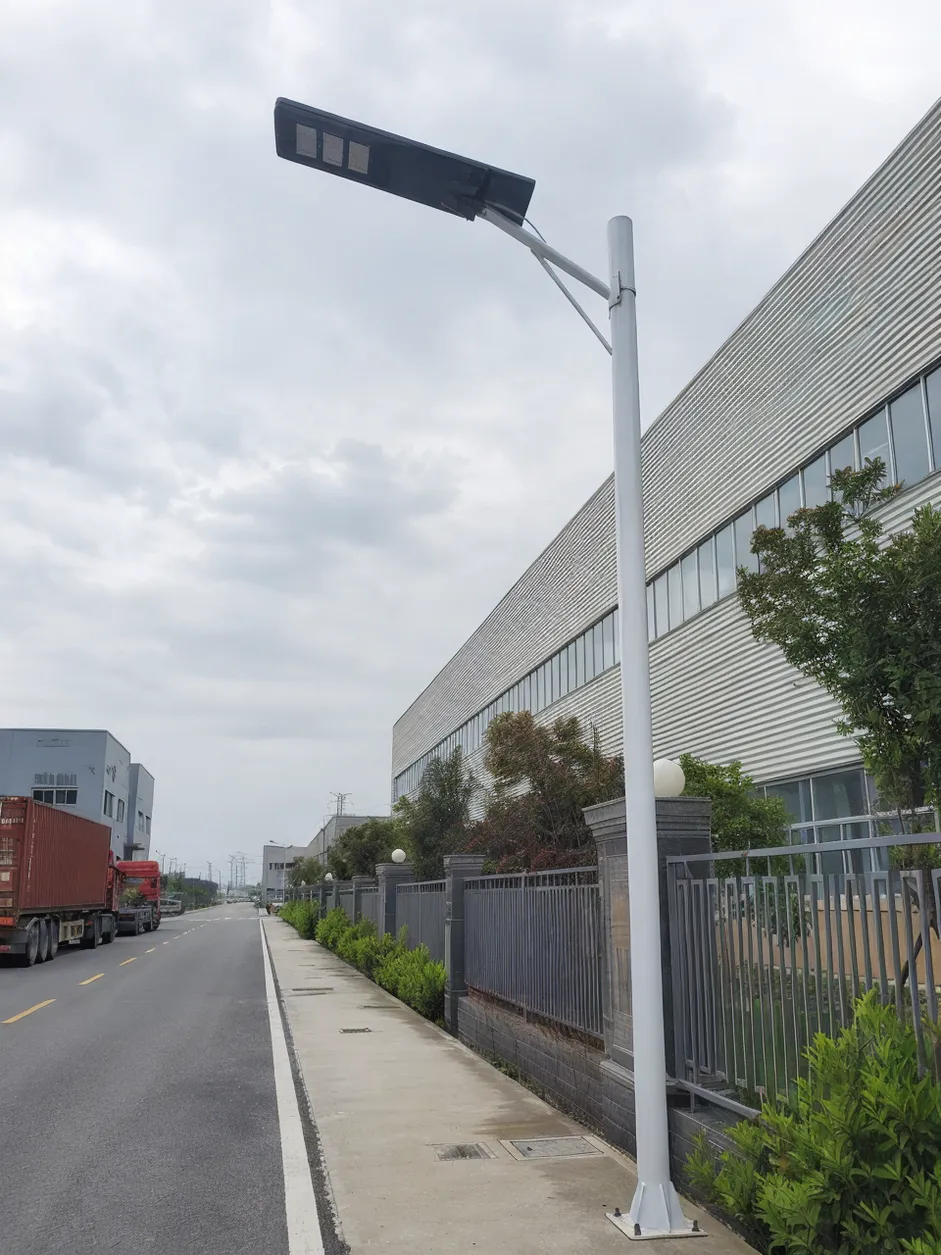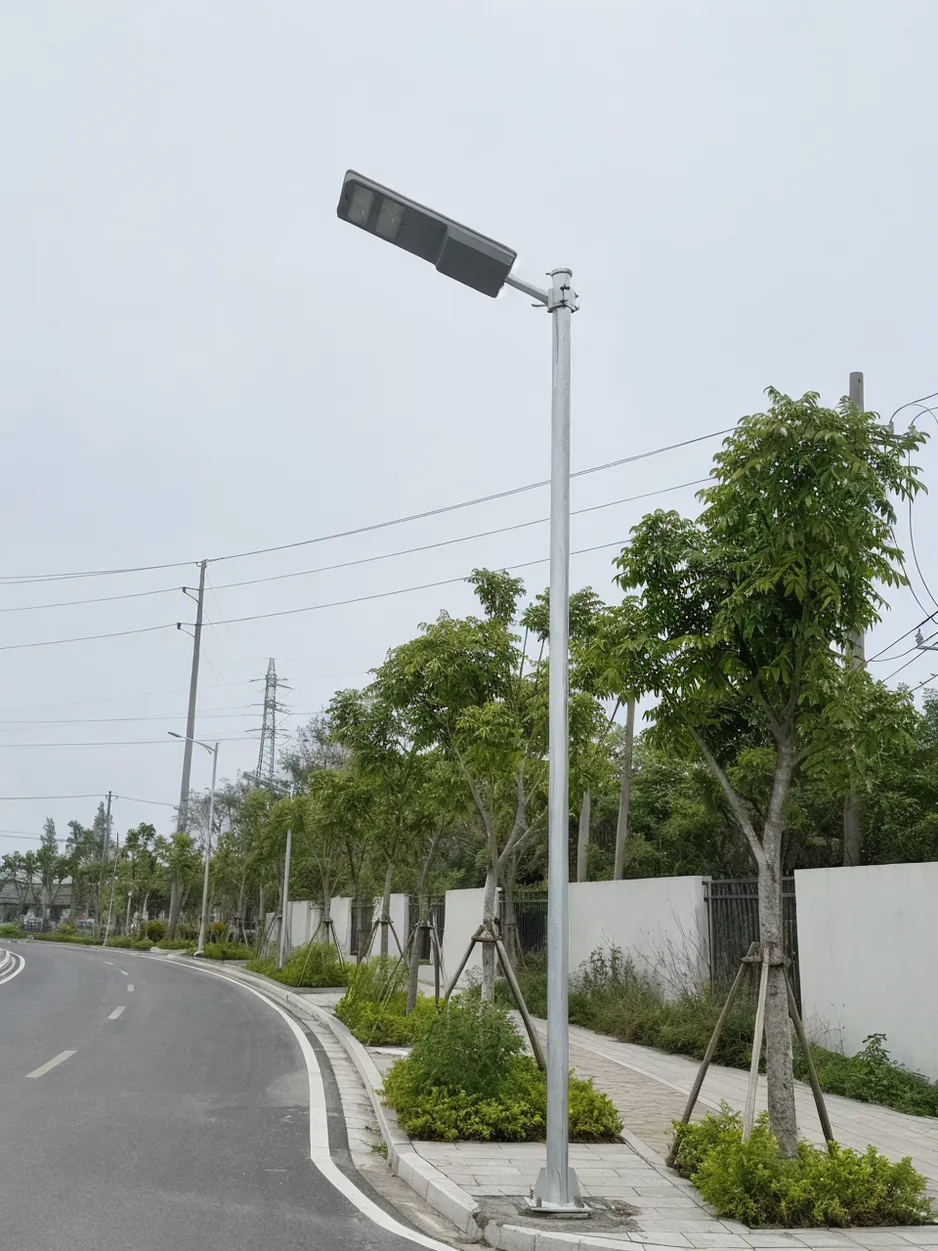
The Real Budget Question Is Not Unit Price
The fixture cost difference between a standard solar street light and a smart solar street light is real — typically 20–40% higher per unit for the smart version, depending on controller spec, connectivity module, and monitoring platform. On a 500-unit tender, that gap is visible on the first page of your budget sheet. What doesn't appear on that first page is the cost of not knowing which lights are failing, how long they've been dark, and how many truck rolls it takes to find out.
That's the actual comparison. Not smart versus standard as a feature argument — but upfront fixture cost versus long-term maintenance visibility, and which one costs more over the project lifecycle.
Here's the quick verdict before we go deeper:
- Standard solar street lights win when the project is compact, accessible, budget-capped, and easy to inspect manually. The simpler controller, fewer electronic SKUs, and lower unit cost are genuine advantages when your maintenance team can walk or drive the route.
- Smart solar street lighting wins when the fleet is large, dispersed, tied to maintenance SLAs, or operating in locations where a night inspection visit costs real money. Remote fault reporting and dimming control reduce operating cost in ways that compound across hundreds of units.
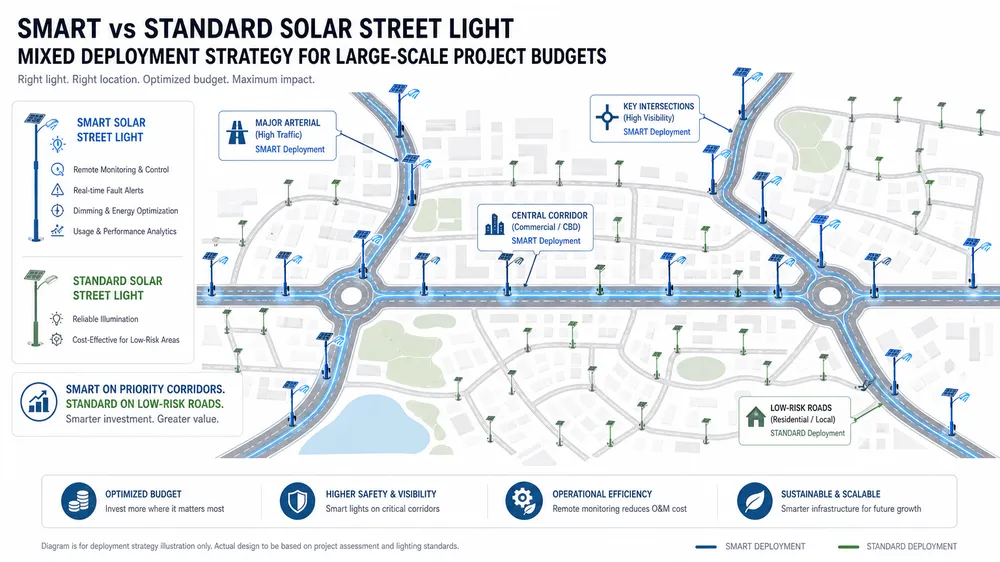
- Mixed deployment is often the most commercially rational answer: smart units on main corridors, intersections, and high-visibility roads; standard units on lower-risk side roads where manual inspection is cheap.
The rest of this article proves that verdict section by section, with a spec matrix, a TCO framework, a scenario winner map, and an RFQ checklist you can use directly.
What Actually Changes Between Standard and Smart Fixtures
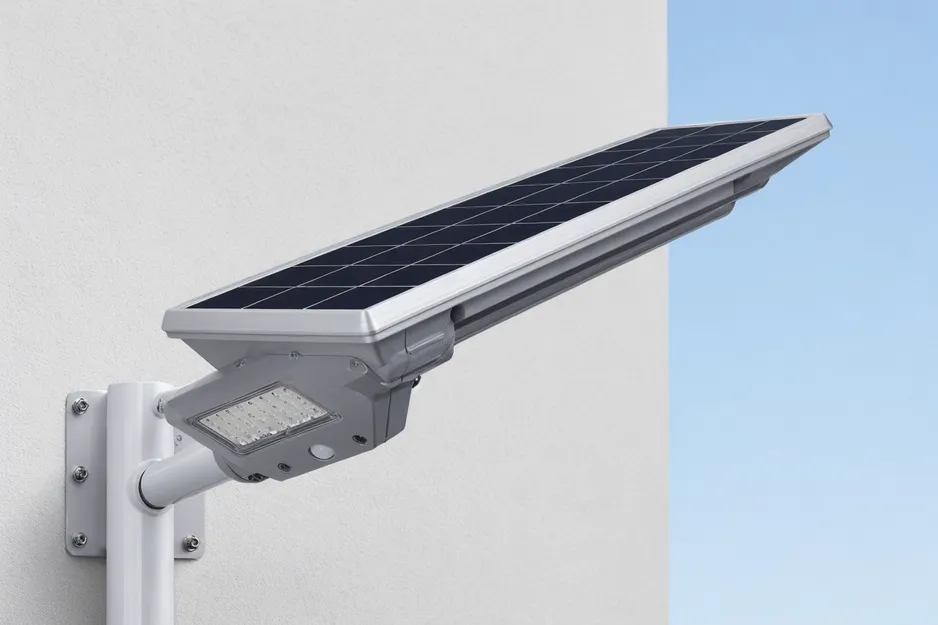
The mechanical housing — panel, battery compartment, LED module, pole bracket — can be identical between a standard and a smart unit. The difference is in the controller and what it connects to.
A standard solar street light runs on a fixed controller: time-based switching, PIR motion sensing, or light-sensor activation. It operates autonomously, requires no network, and produces no data. When a unit fails, you find out when someone reports a dark road or when your maintenance crew does a scheduled inspection. The controller logic is set at commissioning and doesn't change unless a technician is on-site.
A smart solar street light — or more precisely, an IoT solar street light — adds a communication layer on top of the controller. That layer can include a GPRS/4G SIM card, a Zigbee or LoRa mesh node, or a gateway-connected module depending on the platform architecture. What it enables: remote dimming schedules, real-time fault alarms, energy consumption logging, and fleet-level visibility from a dashboard. A solar street light with remote monitoring means you know which unit is underperforming before a complaint arrives.
One clarification worth making explicit: "all-in-one" describes the mechanical structure — panel, battery, LED, and controller integrated into a single housing — not the control capability. An all-in-one smart solar street light combines that compact form factor with IoT control. An all-in-one standard unit has the same housing without the communication layer. Buyers sometimes conflate these terms in RFQs, which creates configuration mismatches at production. (We see this regularly — a buyer specifies "all-in-one smart" but the monitoring requirement turns out to be fault alarm only, not full platform access. Clarifying this before production saves rework.)
Smart functionality is not a single spec. Remote monitoring, dimming scheduling, fault alarm, gateway/SIM requirement, and platform access are separate capabilities that may or may not all be required for your project. Specify exactly which functions you need — it affects both unit cost and commissioning complexity.
For a deeper look at smart control features and platform options, see smart solar street light features.
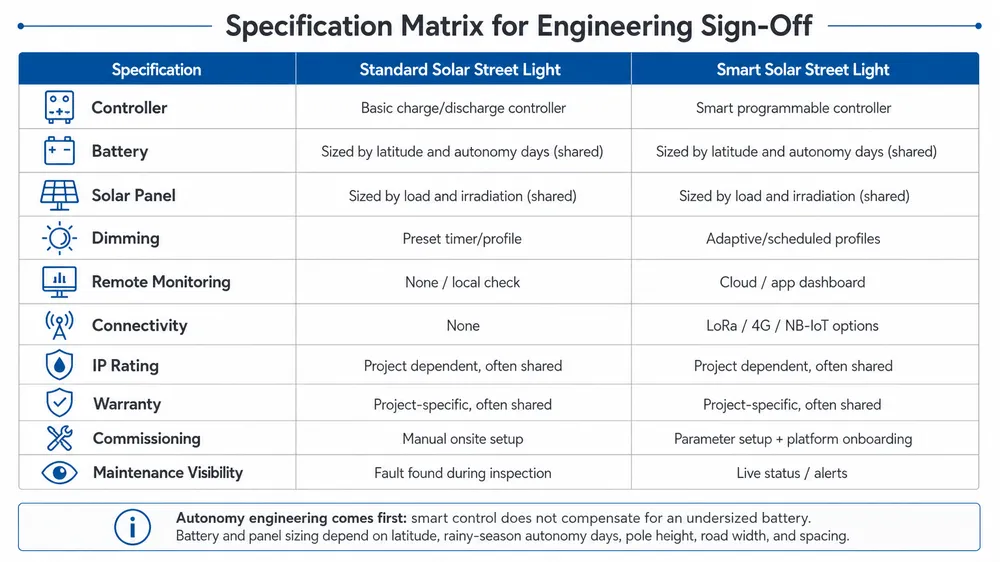
Specification Matrix for Engineering Sign-Off
Both types still require correct sizing for your deployment: target latitude, rainy-season autonomy days, pole height, road width, and installation spacing. The smart controller does not compensate for an undersized battery — autonomy engineering comes first regardless of which type you choose. We size battery and solar panel for the target latitude on both standard and smart configurations through our in-house engineering review.
The table below covers the commercially meaningful differences for project sign-off. Specs that are identical between the two types are noted as shared.
| Specification | Standard Solar Street Light | Smart Solar Street Light (IoT) |
|---|---|---|
| Lumen output range | 2,000–20,000 lm (application-dependent) | 2,000–20,000 lm (same range) |
| LED module | High-efficiency LED, Type II/III/V optics | Same LED module; optics unchanged |
| Battery capacity | Sized for autonomy days at target latitude | Same sizing logic; dimming schedule can extend autonomy |
| Solar panel sizing | Matched to battery and daily load | Same; remote dimming reduces daily load if scheduled |
| Controller type | Fixed logic: time/PIR/light-sensor modes | Programmable: remote dimming, scheduling, reporting |
| Dimming logic | Pre-set at commissioning (e.g., 100%→50% at midnight) | Remotely adjustable post-deployment |
| Remote monitoring | None | Fault alarm, energy log, status dashboard |
| Connectivity | None | GPRS/4G SIM, Zigbee, LoRa, or gateway (project-specific) |
| Network dependency | Zero | SIM/gateway required; coverage must be confirmed |
| IP rating | IP65/IP67 (both types, same housing standard) | IP65/IP67 (same) |
| Commissioning | Set controller parameters on-site; straightforward | Device registration, signal check, platform onboarding required |
| Spare parts complexity | LED module, battery, controller (3 core SKUs) | Adds communication module, SIM, gateway variants |
| Certification | CE, RoHS, IEC 62124, ISO 9001:2015 | Same certifications; platform documentation may be added |
| Warranty | 3-year standard | 3-year standard (hardware); platform/SIM terms separate |
| OEM/ODM | Available from 100 units | Available; MOQ may vary by controller configuration |
For the full Solar Street & Roadway Lights Manufacturer product range, both types are manufactured on the same production lines with the same QC baseline.

The Hidden Cost Is Fault Visibility, Not the Controller
The controller price difference is visible. The maintenance cost difference is not — until you're 18 months into a 600-unit deployment and your client is asking why three roads have been dark for two weeks.
Here's how the hidden cost structure actually works for each type.
Standard solar street light maintenance costs:
- Scheduled night inspections to identify failed units (labor + vehicle + time)
- Complaint-driven fault discovery — meaning the road is dark before you know about it
- No energy consumption data, so battery degradation is invisible until the unit stops working
- Inspection frequency must increase as the fleet ages, because there's no early-warning signal
Smart solar street light operating costs:
- Higher unit cost (20–40% premium, configuration-dependent)
- Commissioning time: device registration, signal verification, platform onboarding — typically adds 15–30 minutes per unit at installation
- SIM card or gateway cost: ongoing data fees, typically modest per unit but real at scale
- Technician familiarity with the platform: first deployment has a learning curve
- Platform or software license fees if the monitoring system is proprietary
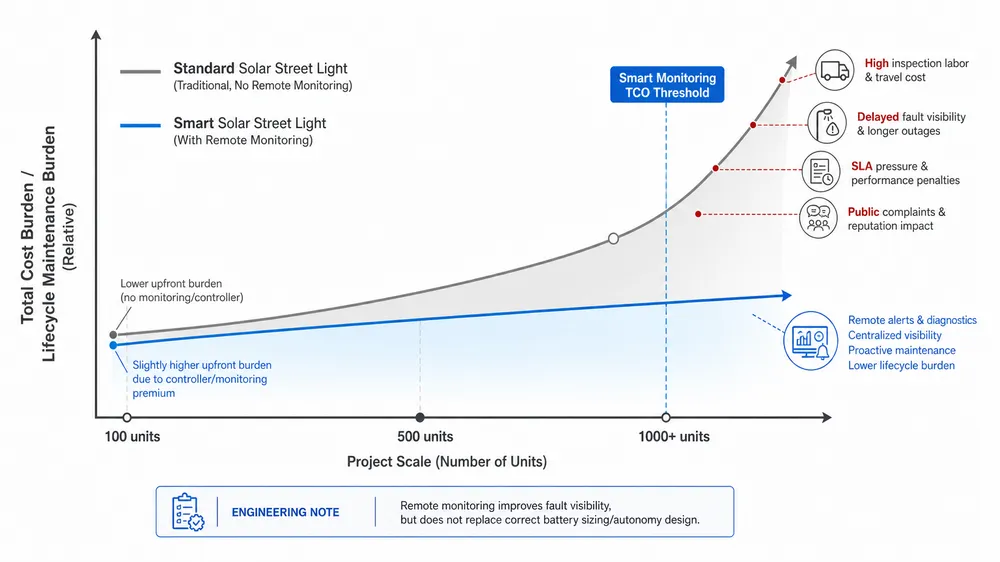
The TCO comparison comes down to one calculation: smart premium + commissioning + data fees versus avoided inspection visits + faster fault response + lower service-contract exposure.
At 100 units on a compact, accessible site, the math usually favors standard. Your maintenance team can inspect the full fleet in a single night run. The smart premium across 100 units may exceed the inspection savings for years.
At 500 units across dispersed municipal roads, the calculation shifts. If each inspection visit covers 20–30 units and takes a crew half a day, a full fleet inspection is a significant recurring cost. A fault alarm that triggers a targeted repair visit — instead of a full sweep — starts paying back the smart premium within the first year of operation.
At 1,000+ units across highway corridors or regional road networks, smart monitoring is almost always the lower total cost option when maintenance SLAs are in place. The cost of a missed fault — a dark highway section, a service-contract penalty, a municipal complaint — exceeds the per-unit smart premium many times over.
One engineering point that gets missed in this comparison: remote monitoring does not fix an undersized battery. A smart unit with insufficient autonomy days for the rainy season will still fail in the field — you'll just get a fault alarm instead of a complaint. Correct battery sizing for your target latitude and consecutive cloudy days is the foundation. Smart control is the visibility layer on top of it, not a substitute for it.
The strongest case for smart solar street lighting is not energy savings or dimming efficiency — it's the reduction in blind spots. On a large project, the lights you don't know are failing are the ones that create liability.
Project Scale Winner Map
Generic pros-and-cons lists don't help you make a budget decision. Scenarios do. Here are the five deployment conditions we see most often, with a direct verdict for each.
| Project Scenario | Likely Winner | Budget Reason |
|---|---|---|
| 50–150 units, compact site, easy road access | Standard | Inspection cost is low; smart premium exceeds maintenance savings |
| 200–500 units across municipal roads, mixed access | Mixed deployment | Smart on main corridors; standard on side roads controls capex while keeping visibility where it matters |
| 500–1,000+ units, dispersed roads or highway corridors | Smart | Inspection cost per unit is high; fault visibility reduces service-contract risk |
| Industrial park or campus with internal maintenance team | Depends on labor cost | If the team is on-site daily, standard is sufficient; if the team is shared across sites, smart reduces unnecessary visits |
| Remote rural roads or highway corridors, expensive site access | Smart | Each truck roll is costly; fault alarm replaces blind inspection sweeps |
On mixed deployment: this is not a compromise — it's a deliberate budget optimization. Main roads, intersections, and high-visibility corridors carry the most political and operational risk when dark. Smart units there. Side roads and low-traffic paths where a dark light is noticed quickly and fixed cheaply — standard units there. The same factory, the same housing, the same QC baseline. The only difference is the controller and connectivity module.
The smart solar street light vs standard decision is not binary for most large projects. The question is which zones justify the monitoring premium and which don't.
Regional Conditions That Change the Budget Answer
The smart-versus-standard decision is not purely about project scale. Operating environment and regional infrastructure context shift the calculation.
Middle East: Long road corridors, high ambient temperatures, and dust accumulation make battery sizing and thermal management the first engineering priority — not the control layer. That said, when a project spans 50+ km of highway with limited maintenance crew coverage, the cost of a night inspection sweep is high enough that smart fault reporting pays back quickly. Confirm network coverage before specifying SIM-based monitoring; some remote corridors require gateway mesh rather than cellular.
Africa: Remote roads and limited local maintenance infrastructure make fault visibility genuinely valuable — a dark road that goes unreported for weeks is a real operational risk. The constraint is network availability. In areas with reliable 4G coverage, IoT solar street lights with remote monitoring are a strong fit. In areas with patchy coverage, a gateway-based mesh or LoRa network may be needed, which adds commissioning complexity and cost. Confirm connectivity before the specification is locked.
Southeast Asia: High humidity, heavy rainy seasons, and dense road networks make autonomy sizing and IP67 waterproofing the baseline requirements for both types. The rainy season is where undersized batteries fail — and where smart monitoring earns its keep by flagging degraded units before the next storm cycle. For large municipal projects in the region, documentation and reporting requirements are increasingly common, which favors smart systems.
North America and Europe: Municipal and infrastructure projects in these markets often carry service accountability requirements — maintenance reporting, uptime documentation, and SLA compliance. Smart solar street lighting with remote monitoring supports those documentation requirements directly. CE and IEC 62124 certification covers both types from our factory; platform documentation for the monitoring system may be an additional requirement depending on the tender.
In all regions: IP65 is the minimum for outdoor solar street lights; IP67 is the correct spec for areas with flooding risk, heavy rain, or road-level water exposure. Both standard and smart units from our factory meet IP65/IP67 depending on configuration. (We've seen projects in Southeast Asia specify IP65 and then deploy in flood-prone zones — the first rainy season makes the case for IP67 clearly.)
Procurement Risk Falls When Both Options Come From One Factory
Qualifying two suppliers for a mixed smart-and-standard deployment is a procurement risk that doesn't get enough attention in project planning. When the standard units come from one factory and the smart units from another, you're managing two sets of housing tolerances, two battery chemistries, two controller logic systems, two spare-parts inventories, two warranty processes, and two QC baselines. On a 500-unit project, that complexity compounds at every stage: incoming inspection, installation, commissioning, and after-sales.
We manufacture both standard and smart solar street lights in-house at our 12,000 m² facility in Zhongshan. The same housing tooling, the same LED module, the same battery cell sourcing, the same automated SMT production line for control boards — whether the unit ships with a fixed controller or an IoT module. Our 15+ optical and electrical engineers handle battery autonomy sizing and system configuration for both types in a single engineering review. One RFQ, one factory audit, one pre-shipment inspection process covering the full mixed order.
100% pre-shipment inspection applies equally to standard and smart units. For smart units, that includes controller function verification, communication module pairing, and dimming logic confirmation before the container is sealed. We've seen what happens when smart units arrive on-site with misconfigured controllers or unregistered SIM modules — it turns a one-day commissioning job into a week of troubleshooting. We test it here so you don't debug it there.
OEM and ODM are available for both types. Private-label standard or Smart Solar Street Light units from the same factory means your brand appears consistently across the full deployment, regardless of which zones get smart control and which get standard. MOQ starts at 100 units for standard models; smart configurations may have higher minimums depending on the controller and connectivity module specified.
Reorder simplicity is the long-term benefit. When the project expands or replacement units are needed two years later, one supplier relationship covers both types.
RFQ Checklist for a Clean Budget Comparison
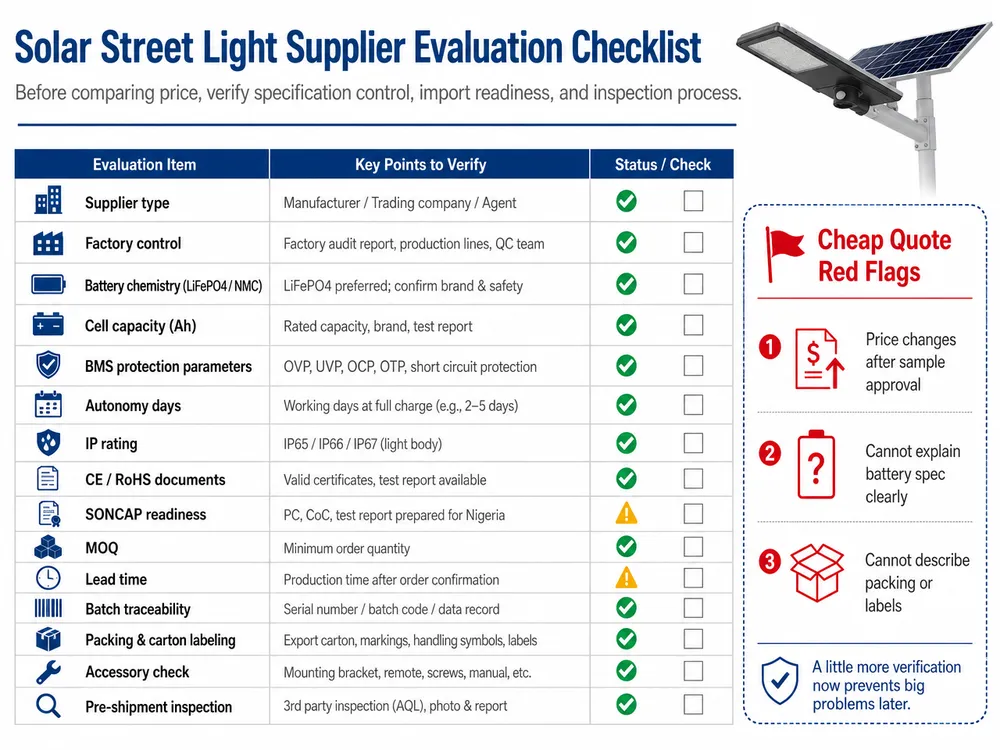
The most common reason a smart-versus-standard budget comparison produces a misleading result: the two quotes are not built on the same battery, panel, and lumen basis. A standard unit quoted with a smaller battery and a smart unit quoted with a larger one will show a cost gap that has nothing to do with the control layer. To get a clean comparison, both configurations need to be sized identically for your deployment conditions.
Use this checklist when sending an RFQ for either type:
Project parameters:
- [ ] Total unit count (and split if mixed deployment is planned)
- [ ] Road width and target pole height
- [ ] Required lumen output and optical distribution (Type II, III, or V)
- [ ] Installation spacing (meters between poles)
- [ ] Target region and latitude (for battery autonomy calculation)
- [ ] Required autonomy days during rainy season (consecutive cloudy days)
Technical requirements:
- [ ] IP rating requirement: IP65 or IP67
- [ ] Preferred structure: all-in-one or split (separate panel and fixture)
- [ ] Monitoring requirement: none / fault alarm only / remote dimming / full platform access
- [ ] Connectivity preference: SIM/4G, Zigbee mesh, LoRa, or gateway-based
- [ ] Dimming profile: fixed schedule or remotely adjustable
Commercial and documentation requirements:
- [ ] OEM branding or packaging requirements
- [ ] Certification documentation needed: CE, RoHS, IEC 62124, DLC, or others
- [ ] Platform or software documentation required for the smart system
- [ ] Warranty terms required
Comparing smart versus standard without locking these parameters first gives you a price difference, not a budget decision. Once the specs are aligned, the cost gap between the two types reflects only the controller and connectivity layer — which is the number you actually need to evaluate against your maintenance cost model.
Send your project parameters to Request Quote and we'll return a configuration recommendation and unit pricing for both standard and smart options on the same battery and lumen basis.
FAQ for Procurement and Engineering Review
Is a smart solar street light worth the premium for a 500-unit road project?
It depends on inspection cost and maintenance accountability, not unit count alone. At 500 units across dispersed municipal roads where each inspection sweep requires a crew and vehicle, smart fault reporting typically pays back the per-unit premium within the first year of operation by replacing blind inspection sweeps with targeted repair visits. If the 500 units are on a compact, easily accessible site where a single crew can cover the full fleet in one night run, the standard option is likely the lower total cost. The break-even is not a fixed number — it's the ratio of your inspection cost per visit to the smart premium per unit.
Can standard solar street lights and smart solar street lights be used in the same project?
Yes, and for large projects this is often the most commercially rational approach. The housing, LED module, battery, and solar panel can be identical between the two types — only the controller and connectivity module differ. Using the same factory for both means consistent housing tolerances, matching spare parts, and a single QC baseline across the full deployment. The practical requirement is that the smart and standard zones are clearly defined in the project specification before production, so controller configuration and commissioning planning are handled correctly.
Does remote monitoring reduce battery failure?
Remote monitoring detects battery degradation earlier — it does not prevent it. A smart solar street light with remote monitoring will flag a unit whose runtime is shortening before it goes completely dark, giving you a maintenance window instead of a failure event. But the underlying cause of battery failure — undersized capacity for the rainy season, incorrect charge/discharge cycling, or cell quality — is an engineering and sourcing problem, not a monitoring problem. Correct autonomy sizing for your target latitude and consecutive cloudy days is the foundation. Monitoring is the early-warning layer on top of it.
What should be checked before specifying an IoT solar street light?
Four things before the specification is locked: (1) Network coverage at the deployment site — SIM-based monitoring requires reliable 4G or 3G coverage; remote or rural sites may need a gateway mesh or LoRa network instead. (2) Platform requirements — fault alarm only, remote dimming, energy logging, and full platform access are different specifications with different costs. (3) Commissioning plan — IoT units require device registration and signal verification at installation; factor this into the installation schedule. (4) Ongoing data costs — SIM fees and platform licenses are real recurring costs; confirm these before the project budget is finalized.
Is an all-in-one smart solar street light better than a split smart system for large projects?
All-in-one units — where panel, battery, LED, and controller are integrated into a single housing — reduce installation time and pole hardware complexity, which matters on large projects where installation labor is a significant cost. The trade-off is that battery replacement requires removing the full fixture rather than swapping a separate battery box. For projects in regions with high battery replacement frequency (extreme heat, extended rainy seasons), a split configuration with an accessible battery compartment can reduce long-term service cost. For most standard deployment conditions, the all-in-one form factor is the more practical choice at scale. Specify which structure you need in the RFQ — both are available with standard or smart control.