The Solar Fan Battery Runtime Formula Buyers Need First
You need one formula to start: Battery capacity (Wh) ÷ Fan power draw (W) = Runtime (hours). That's the baseline. Everything else is derating.
Take a 12W solar fan with a 60Wh battery pack. 60 ÷ 12 = 5 hours of theoretical runtime. If your deployment needs 8 hours of solar fan overnight operation, you're 3 hours short before accounting for real-world losses.
Use Wh (watt-hours), not mAh or Ah alone. A "10,000 mAh" battery spec is meaningless without voltage. At 3.7V that's 37Wh. At 12V it's 120Wh. Suppliers who quote only mAh are either inexperienced or hoping you won't calculate the actual energy capacity. We see this constantly in RFQ submissions — a buyer asks for "8 hours runtime" and receives three quotes with identical mAh ratings but voltages ranging from 3.2V to 12V, giving you a 4× spread in actual capacity.
The most common buyer mistake we encounter: conflating solar panel wattage with battery capacity. A 20W solar panel charges the battery during the day. A 60Wh battery stores that energy. The fan draws from the battery at night. Three separate specs, three different units. If your fan runs at night and you only spec the panel, you have no runtime guarantee.
This formula gives you the theoretical maximum. Real deployments need derating for temperature, depth of discharge limits, charge controller losses, motor speed variation, and battery aging. Spec for theory and you'll field calls about fans stopping at 3 AM.
Real-World Derating Factors That Shorten Solar Fan Battery Runtime
Lithium batteries lose 10–20% capacity below 10°C. Above 45°C they gain thermal stress and accelerated aging. If your deployment site sees winter lows of 5°C, your 60Wh battery is effectively 48–54Wh during those months, cutting your 5-hour runtime to 4–4.5 hours before you account for anything else.
Depth of discharge (DoD) limits matter for cycle life. Cycling a lithium battery to 100% DoD gives you roughly 500 cycles before capacity drops below 80% of nameplate. Cycling to 80% DoD doubles that to 1,000+ cycles. Cycling to 50% DoD can push you past 2,000 cycles. The trade-off: if you limit DoD to 80%, your 60Wh battery gives you 48Wh of usable energy, knocking another hour off your solar fan battery runtime. Commercial deployments where replacement cost exceeds battery cost should spec for 70–80% DoD and accept the runtime hit. Consumer products chasing the longest advertised runtime often ignore this, which is why buyers see warranty claims spike in year two.
Charge controller efficiency ranges from 85% to 92% in typical MPPT units. That loss happens during the day when solar energy transfers to the battery, but it affects how much capacity you actually have available at night. A 20W panel in 5 peak sun hours delivers 100Wh of gross energy. At 88% controller efficiency, 88Wh reaches the battery. At 85%, only 85Wh. That 3Wh difference is 15 minutes of runtime on a 12W fan.
Motor speed settings change power draw non-linearly. A 3-speed solar fan might pull 8W on low, 12W on medium, and 18W on high — not a clean 33% / 66% / 100% curve because motor efficiency shifts with RPM and airflow resistance increases with the square of speed. Buyers who spec runtime based on low-speed operation and then field-deploy on high speed will see solar fan battery hours drop by 40–50%, not the 20–30% they expected.
Battery aging is cumulative. A new LiFePO4 cell rated at 60Wh will degrade to 51–54Wh over the first 500 cycles even with proper DoD management. Li-ion NMC cells degrade faster, hitting 48–51Wh in the same window. If you spec for exactly 8 hours of runtime with a new battery, you're below 7 hours within the first year of nightly use.
The practical rule we give OEM buyers: spec 1.3× the calculated capacity to account for cumulative derating. If your formula says you need 60Wh, order an 80Wh battery pack. That margin covers temperature swings, DoD limits, controller losses, and aging without cutting into your advertised runtime within warranty period.
LiFePO4 vs. Li-ion for Solar Fan Battery Applications — Factory Perspective
LiFePO4 (lithium iron phosphate) delivers 90–120 Wh/kg, cycles 2,000+ times to 80% capacity at 80% DoD, and maintains thermal stability up to 60°C without significant risk of thermal runaway. It costs $0.18–$0.25 per Wh at OEM volumes (500+ units). Li-ion NMC or NCA chemistries deliver 150–200 Wh/kg, cycle 500–1,000 times under the same conditions, require BMS with active thermal cutoff below 55°C, and cost $0.12–$0.18 per Wh.
The energy density gap means a 60Wh Li-ion pack weighs 300–400g. The same capacity in LiFePO4 weighs 500–650g. For portable solar fans where buyers optimize for weight, Li-ion wins. For fixed installations where the fan mounts to a wall or ceiling and weight doesn't affect user experience, the density advantage disappears.
LiFePO4 makes commercial sense when replacement cost exceeds the battery premium. A telecom shelter solar fan deployment 200 km from the nearest service center costs more in truck rolls and labor than the $4–6 per unit LiFePO4 premium. The longer cycle life means you replace batteries every 5–6 years instead of every 2–3 years, cutting lifetime deployment cost even though unit cost is higher. We've seen buyers switch from Li-ion to LiFePO4 after warranty claim rates hit 8% in year two — not because the fans failed, but because logistics cost made even a small failure rate unprofitable.
Li-ion is the right trade-off for price-sensitive markets where buyers compete on retail shelf price and warranty periods are 1 year or less. Portable consumer solar fans targeting the $40–60 retail bracket can't absorb the LiFePO4 premium and still hit margin targets. The shorter cycle life is acceptable because consumer use patterns are intermittent (not nightly), and the product refresh cycle is 2–3 years regardless of battery health.
For extreme temperature environments, LiFePO4 is the only safe choice. We won't ship Li-ion packs for installations where ambient temperature exceeds 40°C for more than 4 hours per day — the thermal stress accelerates dendrite formation and the BMS has to cut off charging too often, which defeats the purpose of solar fan battery backup. LiFePO4 handles 45°C continuous and 50°C peak without thermal management beyond passive convection.
JXSOL's default spec for outdoor fixed solar fan installations is LiFePO4. We offer Li-ion as a cost-reduction option for portable models or when buyers provide written confirmation that deployment environment stays below 35°C and replacement logistics are simple. That's not a sales position — it's a warranty cost position. Our 3-year warranty covers battery capacity retention to 80% of nameplate, and we can't honor that with Li-ion in high-temperature outdoor use.

How Motor Wattage and Speed Settings Change Solar Fan Battery Hours
Solar fans range from 6W desk models to 25W industrial ceiling units. Most commercial outdoor fans we manufacture fall in the 10–18W range, which is the sweet spot for balancing airflow and solar panel practicality (you can charge a 15W fan with a 30–40W panel in most latitudes without oversizing the panel to impractical dimensions).
Speed control is rarely linear. A 3-speed fan rated at 15W continuous typically draws 9W on low, 13W on medium, and 18W on high. The jump from medium to high is larger because you're fighting increased bearing friction and aerodynamic drag. Buyers who assume a 33% power reduction per speed step will overestimate solar fan battery runtime on low speed.
Here's how battery capacity maps to runtime at different wattages, assuming 80% DoD (usable capacity):
40Wh battery pack (32Wh usable):
- 6W fan: 5.3 hours
- 10W fan: 3.2 hours
- 15W fan: 2.1 hours
- 20W fan: 1.6 hours
60Wh battery pack (48Wh usable):
- 6W fan: 8.0 hours
- 10W fan: 4.8 hours
- 15W fan: 3.2 hours
- 20W fan: 2.4 hours
80Wh battery pack (64Wh usable):
- 6W fan: 10.7 hours (exceeds typical overnight need)
- 10W fan: 6.4 hours
- 15W fan: 4.3 hours
- 20W fan: 3.2 hours
100Wh battery pack (80Wh usable):
- 6W fan: 13.3 hours
- 10W fan: 8.0 hours
- 15W fan: 5.3 hours
- 20W fan: 4.0 hours
If you need 8 hours of solar fan overnight operation from a 12W fan, you need at least 96Wh of nameplate capacity (77Wh usable at 80% DoD). That's before derating for temperature and aging. With the 1.3× margin we recommend, you're at 125Wh — which is why we offer 120Wh packs as the top standard option for buyers with genuine overnight requirements.
Buyers sourcing for specific runtime targets should start with required hours × expected wattage, then add the 1.3× derating margin. If your deployment needs 10 hours from a 15W fan, the math is 10 × 15 = 150Wh usable, × 1.25 to back out 80% DoD = 187Wh nameplate, × 1.3 for derating = 243Wh. You need a custom battery configuration or a lower-wattage fan. Most suppliers won't tell you that — they'll quote you an 80Wh pack, collect your deposit, and let you discover the shortfall in the field.
JXSOL can configure battery packs from 40Wh to 120Wh in 10Wh increments for OEM orders (MOQ 100 units). Beyond 120Wh you're into custom cell layouts that require new BMS programming and safety testing, which pushes lead time and adds NRE cost. For most commercial solar fan deployments, the 80–100Wh range hits the runtime target without overbuilding.
Application Scenarios — When 8 Hours Isn't Enough and When It's Overkill
Off-grid telecom shelters need 12–16 hour runtime because equipment generates heat 24/7 and ventilation can't stop during extended cloud cover. These deployments need dual battery packs or high-capacity single packs (100Wh+), LiFePO4 for cycle life, and charge controllers with load-priority logic so the fan stays running even when the panel can't fully recharge the battery during a cloudy day. The buyer is typically a systems integrator or telecom contractor who understands that fan failure means equipment thermal shutdown, which costs more than the battery premium.
Warehouse and factory ventilation runs 8–10 hours overnight when the building is closed and HVAC is off. Medium capacity (60–80Wh) with solar top-up during day shifts works because the deployment is grid-accessible and the fan is a comfort/air quality feature, not a critical system. If the battery dies at 6 AM instead of 8 AM, nobody notices. Buyers in this segment care more about unit cost than runtime precision, so Li-ion is often the right chemistry choice.
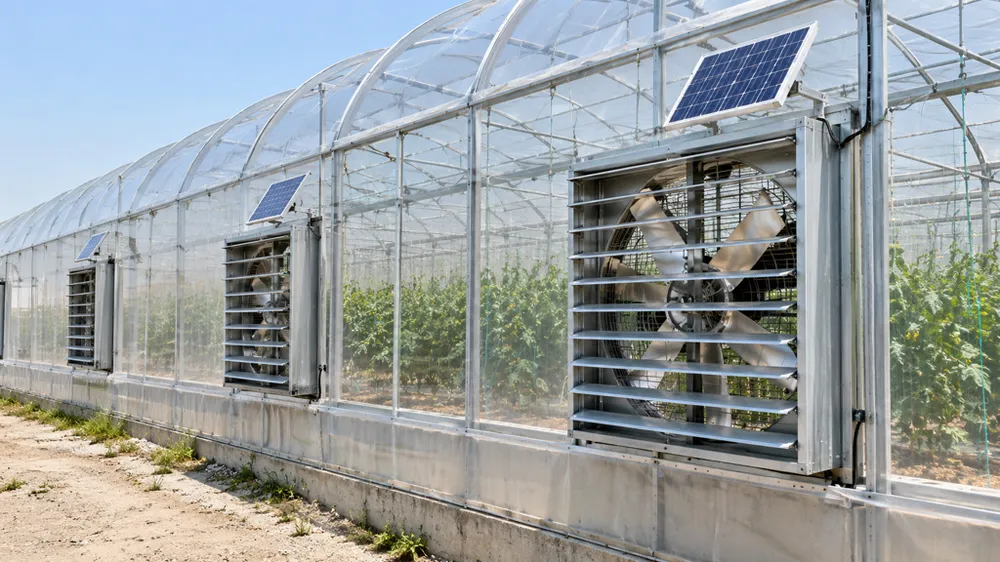
Agricultural applications (greenhouses, livestock barns) need 6–8 hours and can tolerate occasional shortfall because the consequences are mild — slightly higher humidity or temperature, not equipment failure. These buyers are cost-sensitive and often don't have technical staff to audit battery specs, which is why we see the most supplier fraud in this segment (quoted capacity doesn't match delivered capacity). If you're sourcing for agriculture, verify actual Wh ratings and ask for discharge test data, not just cell datasheets.
Emergency backup for clinics, command centers, or critical facilities needs 16+ hours or grid-hybrid configuration. Pure solar isn't appropriate — you need a system that switches to grid or generator when solar charge state drops below a threshold. LiFePO4 is mandatory because replacement logistics during an emergency are impossible, and the buyer liability exposure is high. These deployments are small volume but high value per unit.
Portable and consumer solar fans need 4–6 hours, which matches typical evening use (6 PM to 10–11 PM). Li-ion is the right choice to hit retail price targets, and shorter cycle life is acceptable because usage is intermittent and the product lifecycle is 2–3 years. Buyers in this channel optimize for package size and shelf appeal, not total cost of ownership.
The common buyer error: over-speccing battery capacity for applications where grid or generator backup exists. If your warehouse has grid power and you're using solar fans to reduce electricity cost (not provide independence), you don't need 12-hour runtime — you need enough capacity to cover the overnight period plus a margin for cloudy-day recharge shortfall. Speccing a 100Wh battery when a 60Wh battery with grid failover does the job costs you $8–12 per unit for no commercial benefit.
What to Verify in OEM Solar Fan Battery Specs — Factory Testing Protocols
Verify actual Wh rating, not mAh. A supplier quoting "10,000 mAh battery" without voltage is either inexperienced or dishonest. If they give you mAh at 3.7V but ship cells configured for 3.2V nominal (LiFePO4), you're getting 15% less solar fan battery capacity than the math implied. We've seen this gap in 30% of first-time RFQ submissions — the buyer calculates runtime using 3.7V and receives a pack that delivers 85% of expected hours.
Ask for charge/discharge cycle test data. A legitimate supplier will have datasheets showing capacity retention after 500 cycles at 80% DoD and at the temperature range you specified for deployment. If the supplier says "our cells are rated for 1,000 cycles" but can't show you the test curve, they're quoting cell manufacturer claims without verifying pack-level performance (the BMS and cell matching affect real-world cycle life even when individual cells meet spec).
BMS features are not equal. Every lithium battery pack has a BMS, but "BMS" can mean anything from a $0.30 single-chip protection board to a $4 microcontroller-based system with cell balancing, thermal monitoring, and SOC estimation. Minimum requirements for solar fan battery backup: over-discharge cutoff (prevents cycling below safe voltage), over-charge cutoff (prevents damage during high-irradiance days), thermal cutoff (shuts down if temperature exceeds safe range), and passive cell balancing (equalizes charge across cells during every cycle). If the supplier can't provide a BMS schematic or feature list, they're using the cheapest protection board they can find, and your cycle life will suffer.
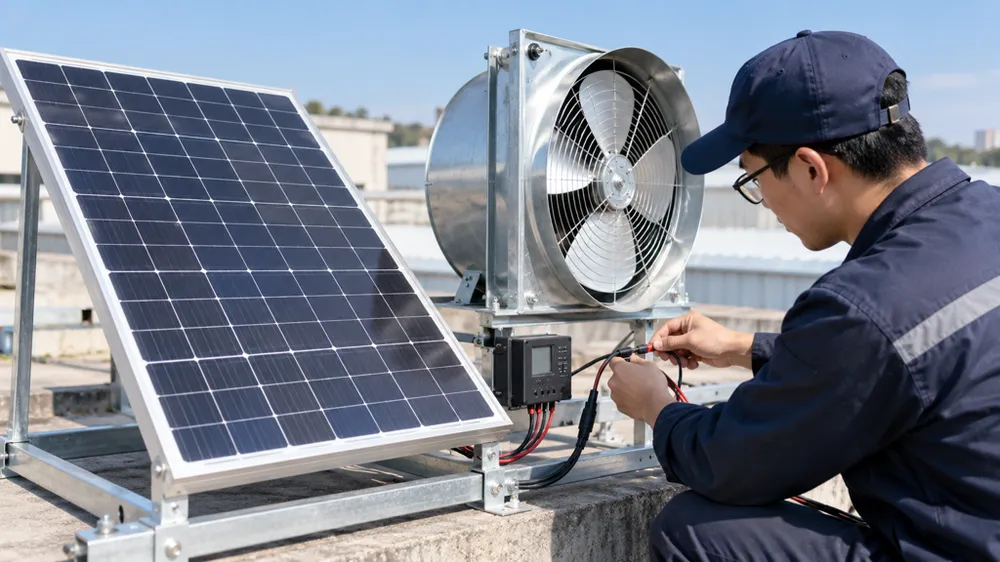
Solar charge controller compatibility matters. MPPT controllers extract 15–25% more energy from the panel than PWM controllers, but they need a battery voltage range that matches their design. If your battery nominal voltage is 11.1V (3S LiFePO4) and the charge controller expects 12V lead-acid profile, the charge logic will cut off early and you won't get full capacity. Verify that the controller and battery voltage curves are matched, or you'll leave energy on the table.
JXSOL's testing protocol: 100% of battery packs go through capacity verification before final assembly (we charge to full, discharge at 0.5C to cutoff voltage, and measure actual Wh delivered). That catches cell mismatch and BMS calibration errors. We sample 10% of each production batch for accelerated cycle testing (200 cycles at 1C charge/discharge in a thermal chamber from 0°C to 45°C) and reject the batch if capacity retention falls below 92% of nameplate at cycle 200. We run thermal stress tests (-10°C to 50°C) on every new cell supplier's samples before we approve them for production. Those tests take 3 weeks and cost $800–1,200 per supplier qualification, but they're why our warranty claim rate on batteries is under 1.2% instead of the 4–6% industry average for solar products.
Red flags when auditing suppliers: they can't provide cycle life data specific to the pack configuration they're quoting (they show you the cell datasheet, not pack test results). They quote voltage and capacity that don't match — a 12V 60Wh pack should have around 5Ah capacity; if they claim 12V 10Ah (120Wh) at the same price as competitors' 60Wh packs, the voltage or capacity is wrong. They don't document BMS features or say "standard BMS" without specification. They can't explain how their charge controller integrates with the battery voltage profile.
Custom Battery Capacity for OEM Orders — Procurement Leverage Point
Standard consumer solar fan SKUs lock you into fixed capacity tiers: 40Wh, 60Wh, 80Wh. If your deployment analysis shows you need 70Wh, you either over-spec to 80Wh (wasting $4–6 per unit) or under-spec to 60Wh (risking field failures and warranty claims). OEM orders above 100 units let you specify exact capacity to match project requirements.
The commercial value: avoid over-speccing and you reduce unit cost without sacrificing performance. Avoid under-speccing and you cut warranty claims, which cost 3–5× the original battery value when you factor in logistics, labor, and customer satisfaction impact. A distributor ordering 500 units for a specific project can save $2,000–3,000 on battery cost by speccing 70Wh instead of 80Wh, or avoid $6,000–10,000 in warranty cost by speccing 70Wh instead of gambling on 60Wh.
JXSOL's capacity customization range: 40Wh to 120Wh in 10Wh increments, with either LiFePO4 or Li-ion chemistry. Below 40Wh the runtime is too short for most commercial applications (under 3 hours with typical fans). Above 120Wh you need custom cell layouts — 18650 cells are 3.4Wh each, so a 120Wh pack is already 35 cells in a complex series-parallel arrangement. Going beyond that requires larger form-factor cells (21700 or 26650) or multi-layer PCB layouts, which adds NRE cost and extends lead time by 4–6 weeks for the first order.
Lead time impact: first custom battery order adds 2 weeks to standard lead time because we need to source cells in the exact configuration, program the BMS for the new voltage and capacity parameters, and run the full qualification test sequence (capacity verification, cycle testing, thermal stress). Repeat orders of the same custom spec ship on standard lead time (4 weeks for 100–500 units, 5–6 weeks for 500–2,000 units) because the configuration is already validated and we stock the cell inventory.
Buyers who don't take advantage of custom capacity either because they don't know it's available or because they assume MOQ is prohibitive leave money on the table. If you're ordering 200+ units for a project with specific runtime requirements, ask your supplier if they can match capacity to your calculated need. If they say no, they're either a trading company without factory access or a factory that doesn't want to support your order size.
Cost Structure — How Battery Capacity Affects Solar Fan Unit Price
Battery packs represent 25–35% of total solar fan BOM cost. For a mid-range 15W solar fan with 60Wh LiFePO4 battery, the component breakdown is roughly: battery pack $9–11, solar panel $6–8, motor and fan blade assembly $5–7, charge controller and BMS $3–4, housing and hardware $4–6, final assembly and QC $3–4. Total BOM $30–40, FOB price $42–58 depending on order volume and customization.
Capacity scaling is near-linear because you're adding cells. An 80Wh battery costs $12–14 (LiFePO4) vs. $9–11 for 60Wh — about $3 per 20Wh increment. A 40Wh battery costs $6–8. The non-linear part is the BMS: a 40Wh pack and an 80Wh pack both need over-charge, over-discharge, and thermal protection, so the BMS cost ($2–3) is fixed regardless of capacity. That means the $/Wh cost decreases slightly as capacity increases, but not enough to justify over-speccing just to get better unit economics.
LiFePO4 premium: +$5–8 per unit vs. equivalent Li-ion capacity. A 60Wh LiFePO4 pack costs $10–12; a 60Wh Li-ion pack costs $7–9. The gap narrows at higher volumes (1,000+ units) because LiFePO4 cell supply chain has improved and pricing has come down 20% over the past 3 years. For buyers ordering 500+ units, the premium is closer to $4–6 per unit.
Landed cost modeling: compare runtime tier vs. unit cost vs. warranty claim rate. A 60Wh solar fan at $48 FOB with 5% warranty claims in year two costs you $48 + ($48 × 0.05) + shipping + logistics for the replacement = $52–54 per unit delivered and supported. A 70Wh fan at $51 FOB with 1.5% warranty claims costs $51 + ($51 × 0.015) + replacement logistics = $52–53. The $3 upfront premium disappears when you model the full ownership cost, and you avoid the customer satisfaction hit from early failures.
The buyer mistake we see most often: focusing only on FOB price without modeling failure cost. A $45 FOB fan with an under-specced 50Wh battery that fails to meet runtime claims generates support calls, replacement shipments, and distributor complaints that cost you $15–25 per failure when you account for logistics, labor, and customer relationship impact. A $48 FOB fan with a properly specced 65Wh battery that works as advertised costs you $48 and nothing else. The $3 difference is the cheapest insurance you can buy.
For most commercial solar fan deployments targeting 8–10 hours of solar fan overnight operation, the 70–80Wh capacity range with LiFePO4 chemistry hits the commercial optimum: high enough to meet runtime claims with margin for derating, low enough to stay competitive on unit cost, and durable enough to keep warranty claims under 2%.