What OEM Customization Means for Solar-Powered Fans
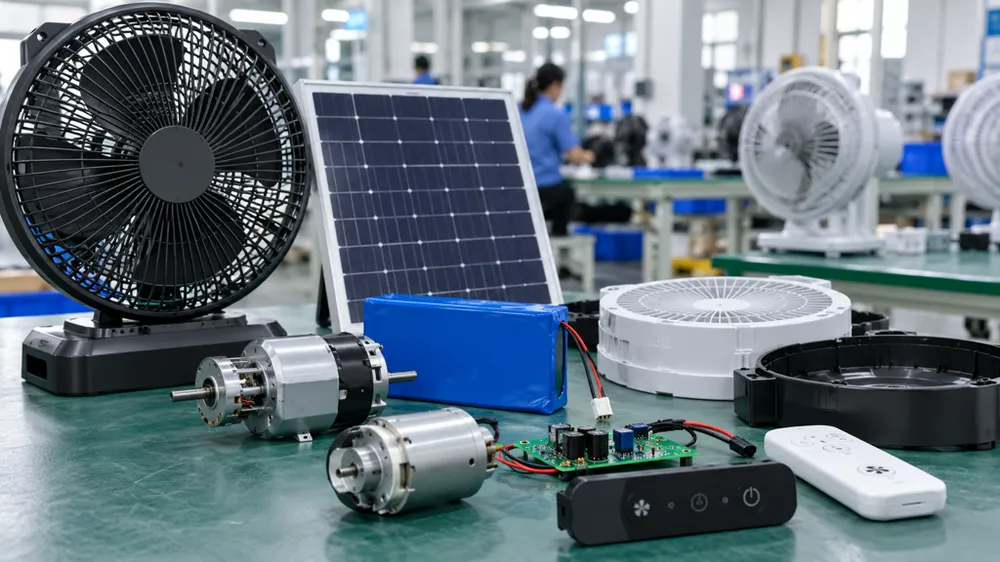
Solar fan OEM isn't logo placement on a catalog model. It's motor specification, solar panel sizing, battery capacity selection, housing material choice, and control system configuration. The customization scope is wide during the design phase, but it narrows sharply once tooling approval happens. Buyers who assume flexibility continues through production discover that solar fans have hard constraints driven by panel-motor matching and battery chemistry — changing a 10W panel to 15W mid-production affects charge time, runtime, and housing dimensions, which means restarting the tooling timeline.
The decision boundary sits between what you can adjust during design and what must be locked before production starts. Most spec mismatches happen because buyers treat OEM programs like modular assembly: swap one component, keep the rest. That works for consumer electronics with standardized voltage inputs. It doesn't work for solar-powered products where the panel, motor, and battery form an engineered system. A panel that can't supply the motor's draw doesn't just reduce performance — it creates a product that won't meet your buyer's expectations in the field.
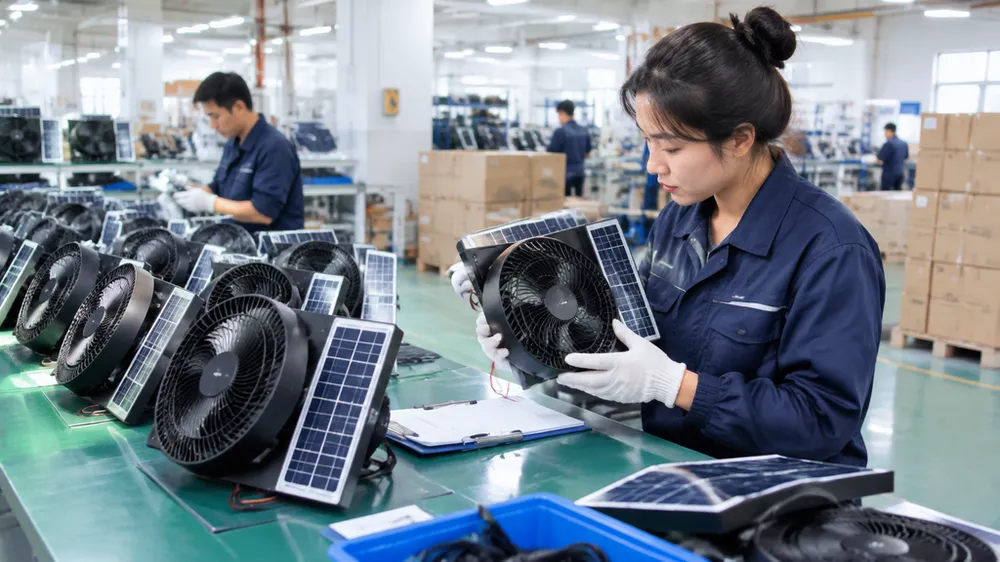
JXSOL's in-house optical and electrical engineering team handles OEM spec review before production scheduling. We're a solar lighting factory that added fans as an adjacent line, so the engineers who verify panel-motor-battery matching are the same team that designs weatherproof solar street lights and garden fixtures. That matters when you compare us to sourcing agents who forward your specs to three suppliers and discover conflicts during assembly. We catch spec mismatches before tooling, not after the first production run ships.
The commercial problem we're solving: your margin depends on hitting your market window, and your landed cost depends on getting the spec right the first time. Engineering rework during production extends your timeline by 3-4 weeks and increases per-unit cost by 15-25% because tooling changes can't be amortized across the full order volume.
Five Customization Categories and Their Production Lock Points
Solar fan OEM customization groups into five categories. Each has a production lock point where changes trigger engineering review or restart the tooling timeline. Knowing these boundaries before you submit an RFQ protects your timeline and prevents cost surprises during production.
Motor specification covers wattage, RPM, and noise level. The motor's power draw determines solar panel sizing and battery discharge rate. A 15W motor needs a panel that can supply 15W plus margin for charge efficiency loss (typically 20-25%), so you're specifying an 18-20W panel. Changing motor wattage after tooling approval requires engineering review because the panel and battery were already selected to match the original motor spec. We've seen buyers request a motor upgrade two weeks into production, then discover the upgraded motor pulls more current than the existing battery can safely discharge. That forces a battery chemistry switch, which restarts the safety certification timeline. Lock point: motor spec must be final before panel and battery selection.
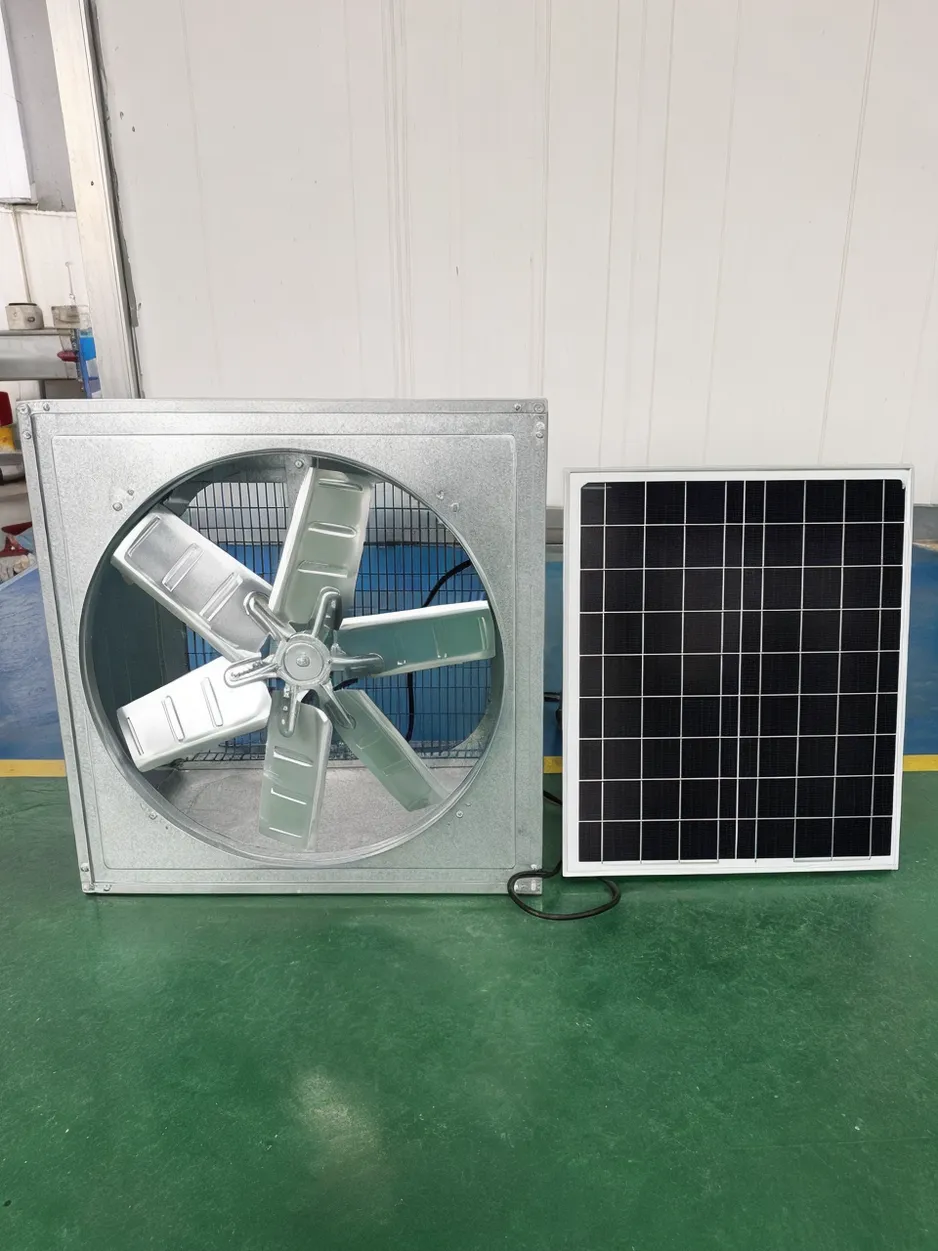
Solar panel configuration includes wattage, efficiency rating, and physical dimensions. Panel size determines housing mold dimensions — a 20W panel is physically larger than a 10W panel, which changes the housing footprint. Upgrading panel wattage mid-production creates two problems: the housing mold no longer fits, and the higher wattage changes charge time, which may require battery capacity adjustment to avoid overcharge. We had a distributor request a panel upgrade after the housing mold was cut because they wanted longer runtime. The panel physically fit, but the charge controller couldn't handle the higher current without firmware modification. The production hold lasted 18 days. Lock point: panel wattage and dimensions must be locked before housing mold approval.
Battery capacity and chemistry means lithium-ion versus LiFePO4, mAh rating, and charge/discharge cycle rating. Battery supplier selection happens during the design phase because each chemistry has different voltage curves, charge controller requirements, and safety certification protocols. Switching from lithium-ion to LiFePO4 after production starts triggers a new round of battery safety testing under IEC 62133 or UN38.3, depending on your target market. The recertification timeline is 4-6 weeks, not counting the time to source the new battery and modify the charge controller firmware. Battery capacity also affects runtime calculations — a buyer who increases capacity mid-production to extend runtime discovers that the solar panel's charge rate is now insufficient, which means the fan won't reach full charge during a standard 8-hour sun day. Lock point: battery chemistry and capacity must be locked before charge controller design and safety certification begin.
Housing material and color covers ABS plastic versus aluminum, UV-resistant coating formulation, and color matching to your brand palette. Custom colors require minimum order quantities because color masterbatch has a minimum production run at the raw material supplier — typically 500+ units for ABS plastic, 1,000+ units for powder-coated aluminum. Changing housing material after mold approval restarts the tooling timeline because aluminum and plastic use different mold technologies (injection molding versus die casting). We allow color customization down to Pantone code matching, but the MOQ threshold applies. Standard colors (white, black, gray) have no MOQ premium. Lock point: housing material must be locked before mold design; custom colors trigger MOQ requirements that affect order economics.
Control system and speed settings includes single-speed versus variable, remote control capability, timer functions, and USB charging ports. The PCB design locks after prototype approval because adding control features mid-production requires PCB redesign, component sourcing, and firmware modification. A distributor requested a remote control upgrade after production started, assuming it was a simple add-on. The remote required a Bluetooth module, which needed FCC certification for North American markets. The certification hold lasted 8 weeks. Variable speed control requires a PWM (pulse-width modulation) motor driver, which increases per-unit cost by $2-3 and adds 0.5W to the system's power budget. That 0.5W affects panel sizing if the buyer is working near the minimum viable panel wattage for their target runtime. Lock point: control system features must be locked before PCB design and firmware development begin.
For each category, MOQ thresholds and engineering review triggers matter as much as the technical lock point. A motor change at 100 units is a spec adjustment; at 1,000 units it's a production hold because the original motor batch was already ordered and the housing mold was cut to match the original motor's mounting bracket dimensions.

How Solar Panel Sizing Interacts With Fan Motor Performance
Panel wattage must match motor draw and battery charge rate, or the system doesn't work as specified. A 10W panel paired with a 15W motor will not achieve rated runtime because the motor draws more power than the panel can supply. The battery discharges faster than it charges, which means runtime decreases with each charge cycle until the fan stops running at the advertised duration. This isn't a gradual performance drop — it's a binary failure that shows up during your buyer's first week of field use.
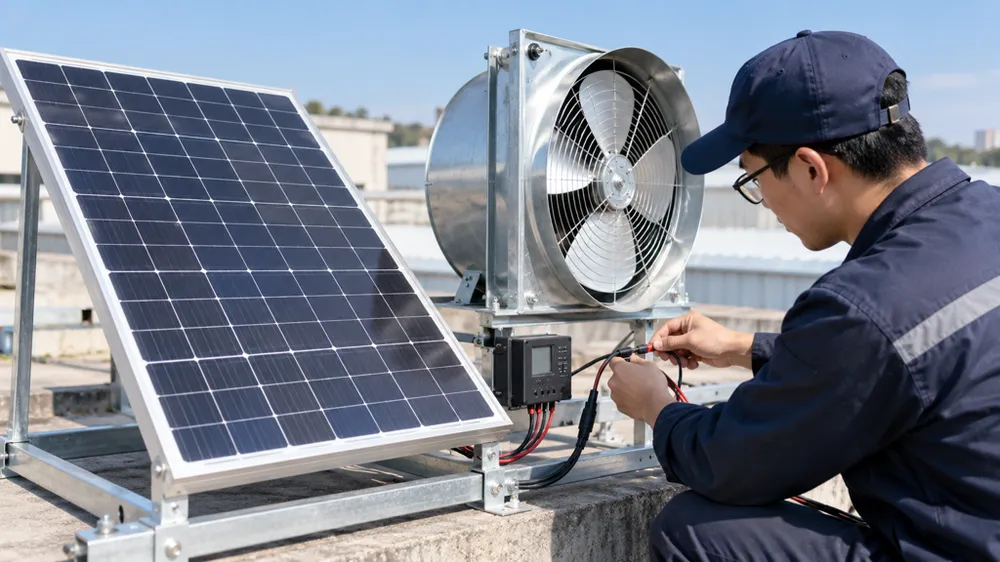
The engineering relationship works like this: motor wattage determines minimum panel wattage, panel wattage determines charge time, and charge time determines minimum battery capacity for the target runtime. If you want 8 hours of runtime from a 15W motor, you need 120Wh of energy storage (15W × 8h). A lithium-ion battery delivers roughly 85% of its rated capacity under load, so you need a 141Wh battery (120Wh ÷ 0.85). At 11.1V nominal voltage (3-cell lithium-ion pack), that's 12,700mAh. Now the panel must charge that 12,700mAh battery in one sun day. Assuming 6 hours of useful sunlight and 80% charge efficiency, you need a 29W panel (141Wh ÷ 6h ÷ 0.80). Round up for safety margin: 30W panel.
That's the baseline calculation. Now add real-world variables. If your target market is northern Europe with 4-hour winter sun days, the panel wattage needs to increase or the runtime spec needs to decrease. If your buyer wants the fan to run while charging (common for ventilation applications), the panel must supply motor draw plus battery charge current simultaneously, which typically requires a 40-50% panel oversizing. These aren't optional optimizations — they're engineering constraints that determine whether the product works.
The failure mode buyers don't anticipate: upgrading panel wattage without adjusting battery capacity creates overcharge risk. A 40W panel charging a 10,000mAh battery can exceed the battery's maximum charge current (typically 0.5C for lithium-ion, which is 5A for a 10Ah battery). Overcharging degrades battery cycle life and can trigger thermal events in extreme cases. The charge controller prevents immediate failure, but it does so by capping charge current, which means your expensive 40W panel operates at 60% capacity. You paid for performance you can't use.
JXSOL's engineering review step exists to prevent these mismatches. Before OEM production starts, our optical and electrical engineers verify panel-motor-battery matching using the same calculation framework we use for solar street lights. We flag overcharge risks, undersized panels, and runtime specs that can't be met with the proposed configuration. This review happens after you submit specs and before we approve tooling, which is when changes are still cheap. Buyers who skip this step — either by working with sourcing agents who don't have engineering staff, or by assuming catalog specs automatically transfer to OEM configurations — discover performance gaps during the first production run. That discovery delays market entry by 4-6 weeks and increases landed cost by 20-30% because the corrected order is smaller and can't amortize tooling costs as efficiently.
MOQ Thresholds That Trigger Tooling or Engineering Review
Minimum order quantities determine which customization options are economically viable. The MOQ isn't arbitrary — it's driven by tooling amortization, component supplier minimums, and quality control batch sizing. Understanding these thresholds before you submit an RFQ prevents spec changes that force you into a higher MOQ tier mid-negotiation.
100–499 units: Standard OEM with logo and packaging customization. At this tier you're working with existing housing molds, standard motor and panel configurations, and catalog battery options. Customization covers silk-screen logo placement, packaging box design, branded user manual, and product label. No tooling changes, no engineering review, no component sourcing delays. Lead time is 25-30 days from deposit to shipment because we're modifying branding layers, not redesigning the product. This tier works for distributors testing private label programs or launching a new market segment without committing to high-volume orders upfront.
500–999 units: Custom housing color and minor control system changes. This tier supports Pantone color matching, custom ON/OFF switch placement, and single-feature additions like a USB charging port or a timer circuit. Color customization triggers a raw material minimum because ABS color masterbatch has a 500kg minimum at our polymer supplier — that's roughly 500-600 fan housings depending on part weight. Control system changes at this tier are limited to features that don't require PCB redesign: adding a switch, relocating a button, or changing LED indicator color. Lead time extends to 35-40 days because we're coordinating custom material batches and validating minor circuit modifications.
1,000+ units: Full ODM with custom mold and proprietary PCB design. This tier unlocks custom housing geometry (different grill pattern, integrated mounting bracket, brand-specific aesthetic), motor specification changes (higher RPM, lower noise target, custom mounting flange), and control system redesign (variable speed, Bluetooth remote, smartphone app integration). Tooling costs at this tier range from $3,000-8,000 depending on complexity, but they're amortized across 1,000+ units so per-unit impact is $3-8. Lead time is 45-55 days because we're managing mold cutting, PCB prototyping, firmware development, and pre-production validation.
The engineering review trigger operates independently of MOQ: any spec change that affects panel sizing, battery supplier, or motor wattage requires engineering sign-off, regardless of order volume. We've had buyers submit 2,000-unit orders with panel upgrades that couldn't supply the requested motor spec. The order volume was high, but the spec was invalid. Engineering review caught it during the pre-production phase, we proposed two corrected configurations (larger panel or smaller motor), and the buyer chose the larger panel option. That review added 3 days to the timeline but prevented a 4-week production hold.
JXSOL's flexible MOQ positioning supports testing before scaling. Start with 100 units of private label on standard specs, validate market demand, then scale to 500-1,000 units with custom colors or control features once you've confirmed reorder economics. Distributors building a solar product catalog use this staging approach to reduce inventory risk while maintaining factory consistency across product lines.
Private Label and Branding Customization Scope
Private label customization covers branding and packaging without affecting engineering specs, so it operates at lower MOQ thresholds and shorter lead times than full OEM programs. This separation matters for distributors who want to test market demand for solar fans under their own brand before committing to custom motor specs or housing designs.
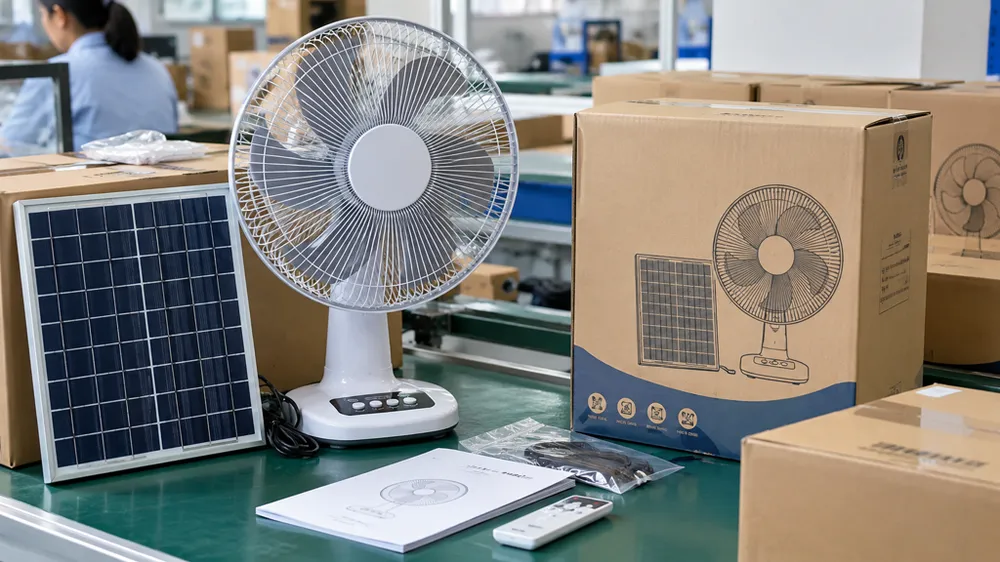
Standard private label options include silk-screen logo on the housing (single-color or two-color print), custom packaging box design with your brand artwork and product information layout, branded user manual and warranty card with your company details and support contacts, and product label with your company name, model number, and regulatory markings. Logo placement follows the housing geometry — typically on the front grill or top panel where it's visible during use. We provide artwork templates during the quotation phase so you can visualize logo size and placement before approving the design.
The lead time difference between private label and full OEM is significant. Branding-only customization adds 7-10 days to production timeline because we're coordinating silk-screen printing and packaging material production, not redesigning the product or cutting new molds. Engineering spec changes add 15-25 days depending on complexity because panel-motor-battery matching must be verified, component suppliers must be coordinated, and pre-production validation must be completed. For buyers working on tight market windows — holiday season inventory, project bid deadlines, trade show product launches — that 2-3 week difference determines whether you hit your timeline.
Private label works best when your brand positioning depends on catalog breadth rather than product differentiation. A distributor selling outdoor equipment (camping gear, RV accessories, emergency preparedness products) benefits more from offering solar fans under their brand alongside solar lights and portable power than from developing a proprietary fan design that requires custom tooling. The commercial logic: your buyers want a supplier who can fulfill multiple product categories in one purchase order, and your margin comes from catalog depth and reorder consistency, not from unique product features.
We've worked with distributors who started with private label at 100-200 units, validated demand over two seasons, then scaled to 500-1,000 units with custom housing colors and control features once they confirmed reorder patterns. That staging approach reduces inventory risk (you're not holding 1,000 units of a product you haven't sold yet) and protects margin (you're not amortizing tooling costs across a first-order volume that might not repeat).
Market Segments Where Solar Fan OEM Programs Create Buyer Value
Solar fan OEM programs create commercial value when your target market requires differentiation that catalog models can't support, or when consolidating factory relationships reduces coordination overhead across multiple product lines. The value isn't in customization for its own sake — it's in the commercial outcomes customization enables.
Outdoor equipment distributors selling camping gear, RV accessories, or emergency preparedness products use solar fan OEM to match motor and panel sizing to regional sunlight conditions. A distributor targeting northern European markets needs higher-output panels to compensate for shorter sun days and lower solar irradiance during winter. Standard catalog fans designed for southern U.S. or Middle Eastern markets use 15-20W panels optimized for 6-8 hours of strong sunlight. Those fans underperform in Stockholm or Edinburgh where useful sunlight drops to 3-4 hours in winter. OEM programs allow panel upgrades (25-30W) and battery capacity increases (15,000-18,000mAh) that maintain runtime specs across different solar zones. The commercial value: you're not explaining to your buyers why the fan only runs 4 hours instead of the advertised 8 — you matched the product spec to their geography before the sale. That reduces returns, protects margin, and builds reorder confidence.
Hospitality and resort supply chains equipping outdoor dining areas, poolside cabanas, or eco-resort accommodations use solar fan ODM to integrate with existing furniture designs and aesthetic standards. A resort with custom teak furniture and brushed aluminum accents can't deploy off-white plastic fans without breaking the design language. ODM customization allows housing material changes (powder-coated aluminum matching the furniture finish), grill pattern modifications (to match other resort fixtures), and mounting bracket integration (so the fan mounts directly to existing pergola or cabana structures without add-on hardware). The commercial value: you're selling a turnkey installation solution, not a product that requires modification in the field. Installation labor is your second-largest project cost after material, and custom mounting integration cuts installation time by 30-40%. That labor savings funds the ODM tooling premium across 200-300 units.
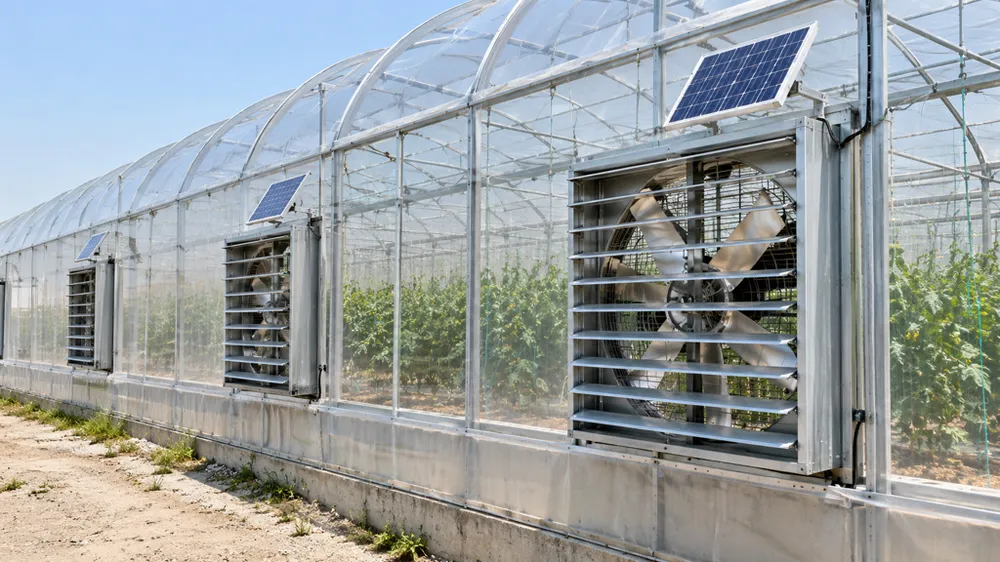
Agricultural tool resellers supplying greenhouse ventilation, livestock barn cooling, or field worker shade structures use solar fan OEM to optimize airflow for agricultural applications rather than personal comfort. Greenhouse ventilation requires higher CFM (cubic feet per minute) and lower noise than camping fans because you're moving air through a 2,000-square-foot structure without disturbing plant growth or stressing livestock. OEM motor specification changes — higher RPM, larger blade diameter, modified blade pitch — increase airflow by 40-50% compared to catalog models designed for personal cooling. The noise reduction matters in livestock barns where high-frequency motor whine causes stress responses that reduce feed conversion efficiency. Custom motor specs targeting sub-45dB operation at full speed protect agricultural productivity. The commercial value: your buyers measure ROI in yield improvement and feed efficiency, not in personal comfort. A solar fan that increases greenhouse tomato yield by 8-10% through better air circulation pays for itself in one growing season. That's a margin conversation you can have with agricultural buyers that catalog product specs don't support.
Across these segments, the common thread is consolidation value. Distributors building solar product catalogs benefit from running OEM programs for fans, lights, and portable power under one factory relationship instead of coordinating three suppliers across three different manufacturing locations. Consolidated factory relationships reduce coordination overhead (one point of contact for specs, quality issues, and logistics), simplify quality control (one inspection protocol across product lines), and improve negotiating leverage (multi-product order volume increases your buyer priority). We've seen distributors reduce their landed cost by 12-15% by consolidating solar product sourcing at JXSOL, not because our per-unit pricing was lower than specialized fan factories, but because consolidated shipping, single-factory quality protocols, and simplified reorder coordination reduced their total cost of ownership.
Pre-Shipment Inspection Protocol for OEM Production Runs
JXSOL's 100% pre-shipment inspection applies to OEM production runs, not just catalog orders. This matters for distributors running private label programs because product defects caught at the factory don't become warranty claims in your market. The total cost of quality includes not just manufacturing defects, but also reverse logistics, customer service overhead, and brand reputation damage. Pre-shipment inspection shifts quality control to the point where corrections are cheapest.
The inspection protocol covers five validation steps. Solar panel output verification measures actual wattage under standard test conditions (1000W/m² irradiance, 25°C cell temperature, AM1.5 spectrum) using a calibrated solar simulator. We're confirming the panel delivers rated wattage ±5%, which is the tolerance that maintains charge time calculations. Panels that underperform get flagged for supplier review — we don't ship panels that won't meet runtime specs because the performance gap shows up during your buyer's first use cycle. Battery charge/discharge testing validates capacity and cycle stability using a battery analyzer that simulates 3 full charge/discharge cycles at rated current. We're confirming the battery holds rated capacity (±3%) and maintains voltage stability during discharge. Batteries that fail capacity testing or show voltage instability during discharge get rejected before they reach your market as warranty claims.
Motor RPM and noise measurement uses a tachometer and sound level meter to verify rotational speed and acoustic output at rated voltage. We're confirming the motor delivers specified airflow (CFM correlates with RPM at constant blade geometry) and stays within noise limits (typically 50dB at 1 meter for personal cooling fans, 45dB for agricultural applications). Motors that exceed noise targets or underperform on RPM get replaced during assembly. Housing waterproof rating confirmation validates IP rating claims through water spray testing (IP65) or temporary immersion testing (IP67) using standardized nozzle pressures and immersion depths per IEC 60529. We're confirming the housing seals prevent water ingress that would damage electronics or corrode battery terminals. Housing failures trigger assembly review — usually the gasket wasn't seated correctly or the cable gland wasn't tightened to spec. Control system function check validates all switches, buttons, timer circuits, and remote control functions across the full operating voltage range (battery fully charged to minimum discharge cutoff). We're confirming the control system behaves as specified under all operating conditions, not just at nominal voltage.
The commercial implication: pre-shipment defects caught at the factory don't become warranty claims in your market. A distributor running a 500-unit private label program with 2% field failure rate spends $15-20 per return on reverse logistics, $25-30 per return on replacement unit cost, and $40-50 per return on customer service overhead. That's $80-100 per failure. Across 10 failures (2% of 500 units), the total cost of quality is $800-1,000. Pre-shipment inspection reduces field failure rate to 0.3-0.5%, which cuts quality cost by 75-85%. That savings funds the inspection overhead and improves margin.
JXSOL's in-house testing lab supports this protocol without adding third-party coordination. The solar simulator, battery analyzer, and waterproof testing equipment are in the same building where the product is assembled, which means inspection happens during production flow rather than as a post-production batch process. We catch defects during assembly when corrections are immediate, not during final inspection when the entire production run has already passed through. Third-party inspection services add 3-5 days to lead time and require coordination between factory, inspector, and buyer. In-house inspection eliminates that coordination overhead and keeps the production timeline predictable.
Spec-Lock Checklist for Solar Fan OEM RFQs
Submit a complete spec-lock checklist with your RFQ to reduce back-and-forth during engineering review and shorten the pre-production timeline. Incomplete RFQs extend the review phase by 5-10 days because we're requesting clarification on panel wattage, confirming battery chemistry choices, or validating that the motor spec can deliver your target airflow. A complete checklist protects your timeline.
Motor specification: Wattage (measured in watts, typically 10-25W for personal cooling fans), RPM (rotational speed, typically 1,200-2,000 RPM for standard blade diameters), noise level target (measured in dB at 1 meter, typically 50dB maximum for personal cooling, 45dB for noise-sensitive applications). If you're specifying airflow (CFM) instead of RPM, include that — we'll back-calculate the motor spec needed to achieve your CFM target at standard blade geometry.
Solar panel configuration: Wattage (typically 15-30W depending on motor draw and target runtime), physical dimensions (important if you have mounting constraints or housing size limits), efficiency rating (monocrystalline panels are 18-22% efficient, polycrystalline are 15-18% — efficiency affects panel size for a given wattage). If you're working in a specific solar zone (northern Europe, equatorial regions, high-altitude locations), note that — we'll adjust panel sizing recommendations to match local irradiance patterns.
Battery capacity and chemistry: Lithium-ion or LiFePO4 (lithium iron phosphate), mAh rating (typically 10,000-20,000mAh depending on motor wattage and runtime target), target runtime in hours. If you have temperature performance requirements (battery operates in -10°C to 50°C environments), specify that — LiFePO4 handles temperature extremes better than standard lithium-ion but costs 20-30% more.
Housing material and color: ABS plastic or aluminum, standard color (white, black, gray) or custom color with Pantone code, UV-resistant coating requirement (relevant for tropical markets with high UV exposure), IP rating requirement (IP65 for splash resistance, IP67 for temporary immersion). Custom colors trigger MOQ thresholds (500+ units for ABS, 1,000+ for aluminum), so confirm your order volume supports the color choice.
Control system requirements: Single-speed or variable speed (variable requires PWM motor driver and increases cost by $2-3 per unit), remote control capability (requires RF or Bluetooth module and may need FCC/CE certification depending on target market), timer function (ON/OFF scheduling), USB charging port (for charging phones or small devices — adds 5W to system power budget). Each feature addition affects PCB design and component cost, so prioritize features that create commercial value for your target market.
Branding and private label scope: Logo artwork (vector format preferred — AI, EPS, or high-resolution PDF), logo placement preference (front grill, top panel, or housing side), packaging box design (custom artwork or standard template with your logo), user manual language (English standard, other languages available), warranty card format (your company details and support contacts). Submit logo artwork in final form — we can't iterate on artwork design during production.
Target order volume and delivery timeline: Initial order quantity (determines MOQ tier and tooling economics), expected reorder pattern (affects our production scheduling and component inventory planning), delivery deadline (port of loading date — important if you're working toward a trade show, holiday season, or project installation deadline), target market (affects regulatory certification requirements — FCC for U.S., CE for Europe, RCM for Australia).
Submitting a complete spec-lock checklist doesn't mean every spec is final — it means you've thought through the full configuration and flagged decision points where you need engineering input. We'd rather see "motor wattage: 15W or 20W, need recommendation based on 8-hour runtime target" than receive an incomplete RFQ that doesn't address motor spec at all. The checklist gives us enough context to provide engineering recommendations during the first review cycle instead of requesting clarification three times before we can evaluate feasibility.