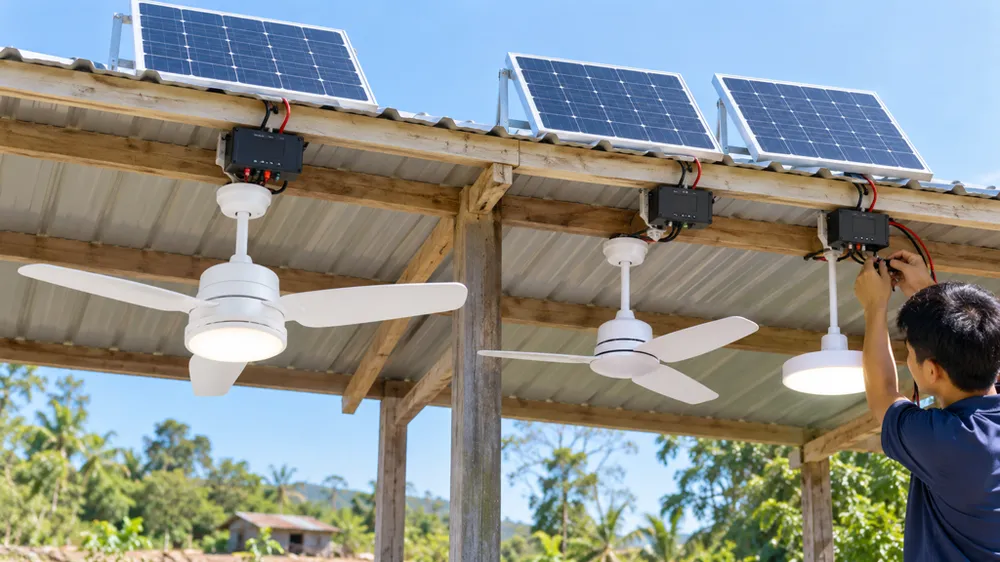
When you're sourcing solar fans with lighting for off-grid projects, the configuration decision — integrated unit with built-in LED or separate fan plus standalone light — directly affects your installed cost, panel sizing, and field service complexity. Retail aggregators treat this as a consumer preference question. It's not. It's a procurement optimization problem where wiring material cost, labor hours, and warranty logistics determine whether you deliver competitive pricing or lose margin to coordination overhead.
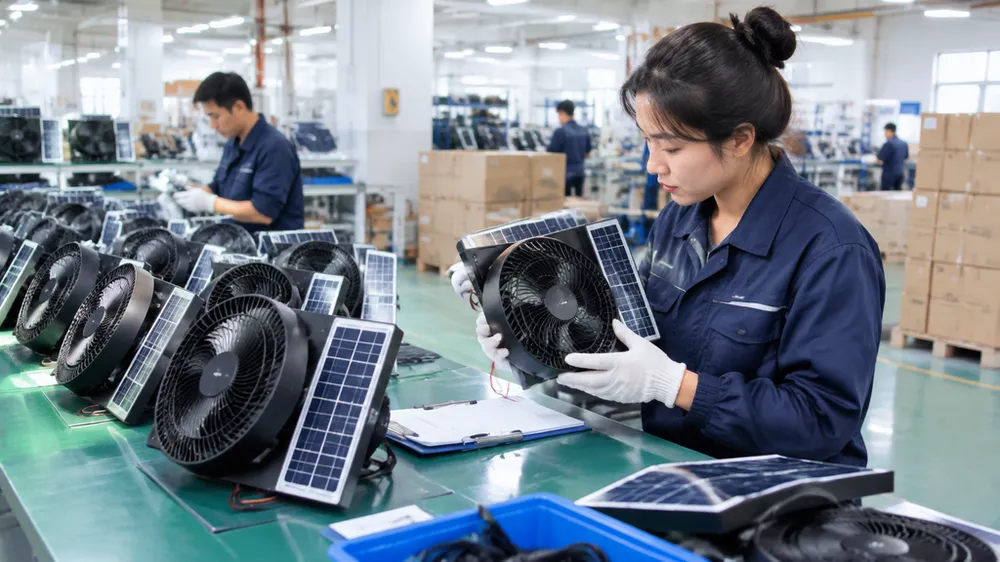
We manufacture both configurations at JXSOL. The integrated solar fan with built-in LED ships as a complete assembly with factory pre-wiring, single-panel input, and unified certification. Separate fan and light configurations give you independent load control and flexible SKU pairing, but require field wiring between two devices, often two solar panels, and dual-product quality verification. Your configuration choice changes installed cost per unit by $8–$15 depending on project scale, and that delta compounds across 200-unit residential projects or 500-unit commercial deployments.
This breakdown walks through installation material cost, panel sizing trade-offs, sourcing logistics, application scenario fit, OEM customization scope, certification overhead, and warranty complexity for both configurations. The goal is decision-ready data — not product education, but the cost structure and procurement mechanics you need to model total landed cost and pick the configuration that fits your project economics.
Installation Material Cost: Integrated Units vs Separate Fan + Light Setups
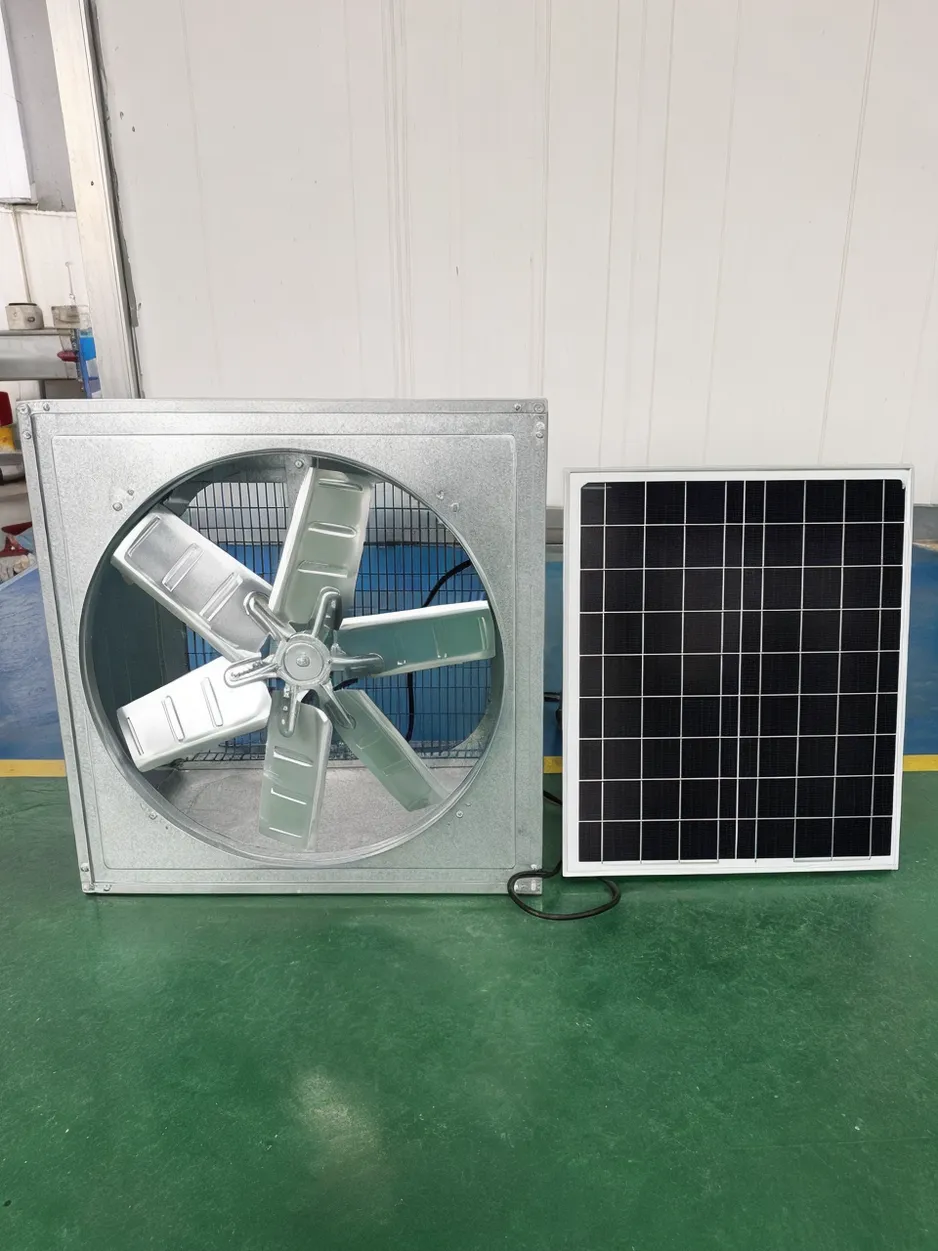
Integrated solar fan with led light vs separate configurations differ in component count before you even start field installation. An integrated unit uses one solar panel (typically 30–50W depending on combined fan + LED load), one charge controller, one battery pack (12V 7Ah–12Ah LiFePO4 or lead-acid), and one mounting bracket set. The fan motor and LED array share internal pre-wiring from the factory, so your installer mounts the unit, connects the panel to the controller input, secures the device, and the circuit is live. At 100-unit procurement scale, material cost per unit averages $48–$68 FOB depending on panel wattage and battery capacity (we'll use $58 as baseline for this comparison).
Separate fan and light configurations require two solar panels — one for the fan (20–30W), one for the light (10–20W) — plus either two independent charge controllers or one dual-output controller with Y-cable wiring. You'll also need two battery packs if the loads don't share a power source, or one larger battery with branch wiring if they do. Mounting hardware doubles: separate brackets for fan and light, plus panel mounting for two devices. Material cost per unit at the same 100-unit scale averages $52–$72 FOB ($62 baseline), only slightly higher than integrated, but that's before field wiring enters the picture.
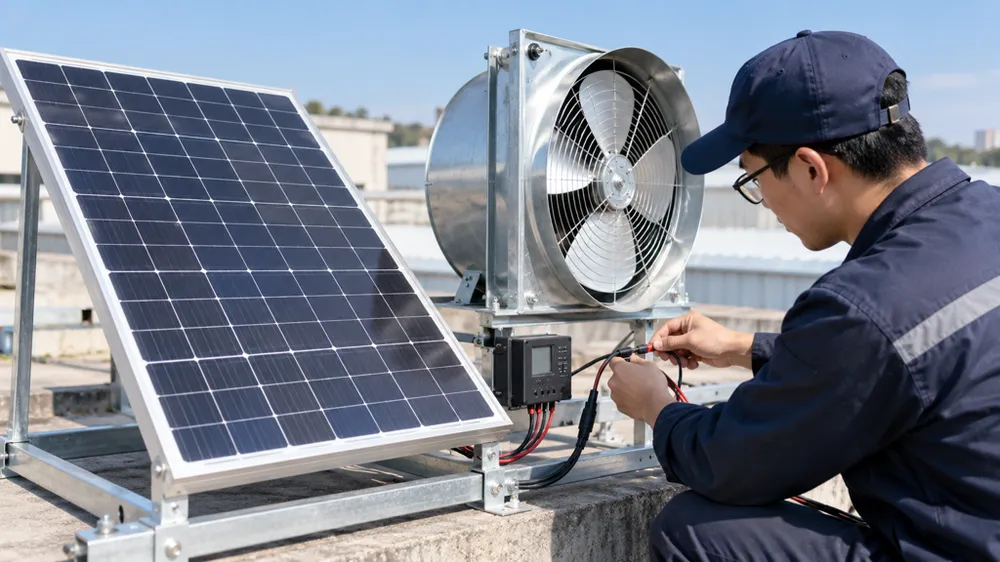
The real cost gap appears in installation labor and wiring materials. Integrated units arrive with internal pre-wiring — the fan motor, LED driver, and battery terminals are already connected inside the enclosure. Your installer runs a single pair of wires from the solar panel to the controller input (typically 14 AWG, 2–3 meters depending on panel placement), mounts the unit to wall or pole, and tests operation. Average installation time: 1.5 hours per unit at standard labor rates. Separate configurations require field wiring between two devices: panel-to-controller, controller-to-battery, battery-to-fan, battery-to-light (or panel-to-light if using independent circuits). If the fan and light are mounted 3 meters apart — common in applications where the fan goes on the ceiling and the light mounts near an entry point — you're running 6–8 meters of cable per installation instead of 2–3 meters. Add connectors, junction boxes if required by local code, and testing both circuits independently. Average installation time: 2.5–3 hours per unit.
Let's model the cost delta with standard assumptions: $15/hour labor rate (typical for off-grid installation contractors in Southeast Asia and Africa, our primary export markets), $0.80/meter for 14 AWG UV-resistant cable, $2.50 for weatherproof connectors per device. Integrated unit installation cost per unit: (1.5 hours × $15) + (2.5 meters cable × $0.80) + $2.50 connectors = $22.50 + $2.00 + $2.50 = $27.00 per unit. Separate unit installation cost per unit: (2.75 hours × $15) + (7 meters cable × $0.80) + ($2.50 connectors × 2 devices) = $41.25 + $5.60 + $5.00 = $51.85 per unit. Installation cost difference: $24.85 per unit, nearly doubling field installation expense.
Combined material + installation cost comparison at 100-unit scale: integrated units = $58 FOB + $27 install = $85 total; separate units = $62 FOB + $51.85 install = $113.85 total. The separate configuration costs $28.85 more per installed unit, a 34% premium driven almost entirely by field labor and wiring complexity. At 200-unit project scale, that's $5,770 in additional deployment cost; at 500 units, $14,425. For distributors competing on turnkey project pricing, that margin erosion matters.

One nuance: the separate configuration's higher cost assumes fan and light are mounted in different locations. If your project mounts both devices within 1 meter of each other — for example, a combo fan + light installed on the same wall bracket in a small storage shed — wiring distance drops and installation time falls closer to 2 hours per unit, narrowing the gap to roughly $15 per unit. But most applications that choose separate configurations do so specifically because they need independent placement (fan on ceiling for airflow, light near door for entry visibility), which means the full wiring penalty applies.
Panel Sizing & Energy Architecture Trade-Offs
Integrated solar fan and light combo off-grid units share one battery and one charge source, so the panel must be sized for the combined peak load of both devices running simultaneously. A typical integrated unit we manufacture uses a 10–15W DC brushless fan motor and a 3–8W LED array (100–300 lumens depending on application spec). Combined peak load: 13–23W. To ensure reliable charging even on partly cloudy days, we size the panel at 2–2.5× the combined load, landing on 30–50W panels for most integrated configurations. The single-panel approach works well when fan and light operate on overlapping schedules — for example, evening ventilation with lighting in agricultural storage buildings, or overnight cooling with security lighting in off-grid residential projects.
Separate fan and light configurations allow independent panel sizing per device. If your fan runs 12 hours daily but the light only runs 6 hours, you can optimize each panel for its specific load and duty cycle. A 15W fan with 12-hour operation needs a 25–30W panel; a 5W light with 6-hour operation needs a 10–15W panel. Total panel wattage: 35–45W, potentially lower than the 50W panel an integrated unit would require for worst-case simultaneous operation. But here's the trade-off: two smaller panels often cost more combined than one larger panel due to doubled frame material, junction box components, and mounting hardware (solar panel manufacturing has strong economies of scale at the module level). And you'll need more roof or pole space for dual-panel mounting, which matters in space-constrained installations.
Battery capacity follows a similar logic. Integrated units typically use 12V 7Ah–12Ah batteries to handle simultaneous fan and light operation for 8–12 hours depending on load. If the combined load is 18W and you need 10 hours of runtime, that's 180Wh, or 15Ah at 12V nominal — so a 12Ah battery with depth-of-discharge limits gives you safe margin. Separate units can use smaller batteries per device if loads don't overlap: a 7Ah battery for the fan, a 5Ah battery for the light. But if you're field-wiring both devices to share one battery (which some installers do to reduce component cost), you still need the same 12Ah capacity as the integrated unit, and now you've added field wiring complexity without saving on battery cost.
Charge efficiency is another dimension. Integrated units with a single MPPT (Maximum Power Point Tracking) charge controller can optimize charging for one panel's voltage-current curve, typically delivering 92–96% charge efficiency in our testing. Separate units with two small PWM controllers — common in low-cost separate configurations — may deliver 85–90% efficiency per controller, and you're running two charging circuits. If both devices share one larger MPPT controller with Y-cable input from two panels, you regain efficiency but add wiring complexity and introduce a single point of failure for both loads.
Design constraint worth noting: integrated units must balance panel wattage for worst-case simultaneous operation even if the fan and light rarely run together in practice. If your actual usage pattern is fan during daytime (when solar charging is active) and light only at night, the integrated unit's panel is oversized for real-world load. Separate configurations let you optimize per device, but that optimization only pays off if your loads are genuinely time-separated. We see this in livestock shelters where daytime ventilation and nighttime pathway lighting are distinct needs — separate units make sense. For applications where evening cooling and lighting happen together (residential porches, outdoor dining areas, workshop ventilation), integrated units avoid oversizing and panel cost waste.
Sourcing & Procurement Logistics for Each Configuration
MOQ differences between integrated solar fan with light and separate configurations directly affect your order flexibility and inventory planning. At JXSOL, integrated solar fans with built-in LED have a 100-unit MOQ per SKU. That's one container-load minimum for a specific configuration: say, 12-inch fan with 200-lumen LED, 40W panel, 12Ah battery. If you want two different specs (one for residential projects, one for commercial), you're placing a 200-unit order. Separate fan and light configurations require 100 units per device type, so if you're sourcing matched quantities, you're effectively at 200-unit MOQ (100 fans + 100 lights) just to get equal stock of each. For distributors testing a new market or stocking backup inventory, integrated units let you enter at half the volume commitment.
Lead time coordination becomes a factor with separate configurations. Integrated units ship as complete assemblies — we manufacture the fan motor, LED module, controller, and enclosure on synchronized production lines, so ex-works lead time is 35–45 days after deposit depending on customization level. Separate fan and light units come from different production workflows (fan assembly uses our motor winding and blade balancing lines; lights use our LED module and driver assembly lines), and while both run in the same factory, scheduling can create staggered completion dates. We've had orders where fans finished on day 38 and lights finished on day 42, delaying the full shipment by four days. If you're sourcing separate devices from two different factories — not uncommon for distributors who already have a preferred light supplier and just need fans — you're coordinating two supply chains, two QC inspections, and two shipping schedules. One delayed container holds up your entire project deployment.
OEM customization scope differs between configurations, and this matters for brand owners building differentiated product lines. For integrated units, we support single-SKU customization across fan diameter (8"–16"), fan speed settings (2-speed, 3-speed, or variable DC control), LED lumen output (100–400lm), LED color temperature (3000K warm white through 6500K daylight), battery capacity (7Ah–20Ah, LiFePO4 or lead-acid), panel wattage (30W–60W), enclosure color (white, black, gray, or custom RAL color match), and mounting bracket type (wall, pole, or ceiling). Change any of those parameters and you're still ordering one integrated SKU — the customization happens within one BOM and one assembly workflow.
Separate fan and light configurations require independent customization negotiations for each device. Want a 12-inch 3-speed fan with 300-lumen 4000K light? That's two separate spec discussions, two sets of samples, two rounds of approval. If you later want to change the light to 5000K but keep the fan unchanged, you're opening a spec revision for one product line while maintaining the other. Integrated units keep all spec changes within one SKU structure, simplifying both initial development and future revisions. The trade-off: if you want to offer customers three fan sizes but only one light output, separate configurations let you stock 3 fan SKUs + 1 light SKU = 4 total SKUs, while integrated units would require 3 SKUs (one per fan size, each with the same light spec). So separate configurations can offer more SKU flexibility when you're mixing and matching, but at the cost of coordination overhead.
Quality verification overhead scales with product count. Integrated units carry CE, RoHS, and IP65 certifications that apply to the complete assembly — one product, one set of test reports, one compliance file to verify per shipment. If you're importing into the EU or North America, your customs documentation references one HS code (typically 8414.51 for ceiling/wall fans with integrated lighting, though classification varies by market). Pre-shipment inspection covers one device: our QC team tests fan operation (airflow, noise level, speed control), light output (lumen measurement, color temperature verification, no flicker at 100Hz/120Hz), charge cycle (panel input to full charge, discharge under load, low-voltage cutoff), and weatherproof integrity (IP65 water spray test per IEC 60529). One device, one inspection protocol, one pass/fail per sample unit.
Separate fan and light configurations require parallel quality verification. If you're sourcing both from JXSOL, we run two inspection protocols — fan testing (motor current draw, bearing noise, blade balance) and light testing (lumen output, driver efficiency, thermal performance under 50°C ambient) — and you receive two sets of test reports. If you're sourcing from two factories, you're managing two supplier audits, two certification files, and two pre-shipment inspections. We've worked with distributors who source fans from us and lights from a Guangdong-based LED supplier two cities over; their QC team has to visit two factories or hire two inspection agencies, doubling verification cost and timeline. And if a field failure occurs later — say, the light dims prematurely — determining root cause becomes a finger-pointing exercise between fan supplier and light supplier if the issue involves shared power supply or wiring interaction.
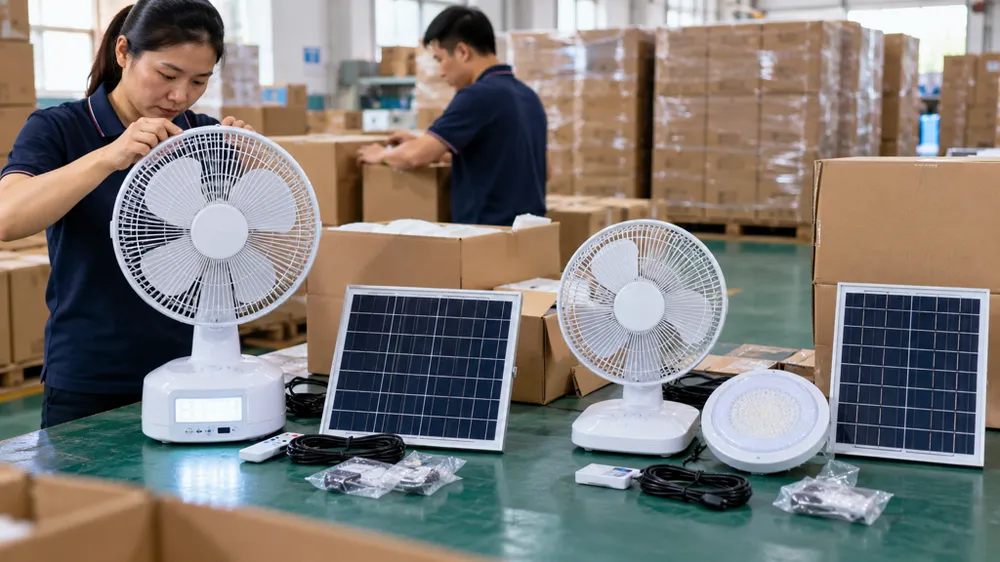
Inventory stocking strategy shifts depending on configuration. Integrated units represent one SKU with higher per-unit value (typically $58–$68 FOB as noted earlier), so your inventory investment per SKU is higher but your SKU count is lower. If you stock three integrated models (small/medium/large), that's three SKUs total. Separate configurations let you stock two fan models and two light models and offer customers four combinations (2×2), but now you're managing four SKUs and need to forecast demand for each independently. If fans sell faster than lights, you're left with stranded light inventory and potential stockouts on fans. Integrated units avoid that imbalance risk.
Margin structure typically favors integrated units for turnkey projects. Distributors selling integrated units to contractors or project buyers mark up the complete assembly as one line item, capturing 25–30% margin on the full unit value. Separate configurations sold as a system (fan + light bundled) let you mark up each component independently — we see distributors taking 30–35% on lights (which have higher perceived value per dollar) and 20–25% on fans (more commoditized), averaging 27–30% system margin. But if buyers source the fan and light separately from different suppliers (which happens when they already have a light supplier relationship), you lose the light sale entirely and only capture fan margin. Integrated units force the full-system purchase, protecting your total margin.
Application Scenario Fit — When Each Configuration Delivers Better ROI
Integrated solar fan and light combo off-grid units deliver the clearest ROI advantage in residential off-grid projects where installation speed and single-vendor accountability matter more than load optimization flexibility. If you're deploying 100–500 units across rural housing developments, temporary worker housing on construction sites, or off-grid vacation cabins, the integrated configuration saves 1–1.5 hours per installation (as shown in the cost breakdown earlier) and eliminates field wiring errors that create warranty callbacks. When your installation crews are working in remote areas with limited technical supervision, factory pre-wiring removes the most common failure mode we see: reversed polarity, loose connections, or incorrect wire gauge causing voltage drop. One service callback to a remote site costs $80–$150 in travel time and labor; preventing two callbacks per 100 units installed pays for the entire cost premium of integrated units (if there even is one after installation savings).
Temporary site deployments — construction trailers, event facilities, disaster relief shelters, mobile clinics — favor integrated units for fast setup and teardown. We've supplied integrated solar fans with built-in LED to NGOs deploying medical tents in sub-Saharan Africa; their teams can install a complete ventilation + lighting solution in under 2 hours per tent using unskilled local labor. Separate configurations would require electricians or at least trained technicians to wire two independent systems, delaying deployment and increasing labor cost. When the project wraps, integrated units demount as one piece and redeploy to the next site without re-wiring. Separate setups require disconnecting and labeling multiple circuit connections, increasing the risk of mix-ups during reassembly.
Markets with limited local technical labor also push toward integrated units. If your target market is rural distributors in East Africa, Southeast Asia, or Pacific Island nations where certified electricians are scarce and expensive, integrated units with plug-and-play panel connections let non-technical installers handle deployment. We've trained distributor sales teams in Kenya and the Philippines to install integrated units using only basic hand tools (drill, wrench, wire stripper) and a one-page instruction sheet. Separate configurations require circuit knowledge — understanding positive/negative polarity, load calculations, fuse sizing — that you can't assume in those markets. The fewer field connections, the fewer points of failure and the lower the skill threshold for installation.
Aesthetic considerations occasionally drive integrated unit adoption, though this matters more for residential and hospitality projects than industrial applications. A single enclosure with integrated fan and light presents cleaner visual lines than two separate devices with visible conduit or cable runs between them. We've supplied integrated units to off-grid eco-lodges and glamping resorts where design consistency matters to the guest experience; separate configurations would require concealing wiring inside walls or ceilings, adding construction cost that erases any equipment savings. For distributors serving architects and design-build contractors, integrated units simplify spec sheets and avoid the "two boxes on the wall" aesthetic that some clients reject.
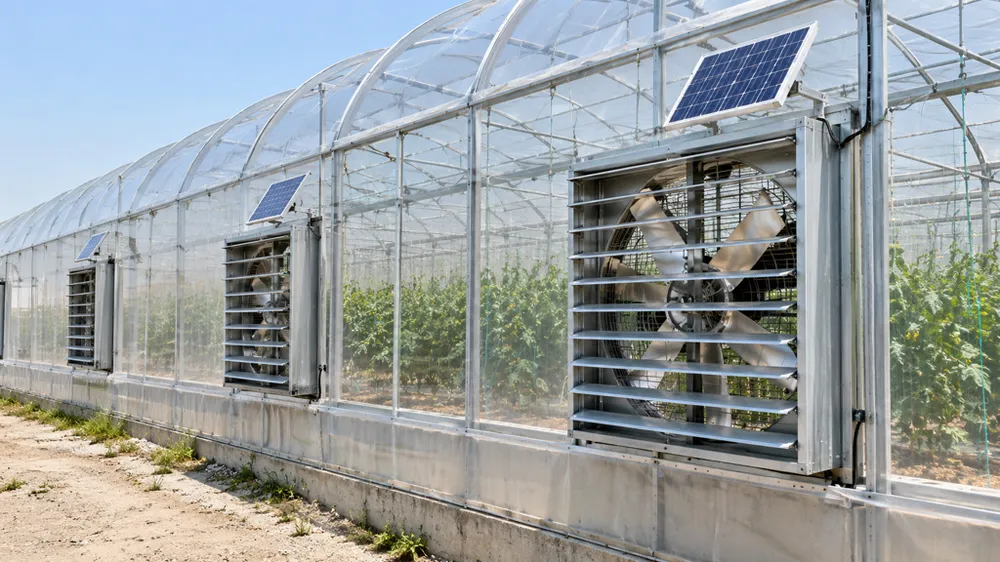
Separate solar fan with led light vs separate configurations win when loads genuinely need independent control or have mismatched operating schedules. Agricultural and livestock applications are the clearest case: daytime ventilation in chicken coops or feed storage (fan runs 8am–6pm when solar generation is active, reducing battery drain) combined with nighttime security lighting around the perimeter (light runs 6pm–6am). Wiring these as separate systems lets you size the fan for daytime-only operation with a smaller battery, and power the light from a separate panel + battery optimized for overnight loads. An integrated unit would force you to size the battery for simultaneous operation even though the loads never overlap, wasting battery capacity and panel wattage.
Retrofit projects also favor separate configurations. If a buyer already has solar fans installed and now wants to add lighting, sourcing standalone solar lights avoids replacing functional fan units. We see this in industrial facilities and warehouses where the original build included ventilation but lighting was grid-powered; when the site goes fully off-grid or loses grid reliability, adding standalone solar lights is more cost-effective than swapping out existing fans for integrated units. Similarly, if a distributor stocks solar lights for pathway applications and customers start requesting fans for the same sites, adding separate fan SKUs lets them serve the new need without obsoleting light inventory.
Applications with extreme load imbalance between fan and light push toward separate configurations to avoid oversizing. If you need a high-CFM industrial fan (25W motor) with minimal lighting (3W, 50-lumen task light), an integrated unit would carry an oversized light module you're not using, or you'd need custom OEM to de-rate the light — which only makes sense at volume. Separate configurations let you pair a heavy-duty fan with a minimal light without customization. Conversely, if you need bright floodlight-level illumination (15W, 800 lumens) with light airflow (8W fan), separate units avoid under-sizing the light to fit an integrated enclosure's power budget.
ROI crossover point based on our project data: for orders above 200 units where fan and light will operate on overlapping schedules, integrated units deliver 8–15% lower total installed cost (equipment + labor + logistics) compared to separate configurations. For orders below 100 units where loads are time-separated or placement is highly variable site-to-site, separate configurations offer better flexibility without significant cost penalty, especially if the buyer already has existing relationships with fan or light suppliers and wants to add the other component incrementally.
Factory Customization Scope & OEM Options for Both Configurations
JXSOL supports OEM customization for integrated solar fan with built-in LED across the full system architecture, not just cosmetic parameters. Fan diameter options range from 8-inch (compact, low-CFM applications like small storage sheds or vehicle cabins) through 16-inch (high-airflow industrial or agricultural use), with blade pitch and motor winding adjusted per diameter to maintain efficiency. Fan speed control includes 2-speed mechanical switch (high/low), 3-speed rotary dial, or fully variable DC speed control via PWM (pulse-width modulation) when you need granular airflow adjustment for temperature-sensitive applications. Motor current draw scales from 8W for the smallest low-speed configuration to 18W for 16-inch high-speed setups.
LED customization within the integrated unit covers lumen output (100lm for accent/night-light level, up to 400lm for task lighting or small-area illumination), color temperature (3000K warm white for residential comfort, 4000K neutral for general work areas, 5000K–6500K daylight for precision tasks or security applications), and beam angle (120° flood for area coverage, 60° spot for focused task lighting). We use SMD LED arrays with constant-current drivers, so lumen output stays stable as battery voltage drops during discharge — no dimming toward end of runtime, which is a common complaint with cheap separate lights using resistor-based current limiting.
Battery capacity is one of the most requested OEM parameters. Standard integrated units ship with 12V 7Ah sealed lead-acid (SLA) batteries for cost-sensitive projects, but we offer 10Ah, 12Ah, or 20Ah SLA for extended runtime, or LiFePO4 (lithium iron phosphate) batteries at the same amp-hour ratings for buyers who need lighter weight, longer cycle life (2000+ cycles vs 300–500 for SLA), and better performance in high-temperature environments. LiFePO4 adds roughly $15–$25 per unit to FOB cost depending on capacity, but the longer service life and reduced warranty claims often justify the premium for distributors serving commercial or government projects where total cost of ownership matters more than initial unit price.
Panel wattage customization from 30W to 60W lets you match the panel to local solar irradiance and duty cycle requirements. If your market has strong sun year-round (Middle East, East Africa, Australia), a 40W panel handles simultaneous fan + light operation even with modest daily sun hours. If you're serving markets with seasonal cloud cover or high-latitude winter conditions (Northern Europe, parts of East Asia), stepping up to a 50W or 60W panel ensures reliable charging during low-irradiance months. We provide panel sizing recommendations based on your target location's solar data, but final choice is yours — we've shipped identical integrated units with 40W panels to Dubai and 50W panels to Germany for the same fan + light spec, adjusted only for local solar conditions.
Enclosure color and mounting bracket type are the cosmetic-level OEM options, but they matter for brand differentiation. Standard colors are white (matches most residential siding), black (industrial/modern aesthetic), and light gray (neutral for commercial buildings). Custom RAL color matching is available at 500-unit minimums with a $400 color-match setup fee — we've done custom beige for a Middle Eastern distributor targeting desert-region housing developments, and custom dark green for an eco-lodge chain wanting to blend units with natural surroundings. Mounting brackets come in wall-mount (horizontal arm with weather boot), pole-mount (U-bolt clamp for 2"–4" diameter poles), and ceiling-mount (flush canopy with downrod) configurations. If your market installs fans on bamboo or wood poles (common in rural Southeast Asia), we can adapt the pole-mount clamp for non-standard diameters.
Development timeline for OEM integrated units: 15–20 days for sample production after you confirm specs (we build 2–3 samples for your testing and approval), then 35–45 days for bulk production after sample sign-off and deposit. Tooling cost applies if you need custom enclosure modifications (e.g., repositioning the light module, adding a separate switch panel, or integrating a motion sensor) — typical mold cost runs $800–$1,500 and amortizes over 500+ units, adding roughly $1.50–$3 per unit to FOB cost at that volume. For standard OEM within our existing enclosure platform (changing fan size, LED output, battery, panel, color, brackets), no tooling cost applies.
Separate fan and light OEM scope allows the same per-device customization — fan diameter, speed settings, motor power for the fan unit; lumen, CCT, beam angle, motion sensor option for the light unit — but you're negotiating two spec sheets and managing two sample cycles. If both devices come from JXSOL, we coordinate the timelines, but you still wait for both samples to arrive before making a system-level go/no-go decision. Sample lead time is 10–15 days per device, so if they're produced sequentially (samples for fan, you approve, then samples for light), you're looking at 20–30 days before you have a testable system. Running both in parallel reduces timeline but requires finalizing both specs upfront without iterative testing.
Testing and certification diverge significantly between configurations. Integrated units undergo combined load testing: we run the fan and light simultaneously under temperature cycling (–10°C to +50°C ambient, per IEC 60068-2-1 and 60068-2-2 for solar equipment), measure current draw across the full duty cycle, verify the charge controller handles peak load without overheating, and confirm the battery supports rated runtime (typically 8–12 hours for our standard 12Ah configurations). That's one test protocol, one set of data, one certification file. Separate fan and light units are tested independently — simpler per-device validation (fan motor endurance test, light lumen maintenance over 1000-hour burn-in), but no certification for system-level interaction. If the fan's startup current causes voltage sag that dims the light when both run on shared power, that's a field discovery, not something pre-shipment testing would catch unless you specifically request system integration testing (which adds cost and timeline).
When to request OEM customization: if you're planning 500+ unit annual volume and targeting a specific market segment (residential off-grid, agricultural, hospitality, industrial), OEM integrated units let you differentiate with branded enclosures, optimized specs, and better alignment to local conditions. Below 500 units/year, use our standard SKUs — we offer three integrated fan sizes (10", 12", 16") with two light output levels (150lm, 300lm) and two battery options (SLA, LiFePO4) as off-the-shelf configurations. That gives you six stock combinations without tooling cost or development timeline. For separate fan and light configurations, OEM makes sense at lower volumes (300+ units/year per device) because you can customize one device without re-engineering the other, but you lose the system-level optimization that integrated OEM provides.
Certification & Quality Verification — Single Product vs Dual Product Compliance
Integrated solar fan with led light vs separate configurations create different compliance verification workflows, and that difference compounds if you're importing into regulated markets or serving government procurement contracts. Integrated units carry CE marking (EU product safety and EMC compliance), RoHS certification (restriction of hazardous substances — lead, mercury, cadmium limits), and IP65 ingress protection rating (dust-tight, protected against water jets per IEC 60529) that apply to the entire assembly. One product, one declaration of conformity, one technical file. When your shipment clears customs in Hamburg or Rotterdam, the customs officer sees one HS code (8414.51 or 8414.59 depending on classification), one product description, one set of certificates. If the shipment gets flagged for document review, you provide one compliance package.
Separate fan and light configurations require independent certification for each device. The fan needs CE and RoHS covering the motor, controller, and enclosure; the light needs CE and RoHS covering the LED module, driver, and housing. If you're sourcing both from JXSOL, we provide both certification files, but you're still presenting two products to customs and compliance auditors. If you're sourcing the fan from JXSOL and the light from a different supplier — which happens when distributors already have established light vendor relationships — you're combining compliance documentation from two factories, two audit trails, two quality management systems. That works fine until there's a field failure or compliance question, at which point determining liability and root cause becomes a multi-party negotiation.
Risk exposure in case of product failure tilts toward integrated units for simpler resolution. If an integrated unit's fan motor fails under warranty, the claim goes to JXSOL; we determine whether it's a motor defect, controller failure, or battery issue, ship a replacement unit or component, and handle the entire RMA process. If a separate configuration's light fails and the buyer suspects it's caused by voltage instability from the fan's motor startup surge, now you're troubleshooting interaction between two devices. If fan and light came from different factories, the fan supplier may claim the light's driver is under-specified; the light supplier may claim the fan's controller isn't regulating voltage properly. We've seen these disputes take 3–4 weeks to resolve while the buyer's customer waits for a fix — not ideal when your reputation is on the line.
Field testing cost per batch sample doubles with separate configurations. Our standard QC protocol for integrated units tests one device per 100-unit batch: measure fan airflow (CFM at 1-meter distance), noise level (dB at operating speed), LED lumen output (integrating sphere measurement), color temperature verification (spectrophotometer), charge cycle validation (panel input under simulated 1000W/m² irradiance, full charge confirm, discharge under combined fan + light load until low-voltage cutoff, verify runtime matches spec). One device, one test session, roughly 3 hours including setup and data recording. For separate fan and light configurations, we test one fan sample per 100-unit batch and one light sample per 100-unit batch — same test procedures per device, but doubled test equipment usage and inspector time. If you're running pre-shipment inspection through a third-party agency (SGS, Intertek, TÜV), you're paying for two inspection sessions instead of one.
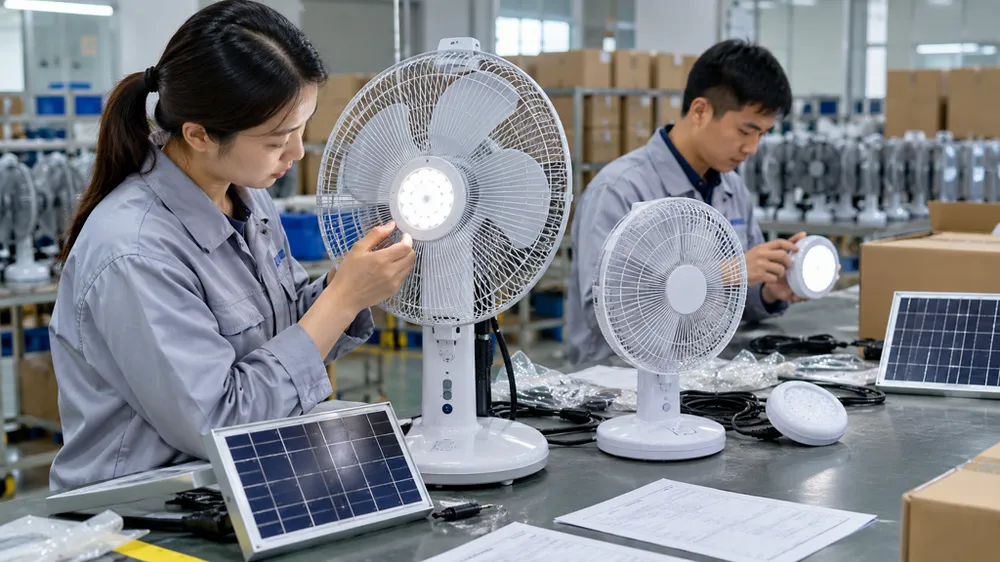
Documentation burden scales with product count. Integrated units require one product manual (covers fan operation, light controls, maintenance, troubleshooting), one installation guide (mounting instructions, panel wiring, first-time setup), and one warranty card. If you're selling to contractors or project managers, they file one document set per product type. Separate fan and light configurations need two manuals, two installation guides, and you'll often need to create a system-level integration document explaining how to wire the fan and light together — because neither device's standalone manual covers connecting to a separate solar-powered device sharing the same panel or battery. We've had distributors request that we write that integration guide for them, which we can do, but it's an additional service that adds timeline and cost (typically $300–$500 for technical writing and translation into the target market's language).
Compliance advantage for strict product liability markets (EU, North America, Australia) leans toward integrated units. If a product-related incident occurs — say, an electrical fault causes a fire — and the system uses separate fan and light components, the legal investigation will examine each device, the wiring between them, the panel, the controller, and the battery to determine fault. If components came from different suppliers, each supplier's liability insurance and legal team gets involved. Integrated units certified as a complete system mean one supplier, one liability chain, simpler legal resolution. For distributors serving government projects or large commercial contracts where product liability insurance is mandatory, integrated units reduce insurance underwriting complexity and sometimes lower your premium because insurers view single-product systems as lower risk than multi-component field-assembled systems.
Export market customs clearance occasionally favors integrated units when customs officials question whether separate fan and light imports are being declared correctly. We've had shipments of separate fans and lights held at Lagos and Jakarta customs because the officer suspected the buyer was importing a "ventilation and lighting system" but declaring two separate low-value items to avoid higher tariffs. Providing the integration wiring diagram and system documentation convinced them it was indeed two products, but it delayed clearance by 5 days and required a customs broker consultation. Integrated units avoid that ambiguity — the declaration says "solar-powered fan with integrated lighting," customs sees one product, clearance proceeds. Small point, but it matters if you're shipping to markets with strict customs scrutiny or frequent reclassification challenges.
Field Service & Warranty Logistics
Warranty claim process for integrated solar fan and light combo off-grid units routes through JXSOL as single point of contact. Our standard warranty covers 3 years for manufacturing defects (motor bearing failure, LED driver malfunction, controller component failure, enclosure cracking under normal use — not impact damage or abuse). When a claim comes in, your customer describes the symptom (fan won't start, light dims after 2 hours, no charging indication), we provide first-level troubleshooting (check panel connection polarity, verify battery voltage with multimeter, inspect fuse), and if the issue persists we ship a replacement unit or the specific failed component (motor assembly, LED board, controller module, battery) depending on what's practical. Single RMA number, single tracking number, one shipment resolves the claim.
Separate fan and light configurations complicate warranty claims when the symptom involves interaction between devices. "Light flickers when fan is running" — is that a problem with the fan's motor brushes creating electrical noise, the light's driver not filtering input properly, undersized wiring between devices causing voltage drop, or a weak battery that can't supply peak current for both loads? If fan and light came from JXSOL, we can troubleshoot the system interaction because we understand both products. If they came from different suppliers, each supplier will likely ask you to isolate their device (disconnect the other component, test standalone) to determine fault — adding diagnosis time and potentially requiring a second site visit. Every extra site visit to a remote off-grid location costs $80–$150 in travel time and labor; preventing one visit per 50 units deployed pays for a significant chunk of any price premium integrated units might carry.
Spare parts stocking requirements differ by configuration. For integrated units, distributors typically stock 2–3 replacement units per 100 deployed (for immediate swap in case of failure) plus a small inventory of field-replaceable modules: fan motor assembly with blades (~$12 cost), LED board (~$5 cost), controller board (~$8 cost), battery (~$10–$22 depending on type). Four component types, small inventory footprint, covers 90%+ of warranty claims without returning units to factory. For separate fan and light configurations, you're stocking spare parts for two product lines: fan motor, fan controller, fan battery for the fan side; LED module, light driver, light battery for the light side. If you're stocking three fan models and two light models (trying to offer mix-and-match flexibility), that's spare parts inventory for five SKUs instead of three integrated SKU types.
Field repair complexity slightly favors separate configurations for one specific reason: when a component fails, replacing the entire device is simpler than component-level repair if your service techs aren't trained on internal disassembly. If a separate light's LED driver fails, swapping the whole light unit (disconnect two wires, mount replacement, reconnect) takes 20 minutes and requires no specialized skills. If an integrated unit's LED driver fails, the proper repair is opening the enclosure, removing the failed driver board, installing a new one, and closing the enclosure — about 40 minutes and requires understanding which screws hold the LED module, how the internal wiring harness connects, and proper reassembly to maintain IP65 seal. We provide field service training and video guides for distributors who want to do component-level repair on integrated units (saves on shipping replacement units back and forth), but not all distributors invest in that training. So separate configurations can be easier to service with unskilled labor via full-device replacement, while integrated units reward technical capability with lower per-repair cost via component swaps.
Service call cost modeling over 3-year warranty period: JXSOL's integrated units averaged 2.3% warranty claim rate across 47,000 units shipped between 2023–2025 (claims included motor bearing failures after 18–24 months in high-dust agricultural environments, LED driver failures in high-temperature installations exceeding 45°C sustained ambient, and battery degradation in installations with chronic undercharging due to undersized panels or heavy shade). Separate fan + light configurations from mixed suppliers show 4–6% claim rates industry-wide based on data we've collected from distributors who switched to integrated units and shared their prior service records — higher rate driven by field wiring issues (loose connections, incorrect polarity, inadequate wire gauge), component mismatch problems (fan startup current exceeding light driver's input tolerance), and finger-pointing delays when root cause spans both devices.
If you're deploying 500 units with an average service call cost of $100 (travel + labor), the expected 3-year service cost difference is significant: integrated units at 2.3% claim rate = 11.5 calls × $100 = $1,150 total service cost; separate units at 5% claim rate (midpoint of 4–6%) = 25 calls × $100 = $2,500 total service cost. That's $1,350 service cost savings over 500 units, or $2.70 per unit deployed. Not huge per-unit, but it's a real reduction in your total cost of ownership and it directly affects customer satisfaction — fewer service calls mean happier end users and better odds of repeat business.
One warranty logistics advantage for separate configurations: if only one device fails and the other is still functional, you're replacing one lower-cost component (a $30–$45 fan or a $15–$25 light) instead of a $58–$68 integrated unit. Over hundreds of warranty events, that adds up. However, this assumes clean single-device failures. In practice, we see interaction failures (both devices stop working due to controller or battery failure affecting the whole system) in roughly 40% of separate-configuration warranty claims, which erases the single-component replacement advantage because you're troubleshooting and potentially replacing both devices anyway.
Practical Buyer Decision Framework
Start by calculating total installed cost per unit for both configurations using your project-specific labor rate and local material costs. Use the baseline numbers from earlier as a template — $58 FOB + $27 install = $85 total for integrated units; $62 FOB + $51.85 install = $113.85 total for separate units at $15/hour labor and $0.80/meter cable cost — then adjust for your actual labor rate (it might be $8/hour in rural Southeast Asia or $25/hour in parts of the Middle East) and your cable cost (varies by country due to copper prices and import tariffs). The installation labor difference (1.5 hours vs 2.75 hours) is relatively stable across markets, but the dollar impact scales with local labor rates.
Evaluate your application's load profile next. Do the fan and light need to run simultaneously? If your target use case is evening cooling with lighting in residential settings, workshop ventilation with task lighting, or agricultural storage with simultaneous airflow and visibility, the loads overlap and an integrated solar fan with built-in LED fits naturally — you're not paying for panel oversizing because you genuinely need the combined capacity. If the fan runs during daytime when solar generation is active (reducing battery drain) and the light runs at night when the fan is off, separate configurations let you optimize each device's battery and panel size independently, potentially saving $8–$12 per unit in component cost. Map your actual expected duty cycles before deciding.
Assess procurement volume and OEM customization needs. If you're ordering 500+ units annually and want branded enclosures, optimized specs for your target market, or differentiated fan/light configurations that competitors don't offer, integrated unit OEM customization delivers better value — one development cycle, one tooling cost (if needed), one SKU to manage. If you're ordering below 500 units per year or you need to offer multiple fan sizes with multiple light outputs (creating a matrix of combinations), separate configurations give you more SKU flexibility without custom development: stock 2–3 fan models, 2–3 light models, let buyers mix and match. That flexibility costs you in coordination overhead and inventory management, but it can be the right trade-off for distributors serving diverse project types.
Map compliance requirements for your target market. If you're exporting to the EU, North America, or other markets with strict product liability and EMC regulations, integrated units certified as complete systems simplify your compliance verification, customs documentation, and legal risk profile. If you're serving markets with lighter regulatory environments or domestic-only projects where certification is optional, the compliance overhead difference between integrated and separate configurations matters less — focus instead on installation cost and service logistics.
Model 3-year total cost of ownership: (unit FOB cost) + (installation cost per unit) + (logistics cost per unit — shipping, customs, inland transport) + (expected service cost per unit over warranty period). For integrated units, that's typically $58 + $27 + $6–$10 logistics + $2.70 service = $93.70–$97.70 per unit. For separate units: $62 + $51.85 + $8–$12 logistics (higher due to dual-product shipment complexity) + $5 service = $126.85–$130.85 per unit. Over 200-unit projects, integrated units save $33.15–$33.15 × 200 = $6,630 in total cost; over 500 units, $16,575. That's margin you can keep, reinvest in market development, or pass through to customers as competitive pricing.
Use this decision matrix as a final check:
Choose integrated solar fan with led light vs separate if:
- Your project exceeds 200 units and installation speed matters (residential developments, temporary housing, quick-deploy scenarios)
- Fan and light will operate on overlapping schedules (evening/nighttime use, simultaneous ventilation + lighting needs)
- You prefer single-vendor accountability and simplified warranty logistics
- Your target market has limited technical labor or you're selling through non-technical distribution channels
- Fast deployment is a priority and you want to minimize field wiring errors
Choose separate fan + light configuration if:
- Your project is below 100 units and you need maximum flexibility in device placement and load control
- Fan and light have distinct, non-overlapping operating schedules (daytime fan, nighttime light)
- You're retrofitting existing solar fan or light installations and want to add the complementary device without replacing functional equipment
- Your application has extreme load imbalance (heavy-duty fan with minimal lighting, or bright lighting with minimal airflow) that would force oversizing in an integrated unit
- You already have established supplier relationships for either fans or lights and want to add the other component incrementally
Hybrid approach worth considering: Stock both configurations if you're serving diverse project types. Use integrated units for turnkey residential and hospitality projects where system simplicity and aesthetics matter; use separate units for custom industrial and agricultural applications where independent control and retrofit capability are priorities. That increases your SKU count and inventory investment, but it lets you capture both market segments without forcing one configuration into applications where it doesn't fit.
Contact JXSOL with your project specs — unit count, target application and load profile, deployment timeline, target market, and whether you need standard SKUs or OEM customization. We'll run the configuration comparison using your specific numbers (labor rates, logistics costs, expected duty cycles) and provide quotes for both integrated and separate options with delivered cost to your market. If you're unsure which configuration fits, send us the application description and we'll recommend the option that optimizes your installed cost and service risk based on 13 years of deploying solar-powered ventilation and lighting across 40+ export markets.