Why Lumen Output Defines Garden Light Application Fit Before You Order
Lumens measure visible light output — the brightness specification that determines whether a solar garden fixture works for pathway safety, border accent, or feature emphasis. Get the lumen range wrong and you pay twice: first at order time when you select the wrong product, then again when end buyers return inventory because pathways are too dim or borders are over-lit.
Most lumen spec conversations stop at the rated number on the data sheet. That works for single-fixture residential buyers, but if you're ordering 500 units for a landscape project or building a branded product line, the rated lumen value is only the starting point. You need lumen consistency tolerance so batch two looks the same as batch one when installed side-by-side. You need the depreciation curve so you know what brightness to expect after two years in the field. You need to understand what lumen adjustments the factory can make within the existing module design versus what requires retooling the panel and battery.
This article provides application lumen ranges for pathway, border, and feature lighting, explains how factory binning controls batch-to-batch consistency, and shows the OEM customization scope when you need a specific lumen output for your branded catalog. We approach this from the factory floor — the place where lumen claims either get verified with test equipment or just copied from a supplier's spec sheet.
Lumen Range by Application Type — Pathway Border and Feature Lighting
Solar garden lights serve three distinct commercial applications, each with its own lumen requirement and consistency priority:
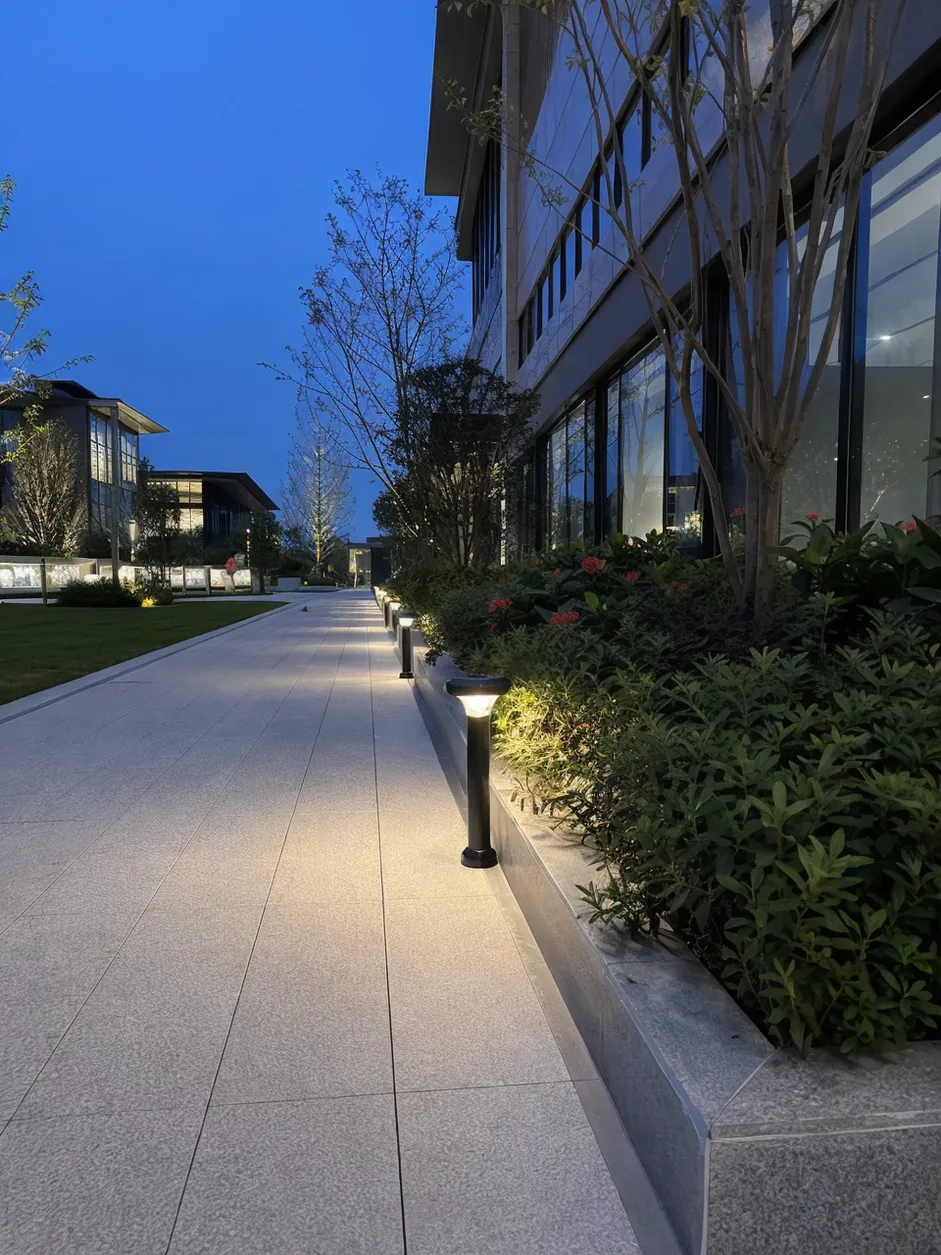
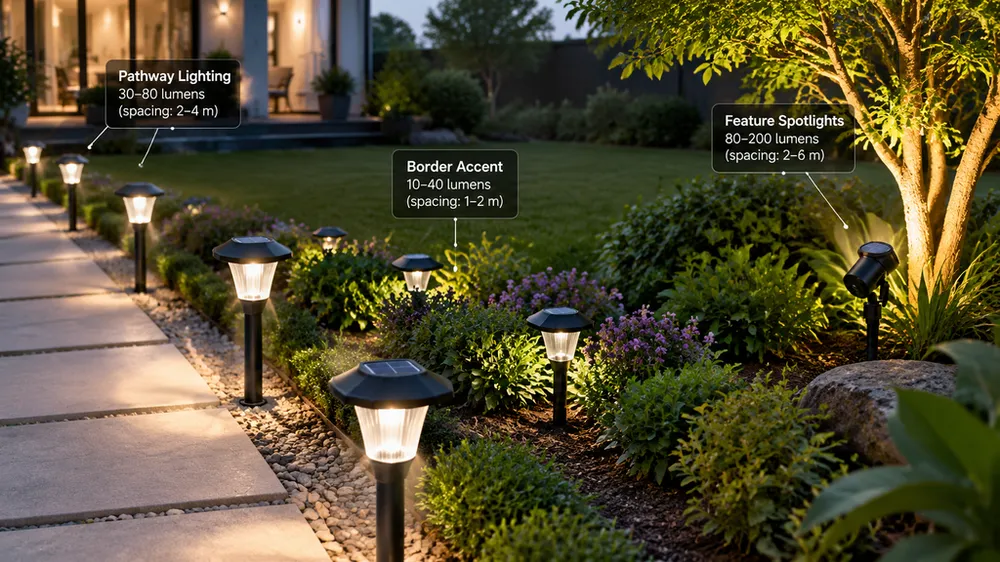
Pathway lighting guides foot traffic and provides safety visibility along walkways, driveways, and entry routes. Effective pathway illumination requires 30–80 lumens per fixture, spaced 8–12 feet apart depending on site conditions. The goal is continuous ground visibility without glare — not spotlight brightness, but enough light to see steps, curbs, and path edges after dark. For buyers deploying 20+ fixtures in a single pathway run, batch-to-batch lumen uniformity matters more than peak brightness, because a 15% lumen variance between production lots shows up as visible dark spots when the lights are installed in sequence.
Border and perimeter accent lighting defines property edges, garden bed boundaries, and architectural lines with subtle illumination. These fixtures operate in the 10–40 lumen range. The purpose is definition, not illumination — you're marking a visual boundary, not lighting the ground. Border lights are often deployed in runs of 20, 30, even 50 units along a property line or garden perimeter. At that scale, even small lumen variance becomes visible because the human eye easily detects brightness differences when fixtures are viewed together. A buyer sourcing 500 units across multiple purchase orders needs tighter binning tolerance than someone buying 10 fixtures for a residential garden.
Feature and spotlight applications — tree uplighting, sculpture emphasis, architectural accent — operate at 80–200 lumens with narrow beam angles to concentrate light on a specific target. These fixtures are used sparingly, often just 2–5 units per project, so lumen variance between fixtures is less visible than in pathway or border applications. Feature lighting tolerates higher lumen variance because each fixture is evaluated on its own performance, not compared side-by-side with 20 others in a continuous run.
Here's the application reference table we use when buyers ask what lumen range fits their project type:
| Application Type | Lumen Range | Typical Spacing | Batch Tolerance Priority |
|---|---|---|---|
| Pathway (safety & navigation) | 30–80 lumens | 8–12 feet | High — uniformity critical |
| Border & perimeter accent | 10–40 lumens | 6–10 feet | High — deployed in long runs |
| Feature & spotlight | 80–200 lumens | Isolated placement | Medium — fewer fixtures per project |
Residential retail buyers often over-spec lumens chasing "brighter is better," but project contractors optimize for cost-per-installed-lumen given coverage requirements. A 50-lumen pathway light at $12 FOB costs less per linear foot of coverage than an 80-lumen fixture at $18 if the project allows slightly closer spacing.

Lumen Consistency Across Production Batches — What Factory QC Actually Controls
The lumen value printed on a data sheet tells you what the LED module is rated to produce under lab conditions. It doesn't tell you whether fixture 1 and fixture 500 from the same production run output the same brightness, or whether batch two ordered six months later will match batch one when installed next to it in a pathway.
LED binning at module assembly is how factories control lumen consistency. At JXSOL, we group LEDs into ±5% lumen output bins before fixture assembly. When a buyer places a 1,000-unit order, every LED module in that order comes from the same bin group, so fixture-to-fixture variance stays within 5%. If you order another 1,000 units eight months later, we pull from the same bin specification so the new batch matches the installed base. Without binning, production variance can reach ±15% — the difference between a pathway that looks evenly lit and one with visible bright and dark sections.
Contrast that with suppliers who claim rated lumens but don't bin at assembly. They're using whatever LEDs the component supplier shipped that week. Batch one might average 52 lumens, batch two might average 44 lumens, and batch three might hit 58 lumens — all technically within the LED manufacturer's published tolerance, but visibly different when installed side-by-side in a commercial project.
We verify lumen output at assembly using an integrating sphere on 10% of modules per production run. That test data goes into the QC report that ships with your order, so you have documentation of actual output, not just rated spec. When distributors call us six months after the first order and ask whether the next batch will match, we pull the binning spec from the first PO and use the same LED bin for the reorder. That's how batch consistency works at the factory level.
Why this matters for your margin: if you sell a 50-lumen pathway light to a landscape contractor and batch two arrives at 42 lumens, the contractor sees darker sections in the installation and returns the product. You eat the cost of reshipping or refunding, the contractor loses confidence in your brand, and the end client questions the contractor's competence. LED binning eliminates that supply chain risk. For OEM buyers building a branded product line, binning consistency means your "50-lumen pathway light" performs the same across every production lot, so your brand promise stays intact.
Lumen Depreciation and Real-World Output After 12–24 Months
Rated lumens measure initial output — the brightness you get when the fixture is new and the battery is fully charged. LED depreciation and battery capacity fade reduce effective brightness over the first two to three years of field operation. If you're specifying fixtures for a multi-year project or offering a commercial warranty, you need to account for lumen degradation in your initial spec.
Typical depreciation curve for solar garden lights: 10% lumen drop in the first year, 20–25% cumulative drop by year three. LED aging (L70 rating) drives part of that reduction, but battery capacity fade is often the larger factor in solar applications. As the battery loses charge capacity in hot or cold climates, it can't supply full current to the LED through the entire runtime, so output drops even though the LED itself hasn't degraded significantly.
For buyers specifying fixtures for commercial projects with multi-year performance expectations, plan for 75–80% of rated lumens as the stable long-term output. If your project requires 50 lumens on the ground after two years, spec a 60–65 lumen fixture at order time to absorb depreciation. That's not over-engineering — it's accounting for known aging behavior in LED and battery components.
JXSOL product design targets L70 at 25,000 hours with battery matched to maintain charge/discharge performance across temperature swings. We document depreciation curves in accelerated aging tests run on each new product design. That data is available on request for buyers who need to defend their lumen spec to an end client or meet a project performance requirement. We don't publish aging data on the public spec sheet because most residential buyers don't care, but commercial buyers sourcing for multi-year contracts want to see it before committing to a large order.
One practical note: depreciation affects all solar garden lights, regardless of supplier. The physics of LED aging and battery fade are the same across the industry. The difference is whether your supplier has documented the curve or just claims "long life" without test data to back it.
OEM Lumen Customization Within LED Module Design Range
For buyers building branded product lines or private-label catalogs, lumen output can be adjusted ±30% within the same LED module and driver design by changing LED quantity, drive current, or bin selection. No housing mold changes, no solar panel retooling, no battery compartment redesign — just module configuration adjustments that affect component selection and assembly parameters.
Example: a standard 50-lumen pathway light module can be configured down to 35 lumens for a budget product tier or up to 65 lumens for a premium tier without changing the enclosure, optics, or physical footprint. The lower lumen version uses fewer LEDs or runs them at lower current (reducing cost and extending battery runtime). The higher lumen version adds LEDs or increases drive current (raising cost and requiring slightly larger battery capacity to maintain target runtime). Both configurations fit the same housing and use the same solar panel mounting, so your product photos, packaging, and installation instructions stay consistent across the lumen range.
That ±30% adjustment window works because the LED module, driver board, and battery compartment are designed with margin. We're not maxing out component capacity at the baseline spec, so there's room to tune performance up or down without crossing thermal limits or voltage thresholds. Beyond ±30%, you're changing the energy budget — that means a larger solar panel, higher-capacity battery, or redesigned driver architecture. At that point you're into full ODM territory with 500+ unit MOQ and mold investment.
Lumen customization timeline: 7–10 days for module adjustment and sample assembly, 3–4 weeks for production batch after you approve the sample. MOQ for lumen-adjusted configurations is typically 200–300 units, lower than full custom design but higher than standard catalog reorders. For buyers with existing catalog positioning — say you're launching a mid-tier line and need to hit 55 lumens at a $14 FOB ceiling — discuss target lumen output and cost constraint together in your RFQ. We reverse-engineer the module configuration to hit both targets, or explain the tradeoff if one needs to flex.
How Solar Panel and Battery Size Constrain Maximum Lumen Output
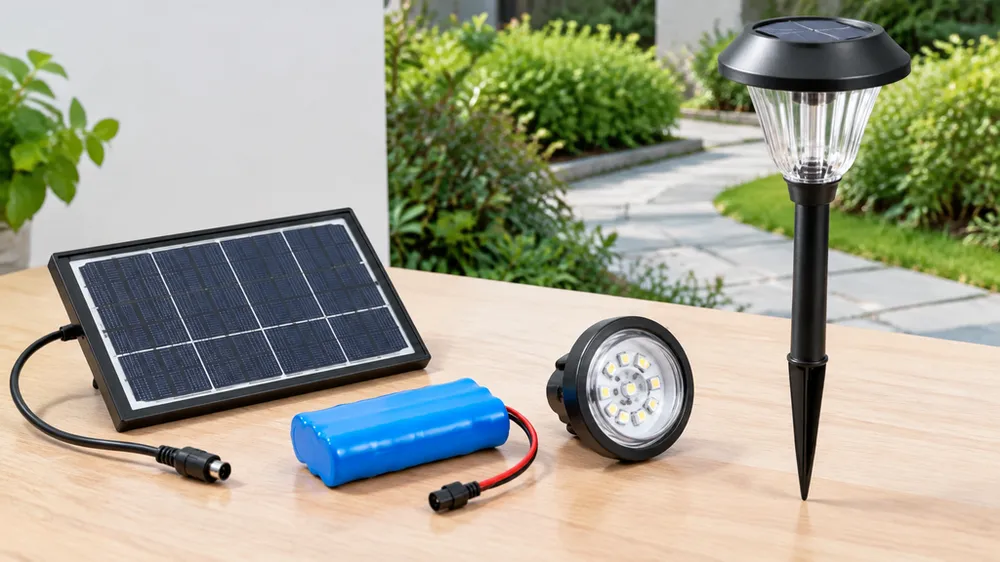
Higher lumen output requires more energy, which means either a larger solar panel (to harvest more charge during the day) or a larger battery (to store enough energy for the target runtime). Both drive up BOM cost and increase fixture size. Understanding the energy budget constraint helps you spec realistic lumen targets and avoid quoting fixtures that can't physically deliver the performance your buyer expects.
Practical constraint example: a 6V 2W solar panel paired with a 3.7V 2000mAh battery can sustain roughly 50–70 lumens for 6–8 hours in summer with long daylight exposure. In winter, when charge windows are shorter and solar irradiance is lower, the same configuration drops to 40–50 lumens to maintain the same runtime. If you want 100+ lumen output for pathway applications, panel area needs to roughly double and battery capacity needs to increase 50–80%, raising FOB cost 30–40% compared to the 50-lumen baseline.
For cost-sensitive buyers, the tradeoff choices are: reduce runtime spec (accept 4–6 hours instead of 8–10 hours), reduce lumen output to match the available energy budget, or increase FOB cost to accommodate a larger panel and battery. There's no free option that delivers higher brightness without touching the energy supply chain.
JXSOL approach: when you provide a lumen spec and a runtime requirement in your RFQ, we calculate the panel wattage and battery capacity needed to deliver that performance, then confirm whether your cost target is achievable or needs adjustment before we build a sample. That avoids the cycle where you approve a sample based on short-term testing, place a large order, then discover in field deployment that the fixture doesn't maintain brightness through a full winter evening because the battery undersized.
Battery matching matters here too. We test charge/discharge performance on battery batches before assembly to confirm capacity rating, because a battery that claims 2000mAh but only delivers 1700mAh in real load conditions will kill your lumen output halfway through the runtime window. Buyers sourcing from suppliers who skip battery QC often see "brightness drops after three hours" complaints in field returns — that's usually battery capacity variance, not LED failure.
Lumen Measurement Standards and What Spec Sheets Do Not Tell You
Lumen ratings use integrating sphere measurement per LM-79 standard, but most spec sheets omit critical details that affect real-world performance comparison. Measurement temperature matters: lumens drop 10–15% at 40°C ambient versus the 25°C lab condition used for rated specs. If you're deploying fixtures in the Middle East or Southeast Asia where summer ground temperatures hit 45°C, expect output below the rated spec.
Beam angle is the other spec sheet gap. A 100-lumen spotlight with a 15° beam angle looks much brighter than a 100-lumen floodlight with a 60° beam angle, even though total lumen output is identical. The spotlight concentrates light into a narrow area, creating higher perceived brightness. The floodlight spreads the same lumen total across a wider area, resulting in lower illuminance at any given point. For feature lighting, narrow beam angles (15–30°) give you punch. For pathway lighting, wider beam angles (60–90°) give you coverage.
Initial versus stabilized output: LED modules run hotter in the first 30 seconds after power-on, and lumen output is higher before thermal equilibrium. Some spec sheets quote initial output (the higher number), but real-world performance is stabilized output after the module reaches operating temperature. The difference is typically 5–10%, but it compounds with other spec optimism to create a gap between data sheet claims and field performance.
For B2B buyers comparing suppliers, request lumen test reports with measurement conditions documented — temperature, beam angle, stabilization time. If two suppliers both claim 50 lumens but one measured at 25°C initial output with a narrow beam and the other measured at 40°C stabilized output with a wide beam, you're not comparing equivalent products. At JXSOL, we verify lumen output at assembly on 10% of modules per batch, tested at 25°C ambient with 30-minute stabilization. That data goes into the QC report, so you know what measurement conditions produced the lumen value we're shipping.
Factory Lumen Binning and Verification Process at JXSOL
JXSOL lumen control process has three checkpoints: LED binning before module assembly, integrating sphere test on 10% of assembled units per production batch, and QC report documentation that ships with the order. That three-layer approach is how we maintain ±5% batch consistency on orders spanning multiple production runs.
LED binning happens at incoming component inspection. We test LED batches from our suppliers and group them into lumen output ranges before releasing them to the assembly line. A 50-lumen fixture design uses LEDs from the 48–52 lumen bin. When you reorder six months later, we pull from the same bin specification, so your new batch matches the installed base. Without binning, natural LED variance means batch one could land at 54 lumens and batch two at 46 lumens — both within the LED manufacturer's published tolerance, but visibly different in a side-by-side installation.
Assembly-stage verification uses an integrating sphere and spectroradiometer to confirm lumen output and color temperature on 10% of completed modules per production run. That's not just a rated-spec check — it's a measurement of the actual assembled product with the driver, LED, and optics integrated. If a batch tests outside the target bin, we investigate whether it's an LED variance issue, a driver current drift, or an assembly error, then correct before the batch ships.
QC report documentation: every order includes a test report showing lumen output, color temperature, and beam angle measurements from the batch sampling. For buyers visiting the factory, you can witness QC testing on your production batch before shipment — we run the integrating sphere test in the on-site lab, and you see the readout in real time.
Why this matters for large orders: a 1,000-unit pathway lighting order without binning can show 15–20% lumen variance between the first and last production lots. Install those fixtures in sequence along a pathway and the brightness inconsistency is obvious. Binning and assembly-stage verification eliminate that visual mismatch, so your 1,000-unit order looks uniform when deployed.
For OEM buyers requiring tighter tolerance than our ±5% standard, we offer ±3% lumen binning at MOQ 1,000+ units. That adds 5–7 days to production lead time and roughly 8–10% to unit cost, because we're selecting from a narrower bin range and rejecting more LEDs during incoming inspection. Most buyers find ±5% sufficient for commercial projects, but if you're building a premium branded line where lumen consistency is a key selling point, ±3% binning gives you that edge.
13+ years of solar lighting production means we have documented lumen stability data across thousands of batches, not just lab-only testing. We track field return patterns and correlate them with production batch data, so we know which LED suppliers deliver consistent long-term performance and which ones show early degradation. That's the data depth you get from a factory that's been running the same product category for over a decade, versus a supplier who just started sourcing solar lights two years ago.
Cost and Lead Time Implications of Lumen Specification Changes
Lumen changes within ±20% of standard module output: no retooling required, 7–10 day sampling timeline, standard MOQ applies (100–500 units depending on model). Example: if the baseline pathway light is 50 lumens and you need 60 lumens for a premium tier, we adjust LED quantity or drive current, assemble a sample within a week, and move to production once you approve.
Lumen changes requiring panel or battery upsizing: 3–4 week lead time for component sourcing, MOQ increases to 500–1,000 units, FOB cost rises proportional to BOM increase. Example: pushing a 50-lumen design to 100 lumens requires a larger solar panel and higher-capacity battery. Panel cost scales with wattage, battery cost scales with capacity, and assembly time increases slightly due to larger component handling. Expect 35–50% FOB cost increase for a 100% lumen increase, because the energy supply components (panel and battery) represent 40–45% of total BOM cost in solar lighting.
Cost sensitivity breakdown: each 10-lumen increase in a 50-lumen baseline raises FOB cost approximately 6–8% due to LED quantity, driver adjustment, or battery capacity changes. The percentage scales non-linearly — small lumen increases (10–15%) are cheap because you're staying within the existing energy budget, but large lumen increases (50%+) require panel and battery changes that hit the BOM hard.
For buyers balancing margin and performance, discuss lumen target and cost ceiling together in your RFQ. If you tell us "I need 65 lumens and my cost ceiling is $13 FOB," we calculate whether that's achievable with LED and driver adjustments, or whether we need to compromise on runtime (shorter evening duration) to stay within budget. That's better than approving a sample at $15 FOB and discovering later that your retail margin doesn't support the final cost.
Rush lumen customization: if you need sample turnaround within 5 days instead of the standard 7–10 days, we can prioritize your order at MOQ 500+ units and 15% cost premium over standard lead time. That expedite option works for buyers who need to hit a trade show deadline or respond to an urgent project RFQ, but it only applies to lumen adjustments within the ±30% module design range — full panel/battery redesigns can't be rushed without risking QC shortcuts.
How to Specify Solar Garden Light Lumens in Your RFQ
Minimum RFQ lumen specification should include: target lumen output, application type (pathway/border/feature), acceptable lumen tolerance (±5% is standard, ±3% available at higher MOQ), and runtime requirement (6 hours, 8 hours, 10 hours — affects battery sizing). That four-point spec gives us enough information to propose a module configuration and quote FOB cost.
Optional but useful additions: beam angle preference (narrow spot for feature lighting, wide flood for pathway coverage), depreciation tolerance (if your project spans 3+ years and you need performance guarantees), and cost ceiling per unit. The cost ceiling helps us avoid designing a solution that meets your performance spec but exceeds your margin structure.
Example RFQ that gives us what we need: "50-lumen pathway light, ±5% batch tolerance, 8-hour runtime, 60° beam angle, target FOB $12–13. MOQ 500 units for first order, expect reorders every 3–4 months." That tells us the application, performance requirements, cost constraint, and volume pattern, so we can configure the right module and confirm feasibility before sampling.
JXSOL response to that RFQ includes: confirmed lumen output with test method (integrating sphere, 25°C, 30-minute stabilization), panel wattage and battery capacity, estimated depreciation curve (year 1, year 2, year 3 output), FOB cost breakdown, MOQ, and sampling lead time. If your cost target isn't achievable at the lumen spec you requested, we explain the gap and offer alternatives — either reduce lumens to hit cost, or accept higher cost to maintain lumens.
For OEM buyers building branded product lines, include brand positioning context in your RFQ: "building a mid-tier line for landscape contractors, need performance above big-box retail but cost below premium specialty brands." That context helps us recommend lumen and cost combinations that fit your market segment. A budget-tier buyer optimizing for landed cost gets different recommendations than a premium-tier buyer emphasizing consistency and longevity.
Avoid open-ended "brightest possible" requests without cost or size constraints. Lumen maximization without boundaries leads to overbuilt designs with oversized panels and batteries that hurt your margin and make the fixture too large for typical residential installations. Specify your performance floor (minimum acceptable lumens) and cost ceiling (maximum FOB you can absorb), then let us engineer within those boundaries. That's how you get a solution optimized for commercial viability, not just technical performance.