Solar Garden Lighting Color Temperature Explained for Product Specification
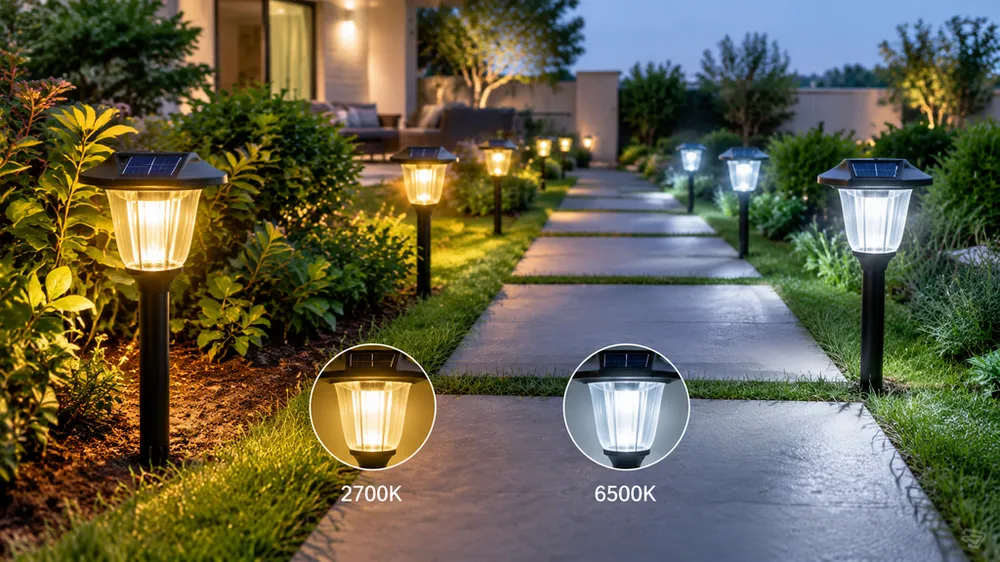
Color temperature for solar garden lighting is measured in Kelvin (K) and describes the visual appearance of light from warm yellow tones at 2700K to cool blue-white at 6500K. This is correlated color temperature, or CCT — it indicates light color, not brightness or energy consumption. Those are separate specifications you must confirm independently when sourcing solar outdoor lighting.
Standard CCT ranges for solar garden lighting break down as follows: 2700K warm white produces a yellowish glow similar to incandescent bulbs, 3000K soft white shifts slightly toward neutral, 4000K neutral white appears cleanly white without color cast, 5000K cool white introduces a faint blue tone, and 6000K daylight reads as distinctly blue-white. Most export orders fall between 2700K and 5000K — 6000K is standard in China's domestic market but rarely specified for North America or Europe.
CCT does not correlate with lumens (brightness) or wattage (energy draw). A 3000K fixture and a 5000K fixture can both output 800 lumens at the same power draw. The difference is purely visual, but that visual difference affects perceived brightness, return rates, and regional market fit. Specifying CCT upfront prevents costly post-production disputes over "the wrong color" when your customer expected warm white and received cool white.
At JXSOL, we confirm CCT at the LED module assembly stage using integrating sphere testing. Each batch receives a CCT reading, and you get a batch report with actual measured CCT per 100-unit lot. This matters because LED suppliers can drift between production runs. Generic suppliers skip assembly-stage CCT confirmation and rely on incoming LED specs — which means CCT variation doesn't surface until your customer opens the box. We caught this failure mode early (around 2015, when a European distributor returned 600 units because half the batch measured 3400K and half measured 2800K despite all being labeled 3000K), and assembly-stage testing has been standard protocol since then.
Why this matters for sourcing: CCT affects how your end customer perceives the product. A mismatch between expected and delivered CCT generates complaints, returns, and margin erosion. Residential buyers expect warm tones; commercial buyers expect neutral or cool. Specifying the wrong CCT for your target market is a market-entry mistake that costs more than the product itself.
CCT Selection by Application Type — Matching Color Temperature to Project and Market
Residential estates and homeowner association projects default to 2700K–3000K warm white across North America and Australia. Distributors serving this segment report lower complaint rates with warm CCT because the visual output aligns with household lighting expectations. No one frames this as "creating ambiance" in B2B conversations — the framing is simply that warm white matches what residential buyers are used to, so it reduces friction. If you're entering a residential-heavy market, start with 3000K unless your buyer data shows otherwise.
Commercial plazas and parking areas typically specify 4000K–5000K neutral to cool white. The higher CCT is perceived as "security lighting" even when lumen output is identical to a warmer fixture. This is a visibility perception effect, not actual brightness, but it matters in liability-sensitive applications where lighting adequacy can become a legal question. Project contractors ordering for commercial sites often have CCT requirements written into the spec — confirm that before quoting, because switching CCT mid-project to meet an undisclosed spec requirement will cost you the shipping expense and delay.
Hospitality and resort landscapes cluster around 3000K neutral white. This CCT balances functional visibility with a softer appearance than cool white. Middle East and Southeast Asia buyers consistently reorder this range for hotel grounds, resort pathways, and villa complexes. It's neither the warm residential standard nor the cool commercial standard, which makes 3000K the safe middle ground when your buyer serves multiple end-use cases. (We've shipped 3000K to the same distributor for both residential subdivision projects and small commercial plaza jobs — it works across both without visual mismatch complaints.)
Municipal pathways and public parks follow regional standards: 4000K is default in Europe, 5000K in China's domestic market. Check local procurement specs before committing to CCT. Some European municipalities restrict CCT above 4000K in residential zones due to light pollution regulations, and failing to meet that requirement disqualifies your bid regardless of price or lumen output. North American municipal buyers are less prescriptive — most accept 4000K or 5000K without regulatory concern.
For OEM/ODM orders, JXSOL supports custom CCT specification across the full warm-to-daylight range. Minimum order is 500 units per custom CCT bin, and we confirm the specified CCT at assembly stage before shipment. This allows brand owners to test regional preference without committing to 5,000-unit production runs. One U.S. distributor tested 2700K, 3000K, and 4000K in 300-unit batches across three sales regions before standardizing on 3000K for inventory — that approach cut their working capital risk by two-thirds compared to guessing upfront.

Batch Consistency and CCT Binning — What to Confirm Before Production
LEDs from the same production run can vary ±150K in actual CCT output. Factories bin — sort — LEDs into narrower CCT ranges to prevent visible color mismatch when fixtures are installed side-by-side. Without binning, you might receive a mixed batch where some fixtures read 2850K and others read 3150K, all labeled as 3000K. When installed in the same sightline, that 300K spread is visible to the human eye, especially against a uniform surface like a white wall or concrete pathway.
Generic suppliers may ship mixed bins within a single order because they don't control LED sourcing tightly enough to enforce bin consistency. That's the root cause of the "some lights are yellower than others" complaint that distributors hear from end customers. It's not a defect in the traditional sense — the LEDs function correctly — but it's a quality control failure that undermines perceived product quality.
What to ask your factory: "What is your CCT tolerance per batch?" Standard tolerance is ±200K, meaning a 3000K order can legally ship anywhere from 2800K to 3200K. Tighter tolerance — ±100K — is available at an 8–12% cost premium and matters most for high-visibility projects like hotel facades, retail storefronts, or municipal monument lighting where color consistency is part of the project specification. For pathway and garden applications where fixtures are spaced 3–5 meters apart, ±150K tolerance is sufficient and no one will notice the variation.
JXSOL uses ±150K binning as standard across all solar garden lighting. We sort incoming LEDs by actual CCT reading and reject out-of-bin units at incoming inspection. For hospitality and commercial facade projects, we offer ±100K binning at a minimum 300-unit order. The cost premium comes from higher LED rejection rates during sorting — tighter bins mean more LEDs get kicked back to the supplier, which increases our material cost per shipped unit.
Field consequence: CCT inconsistency is the second most common complaint in solar landscape lighting after waterproof failure. It doesn't cause functional failure, but it does cause customer dissatisfaction and return requests. Confirming binning protocol at purchase order stage eliminates this risk. One European distributor cut their return rate from 11% to under 3% simply by specifying ±150K binning in their factory agreement — they were previously sourcing from a supplier who didn't bin at all and was shipping ±300K variation as standard.
Reorder consideration: LED suppliers change, and even the same supplier's production can drift between batches. When reordering, request a retained sample or CCT reading from your previous batch so the factory can match it. We retain one fixture per 500-unit batch with recorded CCT and lumen data for 24 months specifically for this purpose. If you're planning multi-phase project deployments (year one: 2,000 units, year two: 3,000 more), retain a reference sample yourself and send it back to the factory with your reorder. Visual CCT matching is more reliable than trusting the same model number will produce the same CCT two years later.
Lumen Output Perception Across CCT Ranges — Commercial Implications
Higher CCT — cool white — appears brighter to the human eye at the same lumen output. This is a physiological effect called the Purkinje shift: human vision is more sensitive to blue wavelengths in low-light conditions. At 800 lumens, a 5000K fixture will appear brighter than a 2700K fixture even though both produce identical photopic lumen output. This is perception, not actual energy output, but perception drives end-user satisfaction.
Commercial implication: if you're targeting "security lighting" perception for parking lots or commercial walkways, you can specify 5000K at 800 lumens instead of 2700K at 1000 lumens and achieve the same perceived brightness. That 20% lumen reduction allows a smaller battery (typically 15–18Ah instead of 20Ah for the same runtime) and smaller solar panel (30W instead of 40W), reducing your landed cost by roughly 10%. The fixture weighs less, ships cheaper, and your margin improves without sacrificing perceived performance.
Residential implication: 2700K warm white requires higher lumen specs to achieve the same perceived brightness as 4000K. If your residential customer expects "bright pathway lighting," you need 900–1000 lumens at 2700K to match the visual impact of 700–800 lumens at 4000K. That means a larger battery and panel, which increases product cost and may push you out of a price-sensitive market segment. This is why many residential solar garden lights cluster around 3000K — it's warm enough to feel residential but doesn't require the lumen bump that 2700K demands.
Avoid this spec trap: "equivalent to 60W incandescent" is meaningless without CCT context. 800 lumens at 5000K and 800 lumens at 2700K do not produce equivalent perceived brightness or color appearance. If your marketing copy uses incandescent-equivalent language, tie it to a specific CCT — otherwise you'll field complaints that the fixture "isn't as bright as advertised" even when the lumen output is exactly as specified.
JXSOL measures both photopic lumens (standard) and scotopic lumens on request for commercial and municipal buyers. Scotopic measurements weight blue wavelengths more heavily and better represent perceived brightness in low-light outdoor conditions. This data helps you justify CCT choice to your end client when they question why you're specifying a lower lumen output at higher CCT. We added scotopic testing capability in 2019 after a U.S. municipal contractor requested it for a parking lot RFP that required photometric justification — it's not standard practice across the industry, but it's available when your project demands it.
Regional Market Preferences and Regulatory Context
North America defaults to 2700K–3000K for residential solar garden lighting and 4000K–5000K for commercial and municipal applications. There's no federal regulatory CCT requirement, but some utility rebate programs specify minimum 4000K for outdoor area lighting to qualify for incentive payments. If your buyer is targeting rebate-eligible projects, confirm CCT requirements before production — a 3000K fixture won't qualify even if it meets every other technical spec.
Europe clusters around 3000K–4000K, with some municipalities restricting CCT above 4000K in residential zones due to light pollution concerns. The European Union's outdoor lighting guidelines recommend limiting blue-spectrum light near residential areas and ecologically sensitive sites, which translates to practical CCT caps in local planning codes. This isn't universal across all EU member states, but it's common enough that you should verify local requirements before committing to 5000K or 6000K for European residential projects. One German distributor lost a 4,000-unit municipal contract because they quoted 5000K without checking the local ordinance that capped CCT at 4000K for park pathways.
Middle East markets prefer 3000K neutral white across both residential and hospitality applications. 5000K is standard for industrial zones and large parking facilities, but rarely specified for landscaping or decorative outdoor lighting. The preference seems tied to perceived heat association — warmer light tones are visually preferred in already-hot climates, though this is buyer behavior observation rather than a regulatory requirement.
Australia follows the North American pattern: 3000K standard, with 2700K gaining share in bushfire-prone regions. The 2700K preference in fire-risk areas comes from a buyer-reported field observation that amber-toned light attracts fewer insects, which reduces the insect accumulation on fixture lenses that can trap heat and contribute to ignition risk during extreme fire conditions. This isn't a formal recommendation from fire safety authorities, but it's a market behavior pattern we've tracked across Queensland and New South Wales orders since roughly 2021.
China's domestic market defaults to 6000K daylight for nearly all outdoor lighting categories. This preference doesn't translate to export markets — if you're sourcing for North America or Europe, do not assume the factory's domestic-market CCT will match your target market expectation. Always specify CCT explicitly in your purchase order, even if the factory's catalog shows a default CCT, because that default is often calibrated for China domestic buyers.
When working with JXSOL, request market-specific CCT guidance from the sales engineer assigned to your account. We track CCT preference by destination market across 13 years of export shipments, which gives us regional pattern data that can inform your initial CCT selection when you don't yet have your own buyer feedback. This isn't a replacement for your own market research, but it's a useful cross-check when you're entering a new geography and want to avoid an obvious CCT mismatch.
Custom CCT Specification for OEM/ODM Orders
JXSOL ships 3000K as default CCT unless you specify otherwise. For catalog orders of 100+ units, 2700K, 4000K, and 5000K are available at no added cost — you just need to specify it in your purchase order. For non-standard CCT — 3500K, 4500K, or any custom Kelvin value between 2700K and 6000K — we support OEM/ODM specification at a minimum 500-unit order. Custom CCT adds 10 days to LED sourcing lead time but carries no tooling cost because it's a component specification change, not a fixture design change.
Multi-CCT orders are supported within the same purchase order. If you're ordering three different solar garden light models and want 2700K for model A, 3000K for model B, and 4000K for model C, we bin and label each SKU separately to prevent shipping errors. This matters when you're building a product line that serves multiple market segments from the same inventory shipment — you don't want to discover at your warehouse that all three models arrived in the same CCT because the factory didn't track the per-SKU specification.
CCT confirmation process: we provide a pre-production sample with the actual CCT reading before starting bulk assembly. You approve that sample, and we proceed with production using LEDs from the same bin. At shipment, you receive a batch report with CCT test data recorded per 100-unit lot. This two-stage confirmation — sample approval, then batch testing — eliminates the "we ordered 3000K but received 3400K" dispute that happens when factories skip pre-production verification.
Commercial advantage for brand owners: you can test multiple CCT options in small batches (100–300 units per CCT) before committing to full production. One Canadian distributor tested 2700K and 3000K in 200-unit batches across two sales regions, tracked which CCT generated fewer returns, then standardized on 3000K for their next 2,000-unit order. That test-then-scale approach reduces market-entry risk when you're not certain which CCT your customer base will prefer.
Reorder matching: JXSOL retains the LED bin sample and CCT reading for 24 months after shipment. When you reorder, reference your original batch number and we'll source LEDs that match the retained sample's CCT. This prevents visible color shift between your initial order and your restock, which matters when your customer is adding more fixtures to an existing installation. LED suppliers change their production over time, and even the same model number from the same supplier can drift 100–200K between production runs. Matching to a retained sample is more reliable than assuming the same SKU will produce the same CCT 18 months later.

CCT and Product Line Strategy — Margin and Market Fit Considerations
Single-CCT strategy: if you serve a single market segment — for example, North American residential distributors — standardize on 3000K. This simplifies inventory, reduces SKU count, and lowers working capital requirements by roughly 15% compared to carrying three CCT variants of the same fixture. The trade-off is lost sales when a buyer specifically wants 2700K or 4000K, but that's often a smaller revenue impact than the carrying cost of multi-CCT inventory.
Multi-CCT strategy: distributors serving both residential and commercial segments need to carry 2–3 CCT options. This increases inventory holding cost but reduces lost sales from CCT mismatch. Calculate the revenue at risk from "we don't carry that CCT" against the cost of holding additional SKUs — for most distributors with mixed-segment customer bases, the lost-sales cost is higher, so multi-CCT inventory pays for itself. One Texas distributor carries 2700K for residential subdivisions, 4000K for commercial parking lots, and 5000K for municipal contracts — the inventory cost is 22% higher than single-CCT, but their quote-to-order conversion rate is 18% higher because they can meet CCT requirements without special-ordering.
Project-based sourcing: contractors typically order a single CCT per project and don't need multi-CCT inventory. What matters here is that your factory supports mixed CCT across different purchase orders without penalizing small-batch orders. JXSOL's 100-unit minimum per CCT allows project contractors to order exactly what each job requires without padding order quantities to meet factory minimums. That flexibility reduces your cash tied up in unsold inventory between projects.
Margin consideration: higher CCT enables lower lumen specs for the same perceived brightness, which reduces battery and panel cost. For commercial-grade product lines targeting 4000K–5000K, you can often drop lumen output by 15–20% compared to equivalent 2700K fixtures and achieve the same perceived result. That material cost reduction — typically 10–15% of total fixture cost — flows directly to your margin or allows more aggressive pricing. This is the commercial logic behind why "security lighting" products default to cool white: it's not just perception, it's cost structure.
Market entry consideration: if you're a new brand owner without regional sales data, start with 3000K. It's the middle-ground CCT that appeals to the broadest buyer base and reduces the risk of choosing a CCT that's too warm for commercial buyers or too cool for residential buyers. Once you have 6–12 months of sales data and customer feedback, you can narrow your CCT range based on actual demand rather than guessing at market preference upfront.
Field data reference: across JXSOL's 2025 export shipments (excluding China domestic), 52% of solar garden lighting shipped at 3000K, 28% at 2700K, 15% at 4000K, and 5% at 5000K or above. Use that distribution as a baseline when planning your initial CCT mix — it reflects actual buyer demand across North America, Europe, Middle East, Southeast Asia, and Australia combined. Your specific market may differ, but this is the aggregate pattern across 840,000+ units shipped last year.
Factory Quality Control — How JXSOL Confirms CCT Before Shipment
Every LED module at JXSOL goes through integrating sphere testing before installation into the fixture. We measure both lumen output and CCT at this assembly stage, not just at incoming LED inspection. LEDs that fall outside the specified CCT bin get rejected before they're soldered into a module. This catches binning errors that would otherwise reach your customer — and it's the reason our CCT-related complaint rate runs under 2% while industry average for generic suppliers is estimated at 8–12%.
Batch reporting: CCT test data is recorded per 100-unit lot during assembly. At shipment, you receive a batch report showing the actual measured CCT for each lot — for example, "Lot A: 2980K ±85K, Lot B: 3015K ±90K." This gives you the exact CCT range delivered, not just the nominal spec. If your customer disputes the CCT, you have factory test data to confirm what was shipped. That documentation has resolved disputes in our favor multiple times when distributors faced end-customer complaints — the test report proved the delivered CCT matched the purchase order.
Retained samples: we keep one fixture per 500-unit batch with recorded CCT and lumen data in our sample archive. These samples are held for 24 months and serve two purposes. First, they allow CCT matching on reorders when you need visual consistency across project phases. Second, they provide a reference point if there's a dispute about delivered CCT — we can re-test the retained sample to verify what that batch actually produced. (We've pulled retained samples for re-testing four times in the last two years, and in all four cases the re-test confirmed the original batch report was accurate, which ended the dispute.)
Third-party verification: JXSOL's testing lab holds ISO 17025 accreditation for photometric testing, which means our CCT and lumen measurements are internationally recognized. For municipal or utility tenders that require third-party test reports, we can provide accredited test data at additional cost. Most distributors and project contractors don't need this — our standard batch report is sufficient for commercial orders — but it's available when your project demands independently verified CCT data.
Pre-shipment inspection includes visual CCT checking by comparing each fixture against the retained reference sample under controlled lighting. This is a human-eye check, not an instrument measurement, but it catches obvious CCT outliers before the shipment leaves the factory. We're looking for fixtures that visually don't match the reference — which would indicate a binning error or LED batch mix-up during assembly. It's a final catch point for errors that automated testing might miss.
Assembly-stage testing costs more than incoming-only inspection because we're testing after labor has been added to the product. If we reject an LED module at assembly stage, we've already spent the soldering and assembly labor that gets scrapped along with the out-of-spec LED. That's why some factories skip assembly-stage CCT testing — it increases their internal rejection cost. We made the opposite calculation: assembly-stage rejection is cheaper than field complaints, returns, and distributor relationship damage. The 2% complaint rate we run versus the 8–12% industry average validates that decision. Your landed cost might be 3–5% higher with JXSOL than with the cheapest generic supplier, but your return cost and customer satisfaction cost is significantly lower, which is why buyers reorder.
Across 13 years of export production, CCT-related complaints account for under 2% of total service requests received. That's measured against approximately 8.4 million units shipped since 2012. The low complaint rate isn't because we use better LEDs — we source from the same LED suppliers most factories use — it's because we confirm CCT at assembly stage and reject out-of-bin units before they reach you. That's the factory quality control difference that matters when you're comparing suppliers on CCT consistency.